
Submitted:
28 December 2025
Posted:
30 December 2025
Read the latest preprint version here
Abstract
Background Long-term exposure to ambient ozone pollution is associated with increased respiratory morbidity and mortality, particularly from chronic obstructive pulmonary disease (COPD). We explored spatial and temporal trends in mortality and burden of disease attributable to ambient ozone pollution f rom 1990 to 2023 at global, regional, and national levels. Methods We used Global Burden of Disease 2023 estimates to assess ozone-attributable COPD mortality. Population-weighted warm-season 8-hour ozone concentrations were estimated using a high-resolution data fusion model combining monitoring, satellite, chemical transport, and land-use data. Relative risks were based on a log-linear exposure–response function from cohort studies, and attributable COPD deaths and DALYs were analysed for 1990–2023 at global, regional, and national levels. Findings Ambient ozone was a notable contributor to COPD mortality in 2023. Exposure to ozone caused approximately 480 000 (95% uncertainty interval [UI] reflecting cohort-based uncertainty) deaths and millions of disability-adjusted life-years (DALYs) from COPD in 2023, with the highest age-standardised rates in South Asian countries (peaking at 17·1 per 100 000 in Nepal). Deaths attributable to ambient ozone increased over the period from 1990 to 2023 in many low- and middle-income countries, driven by population growth and ageing, whereas substantial declines occurred in most high-income regions due to effective precursor controls.Interpretation Ambient ozone pollution contributed persistently to the global burden of COPD mortality in 2023, with absolute numbers of attributable deaths rising over the past 33 years due to demographic transitions in low- and middle-income countries offsetting modest exposure reductions in some regions. The log-linear exposure-response function indicates that meaningful reductions in burden require sustained declines in seasonal ozone concentrations. International experience shows that aggressive air quality management targeting major precursor sources can lower population exposure and associated COPD burden.
Keywords:
COPD mortality
; air pollution
; environmental epidemiology
; public health
; attributable burden
Introduction
Long-term exposure to ambient ozone pollution is associated with increased respiratory morbidity and mortality, particularly from chronic obstructive pulmonary disease (COPD) (Jerrett et al., 2009; Turner et al., 2016; Zhang et al., 2019). The Global Burden of Diseases, Injuries, and Risk Factors Study (GBD) has consistently identified ambient air pollution as a leading environmental risk factor for global disease burden, with disproportionate impacts in low- and middle-income countries (Cromar et al., 2022; GBD 2019 Risk Factors Collaborators, 2020; GBD 2021 Risk Factors Collaborators, 2024). Although ambient particulate matter pollution (PM2.5) dominates overall air pollution-attributable deaths, ozone contributes substantially to COPD mortality—the only outcome with established causality in current GBD assessments (Cohen et al., 2017; GBD 2019 Diseases and Injuries Collaborators, 2020). Recent independent high-resolution global modeling incorporating all-cause mortality has estimated considerably higher ozone-attributable deaths (Wang et al., 2025). In view of evolving exposure-response evidence, improved global ozone monitoring, and ongoing demographic shifts, we analysed spatial and temporal trends in COPD mortality and burden attributable to ambient ozone pollution from 1990 to 2023 at global, regional, and national levels using data from GBD 2023.
Methods
Data Source and GBD 2023 Estimation Process
The Global Burden of Disease Study 2023 (GBD 2023) provides pre-computed estimates of deaths and disability-adjusted life-years (DALYs) attributable to ambient ozone pollution for COPD—the only outcome with established causality for long-term ozone exposure. In GBD 2023, population-weighted warm-season daily maximum 8-hour ozone concentrations were estimated at high spatial resolution using a data fusion model that integrated ground-level monitoring, satellite retrievals, chemical transport model outputs, land-use information, and other predictors (GBD 2021 Risk Factors Collaborators, 2024). Relative risks for COPD mortality were derived from a log-linear exposure-response function based on large prospective cohort studies, with a theoretical minimum-risk exposure level (TMREL) uniformly distributed between 29·1 and 35·7 parts per billion. The population-attributable fraction (PAF) was calculated by combining exposure and relative risk estimates, and attributable COPD deaths and DALYs were obtained by applying the PAF to baseline COPD outcomes. A detailed description of the GBD comparative risk assessment framework is provided elsewhere.
Present Analysis
We downloaded publicly available GBD 2023 results for ozone-attributable COPD deaths and DALYs (including number of deaths, age-standardised rates, and 95% uncertainty intervals) for the years 1990 and 2023 at global, regional, and national levels. Using these pre-computed estimates, we calculated percentage changes in the absolute number of attributable deaths between 1990 and 2023, examined spatial patterns of age-standardised death rates in 2023, and identified countries with the highest burdens. All figures (exposure-response curve, world maps, and tables) were generated from the downloaded GBD data using Python (matplotlib, geopandas, pandas, and numpy)(Harris et al., 2020; Hunter, n.d.; Jordahl et al., 2020; McKinney, 2010).
Research in Context
Evidence Before This Study
Systematic reviews by the US Environmental Protection Agency (Brown et al., 2011) and the World Health Organization (WHO, 2021) have established that long-term exposure to ambient ozone pollution is associated with increased respiratory morbidity and mortality, particularly from COPD. Cohort studies and meta-analyses have confirmed positive associations between long-term ozone exposure and COPD mortality, with relative risks around 1.05–1.09 per 10 ppb increase (Hu & Yang, 2024; Huangfu & Atkinson, 2020; Lim et al., 2019). The Global Burden of Disease (GBD) Study has included ozone as a risk factor for COPD since earlier cycles, estimating hundreds of thousands of attributable deaths annually, with updates reflecting refined exposure-response functions, improved ozone monitoring, and monitoring data (Cohen et al., 2017; GBD 2021 Risk Factors Collaborators, 2024). Independent global assessments applying updated relative risk estimates from the American Cancer Society CPS-II cohort to broader respiratory mortality (rather than COPD alone) have reported higher attributable burdens, on the order of 1.04–1.23 million deaths in 2010 (Malley et al., 2017).
Added Value of This Study
This study provides the most recent estimates of the global burden of COPD attributable to ambient ozone pollution using data from the Global Burden of Disease Study 2023. We show substantially higher age-standardised mortality rates in 2023 (peaking at 17·1 per 100 000 in Nepal) compared with earlier GBD cycles (peaks around 2–3 per 100 000 in 2015), reflecting refinements in exposure-response functions, improved ozone monitoring, and updated baseline COPD mortality data (Cohen et al., 2017; GBD 2019 Risk Factors Collaborators, 2020). Over the 33-year period from 1990 to 2023, ozone-attributable COPD deaths declined substantially (>50%) in most high-income regions (Europe, North America, Japan) due to effective control of ozone precursors, whereas increases exceeding 100% (and in some cases >200%) occurred in many low- and middle-income countries, driven primarily by population growth and ageing. These demographic factors offset stable or modestly reduced ozone exposure in populous regions such as South Asia and parts of the Middle East and sub-Saharan Africa.
By placing ozone-attributable COPD burden within the context of long-term trends, this analysis elucidates the challenges in reducing its public health impact: successes in precursor emission controls in high-income settings contrast with rising absolute burdens in developing regions due to demographic transitions. These findings highlight the need for integrated strategies that combine sustained ozone precursor reductions with policies addressing population vulnerability to achieve future declines in attributable mortality.
Implications of All the Available Evidence
Ambient ozone pollution contributes persistently to the global burden of COPD mortality, with attributable deaths in the hundreds of thousands annually (Cohen et al., 2017; GBD 2021 Risk Factors Collaborators, 2024). From 1990 to 2023, trends in attributable deaths reflect demographic (population growth and ageing) and exposure changes, with substantial declines in high-income countries offset by increases in low- and middle-income regions.
Should current trends continue without accelerated precursor controls, absolute burdens will rise further in populous developing countries. The log-linear exposure–response function indicates that meaningful reductions require sustained declines in seasonal ozone concentrations. International experience shows that national and subnational policies targeting ozone precursors can lower population exposure and associated COPD burden. Aggressive air quality management focused on major sources, combined with demographic considerations, is essential to reduce future impacts.
Results
Exposure–Response Function for Ambient Ozone
Figure 1 illustrates the exposure–response function used in GBD 2023 for long-term ambient ozone exposure and COPD mortality. The relationship is log-linear, with relative risk fixed at 1 below the theoretical minimum-risk exposure level (TMREL; uniform distribution 29·1–35·7 ppb) and increasing above this threshold. The central estimate of the relative risk is approximately 1·06 (95% uncertainty interval 1·03–1·10) per 10 ppb increase in seasonal daily maximum 8-hour ozone concentration.
Ozone-Attributable COPD Mortality Rates in 2023
Figure 2 shows age-standardised death rates (per 100 000 population) attributable to ambient ozone pollution from COPD in 2023. Globally, ambient ozone was estimated to cause approximately 480 000 COPD deaths in 2023. Rates were generally low globally (<5 per 100 000 in most countries), with the lowest rates predominating in sub-Saharan Africa, Latin America, and parts of Southeast Asia and Oceania. Moderate rates (5–9 per 100 000) were observed in northern Europe, North America, Australia, New Zealand, the Mediterranean region, and selected Pacific islands.
The highest rates (≥12 per 100 000) were concentrated in South Asia: Nepal (17·1), India (16·2), Bangladesh (16·0), and Bhutan (13·3). An elevated rate of 10·2 per 100 000 occurred in the Democratic People’s Republic of Korea. Rates of 5–9 per 100 000 were seen in China (6·6), Italy (7·3), Pakistan (7·4), Türkiye (5·0), Cyprus (5·6), and other Mediterranean and European countries.
This pattern reflects the combined influence of seasonal ozone concentrations, precursor emissions, baseline COPD prevalence, and population vulnerability. Insets magnify small or clustered regions (Caribbean, Balkans, West Africa, Eastern Mediterranean).
Changes in Ozone-Attributable COPD Deaths, 1990–2023
Figure 3 shows the percentage change in ozone-attributable COPD deaths from 1990 to 2023. Substantial declines exceeding 50% were achieved across most of Europe (Italy, Germany, France, Spain, Croatia, Greece, United Kingdom), North America (USA, Canada), Japan, and Indonesia, reflecting effective control of ozone precursors. Moderate declines (10–50%) were widespread in other high-income regions. Conversely, increases were prominent in low- and lower-middle-income countries, with relative rises frequently exceeding 20–100% in South Asia (India, Bangladesh, Pakistan, Nepal), the Middle East (Iran, Iraq, Saudi Arabia, Qatar, Bahrain, United Arab Emirates), and parts of sub-Saharan Africa (Angola, Nigeria, Ethiopia, Democratic Republic of the Congo). Some countries exhibited increases over 200%, driven by population growth, ageing, and sustained ozone exposure.
Substantial declines exceeding 50% were achieved across most of Europe (including Italy, Germany, France, Spain, Croatia, Greece, and the United Kingdom), North America (USA and Canada), Japan, and Indonesia, reflecting effective control of ozone precursors (Figure 3). Moderate declines (10–50%) were widespread in other high-income regions. Conversely, increases were prominent in many low- and lower-middle-income countries, with relative rises frequently exceeding 20–100% in South Asia (India, Bangladesh, Pakistan, Nepal), the Middle East (Iran, Iraq, Saudi Arabia, Qatar, Bahrain, United Arab Emirates), and parts of sub-Saharan Africa (Angola, Nigeria, Ethiopia, Democratic Republic of the Congo). Some countries exhibited increases over 200%, driven primarily by population growth, ageing, and sustained or modestly reduced ozone exposure (Figure 3).
Burden in the Most Affected Countries
Table 1 lists the 10 countries with the highest absolute number of ozone-attributable COPD deaths in 2023. India and China accounted for the majority of the global burden, with 234 000 (95% uncertainty interval 57 000–407 000) and 94,000 (22 000–180 000) deaths, respectively. Bangladesh, Pakistan, and the United States completed the top five. Age-standardised rates were highest in Nepal (17·1 per 100 000, 95% UI 3·6–31·1), India (16·2 per 100 000, 3·9–28·2), and Bangladesh (16·0 per 100 000, 3·1–30·1), far exceeding those in high-income countries such as the United States (3·8 per 100 000, 0·9–6·9) and Italy (7·3 per 100 000, 1·7–13·1).
Ambient ozone pollution thus contributed a modest but heterogeneous fraction of total COPD mortality in 2023. High-income regions demonstrated substantial progress in reducing attributable deaths over three decades, whereas demographic transitions and persistent exposure drove increases in many populous developing countries. Age-standardised ozone-attributable COPD death rates for all countries and territories in 2023 are provided in Supplementary Table S1.
Discussion
In this Article, we present, to our knowledge, the most comprehensive assessment to date of the global status and 33-year trends in COPD burden attributable to ambient ozone pollution, estimating approximately 480 000 attributable deaths globally in 2023 while highlighting the crucial role of demographic transitions and methodological refinements in GBD 2023. Estimation of spatially resolved age-standardised rates in 2023 and analysis of changes in attributable deaths from 1990 to 2023—driven by population growth, ageing, and exposure patterns—provide important insights for developing policies to reduce the respiratory health effects of ozone. These estimates, made within the framework of the Global Burden of Disease Study 2023, allow contextual comparison with other environmental and behavioural risk factors.
We estimated that long-term exposure to ambient ozone pollution contributed to approximately 480 000 deaths from COPD globally in 2023, consistent with ranges reported in previous GBD assessments (Cohen et al., 2017; GBD 2021 Risk Factors Collaborators, 2024). Ozone-attributable COPD mortality represented a modest fraction of total global COPD deaths but remained a notable environmental risk for respiratory outcomes in regions with elevated seasonal concentrations. Although age-standardised rates due to ozone exposure were low in earlier cycles (on the order of a few per 100 000 in 2015), the absolute numbers of attributable deaths increased over time as a result of population growth and ageing, particularly in South Asia and other low- and middle-income countries where populations are expanding and becoming older (Cohen et al., 2017). These demographic shifts outweighed reductions in attributable rates observed in high-income countries due to effective precursor controls. Ambient ozone pollution thus continues to pose a substantial public health challenge, especially when combined with other respiratory risks in vulnerable populations.
Absolute numbers of attributable COPD deaths were higher in recent GBD estimates than in earlier cycles such as GBD 2015 (Cohen et al., 2017). These differences are partly a result of refinements to the log-linear exposure-response function based on cohort evidence (Jerrett et al., 2009; Turner et al., 2016) and substantial improvements in global ozone monitoring, modelling, and population-weighted exposure estimates. Because of these updated data sources and methods, the current estimates are considered more accurate.
Our results assume that the toxicity of ambient ozone for COPD mortality depends only on the magnitude of seasonal concentration, but not on specific precursor sources (such as traffic or industrial emissions) or regional differences in ozone formation chemistry, which vary among and within countries (Jerrett et al., 2009; Turner et al., 2016). However, despite substantial effort, neither epidemiological nor toxicological research has identified particular sources, precursor emissions, or regional differences in ozone formation chemistry that uniquely determine its respiratory toxicity beyond concentration levels, and therefore the evidence does not support the development and application of source-specific relative risk functions for burden estimation (WHO, 2021). This issue remains an active area of research and is a source of uncertainty in our estimates.
In the past few years, other researchers have estimated the burden of disease due to ambient ozone pollution using different data and methods. Recent assessments by the Health Effects Institute in the State of Global Air reports have provided ozone-attributable COPD mortality estimates in the range of 200 000–400 000 deaths annually, based on GBD-derived exposure and risk functions (Health Effects Institute, 2020, 2025). Some independent modelling studies have reported higher global estimates by incorporating broader respiratory outcomes or all-cause mortality beyond COPD alone (Wang et al., 2025). These alternative estimates often rely on earlier or different exposure-response relationships and coarser spatial resolution, which can introduce potential misalignment between ozone levels and population density compared with the finer GBD-based assessments.
As in any assessment of this scope, this study has limitations. Since the GBD is regularly updated, we anticipate future methodological enhancements to address them. First, the estimates presented here probably underestimate the complete burden of disease attributable to ambient ozone pollution. Although COPD is the only outcome with established causality for long-term ozone mortality in current GBD assessments, emerging evidence from systematic reviews and large cohort studies suggests associations with broader respiratory outcomes and potential links to cardiovascular and all-cause effects (Huangfu & Atkinson, 2020; Jerrett et al., 2009; Kazemiparkouhi et al., 2020; Turner et al., 2016; Wang et al., 2025). Future GBD updates will consider additional outcomes if they meet strict inclusion criteria for causality and evidence strength (GBD 2019 Risk Factors Collaborators, 2020).
Second, our estimate of the importance of ambient ozone assumes that exposure does not affect the prevalence of other mortality risk factors. However, if long-term exposure to ozone exacerbates underlying respiratory conditions or influences cardiovascular risks through inflammatory pathways, then some amount of the ozone burden would be mediated by its effect on these intermediate factors (Jerrett et al., 2009; Turner et al., 2016). Mediation analysis has been used in GBD assessments to more accurately apportion the burden attributable to other risk factors such as smoking and hypertension, but an absence of sufficient longitudinal studies currently limits such analyses for ambient ozone (GBD 2019 Risk Factors Collaborators, 2020).
Third, because large-scale cohort studies of long-term ozone exposure and mortality are limited in the most polluted regions, the exposure-response function was extrapolated to estimate effects at concentrations above those typically observed in North American and European cohorts, but the magnitude of excess relative risk from ozone at high seasonal levels remains uncertain (Jerrett et al., 2009; Turner et al., 2016). In Asian cohort studies from recent years, associations with respiratory mortality have been reported using related metrics, and conversions to equivalent ozone concentrations suggest that the GBD function provides reasonable estimates of effects in high-exposure settings (Huangfu & Atkinson, 2020).
Fourth, although we included estimates of the effect of seasonal ozone exposure on COPD mortality, less evidence is available for this relationship than for other air pollution risks such as particulate matter. However, a causal link between increased COPD mortality and long-term exposure to ozone is, in our view, supported by a large body of evidence linking ozone exposure to adverse effects on the respiratory system, including chronic changes in lung structure and function in humans and animal models, and increased morbidity and mortality from COPD due to short-term and long-term exposure, especially in warmer seasons (Jerrett et al., 2009; Turner et al., 2016).
In conclusion, ambient ozone pollution contributes substantially to the global burden of COPD mortality, with the absolute number of attributable deaths increasing over the past 33 years as a result of demographic trends and persistent exposure in low- and middle-income countries (Cohen et al., 2017; GBD 2021 Risk Factors Collaborators, 2024). Should these trends continue, major reductions in ozone precursor emissions will be needed to avoid further increases in disease burden. Moreover, the log-linear exposure-response function implies that meaningful reductions in burden require sustained declines in seasonal ozone concentrations above the TMREL (Jerrett et al., 2009; Turner et al., 2016). As a result, the challenges for future reductions in the burden of disease attributable to ambient ozone are substantial. International experience has shown that exposure to ambient ozone and its associated burden of disease can be lowered for entire populations via policy action at the national and subnational levels. Experience in high-income countries suggests that aggressive air quality management programmes focused on major sources of ozone precursors, including road transport and industrial emissions, have contributed to decreased ozone exposures and attributable mortality over recent decades (Jerrett et al., 2009).
Supplementary Materials
The following supporting information can be downloaded at the website of this paper posted on Preprints.org.
Author Contributions
AR was responsible for the study conception and design, acquisition of data, analysis and interpretation of data, drafting of the manuscript, and critical revision of the manuscript for important intellectual content. AR approved the final version to be published and agrees to be accountable for all aspects of the work.
Funding
This study did not receive any funding.
Acknowledgments
We gratefully acknowledge the Institute for Health Metrics and Evaluation (IHME) and the Global Burden of Disease (GBD) Study collaborators for generating and providing access to the comprehensive GBD 2023 dataset, which formed the foundation of this analysis. The GBD Study’s rigorous methodology, continuous updates to exposure estimates, risk functions, and disease burden metrics enabled the estimation of ozone-attributable chronic obstructive pulmonary disease mortality presented here. We thank the thousands of researchers, data providers, and institutions contributing to the GBD for making these vital public health data freely available. Any interpretations, conclusions, or errors in this work are solely those of the author and do not necessarily reflect the views of IHME or the GBD collaborators.
Declaration of interests
We declare no competing interests.
References
- Brown, J.; Bowman, C.; Buckley, B.; Clark, M.; Dubois, J. Integrated Science Assessment for Ozone and Related Photochemical Oxidants. 2011. Available online: https://hero.epa.gov/reference/4256759/.
- Cohen, A. J.; Brauer, M.; Burnett, R.; Anderson, H. R.; Frostad, J.; Estep, K.; Balakrishnan, K.; Brunekreef, B.; Dandona, L.; Dandona, R.; Feigin, V.; Freedman, G.; Hubbell, B.; Jobling, A.; Kan, H.; Knibbs, L.; Liu, Y.; Martin, R.; Morawska, L.; Forouzanfar, M. H. Estimates and 25-year trends of the global burden of disease attributable to ambient air pollution: An analysis of data from the Global Burden of Diseases Study 2015. Lancet (London, England) 2017, 389(10082), 1907–1918. [Google Scholar] [CrossRef]
- Cromar, K. R.; Gladson, L. A.; Hicks, E. A.; Marsh, B.; Ewart, G. Excess Morbidity and Mortality Associated with Air Pollution above American Thoracic Society Recommended Standards, 2017-2019. Annals of the American Thoracic Society 2022, 19(4), 603–613. [Google Scholar] [CrossRef] [PubMed]
- GBD 2019 Diseases and Injuries Collaborators. Global burden of 369 diseases and injuries in 204 countries and territories, 1990-2019: A systematic analysis for the Global Burden of Disease Study 2019. Lancet (London, England) 2020, 396(10258), 1204–1222. [Google Scholar] [CrossRef]
- GBD 2019 Risk Factors Collaborators. Global burden of 87 risk factors in 204 countries and territories, 1990-2019: A systematic analysis for the Global Burden of Disease Study 2019. Lancet (London, England) 2020, 396(10258), 1223–1249. [Google Scholar] [CrossRef]
- GBD 2021 Risk Factors Collaborators. Global burden and strength of evidence for 88 risk factors in 204 countries and 811 subnational locations, 1990-2021: A systematic analysis for the Global Burden of Disease Study 2021. Lancet (London, England) 2024, 403(10440), 2162–2203. [Google Scholar] [CrossRef]
- Harris, C. R.; Millman, K. J.; van der Walt, S. J.; Gommers, R.; Virtanen, P.; Cournapeau, D.; Wieser, E.; Taylor, J.; Berg, S.; Smith, N. J.; Kern, R.; Picus, M.; Hoyer, S.; van Kerkwijk, M. H.; Brett, M.; Haldane, A.; del Río, J. F.; Wiebe, M.; Peterson, P.; Oliphant, T. E. Array programming with NumPy. Nature 2020, 585(7825), 357–362. [Google Scholar] [CrossRef] [PubMed]
- Health Effects Institute, S. State of Global Air 2020; 2020. [Google Scholar]
- Health Effects Institute, S. State of Global Air 2025; 2025. [Google Scholar]
- Hu, W.; Yang, J. Effect of ambient ozone pollution on disease burden globally: A systematic analysis for the global burden of disease study 2019. Science of the Total Environment 2024, 926, 171739. [Google Scholar] [CrossRef] [PubMed]
- Huangfu, P.; Atkinson, R. Long-term exposure to NO2 and O3 and all-cause and respiratory mortality: A systematic review and meta-analysis. Environment International 2020, 144, 105998. [Google Scholar] [CrossRef] [PubMed]
- Hunter, J. D. Matplotlib: A 2D Graphics Environment. n.d. Available online: https://www.computer.org/csdl/magazine/cs/2007/03/c3090/13rRUwbJD0A.
- Jerrett, M.; Burnett, R. T.; Pope, C. A.; Ito, K.; Thurston, G.; Krewski, D.; Shi, Y.; Calle, E.; Thun, M. Long-Term Ozone Exposure and Mortality. New England Journal of Medicine 2009, 360(11), 1085–1095. [Google Scholar] [CrossRef] [PubMed]
- Jordahl, K.; Van Den Bossche, J.; Wasserman, J.; McBride, J.; Fleischmann, M.; Gerard, J.; Tratner, J.; Perry, M.; Farmer, C.; Hjelle, G. A.; Gillies, S.; Cochran, M.; Bartos, M.; Culbertson, L.; Eubank, N.; Bilogur, A.; Maxalbert. geopandas/geopandas: V0.7.0; Zenodo, 2020. [Google Scholar] [CrossRef]
- Kazemiparkouhi, F.; Eum, K.-D.; Wang, B.; Manjourides, J.; Suh, H. H. Long-term ozone exposures and cause-specific mortality in a US Medicare cohort. Journal of Exposure Science & Environmental Epidemiology 2020, 30(4), 650–658. [Google Scholar] [CrossRef]
- Lim, C. C.; Hayes, R. B.; Ahn, J.; Shao, Y.; Silverman, D. T.; Jones, R. R.; Garcia, C.; Bell, M. L.; Thurston, G. D. Long-Term Exposure to Ozone and Cause-Specific Mortality Risk in the United States. American Journal of Respiratory and Critical Care Medicine 2019, 200(8), 1022–1031. [Google Scholar] [CrossRef] [PubMed]
- Malley, C. S.; Henze, D. K.; Kuylenstierna, J. C. I.; Vallack, H. W.; Davila, Y.; Anenberg, S. C.; Turner, M. C.; Ashmore, M. R. Updated Global Estimates of Respiratory Mortality in Adults ≥30Years of Age Attributable to Long-Term Ozone Exposure. Environmental Health Perspectives 2017, 125(8), 087021. [Google Scholar] [CrossRef] [PubMed]
- McKinney, W. Data Structures for Statistical Computing in Python; 2010; pp. 56–61. [Google Scholar] [CrossRef]
- Turner, M. C.; Jerrett, M.; Pope, C. A.; Krewski, D.; Gapstur, S. M.; Diver, W. R.; Beckerman, B. S.; Marshall, J. D.; Su, J.; Crouse, D. L.; Burnett, R. T. Long-Term Ozone Exposure and Mortality in a Large Prospective Study. American Journal of Respiratory and Critical Care Medicine 2016, 193(10), 1134–1142. [Google Scholar] [CrossRef] [PubMed]
- Wang, Y.; Yang, Y.; Yuan, Q.; Li, T.; Zhou, Y.; Zong, L.; Wang, M.; Xie, Z.; Ho, H. C.; Gao, M.; Tong, S.; Lolli, S.; Zhang, L. Substantially underestimated global health risks of current ozone pollution. Nature Communications 2025, 16(1), 102. [Google Scholar] [CrossRef] [PubMed]
- WHO. WHO global air quality guidelines: Particulate matter (PM2.5 and PM10), ozone, nitrogen dioxide, sulfur dioxide and carbon monoxide. World Health Organization. 2021. Available online: http://www.ncbi.nlm.nih.gov/books/NBK574594/.
- Zhang, J. (Jim); Wei, Y.; Fang, Z. Ozone Pollution: A Major Health Hazard Worldwide. Frontiers in Immunology 2019, 10. [Google Scholar] [CrossRef] [PubMed]
Figure 1.
GBD 2023 exposure–response function for ambient ozone and COPD mortality.
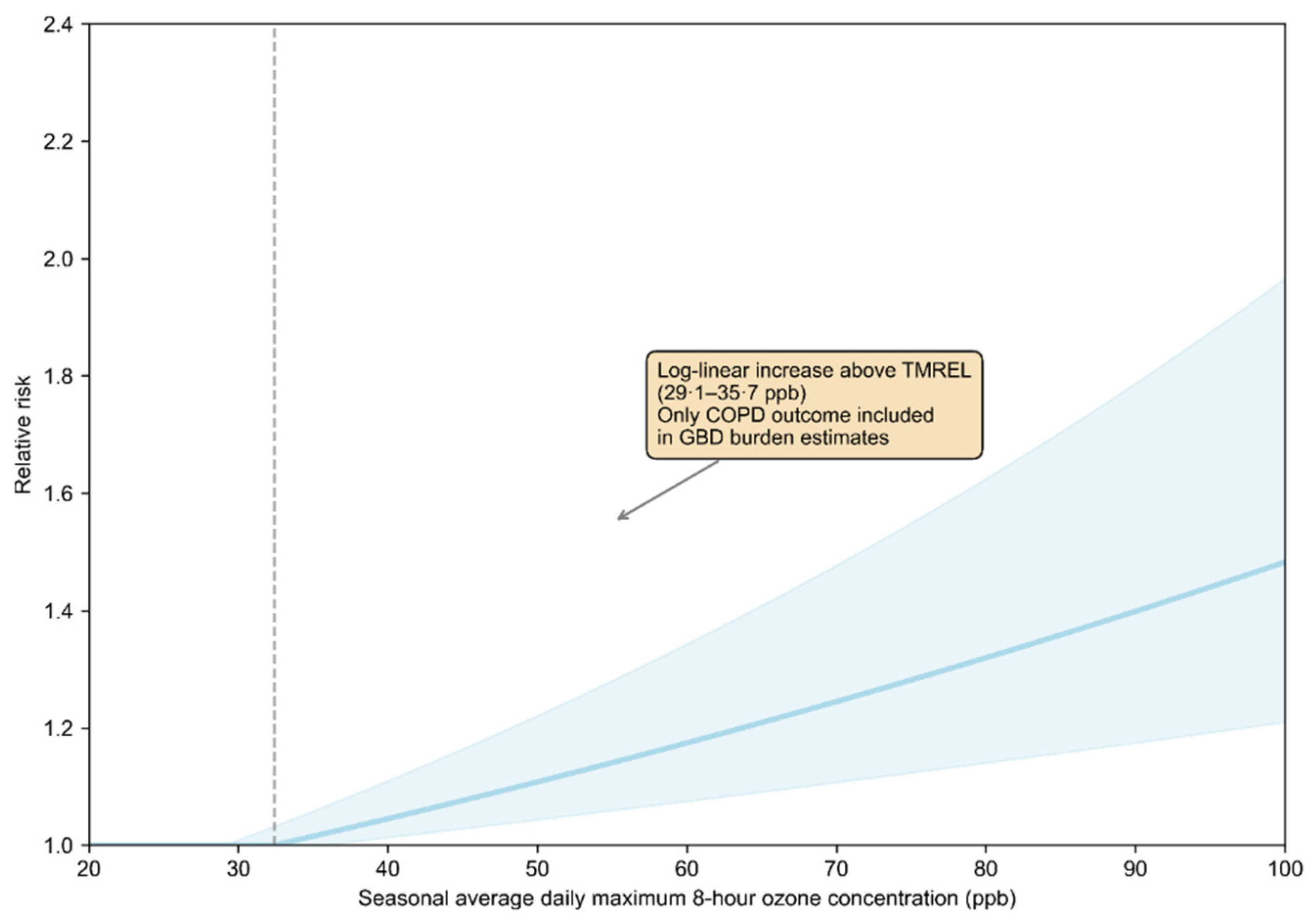
Figure 2.
Age-standardised ozone-attributable COPD death rates per 100 000 population, 2023, Data from GBD 2023.
Figure 2.
Age-standardised ozone-attributable COPD death rates per 100 000 population, 2023, Data from GBD 2023.
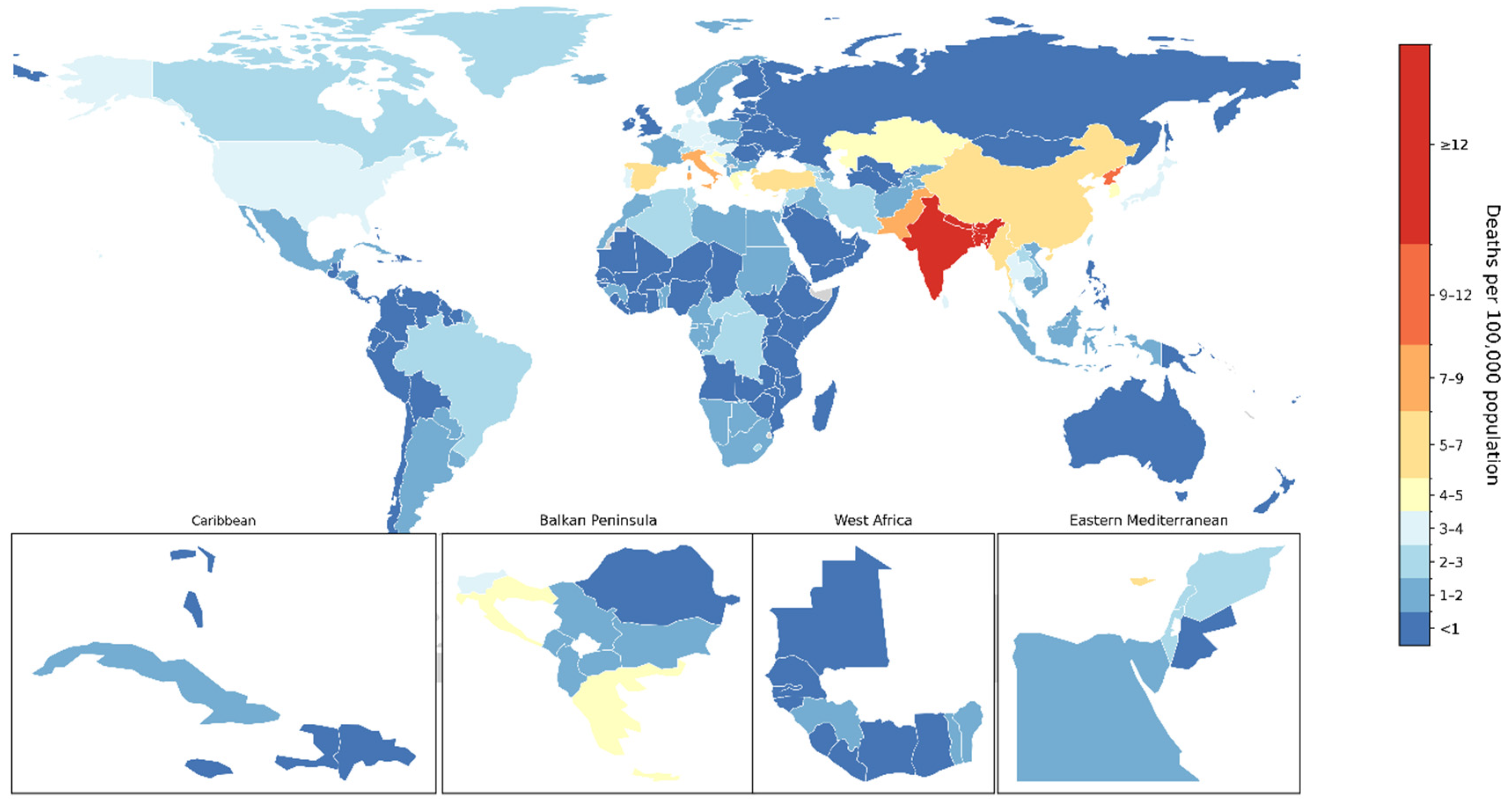
Figure 3.
Percentage change in the number of ozone-attributable COPD deaths, 1990–2023, Data from GBD 2023.
Figure 3.
Percentage change in the number of ozone-attributable COPD deaths, 1990–2023, Data from GBD 2023.
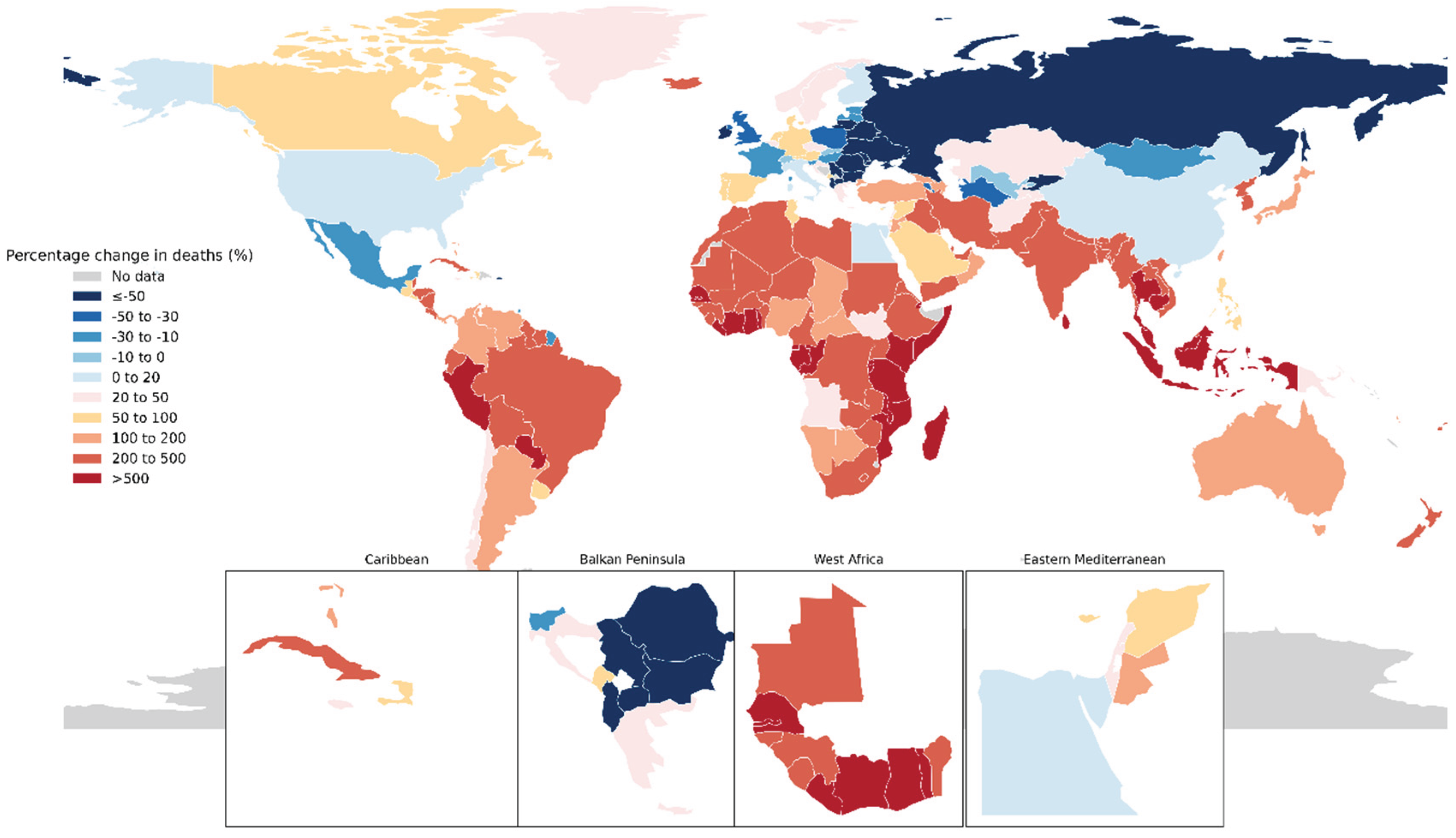

Table 1.
Top 10 countries with the highest number of deaths attributable to ambient ozone pollution from chronic obstructive pulmonary disease (COPD) in 2023, Data from GBD 2023.
Table 1.
Top 10 countries with the highest number of deaths attributable to ambient ozone pollution from chronic obstructive pulmonary disease (COPD) in 2023, Data from GBD 2023.
| Rank | Country | Deaths, in thousands (95% UI) | Age-standardised deaths per 100 000 people (95% UI) |
|---|---|---|---|
| 1 | India | 234.0 (56.9–406.7) | 16.2 (3.9–28.2) |
| 2 | China | 93.7 (21.9–179.7) | 6.6 (1.5–12.6) |
| 3 | Bangladesh | 27.8 (5.4–52.3) | 16.0 (3.1–30.1) |
| 4 | Pakistan | 18.0 (4.0–35.0) | 7.4 (1.7–14.3) |
| 5 | United States of America | 12.8 (3.1–23.1) | 3.8 (0.9–6.9) |
| 6 | Nepal | 5.3 (1.1–9.7) | 17.1 (3.6–31.1) |
| 7 | Brazil | 5.0 (1.2–9.2) | 2.4 (0.6–4.3) |
| 8 | Indonesia | 4.4 (1.0–8.5) | 1.5 (0.4–3.0) |
| 9 | Italy | 4.3 (1.0–7.7) | 7.3 (1.7–13.1) |
| 10 | Türkiye | 4.3 (0.9–8.1) | 5.0 (1.1–9.5) |
Disclaimer/Publisher’s Note: The statements, opinions and data contained in all publications are solely those of the individual author(s) and contributor(s) and not of MDPI and/or the editor(s). MDPI and/or the editor(s) disclaim responsibility for any injury to people or property resulting from any ideas, methods, instructions or products referred to in the content. |
© 2025 by the authors. Licensee MDPI, Basel, Switzerland. This article is an open access article distributed under the terms and conditions of the Creative Commons Attribution (CC BY) license (http://creativecommons.org/licenses/by/4.0/).
Copyright: This open access article is published under a Creative Commons CC BY 4.0 license, which permit the free download, distribution, and reuse, provided that the author and preprint are cited in any reuse.