
Submitted:
24 December 2025
Posted:
26 December 2025
You are already at the latest version
Abstract
This paper presents GenAI Financial Reporter, a multimodal artificial intelligence system designed to automate the generationof comprehensive financial analysis reports. The system leverages large language models (GPT-4o), retrieval-augmentedgeneration (RAG) with ChromaDB vector database, and multi-agent architectures to transform raw financial data intoprofessional reports enriched with text summaries, interactive visualizations, and audio narration. By integrating real-timemarket data from Yahoo Finance and SEC EDGAR filings, the system computes 27 key performance indicators (KPIs) fromstructured financial data stored in PostgreSQL and generates contextually-grounded analysis using RAG over SEC filing text.Our evaluation demonstrates vector similarity search completing in 1.3ms and full RAG queries averaging 15 seconds. Anablation study shows that RAG-enabled queries cite an average of 4 SEC filing sources per response compared to zero forbaseline approaches, improving answer provenance. The system supports multi-company comparisons, historical trendanalysis, and exports to multiple formats including PDF, DOCX, HTML, and MP3 audio. Deployed on AWS EC2 with Dockercontainerization, the system achieves production-ready reliability. We note that this is a systems paper emphasizing practical deployment;rigorous evaluation against financial benchmarks remains future work.
Keywords:
generative AI
; financial reporting
; RAG
; vector database
; GPT-4o
; multi-agent systems
; semantic search
; ChromaDB
; SEC EDGAR
I. Introduction
Financial reporting and analysis represent critical functions for investors, analysts, and business leaders seeking to make informed decisions. Traditional approaches to generating comprehensive financial reports require significant manual effort, often consuming 8 or more hours per company to compile data, calculate ratios, generate insights, and produce professional documentation. This labor-intensive process introduces inconsistencies, limits accessibility, and constrains the scalability of financial analysis operations.
The emergence of large language models (LLMs) and generative AI technologies presents opportunities to transform financial reporting workflows. These technologies can process complex financial data, generate human-readable insights, and produce professional-quality outputs at scale. However, effectively applying generative AI to financial reporting requires careful architectural design to ensure accuracy, maintain professional standards, and deliver multimodal outputs that serve diverse stakeholder needs.
This paper presents GenAI Financial Reporter, a comprehensive multimodal AI system that addresses these challenges. Our primary contributions include: (1) a RAG-enhanced architecture using ChromaDB for context-aware financial analysis with 1.3ms vector search latency, (2) a multi-agent system with five specialized agents for analytical tasks, (3) integration with authoritative data sources including SEC EDGAR and Yahoo Finance with automatic filing import, (4) a production-ready deployment with system-level evaluation, and (5) open-source release of the complete implementation. We emphasize that this is primarily a systems paper; rigorous benchmark evaluation remains important future work.
II. Related Work
The application of natural language processing (NLP) to financial analysis has evolved significantly. Early work focused on sentiment analysis of financial news and earnings calls [1], while subsequent research explored automated summarization of financial documents [2]. The introduction of transformer-based models, particularly BERT and its variants, enabled more sophisticated financial text understanding [3].
Recent advances in large language models have opened new possibilities for financial applications. FinGPT [4] demonstrated the potential of domain-adapted language models for financial analysis, while BloombergGPT [5] showed that models trained on financial corpora achieve superior performance on finance-specific tasks. Retrieval-augmented generation (RAG) has emerged as a powerful paradigm for enhancing LLM outputs with relevant context [6].
More recent work has advanced financial AI systems with rigorous evaluation. FinTral [10] introduced tool-augmented financial LLMs with comprehensive benchmark evaluation. Open-FinLLMs [11] provides open-source alternatives with detailed accuracy metrics across multiple financial tasks. FinAR-Bench [14] decomposes financial analysis into extraction, indicator computation, and reasoning with strict numeric evaluation. REAL-MM-RAG [15] and MDocAgent [16] address challenges with multi-modal retrieval from tables and charts in financial documents. MarketSenseAI 2.0 [13] includes retrieval faithfulness metrics. Our work differs in emphasis: we prioritize end-to-end production deployment and multimodal output generation rather than benchmark performance, though we acknowledge this evaluation gap as a limitation.
III. System Architecture
A. Overall Design
The GenAI Financial Reporter employs a modular architecture comprising five primary components: data ingestion, financial analysis engine, AI generation layer, visualization module, and report assembly. The backend is implemented in Python using FastAPI. PostgreSQL serves as the primary database for storing structured company information, financial statements, and computed KPIs. ChromaDB provides vector storage for SEC filing text chunks. The frontend is built with React 18, Vite, and Tailwind CSS.
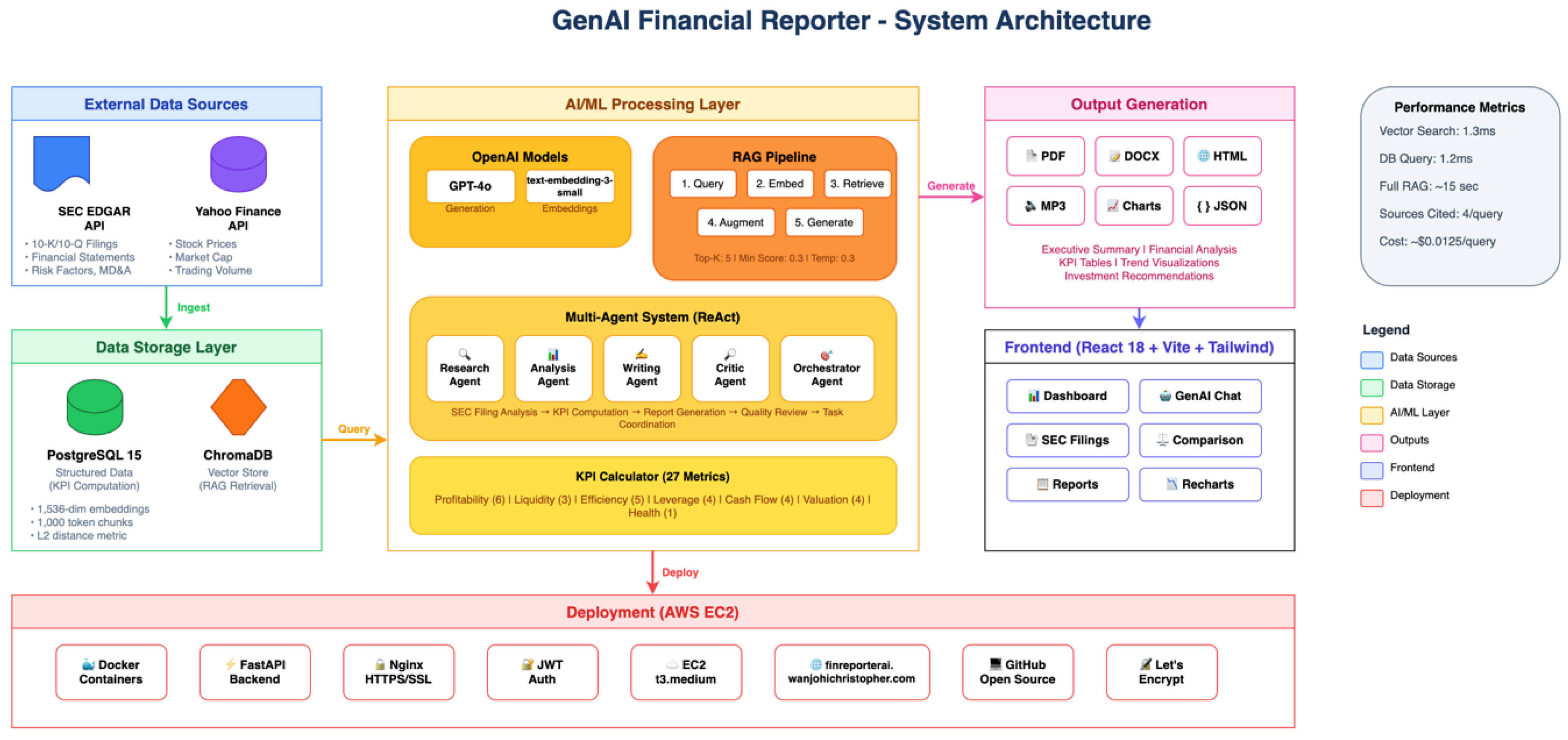
Figure 1.
System architecture of GenAI Financial Reporter showing data flow from external sources (SEC EDGAR, Yahoo Finance) through storage layers (PostgreSQL, ChromaDB), AI/ML processing (GPT-4o, RAG, Multi-Agent System), to multimodal outputs.
Figure 1.
System architecture of GenAI Financial Reporter showing data flow from external sources (SEC EDGAR, Yahoo Finance) through storage layers (PostgreSQL, ChromaDB), AI/ML processing (GPT-4o, RAG, Multi-Agent System), to multimodal outputs.
Important architectural note: KPI calculations are performed on structured financial data stored in PostgreSQL (sourced from SEC EDGAR’s structured fields and Yahoo Finance APIs), not extracted from text via RAG. The RAG pipeline is used for qualitative analysis—answering questions about risk factors, business segments, and management discussion from SEC 10-K narrative text. This separation ensures numeric accuracy for KPIs while leveraging RAG for contextual understanding.
B. RAG Pipeline Implementation
The retrieval-augmented generation pipeline provides context-aware responses for qualitative financial analysis. Table 1 presents the complete RAG configuration.
C. Multi-Agent System
We implemented a multi-agent architecture with five specialized agents: Research Agent (gathers and synthesizes information from SEC filings), Analysis Agent (computes KPIs from structured data), Writing Agent (generates narratives and executive summaries), Critic Agent (reviews outputs for consistency), and Orchestrator Agent (coordinates task decomposition). The architecture follows the ReAct paradigm. We acknowledge that detailed prompt engineering, tool call traces, and failure analysis are not presented in this paper; these constitute important future documentation.
D. Financial Metrics
The financial analysis engine computes 27 key performance indicators from structured financial data in PostgreSQL, organized into seven categories as shown in Table 2. These calculations use standard GAAP formulas applied to structured numeric fields, not text extraction.
IV. Implementation
A. Data Integration
The system integrates data from multiple sources with distinct purposes. SEC EDGAR integration provides: (1) structured financial data fields for KPI computation, stored in PostgreSQL, and (2) 10-K narrative text (risk factors, MD&A sections) chunked and indexed in ChromaDB for RAG queries. Yahoo Finance provides real-time market data. When a user queries a company not yet indexed, the system automatically fetches filings, extracts text, generates embeddings, and stores them. We do not currently parse XBRL; structured data comes from SEC’s JSON API endpoints.
B. Technology Stack
Table 3 summarizes the key technologies employed.
V. Evaluation
We conducted system-level evaluation focusing on latency and provenance. We explicitly acknowledge this evaluation is limited: we do not benchmark against FinQA, ConvFinQA, FinanceBench, or other established datasets, nor do we report retrieval metrics (NDCG@k, Recall@k) or faithfulness scores (RAGAS). These constitute critical future work.
A. System Performance
Table 4 presents latency measurements collected on AWS EC2 t3.medium (2 vCPU, 4GB RAM).
The ChromaDB vector search achieves 1.3ms average latency. The full RAG pipeline latency (15 seconds) is dominated by GPT-4o inference time, not retrieval. The vector search component is not the bottleneck, as expected for embedding-based retrieval.
B. Provenance Analysis
To assess whether RAG improves answer provenance, we compared RAG-enabled responses against a baseline. Table 5 presents results.
Important limitation: “Sources cited” measures provenance, not correctness or faithfulness. A system could cite irrelevant sources or hallucinate despite citations. This metric indicates that RAG retrieves and presents source material; it does not validate accuracy. Proper evaluation would require RAGAS faithfulness scores, human annotation of citation relevance, and numeric verification against ground truth—all future work.
Each RAG response cites an average of 4 text chunks from SEC 10-K filings, providing traceable references for qualitative claims. Without RAG, responses would rely solely on GPT-4o’s parametric knowledge without document grounding. We emphasize this demonstrates provenance capability, not accuracy validation.
C. Cost Analysis
Table 6 presents estimated API costs based on OpenAI pricing (December 2025). Estimates assume approximately 3,000 input tokens and 500 output tokens per query.
VI. Limitations and Future Work
We explicitly acknowledge substantial limitations of this work:
Evaluation Limitations: This paper presents system-level metrics without rigorous benchmark evaluation. We do not evaluate on FinQA, ConvFinQA, FinanceBench, FinAR-Bench, or other established financial NLP datasets. We do not report retrieval quality metrics (NDCG@k, Recall@k) or faithfulness scores (RAGAS). The “sources cited” metric measures provenance, not correctness. Human evaluation of output quality is not conducted. These constitute critical gaps.
Structured Data Extraction: We do not parse XBRL or implement robust table extraction from SEC filings. KPIs are computed from SEC’s JSON API structured fields stored in PostgreSQL, which may not capture all nuances (non-GAAP adjustments, restatements, amended filings). The RAG pipeline operates on narrative text only and cannot reliably extract numeric values from tables or charts.
Technical Design Choices: Key design decisions (L2 distance vs. cosine, chunk size selection, k=5 retrieval) lack empirical justification through ablation. We use ChromaDB’s defaults without systematic comparison. Multi-agent prompts and orchestration logic are not published in detail.
Scope and Accuracy: Generated reports may contain hallucinations, numeric errors, or misleading analysis. The system should not be used for investment decisions without qualified human review. Edge cases (amendments, restatements, complex multi-year reconciliations) are not systematically evaluated.
Future Work: Priority future directions include: (1) evaluation on FinAR-Bench and ConvFinQA with strict numeric tolerances, (2) XBRL parsing for structured extraction, (3) RAGAS faithfulness evaluation, (4) human annotation studies with inter-rater reliability, (5) comparison against domain-specialized models (FinTral, Open-FinLLMs), (6) empirical comparison of distance metrics and retrieval configurations, and (7) detailed agent prompt and failure documentation.
VII. Conclusion
This paper presented GenAI Financial Reporter, a multimodal AI system for automated financial report generation. The system combines RAG with ChromaDB (1.3ms vector search), multi-agent orchestration, and integration with SEC EDGAR and Yahoo Finance. We demonstrate production deployment and open-source the implementation.
We emphasize this is primarily a systems paper describing practical deployment architecture. The evaluation demonstrates system functionality and provenance capability (4 sources cited per response), but does not validate accuracy, faithfulness, or benchmark performance. Rigorous evaluation against financial NLP benchmarks, structured XBRL extraction, and human annotation studies remain essential future work before any high-stakes application.
Acknowledgments
The authors thank the Department of Computer Science at The Catholic University of America for supporting this work through the Artificial Intelligence course.
References
- Kearney, M.; Liu, S. Textual sentiment in finance: A survey of methods and models. Int. Review of Financial Analysis 2014, 33, 171–185. [Google Scholar] [CrossRef]
- El-Haj, A. Multilingual financial text summarization. Proc. 1st Financial Narrative Processing Workshop 2018. [Google Scholar]
- Araci, D. FinBERT: Financial sentiment analysis with pre-trained language models. arXiv 2019, arXiv:1908.10063. [Google Scholar]
- Yang, H. FinGPT: Open-source financial large language models. arXiv 2023, arXiv:2306.06031. [Google Scholar] [CrossRef]
- Wu, S. BloombergGPT: A large language model for finance. arXiv 2023, arXiv:2303.17564. [Google Scholar] [CrossRef]
- Lewis, P. Retrieval-augmented generation for knowledge-intensive NLP tasks. NeurIPS 2020, 33. [Google Scholar]
- OpenAI, GPT-4 technical report. arXiv 2023, arXiv:2303.08774.
- Chase, H. LangChain. github.com/langchain-ai/langchain, 2022. [Google Scholar]
- Financial Management Association, Analyst Workflow and Reporting Practices. 2023.
- Bhatia, R. FinTral: A Family of GPT-4 Level Multimodal Financial LLMs. arXiv 2024, arXiv:2402.10986. [Google Scholar]
- Xie, Q. Open-FinLLMs: Open Multimodal LLMs for Financial Applications. arXiv 2024, arXiv:2408.11878. [Google Scholar]
- Chen, J. MultiFinRAG. arXiv 2025, arXiv:2506.20821. [Google Scholar] [CrossRef]
- Kumar, A. MarketSenseAI 2.0. arXiv 2025, arXiv:2502.00415. [Google Scholar]
- Zhang, Z. FinAR-Bench: Financial Analysis and Reasoning Benchmark. arXiv 2025, arXiv:2506.07315. [Google Scholar]
- Wang, Y. REAL-MM-RAG: Real-world Multi-Modal RAG. arXiv 2025, arXiv:2502.12342. [Google Scholar]
- Li, L. MDocAgent: Multi-Document Agent. arXiv 2025, arXiv:2503.13964. [Google Scholar]

Table 1.
RAG Pipeline Configuration.
| Parameter | Value |
|---|---|
| Embedding Model | text-embedding-3-small |
| Embedding Dimensions | 1,536 |
| Tokenizer | tiktoken (cl100k_base) |
| Chunk Size | 1,000 tokens |
| Chunk Overlap | 200 tokens |
| Vector Database | ChromaDB (persistent) |
| Distance Metric | L2 (Euclidean)* |
| Top-K Retrieval | 5 |
| Min Relevance Score | 0.3 |
| Generation Model | GPT-4o |
| Temperature | 0.3 |
| Max Output Tokens | 2,000 |
*ChromaDB default. For normalized embeddings (as OpenAI provides), L2 and cosine similarity are mathematically equivalent. Future work will empirically compare distance metrics.
Table 2.
Computed Key Performance Indicators (27 Metrics).
| Category | Metrics |
|---|---|
| Profitability (6) | Gross Margin, Operating Margin, Net Margin, ROE, ROA, ROCE |
| Liquidity (3) | Current Ratio, Quick Ratio, Cash Ratio |
| Efficiency (5) | Asset Turnover, Inventory Turnover, Receivables Turnover, DSO, DIO |
| Leverage (4) | Debt-to-Equity, Debt-to-Assets, Equity Multiplier, Interest Coverage |
| Cash Flow (4) | OCF Ratio, FCF Yield, Cash Flow Coverage, CapEx-to-Revenue |
| Valuation (4) | P/E Ratio, P/B Ratio, P/S Ratio, EV/EBITDA |
| Health (1) | Altman Z-Score |
Total: 6+3+5+4+4+4+1 = 27 KPIs.
Table 3.
Technology Stack Summary.
| Layer | Technologies |
|---|---|
| Backend | Python 3.11, FastAPI, SQLAlchemy, Pydantic |
| AI/ML | OpenAI GPT-4o, text-embedding-3-small, ChromaDB, tiktoken |
| Database | PostgreSQL 15 (structured data), ChromaDB (vector store) |
| Frontend | React 18, Vite, Tailwind CSS, Recharts |
| Data Sources | SEC EDGAR API (JSON endpoints), Yahoo Finance |
| DevOps | Docker, AWS EC2 t3.medium, Nginx, Let’s Encrypt |
Table 4.
System Performance Breakdown.
| Component | Avg (ms) | Min | Max |
|---|---|---|---|
| API Health Check | 3.3 | 0.8 | 13.0 |
| PostgreSQL Query | 1.2 | 0.7 | 2.7 |
| ChromaDB Vector Search | 1.3 | 0.9 | 2.1 |
| Full RAG Pipeline* | 15,043 | 12,620 | 17,465 |
| SEC EDGAR API Call | 14.0 | - | - |
*Dominated by GPT-4o inference (~14-16 seconds). SEC EDGAR latency based on single measurement.
Table 5.
Provenance Analysis: RAG-Enabled Responses.
| Metric | RAG Pipeline |
|---|---|
| Queries Tested | 3 |
| Average Latency | 13,530 ms |
| Average Sources Cited | 4.0 per response |
| Source Type | SEC 10-K filing excerpts |
| Cites Specific Fiscal Years | Yes (2022-2024) |
Table 6.
API Cost Estimates (December 2025 Pricing).
| Usage | Est. Cost (USD) |
|---|---|
| Per Query (~3.5K tokens) | ~$0.0125 |
| Per 100 Queries | ~$1.25 |
| Per 1,000 Queries | ~$12.50 |
Based on GPT-4o at $0.0025/1K input, $0.01/1K output tokens. Embedding costs negligible (~$0.000002/query).
Disclaimer/Publisher’s Note: The statements, opinions and data contained in all publications are solely those of the individual author(s) and contributor(s) and not of MDPI and/or the editor(s). MDPI and/or the editor(s) disclaim responsibility for any injury to people or property resulting from any ideas, methods, instructions or products referred to in the content. |
© 2025 by the authors. Licensee MDPI, Basel, Switzerland. This article is an open access article distributed under the terms and conditions of the Creative Commons Attribution (CC BY) license (http://creativecommons.org/licenses/by/4.0/).
Copyright: This open access article is published under a Creative Commons CC BY 4.0 license, which permit the free download, distribution, and reuse, provided that the author and preprint are cited in any reuse.


