

Submitted:
24 December 2025
Posted:
25 December 2025
You are already at the latest version
Abstract
Cheese must be perceived as a dynamic ecosystem in a continuous flux between external factors, intrinsic factors such as the physico-chemical composition, and the interactions between the different microbial communities. Besides, the chemical environment together with extrinsic factors and physical handling, determines the microbiota that will be favored or suppressed during ripening, which deeply affects the cheese's aroma, flavor, texture, and appearance. Cheese aroma profile has been studied by gas chromatography-olfactometry (GC-O) for more than 30 years, demonstrating its relative importance as a useful tool to explain the products diversity and particularities because of the milk origin, milk type (whole, pasteurized, etc.), cheese variety, elaboration process, and ripening conditions. An inflexion in the literature on aroma of this dairy product is explained by revisions published at the beginning of the 2000s. In this study, a brief report on the information published during 2002-2022 (source: Google Scholar®) is presented focusing on key odorants components from different cheese varieties, the application of new sampling procedures and GC-O analysis to describe the aroma of types never assessed before with this approach, offering complementary data to sensory approaches.
Keywords:
cheese
; aroma compounds
; odorants
; gas chromatography-olfactometry
; sensory analysis
1. Introduction
Cheese is an extensively consumed food product originating from the activity of several microbial strains on whole or pasteurized soft milk curd, which is molded/firmed rendering the final product after an adequate ripening storage period (Belitz et al., 2009; Zheng et al., 2021). Cheese is consumed in almost every country in the world either for its significant nutritional value (protein, fat, and trace elements) or to satisfy hedonic desires (Chen et al., 2021; Zheng et al., 2021).
More than 2000 varieties of cheeses are produced worldwide, where the perception of the aroma and other sensory characteristics reflect the milk from it comes, the process used in their production and the physical and chemical changes occurring during ripening (Belitz et al., 2009). Moreover, the quality of the employed milk is determined by the animals’ breed, their diet, the health and nutritional status, and the stage of lactation (Friedrich & Acree, 1998). In addition, the milk treatment prior to cheese production, in particular the heat treatment (i.e., pasteurization), can destroy micro-organisms and reduce enzyme activity, limiting the development of sensory character during ripening (Belitz et al., 2009). Different families of odorant components (smell-triggering volatiles) have been identified in cheese extracts such as benzene-derived, sulfur compounds, acids, alcohols, aldehydes, esters, furans, hydrocarbons, ketones, lactones, and terpenes (see Section 2) (Belitz et al., 2009; Chen et al., 2021). Cheese aroma analysis includes extraction, separation, and quantification of these components which represents difficulties by the low concentration of many of them, their low odor threshold values, and the complexity of the food matrix (Belitz et al., 2009; Friedrich & Acree, 1998). Indeed, odorants extraction can strongly depend on the level of carbohydrates, lipids, and proteins from the cheese matrix (Friedrich & Acree, 1998). Thus, the cheese aroma analysis has always been a challenge.
Among the analytical techniques for analyzing cheese aroma, gas chromatography-olfactometry (GC-O) deserves a special place as it in general combines a physicochemical detector (FID, ECD, TCD, single quadrupole MS, etc.) simultaneously to an olfactometric port (d‘Acampora Zellner et al., 2008; Bonini et al., 2022). Depending on the data collection technique used, it is possible to assign a descriptor and an intensity to each compound (Song & Liu, 2018). Many reviews available in the literature discuss the different GC-O techniques (AEDA, AECA, modified frequency, CharmAnalysis®, Osme, NIF, SNIF) applied to interpret the data obtained (d‘Acampora Zellner et al., 2008; Dellacassa & Minteguiaga, 2023; among others), thus they will no longer be discussed here.
Diverse approaches have been applied to obtain the aroma of cheese prior GC-O, being headspace sampling (SPME or other static/dynamic approaches) preferred by its simplicity and reliability when compared to solvent extraction or distillation procedures (Friedrich & Acree, 1998; Belitz et al., 2009, Tian et al., 2019; Zabaleta et al., 2016). As the odorants in cheese could be present at very low concentration (10-4 to 10-11 g/L), SPME avoids laborious work to extract and concentrate the odorants in cheese (Frank et al., 2004).
Despite GC-O was early developed for the perfumery industry (Fuller et al., 1964), its application to dairy matrices was only performed 30 years ago (Moio et al., 1993). More than 600 volatile components have been identified in cheese (Curioni & Bosset, 2002). But GC-O, as a separative technique, does not account for important interactions between the odorants in the matrix which might change the overall impression of the cheeses, and these interactions can only be detected with correlation experiments with sensory analysis datasets (Thomsen et al., 2012). However, GC-O is very suitable for the identification of specific notes or off-flavors in cheeses, usually related to one or to a small group of closely related compounds (e.g identification of the components responsible for acid, rancid and fecal odor; Zabaleta et al., 2016).
In the literature three reviews can be found dealing with GC-O applied to dairy products, and specifically to cheese aroma, which were published more than 20 years ago (Mariaca & Bosset, 1997; Friedrich & Acree, 1998; Curioni & Bosset, 2002). The work of Curioni & Bosset (2002) reviews in nine tables the main odor-active components described by GC-O in the different varieties of cheese evaluated at that time, summarizing the GC-O technique employed by the different authors in the original research. As the authors stated, “…a comprehensive list of cheese key odorants, determined by GC-O, has not been established…”.
The aim of the present contribution is to briefly update the Curioni & Bosset’s publication with the information developed in the period 2002-2022. The papers included in this brief review were selected from Google Scholar® by including the terms “odor”, “aroma”, “cheese”, “gas chromatography/olfactometry” in several combinations. In fact, great amount of information was accumulated during this last time by the application of new sampling procedures and GC-O analysis to known cheese varieties. Moreover, the description of the aroma of varieties that had never been assessed before with this approach also is intended to be covered in this brief review.
2. Main Groups of Aroma Active Components in Different Cheese Varieties
The Cheese aroma derived from the native components from raw whole milk and consequently of the animal diet, from the different stages of production, as well as from several catabolic pathways (glycolysis, lipolysis, proteolysis) during ripening by the microbial strains (Boscaini et al., 2003; Belitz et al., 2009). Some of the most common and potent odorants (with lower odor thresholds) in cheeses are (Figure 1): alcohols (1: 1-octen-3-ol; 2: 3-methyl-1-butanol; 3: 2-heptanol; 4: 2-phenylethanol), aldehydes (5: 2-methylpropanal; 6: 2-methylbutanal; 7: 3-methylbutanal; 8: n-hexanal; 9: 2-(E)-nonenal) ketones (10: 2-heptanone, 11: 2-undecanone; 12: 1-octen-3-one); esters (lineal 13: ethyl octanoate; branched, 14: methyl-2-methylbutanoate; and aromatic, 15: phenylethyl acetate); short-chain fatty acids; furans (16: furaneol), lactones (17: δ-octalactone), terpenes, and non-oxygenated compounds (18: indole; 19: 2-ethyl-3,5-dimethylpyrazine; 20: methional) (Curioni & Bosset, 2002; Belitz et al., 2009). Alcohols represent the most diverse group (Curioni & Bosset, 2002). The specific odor descriptors and the determined thresholds for those compounds are shown in Table 1.
Most of the cheese odorant components are formed during cheese ripening through biochemical catabolic reactions, but secondary reactions can also occur (Curioni & Bosset, 2002; Belitz et al., 2009; de Jesus Filho et al., 2021; Zheng et al., 2021). For example, alcohols are in general originated as degradation products of long-chain fatty acids, or through catabolism routes of amino-acids and sugars (Curioni & Bosset, 2002). In fact, 1 is one of the most cited examples of cheese odorants (descriptors: mushrooms and green) and originates from the degradation of linoleic/linolenic acids (Curioni & Bosset, 2002). It has been proposed that 1 (as well as 12) are originated by the fungi Penicillium spp. during the cheese maturation (Karahadian et al., 1985). So, it is not surprising that even 1 being one of the main odorants in mould-ripened cheeses such as Brie, Camembert and Gorgonzola, is also present as a key odorant of water buffalo Mozzarella and Grana Padano (Curioni & Bosset, 2002). In addition, the derivative ketone (12) shows the same aroma descriptor and can intensify the mushroom odor contribution to the cheeses’ blend, as is the case of Camembert (Kubíčková & Grosch, 1997). Another interesting example of catabolic generated odorants are aldehydes, which usually are products of Strecker degradation and transamination from amino acids (Curioni & Bosset, 2002). Three of the strongest odorants of this family are 5, 6 and 7 (for example in Camembert, Cheddar, Emmental, and Gruyère cheeses). Other degradation routes lead to the other type of odorants (Figure 1), which are reviewed in deep by Curioni & Bosset (2002).
As demonstrated by Cornu et al. (2009), the influence of the odorants originated from the raw milk cannot be ruled out. Terpenes are strong odorants generally associated with pastures, thus indicating the influence of the animal diet in the aroma of some cheese varieties (Cornu et al., 2009).
As for other foods, odorants common to most of the cheeses can confer the basic and typical “cheese” notes, while some specific components discriminate the aroma of the different varieties, as demonstrated through multivariate statistic by Thomsen et al. (2012). Instead, the “aroma balance theory” establishes that the perceived differences are related to quantitative variations in the common odorants, which in turn could confer different aromas, enabling the enhancement or suppression of other odorants (Thomsen et al., 2012).
3. Examples of Cheese Aroma Studies Employing GC-O during the Period 2002-2022
To summarize the information on this topic, cheeses will be classified depending on the water content (hard, semihard, and soft) following the criteria of Belitz et al. (2009), as well as regarding their origin (blue mold ripened, goats’ and ewes’ milk cheeses).
3.1. Hard Cheeses (49-56% of Water)
Boscaini et al. (2003) employed GC-O with a detection frequency method to assess the fruity and creamy characteristic aromas of three authentic Italian Grana hard cheeses (Grana Padano, Grana Trentino, Parmigiano Reggiano) made from fluid whole bovine milk. The authors applied dynamic headspace extraction and identified the components from the samples through GC-FID, GC-MS and PTR-MS (proton-transfer reaction/mass spectrometry). Fruity notes demonstrated being related to an aldehyde (7), a ketone (10), some esters (ethyl-butanoate, ethyl hexanoate, and 3-methylbutyl acetate), and to some unidentified components. Buttery-caramel notes were attributed to the presence of diacetyl. Minor odorants not detected by GC-FID or GC-MS were determined using PTR-MS (12 and 20). Almost in parallel, the authentic Italian Parmigiano Reggiano aroma was studied by Qian & Reineccius (2003a,b,c), who applied Osme and AEDA for GC-O analyses. They found that the most potent odorants were aldehydes (5, 6, 7, acetaldehyde), esters (13, ethyl butanoate, ethyl hexanoate), sulfur compounds (20, dimethyl trisulphide), a diketone (diacetyl), and a pyrazine (2,6-dimethylpyrazine). However, differences among both approaches could be related to the origin and processing of the cheese samples and the different GC-O techniques applied.
Frank et al. (2004) described the aroma analysis of three commercial hard cheeses (Grana Padano, Parmesan, and Pecorino) from Australia without further considerations related to the actual origin of those products. The sampling was performed by SPME, and the analyses of the odorants by GC-MS and GC-O (detection frequency). Straight chain aliphatic acids and esters, described as having strong aroma impact, were identified in Grana Padano (butanoic acid, ethyl butanoate, ethyl hexanoate), but homofuraneol also was highlighted. Sulfur compounds (20, dimethyl trisulfide, methanetiol) and lactones (δ-decalactone and sotolone) strongly characterized the aroma of Parmesan cheese, while isovaleric acid presented a great contribution to the blend of Pecorino.
Mihalic, a traditional hard and brined variety of cheese produced in the Marmara region (Turkey) from whole sheep milk was studied by SPME/GC-O by Aday & Yuceer (2014) after six months ripening time. Some of the most intense components identified in the 25 cheese varieties studied by the authors were: 12; 20; acetic, butanoic and hexanoic acids; diacetyl; ethyl butyrate and hexanoate; heptanal; and 2,4-(E,E)-nonadienal. Less common odorants such as 3-methyltiophene, 2-acetylthiazole, 2-acetyl-2-thiazoline, and 2-isopropyl-3-methoxypyrazine were also detected in at least one Mihalic cheese headspace. Variations found among the different cheese varieties were assigned to differences in the elaboration processes.
3.2. Semi-Hard Cheeses (54-63% of Water)
Avsar et al. (2004) specifically looked for the nutty/malty aromatic notes of Cheddar cheese using AEDA and direct intensity GC-O techniques, finding that Strecker aldehydes (5-7) and benzaldehyde were the main contributors to such aroma. These results were also confirmed by Chen et al. (2021), who highlighted that the presence of such aromatic descriptors is desirable for Chinese consumers. With a similar objective and protocol, Carunchia-Whestine et al. (2005) determined that 4, 15 and phenylacetaldehyde were the main odorants contributing to the rosy/floral aroma in certain Cheddars.
Three varieties of Cheddar matured cheeses were also analysed by GC-O by Frank et al. (2004), who highlighted the role of 20, butanoic acid and dimethyl trisulfide as their strong odorants. Recently, Chen et al. (2022) reported lactones (17, γ-octalactone, γ-undecalactone, γ-dodecalactone, δ-decalactone, and δ-dodecalactone) as sensory active components in some Cheddar cheese varieties. They also showed that the concentration of this group of components was proportional to the cheese maturity period. By complementing the GC-O studies with recombination and aroma omission techniques, they found that the presence of the lactones reduced sour and rancid aroma intensity and improved overall flavour acceptability.
Berdagué et al. (2007) developed a special GC-O device (8-way/8-assessors: 8W-GC-O; VIDEO-Sniff method) synchronised with a MS detector and applied it to French Salers cheese aroma extracted by purge and trap (P&T, dynamic headspace). The authors detected 46 aromatic zones, identifying 44 odorants including 1, 5, 7, 8, 12, and 20.
Cornu et al. (2009) studied the aroma active components of the denomination protected uncooked French Cantal cheese, focusing on the influence of the cow diet, milk pasteurization, and ripening. Aromas were sampled by P&T and analysed using 8W-GC-O. The main odour active components detected were: 1, 7, 8, butanoic acid, 2,3-butanedione, heptanal, 3-methylthiopropanal, octanal and toluene. Authors did not find (or found little) influence of the cow diet and pasteurization on the major aroma components of Cantal cheese, while ripening was pointed out as a more important variability factor.
Thomsen et al. (2012) analysed the aromatic profile of seven French non-processed semi-hard cheeses elaborated from cow milk. Employing P&T/8W-GC-O, they correlated these results with sensory analysis through PLS. The most intense odorants detected were: 7, 9, 12, 20, 2,3-butanedione, dimethyltrisulphide, 2- and 3-methylbutanoic acids, methyl 2-methyl-3-furyldisulphide (identified as a new cheese odorant having cooked meat notes) and toluene (Thomsen et al., 2012). Several interesting correlations between the sensory and olfactometry datasets were revealed by the authors (89% of the sensorial responses were explained by 68% of the olfactometry responses), demonstrating the usefulness of this approach.
Fuchsmann et al. (2015) evaluated by a GC-O direct frequency technique the aroma of five varieties of the Swiss Tilsit cheeses, with the application of SPME to extract the attributable components. The authors specifically looked for the odorants which confer sulphury and buttery/cheese notes to these products. 2,3-Butanedione, butanoic and 3-methylbutanoic acids were responsible for the latter aromas, while more than 12 different sulfur compounds were detected at ppb levels but few of them were confirmed as decisively influencing the Tilsit aromas [20, dimethyl- disulfide and trisulfide, bis(methylthio)methane, 3-(methylthio)propanal]. Some odorants contributed to differentiate among the five varieties, which reinforced the importance of GC-O as a discriminating sensory tool.
Jo et al. (2018) studied semi-hard Gouda aromas of cheeses from five different countries and with different aging times by GC-O. Volatile components were extracted by SPME. The most relevant odorants detected in Gouda were two acids (acetic and butanoic), three aldehydes (5-7), a diketone (diacetyl), an ester (ethyl butanoate), a lactone (δ-decalactone), a furan (homofuraneol), a pyrazine (2-isobutyl-3-methoxypyrazine), and a sulphur aldehyde (20). As expected, the aroma profile varied along the ripening process as well as according to the origin.
Recently, de Jesus Filho et al. (2021) reported for the first-time, using GC-O (modified frequency technique), the aroma of the artisanal Brazilian Canastra cheese at three different ripening stages. The authors sampled the headspace using an SPME chemometric optimized protocol and found that five short-chain fatty acids (acetic, butanoic, isobutanoic, propanoic, isovaleric) and two esters (ethyl hexanoate, isoamyl acetate) were the most potent key aroma components of these cheeses, conferring its typical aroma descriptors. As previously demonstrated by other authors ripening influenced the aroma profile of the final Canastra cheese.
3.3. Soft Cheeses (> 67% of Water)
Circassian Turkish cheeses were studied through SPME extraction and GC-O sensorial analysis (intensity technique) by Guneser & Yuceer (2011). The samples were Caucasian full-fat and acid-coagulated cheeses produced using different animal sources of milk (cow, sheep, goat, buffalo), or by mixing more than one milk type, fresh (15-30 days of ripening) or smoked (with beech or oak). As expected from these diverse origin and processes, the aroma active components varied among the different Circassian cheeses analysed but the most intense perceived were: 12, 20, p-cresol (a bacterial off-flavor in dairy products, displaying the major intensity in smoked cheeses), butanoic and hexanoic acids, ethyl butanoate, maltol, 2-methoxyphenol (exclusive odorant from smoking), and 2,6-(E,Z)-nonadienal. Only butanoic acid and diacetyl odorants were determined in all the Circassian samples.
3.4. Blue Mold Ripened Cheeses
Frank et al. (2004) sampled the headspace of three blue cheeses, two of them being strong blue-mold varieties and the remaining one a mild blue-mold. Latter differed remarkably in the aroma perceived, highlighting the role of 2,5- and 2,6-dimetylpyrazines, methyl propyl-pyrazine and other pyrazines as distinctive odorants. Aliphatic esters/ketones, a sesquiterpene and sulfur compounds were shared as potent aroma impact components from the two strong blue-mold ripened cheeses, whilst lactones were perceived in the three varieties.
3.5. Goat Milk Cheeses
Regarding goat milk made cheeses, Carunchia-Whetstine et al. (2003) characterized (GC-O, detection frequency technique) the aroma profile of the fresh Chevre-style, which was dominated by sweet, dairy, animal, and waxy notes. Short-chain fatty acids (4-ethyl and 4-methyl octanoic, and octanoic itself) were responsible by the waxy aroma. Other aromatic key components identified were 12, ortho-aminoacetophenone, 2,3-butanedione and several lactones.
Poveda et al. (2008) analyzed the aromas of the commercial goat’s milk semi-hard cheeses from different Spanish regions. The volatile components were extracted through SDE (simultaneous distillation-extraction), and the odorants determined by GC-O (intensity technique), correlating this information with GC-MS and sensory analyses. Short-chain fatty acids accounted for 84% of the raw volatile concentration being associated statistically with the descriptors “cheese”, “fatty”, “goat”, “rancid” and “sweat”. The olfactive most potent acids were acetic, butanoic, 3-methylbutanoic, pentanoic, hexanoic, octanoic, 4-methyloctanoic and 4-ethyloctanoic (the last two correlated with “goat” descriptors). Interestingly, decanoic acid, the main compound in SDE extracts, was barely perceived in the GC-O assessments. Other odorants also important in the aromatic profile of goat milk cheese were: δ-decalactone (dairy/sweet), ethyl hexanoate and ethyl dodecanoate (fruity notes), phenylacetaldehyde (dry fruit aroma), 3-methylthiopropanal (cooked vegetables), 1-hexanol (green) and other furane compounds.
3.6. Ewes Milk Cheeses
Sádecká et al. (2014) studied the aromatic profile of the creamy salted Bryndza cheese made from raw ewes’ unpasteurized milk and ripened around 15 days. This product is typical from the Slovakian Carpathian Mountains, and it is believed that Spring cheeses are of superior quality, a fact attributed to the pastures which eventually can contribute to their aromas. The authors employed SPME to extract the Bryndza curd and cheese aroma components and characterized them by GC-MS and GC-O (detection frequency). Twenty-seven odorants were identified being, as expected, less numerous and less intense for the young curd and more concentrated in the ripened cheese. The main odorants were 2, 4, acetic acid, ethyl acetate, 2-methyl-1-butanol, 2,3-heptanedione, and 2,4-dimethyl-1-heptene. Moreover, Sádecká et al. (2016) studied the barrelled cheese (an intermediate product in the Bryndza production) regarding its aroma and microbial diversity, and they found the fatty acids isovaleric, butanoic (co-eluted with ethyl butanoate) and hexanoic as the main odorants.
Zabaleta et al. (2016) focused on the identification of the components associated with off-flavours (acid, rancid and faecal) of ewes’ raw milk commercial cheeses. Aroma odorant compounds were extracted by solvent assisted flavour evaporation (SAFE), detected by GC-O, and identified and quantified by GC-MS. A peculiar profile of short-chain free fatty acids was associated with acid and rancid off-flavours, whereas faecal ones were related to minor components (2, and 4-methylphenol). section may be divided by subheadings. It should provide a concise and precise description of the experimental results, their interpretation as well as the experimental conclusions that can be drawn.
4. Conclusion
In short, the information presented in this review allows us to affirm that cheese aroma plays a crucial role in determining its quality and flavour, as aroma is the first sensory aspect that is perceived, and it sets the stage for the other sensory experiences that follow (taste and texture). GC-O is a powerful tool for studying cheese aroma, allowing the separation and identification of the volatile components involved (in particular, when associated to MS set-ups). Additionally, GC-O can be employed to compare different cheeses, to identify the specific components that contribute to their distinct aromas, to detect off-flavours, and to correlate the aromas to the different aspects of their production chain as (among others): the animals’ diet, microbial communities, handling processes and ripening conditions. Thus, GC-O applications on cheese aromas is expected to increase in the literature in the following years as a key analytical tool for the quality control of these products.
Author Contributions
MM and ED contributed to the conception and design of this review. All authors contributed to the literature search for constructing the corresponding database. MM wrote the first draft of the manuscript. AMFF, LF and FF wrote sections of the manuscript. MM and ED performed the final edition of the content. All authors have read and agreed to the published version of the manuscript.
Funding
This research received no external funding.
Acknowledgments
In this section you can acknowledge any support given which is not covered by the author contribution or funding sections. This may include administrative and technical support, or donations in kind (e.g., materials used for experiments).
Conflicts of Interest
The authors declare no conflict of interest.
References
- Aday, S.; Karagul-Yuceer, Y. Physicochemical and sensory properties of Mihalic cheese. Int. J. Food Prop. 2014, 17, 2207–2227. [Google Scholar] [CrossRef]
- Akira, A.; Kazuhiko, T.; Kenichi, U. (1996). Method for improving flavor of food or drink. U.S. Patent No 5,496,580. Washington, DC: U.S. Patent and Trademark Office.
- Arora, G.; Cormier, F.; Lee, B. Analysis of odor-active volatiles in Cheddar cheese headspace by multidimensional GC/MS/sniffing. J. Agric. Food Chem. 1995, 43, 748–752. [Google Scholar] [CrossRef]
- Avsar, Y.K.; Karagul-Yuceer, Y.; Drake, M.A.; Singh, T.K.; Yoon, Y.; Cadwallader, K.R. Characterization of nutty flavor in cheddar cheese. J. Dairy Sci. 2004, 87, 1999–2010. [Google Scholar] [CrossRef] [PubMed]
- Belitz, H.-D.; Grosch, W.; Schieberle, P. (2009). Food Chemistry. 4th edition. Verlag, Berlin, Heidelberg: Springer. [CrossRef]
- Berdagué, JL; Tournayre, P.; Cambou, S. Novel multi-gas chromatography-olfactometry device and software for the identification of odour-active compounds. J. Chromatogr. A 2007, 1146, 85–92. [Google Scholar] [CrossRef]
- Bonini, A.; Dellacassa, E.; Ares, G.; Daners, G.; Godoy, A.; Boido, E.; Fariña, L. Fecal descriptor in honey: indole from a floral source as an explanation. J. Sci. Food Agric. 2022, 102, 6780–6785. [Google Scholar] [CrossRef]
- Boscaini, E.; Van Ruth, S.; Biasoli, F.; Gasperi, F.; Märk, T.D. Gas Chromatography?Olfactometry (GC-O) and Proton Transfer Reaction?Mass Spectrometry (PTR-MS) Analysis of the flavor profile of Grana Padano, Parmigiano Reggiano, and Grana Trentino cheeses. J. Agric. Food Chem. 2003, 51, 1782–1790. [Google Scholar] [CrossRef]
- Carunchia-Whetstine, M.E.; Karagul-Yuceer, Y.; Avsar, Y.K.; Drake, M.A. Identification and quantification of character aroma components in fresh Chevre-style goat cheese. J. Food Sci. 2003, 68, 2441–2447. [Google Scholar] [CrossRef]
- Carunchia-Whetstine, M.E.; Cadwallader, K.R.; Drake, M.A. Characterization of Aroma Compounds Responsible for the Rosy/Floral Flavor in Cheddar Cheese. J. Agric. Food Chem. 2005, 53, 3126–3132. [Google Scholar] [CrossRef]
- Chen, C.; Zhou, W.; Yu, H.; Yuan, J.; Tian, H. Evaluation of the perceptual interactions among aldehydes in a Cheddar cheese matrix according to odor threshold and aroma intensity. Molecules 2020, 25, 4308. [Google Scholar] [CrossRef]
- Chen, C.; Zhou, W.; Yu, H.; Yuan, J.; Tian, H. Characterization of major odor-active compounds responsible for nutty flavor in Cheddar cheese according to Chinese taste. Flav. Fragr. J. 2021, 36, 171–181. [Google Scholar] [CrossRef]
- Chen, C.; Liu, Z.; Yu, H.; Xu, Z.; Tian, H. Flavoromic determination of lactones in cheddar cheese by GC-MS-olfactometry, aroma extract dilution analysis, aroma recombination and omission analysis. Food Chem. 2022, 368, 130736. [Google Scholar] [CrossRef]
- Christensen, K.R.; Reineccius, G.A. Aroma extract dilution analysis of aged Cheddar cheese. J. Food Sci. 1995, 60, 218–220. [Google Scholar] [CrossRef]
- Cornu, A.; Rabiau, N.; Kondjoyan, N.; Verdier-Metz, I.; Pradel, P.; Tournayre, P.; Berdague, J.L.; Martin, B. Odour-active compound profiles in Cantal-type cheese: Effect of cow diet, milk pasteurization and cheese ripening. Int. Dairy J. 2009, 19, 588–594. [Google Scholar] [CrossRef]
- Curioni, P.M.G.; Bosset, J.O. Key odorants in various cheese types as determined by gas chromatography-olfactometry. Int. Dairy J. 2002, 12, 959–984. [Google Scholar] [CrossRef]
- d’Acampora Zellner, B.; Dugo, P.; Dugo, G.; MondelloL. Gas chromatography-olfactometry in food flavour analysis. J. Chromatogr. A 2008, 1186, 123–143. [Google Scholar] [CrossRef]
- de Jesus Filho, M.; Klein, B.; Wagner, R.; Godoy, H.T. Key aroma compounds of Canastra cheese: HS-SPME optimization assisted by olfactometry and chemometrics. Food Res. Int. 2021, 150, 110788. [Google Scholar] [CrossRef] [PubMed]
- Dellacassa, E.; Minteguiaga, M. (2023). "Gas Chromatography-Olfactometry (GC-O) of essential oils and volatile extracts", in Essential Oils: Extraction Methods and Applications, ed. Inamuddin (New York, NY: Wiley-Scrivener), in press.
- Frank, D.C.; Owen, C.M.; Patterson, J. Solid phase microextraction (SPME) combined with gas-chromatography and olfactometry-mass spectrometry for characterization of cheese aroma compounds. LWT-Food Sci. Technol. 2004, 37, 139–154. [Google Scholar] [CrossRef]
- Friedrich, J.E.; Acree, T.E. Gas Chromatography Olfactometry (GC/O) of dairy products. Int. Dairy J. 1998, 8, 235–241. [Google Scholar] [CrossRef]
- Fuchsmann, P.; Stern, M.T.; Brügger, Y.-A.; Breme, K. Olfactometry Profiles and Quantitation of Volatile Sulfur Compounds of Swiss Tilsit Cheeses. J. Agric. Food Chem. 2015, 63, 7511–7521. [Google Scholar] [CrossRef] [PubMed]
- Fuller, G.H.; Steltenkamp, R.; Tisserand, G.A. The gas chromatograph with human sensor: perfumer model. Ann. N. Y. Acad. Sci. 1964, 116, 711–724. [Google Scholar] [CrossRef]
- Gripon, J.C. (1997). "Flavour and texture in soft cheese", in Microbiology and Biochemistry of Cheese and Fermented Milk, ed. A. Law (New York, NY: Springer), 193-206.
- Guneser, O.; Karagul-Yuceer, Y. Characterisation of aroma-active compounds, chemical and sensory properties of acid-coagulated cheese: Circassian cheese. Int. J. Dairy Technol. 2011, 64, 517–525. [Google Scholar] [CrossRef]
- Jo, Y.; Benoist, D.M.; Ameerally, A.; Drake, M.A. Sensory and chemical properties of Gouda cheese. J. Dairy Sci. 2018, 101, 1967–1989. [Google Scholar] [CrossRef] [PubMed]
- Karahadian, C.; Josephson, D.B.; Lindsay, R.C. Contribution of Penicillium sp. to the flavors of Brie and Camembert Cheese. J. Dairy Sci. 1985, 68, 1865–1877. [Google Scholar] [CrossRef]
- Kubí?ková, J; Grosch, W. Evaluation of potent odorants of Camembert cheese by dilution and concentration techniques. Int. Dairy J. 1997, 7, 65–70. [Google Scholar] [CrossRef]
- Mariaca, R.; Bosset, J.O. Instrumental analysis of volatile (flavour) compounds in milk and dairy products. Lait 1997, 77, 13–40. [Google Scholar] [CrossRef]
- Moio, L.; Langlois, D.; Etievant, P.; Addeo, F. Powerful odorants in bovine, ovine, caprine and water buffalo milk determined by means of gas chromatography-olfactometry. J. Dairy Res. 1993, 60, 215–222. [Google Scholar] [CrossRef]
- Poveda, J.M.; Sánchez-Palomo, E.; Pérez-Coello, M.S.; Cabezas, L. Volatile composition, olfactometry profile and sensory evaluation of semi-hard Spanish goat cheeses. Dairy Sci. Technol. 2008, 88, 355–367. [Google Scholar] [CrossRef]
- Qian, M.; Reineccius, G. Potent aroma compounds in Parmigiano Reggiano cheese studied using a dynamic headspace (purge-trap) method. Flavour Fragr. J. 2003a, 18, 252–259. [Google Scholar] [CrossRef]
- Qian, M.; Reineccius, G. Static Headspace and Aroma Extract Dilution Analysis of Parmigiano Reggiano cheese. J. Food Sci. 2003b, 68, 794–798. [Google Scholar] [CrossRef]
- Qian, M.; Reineccius, G. Quantification of aroma compounds in Parmigiano Reggiano cheese by a dynamic headspace Gas Chromatography-Mass Spectrometry technique and calculation of odor activity value. J. Dairy Sci. 2003c, 86, 770–776. [Google Scholar] [CrossRef]
- Roger, S.; Degas, C.; Gripon, J.C. Production of phenyl ethyl alcohol and its esters during ripening of traditional camembert. Food Chem. 1988, 28, 129–140. [Google Scholar] [CrossRef]
- Sádecká, J; Kolek, E.; Pangallo, D.; Valík, L.; Kuchta, T. Principal volatile odorants and dynamics of their formation during the production of May Bryndza cheese. Food Chem. 2014, 150, 301–306. [Google Scholar] [CrossRef] [PubMed]
- Sádecká, J.; Šaková, N.; Pangallo, D.; Kore?ová, J.; Kolek, E.; Puškarová, A.; Bu?ková, M.; Valík, L.; Kuchta, T. Microbial diversity and volatile odour-active compounds of barrelled ewes’ cheese as an intermediate product that determines the quality of winter bryndza cheese. LWT-Food Sci. Technol. 2016, 70, 237–244. [Google Scholar] [CrossRef]
- Song, H.; Liu, J. GC-O-MS technique and its applications in food flavor analysis. Food Res. Int. 2018, 114, 187–198. [Google Scholar] [CrossRef]
- Taylor, K.; Wick, C.; Castada, H.Z.; Kent, K.; Harper, W.J. Discrimination of Swiss cheese from 5 different factories by high impact volatile organic compound profiles determined by odor activity value using Selected Ion Flow Tube Mass Spectrometry and odor threshold. J. Food Sci. 2013, 78, C1509–C1515. [Google Scholar] [CrossRef]
- Thomsen, M.; Martin, C.; Mercier, F.; Tournayre, P.; Berdagué, J-L; Thomas-Danguin, T.; Guichard, E. Investigating semi-hard cheese aroma: Relationship between sensory profiles and gas chromatography-olfactometry data. Int. Dairy J. 2012, 26, 41–49. [Google Scholar] [CrossRef]
- Tian, H.; Xu, X.; Chen, C.; Yu, H. Flavoromics approach to identifying the key aroma compounds in traditional Chinese milk fan. J. Dairy Sci. 2019, 102, 9639–9650. [Google Scholar] [CrossRef] [PubMed]
- Wang, J.; Yang, Z.J.; Wang, Y.D.; Cao, Y.P.; Wang, B.; Liu, Y. The key aroma compounds and sensory characteristics of commercial Cheddar cheeses. J. Dairy Sci. 2021, 104, 7555–7571. [Google Scholar] [CrossRef] [PubMed]
- Zabaleta, L.; Gourrat, K.; Barron, L.J.B.; Albisua, M.; Guichard, E. Identification of odour-active compounds in ewes’ raw milk commercial cheeses with sensory defects. Int. Dairy J. 2016, 58, 23–30. [Google Scholar] [CrossRef]
- Zheng, X.; Shi, X.; Wang, B. A Review on the General Cheese Processing Technology, Flavor Biochemical Pathways and the Influence of Yeasts in Cheese. Front. Microbiol. 2021, 12, 703284. [Google Scholar] [CrossRef]
Figure 1.
Compounds frequently found in the aroma of cheese.
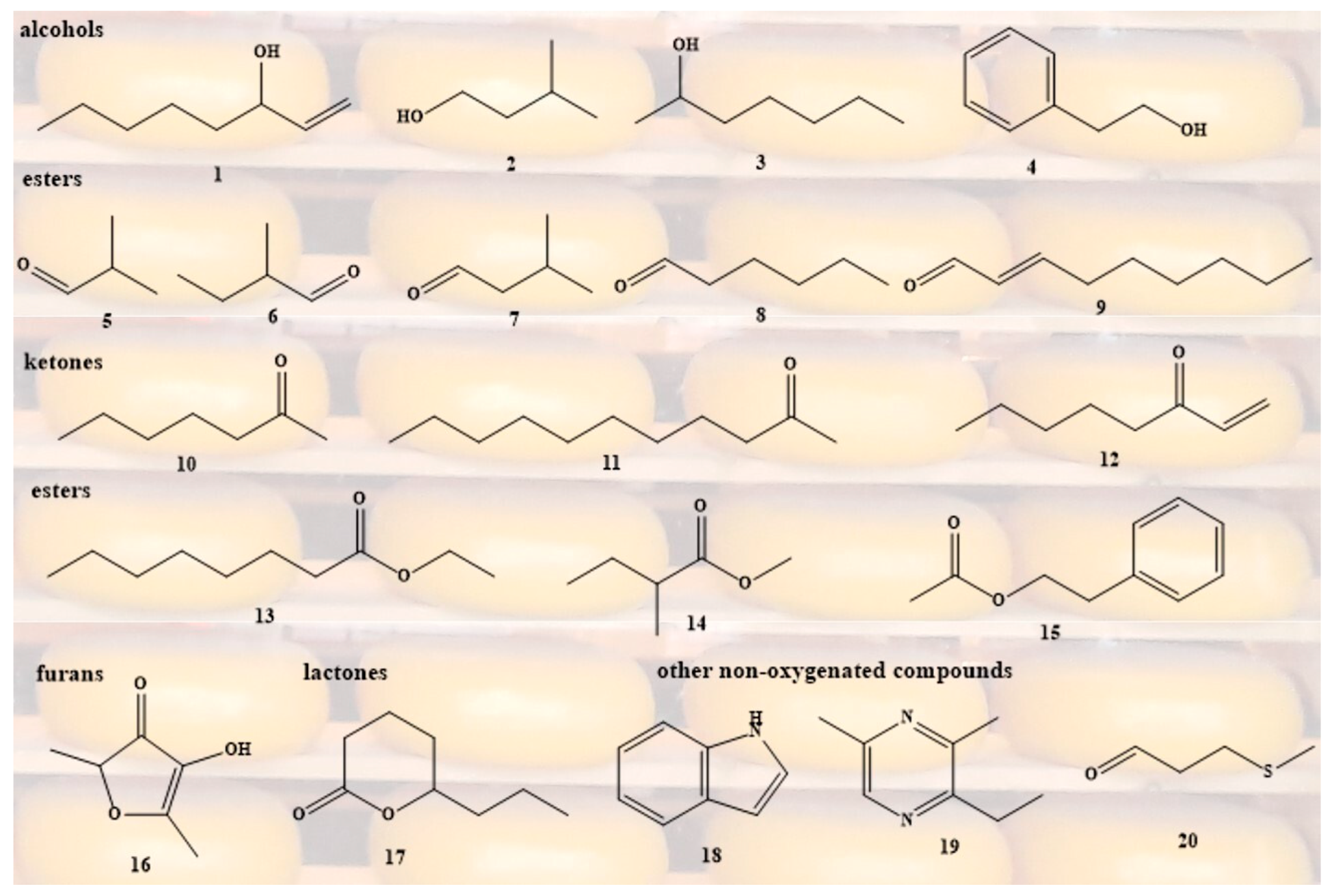

Table 1.
This is a table. Tables should be placed in the main text near to the first time they are cited.
Table 1.
This is a table. Tables should be placed in the main text near to the first time they are cited.
| Compound | Odour descriptor | Thresholds (µg/kg)1 |
Reference |
|---|---|---|---|
| 1-octen-3-ol (1) | mushrooms, green | 1 | Wang et al. (2021) |
| 3-methyl-1-butanol (2) | alcoholic, winey, fruity | 4750 | Qian & Reineccius (2003c) |
| 2-heptanol (3) | mushroom | 410 | Qian & Reineccius (2003c) |
| 2-phenylethanol (4) | floral | 9 | Gripon (1997) |
| 2-methylpropanal (5) | Pungent, varnish, fruity | 150 | Qian & Reineccius (2003c) |
| 2-methylbutanal (6) | Malty, almond, cacao, apple-like | 175 | Chen et al. (2020) |
| 3-methylbutanal (7) | Malty, nutty, almond, cocoa | 150 | Chen et al. (2020) |
| n-hexanal (8) | green, grassy | 5 | Wang et al. (2021) |
| 2-(E)-nonenal (9) | cucumber | 0.3 | Wang et al. (2021) |
| 2-heptanone (10) | fruity, sweet | 1500 | Qian & Reineccius (2003c) |
| 2-undecanone (11) | floral | 6.2 | Wang et al. (2021) |
| 1-octen-3-one (12) | mushroom, green | 0.06 | Wang et al. (2021) |
| ethyl octanoate (13) | pineapple and apple, brandy nuance | 32 | Qian & Reineccius (2003c) |
| methyl-2-methylbutanoate (14) | fruity, apple, green | 5 (water) | Akira et al. (1996) |
| phenylethyl acetate (15) | fresh, fruity, pear | 20 | Roger et al. (1988) |
| furaneol (16) | pineapple, strawberry | 25 | Wang et al. (2021) |
| δ-octalactone (17) | coconut | 8.5 | Wang et al. (2021) |
| indole (18) | musty | 64 (honey) | Bonini et al. (2022) |
| 2,3-diethyl-5-methylpyrazine (19) | burnt coffee, nutty, roasted | 3.74 | Taylor et al. (2015) |
| methional (20) | potato | 0.25 | Wang et al. (2021) |
1 Threshold values evaluated in cheese matrix, except for methyl-2-methylbutanoate and indole.
Disclaimer/Publisher’s Note: The statements, opinions and data contained in all publications are solely those of the individual author(s) and contributor(s) and not of MDPI and/or the editor(s). MDPI and/or the editor(s) disclaim responsibility for any injury to people or property resulting from any ideas, methods, instructions or products referred to in the content. |
© 2025 by the authors. Licensee MDPI, Basel, Switzerland. This article is an open access article distributed under the terms and conditions of the Creative Commons Attribution (CC BY) license (http://creativecommons.org/licenses/by/4.0/).
Copyright: This open access article is published under a Creative Commons CC BY 4.0 license, which permit the free download, distribution, and reuse, provided that the author and preprint are cited in any reuse.


