

Submitted:
19 December 2025
Posted:
22 December 2025
You are already at the latest version
Abstract
The current paper deals with the sets of Johnson circles, and to the famous Yang- Baxter equations. The Johnson–Tzitzeica theorem could be considered a result related to symmetry. we will also present an asymmetric construction related to the Johnson–Tzitzeica theorem. Then, there is a special section discussing on the Yang-Baxter equations. The concluding section attempts to connect the two above topics.
Keywords:
Johnson-Tzitzeica theorems
; Euler formula
; Yang-Baxter equations
; algebras
; coalgebras
MSC: 00A05; 00A27; 16B50; 16T25; 30D05
1. Introduction
The Yang-Baxter equations are important tools in mathematics, physics and computer science (see [1,2,3,4]). The Yang–Baxter equations create a unifying framework for the duality of finite dimensional algebras and finite dimensional coalgebras. This idea will be explored in the realm of geometry in the current paper.
In geometry, a set of Johnson circles comprises three circles of equal radius r sharing one common point of intersection O (see the Figure 1).
In a Johnson configuration the circles there are usually four intersections points ([5]). In the Johnson-Tzitzeica theorem “the figure is so simple (especially as it can be drawn and the theorem verified with a coin or other circular object) that it seems almost out of the question that the fact can have escaped detection. Even if geometers have overlooked it, someone must have noticed it in casually drawing circles. But if this were the case, it seems like a theorem of sufficient interest to receive some prominence in the literature, and therefore ought to be well known” (see [6]).
We will consider a theorem which start with an asymmetric hypothesis (see the Figure 2).
This hypothesis will eventually lead to a mosaic of circles of the same radius (see the Figure 3).
Section 3 deals with the (set-theoretical) Yang-Baxter equations ([1,2,3,7,8]). We will consider the symmetry or the asymmetry of the braid condition and the quantum Yang-Baxter equation. There exists an unifying equation for the braid condition and the quantum Yang-Baxter equation, and it will be denoted UYBC. Some solutions for UYBC will be given.
Finally, the concluding section attempts to connect the two above main topics, and add some clarification to the topics presented in the current paper.
2. On Tzitzeica-Johnson’s Theorem and Pictorial Mathematics
Florin Caragiu gave an invited talk at an International Workshop on Differential Geometry and Its Applications (UPG Ploiesti, 2015). In his talk he discussed about pictorial mathematics. This talk was published as a capter in [9]. We are going to use his method in presenting the Tzitzeica-Johnson problem and its “relatives”.
We consider the Tzitzeica-Johnson problem first ([10]). All the circles will have a fixed radius of length r. For three circles the intersection points of pairs of circles are denoted by A, B, C and the common point of intersection of the three circles is denoted by O (see the Figure 4).
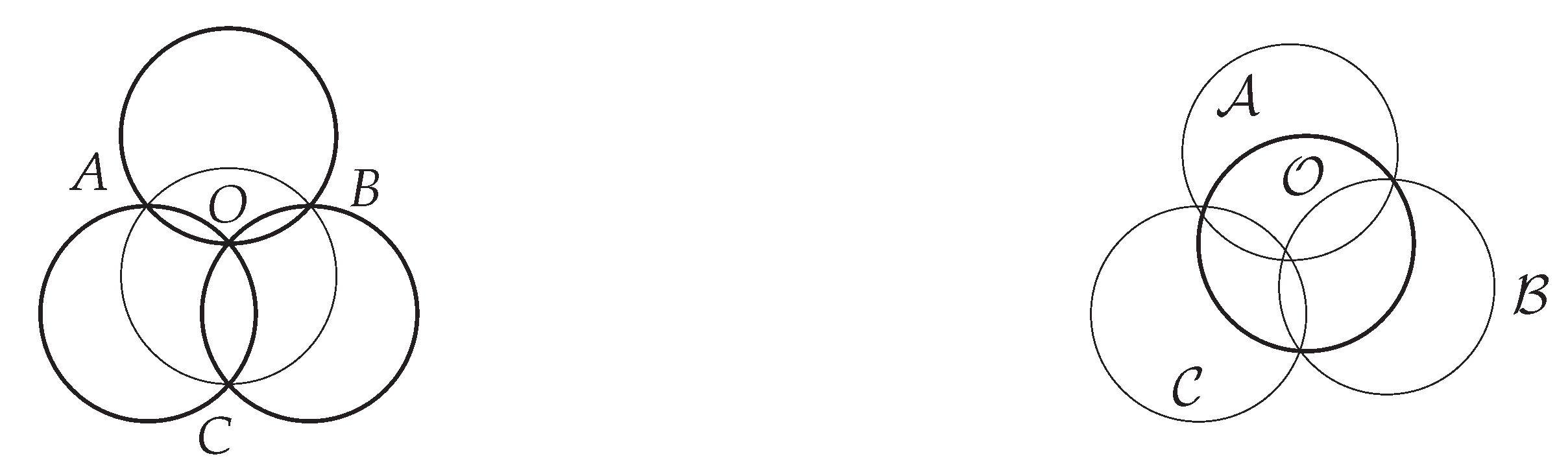
There exist other similar theorems. For example, the dual of the Tzitzeica-Johnson theorem (see the Figure 5).
We consider a new theorem, which is related with “The three coins problem”. We present it in a pictorial manner. All the circles have the same radius. The hypothesis of this theorem starts with an asymmetric picture (see the Figure 6).
We will add more circles below.
We first add a circle through C (see the Figure 7). We call this circle .
Because the first picture was asymmetric, the hypothesis continues to lead to asymmetry in the figures (see the Figure 8, Figure 9 and Figure 10).
The conclusion of the MCP is that the circle through Q and R is tangent to the circle . This can be seen in the following picture (see the Figure 11).
Proof of MCP. We now sketch the proof to the The Many Coins Problem (MCP). It will be based on the Euler’s formula [11]. We will change the perspective a little bit in order to simplify the computations. Also, we will use the symmetries of the figure.
Our approach is to choose as the origin of a Cartesian system the center of the circle , and the x-axis to pass through the center of the circle .
The center of the circle will be . The centers of the circle and will be , respectively . The distance from the centers of the circles and will be .
Suppose that the polar coordinates of C and B are and . Then, the coordinates of the center of are (because these coordinates form a rhombus).
By similar arguments, the coordinates of Q and R are and .
The center of the circle is .
Now, the distance between the center of the circle and the center of the circle is:
.
□
3. Yang-Baxter Equations
The most intuitive interpretation of the Yang-Baxter equations is the simplest form of the Yang-Baxter equations. It is called the set-theoretical Yang-Baxter equation.
If X is a set, let be a function, and .
Definition 3.1.
Using the above notation, the set-theoretical Yang-Baxter equation is the following:
We now give more general definitions. We will be working over a field k. The tensor products will be defined over k. Let V be a vector space over k.
Let be the identity map of the space V.
We denote by the twist map defined by .
For a k-linear map, let
We denote by a linear map acting on the first and third component of .
In fact, .
Definition 3.2.
A
Yang-Baxter operator
is k-linear map , which satisfies the braid condition:
Usually, we also require that the map R is invertible.
Remark 3.3.
If R satisfies (2) then both and satisfy the the quantum Yang-Baxter equation:
Remark 3.4.
We can see that the quantum Yang-Baxter equation is a symmetric equation. The braid condition is asymmetric. We now consider an unifying equations for the quantum Yang-Baxter equation and the braid condition (UYBC):
Theorem 3.5.
The following new solution for UYBC is proposed below:
, and . We require that and .
Proof. This can be checked directly. The left hand side reads:
.
The left hand side reads:
.
□
Remark 3.6.
If and , then is a solution for the quantum Yang-Baxter equation, the braid condition and QYBC.
4. Conclusions and Final Comments
There exists an unifying equation for the braid condition and the quantum Yang-Baxter equation, and it was denoted UYBC. Some solutions for it were given.
The Yang–Baxter equations could be interpreted as a unifying framework for the duality of finite dimensional algebras and finite dimensional coalgebras ([12]). The duality between finite dimensional algebras and coalgebras to the category .
This can be seen bellow, in the following diagram:
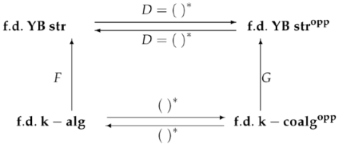
This idea of duality extension will be considered in geometric framework below.
For the Tzitzeica-Johnson theorem there exists a dual theorem (see the Figure 12).
The unification of the Tzitzeica-Johnson theorem and its dual will be given in terms of cones below.
Theorem 4.1.
Let be a cone of vertex O and base the circle .
Let , and be three cones such that and . (So, these three cones are oriented in the opposite direction compared with the first cone.)
Let , and be three cones such that , and . (The orientation of these cones is the same with the orientation of the first cone.) Also, , and .
The conclusion is that there exists a cone of vertex T and base the circle such that and . Of course, the orientation of this cone is opposite to the orientation of the first cone.
Proof. The proof follows from applying both the Tzitzeica-Johnson theorem and its dual.
The Tzitzeica-Johnson theorem can be proved using complex numbers and the Euler’s formula. We chose a Cartesian coordinate system with the origin O. The circles which intersect in O are given by the following equations: , and .
The intersections of these circles which differ from O are given by the following complex numbers:
, and .
So, the fourth circle is given by the equation ,
The dual of the Tzitzeica-Johnson theorem can also be proved using the Euler’s formula. On the unit circle we pick three points: , and .
The circles throught two of these are given by the following equations:
, and .
The conclusion is that the last three circles pass through the point .
□
Remark 4.2.
The dual of the above theorem is the theorem itself, because the dual of a cone is also a cone.
References
- Yang, C.N. Some exact results for the many-body problem in one dimension with repulsive delta-function interaction . Phys. Rev. Lett. 1967, 19, 1312–1315. [Google Scholar] [CrossRef]
- Baxter, R.J. Exactly Solved Models in Statistical Mechanics; Acad. Press: London, 1982. [Google Scholar]
- Baxter, R.J. Partition function for the eight-vertex lattice model . Ann. Physics 1972, 70, 193–228. [Google Scholar] [CrossRef]
- Iordanescu, R.; Nichita, F.F.; Nichita, I.M. The Yang-Baxter Equation, (Quantum) Computers and Unifying Theories . Axioms 2014, 3, 360–368. [Google Scholar] [CrossRef]
- Johnson circles, From Wikipedia, the free encyclopedia. Available online: https://en.wikipedia.org/wiki/Johnson_circles.
- Johnson, R.A. A Circle Theorem. American Mathematical Monthly 1916, 23, 161–162. [Google Scholar] [CrossRef]
- Nichita, F.F. Mathematics and Poetry · Unification, Unity, Union. Sci 2020, 2, 72. [Google Scholar] [CrossRef]
- Nichita, F.F. Unification Theories: Examples and Applications . Axioms 2018, 7, 85. [Google Scholar] [CrossRef]
- Caragiu, F.; Lemeni, A.; Trausan-Matu, S. Language in Mathematics, Science and Artificial Intelligence vs. Language in Theology, Dialog in Absolut / ieromonah Ghelasie Gheorghe; Platytera: Bucuresti, 2007; pp. 293–3007. [Google Scholar]
- Moise, L.D.; Cristea, R. Titeica - reverbertii si permanente ale geometriei in contemporaneitate. In Proceedings, Conferinta Nationala de Invatamant Virtual; 2013; Volume editia a XI-a, pp. 150–156. [Google Scholar]
- Iordanescu, R.; Nichita, F.F.; Pasarescu, O. Unification Theories: Means and Generalized Euler Formulas. Axioms 2020, 9, 144. [Google Scholar] [CrossRef]
- Nichita, F.F.; Schack, S.D. The duality between algebras and coalgebras . Ann. Univ. Ferrara - Sez. VII - Sc. Mat. 2005, vol. LI, 173–181. [Google Scholar] [CrossRef]
Figure 1.
The symmetry of a set of Johnson circles.
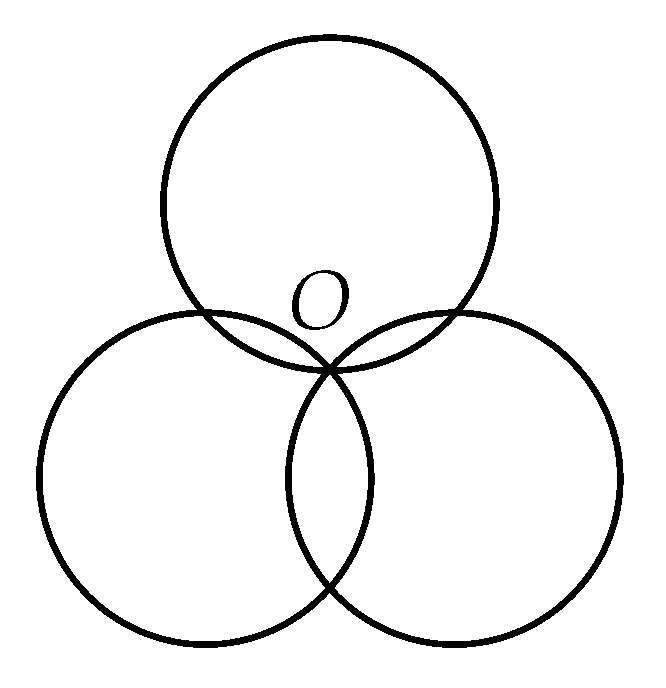
Figure 2.
The Many Coins Problem starts with an asymmetry in the hypothesis.
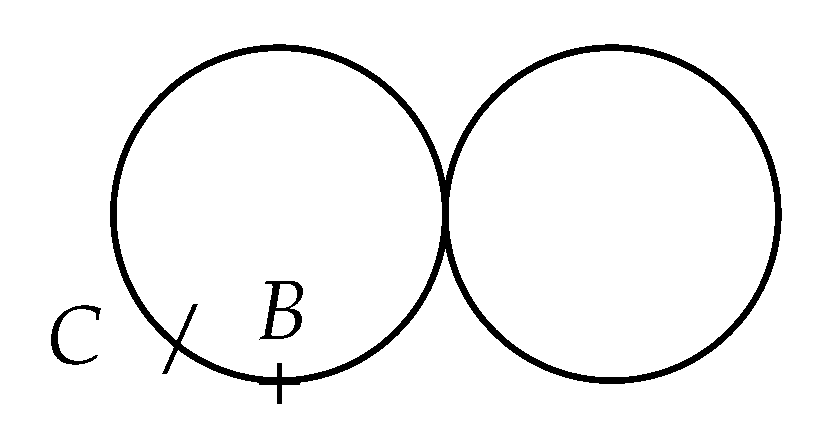
Figure 3.
The Many Coins Problem. The final mosaic.
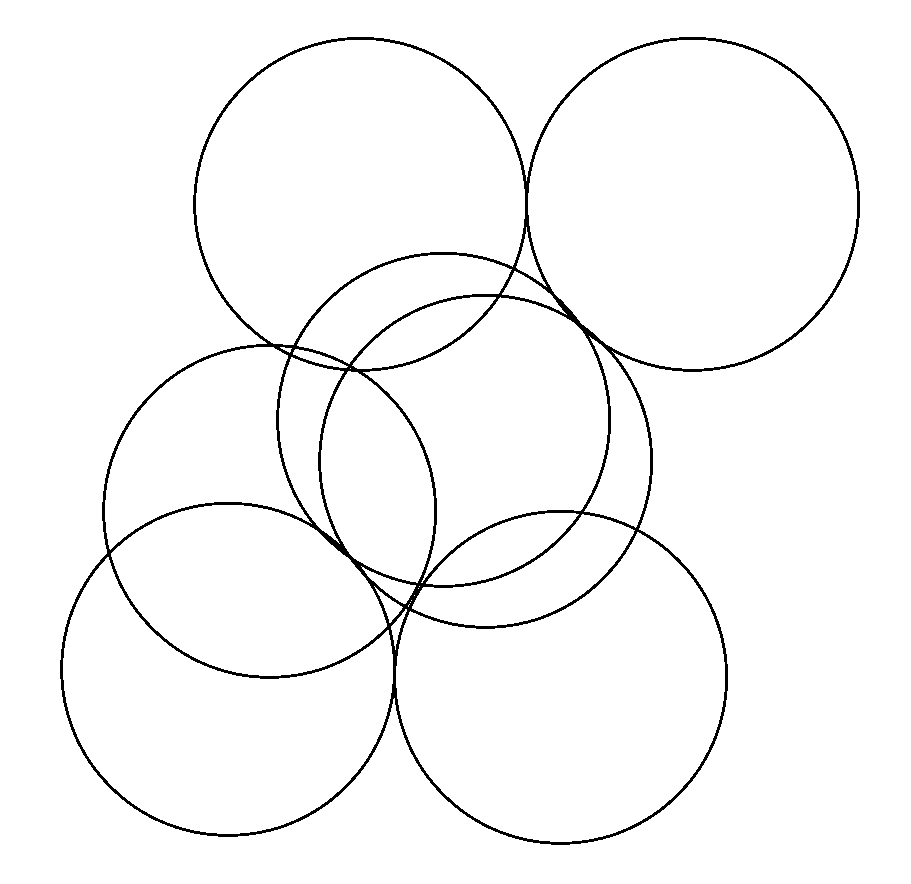
Figure 4.
The three coins problem (Tzitzeica - 1908, Johnson - 1916). Under the above assumptions, there exists a circle with radius r, passing through the points A, B and C.
Figure 4.
The three coins problem (Tzitzeica - 1908, Johnson - 1916). Under the above assumptions, there exists a circle with radius r, passing through the points A, B and C.
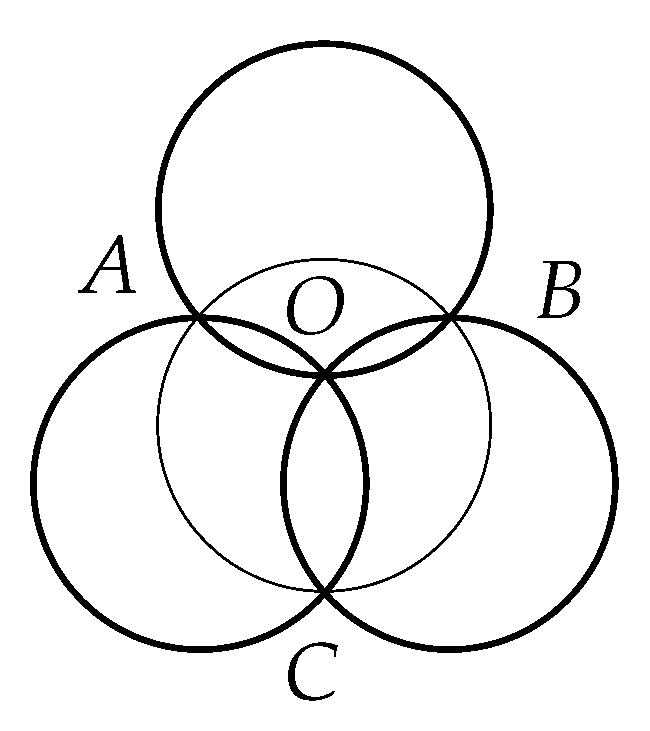
Figure 5.
The dual of the Tzitzeica-Johnson theorem.
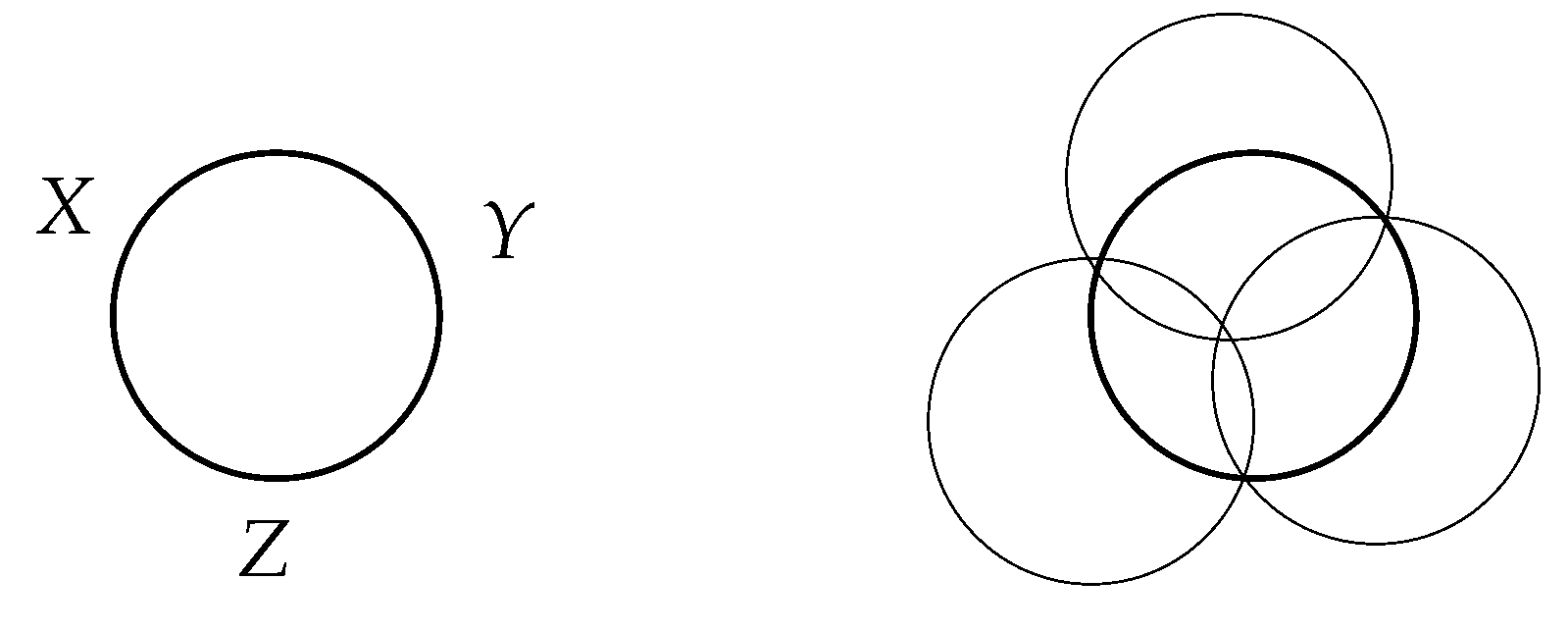
Figure 6.
The Many Coins Problem (MCP). We begin with 2 circles. The points B and C are taken on the first circle. This is an asymmetric picture.
Figure 6.
The Many Coins Problem (MCP). We begin with 2 circles. The points B and C are taken on the first circle. This is an asymmetric picture.
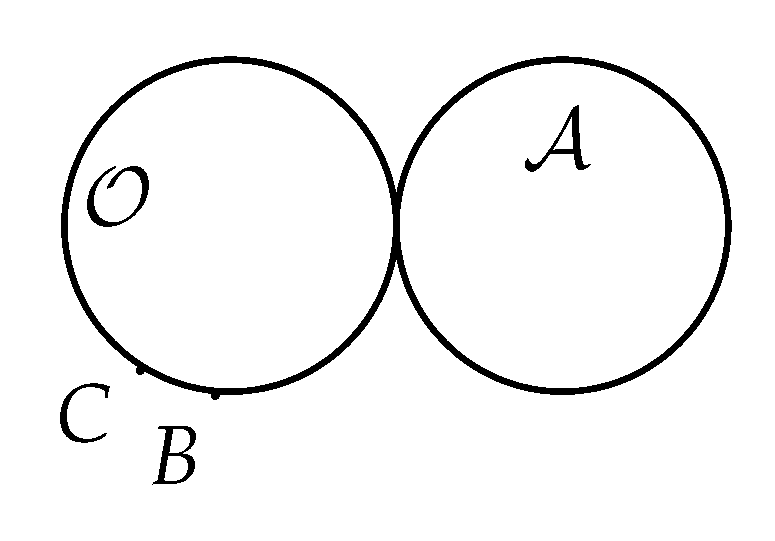
Figure 7.
MCP. A third circle, tangent to the second circle, is drawn through the point C.
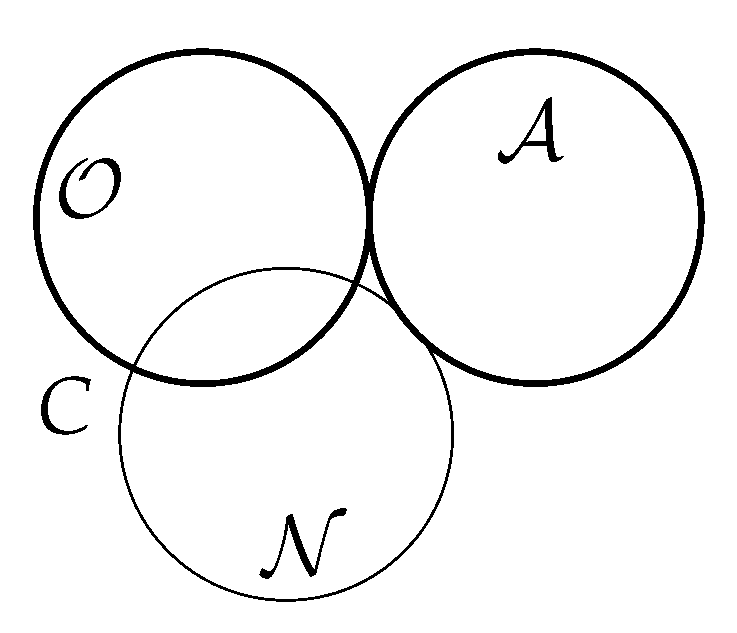
Figure 8.
MCP. A forth circle, tangent to the second circle, is drawn through the point B.
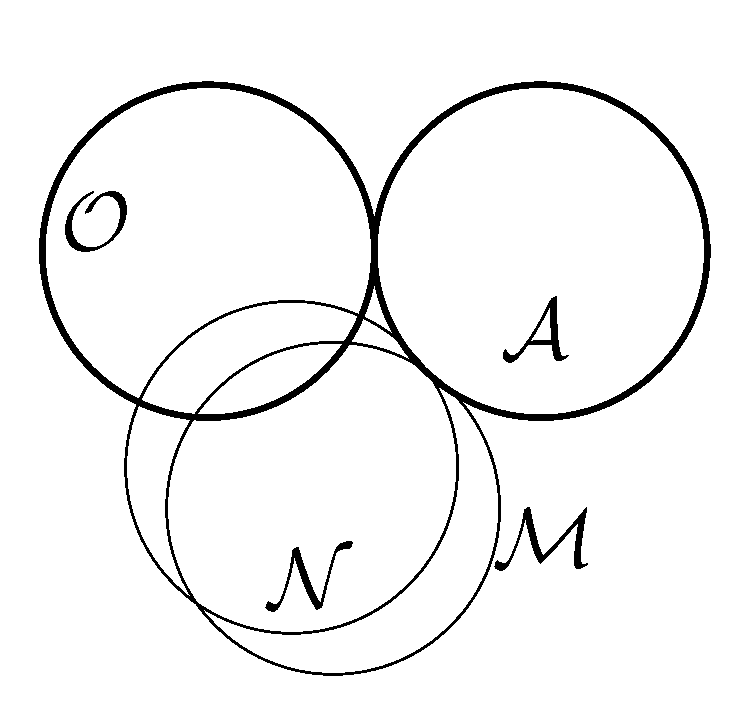
Figure 9.
MCP. A fifth circle is drawn through the points B and C.
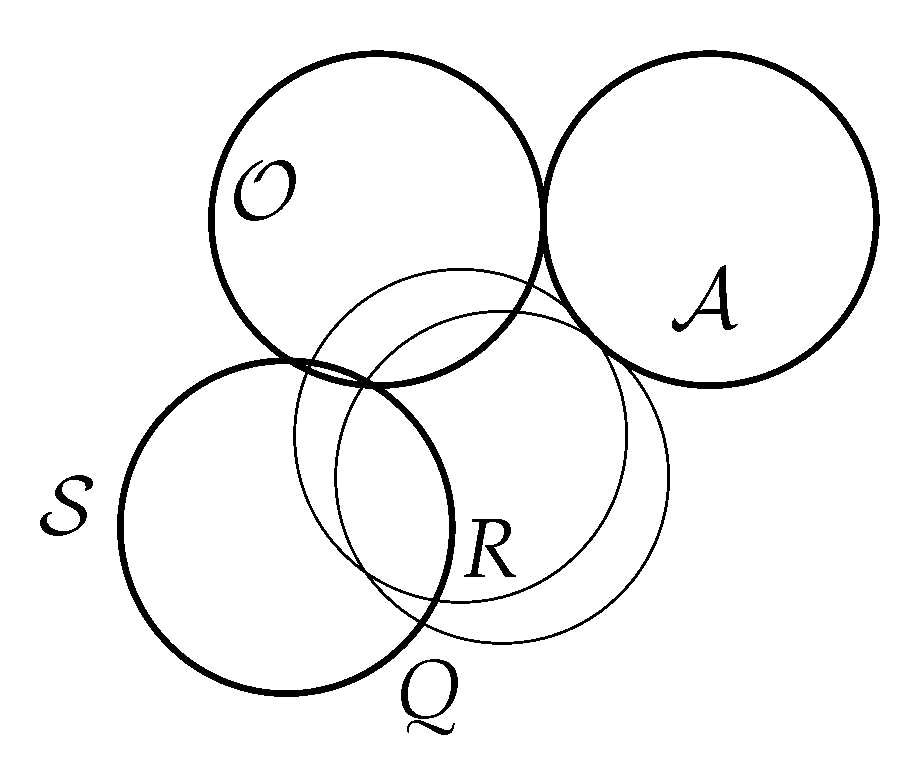
Figure 10.
MCP. A sixth circle, tangent to the circles and is drawn.
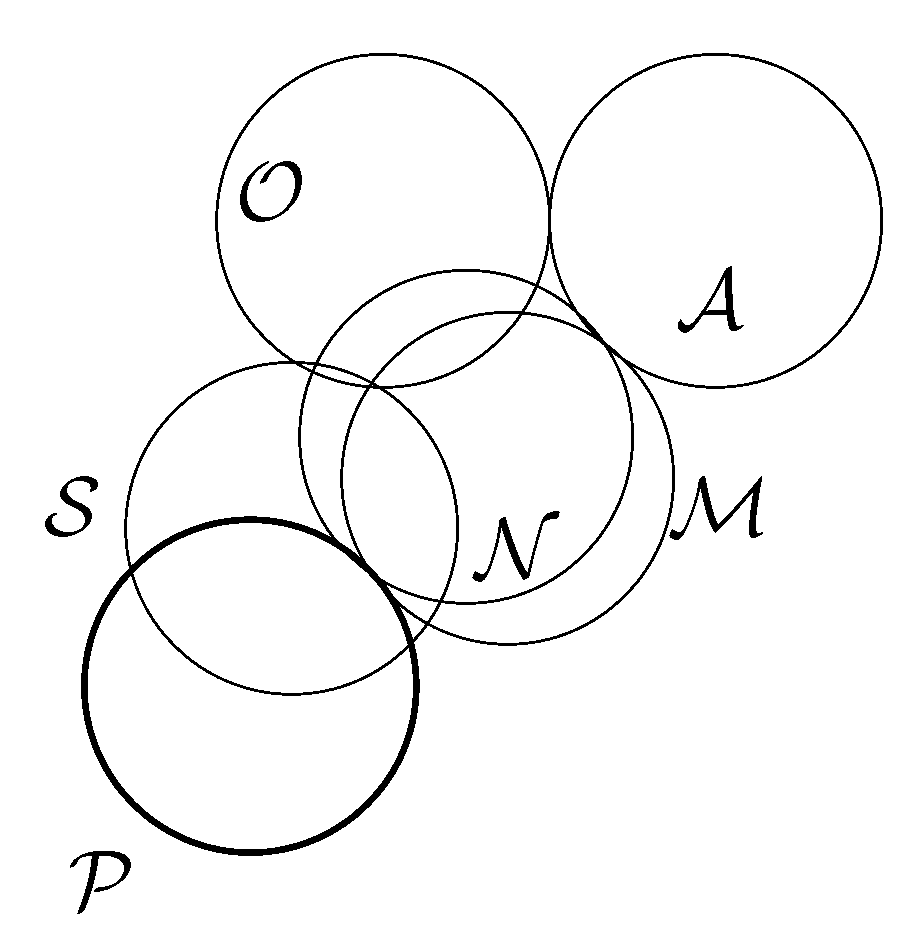
Figure 11.
MCP. Conclusion. The circle through Q and R is tangent to the circle .
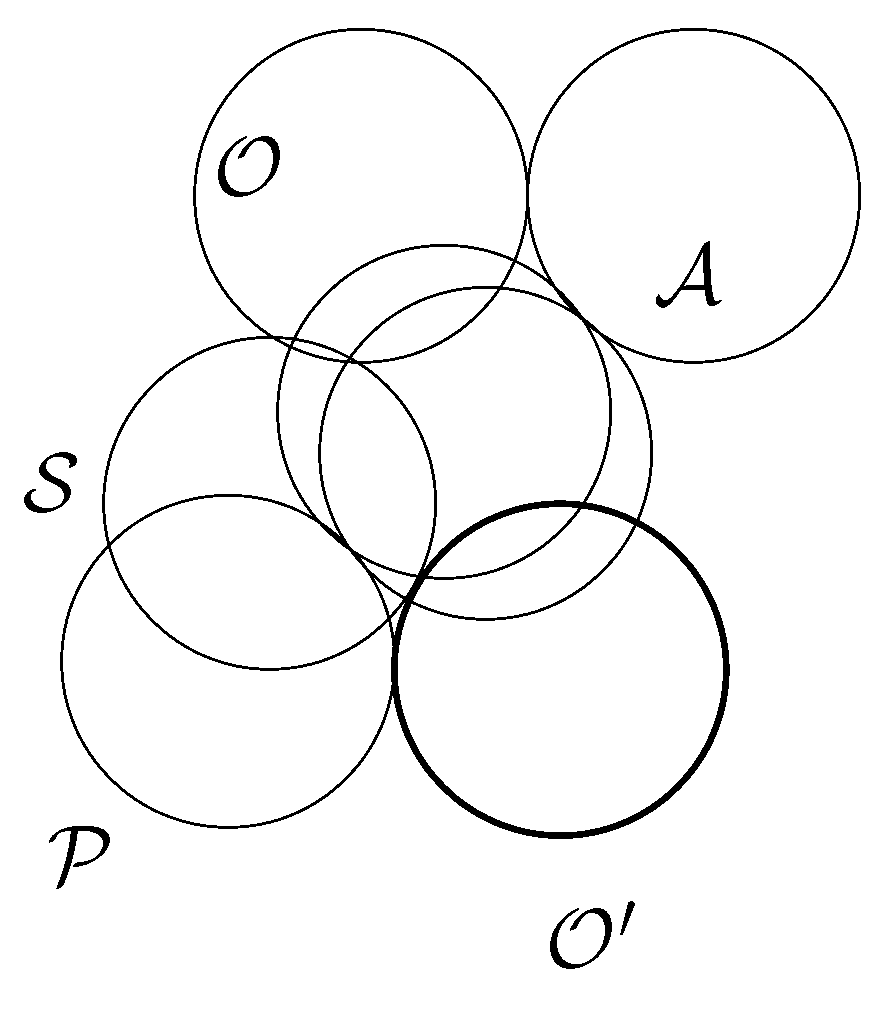
Figure 12.
The Tzitzeica-Johnson’s theorem and its dual.
Disclaimer/Publisher’s Note: The statements, opinions and data contained in all publications are solely those of the individual author(s) and contributor(s) and not of MDPI and/or the editor(s). MDPI and/or the editor(s) disclaim responsibility for any injury to people or property resulting from any ideas, methods, instructions or products referred to in the content. |
© 2025 by the author. Licensee MDPI, Basel, Switzerland. This article is an open access article distributed under the terms and conditions of the Creative Commons Attribution (CC BY) license.
Copyright: This open access article is published under a Creative Commons CC BY 4.0 license, which permit the free download, distribution, and reuse, provided that the author and preprint are cited in any reuse.


