

Submitted:
18 December 2025
Posted:
22 December 2025
You are already at the latest version
Abstract
Bell--CHSH is frequently paraphrased as ``local realism is impossible'' after experimental violations of CHSH. The theorem is correct, but the paraphrase hides a structural assumption: \emph{selection centrality} (fair sampling), i.e.\ that the detected sample is not a setting- and hidden-variable--dependent reweighting of the hidden prior. We give a precise measure-theoretic separation between (i) the \emph{central} sector, where $E_{\mathrm{obs}}=E_{\mathrm{full}}$ and CHSH$\le 2$ holds under measurement independence and locality, and (ii) the \emph{noncentral} sector, where the observed correlations are computed under a reweighted measure $d\nu_{a,b}=w(a,b,\lambda)\,d\rho$. We prove a sharp CHSH inflation bound \[ S_{\mathrm{obs}}\le 2+4\delta, \qquad \delta:=\sup_{a,b}\int |w(a,b,\lambda)-1|\,\rho(d\lambda), \] so reproducing Tsirelson's $2\sqrt2$ by strictly local measurement-independent models via selection requires $\delta\ge (2\sqrt2-2)/4\approx0.2071$. We provide (A) a canonical Radon--Nikod\'ym construction (piecewise constants on sign regions plus a small positive remainder), (B) an explicit local factorized detection-loophole construction that reproduces arbitrary finite correlation tables, and (C) an implementable optics protocol to estimate or upper-bound $\delta$ from time-tag data via window dithering, threshold and spectral sweeps, and auxiliary-tag binning. This paper critiques not the validity of Bell's theorem, but the common overstatement of what CHSH violations imply without an explicit, quantitative centrality audit.
Keywords:
Bell's theorem
; centrality
; non-locality
1. Introduction (What Is Being Critiqued)
Bell’s theorem is a mathematically correct statement: under measurement independence (MI), local response functions, and bounded outcomes, the unconditional correlations obey CHSH. Modern experiments violate CHSH and therefore exclude the central local hidden-variable class provided one has controlled the relevant selection assumptions.
The critique addressed here is narrower and operational:
A CHSH violation implies nonlocality only after one has controlled/justified how the accepted sample is produced—i.e. that the accepted ensemble is not a setting-dependent hidden-variable reweighting large enough to inflate CHSH above 2.
In any real experiment, “the observed sample” is produced by hardware gates, detector thresholds, time-tag rules, coincidence identification, and analysis windows. All of these can be expressed as a setting-dependent selection weight.
A key logical separation, often blurred in informal discussion, is:
- Setting-independence of the accepted hidden ensemble: the same hidden-variable law governs accepted trials for all setting pairs. This is what lets one integrate the CHSH pointwise algebra over a single measure.
- Fair sampling / centrality relative to the hidden prior: the accepted hidden-variable law equals the underlying hidden prior, so that .
The second implies the first, but not conversely.
2. Framework
Let be the (finite or continuous) setting sets for Alice and Bob. Let be a probability space of hidden variables . Measurement independence (MI) means does not depend on .
2.1. Local Outcomes
Outcomes are bounded and local:
with A depending only on and B only on . The deterministic case is included.
2.2. Selection as a Radon–Nikodým Reweighting
Selection/detection/coincidence identification is modeled by an acceptance probability (or acceptance gate)
This is intentionally general: it may represent independent local detections, or a joint post-processing acceptance rule (e.g. time-window coincidence assignment) that depends on both sides’ local records.
Define the acceptance rate
and the normalized Radon–Nikodým density
Equivalently, define the accepted-sample measure by
Remark 1
(Local-factorized detection as a special case). If selection is generated by independent local detection probabilities with acceptance iff both sides detect, then one has
which is the usual “detection loophole” structure. None of the bounds below require factorization; only (1) is used.
2.3. Observed vs. Unconditional Correlations
Define the observed (accepted-sample) correlation
and the unconditional (“full”) correlation
For a CHSH quartet , define
Also define the unconditional CHSH expression
2.4. A Quantitative Noncentrality Statistic
Define the deviation from centrality
Note that and .
3. Where Bell–CHSH Actually Lives: Unconditional and Setting-Independent Sectors
3.1. The Pointwise CHSH Algebra
Lemma 1
(Pointwise CHSH bound). Fix λ. For any and any ,
Proof.
This is the standard CHSH algebra; boundedness is enough. (Determinism is not required.) □
3.2. Unconditional Bell–CHSH (The Theorem Proper)
Theorem 1
(Unconditional Bell–CHSH). Assume MI, locality, and bounded outcomes. Then for any quartet ,
Proof.
Lemma 1 holds pointwise in . Integrate w.r.t. . □
3.3. Setting-Independent Selection (Enough to Apply CHSH to the Accepted Sample)
Definition 1
(Setting-independent selection). Selection issetting-independentif there exists a probability measure ν on Λ such that for all . Equivalently, ρ-a.e. (no setting dependence in the RN density).
Theorem 2
(CHSH on the accepted sample under setting-independent selection). Assume MI, locality, bounded outcomes, and setting-independent selection (Definition 1). Then for any quartet ,
Proof.
Under setting-independent selection, each is an integral of with respect to the same measure . Apply Lemma 1 pointwise and integrate w.r.t. . □
Remark 2 (What setting-independence doesnotgive)Setting-independent selection doesnotimply that the accepted ensemble equals the full ensemble: one can have (hence ) while still having . What breaks CHSH on accepted data issetting dependenceof , not merely .
3.4. Fair Sampling/Centrality (Accepted Ensemble Equals the Hidden Prior)
Definition 2
(Coincidence centrality / fair sampling). Selection iscentral(fair sampling) if
Equivalently, ρ-a.e. for all , or .
Lemma 2
(A sufficient “strong” condition). If factorizes as with no λ-dependence, then selection is central in the sense of Definition 2.
Proof.
If then and hence . □
Remark 3 (Centrality doesnotimply -independent local efficiencies)The converse of Lemma 2 is false: (centrality at the accepted-ensemble level) only forces to be λ-independent for eachpair; it does not force any particular factorization, nor λ-independence of individual local detection probabilities in a factorized model.
Theorem 3
(Centrality identity). Assume MI, locality, bounded outcomes, and central selection (Definition 2). Then
and hence for any quartet .
Proof.
If then by definition. Then by Theorem 1. □
Remark 4 (Hiddenness is irrelevant to thealgebra, but selection is not)Lemma 1 is pointwise in λ. Whether λ is observed or not does not affect CHSH. What matters is whether the four accepted-sample expectations are taken with respect to asinglemeasure (setting-independent selection) or a setting-dependent family (noncentral selection).
4. Noncentral Selection: Universal Deviation and CHSH Inflation Bounds
4.1. Deviation of a Single Correlation
Theorem 4
(Deviation bound). For each ,
Equivalently,
Proof.
so by ,
□
4.2. CHSH Inflation
Theorem 5
(CHSH inflation bound). Assume MI, locality, and bounded outcomes. For any quartet ,
In particular,
Equivalently,
Proof.
Apply Theorem 4 to each of the four setting pairs in and use the triangle inequality inside each absolute value. One obtains
Then apply Theorem 1 to bound . The additional cap holds trivially because each correlation lies in . □
Corollary 1
(Tsirelson noncentrality threshold). If is reproduced by a strictly local, MI model via selection, then necessarily
4.3. Optimality of the Constant 4 (A Saturating Example)
Proposition 1
(Sharpness of the coefficient 4). For any , there exists a measurement-independent, local deterministic model with outcomes in and a setting-dependent acceptance rule such that, for a fixed CHSH quartet, and
Consequently the coefficient 4 in Theorem 5 cannot be improved in general.
Proof 
(Explicit construction). Consider two settings per side, labeled and . Let with the uniform prior (MI).
Define local deterministic outcomes via the following table:
A direct check gives the unconditional correlations
hence .
Now define, for each pair , the RN density
where and .
Since , each has mean 1. Because each and , one checks pointwise that .
Moreover, for one computes
Thus
Finally, realize each via an acceptance probability by choosing
so that (1) holds with . □
5. Constructive Noncentral Models: What Becomes Possible Once Centrality Is Dropped
5.1. Canonical RN-Density Recipe (Measure-Theoretic)
Fix a pair . Suppose there exist measurable disjoint regions with such that
Let be a target correlation and set
Define the unnormalized RN density
where has and is small. Normalize:
Then and , and can be made arbitrarily close to by choosing small.
Remark 5
(Physical realizability vs. pure RN construction). Equation (3) constructs theconditional measure abstractly. To realize viafactorized localdetection functions , one must ensure global consistency across all a and b. The next subsection provides an explicit factorized local construction on a finite setting grid.
5.2. Explicit Factorized Local Construction for Arbitrary Finite Correlation Tables
Fix finite settings and and targets .
Theorem 6
(Finite-table simulation by factorized local detection selection). There exists a probability space , local deterministic outcomes , and factorized local detection indicators such that:
- (a)
- (MI) ρ is independent of ,
- (b)
- (locality) A depends only on and B only on ,
- (c)
- theobservedcorrelations conditioned on coincidence satisfy
Proof
(Construction). Let with the product of the uniform probability measure on and Lebesgue measure on . Write .
Define local detection indicators
Then for setting pair , a coincidence occurs iff ; the coincidence probability is (setting-independent).
Define outcomes
These are local because A depends only on and B depends only on .
Conditioned on coincidence at settings we have and , and . Therefore
Since on coincidences, . □
Remark 6
(What this theorem means and what it does not). This is an explicit detection-loophole (noncentral selection) simulation withfactorized localdetections. It does not contradict Bell’s theorem because it violates setting-independent selection (and hence centrality). Its coincidence rate is and its noncentrality is large; for instance, with deterministic accept/reject one can compute .
6. PV as a Physical Motivation: Fibered Noninjectivity (Optional)
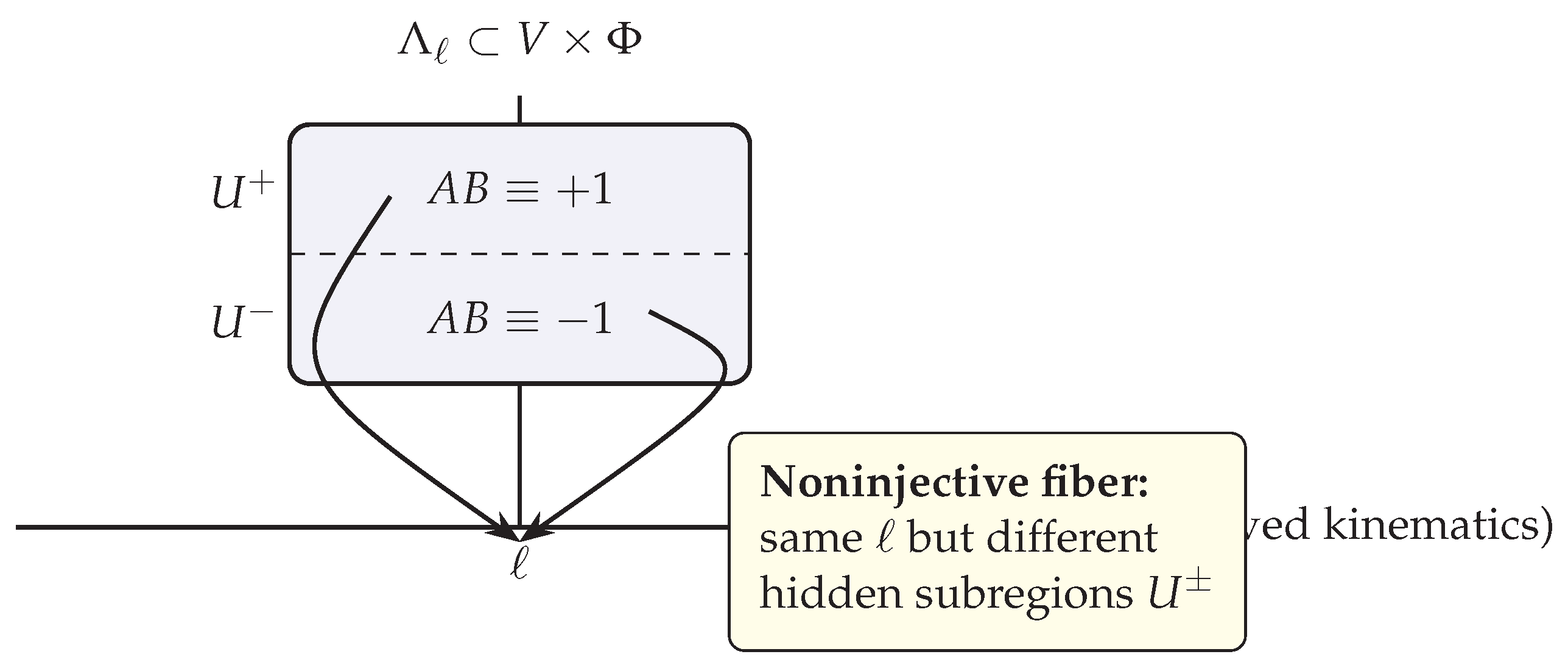
The mathematics above does not require any PV-specific mechanism; any hidden-variable space with selection dependence suffices. A PV narrative can be made precise as follows.
Suppose the hidden state has the form where V is an observed kinematic parameter space and is an auxiliary PV coordinate. Let be an operational kinematic summary (e.g. a Lorentz parameter) that is noninjective on fibers: distinct share the same observed . Then inside a fixed observed cell ℓ, the auxiliary can carry different sign structure for , enabling reweighting without changing the coarse observed kinematics.
Figure 1.
PV-style motivation: noninjective hidden fibers allow internal sign structure inside a fixed observed kinematic cell.
Figure 1.
PV-style motivation: noninjective hidden fibers allow internal sign structure inside a fixed observed kinematic cell.
7. Experimental Audit Protocol: Estimating Resolved Noncentrality and What it Can Certify
The bound makes operationally meaningful if one has an independent upper bound on for the actual selection rule.
However, without event-ready trials and/or additional assumptions, is not identifiable from accepted data alone. What can be estimated robustly from auxiliary tags is a resolved noncentrality that lower-bounds.
7.1. Resolved Noncentrality from an Auxiliary Tag
Let be a measurable tag (arrival-time residual bin, spectral bin, pulse-energy bin, etc.). Define the pushforward measures and on by
Define the coarse-grained RN derivative on bins
(where ; ignore empty bins).
Definition 3
(Resolved noncentrality). Define
Theorem 7 (Data-processing inequality: binning can onlydecrease)For every tag X and every ,
Moreover, if refines X (i.e. X is a function of ), then .
Proof.
Using Jensen’s inequality and conditional expectation,
The refinement monotonicity is the same statement applied to the “forgetful” map from to X. □
Remark 7
(Interpretation). Auxiliary-tag binning gives an empirical handle onhow noncentral selection already is at the resolution X, but it doesnotupper-bound the true hidden δ without an additional assumption such as “selection depends on λ only through X” (i.e. w is X-measurable).
7.2. Protocol Overview (Event-Ready Recommended)
- P1.
- Event-ready trials (if possible). Use heralding to define trials independent of outcomes; otherwise use fixed clock bins and include explicit assumptions about which trials “exist”.
- P2.
- Record rich auxiliary tags X foralltrials. Examples: local arrival times relative to a trial clock, pulse energy monitor, spectral bin, etc. The goal is to enlarge the observed sigma-algebra so that selection becomes more nearly X-measurable.
- P3.
- Estimate acceptance rates. For each and bin i, estimate and .
- P4.
- Compute with uncertainty. Compute and then and . Bootstrap over trials to produce a lower CI (because it is a lower-bound quantity).
- P5.
- Report aresolution curve. Repeat with progressively refined tags (larger K / more coordinates) to observe whether stabilizes or grows.
7.3. Estimators
Let estimated from all trials (accepted or not). For each , estimate
Then
7.4. What Can Be Concluded (And What Cannot)
What can certify.
If is already large (e.g. exceeds the Tsirelson threshold ), then the experiment demonstrably contains strong setting-dependent selection structure at the measured resolution X—strong enough, in principle, to inflate CHSH to quantum-like values.
What is needed to exclude selection-based local explanations.
To exclude strictly local MI models of the “selection inflation” type using the bound , one needs an upper bound on the true . This requires either:
- (i)
- a justified sufficiency assumption (e.g. w is X-measurable up to negligible error), so that ; or
- (ii)
- an independent physical/model-based constraint on how can vary with unmeasured degrees of freedom.
Decision rule (when an upper bound is available).
If an experiment provides an upper confidence bound on (by one of the routes above), and an estimate with standard error , then a one-sided exclusion test is
Window dithering / threshold sweeps (robustness diagnostics).
Repeating the analysis while varying coincidence windows, thresholds, filters, and binning rules is still valuable as a robustness diagnostic: large swings in or under small analysis perturbations are direct evidence that selection rules matter. But such sweeps do not, by themselves, furnish a rigorous upper bound on without explicit modeling assumptions.
8. Conclusions
Bell–CHSH is correct for unconditional correlations (Theorem 1). Whether an observed CHSH violation compels nonlocality depends on the selection semantics: the accepted correlations are expectations under a potentially setting-dependent measure .
The RN density w and its deviation from centrality provide a clean quantitative parameterization of this gap. The universal inflation bound
turns “fair sampling” from a slogan into a measurable requirement: Tsirelson’s demands somewhere if one insists on strict locality and MI with setting-dependent post-selection.
Rather than asserting a blanket “refutation of local realism” from alone, the defensible scientific program is: (i) formalize selection as a measure-theoretic reweighting, (ii) quantify how much noncentrality is needed to mimic a given CHSH violation, and (iii) audit (or explicitly assume) the selection structure in the experimental pipeline.
Appendix A. A Common Mistaken “Local Model” and the Correct Integral
A frequently proposed local deterministic model is
with . Its correlation is not . A direct geometric computation gives a triangular wave in the wrapped distance (with wrapped into ):
extended periodically with period . This cannot exceed CHSH. Obtaining locally requires relaxing setting-independent selection (e.g. setting-dependent post-selection), or relaxing MI, or relaxing locality.
Appendix B. State Semantics for Bell Inference (S0/S1/S3/S4 as an Inferential Template)
This paper uses the same state-semantics logic developed in the PV radical note (S0 strict / S1 bracketed / S3 regularized / S4 blow-up) as an explicit audit tool for the standard Bell–CHSH inference.
Appendix B.1. A Shared Logical Pattern: “Cancellation” Hides a Hypothesis
In the PV note, a CAS output such as
is only meaningful as a generic expression once one has implicitly bracketed away the exceptional locus (i.e. worked in the localization ). In strict semantics, the original radical equation forces and therefore cannot determine v.
Bell–CHSH has an analogous inferential fault line: the step from accepted (post-selected) correlations to unconditional correlations, and the step from four different accepted ensembles to a single ensemble, are both cancellation moves valid only under explicit selection hypotheses.
Recall
and .
Lemma A1
(Measure-identification lemma). Fix . The following are equivalent:
- (i)
- (equivalently ρ-a.e.).
- (ii)
- For every bounded measurable ,
In particular, equality of asinglecorrelation doesnotimply .
Proof. (i)⇒(ii) is immediate. For (ii)⇒(i), equality of integrals for all bounded measurable f implies equality of measures, hence -a.e. by uniqueness of the RN derivative. □
Appendix B.2. Bell States B0/B1/B3/B4 (the PV-Analogue Template)
We now define four Bell-analogue states, deliberately paralleling the PV note.
Definition A1
(Bell-state semantics). Fix a Bell-test model class with MI and locality. Define:
- B0 (strict observational semantics).The accepted-sample correlations are computed under theactualsetting-dependent measures , with no assumption that w is setting-independent or central.
- B1 (bracketed / CHSH-applicable semantics).One adds an explicit selection hypothesis sufficient to integrate the CHSH pointwise algebra over a single measure—e.g. setting-independent selection (Definition 1), and in the stronger fair-sampling form, centrality (Definition 2).
- B3 (regularized semantics).One does not assert w is setting-independent or central, but bounds its deviation from centrality by δ and uses the universal inflation bound .
- B4 (blow-up / resolution semantics).One enlarges the observable sigma-algebra by introducing auxiliary tags X (time residual, spectral bin, pulse-energy bin, etc.) so that selection dependence becomes partially resolved and one can estimate (a lower bound on δ).
Appendix B.3. A Compact Comparison Table (PV S0–S4 vs. Bell B0–B4)
| State idea | PV radical note | Bell inference analogue |
| Strict semantics | S0: original radical equation forces , v underdetermined | B0: accepted data governed by setting-dependent ; CHSH can inflate up to |
| Bracket / generic | S1: add to divide by and get a determinate v branch | B1: add an explicit selection hypothesis (setting-independence; optionally centrality ) to apply CHSH to accepted data |
| Regularize | S3: assign a continuation across (removable singularity convention) | B3: bound and use as controlled near-central inference |
| Resolve / blow-up | S4: add a direction coordinate over the base locus to resolve indeterminacy | B4: add auxiliary tags/partitions to resolve and estimate selection structure () |
Appendix B.4. Diagram: Where the Extra Hypothesis Enters (Modus Ponens Made Explicit)
Remark A1
(What this does and does not “critique”). The critique is not that Bell’s theorem is incorrect. It is that the common inference
silently inserts a B1-style selection hypothesis. Without that, the logically correct strict statement is B0/B3:
and Tsirelson’s demands somewhere if one insists on strict locality and MI.
References
- Bell, J. S. On the Einstein Podolsky Rosen Paradox. Physics Physique Fizika 1964, 1, 195–200. [Google Scholar] [CrossRef]
- Clauser, J. F.; Horne, M. A.; Shimony, A.; Holt, R. A. Proposed experiment to test local hidden-variable theories. Phys. Rev. Lett. 1969, 23, 880–884. [Google Scholar] [CrossRef]
- Pearle, P. M. Hidden-variable example based upon data rejection. Phys. Rev. D 1970, 2, 1418–1425. [Google Scholar] [CrossRef]
- Garg, A.; Mermin, N. D. Detector inefficiencies in the Einstein-Podolsky-Rosen experiment. Phys. Rev. D 1987, 35, 3831–3835. [Google Scholar] [CrossRef] [PubMed]
- Eberhard, P. H. Background level and counter efficiencies required for a loophole-free Einstein-Podolsky-Rosen experiment. Phys. Rev. A 1993, 47, R747–R750. [Google Scholar] [CrossRef] [PubMed]
- Hensen, B.; et al. Loophole-free Bell inequality violation using electron spins separated by 1.3 kilometres. Nature 2015, 526, 682–686. [Google Scholar] [CrossRef] [PubMed]
- Giustina, M.; et al. Significant-Loophole-Free Test of Bell’s Theorem with Entangled Photons. Phys. Rev. Lett. 2015, 115, 250401. [Google Scholar] [CrossRef] [PubMed]
- Shalm, L. K.; et al. Strong Loophole-Free Test of Local Realism. Phys. Rev. Lett. 2015, 115, 250402. [Google Scholar] [CrossRef] [PubMed]
Disclaimer/Publisher’s Note: The statements, opinions and data contained in all publications are solely those of the individual author(s) and contributor(s) and not of MDPI and/or the editor(s). MDPI and/or the editor(s) disclaim responsibility for any injury to people or property resulting from any ideas, methods, instructions or products referred to in the content. |
© 2025 by the authors. Licensee MDPI, Basel, Switzerland. This article is an open access article distributed under the terms and conditions of the Creative Commons Attribution (CC BY) license (http://creativecommons.org/licenses/by/4.0/).
Copyright: This open access article is published under a Creative Commons CC BY 4.0 license, which permit the free download, distribution, and reuse, provided that the author and preprint are cited in any reuse.


