

Submitted:
17 December 2025
Posted:
18 December 2025
You are already at the latest version
Abstract
Stimuli-responsive hydrogels are an emerging class of smart materials with immense potential across biomedical engineering, soft robotics, environmental systems, and advanced manufacturing. In this review, we present an in-depth exploration of their material design, classification, fabrication strategies, and real-world applications. We examine how a wide range of external stimuli—such as temperature, pH, moisture, ions, electricity, magnetism, redox conditions, and light—interact with polymer composition and crosslinking chemistry to shape the responsive behavior of hydrogels. Special attention is given to the growing field of 4D printing, where time-dependent shape and property changes enable dynamic, programmable systems. Unlike existing reviews that often treat materials, stimuli, or applications in isolation, this work introduces a multidimensional comparative framework that connects stimulus-response behavior with fabrication techniques and end-use domains. We also highlight key challenges that limit practical deployment—including mechanical fragility, slow actuation, and scale-up difficulties—and outline engineering solutions such as hybrid material design, anisotropic structuring, and multi-stimuli integration. Our aim is to offer a forward-looking perspective that bridges material innovation with functional design, serving as a resource for researchers and engineers working to develop next-generation adaptive systems.
Keywords:
stimuli‐responsive hydrogels
; 4D printing
; adaptive materials
; shape‐morphing systems
; hydrogel actuators
; functional material design
; advanced manufacturing
1. Introduction
Hydrogels are 3D polymer structures capable of holding large quantities of water. These networks are stabilized by crosslinks, which can either be formed through chemical bonds (covalent) or physical forces (such as hydrogen bonds, van der Waals interactions, or electrostatic forces). These crosslinks help the hydrogel maintain its structure despite the high-water content [1,2]. The first hydrogel material was reported in the literature in 1960 by Wichterle and Lim. They developed a biocompatible polyhydroxyethyl methacrylate hydrogel, which was used in long-term contact with human tissues, including applications like contact lenses and arterial implants [3]. Hydrogels can be produced from nearly any water-soluble polymer, encompassing a broad spectrum of chemical compositions and bulk physical properties. Moreover, hydrogels can be designed in various physical forms, including slabs, microparticles, nanoparticles, coatings, and films [4].
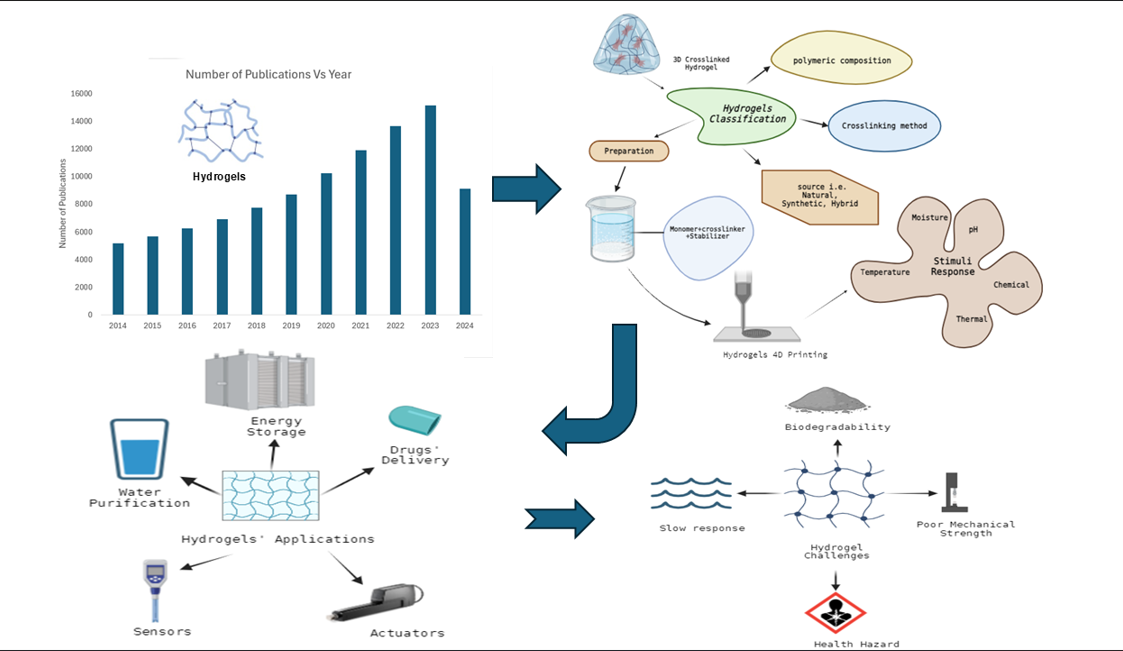
In recent decades, advanced hydrogel materials have garnered significant research interest [5]. Figure 1. shows the number of publications on the topic of hydrogels in the last decade. Due to their tunable properties and functionalities, along with their simple preparation methods, hydrogels play a vital role in various biomedical and engineering applications. These applications include tissue-engineering scaffolds, drug-delivery systems, soft contact lenses, antifouling coatings, sensors, actuators, soft robotics, and wastewater treatment [6,7,8,9,10,11,12,13]. Furthermore, stimuli-responsive hydrogels can react to various stimuli such as light [14,15], pH [16,17], temperature [18,19], Electricity [20,21], and magnetism [22,23], leading to changes in volume or shape. Research has demonstrated that multi-responsive hydrogels, including poly(N-isopropylacrylamide)/Chitosan and polyvinyl alcohol crosslinked with polyacrylamide, have made significant advancements in the fields of intelligent sensors, actuators, and targeted drug delivery systems for cancer cells [24,25]. Hydrogels derived from natural polymers, such as chitosan and keratin (including polylactic keratin), are extensively studied for their applications in developing organic light-emitting diode and liquid crystal display materials, as well as specialized drug delivery systems [26,27].
Recently emerging from 3D printing technology, 4D printing showcases significant potential and promising capabilities for a wide range of applications [28]. 4D printing was initiated and coined by a research group at Massachusetts Institute of Technology [29]. It leverages the rapid advancements in smart materials, 3D printing technology, and mathematical modeling and design [30]. 4D printing was originally defined as "4D printing = 3D printing + time," emphasizing the added dimension of time, where printed structures can change shape or function over time in response to external stimuli. Figure 2. provides a basic illustration of the 4D printing concept, showing how the shape, properties, or functionality of a 3D-printed structure can evolve over time [31,32,33]. 4D printing represents a deliberate advancement of the 3D printed structure, encompassing changes in shape, properties, and functionalities. It facilitates self-assembly, multifunctionality, and self-repair capabilities. Additionally, it is characterized by its time-dependence, independence from specific printers, and predictability. Unlike traditional 3D-printed devices, 4D-printed devices can interact with their environment by responding to external stimuli, generating various outputs such as mechanical movements or biological responses. As a result, 4D printing techniques have attracted significant attention in both academic and industrial fields [34].
The emergence of hydrogels through 4D printing has captured the attention of scholars and scientists, leading to a wave of discoveries and advancements in this innovative area [36,37,38,39,40]. The convergence of hydrogel innovation with 4D printing not only highlights the interdisciplinary partnerships propelling the next wave of smart technology but also the swift advancement of material science. Hydrogels in 4D printing have enormous promises and might have revolutionary effects on both business and daily life as research into the material advances.
Several excellent reviews have already surveyed stimuli-responsive hydrogels and hydrogel-based additive manufacturing from different perspectives. Koetting et al. and Ullah et al. [41,42] provided broad overviews of stimulus-responsive hydrogels, emphasizing fundamental theory, classification, and biomedical applications. Sun et al. and Hendi et al. [43,44] focused on specific sensing and healthcare-related implementations, while Nasution et al. [45] in Gels discussed cellulose-based hydrogels with an emphasis on crosslinking effects. Champeau et al. [46] reviewed 4D printing of hydrogels from a process and materials perspective. More recently, dedicated reviews appeared on Gels related to stimuli-responsive hydrogels and their applications, on smart drug-delivery carriers based on stimuli-responsive hydrogels and nanogels, and on 3D-printed hydrogels for diverse applications, which together consolidate the state of the art in hydrogel chemistry, stimuli-driven functions, and printing technologies [47,48,49].
In contrast to these earlier works, this review specifically targets stimuli-responsive hydrogels for 4D printing and adaptive engineering systems. We introduce a multidimensional classification framework that simultaneously links (i) stimulus type (thermal, pH, moisture, ionic, electric, magnetic, redox, and light), (ii) hydrogel composition and crosslinking chemistry, and (iii) fabrication strategies, with particular attention to 3D/4D printing methods and printed architectures. By integrating this framework with an extensive comparative table that maps materials, fabrication techniques, and end-use domains, we move from a purely material- or application-centric perspective to a design-oriented, system-level view. Furthermore, we synthesize engineering guidelines to tackle practical bottlenecks such as mechanical fragility, slow actuation, environmental stability, and scale-up, thereby positioning this work as a bridge between stimuli-responsive hydrogel science and functional device engineering in biomedical, soft robotic, environmental, and energy-related applications.
2. Classification of Hydrogels
Hydrogels can be classified in various ways. However, since hydrogels are fundamentally composed of cross-linking networks, they can be categorized based on their cross-linking methods into two main types: (a) physically cross-linked or self-assembled hydrogels, and (b) chemically cross-linked hydrogels [50,51]. Several types of chemical and physical hydrogels have been developed using natural and synthetic polymers, and they have been utilized in a wide range of applications. Physical or chemical interactions or functional groups involved in the synthesis enhance the hydrogel structure, creating a new compound tailor for specific applications. The key components necessary for hydrogel production are illustrated in Figure 3
2.1. Classification Based on Crosslink Type
Hydrogels can be categorized based on the nature of their crosslinking mechanisms, which significantly influence their structural integrity, mechanical properties, and responsiveness to external stimuli. There has been a growing research interest in physically crosslinked or reversible gels because they are relatively easy to synthesize and do not require any crosslinking agents [52]. Polymer chains can be physically crosslinked using various external stimuli, such as pH and temperature, along with different physicochemical interactions. These include hydrophobic interactions, hydrogen bonding, electrostatic interactions, stereo-complexation, and supramolecular chemistry. Although physically crosslinked hydrogels exhibit significantly inferior mechanical properties compared to chemically crosslinked hydrogels, they offer a safer and cleaner alternative.
Chemically crosslinked gels, also known as 'permanent' gels, are networks created through covalent bonds by employing diverse synthetic strategies to crosslink polymer chains [53]. The covalent bonds between polymer chains are formed through chemical cross-linking, which can occur either in solution or in the dry state. These gels are generally created by: i) polymerizing a hydrophilic monomer with a multifunctional cross-linking agent, or ii) cross-linking pre-formed water-soluble polymers. Chemical cross-linking methods include (i) radical polymerization [54], (ii) photo-polymerization [55], (iii) enzymatic reactions [56], and (iv) covalent cross-linking via linkers [57].
2.2. Classification Based on Source
Hydrogels can be categorized into three groups based on whether they originate from natural, synthetic sources [58] or hybrid. Figure 4. represents the types of materials used for hydrogel synthesis based on their origin.
2.2.1. Natural Hydrogels
Natural hydrogels are created using biopolymers such as proteins (e.g., collagen, gelatin, fibrin) and polysaccharides (e.g., hyaluronic acid, chitosan, dextran, alginate). These hydrogels are biodegradable and produce low-toxicity byproducts. However, they often face limitations due to inadequate mechanical strength [59].
2.2.2. Synthetic Hydrogels
Synthetic hydrogels are created through chemical polymerization of artificial monomers. They can be classified as homopolymeric, copolymeric, multipolymeric, polymer blends, or interpenetrating polymer network hydrogels. These hydrogels are synthesized using techniques such as bulk polymerization, solution polymerization, or inverse suspension polymerization. The main advantages of these hydrogels include precise control during mass production and the ability to customize their properties across a broad spectrum. Disadvantages include low biodegradability and the potential incorporation of toxic substances from crosslinkers and the synthesis environment [59].
2.2.3. Hybrid Hydrogels
To address the limitations of both natural and synthetic hydrogels, hybrid hydrogels composed of both natural and synthetic materials are synthesized. These hydrogels exhibit multiple functionalities and enhanced chemical, and physical properties [60]. Natural polymers, such as chitosan, collagen, and dextran, are frequently combined with synthetic polymers PVA and PNIPAM to create hybrid hydrogels. The integration of these diverse materials leads to hydrogels with superior properties and functionalities, tailored for specific applications [61].
2.3. Classification According to Polymeric Composition
Hydrogels are categorized based on the types of polymers that were utilized in their creation, which is known as the polymeric composition of these materials. This taxonomy aids in comprehending the characteristics, uses, and actions of various hydrogels. Typically, there are three primary categories [62]:
2.3.1. Homopolymeric Hydrogels
Homopolymers are polymer networks created from a single type of monomer that has undergone cross-linking. In these networks, the same monomer acts as the fundamental structural unit. The characteristics of the monomer and the polymerization methods used dictate whether a homopolymer is cross-linked or uncrosslinked. Examples of cross-linked homopolymeric hydrogels include poly(hydroxyalkyl methacrylate), poly(3-hydroxypropyl methacrylate), and poly(2-hydroxyethyl methacrylate) [63,64]. Examples of uncrosslinked homopolymeric hydrogels include poly(N-vinyl-2-pyrrolidinone) and PEG[65].
2.3.2. Copolymeric Hydrogels
These hydrogels are produced by cross-linking two co-monomer units, with at least one of the units being hydrophilic [66]. Copolymers can have block, graft, alternating, or random network structures, depending on the arrangement of the monomers. They can be cross-linked either physically or chemically using a variety of polymerization methods.
2.3.3. Multipolymer Interpenetrating Polymeric Hydrogel
The first IPN was developed in 1914 by Jonas Aylsworth, who blended natural rubber with sulfur [67]. Multipolymer hydrogels are created by polymerizing and cross-linking three or more monomers [68]. IPNs, often described as "alloys" of cross-linked polymers, contain at least one polymer that is synthesized and/or cross-linked in the presence of another polymer. These networks interlace without forming covalent bonds between them, making it impossible to separate them without breaking chemical bonds [69,70]. A common method for creating IPNs involves immersing a pre-polymerized hydrogel in a solution containing monomers and initiators. The interlocking arrangement of the cross-linked IPN components improves the stability of both the bulk and surface morphology. This process can produce moderately dense hydrogel matrices with stiffer and more robust mechanical properties [42,71].
The grouping of hydrogels according to their source, physical characteristics, structural makeup, and network structure provides important information on their applications and roles. IPNs and multipolymer systems increase the use and versatility of hydrogels, which come in natural, synthetic, and hybrid kinds, each with its advantages. This classification not only facilitates the selection of hydrogels for certain applications but also fosters advancements in hydrogels, resulting in creative solutions across numerous industries.
3. Stimuli-Responsive Hydrogels
Stimuli-responsive hydrogels are a diverse group of hydrogels that can undergo switchable transitions from gel to solution or gel to solid in response to external stimuli. Stimuli-responsive hydrogels can exhibit swelling changes in response to external stimuli such as pH, temperature, ionic strength, electric fields, magnetic fields, light, and chemical triggers [44,72,73]. They undergo reversible or irreversible changes in physical properties and chemical structures. Due to their excellent biocompatibility, sensitivity to external stimuli, and high water-retention, hydrogels with three-dimensional (3D) cross-linked network structures have been widely used in a broad range of applications [74,75]. Figure 5. represents the illustration of response which can generate stimuli in smart hydrogels.
Hydrogels are utilized in 4D printing for their swelling properties, which enable the creation of shape-morphing structures [76]. As the movement of ions, molecules, and water into the hydrogel primarily occurs through diffusion, the time required for volumetric changes is influenced by the diffusion distance or the size of the hydrogels [77]. Scaling down the size of hydrogel structures to micrometers can result in response times ranging from a few seconds to sub-seconds [78].
Numerous applications of stimuli-responsive hydrogels have been proposed, including their use as functional matrices for sensing, actuators, and biomedical applications such as controlled drug release, tissue engineering, and imaging. Additionally, stimuli-triggered hydrogels have been utilized to construct catalytic switches, logic-gate operations, surfaces for controlled cell growth, and more [79].
In this section, we will discuss the smart hydrogels and different response stimuli (moisture, temperature, pH, etc.) that elicit their responses. Investigating the mechanisms underlying these stimuli-responsive behaviors will help us create and improve hydrogels for a wider range of functional requirements, improving their performance and increasing the range of possible scientific and technological uses. Furthermore, we will delve into the limitations and strong pursuits of each response. To give the reader an overview of the recent publications, Table 1. represents commonly reported stimuli-responsive hydrogel matrices including various types that respond to different stimuli, fabrication techniques, and applications.
3.1. Moisture-Responsive Hydrogels
Hydrogels are distinguished by their ability to absorb a substantial amount of water or moisture without dissolving. Once absorbed, water is difficult to remove, even under pressure [80,81]. Additionally, the substantial amount of absorbed water leads to swelling, causing significant -volume expansion. This large volume change during the wetting and drying process can result in notable alterations in surface morphology or the overall configuration [82]. The swelling and deswelling behaviors in response to changes in environmental humidity have been leveraged to create responsive hydrogel structures [34]. Jingjing Li et al. [83] explored a Yin–Yang-interface design, they combined a moisture-responsive polyacrylamide hydrogel layer (Yang) with a moisture-inert polyethylene terephthalate layer by using an interfacial poly(2-ethylhexyl acrylate) adhesion layer to develop actuators. The PAM hydrogel is moisture-sensitive, allowing water molecules to infiltrate its network and cause volume swelling through intermolecular hydrogen bonds. Conversely, PET polymer films are moisture-inert and do not exhibit significant volume changes. Consequently, when the actuating film is placed in a humid environment, an asymmetric volume expansion occurs, causing it to bend towards the PET side. Figure 6 (a). represents the controllable morphing of the YYI actuator in response to varying humidity levels. Yuan Yao et al. [84] developed a zwitterionic lanthanide-based supramolecular hydrogel ink for 3D-printable hydrogel actuators, showcasing humidity-sensitive luminescence adjustability and deformation capabilities. The fluorescence color tuning is accomplished through the competing effects of nonconjugated chromophores and dynamically coordinated Eu³⁺ ions, while the change in opacity results from the phase separation or dissolution of neutralized zwitterionic polymers in dehydrated or hydrated states. Figure 6 (b). demonstrates time-lapse images of the biomimetic anthesis process of the initially fully swelled printed hydrogel flower. In another study related to actuators, Yifan Zheng et al. [85] created a highly stretchable and durable hydrogel based on poly(vinyl alcohol) for reprogrammable actuators. The actuator was formed using a freeze-thaw treatment of a mixture comprising PVA, mono(9-anthracenemethyl) succinate-grafted PVA (PVA-SA-AN), tannic acid, and cetyltrimethylammonium bromide, followed by UV irradiation. The hydrophilic nature of the PVA substrate provided excellent water absorption, allowing the actuator to be actuated by water. Additionally, the incorporation of PVA-SA-AN and CTAB granted the actuator reversible programmability.
A conductive hydrogel is a semi-solid, three-dimensional interconnected porous network that features adjustable chemical and physical interactions along with excellent conductivity [86,87]. Zhenzhen Liu et al. [88] developed highly compressible conductive hydrogel sensors that exhibit synergistic properties, including long-lasting moisture retention, extreme temperature tolerance, and strain sensitivity. In this study, a dual-crosslinked hydrogel electrolyte was developed by immersing a photo-crosslinked polyvinyl alcohol (PVA-W) hydrogel in a solvent containing tannic acid, NaCl, glycerin, and water. These hydrogel electrolytes are easily fabricated, cost-effective, and demonstrate high performance, making them promising candidates for various multifunctional flexible electronic applications, such as technology wearable, devices energy storage and biosensors.
Water evaporation and freezing in hydrogels result in poor drying and freezing tolerances, respectively, which significantly restrict their durability, stability, and range of applications [89]. A high-strength, antifreeze, and moisturizing conductive hydrogel containing glycerin has been developed by Yinjie Peng et al. [90] for human motion detection. Although adding glycerin enhanced the antifreeze and moisturizing characteristics, it led to a decrease in mechanical properties, including maximum stress and elongation at break. To improve both mechanical strength and antifreeze properties, PAA and glycerin were introduced into the PVA/PEDOT hydrogel network using a two-stage soaking method. The addition of PAA considerably increased the mechanical properties, while glycerin contributed to the hydrogel's antifreeze and moisturizing abilities.
Cellulose has recently attracted scientific interest for its potential use in producing moisture-sensitive films due to its sustainability [91]. A study [92] details the synthesis and thorough characterization of water-responsive hybrid hydrogels composed of CMC and PVA, using citric acid as the crosslinking agent. This approach results in tunable physicochemical properties. The hydrogels were engineered to display flexible swelling characteristics by adjusting the molecular weight of CMC, the degree of substitution, and the degree of hydrolysis of PVA. These factors were linked to the synthesis conditions, the CMC/PVA ratio, and the level of chemical crosslinking (CA/CMC ratio), allowing for the creation of tailored hybrid networks. The water-responsive behavior was notably affected by the concentration of the CA crosslinker and the incorporation of PVA as a modifier in the CMC-based network. In a separate study, Jie Wei et al.[93] developed a durable and conductive composite film humidity actuator by leveraging the combined effects of one-dimensional CNFs , CNTs, and two-dimensional GO through an efficient vacuum-assisted self-assembly technique. This composite film integrates cellulose CNFs, GO, and CNTs for a humidity-responsive actuator, where CNFs and GO absorb moisture through hydrogen bonding, while CNTs enhance water transport, resulting in volume expansion and actuation in response to humidity changes. Figure 6 (c). represents the deformation and underlying mechanisms of the CNF/GO/CNT composite film.
Moisture-driven hydrogels serve as executive devices capable of performing a wide range of complex tasks. One crucial performance metric for these hydrogels is their response speed to changes in ambient humidity. Despite their ease of fabrication and manufacturing moisture-driven hydrogels show slow response which limits their applications [94].
3.2. Thermo-Responsive Hydrogels
Temperature is a commonly used external stimulus to induce shape deformation and geometric arrangement in responsive materials, as it can be easily controlled and applied non-invasively [125]. Thermo-responsive materials are a type of smart material that reacts to changes in temperature [126]. Thermosensitive hydrogels exhibit unique behavior: they form a gel at higher temperatures and revert to a liquid state at lower temperatures within a specific temperature range. This behavior is contrary to the conventional melt transition behavior typically observed in many materials [127]. This gelation process does not necessitate any supplementary assistance or triggers like enzymes; thus, it is regarded as a harmless phase transition method [128].
PNIPAm is a representative stimuli-sensitive polymer known for being noncytotoxic and exhibiting temperature-dependent shape transformation [129]. The LCST is the pivotal temperature at which components in a mixture become immiscible. In polymer solutions, this usually triggers a transition from a coil to a globule, minimizing contact with the solvent [130]. Among thermo-responsive homopolymers, PNIPAm has well-characterized structure and its LCST of 32°C [131,132,133]. Tobias Spratte et al. [134] made a novel approach to fabricate PNIPAM-based microactuator systems with precise designs using DLW, allowing for a thorough investigation of their shrinkage and swelling characteristics. This process involves the polymerization of a photo-sensitive resistive hydrogel composed of NIPAM monomers, MBA comonomers, and lithium phenyl-2,4,6-trimethylbenzoylphosphinate (LAP) as a PI via two-photon absorption. Both 2D cross-sectional analyses and 3D volumetric comparisons of the hydrogel structures were conducted before and after shrinkage at temperatures of 22°C and 45°C. In another research article, Lukas Bauman et al. [135] prepared composite double-network hydrogel with multi-thermo-responsive properties using VAT polymerization. A multi-thermo-responsive hydrogel was developed by enhancing a PNIPAM (PNIPAm) thermo-responsive network with Pluronic P123 diacrylate, making it suitable for photopolymerization 3D printing. Notably, the hydrogel demonstrated significant variations in strength as it collapsed, aligning with the expected behavior of PNIPAm-based hydrogels. The incorporation of two thermo-responsive components resulted in two distinct LCSTs instead of a single shifted LCST. Figure 7 (a-c). demonstrates the hydrogel resin showcases excellent fidelity in printing. PNIPAM can be utilized in multifunctional bioelectronic devices suitable for extended temperature monitoring and drug delivery applications. In a study related to the development of multifunctional Organic Electrochemical Transistors, Naroa Lopez-Larrea et al. [136] produced a thermo-responsive hydrogel composed of poly(3,4-ethylenedioxythiophene) doped with poly(styrene sulfonate) (PEDOT:PS PNIPAM. The PEGDA was used as a cross-linker and a commercial PI (Darocur/Rf ) was added to the NIPAM/PEDOT mixtures. The hydrogel has a LCST of approximately 35°C. Above this temperature, its resistance changes (Young′s Modulus) dramatically due to the shrinkage it undergoes with increasing temperature. Figure 7 (d). represents stimuli-responsiveness of 3D-Printed PNIPAM/PEDOT (1.3 wt.%) hydrogel and PEGDA in lotus Blossom shape below and above LCST (35°C)
Other than the PNIPAm usage in the development of actuators and drug release applications, researchers have also used them in water desalination. In a similar attempt Keyuan Zhang et al. [137] developed an ionic thermo-responsive PNIPAM/γ-PGA/PEG hydrogel as a drawing agent for enhanced forward-osmosis desalination. NIPAM, γ-PGA, and PEG were dissolved in deionized water to form comonomer solutions, with MBA used as a cross-linker. The results indicate that the hydrogel demonstrated promising recyclability in terms of water flux. Figure 7 (e). represents a schematic diagram of the desalination setup. In another paper, Yunsong Liu et al. [138] developed a thermo-responsive hydrogel evaporator precursor to improve water transport for efficient solar steam generation using UV-cured 3D printing. The primary components of the evaporator included NIPAM, PEGDA, and sodium alginate. This evaporator exhibited notable phase transitions, strong mechanical strength, and excellent hydrophilicity, significantly enhancing its water transport capacity and durability. Concurrently, solar evaporation experiments validated the efficient performance of the thermo-responsive evaporator.
Despite the ease of preparation and fabrication, some disadvantages of thermosensitive hydrogels include delayed temperature response, weak mechanical properties, and poor biocompatibility, which limit their potential use in drug delivery applications [139]
3.3. Chemical-Responsive Hydrogel
The swelling properties of hydrogels, influenced by factors such as temperature, pH, composition, and ionic strength of the surrounding solutions, have been extensively utilized in the design of sensors, actuators, and soft robotics [64]. The mechanism of their chemical-stimuli response is attributed to the crosslinking and dissociation of the polymer chains upon interaction with ions [140,141]. Over the past two decades, the field of pH-responsive hydrogels has garnered significant academic and commercial interest, driven by advancements in synthetic methodologies and their broad application potential [142]. Chitosan-based[143], PEGMA [144], and PAA-based [145] hydrogels are some commonly used pH-responsive hydrogels.
Wei Wang et al. [146] developed a pH-responsive hydrogel composed of CMC and CS was investigated for its ability to adsorb and desorb anionic and cationic dyes. The interpenetrating network hydrogel was synthesized by crosslinking CMC and CS with epichlorohydrin. Samples were immersed in buffer solutions with different pH levels, then removed for analysis. The swelling ratio of the samples was calculated to evaluate their responsiveness to pH changes. It was observed that transferring the hydrogels from pH 2 to pH 7 for one hour reduced their swelling rates by approximately half. Subsequently, when exposed to pH 11 for one hour, the hydrogels began to swell again. Conversely, when immersed in a pH 7 environment for one hour, the swelling rate decreased once more. Figure 8 (a). represents schematic diagram and operational mechanism illustrating CMC and CS interact with Methylene Blue during adsorption and desorption processes.
PANI, a highly recognized conductive polymer, has garnered significant interest for its exceptional optical and electrical properties, robust environmental stability, reversible redox characteristics, and strong interactive capabilities [147]. Youngsang Ko et al. [148] developed pH-responsive PANI/PEG composite arrays for colorimetric sensor applications. In the study, PANI/PEG arrays were created using environmentally friendly PEG photolithography techniques, with Irgacure 2959 serving as the PI. When subjected to pH variations from neutral (pH 8) to acidic (pH 2), the PANI/PEG composite hydrogel exhibited two notable absorption peaks: one at 420 nm that intensified and another at 668 nm that diminished. This pH-responsive behavior caused distinct color transitions, shifting from deep blue to blue, cyan, and green. Figure 8 (b). depicts schematic illustration for fabrication of PANI/PEG hydrogel.
Despite the ease of preparation of the solutions to prepare the pH-responsive hydrogels, the pH-responsive hydrogels need pH solution for response, additionally, they show a slow response time [149,150] .
Ionic strength and concentration are another chemical response which can cause the swelling and contraction of hydrogels. Hydrogels with ion concentrations are responsive to certain ions being present in their surroundings or react to the total ionic strength of the surrounding solution, which considers each ion's charge and concentration [60]. In an article related to calcium-responsive hydrogels, Jiren Luo and Fei Sun [151] constructed a Protein-based Ca2+-responsive hydrogels by covalently linking calmodulin and its specific ligand, M13-peptide, through SpyTag/SpyCatcher chemistry. The resulting materials demonstrated strong calcium responsiveness in terms of gel mechanics and stability, making them suitable for 3D cell culturing, Xiang Di et.al. [152] created a robust and highly sensitive ionic conductive hydrogel through a fully physically crosslinked PVA network, utilizing a simple soaking method with an inorganic salt solution. Researchers integrated sodium chloride into the physically crosslinked PVA matrix via a universal soaking technique. This approach enhanced the hydrogels' sensitivity, mechanical strength, and ionic conductivity. This method endowed the PVA hydrogels with high sensitivity, mechanical strength, and ionic conductivity. The migration of Na+ and Cl- ions into the hydrogel network enhanced the PVA-N gels' ionic conductivity and sensitivity, making them suitable for ultrasensitive sensors, including human motion detectors, voice recognition sensors, and wearable devices.
In an article related to the treatment of domestic waste, Heidy Cruz et al. [153] improved PAA-based hydrogels to enhance the efficiency of ammonium removal from household wastewater. The hydrogel was synthesized using acrylic acid with a concentration of 200 mg/L monomethyl ethyl hydroquinone as an inhibitor. Ammonium persulfate served as the initiator, while MBA acted as the crosslinking agent. Additionally, Span 60 was included as a stabilizer for the suspension. A synthetic wastewater was created using high-purity calcium chloride dihydrate, potassium dihydrogen orthophosphate, magnesium sulfate heptahydrate, and sodium chloride, adjusted to different ionic strength levels. Sorption tests in NH4Cl solutions showed that PAA hydrogels had lower ammonium sorption efficiency (18%), while hydrogels performed significantly better, reducing ammonium concentrations to below 10 mg/L NH4-N. An article related to preparing anisotropic hydrogels with special properties, Haidong Shi et al. [154] utilized Hydroxypropyl cellulose and PNIPAM) hydrogel was utilized to develop an anisotropic single-domain hydrogel by employing mechanical shearing techniques. This anisotropic hydrogel demonstrates responsiveness to both temperature and ionic strength stimuli, allowing for tailored performance in various applications. MBA and Irgacure 2959 as a chemical crosslinker and PI respectively. The anisotropic single-domain Hydroxypropyl cellulose −PNIPAM hydrogel exhibits highly sensitive interference color changes in response to temperature variations and different ionic strengths.
3.4. Redox-Responsive Hydrogels
Redox-responsive hydrogels are designed to undergo structural or property changes in response to redox (reduction-oxidation) reactions. These hydrogels typically incorporate redox-sensitive functional groups or molecules, such as ferrocene, disulfide bonds, or quinone groups, which can reversibly switch between oxidized and reduced states [157]. When exposed to redox stimuli (e.g., chemical reducing/oxidizing agents, electrical potentials, or enzymatic reactions), the hydrogel's network can swell, shrink, degrade, or change its mechanical properties. This responsiveness makes redox hydrogels highly suitable for applications such as drug delivery systems, where controlled release is triggered by redox gradients in biological environments, or in biosensors and actuators that operate in response to electrochemical signals [158,159].
In one paper, Ismail Altinbasak et al. [160] synthesized poly(ethylene glycol)-based redox-responsive hydrogels through the Diels–Alder reaction, utilizing a furan-containing hydrophilic copolymer and a disulfide-containing bis-maleimide crosslinker. The hydrogels were produced with yields ranging from 71% to 82% under mild and environmentally friendly conditions. By adjusting the density of the redox-responsive crosslinker, the researchers were able to fine-tune the hydrogels' mechanical properties and their stability in reducing environments. It was found that increasing the crosslinker amount resulted in reduced water uptake and lower porosity in the hydrogels. Rheological analysis revealed that higher temperatures and crosslinker densities accelerated the gelation process, while the presence of thiol-containing reducing agents triggered hydrogel degradation. Figure 9 (a,b). Visualizes the release of protein in redox-responsive hydrogels.
Redox hydrogels face several disadvantages, including limited chemical and mechanical stability, slow electron transfer kinetics, and low electronic conductivity. They often undergo significant swelling and shrinking, leading to mechanical instability, and their redox potential can be difficult to tune precisely[162,163]. Fabrication is complex, and achieving uniform distribution of redox-active species is challenging. Biocompatibility issues, environmental sensitivity, and limited loading capacity further restrict their use. Additionally, they may suffer from self-discharge in energy storage and interference in biosensing, while high costs and scalability issues hinder large-scale production [164,165].
3.5. pH-Responsive Hydrogels
Stimuli-responsive hydrogels, particularly pH-responsive hydrogels, have garnered significant attention due to their ability to undergo reversible physical or chemical changes in response to variations in environmental pH. These hydrogels are typically composed of polymer networks with ionizable functional groups, such as carboxyl or amine groups, which protonate or deprotonate depending on the pH, leading to swelling or deswelling behavior [166,167]. pH-responsive hydrogels work by leveraging the presence of ionizable functional groups within their polymer networks, which undergo protonation or deprotonation in response to changes in the surrounding pH. These functional groups, such as carboxyl (-COOH) or amine (-NH₂) groups, can gain or lose protons depending on the pH of the environment [168]. For example, in an acidic environment (low pH), carboxyl groups tend to remain protonated (-COOH), making the hydrogel more hydrophobic and causing it to shrink or deswell. Conversely, in a basic environment (high pH), carboxyl groups lose protons and become negatively charged (-COO⁻), leading to electrostatic repulsion between the polymer chains and resulting in hydrogel swelling. Similarly, amine groups protonate (-NH₃⁺) in acidic conditions, causing swelling, and deprotonate (-NH₂) in basic conditions, leading to deswelling [169,170].
In recent years, researchers have developed a variety of pH-responsive conductive hydrogels. For instance, Ma’s group synthesized a pH-responsive conductive hydrogel by polymerizing acrylic acid (AA) with graphene sheets at 70°C for 4 hours [171]. The hydrogel, once prepared, showcased notable electrical conductivity, achieving a peak conductivity of 2.78 × 10⁻⁷ S m⁻¹, as well as strong and flexible mechanical characteristics, with a compressive strength of 6.9 MPa and a compressive modulus of 19.03 MPa. These enhanced properties stemmed from the combined effects of the PAA chains and graphene sheets. To assess its pH-responsive nature, the hydrogel's swelling ratio was examined across different pH values. It displayed a reduced swelling ratio at pH levels below 4.5 and an increased swelling ratio at pH levels above 4.5, underscoring its dynamic responsiveness to pH changes in the environment. Figure 10 (a,b) illustrates the deformation behavior of two hydrogels. Another pH-responsive hydrogel incorporating carbon-based materials was developed through the copolymerization of AA, ethylene glycol dimethacrylate (EDGMA), and hydroxyethyl acrylate (HEA) in a graphene oxide (GO) solution at 50°C for 3 hours, as illustrated in Figure 10 (c) [172]. The resulting hydrogel demonstrated pH-dependent behavior, transitioning from a contracted state at pH < 4 to a swollen state at pH > 4. Additionally, the electrical conductivity of the hydrogel increased from 0.6 × 10⁻³ S m⁻¹ at pH 2 to 2.2 × 10⁻³ S m⁻¹ at pH 8, highlighting its responsiveness to pH changes. However, the mechanical properties of hydrogel were not explored or reported in this study.
pH-responsive hydrogels face several limitations that restrict their broader use. These include slow response times due to delayed ion and water diffusion, poor mechanical strength leading to structural instability, and potential cytotoxicity or biocompatibility issues from degradation byproducts [41]. Their pH sensitivity is often limited to a narrow range, which may not align with specific application requirements, and excessive swelling or shrinking can cause mechanical failure or delamination. Additionally, achieving precise control over their properties is challenging, and their performance can be affected by environmental factors like temperature and ionic strength. Conductive variants often exhibit low electrical conductivity, and repeated pH cycling can lead to degradation over time. Furthermore, complex synthesis processes and high costs hinder large-scale production[173,174].
3.6. Other Stimuli-Responsive Hydrogels
There are also stimuli other than moisture, thermal, and chemical responses which can cause swelling and deswelling of hydrogels. For instance, electroactive hydrogels that respond to external electrical fields are an example of such stimuli. In an article Yerin Shin et al. [175] developed and fabricated an electro-stimulated hydrogel actuator system capable of rapid and flexible folding deformation under a low electric field. The researchers developed electrically responsive hydrogels, specifically poly(sodium 4-vinylbenzenesulfonate/2-hydroxyethylmethacrylate/acrylamide) (P(VBS/HEMA/AAm)) and poly(sodium 4-vinylbenzenesulfonate/2-hydroxyethylmethacrylate/acrylic acid) (P(VBS/HEMA/AAc)). The N,N,N′,N′-tetramethylethylenediamine (TMEDA), and PEGDA were used as initiators and crosslinkers respectively. The study concluded that the mechanical actuation of P(VBS/HEMA/AAm) and P(VBS/HEMA/AAc) hydrogels in response to an electric field is affected by several factors, such as the applied voltage, ionic strength of the electrolyte solution, cross-linking density, and chemical composition. Figure 11 (a,b) illustrates how a hydrogel bends when an electric field is applied. This highlights its potential for use in advanced applications like soft robotics and smart materials. Electrical field responsive hydrogels have many advantages, for instance show high response when an electrical field is applied to them; however, they need electrolytes and electrodes to create that response [176].
Some hydrogels respond to externally applied magnetic fields. Such hydrogels fall under the category of magnetic responsive hydrogels. In an article related to such stimuli, Daria Podstawczy et al. [177] developed 3D-printed stimuli-responsive actuators made from magnetic nanoparticle-embedded alginate-methylcellulose hydrogels. A thixotropic ink for magnetic 3D printing was formulated using alginate and methylcellulose, incorporating PAA-stabilized magnetic nanoparticles using DIW 3D printing technique. Figure 11 (c) shows exhibition of the hydrogel’s mechanical resilience, demonstrated through knotting. It was observed that while methylcellulose enhanced the ink's rheological properties, it negatively affected the mechanical stability of the hydrogel. One advantage of using the magnetic response hydrogel is to control them remotely; however, this sort of response is only achieved with magnetic particles [178].
Combining multiple distinct stimuli enhances the versatility and applicability of hydrogels. In such an attempt Saeeun Jang et al. [179] developed a 4D-printed untethered milli-gripper made from a biodegradable and biocompatible electro- and magneto-active hydrogel. In this study, an electromagnetic field-responsive untethered milli-gripper was developed using a bio-3D printer. The device incorporated a biocompatible and biodegradable chitosan hydrogel, enhanced with citric acid-coated SPIONs. When an electric field is applied in an electrolyte, the untethered milli-gripper undergoes deswelling toward the positive electrode (anode), causing it to bend in that direction and creating a gripping motion. The presence of citric acid-coated SPIONs allows for precise 3D positioning of the milli-gripper using a neodymium permanent magnet. Figure 12 (a-e). illustrates the basic concept of the untethered milli-gripper. In another paper related to multiple responsive hydrogels, Xinmeng Zhou et al. [180] developed triple-responsive (Glucose, Temperature, and pH) nanocomposite hydrogel microneedles for controllable drug delivery through UV cured Photopolymerization. The ink formulation consists of four functionally diverse monomers: 2-(dimethylamino)ethyl methacrylate, N-isopropyl acrylamide, acrylic acid, and acrylamide. These monomers are crosslinked using aluminum hydroxide nanoparticles, which act as both reinforcing agents and crosslinking centers. This results in a nanocomposite hydrogel with exceptional mechanical strength, which is essential for the 3D printing of hydrogel microneedle patches.
4. Applications
Hydrogels have been around for over fifty years, yet they continue to captivate material scientists and biomedical researchers. Significant advancements have been achieved in their formulations and applications [184]. Hydrogels, with their superior swelling behavior, mechanical strength, biocompatibility, adjustable biodegradability, and low toxicity, have been extensively utilized in wound healing, tissue engineering, water treatment, agriculture, food, sensor technology, firefighting, and numerous other fields [185].
This section will explore the applications of technology across a range of fields, including actuation, water treatment, and sensory systems. Figure 13. illustrates some key applications of hydrogels.
4.1. Actuators
Soft robots and actuators are innovative devices that enhance capabilities in robotics. The flexibility and compliance offered by the soft functional materials used in their fabrication make them perfect for performing delicate tasks in fragile environments, such as the food and biomedical sectors [186]. Yuki Takishima et al. [187] reported the creation and analysis of a 3D-printed hydrogel soft actuator, designed to resemble a jellyfish. These actuators were composed of three components: (1) Connector, serving as the junction between the main body of the actuator and the air pressure inlet tube, (2) Box, functioning as the balloon-like inflation section, and (3) Base, which is attached to the Box. Figure 14 (a,b) represents Images showing the measured points of actuators. A bilayer hydrogel actuator with controllable temperature and near-infrared laser responses was fabricated by Qian Zhao et al. [188]. Enhanced bonding strength in hydrogel actuators was achieved through polymerization at the interface boundary and anisotropic microstructures. The integration of molding and 3D printing facilitated the creation of bilayer hydrogel actuators characterized by enhanced mechanical strength and responsive deformation to temperature changes and infrared laser stimuli. Figure 14 (c). shows Near-infrared reactions of bilayer hydrogel actuators created via molding.
A significant obstacle for soft robotics in real-world applications is managing environmental stresses and risks associated with the use of conventional, non-biodegradable, or hazardous materials. To address this challenge, Wenhuan Sun et al. [189] have demonstrated the use of free-form reversible embedding in suspended hydrogels through 3D DIW to create small-scale, biologically derived hydraulic actuators capable of generating millinewton-level forces with complex actuation geometries. This innovative printing technique facilitates the creation of intricate robotic structures in a single step, removing the necessity for multi-stage casting or the assembly of separate actuators post-fabrication. Similarly in another article, Ellen H. Rumley et al. [190] created sustainable soft robots using biodegradable electrohydraulic actuators. These actuators were developed using a range of materials, including various biodegradable polymer films, an ester-based liquid dielectric, and a gelatin hydrogel infused with NaCl. They exhibit reliable operation under high electric fields of up to 200 V/μm, showing performance on par with non-biodegradable alternatives while withstanding over 100,000 actuation cycles. Sandhya Rani Goudu et al. [191] constructed biodegradable untethered magnetic hydrogel milli-grippers. The body of the gripper was made from a collagen-based hydrogel network derived from porcine extracellular matrix, which was integrated with SPIONs. This design allowed the gripper to execute functions such as cargo grabbing, rolling transportation, and release, all controlled through variations in magnetic field inputs.
Nature offers a wealth of inspiration for the design and fabrication of hydrogel robots exhibiting autonomous and intelligent behaviors, such as movement, sensory perception, and responsiveness to environmental changes [192]. Yanfei Ma et al. [193] showcased a powerful and efficient hydrogel actuator that draws inspiration from the energy conversion mechanisms utilized by jumping organisms. This actuator harnesses elastic energy, which is stored in a stretched polymer network through physical crosslinking with Fe³⁺ ions. Upon exposure to acid or light, the actuator rapidly releases this stored energy by destabilizing the newly formed Fe³⁺ coordination bonds. Figure 14 (d). illustrates Bending actuator made of EDG-paper. Similarly in another article, He Liu et al. [194] developed a multifunctional bioinspired gradient hydrogel that integrates self-sensing and actuation capabilities, facilitating remote interaction between soft and hard robots. By combining actuation and sensing functionalities, a self-sensing bioinspired tongue was created. This system is connected to the Internet of Things, allowing for the quantification of the motion trajectory of the soft actuators and enabling a remote-control mechanism in response to near-infrared light stimuli.
Hydrogels are appealing for use in actuators because they are biocompatible and responsive to various stimuli. However, they face several limitations. They tend to have slow response times because water diffusion takes time, and they often generate low force due to their material weaknesses. Their movement range can be limited, and they are sensitive to environmental factors, which can affect their performance. Researchers are working to overcome these challenges by creating new materials and developing improved actuation methods to make hydrogel actuators more powerful and versatile [197].
4.2. Energy Storage
Recently, hydrogels have gained recognition as valuable materials for energy conversion and storage systems. Their promising applications arise from features such as a high specific surface area, a porous microstructure, adjustable chemical and physical properties, and minimized pathways for charge and mass transfer [198,199]. Hydrogels host water within their networks, which in turn serves as a medium for multiple ions, endowing the hydrogels with diverse functionalities. For instance, hydrogels containing acidic (H⁺) or alkaline (OH⁻) solutions are widely used as electrolytes in flexible batteries and supercapacitors. The 3D interconnected network of hydrogels provides unblocked pathways for ion transport, further facilitated by the high water content [200].
The graphene hydrogel fibers are perfect for incorporating into wearable technology because they mix the flexibility and lightweight properties of hydrogel with the remarkable mechanical strength and electrical conductivity of graphene. In an article, Chaojun Wang et al. [201] developed drying graphene hydrogel fibers for capacitive energy storage. Different dried graphene fibers exhibited a wide range of specific volumetric capacitance, from 5 to 120 F cm-³, and diverse rate capabilities in capacitive energy storage. Figure 15 (a) represents energy storage performance of dried fibers. Similarly in another article Minfeng Chen et al. [202] developed a versatile hydrogel electrolyte tailored for environmentally adaptive, dendrite-free aqueous Zn–MnO₂ batteries. This innovative hydrogel electrolyte demonstrated impressive ionic conductivity, enhanced mechanical properties including high tensile strength and elasticity, an exceptionally low freezing point, effective self-healing capabilities, robust adhesion, and outstanding heat resistance. In another article related to hydrogel electrolyte Yanbo Wang et al. [203] created solid polymer and hydrogel electrolytes for use in zinc-ion batteries. The hydrogel electrolyte demonstrated high ionic conductivity along with remarkable mechanical properties, including impressive tensile strength and elasticity. It also featured an exceptionally low freezing point, effective self-healing capabilities, strong adhesion, and excellent heat resistance. Figure 15(b) illustrates electrochemical performance of Zn | |MnHCF cell. Flexible supercapacitors are emerging as attractive energy storage solutions because of their portability and extended cycle life. Nonetheless, their practical use is limited by inadequate interfacial adhesion between the layers of the supercapacitors. To address this problem, Dingkun Wang et al. [204] introduced lignin-infused hydrogel matrices that exhibit improved adhesion and toughness for application in all-hydrogel supercapacitors. This research details the creation of a hydrogel matrix formed by incorporating Ag-lignin nanoparticles into a polyacrylamide network. The distinctive interwoven microfibril architecture and the non-covalent interactions within the matrix lead to a notable increase in both adhesion and mechanical strength. Figure 15 (c,d) depicted photographs of the hydrogel supercapacitor . Jiahui Zhao et al. [205] developed a double-cross-linked hydrogel composed of PANI and PVA, known as PH-A hydrogel. The dual-crosslinking approach aimed to improve the hydrogel's mechanical properties and electrochemical performance, making it a promising candidate for energy storage applications. In another article where hydrogel was used as an electrolyte, Jian-hao Lin et al. [206] made a self-healable and redox-active hydrogel electrolyte for supercapacitor applications by incorporating ferric ions. The redox reaction of Fe³⁺ occurred on polyaniline/CNTs electroactive material, resulting in a high capacitance and remarkable energy density, along with excellent cycling stability. Furthermore, the hydrogel could regain its electrochemical performance after being cut and healed, significantly improving the reliability and safety of the energy storage device.
Flexible electrochemical supercapacitors have demonstrated significant potential for next-generation wearable and implantable energy storage devices [207]. However, there are some limitations for instance, in supercapacitors with ultrahigh flexibility, the main challenge lies in the poor interfacial adhesion of hydrogel-based electrode/electrolyte interfaces, leading to detachment during deformation and hindering electrochemical performance. The water-decomposition issue in current supercapacitors limits their electrochemical performance, including output voltage and energy density [208].
Hydrogels possess unique characteristics such as solubility, swellability, and hydrophilicity, making them an ideal choice for wastewater treatment[209]. Interfacial evaporation with porous hydrogels has shown outstanding solar evaporation efficiency under natural sunlight, providing a cost-effective solution for clean water supply. Youhong Guo et al. [210] created highly elastic interconnected porous hydrogels through a self-assembled templating method aimed at solar water purification. This approach proved to be a simple and effective technique for fabricating large-scale elastic hydrogel evaporators that exhibit outstanding desalination performance. In another similar article, Fangbin Li et al. [211] made self-repairing and damage-tolerant hydrogels designed for efficient solar-powered water purification and desalination. A durable, monolithic, and self-floating interfacial steam generator was successfully created through the simple integration of self-healing polymeric hydrogels, demonstrating high-performance solar-driven water evaporation and desalination. Figure 16 (a). presents the working mechanism of the interfacial steam generator proposed in this study. Youhong Guo et al. [212] developed biomass-derived hybrid hydrogel evaporators tailored for affordable solar water purification. This study focused on creating a hydrogel using the naturally abundant konjac glucomannan, which was combined with easily fabricated photothermal nanoparticles derived from iron-based metal-organic frameworks. The hybrid hydrogel evaporators exhibited efficient water transport, effective water activation, and anti-salt-fouling properties, leading to a high evaporation rate. Figure 16 (b). represents evaporation and anti-salt-fouling performance of hydrogel.
Advanced technologies and materials are essential for removing pollutants from contaminated water. The adsorption process offers numerous advantages, including high adaptability and removal efficiency for water sources of varying quality [213]. Alvin Lim Teik Zheng et al. [214] synthesized a hydrogel incorporating silver nanoparticles, porphyrin, and reduced GO, designed specifically as a dye adsorbent for wastewater treatment. Gao-Jie Jiao et al. [215] successfully removed heavy metal ions from wastewater for reuse in chemiluminescence through the successive application of lignin-based composite hydrogels. In this work, a sulfomethylated lignin-grafted-polyacrylic acid hydrogel was fabricated using a simple and environmentally friendly synthetic strategy. In another article, Van Thuan Le et al. [216] developed eco-friendly cellulose-based hydrogels intended for water treatment and purification. Despite their promise, challenges remain, including relatively low mechanical strength and durability. In another Md. Samrat Hossain et al. [217] developed hydrogel-based superabsorbent for the efficient removal of heavy metals in industrial wastewater treatment and environmental conservation. Yan Liu et al. [218] created granular composite hydrogels designed for the recovery of ammonia nitrogen from wastewater, with the goal of enhancing crop growth. Aurel Diacon et al. [219] created dual-responsive hydrogels designed for detecting and removing mercury ions from wastewater.
While hydrogels are an effective method for wastewater purification, their regeneration capacity is often restricted. After several treatment cycles, these adsorbents can lose their active sites, resulting in waste and potential secondary pollution. Hence, it is essential to tackle this challenge sustainably. Innovative research is required to establish a circular approach that enhances the value of spent adsorbents through reusability. One possible solution is to repurpose spent adsorbents for other applications, such as catalysis, antimicrobial uses, or energy applications, to achieve zero or minimal waste generation [220].
4.3. Sensors
As materials chemistry advances rapidly and our understanding of sensing mechanisms deepens, there is a growing effort to functionalize hydrogels to broaden the range of detectable substances. Advanced processing technologies impart new properties to hydrogels, such as conductivity, anti-freezing, and self-healing capabilities. This is primarily achieved by designing cross-linking structures, like interpenetrating polymer networks, or incorporating novel structures, such as nanoparticles, nanowires, and nanosheets, into traditional chemical sensing materials [221].
Flexible wearable devices are attracting considerable interest due to their benefits of wearability, compact design, and adaptability [222]. To gain advantages from these properties, Dequan Wei et al. [223] created multifunctional bi-network ionic conductive hydrogels that utilize on-demand graft modification, enabling real-time monitoring of human movements through wearable sensors. A highly flexible, elastic, antimicrobial, and conductive composite hydrogel was developed using cellulose. The hydrogel sensor demonstrated high sensitivity, quickly responding to changes in human movement through electrical signals. Figure 17 (a-c) represents the vibrations associated with hydrogel.
In another article, Li Zhao et al. [224] created ultra-stretchable, adhesive, and self-repairing hydrogels infused with silk fibroin for use in wearable sensors. A straightforward one-pot thermal polymerization method is introduced to fabricate silk fibroin-doped hydrogels (SFH). These hydrogels are both chemically and physically cross-linked using acrylamide, acrylic acid, and silk fibroin. In conclusion, the SFH has extensive applications in various fields, including electronic skin, soft robotics, wearable electronic devices, vocal cord disease monitoring, and human-machine interaction. Figure 17 (d). represents the demonstration of Self-Healing Capability After Being Severed and Rejoined.
Due to their inherent limitations of low stretchability and significant hysteresis, existing strain sensors fall short of fully realizing their potential in wearable or robotic systems. To address these intrinsic problems, Zequn Shen et al. [225] created highly stretchable, ultra-low hysteresis conducting polymer hydrogel strain sensors for use in soft robotics. This was accomplished through a distinctive microphase semi-separated network design by combining PEDOT nanofibers with PVA. The developed strain gauge was used to monitor different physiological signals, detect hand gestures, power a soft gripper for object recognition, and remotely control an industrial robot. Fabricating a hydrogel with an anisotropic structure akin to human tissues to achieve anisotropic sensing characteristics poses a significant challenge. A straightforward and effective method for preparing anisotropic PVA conductive hydrogels was developed, which exhibited anisotropic mechanical properties and ion conductivity. The anisotropic hydrogel was successfully created through an initial thermal stretching process followed by directional freezing.
The development of underwater strain sensors remains a significant challenge due to the swelling of hydrogels in aquatic environments. Jiayuan Ren et al. [226] developed an anti-swellable hydrogel strain sensor designed for underwater motion detection. The fabrication involved creating an anti-swellable hydrogel composed of PVA, a copolymer of [2-(methacryloyloxy) ethyl] dimethyl-(3-sulfopropyl) ammonium hydroxide, and 2-hydroxyethyl methacrylate. High sensitivity was achieved, enabling the detection of multidirectional motions such as raising the head, swinging the arm, and bending the elbow, knee, and finger. Li Chen et al. [227] developed a supramolecular polyionic liquids hydrogel characterized by its anti-swelling properties, specifically tailored for underwater sensing applications. The hydrogel incorporated an ionic liquid with an extended alkyl chain, which created a hydrophobic region within the structure. This design significantly reduced the swelling ratio and limited ion diffusion, enhancing the hydrogel's performance in aquatic environments. Xiaoqing Ming et al. [228] crafted anti-swelling conductive polyampholyte hydrogels using ionic complexation, specifically tailored for applications in underwater motion sensing and dynamic information storage. This hydrogel, derived from a copolymer of acrylic acid and 1-butyl-3-vinylimidazolium bromide, exhibits remarkable capabilities in accurately and consistently sensing electromechanical responses across a broad range of strains. As a result, it serves as an excellent candidate for strain sensors designed to monitor human movements effectively in both air and aquatic environments.
4.4. Soft Robotics
Hydrogels are highly versatile materials that have gained significant attention in the field of soft robotics due to their unique properties, such as softness, flexibility, biocompatibility, and stimuli-responsiveness. These characteristics make hydrogels ideal for creating actuators, sensors, and other components in soft robotic systems. The continuously deformable bodies of hydrogels provide them with a high degree of freedom, enabling them to handle irregular tasks with greater flexibility and simplicity compared to traditional rigid robots. Moreover, their compliant materials, which have an elastic modulus similar to that of biological soft tissues, allow them to interact with humans safely and comfortably. This makes them particularly well-suited for applications requiring close human-robot interaction [229]. By studying the biological behavior of praying mantises in nature and drawing inspiration from their movements, a biomimetic walker was developed. This innovative design utilizes a 3D-Walking Magnetic Robot (WMR) actuator and commercial printing paper, combining bio-inspired principles with accessible materials to create a functional and efficient robotic system [230]. The 3D-WMR actuator was fabricated by spraying a composite material of PDMS (polydimethylsiloxane) and iron (II, III) oxide (PIC) onto a sodium SA film. Using an SA solution, the biomimetic legs, cut from commercial printing paper, were carefully designed and securely attached (welded) to the SA side of the PIC/SA film. When subjected to alternating cycles of light and humidity stimulation, the walker achieves continuous forward crawling motion. This movement is driven by the difference in friction between the front and rear limbs and the base, enabling the robot to mimic the locomotion of its biological inspiration. The Figure 18 (a, b, c) represents the smart multifunctional uses of WMR Actuators. Han et al. [231] developed a double-layer hydrogel actuator by combining inert gelatin infused with a shape-memory hydrogel [tannic acid gelatin (TAG)] and Fe3O4 particles, resulting in a material capable of dual responses to temperature and light. Building on this, they designed a remote-controlled soft robot that leverages light-induced shape transformation and magnetic field-guided motion for precise control and movement. The robot is capable of navigating through winding spaces, grasping target objects, and retrieving them, as illustrated in Figure 18 (d, e, f). Under the guidance of a magnetic field, the four-claw robot can maneuver through narrow gaps, grasp objects when exposed to near-infrared light, and then transport them. Similarly, the double-claw robot can move within a thin tube guided by a magnet, capture items triggered by near-infrared light, and deliver them to the tube's opening.
4.5. Drug Delivery
Hydrogels have emerged as a highly versatile and effective platform for drug delivery due to their unique physicochemical properties, including high water content, biocompatibility, and tunable mechanical and chemical characteristics. These three-dimensional, cross-linked polymer networks can encapsulate a wide range of therapeutic agents, such as small molecules, proteins, and nucleic acids, and release them in a controlled and sustained manner. Their ability to respond to environmental stimuli, such as pH, temperature, light, or enzymatic activity, makes them particularly attractive for targeted and stimuli-responsive drug delivery systems [235].
One of the most significant advantages of hydrogels is their ability to release drugs in response to specific physiological or external triggers, making them highly adaptable for personalized medicine. For example, temperature-responsive hydrogels, such as those based on PNIPAm, undergo a phase transition at their LCST, enabling drug release at body temperature [236]. This property is particularly useful for applications such as cancer therapy, where localized hyperthermia can trigger the release of chemotherapeutic agents directly at the tumor site, enhancing treatment efficacy while minimizing systemic toxicity. Similarly, pH-sensitive hydrogels, often composed of PAA or chitosan, can release drugs in acidic environments, such as those found in tumor tissues or the stomach, making them ideal for targeted gastrointestinal or cancer therapies [237]. Light-responsive hydrogels, which incorporate photochromic molecules or nanoparticles, offer another layer of control, allowing for precise, on-demand drug release when exposed to specific wavelengths of light [238]. Additionally, enzyme-responsive hydrogels can be designed to degrade and release their payload in the presence of specific enzymes that are overexpressed in certain disease states, such as matrix metalloproteinases (MMPs) in cancerous tissues [239]. These stimuli-responsive properties enable hydrogels to deliver drugs in a spatially and temporally controlled manner, significantly improving therapeutic outcomes and reducing side effects. Furthermore, the ability to combine multiple stimuli-responsive mechanisms within a single hydrogel system allows for even greater precision and versatility in drug delivery, paving the way for advanced, multifunctional therapeutic platforms.
Despite their numerous advantages, challenges remain in the clinical translation of hydrogel-based drug delivery systems. Key issues include optimizing the mechanical strength, degradation rate, and biocompatibility of hydrogels for specific applications, as well as ensuring reproducibility and scalability for large-scale production [240]. Furthermore, the long-term stability and potential immune response to hydrogel materials need to be thoroughly investigated to ensure safety and efficacy. Future research is focused on developing multifunctional hydrogels that combine drug delivery with diagnostic capabilities, enabling theragnostic applications. Advanced fabrication techniques, such as 3D and 4D printing, are also being leveraged to create personalized and adaptive drug delivery systems that can respond dynamically to physiological changes [241]. Additionally, the integration of artificial intelligence and machine learning into hydrogel design and optimization could further enhance their performance and applicability.
5. Printing Technologies and Material Requirements
Most AM processes can accommodate 4D printing, provided the printed material, or precursor material, is compatible with the printer [242,243]. While various smart materials have been utilized in 4D printing, polymers—especially hydrogels—have received considerable attention. This is primarily because of their high deformability, excellent flexibility, and lower cost compared to metals and ceramics [244,245,246]. The printing process starts with the development of a virtual model of the desired geometry, which is designed using CAD software. This model is then converted into a format compatible with the printer software. This conversion process is heavily influenced by the specific printing technique used, as the intended geometry must be integrated with the machine's capabilities and processing parameters [247]. Various printing techniques, including inkjet, extrusion, and stereolithography, present unique advantages and challenges in the production of hydrogels. Table 2. shows the Classification of AM Processes According to ISO/ASTM 52900: Brief Descriptions, Raw Material Forms, Advantages, and Disadvantages. Among the seven categories of AM technologies, material extrusion and vat photopolymerization have made extensive use of polymeric materials [248]. Figure 19. is the summary of Stimuli-Responsive Hydrogel Materials for Developing 4D-Printed Hydrogels.
5.1. Vat Photopolymerization
The primary limitations of 3D printing techniques are their structural resolution and the requirement for inks to possess specific physical properties, imposing constraints on ink composition. However, certain challenges, particularly the resolution issue, can be overcome by utilizing stereolithography-based printing systems [258]. Vat photopolymerization usually produces highly crosslinked polymer networks [259]. Among the various vat photopolymerization techniques, SLA stands out as it utilizes a laser to create a focused beam [260] and DLP uses a projector to illuminate a specific area [261] stand out in the manufacturing of 4D hydrogel.
5.1.1. Stereolithography
SLA is a vat polymerization technique that involves layers of liquid precursor, which consist of a monomer, a crosslinker, a PI, and a photoabsorber or a pre-polymer [262,263,264] in a vat are sequentially exposed to UV light, selectively solidifying them. A PI molecule in the resin reacts to incoming light, activating the chemical polymerization reaction locally and curing only the exposed regions. It utilizes photopolymerizable materials, such as acrylates and methacrylamides, as the polymer resin. These materials are cured by a light source, enabling the construction of the desired 3D structures in a layer-by-layer manner [260]. Once the first layer is formed, a new layer of resin is applied, irradiated, and cured. As a result, the part gradually grows incrementally, layer by layer [265]. Controlling the light intensity and exposure duration enables precise local control over monomer conversion and crosslinking density, which affects local swelling [266].
Ilbey Karakurt et al. [267] prepared the ascorbic acid-loaded hydrogels using bottom-up SLA. The hydrogel is composed of AA encapsulated within a PEGDMA-based polymer network, polymerized using riboflavin as a PI. Arfa S`. Alketbi et al. [268] studied the influence of PEGDA photopolymerization on 3D printed hydrogel structure and swelling in micro-stereolithography. The cross-linking reaction of PEGDA was conducted under light exposure, using TPO as the PI, which produces free radicals. To illustrate the impact of exposure energy, PEGDA gels were prepared at intensities of 20 and 30, corresponding to 43.3 mW/cm² and 60 mW/cm², respectively, with exposure durations of 1, 2, and 2.5 seconds. In another study related to the photopolymerization of hydrogel, Manjot Singh et al. [269] investigated the photopolymerization of hydrogels with closed-loop control involved preparing PEGDMA precursor solutions at concentrations of 8%, 10%, and 12% weight/volume by dissolving PEGDMA in deionized water. Similarly, NIPAm precursor solutions were prepared at the same concentrations by dissolving 0.5 g of NIPAm and 0.5 g of 1% MBA in DI water, with the total volume adjusted using 5.25 g, 4 g, or 3.17 g of DI water to achieve the desired concentrations. A PI solution containing 0.2% of 20% 2,2-dimethoxy2-phenylacetophenone in ethanol was used. The researchers discovered that closed-loop photopolymerization allowed for the fabrication of hydrogels with a controlled network structure and storage modulus. They also observed that the network structure and storage modulus of PEGDMA hydrogels depended on the extent and temporal profile of UV light exposure 95.
The SLA technique has achieved only limited success in printing hydrogels that possess intricate and complex internal structures. This is attributed to the high-water content relative to the reactive monomers, which compromises the layer-by-layer build due to insufficient adhesion on the build plate. Additionally, it is challenging to form a structure that can support itself against gravity [270].
5.1.2. Digital Light Processing
DLP technology, named for the digital light projector, employs digital micro-mirror device technology [271]. In this process, photosensitive resin is locally polymerized to form a stack of layers through consecutive projections of 2D layer images from a DLP source. Yangyang He et al. [272] prepared the transparent, strong, and highly conductive hydrogels by using DLP 4D printing technique. A novel waterborne polyurethane microemulsion is synthesized utilizing a standard hydrophobic PI. The high efficacy of this PI enables its application in DLP 3D printing, allowing the creation of intricate structures with high resolution. Figure 20 (a). illustrates the transformation of a printed lattice for ethanol-induced rigidity and water recovery.
Zhengqiang Guo et al. [273] prepared cellulose with high toughness and strength by using a DLP 3D printing strategy for strain sensing. The tough hydrogels were prepared using a dual-crosslinking strategy that combines both physical and chemical methods. First, CNF was dispersed in deionized water. Then, sodium dodecyl sulfate and sodium chloride were added, and the solution was mixed with a magnetic stirrer to achieve a uniform dispersion. PEGDA was added as a crosslinker and stirred thoroughly. Researchers state that hydrogel possesses excellent self-powered characteristics and broad environmental adaptability, making it highly advantageous for the future development of wearable electronic devices. Figure 20 (b). represents the structures printed by DLP 3D strategy. Matteo Caprioli et al. [274] developed self-healing hydrogels through 3D printing using DLP. Water-soluble nanoparticles based on diphenyl (2,4,6-trimethylbenzoyl) phosphine oxide (containing ionic surfactant- methyl red sodium salt) were employed as a PI. Figure 20 (c). represents the hole cylinder structure.
The potential of DLP-based 3D printing to fabricate hybrid structures combining highly stretchable, high-water-content hydrogels with other UV-curable polymers has yet to be realized. This is primarily due to the limited availability of highly efficient DLP-based multimaterial 3D printing systems and the absence of a universal method for creating robust bonds between high-performance hydrogels and various UV-curable polymers [275,276,277].
5.2. Extrusion-Based Printing Techniques
Extrusion printing is a method that builds structures by extruding material through a nozzle onto a platform. The material can be manipulated either by moving the nozzle across the platform or by shifting the platform beneath the nozzle. In both scenarios, 3D structures are created by continuously depositing material layer by layer. However, extrusion printing encounters several challenges, including difficulties with polymerization kinetics. If the kinetics are too slow, it can become challenging to maintain the dimensional stability of the printed form.
The two most commonly used techniques for hydrogel fabrication are FDM and DIW. However, the DIW is the most widely used technique in literature, this section will explore DIW technique, its limitations, and recent publications.
Direct Ink Writing
DIW is a widely used extrusion-based AM process, offering excellent interfacial bonding and adjustable mechanical properties [34]. In this process, viscoelastic ink is extruded through a deposition nozzle in a layer-by-layer manner to create scaffolds and other 3D geometries on a computer-controlled translational stage [278,279]. DIW distinguishes itself from other additive manufacturing technologies because it is not limited by the material class, as long as the precursor ink possesses suitable rheological properties, including appropriate viscosity, yield stress under shear and compression, and viscoelastic characteristics such as loss and elastic moduli. As a result, this technique can effectively print nearly any ink into a 3D structure with high-resolution patterning, architectural flexibility, and specific material properties [280].
Hydrogels do not always need to be modified for DIW fabrication; instead, they can be used to enhance the properties of other materials. This versatility opens up exciting possibilities for innovative applications and cutting-edge solutions. For instance, Shiyu Qin et al. [281] modified the properties of all-aromatic polyimides by adding the polyamide acid salt based hydrogels. The addition of PAAS hydrogel is attributed to its exceptional rheological properties. DIW was employed to fabricate PI objects, resulting in a reduction of thermal conductivity from 0.102 W/m·K to 0.061 W/m·K after structural design and 3D printing. Furthermore, the density decreased from 0.4562 g/cm³ to 0.2731 g/cm³.
An article related to the alteration of rheological properties of hydrogels, Yin Cheng et al. [282] utilized biocompatible alginate as a rheological modifier to develop 3D freeform architectures of both chemically and physically cross-linked hydrogels using DIW printing. To examine the effects of rheological tailoring, researchers chose acrylamide as the model hydrogel precursor and incorporated varying amounts of alginate. Figure 21 (a). illustrates the prepared artificial tentacle structure rotation at different time intervals.
Ji Liu et al. [283] used DIW 3D printing technique to manufacture multifunctional conducive polymer composite hydrogel. In this study, a highly 3D printable ink was created using PEDOT, relying solely on commercially available raw materials. To achieve the desired properties, CNTs were added in the printable ink. It provides effective electromagnetic interference shielding and exhibits strong sensing capabilities. Moreover, its biocompatibility highlights its significant potential for use in implantable devices and tissue engineering applications. Figure 21 (b). demostrates the preparation process for ink.
The ink should possess shear thinning properties, meaning it flows through the deposition nozzle like a liquid when stressed above its yield strength and quickly sets after deposition to ensure shape retention. Since shear thinning is not an inherent property for most inks, especially dilute ones, many inks are excluded or require meticulous control of their compositions and rheological behaviors [284].
In another article [285] , hybrid scaffolds were developed by combining either alginate or alginate-bio glass composite hydrogels with a 3D-printed porous PLA structure. The deposited PLA scaffolds underwent surface treatment with polyacrylic acid, significantly enhancing their wettability. This surface-modified PLA scaffold integrated seamlessly with the hydrogels, offering both shape and mechanical rigidity to the hydrogel structure. Figure 21 (c). represents CAD model of scaffold.
Natural hydrogels are inherently weak, causing the printed filaments to spread easily. If these filaments fail to retain their shapes, it negatively affects the subsequent layers and the overall structure, as the initial layers may collapse or deform under the weight of the layers above them. Consequently, stacking a natural hydrogel into a 3D construct is highly challenging [286].
4D printing of hydrogels represents a promising frontier in additive manufacturing, enabling the fabrication of dynamic, stimuli-responsive structures with applications in biomedical engineering, soft robotics, and smart materials [287]. By leveraging various AM techniques, such as vat photopolymerization, extrusion-based printing, and material jetting, researchers have developed hydrogels with tunable mechanical properties, self-healing abilities, and complex architecture. However, significant challenges remain in optimizing print resolution, improving interlayer adhesion, and enhancing the mechanical robustness of hydrogel-based structures. The high water content in hydrogels often compromises structural stability, particularly in stereolithography-based printing, limiting the fabrication of intricate geometries. Additionally, extrusion-based techniques like DIW require precise rheological control to maintain print fidelity and prevent filament collapse. Further advancements in multi-material printing, hybrid hydrogel formulations, and post-processing strategies are essential to overcome these limitations [288,289].
6. Challenges and Future Opportunities
Recently, a wide variety of innovative hydrogels have been reported in the literature, inspired by the structural and functional principles governing behavior in the natural world. Figure 21. Illustrates the opportunities and challenges in hydrogel research. Many of these approaches to designing multifunctional networks offer forward-thinking concepts for the new structural design of advanced materials [290]. Hydrogels have achieved remarkable progress; however, there are significant challenges in terms of their fabrication, mechanical properties, and compatibility with required applications.
- (1)
- For instance, conventional conductive hydrogels are limited to moderate environments due to their poor environmental resilience. Their high-water content and hydrophilic structure cause them to swell undesirably in humid conditions, freeze at sub-zero temperatures, and dehydrate through evaporation, compromising their structural integrity [291]. However, conductive hydrogels are typically designed to achieve desired properties by incorporating many conductive fillers. However, this often weakens the gels' mechanical properties due to reduced network compatibility caused by the aggregation of conductive materials. As a result, this restricts their practical applications, particularly in wearable electronics, which necessitate a blend of high conductivity, stretchability, fracture strength, appropriate modulus, and quick self-recovery. Therefore, ongoing efforts are necessary to meticulously choose the raw materials, optimize fabrication methods, and refine structural designs [292]. Moreover, developing suitable ink for printing requires balancing tunable rheology with printing quality, as highly concentrated ink offers rapid prototyping. Still, it can result in rigid, less responsive devices, while dilute ink improves flexibility but sacrifices shape fidelity and speed [293].
- (2)
- Natural hydrogels derived from renewable and cost-effective sources like starch form a fascinating category of biopolymeric materials. They are being progressively employed in a diverse range of applications spanning the biomedical, cosmeceutical, and food industries. However, the synthesis of these materials is hampered by lengthy processing times, high energy consumption, and safety concerns, which often result in significant environmental damage. These issues are major obstacles to their broader utilization [294]. There are several limitations related to the printability of natural hydrogels, for example, the mechanical performance, specifically the elastic modulus, is lower in the permanent state compared to the temporary state after the printing [295].
- (3)
- Hydrogels have emerged as promising materials for energy conversion and storage systems. Most ion-conductive hydrogel electrolytes derive their conductivity from the movement of H+ and OH- ions. However, generating these ions typically requires the use of acids and alkalis, which can be harmful to human skin. This presents a challenge for their application in wearable electronic devices. While the preparation methods and technologies for hydrogel electrolytes are relatively mature, there is significant room for improvement in material selection. Developing environmentally and socially sustainable materials, or using biodegradable hydrogels as electrolyte or electrode materials, is an urgent need today and market [296].Figure 22. Challenges and Opportunities in Hydrogels.
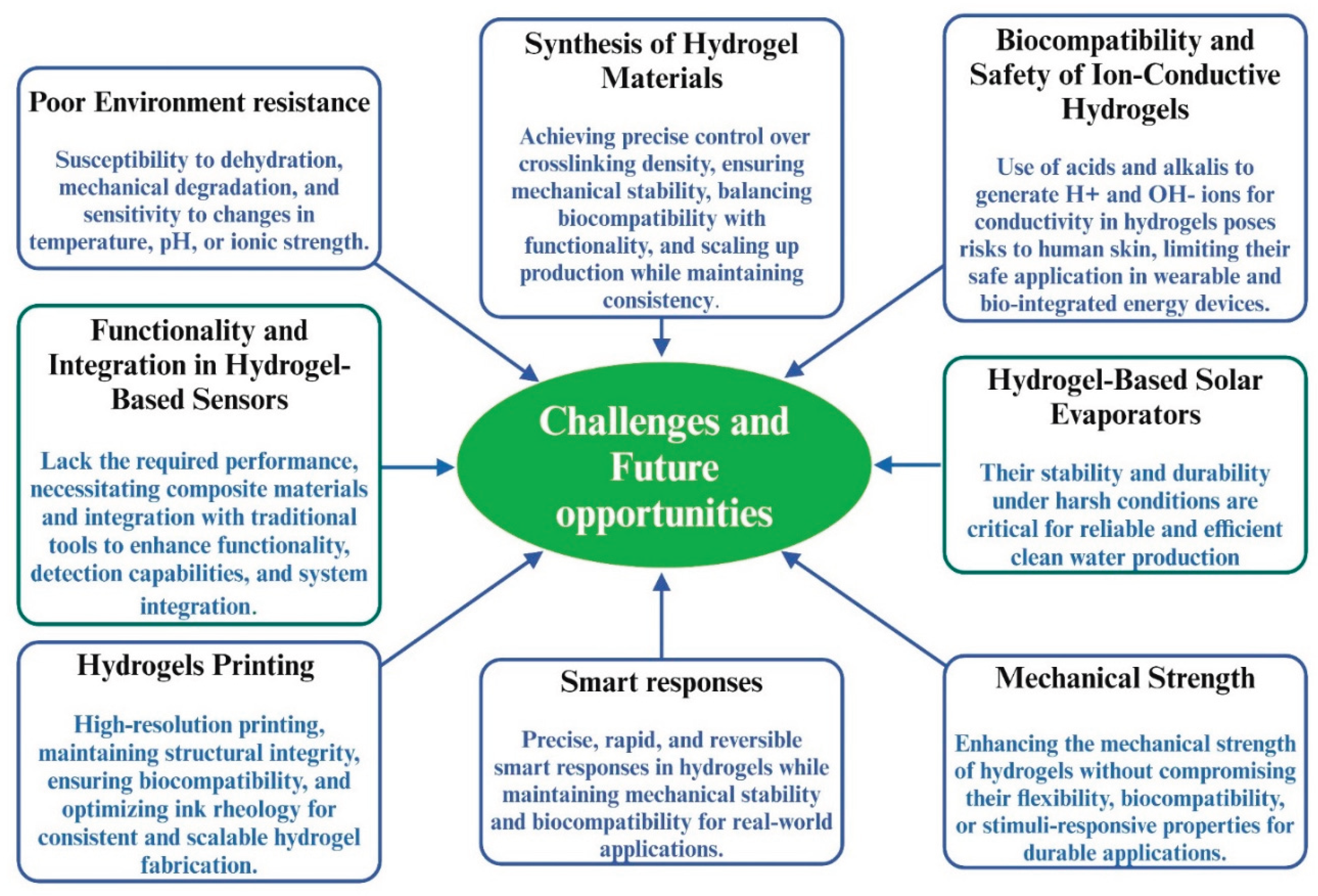
- (1)
- Another area where hydrogels are making strides is sensors. Hydrogel material alone often falls short of meeting application demands, so composite materials are used to introduce additional functionalities. The synergy between hydrogels and other traditional analytical tools is leveraged. While hydrogels do not always surpass existing techniques, they enhance functionality, facilitate detection, and integrate multiple sensor components into a single system.
- (2)
- Hydrogel-based evaporators have outperformed many reported evaporators, offering distinct advantages. However, challenges and opportunities remain to enhance their strengths. For instance, a deeper understanding of the fundamental evaporation mechanism within hydrogels is needed. Additionally, the stability and durability of hydrogel-based solar evaporators under severe conditions require improvement to ensure stable clean water delivery in practical applications [297].
- (3)
- Achieving high-strength hydrogels requires overcoming limitations such as balancing mechanical robustness with flexibility, ensuring biocompatibility, and enhancing stability under varying environmental conditions. Developing tunable mechanical properties for specific applications, integrating multiple enhancement strategies for synergistic effects, and understanding structure-property relationships through advanced characterization techniques remain critical hurdles [298,299]. Additionally, creating scalable and sustainable fabrication methods while maintaining performance consistency poses significant challenges.
- (4)
- The widespread adoption of 3D hydrogel printing faces several critical hurdles, including optimizing material properties for improved printability and bioactivity, enhancing printing techniques for higher resolution and speed, and designing complex scaffold architectures with functional gradients and vascular networks. Post-printing processing, such as ensuring structural integrity and functionality, along with the challenges of scaling up to high-throughput manufacturing, further complicate its implementation. Additionally, the clinical translation of 3D-printed hydrogels requires addressing regulatory and ethical considerations, as well as ensuring reproducibility and biocompatibility for real-world applications [300,301,302].
Hydrogels have achieved tremendous development in terms of their range of applications. Their chemical diversity and control over multiscale architecture have made them attractive in the field of medicine, soft robotics, sensors, and environmental engineering. However, there are significant challenges related to their printing, mechanical properties, biocompatibility, and cost-effectiveness. The rapid advancements in hydrogel technology present exciting opportunities across diverse fields, driven by their unique properties and multifunctionality. In wearable electronics, the development of conductive hydrogels with enhanced environmental resilience, mechanical strength, and self-recovery capabilities can revolutionize flexible and stretchable devices. For biomedical applications, natural hydrogels derived from renewable sources offer sustainable solutions, with potential improvements in synthesis methods to reduce energy consumption and environmental impact. In energy storage and conversion, the creation of biocompatible and biodegradable hydrogel electrolytes can address safety concerns and expand their use in wearable and eco-friendly devices. Hydrogel-based sensors provide opportunities for integrating multiple functionalities into compact systems, enhancing detection and monitoring capabilities. Additionally, hydrogel evaporators hold promise for efficient clean water production, with further research into evaporation mechanisms and durability under harsh conditions. The pursuit of high-strength hydrogels with tunable mechanical properties opens doors for applications in tissue engineering, soft robotics, and beyond. Finally, hydrogel printing offers transformative potential in regenerative medicine, with opportunities to optimize printing techniques, scaffold designs, and clinical translation processes. By addressing current challenges and leveraging interdisciplinary innovations, hydrogels can unlock groundbreaking solutions to global challenges in healthcare, sustainability, and technology.
7. Conclusions
This review has provided a comprehensive and integrative examination of stimuli-responsive hydrogels, encompassing their classification by source, structure, and crosslinking strategies, their behavior under a wide spectrum of external stimuli, and the transformative role of 4D printing in enabling programmable, shape-morphing systems. By synthesizing developments in hydrogel chemistry, smart material design, and advanced manufacturing, we proposed a multi-dimensional framework linking stimulus types to material compositions, fabrication methods, and application domains.
Stimuli-responsive hydrogels continue to unlock opportunities across a range of engineering and scientific fields—from biomedical devices and soft robotics to water purification and smart sensors. Yet, persistent limitations such as weak mechanical strength, slow actuation speeds, and challenges in printability and scalability remain critical bottlenecks. Addressing these requires collaborative efforts across chemical engineering, materials science, and bio-fabrication to develop robust, multifunctional, and industrially viable systems.
Looking ahead, the convergence of intelligent material systems with emerging digital manufacturing platforms will be central to realizing hydrogels as core components of next-generation engineering technologies. By bridging material function with practical application, stimuli-responsive hydrogels are poised to play a pivotal role in shaping the future of adaptive, sustainable, and high-performance systems in chemical and process engineering.
Author Contributions
CRediT: Muhammad F. Siddique: Writing – original draft, Resources, Methodology, Investigation, Formal analysis, Data curation. Farag K Omar: Supervision, Project administration, Formal analysis, Conceptualization. Ali Al Marzouqi: Writing – review & editing, Supervision, Project administration, Investigation, Formal analysis, Conceptualization.
Funding
This research was supported by United Arab Emirates University with a research grant code G00003797.
Acknowledgments
The authors would like to express their sincere gratitude to the United Arab Emirates University for generously providing the research facilities and support necessary for the completion of this review. Their valuable resources and assistance have been instrumental in conducting this research.
Abbreviations
| AA | Ascorbic Acid |
| AM | Additive Manufacturing |
| CAD | Computer Aided Design |
| CMC | Carboxymethyl cellulose |
| CNF | Cellulose Nanofiber |
| CNT | Carbon Nanotubes |
| CS | Chitosan |
| DIW | Direct Ink Writing |
| DLP | Digital Light Processing |
| FDM | Fused Deposition Modeling |
| GO | Graphene Oxide |
| IPN | Interpenetrating Polymer Network |
| LCST | Lower Critical Solution Temperature |
| MBA | NN′-Methylenebis(acrylamide) |
| NIPAm | N-isopropylacrylamide |
| PAA | Poly(acrylic acid) |
| PAM | Polyacrylamide |
| PANI | Polyaniline |
| PEDOT | Poly(3,4-ethylenedioxythiophene): polystyrene sulfonate |
| PEG | Poly(ethylene glycol) |
| PEGDA | Poly(ethylene glycol) diacrylate |
| PEGDMA | Polyethylene glycol dimethacrylate |
| PI | Photoinitiator |
| PNIPAm | Poly(N-isopropylacrylamide) |
| PVA | Polyvinyl Alcohol |
| SLA | Stereolithography |
| SPIONs | Superparamagnetic Iron Oxide Nanoparticles |
| TPO | Diphenyl(2,4,6-trimethylbenzoyl)-phosphine oxide |
| TOCN | TEMPO-oxidized cellulose nanofiber |
References
- Seliktar, D. Designing Cell-Compatible Hydrogels for Biomedical Applications. Science (1979) 2012, 336, 1124–1128. [Google Scholar] [CrossRef]
- Zhou, Y.; Wan, C.; Yang, Y.; Yang, H.; Wang, S.; Dai, Z.; Ji, K.; Jiang, H.; Chen, X.; Long, Y.; et al. Highly Stretchable, Elastic, and Ionic Conductive Hydrogel for Artificial Soft Electronics. Adv Funct Mater 2019, 29, 1806220. [Google Scholar] [CrossRef]
- Wichterle, O.; Lím, D. Hydrophilic Gels for Biological Use. Nature 1960, 185:4706 1960(185), 117–118. [Google Scholar] [CrossRef]
- Garg Guru, S.; Khalsa, R.; Garg Guru, A. Hydrogel: Classification, Properties, Preparation and Technical Features; 2016. [Google Scholar]
- Wang, W.; Narain, R.; Zeng, H. Hydrogels; Polymer Science and Nanotechnology: Fundamentals and Applications, 2020; pp. 203–244. [Google Scholar] [CrossRef]
- Yan, B.; Han, L.; Xiao, H.; Zhang, J.; Huang, J.; Hu, W.; Gu, Y.; Liu, Q.; Zeng, H. Rapid Dewatering and Consolidation of Concentrated Colloidal Suspensions: Mature Fine Tailings via Self-Healing Composite Hydrogel. ACS Appl Mater Interfaces 2019, 11, 21610–21618. [Google Scholar] [CrossRef]
- Yuk, H.; Lin, S.; Ma, C.; Takaffoli, M.; Fang, N.X.; Zhao, X. Hydraulic Hydrogel Actuators and Robots Optically and Sonically Camouflaged in Water. Nat Commun 2017, 8, 14230. [Google Scholar] [CrossRef]
- Ma, C.; Lu, W.; Yang, X.; He, J.; Le, X.; Wang, L.; Zhang, J.; Serpe, M.J.; Huang, Y.; Chen, T. Bioinspired Anisotropic Hydrogel Actuators with On–Off Switchable and Color-Tunable Fluorescence Behaviors. Adv Funct Mater 2018, 28, 1704568. [Google Scholar] [CrossRef]
- Chen, J.; Peng, Q.; Thundat, T.; Zeng, H. Stretchable, Injectable, and Self-Healing Conductive Hydrogel Enabled by Multiple Hydrogen Bonding toward Wearable Electronics. Chemistry of Materials 2019, 31, 4553–4563. [Google Scholar] [CrossRef]
- Li, L.; Yan, B.; Yang, J.; Chen, L.; Zeng, H. Novel Mussel-Inspired Injectable Self-Healing Hydrogel with Anti-Biofouling Property. Advanced Materials 2015, 27, 1294–1299. [Google Scholar] [CrossRef] [PubMed]
- Maulvi, F.A.; Lakdawala, D.H.; Shaikh, A.A.; Desai, A.R.; Choksi, H.H.; Vaidya, R.J.; Ranch, K.M.; Koli, A.R.; Vyas, B.A.; Shah, D.O. In Vitro and in Vivo Evaluation of Novel Implantation Technology in Hydrogel Contact Lenses for Controlled Drug Delivery. Journal of Controlled Release 2016, 226, 47–56. [Google Scholar] [CrossRef]
- Chen, Y.; Wang, W.; Wu, D.; Nagao, M.; Hall, D.G.; Thundat, T.; Narain, R. Injectable Self-Healing Zwitterionic Hydrogels Based on Dynamic Benzoxaborole–Sugar Interactions with Tunable Mechanical Properties. Biomacromolecules 2018, 19, 596–605. [Google Scholar] [CrossRef] [PubMed]
- Tseng, T.C.; Tao, L.; Hsieh, F.Y.; Wei, Y.; Chiu, I.M.; Hsu, S.H. An Injectable, Self-Healing Hydrogel to Repair the Central Nervous System. Advanced Materials 2015, 27, 3518–3524. [Google Scholar] [CrossRef]
- Jiang, Z.; Tan, M.L.; Taheri, M.; Yan, Q.; Tsuzuki, T.; Gardiner, M.G.; Diggle, B.; Connal, L.A. Strong, Self-Healable, and Recyclable Visible-Light-Responsive Hydrogel Actuators. Angew Chem Int Ed Engl 2020, 59, 7049–7056. [Google Scholar] [CrossRef] [PubMed]
- Zavahir, S.; Sobolčiak, P.; Krupa, I.; Han, D.S.; Tkac, J.; Kasak, P. Ti3C2Tx MXene-Based Light-Responsive Hydrogel Composite for Bendable Bilayer Photoactuator. Nanomaterials 2020, 10, 1419. [Google Scholar] [CrossRef]
- Ding, H.; Li, B.; Jiang, Y.; Liu, G.; Pu, S.; Feng, Y.; Jia, D.; Zhou, Y. PH-Responsive UV Crosslinkable Chitosan Hydrogel via “Thiol-Ene” Click Chemistry for Active Modulating Opposite Drug Release Behaviors. Carbohydr Polym 2021, 251, 117101. [Google Scholar] [CrossRef]
- Han, Z.; Wang, P.; Mao, G.; Yin, T.; Zhong, D.; Yiming, B.; Hu, X.; Jia, Z.; Nian, G.; Qu, S.; et al. Dual PH-Responsive Hydrogel Actuator for Lipophilic Drug Delivery. ACS Appl Mater Interfaces 2020, 12, 12010–12017. [Google Scholar] [CrossRef]
- Liu, J.; Jiang, L.; Liu, A.; He, S.; Shao, W. Ultrafast Thermo-Responsive Bilayer Hydrogel Actuator Assisted by Hydrogel Microspheres. Sens Actuators B Chem 2022, 357, 131434. [Google Scholar] [CrossRef]
- Chen, T.; Yang, Y.; Peng, H.; Whittaker, A.K.; Li, Y.; Zhao, Q.; Wang, Y.; Zhu, S.; Wang, Z. Cellulose Nanocrystals Reinforced Highly Stretchable Thermal-Sensitive Hydrogel with Ultra-High Drug Loading. Carbohydr Polym 2021, 266, 118122. [Google Scholar] [CrossRef]
- Jiang, H.; Fan, L.; Yan, S.; Li, F.; Li, H.; Tang, J. Tough and Electro-Responsive Hydrogel Actuators with Bidirectional Bending Behavior. Nanoscale 2019, 11, 2231–2237. [Google Scholar] [CrossRef]
- Ying, Z.; Wang, Q.; Xie, J.; Li, B.; Lin, X.; Hui, S. Novel Electrically-Conductive Electro-Responsive Hydrogels for Smart Actuators with a Carbon-Nanotube-Enriched Three-Dimensional Conductive Network and a Physical-Phase-Type Three-Dimensional Interpenetrating Network. J Mater Chem C Mater 2020, 8, 4192–4205. [Google Scholar] [CrossRef]
- Manjua, A.C.; Alves, V.D.; Crespo, J.G.; Portugal, C.A.M. Magnetic Responsive PVA Hydrogels for Remote Modulation of Protein Sorption. ACS Appl Mater Interfaces 2019, 11, 21239–21249. [Google Scholar] [CrossRef]
- Chen, H.; Zhang, X.; Shang, L.; Su, Z. Programmable Anisotropic Hydrogels with Localized Photothermal/Magnetic Responsive Properties. Advanced Science 2022, 9, 2202173. [Google Scholar] [CrossRef]
- Liu, H.; Rong, L.; Wang, B.; Xie, R.; Sui, X.; Xu, H.; Zhang, L.; Zhong, Y.; Mao, Z. Facile Fabrication of Redox/PH Dual Stimuli Responsive Cellulose Hydrogel. Carbohydr Polym 2017, 176, 299–306. [Google Scholar] [CrossRef]
- Manga, R.D.; Jha, P.K. Mathematical Models for Controlled Drug Release Through PH-Responsive Polymeric Hydrogels. J Pharm Sci 2017, 106, 629–638. [Google Scholar] [CrossRef] [PubMed]
- Peralta Ramos, M.L.; González, J.A.; Fabian, L.; Pérez, C.J.; Villanueva, M.E. Sustainable and Smart Keratin Hydrogel with PH-Sensitive Swelling and Enhanced Mechanical Properties. Materials Science and Engineering: C 2017, 78, 619–626. [Google Scholar] [CrossRef]
- Karimi, A.R.; Tarighatjoo, M.; Nikravesh, G. 1,3,5-Triazine-2,4,6-Tribenzaldehyde Derivative as a New Crosslinking Agent for Synthesis of PH-Thermo Dual Responsive Chitosan Hydrogels and Their Nanocomposites: Swelling Properties and Drug Release Behavior. Int J Biol Macromol 2017, 105, 1088–1095. [Google Scholar] [CrossRef] [PubMed]
- Momeni, F.; Hassani, M.Mehdi; N, S.; Liu, X.; Ni, J. A Review of 4D Printing. Mater Des 2017, 122, 42–79. [Google Scholar] [CrossRef]
- Tibbits: The Emergence of “4D Printing” - Google Scholar. Available online: https://scholar.google.com/scholar?hl=en&as_sdt=0,5&cluster=9787433058056401908 (accessed on 12 June 2024).
- Choi, J.; Reddy, D.A.; Islam, M.J.; Seo, B.; Joo, S.H.; Kim, T.K. Green Synthesis of the Reduced Graphene Oxide–CuI Quasi-Shell–Core Nanocomposite: A Highly Efficient and Stable Solar-Light-Induced Catalyst for Organic Dye Degradation in Water. Appl Surf Sci 2015, 358, 159–167. [Google Scholar] [CrossRef]
- Ge, Q.; Qi, H.J.; Dunn, M.L. Active Materials by Four-Dimension Printing. Appl Phys Lett 2013, 103. [Google Scholar] [CrossRef]
- Pei, E. 4D Printing: Dawn of an Emerging Technology Cycle. Assembly Automation 2014, 34, 310–314. [Google Scholar] [CrossRef]
- Khoo, Z.X.; Teoh, J.E.M.; Liu, Y.; Chua, C.K.; Yang, S.; An, J.; Leong, K.F.; Yeong, W.Y. 3D Printing of Smart Materials: A Review on Recent Progresses in 4D Printing. Virtual Phys Prototyp 2015, 10, 103–122. [Google Scholar] [CrossRef]
- Dong, Y.; Wang, S.; Ke, Y.; Ding, L.; Zeng, X.; Magdassi, S.; Long, Y. 4D Printed Hydrogels: Fabrication, Materials, and Applications. Adv Mater Technol 2020, 5, 2000034. [Google Scholar] [CrossRef]
- 3D Printing Is So 2013 — Introducing 4D Printing! - Brit + Co. Available online: https://www.brit.co/4d-printing/ (accessed on 13 June 2024).
- Hu, Y.; Wang, Z.; Jin, D.; Zhang, C.; Sun, R.; Li, Z.; Hu, K.; Ni, J.; Cai, Z.; Pan, D.; et al. Botanical-Inspired 4D Printing of Hydrogel at the Microscale. Adv Funct Mater 2020, 30, 1907377. [Google Scholar] [CrossRef]
- Li, Z.; Liu, P.; Ji, X.; Gong, J.; Hu, Y.; Wu, W.; Wang, X.; Peng, H.Q.; Kwok, R.T.K.; Lam, J.W.Y.; et al. Bioinspired Simultaneous Changes in Fluorescence Color, Brightness, and Shape of Hydrogels Enabled by AIEgens. Advanced Materials 2020, 32, 1906493. [Google Scholar] [CrossRef]
- Spiegel, C.A.; Hippler, M.; Münchinger, A.; Bastmeyer, M.; Barner-Kowollik, C.; Wegener, M.; Blasco, E. 4D Printing at the Microscale. Adv Funct Mater 2020, 30, 1907615. [Google Scholar] [CrossRef]
- Kim, S.H.; Seo, Y.B.; Yeon, Y.K.; Lee, Y.J.; Park, H.S.; Sultan, M.T.; Lee, J.M.; Lee, J.S.; Lee, O.J.; Hong, H.; et al. 4D-Bioprinted Silk Hydrogels for Tissue Engineering. Biomaterials 2020, 260, 120281. [Google Scholar] [CrossRef]
- Narupai, B.; Smith, P.T.; Nelson, A. 4D Printing of Multi-Stimuli Responsive Protein-Based Hydrogels for Autonomous Shape Transformations. Adv Funct Mater 2021, 31, 2011012. [Google Scholar] [CrossRef]
- Koetting, M.C.; Peters, J.T.; Steichen, S.D.; Peppas, N.A. Stimulus-Responsive Hydrogels: Theory, Modern Advances, and Applications. Materials Science and Engineering: R: Reports 2015, 93, 1–49. [Google Scholar] [CrossRef] [PubMed]
- Ullah, F.; Othman, M.B.H.; Javed, F.; Ahmad, Z.; Akil, H.M. Classification, Processing and Application of Hydrogels: A Review. Mater Sci Eng C Mater Biol Appl 2015, 57, 414–433. [Google Scholar] [CrossRef] [PubMed]
- Sun, X.; Yao, F.; Li, J. Nanocomposite Hydrogel-Based Strain and Pressure Sensors: A Review. J Mater Chem A Mater 2020, 8, 18605–18623. [Google Scholar] [CrossRef]
- Hendi, A.; Hassan, M.U.; Elsherif, M.; Alqattan, B.; Park, S.; Yetisen, A.K.; Butt, H. Healthcare Applications of PH-Sensitive Hydrogel-Based Devices: A Review. Int J Nanomedicine 2020, 15, 3887–3901. [Google Scholar] [CrossRef] [PubMed]
- Nasution, H.; Harahap, H.; Dalimunthe, N.F.; Ginting, M.H.S.; Jaafar, M.; Tan, O.O.H.; Aruan, H.K.; Herfananda, A.L. Hydrogel and Effects of Crosslinking Agent on Cellulose-Based Hydrogels: A Review. Gels 2022, 8. [Google Scholar] [CrossRef]
- Champeau, M.; Heinze, D.A.; Viana, T.N.; de Souza, E.R.; Chinellato, A.C.; Titotto, S. 4D Printing of Hydrogels: A Review. Adv Funct Mater 2020, 30, 1910606. [Google Scholar] [CrossRef]
- Protsak, I.S.; Morozov, Y.M.; Protsak, I.S.; Morozov, Y.M. Fundamentals and Advances in Stimuli-Responsive Hydrogels and Their Applications: A Review. Gels 2025, Vol. 11, 2025, 11. [Google Scholar] [CrossRef] [PubMed]
- Zhang, Y.; Wu, B.M.; Zhang, Y.; Wu, B.M. Current Advances in Stimuli-Responsive Hydrogels as Smart Drug Delivery Carriers. Gels 2023, Vol. 9, 2023, 9. [Google Scholar] [CrossRef] [PubMed]
- Agrawal, A.; Hussain, C.M.; Agrawal, A.; Hussain, C.M. 3D-Printed Hydrogel for Diverse Applications: A Review. Gels 2023, Vol. 9, 2023, 9. [Google Scholar] [CrossRef]
- Chung, H.J.; Park, T.G. Self-Assembled and Nanostructured Hydrogels for Drug Delivery and Tissue Engineering. Nano Today 2009, 4, 429–437. [Google Scholar] [CrossRef]
- Slaughter, B. V.; Khurshid, S.S.; Fisher, O.Z.; Khademhosseini, A.; Peppas, N.A. Hydrogels in Regenerative Medicine. Advanced Materials 2009, 21, 3307–3329. [Google Scholar] [CrossRef]
- Bustamante-Torres, M.; Romero-Fierro, D.; Arcentales-Vera, B.; Palomino, K.; Magaña, H.; Bucio, E. Hydrogels Classification According to the Physical or Chemical Interactions and as Stimuli-Sensitive Materials. Gels 2021, Vol. 7 7, 182. [Google Scholar] [CrossRef]
- Xue, X.; Hu, Y.; Wang, S.; Chen, X.; Jiang, Y.; Su, J. Fabrication of Physical and Chemical Crosslinked Hydrogels for Bone Tissue Engineering. Bioact Mater 2022, 12, 327–339. [Google Scholar] [CrossRef]
- Rebers, L.; Reichsöllner, R.; Regett, S.; Tovar, G.E.M.; Borchers, K.; Baudis, S.; Southan, A. Differentiation of Physical and Chemical Cross-Linking in Gelatin Methacryloyl Hydrogels. Scientific Reports 2021, 11:1 2021(11), 1–12. [Google Scholar] [CrossRef]
- Nguyen, K.T.; West, J.L. Photopolymerizable Hydrogels for Tissue Engineering Applications. Biomaterials 2002, 23, 4307–4314. [Google Scholar] [CrossRef]
- Ehrbar, M.; Rizzi, S.C.; Schoenmakers, R.G.; San Miguel, B.; Hubbell, J.A.; Weber, F.E.; Lutoff, M.P. Biomolecular Hydrogels Formed and Degraded via Site-Specific Enzymatic Reactions. Biomacromolecules 2007, 8, 3000–3007. [Google Scholar] [CrossRef]
- Yeh, Y.Y.; Tsai, Y.T.; Wu, C.Y.; Tu, L.H.; Bai, M.Y.; Yeh, Y.C. The Role of Aldehyde-Functionalized Crosslinkers on the Property of Chitosan Hydrogels. Macromol Biosci 2022, 22, 2100477. [Google Scholar] [CrossRef]
- Zhao, W.; Jin, X.; Cong, Y.; Liu, Y.; Fu, J. Degradable Natural Polymer Hydrogels for Articular Cartilage Tissue Engineering. Journal of Chemical Technology & Biotechnology 2013, 88, 327–339. [Google Scholar] [CrossRef]
- Singhal, R.; Gupta, K. A Review: Tailor-Made Hydrogel Structures (Classifications and Synthesis Parameters). Polym Plast Technol Eng 2016, 55, 54–70. [Google Scholar] [CrossRef]
- Mehta, P.; Sharma, M.; Devi, M. Hydrogels: An Overview of Its Classifications, Properties, and Applications. J Mech Behav Biomed Mater 2023, 147, 106145. [Google Scholar] [CrossRef]
- Maleki, B.; Kargar, P.G.; Ashrafi, S.S.; Ghani, M.; Maleki, B.; Kargar, P.G.; Ashrafi, S.S.; Ghani, M. Perspective Chapter: Introduction to Hydrogels – Definition, Classifications, Applications and Methods of Preparation. Ionic Liquids - Recent Advances [Working Title] 2024. [Google Scholar] [CrossRef]
- Mohite, P.; Pharm. S.A.-Int.J.Adv.; 2017, undefined A Hydrogels: Methods of Preparation and Applications. In core.ac.uk.
- Ahmad, Z.; Salman, S.; Khan, S.A.; Amin, A.; Rahman, Z.U.; Al-Ghamdi, Y.O.; Akhtar, K.; Bakhsh, E.M.; Khan, S.B. Versatility of Hydrogels: From Synthetic Strategies, Classification, and Properties to Biomedical Applications. Gels 2022, Vol. 8(Page 167 2022, 8), 167. [Google Scholar] [CrossRef]
- Hoffman, A.S. Hydrogels for Biomedical Applications. Adv Drug Deliv Rev 2012, 64, 18–23. [Google Scholar] [CrossRef]
- Desai, P. Synthesis and Characterization of Polyionic Hydrogels. Theses and Dissertations 2008. [Google Scholar] [CrossRef]
- Iizawa, T.; Taketa, H.; Maruta, M.; Ishido, T.; Gotoh, T.; Sakohara, S. Synthesis of Porous Poly(N-Isopropylacrylamide) Gel Beads by Sedimentation Polymerization and Their Morphology. J Appl Polym Sci 2007, 104, 842–850. [Google Scholar] [CrossRef]
- Nayak, A.K.; Hasnain, M.S.; Aminabhavi, T.M. Drug Delivery Using Interpenetrating Polymeric Networks of Natural Polymers: A Recent Update. J Drug Deliv Sci Technol 2021, 66, 102915. [Google Scholar] [CrossRef]
- Thakur, S.; Thakur, V.K.; Arotiba, O.A. History, Classification, Properties and Application of Hydrogels: An Overview 2018, 29–50. [CrossRef]
- Sperling, L.H. Interpenetrating Polymer Networks: An Overview 1994, 3–38. [CrossRef]
- Myung, D.; Waters, D.; Wiseman, M.; Duhamei, P.E.; Noolandi, J.; Ta, C.N.; Frank, C.W. Progress in the Development of Interpenetrating Polymer Network Hydrogels. Polym Adv Technol 2008, 19, 647–657. [Google Scholar] [CrossRef]
- Kumar Singh, S.; Dhyani Assistant Professor, A.; Shailesh Kumar Singh, C.; Dhyani, A.; Juyal, D. Hydrogel: Preparation, Characterization and Applications. The Pharma Innovation Journal 2017, 6, 25–32. [Google Scholar]
- Zhou, Z.; Qian, C.; Yuan, W. Self-Healing, Anti-Freezing, Adhesive and Remoldable Hydrogel Sensor with Ion-Liquid Metal Dual Conductivity for Biomimetic Skin. Compos Sci Technol 2021, 203, 108608. [Google Scholar] [CrossRef]
- Samadian, H.; Maleki, H.; Allahyari, Z.; Jaymand, M. Natural Polymers-Based Light-Induced Hydrogels: Promising Biomaterials for Biomedical Applications. Coord Chem Rev 2020, 420, 213432. [Google Scholar] [CrossRef]
- Pourjavadi, A.; Heydarpour, R.; Tehrani, Z.M. Multi-Stimuli-Responsive Hydrogels and Their Medical Applications. New Journal of Chemistry 2021, 45, 15705–15717. [Google Scholar] [CrossRef]
- Zhou, Q.; Dong, X.; Xiong, Y.; Zhang, B.; Lu, S.; Wang, Q.; Liao, Y.; Yang, Y.; Wang, H. Multi-Responsive Lanthanide-Based Hydrogel with Encryption, Naked Eye Sensing, Shape Memory, Self-Healing, and Antibacterial Activity. ACS Appl Mater Interfaces 2020, 12, 28539–28549. [Google Scholar] [CrossRef] [PubMed]
- Wu, J.J.; Huang, L.M.; Zhao, Q.; Xie, T. 4D Printing: History and Recent Progress. Chinese Journal of Polymer Science (English Edition) 2018, 36, 563–575. [Google Scholar] [CrossRef]
- Beebe, D.J.; Moore, J.S.; Bauer, J.M.; Yu, Q.; Liu, R.H.; Devadoss, C.; Jo, B.H. Functional Hydrogel Structures for Autonomous Flow Control inside Microfluidic Channels. Nature 2000, 404 404, 6778 2000 588–590. [Google Scholar] [CrossRef] [PubMed]
- Richter, A.; Kuckling, D.; Howitz, S.; Gehring, T.; Arndt, K.F. Electronically Controllable Microvalves Based on Smart Hydrogels: Magnitudes and Potential Applications. Journal of Microelectromechanical Systems 2003, 12, 748–753. [Google Scholar] [CrossRef]
- Willner, I. Stimuli-Controlled Hydrogels and Their Applications. Acc Chem Res 2017, 50, 657–658. [Google Scholar] [CrossRef]
- Ahn, S.K.; Kasi, R.M.; Kim, S.C.; Sharma, N.; Zhou, Y. Stimuli-Responsive Polymer Gels. Soft Matter 2008, 4, 1151–1157. [Google Scholar] [CrossRef]
- Padmanabha Raju, M.; Mohana Raju, K. Synthesis and Water Absorbency of Superabsorbent Copolymers. International Journal of Polymer Analysis and Characterization 2003, 8, 245–253. [Google Scholar] [CrossRef]
- Salvekar, A.V.; Huang, W.M.; Xiao, R.; Wong, Y.S.; Venkatraman, S.S.; Tay, K.H.; Shen, Z.X. Water-Responsive Shape Recovery Induced Buckling in Biodegradable Photo-Cross-Linked Poly(Ethylene Glycol) (PEG) Hydrogel. Acc Chem Res 2017, 50, 141–150. [Google Scholar] [CrossRef]
- Li, J.; Zhang, G.; Cui, Z.; Bao, L.; Xia, Z.; Liu, Z.; Zhou, X. High Performance and Multifunction Moisture-Driven Yin–Yang-Interface Actuators Derived from Polyacrylamide Hydrogel. Small 2023, 19, 2303228. [Google Scholar] [CrossRef]
- Yao, Y.; Yin, C.; Hong, S.; Chen, H.; Shi, Q.; Wang, J.; Lu, X.; Zhou, N. Lanthanide-Ion-Coordinated Supramolecular Hydrogel Inks for 3D Printed Full-Color Luminescence and Opacity-Tuning Soft Actuators. Chemistry of Materials 2020, 32, 8868–8876. [Google Scholar] [CrossRef]
- Zheng, Y.; Huang, H.; Yu, J.; Hu, Z.; Wang, Y. Highly Stretchable and Strong Poly (Vinyl Alcohol)-Based Hydrogel for Reprogrammable Actuator Applications. Chemical Engineering Journal 2023, 454, 140054. [Google Scholar] [CrossRef]
- Shi, Z.; Gao, X.; Ullah, M.W.; Li, S.; Wang, Q.; Yang, G. Electroconductive Natural Polymer-Based Hydrogels. Biomaterials 2016, 111, 40–54. [Google Scholar] [CrossRef]
- Chen, J.; Peng, Q.; Thundat, T.; Zeng, H. Stretchable, Injectable, and Self-Healing Conductive Hydrogel Enabled by Multiple Hydrogen Bonding toward Wearable Electronics. Chemistry of Materials 2019, 31, 4553–4563. [Google Scholar] [CrossRef]
- Liu, Z.; Liu, J.; Zhang, J.; Zheng, B.; Ren, X.; Long, Y.; Fang, L.; Ou, R.; Liu, T.; Wang, Q. Highly Compressible Hydrogel Sensors with Synergistic Long-Lasting Moisture, Extreme Temperature Tolerance and Strain-Sensitivity Properties. Mater Chem Front 2020, 4, 3319–3327. [Google Scholar] [CrossRef]
- Wu, Z.; Yang, X.; Wu, J. Conductive Hydrogel- And Organohydrogel-Based Stretchable Sensors. In ACS Appl Mater Interfaces; GIF, 2021; Volume 13, pp. 2128–2144. [Google Scholar] [CrossRef]
- Peng, Y.; Pi, M.; Zhang, X.; Yan, B.; Li, Y.; Shi, L.; Ran, R. High Strength, Antifreeze, and Moisturizing Conductive Hydrogel for Human-motion Detection. Polymer (Guildf) 2020, 196, 122469. [Google Scholar] [CrossRef]
- Al Nahari, B.B.M.A.; Zarbane, K.; Beidouri, Z. The Use of Moisture-Responsive Materials in 4D Printing. Journal of Achievements in Materials and Manufacturing Engineering 2023, 119, 5–13. [Google Scholar] [CrossRef]
- Capanema, N.S.V.; Mansur, A.A.P.; Carvalho, I.C.; Carvalho, S.M.; Mansur, H.S. Bioengineered Water-Responsive Carboxymethyl Cellulose/Poly(Vinyl Alcohol) Hydrogel Hybrids for Wound Dressing and Skin Tissue Engineering Applications. Gels 2023, 9, 166. [Google Scholar] [CrossRef]
- Wei, J.; Jia, S.; Guan, J.; Ma, C.; Shao, Z. Robust and Highly Sensitive Cellulose Nanofiber-Based Humidity Actuators. ACS Appl Mater Interfaces 2021, 13, 54417–54427. [Google Scholar] [CrossRef] [PubMed]
- Sydney Gladman, A.; Matsumoto, E.A.; Nuzzo, R.G.; Mahadevan, L.; Lewis, J.A. Biomimetic 4D Printing. Nat Mater 2016, 15, 413–418. [Google Scholar] [CrossRef]
- Li, Y.; Zheng, W.; Li, B.; Dong, J.; Gao, G.; Jiang, Z. Double-Layer Temperature-Sensitive Hydrogel Fabricated by 4D Printing with Fast Shape Deformation. Colloids Surf A Physicochem Eng Asp 2022, 648, 129307. [Google Scholar] [CrossRef]
- Hua, M.; Wu, D.; Wu, S.; Ma, Y.; Alsaid, Y.; He, X. 4D Printable Tough and Thermoresponsive Hydrogels. ACS Appl Mater Interfaces 2021, 13, 12689–12697. [Google Scholar] [CrossRef]
- Abdullah, T.; Okay, O. 4D Printing of Body Temperature-Responsive Hydrogels Based on Poly(Acrylic Acid) with Shape-Memory and Self-Healing Abilities. ACS Appl Bio Mater 2023, 6, 703–711. [Google Scholar] [CrossRef]
- Brossier, T.; Habib, M.; Benkhaled, B.T.; Volpi, G.; Lapinte, V.; Blanquer, S. 4D Printing of Hydrogels Based on Poly(Oxazoline) and Poly(Acrylamide) Copolymers by Stereolithography. Mater Adv 2024, 5, 2750–2758. [Google Scholar] [CrossRef]
- Narupai, B.; Smith, P.T.; Nelson, A. 4D Printing of Multi-Stimuli Responsive Protein-Based Hydrogels for Autonomous Shape Transformations. Adv Funct Mater 2021, 31, 2011012. [Google Scholar] [CrossRef]
- Podstawczyk, D.; Nizioł, M.; Szymczyk-Ziółkowska, P.; Fiedot-Toboła, M.; Podstawczyk, D.; Nizioł, M.; Szymczyk-Ziółkowska, P.; Fiedot-Toboła, M. Development of Thermoinks for 4D Direct Printing of Temperature-Induced Self-Rolling Hydrogel Actuators. Adv Funct Mater 2021, 31, 2009664. [Google Scholar] [CrossRef]
- Zu, S.; Wang, Z.; Zhang, S.; Guo, Y.; Chen, C.; Zhang, Q.; Liu, T.; Liu, Q.; Zhang, Z. A Bioinspired 4D Printed Hydrogel Capsule for Smart Controlled Drug Release. Mater Today Chem 2022, 24, 100789. [Google Scholar] [CrossRef]
- Pelluau, T.; Brossier, T.; Habib, M.; Sene, S.; Félix, G.; Larionova, J.; Blanquer, S.; Guari, Y. 4D Printing Nanocomposite Hydrogel Based on PNIPAM and Prussian Blue Nanoparticles Using Stereolithography. Macromol Mater Eng 2024, 309, 2300305. [Google Scholar] [CrossRef]
- Zhao, H.; Huang, Y.; Lv, F.; Liu, L.; Gu, Q.; Wang, S. Biomimetic 4D-Printed Breathing Hydrogel Actuators by Nanothylakoid and Thermoresponsive Polymer Networks. Adv Funct Mater 2021, 31, 2105544. [Google Scholar] [CrossRef]
- Goyal, R.; Sahu, S.; Mitra, S.; Niranjan, R.; Priyadarshini, R.; Yadav, R.; Lochab, B. Nanocellulose-Reinforced 4D Printed Hydrogels: Thermoresponsive Shape Morphing and Drug Release. ACS Appl Polym Mater 2024, 6, 1348–1361. [Google Scholar] [CrossRef]
- Zu, S.; Zhang, Z.; Liu, Q.; Wang, Z.; Song, Z.; Guo, Y.; Xin, Y.; Zhang, S. 4D Printing of Core–Shell Hydrogel Capsules for Smart Controlled Drug Release. Biodes Manuf 2022, 5, 294–304. [Google Scholar] [CrossRef]
- Jiang, Z.; Shen, P.; Li Tan, M.; Yan, Q.; Viktorova, J.; Cementon, C.; Peng, X.; Xiao, P.; Connal, L.A. 3D and 4D Printable Dual Cross-Linked Polymers with High Strength and Humidity-Triggered Reversible Actuation. Mater Adv 2021, 2, 5124–5134. [Google Scholar] [CrossRef]
- Tahouni, Y.; Cheng, T.; Lajewski, S.; Benz, J.; Bonten, C.; Wood, D.; Menges, A. Codesign of Biobased Cellulose-Filled Filaments and Mesostructures for 4D Printing Humidity Responsive Smart Structures. 3D Print Addit Manuf 2023, 10, 1–14. [Google Scholar] [CrossRef]
- Zhuo, S.; Shu Hieng Tie, B.; Keane, G.; Geever, L.M. Strategies for Developing Shape-Shifting Behaviours and Potential Applications of Poly (N-Vinyl Caprolactam) Hydrogels. Polymers 2023, Vol. 15 15, 1511. [Google Scholar] [CrossRef]
- Cao, P.; Tao, L.; Gong, J.; Wang, T.; Wang, Q.; Ju, J.; Zhang, Y. 4D Printing of a Sodium Alginate Hydrogel with Step-Wise Shape Deformation Based on Variation of Crosslinking Density. ACS Appl Polym Mater 2021, 3, 6167–6175. [Google Scholar] [CrossRef]
- Parimita, S.; Kumar, A.; Krishnaswamy, H.; Ghosh, P. Solvent Triggered Shape Morphism of 4D Printed Hydrogels. J Manuf Process 2023, 85, 875–884. [Google Scholar] [CrossRef]
- Fanjul-Mosteirín, N.; Aguirresarobe, R.; Sadaba, N.; Larrañaga, A.; Marin, E.; Martin, J.; Ramos-Gomez, N.; Arno, M.C.; Sardon, H.; Dove, A.P. Crystallization-Induced Gelling as a Method to 4D Print Low-Water-Content Non-Isocyanate Polyurethane Hydrogels. Chemistry of Materials 2021, 33, 7194–7202. [Google Scholar] [CrossRef] [PubMed]
- Ren, L.; Li, B.; Liu, Q.; Ren, L.; Song, Z.; Zhou, X.; Gao, P. 4D Printing Dual Stimuli-Responsive Bilayer Structure Toward Multiple Shape-Shifting. Front Mater 2021, 8, 655160. [Google Scholar] [CrossRef]
- Han, Z.; Wang, P.; Mao, G.; Yin, T.; Zhong, D.; Yiming, B.; Hu, X.; Jia, Z.; Nian, G.; Qu, S.; et al. Dual PH-Responsive Hydrogel Actuator for Lipophilic Drug Delivery. ACS Appl Mater Interfaces 2020, 12, 12010–12017. [Google Scholar] [CrossRef]
- Simińska-Stanny, J.; Nizioł, M.; Szymczyk-Ziółkowska, P.; Brożyna, M.; Junka, A.; Shavandi, A.; Podstawczyk, D. 4D Printing of Patterned Multimaterial Magnetic Hydrogel Actuators. Addit Manuf 2022, 49, 102506. [Google Scholar] [CrossRef]
- Li, S.; Yang, H.; Chen, G.; Zheng, J.; Wang, W.; Ren, J.; Zhu, C.; Yang, Y.; Cong, Y.; Fu, J. 4D Printing of Biomimetic Anisotropic Self-Sensing Hydrogel Actuators. Chemical Engineering Journal 2023, 473, 145444. [Google Scholar] [CrossRef]
- Wu, C.Y.; Chen, J.R.; Su, C.K. 4D-Printed PH Sensing Claw. Anal Chim Acta 2022, 1204, 339733. [Google Scholar] [CrossRef] [PubMed]
- Nishiguchi, A.; Zhang, H.; Schweizerhof, S.; Schulte, M.F.; Mourran, A.; Möller, M. 4D Printing of a Light-Driven Soft Actuator with Programmed Printing Density. ACS Appl Mater Interfaces 2020, 12, 12176–12185. [Google Scholar] [CrossRef]
- Wang, R.; Yuan, C.; Cheng, J.; He, X.; Ye, H.; Jian, B.; Li, H.; Bai, J.; Ge, Q. Direct 4D Printing of Ceramics Driven by Hydrogel Dehydration. Nature Communications 2024, 15 15, 1–11. [Google Scholar] [CrossRef] [PubMed]
- Deng, C.; Liu, Y.; Fan, X.; Jiao, B.; Zhang, Z.; Zhang, M.; Chen, F.; Gao, H.; Deng, L.; Xiong, W. Femtosecond Laser 4D Printing of Light-Driven Intelligent Micromachines. Adv Funct Mater 2023, 33, 2211473. [Google Scholar] [CrossRef]
- Deng, C.; Qu, J.; Dong, J.; Guo, Y.; Wu, X.; Fang, Y.; Sun, X.; Wei, Y.; Li, Z. 4D Printing of Magnetic Smart Structures Based on Light-Cured Magnetic Hydrogel. Chemical Engineering Journal 2024, 494, 152992. [Google Scholar] [CrossRef]
- Li, H.; Boon Chng, C.; Zheng, H.; See Wu, M.; Jorge Da Silva Bartolo, P.; Jerry Qi, H.; Jun Tan, Y.; Zhou, K.; Li, H.; Zheng, H.; et al. Self-Healable and 4D Printable Hydrogel for Stretchable Electronics. Advanced Science 2024, 11, 2305702. [Google Scholar] [CrossRef]
- Wang, L.; Zhang, J.; Zhang, X.; Shi, G.; He, Y.; Cui, Z.; Zhang, X.; Fu, P.; Liu, M.; Qiao, X.; et al. High Colloidal Stable Carbon Dots Armored Liquid Metal Nano-Droplets for Versatile 3D/4D Printing Through Digital Light Processing (DLP). Energy & Environmental Materials 2024, 7, e12609. [Google Scholar] [CrossRef]
- Shi, W.; Jang, S.; Kuss, M.A.; Alimi, O.A.; Liu, B.; Palik, J.; Tan, L.; Krishnan, M.A.; Jin, Y.; Yu, C.; et al. Digital Light Processing 4D Printing of Poloxamer Micelles for Facile Fabrication of Multifunctional Biocompatible Hydrogels as Tailored Wearable Sensors. ACS Nano 2024, 18, 7580–7595. [Google Scholar] [CrossRef]
- Ratri, M.C.; Suh, J.; Ryu, J.; Chung, B.G.; Shin, K. Formulation of Three-Dimensional, Photo-Responsive Printing Ink: Gold Nanorod-Hydrogel Nanocomposites and Their Four-Dimensional Structures That Respond Quickly to Stimuli. J Appl Polym Sci 2023, 140, e53799. [Google Scholar] [CrossRef]
- Antezana, P.E.; Municoy, S.; Ostapchuk, G.; Catalano, P.N.; Hardy, J.G.; Evelson, P.A.; Orive, G.; Desimone, M.F. 4D Printing: The Development of Responsive Materials Using 3D-Printing Technology. Pharmaceutics 2023, Vol. 15 15, 2743. [Google Scholar] [CrossRef] [PubMed]
- Thakur, V.; Singh, R.; Kumar, R.; Gehlot, A. 4D Printing of Thermoresponsive Materials: A State-of-the-Art Review and Prospective Applications. International Journal on Interactive Design and Manufacturing 2023, 17, 2075–2094. [Google Scholar] [CrossRef]
- Dou, Q.Q.; Liow, S.S.; Ye, E.; Lakshminarayanan, R.; Loh, X.J. Biodegradable Thermogelling Polymers: Working Towards Clinical Applications. Adv Healthc Mater 2014, 3, 977–988. [Google Scholar] [CrossRef]
- Zhang, K.; Xue, K.; Loh, X.J. Thermo-Responsive Hydrogels: From Recent Progress to Biomedical Applications. Gels 2021, Vol. 7(Page 77 2021, 7), 77. [Google Scholar] [CrossRef]
- Takezawa, T.; Mori, Y.; Yonaha, T.; Yoshizato, K. Characterization of Morphology and Cellular Metabolism during the Spheroid Formation by Fibroblasts. Exp Cell Res 1993, 208, 430–441. [Google Scholar] [CrossRef] [PubMed]
- Zhang, Q.; Weber, C.; Schubert, U.S.; Hoogenboom, R. Thermoresponsive Polymers with Lower Critical Solution Temperature: From Fundamental Aspects and Measuring Techniques to Recommended Turbidimetry Conditions. Mater Horiz 2017, 4, 109–116. [Google Scholar] [CrossRef]
- Alexander, A.; Ajazuddin; Khan, J.; Saraf, S.; Saraf, S. Polyethylene Glycol (PEG)–Poly(N-Isopropylacrylamide) (PNIPAAm) Based Thermosensitive Injectable Hydrogels for Biomedical Applications. European Journal of Pharmaceutics and Biopharmaceutics 2014, 88, 575–585. [Google Scholar] [CrossRef]
- Kumar, A.; Srivastava, A.; Galaev, I.Y.; Mattiasson, B. Smart Polymers: Physical Forms and Bioengineering Applications. Prog Polym Sci 2007, 32, 1205–1237. [Google Scholar] [CrossRef]
- Zheng, W.J.; An, N.; Yang, J.H.; Zhou, J.; Chen, Y.M. Tough Al-Alginate/Poly(N -Isopropylacrylamide) Hydrogel with Tunable LCST for Soft Robotics. ACS Appl Mater Interfaces 2015, 7, 1758–1764. [Google Scholar] [CrossRef]
- Spratte, T.; Geiger, S.; Colombo, F.; Mishra, A.; Taale, M.; Hsu, L.Y.; Blasco, E.; Selhuber-Unkel, C. Increasing the Efficiency of Thermoresponsive Actuation at the Microscale by Direct Laser Writing of PNIPAM. Adv Mater Technol 2023, 8, 2200714. [Google Scholar] [CrossRef]
- Bauman, L.; Zhao, B. Multi-Thermo Responsive Double Network Composite Hydrogel for 3D Printing Medical Hydrogel Mask. J Colloid Interface Sci 2023, 638, 882–892. [Google Scholar] [CrossRef] [PubMed]
- Lopez-Larrea, N.; Wustoni, S.; Peñas, M.I.; Uribe, J.; Dominguez-Alfaro, A.; Gallastegui, A.; Inal, S.; Mecerreyes, D. PNIPAM/PEDOT:PSS Hydrogels for Multifunctional Organic Electrochemical Transistors. Adv Funct Mater 2024, 2403708. [Google Scholar] [CrossRef]
- Zhang, K.; Li, F.; Wu, Y.; Feng, L.; Zhang, L. Construction of Ionic Thermo-Responsive PNIPAM/γ-PGA/PEG Hydrogel as a Draw Agent for Enhanced Forward-Osmosis Desalination. Desalination 2020, 495, 114667. [Google Scholar] [CrossRef]
- Liu, Y.; Zheng, X. 3D Printed Thermo-Responsive Hydrogel Evaporator with Enhanced Water Transport for Efficient Solar Steam Generation. Solar Energy 2024, 273, 112507. [Google Scholar] [CrossRef]
- Khan, B.; Arbab, A.; Khan, S.; Fatima, H.; Bibi, I.; Chowdhry, N.P.; Ansari, A.Q.; Ursani, A.A.; Kumar, S.; Hussain, J.; et al. Recent Progress in Thermosensitive Hydrogels and Their Applications in Drug Delivery Area. MedComm - Biomaterials and Applications 2023, 2. [Google Scholar] [CrossRef]
- Rastogi, P.; Biofabrication, B.K.-. 2019, undefined Review of Alginate-Based Hydrogel Bioprinting for Application in Tissue Engineering.
- Han, X.; Dong, Z.; Fan, M.; Liu, Y.; li, J.; Wang, Y.; Yuan, Q.; Li, B.; Zhang, S. Macromol. Rapid Commun. 12/2012. Macromol Rapid Commun 2012, 33, 1017–1017. [Google Scholar] [CrossRef]
- Kocak, G.; Tuncer, C.; Bütün, V. PH-Responsive Polymers. Polym Chem 2016, 8, 144–176. [Google Scholar] [CrossRef]
- Che, Y.; Li, D.; Liu, Y.; Ma, Q.; Tan, Y.; Yue, Q.; Meng, F. Physically Cross-Linked PH-Responsive Chitosan-Based Hydrogels with Enhanced Mechanical Performance for Controlled Drug Delivery. RSC Adv 2016, 6, 106035–106045. [Google Scholar] [CrossRef]
- Sheng, W.; Liu, T.; Liu, S.; Wang, Q.; Li, X.; Guang, N. Temperature and PH Responsive Hydrogels Based on Polyethylene Glycol Analogues and Poly(Methacrylic Acid) via Click Chemistry. Polym Int 2015, 64, 1415–1424. [Google Scholar] [CrossRef]
- Thakur, S.; Arotiba, O.A. Synthesis, Swelling and Adsorption Studies of a PH-Responsive Sodium Alginate–Poly(Acrylic Acid) Superabsorbent Hydrogel. Polymer Bulletin 2018, 75, 4587–4606. [Google Scholar] [CrossRef]
- Wang, W.; Hu, J.; Zhang, R.; Yan, C.; Cui, L.; Zhu, J. A PH-Responsive Carboxymethyl Cellulose/Chitosan Hydrogel for Adsorption and Desorption of Anionic and Cationic Dyes. Cellulose 2021, 28, 897–909. [Google Scholar] [CrossRef]
- Dhand, C.; Das, M.; Datta, M.; Malhotra, B.D. Recent Advances in Polyaniline Based Biosensors. Biosens Bioelectron 2011, 26, 2811–2821. [Google Scholar] [CrossRef] [PubMed]
- Ko, Y.; Jeong, H.Y.; Kwon, G.; Kim, D.; Lee, C.; You, J. PH-Responsive Polyaniline/Polyethylene Glycol Composite Arrays for Colorimetric Sensor Application. Sens Actuators B Chem 2020, 305, 127447. [Google Scholar] [CrossRef]
- Dutta, S.; Cohn, D. Temperature and PH Responsive 3D Printed Scaffolds. J Mater Chem B 2017, 5, 9514–9521. [Google Scholar] [CrossRef]
- Garcia, C.; Gallardo, A.; López, D.; Elvira, C.; Azzahti, A.; Lopez-Martinez, E.; Cortajarena, A.L.; González-Henríquez, C.M.; Sarabia-Vallejos, M.A.; Rodríguez-Hernández, J. Smart PH-Responsive Antimicrobial Hydrogel Scaffolds Prepared by Additive Manufacturing. ACS Appl Bio Mater 2018, 1, 1337–1347. [Google Scholar] [CrossRef]
- Luo, J.; Sun, F. Calcium-Responsive Hydrogels Enabled by Inducible Protein–Protein Interactions. Polym Chem 2020, 11, 4973–4977. [Google Scholar] [CrossRef]
- Di, X.; Ma, Q.; Xu, Y.; Yang, M.; Wu, G.; Sun, P. High-Performance Ionic Conductive Poly(Vinyl Alcohol) Hydrogels for Flexible Strain Sensors Based on a Universal Soaking Strategy. Mater Chem Front 2021, 5, 315–323. [Google Scholar] [CrossRef]
- Cruz, H.; Laycock, B.; Strounina, E.; Seviour, T.; Oehmen, A.; Pikaar, I. Modified Poly(Acrylic Acid)-Based Hydrogels for Enhanced Mainstream Removal of Ammonium from Domestic Wastewater. Environ Sci Technol 2020, 54, 9573–9583. [Google Scholar] [CrossRef]
- Shi, H.; Yang, Y.; Huang, Y.; Li, X.; Shi, Y. Anisotropic Single-Domain Hydrogel with Stimulus Response to Temperature and Ionic Strength. Macromolecules 2022. [Google Scholar] [CrossRef]
- Huang, L.; Jiang, R.; Wu, J.; Song, J.; Bai, H.; Li, B.; Zhao, Q.; Xie, T. Ultrafast Digital Printing toward 4D Shape Changing Materials. Advanced Materials 2017, 29, 1605390. [Google Scholar] [CrossRef]
- Kirillova, A.; Maxson, R.; Stoychev, G.; Gomillion, C.T.; Ionov, L. 4D Biofabrication Using Shape-Morphing Hydrogels. Advanced Materials 2017, 29, 1703443. [Google Scholar] [CrossRef] [PubMed]
- Piazza, R.D.; dos Santos, C.C.; Pinto, G.C.; Lucena, G.N.; Junior, M.J.; Marques, R.F.C. Multifunctional Redox and Temperature-Sensitive Drug Delivery Devices. Biomedical Materials & Devices 2023, 2023 2 2, 191–207. [Google Scholar] [CrossRef]
- Gaddimath, S.; Payamalle, S.; Channabasavana Hundi Puttaningaiah, K.P.; Hur, J. Recent Advances in PH and Redox Responsive Polymer Nanocomposites for Cancer Therapy. Journal of Composites Science 2024, Vol. 8 8, 28. [Google Scholar] [CrossRef]
- Ma, X.; Sekhar, K.P.C.; Zhang, P.; Cui, J. Advances in Stimuli-Responsive Injectable Hydrogels for Biomedical Applications. Biomater Sci 2024, 12, 5468–5480. [Google Scholar] [CrossRef]
- Altinbasak, I.; Sanyal, R.; Sanyal, A. Best of Both Worlds: Diels–Alder Chemistry towards Fabrication of Redox-Responsive Degradable Hydrogels for Protein Release. RSC Adv 2016, 6, 74757–74764. [Google Scholar] [CrossRef]
- Khodeir, M.; Antoun, S.; van Ruymbeke, E.; Gohy, J.F. Temperature and Redox-Responsive Hydrogels Based on Nitroxide Radicals and Oligoethyleneglycol Methacrylate. Macromol Chem Phys 2020, 221, 1900550. [Google Scholar] [CrossRef]
- Hoare, T.R.; Kohane, D.S. Hydrogels in Drug Delivery: Progress and Challenges. Polymer (Guildf) 2008, 49, 1993–2007. [Google Scholar] [CrossRef]
- Polymer Gels; 2018. [CrossRef]
- Kim, J.; Kim, J.H.; Ariga, K. Redox-Active Polymers for Energy Storage Nanoarchitectonics. Joule 2017, 1, 739–768. [Google Scholar] [CrossRef]
- Li, L.; Shi, Y.; Pan, L.; Shi, Y.; Yu, G. Rational Design and Applications of Conducting Polymer Hydrogels as Electrochemical Biosensors. J Mater Chem B 2015, 3, 2920–2930. [Google Scholar] [CrossRef] [PubMed]
- Kocak, G.; Tuncer, C.; Bütün, V. PH-Responsive Polymers. Polym Chem 2016, 8, 144–176. [Google Scholar] [CrossRef]
- Gupta, P.; Vermani, K.; Garg, S. Hydrogels: From Controlled Release to PH-Responsive Drug Delivery. Drug Discov Today 2002, 7, 569–579. [Google Scholar] [CrossRef]
- Rizwan, M.; Yahya, R.; Hassan, A.; Yar, M.; Azzahari, A.D.; Selvanathan, V.; Sonsudin, F.; Abouloula, C.N. Erratum: PH Sensitive Hydrogels in Drug Delivery: Brief History, Properties, Swelling, and Release Mechanism, Material Selection and Applications. Polymers 2017, 9, 137. Polymers 2017, Vol. 9(Page 225 2017, 9), 225. [Google Scholar] [CrossRef] [PubMed]
- Liu, J.; Huang, Y.; Kumar, A.; Tan, A.; Jin, S.; Mozhi, A.; Liang, X.J. PH-Sensitive Nano-Systems for Drug Delivery in Cancer Therapy. Biotechnol Adv 2014, 32, 693–710. [Google Scholar] [CrossRef]
- Li, J.; Mooney, D.J. Designing Hydrogels for Controlled Drug Delivery. Nat Rev Mater 2016, 1. [Google Scholar] [CrossRef] [PubMed]
- Alam, A.; Meng, Q.; Shi, G.; Arabi, S.; Ma, J.; Zhao, N.; Kuan, H.C. Electrically Conductive, Mechanically Robust, PH-Sensitive Graphene/Polymer Composite Hydrogels. Compos Sci Technol 2016, 127, 119–126. [Google Scholar] [CrossRef]
- Wang, T.; Zhang, X.; Wang, Z.; Zhu, X.; Liu, J.; Min, X.; Cao, T.; Fan, X. Smart Composite Hydrogels with PH-Responsiveness and Electrical Conductivity for Flexible Sensors and Logic Gates. Polymers 2019, Vol. 11 11, 1564. [Google Scholar] [CrossRef]
- Hoffman, A.S. Hydrogels for Biomedical Applications. Adv Drug Deliv Rev 2012, 64, 18–23. [Google Scholar] [CrossRef]
- Li, J.; Mooney, D.J. Designing Hydrogels for Controlled Drug Delivery. Nature Reviews Materials 2016, 12 2016(1), 1–17. [Google Scholar] [CrossRef]
- Shin, Y.; Choi, M.Y.; Choi, J.; Na, J.H.; Kim, S.Y. Design of an Electro-Stimulated Hydrogel Actuator System with Fast Flexible Folding Deformation under a Low Electric Field. ACS Appl Mater Interfaces 2021, 13, 15633–15646. [Google Scholar] [CrossRef]
- Han, D.; Farino, C.; Yang, C.; Scott, T.; Browe, D.; Choi, W.; Freeman, J.W.; Lee, H. Soft Robotic Manipulation and Locomotion with a 3D Printed Electroactive Hydrogel. ACS Appl Mater Interfaces 2018, 10, 17512–17518. [Google Scholar] [CrossRef]
- Podstawczyk, D.; Nizioł, M.; Szymczyk, P.; Wiśniewski, P.; Guiseppi-Elie, A. 3D Printed Stimuli-Responsive Magnetic Nanoparticle Embedded Alginate-Methylcellulose Hydrogel Actuators. Addit Manuf 2020, 34, 101275. [Google Scholar] [CrossRef]
- Chen, Z.; Zhao, D.; Liu, B.; Nian, G.; Li, X.; Yin, J.; Qu, S.; Yang, W. 3D Printing of Multifunctional Hydrogels. Adv Funct Mater 2019, 29, 1900971. [Google Scholar] [CrossRef]
- Jang, S.; Park, S. 4D Printed Untethered Milli-Gripper Fabricated Using a Biodegradable and Biocompatible Electro- and Magneto-Active Hydrogel. Sens Actuators B Chem 2023, 384, 133654. [Google Scholar] [CrossRef]
- Zhou, X.; Liu, H.; Yu, Z.; Yu, H.; Meng, D.; Zhu, L.; Li, H. Direct 3D Printing of Triple-Responsive Nanocomposite Hydrogel Microneedles for Controllable Drug Delivery. J Colloid Interface Sci 2024, 670, 1–11. [Google Scholar] [CrossRef]
- Zari, E.; Grillo, D.; Tan, Z.; Swiatek, N.; Linfoot, J.D.; Borvorntanajanya, K.; Nasca, L.; Pierro, E.; Florea, L.; Dini, D.; et al. A Reinforced Light-Responsive Hydrogel for Soft Robotics Actuation. 2024 IEEE 7th International Conference on Soft Robotics RoboSoft, 2024 2024; pp. 270–275. [Google Scholar] [CrossRef]
- Wu, Q.; Ma, C.; Chen, L.; Sun, Y.; Wei, X.; Ma, C.; Zhao, H.; Yang, X.; Ma, X.; Zhang, C.; et al. A Tissue Paper/Hydrogel Composite Light-Responsive Biomimetic Actuator Fabricated by In Situ Polymerization. Polymers (Basel) 2022, 14, 5454. [Google Scholar] [CrossRef]
- Kuksenok, O.; Balazs, A.C. Stimuli-Responsive Behavior of Composites Integrating Thermo-Responsive Gels with Photo-Responsive Fibers. Mater Horiz 2015, 3, 53–62. [Google Scholar] [CrossRef]
- Chirani, N.; Yahia, H.; Gritsch, L.; Motta, F.L.; Chirani, S.; Faré, S. History and Applications of Hydrogels. JOURNAL OF BIOMEDICAL SCIENCES 2021, 04, 1–23. [Google Scholar] [CrossRef]
- Rehman, W.U.; Asim, M.; Hussain, S.; Khan, S.A.; Khan, S.B. Hydrogel: A Promising Material in Pharmaceutics. Curr Pharm Des 2020, 26, 5892–5908. [Google Scholar] [CrossRef] [PubMed]
- Zolfagharian, A.; Denk, M.; Bodaghi, M.; Kouzani, A.Z.; Kaynak, A. Topology-Optimized 4D Printing of a Soft Actuator. Acta Mechanica Solida Sinica 2020, 33, 418–430. [Google Scholar] [CrossRef]
- Takishima, Y.; Yoshida, K.; Khosla, A.; Kawakami, M.; Furukawa, H. Fully 3D-Printed Hydrogel Actuator for Jellyfish Soft Robots. ECS Journal of Solid State Science and Technology 2021, 10, 037002. [Google Scholar] [CrossRef]
- Zhao, Q.; Liang, Y.; Ren, L.; Qiu, F.; Zhang, Z.; Ren, L. Study on Temperature and Near-Infrared Driving Characteristics of Hydrogel Actuator Fabricated via Molding and 3D Printing. J Mech Behav Biomed Mater 2018, 78, 395–403. [Google Scholar] [CrossRef] [PubMed]
- Sun, W.; Williamson, A.S.; Sukhnandan, R.; Majidi, C.; Yao, L.; Feinberg, A.W.; Webster-Wood, V.A.; Sun, W.; Williamson, A.S.; Sukhnandan, R.; et al. Biodegradable, Sustainable Hydrogel Actuators with Shape and Stiffness Morphing Capabilities via Embedded 3D Printing. Adv Funct Mater 2023, 33, 2303659. [Google Scholar] [CrossRef]
- Rumley, E.H.; Preninger, D.; Shomron, A.S.; Rothemund, P.; Hartmann, F.; Baumgartner, M.; Kellaris, N.; Stojanovic, A.; Yoder, Z.; Karrer, B.; et al. Biodegradable Electrohydraulic Actuators for Sustainable Soft Robots. In Sci Adv; ZIP, 2023; Volume 9. [Google Scholar] [CrossRef]
- Rumley, E.H.; Preninger, D.; Shomron, A.S.; Rothemund, P.; Hartmann, F.; Baumgartner, M.; Kellaris, N.; Stojanovic, A.; Yoder, Z.; Karrer, B.; et al. Biodegradable Electrohydraulic Actuators for Sustainable Soft Robots. In Sci Adv; ZIP, 2023; Volume 9. [Google Scholar] [CrossRef]
- Chen, Y.; Zhang, Y.; Li, H.; Shen, J.; Zhang, F.; He, J.; Lin, J.; Wang, B.; Niu, S.; Han, Z.; et al. Bioinspired Hydrogel Actuator for Soft Robotics: Opportunity and Challenges. Nano Today 2023, 49, 101764. [Google Scholar] [CrossRef]
- Ma, Y.; Hua, M.; Wu, S.; Du, Y.; Pei, X.; Zhu, X.; Zhou, F.; He, X. Bioinspired High-Power-Density Strong Contractile Hydrogel by Programmable Elastic Recoil. Sci Adv 2020, 6. [Google Scholar] [CrossRef]
- Liu, H.; Chu, H.; Yuan, H.; Li, D.; Deng, W.; Fu, Z.; Liu, R.; Liu, Y.; Han, Y.; Wang, Y.; et al. Bioinspired Multifunctional Self-Sensing Actuated Gradient Hydrogel for Soft-Hard Robot Remote Interaction. Nanomicro Lett 2024, 16, 1–14. [Google Scholar] [CrossRef] [PubMed]
- Wang, X.; Huang, H.; Liu, H.; Rehfeldt, F.; Wang, X.; Zhang, K. Multi-Responsive Bilayer Hydrogel Actuators with Programmable and Precisely Tunable Motions. Macromol Chem Phys 2019, 220, 1800562. [Google Scholar] [CrossRef]
- Ma, Y.; Lu, Y.; Yue, Y.; He, S.; Jiang, S.; Mei, C.; Xu, X.; Wu, Q.; Xiao, H.; Han, J. Nanocellulose-Mediated Bilayer Hydrogel Actuators with Thermo-Responsive, Shape Memory and Self-Sensing Performances. Carbohydr Polym 2024, 335, 122067. [Google Scholar] [CrossRef] [PubMed]
- Li, M.; Wang, X.; Dong, B.; Sitti, M. In-Air Fast Response and High Speed Jumping and Rolling of a Light-Driven Hydrogel Actuator. Nat Commun 2020, 11. [Google Scholar] [CrossRef]
- Zhang, W.; Zhu, X.; Chen, X.; Zhou, Y.; Tang, Y.; Ding, L.; Wu, P. Cyano-Bridged Coordination Polymer Hydrogel-Derived Sn–Fe Binary Oxide Nanohybrids with Structural Diversity: From 3D, 2D, to 2D/1D and Enhanced Lithium-Storage Performance. Nanoscale 2016, 8, 9828–9836. [Google Scholar] [CrossRef]
- Shi, Y.; Peng, L.; Yu, G. Nanostructured Conducting Polymer Hydrogels for Energy Storage Applications. Nanoscale 2015, 7, 12796–12806. [Google Scholar] [CrossRef]
- Wang, Z.; Li, H.; Tang, Z.; Liu, Z.; Ruan, Z.; Ma, L.; Yang, Q.; Wang, D.; Zhi, C. Hydrogel Electrolytes for Flexible Aqueous Energy Storage Devices. Adv Funct Mater 2018, 28, 1804560. [Google Scholar] [CrossRef]
- Wang, C.; Zhai, S.; Yuan, Z.; Chen, J.; Yu, Z.; Pei, Z.; Liu, F.; Li, X.; Wei, L.; Chen, Y. Drying Graphene Hydrogel Fibers for Capacitive Energy Storage. Carbon N Y 2020, 164, 100–110. [Google Scholar] [CrossRef]
- Chen, M.; Chen, J.; Zhou, W.; Han, X.; Yao, Y.; Wong, C.P. Realizing an All-Round Hydrogel Electrolyte toward Environmentally Adaptive Dendrite-Free Aqueous Zn–MnO2 Batteries. Advanced Materials 2021, 33, 2007559. [Google Scholar] [CrossRef]
- Wang, Y.; Li, Q.; Hong, H.; Yang, S.; Zhang, R.; Wang, X.; Jin, X.; Xiong, B.; Bai, S.; Zhi, C. Lean-Water Hydrogel Electrolyte for Zinc Ion Batteries. Nature Communications 2023, 14 14, 1–10. [Google Scholar] [CrossRef]
- Wang, D.; Yang, F.; Cong, L.; Feng, W.; Wang, C.; Chu, F.; Nan, J.; Chen, R. Lignin-Containing Hydrogel Matrices with Enhanced Adhesion and Toughness for All-Hydrogel Supercapacitors. Chemical Engineering Journal 2022, 450, 138025. [Google Scholar] [CrossRef]
- Zhao, J.; Cao, L.; Lai, F.; Wang, X.; Huang, S.; Du, X.; Li, W.; Lin, Z.; Zhang, P. Double-Cross-Linked Polyaniline Hydrogel and Its Application in Supercapacitors. Ionics (Kiel) 2022, 28, 423–432. [Google Scholar] [CrossRef]
- Lin, J. hao; Du, X. sheng Self-Healable and Redox Active Hydrogel Obtained via Incorporation of Ferric Ion for Supercapacitor Applications. Chemical Engineering Journal 2022, 446, 137244. [Google Scholar] [CrossRef]
- Li, L.; Meng, J.; Zhang, M.; Liu, T.; Zhang, C. Recent Advances in Conductive Polymer Hydrogel Composites and Nanocomposites for Flexible Electrochemical Supercapacitors. Chemical Communications 2021, 58, 185–207. [Google Scholar] [CrossRef]
- Cao, X.; Jiang, C.; Sun, N.; Tan, D.; Li, Q.; Bi, S.; Song, J. Recent Progress in Multifunctional Hydrogel-Based Supercapacitors. Journal of Science: Advanced Materials and Devices 2021, 6, 338–350. [Google Scholar] [CrossRef]
- Thakur, S.; Chaudhary, J.; Kumar, V.; Thakur, V.K. Progress in Pectin Based Hydrogels for Water Purification: Trends and Challenges. J Environ Manage 2019, 238, 210–223. [Google Scholar] [CrossRef]
- Guo, Y.; de Vasconcelos, L.S.; Manohar, N.; Geng, J.; Johnston, K.P.; Yu, G. Highly Elastic Interconnected Porous Hydrogels through Self-Assembled Templating for Solar Water Purification. Angewandte Chemie International Edition 2022, 61, e202114074. [Google Scholar] [CrossRef]
- Li, F.; Li, N.; Wang, S.; Qiao, L.; Yu, L.; Murto, P.; Xu, X. Self-Repairing and Damage-Tolerant Hydrogels for Efficient Solar-Powered Water Purification and Desalination. Adv Funct Mater 2021, 31, 2104464. [Google Scholar] [CrossRef]
- Guo, Y.; Lu, H.; Zhao, F.; Zhou, X.; Shi, W.; Yu, G. Biomass-Derived Hybrid Hydrogel Evaporators for Cost-Effective Solar Water Purification. Advanced Materials 2020, 32, 1907061. [Google Scholar] [CrossRef]
- Yang, Y.; Zhu, Q.; Peng, X.; Sun, J.; Li, C.; Zhang, X.; Zhang, H.; Chen, J.; Zhou, X.; Zeng, H.; et al. Hydrogels for the Removal of the Methylene Blue Dye from Wastewater: A Review. Environmental Chemistry Letters 2022, 4 20, 2665–2685. [Google Scholar] [CrossRef]
- Lim Teik Zheng, A.; Phromsatit, T.; Boonyuen, S.; Andou, Y. Synthesis of Silver Nanoparticles/Porphyrin/Reduced Graphene Oxide Hydrogel as Dye Adsorbent for Wastewater Treatment. FlatChem 2020, 23, 100174. [Google Scholar] [CrossRef]
- Jiao, G.J.; Ma, J.; Li, Y.; Jin, D.; Zhou, J.; Sun, R. Removed Heavy Metal Ions from Wastewater Reuse for Chemiluminescence: Successive Application of Lignin-Based Composite Hydrogels. J Hazard Mater 2022, 421, 126722. [Google Scholar] [CrossRef]
- Le, V.T.; Joo, S.W.; Berkani, M.; Mashifana, T.; Kamyab, H.; Wang, C.; Vasseghian, Y. Sustainable Cellulose-Based Hydrogels for Water Treatment and Purification. Ind Crops Prod 2023, 205, 117525. [Google Scholar] [CrossRef]
- Hossain, Md.S.; Hossain, Md.M.; Khatun, Most.K.; Hossain, K.R. Hydrogel-Based Superadsorbents for Efficient Removal of Heavy Metals in Industrial Wastewater Treatment and Environmental Conservation. Environmental Functional Materials 2023, 2, 142–158. [Google Scholar] [CrossRef]
- Liu, Y.; Zhu, Y.; Mu, B.; Zong, L.; Wang, X.; Wang, A. One-Step Green Construction of Granular Composite Hydrogels for Ammonia Nitrogen Recovery from Wastewater for Crop Growth Promotion. Environ Technol Innov 2024, 33, 103465. [Google Scholar] [CrossRef]
- Diacon, A.; Albota, F.; Mocanu, A.; Brincoveanu, O.; Podaru, A.I.; Rotariu, T.; Ahmad, A.A.; Rusen, E.; Toader, G. Dual-Responsive Hydrogels for Mercury Ion Detection and Removal from Wastewater. Gels 2024, 10, 113. [Google Scholar] [CrossRef] [PubMed]
- Godiya, C.B.; Martins Ruotolo, L.A.; Cai, W. Functional Biobased Hydrogels for the Removal of Aqueous Hazardous Pollutants: Current Status, Challenges, and Future Perspectives. J Mater Chem A Mater 2020, 8, 21585–21612. [Google Scholar] [CrossRef]
- Zhou, P.; Zhang, Z.; Mo, F.; Wang, Y. A Review of Functional Hydrogels for Flexible Chemical Sensors. Advanced Sensor Research 2024, 3, 2300021. [Google Scholar] [CrossRef]
- Chen, S.; Sun, L.; Zhou, X.; Guo, Y.; Song, J.; Qian, S.; Liu, Z.; Guan, Q.; Meade Jeffries, E.; Liu, W.; et al. Mechanically and Biologically Skin-like Elastomers for Bio-Integrated Electronics. Nature Communications 2020, 11:1 2020(11), 1–8. [Google Scholar] [CrossRef]
- Wei, D.; Lv, S.; Zuo, J.; Liu, J.; Wang, J.; Liu, L.; Zeng, Q. Engineering Versatile Bi-Network Ionic Conductive Hydrogels Wearable Sensors via on Demand Graft Modification for Real-Time Human Movement Monitoring. Chemical Engineering Journal 2024, 154176. [Google Scholar] [CrossRef]
- Zhao, L.; Zhao, J.; Zhang, F.; Xu, Z.; Chen, F.; Shi, Y.; Hou, C.; Huang, Y.; Lin, C.; Yu, R.; et al. Highly Stretchable, Adhesive, and Self-Healing Silk Fibroin-Dopted Hydrogels for Wearable Sensors. Adv Healthc Mater 2021, 10, 2002083. [Google Scholar] [CrossRef]
- Shen, Z.; Zhang, Z.; Zhang, N.; Li, J.; Zhou, P.; Hu, F.; Rong, Y.; Lu, B.; Gu, G.; Shen, Z.; et al. High-Stretchability, Ultralow-Hysteresis ConductingPolymer Hydrogel Strain Sensors for Soft Machines. Advanced Materials 2022, 34, 2203650. [Google Scholar] [CrossRef]
- Ren, J.; Liu, Y.; Wang, Z.; Chen, S.; Ma, Y.; Wei, H.; Lü, S.; Ren, J.; Liu, Y.; Wang, Z.; et al. An Anti-Swellable Hydrogel Strain Sensor for Underwater Motion Detection. Adv Funct Mater 2022, 32, 2107404. [Google Scholar] [CrossRef]
- Chen, L.; Fei, X.; Zhou, Y.; Tian, J.; Xu, L.; Li, Y. Polyionic Liquids Supramolecular Hydrogel with Anti-Swelling Properties for Underwater Sensing. J Colloid Interface Sci 2022, 628, 287–298. [Google Scholar] [CrossRef]
- Ming, X.; Sheng, Y.; Yao, L.; Li, X.; Huang, Y.; Zhu, H.; Zhang, Q.; Zhu, S. Anti-Swelling Conductive Polyampholyte Hydrogels via Ionic Complexations for Underwater Motion Sensors and Dynamic Information Storage. Chemical Engineering Journal 2023, 463, 142439. [Google Scholar] [CrossRef]
- Lee, Y.; Song, W.J.; Sun, J.Y. Hydrogel Soft Robotics. Materials Today Physics 2020, 15, 100258. [Google Scholar] [CrossRef]
- Sun, L.; Zhao, Q.; Che, L.; Li, M.; Leng, X.; Long, Y.; Lu, Y. Multi-Stimuli-Responsive Weldable Bilayer Actuator with Programmable Patterns and 3D Shapes. Adv Funct Mater 2024, 34. [Google Scholar] [CrossRef]
- Han, Z.; Li, Y.; Wu, X.; Zhang, J. Tetherless and Batteryless Soft Navigators and Grippers. ACS Appl Mater Interfaces 2024, 16, 14345–14356. [Google Scholar] [CrossRef]
- Zhang, J.; Zeng, L.; Qiao, Z.; Wang, J.; Jiang, X.; Zhang, Y.S.; Yang, H. Functionalizing Double-Network Hydrogels for Applications in Remote Actuation and in Low-Temperature Strain Sensing. ACS Appl Mater Interfaces 2020, 12, 30247–30258. [Google Scholar] [CrossRef]
- Wu, J.; Jang, B.; Harduf, Y.; Chapnik, Z.; Avci, Ö.B.; Chen, X.; Puigmartí-Luis, J.; Ergeneman, O.; Nelson, B.J.; Or, Y.; et al. Helical Klinotactic Locomotion of Two-Link Nanoswimmers with Dual-Function Drug-Loaded Soft Polysaccharide Hinges. Advanced Science 2021, 8, 2004458. [Google Scholar] [CrossRef] [PubMed]
- Zhao, Q.; Chang, Y.; Yu, Z.; Liang, Y.; Ren, L.; Ren, L. Bionic Intelligent Soft Actuators: High-Strength Gradient Intelligent Hydrogels with Diverse Controllable Deformations and Movements. J Mater Chem B 2020, 8, 9362–9373. [Google Scholar] [CrossRef] [PubMed]
- Li, Z.; Guan, J. Thermosensitive Hydrogels for Drug Delivery. Expert Opin Drug Deliv 2011, 8, 991–1007. [Google Scholar] [CrossRef] [PubMed]
- Gao, J.; Li, M.; Chen, H.; Xu, Z.; Li, J.; Kong, Y.; Zuo, X. Synthesis of Stimuli-Responsive Copolymeric Hydrogels for Temperature, Reduction and PH-Controlled Drug Delivery. Journal of Industrial and Engineering Chemistry 2025, 143, 252–261. [Google Scholar] [CrossRef]
- Cheng, Y.; Zhang, H.; Wei, H.; Yu, C.Y. Injectable Hydrogels as Emerging Drug-Delivery Platforms for Tumor Therapy. Biomater Sci 2024, 12, 1151–1170. [Google Scholar] [CrossRef]
- Gupta, B.; Agarwal, R.; Alam, M.S. Hydrogels for Wound Healing Applications. Biomedical Hydrogels 2011, 184–227. [Google Scholar] [CrossRef]
- Merino, S.; Martín, C.; Kostarelos, K.; Prato, M.; Vázquez, E. Nanocomposite Hydrogels: 3D Polymer-Nanoparticle Synergies for on-Demand Drug Delivery. In ACS Nano; GIF, 2015; Volume 9, pp. 4686–4697. [Google Scholar] [CrossRef]
- Xiao, Y.; Gu, Y.; Qin, L.; Chen, L.; Chen, X.; Cui, W.; Li, F.; Xiang, N.; He, X. Injectable Thermosensitive Hydrogel-Based Drug Delivery System for Local Cancer Therapy. Colloids Surf B Biointerfaces 2021, 200, 111581. [Google Scholar] [CrossRef]
- Kuang, X.; Roach, D.J.; Wu, J.; Hamel, C.M.; Ding, Z.; Wang, T.; Dunn, M.L.; Qi, H.J. Advances in 4D Printing: Materials and Applications. Adv Funct Mater 2019, 29, 1805290. [Google Scholar] [CrossRef]
- Quanjin, M.; Rejab, M.R.M.; Idris, M.S.; Kumar, N.M.; Abdullah, M.H.; Reddy, G.R. Recent 3D and 4D Intelligent Printing Technologies: A Comparative Review and Future Perspective. Procedia Comput Sci 2020, 167, 1210–1219. [Google Scholar] [CrossRef]
- Loh, G.H.; Pei, E.; Harrison, D.; Monzón, M.D. An Overview of Functionally Graded Additive Manufacturing. Addit Manuf 2018, 23, 34–44. [Google Scholar] [CrossRef]
- Wang, S.; Owusu, K.A.; Mai, L.; Ke, Y.; Zhou, Y.; Hu, P.; Magdassi, S.; Long, Y. Vanadium Dioxide for Energy Conservation and Energy Storage Applications: Synthesis and Performance Improvement. Appl Energy 2018, 211, 200–217. [Google Scholar] [CrossRef]
- Ke, Y.; Wang, S.; Liu, G.; Li, M.; White, T.J.; Long, Y. Vanadium Dioxide: The Multistimuli Responsive Material and Its Applications. Small 2018, 14, 1802025. [Google Scholar] [CrossRef]
- Ma, J.; Franco, B.; Tapia, G.; Karayagiz, K.; Johnson, L.; Liu, J.; Arroyave, R.; Karaman, I.; Elwany, A. Spatial Control of Functional Response in 4D-Printed Active Metallic Structures. Scientific Reports 2017, 7:1 2017(7), 1–8. [Google Scholar] [CrossRef] [PubMed]
- Champeau, M.; Alves Heinze, D.; Nunes Viana, T.; Rodrigues de Souza, E.; Cristine Chinellato, A.; Titotto, S.; Champeau, M.; Heinze, D.A.; Viana, T.N.; de Souza, E.R.; et al. 4D Printing of Hydrogels: A Review. 2020. [Google Scholar] [CrossRef]
- González-Henríquez, C.M.; Sarabia-Vallejos, M.A.; Rodriguez-Hernandez, J. Polymers for Additive Manufacturing and 4D-Printing: Materials, Methodologies, and Biomedical Applications. Prog Polym Sci 2019, 94, 57–116. [Google Scholar] [CrossRef]
- Bose, A.; Reidy, J.P.; Pötschke, J. Sinter-Based Additive Manufacturing of Hardmetals: Review. Int J Refract Metals Hard Mater 2023, 119, 263–4368. [Google Scholar] [CrossRef]
- Vafadar, A.; Guzzomi, F.; Rassau, A.; Hayward, K. Advances in Metal Additive Manufacturing: A Review of Common Processes, Industrial Applications, and Current Challenges. Applied Sciences 2021, Vol. 11 11, 1213. [Google Scholar] [CrossRef]
- Ziaee, M.; Crane, N.B. Binder Jetting: A Review of Process, Materials, and Methods. Addit Manuf 2019, 28, 781–801. [Google Scholar] [CrossRef]
- Svetlizky, D.; Das, M.; Zheng, B.; Vyatskikh, A.L.; Bose, S.; Bandyopadhyay, A.; Schoenung, J.M.; Lavernia, E.J.; Eliaz, N. Directed Energy Deposition (DED) Additive Manufacturing: Physical Characteristics, Defects, Challenges and Applications. Materials Today 2021, 49, 271–295. [Google Scholar] [CrossRef]
- Gülcan, O.; Günaydın, K.; Tamer, A. The State of the Art of Material Jetting—A Critical Review. Polymers 2021, Vol. 13 13, 2829 2021 2829. [Google Scholar] [CrossRef]
- Oleff, A.; Küster, B.; Stonis, M.; Overmeyer, L. Process Monitoring for Material Extrusion Additive Manufacturing: A State-of-the-Art Review. Progress in Additive Manufacturing 2021, 4 2021(6), 705–730. [Google Scholar] [CrossRef]
- Dev Singh, D.; Mahender, T.; Raji Reddy, A. Powder Bed Fusion Process: A Brief Review. Mater Today Proc 2021, 46, 350–355. [Google Scholar] [CrossRef]
- Salmi, M. Additive Manufacturing Processes in Medical Applications. Materials 2021, Vol. 14 14, 191. [Google Scholar] [CrossRef]
- Zhang, F.; Zhu, L.; Li, Z.; Wang, S.; Shi, J.; Tang, W.; Li, N.; Yang, J. The Recent Development of Vat Photopolymerization: A Review. Addit Manuf 2021, 48, 102423. [Google Scholar] [CrossRef]
- Puza, F.; Lienkamp, K. 3D Printing of Polymer Hydrogels—From Basic Techniques to Programmable Actuation. Adv Funct Mater 2022, 32, 2205345. [Google Scholar] [CrossRef]
- Liz-Basteiro, P.; Reviriego, F.; Martínez-Campos, E.; Reinecke, H.; Elvira, C.; Rodríguez-Hernández, J.; Gallardo, A. Vat Photopolymerization 3D Printing of Hydrogels with Re-Adjustable Swelling. Gels 2023, 9, 600. [Google Scholar] [CrossRef]
- Melchels, F.P.W.; Feijen, J.; Grijpma, D.W. A Review on Stereolithography and Its Applications in Biomedical Engineering. Biomaterials 2010, 31, 6121–6130. [Google Scholar] [CrossRef]
- Lu, Y.; Mapili, G.; Suhali, G.; Chen, S.; Roy, K. A Digital Micro-Mirror Device-Based System for the Microfabrication of Complex, Spatially Patterned Tissue Engineering Scaffolds. J Biomed Mater Res A 2006, 77, 396–405. [Google Scholar] [CrossRef] [PubMed]
- Dutta, S.; Cohn, D. Temperature and PH Responsive 3D Printed Scaffolds. J Mater Chem B 2017, 5, 9514–9521. [Google Scholar] [CrossRef]
- Uzcategui, A.C.; Muralidharan, A.; Ferguson, V.L.; Bryant, S.J.; McLeod, R.R. Understanding and Improving Mechanical Properties in 3D Printed Parts Using a Dual-Cure Acrylate-Based Resin for Stereolithography. Adv Eng Mater 2018, 20. [Google Scholar] [CrossRef]
- Han, D.; Lu, Z.; Chester, S.A.; Lee, H. Micro 3D Printing of a Temperature-Responsive Hydrogel Using Projection Micro-Stereolithography. Sci Rep 2018, 8. [Google Scholar] [CrossRef]
- Kodama, H. Automatic Method for Fabricating a Three-dimensional Plastic Model with Photo-hardening Polymer. Review of Scientific Instruments 1981, 52, 1770–1773. [Google Scholar] [CrossRef]
- Huang, L.; Jiang, R.; Wu, J.; Song, J.; Bai, H.; Li, B.; Zhao, Q.; Xie, T. Ultrafast Digital Printing toward 4D Shape Changing Materials. Advanced Materials 2017, 29, 1605390. [Google Scholar] [CrossRef]
- Karakurt, I.; Aydoğdu, A.; Çıkrıkcı, S.; Orozco, J.; Lin, L. Stereolithography (SLA) 3D Printing of Ascorbic Acid Loaded Hydrogels: A Controlled Release Study. Int J Pharm 2020, 584, 119428. [Google Scholar] [CrossRef]
- Alketbi, A.S.; Shi, Y.; Li, H.; Raza, A.; Zhang, T.J. Impact of PEGDA Photopolymerization in Micro-Stereolithography on 3D Printed Hydrogel Structure and Swelling. Soft Matter 2021, 17, 7188–7195. [Google Scholar] [CrossRef]
- Singh, M.; Zhang, J.; Bethel, K.; Liu, Y.; Davis, E.M.; Zeng, H.; Kong, Z.; Johnson, B.N. Closed-Loop Controlled Photopolymerization of Hydrogels. ACS Appl Mater Interfaces 2021, 13, 40365–40378. [Google Scholar] [CrossRef] [PubMed]
- Kalossaka, L.M.; Mohammed, A.A.; Sena, G.; Barter, L.; Myant, C. 3D Printing Nanocomposite Hydrogels with Lattice Vascular Networks Using Stereolithography. J Mater Res 2021, 36, 4249–4261. [Google Scholar] [CrossRef]
- Monk, D.W.; Gale, R.O. The Digital Micromirror Device for Projection Display. Microelectron Eng 1995, 27, 489–493. [Google Scholar] [CrossRef]
- He, Y.; Yu, R.; Li, X.; Zhang, M.; Zhang, Y.; Yang, X.; Zhao, X.; Huang, W. Digital Light Processing 4D Printing of Transparent, Strong, Highly Conductive Hydrogels. ACS Appl Mater Interfaces 2021, 13, 36286–36294. [Google Scholar] [CrossRef]
- Guo, Z.; Ma, C.; Xie, W.; Tang, A.; Liu, W. An Effective DLP 3D Printing Strategy of High Strength and Toughness Cellulose Hydrogel towards Strain Sensing. Carbohydr Polym 2023, 315, 121006. [Google Scholar] [CrossRef] [PubMed]
- Caprioli, M.; Roppolo, I.; Chiappone, A.; Larush, L.; Pirri, C.F.; Magdassi, S. 3D-Printed Self-Healing Hydrogels via Digital Light Processing. Nature Communications 2021, 12:1 2021(12), 1–9. [Google Scholar] [CrossRef]
- Zhang, B.; Li, S.; Hingorani, H.; Serjouei, A.; Larush, L.; Pawar, A.A.; Goh, W.H.; Sakhaei, A.H.; Hashimoto, M.; Kowsari, K.; et al. Highly Stretchable Hydrogels for UV Curing Based High-Resolution Multimaterial 3D Printing. J Mater Chem B 2018, 6, 3246–3253. [Google Scholar] [CrossRef]
- Zheng, X.; Smith, W.; Jackson, J.; Moran, B.; Cui, H.; Chen, D.; Ye, J.; Fang, N.; Rodriguez, N.; Weisgraber, T.; et al. Multiscale Metallic Metamaterials. Nature Materials 2016, 15:10 2016(15), 1100–1106. [Google Scholar] [CrossRef] [PubMed]
- Ge, Q.; Chen, Z.; Cheng, J.; Zhang, B.; Zhang, Y.F.; Li, H.; He, X.; Yuan, C.; Liu, J.; Magdassi, S.; et al. 3D Printing of Highly Stretchable Hydrogel with Diverse UV Curable Polymers. Sci Adv 2021, 7. [Google Scholar] [CrossRef]
- Lewis, J.A. Direct Ink Writing of 3D Functional Materials. Adv Funct Mater 2006, 16, 2193–2204. [Google Scholar] [CrossRef]
- Lewis, J.A.; Smay, J.E.; Stuecker, J.; Cesarano, J. Direct Ink Writing of Three-Dimensional Ceramic Structures. Journal of the American Ceramic Society 2006, 89, 3599–3609. [Google Scholar] [CrossRef]
- Smay, J.; Gratson, G.R.S.-A.; Gratson, GM; Shepherd, RF; Cesarano, J, III. undefined Directed Colloidal Assembly of 3D Periodic Structures. In Wiley Online LibraryJE Smay;JA LewisAdvanced Materials, 2002•Wiley Online Library; 2002. [Google Scholar] [CrossRef]
- Qin, S.; Jiang, Y.; Ji, Z.; Yang, C.; Guo, Y.; Zhang, X.; Qin, H.; Jia, X.; Wang, X. Three-Dimensional Printing of High-Performance Polyimide by Direct Ink Writing of Hydrogel Precursor. J Appl Polym Sci 2021, 138, 50636. [Google Scholar] [CrossRef]
- Cheng, Y.; Chan, K.H.; Wang, X.Q.; Ding, T.; Li, T.; Lu, X.; Ho, G.W. Direct-Ink-Write 3D Printing of Hydrogels into Biomimetic Soft Robots. ACS Nano 2019, 13, 13176–13184. [Google Scholar] [CrossRef]
- Liu, J.; Garcia, J.; Leahy, L.M.; Song, R.; Mullarkey, D.; Fei, B.; Dervan, A.; Shvets, I. V.; Stamenov, P.; Wang, W.; et al. 3D Printing of Multifunctional Conductive Polymer Composite Hydrogels. Adv Funct Mater 2023, 33, 2214196. [Google Scholar] [CrossRef]
- Li, X.; Zhang, P.; Li, Q.; Wang, H.; Yang, C. Direct-Ink-Write Printing of Hydrogels Using Dilute Inks. iScience 2021, 24. [Google Scholar] [CrossRef]
- Das, M.; Sharabani-Yosef, O.; Eliaz, N.; Mandler, D. Hydrogel-Integrated 3D-Printed Poly(Lactic Acid) Scaffolds for Bone Tissue Engineering. J Mater Res 2021, 36, 3833–3842. [Google Scholar] [CrossRef]
- Li, H.; Tan, C.; Li, L. Review of 3D Printable Hydrogels and Constructs. Mater Des 2018, 159, 20–38. [Google Scholar] [CrossRef]
- Demoly, F.; Dunn, M.L.; Wood, K.L.; Qi, H.J.; André, J.C. The Status, Barriers, Challenges, and Future in Design for 4D Printing. Mater Des 2021, 212, 110193. [Google Scholar] [CrossRef]
- Ramezani, M.; Mohd Ripin, Z. 4D Printing in Biomedical Engineering: Advancements, Challenges, and Future Directions. Journal of Functional Biomaterials 2023, Vol. 14 14, 347. [Google Scholar] [CrossRef] [PubMed]
- Ge, Q.; Sakhaei, A.H.; Lee, H.; Dunn, C.K.; Fang, N.X.; Dunn, M.L. Multimaterial 4D Printing with Tailorable Shape Memory Polymers. Sci Rep 2016, 6. [Google Scholar] [CrossRef]
- Bercea, M. Bioinspired Hydrogels as Platforms for Life-Science Applications: Challenges and Opportunities. Polymers 2022, Vol. 14 14, 2365. [Google Scholar] [CrossRef]
- Li, Y.; Cheng, Q.; Deng, Z.; Zhang, T.; Luo, M.; Huang, X.; Wang, Y.; Wang, W.; Zhao, X. Recent Progress of Anti-Freezing, Anti-Drying, and Anti-Swelling Conductive Hydrogels and Their Applications. Polymers 2024, Vol. 16 16, 971. [Google Scholar] [CrossRef]
- Liu, J.; Wang, W.; Li, H.; Huo, P.; Teng, P.; Ding, H.; Shen, X. Recent Progress in Fabrications, Properties and Applications of Multifunctional Conductive Hydrogels. Eur Polym J 2024, 208, 112895. [Google Scholar] [CrossRef]
- Ge, G.; Wang, Q.; Zhang, Y.Z.; Alshareef, H.N.; Dong, X. 3D Printing of Hydrogels for Stretchable Ionotronic Devices. Adv Funct Mater 2021, 31, 2107437. [Google Scholar] [CrossRef]
- Krystyjan, M.; Koshenaj, K.; Ferrari, G. A Comprehensive Review on Starch-Based Hydrogels: From Tradition to Innovation, Opportunities, and Drawbacks. Polymers 2024, Vol. 16 16, Page 1991 2024. [Google Scholar] [CrossRef]
- Costa, P.D.C.; Costa, D.C.S.; Correia, T.R.; Gaspar, V.M.; Mano, J.F. Natural Origin Biomaterials for 4D Bioprinting Tissue-Like Constructs. Adv Mater Technol 2021, 6, 2100168. [Google Scholar] [CrossRef]
- Han, X.; Xiao, G.; Wang, Y.; Chen, X.; Duan, G.; Wu, Y.; Gong, X.; Wang, H. Design and Fabrication of Conductive Polymer Hydrogels and Their Applications in Flexible Supercapacitors. J Mater Chem A Mater 2020, 8, 23059–23095. [Google Scholar] [CrossRef]
- Zhou, X.; Guo, Y.; Zhao, F.; Yu, G. Hydrogels as an Emerging Material Platform for Solar Water Purification. In Acc Chem Res; GIF, 2019; Volume 52, pp. 3244–3253. [Google Scholar] [CrossRef]
- Guo, R.; Yu, D.; Wang, S.; Fu, L.; Lin, Y. Nanosheet–Hydrogel Composites: From Preparation and Fundamental Properties to Their Promising Applications. Soft Matter 2023, 19, 1465–1481. [Google Scholar] [CrossRef] [PubMed]
- Chen, Y.M.; Dong, K.; Liu, Z.Q.; Xu, F. Double Network Hydrogel with High Mechanical Strength: Performance, Progress and Future Perspective. Sci China Technol Sci 2012, 55, 2241–2254. [Google Scholar] [CrossRef]
- Sun, W.; Schaffer, S.; Dai, K.; Yao, L.; Feinberg, A.; Webster-Wood, V. 3D Printing Hydrogel-Based Soft and Biohybrid Actuators: A Mini-Review on Fabrication Techniques, Applications, and Challenges. [CrossRef]
- Sun, W.; Schaffer, S.; Dai, K.; Yao, L.; Feinberg, A.; Webster-Wood, V. 3D Printing Hydrogel-Based Soft and Biohybrid Actuators: A Mini-Review on Fabrication Techniques, Applications, and Challenges. [CrossRef]
- Sun, W.; Schaffer, S.; Dai, K.; Yao, L.; Feinberg, A.; Webster-Wood, V. 3D Printing Hydrogel-Based Soft and Biohybrid Actuators: A Mini-Review on Fabrication Techniques, Applications, and Challenges. [CrossRef]
Figure 1.
Number of hydrogel publications (source: Scopus; keyword: Hydrogel; March 2025).
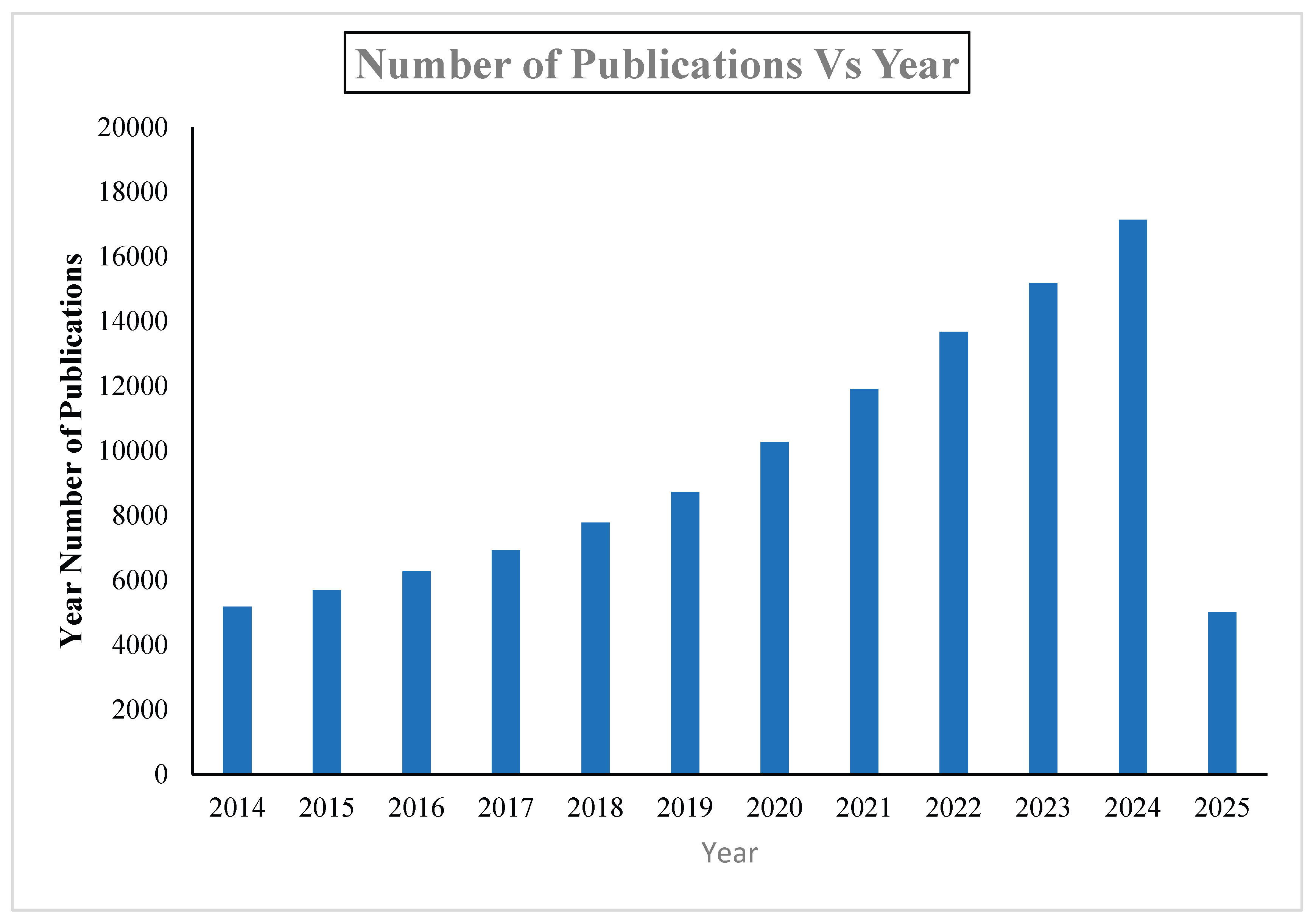
Figure 2.
An elementary depiction of the concept of 4D printing[35].
Figure 2.
An elementary depiction of the concept of 4D printing[35].
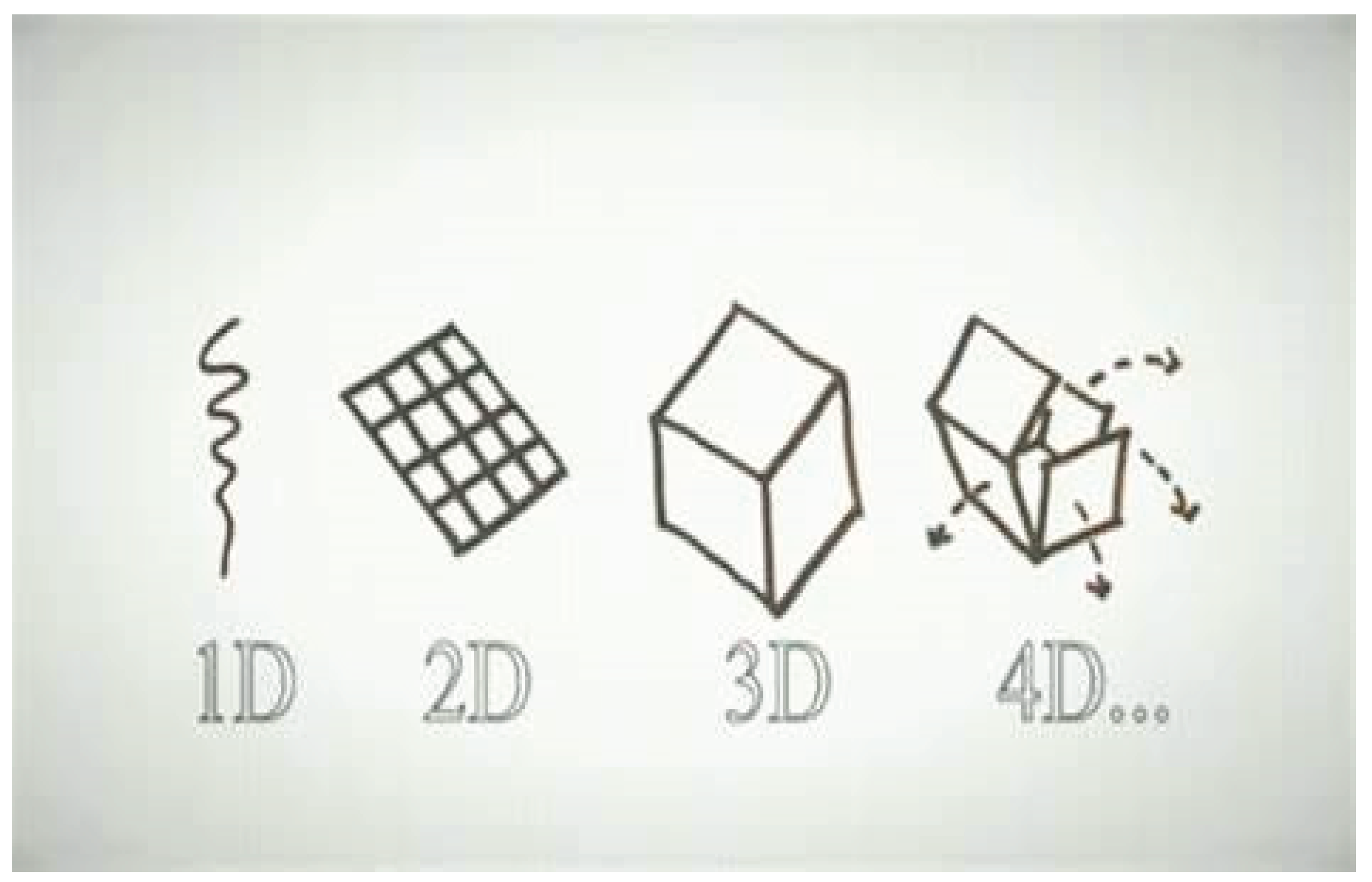
Figure 3.
Key parameters influencing hydrogel synthesis.
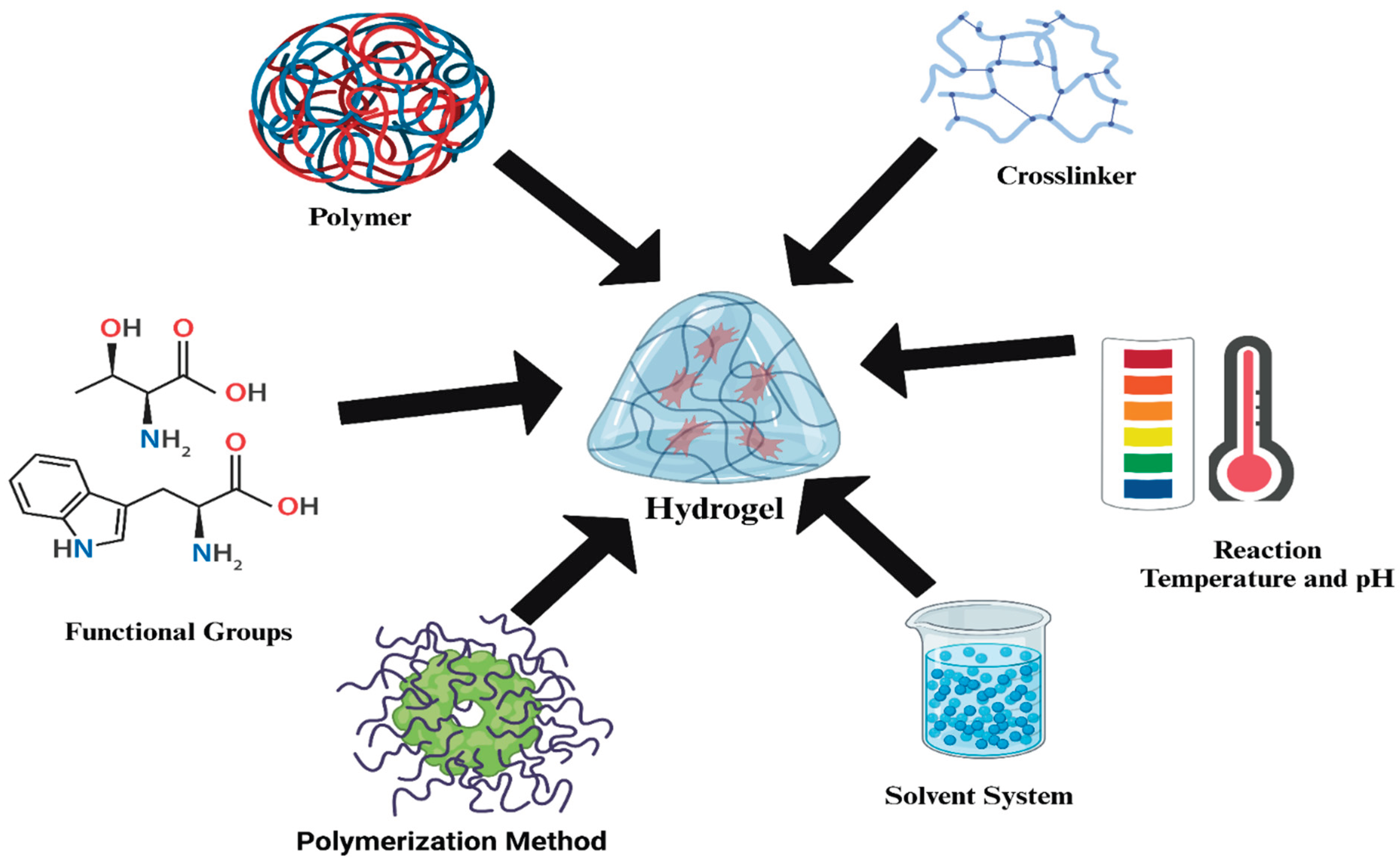
Figure 4.
Types of materials used for hydrogel synthesis based on their origin.
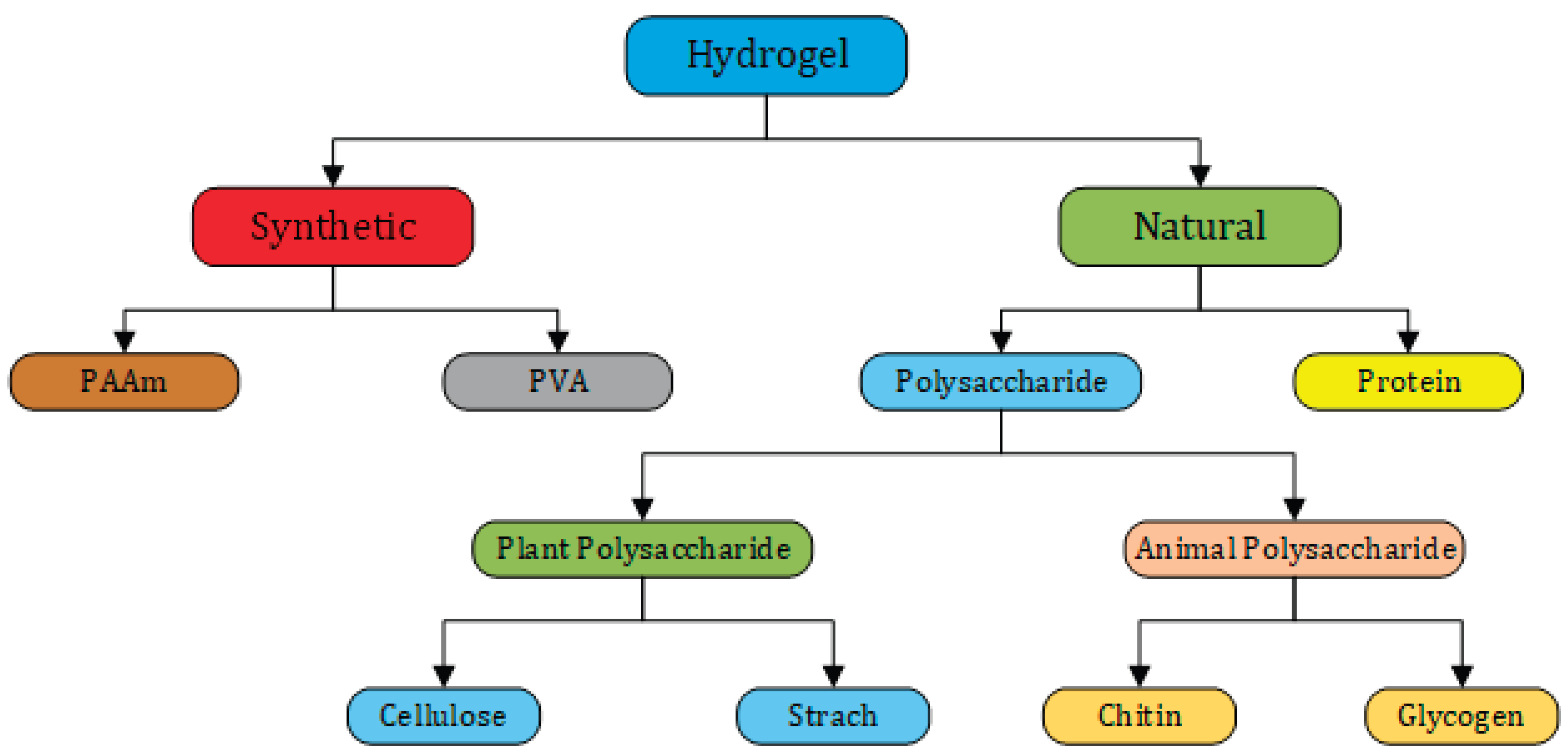
Figure 5.
Multifunctional Stimuli-Responsive Hydrogel: A Schematic Overview of Key Response Mechanism.
Figure 5.
Multifunctional Stimuli-Responsive Hydrogel: A Schematic Overview of Key Response Mechanism.
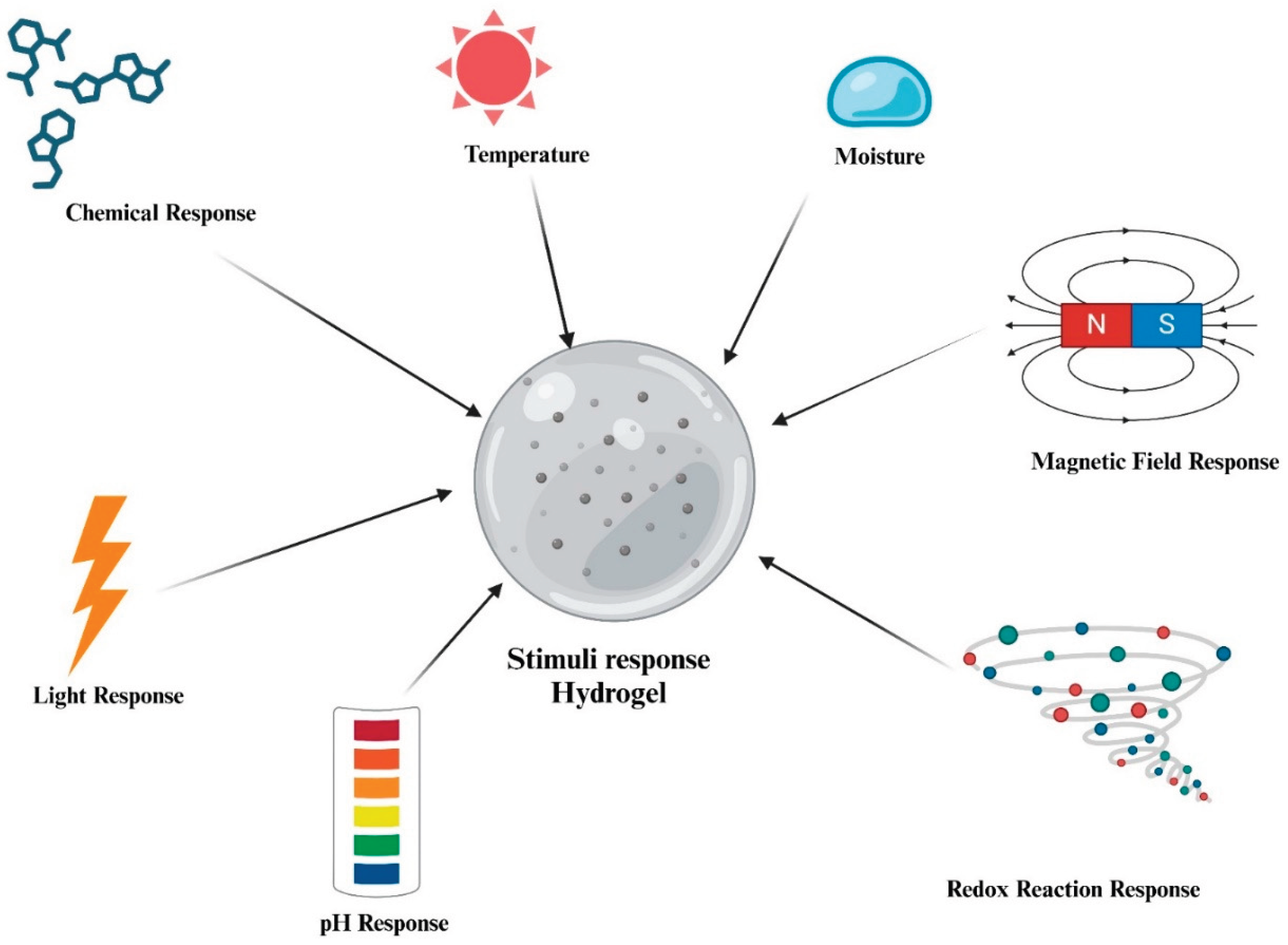
Figure 6.
illustrates the programmable morphing of the YYI actuator under different humidity levels. a) A left-handed coil actuator with the PAM hydrogel on the inside. (HP* Relative Humidity) [83] b) Time-lapse images of the biomimetic anthesis process of the initially fully swelled printed hydrogel flower at a relative humidity condition of 20%, exhibiting simultaneous blue-to-red luminescence color tuning and shape morphing [84] c) Schematic diagram illustrating the actuation mechanism of the humidity-responsive actuator for the CNF/GO/CNT composite film [93].
Figure 6.
illustrates the programmable morphing of the YYI actuator under different humidity levels. a) A left-handed coil actuator with the PAM hydrogel on the inside. (HP* Relative Humidity) [83] b) Time-lapse images of the biomimetic anthesis process of the initially fully swelled printed hydrogel flower at a relative humidity condition of 20%, exhibiting simultaneous blue-to-red luminescence color tuning and shape morphing [84] c) Schematic diagram illustrating the actuation mechanism of the humidity-responsive actuator for the CNF/GO/CNT composite film [93].
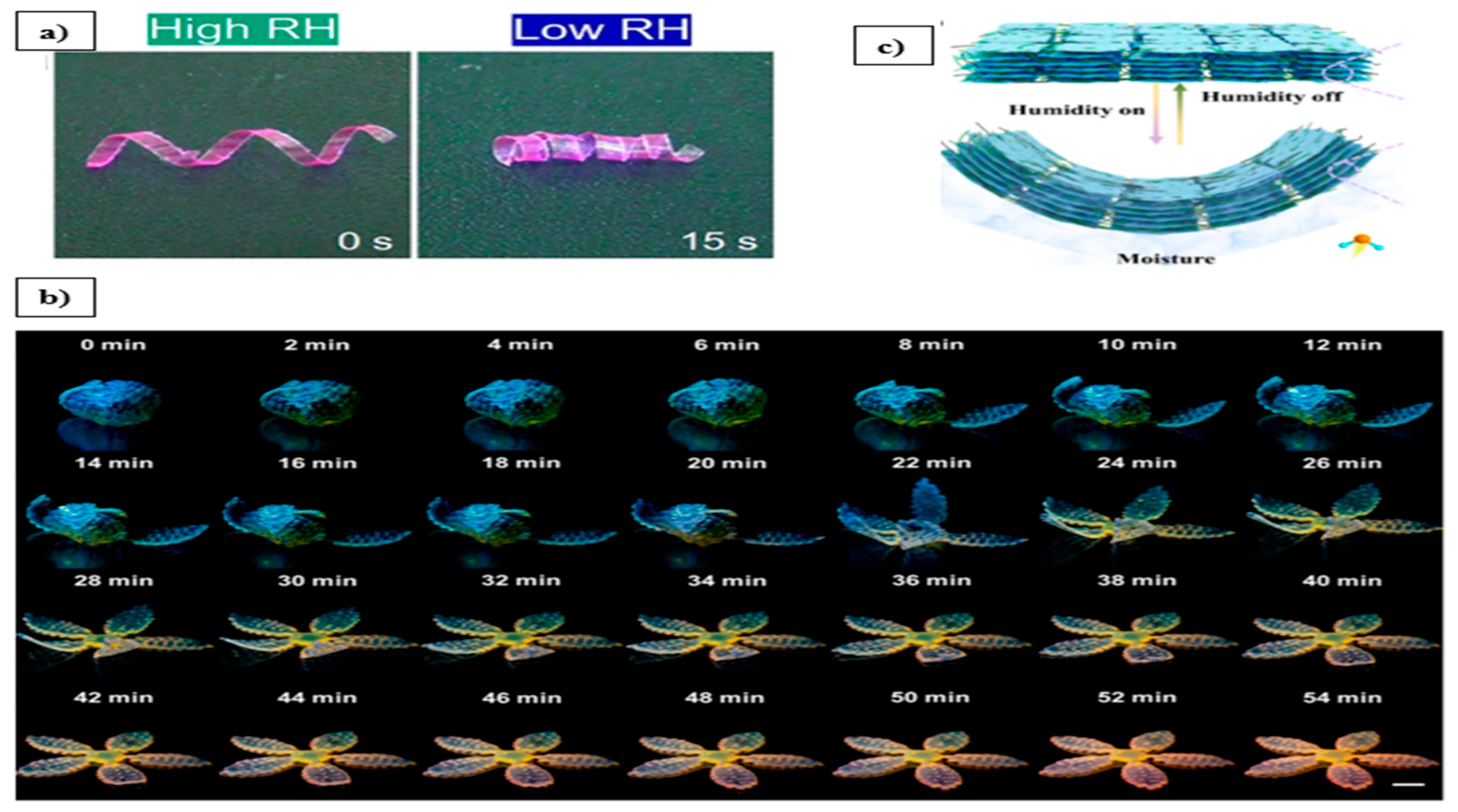
Figure 7.
The hydrogel resin demonstrates high fidelity in printing: (a) 3D model, (b) printed hydrogel precursor, and(c) final hydrogel at 20°C [135] (d) Stimuli-Responsiveness of 3D-Printed PNIPAM/PEDOT (1.3 wt.%) Hydrogel and PEGDA Hydrogel in Lotus Blossom Shape Below and Above LCST (35°C) [136] (e) Schematic diagram of the desalination setup [137].
Figure 7.
The hydrogel resin demonstrates high fidelity in printing: (a) 3D model, (b) printed hydrogel precursor, and(c) final hydrogel at 20°C [135] (d) Stimuli-Responsiveness of 3D-Printed PNIPAM/PEDOT (1.3 wt.%) Hydrogel and PEGDA Hydrogel in Lotus Blossom Shape Below and Above LCST (35°C) [136] (e) Schematic diagram of the desalination setup [137].
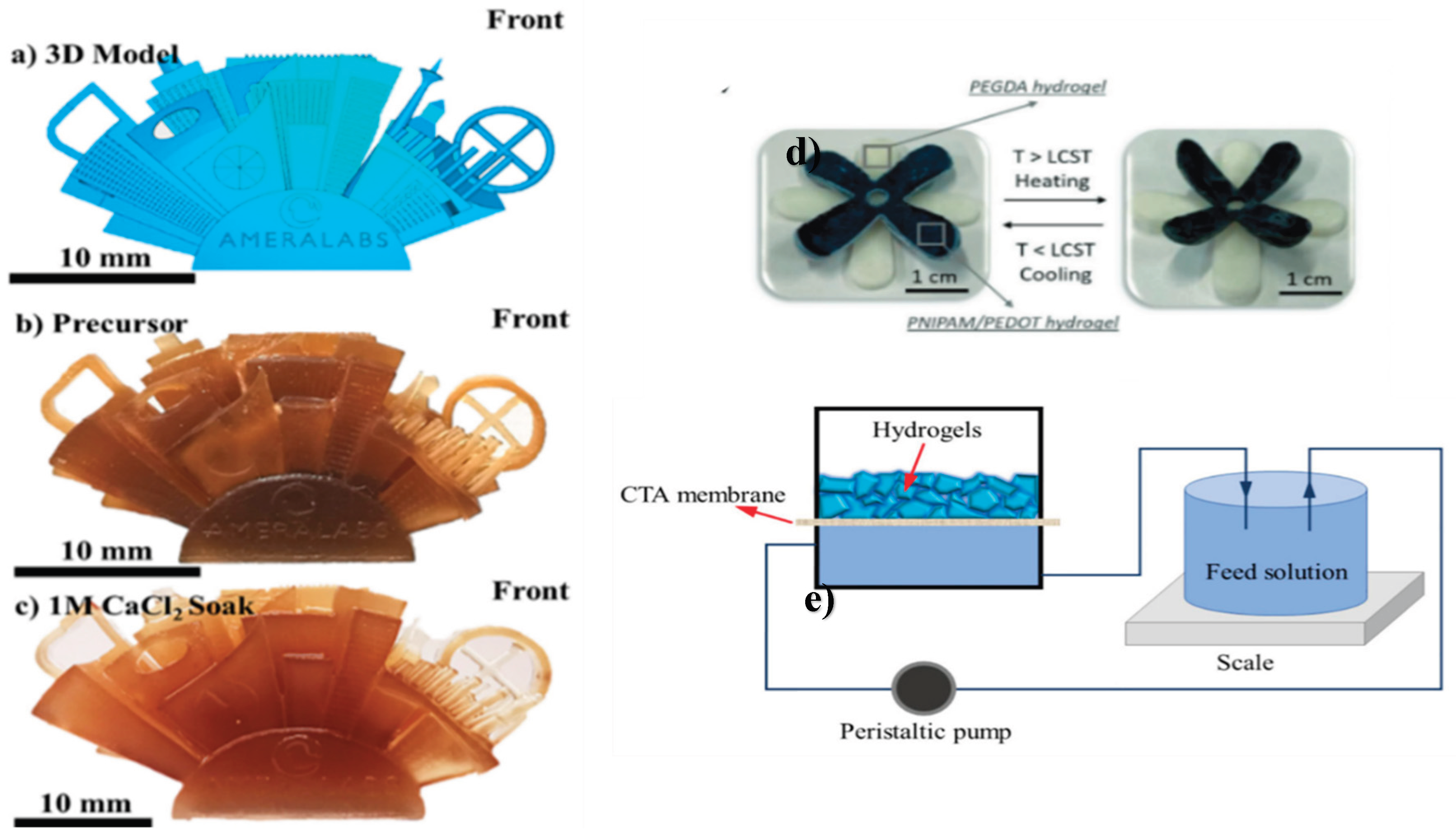
Figure 8.
The hydrogel resin demonstrates high fidelity in printing. (a) Illustration and operational mechanism of Methylene Blue adsorption and desorption using CMC/CS hydrogels [146] (b) Schematic illustration for the fabrication of (i) positional PANI/PEG array films and (ii) non-positional PANI/PEG suspension arrays. PEG photolithography was utilized to create two distinct types of polyaniline/polyethylene glycol (PANI/PEG) composite microarrays [148]In another article, Mariam et al. [161] developed temperature and redox-responsive hydrogels based on nitroxide radicals and oligoethyleneglycol methacrylate. These hydrogels exhibit dual responsiveness, allowing them to undergo structural or property changes in response to both temperature variations and redox stimuli. A polymer hydrogel with dual temperature and redox responsiveness was fabricated by randomly integrating 2,2,6,6-tetramethyl-1-piperidinyloxy-methacrylate (TEMPO) stable nitroxide radicals and oligoethylene glycol methacrylate (OEGMA) groups into its polymer framework. The redox-sensitive behavior arose from the reversible oxidation of TEMPO into an oxoammonium cation (TEMPO+), while the temperature-dependent response stemmed from the lower critical solubility temperature (LCST) of OEGMA. Due to the minimal incorporation of di(ethylene glycol) dimethacrylate (OEGMA2) as a chemical crosslinker, the hydrogels, once swollen in water, comprised microgel particles with intertwined polymer chains that remained uncrosslinked at the chemical level. By adjusting the TEMPO concentration within the polymer matrix, it was observed that the radical form of TEMPO self-assembled into hydrophobic clusters, functioning as physical crosslinking nodes within the hydrogel and reinforcing cohesion between microgel particles. Figure 9 (c). illustrates the collection of composed hydrogels.
Figure 8.
The hydrogel resin demonstrates high fidelity in printing. (a) Illustration and operational mechanism of Methylene Blue adsorption and desorption using CMC/CS hydrogels [146] (b) Schematic illustration for the fabrication of (i) positional PANI/PEG array films and (ii) non-positional PANI/PEG suspension arrays. PEG photolithography was utilized to create two distinct types of polyaniline/polyethylene glycol (PANI/PEG) composite microarrays [148]In another article, Mariam et al. [161] developed temperature and redox-responsive hydrogels based on nitroxide radicals and oligoethyleneglycol methacrylate. These hydrogels exhibit dual responsiveness, allowing them to undergo structural or property changes in response to both temperature variations and redox stimuli. A polymer hydrogel with dual temperature and redox responsiveness was fabricated by randomly integrating 2,2,6,6-tetramethyl-1-piperidinyloxy-methacrylate (TEMPO) stable nitroxide radicals and oligoethylene glycol methacrylate (OEGMA) groups into its polymer framework. The redox-sensitive behavior arose from the reversible oxidation of TEMPO into an oxoammonium cation (TEMPO+), while the temperature-dependent response stemmed from the lower critical solubility temperature (LCST) of OEGMA. Due to the minimal incorporation of di(ethylene glycol) dimethacrylate (OEGMA2) as a chemical crosslinker, the hydrogels, once swollen in water, comprised microgel particles with intertwined polymer chains that remained uncrosslinked at the chemical level. By adjusting the TEMPO concentration within the polymer matrix, it was observed that the radical form of TEMPO self-assembled into hydrophobic clusters, functioning as physical crosslinking nodes within the hydrogel and reinforcing cohesion between microgel particles. Figure 9 (c). illustrates the collection of composed hydrogels.
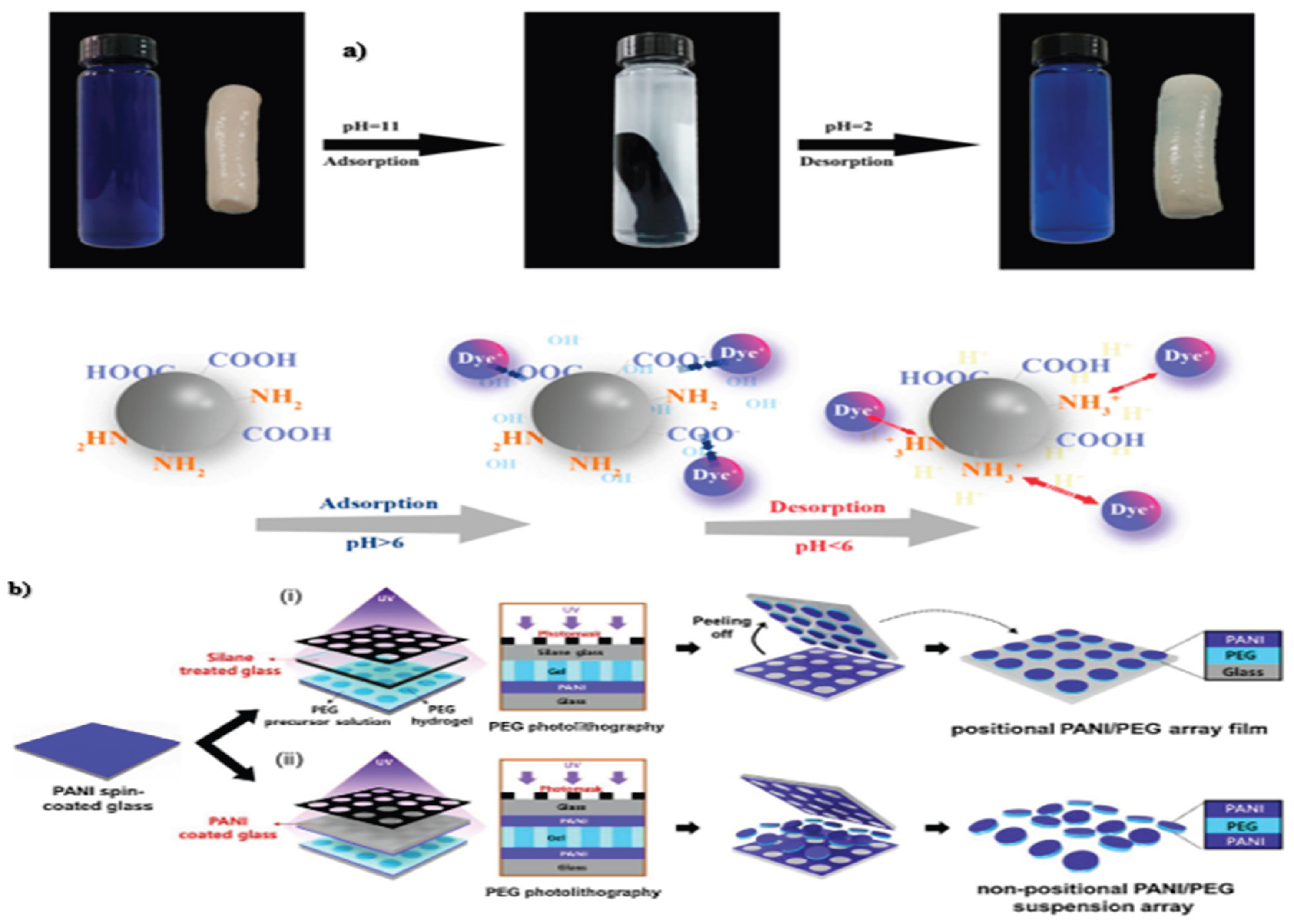
Figure 9.
a) Visual photographs of UV-illuminated vials demonstrating differences in the release of FITC-BSA from hydrogels in DTT (21 mM) and in PBS solutions. b) Release profile of FITC-BSA from hydrogels with varying crosslinking in DTT and PBS solution at 37 °C [160]. c) collection of hydrogels composed of reduced P(TEMPO-r-OEGMA) and oxidized P(TEMPO⁺-r-OEGMA) was developed, featuring a crosslinking ratio (XCL) of 0.03 and a range of TEMPO compositions (XTEMPO) [161].
Figure 9.
a) Visual photographs of UV-illuminated vials demonstrating differences in the release of FITC-BSA from hydrogels in DTT (21 mM) and in PBS solutions. b) Release profile of FITC-BSA from hydrogels with varying crosslinking in DTT and PBS solution at 37 °C [160]. c) collection of hydrogels composed of reduced P(TEMPO-r-OEGMA) and oxidized P(TEMPO⁺-r-OEGMA) was developed, featuring a crosslinking ratio (XCL) of 0.03 and a range of TEMPO compositions (XTEMPO) [161].
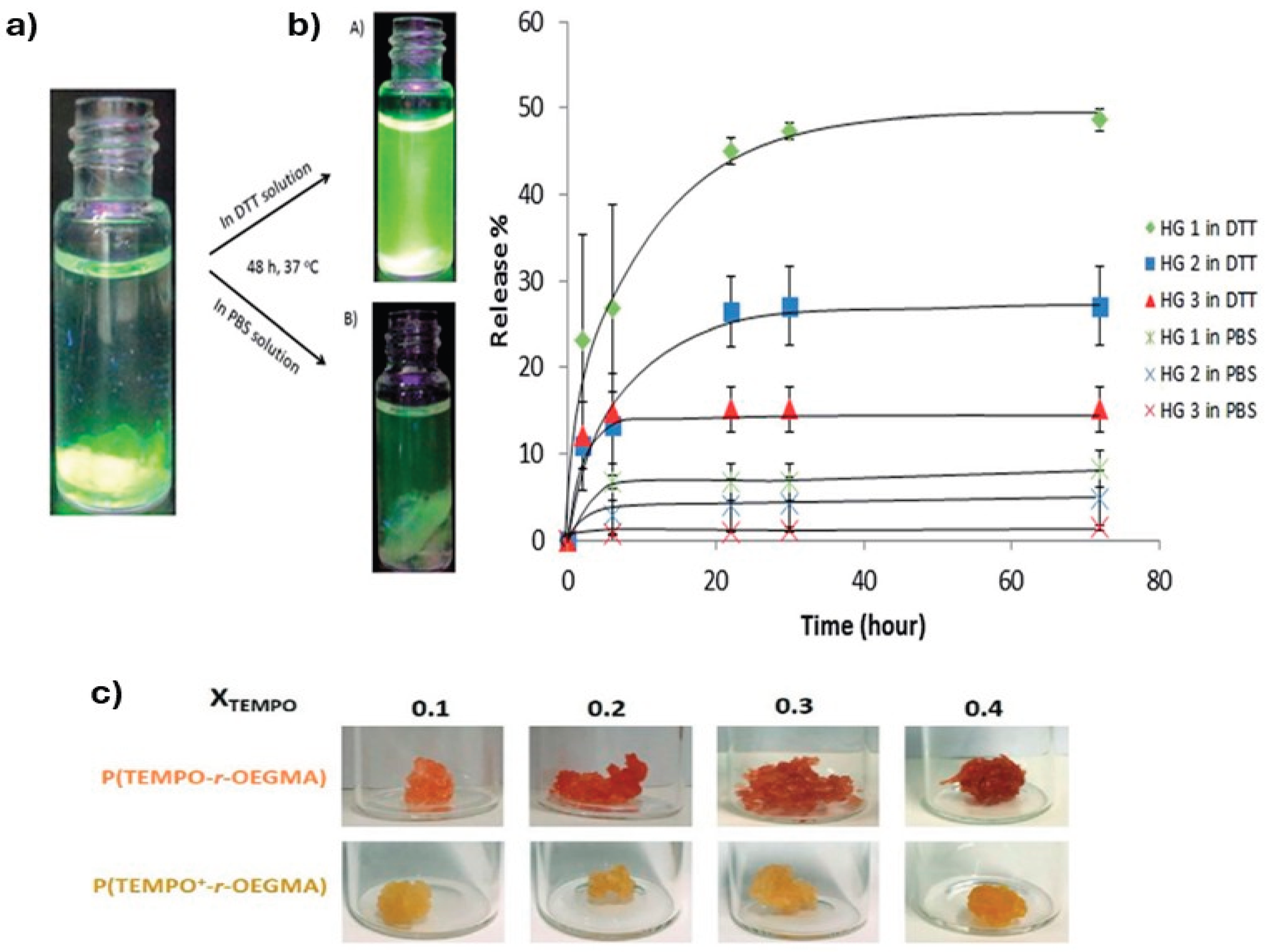
Figure 10.
Macroscopic visualization of the deformation behavior was performed for (a) neat polyacrylic acid (PAA) and (b) its graphene composite hydrogel at 0.5 vol% [172]. (c) synthesis of a pH-responsive conductive hydrogel composed of poly(acrylic acid-co-ethylene glycol dimethacrylate–hydroxyethyl methacrylate)/graphene oxide (poly(AA-co-EDGMA–HEMA)/GO) [172].
Figure 10.
Macroscopic visualization of the deformation behavior was performed for (a) neat polyacrylic acid (PAA) and (b) its graphene composite hydrogel at 0.5 vol% [172]. (c) synthesis of a pH-responsive conductive hydrogel composed of poly(acrylic acid-co-ethylene glycol dimethacrylate–hydroxyethyl methacrylate)/graphene oxide (poly(AA-co-EDGMA–HEMA)/GO) [172].
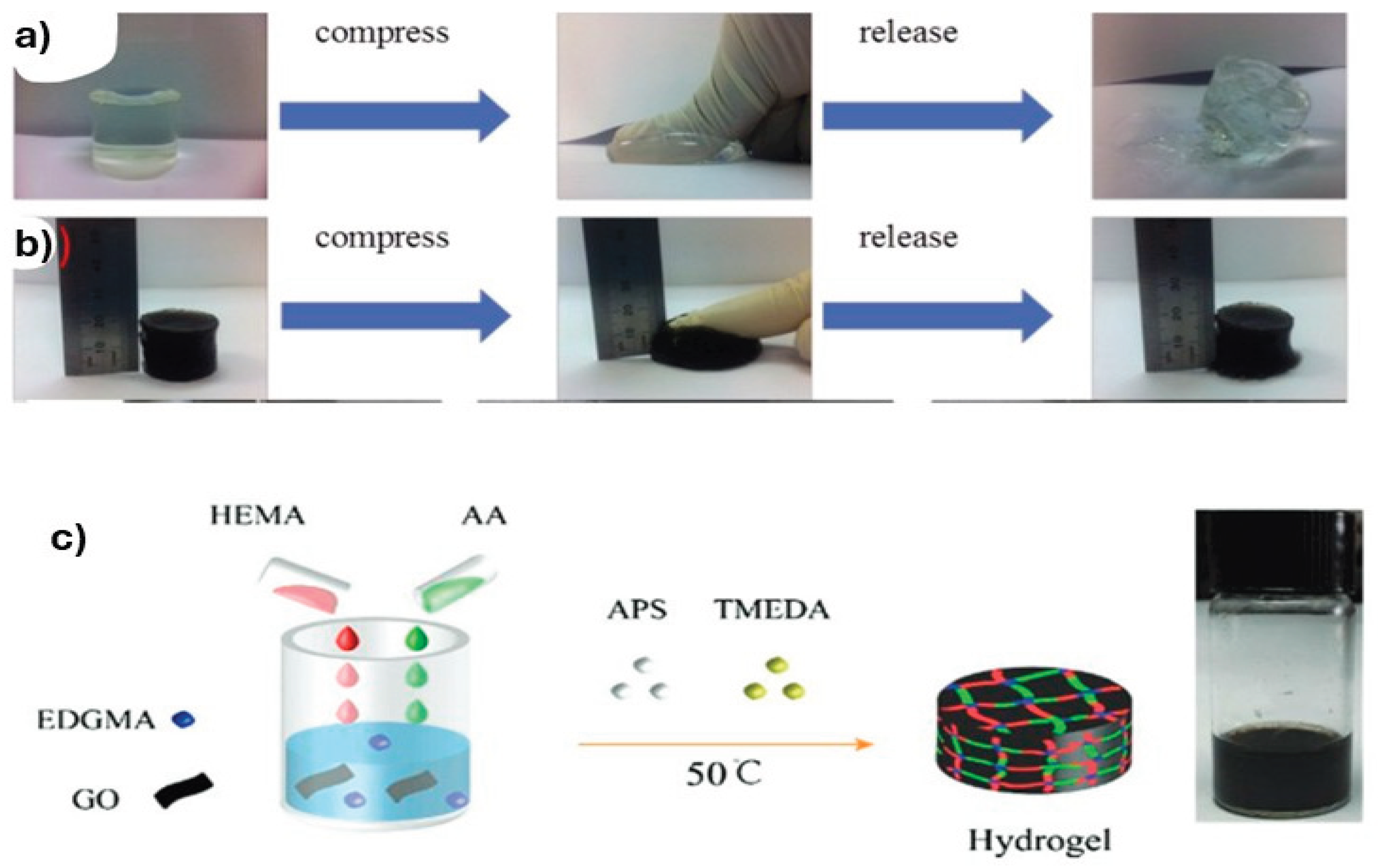
Figure 11.
(a) A visual depiction of how a hydrogel bends when an electric field is applied. (b) The P(VBS/HEMA/AAm)-1/10/5 hydrogel-1.0, placed in a 0.025 M NaCl solution, shows clear bending motion under a 10 V electric field, showcasing its ability to respond to electrical stimulation [175]. (c) Exhibition of: (A) the hydrogel’s mechanical resilience, demonstrated through knotting; (B) the magnetic gradient embedded within the 3D-printed hydrogel (inset: optical analysis of its layered architecture); (C1-C2) the hydrogel’s dynamic magnetic response to a neodymium magnet, showcasing a flexible hydrogel tile capable of bending, folding, and being drawn toward the magnet [177].
Figure 11.
(a) A visual depiction of how a hydrogel bends when an electric field is applied. (b) The P(VBS/HEMA/AAm)-1/10/5 hydrogel-1.0, placed in a 0.025 M NaCl solution, shows clear bending motion under a 10 V electric field, showcasing its ability to respond to electrical stimulation [175]. (c) Exhibition of: (A) the hydrogel’s mechanical resilience, demonstrated through knotting; (B) the magnetic gradient embedded within the 3D-printed hydrogel (inset: optical analysis of its layered architecture); (C1-C2) the hydrogel’s dynamic magnetic response to a neodymium magnet, showcasing a flexible hydrogel tile capable of bending, folding, and being drawn toward the magnet [177].
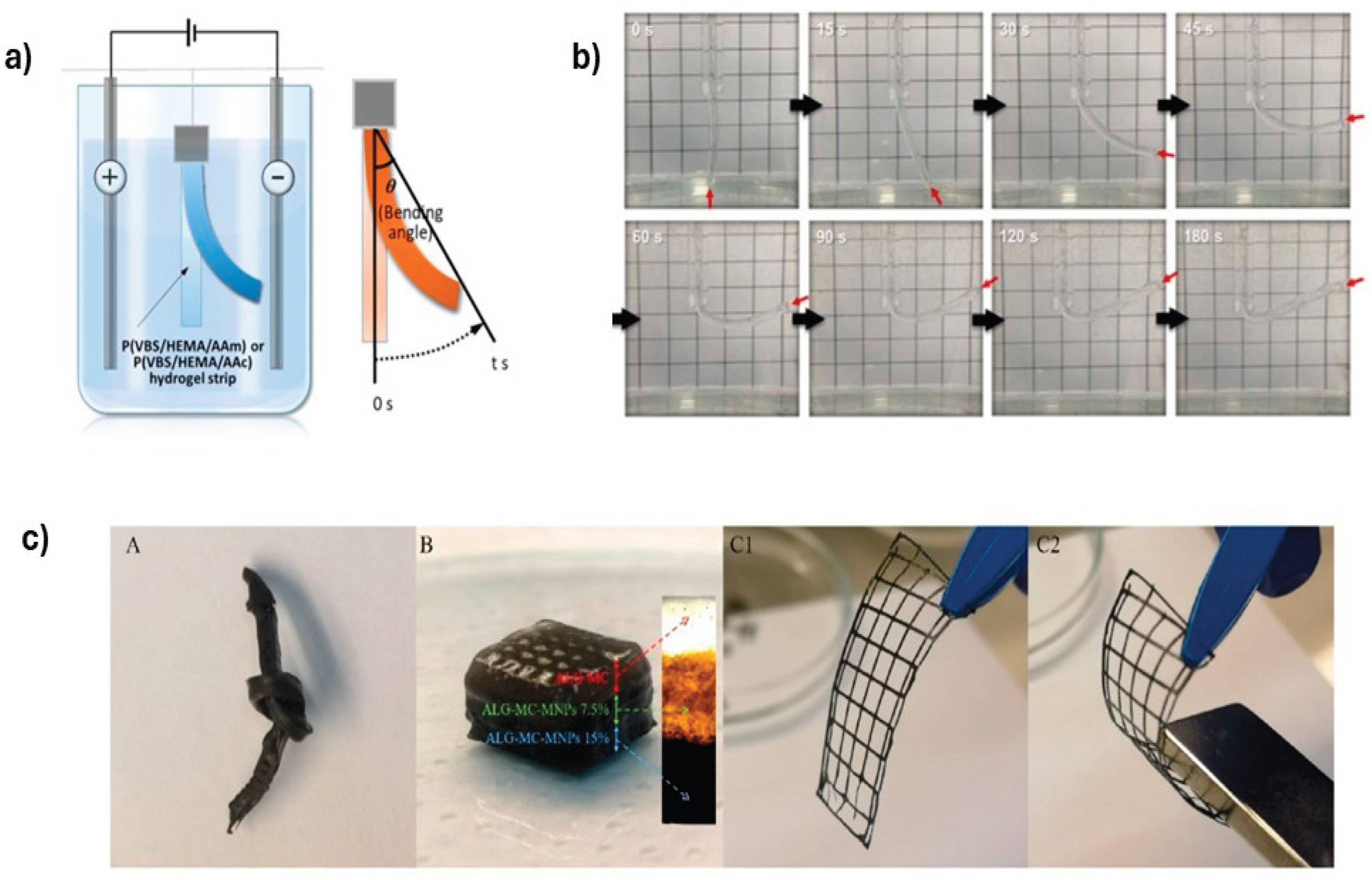
Figure 12.
Concept of the Untethered Milli-Gripper:(a) 3D printing of the untethered milli-gripper composed of an ink containing the chitosan hydrogel and citric acid-coated SPIONs. (b) Gripping motion of the untethered milli-gripper induced by an electric field. (c) Locomotion of the untethered milli-gripper induced by a magnetic field generated using a neodymium permanent magnet. (d) Biocompatibility and biodegradability of the untethered milli-gripper. (e) Overall process of cargo delivery: 1) Placing the untethered milli-gripper on cargo in the initial state. 2) Gripping of cargo induced by an electric field. 3) Moving up by a magnetic field. 4) Moving sideways by a magnetic field. 5) Releasing cargo induced by an electric field [179]. Light-responsive hydrogels are smart materials that react to external light stimuli. Upon exposure to light, they shrink by expelling water, allowing for non-invasive, cost-effective, and remotely controlled actuation. Emilia Zari et al. [181] present a light-driven, 3D (Extrusion)-printed elastomer/hydrogel composite actuator. The soft photo-actuator integrates TangoPlus, a flexible 3D printing material, with a PNIPAM hydrogel copolymerized with the photochromic molecule spiropyran. The composite actuator's passive layer is composed of TangoPlus, a flexible 3D printing material. This elastomeric layer enhances the mechanical integrity of the hydrogel-based actuator. The incorporation of the spiropyran element into the PNIPAM gel makes it photo responsive. In another article, Qijun Wu et al. [182] described the creation of a light-responsive actuator by integrating tissue paper with a hydrogel composite made from PNIPAM. This was accomplished through an uncomplicated in situ polymerization method that involved inkjet-printed tissue paper. The prepolymer solution was formulated by dissolving NIPAM (the monomer), N,N'-Methylenebis(acrylamide) as the crosslinker, and 2,2'-Azobis(2-methylpropionamidine) dihydrochloride as the PI in deionized water. The composite actuator benefited from the inherent strength of natural tissue paper, coupled with strong interactions at the interface of the bilayer structure, which collectively enhanced its mechanical properties and resulted in a tensile strength of 1.2 MPa. Light-driven hydrogels can be remotely controlled, but difficult to control light intensity penetration depth [183].
Figure 12.
Concept of the Untethered Milli-Gripper:(a) 3D printing of the untethered milli-gripper composed of an ink containing the chitosan hydrogel and citric acid-coated SPIONs. (b) Gripping motion of the untethered milli-gripper induced by an electric field. (c) Locomotion of the untethered milli-gripper induced by a magnetic field generated using a neodymium permanent magnet. (d) Biocompatibility and biodegradability of the untethered milli-gripper. (e) Overall process of cargo delivery: 1) Placing the untethered milli-gripper on cargo in the initial state. 2) Gripping of cargo induced by an electric field. 3) Moving up by a magnetic field. 4) Moving sideways by a magnetic field. 5) Releasing cargo induced by an electric field [179]. Light-responsive hydrogels are smart materials that react to external light stimuli. Upon exposure to light, they shrink by expelling water, allowing for non-invasive, cost-effective, and remotely controlled actuation. Emilia Zari et al. [181] present a light-driven, 3D (Extrusion)-printed elastomer/hydrogel composite actuator. The soft photo-actuator integrates TangoPlus, a flexible 3D printing material, with a PNIPAM hydrogel copolymerized with the photochromic molecule spiropyran. The composite actuator's passive layer is composed of TangoPlus, a flexible 3D printing material. This elastomeric layer enhances the mechanical integrity of the hydrogel-based actuator. The incorporation of the spiropyran element into the PNIPAM gel makes it photo responsive. In another article, Qijun Wu et al. [182] described the creation of a light-responsive actuator by integrating tissue paper with a hydrogel composite made from PNIPAM. This was accomplished through an uncomplicated in situ polymerization method that involved inkjet-printed tissue paper. The prepolymer solution was formulated by dissolving NIPAM (the monomer), N,N'-Methylenebis(acrylamide) as the crosslinker, and 2,2'-Azobis(2-methylpropionamidine) dihydrochloride as the PI in deionized water. The composite actuator benefited from the inherent strength of natural tissue paper, coupled with strong interactions at the interface of the bilayer structure, which collectively enhanced its mechanical properties and resulted in a tensile strength of 1.2 MPa. Light-driven hydrogels can be remotely controlled, but difficult to control light intensity penetration depth [183].
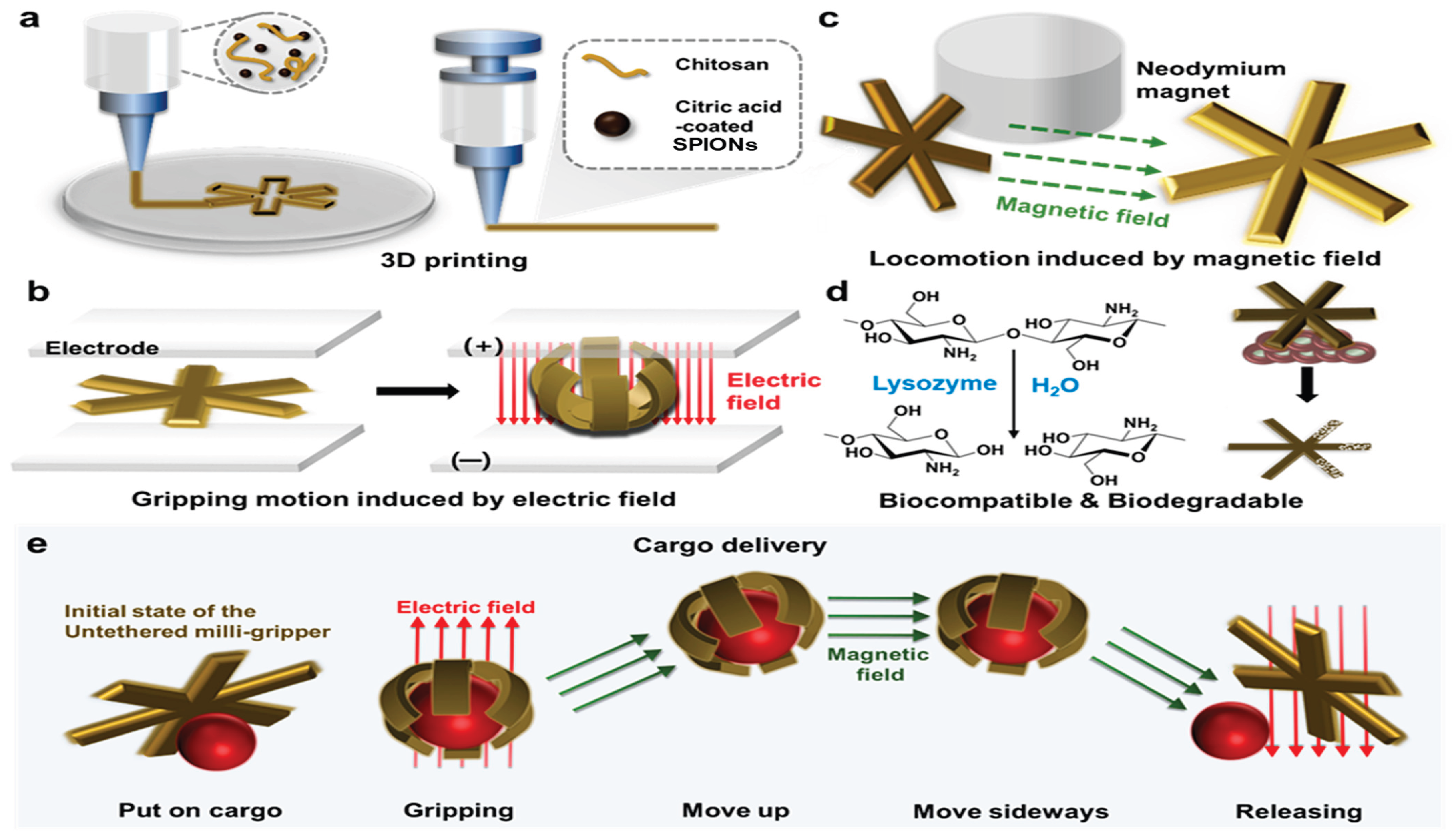
Figure 13.
Key applications of hydrogels.
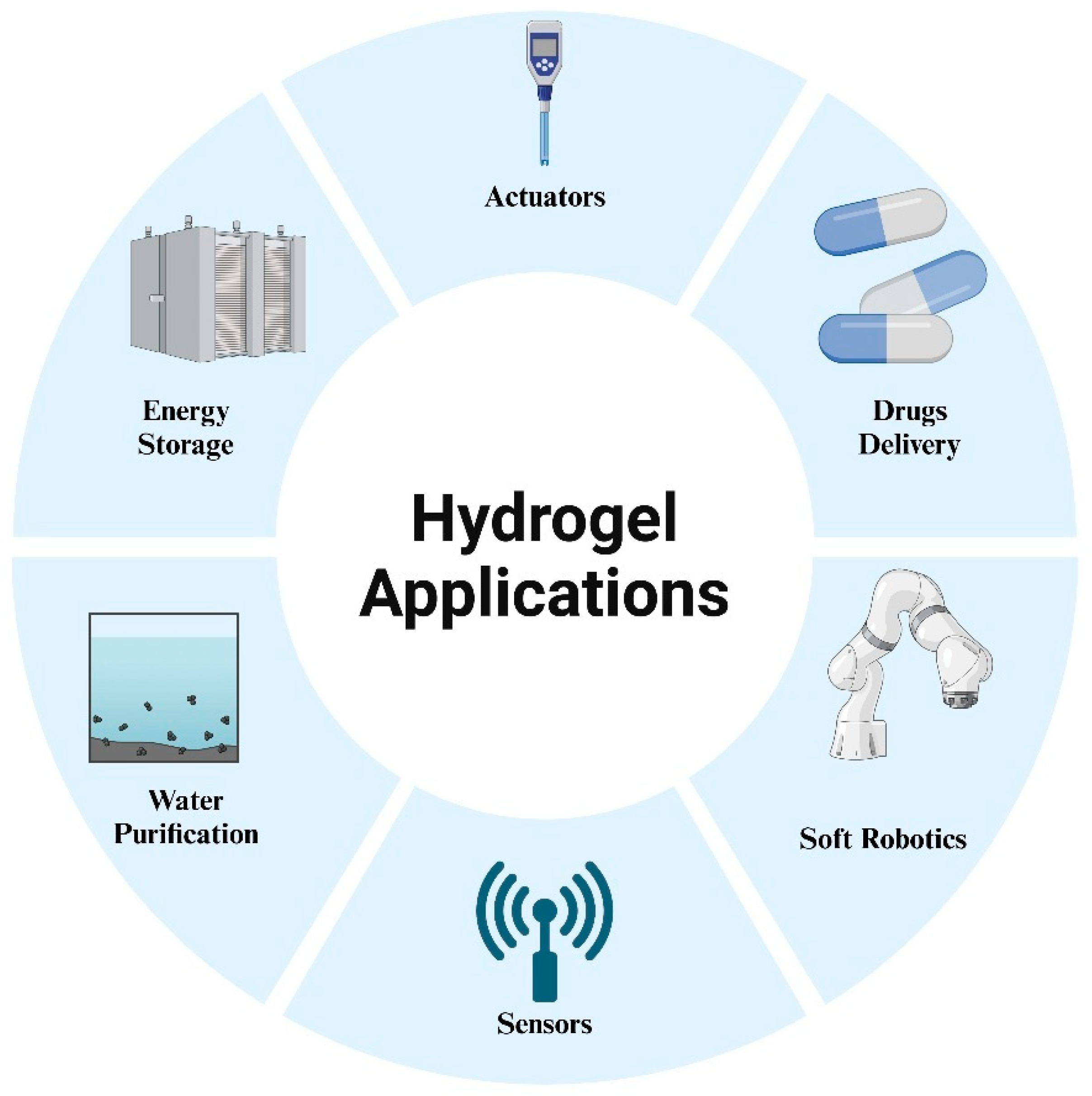
Figure 14.
Images showing the measured points of (a) a 3D-printed actuator and (b) a moon jellyfish [187]. (c) Near-infrared reactions of (a-1) through (a-5) PNIPAm-GO1, (b-1) through (b-5) PNIPAm-GO2, and (c-1) through (c-5) PNIPAm-GO3 bilayer hydrogel actuators created via molding [188]. (d). Bending actuator made of EDG-paper (plastic material) bimorph structure showing strong driving force by lifting a weight (4 g), which is unachievable by the osmotic (PNIPAm) hydrogel as the control [193].Nanocellulose has gained significant interest in the development and creation of various soft actuators, attributed to its abundant availability, favorable mechanical characteristics, and eco-friendly nature. Wang et al. [195] reported a thermo-responsive bilayer hydrogel gripper consisting of PNIPAM as the active layer and poly(N-hydroxyethyl acrylamide) combined with CNCs as the cooperating layer. The incorporation of CNCs as macromolecular cross-linkers and nanofillers increased the cross-linking density and mechanical properties of the cooperating layer. Similarly, in another article, Yuanyuan Ma. et al. [196] created bilayer hydrogel actuators enhanced with nanocellulose, showcasing thermo-responsive, shape memory, and self-sensing abilities. The PNIPAM/TOCN/PAM hydrogel actuator serves multiple functions, including acting as an encapsulation device, jack, temperature-controlled fluid valve, and temperature-control manipulator. The addition of Fe³⁺ significantly improves the actuator's performance, providing synergistic shape memory and temperature-driven functionality, making it suitable as a temperature-responsive switch for monitoring ambient temperature.
Figure 14.
Images showing the measured points of (a) a 3D-printed actuator and (b) a moon jellyfish [187]. (c) Near-infrared reactions of (a-1) through (a-5) PNIPAm-GO1, (b-1) through (b-5) PNIPAm-GO2, and (c-1) through (c-5) PNIPAm-GO3 bilayer hydrogel actuators created via molding [188]. (d). Bending actuator made of EDG-paper (plastic material) bimorph structure showing strong driving force by lifting a weight (4 g), which is unachievable by the osmotic (PNIPAm) hydrogel as the control [193].Nanocellulose has gained significant interest in the development and creation of various soft actuators, attributed to its abundant availability, favorable mechanical characteristics, and eco-friendly nature. Wang et al. [195] reported a thermo-responsive bilayer hydrogel gripper consisting of PNIPAM as the active layer and poly(N-hydroxyethyl acrylamide) combined with CNCs as the cooperating layer. The incorporation of CNCs as macromolecular cross-linkers and nanofillers increased the cross-linking density and mechanical properties of the cooperating layer. Similarly, in another article, Yuanyuan Ma. et al. [196] created bilayer hydrogel actuators enhanced with nanocellulose, showcasing thermo-responsive, shape memory, and self-sensing abilities. The PNIPAM/TOCN/PAM hydrogel actuator serves multiple functions, including acting as an encapsulation device, jack, temperature-controlled fluid valve, and temperature-control manipulator. The addition of Fe³⁺ significantly improves the actuator's performance, providing synergistic shape memory and temperature-driven functionality, making it suitable as a temperature-responsive switch for monitoring ambient temperature.
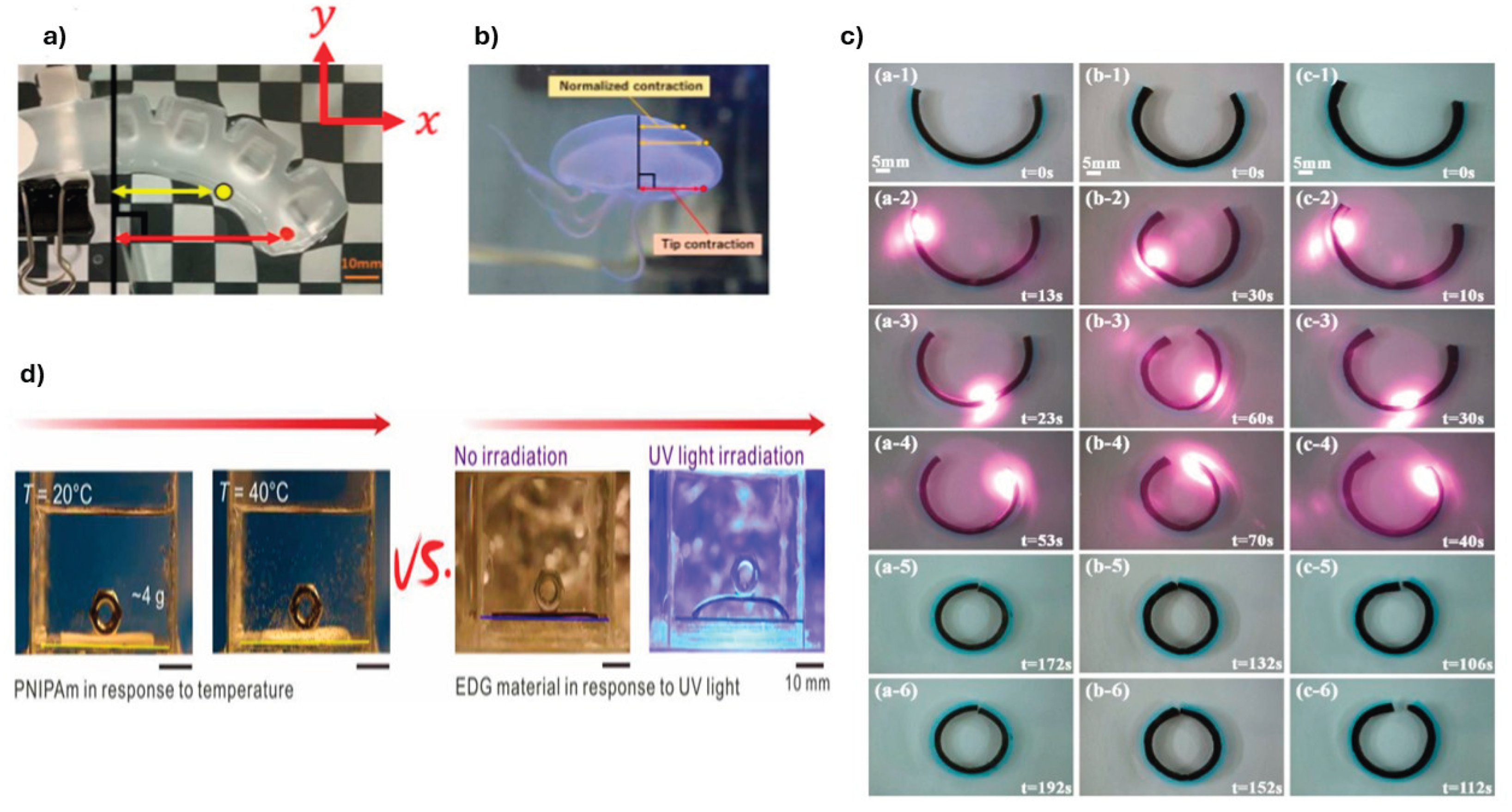
Figure 15.
(a) Capacitive energy storage performance of dried rGO fibers [201]. (b) Electrochemical performance of Zn | MnHCF cell with the ZIG−20 wt% electrolyte . Discharge-charge profiles at varying rates [203]. (c) Photographs of the supercapacitor in different deformation states.(d) Photographs of the all-hydrogel supercapacitor [204] Water Purification.
Figure 15.
(a) Capacitive energy storage performance of dried rGO fibers [201]. (b) Electrochemical performance of Zn | MnHCF cell with the ZIG−20 wt% electrolyte . Discharge-charge profiles at varying rates [203]. (c) Photographs of the supercapacitor in different deformation states.(d) Photographs of the all-hydrogel supercapacitor [204] Water Purification.
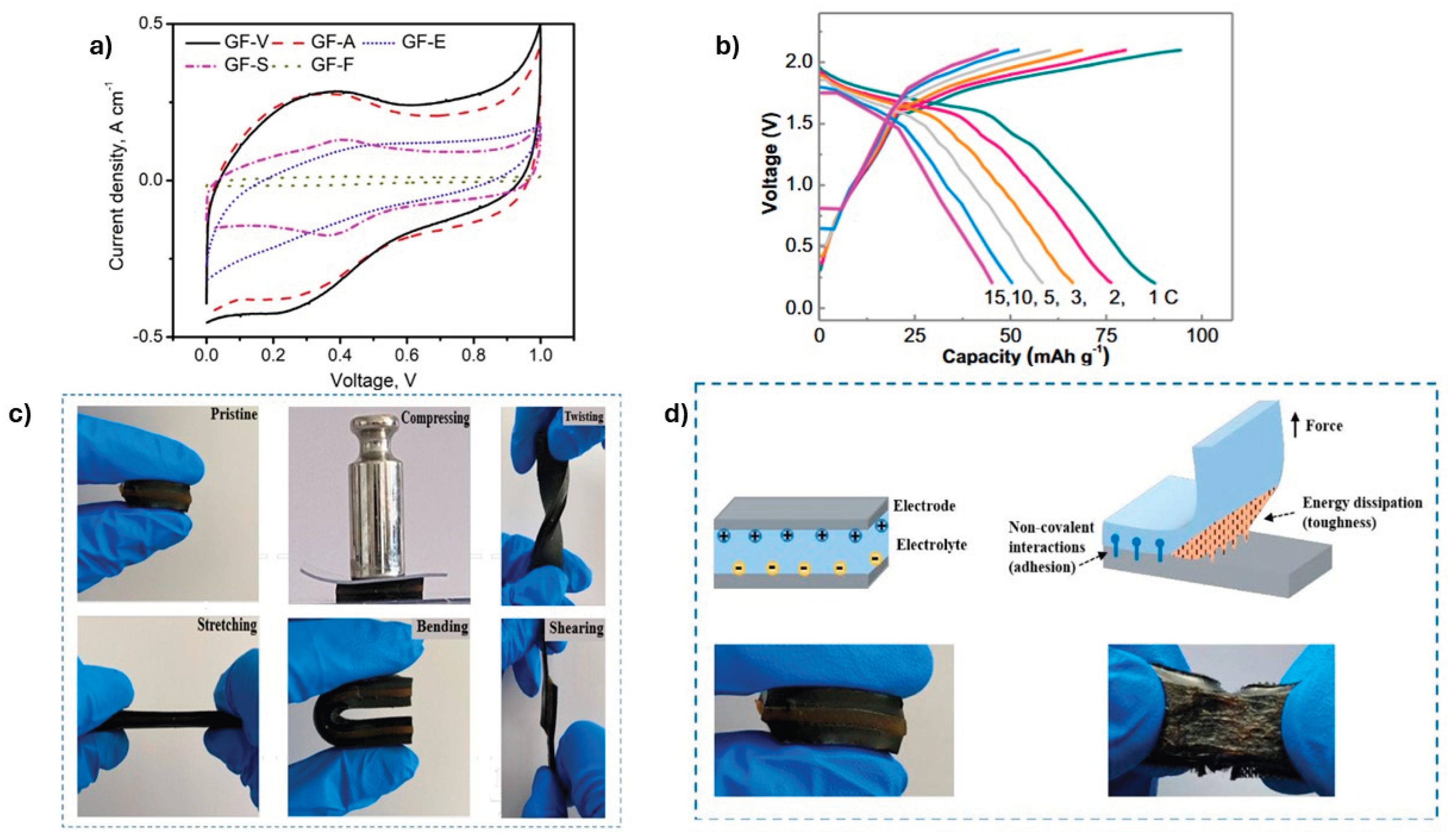
Figure 16.
(a) Schematic representation and working mechanism of the interfacial steam generator proposed [211]. (b) Evaporation and anti-salt-fouling performance of hydrogel under one sun illumination, with initial salt crystallization presence [212].
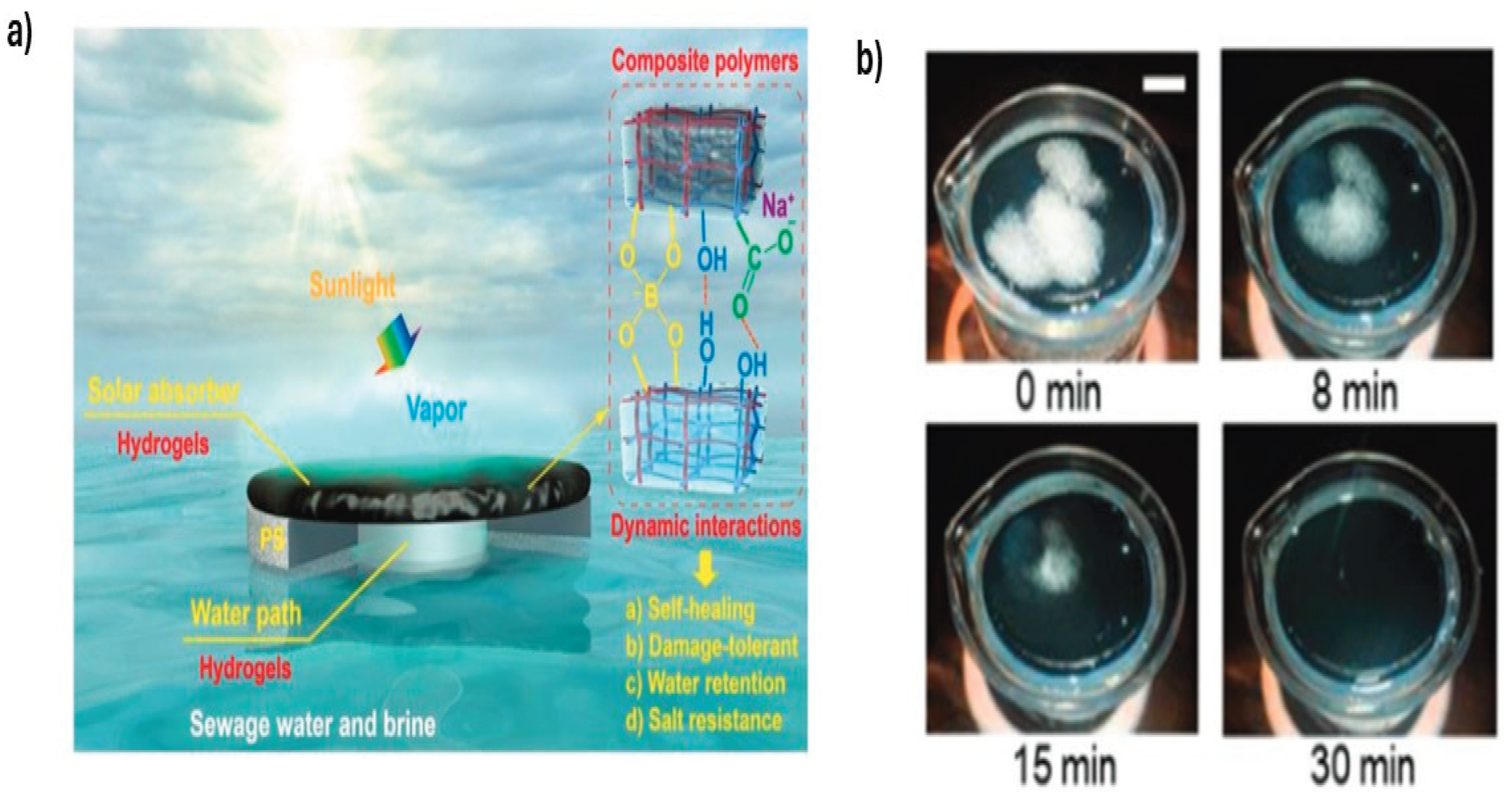
Figure 17.
The hydrogel sensor tracks vibrations associated with (a) stretching actions, (b) handwriting, and (c) speech [223]. (d) Demonstration of Self-Healing Capability After Being Severed and Rejoined (a) Initial state of the hydrogel. (b) Integrated into an active circuit. (c) Illuminates an LED when powered by 3.0 V. (d) Hydrogel is cut into two separate pieces. (e) The LED reignites at the same voltage after reconnection. (f) After two minutes of healing, the junction crack becomes less visible. (g) One segment is dyed, with the insect confirming the SFH remains conductive. (h) After 12 hours of healing, the dye diffuses through the junction, resulting in a uniform color, and the restored SFH retains its stretchability [224].Hydrogel-based sensors are currently in the nascent phases of their development, highlighting an immediate necessity to transition from theoretical studies to real-world applications. Sensitivity is crucial in the design of nanocomposite hydrogels, as it enables the accurate detection of subtle movements or physiological signals, expanding their potential applications. Another key parameter is the working range; a larger working range allows for the detection of a wider array of human movements. However, the current working ranges for nanocomposite hydrogel-based strain and pressure sensors need improvement. This is due to the incompatibility between nanofillers and the hydrogel network, which hinders the stretchability of the hydrogels [43].
Figure 17.
The hydrogel sensor tracks vibrations associated with (a) stretching actions, (b) handwriting, and (c) speech [223]. (d) Demonstration of Self-Healing Capability After Being Severed and Rejoined (a) Initial state of the hydrogel. (b) Integrated into an active circuit. (c) Illuminates an LED when powered by 3.0 V. (d) Hydrogel is cut into two separate pieces. (e) The LED reignites at the same voltage after reconnection. (f) After two minutes of healing, the junction crack becomes less visible. (g) One segment is dyed, with the insect confirming the SFH remains conductive. (h) After 12 hours of healing, the dye diffuses through the junction, resulting in a uniform color, and the restored SFH retains its stretchability [224].Hydrogel-based sensors are currently in the nascent phases of their development, highlighting an immediate necessity to transition from theoretical studies to real-world applications. Sensitivity is crucial in the design of nanocomposite hydrogels, as it enables the accurate detection of subtle movements or physiological signals, expanding their potential applications. Another key parameter is the working range; a larger working range allows for the detection of a wider array of human movements. However, the current working ranges for nanocomposite hydrogel-based strain and pressure sensors need improvement. This is due to the incompatibility between nanofillers and the hydrogel network, which hinders the stretchability of the hydrogels [43].
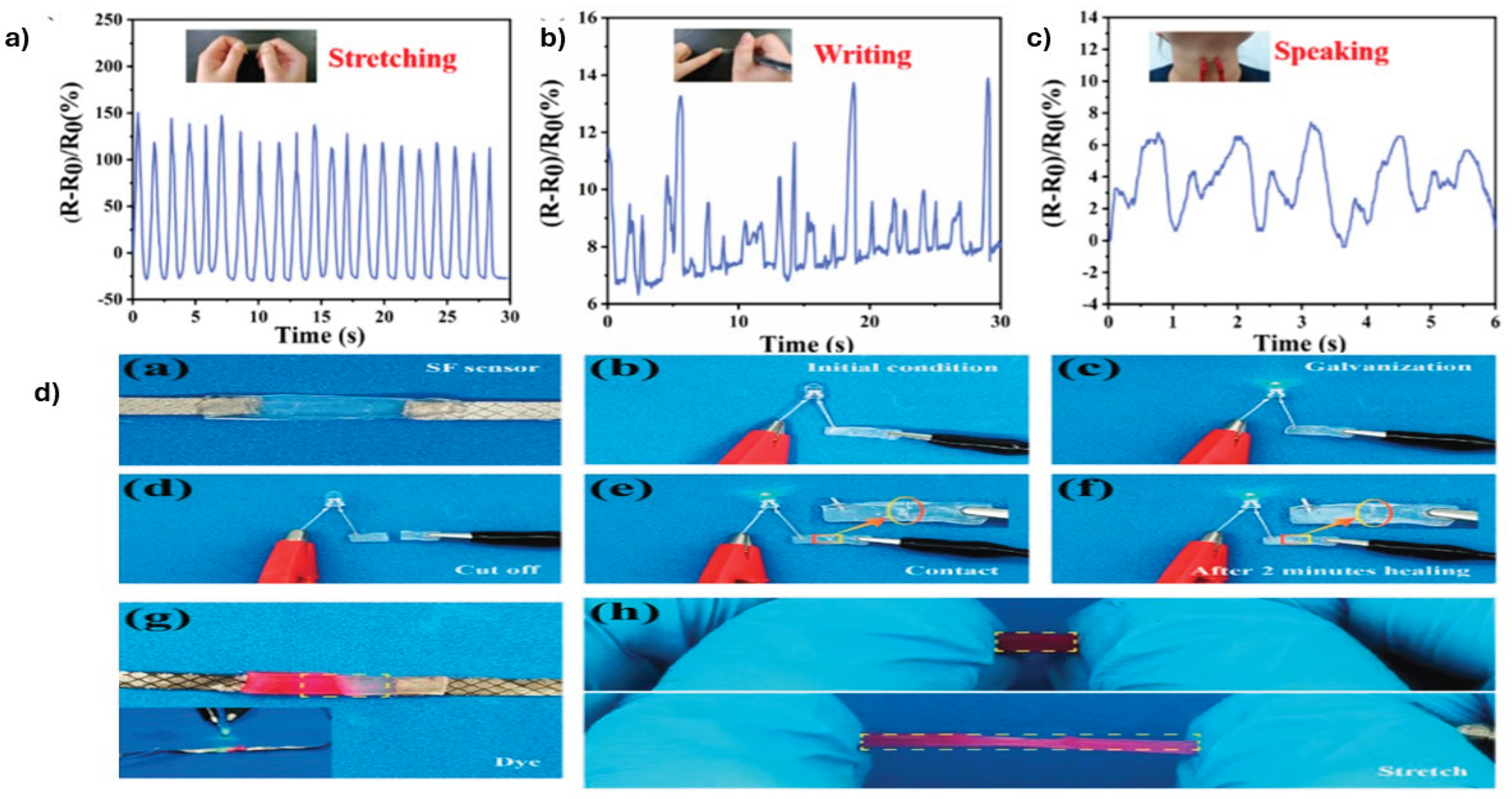
Figure 18.
Smart Multifunctional Uses of WMR Actuators Mimicking Nature with Biomimetic Walkers, Intelligent Curtains, Adaptive Grippers, and Rolling Mechanisms. (a) Snapshot of a praying mantis in the wild. (b) Diagram showing biomimetic walkers bending under light and flattening under humidity. c) Photos capturing the walker’s forward motion powered by alternating light and humidity triggers [230,231]. (d) Diagram showing the soft robot’s ability to move, overcome obstacles, grab, and transport target objects. (e) Design of a four-claw soft actuator that navigates narrow gaps with magnetic guidance, grips objects under near-infrared (NIR) light, and carries them away. (f) Structure of a two-claw soft actuator, with visuals demonstrating its capability to enter a thin tube, retrieve objects, and bring them to the surface [231].Hydrogel-based swimming robots are frequently explored in research, with designs centered around their ability to dynamically deform in response to external stimuli. For instance, Zhang et al. [232] developed a polyacrylamide/sodium alginate/carbon nanotube (PAAM/SA/CNT) dual-network hydrogel. This material exhibited controllable photomechanical deformation, including bending, expansion, swimming, and object grasping, when exposed to near-infrared light. Notably, when the PAAM/SA/CNT hydrogel was placed in water, it demonstrated the ability to swim approximately 35 mm under light stimulation. This highlights the potential of hydrogels in creating responsive and adaptable robotic systems for aquatic environments. Under near-infrared light irradiation at an intensity of 1 W·cm⁻², the hydrogel swam a distance of 0 to 35 mm over 306 seconds. The swimming distance initially increased rapidly, then slowed down, and eventually reached a plateau. Drawing inspiration from the movement of bacteria and other microorganisms, researchers have also developed artificial spiral micro- and nanorobots. These robots are capable of performing spiral motions or following spiral paths while swimming, powered by external energy sources such as magnetic fields, light, or chemical gradients. This biomimetic approach enables precise control and efficient locomotion at small scales [233]. Qian Zhao et al. [234] engineered a groundbreaking series of intelligent gradient hydrogels reinforced with nanofibrillated cellulose (NFC), showcasing rapid responsiveness, versatile response modes, and multifunctional self-driven capabilities. The findings revealed that the NFC-enhanced gradient smart hydrogel exhibits controllable underwater movement under continuous near-infrared (NIR) irradiation. The hydrogel demonstrates the ability to perform "forward" and "turning" motions when exposed to NIR light, enabling it to navigate and avoid obstacles underwater. By selectively irradiating the middle, left, or right positions of the hydrogel's back, it can achieve forward movement, right turns, or left turns, respectively. These controllable, repeatable, and efficient obstacle-avoidance capabilities highlight the potential of hydrogel as a versatile material for applications in soft robotics and targeted drug delivery systems, offering a promising new direction for smart hydrogel actuators.
Figure 18.
Smart Multifunctional Uses of WMR Actuators Mimicking Nature with Biomimetic Walkers, Intelligent Curtains, Adaptive Grippers, and Rolling Mechanisms. (a) Snapshot of a praying mantis in the wild. (b) Diagram showing biomimetic walkers bending under light and flattening under humidity. c) Photos capturing the walker’s forward motion powered by alternating light and humidity triggers [230,231]. (d) Diagram showing the soft robot’s ability to move, overcome obstacles, grab, and transport target objects. (e) Design of a four-claw soft actuator that navigates narrow gaps with magnetic guidance, grips objects under near-infrared (NIR) light, and carries them away. (f) Structure of a two-claw soft actuator, with visuals demonstrating its capability to enter a thin tube, retrieve objects, and bring them to the surface [231].Hydrogel-based swimming robots are frequently explored in research, with designs centered around their ability to dynamically deform in response to external stimuli. For instance, Zhang et al. [232] developed a polyacrylamide/sodium alginate/carbon nanotube (PAAM/SA/CNT) dual-network hydrogel. This material exhibited controllable photomechanical deformation, including bending, expansion, swimming, and object grasping, when exposed to near-infrared light. Notably, when the PAAM/SA/CNT hydrogel was placed in water, it demonstrated the ability to swim approximately 35 mm under light stimulation. This highlights the potential of hydrogels in creating responsive and adaptable robotic systems for aquatic environments. Under near-infrared light irradiation at an intensity of 1 W·cm⁻², the hydrogel swam a distance of 0 to 35 mm over 306 seconds. The swimming distance initially increased rapidly, then slowed down, and eventually reached a plateau. Drawing inspiration from the movement of bacteria and other microorganisms, researchers have also developed artificial spiral micro- and nanorobots. These robots are capable of performing spiral motions or following spiral paths while swimming, powered by external energy sources such as magnetic fields, light, or chemical gradients. This biomimetic approach enables precise control and efficient locomotion at small scales [233]. Qian Zhao et al. [234] engineered a groundbreaking series of intelligent gradient hydrogels reinforced with nanofibrillated cellulose (NFC), showcasing rapid responsiveness, versatile response modes, and multifunctional self-driven capabilities. The findings revealed that the NFC-enhanced gradient smart hydrogel exhibits controllable underwater movement under continuous near-infrared (NIR) irradiation. The hydrogel demonstrates the ability to perform "forward" and "turning" motions when exposed to NIR light, enabling it to navigate and avoid obstacles underwater. By selectively irradiating the middle, left, or right positions of the hydrogel's back, it can achieve forward movement, right turns, or left turns, respectively. These controllable, repeatable, and efficient obstacle-avoidance capabilities highlight the potential of hydrogel as a versatile material for applications in soft robotics and targeted drug delivery systems, offering a promising new direction for smart hydrogel actuators.
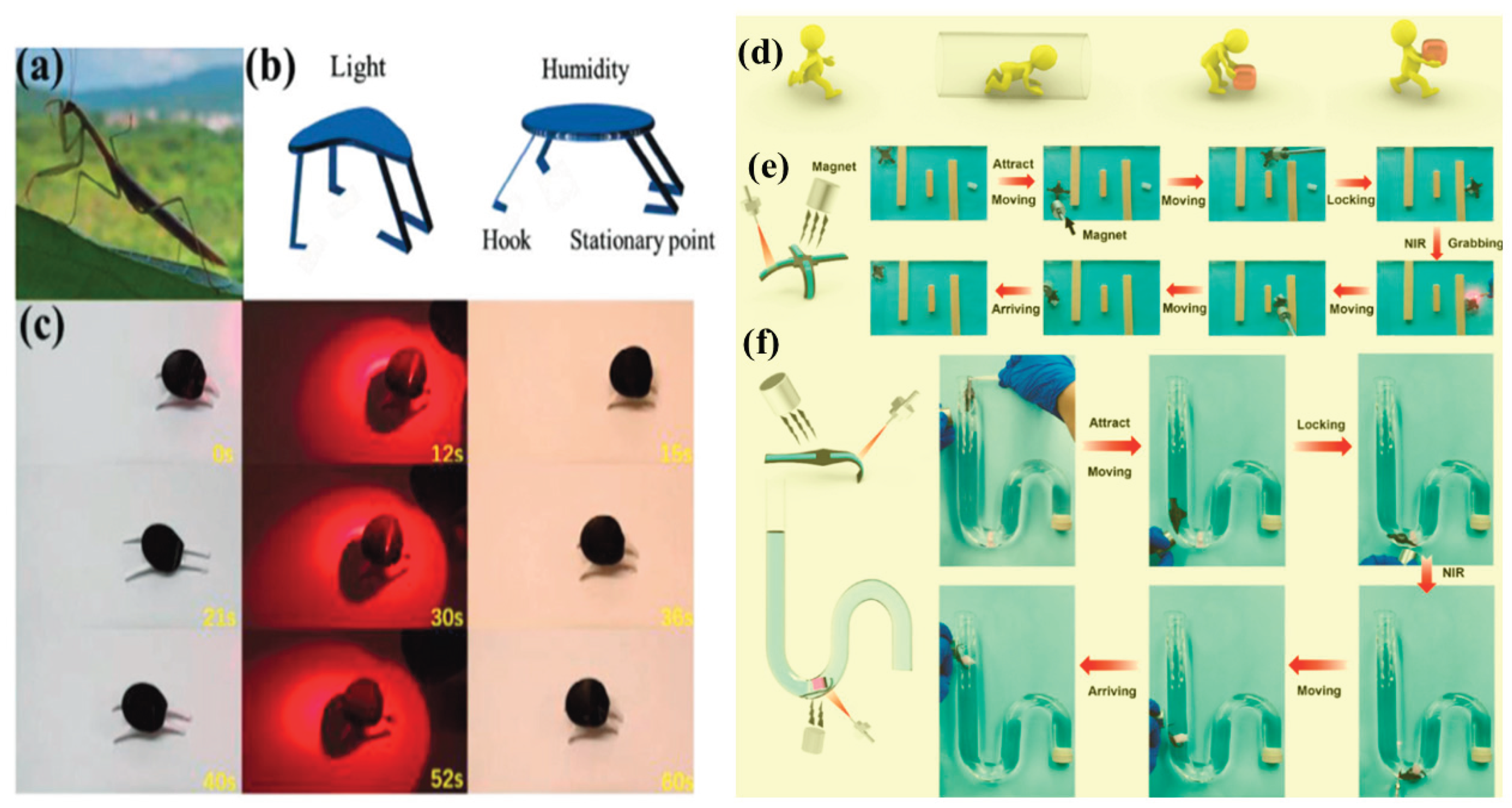
Figure 19.
Summary of Stimuli-Responsive Hydrogel Materials for Developing 4D-Printed Hydrogels.
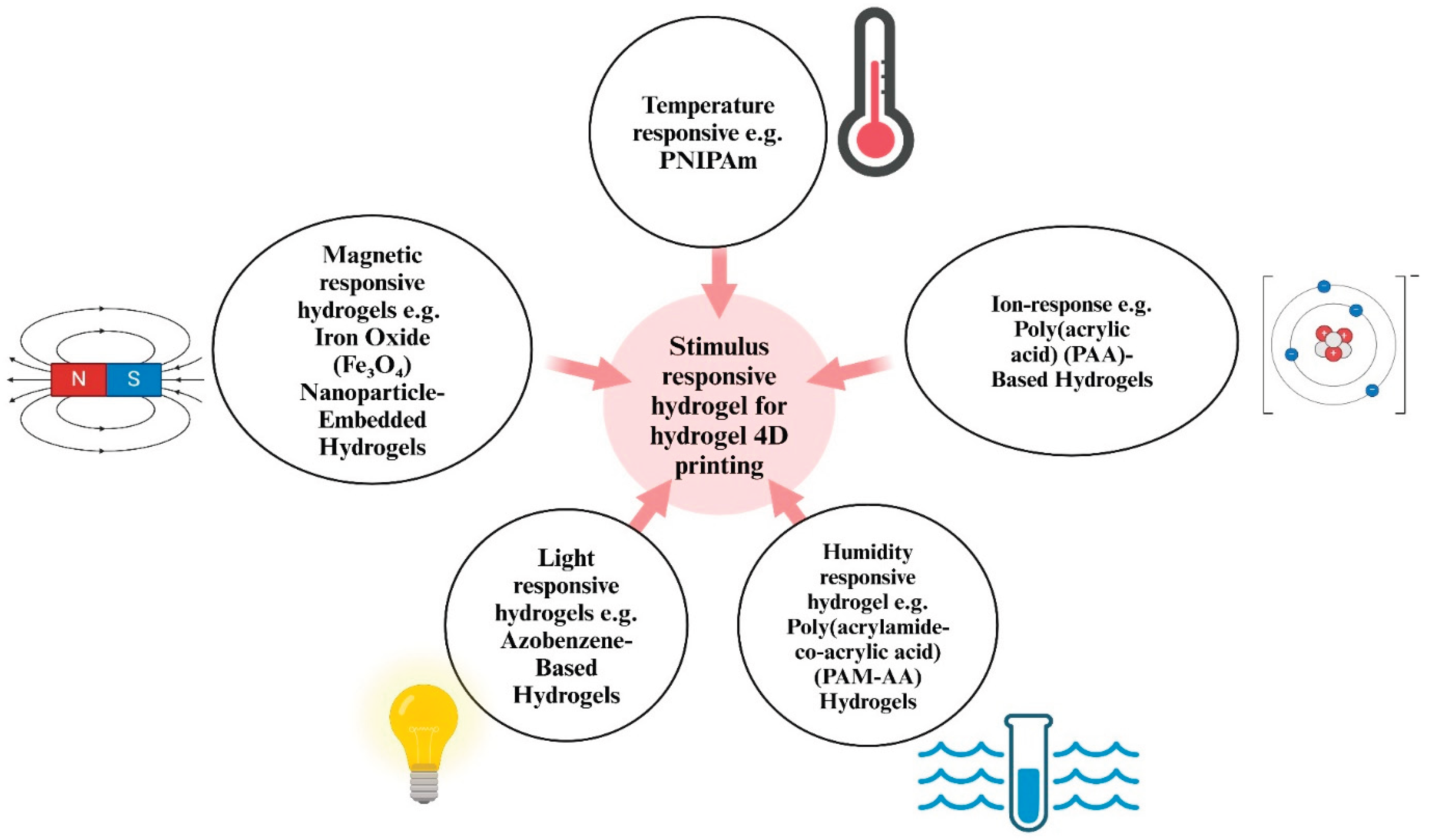
Figure 20.
a) The printed soft lattice structure transitioned to a rigid state after being immersed in ethanol for 10 minutes and reverted to its original soft state upon immersion in distilled water for 2 minutes [272] b) Printed Round Sheet Featuring Zero and Negative Poisson's Ratio Structures Alongside a Honeycomb Planar Design [273] c) A holed cylindrical structure printed with methyl red sodium salt dye demonstrated the ability to withstand stretching deformation after a 2-hour healing process [274].
Figure 20.
a) The printed soft lattice structure transitioned to a rigid state after being immersed in ethanol for 10 minutes and reverted to its original soft state upon immersion in distilled water for 2 minutes [272] b) Printed Round Sheet Featuring Zero and Negative Poisson's Ratio Structures Alongside a Honeycomb Planar Design [273] c) A holed cylindrical structure printed with methyl red sodium salt dye demonstrated the ability to withstand stretching deformation after a 2-hour healing process [274].
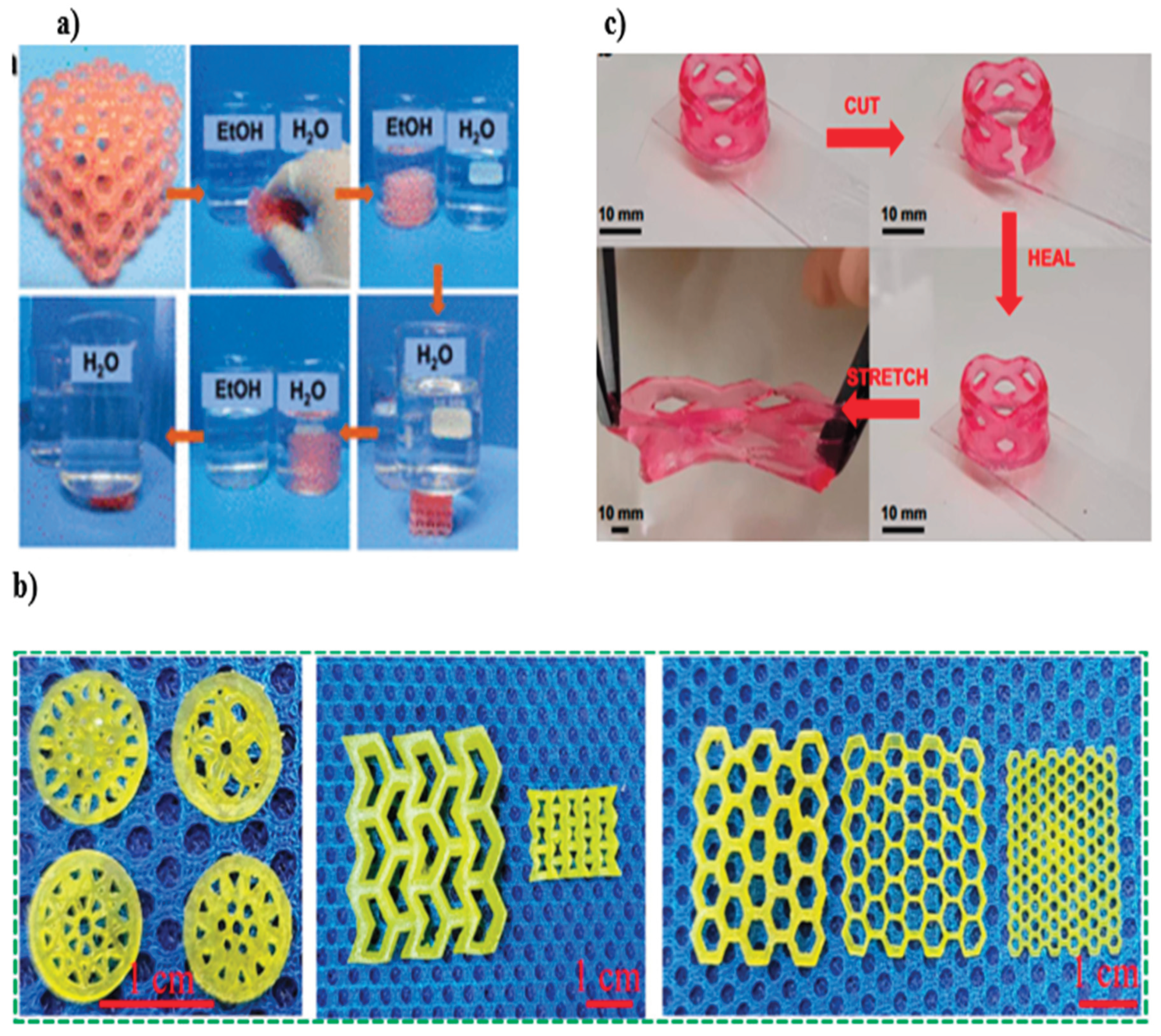
Figure 21.
a) The motion of the artificial tentacle over time from T1 to T5, showcasing a complete circular rotation,[282]. b) Process for Preparing Composite Inks using DIW [283]. c) CAD model of the scaffold and schematics illustrating hydrogel-incorporated scaffolds. CCD image: The physical 3D-printed scaffold [285].
Figure 21.
a) The motion of the artificial tentacle over time from T1 to T5, showcasing a complete circular rotation,[282]. b) Process for Preparing Composite Inks using DIW [283]. c) CAD model of the scaffold and schematics illustrating hydrogel-incorporated scaffolds. CCD image: The physical 3D-printed scaffold [285].
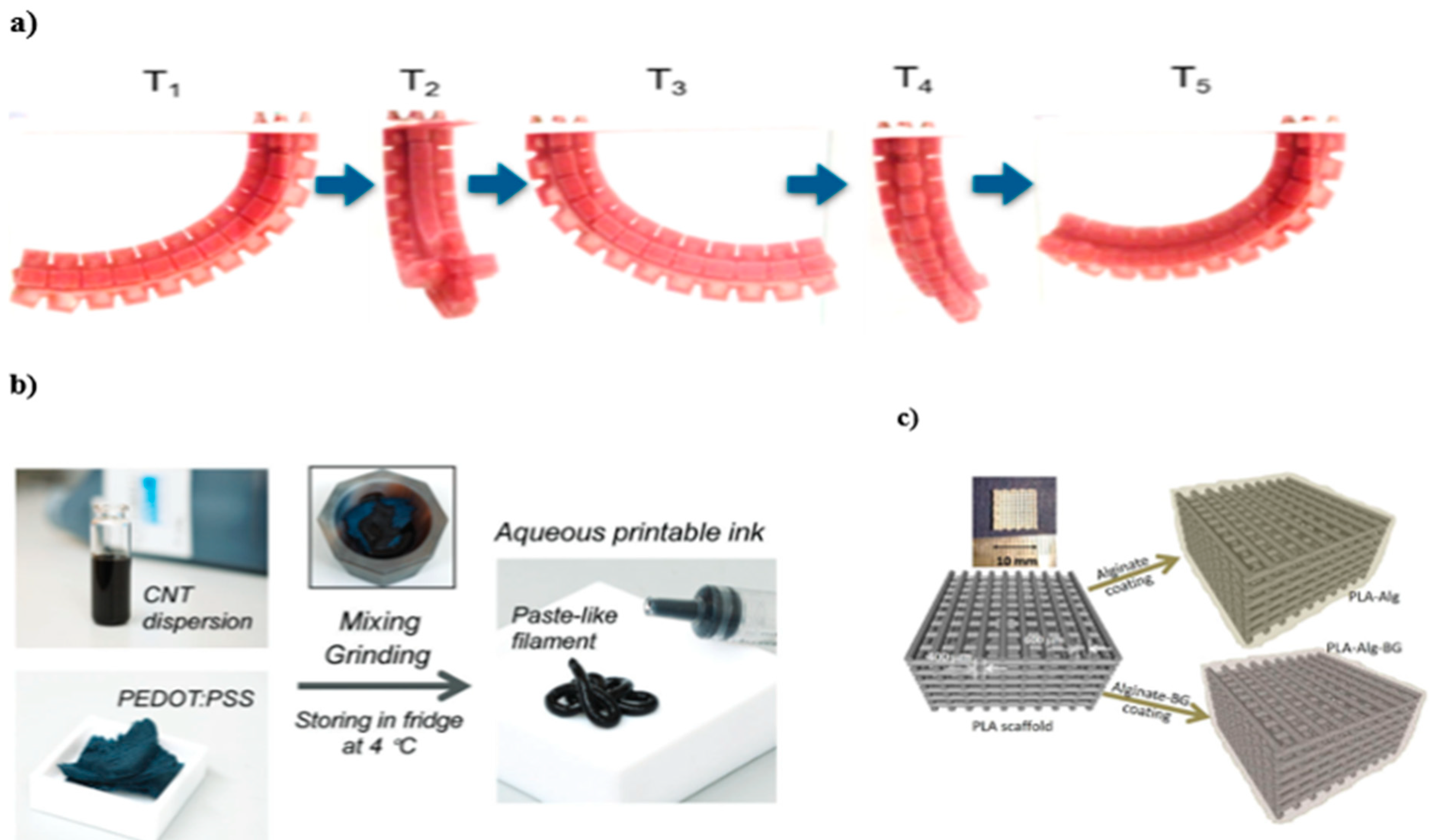

Table 1.
Commonly Reported Stimuli-Responsive Hydrogel Matrices: Types, Fabrication Techniques, and Applications.
Table 1.
Commonly Reported Stimuli-Responsive Hydrogel Matrices: Types, Fabrication Techniques, and Applications.
| Stimulus | Materials Responsible for Shape-Morphing | Material (Hydrogel: Composition of the Base Material) | Fabrication Technique | Proposed Application(s) |
Authors | Reference |
|---|---|---|---|---|---|---|
| Temperature | poly(NIPAM-co-DMAPMA)/clay | Bilayer NIPAM+DMAPMA+ crosslinking agent (MBA)+ light initiator TPO+ rheological modifier (Laponite XLG) |
DIW | Bionic | Yangyang Li et. al | [95] |
| Temperature | PVA/(PVA-MA)-g-PNIPAM | PVA + NIPAM + Photoabsorber (tartrazineas) + light initiator TPO | DLP | Actuators | Mutian Hua et al. | [96] |
| Temperature | PAA | Acrylic Acid+PI (TPO)+crosslinker (dexadecyl acrylate) | SLA | Biomedical | Turdimuhammad Abdullah et al. | [97] |
| Temperature | PNIPAM PNIPAM+PiPrOx | 2-isopropyl-2-oxazoline+ 2-Methyl-2-oxazoline+NIPAM+ PI (TPO)+ photoabsorber (Orange G) |
SLA | Biomedical | Thomas Brossier et al. | [98] |
| Temperature + pH |
NIPAAm+MA-BSA | poly(ethyleneoxide)-b-poly(propylene oxide)-b-poly(ethylene oxide)+Photocurer (Lithium phenyl-2,4,6-trimethylbenzoylphosphinate) | DIW | Biomaterials | Benjaporn Narupai et.al. | [99] |
| Temperature | PNIPAM+Alginate | NIPAAm+ crosslinker (PEGDA)+ PI+ rheological modifier (Laponite XLG) | - | soft robotics | Daria Podstawczyk et al. | [100] |
| Temperature | PNIPAM | NIPAM+ PI a-ketoglutaric acid+ cross-linker(MBA)+ Rheology modifier Carbomer 940 |
Extrusion+UV curing | Drug release |
S. Zu et al. | [101] |
| Temperature + Light |
PNIPAM + Prussian Blue Nanoparticles | NIPAM + PEG dimethacrylate)+ crosslinker (PEGDA700) + PI (Darocur 1173) | SLA | Actuators | Tristan Pelluau et.al. | [102] |
| Temperature | (PNIPA/PAA) | rheological modifier (Laponite)+ NIPAM+Crosslinker N,N′-methylenebisacrylamide (Bis) + PI (LAP) | Extrusion | Actuators | Hao Zhao et al. | [103] |
| Temperature | PNIPAM/Alginate/CNF | NIPAM+PI (Irgacure)+crosslinker (MBA)+Crosslinker PEGDA+Reinforced (TCNF)+ | DIW | Drug Release | Rohit Goyal. et al. | [104] |
| Temperature | PNIPAM | NIPAM+crosslinker (MBA)+ rheology modifier (Carbomer) | DIW | controlled drug release |
Shou Zu et al. | [105] |
| Humidity | poly(MAA-co- OEGMA) |
oligo(ethylene glycol) methacrylate (OEGMA)+ ethacrylic acid (MAA)+ 4-Nitrophenyl benzoate (Catalyst) | DIW | soft robots | Zhen Jiang et al. | [106] |
| Humidity | PLA+PHBV | Bilayer Polyurethane+polyketone+PLA |
FDM | Smart structures | Yasaman Tahouni et al. | [107] |
| Temperature + Hydration |
Poly (N-vinyl caprolactam) (PNVCL) | Bilayer N, N-Dimethylacrylamid+NVCL+Crosslinker (PEGFMA)+ PI (Irgacure) |
SLA | actuator | Shuo Zhuo et al. | [108] |
| Ca2+/chitosan | Sodium Alginate | Sodium alginate+ 2-(Dimethylamino) ethyl methacrylate+ methacrylic anhydride+ PI 2-hydroxy-2-methylpropiophenone | DIW | - | Pengrui Cao et al. | [109] |
| Humidity | Chitosan+Acetic Acid | Chitosan Powder+Crosslinker (Critric Acid)+Rheological Modifier (trimethyl silane spray) | DIW | Actuator | Smruti Parimita et.al. | [110] |
| Water | non-isocyanate poly(hydroxyurethane) | poly(ethyleneglycol) + Chain Extender poly(ethylene oxide) diamine+ cross-linker tris(2-aminoethylene)amine (TAEA) | DIW | Biomedical | Noé Fanjul-Mosteirín et al. | [111] |
| Temperature + Water |
polyurethane (PU)- polyvinyl chloride (SMPVC) bilayer | Bilayer Water swelling (PU)+Heat shrinkage shape (SMPVC) |
DIW | - | Luquan Ren et al. | [112] |
| pH of acidic or basic Environment |
PAAm/PAAc | Bilayer Acrylic acid+Crosslinker (MBA)+UV initiator (ammonium persulfate)+coupling agent ((trimethoxysilyl) propylmethacrylate)+ cyanoacrylate adhesive to bond two layers |
- | Lipophilic Drug Delivery |
Zilong Han. et al. | [113] |
| Magnet | Magnetic hydrogel structures from natural polymers | alginate (ALG)+ methylcellulose (MC)+polyacrylic acid (PAA)+ magnetite nanoparticles of Fe3O4 (MNPs)+ .5 M CaCl2 solution for 24 h for Ca2+ crosslinking |
DIW | Actuators | Julia Siminska-Stanny et al. | [114] |
| Temperature | PNIPAM/short carbon fibers (SCFs) | NIPAM + PI (2959) SCFs+Rheology modifier (clay nanosheets) + (PEGDA, PEGDA) + catalyst (N,N,N’,N’-Tetramethylethylenediamine)( TEMED)+ Glucose + glucose oxidase |
DIW | Self-Sensing Actuators | Shengnan Li. et al. | [115] |
| pH | poly(4-vinylpyridine) (P4VP)+ Acrylonitrile butadiene styrene (ABS) | Pure ABS+P4VP+10 mM phosphateecitrate (for pH sensing)+ Ammonium acetate | FDM | Sensing claw | Chun-Yi Wu et al. | [116] |
| Temperature | PNIPAM/gold nanorod | NIPAm monomer+PI (Irgacure 819)+ ethylene glycol/acetone solution+macrocrosslinkers (bi-, tri-, and tetra-allyl-functional PNIPAm) | Multiphoton lithography | bioinspired soft materials | Akihiro Nishiguchi et al. | [117] |
| Dehydration | ceramic elastomer slurry/ acrylic acid-PEGDA (AP) precursor with low viscosity | Crosslinker (PEGDA)+ Ceramic elastomer: benzyl acrylate (BA), PEGDA and zirconia (ZrO2) nanopowders | DLP | - | Rong Wang et al. | [118] |
| Light | carbon nanotube-doped NIPAM composite (CNNC) | NIPAM+ (Single wall CNTs) SWNTs with polyaniline sulfonic acid groups+ cross-linking agent (MBA)+ PI (Triethanolamine+LAP) | femtosecond laser direct writing | microbots | Chunsan Deng et al. | [119] |
| Magnet | Light curable Magnetic hydrogel elastomer (PLMHE) with magnetic controllability | Monomer PEG (4 0 0) DA +catalyst (OMNIRAD TPO) +Thickening agent (Bentonite clay)+ neodymium iron boron magnetic powder+ Mechanical properties enhancer (Polyethylene glycol)+Light initiator (TPO) |
Extrusion | Soft Actuators | Chengyao Deng et al. | [120] |
| Water | acrylic acid (AAC) network and Fe3+ ions | Acrylic acid (AAC) + Physical crosslinkers (Fe 3+)+ cross-linker (MBA)+ PI (LAP) | DLP | Stretchable electronics | Huijun Li et al. | [121] |
| Water + Light |
Liquid Metal nanodroplets armored by carbon dots (LMD@CDs) + poly acrylamide (AAm) | Monomer (AAm)+ PI (TPO)+ cross-linker (PEGDA)+ | DLP | - | Linan Wang et al. | [122] |
| Dehydration + Rehydration |
F-127 based hydrogel | Photo absorber (Tartrazine)+F-127 diacrylate+PI (LAP+ Irgacure 2959)+ LiCl solution | DLP | Strain Sensor | Wen Shi et al. | [123] |
| Temperature + Light |
(NIPAm) and polyethylene glycol thiol-coated gold nanorod (P-AuNR) hydrogel | NIPAm+P-AuNR+AAm+chemical crosslinking agent (N,N-Methylenebisacrylamide)+UV PI (irgacure 295) | Photopolymerization | - | Monica C. Ratri et al. | [124] |
Table 2.
Classification of AM Processes According to ISO/ASTM 52900: Brief Descriptions, Raw Material Forms, Advantages, and Disadvantages.
Table 2.
Classification of AM Processes According to ISO/ASTM 52900: Brief Descriptions, Raw Material Forms, Advantages, and Disadvantages.
| AM Process Classification | Brief Description | Examples of Technique | Form of Raw Material | Pros | Cons | References |
|---|---|---|---|---|---|---|
| Binder Jetting | A liquid bonding agent is selectively applied to a thin layer of powder spread across a powder bed, effectively binding the powder particles in specified areas. | Metal Binder Jetting, Sand Binder Jetting, Ceramic Binder Jetting. | Ceramics, metal, Biomaterials, polymers | High build rate, Incorporate functionally graded materials. | Resolution and Accuracy, Post-Processing | [249], [250], [251] |
| Directed Energy Deposition | Focused thermal energy is employed to melt materials during deposition, facilitating their fusion. The source of thermal energy can be a laser, electron beam, or plasma arc. | Electron Beam AM, Laser Engineering Net Shaping | Metals, Alloys, and composites | High-throughput new material development, rapid manufacturing of large near-net-shape parts. | Shrinkage, residual stress, and deformation | [249], [250], [252] |
| Material jetting | Droplets of build materials, such as fine inorganic powders suspended in organic solvents with photopolymer or waxes, are selectively deposited to construct the desired part. | PolyJet, NanoParticle Jetting | Polymers | High resolution and accuracy, Multiple materials and colors, Smooth surface finishes | Limited material selection, Strength | [249], [250], [253] |
| Material Extrusion | Material is selectively dispensed through a heated nozzle using a powder injection molding feedstock, which consists of metal powder combined with organic binders and formed into coils, rods, or granules. This material is extruded through the heated nozzle and deposited onto a platform that has precise x, y, and z motion control to create the desired geometric shape. Afterward, the part undergoes debinding and consolidation processes to achieve the final product. | Direct Ink Writing, Fused Filament Fabrication, Fused Deposition Modeling | Polymers | low costs, a large variety of feedstock materials | Impaired surface quality, part deformation. | [249], [250], [254] |
| Powder Bed Fusion | Thermal energy is employed to selectively fuse specific regions of a powder bed, defining the final part geometry. The energy source, which may be a laser or an electron beam, either sinters or melts the powders depending on the material and the intensity of the applied energy. | Selective laser sintering, direct metal laser sintering, electron beam melting, selective heat sintering | Metals, Polymers | homogeneous microstructures, free of internal stresses | High Cost, Rough Surface Finish | [249], [250], [255] |
| Sheet Lamination | Thin sheets or foils of material are shaped using a laser or knife and then bonded together to create a 3D part. This process does not require sintering. | Laminated object manufacturing, ultrasonic AM | Metals, Polymers | Hybrid Manufacturing Integration, Ease of Material Handling | Surface Finish, Limited Material Selection | [249], [250], [256] |
| Vat Photo- polymerization | A liquid photopolymer mixed with metal or ceramic powder is selectively hardened using light-activated polymerization. When metals or ceramics are involved, the polymer breaks down, and the shape is solidified through a sintering process. | Scanning stereolithography, microstereolithography, two-photon polymerization | Polymers | High precision, Smooth finish, Versatile material options | Limited Material Strength, Limited Build Volume | [249], [250], [257] |
Disclaimer/Publisher’s Note: The statements, opinions and data contained in all publications are solely those of the individual author(s) and contributor(s) and not of MDPI and/or the editor(s). MDPI and/or the editor(s) disclaim responsibility for any injury to people or property resulting from any ideas, methods, instructions or products referred to in the content. |
© 2025 by the authors. Licensee MDPI, Basel, Switzerland. This article is an open access article distributed under the terms and conditions of the Creative Commons Attribution (CC BY) license (http://creativecommons.org/licenses/by/4.0/).
Copyright: This open access article is published under a Creative Commons CC BY 4.0 license, which permit the free download, distribution, and reuse, provided that the author and preprint are cited in any reuse.


