
Submitted:
17 December 2025
Posted:
17 December 2025
You are already at the latest version
Abstract
Federated Learning (FL) and Split Learning (SL) maintain client data privacy during collaborative training by keeping raw data on distributed clients and only sharing model updates (FL) or intermediate results (SL) with the centralized server. However, this level of privacy is insufficient, as both FL and SL remain vulnerable to security risks like poisoning and various inference attacks. To address these flaws, we introduce SplitML, a secure and privacy-preserving framework for Federated Split Learning (FSL). SplitML generalizes and formalizes FSL using IND−CPAD secure Fully Homomorphic Encryption (FHE) combined with Differential Privacy (DP) to actively reduce data leakage and inference attacks. This framework allows clients to use different overall model architectures, collaboratively training only the top (common) layers while keeping their bottom layers private. For training, clients use multi-key CKKS FHE to aggregate weights. For collaborative inference, clients can share gradients encrypted with single-key CKKS FHE to reach a consensus based on Total Labels (TL) or Total Predictions (TP). Empirical results show that SplitML significantly improves protection against Membership Inference (MI) attacks, reduces training time, enhances inference accuracy through consensus, and incurs minimal federation overhead.
Keywords:
federated learning
; split learning
; privacy-preserving machine learning
; fully homomorphic encryption
; differential privacy
1. Introduction
Machine Learning (ML) is a powerful tool that can solve various problems, yet it raises serious privacy concerns. Indeed, when ML models are trained on sensitive data, there is a risk that this data could be used to identify individuals or infer sensitive information about them. For instance, telecom companies implement advanced ML algorithms based on locally collected data through Security Incidents and Events Management (SIEM) to help determine potential cyber threats, protect their networks and customers’ data, and enhance security and privacy measures. Telecom data is one of the most sensitive data types, as any four location points are enough to uniquely re-identify 90% of individuals [1].
While SIEMs can be hosted on a standalone network device, they can also be deployed through cloud services offered by security service providers. These systems process logs in quasi-real-time but may also support offline log processing. They are responsible for storing, analyzing, and correlating logs. Gathered data from a standalone SIEM can include incomplete or non-representative information, leading to the inaccurate classification of incidents, thus taking improper actions that can induce severe damages [2]. Collaboration between different SIEMs is encouraged to deal with this challenge. The collaborative SIEM system helps companies quickly identify and respond to potential threats and reduce the impact of security breaches. By collaborating and sharing their expertise, the companies also improve their security posture and build customer trust. However, this raises many issues. When a client shares its logs with other organizations, this information can be exploited, and the reported incident can be used to attack vulnerable devices. This becomes even more critical if the reported incident involves a widely used device. The use of incident information can lead to the creation of valuable target profiles for security vendors or be sold to competitors as alert reports, directly damaging the company’s brand and reputation. Indeed, distributed ML algorithms, i.e., Federated Learning (FL) [3] and Split Learning (SL) [4], enable the training of a global model on decentralized data stored on multiple client devices without sharing these data with a central entity. (Refer appendix §B.1, §B.2 for details.) This approach can benefit SIEM scenarios where sensitive proprietary data cannot be shared with peers.
Despite data being resident on the client device, confidentiality and privacy remain at risk. Distributed learning methods, including federated and split learning, provide local obfuscation but are not formal privacy mechanisms and offer no inherent guarantees of privacy. Several privacy attacks such as Membership Inference [5,6] and Model Poisoning [7] must be considered. These attacks aim to infer sensitive information about the training data or clients. They exploit the relationship between the updates and the private features on which they were trained. By analyzing the global model, attackers might reconstruct training data or individual contributions, even if gradients are carefully designed. This is possible because the global model embodies aggregate information from participants’ data. SL involves exchanging Intermediate Representations (IR) between participants. Analyzing these IRs, even without raw data, might reveal sensitive information hidden within them. An attacker can reconstruct parts of the private training data used to build the model by feeding crafted inputs and observing model outputs. Dishonest users can inject manipulated updates into the training process to steer the model toward incorrect predictions or biased outcomes. These “poisoned" updates influence the global model, affecting everyone. Attackers might tamper with their data before training their local model and then contribute to the poisoned model updates. This way, they can subtly influence the global model without directly injecting malicious updates.
It is necessary to ensure confidentiality, integrity, and privacy while enhancing collaboration. Several solutions are proposed to implement various Privacy Enhancing Technologies (PET), namely (i) privacy-preserving computation, e.g., Fully Homomorphic Encryption (FHE) and secure Multi-Party Computation (MPC), and (ii) Statistical Disclosure Control (SDC) techniques, e.g., Differential Privacy (DP). FHE allows computations on encrypted data without needing to decrypt it, ensuring confidential analysis, while DP perturbs data to hide individual characteristics. (Refer appendix §A.1, §A.2 for details.)
These techniques aim to protect the privacy of both the client data and the associated model and prevent inference attacks while enabling practical model training in a distributed manner. However, their implementation in real-world scenarios brings new challenges with malicious or curious adversaries1, which may collude to derive information regarding other participants. This paper proposes SplitML, a general framework to enhance collaborative yet personalized neural networks. Though SplitML can be used for any application, we focus on intrusion detection in this paper. In our scheme, the input layer, the output layer, and the learning task are shared across clients with a possible variation in hidden layers. Clients may want a deeper network as depth helps achieve more accurate models for their local distributions or a shallow network to reduce resource usage.
SplitML supports heterogeneous client models, where the top layers (close to input data) of a client model that extract generic dataset features are shared with other client models. In contrast, the bottom layers (close to output labels) are more specific. Here, the advantages of model heterogeneity are two-fold: (1) for training, it helps increase model accuracy over non-IID data, and (2) diverse predictions can be obtained for inference through consensus.
We assume clients share features and labels while keeping their data and ML models private in a semi-honest threat model2. Clients collaborate to train the top layers with the help of a central server and keep their bottom layers private. In SplitML, clients train their models locally on their private data and collaborate to train only a set of generic (top) layers with FL by sharing encrypted weights. Thus, aggregation is performed on shared layers, although they might have been trained on different (overall) topologies. By abstraction, the use of FL increases the size of the training dataset, so the feature extraction by the first layers will be more accurate. Clients have the same architecture for the output layer but may have different hidden layers to facilitate a personalized model. As such, they refrain from sharing them with other clients and ensure they will not be able to get any information about their dataset.
SplitML is fundamentally different from Vertical Federated Learning (VFL) in how the data is partitioned: VFL is a feature-partitioned approach, designed for scenarios where multiple clients share the same set of samples (users/entities) but each client possesses a different portion of the feature space (). In contrast, SplitML is built upon Federated Split Learning, which is a sample-partitioned approach similar to Horizontal Federated Learning (HFL), where clients possess the same feature set () but hold different, non-overlapping samples (). This sample partitioning is central to SplitML’s novelty, as it allows clients to use private bottom model layers for local feature extraction while collaboratively aggregating and training the common top layers, an architecture fundamentally different from the feature-split collaboration utilized by VFL.
FHE is the most comprehensive cryptographic solution, enabling the direct execution of arbitrary computations (any function) on ciphertexts. Introduced by Gentry in 2009 [8], FHE fundamentally enables data owners to use untrusted cloud services for analysis without exposing their data in plaintext [9,10,11,12,13,14,15,16,17]. Despite its comprehensive capabilities, general FHE schemes still face challenges related to high computational overhead and large ciphertext sizes. To address these performance issues, the Cheon-Kim-Kim-Song (CKKS) scheme [18] was developed as a specialized variant of FHE in 2017. CKKS is uniquely designed for approximate arithmetic on real and complex numbers, making it highly suitable for numerical analysis, machine learning, and statistical tasks. We use OpenFHE [19,20] library to implement multi-key CKKS for training and single-key CKKS for inference.
(Indistinguishability under Chosen-Plaintext Attack) is the minimum security standard for modern Public-Key Cryptography (PKC), formalized by a game where an attacker, given only the Public Key (PK), must fail to distinguish between the ciphertexts of two chosen messages with a success probability better than random chance; this guarantee ensures confidentiality and necessitates the use of probabilistic encryption. However, Li and Micciancio recently showed that the standard model is insufficient for the CKKS FHE scheme in multi-party contexts, demonstrating a key recovery attack that is feasible when decryption results are shared among multiple parties, such as in a threshold FHE setting, thereby requiring a stronger adversarial security model than to maintain the confidentiality of the Secret Key (SK). To mitigate this, OpenFHE subsequently extended the original CKKS scheme to operate under a stronger adversarial model that permits the sharing of decryption results among multiple parties, choosing a default configuration designed to tolerate a relatively large number of decryption queries involving the same or related ciphertexts. Specifically, OpenFHE’s CKKS implementation utilizes a countermeasure known as noise flooding, which involves adding a large, random Gaussian noise to the ciphertext just before decryption, mathematically achieving the security notion of (a principle based on Differential Privacy). This method ensures that the statistical noise distribution of the output is independent of the SK, a guarantee that cannot be provided by the intrinsic, often data-dependent, noise generated during homomorphic operations.
Existing approaches for collaborative training, such as FL, SL, and their hybrids like Federated Split Learning (FSL) and SplitFed Learning (SFL), primarily offer privacy through data localization, but remain fundamentally vulnerable to various inference and poisoning attacks. We discuss previous works for privacy-preserving tasks in more details in appendices and briefly compare our approach SplitML (Figure 1c) with FL (Figure 1a), SL (Figure 1b), and the combinations of two approaches. While primitives like SecAgg [21] use secure multi-party computation to protect the model weights during aggregation from the central server, they do not defend against an adversarial client’s ability to extract sensitive training data or exploit shared decryption results in advanced settings like threshold FHE.
SplitML generalizes FSL under the rigorous security model using a combination of FHE with DP. This approach not only provides robust security against well-known threats like Membership Inference (MI) attacks but also enables novel features, such as supporting heterogeneous client model architectures and utilizing multi-key CKKS for secure aggregation and consensus-based inference. Our experiments show that the (minimum) member-accuracy for the MI attack on the top layers (for any number of shadow models) was about 37%. In contrast, for bottom layers, they were as low as 19%.
Our contributions in this paper can be summarized as follows:
- We formalize FL and SL and present SplitML, a fused FL (for training) and SL (for inference) partitioned between ML model layers to reduce information leakage. The novelty stems from clients collaborating on partial models (instead of full models in FL) to enhance collaboration while reducing privacy risks. While federation helps improve feature extraction, horizontal splitting allows entities to personalize their models concerning their specific environments, thus improving results.
- SplitML implements multi-key FHE with DP during training to protect against clients colluding with each other or a server colluding with clients under an honest-but-curious assumption. SplitML reduces time compared to training in silo while upholding privacy with security.
- We propose a novel privacy-preserving counseling process for inference. An entity can request a consensus by submitting an encrypted classification query using single-key FHE with DP to its peers.
- We empirically show that SplitML is robust against various threats such as poisoning and inference attacks.
This paper is organized as follows. First we introduce the threat model in §2.1 and detail the proposed framework in §2.2. Then, §3 discusses security threats concerning the identified adversaries, and §4 reviews the empirical evidence before concluding in §5. We briefly discuss background and related work in Appendix.
2. Our Framework
2.1. Threat Model
SplitML follows the standard client-server model, where trust is established before training starts (e.g., in the log analysis domain, the organizations (clients) may opt out of the corresponding SIEM platform (server) if they host adversarial clients). In an ideal scenario, all participants, including the server and the K clients, act honestly and perform their assigned tasks. For each training round, clients train their local models on their own (unencrypted) data, and the server combines the (encrypted) weights for shared layers. After training, all clients perform inference locally (unencrypted) and don’t share any information with their peers or the server. However, a client may want to perform consensus on a subset of data to benefit from heterogeneous models, in which case a client sends (encrypted) smashed data to its peers.
Our system only considers a scenario where the server, while curious, passively observes updates and cannot modify anything. It does not address a more robust scenario where a malicious server actively collaborates with clients and disrupts the training process. While honest-but-curious clients follow the protocol, they could potentially collaborate to learn about specific individuals in the training data (membership inference attack). Malicious clients, however, may deviate from the protocol for harmful purposes and send misleading updates (model poisoning attack) or attempt to extract the entire model from a particular client. Communication (e.g., exchange of weights and gradients) is encrypted in SplitML, and our scheme is secure under collusion if the colluding clients are lower than T clients required for fused decryption3 under multi-key FHE ( for multi-key FHE and for threshold-key FHE). Moreover, DP offers plausible protection in case clients collude with the server to uncover the model weights of the target. In FL, the federation server has access to the entire model; in contrast, the server has access only to the server-side (shared) portion of the model in SL and SplitML. Unlike SL, SplitML does not have access to the (unencrypted) smashed data from the clients during training, and a client chooses its peers to send encrypted (under single-key FHE) smashed data for inference.
2.2. Proposed Architecture
| Algorithm 1 Public and Secret Keys Generation |
|
Input: Each client performs iteratively
Output: Public and private keypairs for each client
|
| Algorithm 2 Evaluation Keys Generation for Addition |
|
Input: Keypairs for each client
Output: Evaluation key for Addition
|
| Algorithm 3 Evaluation Keys Generation for Multiplication |
|
Input: Keypairs for each client
Output: Evaluation key for Multiplication
|
| Algorithm 4 Training |
|
Input:
Output: Trained models for each client
|
| Algorithm 5 Inference |
|
Input: Data subset from client
Output: Class labels or predictions scores from clients
|
Definition 1.
SplitML is a privacy-preserving, secure collaborative scheme for training and inference of a partially shared ML model deploying FL using an FHE scheme with clients and an FL server S. A client local model has total layers, where are the shared top layers up to the ‘cut/split layer’ q and the rest of the are private (bottom) layers including a common output layer. For each training round , participants train with their private (iid or non-iid) dataset with common attributes A and common labels L. After each training round, the participants send their model weights encrypted with FHE for n layers () to S, where the server aggregates the weights with some averaging algorithm and sends the encrypted updates to participants of the next round. Training continues till all achieve an acceptable accuracy or fixed rounds R. The clients can further collaborate to form a consensus using FHE during inference for the model outputs with low confidence close to the classification boundary for some threshold .
Our proposed solution SplitML (Definition 1) is a Federated Split Learning (FSL) approach where each client shares output labels (classes) L and input attributes (features) A but may have different ML models (hidden layers), except for the top common layers and the output layer. Clients train all their models locally on their private data and send the weights for the shared layers encrypted with an FHE scheme to a federated server S for each training round r. The server makes the averaging in the encrypted domain from the participants during that round and updates the clients.
A significant benefit of SplitML is observed in the inference phase, where the clients benefit from model diversity after training. For instance, a network domain administrator can collect a few log records for which their model has a ‘low confidence’ regarding classification (e.g., the likelihood of false positives/negatives). In this case, the admin reprocesses the logs and sends the encrypted gradients up to the ‘cut layer’4 () to other admins to run the classification on their models (which may differ from others) and get the encrypted results. The requester decrypts the received results with single-key FHE decryption key . A consensus-based corresponding label is determined through most total labels or prediction scores received.
SplitML is both multi-institutional, where we use data from multiple institutions during training, and cross-institutional, where we use models from multiple institutions for inference. SplitML seamlessly fuses FL for training and SL for inference.
- SplitML can generalize Federate Learning (FL) with a parameter over model layers, where controls the proportion of layers to collaborate on. Thus, FL is realized when clients collaborate to train all layers of the global ML model M; hence, . A value of indicates no collaboration, thus .
- Transfer Learning (TL) [22,23,24,25,26] is realized for an architecture (e.g., Convolutional Neural Networks - Artificial Neural Networks (CNN-ANN) model) where K distinct clients collaborate to train the first n (e.g., convolution) layers for feature extraction. For inference after training, clients retrain the rest of the (e.g., Fully Connected (FC)) layers of their ML model till convergence on their private data without updating the first n layers (effectively freezing the feature extracting CNN layers).
We compare SplitML with existing approaches regarding resource requirements in Table 1. For each client, k in SplitML computation cost can vary based on local model instead of a fixed cost for global model M in FL. Also, we can save bandwidth in SplitML compared to FL, as only the model updates for top (shared) layers n are shared compared to all layers of the model . Unlike SplitFed Learning (SFL) [27], we support clients with different model architectures and encrypt all shared information, which, to our knowledge, is a simultaneous first in prior work. More details about SFL are described in §B.3.
2.3. Key Generation
This section briefly describes the procedures to generate client secret keys, a shared public key, and evaluation keys for the server. Key generation is an offline setup phase in SplitML before training. We use the OpenFHE [28] library to implement these procedures.
2.3.1. Public and Secret Keys
Multi-key FHE uses multiple encryption keys, one for each party. This makes it more difficult for any one party to decrypt the ciphertext, even if they are malicious. For a more secure (under collusion), multi-key approach, all K clients participating in the training generate their Public-Private key pairs in sequence (Refer to Algorithm 15). A shared Public Key is generated using each .
2.3.2. Evaluation Key for Addition
Similarly, each operation-specific key, such as for addition, for multiplication, and for fused decryption, is generated from secret shares of all the K clients (or some clients as per threshold). Generating the evaluation key for addition is a two-pass process, as shown in Algorithm 2. In the first iteration, all clients generate their addition keys using their secret and public keys . In the second iteration, the final shared addition key is calculated from client keys .
2.3.3. Evaluation Key for Multiplication
The evaluation key for multiplication is generated in four iterations, as shown in Algorithm 3. The first two iterations are similar to the process in Algorithm 2. In the first pass, all clients K generate their multiplication keys using their secret keys . In the second pass, clients calculates with their keys . In the third pass, clients generates with . Finally, all shares are fused to yield the final key .
2.4. Training Phase
SplitML requires that all K clients share common data attributes A, output labels L, model hyperparameters - batch size and learning rate , output (last) layer, and the model structure up to the first (top) n layers before the training begins. Clients can have a variable architecture for hidden layers, except the output layer, where the total (bottom) layers of a client are , , including the last layer, and the total layers of a client model are . We briefly justify using multi-key (or threshold6) FHE over single-key FHE in collaborative training.
2.4.1. Single-key FHE
In the single-key FHE training (Figure 2a), one of the clients is chosen (at random) to generate the homomorphic encryption parameters: Public Key to encrypt client model updates, Secret Key to decrypt averaged weights, and Evaluation Key to perform averaging in the cipher domain. and are shared with all clients and is shared with the FL server. All clients K share their encrypted weights under for shared layers to server S, and S averages the weights using . Clients can decrypt this result using shared secret and update their models. However, single-key FHE is insecure in a multiparty setting because it allows any party with the key to decrypt the entire ciphertext. This means that if one party is malicious, they can collude with the other parties to decrypt the ciphertext and learn the secret data. To address this security vulnerability, multi-key FHE was proposed.
2.4.2. Multi-key FHE
The multi-key FHE training procedure is detailed in Algorithm 4 and Figure 2c. For every training round , all clients K (alternatively, several participants are chosen in threshold-FHE) perform forward and backward propagation on their entire models on their private data and share the encrypted model updates with a common public key for the first n shared layers to the central server S.
S uses FedAvg [3] (or other federated averaging algorithms) to calculate the global model weights and share them with all clients. To calculate the averaged weights in the encrypted domain, S uses evaluation keys for addition and multiplication to add all encrypted weights received from the clients and multiply with to average. After receiving the encrypted result, clients partially decrypt the results with their secret keys , and S generates fused decryption from partial descriptions using an evaluation key for fused decryption to get the final result in plaintext. Clients update the weights of top layers accordingly before the next training round begins. Training continues till all the clients achieve their target accuracy or the maximum limit of rounds R.
2.5. Inference Phase
After the training, all clients should have converged models with their target accuracy. The top n layers have the same architecture and weights across clients, facilitating transfer learning and consensus. We propose a novel consensus approach in the encrypted domain as detailed in Algorithm 5 and Figure 2b. For prediction, any client can choose to perform a consensus in the encrypted domain for the samples close to the classification boundary or the range with high false positives/negative occurrences7. For instance, clients may use the activation function for the output layer for a binary log classification where 0 indicates a ‘normal’ scenario and 1 is an ‘anomaly’. A client may choose a and collect samples for which , as the classification boundary is drawn at . First, a client generates single-key FHE keys (different from multi-key FHE used in training) and shares with consensus peers. calculates forward activations up to cut layer q for and encrypts forward activations using for these samples to chosen peers. Peers participating in the consensus receive and and send either the encrypted predicted label or values after performing homomorphic calculations on their bottom layers. The client decrypts these results using its secret key and chooses a label based on the majority vote.
We propose two variants for consensus results: total labels (TL) or prediction scores (TP):
- The (voting) clients send a classification label (TL), and the consensus is done on a label majority.
- The (voting) clients send a result of the final activation function (TP), which is summed up, and the label is chosen if the summation is higher than some required threshold.
In ensemble learning, majority voting (hard voting) and soft voting combine predictions from multiple models. TL represents majority voting, and TP represents soft voting. For a majority vote, each model “votes" for a class, and the most popular choice wins. It is simple but ignores confidence levels. Soft voting is more nuanced, considering each model’s “certainty" by averaging their predicted probabilities for each class. This can be more accurate, especially when models disagree slightly or deal with imbalanced data.
Consider a consensus setup with a activation with for peers, with representing a “normal" class and as an “anomaly" for a binary log classification. In a TL consensus, a sample is considered abnormal if a majority, e.g., 6 out of 10 participants ( or more), classify a sample as 1. Meanwhile, all the predicted values are summed up for a TP consensus. A sample may be considered anomalous if the result exceeds some chosen threshold, e.g., for 10 participants, given that the classification boundary is drawn at (for ) and .
2.6. Differential Privacy
Multi-key FHE is vulnerable to collusion and shared model updates (training) and cut layer gradients (inference) can reveal substantial information about the local datasets in a federated setting. We use Differential Privacy (DP) to protect the privacy of honest clients. DP can be applied to local model updates before aggregation at each training round (or to gradients during inference). This application helps mitigate inversion and inference attacks with minimal impact on model utility. However, DP may not prevent Extraction attacks or reduce the severity of the privacy violations that extraction enables [29]. Model Extraction attacks can be mitigated using techniques such as model compression, obfuscation, and watermarking [30] and security measures in the deployment environment. SplitML reduces privacy leakage under the honest-but-curious model with collusion by cryptographic guarantees of secure FHE. Li and Micciancio [31] showed that approximate FHE schemes such as CKKS [18] can leak information about the secret key. In some scenarios, the model may not be sufficient for the CKKS scheme because a decryption result can be used to perform a key recovery attack. CKKS decryptions give direct access to the secret key given a ciphertext and decryption since the user gets and its decryption is . As a solution [32] we employ decryption given a CKKS ciphertext as a randomized procedure
where is a discrete Gaussian over the polynomial ring, and is a standard deviation. For bits of statistical security,
where is the number of adversarial queries expected and is the ciphertext error estimate.
This attack applies to the setting where multiple parties must share decryption results, e.g., in the multi-key (or threshold) FHE setting. By default, OpenFHE [28] chooses a configuration to prevent passive attacks where many decryption queries of the same or related ciphertexts can be tolerated (The lower bound for the tolerated number of such decryption queries is ). For more robust adversarial models, the number of shared decryptions of the same or related ciphertexts can be increased at the cost of precision.
A recent investigation [33] into using homomorphic encryption’s intrinsic noise growth for DP found that this noise is highly dependent on the input messages, leading to potential privacy leakage. This case study showed that while a relaxed precision parameter could achieve a reasonable privacy budget () over 50 iterations when message dependence was ignored, accounting for this dependence dramatically increased the leakage, resulting in a much worse privacy budget () over the same iterations. To provide robust, localized protection for honest clients against collusion between curious clients and the server, SplitML employs a two-fold DP8 mechanism during encryption that is designed to persist because the noise is locally generated by each client, not collaboratively or centrally added. This dual protection relies on: (1) the intrinsic errors inherent to the CKKS encryption scheme, and (2) the extra noise added via noise flooding through the default OpenFHE configuration, which is the mechanism used to achieve the stronger security against key-recovery attacks.
3. Security Analysis
3.1. Model Poisoning Attacks
Byzantine problems occur when some clients are compromised and do not compute or upload weights correctly. As shown in [7], when the average function is used for aggregation, a Byzantine attacker can take over and lead training to an incorrect phase. Model poisoning manipulates the local model to inject backdoors or wrong inputs into the global shared model.
SplitML benefits from split learning in the absence of a global model. An adversary may only influence the top (shared) layers for feature extraction and can not significantly impact the outcome of an honest client model, as the bottom (personalized) layers will compensate for the propagated errors of shared layers. The local model will be trained for multiple rounds (epochs) until the desired accuracy is achieved. In the following, we discuss different experiments and analyze the robustness of our scheme against model poisoning attacks with different settings.
First, we experimented on three small Neural Network (NN) models on a binary log classification problem. All three clients collaborate to update weights for the first layer of 4 neurons with ReLU activation. Clients have the last (output) layer with two neurons and activation in common, where one neuron corresponds to the ‘normal’ and another to the ‘anomaly’ class. Model-1 has a hidden layer of 2 neurons with activation, model-2 does not have any hidden layers, and model-3 has two hidden layers with two neurons each; the prior hidden layer has , and the later hidden layer has activation. We have used modified Loghub [34] HDFS_1 labeled data from Logpai; refer to §4.1 for details.
We experimented with different configurations of SplitML and measured the trained model’s accuracy (Figure 3a,b, and Table 2). In the first scenario, S1, all three clients have heterogeneous models, as described earlier. They perform honestly and collaborate on a shared input layer with four neurons. We achieved 96.64% validation accuracy for model-1, 95.90% accuracy for model-2, and 100% accuracy for model-3. We use this as a benchmark and compare model accuracy for each client in malicious settings S2 and S3, where clients send poisonous weights instead of correct layer weights. In S2 (SplitML in adversarial setting with heterogenous models) and S3 (SplitML in malicious setting with homogeneous models), only model-2 is honest, and the majority of clients (model-1 and model-3) are poisonous. We chose a considerable (poisonous) update value of 999 for the experiments compared to values in the in an honest setting. S2 achieved a remarkable 89.80% (only dropped ) accuracy with a malicious majority.
In S3, we repeat the malicious majority setting of S2, with all three clients having the same 4-layer architecture as model-3. We observed similar accuracy levels for poisonous clients 1 and 3, honest client 2 suffered heavily while only achieving 53.38% (over 40% loss) accuracy, close to random guessing. We repeated this experiment in an FL setting, where clients collaborate on all layers instead of the top layers in S3. We observed similar accuracy metrics for FL as S3.
We validated the results by repeating these experiments with five models. All five clients collaborate to train the first 2 (top) layers. The input layer has five neurons, and the second layer has four neurons; both layers use activation. The output layer is shared with a single neuron and activation. Model-1 has a third (hidden) layer before the output layer, with two neurons and activation. Similarly, Model-2 has a hidden layer with four neurons, and Model-4 has three neurons; both use activation. Model-3 does not have any additional layers. Model-5 has two layers, both with two neurons and activation.
In an honest setting, all five client models, M1 to M5, send correct updates. Under the malicious setting, only clients 2 and 4 are honest, and a majority (3 out of 5) models 1,3, and 5 send poisonous updates (vector of 999 instead of honest values in the range ). Since FL architecture collaborates on all the layers, we observed a poor performance (Table 3) as expected with very high losses. In FL, only models 1 and 2 managed to get 96% accuracy, while model 3 observed 56% accuracy, where its performance dropped by 35% compared to the honest setting. Moreover, models 4 and 5 in FL reported 0% accuracy.
FL leaks information (under malicious setting) as the reported validation accuracy for these five models corresponds to their data distribution. Since the poisonous updates classifies everything as anomalous, validation accuracy is inversely proportional to the dataset size with normal class. Model-1 had 3.08% normal samples, Model-2 had 3.67%, Model-3 had 43.23%, and Model-4 and Model-5 had 100% normal samples (thus 0% accuracy).
SplitML performed exceptionally well, with the same model accuracy in a poisonous setting as honest. Only model-3 performed poorly with 56% accuracy, as it has an output layer right after the two shared layers and did not have any additional hidden layers to compensate for the propagated poisonous values and adjust the weights in the deep hidden layers. While we presented empirical evidence of inherent robustness to poisoning attacks due to our architecture, we do not offer active mitigations to prevent poisonous updates (refer Appendix §C.1), as measures based on the similarity of model updates would not be helpful if the majority of the clients are malicious.
3.2. Inference Attacks
The following subsections discuss membership inference and model inversion attacks in detail.
3.2.1. Membership Inference
A Membership Inference (MI) attack [35] is to determine whether a data record is contained in a client’s training dataset. A privacy breach is incurred when information (e.g., model weights) is shared between servers. While an MI black-box attack with shadow models (Figure 4) is performed with the help of original labels retrieved/queried for the datasets on a target model, in our case, due to the splitting of a client’s local model, we develop attack models both for the (i) top layers and (ii) bottom layers from a split:
- First, we attack (input) datasets and their gradients from the split layer to determine their membership.
- We develop another attack model to infer membership from labels or predictions given the gradients from the cut layer.
We attacked a CNN model similar to [36] on the MNIST [37] dataset. The target model has 4 CNN and 2 ANN layers, with the first convolution layer with 3x3 kernel and activation. It is followed by a max pooling layer with a 2x2 kernel. The third convolution layer has a 3x3 kernel with a activation followed by a fourth max pooling layer of 2x2. The fifth layer is a dense layer with 128 neurons with activation, followed by a 10-neuron output layer with activation. We refer to this full model with six layers as architecture A (Figure 5).
Architecture-B is this full model A’s first 4 CNN layers (top split), and C is the last 2 ANN layers (bottom split). We then create more models, keeping the top layers (as in A) the same and measuring MI attack accuracy with shadow models on different bottom layers after the split. Architecture-D has 3 ANN layers: 128 neurons with , 64 with , and 10 with . E has the same number of (ANN) layers (2) as in A with 64 neurons instead of 128 in the first dense layer, keeping the same output layer. F has 2 layers as in A but 256 neurons rather than 128. In G, we remove the 128-neuron layer and keep the output layer. Finally, H has 128 neurons with and 10 with for the output layer. Due to the intrinsics of the shadow models, the developed attack model will have good accuracy either on MI or non-MI. An attacker may develop two attack models complementing each other for high-confidence results. Further, We empirically observed (Table 4) that the top layers, on average, leak more information than the bottom layers for MI. However, on average, splitting helps reduce attack accuracy on partial models compared to performing this attack on a complete model. Though accuracy was observed around for average cases, which is analogous to random guessing, a well-trained model can improve attack performance. While using a Laplacian noise for DP is expected, we suggest adding extra Gaussian noise for encryption to reduce the attack accuracy and achieve security for approximate FHE. Scaling parameter can be adjusted for better precision for this extra noise.
3.2.2. Model Inversion
Model inversion uses the output of a model applied to a hidden input to infer certain features of this input. In [38], model inversion is used to construct an input that produces output 1 for class i and 0 for the rest for face recognition. This input is not an actual member of the training dataset but simply an average of the features that “characterize" the class. The results are semantically meaningless and not recognizable as any specific image from the training dataset. Critically, model inversion does not produce any particular image from the training dataset, which defines Membership Inference (MI). In summary, model inversion produces the average of the features that, at best, can characterize an entire output class. In log anomaly detection, inverting a model is impractical because an “average" representation of a text log entry is not as semantically accurate as an average representation of a class in a facial recognition task. Moreover, due to multi-key FHE, such attacks are only feasible in a colluding (targeted) setting. Finally, we apply Gaussian noise during encryption, which enhances user privacy. Refer §C for existing solutions against such attacks.
3.3. Model Extraction Attacks
Model Extraction (ME) attacks target the confidentiality of ML models [29]. The adversary aims to obtain a stolen replica that performs similarly to the victim while making a few labeling queries. FL focuses on protecting clients’ data but is highly vulnerable to Intellectual Property (IP) threats, whereas SL prevents model leakage by design. The model is split in SL, so IP threat due to directly downloading the model is non-existent. Similarly, in SplitML, the clients (attackers) do not have access to the entire models of their peers (victims). Hence, they cannot download their models. A successful ME attack breaches the model IP and also makes the model more vulnerable. ME attack can support transferable adversarial attacks [39], mainly targeted ones [40] against the victim model. A high-fidelity surrogate model can also perform bit-flip attacks [41]. Li et al. [42] expose the vulnerability of SL and show how malicious clients can launch ME attacks by querying the gradient information from the server side. They propose five variants of ME attack, which differ in the gradient usage and the data assumptions. In SplitML, peers do not have access to gradients but only the weights of shared layers during training.
While SL is better than FL regarding IP protection, it is still vulnerable. Jagielski et al. [43] shows that a high fidelity and accurate model can be obtained with few model prediction queries. ME is relevant in SplitML for inference where an adversary sends abundant queries to a target and observes the results for each crafted input. Potential countermeasures restrict or modify information returned in each query [44]. For example, returning the full vector of probabilities reveals much information. The defender may thus choose to return a variant whose numerical precision is lower or even to produce only the most likely label with or without the associated output probability. The defender could also return a random label and noise. Hence, we endorse collaborating on labels (TL) rather than prediction scores (TP) to reduce information leakage.
4. Experimental Analysis
4.1. Dataset
Generally, log anomaly datasets are skewed and dominated by either ‘normal’ or ‘anomalous’ samples. Hence, we use a balanced dataset to mitigate the problem of achieving ‘pseudo-high’ accuracy of the ML model. To demonstrate the balance of classes in our dataset (Table 5), we used a ‘Return-1 Model’ to always classify the data as ‘anomalous.’ As a result, we observed 49.99% accuracy and a recall of 100%, as the model always returns label-19 for an anomaly. We have used Loghub HDFS_1 [34] labeled data from Logpai, which is 1.47 GB of HDFS log data set generated through running Hadoop-based map-reduce jobs on more than 200 Amazon’s EC2 nodes for 38.7 hours and labeled by Hadoop domain experts. Among 11,175,629 log entries collected, 2.58% (288,250) data is anomalous. We have used Drain [45] log parser10 to transform our unstructured log data to a structured format.
We created a smaller and balanced dataset of 576,499 inputs with seven features uniformly distributed among ‘normal’ and ‘anomaly’ classes. We further partition the data as a non-overlapping i.i.d. dataset of 397,366 observations split across three clients. Client-1 had 69,455 normal and 66,780 anomaly samples, Client-2 had 93,032 normal and 73,055 anomaly samples, and Client-3 had 43,666 normal and 51,378 anomaly samples. On each client, we use 20% of data for testing and 80% for training.
4.2. Results
We present experimental results about ML attacks in §3. The computations were performed on a MacBook Pro with a 2.4 GHz Quad-Core Intel Core i5 processor and 8 GB 2133 MHz LPDDR3 memory. We used Python 3.11 [46] with sklearn APIs [47] for binary classifiers. We compared the performance based on the following measures: Precision, Recall, Accuracy, and F1-Score. We created three small NNs, depicting three clients (Client-1, 2, 3) participating in our scheme for both training and inference.
The models share the first two Fully Connected (FC) layers, with the first layer having five neurons, 40 parameters, and activation and the second layer having four neurons, 24 parameters, and activation. For simplicity, all the models have a common output layer with a single neuron and activation function. Model-1 has a third layer with two neurons, ten parameters, and activation. Model-2 only has the three layers described earlier. In contrast, Model-3 has two additional FC layers, a third layer with three neurons, 15 parameters, and activation, and a fourth layer with two neurons, eight parameters, and activation.
All the clients train their models with plaintext data and only encrypt the weights to the FL server after one round is complete. For each round, all clients train their models for one epoch in parallel. In the first round, clients initialize their model weights with random values, and for the subsequent rounds, the weights for the shared layers are set to the values provided by the server. The server calculates the results in each round using an FL algorithm (like FedAvg) in the encrypted domain and the homomorphic . Empirically, we observed that we reduced the epochs required to converge the model on average by half. As shown in Figure 6, for a batch size of 64 and learning rates of 0.05 and 0.10, the standalone training (S_Acc, S_Loss denotes Standalone Accuracy/Loss) required six epochs to converge whereas collaborative learning (C_Acc, C_Loss denotes Collaborative Accuracy and Loss) achieved higher accuracy in only three epochs.
We further experimented with inference using the earlier trained models. For activation function , we set boundary threshold . We performed prediction consensus using both the predicted label TL (§2.5.1) and prediction value TP (§2.5.2) approach for the samples that fall in the prediction range of . We set and to choose label-1 for three clients in a consensus.
We observed that TL performed better when most samples were classified as normal (prediction scores close to 0), and TP worked better when most were anomalous (scores close to 1). For example, in an observation for with 88 normal and 0 anomaly samples, Model-1 achieved 18.18%, Model-2 achieved 73.86%, Model-3 achieved 00.00%, TL achieved 75.00%, and TP achieved 31.82% accuracy. TL outperformed all models. In another observation for (Table 6) with 353 normal and 2175 anomalies, Model-1 had 87.70%, Model-2 had 73.66%, Model-3 had 86.04%, TL had 73.66%, and TP recorded the highest of 88.77% accuracy.
In practice, a client may want to perform a consensus for the predictions most likely to be False Positives (FP) and False Negatives (FN). From our experiments, we observed that for our three clients with output, all the false predictions were from and . For one observation for with 1388 FN and 23663 FP collected from all three clients, Model-1 achieved 5.54%, Model-2 achieved 41.11%, Model-3 achieved 5.54%, TL achieved 5.54%, and TP achieved 20.80% accuracy. For another observation for with 3166 FN and 29 FP, Model-1 achieved 0.69%, Model-2 achieved 26.29%, Model-3 achieved 26.26%, TL achieved 32.99% and TP achieved 21.60% accuracy.
Key generation involves interaction between parties and is done before the training process begins. We observed seconds processing time (zero network communication overhead, as all the clients were simulated locally on a single machine) to generate all private and shared keys. Federation overhead was seconds of total training time of seconds per epoch.
5. Conclusion
This paper presents the SplitML framework, a unified approach that builds upon secure and trusted learning to tackle privacy-utility concerns in real-world distributed model training. SplitML merges the strengths of FL and SL, enabling personalized models while safeguarding client data and thwarting inference attacks. It leverages multi-key Fully Homomorphic Encryption (FHE) with minimal overhead for secure communication and the protection of sensitive information. Additionally, it incorporates a counseling process allowing encrypted queries and aggregated classification results without compromising privacy. While addressing typical ML attacks through enhanced security and privacy in a collaborative setting, future work will incorporate fairness considerations into the architecture. The current threat model assumes an honest-but-curious server (passively curious, not actively malicious), which may potentially collaborate with malicious clients. A natural next step involves extending the threat model to include an untrusted server by deploying signature verification for clients, distributed servers, or a peer-to-peer scheme, thereby eliminating reliance on a single, central, trusted server.
Appendix A Background
We denote the notations used in this paper in Table A1, then briefly describe Fully Homomorphic Encryption (FHE) and Differential Privacy (DP) in the following subsections.

Table A1.
Notations used in this paper.
| Symbol | Name |
|---|---|
| Encryption | |
| Decryption | |
| Addition | |
| Multiplication | |
| Public Key | |
| Secret Key | |
| Evaluation Key for Addition | |
| Evaluation Key for Multiplication | |
| Evaluation Key for Fused Decryption | |
| Scaling Factor for FHE | |
| Classification Threshold | |
| Activation Function f on Input z | |
| S | Central (Federation) Server |
| K | (Total) Number of Clients |
| k | Client Index () |
| T | (Threshold) Number of Clients |
| required for Fused Decryption () | |
| Number of Colluding Clients | |
| k-th Client | |
| Dataset of k-th Client | |
| o | Observation (Record) in a Dataset ( |
| A | Shared Attributes (Features) |
| L | Shared Labels |
| n | Number of Shared Layers |
| Number of Personalized Layers | |
| of k-th Client | |
| ML model of k-th Client | |
| Number of Total Layers of k-th Client | |
| () | |
| q | Cut (Split) Layer |
| Size of the Cut Layer | |
| Gradient from Cut Layer q | |
| Number of Decryption Queries | |
| m | Number of Participants in Training |
| p | Training Participant Index () |
| p-th Participant | |
| Number of Participants in Consensus | |
| h | Consensus Participant Index () |
| R | Number of Training Rounds |
| r | Round Index () |
| Fraction of ML parameters with a Client | |
| Fraction of ML parameters with the Server | |
| Batch Size | |
| Learning Rate |
Appendix A.1. Fully Homomorphic Encryption (FHE)
FHE is a cryptographic primitive that can perform arithmetic computations directly on encrypted data. This makes FHE a preferred candidate for privacy-preserving computation and storage [9,10]. FHE has received significant attention worldwide, which yielded many improvements since Gentry’s scheme in 2009 [8]. As a result, FHE is used in many applications [11,12,13,14,15,16,17]. FHE can be classified as word-wise [48,49,50,51] and bit-wise [52,53] schemes as per the supported operations.
FHE allows arbitrary computations to be performed on encrypted data without decrypting by using three keys: the public key (), the secret key (), and the evaluation key (). The public key can be used to encrypt data. The secret key can be used to decrypt data. The evaluation key can be used to evaluate circuits on encrypted data. It is typically generated from the secret key but can also be generated from the public and secret keys together.
This work utilizes the CKKS [18] scheme as a FHE scheme. CKKS varies from other FHE schemes (such as BFV [54,55], BGV [56], and TFHE [57]) in the way in which it interprets encryption noise. Indeed, CKKS treats encryption noise as part of the message, similar to how floating-point arithmetic approximates real numbers. This means the encryption noise does not eliminate the Most Significant Bits (MSBs) of the plaintext as long as it stays small enough. CKKS decrypts the encryption of message as an approximated value , where is a slight noise. The authors of CKKS suggested multiplying plaintexts by a scaling factor before encryption to lessen precision loss after adding noise during encryption. CKKS also sustains batching, a process for encoding many plaintexts within a single ciphertext in a Single Instruction Multiple Data (SIMD) fashion. CKKS is a set of probabilistic polynomial-time algorithms regarding the security parameter. The algorithms are:
- : generates a key pair.
- : encrypts a plaintext.
- : decrypts a ciphertext.
- : evaluates an arithmetic operation on ciphertexts (encrypted data).
Multi-key CKKS is a tuple of five probabilistic polynomial-time algorithms. Given a security parameter , the maximal multiplicative depth of evaluatable circuits , the number of clients K, and access structure , returns a public key and K secret keys to and evaluation key . Given a public key and a message , returns a ciphertext . Given a secret key and a ciphertext , returns a partial decryption . Given an evaluation key , a circuit f, and ciphertexts to , returns a ciphertext . Given a set of partial decryptions where , and a ciphertext , returns a message approximate of .
Appendix A.2. Differential Privacy (DP)
DP [58] can guarantee privacy by allowing data to be analyzed without revealing sensitive information about any item in the dataset. This is done by adding random noise to the data, making distinguishing between the original and noisy data impossible.
The amount of noise added to the data is determined by a parameter called , known as the privacy budget. The higher the value of , the more noise is added to the data and the stronger the privacy guarantee. A mechanism is considered -DP if, ∀ adjacent datasets, x and y, and ∀ possible subsets of results, of the mechanism, the following holds:
DP adds random noise to the data, obscuring private information. The amount of noise can be carefully specified to achieve DP [58,59] and its variants [60] for protecting privacy, in particular, of ML training data [61]. DP learning has been applied to regressions [62,63], Support Vector Machines (SVM) [64], Decision Trees (DT) [65], and Neural Networks (NN) [66]. A client may add noise to their input data [67] or the local updates before sending them to the federated server [68]. The noise can also be added on the server side [69]. A probability bound on the information leakage can be computed based on the amount of noise added, indicating how likely an adversary can extract private information from the data. The goal is to prevent an attacker from extracting private information from the trained model by controlling how much each sample can influence the parameters during training [70].
Multiple parties can also use it to train a shared model on distributed data without disclosing private data to other participants [71]. Bad actors may collude in a collaborative learning process in an honest-but-curious model. The server may not be trusted to generate the noise to protect the data by DP because it may communicate it to clients, thus annihilating the DP guarantees. In that case, a common practice is to make the participants generate the noise in a distributed way [72,73]. This is especially practical for the resulting noise to follow a Gaussian distribution since this distribution is stable by addition.
Dong et al. [74] experimented with Gaussian and Laplacian noises and observed that the trade-off between utility and defense mainly depends on the magnitude of noise levels and is less related to the noise types. In addition, both types of noises will introduce a non-negligible accuracy drop for the target model.
Titcombe et al. [75] introduced a noise defense in which additive Laplacian noise is applied to the intermediate data representation on the data owners’ side before sending it to the computational server. This obscures the data communicated between model segments and makes it harder for the attacker to learn the mapping from the intermediate representation to the input data. The noise defense can be applied unilaterally by the data holder. This is useful when a data holder does not trust the computational server.
Appendix B Related Work
In this section, we present formal definitions for Federated Learning (Definition A1) and Split Learning (Definition A2) and discuss their inherent vulnerabilities.
Appendix B.1. Federated Learning
Federated Learning (FL) developed by Google [3] distributively trains ML models in devices having privacy-sensitive local training samples to solve the data islanding problem. At the starting round of the FL training, central (federation) server S initializes a global model and sends it to m participants (out of k clients) of the current round of FL. After receiving the initial model , each participant starts on-device training and updates the model using local samples. Then, each participant returns the updated model to the server. The server aggregates all the received models to generate the updated version of the global model. These rounds of computation-communication continue () until the server acknowledges the global model to be converged. FL can be classified [76] into three types:
- Horizontal Federated Learning (HFL), where organizations share partial features.
- Vertical Federated Learning (VFL), where organizations share partial samples.
- Federated Transfer Learning (FTL), where neither samples nor features have much in common.
Definition A1.
FL is a privacy-preserving collaborative distributed learning scheme for training a globally shared ML model M with clients and an FL server S. For each training round , participants train all the shared layers of with their private dataset with common attributes A and common labels L. After each training round, S averages the weights of from all participants with some averaging algorithm and sends the updated model weights to participants of the next round. Training continues till M converges or fixed rounds R.
The main disadvantage of FL is that each client needs to run the full ML model, and resource-constrained clients, such as those available in the Internet of Things (IoT) devices, can only afford to run part of the model. In SplitML clients runs full models locally, but communication cost is lower, as weights for only shared layers are sent. Also, the central server requires less computation in SplitML to average the weights of shared layers compared to all layers in FL. Hence, SplitML can help lower the communication costs on clients and computation costs on the server.
Model privacy vanishes in FL for others if one of the clients is compromised. The heterogeneity of models in SplitML can help protect privacy even though some clients are compromised.
FL is also vulnerable to Inference attacks. Truex et al. [77] proposed a feasible black-box membership inference attack in FL. Zhu et al. [68] proposed a deep leakage method to retrieve training data from publicly shared gradients on computer vision and Natural Language Processing (NLP) tasks. Wang et al. [78] used a Generative Adversarial Network (GAN) based method called Multi-task GAN in FL to precisely recover the private data from a specific client, which causes user-level privacy leakage. We provide empirical evidence to show that SplitML offers robust protection against these attacks. The heterogeneity of data and models and the fact that in SplitML, only top layers weights are shared provides extensive protection against inference.
In an FL setting [79,80,81], the heterogeneity of client data makes the (Model) Poisoning attacks easier and detection harder. A Byzantine adversary launches a Model Poisoning attack, manipulating an arbitrary proportion of malicious users to deviate from a correct trend by submitting poisonous local model updates. The adversarial objective of malicious users is to cause the federated model to yield attacker-chosen target labels for specific samples (targeted attacks [79,80]), or to misclassify all testing samples indiscriminately (untargeted attacks [81]). Privacy-Preserving Federated Learning (PPFL) is vulnerable to Model Poisoning attacks launched by a Byzantine adversary, who crafts malicious local gradients to harm the accuracy of the federated model. To mitigate these attacks, the central server must distinguish the information uploaded by honest clients from malicious ones. Our experiments show that SplitML by-design protects against malicious clients performing Model Poisoning attacks to lower the accuracy of honest clients, even when the majority are sending malicious updates.
HeteroFL [82] introduces a novel framework to address the challenge of possibly heterogeneous clients such as mobile phones and IoT devices equipped with different computation and communication capabilities in FL. HeteroFL tackles inefficiencies by allowing clients to train local models with varying complexity levels. HeteroFL proposes to allocate subsets of global model parameters adaptively according to the corresponding capabilities of local clients. Clients with higher computational capabilities can train more complex models, while those with limited resources can use simpler models. Despite these differences, all models belong to the same model class. This approach departs from traditional FL, where local models typically share the same architecture as the global model.
Helios [83] is a heterogeneity-aware framework to address the straggler (devices with weak computational capacities) issue in FL. It identifies the different training capabilities of individual devices and assigns them appropriate workloads. Helios proposes a ”soft-training" method that dynamically compresses the model training workload for stragglers. This is achieved through a rotating neuron training approach, where only a subset of the model’s neurons are trained at each step. Helios aims to accelerate the training of stragglers while maintaining the accuracy and convergence of the overall FL process.
Heterogenous FL [82,83] enables the training of heterogeneous local models while producing a shared global inference model. While these frameworks consider heterogeneous clients in terms of computational resources to collaboratively train a shared global model, SplitML considers heterogeneity in terms of model architecture itself. Unlike the model partitions calculated by algorithms in these approaches, clients in SplitML choose their own local models and don’t have a shared global model.
Appendix B.2. Split Learning
In the (vanilla) Split Learning (SL) algorithm [4], from one specific layer, called the ‘split layer’ or ‘cut layer,’ the Neural Network (NN) is split into two sub-networks. The client performs forward propagation on local training data and computes the output of its sub-network up to the cut layer, which is sent to the server to compute the final output until the last layer of the network. At the server’s sub-network, the gradients are backpropagated from the last layer to the split layer, and the gradient of the split layer is sent back to the client. The client performs the rest of the backward propagation process from the split to the first layer of the network. This process continues until the client has new training data. The server has no direct access to clients’ raw data, and complete model parameters are not sent to the server. The only information being communicated is the output of the cut layer from clients to the server and the cut layer gradient from the server to clients. Compared with other approaches, such as FL, SL requires consistently fewer resources from the participating clients, enabling lightweight and scalable distributed training solutions.
Definition A2.
(Vanilla/Horizontal) SL is a privacy-preserving collaborative distributed learning scheme for training a globally shared ML model M with clients and an FL server S. For each training round , a participant trains the first shared layers () up to the ‘cut/split layer’ q of the ML model with its private dataset with common attributes A and common labels L. In each round, the participant sends its gradients from the cut layer to S, where the training continues for the last t layers, and later S sends the gradients back to the participant for backward-propagation of M. Training continues till M converges or fixed rounds R.
SL splits the full ML model into multiple smaller network portions and trains them separately on a server () and (distributed) clients () with their local data. The relay-based training in SL makes the clients’ resources idle because only one client engages with the server at one instance, causing a significant increase in the training overhead with many clients. SL can become inefficient with many clients; unlike SL, training in FL and SplitML is parallel.
SplitNN [84], a distributed deep learning method, does not share raw data or model details with collaborating institutions. The proposed configurations of SplitNN (a) Simple vanilla SL, (b) SL without label sharing, and (c) SL for vertically partitioned data cater to practical health settings [84]. A drawback of the (a) vanilla SL is that the output labels L of training samples must be transmitted from clients to the server. In (b), a U-shaped configuration for SL is presented to alleviate the problem of label sharing in SL, where four sub-networks are used to make the model training possible without label sharing. The (a) and (b) approaches are suitable for horizontal data where training samples in different clients share the same feature space but do not share the sample space.
In contrast, vertical SL schemes deal with data structures in which different features of the same training samples are available to different clients. In (c), a vertical SL configuration is presented in which two clients containing different modalities of the same training samples train their specific sub-networks up to the cut layer q. Then, the outputs of their sub-networks are concatenated and sent to the server. The server performs forward and backward propagations and sends the gradient to each client to complete the backward propagation and train the overall network. However, SL introduces many security risks like data leakage and model theft.
Like FL and SplitML, the SL scheme protects clients’ data by not sending it directly to the server. However, model inversion attacks can compromise data protection in SL. Model inversion is a class of attacks that attempts to recreate data fed through a predictive model, either at inference or training [38,85,86,87].
It has been shown that model inversion attacks work better on earlier hidden layers of a neural network due to the increased structural similarity to input data [88]. This makes SL a prime target for model inversion attacks. In SplitML training, we do not share gradients from cut layer but collaborate on encrypted model weights. In SplitML, inference is done locally after a model is converged in training, and if a client chooses to perform consensus with peers, it encrypts with FHE. These measures enhance defenses against inference attacks.
In a backdoor attack, a malicious party could introduce a backdoor into the model trained by the SL participants. This would allow the malicious party to control the model’s output, even if they cannot access it. In SplitML, these attacks are more challenging due to the heterogeneity of models and the fact that models are not partitioned between clients and servers.
In Sybil attacks [89,90], a malicious party could create multiple fake identities to influence the model’s training. This could be done to skew the model’s output in the desired direction. In SplitML, the setup phase requires generating collaborative evaluation keys and a secret key shares for fused decryption. Hence, it is computationally infeasible for a PPT adversary to set up fake clients and participate in encrypted collaborative training.
Pasquini et al. [91] demonstrated that an honest-but-curious server could obtain the clients’ data during training. They propose a Feature-space Hijacking Attack (FSHA) by adapting and extending the inference attack in [92] to make it work in SL. FSHA assumes an attacker with access to a public dataset that follows a similar distribution to the client’s private training dataset. Since the decoder essentially knows how to invert the values belonging to that latent space, it can invert values received from the client and obtain the original inputs. During the attack, the server exploits its control on the training process and steers it towards a specific target feature-space that is appositely crafted. Such an attack encompasses two phases: (1) a setup phase where the server hijacks the learning process, and (2) a subsequent inference phase where the server can freely recover the smashed data sent from the clients.
UnSplit [93] proposed a novel symbiotic combination of model stealing and model inversion in a limited threat model within the context of SL. UnSplit assumes an honest-but-curious attacker, a much weaker form than a powerful malicious attacker, who knows the (global) model architecture but not the parameters. The attacker aims to recover any input given to the network and obtain a functionally similar (i.e., similar performance on unseen data) clone of the client network.
Unlike FSHA [91], UnSplit [93] has no assumptions about the attacker’s knowledge of a public data set related to the original task. Unlike SL, the server (adversary) does not control the model after the split layer and does not influence the learning process in SplitML. Moreover, encrypted layer weights are shared in SplitML, not the gradients, making such attacks infeasible. In SplitML, the attacker may not know the client’s local model due to heterogeneity. Additionally, SplitML deploys multi-key FHE with -DP (refer §A for details) to provide provable security guarantees.
Appendix B.3. Integrating FL with SL
Thapa et al. [27] proposed SplitFed Learning (SFL), combining FL and SL to train models on horizontally partitioned data. SFL considers the advantages of FL and SL while emphasizing data privacy and the robustness of the model by incorporating Differential Privacy (DP). In FL, the central server has access to the entire model. In contrast, the central server has access only to the server-side portion of the model and the smashed data (i.e., activation vectors of the cut layer) from the client in SL and SFL. In SFL, all clients perform forward-propagation on their client-side model in parallel and pass their smashed data to the central server. With each client’s smashed data, the central server processes forward-propagation and backward-propagation on its server-side model. It then sends the gradients of the smashed data to the respective clients for backward propagation. Afterward, the server updates its model by federated averaging algorithm (FedAvg [3]), and each client performs the backward propagation on their client-side local model and computes its gradients. A DP mechanism makes gradients private and sends them to the fed server. The fed server conducts the FedAvg of the client-side local updates and sends them back to all participants.
SFL proposes two variants. In , the server-side models of all clients are executed separately in parallel and then aggregated to obtain the global server-side model at each global epoch. processes the forward-backward-propagations of the server-side model sequentially concerning the client’s smashed data (no FedAvg of the server-side models). SFLV2 is motivated by the intuition of the possibility of increasing the model accuracy by removing the model aggregation executed separately in parallel and then aggregated to obtain the global server-side model at each epoch. When the number of clients increases, the training time cost increases in the order: .
While SFL takes advantage of FL with SL, it also inherits its security challenges. For instance, the global model is shared across all participants, making inference and poisoning attacks easier. In our scheme SplitML, clients may have different bottom layers, making the attacks difficult. Another advantage of our scheme is consensus after training, where a client may request its peers to vote on some of the samples during inference.
Existing Federated and Split Learning approaches work on vertically or horizontally partitioned data and cannot handle sequentially partitioned data where multiple sequential data segments are distributed across clients. The most common ML models for training on sequential data are Recurrent Neural Network (RNN), Gated Recurrent Unit (GRU), and Long Short-Term Memory (LSTM). Existing SL approaches work on feed-forward networks and cannot be used for recurrent networks. This data distribution is different from vertical and horizontal partitioned data. FedSL [94] proposed a novel federated split learning framework to train models on distributed sequential data. RNNs are split into sub-networks, and each sub-network is trained on a client containing single segments of multiple-segment training sequences.
Previous SL methods split feed-forward NN while FedSL split RNN. SL is performed between clients, and FL is performed between clients and the server. In the SL step of SplitFed [27], label sharing is required among clients and the split server. However, in FedSL [94], the complete model is not shared, and label sharing is not required between clients or clients and servers. This line of work involving sequential partition is parallel to ours.
Appendix C Defenses
In this section, we present existing solutions to prominent machine-learning attacks discussed in §3.
Appendix C.1. Model Poisoning
Yin et al. [95] presents the median statistics against Byzantine failures, which computes the median of local gradients as the global update in FL. Krum [96] adopts the Euclidean distance to determine outliers. The gradient with the closest distance to its neighboring gradients is selected as the global gradient. Bulyan [97] selects specific local gradients using Krum [96] and then aggregates for the global gradient. Auror [98] uses K-means to cluster local model updates and identify the outliers in FL.
Sybils [99] use cosine similarity to identify the closest gradients as the outliers against model poisoning in non-IID (Independently Identically Distribution), meaning malicious gradients have similar variations distinct from benign gradients. As local updates trained on non-IID data have relatively distinct distributions [100,101], these schemes in [97] and [98] may have a high probability of misjudging benign local updates trained on non-IID data as outliers. Sybils [99] also demonstrate a significant accuracy drop in an IID scenario, where IID gradients with similar distributions are quickly regarded as malicious gradients.
FL trust [102] is a Byzantine-tolerance mechanism against model poisoning based on the assumption of a clean validation dataset held by the server, which identifies the outliers by measuring the cosine similarity of each local gradient to the benign gradient trained on the validation data. With the same assumption, the trimmed-means method [81] is also proposed with a validation dataset.
Unfortunately, these schemes are not applicable in the PPFL setting since the server in PPFL is prohibited from collecting and operating training and validation data directly in compliance with privacy policies [103,104].
Liu et al. [105] proposed the Privacy-Enhanced FL (PEFL) against poisoning attacks with IID data, which uses the Pearson correlation coefficient to identify the outliers. It adopts the two-server model for secure computation, in which a trusted server holds the secret key to decrypt intermediate encrypted parameters. This defense strategy takes the strong security assumption that the confidentiality of the secret key cannot be compromised.
Once the adversary corrupts the server, it is easy to leak the secret key, resulting in privacy leakage. Ma et al. [106] designed a privacy-preserving defense strategy using two-trapdoor homomorphic encryption (ShieldFL), which can resist encrypted model poisoning without compromising privacy in PPFL. They also propose the Byzantine-tolerance aggregation using cosine similarity, which can achieve robustness for both IID and non-IID data.
Appendix C.2. Membership Inference
Wei et al. [107] proposed an algorithm called NbAFL, which adds artificial noise before aggregation. Geyer et al. [108] considered this problem from the client-side perspective, and they used random sub-sampling and the Gaussian mechanism to distort the sum of all updates. Hao et al. [109] integrated additively homomorphic encryption [110] with DP. Their method provides more substantial protection to prevent privacy leakage when multiple nodes or central servers collude.
Appendix C.3. Model Inversion
Abuadbba et al. [111] apply noise to the intermediate tensors in an SL to defend against model inversion attacks on one-dimensional ECG data. The authors frame this defense as a DP [112] mechanism. However, in their work, adding noise significantly impacts the model’s accuracy for modest values. A similar method, Shredder [113], adaptively generates a noise mask to minimize mutual information between input and intermediate data.
NoPeekNN [114] limits data reconstruction in SL by minimizing the distance correlation between the input data and the intermediate tensors during model training. NoPeekNN optimizes the model by a weighted combination of the task’s loss and a distance correlation loss, which measures the similarity between the input and intermediate data. NoPeekNN’s loss weighting is governed by a hyperparameter . While NoPeekNN was shown to reduce an autoencoder’s ability to reconstruct input data, it has not been applied to an adversarial model inversion attack.
Titcombe et al. [75] extend NoPeekNN [114] and propose a simple additive noise method to defend against model inversion. Their method can significantly reduce attack efficacy at an acceptable accuracy trade-off on MNIST. Their work defines a threat model for SL in which training and inference data are stolen in an FL system. They examine the practical limitations on attack efficacy, such as the amount of data available to an attacker and their prior knowledge of the target model. They introduce a method for protecting data, consisting of random noise added to the intermediate data representation of SL. However, they only consider the susceptibility of inference-time data to model inversion and do not investigate the efficacy of the attack on data collected during training.
As noise defense and NoPeekNN are introduced at the intersection between model segments, they do not protect against white box model inversion, which extracts training data memorized by a data owner’s model segment. Other works [115,116] provide practical ways to mitigate model inversion attacks. However, they cannot achieve satisfactory mitigation when the client-side model has few layers (less than 3 in a VGG-11 model). A training-time DP mechanism, such as DP-SGD or PATE [70,71,117] could offer protection against other attack types (e.g., MI [35], Sybil attacks [89,90]).
Appendix C.4. Model Extraction
Model owners can use watermarks to detect and claim ownership of their stolen machine-learning models. Watermarking can be considered a form of poisoning by leveraging unused model capacity to overfit outlier input-output pairs known only to the defender to claim ownership. Authors in [118,119] introduced watermarking algorithms that rely on data poisoning [120]. Jia et al. [121] proposed Entangled Watermark Embedding (EWE) using Soft Nearest Neighbors Loss (SNNL), which forces the model to entangle representations for legitimate task data and watermarks.
References
- de Montjoye, Y.A.; Radaelli, L.; Singh, V.K.; Pentland, A.S. Unique in the shopping mall: On the reidentifiability of credit card metadata. Science 2015, 347, 536–539. [Google Scholar] [CrossRef]
- Zhang, J.; Li, C.; Qi, J.; He, J. A Survey on Class Imbalance in Federated Learning. arXiv 2023, arXiv:2303.11673. [Google Scholar] [CrossRef]
- McMahan, B.; Moore, E.; Ramage, D.; Hampson, S.; y Arcas, B.A. Communication-efficient learning of deep networks from decentralized data. In Proceedings of the Artificial intelligence and statistics. PMLR, 2017; pp. 1273–1282. [Google Scholar]
- Gupta, O.; Raskar, R. Distributed learning of deep neural network over multiple agents. Journal of Network and Computer Applications 2018, 116, 1–8. [Google Scholar] [CrossRef]
- Yin, X.; Zhu, Y.; Hu, J. A comprehensive survey of privacy-preserving federated learning: A taxonomy, review, and future directions. ACM Computing Surveys (CSUR) 2021, 54, 1–36. [Google Scholar] [CrossRef]
- Nasr, M.; Shokri, R.; Houmansadr, A. Comprehensive privacy analysis of deep learning: Passive and active white-box inference attacks against centralized and federated learning. In Proceedings of the 2019 IEEE symposium on security and privacy (SP), 2019; IEEE; pp. 739–753. [Google Scholar]
- Xia, Q.; Tao, Z.; Hao, Z.; Li, Q. FABA: an algorithm for fast aggregation against byzantine attacks in distributed neural networks. In Proceedings of the IJCAI, 2019. [Google Scholar]
- Gentry, C. Fully homomorphic encryption using ideal lattices. In Proceedings of the Proceedings of the forty-first annual ACM symposium on Theory of computing, 2009; pp. 169–178. [Google Scholar]
- Trivedi, D. Privacy-Preserving Security Analytics; 2023. [Google Scholar]
- Trivedi, D. The Future of Cryptography: Performing Computations on Encrypted Data. ISACA Journal 2023, 1. [Google Scholar]
- Angel, S.; Chen, H.; Laine, K.; Setty, S. PIR with compressed queries and amortized query processing. In Proceedings of the 2018 IEEE symposium on security and privacy (SP), 2018; IEEE; pp. 962–979. [Google Scholar]
- Bos, J.W.; Castryck, W.; Iliashenko, I.; Vercauteren, F. Privacy-friendly forecasting for the smart grid using homomorphic encryption and the group method of data handling. In Proceedings of the Progress in Cryptology-AFRICACRYPT 2017: 9th International Conference on Cryptology in Africa, Dakar, Senegal, May 24-26, 2017; Springer; pp. 184–201. [Google Scholar]
- Boudguiga, A.; Stan, O.; Sedjelmaci, H.; Carpov, S. Homomorphic Encryption at Work for Private Analysis of Security Logs. In Proceedings of the ICISSP, 2020; pp. 515–523. [Google Scholar]
- Bourse, F.; Minelli, M.; Minihold, M.; Paillier, P. Fast homomorphic evaluation of deep discretized neural networks. In Proceedings of the Advances in Cryptology–CRYPTO 2018: 38th Annual International Cryptology Conference, Santa Barbara, CA, USA, August 19–23, 2018; Proceedings, Part III 38. Springer; pp. 483–512. [Google Scholar]
- Kim, M.; Lauter, K. Private genome analysis through homomorphic encryption. Proceedings of the BMC medical informatics and decision making. BioMed Central 2015, Vol. 15, 1–12. [Google Scholar] [CrossRef]
- Trama, D.; Clet, P.E.; Boudguiga, A.; Sirdey, R. Building Blocks for LSTM Homomorphic Evaluation with TFHE. In Proceedings of the International Symposium on Cyber Security, Cryptology, and Machine Learning, 2023; Springer; pp. 117–134. [Google Scholar]
- Trivedi, D.; Boudguiga, A.; Triandopoulos, N. SigML: Supervised Log Anomaly with Fully Homomorphic Encryption. In Proceedings of the International Symposium on Cyber Security, Cryptology, and Machine Learning, 2023; Springer; pp. 372–388. [Google Scholar]
- Cheon, J.H.; Kim, A.; Kim, M.; Song, Y. Homomorphic Encryption for Arithmetic of Approximate Numbers. Cryptology ePrint Archive, Report 2016/421. 2016. Available online: https://eprint.iacr.org/2016/421.
- Badawi, A.A.; Alexandru, A.; Bates, J.; Bergamaschi, F.; Cousins, D.B.; Erabelli, S.; Genise, N.; Halevi, S.; Hunt, H.; Kim, A.; et al. OpenFHE: Open-Source Fully Homomorphic Encryption Library. Cryptology ePrint Archive, Paper 2022/915. 2022. Available online: https://eprint.iacr.org/2022/915.
- Al Badawi, A.; Bates, J.; Bergamaschi, F.; Cousins, D.B.; Erabelli, S.; Genise, N.; Halevi, S.; Hunt, H.; Kim, A.; Lee, Y.; et al. OpenFHE: Open-Source Fully Homomorphic Encryption Library. In Proceedings of the Proceedings of the 10th Workshop on Encrypted Computing & Applied Homomorphic Cryptography, New York, NY, USA, 2022; WAHC’22, pp. 53–63. [Google Scholar] [CrossRef]
- Bonawitz, K.; Ivanov, V.; Kreuter, B.; Marcedone, A.; McMahan, H.B.; Patel, S.; Ramage, D.; Segal, A.; Seth, K. Practical Secure Aggregation for Privacy-Preserving Machine Learning. In Proceedings of the Proceedings of the 2017 ACM SIGSAC Conference on Computer and Communications Security, New York, NY, USA, 2017; CCS ’17, pp. 1175–1191. [Google Scholar] [CrossRef]
- Pan, S.J.; Yang, Q. A survey on transfer learning. IEEE Transactions on knowledge and data engineering 2009, 22, 1345–1359. [Google Scholar] [CrossRef]
- Tan, C.; Sun, F.; Kong, T.; Zhang, W.; Yang, C.; Liu, C. A survey on deep transfer learning. In Proceedings of the Artificial Neural Networks and Machine Learning–ICANN 2018: 27th International Conference on Artificial Neural Networks, Rhodes, Greece, October 4-7, 2018, Proceedings, Part III 27, 2018; Springer; pp. 270–279. [Google Scholar]
- Ring, M.B. CHILD: A first step towards continual learning. Machine Learning 1997, 28, 77–104. [Google Scholar] [CrossRef]
- Yang, Q.; Ling, C.; Chai, X.; Pan, R. Test-cost sensitive classification on data with missing values. IEEE Transactions on Knowledge and Data Engineering 2006, 18, 626–638. [Google Scholar] [CrossRef]
- Zhu, X.; Wu, X. Class noise handling for effective cost-sensitive learning by cost-guided iterative classification filtering. IEEE Transactions on Knowledge and Data Engineering 2006, 18, 1435–1440. [Google Scholar]
- Thapa, C.; Arachchige, P.C.M.; Camtepe, S.; Sun, L. Splitfed: When federated learning meets split learning. Proceedings of the Proceedings of the AAAI Conference on Artificial Intelligence 2022, Vol. 36, 8485–8493. [Google Scholar] [CrossRef]
- Security Notes for Homomorphic Encryption — OpenFHE documentation. 2022. Available online: https://openfhe-development.readthedocs.io/en/latest/sphinx_rsts/intro/security.html.
- Tramèr, F.; Zhang, F.; Juels, A.; Reiter, M.K.; Ristenpart, T. Stealing Machine Learning Models via Prediction APIs. Proceedings of the USENIX security symposium 2016, Vol. 16, 601–618. [Google Scholar]
- Juuti, M.; Szyller, S.; Marchal, S.; Asokan, N. PRADA: protecting against DNN model stealing attacks. In Proceedings of the 2019 IEEE European Symposium on Security and Privacy (EuroS&P), 2019; IEEE; pp. 512–527. [Google Scholar]
- Li, B.; Micciancio, D. On the security of homomorphic encryption on approximate numbers. In Proceedings of the Advances in Cryptology–EUROCRYPT 2021: 40th Annual International Conference on the Theory and Applications of Cryptographic Techniques, Zagreb, Croatia, October 17–21, 2021, Proceedings, Part I 40, 2021; Springer; pp. 648–677. [Google Scholar]
- openfhe-development/src/pke/examples/CKKS_ NOISE_FLOODING.md at main · openfheorg/openfhe-development. 2022. Available online: https://github.com/openfheorg/openfhe-development/blob/main/src/pke/examples/.
- Ogilvie, T. Differential Privacy for Free? Harnessing the Noise in Approximate Homomorphic Encryption. Cryptology ePrint Archive 2023. [Google Scholar]
- He, S.; Zhu, J.; He, P.; Lyu, M.R. Loghub: A Large Collection of System Log Datasets towards Automated Log Analytics. 2020. [Google Scholar] [CrossRef]
- Shokri, R.; Stronati, M.; Song, C.; Shmatikov, V. Membership inference attacks against machine learning models. In Proceedings of the 2017 IEEE symposium on security and privacy (SP). IEEE, 2017; pp. 3–18. [Google Scholar]
- Nicolae, M.I.; Sinn, M.; Tran, M.N.; Buesser, B.; Rawat, A.; Wistuba, M.; Zantedeschi, V.; Baracaldo, N.; Chen, B.; Ludwig, H.; et al. Adversarial Robustness Toolbox v1.2.0. CoRR 2018, 1807.01069. [Google Scholar]
- LeCun, Y.; Cortes, C. MNIST handwritten digit database. 2010. [Google Scholar] [CrossRef]
- Fredrikson, M.; Jha, S.; Ristenpart, T. Model inversion attacks that exploit confidence information and basic countermeasures. In Proceedings of the Proceedings of the 22nd ACM SIGSAC conference on computer and communications security, 2015; pp. 1322–1333. [Google Scholar]
- Goodfellow, I.J.; Shlens, J.; Szegedy, C. Explaining and harnessing adversarial examples. arXiv 2014, arXiv:1412.6572. [Google Scholar]
- Madry, A.; Makelov, A.; Schmidt, L.; Tsipras, D.; Vladu, A. Towards deep learning models resistant to adversarial attacks. arXiv 2017, arXiv:1706.06083. [Google Scholar]
- Rakin, A.S.; He, Z.; Fan, D. Bit-flip attack: Crushing neural network with progressive bit search. In Proceedings of the Proceedings of the IEEE/CVF International Conference on Computer Vision, 2019; pp. 1211–1220. [Google Scholar]
- Li, J.; Rakin, A.S.; Chen, X.; Yang, L.; He, Z.; Fan, D.; Chakrabarti, C. Model Extraction Attacks on Split Federated Learning. arXiv 2023, arXiv:2303.08581. [Google Scholar] [CrossRef]
- Jagielski, M.; Carlini, N.; Berthelot, D.; Kurakin, A.; Papernot, N. High accuracy and high fidelity extraction of neural networks. In Proceedings of the Proceedings of the 29th USENIX Conference on Security Symposium, 2020; pp. 1345–1362. [Google Scholar]
- Jagielski, M.; Carlini, N.; Berthelot, D.; Kurakin, A.; Papernot, N. High-fidelity extraction of neural network models. arXiv 2019, arXiv:1909.01838. [Google Scholar]
- He, P.; Zhu, J.; Zheng, Z.; Lyu, M.R. Drain: An online log parsing approach with fixed depth tree. In Proceedings of the 2017 IEEE international conference on web services (ICWS), 2017; IEEE; pp. 33–40. [Google Scholar]
- Foundation, P.S. Python 3.11. 2023. [Google Scholar]
- Buitinck, L.; Louppe, G.; Blondel, M.; Pedregosa, F.; Mueller, A.; Grisel, O.; Niculae, V.; Prettenhofer, P.; Gramfort, A.; Grobler, J.; et al. API design for machine learning software: experiences from the scikit-learn project. In Proceedings of the ECML PKDD Workshop: Languages for Data Mining and Machine Learning, 2013; pp. 108–122. [Google Scholar]
- Brakerski, Z.; Gentry, C.; Vaikuntanathan, V. (Leveled) fully homomorphic encryption without bootstrapping. ACM Transactions on Computation Theory (TOCT) 2014, 6, 1–36. [Google Scholar] [CrossRef]
- Cheon, J.H.; Kim, A.; Kim, M.; Song, Y. Homomorphic encryption for arithmetic of approximate numbers. In Proceedings of the Advances in Cryptology–ASIACRYPT 2017: 23rd International Conference on the Theory and Applications of Cryptology and Information Security, Hong Kong, China, December 3-7, 2017, Proceedings, Part I 23, 2017; Springer; pp. 409–437. [Google Scholar]
- Fan, J.; Vercauteren, F. Somewhat practical fully homomorphic encryption. Cryptology ePrint Archive 2012. [Google Scholar]
- Gentry, C.; Sahai, A.; Waters, B. Homomorphic encryption from learning with errors: Conceptually-simpler, asymptotically-faster, attribute-based. In Proceedings of the Advances in Cryptology–CRYPTO 2013: 33rd Annual Cryptology Conference, Santa Barbara, CA, USA, August 18-22, 2013; Proceedings, Part I. Springer; pp. 75–92. [Google Scholar]
- Chillotti, I.; Gama, N.; Georgieva, M.; Izabachene, M. Faster fully homomorphic encryption: Bootstrapping in less than 0.1 seconds. In Proceedings of the Advances in Cryptology–ASIACRYPT 2016: 22nd International Conference on the Theory and Application of Cryptology and Information Security, Hanoi, Vietnam, 4-8 December 2016; Proceedings, Part I 22. Springer; pp. 3–33. [Google Scholar]
- Ducas, L.; Micciancio, D. FHEW: bootstrapping homomorphic encryption in less than a second. In Proceedings of the Advances in Cryptology–EUROCRYPT 2015: 34th Annual International Conference on the Theory and Applications of Cryptographic Techniques, Sofia, Bulgaria, April 26-30, 2015, Proceedings, Part I 34, 2015; Springer; pp. 617–640. [Google Scholar]
- Brakerski, Z. Fully Homomorphic Encryption Without Modulus Switching from Classical GapSVP. In Proceedings of the Proceedings of the 32Nd Annual Cryptology Conference on Advances in Cryptology — CRYPTO 2012 -, New York, NY, USA, 2012; Volume 7417, pp. 868–886. [Google Scholar] [CrossRef]
- Fan, J.; Vercauteren, F. Somewhat Practical Fully Homomorphic Encryption. Cryptology ePrint Archive, Report 2012/144. 2012. Available online: https://eprint.iacr.org/2012/144.
- Brakerski, Z.; Gentry, C.; Vaikuntanathan, V. Fully Homomorphic Encryption without Bootstrapping. Cryptology ePrint Archive, Paper 2011/277. 2011. Available online: https://eprint.iacr.org/2011/277.
- Chillotti, I.; Gama, N.; Georgieva, M.; Izabachène, M. Faster Fully Homomorphic Encryption: Bootstrapping in Less Than 0.1 Seconds. In Proceedings of the Advances in Cryptology – ASIACRYPT 2016; Berlin, Heidelberg, Cheon, J.H., Takagi, T., Eds.; 2016; pp. 3–33. [Google Scholar]
- Dwork, C. Differential privacy. In Proceedings of the International colloquium on automata, languages, and programming; Springer, 2006; pp. 1–12. [Google Scholar]
- Dwork, C.; Roth, A.; et al. The algorithmic foundations of differential privacy. Foundations and Trends® in Theoretical Computer Science 2014, 9, 211–407. [Google Scholar] [CrossRef]
- Li, N.; Qardaji, W.; Su, D.; Wu, Y.; Yang, W. Membership privacy: A unifying framework for privacy definitions. In Proceedings of the Proceedings of the 2013 ACM SIGSAC conference on Computer & communications security, 2013; pp. 889–900. [Google Scholar]
- Vinterbo, S.A. Differentially private projected histograms: Construction and use for prediction. In Proceedings of the Joint European Conference on Machine Learning and Knowledge Discovery in Databases, 2012; Springer; pp. 19–34. [Google Scholar]
- Chaudhuri, K.; Monteleoni, C. Privacy-preserving logistic regression. Advances in neural information processing systems 2008, 21. [Google Scholar]
- Zhang, J.; Zhang, Z.; Xiao, X.; Yang, Y.; Winslett, M. Functional mechanism: Regression analysis under differential privacy. arXiv 2012, arXiv:1208.0219. [Google Scholar] [CrossRef]
- Rubinstein, B.I.; Bartlett, P.L.; Huang, L.; Taft, N. Learning in a large function space: Privacy-preserving mechanisms for SVM learning. arXiv 2009, arXiv:0911.5708. [Google Scholar] [CrossRef]
- Jagannathan, G.; Pillaipakkamnatt, K.; Wright, R.N. A practical differentially private random decision tree classifier. In Proceedings of the 2009 IEEE International Conference on Data Mining Workshops. IEEE, 2009; pp. 114–121. [Google Scholar]
- Shokri, R.; Shmatikov, V. Privacy-preserving deep learning. In Proceedings of the Proceedings of the 22nd ACM SIGSAC conference on computer and communications security, 2015; pp. 1310–1321. [Google Scholar]
- Pustozerova, A.; Mayer, R. Information leaks in federated learning. Proceedings of the Proceedings of the Network and Distributed System Security Symposium 2020, Vol. 10, 122. [Google Scholar]
- Zhu, L.; Liu, Z.; Han, S. Deep leakage from gradients. Advances in neural information processing systems 2019, 32. [Google Scholar]
- McMahan, H.B.; Ramage, D.; Talwar, K.; Zhang, L. Learning differentially private language models without losing accuracy. CoRR abs/1710.06963 (2017). arXiv 2017. [Google Scholar]
- Abadi, M.; Chu, A.; Goodfellow, I.; McMahan, H.B.; Mironov, I.; Talwar, K.; Zhang, L. Deep learning with differential privacy. In Proceedings of the Proceedings of the 2016 ACM SIGSAC conference on computer and communications security, 2016; pp. 308–318. [Google Scholar]
- Papernot, N.; Song, S.; Mironov, I.; Raghunathan, A.; Talwar, K.; Erlingsson, Ú. Scalable private learning with pate. arXiv 2018, arXiv:1802.08908. [Google Scholar] [CrossRef]
- Sabater, C.; Bellet, A.; Ramon, J. Distributed differentially private averaging with improved utility and robustness to malicious parties. 2020. [Google Scholar]
- Grivet Sébert, A.; Pinot, R.; Zuber, M.; Gouy-Pailler, C.; Sirdey, R. SPEED: secure, PrivatE, and efficient deep learning. Machine Learning 2021, 110, 675–694. [Google Scholar] [CrossRef]
- Dong, X.; Yin, H.; Alvarez, J.M.; Kautz, J.; Molchanov, P.; Kung, H. Privacy Vulnerability of Split Computing to Data-Free Model Inversion Attacks. arXiv 2021, arXiv:2107.06304. [Google Scholar]
- Titcombe, T.; Hall, A.J.; Papadopoulos, P.; Romanini, D. Practical defences against model inversion attacks for split neural networks. arXiv 2021, arXiv:2104.05743. [Google Scholar] [CrossRef]
- Yang, Q.; Liu, Y.; Chen, T.; Tong, Y. Federated machine learning: Concept and applications. ACM Transactions on Intelligent Systems and Technology (TIST) 2019, 10, 1–19. [Google Scholar] [CrossRef]
- Truex, S.; Liu, L.; Gursoy, M.E.; Yu, L.; Wei, W. Demystifying membership inference attacks in machine learning as a service. IEEE Transactions on Services Computing 2019, 14, 2073–2089. [Google Scholar] [CrossRef]
- Wang, Z.; Song, M.; Zhang, Z.; Song, Y.; Wang, Q.; Qi, H. Beyond inferring class representatives: User-level privacy leakage from federated learning. In Proceedings of the IEEE INFOCOM 2019-IEEE conference on computer communications. IEEE, 2019; pp. 2512–2520. [Google Scholar]
- Bagdasaryan, E.; Veit, A.; Hua, Y.; Estrin, D.; Shmatikov, V. How to backdoor federated learning. In Proceedings of the International Conference on Artificial Intelligence and Statistics. PMLR, 2020; pp. 2938–2948. [Google Scholar]
- Hou, B.; Gao, J.; Guo, X.; Baker, T.; Zhang, Y.; Wen, Y.; Liu, Z. Mitigating the backdoor attack by federated filters for industrial IoT applications. IEEE Transactions on Industrial Informatics 2021, 18, 3562–3571. [Google Scholar] [CrossRef]
- Fang, M.; Cao, X.; Jia, J.; Gong, N.Z. Local model poisoning attacks to byzantine-robust federated learning. In Proceedings of the Proceedings of the 29th USENIX Conference on Security Symposium, 2020; pp. 1623–1640. [Google Scholar]
- Diao, E.; Ding, J.; Tarokh, V. Heterofl: Computation and communication efficient federated learning for heterogeneous clients. arXiv arXiv:2010.01264. [CrossRef]
- Xu, Z.; Yu, F.; Xiong, J.; Chen, X. Helios: Heterogeneity-aware federated learning with dynamically balanced collaboration. In Proceedings of the 2021 58th ACM/IEEE Design Automation Conference (DAC), 2021; IEEE; pp. 997–1002. [Google Scholar]
- Vepakomma, P.; Gupta, O.; Swedish, T.; Raskar, R. Split learning for health: Distributed deep learning without sharing raw patient data. arXiv 2018, arXiv:1812.00564. [Google Scholar] [CrossRef]
- Chen, S.; Jia, R.; Qi, G.J. Improved techniques for model inversion attacks. 2020. [Google Scholar]
- Zhang, Y.; Jia, R.; Pei, H.; Wang, W.; Li, B.; Song, D. The secret revealer: Generative model-inversion attacks against deep neural networks. In Proceedings of the Proceedings of the IEEE/CVF conference on computer vision and pattern recognition, 2020; pp. 253–261. [Google Scholar]
- Wu, M.; Zhang, X.; Ding, J.; Nguyen, H.; Yu, R.; Pan, M.; Wong, S.T. Evaluation of inference attack models for deep learning on medical data. arXiv arXiv:2011.00177. [CrossRef]
- He, Z.; Zhang, T.; Lee, R.B. Model inversion attacks against collaborative inference. In Proceedings of the Proceedings of the 35th Annual Computer Security Applications Conference, 2019; pp. 148–162. [Google Scholar]
- Douceur, J.R. The sybil attack. In Proceedings of the Peer-to-Peer Systems: First International Workshop, IPTPS 2002, Cambridge, MA, USA, 7–8 March 2002; Springer; pp. 251–260. [Google Scholar]
- Kairouz, P.; McMahan, H.B.; Avent, B.; Bellet, A.; Bennis, M.; Bhagoji, A.N.; Bonawitz, K.; Charles, Z.; Cormode, G.; Cummings, R.; et al. Advances and open problems in federated learning. Foundations and Trends® in Machine Learning 2021, 14, 1–210. [Google Scholar] [CrossRef]
- Pasquini, D.; Ateniese, G.; Bernaschi, M. Unleashing the tiger: Inference attacks on split learning. In Proceedings of the Proceedings of the 2021 ACM SIGSAC Conference on Computer and Communications Security, 2021; pp. 2113–2129. [Google Scholar]
- Hitaj, B.; Ateniese, G.; Perez-Cruz, F. Deep models under the GAN: information leakage from collaborative deep learning. In Proceedings of the Proceedings of the 2017 ACM SIGSAC conference on computer and communications security, 2017; pp. 603–618. [Google Scholar]
- Erdoğan, E.; Küpçü, A.; Çiçek, A.E. Unsplit: Data-oblivious model inversion, model stealing, and label inference attacks against split learning. In Proceedings of the Proceedings of the 21st Workshop on Privacy in the Electronic Society, 2022; pp. 115–124. [Google Scholar]
- Abedi, A.; Khan, S.S. Fedsl: Federated split learning on distributed sequential data in recurrent neural networks. arXiv arXiv:2011.03180. [CrossRef]
- Yin, D.; Chen, Y.; Kannan, R.; Bartlett, P. Byzantine-robust distributed learning: Towards optimal statistical rates. In Proceedings of the International Conference on Machine Learning. PMLR, 2018; pp. 5650–5659. [Google Scholar]
- Blanchard, P.; El Mhamdi, E.M.; Guerraoui, R.; Stainer, J. Machine learning with adversaries: Byzantine tolerant gradient descent. Advances in neural information processing systems 2017, 30. [Google Scholar]
- Guerraoui, R.; Rouault, S.; et al. The hidden vulnerability of distributed learning in byzantium. In Proceedings of the International Conference on Machine Learning. PMLR, 2018; pp. 3521–3530. [Google Scholar]
- Shen, S.; Tople, S.; Saxena, P. Auror: Defending against poisoning attacks in collaborative deep learning systems. In Proceedings of the Proceedings of the 32nd Annual Conference on Computer Security Applications, 2016; pp. 508–519. [Google Scholar]
- Fung, C.; Yoon, C.J.; Beschastnikh, I. The Limitations of Federated Learning in Sybil Settings. In Proceedings of the RAID, 2020; pp. 301–316. [Google Scholar]
- Zhao, Y.; Li, M.; Lai, L.; Suda, N.; Civin, D.; Chandra, V. Federated learning with non-iid data. arXiv 2018, arXiv:1806.00582. [Google Scholar] [CrossRef]
- Wang, H.; Kaplan, Z.; Niu, D.; Li, B. Optimizing federated learning on non-iid data with reinforcement learning. In Proceedings of the IEEE INFOCOM 2020-IEEE Conference on Computer Communications. IEEE, 2020; pp. 1698–1707. [Google Scholar]
- Cao, X.; Fang, M.; Liu, J.; Gong, N.Z. Fltrust: Byzantine-robust federated learning via trust bootstrapping. arXiv 2020, arXiv:2012.13995. [Google Scholar]
- Melis, L.; Song, C.; De Cristofaro, E.; Shmatikov, V. Exploiting unintended feature leakage in collaborative learning. In Proceedings of the 2019 IEEE symposium on security and privacy (SP), 2019; IEEE; pp. 691–706. [Google Scholar]
- Goddard, M. The EU General Data Protection Regulation (GDPR): European regulation that has a global impact. International Journal of Market Research 2017, 59, 703–705. [Google Scholar] [CrossRef]
- Liu, X.; Li, H.; Xu, G.; Chen, Z.; Huang, X.; Lu, R. Privacy-enhanced federated learning against poisoning adversaries. IEEE Transactions on Information Forensics and Security 2021, 16, 4574–4588. [Google Scholar] [CrossRef]
- Ma, Z.; Ma, J.; Miao, Y.; Li, Y.; Deng, R.H. ShieldFL: Mitigating model poisoning attacks in privacy-preserving federated learning. IEEE Transactions on Information Forensics and Security 2022, 17, 1639–1654. [Google Scholar] [CrossRef]
- Wei, K.; Li, J.; Ding, M.; Ma, C.; Yang, H.H.; Farokhi, F.; Jin, S.; Quek, T.Q.; Poor, H.V. Federated learning with differential privacy: Algorithms and performance analysis. IEEE Transactions on Information Forensics and Security 2020, 15, 3454–3469. [Google Scholar] [CrossRef]
- Geyer, R.C.; Klein, T.; Nabi, M. Differentially private federated learning: A client level perspective. arXiv 2017, arXiv:1712.07557. [Google Scholar]
- Hao, M.; Li, H.; Luo, X.; Xu, G.; Yang, H.; Liu, S. Efficient and privacy-enhanced federated learning for industrial artificial intelligence. IEEE Transactions on Industrial Informatics 2019, 16, 6532–6542. [Google Scholar] [CrossRef]
- Phong, L.T.; Aono, Y.; Hayashi, T.; Wang, L.; Moriai, S. Privacy-Preserving Deep Learning via Additively Homomorphic Encryption. IEEE Transactions on Information Forensics and Security 2018, 13, 1333–1345. [Google Scholar] [CrossRef]
- Abuadbba, S.; Kim, K.; Kim, M.; Thapa, C.; Camtepe, S.A.; Gao, Y.; Kim, H.; Nepal, S. Can we use split learning on 1d cnn models for privacy preserving training? In Proceedings of the Proceedings of the 15th ACM Asia Conference on Computer and Communications Security, 2020; pp. 305–318. [Google Scholar]
- Dwork, C. Differential privacy: A survey of results. In Proceedings of the Theory and Applications of Models of Computation: 5th International Conference, TAMC 2008, Xi’an, China, April 25-29, 2008; Proceedings 5. Springer; pp. 1–19. [Google Scholar]
- Mireshghallah, F.; Taram, M.; Ramrakhyani, P.; Jalali, A.; Tullsen, D.; Esmaeilzadeh, H. Shredder: Learning noise distributions to protect inference privacy. In Proceedings of the Proceedings of the Twenty-Fifth International Conference on Architectural Support for Programming Languages and Operating Systems, 2020; pp. 3–18. [Google Scholar]
- Vepakomma, P.; Gupta, O.; Dubey, A.; Raskar, R. Reducing leakage in distributed deep learning for sensitive health data. arXiv 2019, arXiv:1812.005642. [Google Scholar]
- Li, J.; Rakin, A.S.; Chen, X.; He, Z.; Fan, D.; Chakrabarti, C. Ressfl: A resistance transfer framework for defending model inversion attack in split federated learning. In Proceedings of the Proceedings of the IEEE/CVF Conference on Computer Vision and Pattern Recognition, 2022; pp. 10194–10202. [Google Scholar]
- Vepakomma, P.; Singh, A.; Gupta, O.; Raskar, R. NoPeek: Information leakage reduction to share activations in distributed deep learning. In Proceedings of the 2020 International Conference on Data Mining Workshops (ICDMW), 2020; IEEE; pp. 933–942. [Google Scholar]
- Papernot, N.; Abadi, M.; Erlingsson, U.; Goodfellow, I.; Talwar, K. Semi-supervised knowledge transfer for deep learning from private training data. arXiv 2016, arXiv:1610.05755. [Google Scholar]
- Zhang, J.; Gu, Z.; Jang, J.; Wu, H.; Stoecklin, M.P.; Huang, H.; Molloy, I. Protecting intellectual property of deep neural networks with watermarking. In Proceedings of the Proceedings of the 2018 on Asia Conference on Computer and Communications Security, 2018; pp. 159–172. [Google Scholar]
- Nagai, Y.; Uchida, Y.; Sakazawa, S.; Satoh, S. Digital watermarking for deep neural networks. International Journal of Multimedia Information Retrieval 2018, 7, 3–16. [Google Scholar] [CrossRef]
- Jagielski, M.; Oprea, A.; Biggio, B.; Liu, C.; Nita-Rotaru, C.; Li, B. Manipulating machine learning: Poisoning attacks and countermeasures for regression learning. In Proceedings of the 2018 IEEE symposium on security and privacy (SP), 2018; IEEE; pp. 19–35. [Google Scholar]
- Jia, H.; Choquette-Choo, C.A.; Chandrasekaran, V.; Papernot, N. Entangled Watermarks as a Defense against Model Extraction. In Proceedings of the USENIX Security Symposium, 2021; pp. 1937–1954. [Google Scholar]
| 1 | A curious adversary is a passive entity that observes and learns from a system’s communication without altering it, whereas a malicious adversary is an active entity that can observe, alter, and inject false information into the system. |
| 2 | A semi-honest threat model (also known as “honest-but-curious") assumes that an adversary will faithfully follow a protocol’s instructions but will attempt to learn as much private information as possible from the messages they observe. |
| 3 | Fused decryption in multi-key FHE efficiently combines partial decryption results from multiple parties into a single plaintext. |
| 4 | A ‘cut or split layer’ is the separation boundary between (shared) common layers and the rest of the (local) model. |
| 5 | For simplicity, we denote various OpenFHE API for key generation as a variation of function. |
| 6 | Multi-key FHE requires all participants to be online and share their partial decryptions to evaluate the fused decryption, which may be infeasible for organizations distributed over the internet. Threshold-FHE eases this by requiring T out of K, partial decryptions to calculate fused decryption. |
| 7 | After federated training concludes, a client may observe the output range for false predictions and choose to perform consensus for the samples falling in this range to improve the inference accuracy. For as , we choose for boundaries (label 0) and (label 1) by simulation. Since all the false predictions were from ranges and . |
| 8 | We do not manually inject additional DP noise into the system; instead, we rely on two inherent features of the CKKS scheme for DP guarantees: the default OpenFHE configuration for noise flooding and the intrinsic noise generated during CKKS operations. Alternatively, for FHE schemes like BGV or BFV, achieving DP would typically involve adding extra noise directly to the model updates before they are encrypted. |
| 9 | We denote normal class as label-0 and anomalous with label-1. |
| 10 | We omit the details of textual log data parsing for brevity. |
Figure 1.
(a) In FL, all the clients and the server have the same (global) model architecture and weights. (b) The shared (global) model is partitioned in SL between clients and the server. Instead of training the full model locally and sharing the model weight updates after each training round with the central server (in FL), training is split in SL, and forward and backward passes are carried over iterative training rounds. Our scheme (c) SplitML prevents the leakage caused (in FL and SL) by a global model architecture and model weights as each client in SplitML is allowed to have a different (local) model architecture for their bottom layers after the ‘split’ (or ‘cut’) layer. Clients collaborate through a server employing multi-key or threshold FHE to train the common top layers.
Figure 1.
(a) In FL, all the clients and the server have the same (global) model architecture and weights. (b) The shared (global) model is partitioned in SL between clients and the server. Instead of training the full model locally and sharing the model weight updates after each training round with the central server (in FL), training is split in SL, and forward and backward passes are carried over iterative training rounds. Our scheme (c) SplitML prevents the leakage caused (in FL and SL) by a global model architecture and model weights as each client in SplitML is allowed to have a different (local) model architecture for their bottom layers after the ‘split’ (or ‘cut’) layer. Clients collaborate through a server employing multi-key or threshold FHE to train the common top layers.
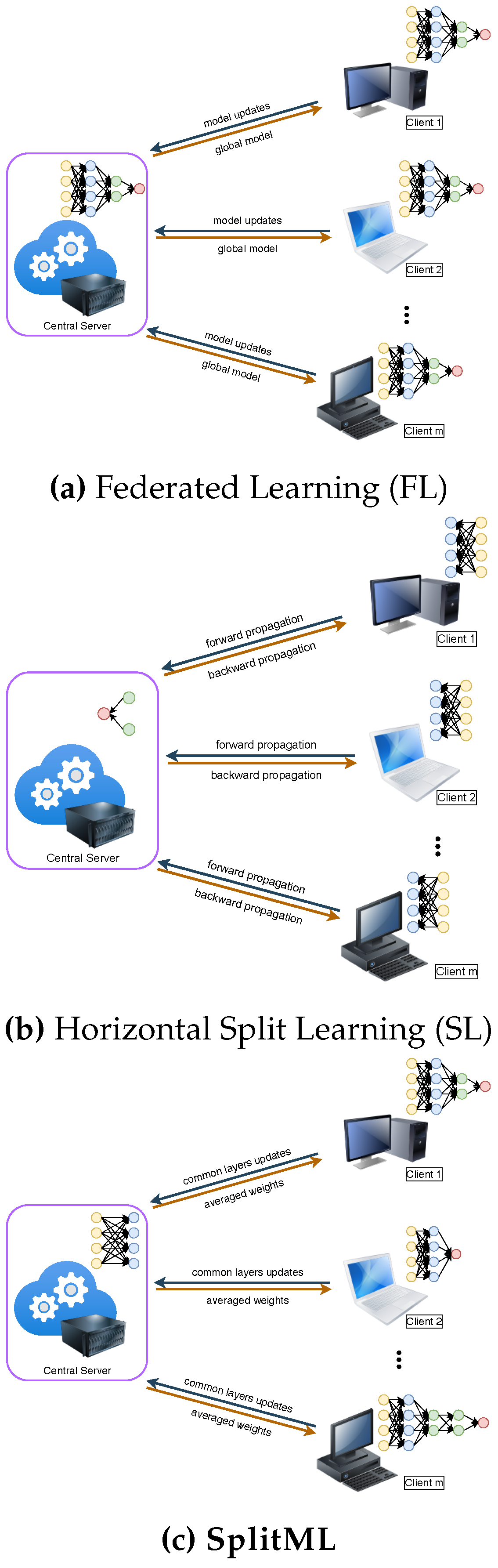
Figure 2.
(a) Training and (b) Inference phases with single-key FHE and (c) Training phase with multi-key FHE in SplitML. Unlike most schemes, we perform both training and inference using FHE. For single-key FHE, a randomly chosen client generates before training and shares with the federated server and with training participants . For inference, a requester R generates session keys and shares with consensus participants . R queries for prediction scores or labels. In multi-key protocol, each client generates its secret key sequentially for partial decryption, and a shared public key is calculated at the end. Evaluation keys for an addition , multiplication , and fused decryption are calculated afterward.
Figure 2.
(a) Training and (b) Inference phases with single-key FHE and (c) Training phase with multi-key FHE in SplitML. Unlike most schemes, we perform both training and inference using FHE. For single-key FHE, a randomly chosen client generates before training and shares with the federated server and with training participants . For inference, a requester R generates session keys and shares with consensus participants . R queries for prediction scores or labels. In multi-key protocol, each client generates its secret key sequentially for partial decryption, and a shared public key is calculated at the end. Evaluation keys for an addition , multiplication , and fused decryption are calculated afterward.
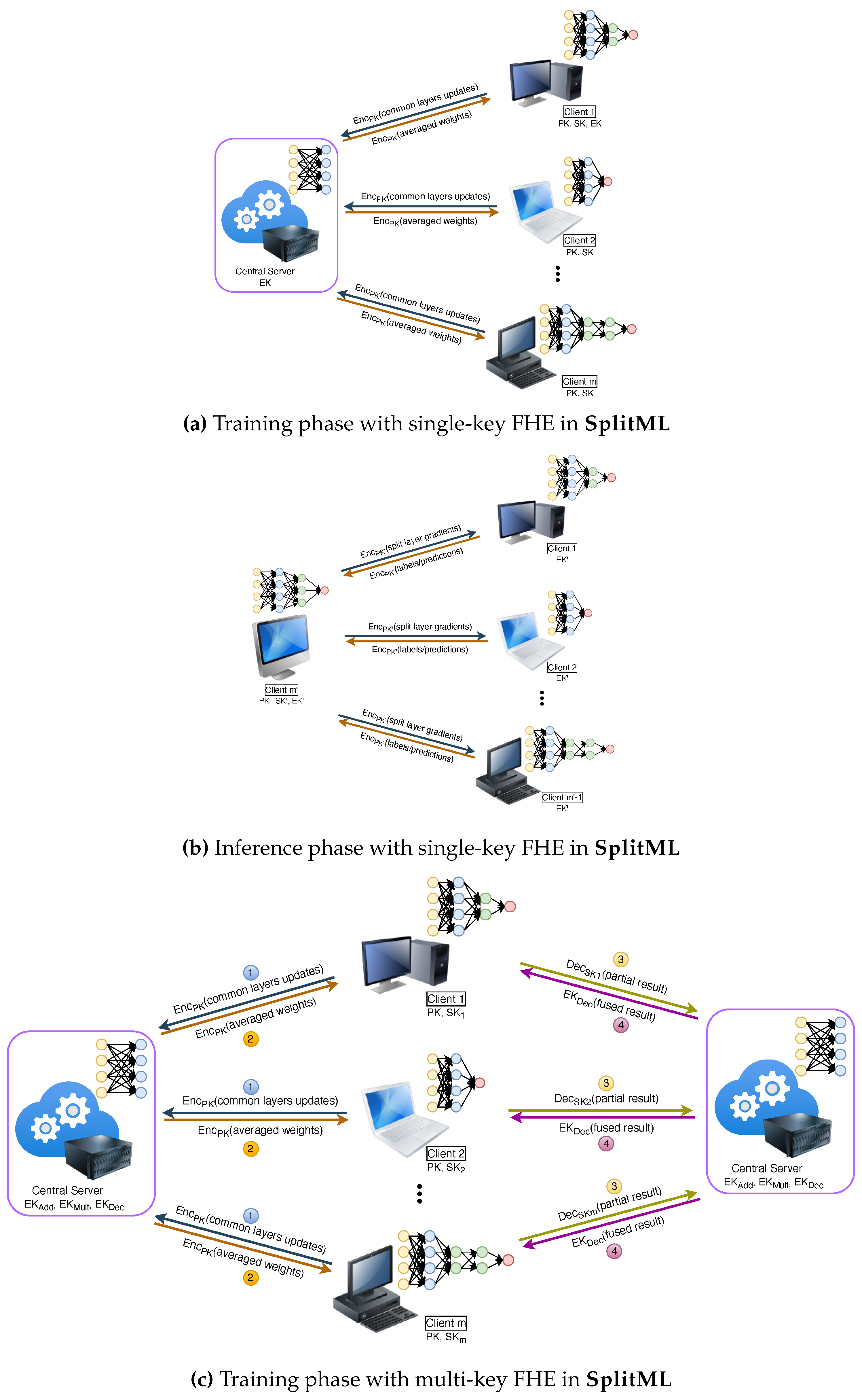
Figure 3.
Comparing training loss (lower is better) and validation accuracy (higher is better) under model poisoning attack for different configurations (all three clients are honest (no poisoning) and only Client-2 is honest (Model-1,3 sends poisonous updates)) of SplitML (honest and malicious) and Federated Learning (malicious).
Figure 3.
Comparing training loss (lower is better) and validation accuracy (higher is better) under model poisoning attack for different configurations (all three clients are honest (no poisoning) and only Client-2 is honest (Model-1,3 sends poisonous updates)) of SplitML (honest and malicious) and Federated Learning (malicious).
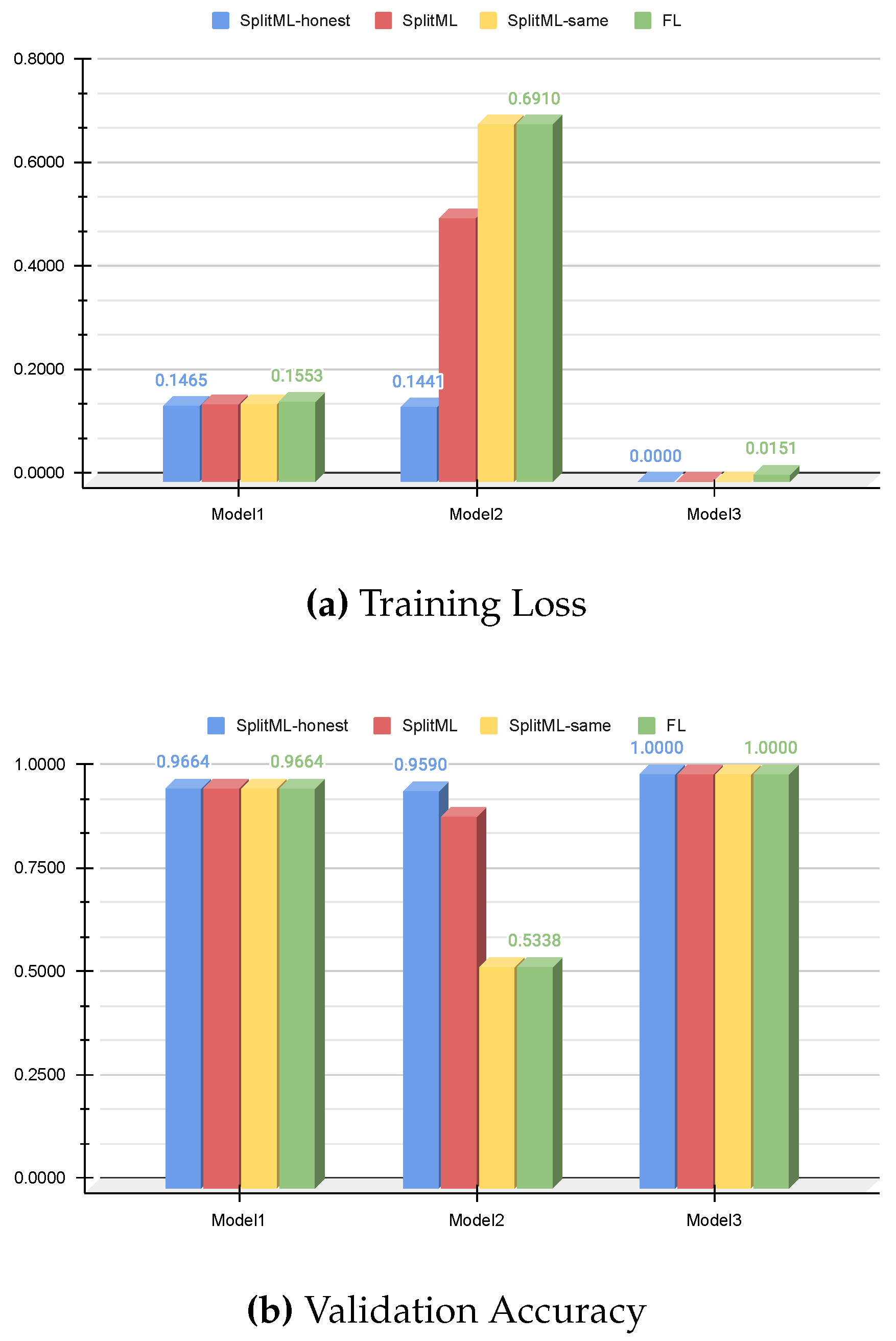
Figure 4.
Membership Inference (MI) attack using black-box shadow models deploys multiple shadows with synthetic or captured data for membership (Training set) and non-membership (Testing set) to train the attack model, which can either detect membership (In) or non-membership (Out) of a record with high accuracy.
Figure 4.
Membership Inference (MI) attack using black-box shadow models deploys multiple shadows with synthetic or captured data for membership (Training set) and non-membership (Testing set) to train the attack model, which can either detect membership (In) or non-membership (Out) of a record with high accuracy.
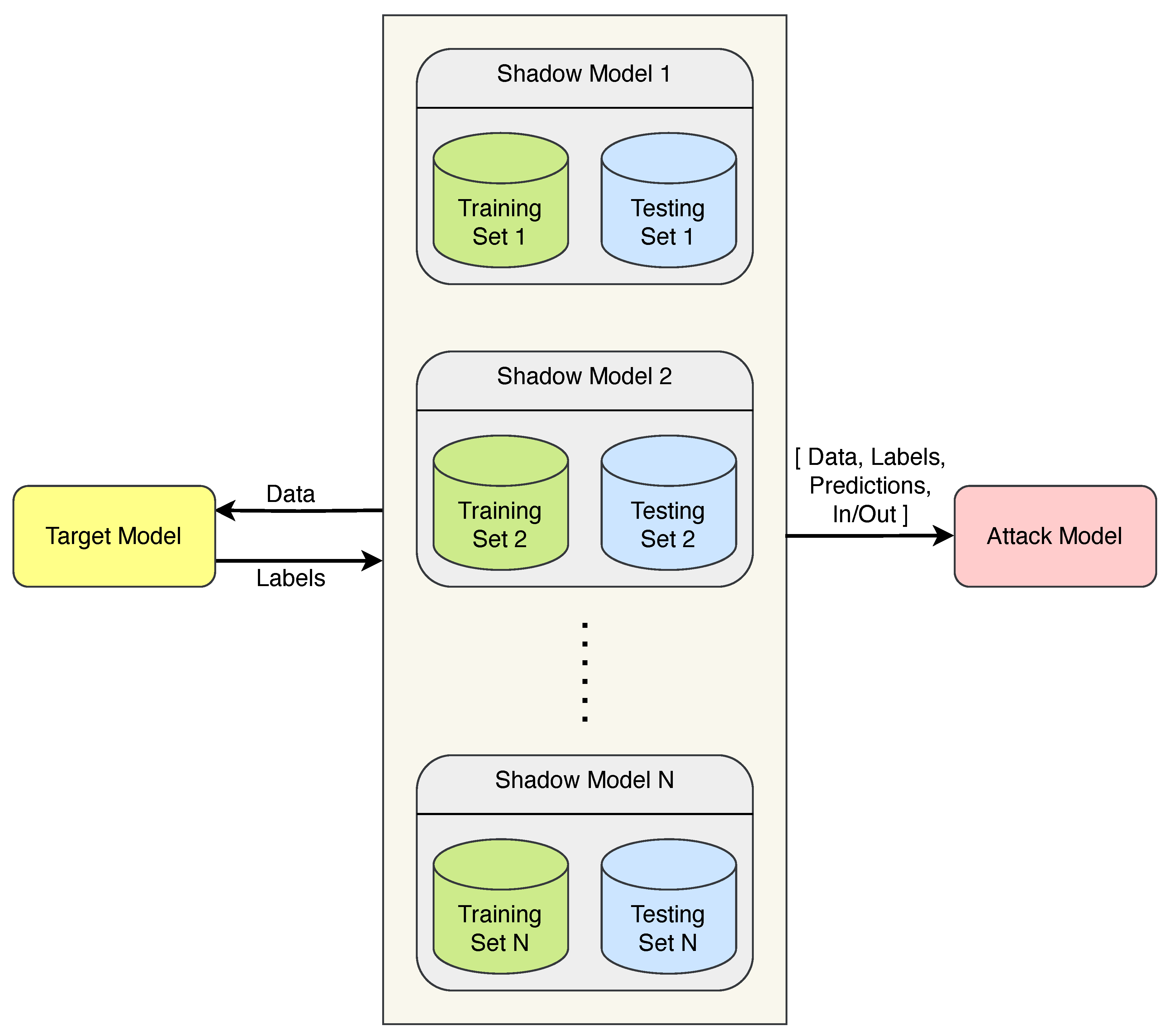
Figure 5.
Member-Accuracy of Membership Inference attack for different shadow model sizes on different architectures. A = Full model without split, B = Top (common) layers before the split, C = Bottom layers after the split, D = More split layers, E = The same number of split layers but fewer neurons, F = Same layers but more neurons, G = Less number of split layers and H = The Same number of bottom split layers but different activation functions. Attack accuracy on a full model (all layers) was as high as , while splitting the layers reduced the attack accuracy to or , equivalent to random guessing.
Figure 5.
Member-Accuracy of Membership Inference attack for different shadow model sizes on different architectures. A = Full model without split, B = Top (common) layers before the split, C = Bottom layers after the split, D = More split layers, E = The same number of split layers but fewer neurons, F = Same layers but more neurons, G = Less number of split layers and H = The Same number of bottom split layers but different activation functions. Attack accuracy on a full model (all layers) was as high as , while splitting the layers reduced the attack accuracy to or , equivalent to random guessing.
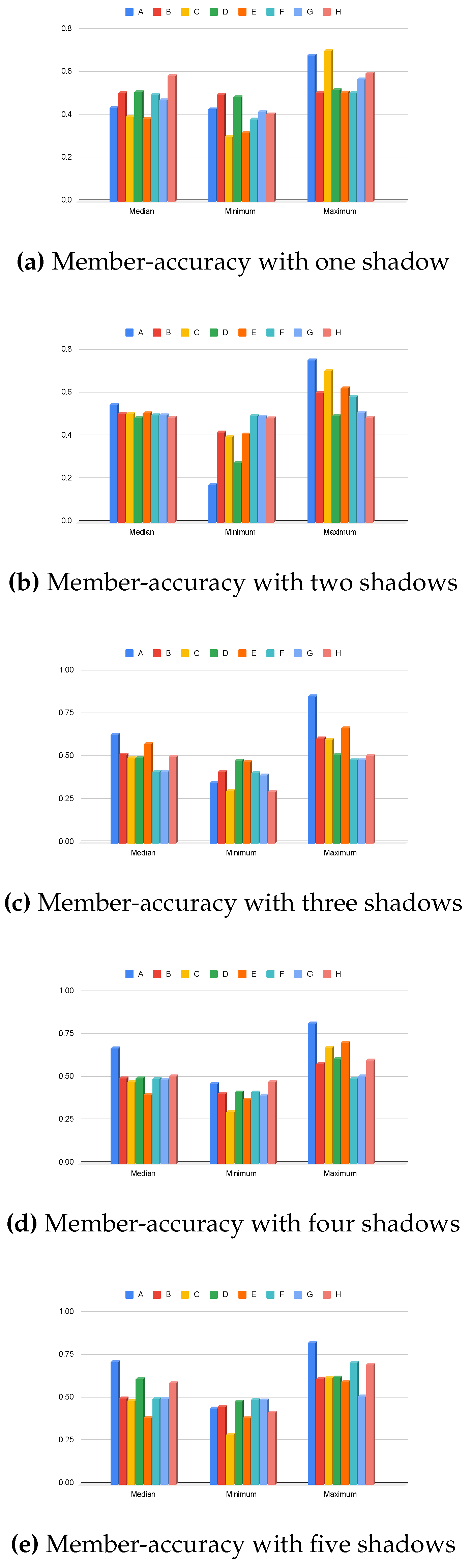
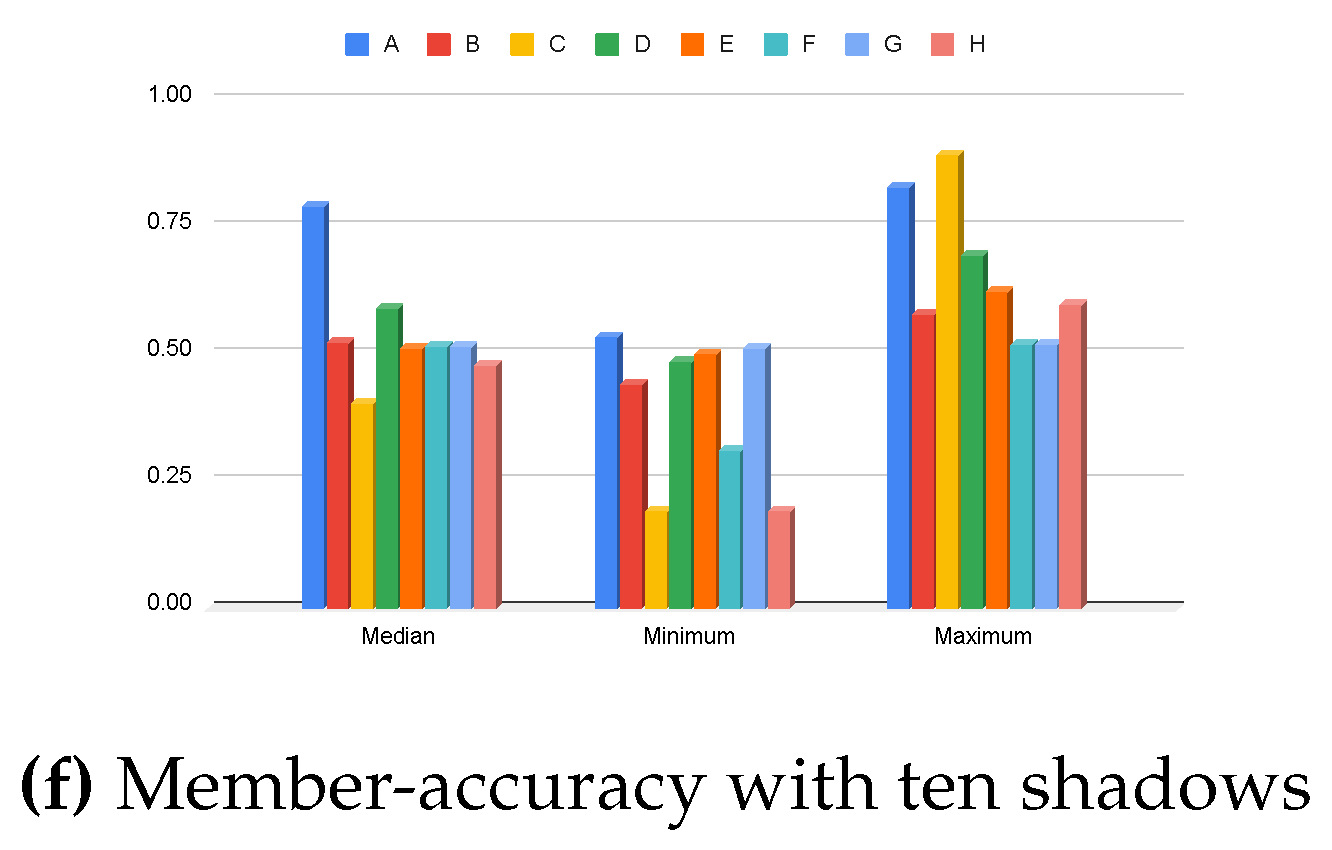
Figure 6.
Accuracy and loss (in standalone and collaborative settings) for training epochs with learning rate .
Figure 6.
Accuracy and loss (in standalone and collaborative settings) for training epochs with learning rate .
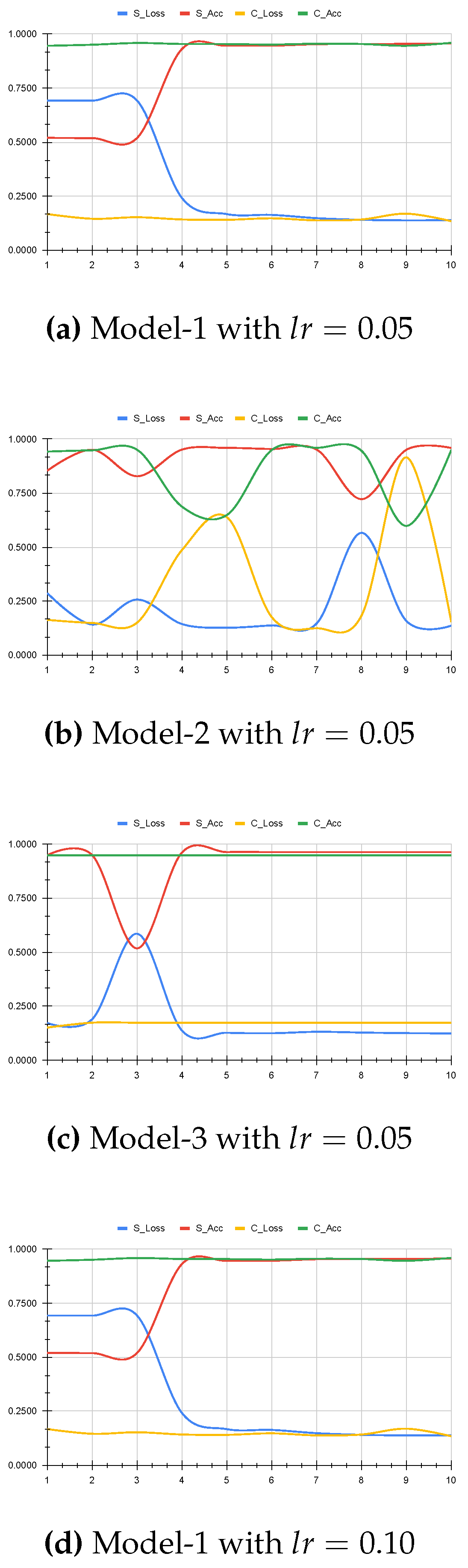
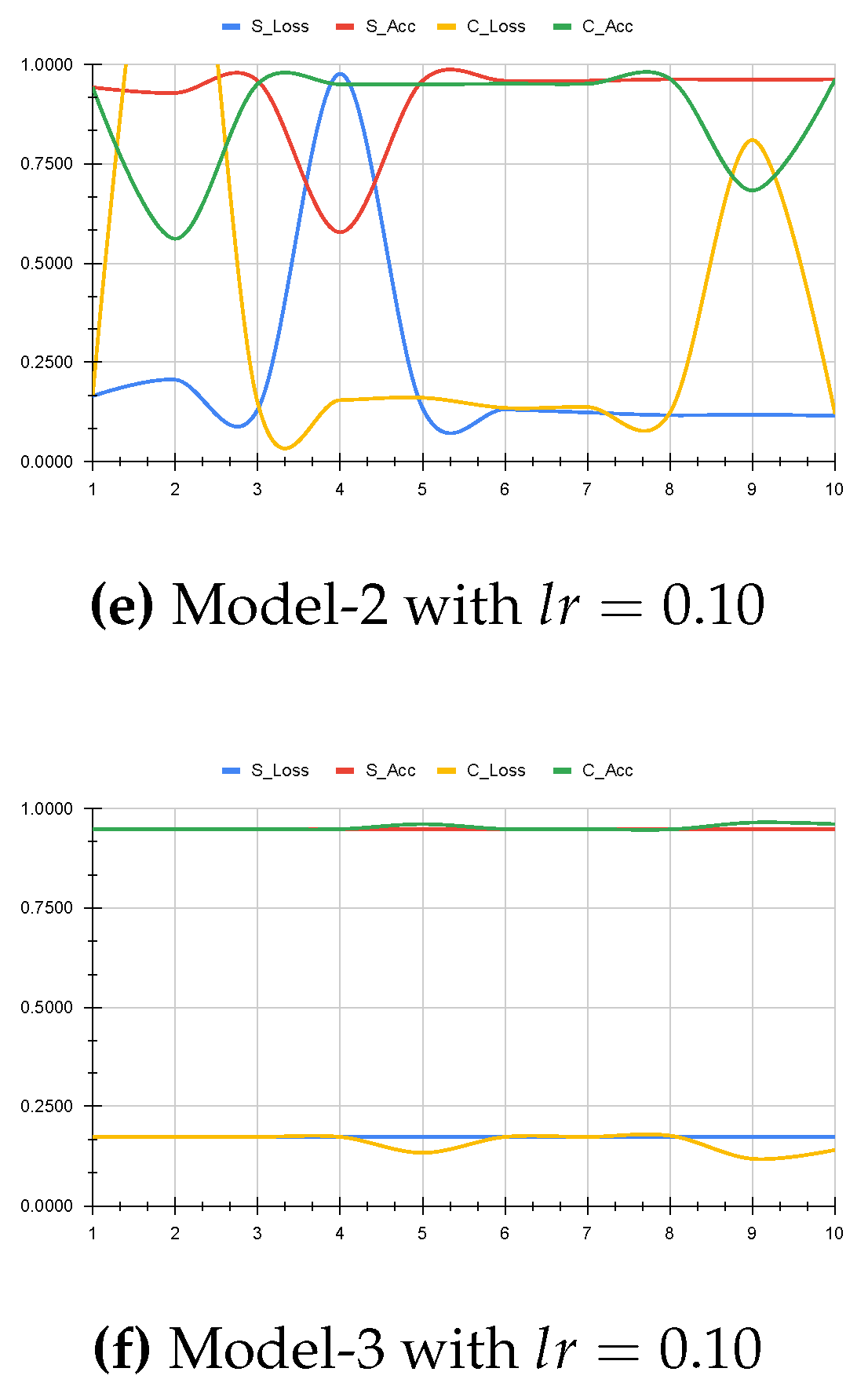
Table 1.
Comparison of computation and communication costs per client in different schemes. Assuming (usually cardinality follows: ), SplitML can help save bandwidth over FL. Here, denotes the fraction of ML parameters of model M with a client.
Table 1.
Comparison of computation and communication costs per client in different schemes. Assuming (usually cardinality follows: ), SplitML can help save bandwidth over FL. Here, denotes the fraction of ML parameters of model M with a client.
| Method | Computation | Communication |
|---|---|---|
| FL [3] | ||
| SL [4] | ||
| SFL [27] | ||
| SplitML |
Table 2.
Accuracy metrics for clients during training under varying settings. M-1,2,3 refers to model-1,2,3; TA is Training Accuracy; TL is Training Loss; VA is Validation Accuracy; VL is Validation Loss. S1 refers to heterogeneous models of SplitML in honest setting; S2 is heterogeneous models in poisonous setting; S3 is homogeneous models of SplitML in poisonous setting, and FL is poisonous setting.
Table 2.
Accuracy metrics for clients during training under varying settings. M-1,2,3 refers to model-1,2,3; TA is Training Accuracy; TL is Training Loss; VA is Validation Accuracy; VL is Validation Loss. S1 refers to heterogeneous models of SplitML in honest setting; S2 is heterogeneous models in poisonous setting; S3 is homogeneous models of SplitML in poisonous setting, and FL is poisonous setting.
| Type | S1 | S2 | S3 | FL | ||||||||
|---|---|---|---|---|---|---|---|---|---|---|---|---|
| M1 | M2 | M3 | M1 | M2 | M3 | M1 | M2 | M3 | M1 | M2 | M3 | |
| TA | 0.9655 | 0.9583 | 1.0000 | 0.9655 | 0.8404 | 1.0000 | 0.9655 | 0.5345 | 1.0000 | 0.9655 | 0.5345 | 0.9994 |
| TL | 0.1465 | 0.1441 | 0.0000 | 0.1501 | 0.5115 | 0.0000 | 0.1501 | 0.6908 | 0.0000 | 0.1553 | 0.6910 | 0.0151 |
| VA | 0.9664 | 0.9590 | 1.0000 | 0.9664 | 0.8980 | 1.0000 | 0.9664 | 0.5338 | 1.0000 | 0.9664 | 0.5338 | 1.0000 |
| VL | 0.1433 | 0.1438 | 0.0000 | 0.1473 | 0.4348 | 0.0000 | 0.1472 | 0.6910 | 0.0000 | 0.1472 | 0.6909 | 0.0008 |
Table 3.
Accuracy metrics for five clients in a training phase. S1 refers to heterogeneous models in honest SplitML setting, S2 is heterogeneous models in poisonous SplitML setting, S3 is homogeneous models in poisonous SplitML, and FL is performed under the poisonous setting.
Table 3.
Accuracy metrics for five clients in a training phase. S1 refers to heterogeneous models in honest SplitML setting, S2 is heterogeneous models in poisonous SplitML setting, S3 is homogeneous models in poisonous SplitML, and FL is performed under the poisonous setting.
| Arch | Training Loss | Validation Accuracy | ||||||||
|---|---|---|---|---|---|---|---|---|---|---|
| M1 | M2 | M3 | M4 | M5 | M1 | M2 | M3 | M4 | M5 | |
| S1 | 0.1352 | 0.1564 | 0.2390 | 0.0000 | 0.0000 | 0.9691 | 0.9623 | 0.9163 | 1.0000 | 1.0000 |
| S2 | 0.1378 | 0.1568 | 5241.3701 | 0.0000 | 0.0000 | 0.9691 | 0.9623 | 0.5658 | 1.0000 | 1.0000 |
| S3 | 0.1378 | 0.1568 | 0.6839 | 0.0000 | 0.0000 | 0.9691 | 0.9623 | 0.5658 | 1.0000 | 1.0000 |
| FL | 8.48E+15 | 1.03E+16 | 1.19E+17 | 3.20E+17 | 3.43E+17 | 0.9691 | 0.9623 | 0.5658 | 0.0000 | 0.0000 |
Table 4.
Member-accuracy for different shadow models.
| Shadows | Architecture | Median | Minimum | Maximum |
|---|---|---|---|---|
| Full model | 0.4374 | 0.4302 | 0.6816 | |
| 1 | Top layers | 0.5072 | 0.5006 | 0.5100 |
| Bottom layers | 0.3970 | 0.3046 | 0.7036 | |
| Full model | 0.5464 | 0.1764 | 0.7552 | |
| 2 | Top layers | 0.5064 | 0.4186 | 0.6028 |
| Bottom layers | 0.5072 | 0.3994 | 0.7042 | |
| Full model | 0.6306 | 0.3482 | 0.8566 | |
| 3 | Top layers | 0.5170 | 0.4154 | 0.6088 |
| Bottom layers | 0.4958 | 0.3030 | 0.6030 | |
| Full model | 0.6750 | 0.4644 | 0.8170 | |
| 4 | Top layers | 0.4994 | 0.4080 | 0.5838 |
| Bottom layers | 0.4778 | 0.3004 | 0.6784 | |
| Full model | 0.7130 | 0.4420 | 0.8260 | |
| 5 | Top layers | 0.5015 | 0.4542 | 0.6166 |
| Bottom layers | 0.4881 | 0.2892 | 0.6196 | |
| Full model | 0.7610 | 0.4730 | 0.8984 | |
| 6 | Top layers | 0.5058 | 0.4352 | 0.5674 |
| Bottom layers | 0.3934 | 0.3792 | 0.5972 | |
| Full model | 0.7572 | 0.7324 | 0.8428 | |
| 7 | Top layers | 0.4766 | 0.4566 | 0.5402 |
| Bottom layers | 0.5054 | 0.5016 | 0.5856 | |
| Full model | 0.7546 | 0.5564 | 0.7862 | |
| 8 | Top layers | 0.5242 | 0.3714 | 0.5594 |
| Bottom layers | 0.4052 | 0.3768 | 0.8056 | |
| Full model | 0.8356 | 0.8176 | 0.8530 | |
| 9 | Top layers | 0.4482 | 0.4374 | 0.5168 |
| Bottom layers | 0.5008 | 0.3904 | 0.6004 | |
| Full model | 0.7886 | 0.5324 | 0.8270 | |
| 10 | Top layers | 0.5206 | 0.4376 | 0.5776 |
| Bottom layers | 0.4020 | 0.1910 | 0.8900 |
Table 5.
Return-1 model shows our dataset’s balanced distribution of two classes.
| Type | Accuracy | Precision | Recall | F1-Score |
|---|---|---|---|---|
| Full (100%) | 0.4999 | 0.4999 | 1.0000 | 0.6666 |
| Test (20%) | 0.5016 | 0.5016 | 1.0000 | 0.6681 |
Table 6.
Consensus results with .
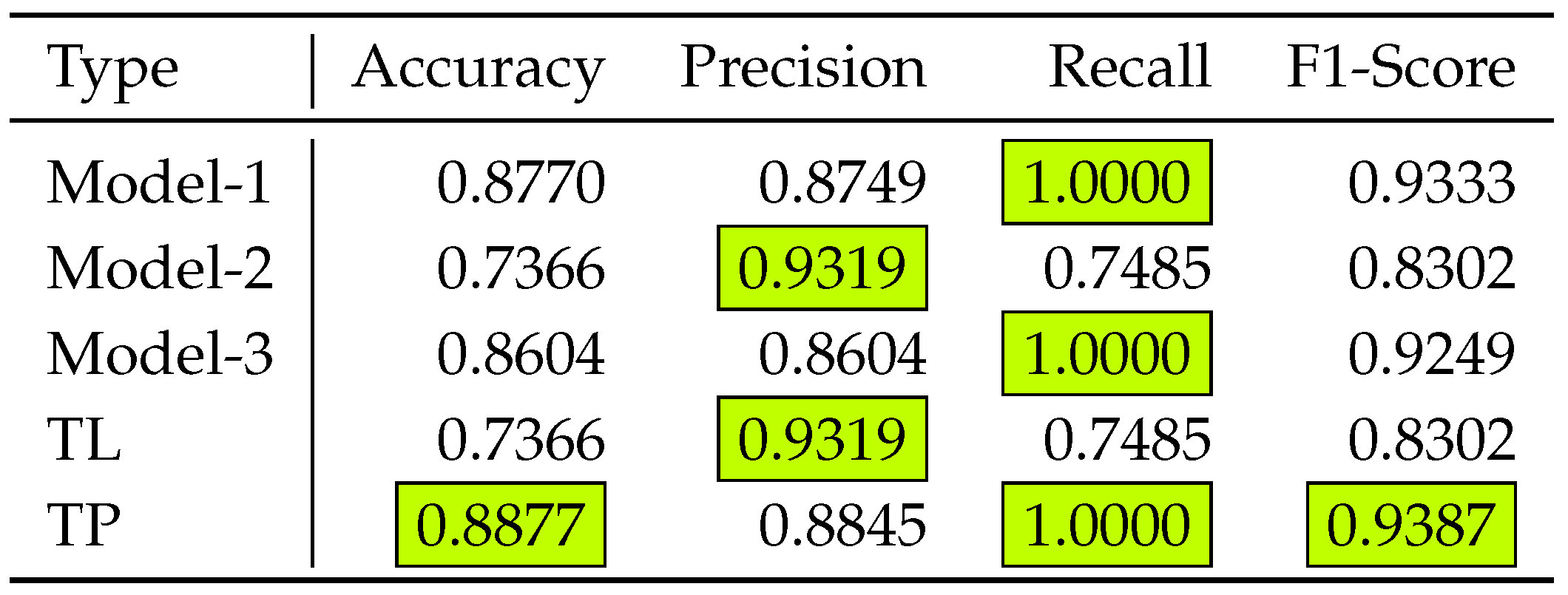 |
Disclaimer/Publisher’s Note: The statements, opinions and data contained in all publications are solely those of the individual author(s) and contributor(s) and not of MDPI and/or the editor(s). MDPI and/or the editor(s) disclaim responsibility for any injury to people or property resulting from any ideas, methods, instructions or products referred to in the content. |
© 2025 by the authors. Licensee MDPI, Basel, Switzerland. This article is an open access article distributed under the terms and conditions of the Creative Commons Attribution (CC BY) license (http://creativecommons.org/licenses/by/4.0/).
Copyright: This open access article is published under a Creative Commons CC BY 4.0 license, which permit the free download, distribution, and reuse, provided that the author and preprint are cited in any reuse.


