Preprint
Article

This version is not peer-reviewed.

Biodegradability and Ecotoxicity Profiles of Choline Acetate, Betaine, and L-Proline NADESs: A Hidden Threat for Eutrophication?

Submitted:

16 December 2025

Posted:

17 December 2025

You are already at the latest version

Abstract

Deep Eutectic Solvents (DESs) and in essence naturally available DESs (NADESs) are considered to be green solvents due to their low vapor pressure, non-flammability, thermal stability, good solvent power and low oxicity. These properties make them attractive as safer and more environmentally acceptable solvent options. Green Chemistry promotes the use of renewable and biocompatible compounds such as amino acids, lipids and acids of natural origin to yield more sustainable DESs, which yields their application in several industrial processes. Driven by the current requisite for sustainable progress, along with overcoming dependence on fossil-based resources, the current work details important findings pertaining to the design of sustainable NADESs from the perspective of green chemistry to exhibit suitable physico-chemical properties and a low toxicological profile. Biodegradation studies using OECD 301D closed bottle test (CBT) were performed to observe the biodegradability of 15 selected NADESs. Toxicity controls were run along with the CBT run to observe the behavior of these NADESs in the environment. In this framework, the present paper investigates the development of safer NADESs. The results obtained suggest that our synthesized NADESs, have high biodegradability and low toxicity towards microalgae. Although a conventional threat to the environment would seem out of reach, it must be hypothesized that such compounds might act as enhancers of eutrophication phenomena.
Keywords: 
;  ;  ;  ;  ;  ;  

1. Introduction

In the advent of sustainability and green chemistry era there is an ongoing quest to discover safer and more environmentally friendly solvents to replace traditional ones derived from fossil-derived chemicals [1]. These conventional solvents pose significant environmental threats during production, use, and disposal [2]. The end-of-life cycle for these solvents is a problem because they are not biodegradable. This means they must be burned, which creates CO2 emissions as they are often non-biodegradable. In addition, the impact of these solvents on human health has recently become a cause for concern in various industrial sectors. For example, N,N-dimethyl formamide (DMF) has recently been highlighted for its reproductive toxicity[3]. Consequently, its use, particularly in the pharmaceutical industry, has been prohibited within the European Union. In this context, the investigation of sustainable alternatives to fossil-based solvents has intensified in recent years. Among the neoteric solvents,the deep eutectic solvents (DESs) represent a versatile alternative to volatile organic solvents, including those of natural origin [4].The recent popularity of DES is mainly due to their simple preparation and their relatively low-cost [5,6]. DESs are typically obtained by the mixture of two or more compounds [7], which determines a decrease of the melting point of the mixture below that expected for the ideal eutectic [8]. At the basis of this deviation there is the strong interaction between a hydrogen bond donor (HBD) and a hydrogen bond acceptor (HBA) that creates a strong microheterogeneity at the molecular level [9]. However, the real key to the success of DES is their tuneability, which allows for the customization of the system to suit specific needs. Simply modifying the chemical composition of the mixture allows its chemical and physical properties to be adapted for a specific application. An additional degree of modularity can be achieved by adjusting the molar ratio between the components [10]. A subset of DESs, inspired by nature and derived from plant-based products and other bio resources, are called Natural Deep Eutectic Solvents (NADESs) [11]. In fact, they are composed of natural substances, which is the reason behind their biocompatibility [12,13,14].
Although the definition of DESs does not have a direct implication on most features, initially, the green characteristics of DESs were assumed based on the pharmaceutically acceptable profile that was reported in the material safety data sheets of the selected individual components [15]. Later, a few studies have been devoted to investigating the DESs toxicity profile [16]. Indeed, bio-based chemicals may not be completely biodegradable hence not 100% environmentally friendly. However, despite the great interest of academia and industry on DESs and NADESs applications for gas capture [17], biomass valorisation [18,19], wastewater entrapment [20] and wastewater treatment [21], material synthesis [22], the toxicity of these compounds is still an underrated issue. Limited recent research studies have investigated NADESs toxicity on different targets, such as human cells [23,24,25], bacteria [25,26,27,28], yeasts [25], invertebrates and microalgae [12,26,27], and fish [29], sometimes reporting conflicting results. Indeed, what emerged from different papers was a pool of different behaviors of HBA/HBD if assessed singularly or, instead, in a NADESs composition [12]. Moreover, several studies support the idea of DESs as “eco-friendly”, assuming they are not toxic given the fact they are formed by naturally-occurring ingredients and, for this reason, bio-renewable, biodegradable and bio-assimilable [30,31], while other publications report a clear toxicity linkable to some DESs components [23].
Among NADESs components, choline is the most used compound to prepare DESs [32], due to its high biodegradability [33] and low toxicity [31] as well as low cost and widespread availability [34]. Although found in living organisms, choline cation currently on the market is of fossil origin and is obtained from trimethylamine and ethylene oxide [33]. In particular, choline acetate (ChA) and bitartrate (TA) are much less commonly used than choline chloride (ChCl) in the preparation of DES, but they are a valuable halogen-free alternative. For example, DES based on ChTA have recently been used to increase the solubilisation of drugs [35], plasticize starch [36] and extract flavonoids [37]. ChA-based DESs have also recently been studied from a physico-chemical and application perspective [38,39,40,41]. For example, ChA:glycolic acid (GA), ChA:levulinic acid (LA) and ChA:imidazole (Im) showed excellent performance in hemicellulose solubilisation and were used in Kraft cellulose purification. [42] On the other hand, betaine (trimethylglycine, Bet), a zwitterionic compound bearing both formal positive and negative charges has also been used to prepare DESs [43] and has been even suggested as the universal HBA [44]; like choline and betaine it is also biocompatible [45], has low toxicity profile [46,47], and is readily biodegradable. However, in contrast to ChCl, Bet can be derived from renewable sources and in particular by transformation of by-product of sugar production [42]. The use of Bet-based DES has grown significantly in recent years and are being used in numerous applications [48,49,50,51].
The proteinogenic amino acid L-proline (L-Pro) has received attention recently for designing ILs [52,53,54] and NADESs [55,56] for different applications. The ability of L-Pro to form enamines or imines, when reacting with carbonyl groups, as well as its ability to induce chirality promoted by the cyclic structure of the molecule, have been exploited in a wide range of organic synthetic methodologies. L-Pro can promote a very broad diversity of transformations, which can be explained by the multiple catalytic roles allowed by its structural features.
Similarly, L-Pro can behave both as an acid or Brønsted base, or even show both behaviors during a mechanism, being therefore a bifunctional catalyst. It is the only natural amino acid with a secondary amine functionality, a feature that raises the nitrogen pKa and increases its nucleophilicity in comparison to other amino acids. L-Pro has several additional advantages such as being inexpensive, commercially available, non-toxic and easily recoverable, which are important properties from the point of view of green chemistry [57]. L-Pro has recently become widely used as an ingredient in supplements, health foods and cosmetics. The use of L and D-Pro as an HBA in the preparation of DES solvents allows to develop new reaction media with a dual solvent/catalyst role [58].
In this study, a series of 15 different choline, betaine, and L-proline-based NADESs (Table S1) and their single components (Figure 1), was assessed for their biodegradability using the aerobic biodegradation method [59], in order to evaluate their persistence in aquatic systems and the potential release of nutrients, such as N and P by molecule dissolution.
Moreover, we evaluated the potential ecotoxic effect of these compounds and their respective single components in terms of freshwater microalgae Raphidocelis subcapitata growth stimulation and/ or inhibition, hypothesizing an underrated effect of NADESs as potential eutrophication substances.

2. Results

2.1. Biodegradation Results of NADESs

The biodegradability tests conducted for all of the test substances for 28 days were proven to be valid as the control, readily biodegradable sodium acetate was eliminated by at least 60% by the end of 14 days
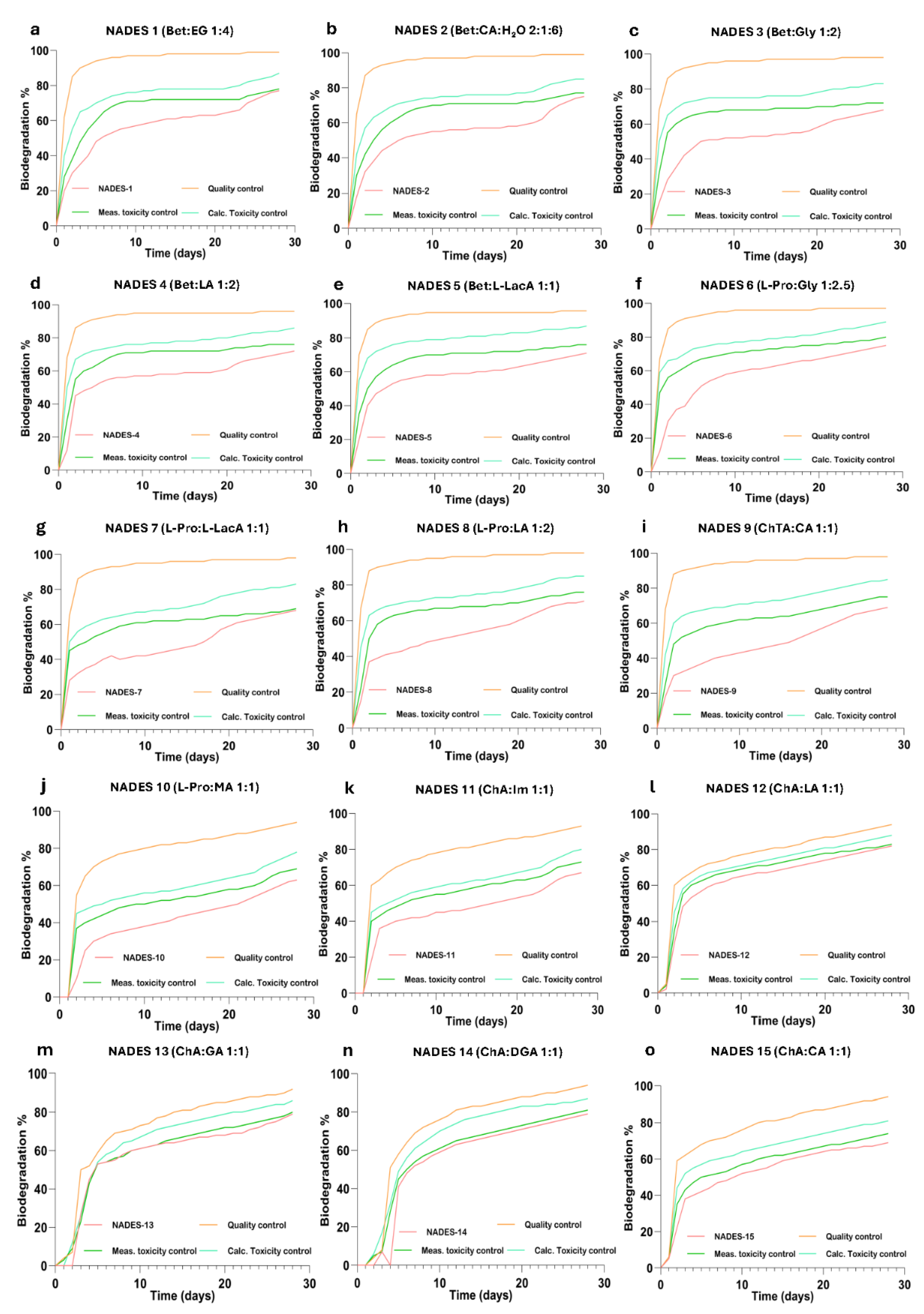
All the tested NADESs, as well their single components, were observed to be classified as “readily biodegradable”, showing biodegradation values > 60 % after a 28-days Closed Bottle Test (Table S2). The only exception was Im, with a biodegradation value of 23 % as an indisvidual HBD component, although when in combination with ChAc (NADES 11), it seemed to not affect whole NADES’s biodegradability score (67 %). The biodegradability profiles observed for studied NADES are presented on Figure 2a-o.

2.2. Raphidocelis subcapitata Growth Bioassay

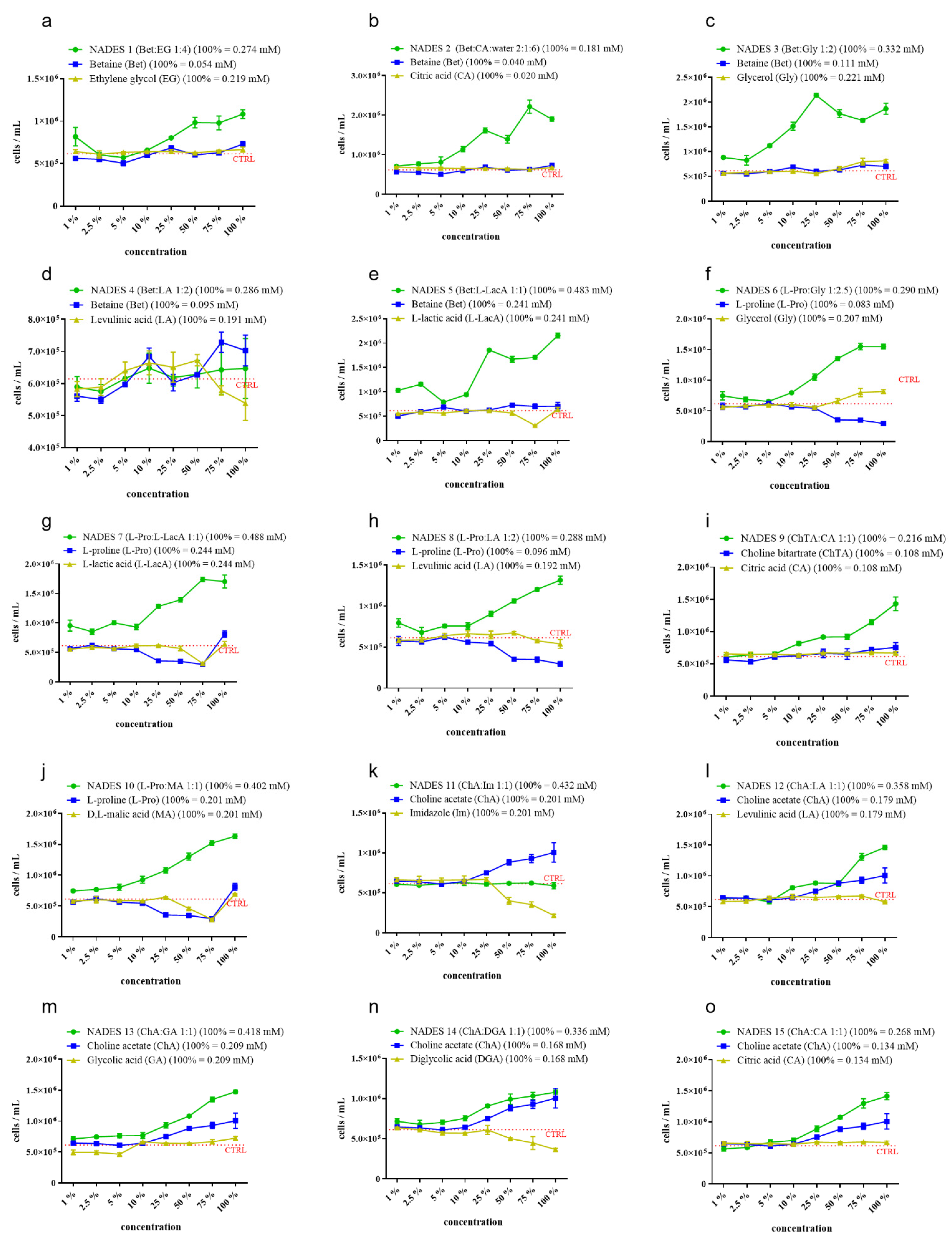
The Figure 3 represents the growth behaviour of R. subcapitata algae exposed to different concentrations of 15 NADESs. Each graphic showed the differences, in terms of concentration response trend, between NADESs and their components. The concentration-response curve showed an algal growth stimulation, with increasing concentrations, in thirteen NADESs compared to control. The only 2 tested NADESs where the algal growth was not different from control were NADES 4 (Bet : LA) (Figure 3d) and NADES 11(ChA : Im) (Figure 3k).
The concentration-response curve showed an algal growth stimulation, with increasing concentrations, in thirteen NADESs compared to control. The only 2 tested NADESs where the algal growth was not different from control were NADES 4 (Bet: LA, Figure 3d) and NADES 11 (ChA : Im, Figure 3k).
Among NADESs components, the one with the most stimulating effect in terms of algal growth was choline acetate, which represents the HBA of NADESs 11-12-13-14-15 (Figure 3 k,l,m,n,o). Following the same trend, L-Pro in NADES 7 and NADES 10 (Figure 3gandFigure 3j, respectively) showed a slight growth stimulation at the maximum tested concentration, followed by a reduction in algal growth at 75 %, 50 % and 25 %. The same compound, tested at concentrations as in NADESs 6 and 8 (Figure 3fandFigure 3h, respectively), showed an inhibiting effect until 50 %. This is linked to the fact that the concentration of L-Pro in NADES 6 and 8 at 50 % was similar to L-Pro in NADES 7 and 10 at 25 %. A similar trend, as for L-Pro in NADESs 7 and 10, was observed for MA and L-LacA (Figure 3 e,g,j). However, in these cases, the inhibition effect was limited to the concentration of 50 % and 75 % for MA and only at 75 % for L-LacA.
Bet and ChTA displayed a similar effect on algal growth, having both shown biostimulation at the 100 % concentration of NADESs 1,2,3,5 and 9 (Figure 3 a,b,c,e,i). In addition, a biomass increase was also found at 50 and 75 % of Bet in NADES 5, and at 75 % of ChTA in NADES 9. Contrastingly, Bet exhibited a different algal growth pattern in NADES 4 (Figure 3d), where three peaks of biostimulation were found at 10, 75 and 100 %, and an inhibition peak was displayed at 2.5 %.
Concerning other tested components, they showed no effect as growth patterns are very similar to those of the respective controls.
ANOVA results, with Tukey’s post-test for multiple comparisons, for all concentration-response effect of each NADES are collected in Supporting Information (File S2).

3. Discussion

Considering the continuously growing necessity of finding new green solutions aiming at decreasing the impact of human activities on the environment, the present study took in considering a pool of 15 NADES, claimed as non-toxic systems, to evaluate their biodegradability potential and their effects on freshwater algal growth. The same analyses were accrued out on the single components to highlight possible differences when mixed in the NADES.
The current study represents the natural development of our previous research work on NADES [12], where the pool of 15 NADES was evaluated in terms of ecotoxicological effects on two batteries of tests, a marine test and a freshwater test. Due to interesting results obtained in terms of microalgal growth biostimulation, particularly emphasized in the freshwater environment, a deeper investigation on biodegradability and single component effect, in respect to the formed DES system, was considered necessary. Observing as example biodegradability percentages of NADES single components after 28 days, we may notice that Im was the one with the lowest biodegradation value (23%). We may suggests that the inoculum used was likely deficient in key breakdown pathways for this particular chemical, since in the NADES with choline acetate the biodegradability risen to 67%, underlining complex interactions between components in whole NADES formulation
Despite the very limited toxic effect of NADES observed with tests involving invertebrates, their potential impact on the environment, if improperly disposed, may lie in their feature as nutrient source, thus increasing the already large pool of substances with the potential to disrupt biogeochemical cycles at a global scale [60]. This disruption might be intensified by extreme natural events linked to a Global Change Scenario, such as thermal heatwaves [61] and ocean acidification [62]. Regarding the latter, it was observed how NADES in aqueous solutions are able to reduce pH value and, as a consequence, enhance algal growth [12,63].
In addition to these statements, a ready biodegradability was observed for the majority of assessed NADES, with biodegradation values at 28 days between 60 % and 81 % for NADES compounds, and between 23 % and 79 % for their single components.
Our data coincides with the report on NADESs based ChCl as HBA and a series of HBD (glycerol, ethylene glycol, urea, glucose, malonic acid, and lactic acid) studied by CBT [33], demonstrated biodegradability beyond 60% in all cases. Irrespectively of number of hydroxyl groups per mole or the presence of carboxylic derivatives, such as acids, esters, or amides the biodegradability profiles were considered as “readily biodegradable”. This feature may lead the general opinion to consider NADES as completely “green” and “eco-friendly” substitutes to conventional organic solvents. However, the fact that they are readily biodegradable may enhance the load of dissolved ions/molecules with nutritional value, such as choline, known also as vitamin B4, and its degradation products, emphasizing the occurrence of eutrophication phenomena [64].
Due to lack of literature treating NADES effects on microalgae, to better understand current observations, it is important to deeply analyse all obtained results and compare NADES effects with their single component behaviour. Among NADES, those showing the highest induction of algal growth were NADES 2 (Bet : CA), 3 (Bet : Gly) and 5 (Bet : L-LacA). All of these three systems have betaine in their formulation, which, notwithstanding a lack of effect while tested as single component, strongly enhanced algal proliferation when combined with Gly, CA, or L-LacA. Moreover, also NADES containing L-Pro as HBA, which tend to slightly reduce algal load while assessed as single component at high concentrations (> 0.29 mM), displayed a growth stimulating effect when in combination with other HBDs (NADES 6-7-8-10). Differently from those cases, effects of NADES with ChA (NADES 11-12-13-14-15), appeared to be more influenced by this latter component respect to all other HBAs, given the similar shape of concentration-effect curves.
Moving the focus specifically to NADES components, it is possible to divide them into three main groups, depending on their effect. The first group, which comprehends the majority of assessed compounds (betaine, ethylene glycol, citric acid, glycerol, glycolic acid, choline bitartrate, L-lactic acid, malic acid and levulinic acid), is composed by substances without significant effects neither in enhancing nor inhibiting algal growth. The second group is composed by Im, L-Pro and DGA. These three compounds showed a limited inhibiting effect on algal growth when tested at concentrations > 0.08 mM for L-Pro, > 0.107 mM for Im, and > 0.1 mM for DGA (concentrations in the relative NADES solution, assessed at dilutions between 25 % and 100 %). The last group is composed by the ChA only, which is present in NADES 11-15 formulations (Figure 3 k,l,m,n,o). As stated before, this particular compound showed a clear algal growth enhancing effect, which followed the same concentration-response curve of the relative NADES, appearing to be the main responsible for algal growth, if compared with concentration-response curves of each assessed whole NADES. However, algal biomass measured at each ChA assessed concentration resulted in lower values, if compared with the relative whole system. This, again, led us to hypothesize a synergistic effect between ChA and the other DES component, like in other assessed NADES. The only exception was represented by NADES 11, where the two opposite effects of Im and ChA seemed to interact by simple addition (Figure 3 k).
This hypothetical synergistic effect of the two components in the NADES composition, observed as an emphasized “overgrowth” effect of the entire systems if compared with both single compounds until 25 % as threshold concentration, has already been observed for ChCl-based DESs [65,66], but also for other toxic DESs, such as glyceline, ethaline and reline [27]. This last result was observed also in the present work with NADES 11 (ChA : Im 1:1) which, as reported before, has Im in its formulation. Im is known to be linked to aquatic toxicity also in other kind of NADES-related compounds, such as ionic liquids [12]. However, while Im showed a certain degree of algal growth inhibition, no relevant effects were observed when it was assessed in combination with ChA as whole DES.
Regarding biodegradability, with the exception of the previously discussed imidazole, no other relevant differences in terms of biodegradability percentages were observed between single components and NADES, with all values still over 60%. However, the readily biodegradability of these compounds, considering that several of them, such as L-proline, betaine and choline acetate, contain nitrogen in their formulation, and the synergistic effect between some components in enhancing microalgal growth, may act as a perfect fertilizer with potential eutrophication effect [67].

4. Materials and Methods

The NADESs used in this study and their composition, along with the ratio of the mixture and their chemical structure, as well as the NADESs components are listed in Table S1.

4.1. Chemicals

Ultrapure deionized water (Milli-Q Direct Water Purification System) was used for all solutions and media preparation. Potassium dichromate, K2Cr2O7 (1 g/L) was purchased as dehydrated salt (ACS reagent grade, purity ≥ 99.0 %) from Sigma-Aldrich and used as reference toxicant for algal growth inhibition assay. For NADESs preparation, both hydrogen bond acceptors (HBAs) (Bet, L-Pro, ChTA, ChA) and hydrogen bond donors (HBDs) (EG, CA, Gly, LA, L-LacA, MA, Im, GA, and DGA) were purchased from Alfa Aesar GmbH. Composition and molar ratios of NADESs tested in this study are reported in Table S1. NADESs were prepared following the methodologies described in the literature [68,69].

4.2. Biodegradability Assessment

In the assessment of the biodegradability of organic compounds, the initial and simple test used is the closed bottle test (modified OECD 301D) usually referred to as the aerobic biodegradation test [70,71].
Aerobic biodegradation testing was done using the modified closed bottle test (CBT), based on OECD 301D guidelines [71,72]. CBT setup with modifications, where biological oxygen consumption is measured with an optode oxygen sensor system using PTFE-lined PSt3 oxygen sensor spots (Fibox 3 PreSens, Regensburg, Germany), allows measuring BOD without dispensing it from the stock solution each time for each test and thereby reducing the number of parallels as once we open a bottle to measure its BOD we cannot use it anymore because its exposed to the atmosphere, so in that case we would keep a stock solution and pour it into new measuring flask each time. The modified setup has also shown to improve reproducibility compared to the original OECD 301D guideline[71,73]. Compared to other standard aerobic biodegradation tests, CBT is better suited for testing compounds with different physico-chemical properties. It is also one of most stringent OECD tests on biodegradability, as the amount of inoculum added is very low and, thus, compounds passing CBT 301D should show good biodegradation not only under artificial wastewater treatment conditions but also in soil and groundwater systems.
Experimental Setup. Each CBT run consisted of four different series each of which was run in duplicates. First was „reference series „in which readily biodegradable sodium acetate in a known concentration (6.41 mg/L) was added to a flask of mineral medium inoculated with effluent from a wastewater treatment plant. As sodium acetate is known to be rapidly biodegradable it acted as a reference and control for monitoring activity of microbes in the inoculum. In the test series a studied compound as a sole source of carbon was added to the inoculated mineral medium. The test compound was added in a concentration corresponding to theoretical oxygen demand (ThOD) of approximately 5 mg/L. ThOD was calculated assuming nitrification would take place as each of the 25 studied compounds included nitrogen atom(s) in their structure. Toxicity control series, containing both sodium acetate and test compound in their respective concentrations, were used to evaluate test compounds’ toxicity against inoculum – if biodegradation values in these bottles were significantly lower compared to reference series, it was concluded that the test compound could be inhibiting or even being toxic to microbes in WWTP effluent. To negate the effect of inoculum itself, blank bottles containing only inoculum and mineral medium were added to each CBT run and the value of these bottles was subtracted from all the other bottles. To make sure seasonal variations in inoculum composition did not have an effect on biodegradation results, a total of 6 CBT runs from June to November were performed.
Inoculum. Effluent from wastewater treatment plant was collected from a municipal wastewater treatment plant in Tallinn, Estonia (Paljassaare wastewater treatment plant, 59°27'55.5"N 24°42'08.8"E). WWTP effluent was filtered through a cellulose filter (membrane ø 240 mm) before being used as inoculum for aerobic biodegradation testing.
Results from each run were accepted if the following criteria were met: (i) difference of extremes of replicate values at the plateau is less than 20 %, (ii) oxygen concentration in test series bottles must not fall below 0.5 mg/L at any time, iii) sodium acetate in reference series must be degraded ≥ 60 % by day 14. Blank bottles oxygen consumption was also monitored to avoid the possibility of the system turning from aerobic to anaerobic. In none of the CBT runs oxygen consumption in blank bottles exceeded 34 % compared to the initial oxygen concentration.

4.3. Ecotoxicity Assessment

Stock and working solutions
3N-BBM + V, Bold Basal Medium
3N-BBM+V (Bold Basal Medium with 3-fold Nitrogen and Vitamins), as algal culture medium, was prepared according to CCAP (Culture Collection of Algae and Protozoa) guidelines. Medium pH value was corrected to 8.00 ± 0.1.

4.4. Naturally Available Deep Eutectic Solvents (NADES)

For all NADESs, a set of working concentrations was prepared, starting form 100 mg/L, which represents our 100%. Selected dilutions for each compound were: 100 - 75 - 50 - 25 - 10 - 5 - 2.5 - 1 %. Dilutions were carried out with algal culture medium 3N-BBM + V.

4.5. HBAs and HBDs

For each HBA and HBD, 1 g/L stock solution was prepared in ultrapure water. These stock solutions were further diluted to test the concentration of each individual component, matching the concentration they had in the corresponding NADES mixture. Dilutions were carried out with algal culture medium 3N-BBM + V. Results were plotted as percentage indicating the relative amount of compound at that NADES tested concentration.

4.6. Raphidocelis subcapitata Growth Bioassay

R. subcapitata, was purchased from the reference center CCAP (Culture Collection of Algae and Protozoa - Scottish Association for Marine Science/SAMS Research Services Ltd). Axenic cultures were kept in 100 mL glass flask stored at 20 ± 2 °C, under natural white illumination (6000–8000 lx) with photoperiod 16:8 dark:light. 3N-BBM + V was used for culturing R. subcapitata. Cultures were renewed every two weeks. The growth assessment of the freshwater alga R. subcapitata (batch: CCAP 1052/1A) was performed following ASTM procedures [74].
Before the test started, an algal working batch was prepared by inoculating 2 mL of maintenance cultures in 20 mL of fresh medium, maintaining it at 20 ± 2 °C under continuous illumination (6000–8000 lx), in order to obtain a logarithmic-phase algal culture. After 72 h, algal concentration in the working batch was measured and diluted to reach a concentration of 106 cell/mL. For the growth inhibition bioassay, all samples at all concentrations were prepared in triplicate, in sterile 24-well plastic plates. 20 μL of diluted algal working batch were inoculated in each 2 mL replica of all samples and negative controls (medium), previously distributed in. Plates were incubated at 20 ± 2 ◦C, under continuous illumination (6000–8000 lx) for 72 h.
After 72 h, absorbance (λ = 670 nm) was measured in each well with a spectrophotometer (Jenway Genova Plus), using 1 cm optic-path plastic cuvettes. Algal concentration (Cells/mL) was calculated using the following equation, previously obtained by the CIBM (Livorno, Italy) research group.
C e l l s / m L = A b s 670 8 10 8
The reference toxicant was potassium dichromate. Stock solution was prepared by dissolving the dehydrated salt in ultrapure water at the concentration of 1 g/L. From stock solution, five different concentrations of potassium dichromate were prepared, respectively directly in algal growth medium (1.8 – 1 – 0.56 – 0.32 – 0.18) mg/L to check the reliability of the test. Results obtained for this assay fell into the laboratory control chart (EC50 0.742 mg /L (0.648 – 0.808).

4.7. Statistical Analysis

For statistical analysis, two-way ANOVA was performed, followed by Tukey multicomparison test to valuated algae growth difference between 1) DES and control 2) HBA /HBD and control 3) DES and HBA/HBD 4) HBAs and HBDs. Statistical analysis was performed with Graph-Pad Prism 7 software (GraphPad Software, La Jolla California, USA, www.graphpad.com). Statistically significant differences were reported with asterisks: p< 0.05 (*), p<0.01 (**), p<0.001 (***).

5. Conclusions

All the studied NADESs and the absolute majority of their components showed good biodegradation values (i.e. >60% = readily biodegradable). However, although they could be labelled as “green” and “safe” from the chemical point of view, they showed a clear stimulating effect of Raphidocelis subcapitata growth. This effect was not always observed when single components were assessed at the same concentration as in the relative whole NADES, suggesting a putative synergistic effect for most of the substances while in mixture. In particular, NADESs with the most accentuate synergistic behavior were those containing betaine and proline, followed by those containing choline acetate and, as the less effective, choline bitartrate. Observing different HBA/HBD combinations, results suggest that the hypothetical synergistic effect may be mainly linked to HBA contribution. Considering what reported above, it appears quite clear that to label NADES as “green” or “eco-friendly” a deeper investigation on both molecular behaviour in solutions and interactions at several organization level, from molecules to ecosystem, is necessary, in order to prevent unpredicted negative effects on the environment.

Supplementary Materials

The following supporting information can be downloaded at the website of this paper posted on Preprints.org. File S1: Table S1. NADESs composition and molar ratios; Table S2. NADESs and their single components, with the relative raw formula, molar mass, concentration for biodegradability assessment, and biodegradation achieved by CBT 301D. File S2: Algal growth test statistic data.

Author Contributions

Nandish M. Nagappa: Conceptualization; Methodology; Investigation – Biodegradability studies; Data curation; Validation; Writing - Original draft preparation. Angelica Mero: Methodology; Investigation – Synthesis and analysis of NADES. Elena Husanu: Methodology; Investigation - Synthesis and purification of NADES. Zeba Usmani: Methodology; Investigation - Biodegradability study; Writing - Original draft preparation. Matteo Oliva: Investigation - Synthesis and characterization of NADES; Data curation. Matilde Vieira Sanches: Methodology; Investigation – Ecotoxicity studies; Data curation; Validation; Writing - Original draft preparation. Giorgia Fumagalli: Methodology; Investigation – Ecotoxicity studies; Writing - Original draft preparation. Andrea Mele: Methodology; Investigation - Synthesis and properties of NADES; Data curation; Writing - Original draft preparation. Andrea Mezzetta: Conceptualization; Methodology; Investigation - Synthesis and properties of NADES; Resources, Writing - Original draft preparation; Writing - Reviewing and Editing. Nicholas Gathergood: Conceptualization; Resources; Funding acquisition; Writing - Reviewing and Editing. Lorenzo Guazzelli: Conceptualization, Funding acquisition; Writing - Reviewing and Editing. Carlo Pretti: Conceptualization, Methodology; Resources; Writing - Reviewing and Editing. Yevgen Karpichev: Conceptualization, Methodology; Resources; Funding acquisition; Writing - Reviewing and Editing.

Acknowledgments

The authors acknowledge funding from ERA-Net Cofund SUSFOOD2 (ImPrOVE) through Ministry of Rural Affairs of Estonia (Z.U., N.G., Y.K.) and through U Pisa (E.H., L.G.). N.M.N. and Y.K. acknowledge Marlen Taggu and AS Tallinna Vesi for providing wastewater treatment plant effluent for aerobic biodegradation tests.

Declaration: of competing interest

The authors declare that they have no known competing financial interests or personal relationships that could have appeared to influence the work reported in this paper. .

References

  1. Hessel, V.; Tran, N.N.; Asrami, M.R.; Tran, Q.D.; Van Duc Long, N.; Escribà-Gelonch, M.; Tejada, J.O.; Linke, S.; Sundmacher, K. Sustainability of Green Solvents – Review and Perspective. Green Chem. 2022, 24, 410–437. [CrossRef]
  2. Winterton, N. The Green Solvent: A Critical Perspective. Clean Technol Environ Policy 2021, 23, 2499–2522. [CrossRef]
  3. Sherwood, J.; Albericio, F.; de la Torre, B.G. N , N -Dimethyl Formamide European Restriction Demands Solvent Substitution in Research and Development. ChemSusChem 2024, 17. [CrossRef]
  4. Wang, Z.; Zhao, X.; Chen, Y.; Wei, C.; Jiang, J. A Review of Designable Deep Eutectic Solvents for Green Fabrication of Advanced Functional Materials. RSC Sustainability 2025, 3, 738–756. [CrossRef]
  5. Zhang, Q.; De Oliveira Vigier, K.; Royer, S.; Jérôme, F. Deep Eutectic Solvents: Syntheses, Properties and Applications. Chem Soc Rev 2012, 41, 7108. [CrossRef]
  6. Smith, E.L.; Abbott, A.P.; Ryder, K.S. Deep Eutectic Solvents (DESs) and Their Applications. Chem Rev 2014, 114, 11060–11082. [CrossRef]
  7. Martins, M.A.R.; Pinho, S.P.; Coutinho, J.A.P. Insights into the Nature of Eutectic and Deep Eutectic Mixtures. J Solution Chem 2019, 48, 962–982. [CrossRef]
  8. Afonso, J.; Mezzetta, A.; Marrucho, I.M.; Guazzelli, L. History Repeats Itself Again: Will the Mistakes of the Past for ILs Be Repeated for DESs? From Being Considered Ionic Liquids to Becoming Their Alternative: The Unbalanced Turn of Deep Eutectic Solvents. Green Chem. 2023, 25, 59–105. [CrossRef]
  9. Alizadeh, V.; Geller, D.; Malberg, F.; Sánchez, P.B.; Padua, A.; Kirchner, B. Strong Microheterogeneity in Novel Deep Eutectic Solvents. ChemPhysChem 2019, 20, 1786–1792. [CrossRef]
  10. Mero, A.; Koutsoumpos, S.; Giannios, P.; Stavrakas, I.; Moutzouris, K.; Mezzetta, A.; Guazzelli, L. Comparison of Physicochemical and Thermal Properties of Choline Chloride and Betaine-Based Deep Eutectic Solvents: The Influence of Hydrogen Bond Acceptor and Hydrogen Bond Donor Nature and Their Molar Ratios. J Mol Liq 2023, 377, 121563. [CrossRef]
  11. Choi, Y.H.; van Spronsen, J.; Dai, Y.; Verberne, M.; Hollmann, F.; Arends, I.W.C.E.; Witkamp, G.J.; Verpoorte, R. Are Natural Deep Eutectic Solvents the Missing Link in Understanding Cellular Metabolism and Physiology? Plant Physiol 2011, 156, 1701–1705. [CrossRef]
  12. Vieira Sanches, M.; Freitas, R.; Oliva, M.; Mero, A.; De Marchi, L.; Cuccaro, A.; Fumagalli, G.; Mezzetta, A.; Colombo Dugoni, G.; Ferro, M.; et al. Are Natural Deep Eutectic Solvents Always a Sustainable Option? A Bioassay-Based Study. Environ Sci Pollut Res 2023, 30, 17268–17279. [CrossRef]
  13. Usmani, Z.; Sharma, M.; Tripathi, M.; Lukk, T.; Karpichev, Y.; Gathergood, N.; Singh, B.N.; Thakur, V.K.; Tabatabaei, M.; Gupta, V.K. Biobased Natural Deep Eutectic System as Versatile Solvents: Structure, Interaction and Advanced Applications. Sci. Total Environ. 2023, 881, 163002. [CrossRef]
  14. Azouz, H.H.; Hayyan, M. Preservation of Biological Systems and Materials Using Deep Eutectic Solvents: Pinnacles and Pitfalls. Sep Purif Technol 2025, 135584. [CrossRef]
  15. Wen, Q.; Chen, J.X.; Tang, Y.L.; Wang, J.; Yang, Z. Assessing the Toxicity and Biodegradability of Deep Eutectic Solvents. Chemosphere 2015, 132, 63–69. [CrossRef]
  16. Hayyan, M.; Hashim, M.A.; Al-Saadi, M.A.; Hayyan, A.; AlNashef, I.M.; Mirghani, M.E.S. Assessment of Cytotoxicity and Toxicity for Phosphonium-Based Deep Eutectic Solvents. Chemosphere 2013, 93, 455–459. [CrossRef]
  17. Chen, Y.; Han, X.; Liu, Z.; Yu, D.; Guo, W.; Mu, T. Capture of Toxic Gases by Deep Eutectic Solvents. ACS Sustain Chem Eng 2020, 8, 5410–5430. [CrossRef]
  18. Chen, Y.; Mu, T. Application of Deep Eutectic Solvents in Biomass Pretreatment and Conversion. Green Energy & Environment 2019, 4, 95–115. [CrossRef]
  19. Mero, A.; Mezzetta, A.; De Leo, M.; Braca, A.; Guazzelli, L. Sustainable Valorization of Cherry ( Prunus Avium L.) Pomace Waste via the Combined Use of (NA)DESs and Bio-ILs. Green Chem. 2024, 26, 6109–6123. [CrossRef]
  20. Chen, Y.; Liu, Z.; Li, Y.; Tong, J.; Guo, Y.; Bi, Z.; Yang, X.; Wang, H.; Wang, J.; Zhao, D. Environmental Science Water Research & Technology Novel Reed + Deep Eutectic Solvent-Derived Adsorbents for Recyclable and Low-Cost Capture of Dyes and Radioactive Iodine from Wastewater. Environ. Sci.: Water Res. Technol 2022, 8, 2411. [CrossRef]
  21. Chabib, C.M.; Ali, J.K.; Jaoude, M.A.; Alhseinat, E.; Adeyemi, I.A.; Al Nashef, I.M. Application of Deep Eutectic Solvents in Water Treatment Processes: A Review. J Water Process Eng 2022, 47. [CrossRef]
  22. Yu, D.; Xue, Z.; Mu, T. Deep Eutectic Solvents as a Green Toolbox for Synthesis. Cell Rep Phys Sci 2022, 3, 100809. [CrossRef]
  23. Li, Y.; Luo, J.; Shan, S.; Cao, Y. High Toxicity of Amino Acid-Based Deep Eutectic Solvents. J Mol Liq 2023, 370, 121044. [CrossRef]
  24. Khorsandi, M.; Shekaari, H.; Mokhtarpour, M.; Hamishehkar, H. Cytotoxicity of Some Choline-Based Deep Eutectic Solvents and Their Effect on Solubility of Coumarin Drug. Eur J Pharm Sci 2021, 167, 106022. [CrossRef]
  25. Rodríguez-Juan, E.; López, S.; Abia, R.; J. G. Muriana, F.; Fernández-Bolaños, J.; García-Borrego, A. Antimicrobial Activity on Phytopathogenic Bacteria and Yeast, Cytotoxicity and Solubilizing Capacity of Deep Eutectic Solvents. J Mol Liq 2021, 337, 116343. [CrossRef]
  26. Garralaga, M.P.; Lomba, L.; Leal-Duaso, A.; Gracia-Barberán, S.; Pires, E.; Giner, B. Ecotoxicological Study of Bio-Based Deep Eutectic Solvents Formed by Glycerol Derivatives in Two Aquatic Biomodels †. 2022. [CrossRef]
  27. Lapeña, D.; Errazquin, D.; Lomba, L.; Lafuente, C.; Giner, B. Ecotoxicity and Biodegradability of Pure and Aqueous Mixtures of Deep Eutectic Solvents: Glyceline, Ethaline, and Reline. Environ Sci Pollut Res 2021, 28, 8812–8821. [CrossRef]
  28. De Morais, P.; Gonçalves, F.; Coutinho, J.A.P.; Ventura, S.P.M. Ecotoxicity of Cholinium-Based Deep Eutectic Solvents. ACS Sustain Chem Eng 2015, 3, 3398–3404. [CrossRef]
  29. Ferreira, I.J.; Meneses, L.; Paiva, A.; Diniz, M.; Duarte, A.R.C. Assessment of Deep Eutectic Solvents Toxicity in Zebrafish (Danio Rerio). Chemosphere 2022, 299, 134415. [CrossRef]
  30. Brett, C.M.A. Perspectives for the Use of Deep Eutectic Solvents in the Preparation of Electrochemical Sensors and Biosensors. Curr Opin Electrochem 2024, 45, 101465. [CrossRef]
  31. Juneidi, I.; Hayyan, M.; Ali, M.; Ab, H. Evaluation of Toxicity and Biodegradability for Cholinium-Based Deep Eutectic Solvents. RSC Adv 2015, 5, 83636. [CrossRef]
  32. Abbott, A.P.; Boothby, D.; Capper, G.; Davies, D.L.; Rasheed, R.K. Deep Eutectic Solvents Formed between Choline Chloride and Carboxylic Acids: Versatile Alternatives to Ionic Liquids. J. Am. Chem. Soc. 2004, 126, 9142. [CrossRef]
  33. Nejrotti, S.; Antenucci, A.; Pontremoli, C.; Gontrani, L.; Barbero, N.; Carbone, M.; Bonomo, M. Critical Assessment of the Sustainability of Deep Eutectic Solvents: A Case Study on Six Choline Chloride-Based Mixtures. ACS Omega 2022, 7, 47449–47461. [CrossRef]
  34. Singh, B.S.; Lobo, H.R.; Shankarling, G.S. Choline Chloride Based Eutectic Solvents: Magical Catalytic System for Carbon–Carbon Bond Formation in the Rapid Synthesis of β-Hydroxy Functionalized Derivatives. Catal Commun 2012, 24, 70–74. [CrossRef]
  35. Lu, C.; Cao, J.; Wang, N.; Su, E. Significantly Improving the Solubility of Non-Steroidal Anti-Inflammatory Drugs in Deep Eutectic Solvents for Potential Non-Aqueous Liquid Administration. Medchemcomm 2016, 7, 955–959. [CrossRef]
  36. Zdanowicz, M.; Jędrzejewski, R.; Pilawka, R. Deep Eutectic Solvents as Simultaneous Plasticizing and Crosslinking Agents for Starch. Int J Biol Macromol 2019, 129, 1040–1046. [CrossRef]
  37. Liu, C.; Lei, J.; Liu, X.; Huang, Z.; Zhao, Y. Novel Ternary Deep Eutectic Solvent Coupled with In-Situ-Ultrasound Synergistic Extraction of Flavonoids from Epimedium Wushanense: Machine Learning, Mechanistic Investigation, and Antioxidant Activity. Ultrason Sonochem 2025, 121, 107547. [CrossRef]
  38. Guglielmero, L.; Mero, A.; Koutsoumpos, S.; Kripotou, S.; Moutzouris, K.; Guazzelli, L.; Mezzetta, A. Choline Acetate-, L-Carnitine- and L-Proline-Based Deep Eutectic Solvents: A Comparison of Their Physicochemical and Thermal Properties in Relation to the Nature and Molar Ratios of HBAs and HBDs. Int J Mol Sci 2025, 26, 8625. [CrossRef]
  39. Sernaglia, M.; Rivera, N.; Bartolomé, M.; Fernández-González, A.; González, R.; Viesca, J.L. Tribological Behavior of Two Novel Choline Acetate-Based Deep Eutectic Solvents. J Mol Liq 2024, 414, 126102. [CrossRef]
  40. Mangiacapre, E.; Barhoumi, Z.; Brehm, M.; Castiglione, F.; Di Lisio, V.; Triolo, A.; Russina, O. Choline Acetate/Water Mixtures: Physicochemical Properties and Structural Organization. Molecules 2025, 30, 3403. [CrossRef]
  41. Di Pietro, M.E.; Tortora, M.; Bottari, C.; Colombo Dugoni, G.; Pivato, R.V.; Rossi, B.; Paolantoni, M.; Mele, A. In Competition for Water: Hydrated Choline Chloride:Urea vs Choline Acetate:Urea Deep Eutectic Solvents. ACS Sustain Chem Eng 2021, 9, 12262–12273. [CrossRef]
  42. Colombo Dugoni, G.; Mezzetta, A.; Guazzelli, L.; Chiappe, C.; Ferro, M.; Mele, A. Purification of Kraft Cellulose under Mild Conditions Using Choline Acetate Based Deep Eutectic Solvents. Green Chem 2020, 22, 8680–8691. [CrossRef]
  43. Zhang, Q.; De Oliveira Vigier, K.; Royer, S.S.; Franc¸ois, F.; Je´roˆme, J.J. Deep Eutectic Solvents: Syntheses, Properties and Applications. Chem. Soc. Rev 2012, 41, 7108–7146. [CrossRef]
  44. Abranches, D.O.; Silva, L.P.; R Martins, M.A.; Pinho, S.P.; P Coutinho, J.A.; Abranches, D.O.; Silva, L.P.; R Martins, M.A.; P Coutinho, J.A.; Pinho, S.P. Understanding the Formation of Deep Eutectic Solvents: Betaine as a Universal Hydrogen Bond Acceptor. ChemSusChem 2020, 13, 4916–4921. [CrossRef]
  45. Ferreira, I.J.; Paiva, A.; Diniz, M.; Duarte, A.R. Uncovering Biodegradability and Biocompatibility of Betaine-Based Deep Eutectic Systems. Environ Sci Pollut Res 2023, 30, 40218–40229. [CrossRef]
  46. Rodrigues, L.A.; Cardeira, M.; Leonardo, I.C.; Gaspar, F.B.; Radojčić Redovniković, I.; Duarte, A.R.C.; Paiva, A.; Matias, A.A. Deep Eutectic Systems from Betaine and Polyols – Physicochemical and Toxicological Properties. J Mol Liq 2021, 335, 116201. [CrossRef]
  47. Benlebna, M.; Ruesgas-Ramón, M.; Bonafos, B.; Fouret, G.; Casas, F.; Coudray, C.; Durand, E.; Cruz Figueroa-Espinoza, M.; Feillet-Coudray, C. Toxicity of Natural Deep Eutectic Solvent Betaine:Glycerol in Rats. J Agric Food Chem 2018, 66, 6205–6212. [CrossRef]
  48. Nowacki, K.; Wysokowski, M.; Galiński, M. Synthesis and Characterization of Betaine-Based Natural Deep Eutectic Solvents for Electrochemical Application. J Mol Liq 2025, 424, 127071. [CrossRef]
  49. Jangir, A.K.; Bhawna; Verma, G.; Pandey, S.; Kuperkar, K. Design and Thermophysical Characterization of Betaine Hydrochloride-Based Deep Eutectic Solvents as a New Platform for CO 2 Capture. New J Chem 2022, 46, 5332–5345. [CrossRef]
  50. Islam, S.; Rubio, C.; Rafikova, K.; Mutelet, F. Desulfurization and Denitrogenation Using Betaine-Based Deep Eutectic Solvents. J Chem Eng Data 2024, 69, 2244–2254. [CrossRef]
  51. Cysewski, P.; Jeliński, T.; Przybyłek, M. Exploration of the Solubility Hyperspace of Selected Active Pharmaceutical Ingredients in Choline- and Betaine-Based Deep Eutectic Solvents: Machine Learning Modeling and Experimental Validation. Molecules 2024, 29, 4894. [CrossRef]
  52. Guo, H.-M.; Niu, H.-Y.; Xue, M.-X.; Guo, Q.-X.; Cun, L.-F.; Mi, A.-Q.; Jiang, Y.-Z.; Wang, J.-J. L-Proline in an Ionic Liquid as an Efficient and Reusable Catalyst for Direct Asymmetric a-Aminoxylation of Aldehydes and Ketones. Green Chem., 2006, 8, 682-684. [CrossRef]
  53. Obregón-Zúñiga, A.; Milán, M.; Juaristi, E. Improving the Catalytic Performance of (S)-Proline as Organocatalyst in Asymmetric Aldol Reactions in the Presence of Solvate Ionic Liquids: Involvement of a Supramolecular Aggregate. Org Lett 2017, 19, 1108–1111. [CrossRef]
  54. Nica Fernández-Stefanuto, V.; Corchero, R.; Rodríguez-Escontrela, I.; Soto, A.; Tojo, E. Ionic Liquids Derived from Proline: Application as Surfactants., ChemPhysChem, 2018, 19, 2885. [CrossRef]
  55. Hao, L.; Wang, M.; Shan, W.; Deng, C.; Ren, W.; Shi, Z.; Lü, H. L-Proline-Based Deep Eutectic Solvents (DESs) for Deep Catalytic Oxidative Desulfurization (ODS) of Diesel. J Hazard Mater 2017, 339, 216–222. [CrossRef]
  56. Giri, C.; Karadendrou, M.-A.; Kostopoulou, I.; Kakokefalou, V.; Tzani, A.; Detsi, A. L-Proline-Based Natural Deep Eutectic Solvents as Efficient Solvents and Catalysts for the Ultrasound-Assisted Synthesis of Aurones via Knoevenagel Condensation. Catalysts 2022, 12(3), 249. [CrossRef]
  57. Vachan, B.S.; Karuppasamy, M.; Vinoth, P.; Vivek Kumar, S.; Perumal, S.; Sridharan, V.; Menéndez, J.C. Proline and Its Derivatives as Organocatalysts for Multi- Component Reactions in Aqueous Media: Synergic Pathways to the Green Synthesis of Heterocycles. Adv Synth Catal 2020, 362, 87–110.
  58. Zárate-Roldán, S.; Trujillo-Rodríguez, M.J.; Gimeno, M.C.; Herrera, R.P. L-Proline-Based Deep Eutectic Solvents as Green and Enantioselective Organocatalyst/Media for Aldol Reaction. J Mol Liq 2024, 396, 123971. [CrossRef]
  59. Assessment of Chemicals | OECD Available online: https://www.oecd.org/en/topics/assessment-of-chemicals.html (accessed on 5 July 2024).
  60. Levain, A.; Barthélémy, C.; Bourblanc, M.; Douguet, J.M.; Euzen, A.; Souchon, Y. Green Out of the Blue, or How (Not) to Deal with Overfed Oceans: An Analytical Review of Coastal Eutrophication and Social Conflict. Environment and Society: Advances in Research 2020, 11, 115–142. [CrossRef]
  61. Zhang, P.; Wang, T.; Zhang, H.; Wang, H.; Hilt, S.; Shi, P.; Cheng, H.; Feng, M.; Pan, M.; Guo, Y.; et al. Heat Waves Rather than Continuous Warming Exacerbate Impacts of Nutrient Loading and Herbicides on Aquatic Ecosystems. Environ Int 2022, 168, 107478. [CrossRef]
  62. Silbiger, N.J.; Nelson, C.E.; Remple, K.; Sevilla, J.K.; Quinlan, Z.A.; Putnam, H.M.; Fox, M.D.; Donahue, M.J. Nutrient Pollution Disrupts Key Ecosystem Functions on Coral Reefs. Proc R Soc B: Bio Sci 2018, 285. [CrossRef]
  63. Leavitt, P.R.; Findlay, D.L.; Hall, R.I.; Smol, J.P. Algal Responses to Dissolved Organic Carbon Loss and PH Decline during Whole-Lake Acidification: Evidence from Paleolimnology. Limnol Oceanogr 1999, 44, 757–773. [CrossRef]
  64. Baldwin, D.S.,; Whittington, J.,; Oliver, R., Temporal Variability of Dissolved P Speciation in a Eutrophic Reservoir—Implications for Predicating Algal Growth. Water Res 2003, 37(19), 4595-4598.
  65. Zhao, B.Y.; Xu, P.; Yang, F.X.; Wu, H.; Zong, M.H.; Lou, W.Y. Biocompatible Deep Eutectic Solvents Based on Choline Chloride: Characterization and Application to the Extraction of Rutin from Sophora Japonica. ACS Sustain Chem Eng 2015, 3, 2746–2755. [CrossRef]
  66. Liu, Y.; Friesen, J.B.; Mcalpine, J.B.; Lankin, D.C.; Chen, S.-N.; Pauli, G.F. Natural Deep Eutectic Solvents: Properties, Applications, and Perspectives. J Nat Prod 2018, 81 (3), 679–690. [CrossRef]
  67. Glibert, P.; Seitzinger, S.; Heil, C.; Burkholder, J.; Parrow, M.; Codispoti, L.; Kelly, V. The Role of Eutrophication in the Global Proliferation of Harmful Algal Blooms. Oceanography 2005, 18, 198–209. [CrossRef]
  68. Hayyan, M.; Hashim, M.A.; Al-Saadi, M.A.; Hayyan, A.; AlNashef, I.M.; Mirghani, M.E.S. Assessment of Cytotoxicity and Toxicity for Phosphonium-Based Deep Eutectic Solvents. Chemosphere 2013, 93, 455–459. [CrossRef]
  69. Colombo Dugoni, G.; Mezzetta, A.; Guazzelli, L.; Chiappe, C.; Ferro, M.; Mele, A. Purification of Kraft Cellulose under Mild Conditions Using Choline Acetate Based Deep Eutectic Solvents. Green Chem 2020, 22, 8680–8691. [CrossRef]
  70. Nyholm, N. The European System of Standardized Legal Tests for Assessing the Biodegradability of Chemicals. Environ Toxicol Chem 1991, 10, 1237–1246. [CrossRef]
  71. OECD. OECD Test Guidelines for Chemicals 1992.
  72. Friedrich, J.; Längin, A.; Kümmerer, K. Comparison of an Electrochemical and Luminescence-Based Oxygen Measuring System for Use in the Biodegradability Testing According to Closed Bottle Test (OECD 301D). Clean (Weinh) 2013, 41, 251–257. [CrossRef]
  73. Kitano, M. Updating of OECD Guidelines for the Testing of Chemicals. Water Sci Technol 1992, 25, 465–472. [CrossRef]
  74. ASTM E1218-21. Standard Guide for Conducting Static Toxicity Tests with Microalgae 2021.
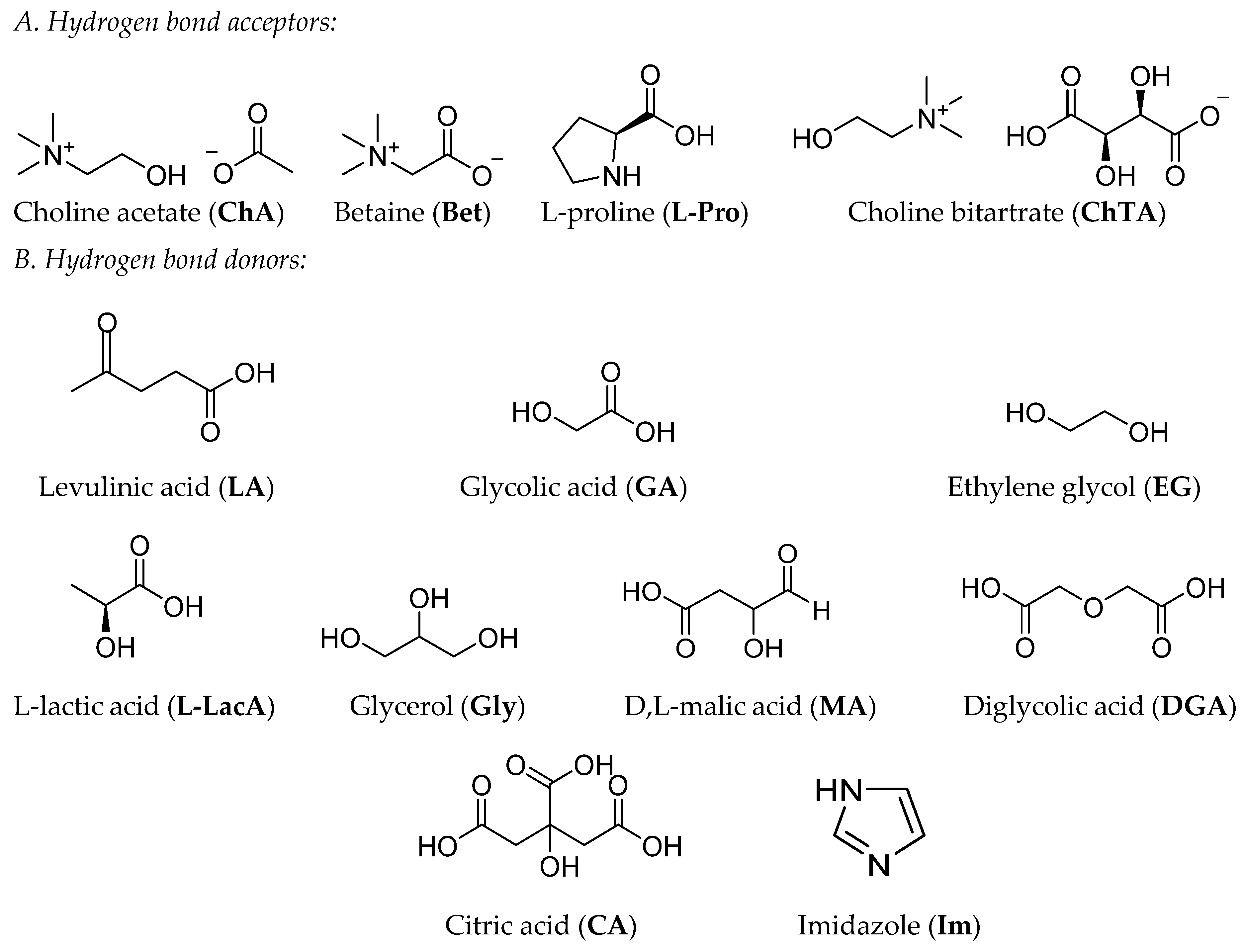
Figure 1. Chemical structures of hydrogen bond acceptors (A) and hydrogen bond donors (B) and their abbreviations used used in this work.
Preprints 189977 g001
Figure 2. Biodegradability profiles of Closed Bottle Test (CBT OECD 301D, 28 days) for studied NADES: . a) Bet:EG; b) Bet:CA; c) Bet:Gly; d) Bet:LA; e) Bet:L-LacA; f) L-Pro:Gly; g) L-Pro:L-LacA; h) L-Pro:LA; i) ChTA:CA; j) L-Pro:MA; k) CA:Im; l) ChA:LA; m) ChA:GA; n) ChA:DGA; o) ChA:CA.
Preprints 189977 g002
Figure 3. Concentration-response graphs of R. subcapitata exposed to NADESs and to their single components at the relative concentration as in the whole compound at the same concentration. Red dotted line is the mean algal concentration measured in controls. a) Bet:EG; b) Bet:CA; c) Bet:Gly; d) Bet:LA; e) Bet:L-LacA; f) L-Pro:Gly; g) L-Pro:L-LacA; h) L-Pro:LA; i) ChTA:CA; j) L-Pro:MA; k) CA:Im; l) ChA:LA; m) ChA:GA; n) ChA:DGA; o) ChA:CA. Results are expressed as mean algal concentration (cells mL-1) ± standard deviation (n=3) for each tested concentration of each tested substance. Statistical analyses of differences among whole compound, components and control are reported in Supporting Information (File S2).
Preprints 189977 g003
Disclaimer/Publisher’s Note: The statements, opinions and data contained in all publications are solely those of the individual author(s) and contributor(s) and not of MDPI and/or the editor(s). MDPI and/or the editor(s) disclaim responsibility for any injury to people or property resulting from any ideas, methods, instructions or products referred to in the content.
Copyright: This open access article is published under a Creative Commons CC BY 4.0 license, which permit the free download, distribution, and reuse, provided that the author and preprint are cited in any reuse.
Prerpints.org logo

Preprints.org is a free preprint server supported by MDPI in Basel, Switzerland.

Subscribe

Disclaimer

Terms of Use

Privacy Policy

Privacy Settings

© 2026 MDPI (Basel, Switzerland) unless otherwise stated