
Submitted:
16 December 2025
Posted:
17 December 2025
You are already at the latest version
Abstract
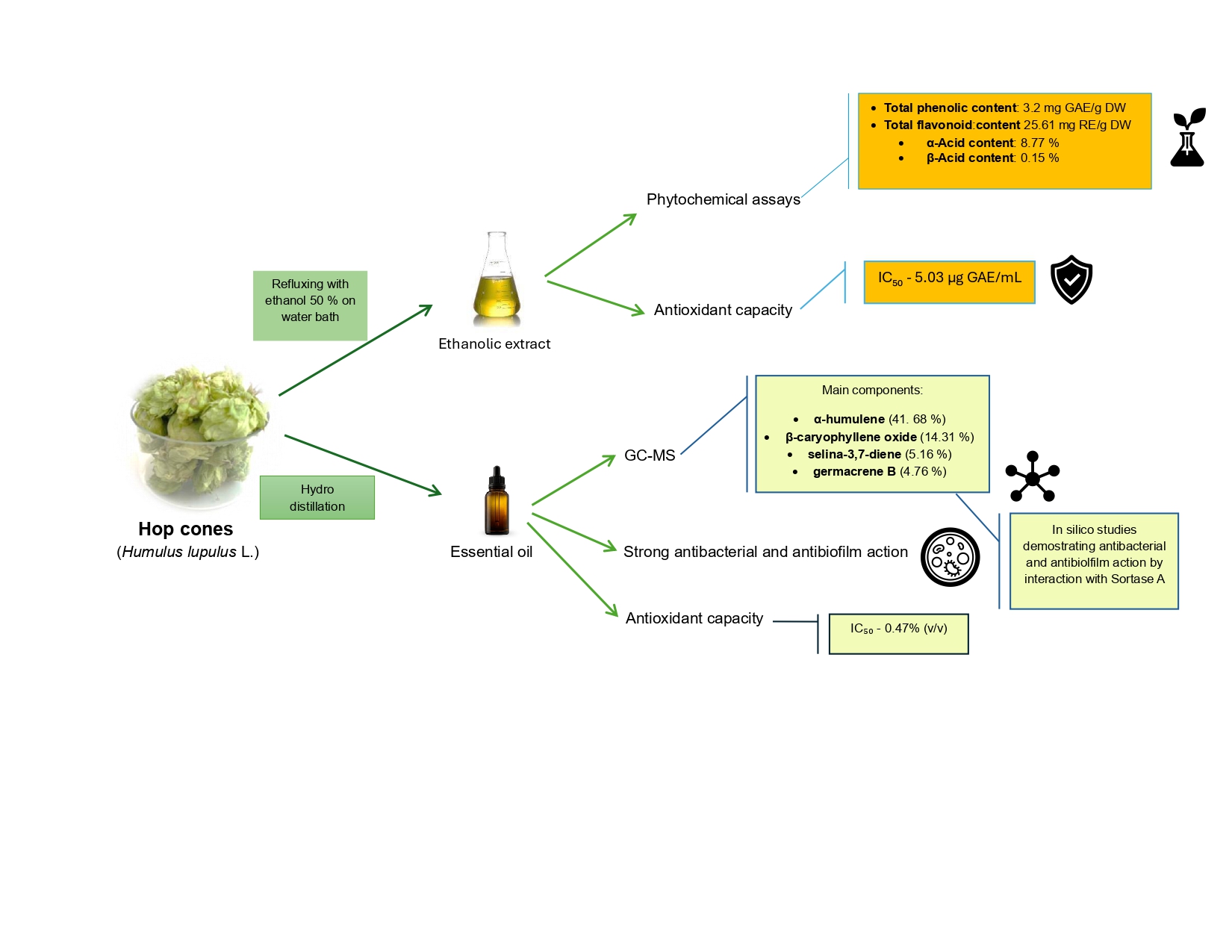
Hop (Humulus lupulus L.) is recognised as a valuable source of bioactive compounds; however, the phytochemical composition and biological potential of wild Romanian hops remain insufficiently characterized. In this study, the bioactive profile of wild hop cones was evaluated using an integrated phytochemical, biological, and in silico ap-proach. The hydroethanolic extract was characterized by a total phenolic content of 25.61 mg GAE/g DW and a total flavonoid content of 3.20 mg RE/g DW, with α-acids predominating (8.77%) and β-acids detected only at trace levels (0.15%). Hydrodistil-lation yielded 0.613 ± 0.11% essential oil, which was rich in sesquiterpene hydrocar-bons (64.61%), mainly α-humulene, β-caryophyllene oxide, selina-3,7-diene, and ger-macrene B. The hydroethanolic extract exhibited strong antioxidant activity (IC₅₀ = 5.03 µg GAE/mL), whereas the essential oil showed a moderate but dose-dependent radi-cal-scavenging capacity (IC₅₀ = 0.44% v/v). In addition, the essential oil displayed pronounced antibacterial and antibiofilm activity against Staphylococcus aureus, Escherichia coli, and Pseudomonas aeruginosa, with the highest antibiofilm inhibition observed for Pseudomonas aeruginosa (96.44%). Molecular docking analysis suggested that the major volatile constituents may interact with S. aureus Sortase A, providing a plausible mechanistic basis for the observed antibiofilm effects. Overall, these findings indicate that wild Romanian hop cones represent a promising source of antioxidant and anti-microbial bioactive compounds, supporting their potential applications in pharmaceu-tical, food, and cosmetic formulations, as well as in natural product–based drug discovery.
Keywords:
Humulus lupulus (hop)
; essential oil
; α-humulene
; β-caryophyllene oxide
; antioxidant
; antimicrobial
; biofilm
; molecular docking
; Sortase A
Copyright: This open access article is published under a Creative Commons CC BY 4.0 license, which permit the free download, distribution, and reuse, provided that the author and preprint are cited in any reuse.


