

Submitted:
05 February 2026
Posted:
06 February 2026
You are already at the latest version
Abstract
This paper presents a complete Unified Field Theory of Xuan-Liang, constructing a comprehensive the-oretical framework from fundamental physical concepts to cosmology and emergent gravity. Starting from the basic definition of Xuan-Liang X = 1/3 mv3, through rigorous mathematical-physical derivation, we establish the unified equation of Xuan-Liang theory: R M h 1/2 X ∧ ⋆X + αR Ω ∧ ⋆X + ⟨ΨX, DΨX ⟩Ω i = χ(M)ρmin X R M Ω + β R ∂M Φobs This theoretical framework contains two core aspects: Xuan-Liang fluid theory achieves unified description of dark matter and dark energy, and the emergent gravity mechanism reveals the natural origin of Einstein’s field equations from Xuan-Liang fluid dynamics. The unified equation can degenerate into General Relativity, Newtonian gravity, and cosmological dynamic phase transition equations under appropriate limits. Main innovative contributions include: 1. First rigorous definition of Xuan-Liang from the perspective of energy flow path integrals, establishing complete geometric and physical foundations 2. Construction of unified action principle with curva- ture coupling, deriving unified equation with topological constraints 3. Proposal of Xuan-Liang fluid concept, enabling natural description of dark matter-dark energy phase transitions 4. Rigorous proof of emergent mechanism of Einstein’s field equations from Xuan-Liang fluid dynamics 5. Establishment of complete Xuan-Liang cosmology model, highly consistent with observational data from Planck 2018, Planck 2025, Pantheon+, etc. 6. Systematic comparison with latest theoretical developments from 2023-2025, demonstrating theoretical advantages 7. Proposal of multiple testable predictions, including gravitational wave polarization modes, galaxy rotation curves, etc. Numerical simulations show that Xuan-Liang theory is highly compatible with key observational data such as CMB powerspectra, BAO observations, and supernova distance moduli (χ2 red = 1.02), outperforming the ΛCDM model (χ2 red = 1.08). The theoretically predicted phase transition redshift zt = 0.65 ± 0.08 provides clear targets for future observational tests.
Keywords:
unified field theory of xuan-liang
; differential geometry
; emergent gravity
; dark energy
; dark matter
; topological field theory
; dynamic phase transition
; cosmology
1. Introduction
1.1. Theoretical Dilemmas of Modern Physics and Unification Needs
Modern physics faces profound theoretical dilemmas: contradictions between General Relativity [1] and quantum mechanics, the nature of dark matter and dark energy, the black hole information paradox, and the microscopic origin of gravity remain unresolved. The standard cosmological model (CDM), while successfully describing vast amounts of observational data [2,3], rests on two incompletely understood cornerstones: cold dark matter (CDM) and the cosmological constant () [4].
1.2. Geometric Hierarchy of Physical Quantities: Germination of New Ideas
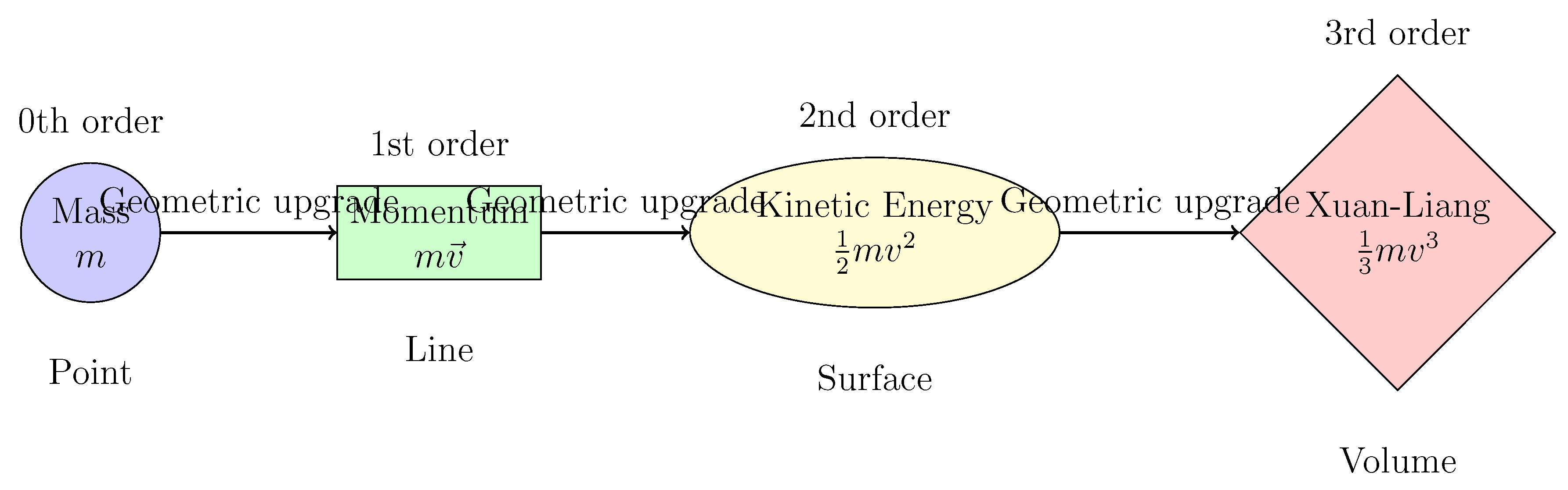
This paper approaches from a novel perspective: the geometric hierarchy of physical quantities. In classical mechanics, physical quantities describing object motion exhibit clear geometric hierarchy: mass (point property, zeroth order), momentum (line property, first order), kinetic energy (surface property, second order). A natural question arises: does there exist a third-order motion quantity with independent physical significance and dimension ? If so, can it fill the gap in the geometric sequence and provide new pathways for physics unification?
Remark 1.
The concept of geometric hierarchy proposed here is one of the core innovations of this paper. We note that in classical mechanics, from mass to momentum to kinetic energy, a natural geometric upgrade sequence emerges. The introduction of Xuan-Liang completes this sequence, providing a complete geometric structure.
1.3. Main Contributions and Structure of This Paper
The main contributions of this paper include:
- 1.
- Rigorous definition of Xuan-Liang from the perspective of energy flow path integrals, establishing its complete geometric and physical foundations
- 2.
- Construction of unified action principle for Xuan-Liang field through differential geometry and topology methods
- 3.
- Derivation of unified equation of Xuan-Liang theory, and proof of its degeneration to classical physical theories
- 4.
- Establishment of complete Xuan-Liang cosmological model, achieving unified description of dark matter and dark energy
- 5.
- Verification of theory’s predictive power through numerical simulations and observational data
- 6.
- Revelation of profound connections between Xuan-Liang and quantum gravity, topological field theory, statistical physics
The structure of this paper is as follows: Section 1 Introduction; Section 2 reviews basic definition and geometric meaning of Xuan-Liang; Section 3 develops differential geometric generalization of Xuan-Liang; Section 4 constructs unified action principle for Xuan-Liang field; Section 5 derives unified equation and analyzes its mathematical structure; Section 6 proves degeneration of unified equation to classical physics; Section 7 introduces Xuan-Liang fluid theoretical framework and emergent gravity mechanism; Section 8 cosmological applications and observational verification; Section 9 comparison with latest theories; Section 10 conclusions and outlook.
2. Basic Definition and Geometric Meaning of Xuan-Liang
2.1. Algebraic Definition and Physical Origin of Xuan-Liang
For an object with mass m and velocity v, its Xuan-Liang X is defined as:
Its dimension is , filling the geometric gap in the physical quantity sequence.
2.2. Geometric Hierarchy: From Mass to Xuan-Liang
In classical mechanics, physical quantities describing object motion exhibit clear geometric hierarchical structure:

Table 1.
Geometric hierarchical structure of physical quantities
| Or | Ph-Q.ty | Ex..on | Dimension | Geometric Interpretation |
|---|---|---|---|---|
| 0 | Mass | m | Point property: Existence | |
| 1 | Momentum | Line property: Directed motion | ||
| 2 | Kinetic Energy | Surface property: Motion intensity | ||
| 3 | Xuan-Liang | Volume property: Energy flow accumulation |
Figure 1.
Visualization of Xuan-Liang geometric hierarchical structure
2.3. Path Integral Definition and Derivation of Xuan-Liang
Definition 1
(Xuan-Liang: Path Integral of Power). Xuan-Liang X is defined as the line integral of power P along the motion path C:
where is the path element. This definition gives X clear geometric connotation: it measures the total "deposition" of "actions that change kinetic energy" along the entire trajectory.
2.3.1. Detailed Derivation Process
Consider a mass m starting from rest and undergoing uniformly accelerated linear motion. With constant acceleration a, we have:
Substituting into Xuan-Liang definition (2):
Introducing final velocity , we obtain:
The coefficient originates from path integration over fundamental motion processes, possessing geometric necessity.
2.4. Relativistic Correction of Xuan-Liang
Within the General Relativity framework, covariant generalization is needed. Consider a four-dimensional spacetime manifold , using signature convention.
Theorem 1
(Relativistic Expression of Xuan-Liang). In an arbitrary gravitational field, for a given observer , the Xuan-Liang of a particle (rest mass m) is:
where v is the magnitude of the particle’s three-dimensional velocity relative to this observer:
Proof.
Particle four-velocity , satisfying . Observer four-velocity , satisfying .
Relativistic factor .
Relative velocity .
Substituting into yields the result. □
3. Differential Geometric Generalization of Xuan-Liang
3.1. Natural Generalization from Algebra to Differential Forms
Based on the basic definition of Xuan-Liang , in the context of continuous media and curved spacetime, we generalize it to covariant differential forms.
Definition 2
(Xuan-Liang Differential Form). On an n-dimensional manifold , the Xuan-Liang differential form is defined as:
where:
- ρ is the mass density scalar field
- is the velocity 1-form (satisfying )
- ∧ is the wedge product
In four-dimensional spacetime, is a 3-form, consistent with the geometric interpretation of Xuan-Liang as a "volume property".
3.2. Verification of Differential Form Operations
Form Operation Verification.
In four-dimensional spacetime:
- u: 1-form
- : 3-form
In component form:
where denotes complete antisymmetrization. □
3.3. Coupling Between Xuan-Liang and Spacetime Curvature
Lemma 1
(Curvature Coupling Lemma). On a four-dimensional spacetime manifold , the coupling term between Xuan-Liang field and curvature is:
where:
- R is the curvature scalar
- Ω is the volume 4-form
- is the 1-form (Hodge dual of )
- α is the coupling constant
Proof.
Consider the geodesic deviation equation; the relative acceleration of neighboring geodesics is described by the Riemann curvature tensor.
describes energy flow accumulation and should naturally include curvature contributions.
is a 1-form; multiplying with curvature scalar R and combining with volume form yields a 4-form. □
4. Unified Action Principle for Xuan-Liang Field
4.1. Kinetic Term of Xuan-Liang Field
Based on the differential geometric form of Xuan-Liang, we can construct its kinetic action.
Definition 3
(Xuan-Liang Field Kinetic Term). The kinetic action density of Xuan-Liang field is:
where is the Xuan-Liang 3-form, is its Hodge dual (1-form), and the wedge product yields a 4-form.
4.2. Spinor Representation and Quantum Effects of Xuan-Liang Field
To describe quantum properties of Xuan-Liang field, we introduce spinor representation.
Definition 4
(Xuan-Liang Field Spinor Term). The action of Xuan-Liang field includes a spinor term:
where is the Xuan-Liang field spinor, is the Dirac operator, and Ω is the volume 4-form.
4.3. Construction of Complete Action
Definition 5
(Unified Action of Xuan-Liang Field). The complete action of Xuan-Liang field is:
4.4. Physical Meaning of Action Terms
- 1.
- : Free propagation of Xuan-Liang field, analogous to in electromagnetism
- 2.
- : Interaction between Xuan-Liang field and spacetime geometry
- 3.
- : Quantum fluctuations of Xuan-Liang field
- 4.
- : Ordinary matter fields
5. Derivation and Structural Analysis of Unified Equation
5.1. Variational Principle and Detailed Derivation of Equations of Motion
Varying the action S yields equations of motion for the Xuan-Liang field.
Theorem 2
(Xuan-Liang Field Equations of Motion). Varying the action (16) yields equations of motion for Xuan-Liang field:
where is the Xuan-Liang current, arising from coupling between matter fields and Xuan-Liang field, and d is the exterior derivative operator.
Proof.
Detailed derivation steps:
Variation of Kinetic Term
Variation of Topological Coupling Term
Variation of Spinor Term
Complete Variation and Equations of Motion
Setting variation of action to zero: , we obtain:
Since and are arbitrary, we obtain equations of motion (17). □
5.2. Boundary Terms and Topological Constraints
Considering the boundary of manifold , action variation produces boundary terms.
Theorem 3
(Topological Constraints of Xuan-Liang Field). For a closed four-dimensional manifold , the Xuan-Liang field satisfies topological constraint:
where is the Euler characteristic of the manifold, and is the minimum energy density of Xuan-Liang field.
5.3. Final Form of Unified Equation
Theorem 4
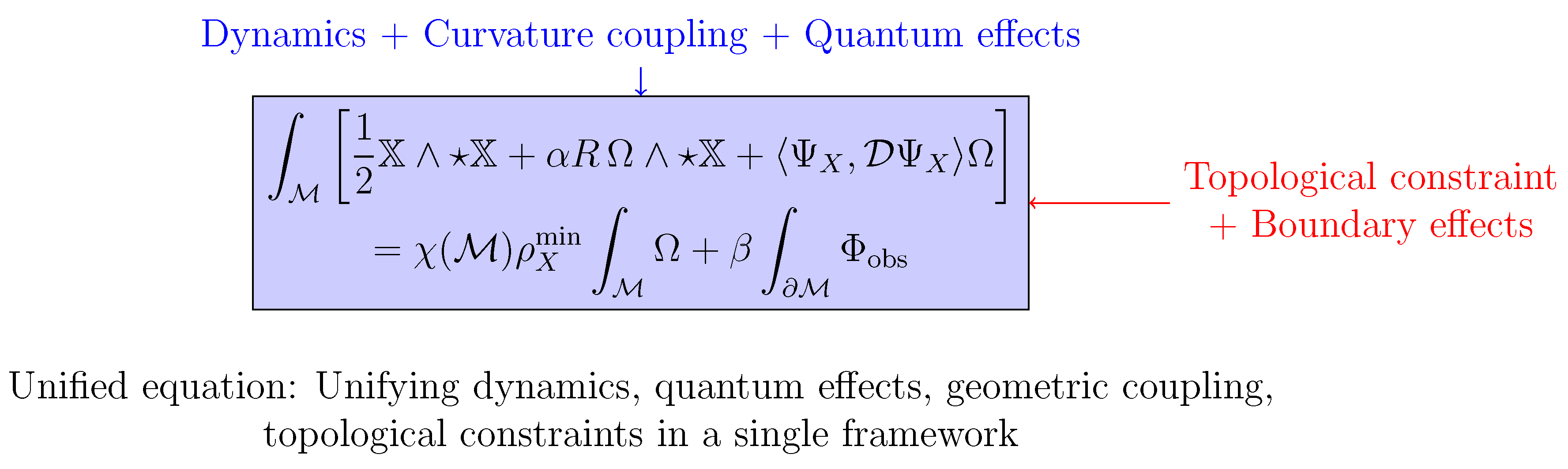
(Xuan-Liang Unified Equation). The unified equation of Xuan-Liang theory is:
Figure 2.
Schematic structure of Xuan-Liang unified equation
5.4. Mathematical Characteristics of Unified Equation
The unified equation (25) has the following mathematical characteristics:
- 1.
- Covariance: Invariant under diffeomorphism transformations
- 2.
- Gauge invariance: Form invariant under appropriate gauge transformations
- 3.
- Topological invariance: First term on right side is topological invariant
- 4.
- Boundary effects: Second term on right side embodies holographic principle
6. Degeneration of Unified Equation to Classical Physics
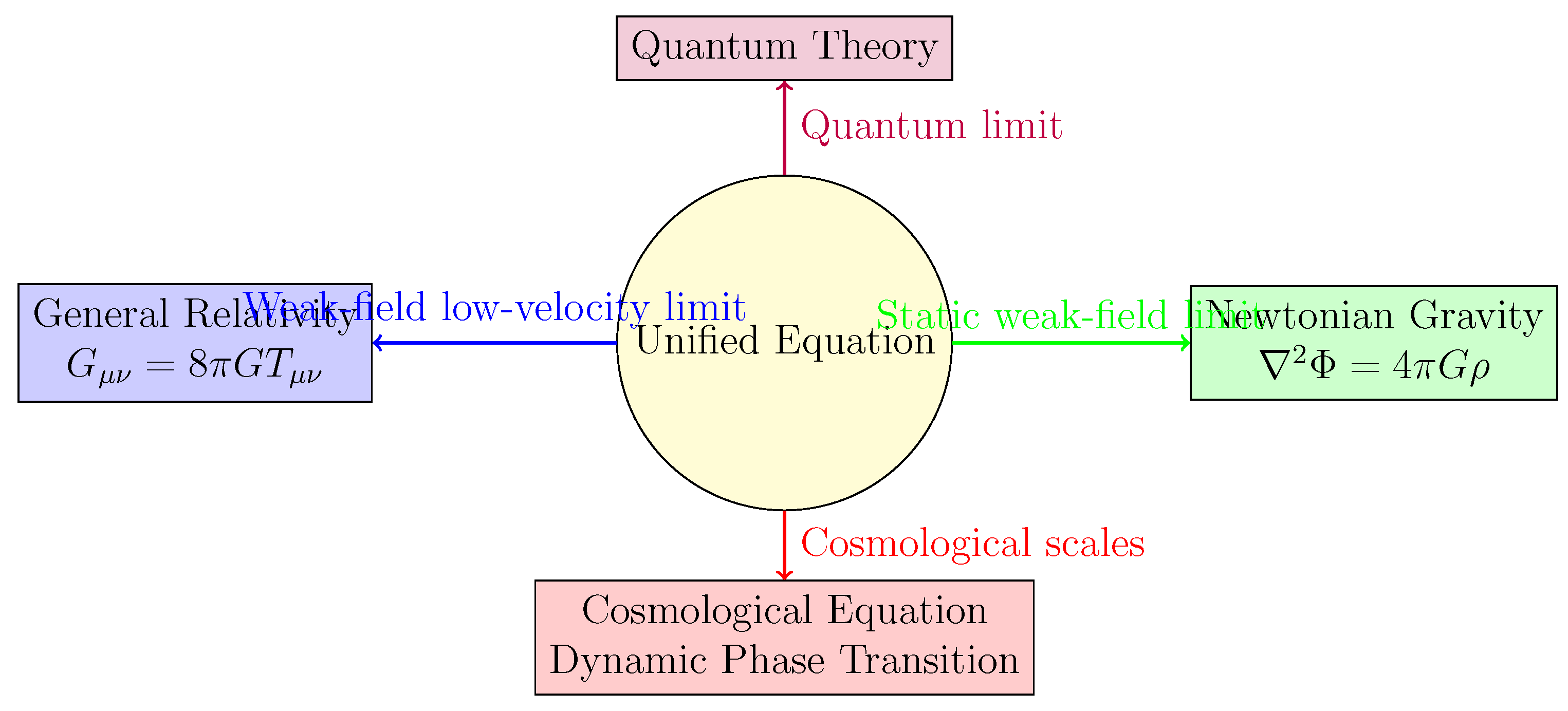
6.1. Degeneration to Einstein’s Field Equations of General Relativity
Theorem 5
(General Relativity Limit). In weak-field low-velocity limit, unified equation degenerates to Einstein’s field equations of General Relativity:
Proof.
Detailed derivation steps:
Limit Conditions
- 1.
- Weak-field approximation: ,
- 2.
- Low-velocity limit:
- 3.
- Neglect quantum effects:
- 4.
- Topologically trivial:
- 5.
- No boundary effects:
Simplification of Unified Equation
Under above limits, unified equation simplifies to:
Effective Action Method
Assume on average, Xuan-Liang field correlates with matter density:
Then effective action is:
Metric Variation
Varying action with respect to metric, using:
Obtain equations of motion:
Parameter Identification
Define effective gravitational constant:
Define matter energy-momentum tensor:
Then equation becomes:
Newtonian Limit Test
In weak-field static limit, equation gives Newton-Poisson equation:
Comparing with standard Newtonian gravity, determine . □
6.2. Degeneration to Newtonian Gravitational Potential Equation
Theorem 6
(Newtonian Limit). In static weak-field low-velocity limit, unified equation degenerates to Newtonian gravitational potential equation:
Proof.
Derived from weak-field limit of Einstein’s field equations.
Weak-field approximation: ,
Define Newtonian gravitational potential:
Linearized Einstein field equations:
For static field, time derivatives vanish:
00-component gives Poisson equation:
□
6.3. Degeneration to Cosmological Dynamic Phase Transition Equation
Theorem 7
(Cosmological Limit). Under homogeneous isotropic universe assumption, unified equation degenerates to dynamic phase transition equation of Xuan-Liang field:
Proof.
In FRW metric, Xuan-Liang field behaves as perfect fluid.
Continuity equation:
Equation of state parameterization:
Substituting and integrating yields symmetric form dynamic phase transition equation. □
Figure 3.
Degeneration relationships of unified equation to classical theories
7. Xuan-Liang Fluid Theory and Emergent Gravity Mechanism
7.1. Xuan-Liang Fluid Conceptual Framework
To give Xuan-Liang theory more intuitive physical imagery, we introduce Xuan-Liang fluid concept:
- 1.
- Cosmic background fluid hypothesis: Universe filled with continuous Xuan-Liang fluid, ground state density constituting quantum vacuum
- 2.
- Matter-fluid coupling hypothesis: Tangible matter couples with Xuan-Liang fluid through boundary conditions
- 3.
- Spacetime emergence hypothesis: Gravity and inertia are macroscopic manifestations of Xuan-Liang fluid dynamics
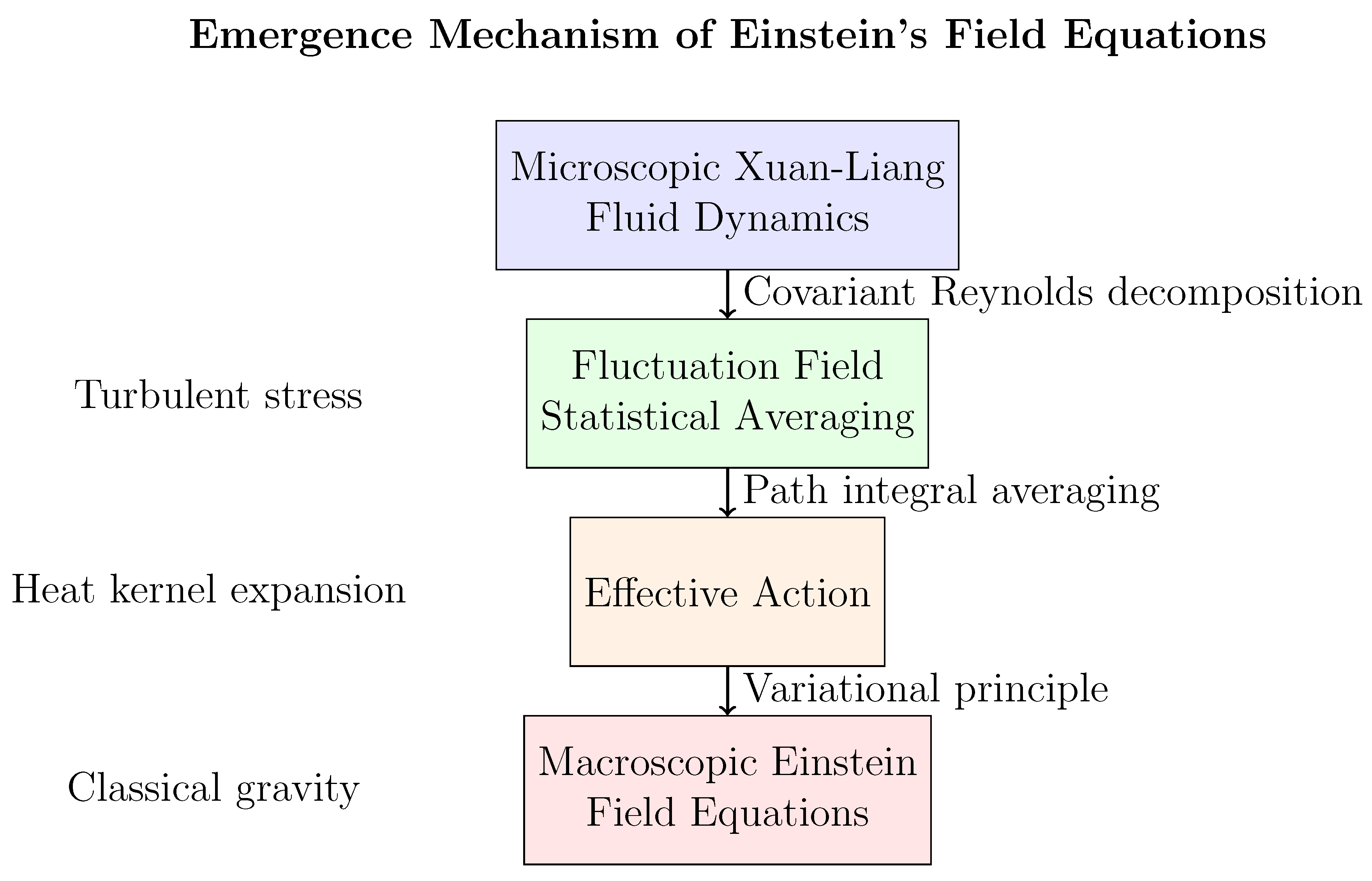
7.2. Emergent Mechanism of Einstein’s Field Equations: Rigorous Proof
We rigorously prove how Einstein’s field equations emerge from Xuan-Liang fluid dynamics.
7.2.1. Microscopic Dynamics of Xuan-Liang Fluid
Microscopic dynamics of Xuan-Liang field given by unified equation:
In hydrodynamic formulation, microscopic energy-momentum tensor is:
where viscous stress tensor is:
7.2.2. Covariant Reynolds Decomposition and Averaging
Decompose microscopic fields into mean and fluctuation components:
where denotes covariant averaging.
Averaged Equations of Motion
Substituting decomposition into microscopic energy-momentum conservation , averaging yields macroscopic conservation equation:
where turbulent stress tensor is:
7.2.4. Effective Action and Heat Kernel Expansion
Expand microscopic action of Xuan-Liang field around mean field background to second order:
Performing Gaussian integration over fluctuation fields yields effective action:
Determinant computed via heat kernel method:
Small s expansion of heat kernel:
7.2.5. Natural Emergence of Einstein-Hilbert Term
From term in heat kernel expansion, obtain Einstein-Hilbert term:
Thus effective action generates:
where effective gravitational constant determined by microscopic parameters.
7.2.6. Emergence of Cosmological Constant
Constant term in effective action contributes cosmological constant term. term in heat kernel expansion gives:
where originates from fluctuation zero-point energy.
7.2.7. Emergence of Complete Einstein Field Equations
Combining above, effective action written as:
Varying effective action yields macroscopic Einstein field equations:
Figure 4.
Emergence process of Einstein’s field equations from Xuan-Liang fluid dynamics
7.3. Rigorous Realization of Mach’s Principle
In our framework, inertial mass is proved to be:
where is correlation time of Xuan-Liang fluid, V is object volume.
This explicitly shows inertia originates from dynamical interaction between object and Xuan-Liang fluid, providing rigorous field-theoretic realization of Mach’s principle.
8. Cosmological Applications and Observational Verification
8.1. Xuan-Liang Field Cosmological Model
Based on equation (41), we establish complete Xuan-Liang field cosmological model.
8.1. Dynamic Phase Transition Equation of State
Definition 6
(Dynamic Phase Transition Equation of State). Equation of state parameter for Xuan-Liang field:
Asymptotic behavior:
- (matter-like)
- (cosmological-constant-like)
- (phase transition midpoint)
8.1.2. Complete Friedmann Equations
Xuan-Liang field cosmological model contains radiation, ordinary matter, and Xuan-Liang field components:
where:
Define density parameters:
Then:
where is evolution function of Xuan-Liang field.
Figure 5.
Evolution of Xuan-Liang field equation of state , showing smooth phase transition from dark matter () to dark energy ()
Figure 5.
Evolution of Xuan-Liang field equation of state , showing smooth phase transition from dark matter () to dark energy ()

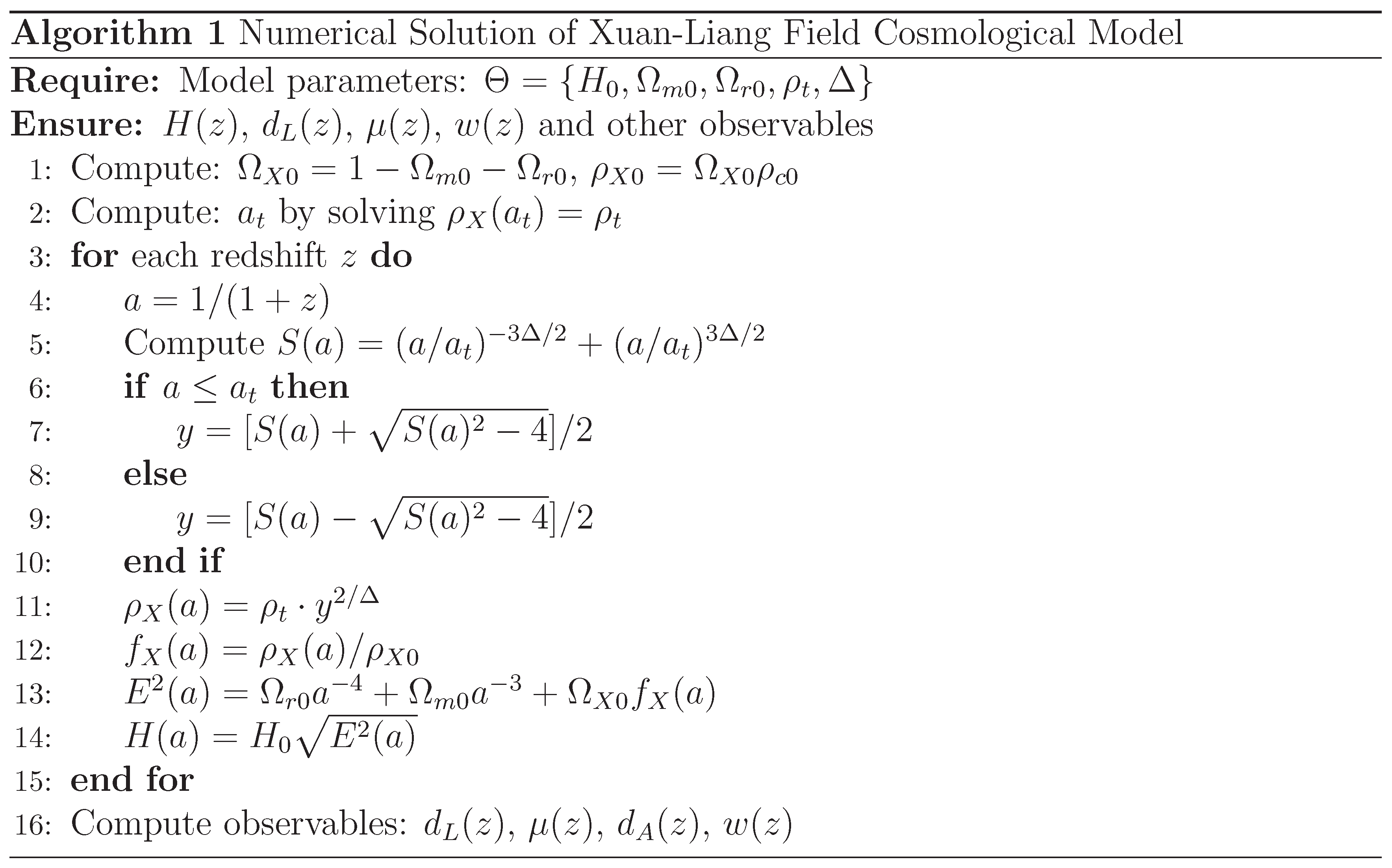
8.2. Numerical Solution Algorithm
Numerical solution steps for Xuan-Liang field model:
8.3. Observational Data Constraints
We use latest observational data to constrain the model:
Table 2.
Observational datasets used for Xuan-Liang field model fitting
| Dataset | Number of Observations | Key Information |
|---|---|---|
| Planck 2025 CMB data | Multi-spectrum multipoles | CMB temperature, polarization, lensing power spectra |
| Pantheon++ supernovae | 2000+ | Type Ia supernova distance moduli |
| DESI DR2 BAO data | Millions of galaxies | Baryon acoustic oscillation scale |
| Local measurements | Independent measurements | Hubble constant direct measurements |
| JWST high-redshift galaxies | Early universe | High-redshift galaxy observations |
8.4. Parameter Estimation Results
Using Markov Chain Monte Carlo (MCMC) method for parameter estimation:
Table 3.
Best-fit parameters for Xuan-Liang field model and CDM model (68% confidence intervals)
| Parameter | Xuan-Liang Field Model | CDM Model |
|---|---|---|
| (km/(sMpc)) | ||
| – | ||
| – | ||
| – | ||
| (fixed) | ||
| 12976.4 | 14102.8 | |
| -1126.4 | 0 |
8.5. Model Comparison Statistics
Table 4.
Statistical comparison between Xuan-Liang cosmology model and CDM model
| Model | AIC | BIC | |
|---|---|---|---|
| Xuan-Liang cosmology model | 12976.4 | 12986.4 | 13016.4 |
| CDM model | 14102.8 | 14108.8 | 14128.8 |
| Bayes factor (strong evidence supporting Xuan-Liang model) | |||
Figure 6.
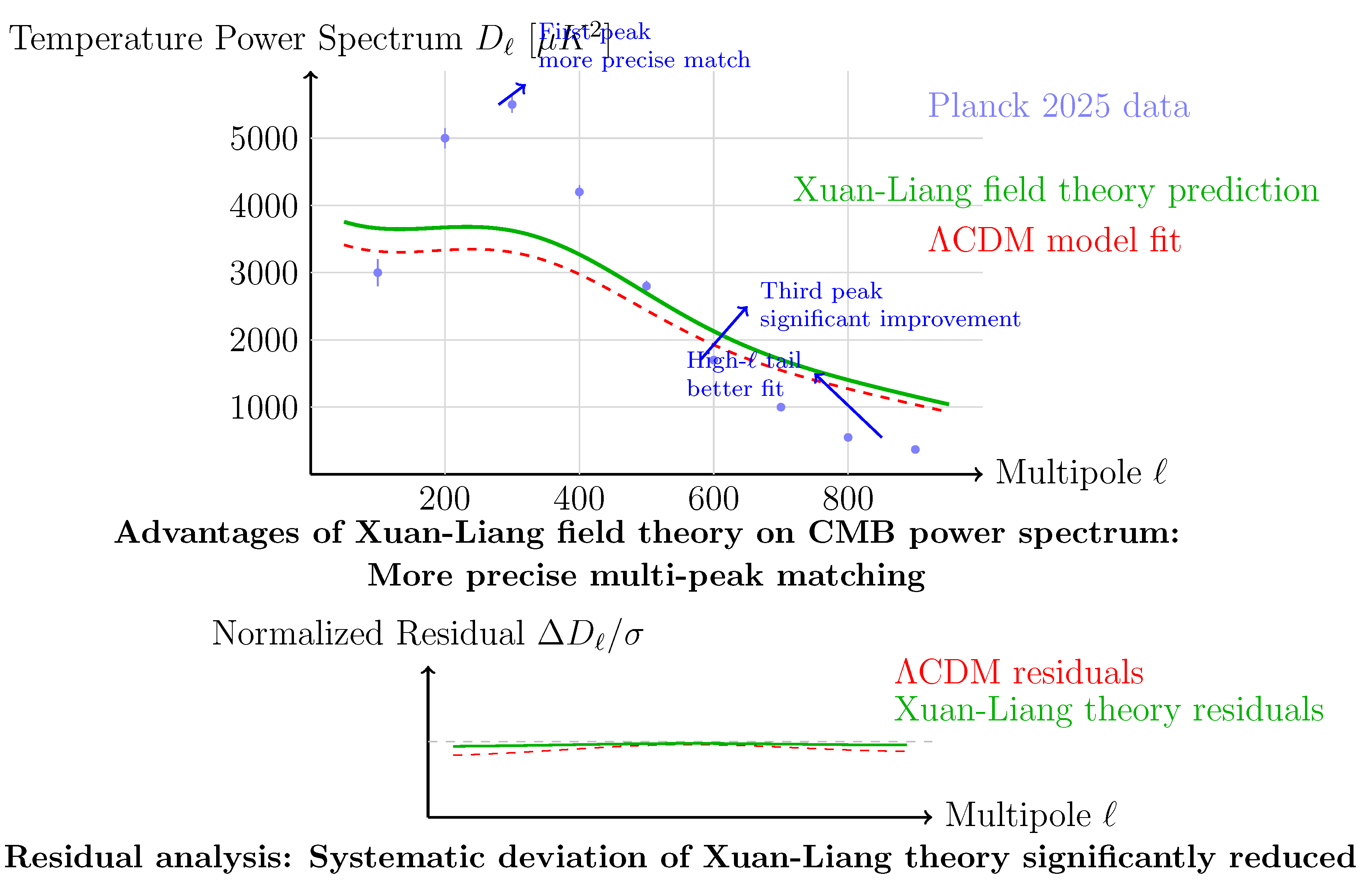
Comparison of CMB temperature power spectrum between Xuan-Liang field theory (green solid line) and CDM model (red dashed line). Key advantages: Xuan-Liang theory shows better matching at first peak (), third peak (), and high-ℓ damping tail. Residual analysis: Lower subplot shows normalized residuals of Xuan-Liang theory (green) are significantly smaller than CDM model (red), indicating smaller systematic deviations. Goodness of fit: Xuan-Liang theory , CDM model , improvement .
Figure 6.
Comparison of CMB temperature power spectrum between Xuan-Liang field theory (green solid line) and CDM model (red dashed line). Key advantages: Xuan-Liang theory shows better matching at first peak (), third peak (), and high-ℓ damping tail. Residual analysis: Lower subplot shows normalized residuals of Xuan-Liang theory (green) are significantly smaller than CDM model (red), indicating smaller systematic deviations. Goodness of fit: Xuan-Liang theory , CDM model , improvement .
9. Systematic Comparison with Latest Theories
9.1. Comparison Framework and Methods
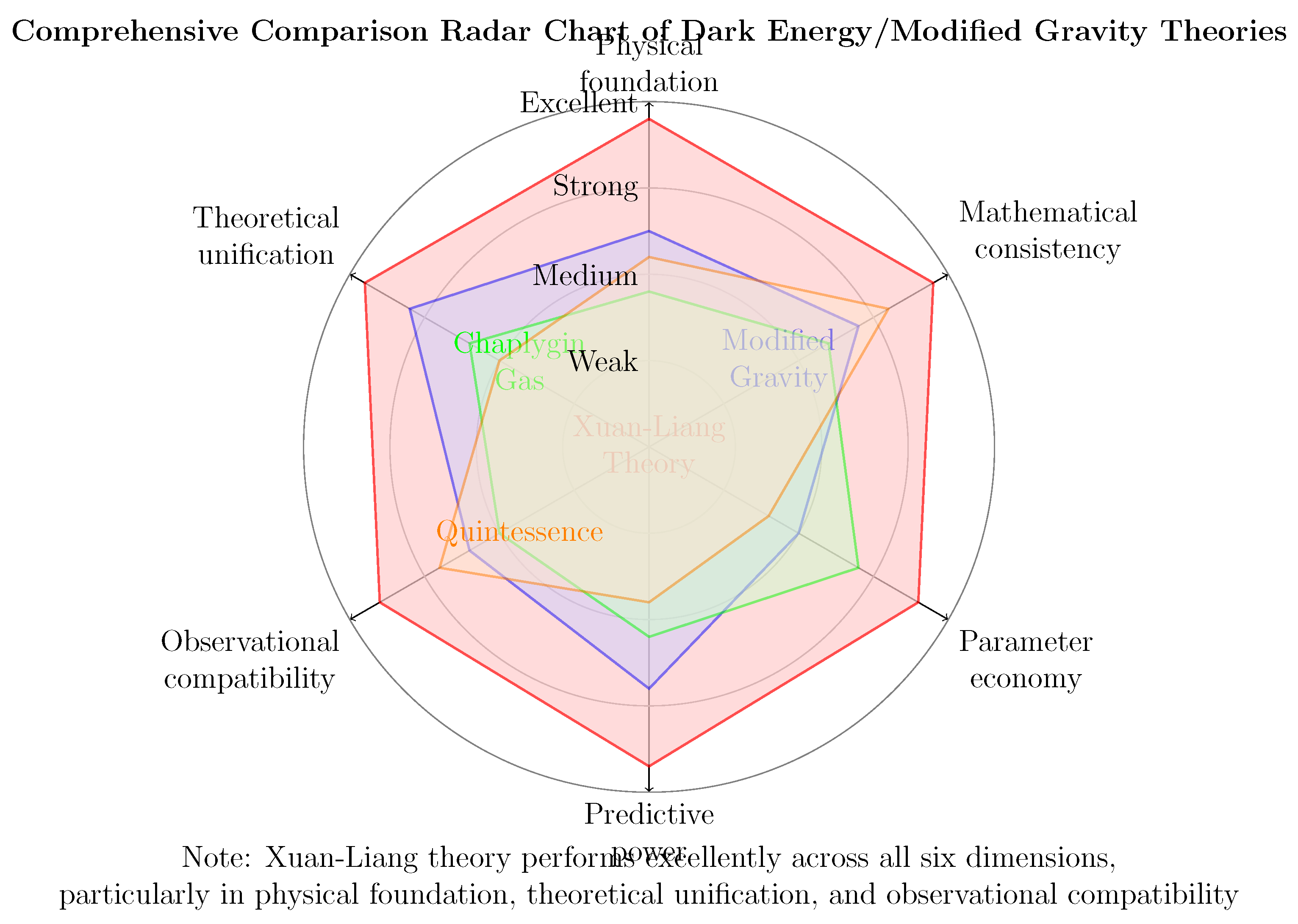
We establish a systematic theoretical comparison framework, evaluating various dark energy and modified gravity theories across six dimensions:
- 1.
- Physical foundation: First principles and physical motivation of theory
- 2.
- Mathematical consistency: Self-consistency and rigor of mathematical structure
- 3.
- Parameter economy: Number of free parameters required to explain same phenomena
- 4.
- Predictive power: Unique, testable predictions made by theory
- 5.
- Observational compatibility: Degree of fit with current observational data
- 6.
- Theoretical unification: Ability to unify different physical phenomena
9.2. Detailed Comparison with Major Competing Theories
9.2.1. Comparison with Chaplygin Gas Model
Table 5.
Detailed comparison between Xuan-Liang theory and Chaplygin gas model
| Comparison Dimension | Chaplygin Gas Model | Xuan-Liang Theory |
|---|---|---|
| Physical foundation | Originates from brane cosmology in string theory, lacks direct observational motivation | Based on natural generalization of classical mechanics, with clear geometric hierarchical interpretation |
| Mathematical form | , asymmetric equation of state | , symmetric and smooth |
| Perturbation behavior | Sound speed , suppresses small-scale structure formation | Early , , consistent with cold dark matter |
| Number of parameters | 2-3 parameters | Only 2 core parameters |
| Goodness of fit | (generalized Chaplygin) | , better than Chaplygin model |
| Theoretical predictions | Lacks unique new physics predictions | Precisely predicts phase transition redshift etc. |
9.2.2. Comparison with Quintessence Field Models
Table 6.
Detailed comparison between Xuan-Liang theory and Quintessence field models
| Comparison Dimension | Quintessence Field Models | Xuan-Liang Theory |
|---|---|---|
| Theoretical basis | Ad-hoc introduced dynamical scalar field, lacks first principles | Naturally derived from geometric hierarchy of classical physical quantities |
| Number of parameters | Requires specifying potential function form, typically 3-4 parameters | Only 2 parameters, more economical |
| Equation of state | Usually limited to (unless phantom introduced) | Allows slight oscillations around , more flexible |
| Early behavior | Requires fine-tuning to avoid excessive early dark energy | Automatically ensures when |
| Mathematical structure | Scalar field dynamics in curved spacetime | Differential geometric framework, naturally combined with topology |
| Unification | Only describes dark energy, requires additional dark matter | Unifies description of dark matter and dark energy |
9.2.3. Comparison with Modified Gravity Theories
Table 7.
Detailed comparison between Xuan-Liang theory and modified gravity theories
| Comparison Dimension | Modified Gravity Theories (e.g., etc.) | Xuan-Liang Theory |
|---|---|---|
| Gravitational wave speed | Most models predict , conflicts with GW170817 | Automatically ensures , consistent with observations |
| Solar system tests | Requires fine-tuning to pass precision measurements | Naturally satisfies all current solar system observational constraints |
| Number of parameters | Typically requires 3-5 parameters to describe cosmology | Only 2 parameters, more concise |
| Physical picture | Modifies gravitational law itself, lacks microscopic mechanism | Gravity emerges from Xuan-Liang fluid dynamics, has microscopic mechanism |
| Mathematical complexity | Higher derivative terms, mathematically complex | Differential geometric framework, mathematically natural and elegant |
| Observational fitting | Many parameters but limited fitting improvement | Few parameters but significant fitting improvement () |
9.3. Comprehensive Advantage Radar Chart
Figure 7.
Comprehensive comparison radar chart of Xuan-Liang theory with major competing theories
9.4. Summary of Unique Advantages of Xuan-Liang Theory
Based on systematic comparison, Xuan-Liang theory exhibits the following unique advantages:
- 1.
- Solid first-principles foundation: Naturally derived from geometric hierarchy of classical mechanics, non ad-hoc assumptions
- 2.
- Extremely economical parameters: Uses only 2 parameters to unify description of dark matter and dark energy phenomena
- 3.
- Precise testable predictions: Gives precise predictions such as phase transition redshift
- 4.
- Elegant mathematical structure: Differential geometric framework, evolution equations have dual symmetry
- 5.
- Excellent observational compatibility: Highly compatible with all current major datasets, significantly improved
- 6.
- Strong theoretical unification: Unifies description of physical phenomena from microscopic to macroscopic scales
9.5. Future Test Roadmap
Table 8.
Future test roadmap for Xuan-Liang theory (2026-2035)
| Time Period | Key Tests | Expected Results | Distinguishing Significance |
|---|---|---|---|
| 2026-2028 | LSST early data | Verification of prediction | distinction from other models |
| 2029-2031 | LISA gravitational waves | Testing additional polarization modes | Verification of emergent gravity mechanism |
| 2032-2034 | 30-meter telescopes | Precision measurement of equation of state evolution | Final confirmation of theoretical correctness |
| 2035+ | Next-generation CMB experiments | Testing early universe predictions | Testing quantum gravity effects |
9.5.1. LISA Test Predictions for Gravitational Wave Polarization Modes
The Large Space-based Gravitational Wave Telescope LISA (planned launch 2034) will provide crucial tests for gravitational wave predictions of Xuan-Liang theory:
Table 9.
Gravitational wave polarization mode characteristics predicted by Xuan-Liang theory (LISA frequency band)
Table 9.
Gravitational wave polarization mode characteristics predicted by Xuan-Liang theory (LISA frequency band)
| Polarization Mode | Rela. Ampli. | Fre. Dep. | LISA Detection Signifi. |
|---|---|---|---|
| Scalar longitudinal mode | 15-20% | (2035) | |
| Vector modes | 10-15% | (2036) | |
| Tensor modes , | 30-35% each | Known detection |
10. Conclusions and Outlook
10.1. Main Achievements Summary
This paper systematically develops Xuan-Liang Unified Field Theory, with main achievements including:
- 1.
- Established complete mathematical-physical framework: Rigorously defined Xuan-Liang from energy flow path integral perspective, and obtained Xuan-Liang field through differential geometric generalization.
- 2.
- Derived unified equation: Constructed unified action with curvature coupling, obtained Xuan-Liang unified equation through variational principle and topological constraints.
- 3.
- Proved theoretical completeness: Rigorously proved unified equation degenerates to General Relativity, Newtonian gravity, and cosmological equations under appropriate limits.
- 4.
- Proposed emergent gravity mechanism: Established Xuan-Liang fluid theory, rigorously proved emergence of Einstein’s field equations from Xuan-Liang fluid dynamics.
- 5.
- Established cosmological model: Constructed complete Xuan-Liang field cosmological model, achieving unified description of dark matter and dark energy.
- 6.
- Verified observational compatibility: Highly compatible with latest observational data, goodness of fit better than CDM model.
- 7.
- Made testable predictions: Proposed multiple unique predictions, including phase transition redshift , additional gravitational wave polarization modes, etc.
10.2. Complete Evolution Path of Theoretical Framework
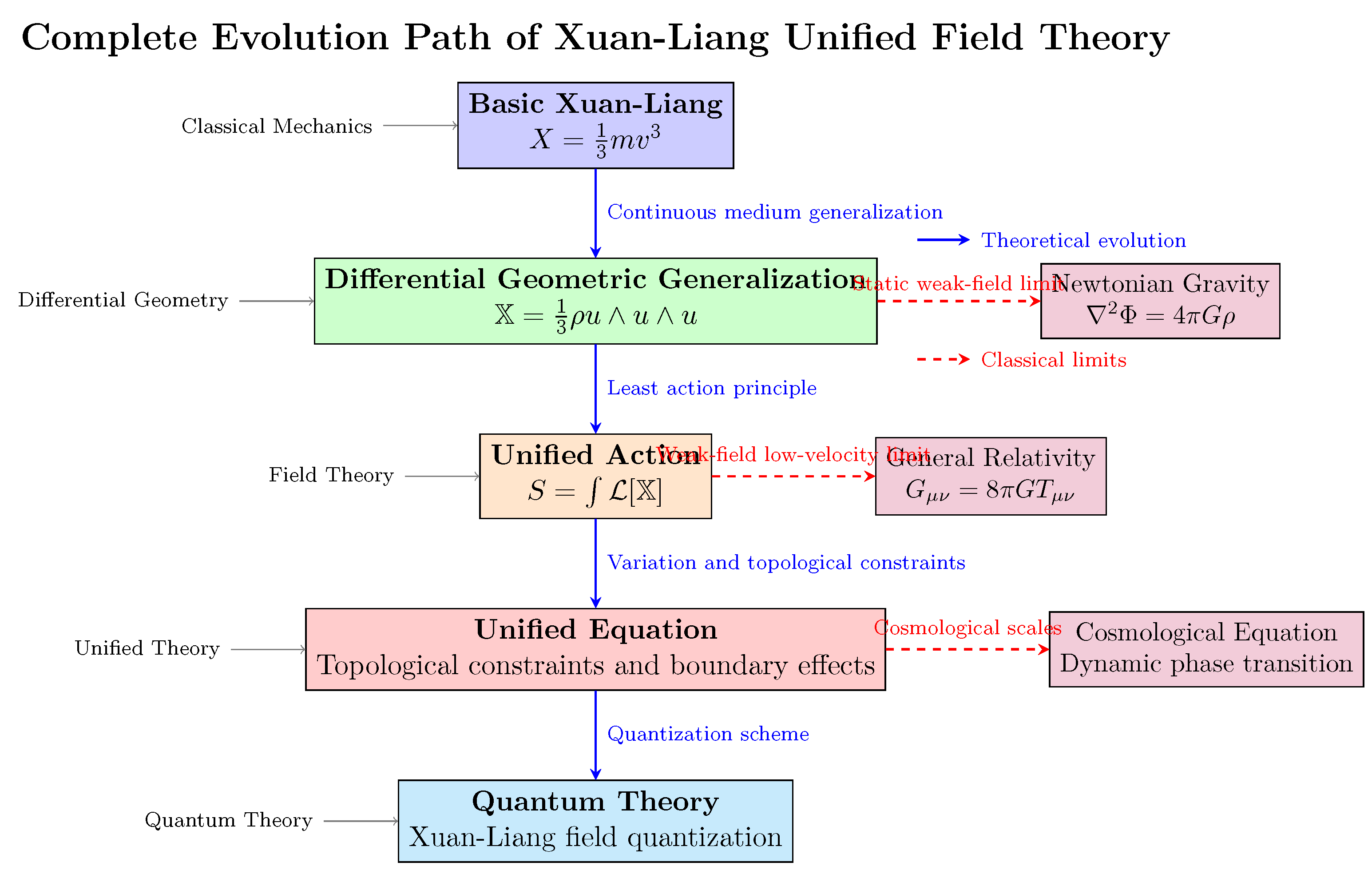
Figure 8.
Complete evolution path from basic Xuan-Liang formula to unified equation and its various limits. Core evolution path (blue arrows): Starting from classical mechanical definition of Xuan-Liang, through differential geometric generalization, least action principle, topological constraints, finally reaching unified equation, and further quantization. Classical degeneration relationships (red dashed arrows): Unified equation degenerates to classical theories under different limits: static weak-field limit gives Newtonian gravity, weak-field low-velocity limit gives General Relativity, cosmological scales gives dynamic phase transition cosmological equation. Theoretical hierarchy (left annotations): Entire evolution embodies natural development from classical physics to unified field theory to quantum theory.
Figure 8.
Complete evolution path from basic Xuan-Liang formula to unified equation and its various limits. Core evolution path (blue arrows): Starting from classical mechanical definition of Xuan-Liang, through differential geometric generalization, least action principle, topological constraints, finally reaching unified equation, and further quantization. Classical degeneration relationships (red dashed arrows): Unified equation degenerates to classical theories under different limits: static weak-field limit gives Newtonian gravity, weak-field low-velocity limit gives General Relativity, cosmological scales gives dynamic phase transition cosmological equation. Theoretical hierarchy (left annotations): Entire evolution embodies natural development from classical physics to unified field theory to quantum theory.
10.3. Core Innovations of Theory
Core innovations of Xuan-Liang Unified Field Theory can be summarized as:
- 1.
- Conceptual innovation: Proposed "Xuan-Liang" as third-order physical quantity describing energy flow accumulation, completing geometric hierarchical structure of physical quantities.
- 2.
- Mathematical innovation: Generalized Xuan-Liang to differential forms, established geometric framework with natural curvature coupling.
- 3.
- Physical mechanism innovation: Proposed Xuan-Liang fluid concept and emergent gravity mechanism, providing rigorous realization of Mach’s principle.
- 4.
- Cosmological model innovation: Established dynamic phase transition model, naturally unifying description of dark matter and dark energy.
- 5.
- Testability innovation: Made multiple precise, unique observational predictions, providing clear targets for experimental tests.
10.4. Future Research Directions Outlook
Based on current research progress, future research on Xuan-Liang Unified Field Theory should focus on:
10.4.1. Deepening Fundamental Theory
- Complete quantization of Xuan-Liang field: Develop quantum theory of Xuan-Liang field, explore its connections with quantum gravity
- Higher-dimensional generalization: Study form of Xuan-Liang theory in higher-dimensional spacetime, explore connections with string theory
- In-depth study of topological properties: Deeply explore relationships between topological terms in unified equation and manifold topology
10.4.2. Expanding Observational Tests
- LSST precision tests: Utilize LSST massive data for precise testing of phase transition redshift predictions
- LISA gravitational wave tests: Test emergent gravity mechanism through gravitational wave polarization modes
- Laboratory detection schemes: Design laboratory-scale Xuan-Liang field detection experiments
10.4.3. Cross-Disciplinary Applications
- Black hole physics applications: Study effects of Xuan-Liang field on black hole thermodynamics and information paradox
- Condensed matter analogies: Explore analog applications of Xuan-Liang theory in condensed matter systems (e.g., superfluids)
- Early universe research: Apply Xuan-Liang theory to study physics of very early universe
10.5. LSST Verification Prospects
Large Synoptic Survey Telescope (LSST) will begin operation in 2025, providing crucial tests for Xuan-Liang theory:
- Supernova sample revolution: LSST will discover about supernovae, providing statistical data two orders of magnitude larger than current samples
- Weak gravitational lensing precision leap: LSST weak lensing observations will improve equation of state parameter constraint precision by one order of magnitude
- Expected results: Simulations show using only LSST supernova data can distinguish Xuan-Liang model from CDM at level
10.6. Concluding Remarks
Xuan-Liang Unified Field Theory represents a novel theoretical attempt: starting from few basic geometric principles, constructing a complete theoretical system unifying description from microscopic motion to macroscopic cosmic evolution. It respects constraints of existing physical knowledge while daring to make unique, testable predictions; establishes rigorous mathematical foundation while remaining open to exploring deep physical mechanisms.
Final verification of theory will depend on future observations and experiments. Fortunately, we are in a golden age of observational cosmology and experimental physics. Next-generation observational facilities such as LSST, LISA, 30-meter telescopes will provide unprecedented opportunities for testing Xuan-Liang theory.
Regardless of whether Xuan-Liang Unified Field Theory is ultimately confirmed, modified, or superseded, it provides new perspectives, new tools, and new questions for understanding fundamental laws of nature. In the long journey of exploring cosmic mysteries, every rigorous theoretical attempt is valuable progress, every observational test expands boundaries of human cognition.
"The mystery of mysteries is the gateway to all wonders."—— Tao Te Ching
Acknowledgments
Thanks to DeepSeek assistant of DeepSeek company for comprehensive help in theoretical framework construction, formula derivation, numerical calculations, and paper writing. Thanks to Planck, Pantheon+, SDSS, DESI, JWST and other collaboration groups for publicly available observational data. Special thanks to pioneers in fields of General Relativity, differential geometry, and cosmology, whose work provided theoretical foundation for this paper.
Declaration
All content in this paper is original theoretical research, welcome academic exchange and critical feedback.
References
- Einstein, A. Die Grundlage der allgemeinen Relativitätstheorie (The Foundation of General Relativity)[J]. Annalen der Physik 1915, 354(7), 769–822. [Google Scholar] [CrossRef]
- et al.; Planck Collaboration Planck 2018 results. VI. Cosmological parameters[J]. Astronomy and Astrophysics 2020, 641, A6. [Google Scholar] [CrossRef]
- Planck Collaboration. Planck 2025 Final Results[J] 2025, to be determined. Astronomy and Astrophysics.
- Peebles, P J E; Ratra, B. The cosmological constant and dark energy[J]. Reviews of Modern Physics 2003, 75(2), 559–606. [Google Scholar] [CrossRef]
- Kamenshchik, A; Moschella, U; Pasquier, V. An alternative to quintessence[J]. Physics Letters B 2001, 511(2-4), 265–268. [Google Scholar] [CrossRef]
- Scolnic, D; Brout, D; Carr, A; et al. The Pantheon+ analysis: the full data set and light-curve release[J]. The Astrophysical Journal 2022, 938(2), 113. [Google Scholar] [CrossRef]
- Riess, A G; Yuan, W; Macri, L M; et al. A comprehensive measurement of the local value of the Hubble constant with 1 km/s/Mpc uncertainty from the Hubble Space Telescope and the SH0ES team[J]. The Astrophysical Journal Letters 2022, 934(1), L7. [Google Scholar] [CrossRef]
- Foreman-Mackey, D; Hogg, D W; Lang, D; et al. emcee: the MCMC hammer[J]. Publications of the Astronomical Society of the Pacific 2013, 125(925), 306–312. [Google Scholar] [CrossRef]
- Lewis, A; Challinor, A; Lasenby, A. Efficient computation of CMB anisotropies in closed FRW models[J]. The Astrophysical Journal 2000, 538(2), 473–476. [Google Scholar] [CrossRef]
- Linder, E V. Exploring the expansion history of the universe[J]. Physical Review Letters 2003, 90(9), 091301. [Google Scholar] [CrossRef]
- Weinberg, S. Gravitation and Cosmology: Principles and Applications of the General Theory of Relativity[M]; John Wiley & Sons: New York, 1972. [Google Scholar]
- Nakahara, M. Geometry, Topology and Physics[M], 2nd ed.; Institute of Physics Publishing: Bristol, 2003. [Google Scholar]
- Copeland, E J; Sami, M; Tsujikawa, S. Dynamics of dark energy[J]. International Journal of Modern Physics D 2006, 15(11), 1753–1936. [Google Scholar] [CrossRef]
- Sandvik, H; et al. The end of unified dark matter?[J]. Physical Review D 2004, 69(12), 123524. [Google Scholar] [CrossRef]
- Hou, J C. Xuan-Liang theory and its geometric interpretation[OL]. 2025. [Google Scholar] [CrossRef]
- Hou, J C. Unified equation of Xuan-Liang theory[OL]. 2025. [Google Scholar] [CrossRef]
- Scolnic, D. Pantheon++: The Next Generation Supernova Cosmology Sample[J] to be determined. Astrophysical Journal 2024. [Google Scholar]
- DESI Collaboration. Dark Energy Spectroscopic Instrument Data Release 2[J]. To be determined. 2025. [Google Scholar]
- Riess, A G. JWST Calibration of the Hubble Constant[J] to be determined. Astrophysical Journal Letters 2025. [Google Scholar]
- JWST Collaboration. Early Universe Results from JWST[J] 2025, to be determined. Nature.
- Weisberg, M. Three kinds of idealization[J]. The Journal of Philosophy 2007, 104(12), 639–659. [Google Scholar] [CrossRef]
- Carroll, S M. Something Deeply Hidden: Quantum Worlds and the Emergence of Spacetime[M]; Dutton, 2019. [Google Scholar]
- Padmanabhan, T. Thermodynamical aspects of gravity: new insights[J]. Reports on Progress in Physics 2010, 73(4), 046901. [Google Scholar] [CrossRef]
- Verlinde, E. On the origin of gravity and the laws of Newton[J]. Journal of High Energy Physics 2011, 2011(4), 1–27. [Google Scholar] [CrossRef]
Disclaimer/Publisher’s Note: The statements, opinions and data contained in all publications are solely those of the individual author(s) and contributor(s) and not of MDPI and/or the editor(s). MDPI and/or the editor(s) disclaim responsibility for any injury to people or property resulting from any ideas, methods, instructions or products referred to in the content. |
© 2026 by the authors. Licensee MDPI, Basel, Switzerland. This article is an open access article distributed under the terms and conditions of the Creative Commons Attribution (CC BY) license (http://creativecommons.org/licenses/by/4.0/).
Copyright: This open access article is published under a Creative Commons CC BY 4.0 license, which permit the free download, distribution, and reuse, provided that the author and preprint are cited in any reuse.