

Submitted:
11 December 2025
Posted:
12 December 2025
You are already at the latest version
Abstract
Microplastics (MPs) enter terrestrial ecosystems through various pathways, including the use of plastic mulching films, treated sewage sludge, chemical and organic fertilizers. Polypropylene (PP) and polyethylene (PE) are the dominant polymers found in both traditional and facility-based farmland soils. MPs negatively impact soil microbial communities and also harm soil invertebrates such as earthworms, nematodes, and springtails. In plants, MPs can induce oxidative stress, damage cells and inhibit growth. Polystyrene (PS) is often identified as the most hazardous polymer, frequently linked to reduced plant growth, which is the most commonly reported effect of soil MP contamination. This review provides novel insights beyond those reported in previous literature, revealing that greenhouse-based cultivation, vegetable crops, orchards, and vineyards are significant contributors to increased soil microplastic contamination. Furthermore, the findings underscore pronounced global heterogeneity in microplastic concentrations within paddy soils, with recorded levels varying widely from 16 to 10,300 items kg⁻¹. Oxidative stress and additive leaching are the dominant mechanisms driving soil microplastic toxicity across exposed organisms. Quantitative studies of fungal-mediated microplastic biodegradation report mean degradation efficiencies of ~7.5% after 50 days, with mass losses of ~23.8% after 30 days and 35–38% after 90 days.
Keywords:
microplastics
; mulching film
; degradation
; fibers
; additives
1. Introduction
Plastics are extensively used across a wide range of sectors worldwide, including food packaging, construction, the automobile industry, and agriculture. Global plastic production reached 413.8 million tons in 2020, driven by growing demand [1]. The degradation of large plastic items through natural processes, photodegradation, and mechanical abrasion results in the formation of microscopic plastic particles [2]. These particles, less than 5 mm in diameter, are known as microplastics (MPs). With lifespans of up to 450 years, MPs have emerged as a significant environmental pollutant [3].
Microplastics are highly hydrophobic and readily adsorb various pollutants such as antibiotics, pesticides, heavy metals, polychlorinated biphenyls (PCBs), and polycyclic aromatic hydrocarbons (PAHs) [4]. The adsorption behavior depends on the size and type of MPs, as well as the chemical characteristics of the pollutants. For instance, the adsorption of atrazine, a commonly used herbicide, on MPs is mainly driven by hydrophobic interactions and electrostatic attractions [5]. Once adsorbed onto MPs, these contaminants can be taken up by crop plants and ultimately enter the human food chain, raising concerns for human health [6].
Microplastics are categorized into two main types: primary MPs, such as microbeads found in personal care products, and secondary MPs, which originate from the breakdown of larger plastic debris [7]. In agricultural soils, the predominant morphotypes of MPs are films, fragments, and fibers [8]. Fragmentation is influenced by factors such as soil organic matter, pH, and average annual temperature. Terrestrial environments can contain up to 6.7% MPs by mass [9], with concentrations generally decreasing from surface to deeper soil layers.
After 32 years of plastic film mulching, MP concentrations in agricultural soils have been reported to range from 2.5 × 10⁶ to 7.4 × 10⁶ particles/m² [10]. Among different land-use types, vegetable farms tend to show the highest MP concentrations compared to orchards, croplands, and grasslands [11]. Sources of MP contamination in agricultural soils include the use of plastic mulching films, wastewater irrigation, atmospheric deposition, and the application of fertilizers, sewage sludge, and compost derived from waste materials [12]. In particular, processed sewage sludge has been identified as a major contributor to MP pollution in agricultural lands [13]. In China, polyethylene mulch films are the primary source of MPs in agricultural soils [14]. The estimated annual amount of MPs entering terrestrial ecosystems is 4 to 23 times higher than that entering the oceans [15].
Microplastics impact soil physicochemical properties, such as porosity and water retention, and influence soil microbial activity. These effects can impair plant growth and reduce crop productivity [16,17]. Interestingly, MPs may contribute to soil carbon storage by introducing carbon-based materials into the soil [18]. MPs with sizes and shapes similar to soil particles tend to have lesser impacts on soil structure and water infiltration [19]. However, MPs can enter plant tissues via apoplastic pathways and thereby reach humans through consumption [20]. They have been detected in edible crops such as carrots, broccoli, potatoes, and apples, with higher concentrations often found in fruits compared to vegetables [21]. MPs have also been found in human lungs, blood, and placentas, raising serious health concerns [22].
Microplastics cause cytotoxic damage to soil organisms such as earthworms [23]. In plants, MPs block root pores, reducing water and nutrient absorption, and induce oxidative stress, leading to reduced root activity and plant biomass [24,25]. Epidemiological studies have linked MPs to a range of adverse health effects, including neurotoxicity, oxidative stress, and respiratory and reproductive disorders [26].
The abundance and movement of MPs in soils are influenced by meteorological conditions. In orchard soils, MP levels are negatively correlated with wind speed and rainfall, but positively correlated with temperature. In vegetable soils, MP abundance increases with higher temperatures, more sunshine hours, and increased rainfall [27]. These factors also affect MP fragmentation and mobility. For example, heavy rainstorms contribute to the breakdown of plastic mulching films and the transport of MPs to aquatic ecosystems through surface runoff [28]. UV radiation plays an essential role in driving the degradation and fragmentation of microplastics (MPs) on soil surfaces. Annual sunshine duration is commonly used as a meteorological indicator to represent the length of time crops are exposed to UV radiation each year. When annual sunshine exceeded 1,500 hours, vegetable soils contained significantly higher MP abundances than food-crop soils. Additionally, orchard soils showed substantially greater MP concentrations than food-crop soils once annual sunshine hours surpassed 2,500 hours. This pattern may be associated with the shading provided by orchard canopies, which reduces UV intensity and therefore requires a longer exposure period to achieve comparable levels of MP degradation [27]. Additionally irrigation plays a significant role in facilitating the vertical migration of MPs, and soil properties further influence their distribution and mobility [29].
This review focuses on four key areas:
a) the origins of MPs in agricultural soils,
b) their occurrences and distribution,
c) the threats they pose to soil health, crops, and human health, and
d) current mitigation strategies and future perspectives.
Ultimately, this review aims to provide a comprehensive understanding of the fate and effects of microplastics in terrestrial environments with focus on agricultural soils.
2. Origins of Microplastics in Agricultural Soils
Plastic products are extensively used in the agricultural sector due to their versatility, durability, and low cost. Materials such as plastic mulching films, irrigation tubing, and greenhouse covers enhance crop productivity, but they also undergo fragmentation and degradation through chemical and physical processes. Microplastic (MP) pollution in agricultural soils has become a growing environmental concern, as MPs alter soil properties, affect crop growth, and pose risks to human health. These particles enter terrestrial ecosystems through multiple pathways, including plastic mulching films, treated sewage sludge, chemical and organic fertilizers, wastewater irrigation, atmospheric deposition, personal care products, and surface runoff [30].
2.1. Plastic Mulching Films
In 2016, global agricultural plastic film consumption was approximately 4 million tons and is projected to increase by 78.4% by 2030 [31]. Plastic mulches help regulate soil temperature, suppress weeds, and maintain soil moisture. However, exposure to ultraviolet (UV) radiation and weathering leads to their fragmentation. These films, primarily composed of polyethylene (PE), are considered the main source of MPs in agricultural soils [30].
As plastic mulches degrade, they release chemical additives such as UV stabilizers, plasticizers, and antioxidants, which pose additional environmental risks. The adsorption–desorption behavior governing the availability of plasticizers in soil is regulated by multiple factors, including interactions with heavy metals, which together influence their environmental persistence and associated ecological risks. Benzophenone (BP), commonly used as a UV stabilizer in plastics, also undergoes photodegradation, with its breakdown strongly affected by environmental variables such as the presence of metal ions (e.g., Fe²⁺, Fe³⁺, and Fe⁶⁺) [32]. Complete removal of plastic films after harvest is often unfeasible, especially when fragments become entangled with plant roots or buried at field edges [10]. Timely collection of mulching films before tilling for the next growing season can help mitigate MP pollution [33]. Nevertheless, recovery of MPs already formed in soils is not feasible. Studies estimate that 25–33% of plastic mulching residues remain in cultivated fields annually [34], with 33–56% of MPs in topsoil (0–100 cm) attributed to plastic mulch films [10].
Microplastic concentrations are closely linked to the duration of mulching film use. For example, fields with 5, 15, and 24 years of mulching recorded MP levels of 80.3 ± 49.3, 308 ± 138.1, and 1075.6 ± 346.8 particles/kg soil, respectively [31]. The surface of MPs becomes increasingly rough with continuous mulching over time [35]. While mulching films are the primary MP source, several other contributors significantly impact microplastic levels in agricultural soils.
2.2. Treated Sewage Sludge (Biosolids)
Wastewater treatment plants (WWTPs) are a major route through which MPs enter agricultural soils, primarily via the land application of treated sewage sludge, also known as biosolids. MPs enter WWTPs through domestic wastewater, industrial discharge, and stormwater. While WWTPs can remove 57%–99% of MPs, the retained particles accumulate in sludge. Biosolids, processed to reduce pathogens and moisture, are applied to farmlands for their nutrient content (e.g., nitrogen and phosphorus), despite containing pollutants like MPs [36].
For instance, in 2018, approximately 2.09 × 10² MPs per capita were introduced into U.S. soils through biosolid application. In England, it is estimated that 6,430 tons of MPs are released annually via this route [36]. In Australia, the MP load in biosolids ranges from 0.7 to 21 g per capita per year. Fibers and films are the predominant MP shapes found after sludge application, and the majority of MPs range from 20 µm to 200 µm in size [37]. The smaller the particle size, the greater the abundance in biosolids.
Common polymers include polyethylene (PE) and polypropylene (PP). Long-term biosolid use results in the vertical migration of MPs to soil depths of 20–40 cm. Tillage and ploughing further facilitate this movement [38]. As MPs often carry heavy metals and persistent organic pollutants, this practice poses significant risks to both human and ecosystem health [37].
2.3. Fertilizers
Controlled-release (CRFs) and slow-release fertilizers (SRFs) are gaining popularity for their efficiency in nutrient delivery. Polymer-coated CRFs (PC-CRFs) are particularly concerning, as their outer polymer layers degrade and contribute MPs to soil. These coatings range in thickness from 10 to 80 µm [39]. Fragmentation occurs due to surface wear, mechanical agitation from tillage, and raindrop impact [40]. Because removal of microcapsules is cost-prohibitive, they often remain in the soil. In Japan alone, 214,372 tons of microcapsules have been introduced into agricultural soils via fertilizers [41].
Organic fertilizers such as pig and chicken manure, as well as composted organic solid waste, are also important MP sources. Livestock feed and packaging materials contribute to MP contamination. Long-term use of organic fertilizers increases MP levels in soils [42]. Interestingly, cow dung fertilizer application has been associated with lower MP inputs [43]. MP abundance in organic fertilizers ranges from 10¹ to 10⁵ particles/kg, with most being smaller than 0.5 mm [44]. Neither aerobic nor anaerobic digestion processes are effective at degrading MPs in organic waste, allowing large quantities to enter soils.
2.4. Wastewater Irrigation
Due to freshwater scarcity and the nutrient content of wastewater, irrigation using treated effluents is common, covering about 8% of global agricultural land [45]. MPs enter WWTPs via personal care products (e.g., microbeads) and synthetic fibers from clothing. Although removal efficiencies range from 90% to 99%, significant quantities persist in biosolids and effluents [46].
Primary and secondary treatments can remove up to 91.1% of MPs, while tertiary treatment can exceed 98% efficiency [47]. In Spain, polyester and cellulosic microfibers have been found in recycled wastewater and soils irrigated with it [48]. MP concentrations in effluents have been reported as 276.3 ± 137.3 particles/L, with most under 0.5 mm [49]. MPs in wastewater can also facilitate the transport of heavy metals, compounding environmental risks.
Greenhouse plastic usage and runoff contribute additional MPs to surface water, which can then enter irrigation systems—where MP concentrations range from 1.88 to 141 items/L [50]. MP content increases with irrigation frequency and tends to migrate to deeper soil layers [51]. Overall, irrigation using wastewater is a substantial pathway of MP contamination, affecting soil health, crop safety, and human health.
2.5. Atmospheric Deposition
Atmospheric deposition is an increasingly recognized pathway of MPs into agricultural soils. Microplastics are released into the air from sources like textiles, tire wear, and soil disturbance [52]. Their light weight allows them to be transported over long distances. Fragments and fibers are the most common atmospheric MP forms. MPs are deposited via dry (e.g., sedimentation) and wet (e.g., rainfall, snow) processes [53].
Larger particles (>10 μm) tend to settle near their source, whereas smaller particles (0.1–1 μm) can travel long distances and be deposited by rainfall [54]. Urban areas generally have higher atmospheric MP concentrations than rural ones. For instance, annual atmospheric MP deposition has been reported at 15 particles/kg of dry soil, primarily polyamide fibers [55]. Deposition rates increase during wet periods and vary significantly by region [56].
Rainfall intensity positively correlates with MP deposition, while duration may have a negative effect. Snowfall is even more efficient at capturing MPs due to its larger surface area [57]. Deposition is highest during winter, as low temperatures inhibit atmospheric dispersion [58,59]. High humidity further promotes MP deposition [60]. Thus, atmospheric deposition is a significant contributor to MP contamination in agricultural soils.
2.6. Personal Care and Cosmetic Products
Cosmetics and personal care products (C&PCPs) are another pathway of MPs into soils. Items such as facial scrubs, toothpaste, soap, deodorant, and nail polish often contain microbeads made from PE or polystyrene (PS) [61,62,63]. These MPs either end up in landfills or pass through WWTPs, contributing to terrestrial pollution. The average MP content in C&PCPs has been reported as 17,692 ± 13,835 particles per mL or gram [61].
Figure 1 presents the main sources of MPs in soils.
As shown in Figure 1b, microplastics originating from plastic mulching films and treated sewage sludge in agricultural soils exhibit high environmental persistence and pose significant risks. In contrast, microplastics derived from cosmetics, personal care products, and atmospheric deposition contribute only minimally to environmental risk.
3. Occurrences of Microplastics in Agricultural Soils
Microplastics (MPs) have been detected in a variety of soil types, including agricultural, coastal, and industrial soils. Global studies have explored MP abundance, with China contributing a significant share of the research [6]. In the Qinghai-Tibetan Plateau, the world’s highest plateau, MP concentrations in both open-field farmland and greenhouse soils ranged from 16.67 to 950 items/kg [64]. In the Weishan Irrigation District, a major agricultural area in the Yellow River basin, average MP concentrations in crop fields, vegetable plots, woodlands, and orchard soils were 512, 900, 633, and 615 items/kg, respectively. Across these land use types, MP concentrations ranged from 260 to 2,420 items/kg, with a mean of 644 ± 397 items/kg [65].
In Hebei Province, China, long-term organic fertilizer application resulted in MP concentrations ranging from 90 to 910 items/kg (mean: 368.88 ± 207.97). Higher application rates correlated with increased MP abundance, and notably, MPs were found in deeper soil layers, contradicting the general trend of decreasing concentrations with depth [42]. In Shihezi City, China, after 23 years of continuous use of polyethylene and biodegradable mulching films in cotton fields, topsoil (0–20 cm) MP concentrations ranged between 6,767 and 8,507 particles/kg [66].
Crop type significantly influences MP occurrence. In Sri Lanka’s Gampaha District, MPs in coconut, vegetable, and paddy fields ranged from 53–153, 253–433, and 447–613 pieces/kg, respectively [67]. In suburban Shanghai, vegetable fields with 5–10 years of mulch application had MP concentrations between 62–78 particles/kg [68], supporting the observation that longer mulch use results in higher soil MP levels. Similarly, after 15 years of chicken manure compost application in Changziying Town, northern China, greenhouse soils contained between 191–248 items/kg (mean: 196 ± 29) [69]. In Thailand’s Nakhon Pathom province, six years of plastic mulching resulted in 620 items/kg in greenhouse soils [33].
In Japan’s Ishikawa Prefecture, paddy fields fertilized with coated fertilizers showed MP concentrations ranging from 2 to 123 items/kg (mean: 48 ± 26) [41]. In Iran, MPs in agricultural soils ranged from 67 to 400 items/kg [70], while in Spain, mulched farmland soils averaged 2,116 ± 1,024 items/kg [71]. In western Germany, MPs in vineyard soils ranged from 400 to 13,000 items/kg, with an average of 4,200 ± 2,800 items/kg. MPs were more concentrated in the upper 0–10 cm (5,109 ± 2,932 items/kg) than in the 10–30 cm layer (3,250 ± 2,406 items/kg), and organically managed vineyards had slightly lower levels than conventionally managed ones (3,800 vs. 4,500 items/kg, respectively) [72]. Figure 2 presents microplastic abundance in paddy soils across different regions of the world.
According to Figure 2, microplastic (MP) abundance varies significantly across different study areas worldwide, ranging from 16 to 10,300 items/kg. This variation may be attributed to factors such as irrigation water transport, inadequate plastic waste management, weather conditions, application of coated fertilizers and atmospheric deposition.
Land use type also plays a key role. In Shouguang City, China, average MP loads in greenhouses and polytunnels were 2,986.1 ± 1,663.8 and 2,506.9 ± 1,160.4 items/kg, respectively. In comparison, cotton, maize, and wheat fields showed 2,246.0 ± 526.1, 1,700.1 ± 244.2, and 1,343.8 ± 458.8 items/kg, respectively [81]. Mulched soils (e.g., greenhouses and cotton fields) generally had higher MP levels than non-mulched ones (e.g., maize and wheat fields). MPs also decreased with depth: 0–20 cm (1,948.1 ± 992.5 items/kg), 20–40 cm (1,349.4 ± 654), and 40–60 cm (670.1 ± 341.6). However, agricultural tillage can homogenize MP distribution across the top 40 cm [81].
Sewage sludge is another significant source. After ten years of sewage sludge application in Chile, MPs ranged from 0.6 to 10.4 items/g, indicating clear long-term contamination [82,83]. In eastern Spain, sludge-treated soils contained 3,060 ± 1,680 MPs/kg, compared to 1,100 ± 570 MPs/kg in untreated soils [84]. In Shandong Province, China, 16 years of annual sludge application at 36 t/ha resulted in an average of 6,811 MPs/kg in topsoil, five times the concentration in untreated soils [85]. Table 1 summarizes the primary sources and characteristics of soil MPs across various regions worldwide.
According to Table 1, mulching film appears to be the primary source of microplastic pollution in the soil worldwide. Facility agriculture (such as greenhouses and vegetable crops) and perennial crops (including orchard crops and vineyards) are associated with increased levels of soil microplastic pollution across different crop types.
3.1. Microplastic Particle Size
Particle size greatly influences MP behavior, mobility, and environmental impact. Smaller MPs tend to persist longer and migrate more easily. Xu et al. [65] found that over 78% of MPs in four land use types in Shandong Province were between 0.1–2 mm, with the dominant size being 0.2–1 mm. In Hebei Province, MPs from soils treated with pig, chicken, and sludge composts averaged 1.67 ± 0.88 mm, 1.10 ± 0.88 mm, and 1.25 ± 0.90 mm, respectively [42].
In Shihezi City, long-term mulch use resulted in MPs <0.25 mm [66]. MPs in Sri Lanka ranged from 5 μm to 5 mm, with many particles <50 μm in Thai greenhouse soils subjected to 1–6 years of mulching [33]. Similar results were reported along China’s Yangtze River, where 42% of riparian MPs were 10–50 μm [86]. Studies on sludge-treated soils revealed that 44.7%–59.1% of MPs were <1 mm [83], and over 80% of MPs in farmland from five Chinese provinces were under 1 mm [87]. In Shouguang City, most MPs in both greenhouse and open field soils were <0.5 mm [88].
3.2. Microplastic Shape
The shape of MPs influences their transport and environmental impact. Fibers and films are particularly mobile, spreading across soil surfaces and migrating via runoff into aquatic systems [89]. In Sri Lanka’s paddy and vegetable fields, fibers were the dominant shape (34–67%), followed by fragments (17–37%) and foams (9–25%) [67]. In Shihezi cotton fields, films comprised 41% of all MPs [66]. After 15 years of compost application in Chinese greenhouse soils, fibers made up 47.7%, fragments 31.4%, and films 15.8% of MPs [69].
Fiber-shaped MPs tend to migrate vertically more easily than other shapes. In sludge-treated soils, fibers were also the dominant type, averaging 1.21 ± 0.25 synthetic fibers/g, while films accounted for 58% of non-fiber MPs [82].
3.3. Microplastic Color
MP color reflects their source and usage. Six different MP colors black, blue, green, white, transparent, and red were identified in Qinghai-Tibetan Plateau soils, with black (34.3%), transparent (20.6%), and blue (20.5%) being dominant [64]. These patterns align with the use of black mulching films and blue agricultural twines.
In Shanghai, black and transparent MPs dominated vegetable field soils [68]. Bi et al. [90] reported transparent (55.5%) and black (15.1%) as the most prevalent colors in eastern China’s coastal plain soils. In the Weishan Irrigation District, transparent and blue MPs were most common due to agricultural film use and industrial wastewater [65]. After 12 years of organic fertilizer application in Hebei Province, 56.04% of MPs were transparent and 11.65% were blue, linked to livestock feed bags and storage tanks [91].
3.4. Microplastic Polymer Type
Different agricultural practices influence MP polymer composition. Polypropylene (PP) and polyethylene (PE) dominate in traditional and facility farmland soils, while polystyrene (PS) and polyethylene (PE) are more common in grasslands [92]. PE is the main polymer in mulch films, explaining its dominance in mulched soils. After 15 years of compost use in greenhouse soils, PE and PP were again most prevalent [69].
Twelve years of organic fertilizer application in Hebei Province resulted in MPs composed mainly of PE, PP, and polyester [42]. In the Weishan Irrigation District, PE accounted for up to 36% of all MPs, with PP also frequently detected [65]. Bai et al. [64] found that PET (36.9%), PE (20.1%), and PP (17.2%) dominated in soils near greenhouses in the Qinghai-Tibetan Plateau, likely due to improper disposal of pesticide containers, extensive film usage, and fishing nets. These findings align with Li et al. [93] who reported PP and PE as dominant in vegetable greenhouse soils.
4. Threats of Microplastics in Agricultural Soils
Microplastics (MPs) can infiltrate agricultural soils through water percolation, biological activity, and tillage operations. Once in the soil, they pose significant threats to the microbial community, soil fauna, plant development, soil properties, carbon cycling, food safety, and even human health. The extent of these impacts is influenced by several MP characteristics, including polymer type, shape, size, concentration, and exposure duration. Due to their high surface-area-to-volume ratio, MPs can also adsorb and transport a range of environmental contaminants, including heavy metals, pesticides, polycyclic aromatic hydrocarbons (PAHs), and trace elements. In addition, additives leaching from plastic mulch films may further disrupt the soil microbiome.
4.1. Effects on Soil Microbial Communities
MPs adversely affect microbial populations such as bacteria and fungi, particularly through their role in introducing toxic metals and organic pollutants into the soil. They are known to reduce microbial biomass and alter community composition, thereby disrupting key soil processes like organic matter decomposition and nitrogen fixation [30,94]. A decrease in microbial diversity can impair soil fertility and promote the proliferation of pathogenic organisms [30]. Research has shown a microbial biomass reduction of up to 15% in soils where MP concentrations range from 0.1–1%, with negative implications for the biogeochemical cycling of nutrients such as nitrogen, phosphorus, potassium, and carbon [95].
High concentrations of polyethylene (PE) have been associated with declines in nitrogen-fixing bacteria, including families such as Sphingomonadaceae and Xanthobacteraceae, which are essential for degrading organic pollutants [96]. Polyacrylic and polyester fibers have also been shown to suppress microbial activity [16]. In Germany, polyethylene terephthalate (PET) contamination was found to decrease root colonization by arbuscular mycorrhizal fungi and to reduce microbial metabolic activity in sandy loam soils [17].
Further studies demonstrated that 5% (w/w) PE particles in fertilized soils inhibited members of the Chloroflexi phylum and Rhodoplanes genus [97]. The presence of PE also reduced the abundance of Bacteroidetes, Nitrospirae, and Acidobacteria. MPs and their additives (e.g., UV stabilizers, flame retardants, antioxidants) have been shown to reduce populations of key bacterial taxa by 23–57% and fungal taxa by 30–43% [98,99].
Microplastics also reduce fungal diversity. For example, exposure to polyvinyl chloride (PVC) and PE MPs at 14% concentrations led to decreased abundance of Chytridiomycota and Basidiomycota in soils from Beijing [99]. These effects are likely due to the difficulty of biodegrading MPs and the leaching of toxic substances like bisphenol A and phthalates [81].
4.2. Impact on Soil Fauna
Soil invertebrates such as earthworms, nematodes, and springtails are particularly vulnerable to MP contamination. MPs can cause physical damage to digestive systems, interfere with nutrient assimilation, and disrupt natural behavior and reproduction.
Earthworms, which play a vital role in soil aeration, organic matter decomposition, and nutrient cycling, are negatively affected by MP exposure. Polystyrene (PS) and high-density polyethylene (HDPE) MPs have been shown to reduce earthworm biomass and increase mortality rates [100,101]. PS exposure also resulted in DNA damage and suppressed antioxidant enzyme activity [102], while exposure to PE and polypropylene (PP) altered lipid metabolism and immune responses [103]. MPs facilitate the bioaccumulation of toxic compounds like phenanthrene and cadmium, further exacerbating their toxicity [104,105].
4.3. Effects on Plants and Food Safety
MPs are taken up by plant roots and can be translocated to aerial tissues. This uptake disrupts root function, reduces photosynthetic efficiency, and impairs nutrient and water absorption, thereby threatening food security. MPs can also cause oxidative stress, damaging plant cells and reducing growth.
PS MPs have been shown to cause cytotoxic effects in onion root cells [112] and reduce root biomass in common bean (Phaseolus vulgaris L.) [113]. In rice, PS and PVC exposure reduced photosynthetic rates by 31.49% and 43.81%, respectively [114,115]. MPs alter chlorophyll a/b ratios, reduce chlorophyll content (up to 15%), and contribute to yield loss [19,30]. Smaller MPs tend to produce stronger negative effects on photosynthesis [116].
Contaminated soils can lead to the accumulation of MPs and associated toxins (e.g., antibiotics, PAHs, pesticides) in edible plant tissues, posing serious food safety risks [117]. Root vegetables such as potatoes and carrots are particularly susceptible [118]. MPs absorbed by plants can induce antioxidant reactions and oxidative stress, further affecting plant metabolism and quality [114,119].
4.4. Risks to Human Health
MPs can enter the human body via ingestion, inhalation, or dermal contact. As carriers of toxic substances, including heavy metals, PAHs, bisphenol A, and phthalates, they pose substantial health risks. MPs have been associated with oxidative stress, immune response activation, membrane damage, and genetic toxicity in human cells [26].
They may impair neurological function by crossing the blood-brain barrier, reduce dendritic spine density, and trigger inflammatory responses in the hippocampus. Cardiovascular risks include impaired cardiac function, myocardial fibrosis, hemolysis, and thrombosis. Marfella et al. [120] linked MPs exposure to increased risks of stroke and myocardial infarction.
In the digestive system, MPs have been shown to reduce mucus secretion, damage intestinal flora, and contribute to liver diseases such as hepatitis and cirrhosis. Reproductive toxicity includes oocyte damage, sperm abnormalities, reduced motility, and decreased fertility. MPs exposure has also been linked to endocrine disruption, cancer, diabetes, and obesity due to the presence of additives like phthalates and bisphenols [121].
4.5. Effects on Soil Properties and Carbon Emissions
MPs alter key soil physical and biological properties, with downstream consequences for plant performance. They can disrupt soil aggregation, decrease porosity, affect bulk density, and reduce nutrient retention, thereby increasing erosion risks by 10–15% [17,30,122].
At concentrations of 0.5%, MPs have been found to reduce soil porosity by 12% [30], raise electrical conductivity by 44% [123], and lower organic carbon content and soil pH, particularly in acidic soils [101,123,124,125]. PVC MPs can also reduce soil aggregate size [126]. Such changes reduce soil fertility and water-holding capacity.
MPs affect carbon dynamics by influencing microbial respiration and CO₂ emissions. Soils contaminated with ≥1% MPs show significantly increased CO₂ emission rates [6]. High concentrations of PVC MPs elevated emissions by 43.9% [127], while biodegradable MPs like polylactic acid (PLA) and PBAT were found to quadruple CO₂ emissions in some studies [128,129]. A meta-analysis of 112 studies confirmed that MPs increase soil CO₂ emissions by an average of 54.3%, driven largely by changes in microbial activity and abundance [130]. Figure 3 presents potential impacts of soil microplastic pollution.
As shown in Figure 3b, microplastics in agricultural soils exhibit high environmental persistence and pose significant risks to soil microbial communities and soil fauna, while the associated risks to human health are comparatively lower.
4.6. Combined Toxicity of Microplastics and Co-Occurring Contaminants
Soil contamination by MPs and heavy metals (HMs) is increasingly recognized as a significant global environmental challenge with substantial ecological and human health implications. The interactions between MPs and HMs are strongly influenced by factors such as MP type, aging, concentration, and particle size, as well as the physicochemical characteristics of the HMs and the soil matrix [131]. Recent studies have demonstrated that MPs can serve as vectors for the transport of HMs in soil environments, including cadmium (Cd), chromium (Cr), copper (Cu), nickel (Ni), lead (Pb), and zinc (Zn) [132]. The sorption of HMs onto MPs occurs through a three-step process, including the initial transfer of ions to the particle surface, subsequent internal diffusion, and final binding at specific sorption sites [133]. When the association between HMs and MPs is weak, HMs are more likely to desorb from MPs than from the soil matrix [134]. Interaction mechanisms can be classified into two main types: physical adsorption and chemical adsorption (chemisorption) During these interactions, chemical mechanisms, including electrostatic interactions and surface complexation, represent the primary pathways for direct binding between microplastics and heavy metals [135]. Consequently MPs act as vectors for HMs in soils, increasing their bioavailability and facilitating their uptake by organisms, thereby promoting transfer through food webs [131].
MPs and antibiotics, two prominent classes of emerging contaminants, frequently co-occur in soil environments. The presence of MPs has been shown to reduce antibiotic availability across various soil types, with soil physicochemical properties exerting a more substantial influence on this reduction than the specific type or concentration of MPs. The impact of MPs on antibiotic mobility and bioavailability arises from their alteration of soil characteristics and the modification of available adsorption sites [136].
Pesticide residues can be strongly sorbed onto microplastics originating from agricultural mulch films. The extent of sorption is highly contaminant-specific and is largely governed by the compound’s hydrophobicity, as reflected by its log Kow value; pesticides with greater hydrophobicity exhibit markedly higher affinity for microplastic surfaces [137]. Co-exposure can produce combined or synergistic biological effects (altered plant uptake, microbial changes, increased toxicity) in lab/short-term studies but field-scale evidence is still limited [137,138].
4.7. Summary of the Potential Impacts of Soil Microplastics
As previously mentioned, MPs have a wide range of negative impacts on the terrestrial environment. Table 2 summarizes the potential effects of microplastics on agricultural soils based on studies around the world.
As shown in Table 2, polystyrene (PS) appears to be the most common polymer type associated with the potential threats of soil microplastic pollution. Moreover, limited plant growth is the most frequently reported effect, attributed to factors such as reduced root colonization by mycorrhizal fungi, cellular root toxicity, decreased photosynthetic activity, and lowered soil pH.
Toxicity mechanisms of MPs in microbes, fauna, and plants vary from oxidative stress to leaching of additives and are linked to specific polymer types and particle sizes. Table 3 presents the main toxicity mechanisms, polymer types, sizes and types of affected target and concludes that polystyrene is the most recorded polymer type across all toxicity mechanisms.
The majority of the cited effects are based on short-term laboratory studies utilizing microplastic concentrations far exceeding environmental levels, highlighting a significant limitation. Aralappanavar et al. [142] emphasize that the majority of existing research relies on short-term laboratory simulations, typically conducted over several weeks or months, which capture only initial and potentially transient microbial responses to microplastics. Consequently, the authors underscore the need for well-designed field studies with sufficient replication and robust control treatments to accurately evaluate the long-term effects of microplastics on soil microbial communities and their functional dynamics. Smídová et al. [143] similarly concluded that extended-duration ecotoxicological assessments are critical for reliably evaluating the environmental risks associated with agricultural plastic use and for ensuring the sustained preservation of soil quality.
5. Management Strategies and Future Perspectives
MPs in agricultural soils pose a significant threat to agroecosystems, affecting soil structure, microbial communities, soil fauna, plant growth, food security, human health, and contributing to increased CO₂ emissions. Addressing this emerging environmental challenge requires a combination of mitigation strategies, technological innovation, policy implementation, and focused future research.
5.1. Remediation and Mitigation Strategies
Biocatalytic and Photocatalytic Degradation:
Biocatalytic and photocatalytic processes have shown considerable promise in degrading MPs in soils [144]. Enzymes such as hydrolases, lipases, cutinases, lignin peroxidases, and PETases play key roles in catalyzing the breakdown of MPs. Advances in protein engineering and enzyme immobilization techniques can significantly enhance biocatalytic efficiency. Photocatalysis, utilizing agents like titanium dioxide (TiO₂), zinc oxide (ZnO), and clay-based catalysts, offers another promising avenue for MP degradation in soil environments [144].
Soil Amendment with Biochar:
Application of biochar to MP contaminated soils has been shown to mitigate negative effects on microbial communities and elemental cycling [145]. Biochar increases the availability of nutrients such as NO₃⁻, NH₄⁺, and available phosphorus while enhancing the abundance of element-cycling microorganisms.
Thermal Treatment Technologies:
Thermal treatments, such as pyrolysis, have proven effective in reducing MPs in soils, particularly those amended with sewage sludge. Pyrolysis at high temperatures (around 500 °C) can decompose MPs, and catalytic pyrolysis has demonstrated greater efficiency due to enhanced reaction kinetics [146,147]. This method is particularly suitable for remediation of surface soil layers [148].
Phytoremediation:
Phytoremediation, involving phytoextraction and phytostabilization, utilizes plant roots to absorb and stabilize MP pollutants. However, high levels of MP contamination may reduce plant growth, thus limiting the effectiveness of this approach [148].
Microbial Degradation:
Microbial degradation is a promising strategy involving bacteria, fungi, and microbial consortia. Fungi such as Aspergillus niger, Trichoderma spp., and Aspergillus norvegicus demonstrate potential due to their enzymatic systems that break down MPs into monomers [149]. Four fungal isolates obtained from the plastisphere associated with LDPE mulch film–treated agricultural soils displayed measurable degradation activity toward LDPE microplastic particles (MPPs). Among these isolates, Penicillium sp. FSB2 exhibited the most pronounced biodegradation capability, achieving a 5.25 ± 0.23% reduction in LDPE MPPs within a 30-day incubation period. These results suggest that Penicillium sp. FSB2 possesses strong potential as an efficient biodegrading strain for mitigating LDPE-derived microplastic contamination [150]. Yu et al. [151] investigated the degradation performance and underlying mechanisms of polystyrene (PS) microplastics utilizing five edible fungal species, Auricularia auricula, Pleurotus ostreatus, Ganoderma lucidum, Pleurotus pulmonarius, and Pleurotus cornucopiae. Among the tested strains, P. ostreatus exhibited the greatest biodegradation capacity, achieving a PS microplastic reduction of 16.17 ± 8.87% over a 50-day incubation period [151].Table 4 summarizes published studies that have quantified plastic biodegradation or mineralization by fungi using laboratory experiments or soil-relevant assay systems.
5.2. Physical and Chemical Remediation Methods
Various techniques have been proposed for the physical separation and chemical treatment of MPs in soil:
- Density Separation and Centrifugation:
This method leverages the density differences between soil particles (2.6–2.7 g/mL) and MPs (0.9–2.3 g/mL). Solutions such as NaCl, MgCl₂, ZnBr₂, and ZnCl₂ are effective for this process. Centrifugation has achieved removal efficiencies above 90% for many MP types, although hydrophilic plastics like PET exhibit lower recovery rates [157,158].
- Chemical Digestion and Filtration:
Strong oxidizing agents (e.g., HCl, HNO₃, H₂SO₄) are used to degrade organic material, enabling MPs to be filtered out using methods such as membrane filtration, elutriation, and sieve separation. Membrane filtration captures MPs larger than the pore size, while elutriation and sieve methods separate MPs based on size and buoyancy.
- Oil-Based Extraction:
This method involves mixing soil with water and oil, causing MPs to migrate into the oil layer where they can be removed. It effectively isolates MPs like PS, PP, PVC, PET, HDPE, LDPE, and polyamide [158].
- Flotation:
5.3. Agricultural Management and Policy Measures
Improved agricultural practices and environmental policies play a crucial role in reducing MP pollution:
- Reduction in Plastic Film Use:
Limiting the use of conventional agricultural plastic films can significantly decrease the accumulation of MPs in soils.
- Adoption of Biodegradable Alternatives:
Biodegradable films made from polylactic acid (PLA) and polyhydroxyalkanoates (PHAs) offer effective alternatives to conventional plastic films, minimizing MP pollution (Bai et al., 2024). Liu et al. [161] reported that polyethylene (PE) mulch films reduced microbial species turnover, whereas films composed of poly(butylene adipate-co-terephthalate)/poly(propylene carbonate) (PBAT/PPC) better maintained soil bacterial diversity. Additionally, relative to PE, PBAT/PPC films promoted the enrichment of microorganisms associated with polymer degradation, particularly members of the orders Bacillales, Burkholderiales, and Actinomycetales. Recent studies further indicate that biodegradable polyglycolic acid (PGA) mulch films substantially enhance the α-diversity of soil fungal communities, stimulate microbial metabolic activity, and support improved plant growth by enhancing soil aggregate structure and increasing water retention capacity. Compared with PBAT-based films, PGA mulch films exhibit superior thermal stability relative to both PE and PBAT, thereby demonstrating greater practical advantages in crop applications. Moreover, the full biodegradability of PGA films contributes to lower microplastic accumulation in soils and reduces long-term ecological risks to soil ecosystems [162]. Biodegradable polymers such as poly(vinyl alcohol) (PVA) and starch are also being actively investigated as environmentally sustainable alternatives due to their non-toxicity, biodegradability, and excellent film-forming properties [163]. Electrospun PVA–starch films have been shown to possess favorable mechanical, thermal, and degradation characteristics, reinforcing their potential as eco-friendly replacements for conventional PE mulching materials [163]. Field evaluations conducted in cotton production systems in Xinjiang (China) further demonstrated that composite films composed of PBAT and poly(propylene carbonate-co-phthalate) (PBAT/PPCP) exhibit superior durability and weather resistance compared with traditional mulching films. These properties subsequently improved cotton yield performance, supporting their integration into sustainable agricultural management while providing a promising mitigation strategy for agricultural plastic pollution [164].
- Legislation and Awareness:
Bans on disposable plastic items and microbeads, as well as public awareness campaigns, are critical in curbing plastic waste and subsequent MP contamination. For instance, the European Green Deal’s “Zero Pollution Action Plan for Water, Air, and Soil” supports efforts to reduce MPs in the environment [64,165].
5.4. Research Gaps and Future Directions
Despite increasing awareness, substantial knowledge gaps remain regarding the ecotoxicological effects and environmental behavior of MPs in terrestrial ecosystems. Addressing these gaps is essential for safeguarding ecosystem integrity and human well-being.
Key challenges include:
- The complex nature of terrestrial ecosystems, which hinders effective monitoring of MP transport and transformation.
- Laboratory simulations often fail to replicate real-world soil dynamics, leading to inaccurate risk assessments.
- The lack of long-term, standardized experimental designs limits understanding of MP impacts over time.
Future research should:
- Develop ecological indicators strongly correlated with MP impacts.
- Implement tiered ecological risk assessment models incorporating these indicators.
- Improve understanding of MP degradation pathways and interactions with soil biota.
- Explore scalable and sustainable remediation technologies adapted to field conditions.
Only through a multidisciplinary approach that integrates science, technology, policy, and community engagement can the challenges posed by microplastic pollution in agriculture be effectively addressed.
6. Conclusions
Microplastics have been recognized as emerging pollutants, drawing global concern over their impact on soil ecosystems. A large number of scientific articles have been published, and extensive research has been carried out to address agricultural soil microplastic pollution. The main conclusions of this overview, related to the occurrence and effects of microplastics in terrestrial environments, are summarized below, as based on the referenced studies:
- The abundance of microplastics (MPs) in paddy soils varies significantly across different study areas worldwide (ranging from 16 to 10,300 items/kg). This variation may be attributed to several factors, including irrigation water transport, improper plastic waste management, weather conditions, application of coated fertilizers and atmospheric deposition, among others.
- Mulching film is considered the primary source of microplastic pollution in agricultural soils worldwide.
- Facility agriculture (e.g., greenhouses and vegetable cultivation) and perennial crops (such as orchards and vineyards) are linked to elevated levels of soil microplastic pollution across various crop types.
- Fibers are the most commonly detected microplastic shape in agricultural soils, primarily originating from plastic mulching films and the application of sewage sludge.
- Black, blue, and transparent are the predominant microplastic colors reported in agricultural soils.
- Polyethylene (PE) and polyethylene terephthalate (PET) are the predominant microplastic polymer types identified in agricultural soils.
- Polystyrene (PS) is frequently identified as the most common polymer type associated with the potential risks of soil microplastic pollution.
- Oxidative stress and the release of chemical additives through leaching represent the most commonly reported mechanisms underlying the toxicity of soil MPs across a wide range of exposed biological targets.
- Limited plant growth is the most frequently reported effect of soil microplastic pollution, attributed to factors such as reduced root colonization by mycorrhizal fungi, cellular toxicity in roots, decreased photosynthetic activity, and lower soil pH.
- Quantitative evaluations of fungal-driven microplastic biodegradation under laboratory and soil-relevant conditions have reported mean degradation efficiencies of the MPs at around 7.5% after a 50-day incubation period, while other studies have documented total mass losses of around 24% after 30 days and 35–38% after 90 days of incubation.
Author Contributions
Conceptualization and Supervision: D. Komilis, Writing-original draft: G. Garbounis, Writing-Review and Editing: H. Karasali, D. Komilis, Methodology: G. Garbounis, H. Karasali.
Declaration of Generative AI and AI-Assisted Technologies in the Writing Process
During the preparation of this work the author(s) used ChatGPT® in order to improve the readability and language of the manuscript. After using this tool/service, the authors reviewed and edited the content as needed and take full responsibility of the content of the published article.
Funding
There was no funding for this work.
Institutional Review Board Statement
Not applicable.
Informed Consent Statement
Not applicable.
Data Availability Statement
No new data were created or analyzed in this study as this is a review article. Data sharing is not applicable to this article. All figures and tables in this manuscript are original.
Acknowledgements
The first author wants to thank the Department of Environmental Engineering of the Democritus University of Thrace for the financial support provided to him via a teaching assistant position at the post-graduate level.
Conflicts of Interest
The authors declare no conflicts of interest.
References
- Statista Research Department (S.R.D.). Annual production of plastics worldwide from 1950 to 2023. Available online: https://www.statista.com/statistics/282732/global-production-of-plastics-since-1950/ (accessed on 30 November 2025).
- Napper, I.E.; Thompson, R.C. (2020). Plastic debris in the marine environment: history and future challenges. Glob. Chall. 2020, 4, 1900081. [Google Scholar] [CrossRef]
- Feng, S.; Lu, H.; Liu, Y. The occurrence of microplastics in farmland and grassland soils in the Qinghai-Tibet plateau: different land use and mulching time in facility agriculture. Environ. Pollut. 2021, 279, 116939. [Google Scholar] [CrossRef] [PubMed]
- Chang, J.; Fang, W.; Liang, J.; Zhang, P.; Zhang, G.; Zhang, H.; Zhang, Y.; Wang, Q. A critical review on interaction of microplastics with organic contaminants in soil and their ecological risks on soil organisms. Chemosphere 2022, 306, 135573. [Google Scholar] [CrossRef]
- Wang, Y.; Liu, C.; Wang, F.; Sun, Q. Behavior and mechanism of atrazine adsorption on pristine and aged microplastics in the aquatic environment: kinetic and thermodynamic studies. Chemosphere 2022, 292, 133425. [Google Scholar] [CrossRef]
- Wu, J. Y.; Gao, J. M.; Pei, Y. Z.; Luo , K. Y.; Yang, W.H.; Wu, J. C.; Yue, X. H.; Jiong Wen, J.; Luo, Y. Microplastics in agricultural soils: A comprehensive perspective on occurrence, environmental behaviors and effects. Chem. Eng. J. 2024, 489, 151328. [CrossRef]
- Hur, J.; Jho, E.H. Current research trends on the effects of microplastics in soil environment using earthworms: mini-review. J. Korean Soc. Environ. Eng. 2021, 43(4), 299–306. [Google Scholar] [CrossRef]
- Zhang, L.; Xie, Y.; Liu, J.; Zhong, S.; Qian, Y.; Gao, P. An overlooked entry pathway of microplastics into agricultural soils from application of sludge-based fertilizers. Environ. Sci. & Technol. 2020, 54(7), 4248–4255. [Google Scholar]
- Fuller, S.; Gautam, A. A procedure for measuring microplastics using pressurized fluid extraction. Environ. Sci. Technol. 2016, 50, 5774–5780. [Google Scholar] [CrossRef]
- Li, S.; Ding, F.; Flury, M.; Wang, Z.; Xu, L.; Li, S.; Jones, D.L.; Wang, J. Macro- and microplastic accumulation in soil after 32 years of plastic film mulching. Environ. Pollut. 2022, 300, 118945. [Google Scholar] [CrossRef]
- Liu, L.; Wang, Z.; Ye, Y.; Qi, K. Effects of agricultural land types on microplastic abundance: A nationwide meta-analysis in China. Sci.Total Environ. 2023, 892, 164400. [Google Scholar] [CrossRef]
- Hoang, V.-H.; Nguyen, M.-K.; Hoang, T.-D.; Ha, M. C.; Huyen, N. T. T.; Bui, V. K. H.; Pham, M.-T.; Nguyen, C.-M.; Chang, S. W.; Nguyen, D. D. Sources, environmental fate, and impacts of microplastic contamination in agricultural soils: A comprehensive review Sci. Total Environ. 2024, 950, 175276. [Google Scholar] [CrossRef]
- Christian, A.E.; Köper, I. Microplastics in biosolids: a review of ecological implications and methods for identification, enumeration, and characterization. Sci. Total Environ. 2023, 864, 161083. [Google Scholar] [CrossRef]
- Ren, S.; Wang, K.; Zhang, J.; Li, J.; Zhang, H.; Qi, R.; Xu, W.; Yan, C.; Liu, X.; Zhang, F.; Jones, D. L.; Chadwick, D. R. (2023). Potential sources and occurrence of macro-plastics and microplastics pollution in farmland soils: A typical case of China. Crit. Rev. Environ. Sci. Technol. 2023, 54(7), 1–24. [Google Scholar] [CrossRef]
- Horton, A.A.; Walton, A.; Spurgeon, D.J.; Lahive, E.; Svendsen, C. Microplastics in freshwater and terrestrial environments: Evaluating the current understanding to identify the knowledge gaps and future research priorities. Sci. Total Environ. 2017, 586, 127–141. [Google Scholar] [CrossRef]
- De Souza Machado, A. A.; Lau, C. W.; Till, J.; Kloas, W.; Lehmann, A.; Becker, R.; Rillig, M. C. Impacts of microplastics on the soil biophysical environment. Environ. Sci. Technol. 2018, 52, 9656–9665. [Google Scholar] [CrossRef] [PubMed]
- De Souza Machado, A. A.; Lau, C. W.; Kloas, W.; Bergmann, J.; Bachelier, J. B.; Faltin, E.; Becker, R.; Görlich, A. S.; Rillig, M. C. Microplastics can change soil properties and affect plant performance. Environ. Sci. Technol. 2019, 53, 6044–6052. [Google Scholar] [CrossRef]
- Wang, Υ.; Hou, P.; Liu, Κ.; Hayat, Κ.; Liu, W. Depth distribution of nano- and microplastics and their contribution to carbon storage in Chinese agricultural soils. Sci. Total Environ. 2024, 913, 169709. [Google Scholar] [CrossRef] [PubMed]
- Huang, D.; Wang, X.; Yin, L.; Chen, S.; Tao, J.; Zhou, W.; Chen, H.; Zhang, G.; Xiao, R. Research progress of microplastics in soil-plant system: ecological effects and potential risks. Sci. Total Environ. 2022, 812, 151487. [Google Scholar] [CrossRef] [PubMed]
- Liu, Y.; Guo, R.; Zhang, S.; Sun, Y.; Wang, F. Uptake and translocation of nano/microplastics by rice seedlings: evidence from a hydroponic experiment. J. Hazard. Mater. 2022, 421, 126700. [Google Scholar] [CrossRef]
- Conti, G.O.; Ferrante, M.; Banni, M.; Favara, C.; Nicolosi, I.; Cristaldi, A.; Fiore, M.; Zuccarello, P. Micro- and nano-plastics in edible fruit and vegetables. The first diet risks assessment for the general population. Environ. Res. 2020, 187, 109677. [Google Scholar] [CrossRef]
- Dusza, H.M.; van Boxel, J.; van Duursen, M.B.M.; Forsberg, M.M.; Legler, J.; Vahakangas, K.H. Experimental human placental models for studying uptake, transport and toxicity of micro- and nanoplastics. Sci. Total Environ. 2023, 860, 160403. [Google Scholar] [CrossRef] [PubMed]
- Boughattas, I.; Hattab, S.; Zitouni, N.; Mkhinini, M.; Missawi, O. Assessing the presence of microplastic particles in and their potential toxicity effects using Eisenia andrei as bioindicator. Sci. Total Environ. 2021, 796, 148959. [Google Scholar] [CrossRef]
- Iqbal, B.; Zhao, T.; Yin, W.; Zhao, X.; Xie, Q.; Khan, K.Y.; Zhao, X.; Nazar, M.; Li, G.; Du, D. Impacts of soil microplastics on crops: a review. Appl. Soil Ecol. 2023, 181, 104680. [Google Scholar] [CrossRef]
- Shi, X.; Shi, R.; Fu, X.; Zhao, Y.; Ge, Y.; Liu, J.; Chen, C.; Liu, W. Impact of microplastics on plant physiology: A meta-analysis of dose, particle size, and crop type interactions in agricultural ecosystems. Sci. Total Environ. 2024, 955, 177245. [Google Scholar] [CrossRef]
- Liu, Z.G.; You, X.Y. Recent progress of microplastic toxicity on human exposure base on in vitro and in vivo studies. Sci. Total Environ. 2023, 903, 166766. [Google Scholar] [CrossRef]
- Cai, L.; Zhang, L.; Liu, Z.; Zhao, X.; Han, J. The factors affecting microplastic pollution in farmland soil for different agricultural uses: A case study of China. Catena 2024, 239, 107972. [Google Scholar] [CrossRef]
- Ling, Q.; Yang, B.; Jiao, J.; Ma, X.; Zhao, W.; Zhang, X. Response of microplastic occurrence and migration to heavy rainstorm in agricultural catchment on the Loess plateau. J. Hazard. Mater. 2023, 460, 132416. [Google Scholar] [CrossRef]
- Liu, Y.; Liu, Y.; Li, Y.; Bian, P.; Hu, Y.; Zhang, J.; Shen, W. Effects of irrigation on the fate of microplastics in typical agricultural soil and freshwater environments in the upper irrigation area of the Yellow River. J. Hazard. Mater. 2023, 447, 130766. [Google Scholar] [CrossRef] [PubMed]
- Hasan, M. M.; Tarannum, M. N. Adverse impacts of microplastics on soil physicochemical properties and crop health in agricultural systems. J. Hazard. Mater. Advances 2024, 17, 100528. [Google Scholar] [CrossRef]
- Huang, Y.; Liu, Q.; Jia, W.; Yan, C.; Wang, J. Agricultural plastic mulching as a source of microplastics in the terrestrial environment. Environ. Pollut. 2020, 260, 114096. [Google Scholar] [CrossRef]
- Ramanayaka, S.; Zhang, H.; Semple, K. T. Environmental fate of microplastics and common polymer additives in non-biodegradable plastic mulch applied agricultural soils. Environ. Pollut. 2024, 363, 125249. [Google Scholar] [CrossRef]
- Boonsong, P.; Ussawarujikulchai, A.; Prapagdee, B.; Pansak, W. Contamination of microplastics in greenhouse soil subjected to plastic mulching. Environ. Technol. & Innov. 2024, 37, 103991. [Google Scholar]
- Yang, Y.; Li, Z.; Yan, C.; Chadwick, D.; Jones, D.L.; Liu, E.; Liu, Q.; Bai, R.; He, W. Kinetics of microplastic generation from different types of mulch films in agricultural soil. Sci. Total Environ. 2022, 814, 152572. [Google Scholar] [CrossRef]
- Li, W.; Wufuer, R.; Duo, J.; Wang, S.; Luo, Y.; Zhang, D.; Pan, X. Microplastics in agricultural soils: Extraction and characterization after different periods of polythene film mulching in an arid region. Sci. Total Environ. 2020, 749, 141420. [Google Scholar] [CrossRef] [PubMed]
- Harley-Nyang, D.; Ali Memon, F.; Baquero, A. O.; Galloway, T. Variation in microplastic concentration, characteristics and distribution in sewage sludge & biosolids around the world. Sci. Total Environ. 2023, 891, 164068. [Google Scholar]
- Bergmann, M.; Gutow, L.; Klages, M. Marine anthropogenic litter, first ed.; Springer: New York, USA, 2015; pp. 229–244. [Google Scholar]
- Heinze, W. M.; Steinmetz, Z.; Klemmensen, N. D. R.; Vollertsen, J.; Cornelis, G. Vertical distribution of microplastics in an agricultural soil after long-term treatment with sewage sludge and mineral fertilizer. Environ. Pollut. 2024, 356, 124343. [Google Scholar] [CrossRef] [PubMed]
- Bian, W.; An, L.; Zhang, S.; Feng, J.; Sun, D.; Yao, Y.; Shen, T.; Yang, Y.; Zhang, M. The long-term effects of microplastics on soil organomineral complexes and bacterial communities from controlled-release fertilizer residual coating. J. Environ. Manage. 2022, 304, 114193. [Google Scholar] [CrossRef] [PubMed]
- Bhattacharjee, L.; Gopakumar, A. N.; Beheshtimaal, A.; Farhad Jazaei, F.; Ccanccapa-Cartagena, A.; Salehi, M. Mechanisms of microplastic generation from polymer-coated controlled-release fertilizers (PC-CRFs). J. Hazard. Mater. 2024, 486, 137082. [Google Scholar] [CrossRef]
- Katsumi, N.; Kusube, T.; Nagao, S.; Okochi, H. Accumulation of microcapsules derived from coated fertilizer in paddy fields. Chemosphere 2021, 267, 129185. [Google Scholar] [CrossRef]
- Guo, S.; Xiao, G.; Chen, Y.; Zhang, J.; Zhang, B.; Ru, S.; Zhao, M. Unraveling the characteristics of microplastics in agricultural soils upon long-term organic fertilizer application: A comprehensive study using diversity indices. Chemosphere 2024, 364, 143235. [Google Scholar] [CrossRef]
- Zhang, S.; Li, Y.; Chen, X.; Jiang,X.; Li, J.; Yang, L.; Xiaoqi Yin, X.; Zhang, X. Occurrence and distribution of microplastics in organic fertilizers in China. Sci. Total Environ. 2022, 844, 157061. [CrossRef]
- Zhang, S.; Li, Y.; Jiang, L.; Chen, X.; Zhao, Y.; Shi, W.; Xing, Z. From organic fertilizer to the soils: What happens to the microplastics? A critical review. Sci. Total Environ. 2024, 919, 170217. [Google Scholar] [CrossRef]
- Ma, S.; Hu, Y.; Wang, W.; Zhang, Q.; Wang, R.; Nan, Z. Exploring the safe utilization strategy of calcareous agricultural land irrigated with wastewater for over 50 years. Sci. Total Environ. 2023, 863, 160994. [Google Scholar] [CrossRef]
- Murphy, F.; Ewins, C.; Carbonnier, F.; Quinn, B. Wastewater treatment works (WwTW) as a source of microplastics in the aquatic environment. Environ. Sci. & Technol. 2016, 50, 5800–5808. [Google Scholar]
- Hidayaturrahman, H.; Lee, T.G. A study on characteristics of microplastic in wastewater of South Korea: identification, quantification, and fate of microplasticsduring treatment process. Mar.Pollut. Bull. 2019, 146, 696–702. [Google Scholar] [CrossRef] [PubMed]
- Pérez-Reverón, R.; González-Sálamo, J.; Hernández-Sánchez, C.; González-Pleiter, M.; Hernández-Borges, J.; Díaz-Peña, F. J. Recycled wastewater as a potential source of microplastics in irrigated soils from an arid-insular territory (Fuerteventura, Spain). Sci. Total Environ. 2022, 817, 152830. [Google Scholar] [CrossRef]
- Ragoobur, D.; Huerta-Lwanga, E.; Somaroo, G. D. Microplastics in agricultural soils, wastewater effluents and sewage sludge in Mauritius. Sci. Total Environ. 2021, 798, 149326. [Google Scholar] [CrossRef] [PubMed]
- Jiang, J.-J.; Hanun, J.N.; Chen, K.-Y.; Hassan, F.; Liu, K.-T.; Hung, Y.-H.; Chang, T.-W. Current levels and composition profiles of microplastics in irrigation water. Environ. Pollut. 2023, 318, 120858. [Google Scholar] [CrossRef]
- Zhao, Z.; Zhao, K.; Zhang, T.; Xu, Y.; Chen, R.; Xue, S.; Liu, M.; Tang, D.; Yang, X.; Giessen, V. Irrigation-facilitated low-density polyethylene microplastic vertical transport along soil profile: an empirical model developed by column experiment. Ecotoxicol. Environ. Saf. 2022, 247, 114232. [Google Scholar] [CrossRef]
- Chai, G.; Nie, Z.; Liu, G.; Huang, X.; Chen, Y.; Yang, X.; Meng, Y. Microplastic pollution in the qinghai-tibet plateau: current state and future perspectives. Rev. Environ. Contam. Toxicol. 2023, 261, 19. [Google Scholar] [CrossRef]
- Klein, M.; Fischer, E.K. Microplastic abundance in atmospheric deposition within the Metropolitan area of Hamburg, Germany. Sci. Total Environ. 2019, 685, 96–103. [Google Scholar] [CrossRef]
- Wu, Y.; Liu, J.; Zhai, J.; Cong, L.; Wang, Y.; Ma, W.; Zhang, Z.; Li, C. Comparison of dry and wet deposition of particulate matter in near-surface waters during summer. PLoS One 2018, 13, 6. [Google Scholar] [CrossRef]
- Adhikari, K.; Pearce, C.I.; Sanguinet, K.A.; Bary, A.I.; Chowdhury, I.; Eggleston, I.; Xing, B.; Flury, M. Accumulation of microplastics in soil after long-term application of biosolids and atmospheric deposition. Sci. Total Environ. 2024, 912, 168883. [Google Scholar] [CrossRef]
- Allen, S.; Allen, D.; Phoenix, V.R.; Le Roux, G.; Jimenez, P.D.; Simonneau, A.; Binet, S.; Galop, D. Atmospheric transport and deposition of microplastics in a remote mountain catchment. Nat. Geosci. 2019, 12, 339–344. [Google Scholar] [CrossRef]
- Abbasi, S.; Alirezazadeh, M.; Razeghi, N.; Rezaei, M.; Pourmahmood, H.; Dehbandi, R.; Mehr, M.R.; Ashayeri, S.Y.; Oleszczuk, P.; Turner, A. Microplastics captured by snowfall: a study in Northern Iran. Sci. Total Environ. 2022, 822, 153451. [Google Scholar] [CrossRef] [PubMed]
- Ding, Y.; Zou, X.; Wang, C.; Feng, Z.; Wang, Y.; Fan, Q.; Chen, H. The abundance and characteristics of atmospheric microplastic deposition in the northwestern South China Sea in the fall. Atmos. Environ. 2021, 253, 11838. [Google Scholar] [CrossRef]
- Sun, J.; Peng, Z.; Zhu, Z.; Fu, W.; Dai, X.; Ni, B. The atmospheric microplastics deposition contributes to microplastic pollution in urban waters. Water Res. 2022, 225, 119116. [Google Scholar] [CrossRef]
- Ding, J.; Sun, C.; He, C.; Zheng, L.; Dai, D.; Li, F. Atmospheric microplastics in the northwestern Pacific Ocean: distribution, source, and deposition. Sci. Total Environ. 2022, 829, 154337. [Google Scholar] [CrossRef] [PubMed]
- Kukkola, A.; Chetwynd, A. J.; Stefan Krause, S.; Lynch, I. Beyond microbeads: Examining the role of cosmetics in microplastic pollution and spotlighting unanswered questions. J. Hazard. Mater. 2024, 476, 135053. [Google Scholar] [CrossRef]
- Zitko, V.; Hanlon, M. Another source of pollution by plastics skin cleaners with plastic scrubbers. Mar. Pollut. Bull. 1991, 22, 41–42. [Google Scholar] [CrossRef]
- Gregory, M.R. Plastic ‘scrubbers’ in hand cleansers: a further (and minor) source for marine pollution identified. Mar. Pollut. Bull. 1996, 32(12), 867–871. [Google Scholar] [CrossRef]
- Bai, X.; Shoaib, N.; Pan, Z.; Pan, K.; Sun, X.; Wu, X.; Zhang, L. Occurrence characteristics and ecological impact of agricultural soil microplastics in the Qinghai Tibetan Plateau, China. J. Hazard. Mater. 2024, 480, 136413. [Google Scholar] [CrossRef] [PubMed]
- Xu, G.; Feng, W.; Yang, Y.; Xu, Z.; Liu, Y.; Li, H. Occurrence, sources, and risks of microplastics in agricultural soils of Weishan Irrigation District in the lower reaches of the Yellow River, China. J. Hazard. Mater. 2025, 491, 137849. [Google Scholar] [CrossRef]
- Wang, K.; Min, W.; Flury, M.; Gunina, A.; Lv, J.; Li, Q.; Jiang, R. Impact of long-term conventional and biodegradable film mulching on microplastic abundance, soil structure and organic carbon in a cotton field. Environ. Pollut. 2024, 356, 124367. [Google Scholar] [CrossRef]
- Athavuda, S.; Weerasinghe, T.; Pathirana, K.; Dabare, P.; Rathnayake, N.; Samarakoon, T.; Hemachandra, C. K. Occurrence and distribution of microplastics in agricultural lands in the Gampaha district of Sri Lanka: Insights from selected paddy fields, vegetable plots, and coconut cultivations. Next Res. 2024, 2, 100101. [Google Scholar] [CrossRef]
- Liu, M.; Lu, S.; Song, Y.; Lei, L.; Hu, J.; Lv, W.; Zhou, W.; Cao, C.; Shi, H.; Yang, X.; He, D. Microplastic and mesoplastic pollution in farmland soils in suburbs of Shanghai, China. Environ. Pollut. 2018, 242, 855–862. [Google Scholar] [CrossRef]
- Zhang, J.; Ding, W.; Wang, S.; Ha, X.; Zhang, L.; Zhao, Y.; Wu, W.; Zhao, M.; Zou, G.; Chen, Y. Pollution characteristics of microplastics in greenhouse soil profiles with the long-term application of organic compost. Resour. Environ. Sustain. 2024, 17, 100165. [Google Scholar] [CrossRef]
- Rezaei, M.; Riksen, M.; Sirjani, E.; Sameni, A.; Geissen, V. Wind erosion as a driver for transport of light density microplastics. Sci. Total Environ. 2019, 669, 273–281. [Google Scholar] [CrossRef] [PubMed]
- Beriot, N.; Peek, J.; Zornoza, R.; Geissen, V.; Huerta-Lwanga, E. Low density- microplastics detected in sheep faeces and soil: a case study from the intensive vegetable farming in Southeast Spain. Sci. Total Environ. 2021, 755, 142653. [Google Scholar] [CrossRef] [PubMed]
- Klaus, J.; Seeger, M.; Bigalke, M.; Weber, C. J. Microplastics in vineyard soils: First insights from plastic-intensive viticulture systems. Sci. Total Environ. 2024, 947, 174699. [Google Scholar] [CrossRef]
- Yao, Y.; Wang, L.; Gong, L.; Li, G.; Xiu, W.; Yang, X.; Tan, B.; Jianning Zhao, J.; Zhang, G. Differences, links, and roles of microbial and stoichiometric factors in microplastic distribution: A case study of five typical rice cropping regions in China. Front. Microbiol. 2022, 13, 985239. [Google Scholar] [CrossRef]
- Zhang, Y.; Wen, X.; Zhou, W.; Yang, Y.; Zhou, Z.; Chen, J.; Wang, X.; Wang, Y.; Tian, J.; Yuan, Y.; You, P.; Yingxing Liu, Y.; Lingshi Yin, L. Retention and migration of microplastics in stepped paddy fields: A study on microplastic dynamics in the special irrigation system. Environ. Res. 2025, 269, 120909. [CrossRef]
- Munoz Yustres, J.L.; Zapata-Restrepo, L.M.; Garcia-Chaves, M.C.; Gomez-Mendez, L.D. Microplastics in rice-based farming systems and their connection to plastic waste management in the Chicoral district of Espinal-Tolima. Chemosphere 2025, 378, 144423. [Google Scholar] [CrossRef]
- Yang, J.; Song, K.; Tu, C.; Li, L.; Feng, Y.; Li, R.; Xu, H.; Luo, Y. Distribution and weathering characteristics of microplastics in paddy soils following long-term mulching: A field study in Southwest China. Sci. Total Environ. 2022, 858, 159774. [Google Scholar] [CrossRef] [PubMed]
- Kang, Y.; Hirota, Y.; Tsukayama, K.; Ikejima, K.; Katsutoshi Sakurai. K. Separation and Measurement of Microplastics in Paddy Soil. J. Environ. Prot. 2024, 15, 1016–1021. [CrossRef]
- Amirhosseini, K.; Haghani, Z.; Alikhani, H.A. Microplastics pollution in rice fields: a case study of Pir Bazar rural district of Gilan, Iran. Environ. Monit. Assess. 2023, 195, 1473. [Google Scholar] [CrossRef]
- Kim, S.-K.; Kim, J.-S.; Lee, H.; Lee, H.-J. Abundance and characteristics of microplastics in soils with different agricultural practices: Importance of sources with internal origin and environmental fate. J. Hazard. Mater. 2020, 403, 123997. [Google Scholar] [CrossRef]
- Lv, W.; Zhou, W.; Lu, S.; Huang, W.; Yuan, Q.; Tian, M.; Lv, W.; He, D. Microplastic pollution in rice-fish co-culture system: A report of three farmland stations in Shanghai, China. Sci. Total Environ. 2018, 652, 1209–1218. [Google Scholar] [CrossRef]
- Li, L.; Yulan Zhang, Y.; Kang, S.; Wang, S.; Gao, T.; Wang, Z.; Luo, X.; Kang, Q.; Sajjad, W. Characteristics of microplastics and their abundance impacts on microbial structure and function in agricultural soils of remote areas in west China. Environ. Pollut. 2024, 360, 124630. [Google Scholar] [CrossRef]
- Corradini, F.; Meza, P.; Eguiluz, R.; Casado, F.; Huerta-Lwanga, E.; Geissen, V. Evidence of microplastic accumulation in agricultural soils from sewage sludge disposal. Sci. Total Environ. 2019, 671, 411–420. [Google Scholar] [CrossRef] [PubMed]
- Yang, J.; Li, L.; Li, R.; Xu, L.; Shen, Y.; Li, S.; Tu, C.; Wu, L.; Christie, P.; Luo, Y. Microplastics in an agricultural soil following repeated application of three types of sewage sludge: A field study. Environ. Pollut. 2021, 289, 117943. [Google Scholar] [CrossRef]
- Van den Berg, P.; Huerta-Lwanga, E.; Corradini, F.; Geissen, V. Sewage sludge application as a vehicle for microplastics in eastern Spanish agricultural soils. Environ. Pollut. 2020, 261, 114198. [Google Scholar] [CrossRef]
- Zhou, W.; Xu, J.; Fu, B.; Wu, Y.; Zhang, K.; Han, J.; Kong, J.; Ma, Y. Microplastic accumulation and transport in agricultural soils with long-term sewage sludge amendments. J. Hazard. Mater. 2024, 480, 136263. [Google Scholar] [CrossRef]
- Zhou, Y.F.; He, G.; Jiang, X.L.; Yao, L.G.; Ouyang, L.; Liu, X.Y.; Liu, W.Z.; Liu, Y. Microplastic contamination is ubiquitous in riparian soils and strongly related to elevation, precipitation and population density. J. Hazard. Mater. 2021, 411, 125178. [Google Scholar] [CrossRef]
- Wang, J.; Li, J.Y.; Liu, S.T.; Li, H.Y.; Chen, X.C.; Peng, C.; Zhang, P.P.; Liu, X.H. Distinct microplastic distributions in soils of different land-use types: a case study of Chinese farmlands. Environ. Pollut. 2021, 269, 116199. [Google Scholar] [CrossRef] [PubMed]
- Yu, L.; Zhang, J.D.; Liu, Y.; Chen, L.Y.; Tao, S.; Liu, W.X. Distribution characteristics of microplastics in agricultural soils from the largest vegetable production base in China. Sci. Total Environ. 2021, 756, 143860. [Google Scholar] [CrossRef] [PubMed]
- Zhang, X.; Chen, Y.; Li, X.; Zhang, Y.; Gao, W.; Jiang, J.; Mo, A.; He, D. Size/shape-dependent migration of microplastics in agricultural soil under simulative and natural rainfall. Sci. Total Environ. 2022, 815, 152507. [Google Scholar] [CrossRef] [PubMed]
- Bi, D.; Wang, B.; Li, Z.; Zhang, Y.; Ke, X.; Huang, C.; Liu, W.; Luo, Y.; Peter Christie, P.; Wu, L. Occurrence and distribution of microplastics in coastal plain soils under three land-use types. Sci. Total Environ. 2022, 855, 159023. [Google Scholar] [CrossRef]
- Wu, R.; Cai, Y.; Chen, Y.; Yang, Y.; Xing, S.; Liao, X. Occurrence of microplastic in livestock and poultry manure in South China. Environ. Pollut. 2021, 277, 116790. [Google Scholar] [CrossRef]
- Hu, J.; Zhang, L.; Zhang, W.; Muhammad, I.; Yin, C.; Zhu, Y.; Li, C.; Zheng, L. Significant influence of land use types and anthropogenic activities on the distribution of microplastics in soil: A case from a typical mining-agricultural city. J. Hazard. Mater. 2024, 477, 135253. [Google Scholar] [CrossRef]
- Li, Q.; Zeng, A.; Jiang, X.; Gu, X. Are microplastics correlated to phthalates in facility agriculture soil? J. Hazard. Mater. 2021, 412, 125164. [Google Scholar] [CrossRef]
- Xiao, M.; Ding, J.; Luo, Y.; Zhang, H.; Yu, Y.; Yao, H.; Zhu, Z.; Chadwick, D. R.; Jones, D.; Chen, J.; Ge, T. Microplastics shape microbial communities affecting soil organic matter decomposition in paddy soil. J. Hazard. Mater. 2022, 431, 128589. [Google Scholar] [CrossRef] [PubMed]
- De Souza Machado, A.A.; Kloas, W.; Zarfl, C.; Hempel, S.; Rillig, M.C. Microplastics as an emerging threat to terrestrial ecosystems. Glob. Change Biol. 2018, 24(4), 1405–1416. [Google Scholar] [CrossRef]
- Fei, Y.; Huang, S.; Zhang, H.; Tong, Y.; Wen, D.; Xia, X.; Wang, H.; Luo, Y.; Barcelo, D. Response of soil enzyme activities and bacterial communities to the accumulation of microplastics in an acid cropped soil. Sci. Total Environ. 2020, 707, 135634. [Google Scholar] [CrossRef] [PubMed]
- Ren, X.; Tang, J.; Liu, X.; Liu, Q. Effects of microplastics on greenhouse gas emissions and the microbial community in fertilized soil. Environ. Pollut. 2020, 256, 113347. [Google Scholar] [CrossRef]
- Meng, J.; Diao, C.; Cui, Z.; Li, Z.; Zhao, J.; Zhang, H.; Hu, M.; Xu, J.; Jiang, Y.; Haider, G.; DongYang, D.; ShengdaoShan, S.; Chen, H. Unravelling the influence of microplastics with/without additives on radish (Raphanus sativus) and microbiota in two agricultural soils differing in pH. J. Hazard. Mater. 2024, 478, 135535. [Google Scholar] [CrossRef] [PubMed]
- Fan, P.; Tan, W.; Yu, H. Effects of different concentrations and types of microplastics on bacteria and fungi in alkaline soil. Ecotoxicol. Environ. Saf. 2022, 229, 113045. [Google Scholar] [CrossRef]
- Cao, D.; Wang, X.; Luo, X.; Liu, G.; Zheng, H. Effects of polystyrene microplastics on the fitness of earthworms in an agricultural soil. IOP Conf. Series: Earth Environ. Sci. 2017, 61, 012148. [Google Scholar] [CrossRef]
- Boots, B.; Russell, C.W.; Green, D.S. Effects of microplastics in soil ecosystems: above and below ground. Environ. Sci. Technol. 2019, 53, 11496–11506. [Google Scholar] [CrossRef]
- Jiang, X.; Chang, Y.; Zhang, T.; Qiao, Y.; Klobucar, G.; Li, M. Toxicological effects of polystyrene microplastics on earthworm (Eisenia fetida). Environ. Pollut. 2020, 259, 113896. [Google Scholar] [CrossRef]
- Chen, K.; Tang, R.; Luo, Y.; Chen, Y.; Ei-Naggar, A.; Du, J.; Bu, A.; Yan, Y.; Lu, X.; Cai, Y.; Chang, S.X. Transcriptomic and metabolic responses of earthworms to contaminated soil with polypropylene and polyethylene microplastics at environmentally relevant concentrations. J. Hazard. Mater. 2022, 427, 128176. [Google Scholar] [CrossRef]
- Xu, G.; Liu, Y.; Song, X.; Li, M.; Yu, Y. Size effects of microplastics on accumulation and elimination of phenanthrene in earthworms. J. Hazard. Mater. 2021, 403, 123966. [Google Scholar] [CrossRef] [PubMed]
- Huang, C.; Ge, Y.; Yue, S.; Zhao, L.; Qiao, Y. Microplastics aggravate the joint toxicity to earthworm Eisenia fetida with cadmium by altering its availability. Sci. Total Environ. 2021, 753, 142042. [Google Scholar] [CrossRef] [PubMed]
- Lei, L.; Liu, M.; Song, Y.; Lu, S.; Hu, J.; Cao, C.; Xie, B.; Shi, H.; He, D. Polystyrene (nano)microplastics cause size-dependent neurotoxicity, oxidative damage and other adverse effects in Caenorhabditis elegans. Environ. Sci. Nano 2018, 5((8)), 2009–2020. [Google Scholar] [CrossRef]
- Kim, S. W.; Waldman, W. R.; Kim, T.-Y.; M.C.; Rillig, M. C. Effects of different microplastics on nematodes in the soil environment: Tracking the extractable additives using an ecotoxicological approach. Environ. Sci. Technol. 2020, 54((21)), 13868–13878. [Google Scholar] [CrossRef]
- Kim, S.W.; Kim, D.; Jeong, S.W.; An, Y.J. Size-dependent effects of polystyrene plastic particles on the nematode Caenorhabditis elegans as related to soil physicochemical properties. Environ. Pollut. 2020, 258, 113740. [Google Scholar] [CrossRef]
- Kim, S. W.; An, Y.-J. Edible size of polyethylene microplastics and their effects oningtail behavior. Environ. Pollut. 2020, 266, 115255. [Google Scholar] [CrossRef]
- Ju, H.; Zhu, D.; Qiao, M. Effects of polyethylene microplastics on the gut microbial community, reproduction and avoidance behaviors of the soil springtail, Folsomia candida. Environ. Pollut. 2019, 247, 890–897. [Google Scholar] [CrossRef]
- Kim, S. W.; An, Y.-J. Soil microplastics inhibit the movement of springtail species. Environ. Int. 2019, 126, 699–706. [Google Scholar] [CrossRef]
- Kaur, M.; Xu, M.; Wang, L. Cyto–genotoxic effect causing potential of polystyrene micro-plastics in terrestrial plants. Nanomaterials 2022, 12((12)), 2024. [Google Scholar] [CrossRef]
- Meng, F.; Yang, X.; Riksen, M.; Xu, M.; Geissen, V. Response of common bean (Phaseolus vulgaris L.) growth to soil contaminated with microplastics. Sci. Total Environ. 2021, 755, 142516. [Google Scholar] [CrossRef] [PubMed]
- Ma, J.; Aqeel, M.; Khalid, N.; Nazir, A.; Alzuaibr, F.M.; Al-Mushhin, A.A.M.; Hakami, O.; Iqbal, M.F.; Chen, F.; Alamri, S.; Hashem, M.; Noman, A. Effects of microplastics on growth and metabolism of rice (Oryza sativa L.). Chemosphere 2022, 307, 135749. [Google Scholar] [CrossRef] [PubMed]
- Ren, X.; Tang, J.; Wang, L.; Liu, Q. Microplastics in soil-plant system: effects of nano/microplastics on plant photosynthesis, rhizosphere microbes and soil properties in soil with different residues. Plant Soil 2021, 462, 561–576. [Google Scholar] [CrossRef]
- Li, Z.; Li, Q.; Li, R.; Zhao, Y.; Geng, J.; Wang, G. Physiological responses of lettuce (Lactuca sativa L.) to microplastic pollution. Environ. Sci. Pollut. Res. 2020, 27, 30306–30314. [Google Scholar] [CrossRef] [PubMed]
- Dong, Y.; Gao, M.; Qiu, W.; Song, Z. Uptake of microplastics by carrots in presence of As (III): combined toxic effects. J. Hazard. Mater. 2021, 411, 125055. [Google Scholar] [CrossRef]
- Taylor, S.E.; Pearce, C.I.; Sanguinet, K.A.; Hu, D.; Chrisler, W.B.; Kim, Y.-M.; Wang, Z.; Flury, M. Polystyrene nano-and microplastic accumulation at Arabidopsis and wheat root cap cells, but no evidence for uptake into roots. Environ. Sci. Nano 2020, 7, 1942–1953. [Google Scholar] [CrossRef]
- Li, J.; Liu, H.; Chen, J.P. Microplastics in freshwater systems: a review on occurrence, environmental effects, and methods for microplastics detection. Water Res. 2018, 137, 362–374. [Google Scholar] [CrossRef]
- Marfella, R.; Prattichizzo, F.; Sardu, C.; et al. Microplastics and nanoplastics in atheromas and cardiovascular events. N. Engl. J. Med. 2024, 390, 900–910. [Google Scholar] [CrossRef]
- Okeke, E. S.; Okoye, C. O.; Atakpa, E.O.; Ita, R. E.; Nyaruaba, R.; Mgbechidinma, C. L.; Akan, O. D. Microplastics in Agroecosystems-Impacts on Ecosystem Functions and Food Chain. Resour. Conserv. Recycl. 2022, 177, 105961. [Google Scholar] [CrossRef]
- De Souza Machado, A.A.; Horton, A.A.; Davis, T.; Maaß, S. Microplastics and their effects on soil function as a life-supporting system. In Microplastics in Terrestrial Environments. The Handbook of Environmental Chemistry; He, D., Luo, Y., Eds.; Springer: Heidelberg, Berlin, Germany, 2020; Volume 95, pp. 1–24. [Google Scholar]
- Gautam, S.; Rathikannu, S.; Katharine, S. P.; Lindsay Kimdesa, R.; Marak, L. K. R.; Alshehri, M. Beyond the surface: Microplastic pollution its hidden impact on insects and agriculture. Phy. Chem. Earth 2024, 135, 103663. [Google Scholar] [CrossRef]
- Li, H.-Z.; Zhu, D.; Lindhardt, J.H.; Lin, S.-M.; Ke, X.; Cui, L. Long-term fertilization history alters effects of microplastics on soil properties, microbial communities, and functions in diverse farmland ecosystem. Environ. Sci. Technol. 2021, 55((8)), 4658–4668. [Google Scholar] [CrossRef] [PubMed]
- Guo, W.; Ye, Z.; Zhao, Y.; Lu, Q.; Shen, B.; Zhang, X.; Zhang, W.; Chen, S.-C; Li, Y. Effects of different microplastic types on soil physicochemical properties, enzyme activities, and bacterial communities. Ecotoxicol. Environ. Saf. 2024, 286, 117219. [Google Scholar] [CrossRef]
- Zhang, D.; Xing, Y.; Wang, X.; Li, W.; Guo, Y.; Tang, Y.; Zhang, H.; Chen, J.; Jiang, B. The effect of polyvinyl chloride microplastics on soil properties, greenhouse gas emission, and element cycling-related genes: Roles of soil bacterial communities and correlation analysis. J. Hazard. Mater. 2024, 480, 136248. [Google Scholar] [CrossRef] [PubMed]
- Zang, H.; Zhou, J.; Marshall, M.R.; Chadwick, D.R.; Wen, Y.; Jones, D.L. Microplastics in the agroecosystem: are they an emerging threat to the plant-soil system? Soil Biol. Biochem. 2020, 148, 107926. [Google Scholar] [CrossRef]
- Li, Y.; Sun, K.; Xu, D.; Gao, B. Microplastics alter CO2 emissions in the soils of the water fluctuation belt of the Three Gorges Reservoir in China. Cell Rep. Sustain. 2025, 2, 100385. [Google Scholar] [CrossRef]
- Rauscher, A.; Meyer, N.; Jakobs, A.; Bartnick, R.; Lueders, T.; Lehndorff, E. Biodegradable microplastic increases CO 2 emission and alters microbial biomass and bacterial community composition in different soil types. Appl. Soil Ecol. 2023, 182, 104714. [Google Scholar] [CrossRef]
- Su, P.; Bu, N.; Liu, X.; Sun, Q.; Wang, J.; Zhang, X.; Xiang, T.; Chu, K.; Zhang, Z.; Cao, X.; Li, Z. Stimulated soil CO2 and CH4 emissions by microplastics: A hierarchical perspective. Soil Biol. Biochem. 2024, 194, 109425. [Google Scholar] [CrossRef]
- Liu, B.; Zha, S.; Qiu, T.; Cuia, Q.; Yang, Y.; Li, L.; Chen, J.; Huang, M.; Zhan, A.; Fang, L. Interaction of microplastics with heavy metals in soil: Mechanisms, influencing factors and biological effects. Sci. Total Environ. 2024, 918, 170281. [Google Scholar] [CrossRef]
- Zhou, Y.; Liu, X.; Wang, L. Characterization of microplastics and the association of heavy metals with microplastics in suburban soil of central China. Sci. Total Environ. 2019, 694, 133798. [Google Scholar] [CrossRef]
- Maity, S.; Biswas, C.; Banerjee, S.; Guchhait, R.; Adhikari, M.; Chatterjee, A.; Pramanick, K. Interaction of plastic particles with heavy metals and the resulting toxicological impacts: a review. Environ. Sci. Pollut. Res. 2021, 28, 60291–60307. [Google Scholar] [CrossRef] [PubMed]
- Wang, F.; Yang, W.; Cheng, P.; Zhang, S.; Zhang, S.; Jiao, W.; Sun, Y. Adsorption characteristics of cadmium onto microplastics from aqueous solutions. Chemosphere 2019, 235, 1073–1080. [Google Scholar] [CrossRef] [PubMed]
- Cao, Y.; Zhao, M.; Ma, X.; Song, Y.; Zuo, S.; Li, H.; Deng, W. A critical review on the interactions of microplastics with heavy metals: Mechanism and their combined effect on organisms and humans. Sci. Total Environ. 2021, 788, 147620. [Google Scholar] [CrossRef]
- Ren, S.; Xia, Y.; Jin, X.; Sun, D.; Luo, D.; Wei, W.; Yang, Q.; Ding, J.; Lv, M.; Chen, L. Influence of microplastics on the availability of antibiotics in soils. Sci. Total Environ. 2024, 924, 171514. [Google Scholar] [CrossRef]
- Sahai, H.; Valverde, M. G.; Morales, M.M.; Hernando, M.D.; Aguilera del Real, A.M.; Fernandez- Alba, A.R. Exploring sorption of pesticides and PAHs in microplastics derived from plastic mulch films used in modern agriculture. Chemosphere 2023, 333, 138959. [Google Scholar] [CrossRef]
- Huang, F.; Chen, L.; Yang, X.; Jeyakumar, P.; Wang, Z.; Sun, S.; Qiu, T.; Zeng, Y.; Chen, J.; Huang, M.; Wang, H.; Fang, L. Unveiling the impacts of microplastics on cadmium transfer in the soil-plant-human system: A review. J. Hazard. Mater. 2024, 477, 135221. [Google Scholar] [PubMed]
- Rong, L.; Zhao, L.; Zhao, L.; Cheng, Z.; Yao, Y.; Yuan, C.; Wang, L.; Sun, H. LDPE microplastics affect soil microbial communities and nitrogen cycling. Sci. Total Environ. 2021, 773, 145640. [Google Scholar] [CrossRef] [PubMed]
- Giorgetti, L.; Spanò, C.; Muccifora, S.; Bottega, S.; Barbieri, F.; Bellani, L.; Castiglione, M. R. Exploring the interaction between polystyrene nanoplastics and Allium cepa during germination: Internalization in root cells, induction of toxicity and oxidative stress. Plant Physiol. Biochem. 2020, 149, 170–177. [Google Scholar] [CrossRef]
- Zhu, F.; Yan, Y.; Doyle, E.; Zhu, C.; Jin, X.; Chen, Z.; Wang, C.; He, H.; Zhou, D.; Gu, C. Microplastics altered soil microbiome and nitrogen cycling: The role of phthalate plasticizer. J. Hazard. Mater. 2021, 427, 127944. [Google Scholar] [CrossRef]
- Aralappanavar, V.K.; Mukhopadhyay, R.; Yu, Y.; Liu, J.; Bhatnagar, A.; Praveena, M.S.; Li, Y.; Paller, M.; Adyel, T.M.; Rinklebe, J.; Bolan, N.S.; Sarkar, B. Effects of microplastics on soil microorganisms and microbial functions in nutrients and carbon cycling – A review. Sci. Total Environ. 2024, 924, 171435. [Google Scholar] [CrossRef]
- Smídova, K.; Selonen, S.; van Gestel, C.A.M.; Fleissig, P.; Hofman, S. Microplastics originated from agricultural mulching films affect enchytraeid multigeneration reproduction and soil properties. J. Hazard. Mater. 2024, 479, 135592. [Google Scholar] [CrossRef]
- Adamu, H.; Bello, U.; IbrahimTafida, U.; Garba, Z. N.; Galadima, A.; Lawan, M. M.; Abba, S. I.; Qamar, M. Harnessing bio and (Photo)catalysts for microplastics degradation and remediation in soil environment. J. Environ. Manage. 2024, 370, 122543. [Google Scholar]
- Wu, C.; Ma, Y.; Shan, Y.; Song, X.; Wang, D.; Ren, X.; Hu, H.; Cui, J.; Yan Ma, Y. Exploring the potential of biochar for the remediation of microbial communities and element cycling in microplastic-contaminated soil. Chemosphere 2024, 362, 142698. [CrossRef]
- Guo, Q.Q.; Xiao, M.R.; Zhang, G.S. The persistent impacts of polyester microfibers on soil bio-physical properties following thermal treatment. J. Hazard. Mater. 2021, 420, 126671. [Google Scholar] [CrossRef] [PubMed]
- Ni, B.-J.; Zhu, Z.-R; Li, W.-H.; Yan, X.; Wei, W.; Xu, Q.; Xia, Z.; Dai, X.; Su, J. Microplastics mitigation in sewage sludge through pyrolysis: the role of pyrolysis temperature. Environ. Sci. Technol. Lett. 2020, 7, 961–967. [Google Scholar] [CrossRef]
- Zhao, S.; Zhang, J. Microplastics in soils during the COVID-19 pandemic: Sources, migration and transformations, and remediation technologies. Sci. Total Environ. 2023, 883, 163700. [Google Scholar] [CrossRef] [PubMed]
- Ekanayaka, A. H.; Tibpromma, S.; Dai, D.; Xu, R.; Suwannarach, N.; Stephenson, S. L.; Dao, C.; Karunarathna, S. C. A review of the fungi that degrade plastic. J. Fungi 2022, 8, 772. [Google Scholar] [CrossRef]
- Omidoyin, K.C.; Hwang, S,K; Hong, J-K.; Jho, E.H. Biodegradation of low-density polyethylene microplastics by Fusarium and Penicillium strains isolated from agricultural soil mulched with polyethylene film. J. Environ. Manage. 2025, 394, 127477. [Google Scholar]
- Yu, X.; Zhang, Y.; Chen, S.; Chen, S.; Wan, C.; Wang, Y.; Zou, L.; Peng, L.; Ye, L..; Li, Q. Study on the degradation efficiency and mechanism of polystyrene microplastics by five kinds of edible fungi. J. Hazard. Mater. 2025, 492, 138165. [Google Scholar] [CrossRef]
- Tian, L.; Kolvenbach, B.; Corvini, N.; Wang, S.; Tavanaie, N.; Wang, L.; Ma, Y.; Scheu, S.; Corvini, P. F.-X.; Ji, R. Mineralisation of 14C-labelled polystyrene plastics by Penicillium variabile after ozonation pre-treatment. New Biotechnol. 2016, 38, 101–105. [Google Scholar]
- Harrat, R.; Bourzama, G.; Sadrati, N.; Zerroug, A.; Burgaud, G.; Ouled-Haddar, H.; Soumati, B. A comparative study on biodegradation of low density polyethylene bags by a Rhizopus arrhizus SLNEA1 strain in batch and continuous cultures. Braz. J. Microbiol. 2024, 55, 3449–3463. [Google Scholar] [CrossRef]
- Sathiyabama, M.; Boomija, R.V. Sathiyamoorthy, T.; Mathivanan, N.; Balaji, R. Mycodegradation of low-density polyethylene by Cladosporium sphaerospermum, isolated from platisphere. Sci. Rep. 2024, 14, 8351. [CrossRef]
- Duan, Y.; Yin, Y.; Ni, Z.; Liu, J.; Gui, H.; Wu, D.; Wu, X.; Wang, L. The effective and green biodegradation of polyethylene microplastics by the screening of a strain with its degrading enzymes. Biochem. Eng. J. 2024, 210, 109429. [Google Scholar] [CrossRef]
- da Luz, J. M.R.; Paes, S.A.; Ribeiro, K.V.G.; Mendes, I.R.; Kasuya, M.C.M. Degradation of Green Polyethylene by Pleurotus ostreatus. PLoS ONE 2015, 10(6), e0126047. [Google Scholar]
- Prata, J. C.; da Costa, J. P.; Lopes, I.; Duarte, A. C.; Rocha-Santos, T. Environmental exposure to microplastics: an overview on possible human health effects. Sci. Total Environ. 2020, 702, 134455. [Google Scholar]
- Barai, D. P.; Gajbhiye, S. L.; Bhongade, Y. M.; Kanhere, H. S.; Kokare, D. M.; Raut, N. A.; Bhanvase, B. A.; Dhoble, S. J. Performance evaluation of existing and advanced processes for remediation of microplastics: A comprehensive review. J. Environ. Chem. Eng. 2025, 13, 116194. [Google Scholar] [CrossRef]
- Mir, I. S.; Cheema, P. P. S. Microplastics—a review of sources, separation, analysis and removal strategies. In: Singh, H.; Singh Cheema, P.P.; Garg, P. (eds) Sustainable Development Through Engineering Innovations. Lecture Notes in Civil Engineering, vol 113. Springer, Singapore, 2021. [CrossRef]
- Zhang, S.; Yang, X.; Gertsen, H.; Peters, P.; Salanki, T.; V. Geissen, V. A simple method for the extraction and identification of light density microplastics from soil. Sci. Total Environ. 2018, 616–617, 1056–1065. [CrossRef]
- Liu, S.; Hu, X.; Wang, S.; Guan, Z.; Yuan, C.; Tian, C.; Luo, S. Biodegradable mulch films drive microbial divergence and heighten environmental risks. Appl. Soil Ecol. 2025, 217, 105579. [Google Scholar] [CrossRef]
- Bai, L.; Chang, N.; Li, W.; Qu, Z.; Hao, T.; Arvola, L.; Graco-Roza, C.; Wang, Z. Impacts of polyglycolic acid (PGA) biodegradable mulch films on agricultural soils: Integrated responses of physicochemical properties, enzyme activities and microbial diversity. J. Environ. Chem. Eng. 2025, 13, 119545. [Google Scholar] [CrossRef]
- Sayana, K.V.; Vishwanath, T. Development and characterization of biodegradable PVA-Starch electrospun films for potential mulch applications. Chem. Data Collect. 2025, 60, 101210. [Google Scholar] [CrossRef]
- Wu, W.; Zhang, K.; Wang, J.; Zhao, R.; Ning, R.; Shang, X.; Zhang, B.; Gao, Y.; Zhang, M.; Jiang, P.; Waterhouse, G.I.N.; Xie, J.; Xu, J. PBAT/PPCP biodegradable mulching films with enhanced weatherability and water barrier properties for increased cotton yields. Adv, Agrochem. 2025, in press. [Google Scholar] [CrossRef]
- Tayyab, M.; Kazmi, S. S. H.; Pastorino, P.; Saqib, H. S. S.; Yaseen, Z. M.; Hanif, M. S.; Islam, W. Microplastics in agroecosystems: Soil-plant dynamics and effective remediation approaches. Chemosphere 2024, 362, 142641. [Google Scholar] [CrossRef] [PubMed]
Figure 1.
Microplastics in agricultural soils: a) main sources of MPs; b) Meta-Analytic map of MP inputs (a.u.: arbitrary unit).
Figure 1.
Microplastics in agricultural soils: a) main sources of MPs; b) Meta-Analytic map of MP inputs (a.u.: arbitrary unit).
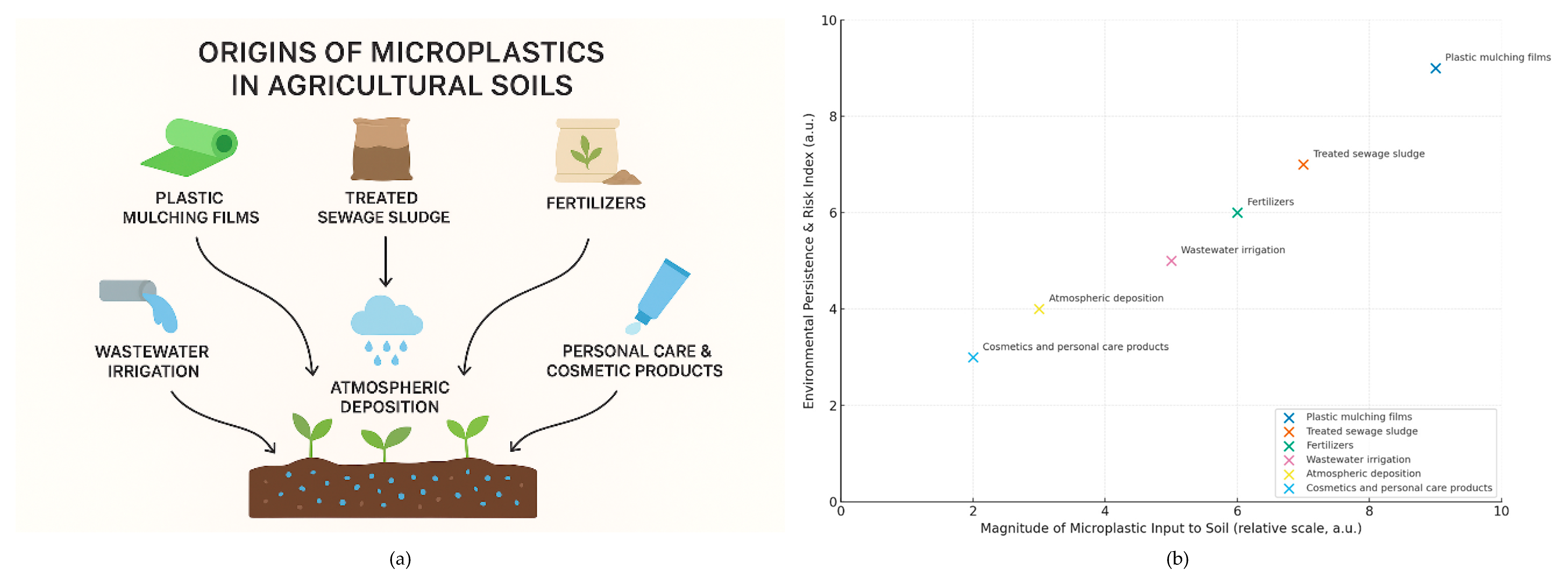
Figure 2.
Microplastics abundance in paddy soils across various regions worldwide. The sources of data in each bar originate respectively from: [67,73,74,75,76,77,78,79,80].
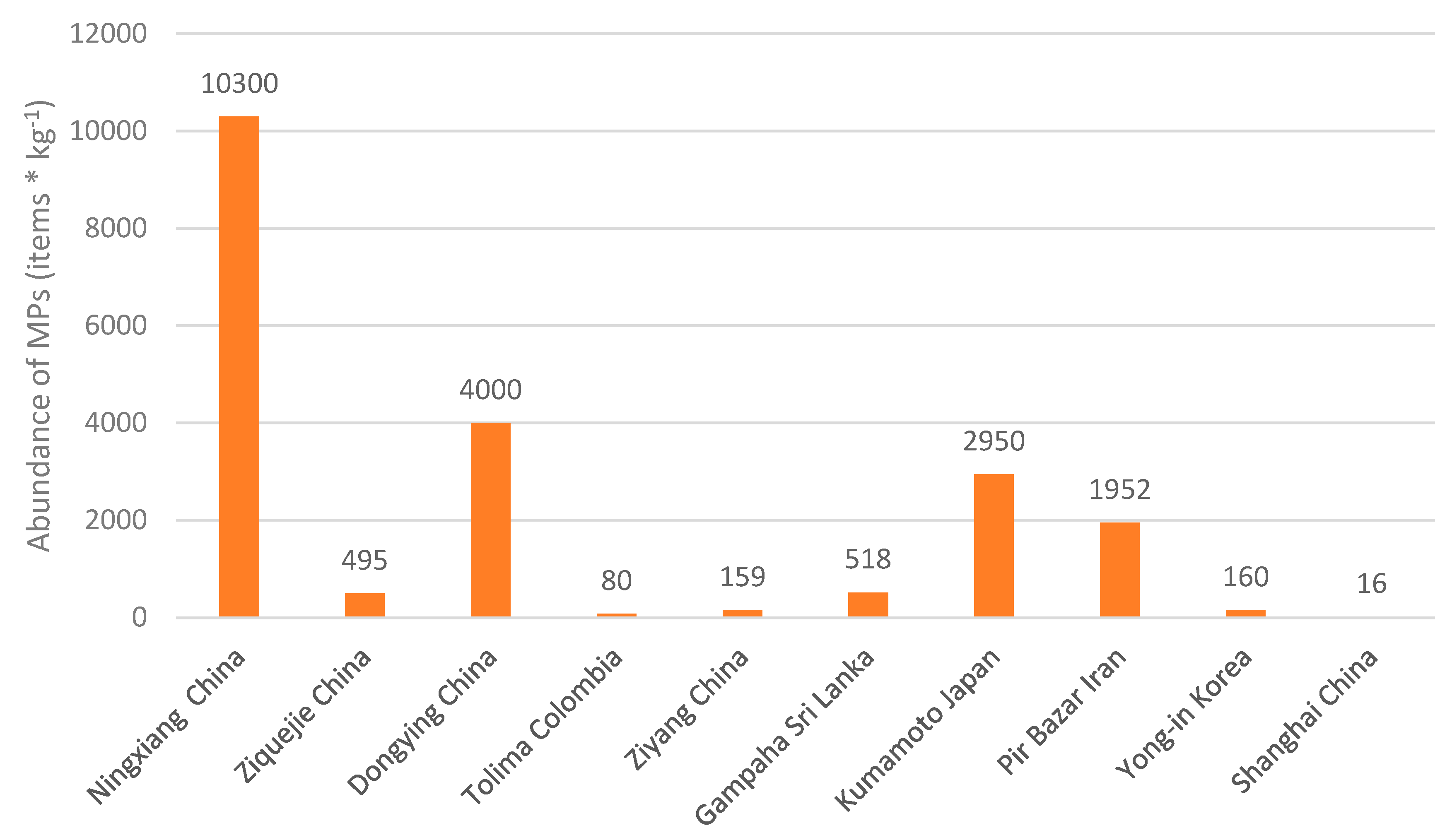
Figure 3.
Impacts of soil microplastic pollution: a) threats of MPs; b) Meta-Analytic map of MP impacts (a.u.: arbitrary unit).
Figure 3.
Impacts of soil microplastic pollution: a) threats of MPs; b) Meta-Analytic map of MP impacts (a.u.: arbitrary unit).
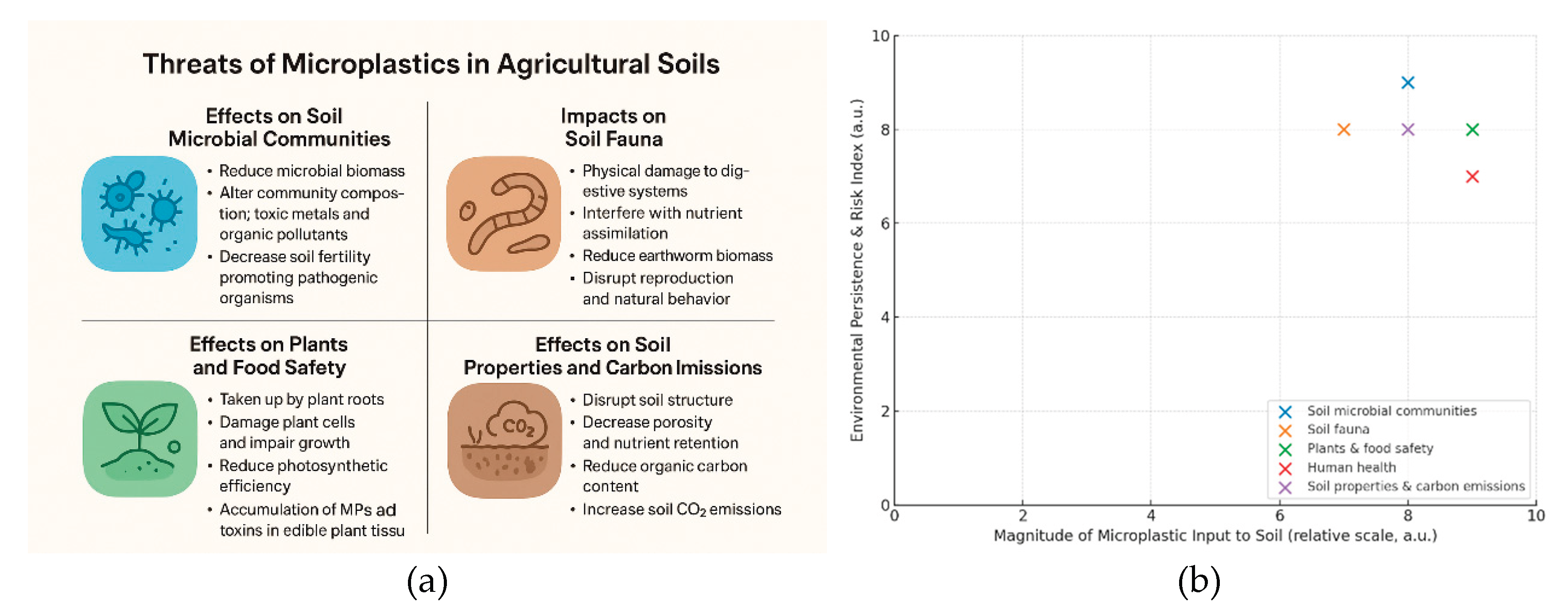

Table 1.
Global Overview of Primary Sources and Characteristics of Soil Microplastics.
| Region | Source | Crop type | Polymer type | Abundance | Color | Shape | Reference |
|---|---|---|---|---|---|---|---|
| Chengguan, China | Mulching films | Greenhouse crops | PE | 611,11 items/kg | Black | Fiber | (Bai et al., 2024) |
| Liaocheng, China | Plastic inputs, organic fertilizers and irrigation water | Vegetable crops | PE | 900 items/kg | Transparent | Fiber | (Xu et al., 2025) |
| Liaocheng, China | Plastic inputs, organic fertilizers and irrigation water | Orchard crops | PE | 615 items/kg | Transparent | Fiber | (Xu et al., 2025) |
| Gampaha, Sri Lanka | Irrigation water, mulching materials, organic fertilizers, inputs from air drift | Paddy fields | PET | 518 items/kg | Blue | Fiber | (Athavuda et al., 2024) |
| Gampaha, Sri Lanka | Irrigation water, mulching materials, organic fertilizers, inputs from air drift | Vegetable crops | PET | 433 items/kg | Black | Fiber | (Athavuda et al., 2024) |
| Gampaha, Sri Lanka | Irrigation water, mulching materials, organic fertilizers, inputs from air drift | Coconut crops | PET | 57 items/kg | Blue | Fiber | (Athavuda et al., 2024) |
| Nakhom Pathom, Thailand | Mulching films | Greenhouse crops | PDVF1 | 620 items/kg | NA2 | NA | (Boonsong, et al., 2024) |
| Murcia, Spain | Mulching films | Vegetable crops | Light density polyethylene | 2116 items/kg | NA | NA | (Beriot et al., 2021) |
| Mellipilla, Chile | Sewage sludge application | Corn | NA | 4.38 mg/kg | NA | Fiber | (Corradini et al., 2019) |
| Jiangsu, China | Sewage sludge application | NA | Polystyrene acrylate | 149.2 items/kg | NA | Fiber | (Yang et al., 2021) |
| Valencia, Spain | Sewage sludge application | Cereals | Light density polyethylene | 2130 items/kg | NA | Fragment | (Van den Berg et al., 2020) |
| Moselle, Germany | Mulching film, grape protection nets, pheromone traps | Vineyard | PP | 4200 items/kg | NA | Fragment | (Klaus et al., 2024) |
1 Polyvinylidene fluoride, 2 NA: Not available.
Table 2.
Potential threats of MPs in agricultural soils.
| Study area | Polymer type | Potential effects | Remarks | Reference |
|---|---|---|---|---|
| Hangzhou China | PE | Decline of Sphingomonadaceae and Xanthobacteraceae (soil bacterial communities) | Inhibition of the biodegradation of soil organic pollutants. | [96] |
| Berlin, Germany | PET | Limited plant growth | Reduced root colonization by arbuscular mycorrhizal fungi, non arbuscular mycorrhizal fungal structures and mycorrhizal fungal coils | [17] |
| Langfang, China | LDPE | Inhibition of the abundance of Bacteroidetes | Limited degradation of complex organic matter in soil biosphere | [139] |
| Jinling, China | PS | Increased mortality of earthworms | Inhibition of organic matter decomposition and maintenance of soil structure | [100] |
| Kaifeng, China | PS | Cellular root toxicity | Inhibition of the absorption of water and nutrients by plants | [112] |
| Beichen, China | PS | Reduced photosynthetic activity of plants | Limited plant growth | [115] |
| Tianjin, China | PS | Human health risks | The migration of PS-MP particles in carrot roots (grown in hydroponic systems) is facilitated by the presence of arsenic (As) in the hydroponic solution | [117] |
| Salerno, Italy | PE, PVC | High risk of myocardial infarction and stroke, | These findings are based on clinical observations | [120] |
| Sanming,, China | LDPE | Reduction of soil pH | MPs alter cation exchange capacity | [125] |
| Pinggu, China | PVC | Disruption of soil GHG emissions | Enhanced CH4 emissions and soil CO2 emissions | [126] |
Table 3.
Toxicity mechanisms of soil MPs across different type of exposed biological target.
| Toxicity Mechanism | Polymer type | MP size | Exposed biological target | Reference |
|---|---|---|---|---|
| Oxidative stress | PS | 10μm | Rice plants | [114] |
| Oxidative stress | PVC | 10μm | Rice plants | [114] |
| Oxidative stress | PS | >100nm | Earthworms | [102] |
| DNA damage | PS | >100nm | Earthworms | [102] |
| Histopathological damage | PS | 1300nm | Earthworms | [102] |
| Disruption of cell division | PS | 100nm | Allium cepa | [112] |
| Cytotoxicity (reduction of mitotic index) | PS | 50nm | Allium cepa | [140] |
| Genotoxicity (induction of cytogenetic anomalies | PS | 50nm | Allium cepa | [140] |
| Leaching of additives | PVC | 150μm | Candidatus Nitrosocosmicus | [141] |
| Leaching of additives | PA, PP | 30μm | Xanthobacteraceae | [58] |
| Reactive oxygen species (ROS) | PS | 5 µm | Root carrots | [117] |
Table 4.
Quantified biodegradation or mineralization of plastics by fungi in lab or soil-relevant assays.
Table 4.
Quantified biodegradation or mineralization of plastics by fungi in lab or soil-relevant assays.
| Reference | Polymer | Fungus (strain if available) | Assay type | Main methods | Main quantitative result |
|---|---|---|---|---|---|
| [152] | Polystyrene (PS) films (¹⁴C-labelled) | Penicillium variabile | Laboratory (liquid/solid culture, radiotracer mineralization) | ¹⁴C radiotracer mineralization (measure ¹⁴CO₂), ozonation pre-treatment tested | Measured mineralization of ¹⁴C-PS by P. variabile; ozonation pretreatment significantly enhanced mineralization (quantitative ¹⁴C mineralization values reported in paper). |
| [151] | Polystyrene (PS) microplastics | Edible fungi tested, Pleurotus ostreatus highest performer (and others) | Lab assays (liquid and soil-like tests) | SEM, FT-IR, enzyme assays, CO₂ measurement | Average degradation ~7.49% after 50 days; Pleurotus ostreatus highest ~16.17 ± 8.87% (50 d). |
| [153] | LDPE films | Rhizopus arrhizus SLNEA1 and other fungi | Batch / continuous culture (liquid / film exposure) | Weight loss measurements, SEM, chemical characterization | ~23.8% weight loss after 30 days (R. arrhizus SLNEA1, batch culture); continuous culture >23% after 90 days (paper reports time course and comparative data). |
| [154] | LDPE films | Cladosporium sphaerospermum and other isolates | Laboratory (solid film exposure in culture) | Weight loss, SEM, FT-IR, CO₂ evolution | Reported rapid weight loss in some isolates (examples in paper: some isolates produced measurable weight loss within days; literature comparisons include 35–38% in 90 days for some fungi). Exact per-isolate numbers in text/figures. |
| [155] | Polyethylene (PE) microplastics | Strain DL-1 (fungal isolate described in paper) | Lab incubation (microplastic suspension/solid assay) | Weight-loss method, electron microscopy, growth on PE as C source | Verified that strain degraded PE MPs by measurable weight loss (paper reports % weight loss and structural evidence). |
| [156] | Green polyethylene (GP) — bio-based PE | Pleurotus ostreatus (PLO6) | Solid substrate / fungal culture (soil-relevant substrate with GP) | Weight (dry mass) loss of substrate, FT-IR, mechanical property changes | Reported surface oxidation and loss of dry mass of GP after fungal treatment; quantitative mass-loss and changes in mechanical properties presented in the paper (examples: significant substrate mass reduction and evidence of polymer oxidation). |
Disclaimer/Publisher’s Note: The statements, opinions and data contained in all publications are solely those of the individual author(s) and contributor(s) and not of MDPI and/or the editor(s). MDPI and/or the editor(s) disclaim responsibility for any injury to people or property resulting from any ideas, methods, instructions or products referred to in the content. |
© 2025 by the authors. Licensee MDPI, Basel, Switzerland. This article is an open access article distributed under the terms and conditions of the Creative Commons Attribution (CC BY) license (https://creativecommons.org/licenses/by/4.0/).
Copyright: This open access article is published under a Creative Commons CC BY 4.0 license, which permit the free download, distribution, and reuse, provided that the author and preprint are cited in any reuse.


