

Submitted:
02 December 2025
Posted:
03 December 2025
You are already at the latest version
Abstract
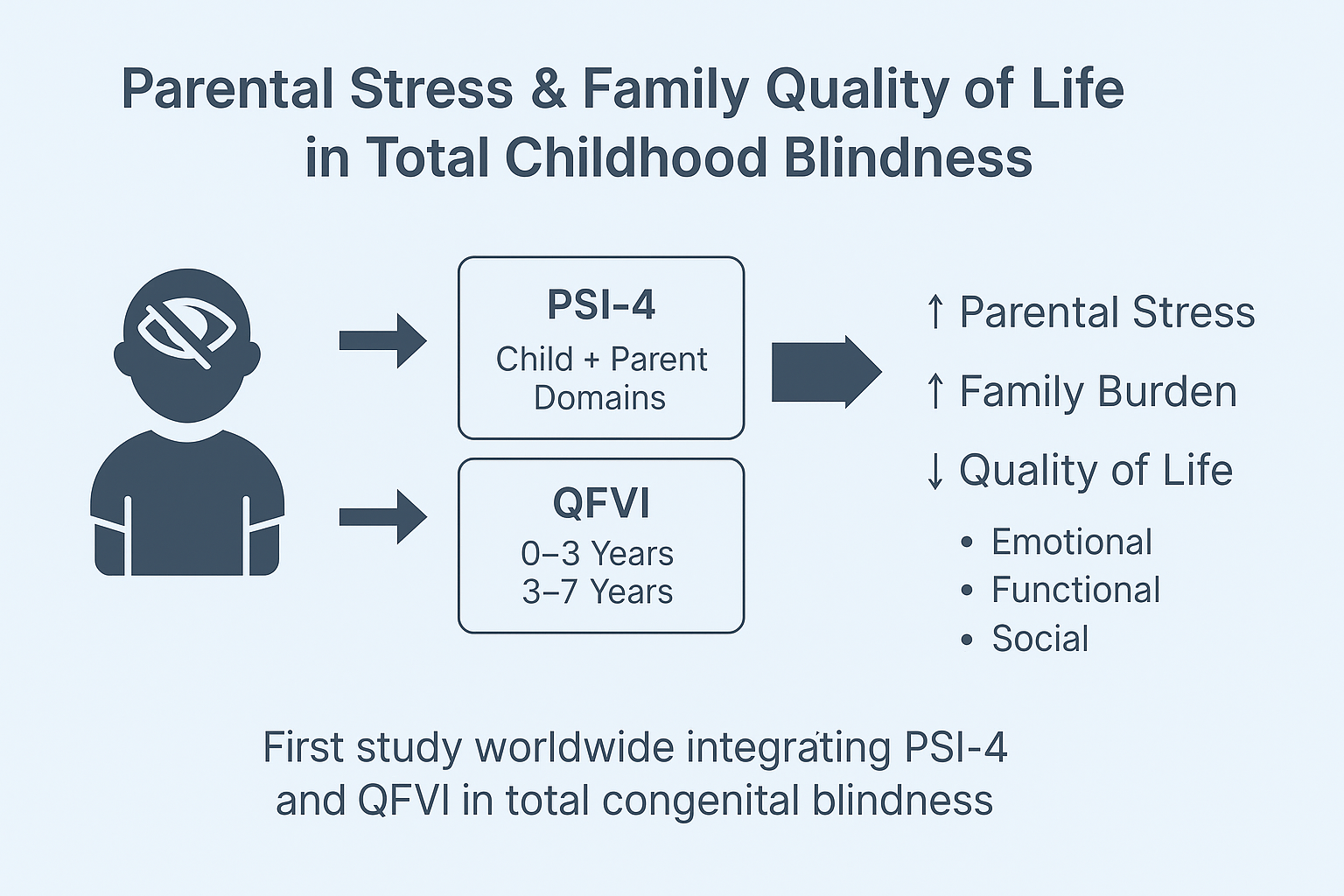
Parental stress is a critical yet understudied dimension of childhood total blindness, a condition that imposes substantial developmental, emotional, and functional challenges on families. This cross-sectional study assessed parenting stress, maternal health symp-toms, and children’s functional vision-related quality of life in 81 mothers of children aged 3 months to 7 years with complete congenital blindness. Mothers completed the Parenting Stress Index-Fourth Edition (PSI-4), the age-appropriate versions of the Quality of Functional Vision Questionnaire (QFVI-3 or QFVI-7), and a sociodemographic and ma-ternal health survey.
Total Parent Stress showed moderately elevated percentile scores (mean ≈ 67), with the highest PSI-4 subdomains in Adaptability, Depression, and Health. Approximately 21% of mothers scored within the clinical range for high stress. Maternal symptomsincluding sadness, insomnia, headaches, forgetfulness, and musculoskeletal painwere significant (all p < 0.01). QFVI global scores indicated moderate impairments in functional vi-sion-related quality of life across age groups. Life Stress demonstrated a small-to-moderate negative correlation with QFVI-7, suggesting that cumulative environmental stressors may adversely affect children’s functional outcomes.
Several protective factors were identified. Among children under age three, maternal en-gagement in physical activity was associated with better QFVI scores, whereas for chil-dren aged 3-7, school attendance correlated with improved functional functioning. Socio-demographic disadvantages, limited access to educational adaptations, and reduced ma-ternal participation in work or leisure activities were linked to higher stress and poorer child functioning.
These findings highlight the importance of multidisciplinary, family-centered care incor-porating psychosocial assessment, early stimulation, orientation and mobility support, and maternal mental health interventions in pediatric ophthalmology.
Keywords:
parental stress
; childhood blindness
; congenital blindness
; functional vision
; pediatric ophthalmology
; maternal health
; caregivers
; early intervention
Copyright: This open access article is published under a Creative Commons CC BY 4.0 license, which permit the free download, distribution, and reuse, provided that the author and preprint are cited in any reuse.


