Preprint
Article

This version is not peer-reviewed.

Development and Validation of the Low Sit–High Step Test for Assessing Lower Extremity Function in Sarcopenia

Submitted:

26 November 2025

Posted:

27 November 2025

You are already at the latest version

Abstract

Objective: The study aimed to evaluate the validity and reliability of the newly developed Low Sit–High Step (LS-HS) Test designed to assess lower-extremity muscle strength in the diagnosis of sarcopenia. Design: The study included 205 participants divided into four groups (possible sarcopenia, sarcopenia, young control, and middle-to-older control). The LS-HS Test was compared across groups, and its ability to distinguish sarcopenia and possible sarcopenia was evaluated. Internal consistency, inter-rater and test–retest reliability, and diagnostic accuracy were assessed to determine the test’s validity and reliability. Results: LS-HS Test scores were higher in participants with possible sarcopenia and sarcopenia (p<0.05). Multinomial logistic regression analysis showed that LS-HS Test performance could predict both possible sarcopenia and sarcopenia (p<0.001). Internal consistency was excellent (Cronbach’s α = 0.938), while inter-rater and test–retest reliability were very high (ICC = 0.998), confirming its reproducibility. ROC analysis demonstrated high diagnostic accuracy in distinguishing both possible sarcopenia and sarcopenia (p<0.01, AUC=0.768, AUC=0.704). Conclusions: The LS-HS Test appears to be a valid, reliable, and practical tool for assessing lower-limb muscle strength and functional decline in the diagnosis of sarcopenia. Its simplicity and clinical applicability suggest that it may serve as a useful option for routine screening and evaluation.

Keywords: 
;  ;  ;  ;  ;  

1. Introduction

Sarcopenia, a disease characterized by the progressive loss of muscle mass and function that becomes more prevalent with aging, is a serious health problem leading to functional impairments, reduced mobility, and an increased risk of falls [1].
Although handgrip strength (HGS) is widely used as a simple indicator of overall muscle strength, it poorly reflects lower-limb power, which declines earlier and more markedly with aging [2,3,4,5,6]. Because HGS has limited capacity to represent lower-extremity strength [4,7,8], assessing lower-limb strength is essential for the early diagnosis of sarcopenia.
The Chair Stand Test (CST) and the Timed Up and Go (TUG) test are useful for assessing mobility; however, they may be limited in detecting early and subtle declines in lower-limb muscle strength. Our clinical observations revealed that many older adults who can easily rise from a standard-height chair or step onto a regular curb often struggle when standing up from a lower surface or stepping onto a higher platform. These individuals frequently rely on their knees or external support to complete such movements. In line with this, previous research has demonstrated a positive association between maximum step height and lower-limb strength [9], however, to our knowledge, no standardized test currently assesses this ability directly.
Based on these clinical insights, the Low Sit–High Step (LS-HS) Test was developed to evaluate the ability to sit and rise from a low stool and to step up and down from a high platform. These movements require greater knee flexion angles (approximately 135–150°) and consequently higher force generation from the quadriceps and hip extensors. Therefore, this study aimed to develop and preliminarily evaluate the LS-HS Test as a clinically applicable, practical, and cost-effective tool for assessing lower-extremity muscle strength and function, and to examine its validity and reliability for use in sarcopenia diagnosis.

2. Materials and Methods

2.1. Design

In this cross-sectional study, we aimed to develop a cost-effective, simple, and easily applicable test to assess lower extremity muscle strength and aid in diagnosing sarcopenia.

2.2. Setting

The study was conducted at the Akdeniz University Hospital Physical Therapy and Rehabilitation Clinic between November 2023 and December 2024. Participants were invited based on specific inclusion criteria, and all participants were assessed on the same day. Two researchers independently evaluated the LS-HS Test on the same day. Participants were recalled two-weeks later, and the test was repeated.

2.3. Participants

A total of 217 individuals aged 18 to 85 years were initially enrolled in this cross-sectional study. Twelve participants were excluded due to noncompliance with the two-week follow up, resulting in 205 participants (151 women and 54 men) who completed all study procedures.
All participants were evaluated for sarcopenia according to the updated diagnostic criteria of the European Working Group on Sarcopenia in Older People 2 (EWGSOP2) [2].
According to these criteria, in women, a HGS below 16 kg indicated probable sarcopenia (low muscle strength). When low muscle strength was accompanied by an appendicular skeletal muscle mass (ASMM) below 15 kg, the diagnosis was classified as sarcopenia (low muscle quantity). If both low muscle strength and low muscle mass were present together with a gait speed of 0.8 meters per second or lower, the condition was defined as severe sarcopenia (low physical performance). In men, an HGS below 27 kg indicated probable sarcopenia, an ASMM below 20 kg confirmed sarcopenia, and a gait speed of 0.8 meters per second or lower indicated severe sarcopenia.
Based on these criteria, 33 participants aged 40 to 85 years were diagnosed with probable sarcopenia, and 23 participants were diagnosed with sarcopenia. Healthy individuals aged 18 to 39 years were assigned to the young control group, while healthy individuals aged 40 to 85 years without sarcopenia formed the middle-to-older control group.
The control groups were not preselected; rather, they consisted of non-sarcopenic individuals identified within the same study population according to the EWGSOP2 framework. The LS-HS Test was intentionally designed to include simple and functional movements that could be performed by individuals from all socioeconomic backgrounds. Therefore, socioeconomic differences are unlikely to have significantly influenced the feasibility, safety, or applicability of the test.
Individuals with joint deformities or pain that could affect lower extremity function, as well as those with conditions that might cause secondary sarcopenia (such as inflammatory rheumatic diseases, malignancies, neurological disorders, or endocrine abnormalities), were excluded from the study. Consequently, all participants classified with sarcopenia were determined to have primary sarcopenia according to the EWGSOP2 diagnostic framework.

Interventions

All participants performed the LS-HS Test under standardized conditions.
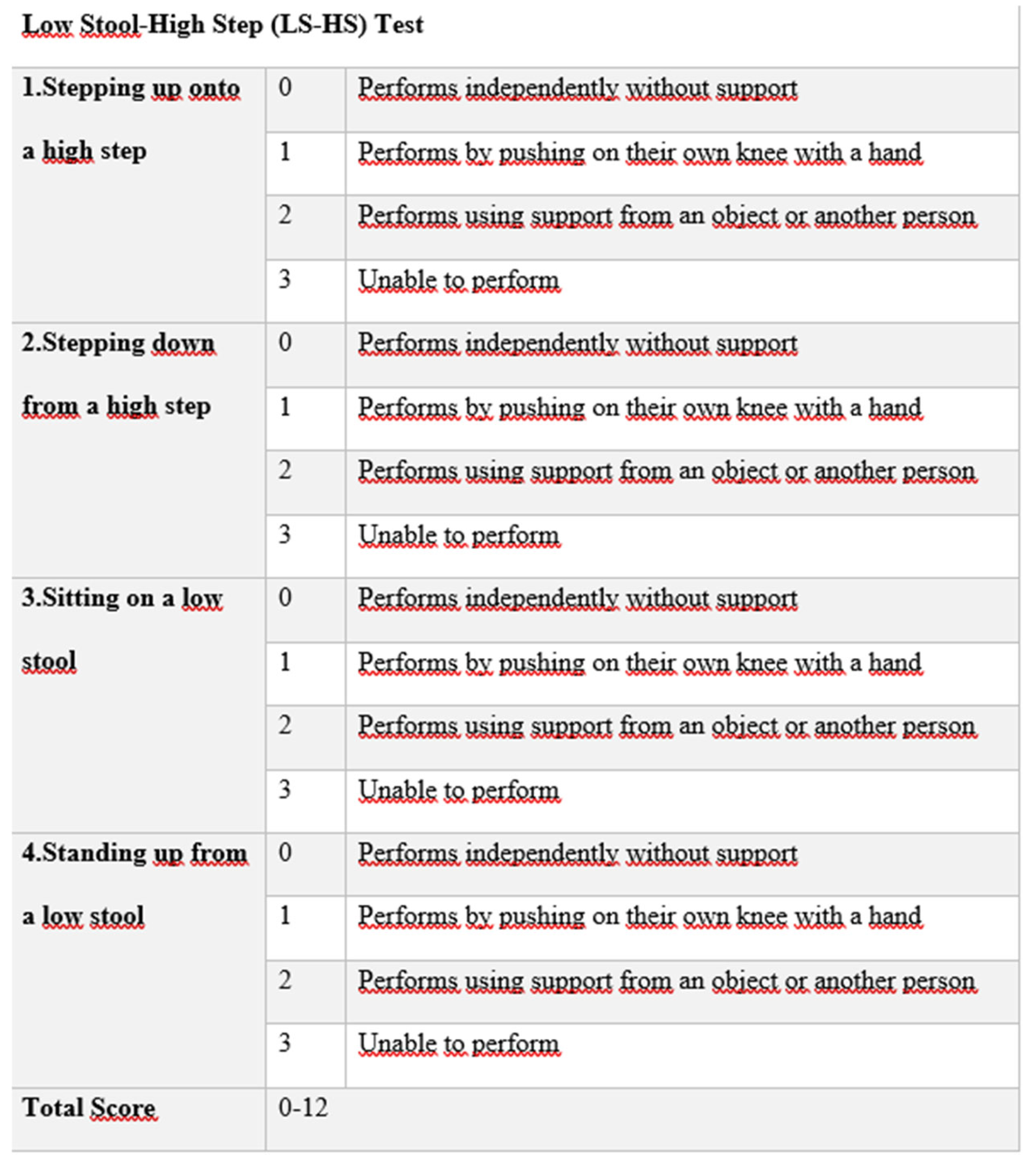
The test consisted of four sequential movements: sitting down on and rising from a 20 cm stool, and stepping up onto and down from a 40 cm platform.
Each participant was given a brief demonstration and allowed one practice attempt before the test. Two independent raters simultaneously recorded the performance to assess inter-rater reliability, and the same procedure was repeated one week later to evaluate test–retest reliability. The same standardized protocol was used for all participants to ensure procedural consistency.

2.4. Measurements

All participants were measured for HGS, ASMM, and gait speed, and the CST, Timed TUGtest, and LS-HS Test were applied to them.
HGS: Measured using a Jamar hand dynamometer (Lafayette Instrument, Lafayette, IN, USA). Two measurements were taken from the dominant hand, and the mean value was used for analysis.
ASMM: Determined by bioelectrical impedance analysis (BIA) using the Tanita Body Composition Analyzer (model BC-418, Tanita Corp, Tokyo, Japan). ASMM was calculated as the sum of muscle mass in both arms and legs.
Gait speed: Measured as the time required to walk 4 meters at a usual pace using a stopwatch.
CST: Recorded as the time taken to stand up five times from a seated position without using the arms.
TUG: Measured as the time taken to rise from a standard chair, walk 3 meters, turn, return, and sit down again.
LS-HS Test: Performed by asking participants to go up and down a 40 cm step (average knee height) and to sit down on and rise from a 20 cm stool (Supplementary 1).
Supplementary 1. Low Sit–High Step (LS-HS) Test
Preprints 186913 i001
The test consists of four components:
(1) 40 cm Step-Up – assesses concentric lower-limb strength, particularly of the hip and knee extensors, as well as balance and coordination.
(2) 40 cm Step-Down – evaluates eccentric control of the quadriceps and balance during descent.
(3) 20 cm Sit-Down – tests eccentric control and postural stability, simulating sitting onto low surfaces.
(4) 20 cm Stand-Up – assesses concentric strength and power of the quadriceps and gluteal muscles, reflecting functional independence and fall risk.
Each movement was scored from 0 to 3:
0 = performs independently without support;
1 = performs by pushing on own knee;
2 = performs using external support;
3 = unable to perform.
Total scores ranged from 0 (best) to 12 (worst).
Two independent raters administered the test on the same day and were blinded to group classifications and all other measurements. The same rater repeated the LS-HS Test one week later to assess test–retest reliability.

2.5. Bias

To minimize potential bias, the LS-HS Test was administered by two independent researchers who were blinded to participants’ group classifications and all other test results.
The same standardized procedure was applied to all participants, and the test was repeated one week later by the same examiner to assess test–retest reliability.

2.6. Statistical Methods

A priori power analysis was performed using G*Power 3.1 software to determine the minimum required sample size for the statistical analyses. Since no prior studies have evaluated the LS-HS Test, the expected effect size was estimated based on Cohen’s conventional criteria for behavioral and clinical research. Assuming a medium effect size (f² = 0.25), a significance level (α) of 0.05, and a statistical power (1–β) of 0.80, the required sample size for a multiple linear regression model with five predictors (age, BMI, HGS, CST, and TUG) was calculated as 128 participants [10].
The final study sample of 205 participants exceeded this requirement, indicating that the study had sufficient statistical power to detect meaningful associations. Therefore, the analyses conducted in this study are considered adequately powered to support the validity and reliability findings of the LS-HS Test.
Statistical analyses were conducted using IBM SPSS Statistics for Windows, Version 23.0 (IBM Corp., Armonk, NY, USA). A p-value<0.05 was considered statistically significant.
Descriptive statistics were presented as mean ± standard deviation (SD) for normally distributed continuous variables and as median (Q1–Q3) for non-normally distributed variables. The normality of data distribution was tested using both the Shapiro–Wilk and Kolmogorov–Smirnov tests.
For group comparisons, parametric tests (independent samples t-test or One-Way ANOVA with Tukey’s HSD post-hoc analysis) were applied when normality and homogeneity of variance assumptions were met. Tukey’s HSD was specifically chosen because it provides robust control of the Type I error rate when variances are equal and group sizes are approximately balanced. Homogeneity of variances was confirmed using Levene’s test (p>0.05). When these assumptions were violated, non-parametric tests (Mann–Whitney U or Kruskal–Wallis test with Bonferroni-adjusted post-hoc comparisons) were used.
Categorical variables were expressed as counts (n) and percentages (%), and compared using the Chi-square test. A p-value<0.05 was considered statistically significant.

2.7. Reliability Analysis

The reliability and validity of the LS-HS Test were comprehensively evaluated.
Internal consistency was assessed using Cronbach’s alpha (α) to determine the homogeneity of the four test items (40 cm step-up, 40 cm step-down, 20 cm sit-down, and 20 cm stand-up). Inter-rater and test–retest reliability were examined using a two-way random effects model with absolute agreement, and intraclass correlation coefficients (ICCs) were reported with 95% confidence intervals (CIs).
Construct validity was analyzed through exploratory factor analysis (EFA). Criterion validity was tested by correlating LS-HS Test scores with HGS, ASMM, gait speed, CST, and TUG results using Pearson or Spearman correlation analyses as appropriate.
Discriminant validity was evaluated by comparing groups using one-way ANOVA or Kruskal–Wallis tests with Bonferroni-adjusted post-hoc analyses.
Predictive validity was assessed using linear and logistic regression analyses, and diagnostic accuracy was determined through ROC analysis, including the calculation of the AUC and Youden index.

2.8. Ethics Statement

This study protocol was approved by the Ethics Committee of Akdeniz University Faculty of Medicine (KAEK-637, 26.10.2022) and conducted in accordance with the ethical standards of the 2000 Declaration of Helsinki.
All participants provided written informed consent prior to participation.
This study adheres to the STROBE guidelines [11], and includes the checklist in the Supplementary Material (see Supplementary Checklist).
Supplementary Checklist: STROBE Statement—checklist of items that should be included in reports of observational studies
Item No Recommendation
Title and abstract 1-3 (a) Indicate the study’s design with a commonly used term in the title or the abstract
(b) Provide in the abstract an informative and balanced summary of what was done and what was found
Introduction
Background/rationale 4-5 Explain the scientific background and rationale for the investigation being reported
Objectives 5 State specific objectives, including any prespecified hypotheses
Methods
Study design 6 Present key elements of study design early in the paper
Setting 6 Describe the setting, locations, and relevant dates, including periods of recruitment, exposure, follow-up, and data collection
Participants 6 (a) Cohort study—Give the eligibility criteria, and the sources and methods of selection of participants. Describe methods of follow-up
Case-control study—Give the eligibility criteria, and the sources and methods of case ascertainment and control selection. Give the rationale for the choice of cases and controls
Cross-sectional study—Give the eligibility criteria, and the sources and methods of selection of participants
(b) Cohort study—For matched studies, give matching criteria and number of exposed and unexposed
Case-control study—For matched studies, give matching criteria and the number of controls per case
Variables 6-8 Clearly define all outcomes, exposures, predictors, potential confounders, and effect modifiers. Give diagnostic criteria, if applicable
Data sources/ measurement 6-8 For each variable of interest, give sources of data and details of methods of assessment (measurement). Describe comparability of assessment methods if there is more than one group
Bias 9 Describe any efforts to address potential sources of bias
Study size 9 Explain how the study size was arrived at
Quantitative variables 9 Explain how quantitative variables were handled in the analyses. If applicable, describe which groupings were chosen and why
Statistical methods 9-10 (a) Describe all statistical methods, including those used to control for confounding
(b) Describe any methods used to examine subgroups and interactions
(c) Explain how missing data were addressed
(d) Cohort study—If applicable, explain how loss to follow-up was addressed
Case-control study—If applicable, explain how matching of cases and controls was addressed
Cross-sectional study—If applicable, describe analytical methods taking account of sampling strategy
(e) Describe any sensitivity analyses
Results
Participants 11 (a) Report numbers of individuals at each stage of study—eg numbers potentially eligible, examined for eligibility, confirmed eligible, included in the study, completing follow-up, and analysed
(b) Give reasons for non-participation at each stage
(c) Consider use of a flow diagram
Descriptive data 11 (a) Give characteristics of study participants (eg demographic, clinical, social) and information on exposures and potential confounders
(b) Indicate number of participants with missing data for each variable of interest
(c) Cohort study—Summarise follow-up time (eg, average and total amount)
Outcome data 11-13 Cohort study—Report numbers of outcome events or summary measures over time
Case-control study—Report numbers in each exposure category, or summary measures of exposure
Cross-sectional study—Report numbers of outcome events or summary measures
Main results 13-14 (a) Give unadjusted estimates and, if applicable, confounder-adjusted estimates and their precision (eg, 95% confidence interval). Make clear which confounders were adjusted for and why they were included
(b) Report category boundaries when continuous variables were categorized
(c) If relevant, consider translating estimates of relative risk into absolute risk for a meaningful time period
Other analyses 14 Report other analyses done—eg analyses of subgroups and interactions, and sensitivity analyses
Discussion
Key results 14 Summarise key results with reference to study objectives
Limitations 19 Discuss limitations of the study, taking into account sources of potential bias or imprecision. Discuss both direction and magnitude of any potential bias
Interpretation 15-19 Give a cautious overall interpretation of results considering objectives, limitations, multiplicity of analyses, results from similar studies, and other relevant evidence
Generalisability 19 Discuss the generalisability (external validity) of the study results
Other information
Funding 19 Give the source of funding and the role of the funders for the present study and, if applicable, for the original study on which the present article is based
* Give information separately for cases and controls in case-control studies and, if applicable, for exposed and unexposed groups in cohort and cross-sectional studies. Note: An Explanation and Elaboration article discusses each checklist item and gives methodological background and published examples of transparent reporting. The STROBE checklist is best used in conjunction with this article (freely available on the Web sites of PLoS Medicine at http://www.plosmedicine.org/, Annals of Internal Medicine at http://www.annals.org/, and Epidemiology at http://www.epidem.com/). Information on the STROBE Initiative is available at www.strobe-statement.org.

3. Results

The average age of the participants 205 (151 females, 54 males) was 56.21(14.00) (mean (SD)) years 18 to 84 years (Table 1).
When patients were divided into four age groups according to the World Health Organization classification: young adults (18–44 years), middle-aged adults (45–59 years), older adults (60–74 years), and elderly adults (75–84 years), HGS and ASMM values showed a gradual decline with advancing age. In contrast, LS-HS test, CST, and TUG scores increased with age, reflecting decreased physical performance and functional capacity (Figure 1).

3.1. Reliability Analysis

Internal Consistency: Internal Consistency: The LS-HS Test demonstrated excellent internal reliability. Cronbach’s α was 0.938, and 0.940 when calculated based on standardized items, indicating excellent internal consistency across the four components of the test (step-up, step-down, sit-down, stand-up). The mean scores of these items ranged from 0.61 (0.89) to 0.93 (1.05). Inter-item correlation coefficients ranged from 0.72 to 0.91, demonstrating strong positive relationships among the test items and confirming the homogeneity of the test content. To further assess reliability, an intraclass correlation coefficient (ICC) analysis was performed using a two-way random-effects model with absolute agreement. The single-measure ICC was 0.778 (95% CI: 0.728–0.821), and the average-measure ICC was 0.933 (95% CI: 0.914–0.948), both statistically significant (p<0.001). These findings confirm that the LS-HS Test has excellent internal consistency and strong reliability across items, raters, and repeated measurements.
Inter-Rater Reliability: A total of 205 participants were evaluated independently by two raters. The inter-rater reliability of the LS-HS Test was analyzed using the intraclass correlation coefficient (ICC) based on a two-way random-effects model with absolute agreement. The single-measure ICC was 0.995 (95% CI: 0.993–0.996, p<0.001), indicating very high agreement between individual scores obtained by different raters. The average-measure ICC was 0.997 (95% CI: 0.997–0.998, p<0.001), confirming near-perfect reliability when the mean scores from multiple raters were considered. The F-test for reliability was also statistically significant (F (204, 204) = 386.93, p<0.001), demonstrating that the LS-HS Test yields highly consistent results between different evaluators.
Test–Retest Reliability: To assess the stability of the LS-HS Test over time, 205 participants completed the test twice, with a two-week interval between sessions. The single-measure ICC was 0.995 (95% CI: 0.993–0.996, p<0.001), showing strong agreement between the two time points, and the average-measure ICC was 0.998 (95% CI: 0.997–0.998, p<0.001), confirming excellent temporal reliability. The F-test for reliability was statistically significant (F(204, 204) = 404.20, p<0.001), indicating that the LS-HS Test demonstrates excellent repeatability and measurement stability over time.

3.2. Validity Analysis

Construct Validity: The construct validity of the LS-HS Test was evaluated using exploratory factor analysis (EFA) based on the four test items. The Kaiser–Meyer–Olkin (KMO) measure of sampling adequacy was 0.738, and Bartlett’s Test of Sphericity was statistically significant (p<0.001), confirming that the data were suitable for factor analysis.
A single factor was extracted, explaining 84.78% of the total variance, with factor loadings ranging from 0.906 to 0.930. These results indicate that all four items measure a common underlying construct—lower extremity muscle strength and function—thus supporting the unidimensional structure and strong construct validity of the LS-HS Test.
Criterion Validity: Criterion validity was examined by correlating LS-HS Test scores with established functional and physiological parameters. LS-HS scores showed positive correlations with age, BMI, CST, and TUG, and negative correlations with HGS, ASMM, and gait speed (all p<0.05) (Supplementary 2).
Supplementary 2. Correlation Between LS-HS Test Scores and Clinical Data
Variables Age BMI HGS ASMM Gait Speed CST TUG
LS-HS Test r = 0.464**
p < 0.001
r = 0.226**
p < 0.001
r = −0.583**
p < 0.001
r = −0.259**
p < 0.001
r = −0.566**
p < 0.001
r = 0.548**
p < 0.001
r = 0.596**
p < 0.001
Age r = 0.020
p = 0.774
r = −0.368**
p < 0.001
r = −0.074
p = 0.294
r = −0.389**
p < 0.001
r = 0.327**
p < 0.001
r = 0.439**
p < 0.001
BMI r = −0.001
p = 0.993
r = 0.316**
p < 0.001
r = −0.150*
p = 0.032
r = 0.080
p = 0.254
r = 0.094
p = 0.180
HGS r = 0.610**
p < 0.001
r = 0.400**
p < 0.001
r = −0.432**
p < 0.001
r = −0.521**
p < 0.001
ASMM r = 0.173*
p = 0.013
r = −0.159*
p = 0.023
r = −0.242**
p < 0.001
Gait Speed r = −0.484**
p < 0.001
r = −0.706**
p < 0.001
CST r = 0.617**
p < 0.001
*p < 0.05;*p < 0.001. r: Pearson correlation coefficient. LS-HS Test: Low Sit–High Step Test. HGS: Handgrip Strength. ASMM: Appendicular Skeletal Muscle Mass. CST: Chair Stand Test. TUG: Timed Up and Go.
These findings confirm that higher LS-HS scores are associated with poorer muscle strength and physical performance, supporting the criterion validity of the test.
Discriminant Validity: When the four groups were compared, LS-HS Test scores were significantly higher in the possible sarcopeniaand sarcopenia groups compared to both control groups (all p<0.05) (Table 2). This finding indicates that the LS-HS Test successfully distinguishes between individuals with different levels of muscle strength and function.
A multiple linear regression model was constructed to examine the determinants of LS-HS Test scores using age, BMI, HGS, CST, and TUG as predictors. The overall regression model was statistically significant (F (8, 199) = 43.158, p<0.001), explaining 52% of the variance in LS-HS scores (R² = 0.520, adjusted R² = 0.508). Among the predictors, age, BMI, HGS, CST, and TUG were identified as significant independent contributors to LS-HS performance (Supplementary 3).
Supplementary 3. Linear Regression Analysis for the LS-HS Test
Estimate (B) SE β t p 95% CI Collinearity Statistics
Lower Upper Tolerance VIF
Intercept -5.977 1.621 0.001* -9.173 -2.781
Age 0.042 0.014 0.164 -3.688 0.004* 0.014 0.070 0.780 1.282
BMI 0.145 0.041 0.176 2.945 0.001* 0.065 0.225 0.993 1.007
HGS -0.095 0.023 -0.235 3.581 0.001* -0.141 -.0049 0.728 1.374
CST 0.141 0.048 0.181 -4.077 0.004* 0.047 0.235 0.638 1.568
TUG 0.302 0.059 0.325 2.947 0.001* 0.186 0.418 0.598 1.671
*: p <0.01. Β: Standardized beta coefficients. CI: Confidence interval. SE: Standard Error. HGS: Hand Grip Strength: CST: Chair Stand Test. TUG: Timed Up and Go Test.
Predictive Validity: To evaluate the predictive validity of the LS-HS Test for identifying possible sarcopeniaand sarcopenia, a multinomial logistic regression analysis was performed including LS-HS Test scores, age, BMI, and sex as predictors. The model was statistically significant (χ² (8) = 71.311, p<0.001), indicating that the predictors effectively differentiated among the outcome categories. The model explained 29.4% (Cox & Snell R²), 37.4% (Nagelkerke R²), and 22.5% (McFadden R²) of the variance in the dependent variable, with a –2 Log Likelihood of 244.945 (Table 3).
These results demonstrate that the LS-HS Test, in combination with demographic and physical parameters, exhibits strong predictive capacity for identifying individuals at risk of sarcopenia.
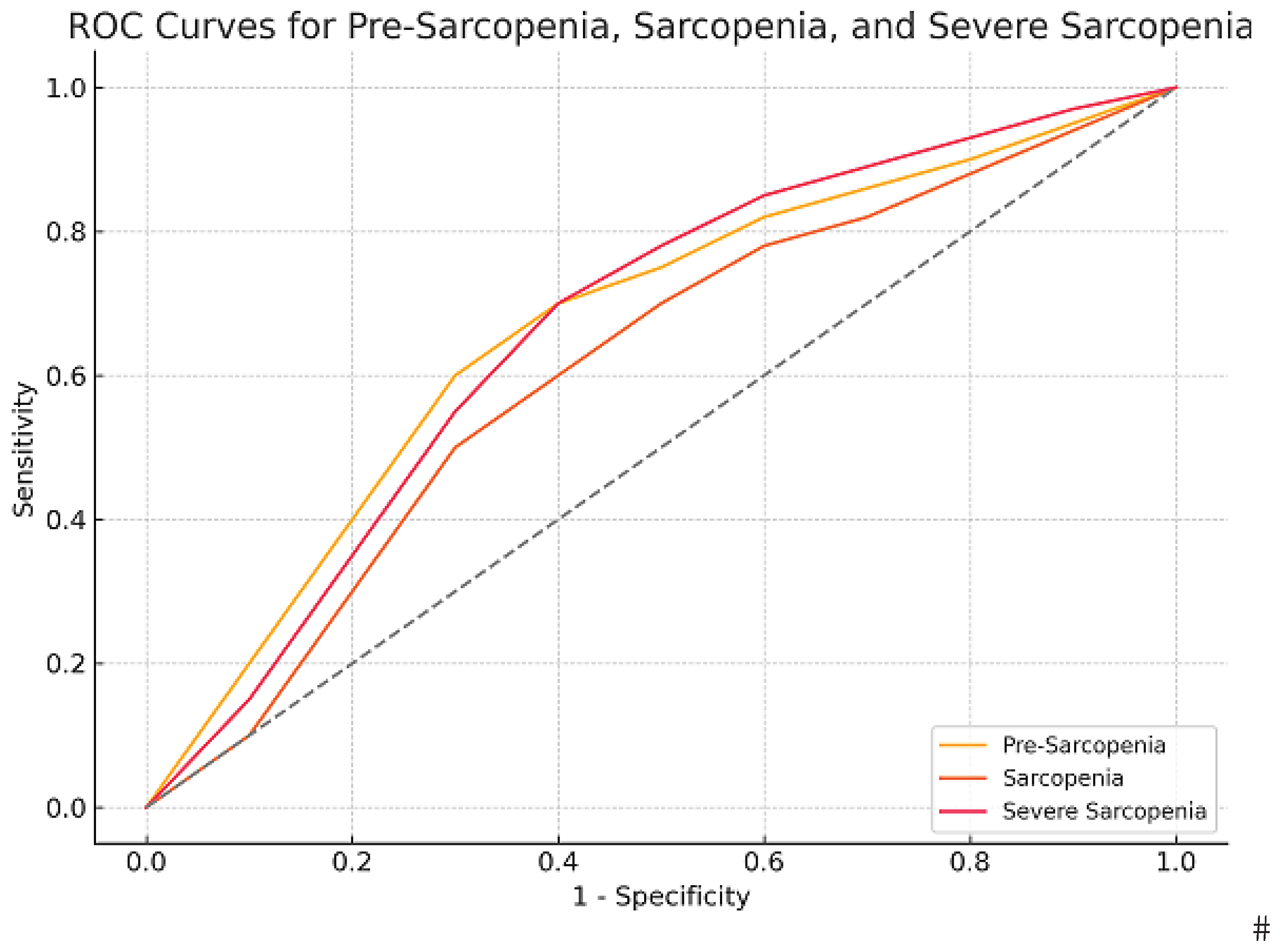
Diagnostic Accuracy: Receiver Operating Characteristic (ROC) curve analysis was conducted to evaluate the diagnostic accuracy of the LS-HS Test in identifying pre-sarcopenia, sarcopenia, and severe sarcopenia. The LS-HS Test demonstrated a significant ability to discriminate between different stages of sarcopenia (all p<0.01) (Table 4, Figure 2, Supplementary 4).
Supplementary 4. Diagnostic Performance of the LS-HS Test at Various Cut-off Points
Possible Sarcopenia Sarcopenia Severe Sarcopenia
Cut-off Se Sp J Se Sp J Se Sp J
-1.0 1.00 0.00 0.00 1.00 0.00 0.00 1.00 0.00 0.00
0.5 0.84 0.49 0.33 0.79 0.43 0.22 0.88 0.43 0.31
1.5 0.82 0.59 0.41 0.79 0.51 0.31 0.88 0.51 0.39
2.5 0.77 0.72 0.49 0.79 0.64 0.43 0.88 0.63 0.51
3.5 0.68 0.79 0.44 0.67 0.68 0.35 0.77 0.68 0.44
4.5 0.61 0.85 0.45 0.67 0.77 0.44 0.77 0.77 0.53
5.5 0.59 0.87 0.46 0.66 0.80 0.42 0.77 0.79 0.56
6.5 0.41 0.89 0.30 0.38 0.83 0.20 0.41 0.82 0.24
7.5 0.36 0.89 0.25 0.33 0.85 0.18 0.35 0.84 0.19
8.5 0.21 0.94 0.15 0.21 0.91 0.12 0.24 0.91 0.15
9.5 0.20 0.95 0.14 0.17 0.92 0.08 0.18 0.92 0.09
11.0 0.09 0.99 0.08 0.04 0.97 0.01 0.00 0.97 -0.03
13.0 0.00 1.00 0.00 0.00 1.00 0.00 0.00 1.00 0.00
Se Sensitivity. Sp Specificity. J: Youden Index.
The classification performance metrics were as follows:
Possible sarcopenia model: Accuracy = 0.732 (73.2%), F1 Score = 0.610 (61.0%)
Sarcopenia model: Accuracy = 0.761 (76.1%), F1 Score = 0.395 (39.5%)
Severe sarcopenia model: Accuracy = 0.790 (79.0%), F1 Score = 0.377 (37.7%)
These results indicate that the LS-HS Test achieves moderate-to-high accuracy in detecting the presence and severity of sarcopenia.
Other Analyses: When participants were categorized into healthy, pre-sarcopenia, and sarcopenia groups according to the proposed LS-HS cut-off values, significant differences were found in age, HGS, gait speed, and CST scores across all groups (p<0.05; all p<0.017 after Bonferroni correction). In contrast, ASMM and TUG scores were similar between healthy and pre-sarcopenic individuals but significantly differed in the sarcopenia group compared to the other two groups (Supplementary 5).
Supplementary 5. Group Comparisons Based on LS-HS Test Classification
Healthy
(82)
Possible sarcopenia (38) Sarcopenia
(85)
p
Age 51 (36-62)
a
58 (51-63)
b
64 (57-71)
c
0.001*
BMI 26.32 (23.59-28.9)
ac
29.3 (26.5-33.33)
b
28.3 (25-31.24)
ac
0.001*
HGS 28 (22-35)
a
23 (20-27)
b
18 (15-20)
c
0.001*
ASMM 21.2 (17.5-24.3)
ab
20.1 (18.2-22.4)
ab
18.2 (16.5-20.3)
c
0.001*
Gait Speed 0.94 (0.82-1.07)
a
0.8 (0.67-0.92)
b
0.68 (0.56-0.82)
c
0.001*
CST 10 (8.33-12)
a
12.03 (10.73-13.98)
b
15.3 (12-18)
c
0.001*
TUG 8 (6.84-9)
ab
8.39 (7.62-9.54)
ab
11.06 (9.4-14.28)
c
0.001*
LS-HS Test Score Classification: 0 points → Healthy. 1–2 points → Pre-sarcopenia. 3–12 points → Sarcopenia. HGS: Hand Grip Strength. ASMM: Appendicular Skeletal Muscle Mass. CST: Chair Stand Test. TUG: Timed Up and Go Test.
These findings suggest that the LS-HS Test can accurately classify individuals across the sarcopenia spectrum and is sensitive to clinically relevant functional differences

4. Discussion

This study aimed to evaluate the validity and reliability of the LS-HSTest as a practical measure of lower-limb muscle strength and function for sarcopenia diagnosis. The findings confirmed that the LS-HS Test is a valid, reliable, and clinically applicable tool for assessing muscle performance in individuals with sarcopenia.
Second, the LS-HS Test performance was significantly associated with age, HGS, gait speed, CST, and TUG test results, supporting its validity as a clinical assessment tool for sarcopenia. Another important finding was that, even after adjusting for age, gender, and BMI, LS-HS scores remained significantly associated with sarcopenia.
It has been reported that with aging, muscle strength decreases linearly at a rate of approximately 1.2-1.3% per year from the third decade of life onwards, with approximately 60% lost over the age of 85 [12,13,14]. In this study, age was associated with pre-sarcopenia, consistent with previous findings; however, the LS-HS Test remained significantly associated with both possible sarcopeniaand sarcopenia, indicating its ability to capture sarcopenia-specific functional decline beyond normal aging.
Although HGS is widely used as a simple indicator of overall muscle strength, it does not adequately reflect lower-limb strength [4,7,8]. With aging, knee extensor strength declines more rapidly than HGS, which plays a more critical role in functional activities such as standing, walking, and stair climbing [4,5,6,17,18,19,20,21]. Therefore, assessing lower-limb strength is crucial for the early detection of sarcopenia.
The CST, recommended by the European Working Group on Sarcopenia in Older People 2 (EWGSOP2) as an alternative to HGS, is a simple functional measure of lower-extremity strength and performance [2,16,20,21,22]. While the CST assesses the ability to sit and stand from a standard-height chair, the LS-HS Test challenges the quadriceps and hip extensors more intensely by involving deeper knee flexion (135–150°). This design allows the LS-HS Test to detect early and subtle declines in lower-limb strength more sensitively.
Nyberg et al. [9], reported that maximal step-up height was strongly associated with knee extension strength and physical performance, supporting the findings of this study.
It has been suggested that HGS and CST are not equivalent indicators of muscle strength. CST is associated with a lower prevalence of sarcopenia compared to HGS [13,21] In this study, HGS demonstrated a stronger correlation with the LS-HS Test compared to the CST. This result suggests that the LS-HS Test is better than the CST test in showing muscle strength. The LS-HS Test scores also showed strong correlations with gait speed and TUG, which are recommended indicators of physical performance [2,3,16]. This finding indicates that the LS-HS Test reflects not only muscle strength but also overall physical performance.
This study showed that the LS-HS Test had predictive value for possible sarcopeniaand sarcopenia even when age, BMI, and gender factors were controlled. When evaluating the diagnostic accuracy of the LS-HS Test, ROC curve analysis showed a moderate-to-high ability to distinguish between healthy individuals, pre-sarcopenia, sarcopenia, and severe sarcopenia cases. The optimal cut-off values identified for detecting possible sarcopeniaand sarcopenia suggest that LS-HS Test performance could be an early indicator of muscle weakness.
The Global Leadership Initiative on Sarcopenia (GLIS, 2023) defined muscle and muscle-specific strength as the core components of sarcopenia, with physical performance loss considered an outcome [23]. The LS-HS Test, which showed strong correlations with muscle strength (HGS) and functional measures (gait speed, TUG), reflects both sarcopenia-specific muscle weakness and functional decline. Its weak association with muscle mass indicates that it is more sensitive to functional impairment rather than structural loss. In line with GLIS’s call to establish standardized diagnostic frameworks and reliable, function-oriented assessment tools, this study contributes a practical and valid method for evaluating lower-limb muscle performance.
The absence of a universally accepted diagnostic standard for sarcopenia has made the assessment of functional decline in muscle strength and physical performance a central diagnostic criterion. Current guidelines identify low muscle strength as the primary determinant of sarcopenia, whereas reduced muscle mass is considered meaningful only when accompanied by functional impairment [2,3,15]. Beaudart et al. [24] reported strong associations between poor muscle function and adverse outcomes such as falls, fractures, dependency, and mortality, emphasizing the diagnostic and prognostic importance of evaluating functional decline.
The LS-HS Test objectively measures functional capacity by focusing on basic motor tasks that can be performed by individuals regardless of age or sex. It is a low-cost, clinically applicable, practical, and reliable method for detecting common issues such as muscle weakness and balance impairment in older adults and may serve as a valuable alternative assessment tool for diagnosing sarcopenia.
LS-HS scores differed significantly across sarcopenia stages, supporting its discriminative validity. Even minimal score changes, such as a score of 1, may hold clinical significance for early functional decline.
This study has several limitations. First, it was conducted in a single-center, cross-sectional design, which may introduce selection bias and restricts evaluation of the LS-HS Test’s predictive capacity for sarcopenia progression. Longitudinal and multicenter studies are needed to confirm its prognostic validity. Moreover, the study sample was not stratified by socioeconomic characteristics, which may indirectly influence muscle performance through factors such as nutrition and physical activity. However, since the LS-HS Test consists of simple, universally feasible movements, these factors are unlikely to have significantly affected the results. Future research should include diverse populations and consider lifestyle variables to further minimize bias. Furthermore, evaluating the LS-HS Test within different diagnostic frameworks, such as the Asian Working Group for Sarcopenia (AWGS) and Sarcopenia Definition and Outcomes Consortium (SDOC), criteria, may help clarify its compatibility across varying diagnostic definitions and strengthen its methodological alignment with existing sarcopenia models.
Because there is no universally accepted standard for diagnosing sarcopenia, detecting functional losses in movements that healthy individuals can normally perform is increasingly important. By activating proximal lower-limb muscles through simple yet demanding movements, the LS-HS Test provides a sensitive approach for identifying early functional decline. This study demonstrated the strong validity, reliability, and diagnostic accuracy of the LS-HS Test in distinguishing possible sarcopeniaand sarcopenia, indicating that it can serve as an age-independent and clinically feasible measure of lower-limb strength. Owing to its simplicity, low cost, and minimal equipment requirements, the LS-HS Test can be readily applied in various clinical and community settings as a screening and diagnostic tool for sarcopenia-related lower-extremity weakness. Further longitudinal and multicenter studies are warranted to confirm its prognostic value and explore its potential role in monitoring treatment and rehabilitation outcomes.

Authors Contributions

ST, RM, İK, BE and NB: Investigation, Data Curation, Formal analysis, Writing original Draft. ST, RM, İK BE: Methodology and design. ST, NB: Data Curation, Supervision. ST: Performing an ultrasound. ST, RM, İK, BE and NB: Writing – ST, NB: Review and Editing. All authors have read and approved the final manuscript.

Funding

None.

Institutional Review Board Statement

This study protocol was approved by the ethics committee of Akdeniz University Faculty of Medicine (KAEK-637,26.10.2022). It was conducted according to the ethical standards of the 2000 Declaration of Helsinki.

Informed Consent Statement

All subjects were informed about the study and obtained their written informed consent.

Data Availability Statement

Data from this study are available from the corresponding author upon reasonable request.

Conflicts of Interest

None.

Abbreviations

HGS Hand Grip Strength
ASMM Appendicular Skeletal Muscle Mass
CST Chair Stand Test
TUG Timed Up and Go Test
LS-HS Test Low Stool-High Step Test

References

  1. Kirk B, Cawthon PM, Arai H, et al. The conceptual definition of sarcopenia: Delphi consensus from the Global Leadership Initiative in Sarcopenia (GLIS). Age Ageing. 2024;53(3). [CrossRef]
  2. Cruz-Jentoft AJ, Bahat G, Bauer J, et al. Sarcopenia: revised European consensus on definition and diagnosis. Age Ageing. 2019;48(1):16–31. [CrossRef]
  3. Chen LK, Woo J, Assantachai P, et al. Asian Working Group for Sarcopenia: 2019 consensus update on sarcopenia diagnosis and treatment. J Am Med Dir Assoc. 2020;21(3):300–307.e2. [CrossRef]
  4. Samuel D, Rowe P. An investigation of the association between grip strength and hip and knee joint moments in older adults. Arch Gerontol Geriatr. 2011;54(2):357–360. [CrossRef]
  5. Xiao Q, Jiang J, Chen Y, et al. Innovative equipment for lower limb muscle strength measurement: design and application in sarcopenia screening. Clin Biomech (Bristol). 2025;122:106418. [CrossRef]
  6. Samuel D, Wilson K, Martin HJ, et al. Age-associated changes in hand grip and quadriceps muscle strength ratios in healthy adults. Aging Clin Exp Res. 2012;24(3):245–250 . [CrossRef]
  7. Bohannon RW. Dynamometer measurements of grip and knee extension strength: are they indicative of overall limb and trunk muscle strength? Percept Mot Skills. 2009;108(2):339–342. [CrossRef]
  8. Tatangelo T, Muollo V, Ghiotto L, et al. Exploring the association between handgrip, lower limb muscle strength, and physical function in older adults: a narrative review. Exp Gerontol. 2022;167:111902. [CrossRef]
  9. Nyberg LA, Hellenius ML, Kowalski J, et al. Repeatability and validity of a standardized maximal step-up test for leg function: a diagnostic accuracy study. BMC Musculoskelet Disord. 2011;12:191. [CrossRef]
  10. Cohen J. Statistical Power Analysis for the Behavioral Sciences. 2nd ed. Hillsdale, NJ: Lawrence Erlbaum Associates; 1998.
  11. von Elm E, Altman DG, Egger M, et al. The Strengthening the Reporting of Observational Studies in Epidemiology (STROBE) statement: guidelines for reporting observational studies. J Clin Epidemiol. 2008;61(4):344–349. [CrossRef]
  12. Coelho-Junior HJ, Alvarez-Bustos A, Landi F, et al. Why are we not exploring the potential of lower limb muscle power to identify people with sarcopenia? Ageing Res Rev. 2025;104:102662. [CrossRef]
  13. Coelho-Junior HJ, Calvani R, Picca A, et al. Are sit-to-stand and isometric handgrip tests comparable assessment tools to identify dynapenia in sarcopenic people? Arch Gerontol Geriatr. 2023;114:105059. [CrossRef]
  14. Lauretani F, Russo CR, Bandinelli S, et al. Age-associated changes in skeletal muscles and their effect on mobility: an operational diagnosis of sarcopenia. J Appl Physiol (1985). 2003;95(5):1851–1860. [CrossRef]
  15. Bhasin S, Travison TG, Manini TM, et al. Sarcopenia definition: the position statements of the Sarcopenia Definition and Outcomes Consortium. J Am Geriatr Soc. 2020;68(7):1410–1418. [CrossRef]
  16. Voulgaridou G, Tyrovolas S, Detopoulou P, et al. Diagnostic criteria and measurement techniques of sarcopenia: a critical evaluation of the up-to-date evidence. Nutrients. 2024;16(3). [CrossRef]
  17. Macaluso A, De Vito G. Muscle strength, power and adaptations to resistance training in older people. Eur J Appl Physiol. 2004;91(4):450–472. [CrossRef]
  18. Martien S, Delecluse C, Boen F, et al. Is knee extension strength a better predictor of functional performance than handgrip strength among older adults in three different settings? Arch Gerontol Geriatr. 2015;60(2):252–258. [CrossRef]
  19. Park TS, Shin MJ. Comprehensive assessment of lower limb function and muscle strength in sarcopenia: insights from the sit-to-stand test. Ann Geriatr Med Res. 2024;28(1):1–8. [CrossRef]
  20. Porto JM, Peres-Ueno MJ, de Matos Brunelli Braghin R, et al. Diagnostic accuracy of the five times stand-to-sit test for the screening of global muscle weakness in community-dwelling older women. Exp Gerontol. 2023;171:112027. [CrossRef]
  21. Yee XS, Ng YS, Allen JC, et al. Performance on sit-to-stand tests in relation to measures of functional fitness and sarcopenia diagnosis in community-dwelling older adults. Eur Rev Aging Phys Act. 2021;18(1):1. [CrossRef]
  22. Harris-Love MO, Benson K, Leasure E, et al. The influence of upper and lower extremity strength on performance-based sarcopenia assessment tests. J Funct Morphol Kinesiol. 2018;3(4). [CrossRef]
  23. Sayer AA, Cruz-Jentoft A. Sarcopenia definition, diagnosis and treatment: consensus is growing. Age Ageing. 2022;51(10). [CrossRef]
  24. Beaudart C, Zaaria M, Pasleau F, et al. Health outcomes of sarcopenia: a systematic review and meta-analysis. PLoS One. 2017;12(1):e0169548. [CrossRef]
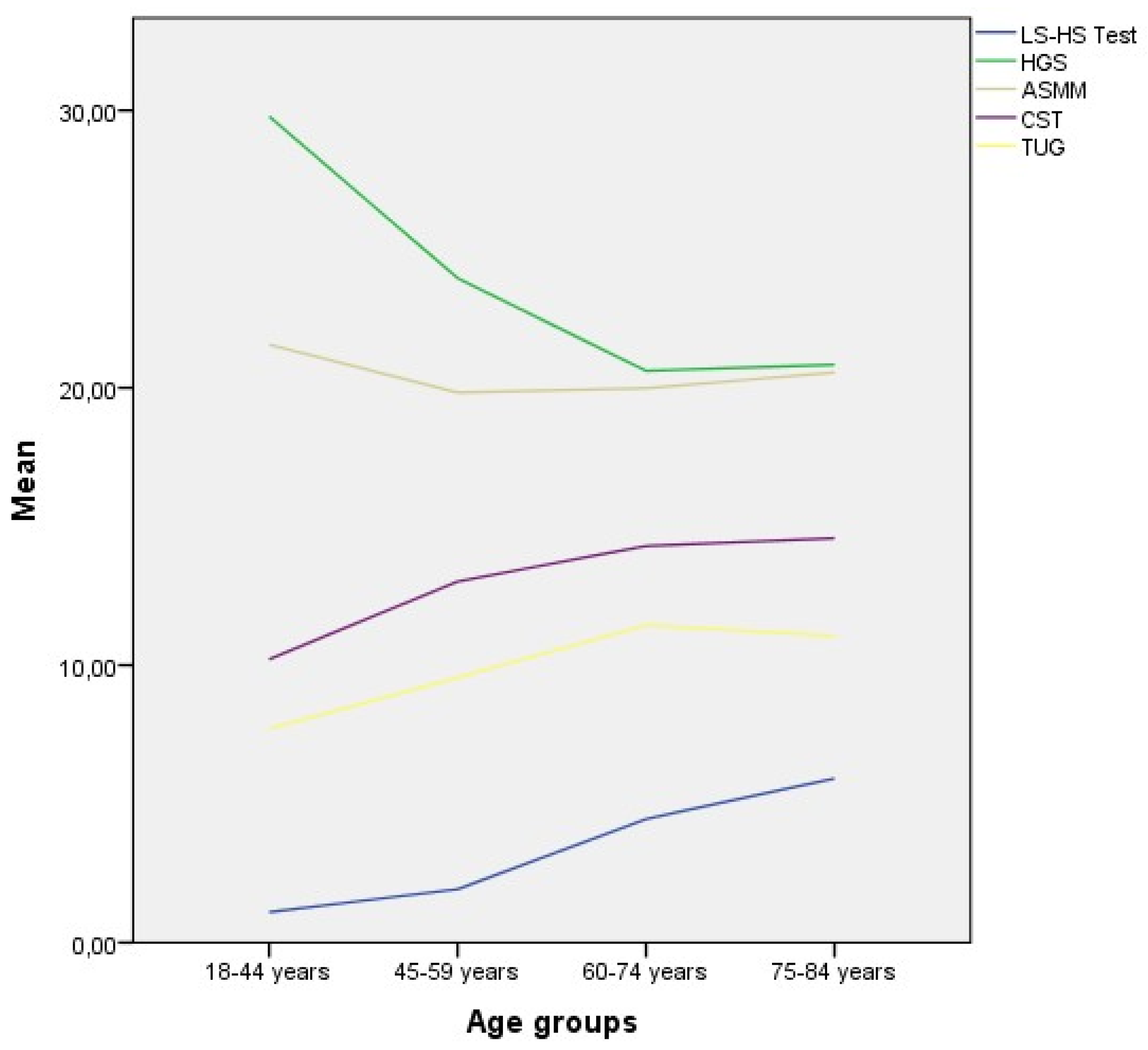
Figure 1. Comparison of Functional and Clinical Parameters Across Age Groups.
Preprints 186913 g001
Figure 2. ROC Curves for Pre-Sarcopenia, Sarcopenia, Severe Sarcopenia.
Preprints 186913 g002
Table 1. Demographic and Clinical Characteristics of All Participants.
n (%)
205 (100%)
Mean (SD) Median (Q1-Q3)
Age 56.21 (14.00) 59 (49-66)
Sex Female 151 (73.7%)
Male 54 (26.3%)
BMI 27.77 (4.34) 27.60 (24,4-30,76)
HGS 23.53 (8.83) 22 (18-28)
ASMM 20.28 (4.20) 19.60 (17.2-22.6)
Gait Speed 0.83 (0.26) 0.80 (0.67-0.96)
CST 13.09 (4.60) 12.00 (10.00-15.35)
TUG 10.07 (3.84) 9.00 (7.69-11.04)
LS-HS Test 3.05 (3.57) 2 (0-6)
Sarcopenia None 149 (72.7%)
Possible sarcopenia 33 (16.1%)
Sarcopenia 7 (3.4%)
Severe Sarcopenia 16 (7.8%)
HGS: Hand Grip Strength: ASMM: Appendicular Skeletal Muscle Mass. CST: Chair Stand Test. TUG: Timed Up and Go Test. LS-HS Test: Low Stool-High Step Test.
Table 2. Comparison of Clinical Data Between Groups.
Control Group 1 Control Group 2 Possible sarcopenia Group Sarcopenia Group p ε²
Median
(Q1-Q3)
Median
(Q1-Q3)
Median
(Q1-Q3)
Median
(Q1-Q3)
n 27 122 33 23
Age 32
(25-35)
a
58
(50-65)
bd
66
(62-72)
cd
62
(57-73)
bcd
0.001* 0.4185
Sex
n (%)
Female 18 (67%) 91(75%) 23(69.7%) 19(.682%) 0.538
Male 9 (33%) 31(25%) 10 (30.3%) 4 (17.4%)
BMI 26.56
(23.38-29.3)
abcd
28.39
(25.22-30.9)
abc
28.3
(26.49-31.22)
abc
24.4
(23.05-26.22)
ad
0.001* 0.0777
HGS 28
(21-37)
ab
23
(20-30)
ab
15
(14-19)
cd
14
(11-15)
cd
0.001* 0.4606
ASMM 20.2
(17.5-23)
abc
20
(17.5-23)
abc
19.8
(18.2-22.7)
abc
14.8
(14.4-15)
d
0.001* 0.2048
Gait Speed 0.9
(0.87-1.14)
a
0.82
(0.68-1)
bd
0.67
(0.57-0.8)
cd
0.74
(0.53-0.89)
bcd
0.001* 0.1573
CST 9.61
(8-11.06)
a
11.91
(9.57-14)
b
15.82
(12.13-20.50)
cd
15
(12.26-19)
cd
0.001* 0.2363
TUG 7.96
(6.8-8.5)
a
8.72
(7.49-10.16)
b
11.03
(9.54-14.10)
cd
11.40
(9.76-19)
cd
0.001* 0.2481
LS-HS Test 0
(0-0)
a
1
(0-4)
b
6
(2-8)
cd
6
(3-8)
cd
0.001* 0.2402
*: p<0.01. ε²: Epsilon squared. HGS: Hand Grip Strength. ASMM: Appendicular Skeletal Muscle Mass. CST: Chair Stand Test. TUG: Timed Up and Go Test. LS-HS Test: Low Stool-High Step Test. Control Group 1: Healthy people aged 18-39. Control Group 2: Healthy people aged 40-85. Possible sarcopenia Group: 40-85 aged. Sarcopenia Group: 40-85 aged. abcd; Post-hoc pairwise comparisons between subgroups were performed using the Mann–Whitney U test with Bonferroni correction. Different letters (a, b, c, d) indicate statistically significant differences between groups (adjusted p<0.125).
Table 3. Multinomial Logistic Regression Analysis for Predicting Possible Sarcopenia and Sarcopenia.
Predictor B SE Wald p Exp(B) 95% CI Lower 95% CI Upper
Category=2 (Sarcopenia Group). Referans=0 (Healty Control)
İntercept -5.19 2.319 5.009 0.025*
Age 0.067 0.024 7.775 0.005** 1.069 1.02 1.121
BMI -0.024 0.055 0.183 0.669 0.977 0.877 1.088
LS-HS Test 0.242 0.073 11.009 0.001** 1.274 1.104 1.471
Sex (1=Female) -0.792 0.551 2.065 0.151 0.453 0.154 1.334
Category=1 (Possible Sarcopenia Group). Referans=0 (ControlGroup)
Intercept 1.03 2.388 0.186 0.666
Age 0.044 0.025 3.15 0.076 1.045 0.995 1.097
BMI -0.24 0.071 11.386 0.001** 0.787 0.685 0.904
LS-HS Test 0.308 0.084 13.46 0.001** 1.36 1.154 1.603
Sex (1=Female) -0.315 0.71 0.197 0.657 0.73 0.182 2.931
*:p<0.05. **: p<0.001. LS-HS Test: Low Stool High Step Test.
Table 4. ROC Analysis for Predicting Possible Sarcopenia, Sarcopenia, and Severe Sarcopenia.
AUC (SE) p 95%CI Cut-Off Sensiv. Spesif. J
Possible Sarcopenia 0.768 (0.039) 0.001* 0.691-0.844 0.5a 0.839 0.490 0.329
2.5b 0.768 0.718 0.486
Sarcopenia 0.704 (0.059) 0.001* 0.589-0.820 2.5a 0.792 0.635 0.427
4.5b 0.667 0.773 0.440
Severe Sarcopenia 0.759 (0.057) 0.001* 0.646-0.870 5.5ab 0.765 0.793 0.558
*: p<0.01. a: Cutt off. b: Our proposed cut-off. J: Youden Index. AUC: Area Under Curve. SE: Standard error. CI: Confidence interval.
Disclaimer/Publisher’s Note: The statements, opinions and data contained in all publications are solely those of the individual author(s) and contributor(s) and not of MDPI and/or the editor(s). MDPI and/or the editor(s) disclaim responsibility for any injury to people or property resulting from any ideas, methods, instructions or products referred to in the content.
Copyright: This open access article is published under a Creative Commons CC BY 4.0 license, which permit the free download, distribution, and reuse, provided that the author and preprint are cited in any reuse.
Prerpints.org logo

Preprints.org is a free preprint server supported by MDPI in Basel, Switzerland.

Subscribe

Disclaimer

Terms of Use

Privacy Policy

Privacy Settings

© 2025 MDPI (Basel, Switzerland) unless otherwise stated