

Submitted:
27 November 2025
Posted:
28 November 2025
You are already at the latest version
Abstract
Modern 5G+grade low power wide area network (LPWAN) technologies such as Narrowband Internet-of-Things (NB-IoT) operate utilizing a multi-channel slotted ALOHA algorithm at the random access phase. As a result, the random access phase in such systems is characterized by relatively low throughput and is highly sensitive to traffic fluctuations that could lead the system outside of its stable operational regime. Although theoretical results specifying the optimal transmission probability that maximizes the successful preamble transmission probability are long known, the lack of knowledge about the current offered traffic load at the BS makes the problem of maintaining the optimal throughput a challenging task. In this paper, we propose and analyze a new reactive access barring scheme for NB+IoT systems based on machine learning (ML) techniques. Specifically, we first demonstrate that knowing the number of user equipments (UE) expierencing a collision at the BS is sufficient to make conclusions about the current offered traffic load. Then, we show that utilizing ML-based techniques, one can safely differentiate between events in the Physical Random Access Channel (PRACH) at the base station (BS) side based on only the signal-to-noise ratio (SNR). Finally, we mathematically characterize the delay experienced under the proposed reactive access barring technique. In our numerical results, we show that by utilizing modern neural network approaches, such as the XGBoost classifier, one can precisely differentiate between events on the PRACH channel with accuracy reaching 0.98 and then associate it with the number of user equipment (UE) competing at the random access phase. Our simulation results show that the proposed approach can keep the successful preamble transmission probability constant at approximately 0.3 in overloaded conditions, when for conventional NB-IoT access, this value is less than 0.05. The proposed scheme achieves near-optimal throughput in multi-channel ALOHA by employing dynamic traffic awareness to adjust the non-unit transmission probability. This proactive congestion control ensures a controlled and bounded delay, preventing latency from exceeding the system’s maximum load capacity.
Keywords:
5G
; mMTC
; CIoT
; random access
; early transmissions
; delay
; optimal resource allocation
1. Introduction
Nowadays, the contemporary Internet of Things (IoT) market is undergoing a rapid transformation [1,2]. Beyond the conventional applications utilizing massive Machine Type Communication service (mMTC) of 5G technologies, such as remote sensory equipment characterized by the asynchronous traffic demands defined in ITU-R M.2410 [3], a new generation of sophisticated services is emerging. These include critical national infrastructure applications, notably in energy grid management, forestry monitoring, and maritime logistics.
This evolution introduces a fundamental challenge: although modern 3GPP-based mMTC solutions, like Narrowband IoT (NB-IoT), successfully support extreme densities of User Equipment (UE), the increasing complexity and varied demands of these new high-value services are beginning to stress the underlying wireless infrastructure [4,5]. Consequently, the air interface itself – the shared radio medium – is rapidly approaching its capacity limit and is predicted to become a bottleneck for sustaining the required performance levels [6]. This necessitates a re-evaluation of resource management and spectral efficiency within these networks.
Due to the requirements for limited power operation of end nodes, each time a packet needs to be transmitted, a new random access attempt is performed in NB-IoT systems. Since these systems utilize multi-channel slotted ALOHA mechanism at the random access phase, their performance degrades quickly under fluctuating traffic conditions [6]. So far a number of proactive control schemes have been proposed [7]. For example, the so-called access barring techniques [8,9] proposed over the last decade classify UEs into several categories allocating access priorities to UEs, i.e., different probabilities for UEs to initiate the random access procedure when a packet needs to a ready for transmission. In spite such schemes made it to the standards, their performance heavily depends on the current traffic conditions, that is usually not know a priori. Furthermore, in light traffic conditions, they introduce unnecessary latency at the random access phase [10].
As an alternative approach, one may utilize reactive congestion control algorithms. Accordingly, base station BS may dynamically estimate the current load conditions and report the current access probability to UE to differing transmission attempt at the random access phase. The rationale behind this approach is that the optimal access probability for multi-channel ALOHA systems long known. Specifically, the authors in [11] demonstrated that the optimal transmission probability is proportional to the number of UEs competing at the random access phase, r, as , where L is the number of preambles. However, in real operational system the information about the number of active UEs competing at the random access phase is not explicitly available at either the UE or the BS. It is, however, theoretically feasible to infer it by observing the events at the PRACH channel that may provide the required information.
To obtain access to the system, NB-IoT UE chooses a preamble randomly and then transmits it over a randomly selected PRACH slot. As a result of the transmission, there might be several outcomes including: (i) incorrect reception due to collision with other UEs that have chosen the same preamble and PRACH slot, (ii) incorrect reception due to insufficient receives signal strength, and (iii) correct reception of a preamble. When the system load is significant the former type of events dominate. Despite this result having been rediscovered multiple times over the last three decades, no real system utilizes it. The rationale is that it is difficult even for BS to infer dynamically by observing the events on the PRACH channel, as the inability to correctly decode a preamble may correspond to multiple events, including no preamble transmission at all, insufficient received signal strength when no collisions happened, or collisions between two or more UEs. These events are characterized by different observed powers that are also affected by various factors, with unknown distance between UEs and BS being one of the main contributors to uncertainty. Thus, given that one can (i) differentiate between the number of UEs colliding with a given preamble and (ii) provide the relation between the number of UEs collided with a given preamble and those that had a packet ready for transmission and (iii) feedback channel, reporting a given access probability back to the UEs, one can design a reactive access barring scheme ensuring optimal performance of the NB-IoT system.
The aim of our paper is design and assess the performance of a reactive access barring technique for NB-IoT systems. To this aim, we first demonstrate there is an explicit relation between the number of UEs colliding with a given preamble and the number of UEs competing for transmission at the random access phase. Then, we assess and compare the performance of ML techniques for the identification of the number of UEs colliding with a given preamble. To this end, we first utilize detailed MATLAB simulations implementing precise preambles’ waveforms and their detection mechanisms in PRACH channel. By constructing the appropriate databases associated with different types of events in PRACH channel, we proceed to test various ML-based classification techniques, including simple models such as tree-based classifiers (tree, random forest, XGBoost) to more complex ones, including multi-layer perceptron and long short-term memory (LSTM) networks. Finally, assess the delay performance of the proposed approach mathematically.
The contributions of our study include:
- we proposed a new reactive access barring technique based of ML-based inference of the number of colliding UEs using SNR information only;
- we demonstrate that by utilizing ML approaches, one can detect the number of UEs that collide in a RACH channel with accuracy reaching .
- we show that utilizing the feedback to UEs using the NPDCCH channel, one may improve the successful preamble reception probability from to approximately and keep it consistent under overloaded system conditions.
The paper is organized as follows. We begin in Section 2 by outlining the related work made in the past. Then, in Section 3 we define our system model. There, we also establish the relation between the number of UEs colliding and the overall number of UEs attempting to access the system. In Section 4, we describe the proposed approach. The utilized simulation environment, datasets, and classification techniques for identification of the number of collided UEs is treated in Section 5. Delta delivered by the proposed scheme is derived analytically in Section 6. Numerical results are then provided in Section 7. Conclusions are drawn in the last section.
2. Related Work
In recent years, the problem of random access (RA) congestion in NB-IoT and LTE-M networks has attracted significant attention from the scientific community. As the number of connected devices increases, the likelihood of collisions at the access stage increases, negatively impacting network latency and throughput. One of the key mechanisms for regulating the load at the RA stage is Access Class Barring (ACB), which allows for managing the access probabilities of different groups of UEs, thereby preventing widespread collisions.
One of the most prominent approaches in this field is the use of machine learning and adaptive control methods. In the paper [12] the authors proposed a dynamic control mechanism for ACB parameters based on deep reinforcement learning (DRL) algorithms. The proposed approach improved network throughput by adapting to changing traffic conditions. Similar ideas were developed in the research [13], which implemented an adaptive access scheme that takes into account the current load and the priority of different device categories.
For high-density scenarios, significant attention is paid to reducing latency and managing traffic priorities. The papers [10,14] focus on load balancing and minimizing latency by introducing differentiated access probabilities for devices with different response time requirements.
Fundamental research, such as [8], analyzes the impact of ACB parameters on network performance under various traffic levels. These findings have led to more advanced solutions based on data analysis and machine learning, including [15], which uses predictive models to adapt access strategies in real time.
In terms of optimizing RA parameters, the paper [16] offers an analytical approach to configuring RA channels to minimize the likelihood of collisions. The review article [7] modern methods and highlights key areas—from classic ACB schemes to ML-based solutions.
Earlier research in the field of massive machine traffic (MTC) laid the foundation for modern solutions. In particular, [17] proposed a congestion control method for MTC networks using femtocells, and [18,19] developed the concept of Contention Resolution Queues, aimed at reducing the probability of collisions. Later, proposed distributed queuing (DQ) algorithms and load estimation, which allowed for more precise regulation of the number of active devices.
Current research extends these approaches by using intelligent optimization methods. For example, [16] optimizes preamble parameters and coverage levels, while [20] implements uplink resource allocation using RL algorithms. Similarly, research on ML for RA channel resource management demonstrates the effectiveness of such methods in congestion prediction and adaptive access control.
Already at beginning of 80s, during the beginning of wireless local area network standardization, researchers highlighted that the knowledge of the traffic load (that is, UEs having packets ready for transmission) can greatly help in designing random access protocols. However, the statistical signal processing methods available at that time were not powerful enough to provide detailed resolution for differentiating between waveform containing a certain number of collided UEs.
The performed review highlights that there have been many attempts to improve the performance of NB-IoT systems under high and/or fluctuating traffic conditions. However, most of those artificially associates UEs with a certain class, and these UEs experience larger delays even when there is no significant traffic load. In general, there are no dynamic eactive schemes proposed so far that attempt to explicitly control the amount of traffic load imposed on the network. We proposed such a mechanism and demonstrated that it is feasible.
3. System Model
In this section, we will first specify the considered scenario. Then, we will remind the utilized multi-channel ALOHA-based random access procedure utilized in NB-IoT system.
3.1. Considered Scenario
We consider the scenario shown in Figure 1 assuming a cell of circular configuration with radius R and a base station (BS) located in the geometrical center. User equipments (UE) are randomly and uniformly distributed in the cell. We explicitly concentrate on the random access over the PRACH channel.
3.2. NB-IoT PRACH Procedure
We consider a 4-step random access scheme. As specified in the NB-IoT standard [21], the User Equipment (UE) detects the NB-IoT carrier by measuring the power of the received synchronization signals on the downlink. During this process, the UE also achieves time and frequency synchronization and decodes the Cell ID. The synchronization information is transmitted at intervals ranging from 24 to 2604 [22].
Once synchronization is complete, the UE configures the PRACH and initiates uplink preamble transmissions based on network-defined parameters, including repetition count and transmission power. The number of repetitions can vary between 1 and 128. Each repetition follows a predefined frequency hopping pattern and is structured into four symbol groups, each comprising five symbols and a cyclic prefix - or , depending on the cell radius (10 or 40 , respectively). As a result, a complete random access attempt can last from to . If the preamble transmission fails, the UE will follow a retransmission timer and a retransmission limit defined by the network. Upon receiving the preamble, the BS will adjust for any time and frequency offsets and determine the timing advance (TA) for further communication. NB-IoT reserves a minimum of orthogonal preambles out of a total of 48. The data transfer phase starts with the NPDCCH sending Downlink Control Information (DCI).
3.3. Propagation Model
We assume multi-path channel with four propagation paths represented by their channel impulse response. The impulse response includes delays of 0, 1, 2 and 3 samples and corresponding amplitudes of dB with Rayleigh fading imposed on top. The path loss is computed using [23]
where to account for unique positions of the UEs and dB is constant cut-off attenuation at m. Finally, additive white Gaussian noise (AWGN) at the received was considered.
3.4. Preamble Generation and Detection
The following PRACH channel parameters were employed for modeling: (i) NPRACHFormat 0 which is default format for NB-IoT PRACH, (ii) periodicity of 160 ms defining the interval between available transmission instants on PRACH. The number of subcarriers is set to , with zero offset. The number of repetitions is set to 1, while the UE transmit power – to 23 dBm.
For preamble detection, we assume a correlation receiver on the BS side implementing detection of transmitted preambles by comparing the received pattern with stored preambles. Preamble generation is performed individually for each equipment, and both random and forced preamble index settings for collision modeling are considered. On the BS side, the signal is correlated with the reference preamble pattern. If the maximum of the autocorrelation function exceeds a predetermined threshold (set to 50% of the ideal preamble energy), the preamble is considered detected. After detection, the number of devices that have used this preamble is analyzed, and the results are classified into the following cases: (i) successful transmission, (ii) collision due to more than one UE transmitting a given preamble, and (iii) detection failure.
4. The Proposed Approach
In this section, we will introduce the proposed approach. We begin with the overall description. Then, we will establish the relation between the number of colliding UEs and the number of competing UEs at the random access phase. Finally, we will specify the BS and UE side algorithms.
4.1. Core Idea
The core idea of the proposed approach is to estimate the number of active UEs, that is, UEs that are currently competing for resources at the NPRACH channel. This can be done by identifying the outcome of the NPRACH transmission. In normal conditions, NB-IoT BS just tries to decode the preamble, and if it fails to do that, it assumes that a collision has happened. We propose to take one step further and identify how many UEs collide with a given preamble. Knowing this information, one may deduce the number of active UEs based on the expression for collision probability defined below.
4.2. Collision Probabilities
The number of UEs that successfully passed the RA phase depends on the number of active UEs in the frame. Assume that there are currently r active UEs in the system competing for NPRACH resources. Let us determine the probability that a collision occurred due to a certain number of UEs. The allocations of preambles at UEs can be expressed as follows
where L is the number of preambles at the RA phase, is the number of ways to select UEs that will fall into the specified s preambles, in which the first k UEs will go into the first preamble, the second k UEs into the 2nd, etc. But since we don’t care about the order in each group of k UEs, we divide by s times. This can be interpreted as as the number of permutations of the multiset.
Then, the number of distributions for which exactly m preambles contain k UEs is
with the probability of this event being .
According to the law of total probability, we obtain that the probability that a collision will occur with exactly k UEs in some preamble. There are way of having k UEs in 0 preambles, k UEs in one preamble, k UEs in 2 preambles, etc. up to L, respectively, which we multiply by the probability of the event that there are k UEs in some arbitrarily chosen preamble. Then, the probability that the collision due to , of colliding UEs is
4.3. BS and UE Sides Algorithms
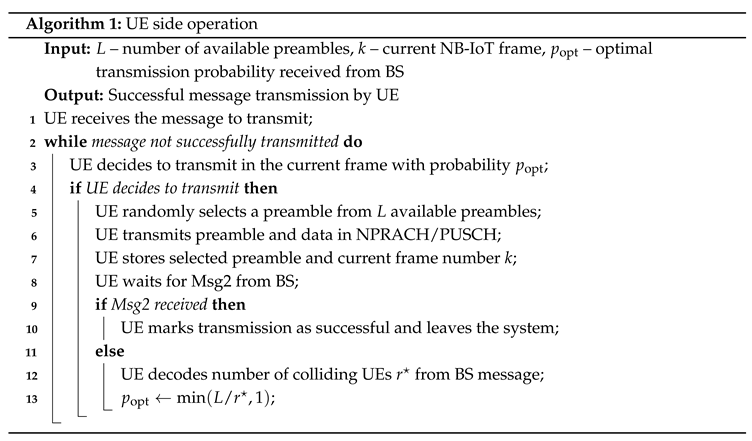
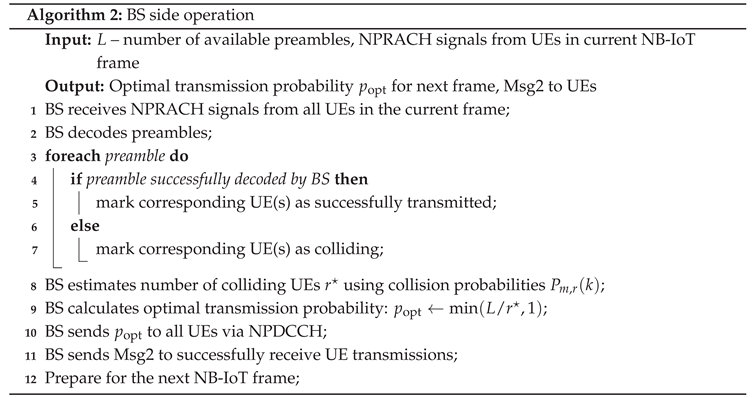
The overall procedure that is performed every NB-IoT frame is as follows: (i) estimate the number of UE colliding at the PRACH channel, , (ii) calculate the optimal transmission probability by utilizing , (iii) advertise over the NPDCCH channel. The critical task is to estimate . How to do that is discussed in the next sections.
To illustrate the detailed operations of the proposed NB-IoT RA approach, we provide two complementary algorithms that describe the procedures at both the UE and BS sides.
The UE-side procedure, presented in Algorithm 1, demonstrates how each UE participates in the RA. Specifically, it shows how UEs select preambles for transmission, monitor the feedback from the BS, and adjust their transmission probability for future frames based on the estimated number of active and colliding UEs. This algorithm captures the iterative nature of UE behavior, including handling collisions and leaving the system upon successful transmission.
The BS side procedure, shown in Algorithm 2, describes how the BS manages incoming NPRACH signals from all UEs in each frame. It includes decoding received preambles, identifying collisions, estimating the total number of active UEs using the collision probability model, and broadcasting the optimal transmission probability to all UEs through NPDCCH. Additionally, the BS sends Msg2 to UEs whose transmissions were successfully received. This algorithm provides a complete view of the BS operations and its coordination role in controlling UE access to shared resources.
Together, these algorithms present a detailed and practical view of the interaction between UEs and the BS in every NB-IoT frame. They bridge the theoretical analysis of collision probabilities and active UE estimation with the operational steps required to implement the proposed approach. By following these algorithms, the overall system efficiently adapts the UE transmission probabilities and manages collisions, ensuring improved performance in the RA phase.
5. Collision Estimation Procedure
In this section, we first describe the simulation environment and data generation procedure. Then, we will introduce the considered ML algorithms. Finally, the training and testing datasets and metrics of interest are introduced.
5.1. Dataset Generation
We carry out our simulation campaign of the NPRACH procedure in MATLAB environment using an extension of the LTE Toolbox for NB-IoT. The main attention is paid to the physical layer (PHY) signal transmission at the NPRACH channel when one or more active UEs pass the random access phase. Simulation modeling has been carried out in MATLAB R2024b environment, using built-in LTE Toolbox functions, including lteNPRACH, designed to generate NB-IoT PRACH signals according to 3GPP TS 36.211. The model covers time slot generation, signal propagation, special effects including fading, thermal noise, and signal processing at the BS.
For each transmission in the random access scenario, a time series of samples of the received signal on the BS side is formed, represented as a sequence of complex numbers: , where is a fixed number of samples in the time domain. Each sample reflects the amplitude value of the complex radio signal received at evenly spaced moments in time during a single preamble transmission. These time series reflect the amplitude and phase structure of the signal at the receiving end and carry information about both the presence of collisions (overlapping preambles from different UEs). These data are collected for each transmission simulation and subsequently used as input features to ML algorithms to automatically detect collisions and recognize the channel state based on the received signal waveform.
In order to construct the dataset, the simulation is carried out according to the following. In each simulation run, we model transmission of j, UEs. The maximum coverage of was set to m. The distances to UEs were chosen to follow a uniform distribution in the coverage area BS with probability density function (pdf) , . For each number of UEs we performed 1000 runs each time generating N time samples , . To account for differences in preamble structure, we forced the cycled use of preambles, where in the first run, the first preamble was chosen, in the second run – second preamble, etc. When the number of UEs is greater than one, we force all UEs to choose the same preamble. These data are used as features for training models based on machine learning algorithms.
The measured amplitude time-series one, three and 5 UEs choosing the same preamble is chosen in Figure 2. Here, one may observe that with the increase of the number of UEs choosing the same preamble the mean amplitude increases signaling a possibility for differentiating between the number of colliding UEs using even simple classifiers such as conventional trees or random forests.
5.2. Utilized ML Techniques
We consider several ML algorithms having various degrees of training and execution complexity. Those having low complexity include one of the most potent decision tree (DT) algorithm, XGBoost [25], and random forest (RF). DT and RF operate using features extracted from the data and may miss patterns that be present in the time-series. Thus, as an alternative, we will consider long-short term memory (LSTM) networks, which capture the spatial structure of the data.
5.2.1. XGBoost
XGBoost is currently one of the strongest machine learning algorithms used for classification and regression tasks. It represents the construction of decision trees with gradient boosting. The scheme of its operation looks like this: the first decision tree is built, which may contain a large error in calculations, after which a new tree is built, which should minimise the error of the previous one. Then a new tree is built again, which aims to correct the errors of all existing trees. The process continues until we minimise the resulting error. The final result will be the sum of predictions of all trees.
5.2.2. Random Forest
Random Forest is one of the machine learning methods that can improve accuracy and significantly reduce the probability of model overfitting. The algorithm creates several subsamples from the training data using bootstrap method. For each subsample, a separate decision tree is built, and they can have different structures and parameters, as each tree is trained on its own subsample of data. In addition, the trees are not pruned, unlike the method with a single decision tree. When solving a classification problem, the final result is usually the one for which the trees gave the most votes. Also, the final result can be calculated through the median: , where is the solution of the i-th tree. In this way, the strong influence of noise can be avoided, and the sensitivity to outliers can be reduced. Due to its high accuracy and ability to handle outliers well, random forest remains one of the most sought-after machine learning methods.
5.2.3. LSTM Neural Networks
LSTM is a special type of recurrent neural network (RNN) designed to handle sequential data and solve the vanishing gradient problem that often occurs in conventional RNNs. They have been designed to handle and predict sequences, that is, data that is time-dependent. The main point of its operation is as follows: LSTM can remove and write information to the cell state using special structures called gateways. There are three main gates that help to control the cell state. The first layer is the forget gate layer. It is a sigmoidal layer that determines what information can be removed from the cell state. The next step is to update the cell state, this layer consists of two parts: the input gates layer, which determines which values need to be updated, and then the tanh layer builds new values to replace the old ones with. In the final step, we implement all the above actions, that is, we change the state of the cell: forgetting unnecessary values and updating the data. Most of the outstanding results that have brought RNNs to mankind have been achieved thanks to LSTM, as this neural network makes inferences considering all previous events. These are networks that contain feedbacks and allow information to be stored for future work.
5.3. Task, Features, and Metrics
Formally, the goal of the introduced ML techniques is to perform multi-class classification of the received NPRACH waveforms. For the LSTM network, the input data are the time-series obtained in simulations. However, for XGBoost, and DT we define the following features that are extracted from the time-series data: (i) mean, (ii) standard deviation, (iii) values of the autocorrelation function at lag-1, and (iv)summed periodogram. The latter is defined via the sum of short-term Fourier transform (STFT)
where represents the STFT magnitude at time m and the frequency , is the -th sample of the time window , is the n-th sample of the window function.
Figure 3 illustrates the behavior of the selected features for classification averaged over time and experiments. As one may observe all the selected features have strictly increasing behavior as the number of UEs colliding increases. While the trends was expected for mean and standard deviation based on the data presented in Figure 2, even summed periodogram and lag-1 NACF values increase. Another important observe we observe is that starting from approximately 5 UEs choosing the same preamble considered statistical properties do not vary much. It implies that simple classification techniques, such as trees and random forest may struggle to distinguish between considered cases. To this end, we also utilize the LSTM that works directly with the time series illustrated in Figure 2, attempting to find hidden behavior.
To evaluate the performance of the proposed algorithms we utilize two metrics: (i) accuracy and (ii) F1. The former metric measures the proportion of correctly classified examples out of the entire dataset and is calculated as , where is the number of correctly classified examples in all the categories, N is the total number of examples. The F1 score combines precision and recall into a single measure by calculating their harmonic mean. This balances the impact of these metrics on the model’s quality assessment, making the F1 score useful when both performance aspects are important. We estimated the F1 for each class k as
where precision for class k, , and recall for class k, , are calculated as
where is the number of true positive predictions for class k, is the number of false positive predictions for class k, is the number of false negative predictions.
6. Delay Assessment
In this section, we will evaluate the random access phase delay associated with the proposed approach. To this aim, consider first the Markov chain describing the number of active UEs at the RA phase. Since is non-reversible, we aggregate all states with a number of active UEs greater than a threshold R in one absorbing state . As a result, becomes an absorbing Markov chain, and its transition probability matrix can be represented as:
where is matrix that reflects the transitions between transient states, is the exit vector to the absorbing state, and is the row-vector of zeros.
The state transition diagram of the considered Markov chain is illustrated in Figure 4. Observe that there are two types of events that cause a state transition at the RA phase. We summarize them below, together with the corresponding probabilities, assuming that the system is initially in state i and in the next frame it moves to state j, i.e., . Note that these events can occur separately or simultaneously. The following events may occur:
- (1)
- Arrival of new UEs. If new UEs arrive when there are i UEs at the RA phase, then there will be j UEs in total in the system.
- (2)
- Successful UEs allocation to preambles and UEs redirection to DT phase. In this case, the out of i UEs will successfully pass the RA phase.
If both events happen simultaneously, then k UEs are successfully allocated to preambles and redirected to the DT phase, and thus new UEs enter the system.
The probability that i out of j active UEs, that are ready to transmit, will transmit, has a binomial distribution, that is
where is the transmission probability with j UEs ready to transmit.
Utilizing the abovementioned observations, the transition probabilities between the transient states are as follows:
for .
Since is a stochastic matrix, the elements of exit vector complement the row sums to one, that is,
where is the unit matrix and is a row vector of ones.
Let start from an empty state with no active UEs. Then the initial vector is . According to the theory of absorbing Markov chains, the average number of steps before absorption is given by [26]
where is the fundamental matrix, .
Finally, multiplying (13) by we obtain the average time before absorption, i.e.,
By utilizing (14), we can make the guided choice of the threshold R allowing us to decrease the computational complexity of the model. To this end, Figure 4 shows the mean time before absorption for the system with preambles as a function of R for different values of arrival rates. As one can observe, at approaches a constant. This effect can be interpreted such that after reaching UEs, the number of active UEs at the random access phase almost surely goes to infinity in a very short time period. Thus, choosing R twice the number of preambles is sufficient.
The fundamental matrix N has a probabilistic interpretation [26]. Specifically, its elements represent the mean number of visits to state j if the initial state was i. This fact can be used to obtain the transient probabilities , as
To obtain the mean delay of packets in the system, we utilize Little’s law. The mean number of UEs at the RA phase,
then the mean delay is immediately given by
7. Numerical Results
In this section, we present our results. We begin with statistical data analysis of the obtained waveforms and defined features. Then, we will proceed with the assessment of accuracy and F1 metrics for single-class and multi-class classifications of collisions on the NPRACH channel.
7.1. Classification Performance
We begin reporting our classification results by observing the accuracy, precision and recall metrics illustrated in Figure 5 for classifying collisions with UEs at the PRACH channel, where 1 implies that the preamble has been successfully received. Observe that accuracy is determined for overall classification, while recall and precision are specified for each class. Observing the data shown in Figure 5a, we see that out of the considered techniques, XGBoost provides the best accuracy of around 0.98, with LSTM lagging slightly behind, providing accuracy of 0.96. The worst accuracy is observed for the Random Forest classifier barely reaching 0.5. Precision and recall show in Figure 5b,c highlights that the latter fails mainly in determining the preamble successful reception probability, while the other two algorithms operate almost perfectly, not allowing for misinterpreting classes. Since LTSM is generally associated with a complex learning phase as compared to XGBoost, the latter is used in what follows.
To demonstrate the versatility of our approach, we now report we accuracy for two different NB-IoT BS coverage areas of 700 and 4000 m in Figure 6a, investigate the dependence of the accuracy of the learning data size in Figure 6b, and classify the feature contribution into the decision making of XGBoost in Figure 6c. First of all, we observe that the proposed classification works well for both considered call sizes, providing comparable high accuracy. Secondly, we see that the classification can also be extended to extremely overloaded systems, correctly classifying up to 7 simultaneous preamble transmissions in the same PRACH resources a slight degradation in the accuracy metric. Furthermore, the accuracy barely depends on the learning dataset size as indicated in Figure 6b. Finally, in Figure 6c we observe that the most weight into the decision of XFBoost classifier in introduced by the variance and mean of the waveform.
7.2. NB-IoT System Performance
In this section, we will illustrate NB-IoT system’s performance operating using the proposed approach and compare it to that of conventional operation. To this end, we utilized the MATLAB modeling tool to simulate these two operational regimes. Here, UEs in the coverage area of the NB-IoT BS have been uniformly distributed. The time interval between arrivals follows exponential distribution resulting in Poisson arrival process. All UEs were completely decentralized. We embedded our algorithm at the BS side, and it detects the number of collisions happening in the preceding frame at the PRACH by utilizing the XGBoost algorithm and advertises this number as a part of the DCI message in the PDCCH. UEs then estimate the optimal transmission probability by utilizing (5) and competes for PRACH resources in the next frame with probability , where L is the known number of preambles, is the number of UEs competing at the random access phase. The rest of the parameters followed the scenario defined ITU-R M.2412.
The successful preamble reception probability as a function of the time interval between arrivals at a single UE is shown in Figure 7. As one may observe, the conventional NB-IoT RAVH procedure results in extremely low preamble successful reception probability up until s, where it starts to increase. Contrarily, we observe that the proposed approach allows us to maintain a consistent successful preamble reception probability across this region.
7.3. Delay Performance
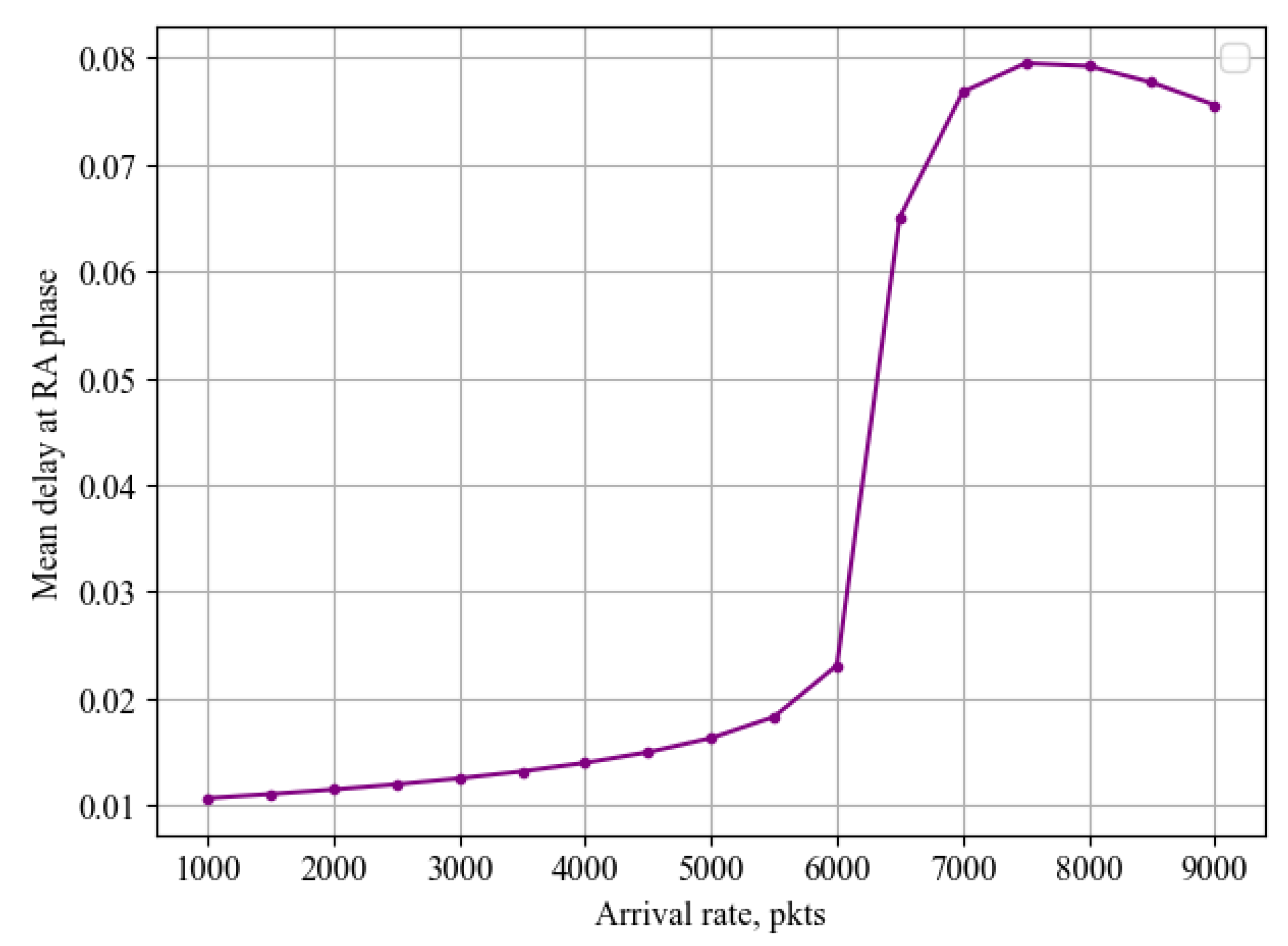
In this section, we will report on the delay performance of the system that utilizes the proposed scheme. To this end, Figure 8 shows the the delay as a function of the arrival rate of packets. As one may observe the overall curve reminds that reported in Figure 7 for the optimal transmission probability. Here, we see that the delay remains low for low arrival rate. This is a region where the system is not overloaded, and the transmission probability is not affected by the BS. Once the system starts to enter the overloaded regime which happens quite quickly, the proposed system based on the identification of the number of UEs experiencing collisions comes into play. We see that it allows the delay to rise till 8 ms and then stabilizes it at this value.
8. Conclusions
Nowadays, mMTC technologies providing coverage to numerous sensing devices are becoming more and more critical for various services, including remote monitoring and control, state update applications, etc. In such systems random access phase, generally implemented using multi-channel ALOHA algorithm, is the major bottleneck. It is known that this algorithm is characterized by the optimal number of UEs competing for access that maximizes the capacity of the system. Knowing the number of UEs competing for access is thus critical for optimizing the performance of the random access phase in mMTC technologies.
In this paper, we propose a novel dynamic access barring technique based on the estimation of the number of UEs competing for resources at the preamble transmission phase. Specifically, by utilizing ML techniques we proposed to deduce the current number of active UEs at the random access phase by observing the waveform of the NPRACH channel. Then, having the analytical expression providing the collision probability for the multi-channel ALOHA mechanism, we probabilistically estimated the number of UEs competing at the random access phase. This information is dynamically returned to the UEs competing for access.
Our numerical results illustrate that the proposed scheme allows for dynamically keeping track of the offered traffic load and induces the non-unit transmission probability when it increases to a certain level, optimal for the maximum performance of the multi-channel ALOHA scheme. The delay in the proposed scheme is kept controlled at the level corresponding to the maximum load that can be handled by the multi-channel ALOHA system.
Author Contributions
Conceptualization, A.D.,V.B. and E.S; methodology, E.S.; software, V.B., A.D; validation, A.D., E.S. and J.K; formal analysis, A.D.; investigation, V.B.; resources, E.S.; data curation, A.D.; writing – original draft preparation, J.K., V.B. and K.S; writing – review and editing, A.D.; visualization, A.D.; supervision, K.S.; project administration, K.S; funding acquisition, V.B. All authors have read and agreed to the published version of the manuscript.
Conflicts of Interest
The authors declare no conflict of interest.
References
- Vetrivel, S.; et al. {IoT} Market Dynamics: An Analysis of Device Sales, Security and Privacy Signals, and their Interactions. In Proceedings of the 33rd USENIX Security Symposium (USENIX Security 24); 2024; pp. 7031–7048. [Google Scholar]
- Ometov, A.; Masek, P.; Moltchanov, D. Connecting Cargo Ships to the Shore: Future of NB-IoT for Maritime Communications. IEEE Internet of Things Magazine 2025, 8, 142–148. [Google Scholar] [CrossRef]
- ITU-R. Minimum requirements related to technical performance for IMT-2020 radio interface. M.2410-0, ITU-R, 2017.
- Stusek, M.; Stepanov, N.; Moltchanov, D.; Masek, P.; Mozny, R.; Turlikov, A.; Hosek, J. Optimizing NB-IoT communication patterns for permanently connected mMTC devices. In Proceedings of the 2022 IEEE Wireless Communications and Networking Conference (WCNC). IEEE; 2022; pp. 1413–1418. [Google Scholar]
- Stepanov, N.; Moltchanov, D.; Turlikov, A. Modeling the NB-IoT transmission process with intermittent network availability. In Proceedings of the International Conference on Next Generation Wired/Wireless Networking. Springer; 2020; pp. 241–254. [Google Scholar]
- Masek, P.; Moltchanov, D.; Stusek, M.; Mozny, R.; Koucheryavy, Y.; Hosek, J. Quantifying NB-IoT Performance in 5G Use-Cases With Mixture of Regular and Stochastic Traffic. IEEE Internet of Things Journal 2024. [Google Scholar] [CrossRef]
- Iiyambo, L.; Hancke, G.; Abu-Mahfouz, A.M. A survey on NB-IoT random access: Approaches for uplink radio access network congestion management. IEEE Access 2024, 12, 95487–95506. [Google Scholar] [CrossRef]
- Ramineni, C.; Tiruchirai Gopalakrishnan, V. Impact of access class barring in narrow band internet of things. IET Wireless Sensor Systems 2019, 9, 399–404. [Google Scholar] [CrossRef]
- Mozny, R.; Masek, P.; Stusek, M.; Zeman, K.; Ometov, A.; Hosek, J. On the performance of narrow-band Internet of Things (NB-IoT) for delay-tolerant services. In Proceedings of the 2019 42nd International Conference on Telecommunications and Signal Processing (TSP). IEEE; 2019; pp. 637–642. [Google Scholar]
- Liu, W.; Zhang, J.; Sun, X.; Zhu, H. Delay-Aware Dynamic Barring Scheme for Massive Access in NB-IoT Network. In Proceedings of the International Wireless Internet Conference. Springer; 2017; pp. 160–170. [Google Scholar]
- Galinina, O.; et al. Stabilizing multi-channel slotted aloha for machine-type communications. In Proceedings of the 2013 IEEE International Symposium on Information Theory. IEEE; 2013; pp. 2119–2123. [Google Scholar]
- Hadjadj-Aoul, Y.; Ait-Chellouche, S. Access control in NB-IoT networks: A deep reinforcement learning strategy. Information 2020, 11, 541. [Google Scholar] [CrossRef]
- Narayanan, S.; Tsolkas, D.; Passas, N.; Merakos, L. ADAM: An adaptive access mechanism for NB-IoT systems in the 5G era. IEEE Access 2021, 9, 109915–109931. [Google Scholar] [CrossRef]
- Miao, Y.; Tian, Y.; Cheng, J.; Hossain, M.S.; Ghoneim, A. RADB: Random Access with Differentiated Barring for Latency-Constrained Applications in NB-IoT Network. Wireless Communications and Mobile Computing 2018, 2018, 6210408. [Google Scholar] [CrossRef]
- Caso, G.; Kousias, K.; Alay, Ö.; Brunstrom, A.; Neri, M. NB-IoT random access: Data-driven analysis and ML-based enhancements. IEEE Internet of Things Journal 2021, 8, 11384–11399. [Google Scholar] [CrossRef]
- Harwahyu, R.; Cheng, R.G.; Wei, C.H.; Sari, R.F. Optimization of random access channel in NB-IoT. IEEE Internet of Things Journal 2017, 5, 391–402. [Google Scholar] [CrossRef]
- Tsai, A.H.; Wang, L.C.; Huang, J.H.; Lin, T.M. Overload control for machine type communications with femtocells. In Proceedings of the 2012 IEEE Vehicular Technology Conference (VTC Fall). IEEE; 2012; pp. 1–5. [Google Scholar]
- Laya, A.; Alonso, L.; Alonso-Zarate, J. Contention resolution queues for massive machine type communications in LTE. In Proceedings of the 2015 IEEE 26th annual international symposium on personal, indoor, and mobile radio communications (PIMRC). IEEE, 2015, pp. 2314–2318.
- Bui, A.T.H.; Nguyen, C.T.; Thang, T.C.; Pham, A.T. A novel effective DQ-based access protocol with load estimation for massive M2M communications. In Proceedings of the 2017 IEEE Globecom Workshops (GC Wkshps). IEEE; 2017; pp. 1–7. [Google Scholar]
- Alcaraz, J.J.; Sanchez-Aarnoutse, J.C.; Gonzalez-Castaño, F.J.; et al. Random Access Control in NB-IoT With Model-Based Reinforcement Learning. IEEE Internet of Things Journal 2024. [Google Scholar] [CrossRef]
- 3GPP. LTE; Evolved Universal Terrestrial Radio Access (E-UTRA); LTE Physical Layer;. TS 36.201 V14.1.0. ETSI, 2017.
- Adhikary, A.; Lin, X.; Wang, Y.P.E. Performance evaluation of NB-IoT coverage. In Proceedings of the 2016 IEEE 84th Vehicular Technology Conference (VTC-Fall). IEEE; 2016; pp. 1–5. [Google Scholar]
- Mozny, R.; Masek, P.; Moltchanov, D.; et al. Characterizing optimal LPWAN access delay in massive multi-RAT smart grid deployments. Internet of Things 2024, 25, 101001. [Google Scholar] [CrossRef]
- Lin, G.Y.; Chang, S.R.; Wei, H.Y. Estimation and Adaptation for Bursty LTE Random Access. IEEE Transactions on Vehicular Technology 2016, 65, 2560–2577. [Google Scholar] [CrossRef]
- Chen, T.; Guestrin, C. system. In Proceedings of the Proceedings of the 22nd acm sigkdd international conference on knowledge discovery and data mining, 2016, pp.
- Kemeny, J.G.; Snell, J.L.; et al. Finite markov chains; Vol. 26, van Nostrand Princeton, NJ, 1969.
Figure 1.
The considered mMTC deployment.
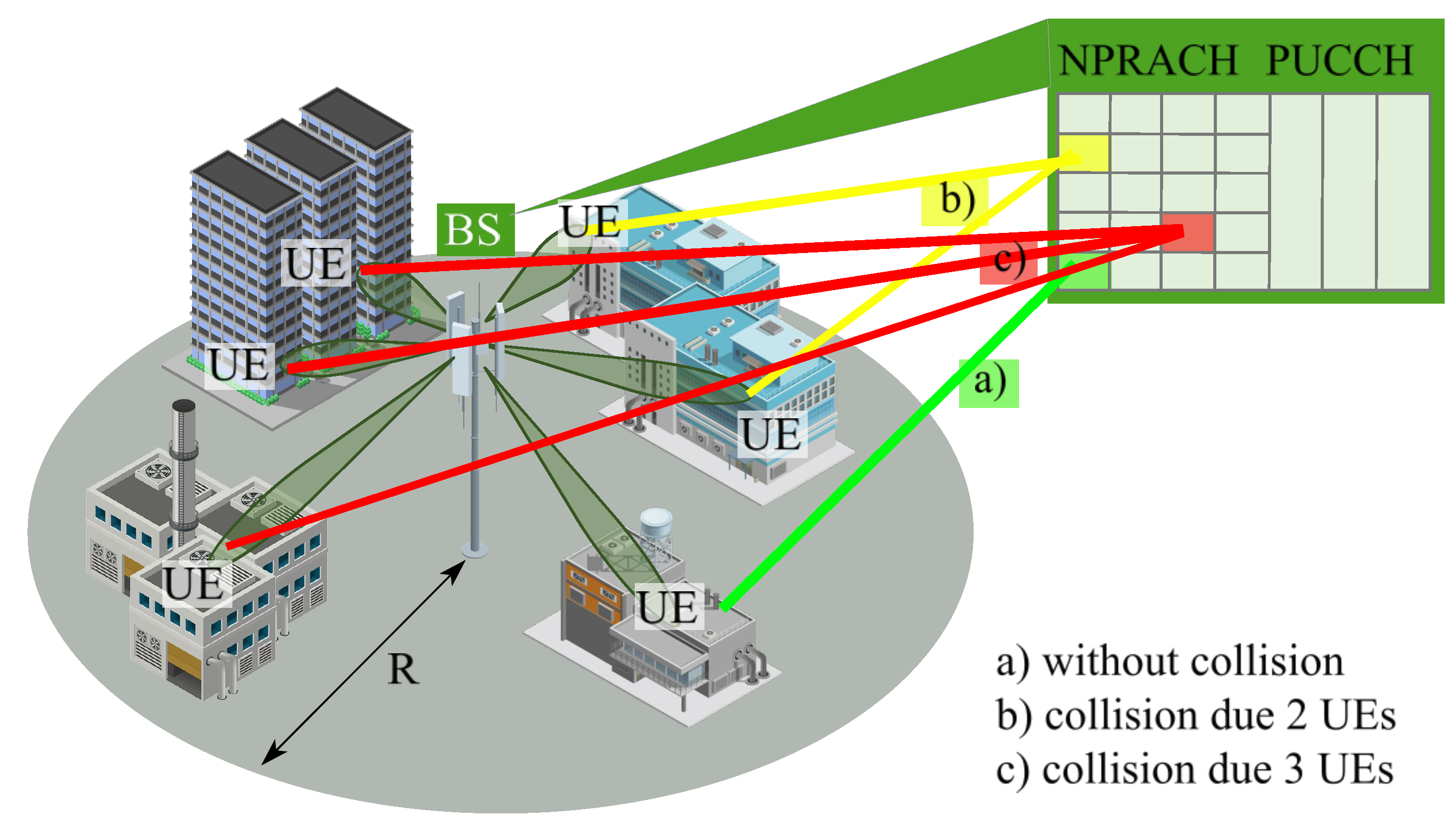
Figure 2.
Amplitude for NPRACH with 1, 3, and 5 UEs in collision.
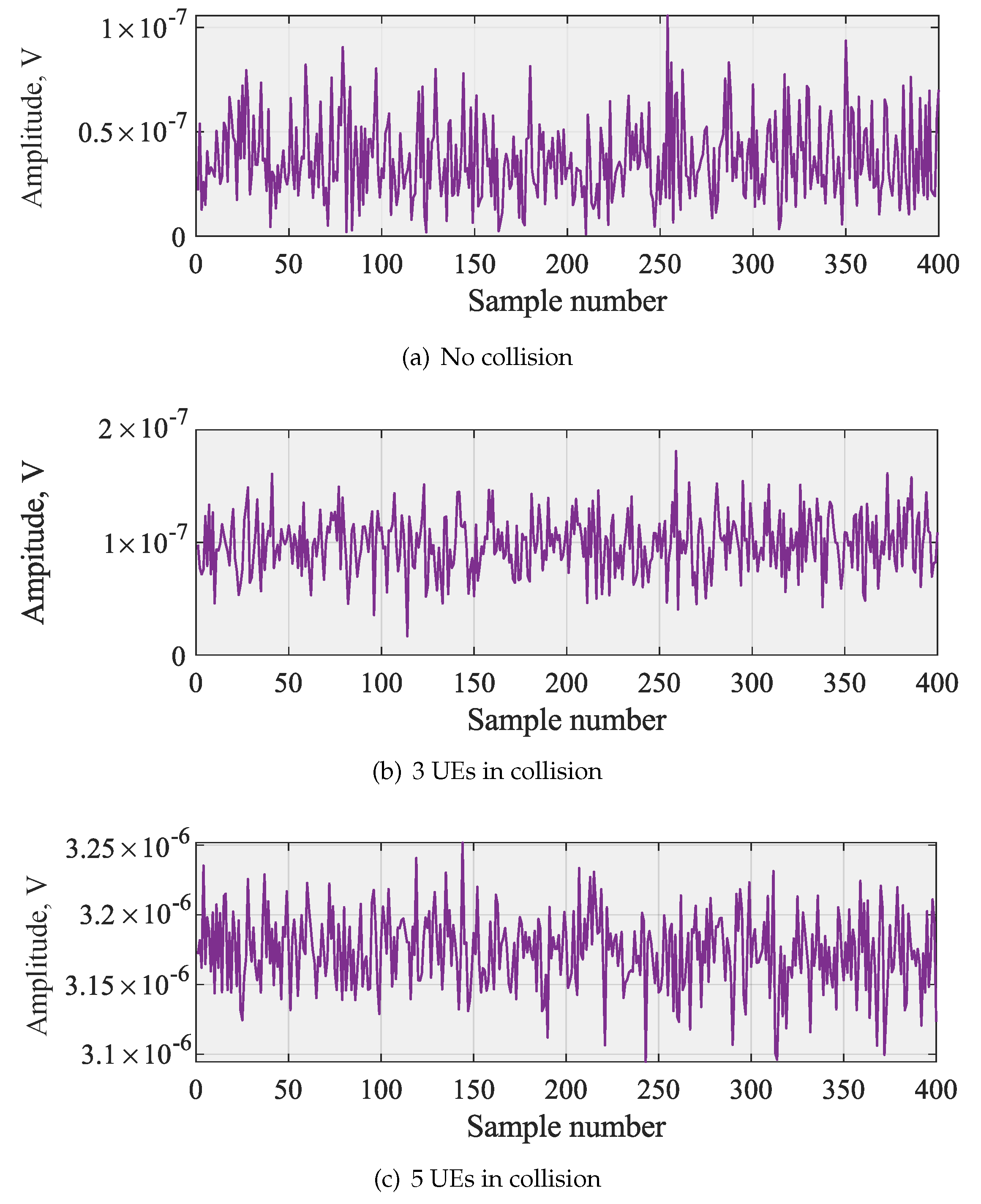
Figure 3.
Averaged features under different numbers of colliding UEs.
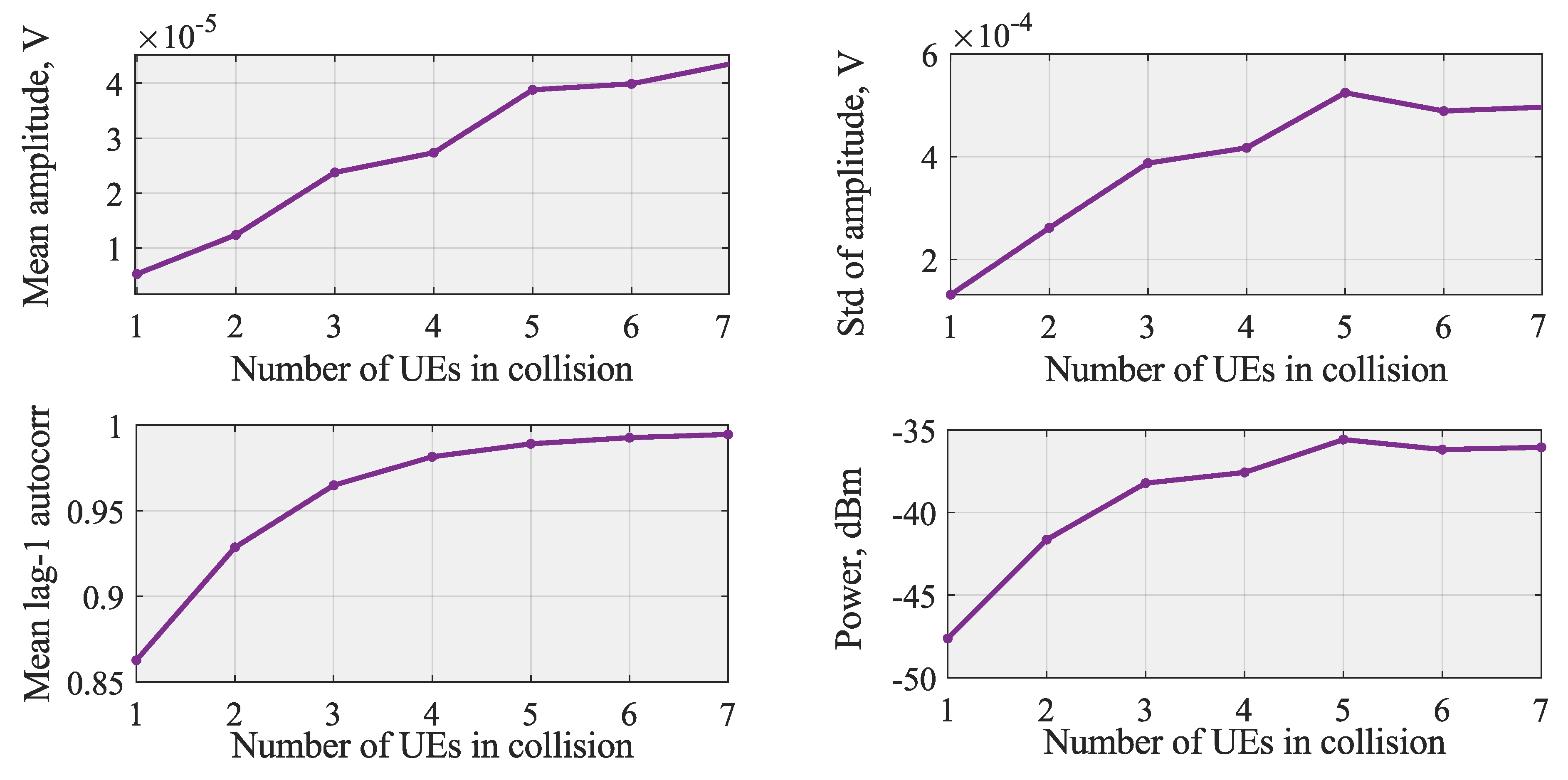
Figure 4.
State transition diagram of the RA phase model.
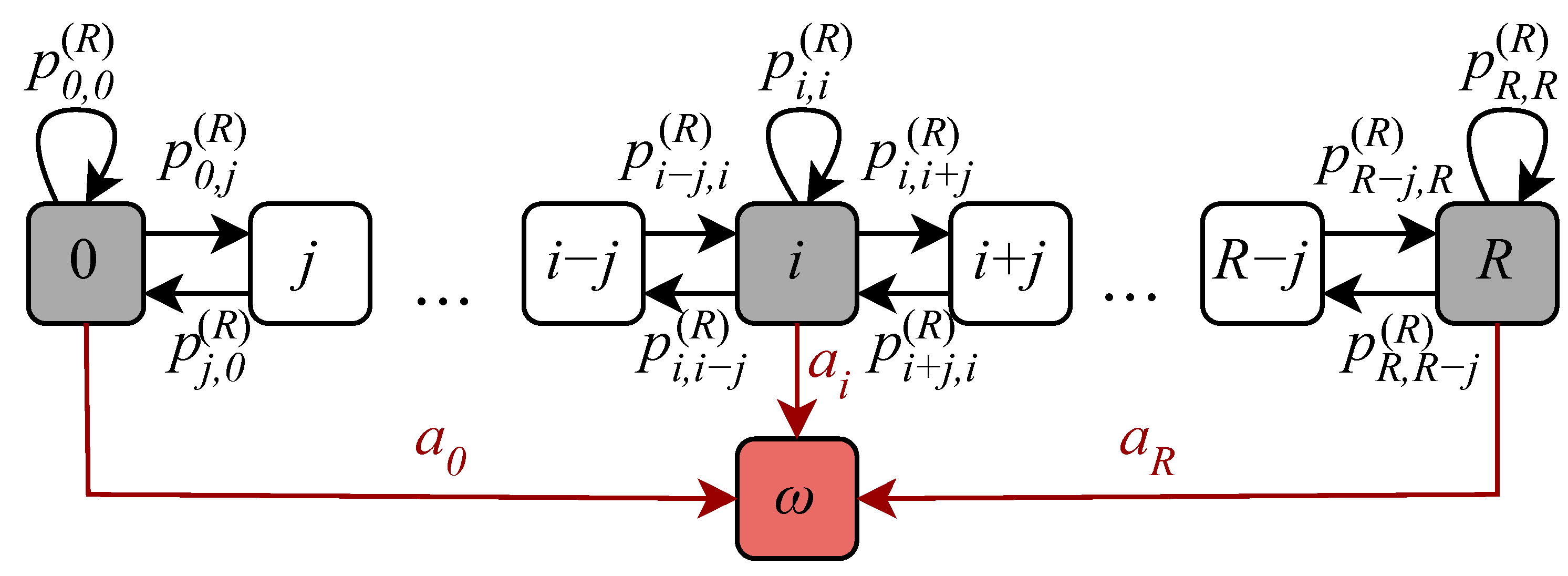
Figure 5.
Accuracy, precision and recall metrics for classifying collisions with UEs at the PRACH channel.
Figure 5.
Accuracy, precision and recall metrics for classifying collisions with UEs at the PRACH channel.
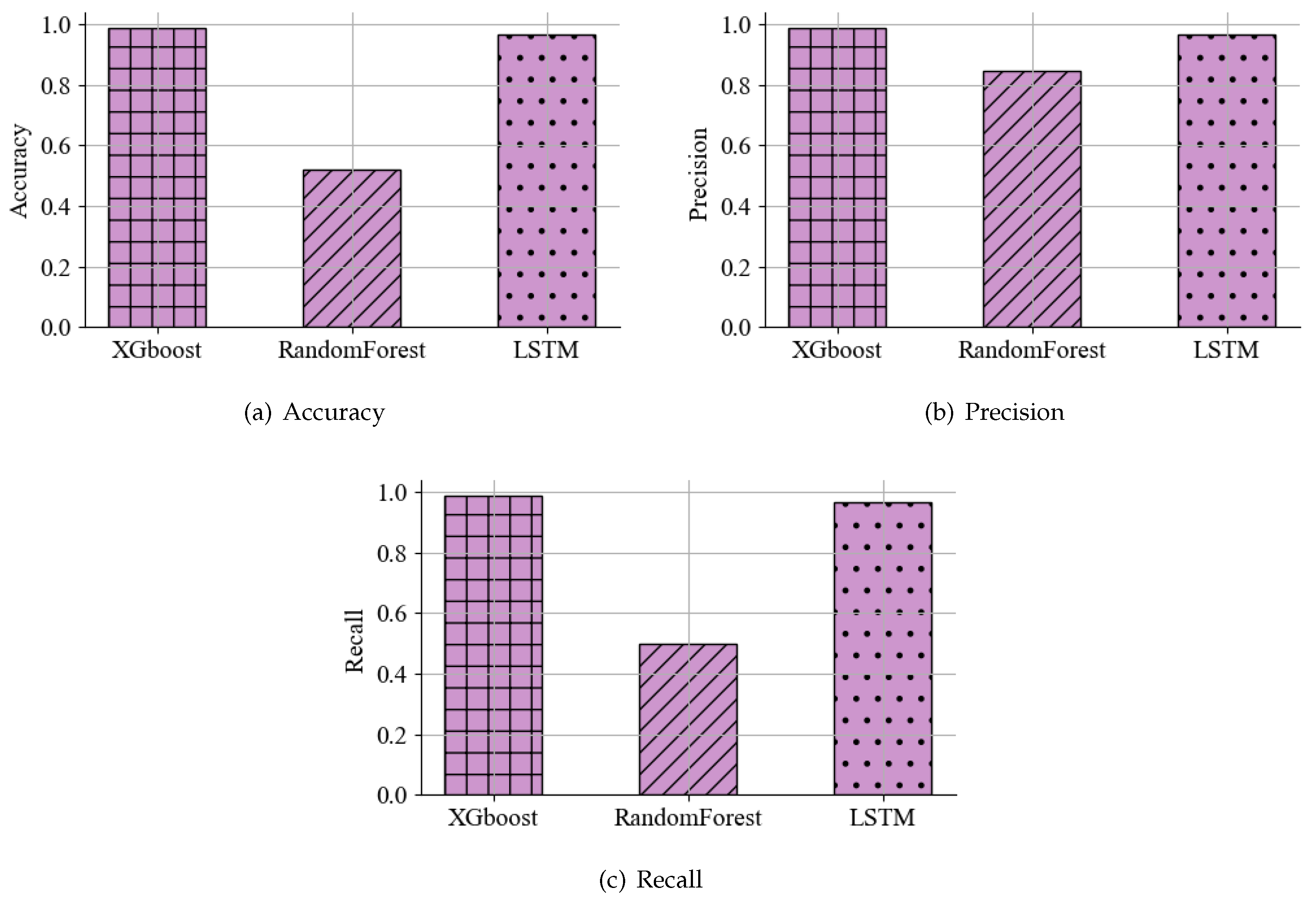
Figure 6.
Classification performance for other systems and XGBoost classifier parameters.
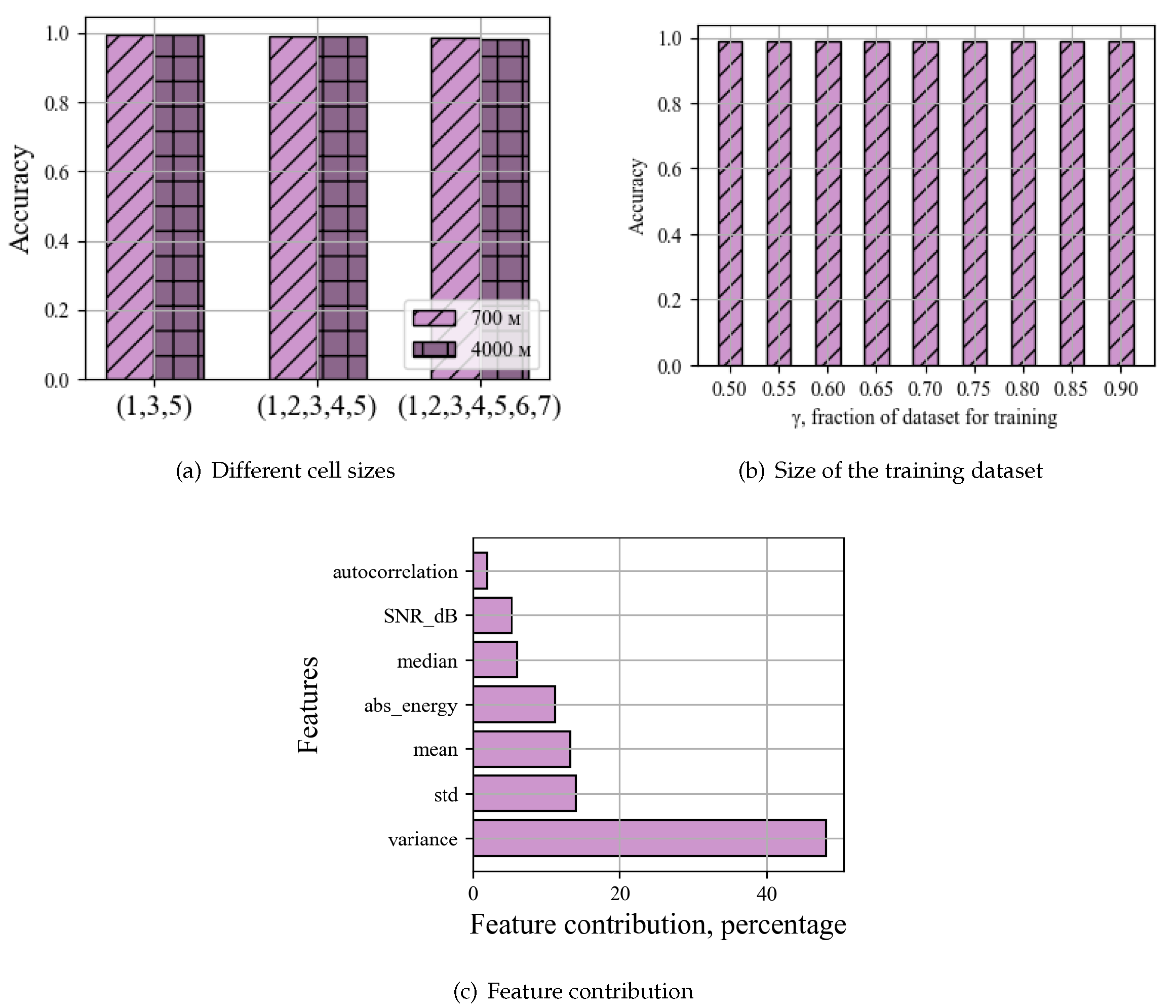
Figure 7.
Successful preamble reception probability for considered modes.
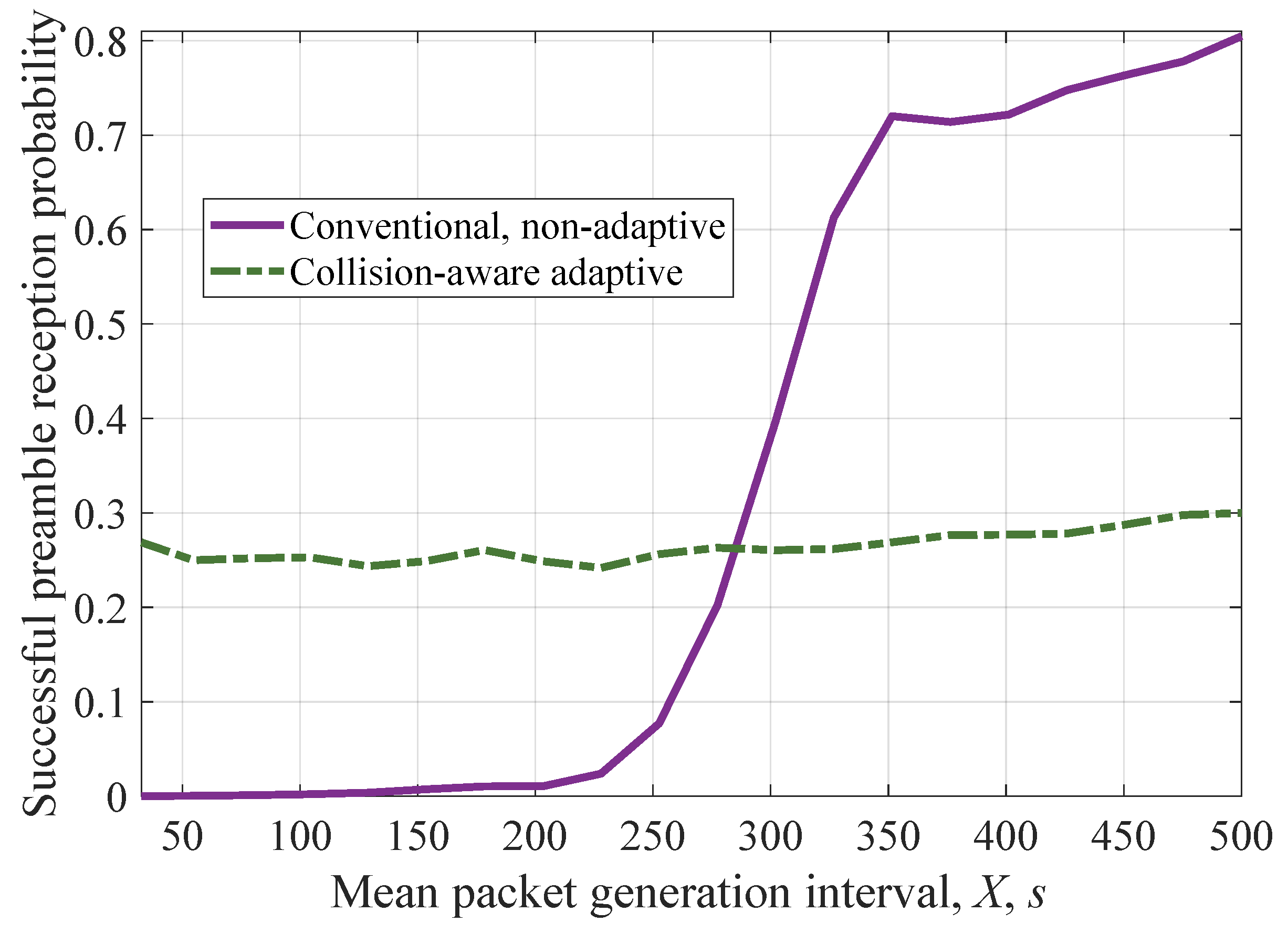
Figure 8.
Delay performance under the proposed scheme.
Disclaimer/Publisher’s Note: The statements, opinions and data contained in all publications are solely those of the individual author(s) and contributor(s) and not of MDPI and/or the editor(s). MDPI and/or the editor(s) disclaim responsibility for any injury to people or property resulting from any ideas, methods, instructions or products referred to in the content. |
© 2025 by the authors. Licensee MDPI, Basel, Switzerland. This article is an open access article distributed under the terms and conditions of the Creative Commons Attribution (CC BY) license (http://creativecommons.org/licenses/by/4.0/).
Copyright: This open access article is published under a Creative Commons CC BY 4.0 license, which permit the free download, distribution, and reuse, provided that the author and preprint are cited in any reuse.


