

Submitted:
22 November 2025
Posted:
24 November 2025
You are already at the latest version
Abstract
The global citrus processing industry generates 15–32 million tonnes of waste annual-ly, representing substantial environmental and economic burdens. However, lemon processing residues—peels, seeds, and pomace—constitute complex matrices rich in high-value compounds, amenable to cascade valorisation within circular biorefinery frameworks. This comprehensive review examines current trends in green extraction technologies for recovering bioactive compounds and functional materials from lemon waste streams. Following systematic bibliometric analysis of 847 publications span-ning 2003–2025, this work delineates the compositional heterogeneity of lemon frac-tions, quantifies typical industrial residue yields, and establishes a hierarchical framework for value-added products encompassing essential oils, pectin, polyphenols, seed oils, citric acid, industrial enzymes, α-cellulose, and nanocrystalline cellulose. Particular emphasis is placed on emerging sustainable extraction methodolo-gies—including ultrasound-assisted extraction, microwave-assisted extraction, super-critical fluid extraction, and enzyme-assisted extraction—which demonstrate yield improvements of 16–112% compared to conventional approaches whilst reducing en-ergy consumption by up to 95%. Critical research gaps are identified, including frag-mented valorisation approaches, insufficient techno-economic assessment, and limited industrial implementation at commercial scales. This review establishes that integrat-ed cascade biorefineries employing sequential green extraction protocols offer eco-nomically viable pathways for transforming lemon processing waste into diversified revenue streams, thereby advancing circular economy principles within the citrus in-dustry.
Keywords:
Citrus × limon
; lemon peel waste
; biorefinery
; cascade valorisation
; ultrasound-assisted extraction
; microwave-assisted extraction
; supercritical fluid extraction
; pectin
; d-limonene
; nanocrystalline cellulose
1. Introduction
1.1. Global Food, Agricultural, and Agro-Industrial Waste: Volumes and Economic Implications
The global food system generates staggering quantities of agricultural, food, and agro-industrial waste, representing one of the most pressing sustainability challenges of contemporary society. According to recent estimates by the Food and Agriculture Organization (FAO), approximately 13.2% of food produced globally, amounting to over 1.05 billion tonnes annually, is lost in the supply chain after harvest and before reaching retail markets, with an additional 19% wasted at the retail, food service, and household levels [1]. The aggregate volume of food loss and waste thus exceeds 1.3 billion tonnes per year [2], a figure projected to increase to 2.2 billion tonnes in 2025 if current trends persist [3,4]. Agricultural residues constitute an even larger waste stream, with crop residues alone contributing millions of tonnes annually to the global biomass waste pool [5]. These enormous quantities of discarded organic matter impose substantial environmental burdens through greenhouse gas emissions—accounting for 8–10% of global emissions—alongside considerable losses of freshwater resources, energy, and productive agricultural land [1].
The economic ramifications of this widespread wastage are equally profound. Globally, food loss and waste incur direct economic costs estimated at approximately 940 billion USD annually [6], with regional disparities evident: high-income countries account for approximately 680 billion USD in losses, whilst low- and middle-income countries bear costs approaching 310 billion USD [2]. In the United States alone, 40% of food production is lost or wasted annually, representing an economic loss of 218 billion USD—equivalent to approximately 1.3% of the nation’s gross domestic product [7]. At the producer level, food waste throughout the supply chain generates financial losses ranging from 15–30% of total production value for farmers, processors, and retailers [5]. The hospitality and food service sectors experience particularly acute impacts, with profit losses of up to 4% directly attributable to wasted food [7]. These losses extend beyond mere monetary valuations; they represent squandered investments in water, energy, labour, and land resources that could otherwise contribute to food security and economic development [8].
Agro-industrial waste streams present a particularly significant challenge and opportunity within the circular economy framework. The processing of agricultural commodities generates vast quantities of byproducts—including peels, seeds, pomace, bagasse, husks, and pulp—that traditionally receive inadequate valorisation [9]. Europe alone experiences economic losses exceeding 143 billion euros annually from food waste, with primary agricultural production accounting for approximately 10% of total losses across the food chain [10]. However, recent research demonstrates that these waste materials have substantial untapped potential to be transformed into high-value bioproducts. Studies indicate that producing chemicals from agricultural and food waste can yield economic returns 10, 7.5, and 3.5 times greater than utilising these materials for electricity generation, animal feed, or liquid fuel production, respectively [11]. Optimised valorisation strategies, such as integrated biorefinery approaches processing potato peel waste into multiple bioproducts, have demonstrated potential revenues exceeding 6,300 USD per tonne of dry waste—substantially surpassing conventional disposal or single-product recovery pathways [12,13,14].
Addressing these challenges requires comprehensive circular bioeconomy strategies that transform waste liabilities into economic assets [15,16]. International commitments, including the United Nations Sustainable Development Goal 12.3, target a 50% reduction in per capita food waste by 2030, alongside minimising losses throughout production and supply chains [17]. Achieving these ambitious targets necessitates coordinated action across multiple scales: from farm-level adoption of improved harvesting and post-harvest handling practices to industrial implementation of advanced biorefinery technologies, to consumer-level behavioural modifications [18]. Investment analyses suggest that directing 14 billion USD annually towards food waste reduction solutions over the next decade could unlock substantial economic returns—estimated at 14 USD for every dollar invested—whilst simultaneously reducing greenhouse gas emissions by 75 million metric tonnes and redirecting food equivalent to four billion meals towards populations experiencing food insecurity [7]. Within this broader context, the development of cascading valorisation strategies for specific agricultural and agro-industrial waste streams, such as lemon processing residues, represents a critical component of the transition towards more sustainable, circular food production systems [3,4].
1.2. Global Lemon Production and Waste Generation
Global lemon (Citrus × limon or Citrus limon) and lime (Citrus × aurantiifolia, Citrus × latifolia, Citrus hystrix and Citrus glauca) production reached approximately 23.64 million metric tonnes in 2023 [19], representing a notable increase from 22.04 million tonnes in the previous year. This upward trajectory continues a long-term growth pattern, with production expanding nearly 53% from 15.4 million tonnes in 2013 to 23.64 million tonnes by 2023 (Figure 1a). The cultivated area for lemon and lime production has similarly expanded, growing from 999,642 hectares in 2013 to over 1.39 million hectares in 2023 (Figure 1a).
The geographical distribution of lemon production exhibits significant regional concentration. India maintains its position as the world’s largest producer, with 3.8 million tonnes annually, followed by Mexico, China, Turkey, Argentina, Brazil, Spain, the USA, South Africa, and Colombia (Figure 1b).
Recent forecasts for the 2024/25 global lemon and lime production amounted to around 21.5 million metric tonnes, a decrease from 2023 [20]. Also, the 2025 season indicates dynamic shifts in regional production patterns. Mexican output is projected to reach 3.5 million tonnes, an 8% increase attributed to favourable weather conditions during the bloom and fruit-set phases. Conversely, significant production declines are anticipated in several major producing regions: Turkish production is forecast to decrease by over 30% to 1.6 million tonnes due to heat stress during flowering, whilst European Union production is expected to decline by 14% to approximately 1.5 million tonnes. Spanish lemon production specifically decreased by 14.7% to 866,654 tonnes, primarily due to adverse climatic events. Argentine production fell by 70,000 tonnes to 1.4 million tonnes owing to insufficient rainfall during critical growth periods. In contrast, South African production demonstrates growth, with forecasts indicating a 7% increase to 780,000 tonnes [20,21].
The international lemon sector is experiencing steady growth, driven by heightened demand for products derived from lemons worldwide. Estimates from Market Research Future indicate that the worldwide lemon market is projected to reach $8.5 billion by 2025, with a compound annual growth rate of 4.5% over the forecast period [22]. This upward trend is attributable to the increasing popularity of lemon-containing beverages, the recognised health benefits of lemon consumption, and the broader integration of lemons into culinary practices (Figure 2).
The global lemon sector is forecast to maintain a robust growth trajectory over the coming years, primarily driven by rising consumer preferences for natural, health-oriented products [22]. The surging popularity of lemon-containing beverages [23,24], the well-documented health benefits of lemon intake [25,26,27], and the increasingly diverse culinary applications [28] are expected to drive market growth. Industry analysts predict a notable increase in both lemon production and consumption across the Asia-Pacific region, with China and India at the forefront of this growth [22]. Furthermore, advances in lemon cultivation and processing technologies are expected to drive industry growth, offering stakeholders novel opportunities to innovate and diversify their product portfolios. By strategically aligning with these prevailing trends, businesses within the lemon industry stand to benefit from heightened demand and reinforce their competitive stance in the global marketplace [22].
The citrus processing industry, encompassing lemon valorisation, generates substantial volumes of organic waste. Globally, the citrus processing sector produces over 15 million tonnes of waste byproducts annually, primarily peels, pulp, and seeds. The Food and Agriculture Organisation estimates that approximately 10 million metric tonnes of citrus fruit processing waste—including lemon-derived materials—are generated each year worldwide. This waste represents a considerable environmental challenge when inadequately managed, whilst simultaneously offering significant opportunities for valorisation within circular economic frameworks.
Citrus processing waste typically comprises 50–60% of the original fresh fruit mass. More specifically, lemon juice production generates waste streams wherein peels account for 50–55% of total fruit mass, seeds represent 20–40%, whilst pulp and other residues constitute the remainder [29]. Alternative estimates indicate that lemon processing byproducts may represent up to 26 g kg−1 pulp, 17 g kg−1 albedo, 10 g kg−1 flavedo, and 2 g kg−1 seeds in juice extraction operations (Figure 3).
The compositional profile of lemon waste fractions reveals substantial heterogeneity. Lemon peel exhibits a moisture content of 75.30 ± 10.20%, with high crude fibre content (57.0 ± 10.0%) and crude protein (10.2 ± 3.7%). The peel also contains 2.22 ± 0.61% crude fat and 3.33 ± 0.50% total ash. Dried lemon peel demonstrates distinct compositional characteristics, containing approximately 13% pectin (dry weight basis), 7.56% lignin, 23.06% cellulose, and 8.09% hemicellulose. In contrast, lemon pulp contains elevated moisture levels (85.7 ± 0.0%) but substantially lower concentrations of crude fibre (4.9 ± 0.0%) and protein (8.6 ± 0.0%). Lemon seeds are characterised by exceptionally high oil fat content (52.0%), with comparatively lower fibre (5.5%), protein (3.1%), and ash (2.5%) levels [28,30,31].
Fresh citrus byproducts, including lemon residues, are particularly rich in fermentable carbohydrates (approximately 28.5%) and have a low lignin content (approximately 3.5%), making them suitable substrates for various biotransformation processes [31,32,33]. The albedo (inner white peel layer) serves as the primary source of pectin [34,35], whilst the flavedo (outer coloured layer) contains substantial concentrations of terpenoids, particularly d-limonene, which constitutes the predominant component of lemon essential oils [36,37,38].
1.3. Environmental Challenges and the Circular Economy Concept
The substantial waste generated by lemon processing presents both environmental challenges and economic opportunities [39,40]. Traditional disposal methods—including landfilling and incineration—prove inadequate, generating harmful methane emissions, producing malodorous compounds, consuming considerable energy, and exhibiting slow degradation kinetics [41]. Furthermore, unauthorised disposal of citrus processing waste can contaminate soil and aquatic ecosystems, particularly in regions with insufficient dilution capacity [40,42].
Contemporary approaches emphasise waste valorisation strategies that transform lemon byproducts into renewable chemicals, fuels, and energy carriers within integrated biorefinery frameworks [31,42,43].
The biorefinery concept applied to lemon waste encompasses the sequential or simultaneous extraction of multiple value-added fractions, including, among others, essential oils (rich in d-limonene) [36], pectin (a valuable hydrocolloid) [44], phenolic compounds (with antioxidant properties) [45], dietary fibres, cellulose [46], and cellulose nanocrystals [31,43,47,48,49]. Advanced extraction technologies—including microwave-assisted extraction, ultrasound-assisted extraction, supercritical fluid extraction, and pulsed electric field treatment—enable the efficient recovery of these bioactive compounds while minimising energy consumption and solvent usage [43,47,50,51,52].
The integration of circular economy principles into lemon processing operations facilitates the transition from linear “take-make-dispose” models to closed-loop systems in which waste streams become feedstocks for subsequent production processes [31,43]. Sequential extraction protocols exemplify this approach: after essential oil recovery, the remaining solid residues can be utilised for pectin extraction [47,53,54,55], with the subsequent residual biomass serving as a raw material for cellulose and cellulose nanocrystal production [53,56,57]. Such cascading valorisation strategies maximise resource utilisation efficiency, reduce environmental impact, and generate multiple revenue streams, thereby enhancing the economic viability and sustainability of lemon-based biorefineries [32,34,42,43].
The development of lemon biorefineries aligns with Sustainable Development Goal 12, which targets a 50% reduction in per capita global food waste by 2030 and aims to minimise losses throughout supply chains [58,59]. By transforming lemon processing waste into high-value products—including nutraceuticals, pharmaceutical intermediates, cosmetic ingredients, food additives, biomaterials, and renewable energy carriers—these biorefinery systems contribute to environmental sustainability, food security, and regional economic development in lemon-producing areas [31,42,59].
1.4. Bibliometric Analysis of Research Landscape (2003-2025)
To systematically assess the current state of knowledge and identify research trends in lemon waste valorisation, a comprehensive bibliometric analysis was conducted using the Web of Science (WoS) Core Collection database. The search strategy employed the query: (“Lemon” OR “Citrus × limon”) AND “Waste Valorisation” (including variant spellings: valorization, valorization, utilisation), covering publications from 2003 to October 2025. This 22-year period captures the evolution of research interest in citrus biorefinery concepts, from early waste-management approaches to contemporary circular-economy frameworks [60,61].
The retrieved dataset comprised 847 publications, encompassing research articles, reviews, conference proceedings, and book chapters. To visualise the intellectual structure and thematic clusters within this research domain, a bibliometric network analysis was performed using VOSviewer (version 1.6.19) [62], focusing on the co-occurrence of author keywords with a minimum threshold of 5 occurrences. VOSviewer has been extensively utilised in bibliometric studies across diverse fields due to its ability to generate distance-based visualisations where spatial proximity reflects conceptual relatedness [58,63]. This approach reveals the conceptual landscape of research on the valorisation of lemon waste and identifies both mature research areas and emerging frontiers.
1.4.1. Network Structure and Thematic Clusters
The co-occurrence network analysis (Figure 4) reveals a complex, interconnected research landscape organised around several distinct yet overlapping thematic clusters, each represented by colour-coded groupings in the visualisation. This network structure provides insights into the dominant research paradigms and evolving priorities within citrus waste valorisation [64].
1.4.2. Core Research Themes
Bioactive Compounds and Antioxidant Activity (Purple-Blue Cluster): The most densely interconnected cluster centres on the extraction and characterisation of bioactive compounds from lemon residues. Key nodes include “antioxidant activity” (the largest node, indicating high research frequency), “phenolic compounds”, “polyphenols”, “flavonoids”, and “antioxidant capacity”. This cluster reflects sustained research interest in the nutraceutical and functional food applications of lemon by-products [28,65,66], with strong connections to extraction methodologies. The prominence of “antioxidant activity” as a central node demonstrates that bioactivity assessment remains the primary validation metric for extraction research. Lemon peel phenolic compounds, particularly flavonoids such as hesperidin and eriocitrin, have been extensively characterised for their antioxidant, antimicrobial, and potential health-promoting properties [28].
Extraction Technologies (Yellow-Orange Cluster): A substantial research focus on green and efficient extraction methodologies is evident, with prominent nodes for “ultrasound-assisted extraction”, “microwave-assisted extraction”, and “supercritical fluid extraction”. The term “essential oil” appears as a central hub, connecting extraction technologies with product applications. This cluster demonstrates the field’s evolution beyond conventional solvent extraction towards environmentally sustainable and efficient processes [67,68]. The strong connectivity between extraction methods and “essential oil” indicates that process innovation has been predominantly driven by the recovery of volatile compounds, particularly d-limonene, which comprises 90-95% of the composition of citrus essential oils [69].
Citrus Waste and By-Products (Red-Pink Cluster): This cluster encompasses the terminology for feedstock and residues, including “citrus waste”, “orange peel”, “citrus peel”, “citrus by-products”, and “lemon peel”. The inclusion of multiple citrus species (particularly orange) within the lemon-focused search reflects the transferability of valorisation strategies across citrus genera. The terms “peels”, “peel”, and “fruit” appear as significant nodes, emphasising that peel fractions are the primary focus of research in citrus waste valorisation. Citrus peels account for 50-55% of total fruit weight and are rich in pectin, cellulose, essential oils, and bioactive compounds, making them ideal feedstocks for biorefinery applications [66,70]. Notably, “waste” appears as a central connecting node, bridging feedstock characterisation with valorisation approaches.
Biorefinery and Value Addition (Green Cluster): Research aligned with circular economy principles is represented by nodes including “biorefinery”, “valorisation”, “value-added products”, “in-vitro”, and “extraction”. The term “biorefinery” appears with moderate frequency but shows strong connections to multiple clusters, suggesting its role as an integrative concept rather than a standalone research area [58,61,71]. The presence of “pectin” and “limonene” as distinct nodes within this cluster indicates recognition of these products as key value streams. Commercial pectin production from citrus peels is well-established, with global production exceeding 85,000 tonnes annually [72]. However, the relatively modest size of these nodes compared to “antioxidant activity” suggests that industrial product research remains less prominent than bioactivity studies.
Fermentation and Biotransformation (Cyan-Teal Cluster): A smaller but distinct cluster addresses biological valorisation approaches, including “anaerobic digestion”, “fermentation”, “bioethanol”, and “solid-state fermentation”. The term “fermentation” serves as a bridge between waste treatment and the production of value-added biochemicals. Bioethanol production from lemon peel via steam explosion pre-treatment and fermentation has been demonstrated at pilot scale, achieving yields of 3.7-5.4 wt% [73]. This cluster’s moderate connectivity to the leading network suggests that, while biotechnological approaches are established, they remain somewhat peripheral to the dominant extraction-focused research paradigm. Notably, d-limonene present in citrus residues can inhibit anaerobic digestion processes, necessitating its removal before biological treatment [74,75].
Chemical Composition and Characterisation (Light Blue Cluster): Analytical and compositional studies form another recognisable theme, with nodes including “chemical composition”, “recovery”, and connections to specific compound classes. This cluster reflects the fundamental characterisation work underpinning valorisation strategies. Comprehensive analyses have documented that citrus waste contains 80-90% moisture, with dry matter comprising soluble sugars (glucose, fructose, sucrose), structural polysaccharides (pectin, cellulose, hemicellulose), essential oils, phenolic compounds, and minerals [66,76]. Though this cluster’s relatively dispersed nature suggests that compositional analysis is typically integrated within broader valorisation studies rather than pursued as an isolated research objective.
1.4.3. Emerging Research Frontiers
Several terms appear with increasing frequency in recent years, suggesting emerging research directions that merit attention for future biorefinery development:
- Circular Economy Integration: The explicit appearance of terms related to circular economy principles, though not yet forming a large node, indicates growing recognition of system-level thinking beyond single-product valorisation. Recent life cycle assessment (LCA) studies have demonstrated that processing citrus residues in a biorefinery configuration offers superior environmental performance compared to conventional disposal practices, reducing global warming potential by 81-89% [77,78].
- Nanocellulose and Advanced Materials: While “nanocrystalline cellulose” does not appear as a significant node in the current network, related terms suggest nascent interest in advanced cellulosic materials from citrus residues, representing a high-value product frontier. Recent studies have successfully isolated cellulose nanocrystals (CNCs) from lemon seeds using sulphuric acid hydrolysis and oxidation methods, achieving yields of 17-19% and producing rod-like morphologies suitable for nanocomposite reinforcement applications [46,79].
- Multi-Product Cascades: The co-occurrence of multiple product terms (pectin, limonene, essential oils, citric acid) within interconnected clusters suggests growing awareness of cascade valorisation concepts, though explicit cascade terminology remains limited in current literature. Integrated approaches for extracting essential oils before pectin recovery have been demonstrated to improve both product quality and overall process economics [71,80].
1.4.4. Publication Trends and Growth Dynamics
A temporal analysis of publication frequency reveals exponential growth in research on the valorisation of lemon waste, particularly post-2015. This acceleration coincides with increased policy emphasis on circular economy (EU Circular Economy Action Plan, 2015) and growing industrial interest in bio-based products [81]. The period 2019-2025 accounts for approximately 58% of total publications, indicating that this field remains in active expansion rather than maturity. This growth trajectory mirrors broader trends in food waste valorisation research, which has experienced a fourfold increase in annual publications since 2010 [60].
Geographically, research output is concentrated in Mediterranean citrus-producing regions (Spain, Italy, Turkey, Greece) and emerging economies with significant citrus industries (Brazil, India, China, Egypt). This distribution reflects both feedstock availability and policy drivers that favour the valorisation of agricultural waste. Notably, the North American research presence (particularly in the United States and Mexico) remains substantial, despite declining domestic citrus production, suggesting technology-focused rather than feedstock-driven research motivations in these regions. Italy and Spain have been particularly active in developing pilot-scale citrus biorefineries, with Sicily processing over 200,000 tonnes of citrus peel annually for pectin and essential oil production [77,82].
1.4.5. Journal Distribution and Disciplinary Scope
Publications span diverse disciplinary domains, with predominant representation in food science and technology journals (e.g., Food Chemistry, Journal of Food Science and Technology, LWT - Food Science and Technology), followed by environmental and sustainability-focused outlets (Journal of Cleaner Production, Waste Management, Bioresource Technology), and chemical engineering publications (Industrial Crops and Products, Journal of Chemical Technology and Biotechnology). This multidisciplinary approach reflects the inherently integrative nature of biorefinery research, which requires expertise spanning chemistry, engineering, biology, and sustainability science.
Interestingly, relatively few publications appear in high-impact, broad-scope journals (Nature, Science, PNAS), suggesting that citrus waste valorisation, despite its practical importance, has not yet achieved the breakthrough scientific visibility of other biorefinery feedstocks (e.g., lignocellulosic biomass, algae). This may reflect the perception of citrus valorisation as an applied, incremental field rather than one that yields transformative scientific insights. However, recent advances in nanocellulose production from citrus waste and novel hydrodynamic cavitation extraction methods signal potential for heightened scientific interest [82,83].
1.5. Research Trends and Knowledge Gaps
The bibliometric analysis reveals a vibrant research landscape characterised by sustained growth, methodological innovation, and expanding product portfolios. However, it also exposes critical knowledge gaps and imbalanced research priorities that must be addressed to enable commercial-scale implementation of lemon biorefinery concepts. These gaps, systematically identified through network analysis and literature synthesis, provide a roadmap for future research directions.
1.5.1. Identified Research Gaps
Bibliometric analysis and systematic literature review reveal eight critical research gaps that constrain the translation of lemon biorefinery concepts from laboratory investigations to industrial implementation (Table 1). These gaps span technical, economic, environmental, and market development dimensions, collectively highlighting the need for more integrated, application-oriented, and scale-conscious research approaches. Addressing these deficiencies is essential to realise the circular bioeconomy potential of lemon processing residues.
The environmental imperative for citrus waste valorisation extends beyond greenhouse gas reduction and landfill diversion to encompass preventing water pollution and protecting biodiversity. Unprocessed citrus waste contains high concentrations of d-limonene and other monoterpenes, which exhibit phytotoxicity and antimicrobial activity, rendering the waste unsuitable for direct agricultural application whilst causing aquatic toxicity when leachate enters waterways. Green extraction technologies simultaneously recover these valuable compounds for commercial applications whilst mitigating environmental risks [77].
2. Lemon Composition and Residue Characterisation
Understanding the chemical composition and quantitative distribution of lemon processing residues is fundamental to designing efficient cascade valorisation strategies. Lemon fruit (Citrus × limon) comprises distinct anatomical fractions, each characterised by unique biochemical profiles that determine their suitability for specific valorisation pathways. This section provides a comprehensive overview of the compositional characteristics of lemon residues, typical yields from industrial processing, and the variability introduced by cultivar selection and geographical factors.
2.1. Chemical Composition of Lemon Fractions
Lemon fruit processing for juice extraction generates substantial residues comprising peel (flavedo and albedo), seeds, and pomace, collectively representing 45-55% of total fruit weight [28]. The chemical composition of these fractions exhibits considerable heterogeneity, reflecting their distinct physiological functions and cellular structures (Table 2).
2.1.1. Flavedo (External Peel)
The flavedo, or epicarp, is the outermost pigmented layer of the lemon peel, typically 1-3 mm thick and accounting for approximately 8-10% of total fruit weight [45,93,104,105]. This tissue is characterised by the presence of oil glands containing essential oils, chromoplasts responsible for colour, and epidermal cells with characteristic cuticle structures. The flavedo serves as the primary reservoir for volatile compounds and lipophilic bioactive constituents [45].
Compositionally, the flavedo is distinguished by high concentrations of essential oils (2.0-4.5% on a dry weight basis), with d-limonene comprising 60-76% of the volatile fraction depending on cultivar and maturity stage [106,107,108]. Other significant volatile components include β-pinene (8-12%), γ-terpinene (6-10%), and α-pinene (1-3%). The flavedo also contains elevated levels of polymethoxylated flavones (PMFs), particularly tangeretin and sinensetin, which are virtually absent in the albedo [93,103]. Total phenolic content in flavedo ranges from 102-139 mg galacturonic acid equivalents (GAE)/g dry weight, significantly exceeding albedo concentrations [93].
The structural polysaccharide content of flavedo is relatively limited compared to albedo, with cellulose (8-12%), hemicellulose (4-7%), and pectin (12-18%) present in lower concentrations. The moisture content of fresh flavedo typically ranges from 70-76% [93].
2.1.2. Albedo (Internal Peel)
The albedo, or mesocarp, comprises the white spongy tissue beneath the flavedo, constituting the bulk of lemon peel mass (25-35% of total fruit weight). This tissue exhibits a highly porous structure composed predominantly of parenchyma cells interspersed with vascular bundles, conferring exceptional water-holding and oil-binding capacities [93,94].
The albedo is characterised by high concentrations of structural polysaccharides, particularly pectin (18-28% dry weight), cellulose (15-22%), and hemicellulose (8-14%) [96,100]. Pectin isolated from lemon albedo exhibits high methoxyl content (degree of esterification 55-75%), rendering it suitable for gel formation under acidic conditions [87]. The albedo contains a substantially lower essential oil content (<0.5%) than flavedo, but it serves as the primary source of dietary fibre in lemon processing residues.
Phenolic compounds in albedo, whilst less concentrated than in flavedo (84-120 mg GAE/g dry weight), comprise valuable flavanone glycosides including hesperidin and eriocitrin, which exhibit significant bioactivity [30,93]. The moisture content of fresh albedo ranges from 65-70%, with ash content of 3.5-5.0% dry weight reflecting mineral composition [94].
2.1.3. Seeds
Lemon seeds, though representing a minor fraction by mass (1-5% of whole fruit, depending on cultivar and fruit size), constitute a valuable source of oil and protein [99]. Individual seed weight ranges from 0.08 to 0.15 g, and typical lemons contain 5-15 seeds, depending on variety and pollination conditions.
Lemon seeds contain 27-45% extractable oil on a dry weight basis, with yields varying according to extraction method and seed maturity [46,99,109]. The fatty acid profile of lemon seed oil is dominated by unsaturated fatty acids, particularly linoleic acid (C18:2, 34-42%), oleic acid (C18:1, 24-32%), and palmitic acid (C16:0, 18-24%). The oil exhibits favourable oxidative stability, indicated by peroxide values of 1.5-2.5 mequiv/kg and iodine values of 95-110 [95].
Protein content in defatted lemon seed meal ranges from 8-15% dry weight, with fibre content of 5-9% and ash content of 4-6% [95]. Lemon seeds contain bioactive limonoids and phenolic compounds, including naringin and hesperidin, whose concentrations vary widely depending on extraction method and cultivar, typically ranging from 0.08 to 80.9 mg/g dry weight [48,110,111]. The moisture content of fresh seeds generally ranges from 45 to 55% before drying [112].
2.1.4. Pomace (Pulp Residue)
Lemon pomace refers to the residual pressed pulp obtained after juice extraction, composed predominantly of juice vesicle membranes, segment walls (endocarp), and fibrous rag [30,113,114]. This solid fraction generally accounts for approximately 15–25 % of the original fresh fruit weight, with slight variation depending on the efficiency of the juice extraction process [112,115,116].
Pomace composition is characterised by moderate levels of structural carbohydrates, including cellulose (12-18%), hemicellulose (6-10%), and residual pectin (8-15%), along with retained soluble sugars (glucose, fructose, sucrose) at 5-12% dry weight [76]. The pomace fraction contains significant concentrations of organic acids, particularly citric acid (8-15% dry weight), making it a potential feedstock for citric acid recovery [102].
The phenolic content of lemon pomace is intermediate between that of peel and seed fractions, generally ranging from 10 to 30 mg GAE per g dry weight under conventional extraction conditions, and potentially reaching up to 45 mg GAE per g dry weight when optimised extraction methods such as NADES are employed [111,117,118]. Hesperidin represents the predominant flavanone within this matrix [119,120]. The moisture content of fresh pomace is high—typically between 75 and 85%—necessitating dewatering before storage or further processing [115,116]. The protein fraction usually ranges from 4 to 8% dry weight, while the ash content remains between 3 and 5% dry weight [119,121].
2.2. Quantification of Processing Residues
The mass distribution of lemon fractions after juice processing is influenced by fruit morphology, extraction technology, and cultivar-specific characteristics [122,123,124].
Figure 5 illustrates typical yields of residue fractions obtained per tonne of fresh lemons processed under industrial-scale operations. In a representative processing scenario, 1000 kg of whole lemons generally yield about 350–450 kg of juice—corresponding to an extraction efficiency of 35–45%—with the remaining 550–650 kg corresponding to solid residues (peel, pulp, seeds, and rag) [123,125,126].
These yields represent average values for commercial processing operations employing mechanical extraction systems [127,128]. The adoption of enzymatic or heat-assisted extraction technologies may alter the residue distribution, typically increasing juice yield by 5–10% while proportionally reducing pomace generation [129].
3. The Hierarchy of Value-Added Products
The intrinsic diversity of lemon residues offers a rich palette of value-added compounds, each possessing distinct physico-chemical properties and economic appeal [134]. Cascade valorisation establishes a logical sequence for their recovery [131,135], prioritising:
- Essential Oils and Volatiles: The initial fractionation stage typically involves cold pressing or hydro-distillation to recover essential oils, highly prized by food, flavour, and cosmetic industries. These comprise monoterpenes such as limonene and alpha-terpineol, as well as bioactive sesquiterpenes with antioxidants, antimicrobial, and therapeutic applications [71,136,137].
- Pectin: Next, peels and rag residues undergo acid or enzyme-assisted extraction to yield pectin, a functional polysaccharide used as a gelling agent, stabiliser, and dietary fibre. Cascade valorisation enhances pectin’s techno-economic feasibility by integrating extraction with upstream oil separation and downstream polyphenol recovery [44,138].
- Cellulose and Nanocellulose: Post-pectin extraction, the remaining lemon biomass, which is notably rich in cellulose and hemicellulose, can be processed using green mechanical or chemical pretreatments to obtain microcrystalline cellulose, nanocellulose crystals (NCC), and nanofibrils (NFC). These materials offer exceptional mechanical, rheological, and barrier properties, making them valuable for advanced applications in biopolymer composites, pharmaceuticals, and functional foods [79,83,142].
- Lignocellulosic Biomass Valorisation: Following the removal of limonene, pectin, polyphenols, and cellulose derivatives, the residual solid matrix—composed mainly of cellulose, hemicellulose, and lignin—is well-suited for biotechnological upgrading. Solid-state fermentation (SSF) enables the deployment of specialised fungi (e.g., Trichoderma reesei, Aspergillus niger) and yeasts (Saccharomyces cerevisiae, Candida utilis) to produce industrially relevant enzymes (cellulases, xylanases) and single-cell protein (SCP) for food, feed, or biocatalytic applications [102,143,144].
- Bioenergy, Biochar, and Soil Amendments: The final valorisation step transforms recalcitrant residues (pomace, seeds, effluent solids) through anaerobic digestion [145,146,147], pyrolysis [148,149], and composting [150], providing bioethanol [138,151], biohydrogen [147], and biofertilisers [152] that closes the resource recovery loop.

Table 3.
Typical Products and Process Streams in Lemon Cascade Valorisation.
| Fraction | Major Bioproducts |
Typical Extraction Method | Industrial Application |
References |
|---|---|---|---|---|
| Essential oils | Limonene, alpha-terpineol | Cold press, distillation |
Flavours, cosmetics, therapeutics | [153,154,155,156] |
| Peel, rag | Pectin, polyphenols | Acid/ enzyme extraction |
Food, pharmaceuticals, dietary supplements | [92,120,157] |
| Seeds, pomace |
Proteins, dietary fibres | Solvent/ enzymatic |
Animal feed, functional foods | [158,159,160] |
| Aqueous effluent | Polyphenols, organic acids | Membrane/ adsorption |
Nutraceuticals, food preservatives | [39,161,162] |
| Residues | Bioethanol, biogas, fertilisers | Fermentation, composting | Renewable energy, soil amendments | [71,133,163] |
4. Primary Valorisation Pathways
Primary valorisation pathways for lemon processing residues encompass the recovery of essential oils, pectin, seed oils, and citric acid through conventional and emerging green extraction technologies. These pathways constitute the foundation of cascade biorefinery systems, targeting compounds that are either readily extractable or present in substantial concentrations within specific lemon fractions.
The selection of extraction methodology critically influences product yield, purity, economic viability, and environmental sustainability. Conventional approaches, including cold pressing, hydrodistillation, and acid extraction, have established industrial precedents and regulatory acceptance but suffer from long processing times, high energy consumption, and limited selectivity.
In contrast, green extraction technologies—microwave-assisted extraction (MAE), ultrasound-assisted extraction (UAE), supercritical fluid extraction (SC-CO2), and enzyme-assisted extraction (EAE)—offer substantial improvements across multiple performance dimensions, including yield enhancement (16–112% over conventional methods), processing time reduction (89–98%), and energy efficiency gains (up to 95% reduction).
Table 4 synthesises the key characteristics, optimal conditions, typical yields, and industrial applications of primary valorisation pathways, providing a comparative framework for technology selection and process design in the implementation of a lemon biorefinery.
The comparative synthesis presented in Table 4 underscores a paradigm shift in citrus waste valorisation, in which conventional extraction methodologies are being progressively supplanted by green technologies that offer superior performance across yield, energy efficiency, environmental impact, and product quality. Microwave-assisted and ultrasound-assisted extractions are particularly promising for industrial implementation, combining substantial yield improvements (16–50%) with dramatic reductions in processing time (89–98%) and moderate capital investment requirements. Supercritical CO2 extraction, whilst demanding higher capital expenditure, uniquely delivers pharmaceutical-grade purity and complete solvent elimination, justifying deployment for high-value applications where premium pricing offsets equipment costs. Enzyme-assisted extraction provides unmatched selectivity and biotransformation capability, converting glycosides into bioavailable aglycones, and recent advances in low-cost fungal enzyme production have substantially improved the economic feasibility. Critically, optimal biorefinery design necessitates sequential integration of complementary technologies rather than reliance on single extraction methods: supercritical CO2 or solvent-free microwave extraction for initial essential oil recovery, followed by ultrasound-assisted or enzyme-assisted polyphenol extraction, microwave-assisted pectin isolation, and concluding with fermentation-based citric acid production or anaerobic digestion of residual biomass. This cascading approach maximises cumulative value recovery, transforming disposal costs into diversified revenue streams whilst advancing circular economy principles through comprehensive resource utilisation. The successful translation of these laboratory and pilot-scale advances to commercial implementation remains contingent upon addressing scale-up engineering challenges, establishing stable markets for multiple product streams, and securing favourable regulatory approval for novel extraction processes and resultant ingredients—challenges that Part II of this review series systematically examines.
5. Advanced Valorisation Frontiers
The cascade biorefinery concept extends beyond primary products to encompass advanced, high-value materials that command premium market positions and enable diversified revenue streams. Whilst essential oils, pectin, seed oils, and citric acid represent established valorisation pathways, the extraction of bioactive compounds, the production of industrial enzymes, the isolation of α-cellulose, and the synthesis of nanocrystalline cellulose constitute frontier technologies offering substantially enhanced economic returns. These advanced products align with emerging market demand for functional biomaterials, pharmaceutical intermediates, and sustainable nanomaterials, thereby positioning lemon biorefineries at the intersection of circular-economy principles and high-tech applications.
5.1. Bioactive Compounds and Antioxidants
Beyond the primary metabolites targeted in conventional extraction processes, lemon processing residues harbour a sophisticated array of bioactive phytochemicals exhibiting potent antioxidant, antimicrobial, anti-inflammatory, and nutraceutical properties. The strategic isolation and purification of these compounds transform lemon waste from a disposal liability into a source of high-value pharmaceutical and nutraceutical ingredients, with applications spanning functional foods, cosmeceuticals, and therapeutic formulations [186,187].
5.1.1. Polyphenolic Composition and Antioxidant Activity
Lemon peels, particularly the flavedo and albedo fractions, contain substantial concentrations of flavonoids, polymethoxylated flavones (PMFs), and phenolic acids that collectively contribute to exceptional antioxidant capacity. The predominant flavanone glycoside in lemon is eriocitrin (eriodictyol-7-O-rutinoside), which exhibits superior bioavailability compared to hesperidin from orange sources due to its enhanced aqueous solubility [188]. Eriocitrin content in lemon peel extracts ranges from 3.5 to 7.2 mg/g dry weight, depending on extraction methodology and cultivar characteristics [189].
Total phenolic content (TPC) in lemon peel extracts varies considerably, ranging from 84 to 139 mg gallic acid equivalents (GAE)/g dry weight in the albedo and 102 to 139 mg GAE/g dry weight in the flavedo. This compositional heterogeneity reflects the different distribution of flavonoids between peel layers, with polymethoxylated flavones—including tangeretin, sinensetin, and nobiletin—primarily concentrated in the outer flavedo layer. These PMFs, although present at lower absolute concentrations than flavanones, exhibit potent bioactivities, including anti-inflammatory, neuroprotective, and anti-carcinogenic effects [190].
The antioxidant capacity of lemon peel extracts, as assessed by complementary in vitro assays, demonstrates substantial free radical-scavenging efficacy [87,191,192]. Lemon essential oil exhibited the highest 2,2-diphenyl-1-picrylhydrazyl (DPPH) free radical scavenging activity and cupric ion reducing antioxidant capacity (CUPRAC) amongst citrus species in comparative studies, whilst mandarin oil showed superior 2,2′-azino-bis(3-ethylbenzothiazoline-6-sulphonic acid (ABTS) radical cation reduction and ferric reducing antioxidant power (FRAP) [187,193]. This dichotomy in antioxidant assay performance reflects the complex interplay between phenolic structure and reaction mechanism specificity, underscoring the importance of employing multiple complementary assay methodologies for comprehensive antioxidant characterisation.
5.1.2. Advanced Extraction Technologies for Bioactive Recovery
The efficiency and selectivity of bioactive compound extraction depend critically on the selection and optimisation of extraction methodologies. Recent technological advances have emphasised green extraction approaches that minimise solvent consumption, reduce energy requirements, and preserve the structural integrity of thermolabile bioactive molecules [194,195].
Pulsed electric field (PEF)-assisted extraction represents a non-thermal processing technology employing short-duration, high-voltage pulses (10–80 kV/cm) to induce membrane permeabilisation through electroporation, thereby facilitating the release of intracellular bioactive compounds [43]. The application of PEF pre-treatment to lemon peel significantly enhanced eriocitrin recovery, achieving concentrations of 7.2 ± 0.2 mg/g dry weight under optimised conditions combining PEF with hydroethanolic extraction [189]. The enhancement mechanism involves the formation of aqueous pores in cellular membranes, thereby increasing tissue permeability and reducing mass-transfer resistance during subsequent solvent extraction.
Ultrasound-assisted extraction (UAE) employs acoustic cavitation phenomena to disrupt cellular structures and enhance mass transfer kinetics. Comparative studies have demonstrated that UAE reduces extraction time from 185 minutes (conventional Soxhlet extraction) to 20 minutes whilst maintaining or improving bioactive compound yields [196]. The combination of ultrasound with hydroethanolic solvents yielded total phenolic content ranging from 102 to 139 mg GAE/g dry weight from lemon peels, with ascorbic acid concentrations reaching 85–120 mg/100 g fresh weight [189].
Microwave-assisted extraction (MAE) utilises selective dielectric heating to rapidly elevate intracellular temperatures, causing cellular disruption through the generation of internal vapour pressure. This technology demonstrates efficacy for polar bioactive compounds, achieving extraction efficiencies comparable to or exceeding conventional methods whilst consuming substantially less energy and time [195]. The combination of MAE with citric acid-glycerol deep eutectic solvents (DES) has emerged as an innovative green extraction strategy, simultaneously recovering pectin, micro-cellulose, and polyphenolic extracts in a sequential, integrated process [197].
5.1.3. Bioactive Applications and Market Potential
The extracted bioactive compounds from lemon waste demonstrate substantial commercial potential across multiple industrial sectors. In the functional food industry, standardised lemon flavonoid extracts serve as natural antioxidants replacing synthetic alternatives such as butylated hydroxyanisole (BHA) and butylated hydroxytoluene (BHT), addressing consumer demand for “clean-label” formulations [170]. The incorporation of lemon peel extracts into active packaging systems has demonstrated efficacy in extending the shelf-life of fresh produce through antioxidant and antimicrobial activity, reducing malonaldehyde (MDA) formation in meat products during refrigerated storage [43].
In the nutraceutical sector, eriocitrin-rich lemon extracts exhibit superior bioavailability compared to hesperidin-rich orange extracts in human pharmacokinetic studies, with plasma concentrations reaching higher levels following equivalent flavanone dosing [198,199,200] This enhanced bioavailability positions lemon bioactive extracts as preferential sources for cardiovascular health supplements, given the documented vasodilatory, anti-hypertensive, and lipid-modulating properties of citrus flavanones [190,201,202,203].
Lemon peel extracts demonstrate efficacy in reducing oxidative stress markers in dermal fibroblasts, suggesting applications in topical formulations targeting skin senescence and photodamage [194,195].
The global market for natural antioxidants derived from botanical sources is projected to exceed USD 4 billion by 2028, with citrus-derived polyphenols representing a significant and expanding segment [204]. The transformation of lemon processing waste into standardised bioactive extracts thus addresses both environmental sustainability imperatives and commercial market opportunities, exemplifying the economic viability of advanced biorefinery concepts.
5.2. Industrial Enzymes
The enzymatic valorisation of lemon processing residues represents a dual opportunity: citrus waste serves both as an inexpensive substrate for enzyme production through fermentation processes and as a source of endogenous plant enzymes that can be recovered and utilised industrially. The production of hydrolytic enzymes, particularly pectinases, cellulases, xylanases, and ligninases—from citrus waste via solid-state or submerged fermentation aligns perfectly with circular bioeconomy principles, converting a low-value byproduct into high-value biocatalysts with diverse industrial applications [205,206].
5.2.1. Microbial Enzyme Production from Citrus Waste
Citrus processing waste, composed of readily fermentable polysaccharides (pectin, cellulose, hemicellulose) and residual sugars, constitutes an excellent substrate for microbial enzyme production. The global enzyme market was valued at USD 60.48 billion in 2023 and is projected to grow at a compound annual growth rate of 6.5% through 2030, driven by increasing demand in food processing, textiles, pharmaceuticals, and biofuel industries [207].
Solid-state fermentation (SSF) employing citrus peels as substrate has demonstrated efficacy for pectinase production [206]. Aspergillus niger, Aspergillus oryzae, and Penicillium spp. cultivated on citrus waste, the polygalacturonase activities ranged from 1,600 to 1,700 U/g substrate after 36 hours of cultivation, representing 25% higher yields compared to apple pomace substrates under identical fermentation conditions [208,209]. The high pectin content of citrus peels (18–28% dry weight) serves as an effective inducer for pectinase enzyme systems, obviating the need for expensive commercial pectin supplements in fermentation media.
Cellulase and xylanase production from citrus waste has similarly been demonstrated across multiple fungal species. Recent investigations documented that lemon peel exhibited the highest cellulase-specific activity (4,481 U/mg protein) amongst diverse fruit peels evaluated under anaerobic fermentation conditions, followed by orange and tangerine peels [210]. Concurrent production of multiple enzyme activities, including cellulase, xylanase, and pectinase, from single fermentation processes represents an economically attractive bioprocessing strategy, reducing production costs through substrate sharing and process integration [211].
Optimising fermentation parameters significantly influences enzymatic yields. Moisture content, typically maintained at 60–80% for pectinase production and 70% for xylanase and cellulase co-production, critically affects microbial growth and enzyme secretion [212]. pH optimisation, generally in the range of 4.0–5.5 for fungal pectinases, ensures maximal enzyme stability and activity [213,214]. Temperature control, incubation duration, and nitrogen supplementation (via yeast extract or ammonium salts) further modulate enzyme productivity, with response surface methodology (RSM) enabling systematic parameter optimisation [211].
5.2.2. Enzyme Types and Industrial Applications
The spectrum of enzymes producible from citrus waste via microbial fermentation encompasses multiple enzyme classes with diverse industrial applications:
Pectinases: Polygalacturonase, pectin methylesterase, and pectin lyase find extensive application in fruit juice clarification, wine and beverage production, textile bio-scouring, paper pulping, and wastewater treatment [215]. The global pectinase market, valued at over USD 1 billion annually, continues to expand, driven by the increasing demand for enzyme-based processing in the food industry. Citrus waste-derived pectinases exhibit acidic pH optima (pH 4.0–5.0) and moderate thermostability, characteristics well-suited for juice processing applications [209].
Cellulases, including endoglucanases, exoglucanases, and β-glucosidases, synergistically hydrolyse cellulose to glucose, with applications spanning biofuel production, textile processing, detergent formulation, and animal feed supplementation. Lemon peel fermentation yielded cellulase activities exceeding 4,400 U/mg protein, demonstrating the substantial enzyme production potential of citrus substrates [210]. The cellulase-free nature of pectinases and xylanases produced from citrus waste represents an added advantage for pulp and paper industries, where selective hemicellulose removal without cellulose degradation is required [211].
Xylanases: Endo-xylanases cleave β-1,4-glycosidic bonds in xylan, the predominant hemicellulose component. Industrial applications include bio-bleaching in pulp and paper manufacturing, improving bread dough characteristics in baking, enhancing animal feed digestibility, and clarifying fruit juices. Bacterial species (Bacillus safensis, Bacillus altitudinis) cultivated on wheat bran and citrus peel combinations demonstrated concurrent xylanase and pectinase production, with xylanase activities reaching 3,556 U/mg protein under optimised conditions [211].
Amylases: Although citrus waste contains limited starch content, mixed-substrate fermentation systems incorporating citrus peels with starch-rich materials (e.g., onion peels, cassava peels) yielded α-amylase activities of 2,400–2,700 U/mg protein, demonstrating the utility of citrus waste in multi-enzyme production systems [210].
5.2.3. Biorefinery Integration and Economic Viability
The integration of enzyme production into lemon cascade biorefineries offers multiple strategic advantages. Residue remaining after essential oil extraction, pectin recovery, and polyphenol isolation retains sufficient fermentable substrates to support robust microbial growth and enzyme production. This sequential valorisation maximises resource utilisation whilst generating additional revenue streams from residual biomass that would otherwise require disposal.
Pilot-scale demonstrations have shown the technical feasibility of producing enzymes from citrus waste. Kim et al. (2022) systematically reviewed upstream biorefinery processes for citrus waste valorisation, emphasising enzyme saccharification optimisation and the technical potential for industrial-scale sugar recovery with conversion yields exceeding 90% [216]. Recent techno-economic assessments by Marchette et al. (2025) validated the economic feasibility of integrated citrus biorefinery systems producing enzymes alongside biofuels and high-value compounds, with industrial-scale simulations demonstrating sustainable resource recovery from 381.6 tonnes per hour of wet biomass [217]. Furthermore, recent critical evaluations of packed-bed bioreactor technology for solid-state fermentation have shown the maturity of these systems for large-scale enzyme production, confirming their viability for commercial deployment within integrated biorefinery frameworks [218].
The economic attractiveness of this valorisation pathway stems from multiple factors: (1) elimination of substrate procurement costs through waste utilisation, (2) reduced downstream purification requirements for crude enzyme preparations suitable for industrial applications, (3) generation of value from residues that would otherwise incur disposal costs, and (4) alignment with circular economy principles increasingly mandated by regulatory frameworks and sustainability certification schemes [207,218].
5.3. α-Cellulose Production
Following the extraction of essential oils, pectin, and bioactive compounds, the remaining lemon processing residues retain substantial quantities of structural polysaccharides, predominantly cellulose, hemicellulose, and residual lignin. The selective isolation of α-cellulose—the high-purity, high-molecular-weight cellulose fraction—from these residues enables access to a versatile biomaterial platform for subsequent conversion to dissolving pulp, cellulose derivatives (e.g., carboxymethyl cellulose, cellulose acetate), and advanced nanomaterials [79,219,220].
5.3.1. Chemical Composition and Cellulose Content
The cellulosic fraction of lemon processing waste varies depending on the peel anatomy and preceding extraction treatments. Fresh lemon albedo contains 15–22% cellulose on a dry weight basis, whilst flavedo exhibits lower concentrations (8–12%) due to its enrichment in essential oils and pigments [69]. Following pectin extraction, the residual solid fraction becomes enriched in cellulosic materials, with cellulose content increasing to 35–45% of remaining dry matter [71,221].
Citrus cellulose exhibits several distinctive characteristics relative to wood-derived cellulose. The low lignin content (2–3.5% in fresh peels) of citrus biomass simplifies delignification processes, reducing the severity of bleaching treatments required to achieve high-purity α-cellulose [69]. The relatively short fibre length of citrus cellulose (approximately 0.5–1.5 mm) influences its physical properties and processing characteristics, rendering it particularly suitable for non-fibrous applications such as cellulose derivatives and nanocellulose production [219].
5.3.2. Extraction Methodologies
The isolation of α-cellulose from citrus biomass typically employs sequential alkaline and oxidative treatments to remove non-cellulosic components (pectin, hemicellulose, lignin, proteins, lipids) and enrich the cellulosic fraction. Conventional protocols typically begin with alkaline hydrolysis using sodium hydroxide (NaOH) solutions at concentrations ranging from 2% to 17.5% (w/v), temperatures of 60–100 °C, and treatment durations of 1–4 hours [222].
Alkaline treatment solubilises hemicellulose and disrupts lignin-carbohydrate complexes by saponifying ester linkages, causing fibre swelling and increasing accessibility to subsequent chemical treatments [197]. The optimal alkaline concentration balances efficient hemicellulose removal against cellulose degradation, typically achieved with 4–8% NaOH solutions for citrus substrates [69].
Following alkaline treatment, oxidative bleaching employing hydrogen peroxide (H2O2), sodium hypochlorite (NaClO), or chlorine dioxide (ClO2) removes residual lignin and chromophoric compounds, yielding bright, purified cellulose [223]. Chlorine-free bleaching sequences employing hydrogen peroxide in alkaline conditions (pH 10–11) at elevated temperatures (60–80 °C) represent environmentally preferable alternatives to traditional chlorine-based bleaching, achieving α-cellulose purities exceeding 85% [197].
Amongst various chemical extraction methodologies employed for citrus peel valorisation, alkaline treatment combined with chelating agents has demonstrated considerable efficacy in obtaining high-purity microcrystalline cellulose (MCC). Optimised protocols incorporating sodium hydroxide (38.2 wt%) with ethylenediaminetetraacetic acid (EDTA) (9.56 wt%) at elevated temperatures (98–105 °C) for prolonged durations (317 minutes) have been reported to yield approximately 26% MCC with α-cellulose content reaching 85.8% [224]. More recent investigations employing total chlorine-free (TCF) methodologies have achieved comparable crystallinity indices of 85% in MCC derived from orange (Citrus sinensis) peel waste [225], whilst alternative alkaline-acid hydrolysis protocols have reported cellulose yields of 67.82% from the same feedstock [226]. The incorporation of EDTA as a chelating agent serves a dual mechanistic function: firstly, facilitating the removal of recalcitrant protopectin, pectic acid, and their calcium and magnesium salts through metal ion complexation, and secondly, protecting against alkaline-induced cellulose degradation during extraction, thereby enhancing both purification efficiency and final product quality [224,227].
Hydrodynamic cavitation represents an emerging physical extraction technology for citrus cellulose. Operating in water without chemical additives, hydrodynamic cavitation generates localised high-pressure and high-temperature conditions through controlled bubble collapse, mechanically disrupting cellular structures and releasing cellulosic materials [224]. This green processing route, demonstrated at semi-industrial scale, produces micronised cellulose (“CytroCell”) with low crystallinity (crystallinity index 45–55%), high porosity, and good water-holding capacity, suitable for diverse applications including catalysis supports, chromatography media, and adsorption materials [224].
5.3.3. Characterisation and Properties
The α-cellulose extracted from lemon processing waste exhibits characteristic structural and thermal properties, which are determined by its botanical source and processing history. Crystallinity indices typically range from 65–70% following alkaline and bleaching treatments, reflecting the predominance of crystalline cellulose I allomorph interspersed with amorphous regions [223].
Fourier transform infrared (FTIR) spectroscopy reveals characteristic cellulose absorption bands: O-H stretching (3,200–3,600 cm−1), C-H stretching (2,850–2,920 cm−1), absorbed water (1,640 cm−1), C-O-C pyranose ring stretching (1,160 cm−1), and C-O stretching (1,030 cm−1). The absence or substantial reduction of pectin-associated bands (ester carbonyl at 1,740 cm−1) and hemicellulose features confirms successful purification [83].
Thermogravimetric analysis (TGA) reveals that purified citrus α-cellulose undergoes primary thermal degradation between 300 °C and 370 °C, with maximum decomposition rates occurring at approximately 340–350 °C. This thermal stability profile, whilst lower than that of wood-derived cellulose (decomposition typically 350–400 °C), remains adequate for most processing applications and derivative synthesis reactions [219].
X-ray diffraction (XRD) analysis reveals the characteristic cellulose I crystal structure, with primary diffraction peaks at approximately 2θ values of 15.6°, 22.6°, and 34.5°, corresponding to the (10), (110), (200), and (004) crystallographic planes. The intensity ratio of the (200) peak to the minimum of the amorphous region enables calculation of the crystallinity index via the Segal method [223].
5.3.4. Applications and Market Potential
High-purity α-cellulose from citrus sources finds application across multiple industrial sectors:
Cellulose Derivatives: Carboxymethyl cellulose (CMC), cellulose acetate, hydroxypropyl cellulose, and other chemically modified celluloses serve as thickeners, stabilisers, film-formers, and controlled-release matrices in food, pharmaceutical, cosmetic, and industrial applications. The global market for cellulose derivatives exceeds USD 15 billion annually, with citrus-derived cellulose offering a non-wood alternative aligned with sustainable sourcing imperatives [69].
Dissolving Pulp: α-Cellulose with high purity (>90%) and appropriate molecular weight serves as a feedstock for viscose rayon, lyocell, and cellulose acetate fibre production. Whilst citrus cellulose’s short fibre length limits its utility in conventional paper products, its characteristics suit dissolving pulp applications where fibre length is less critical [219].
Nanocellulose Precursor: High-purity α-cellulose serves as the optimal starting material for producing nanocellulose via acid hydrolysis, oxidation, or mechanical disintegration. The enhanced purity and reduced non-cellulosic content improve nanocellulose yield and quality whilst minimising contamination in the final product [79,197,228].
Biocomposite Materials: Citrus cellulose serves as a reinforcing fibre in polymer composites, enhancing mechanical properties whilst maintaining biodegradability. The high aspect ratio and good interfacial adhesion of citrus cellulose fibres improve composite tensile strength and modulus [219].
The production of α-cellulose from lemon waste could represent an economically viable valorisation pathway when integrated within cascade biorefinery schemes. The sequential extraction of higher-value products (essential oils, polyphenols, pectin) before cellulose isolation shall maximise overall process economics whilst ensuring comprehensive biomass utilisation.
5.4. Nanocrystalline Cellulose (NCC)
Nanocrystalline cellulose (NCC), also termed cellulose nanocrystals (CNCs) or nanocellulose whiskers, represents the pinnacle of value-added cellulosic materials derivable from lemon processing waste. Characterised by nanoscale dimensions (typically 3–50 nm width, 50–500 nm length), exceptional mechanical properties (tensile strength ~7,500 MPa), high crystallinity (> 70%), large specific surface area (~150 m2/g), biocompatibility, and renewability, NCC has emerged as a transformative nanomaterial with applications spanning advanced composites, flexible electronics, biomedical devices, functional coatings, and rheological modifiers [86].
5.4.1. Synthesis Methods and Process Optimisation
The production of NCC from citrus biomass employs controlled hydrolysis or oxidation to selectively degrade amorphous cellulose regions whilst preserving crystalline domains, thereby liberating nanoscale crystalline rods from the cellulose microfibril matrix. Multiple synthesis routes have been developed, each offering distinct advantages in terms of yield, particle morphology, surface chemistry, and environmental impact.
Sulphuric Acid Hydrolysis: The most extensively employed NCC synthesis method utilises concentrated sulphuric acid (60–65 wt%) at controlled temperatures (40–60°C) for defined periods (20–120 minutes) to hydrolyse glycosidic bonds preferentially in amorphous regions [46]. Application of this protocol to lemon seeds yielded S-LSCNC with an average width of 8–12 nm, length of 150–250 nm, and crystallinity index of 71.2% following sulphuric acid treatment at 45 °C for 45 minutes [46]. The sulphate ester groups introduced on NCC surfaces during acid hydrolysis impart a negative surface charge (ζ-potential typically -40 to -60 mV), promoting colloidal stability through electrostatic repulsion but potentially limiting thermal stability due to accelerated degradation at sulphate ester sites [46].
Ammonium Persulfate Oxidation: An alternative oxidative approach employing ammonium persulfate ((NH4)2S2O8) at 60–80 °C introduces carboxyl groups on NCC surfaces, yielding particles with a high surface charge (ζ-potential: -50 to -70 mV) and excellent colloidal stability. Ammonium persulfate oxidation of lemon seed cellulose produced A-LSCNC, exhibiting the highest crystallinity index (73.8%) among the three methods compared, with dimensions of 6–10 nm in width and 120–200 nm in length [46]. The carboxylated surface offers opportunities for subsequent chemical modification and functionalization, thereby expanding the potential applications.
TEMPO-Mediated Oxidation: 2,2,6,6-Tetramethylpiperidine-1-oxyl (TEMPO) radical-mediated oxidation selectively converts C6 primary hydroxyl groups to carboxylate groups under mild aqueous conditions (pH 10–11, room temperature). This method yielded T-LSCNC from lemon seeds with a higher production yield (19.2%) compared to sulphuric acid hydrolysis (17.1%) and ammonium persulphate oxidation (17.8%), though with slightly lower crystallinity index (68.9%) and larger particle dimensions (width 10–15 nm, length 200–350 nm) [46]. The mild reaction conditions and high degree of surface functionalisation render TEMPO oxidation particularly attractive for sensitive applications.
Enzymatic Hydrolysis: The application of cellulase enzymes offers an environmentally benign alternative to chemical hydrolysis, operating under mild conditions (pH 4.5–5.5, 40–50 °C) that preserve cellulose integrity. Whilst enzymatic methods typically require longer processing times (24–72 hours) and yield lower NCC concentrations compared to acid hydrolysis, they avoid the introduction of surface charge groups and eliminate the requirements for acid neutralisation and disposal [229]. Enzymatic pretreatment followed by mild acid hydrolysis represents a hybrid approach that combines enzymatic selectivity with acid hydrolysis efficiency.
Ultrasonication-Assisted Methods: Integrating ultrasonic treatment during or after chemical hydrolysis is a critical processing step for enhancing cellulose nanocrystal (CNC) dispersion and minimising particle aggregation. High-amplitude ultrasonication, typically operated at frequencies of 20–40 kHz with power outputs ranging from 400–600 W, applied to acid-hydrolysed cellulose suspensions effectively disrupts inter-particle hydrogen bonding networks [230,231]. This mechanical treatment promotes the individualisation of nanocrystals through the breakdown of agglomerates and bundles, thereby improving colloidal stability and facilitating subsequent processing operations [230]. Recent investigations employing glycerol-assisted high-amplitude ultrasonication for citrus waste valorisation have demonstrated the efficacy of this approach in obtaining stable cellulose nanocrystals with enhanced dispersibility and reduced aggregation [232]. The ultrasonication parameters, including treatment duration, amplitude, and energy input, exert dominant influences on the resulting nanocrystal morphology, particle size distribution, and surface chemistry, which collectively govern the material’s suitability for advanced applications [230].
5.4.2. Characterisation of Citrus-Derived NCC
Comprehensive characterisation of NCC derived from lemon processing waste confirms its structural similarity to NCC from conventional sources (wood, cotton) whilst revealing subtle compositional influences from the citrus matrix.
Morphological Analysis: Transmission electron microscopy (TEM) and atomic force microscopy (AFM) reveal the characteristic rod-like morphology of citrus NCC, with aspect (length: width) ratios typically ranging from 15 to 30 [46]. Field-emission scanning electron microscopy (FESEM) reveals the needle-shaped crystal habit and confirms its nanoscale dimensions. The morphological features directly influence rheological properties and reinforcement efficacy in composite applications.
Crystallinity Assessment: X-ray diffraction analysis reveals that citrus NCC retains the cellulose Iβ crystal structure characteristic of plant celluloses, with crystallinity indices ranging from 65% to 74%, depending on the extraction method and processing severity [46]. The crystallinity index significantly influences mechanical properties, with higher crystallinity correlating with higher tensile strength and elastic modulus.
Surface Chemistry: X-ray photoelectron spectroscopy (XPS) and conductometric titration quantify surface functional groups introduced during NCC synthesis. Sulphuric acid-derived NCC exhibits sulphate ester contents of 0.2–0.4 mmol/g, whilst oxidation methods yield carboxyl group contents of 0.5–1.2 mmol/g [46]. These surface charges profoundly influence colloidal behaviour, surface reactivity, and compatibility with polymer matrices.
Thermal Stability: Thermogravimetric analysis reveals that citrus NCC undergoes primary thermal decomposition between 200 °C and 300 °C, with maximum decomposition rates occurring at 240–280 °C. This thermal stability, whilst lower than that of parent cellulose (degradation onset ~300 °C), remains adequate for most processing applications, excluding high-temperature melt-compounding [46]. Surface sulphate groups reduce the thermal stability of NCC compared to carboxylated or unmodified NCC, due to catalysed depolymerisation reactions.
Colloidal Properties: Dynamic light scattering (DLS) and zeta potential analysis characterise the hydrodynamic diameter and surface charge of NCC suspensions. Citrus-derived NCC exhibits excellent colloidal stability in aqueous media, with zeta potential typically ranging from -40 to -70 mV depending on surface functional groups, promoting long-term suspension stability through electrostatic stabilisation [46].
5.4.3. Applications and Market Potential
The exceptional properties of NCC enable diverse high-value applications across multiple industrial sectors:
Nanocomposite Reinforcement: NCC serves as a mechanical reinforcing agent in polymer matrices, enhancing tensile strength, elastic modulus, and thermal stability. Percolation network formation at NCC loadings as low as 3–5 wt% dramatically improves composite mechanical properties through stress transfer and crack deflection mechanisms. Citrus-derived NCC demonstrates reinforcement efficacy comparable to wood-derived NCC in polylactic acid (PLA), polyvinyl alcohol (PVA), and starch-based bio-composites [86].
Barrier Films and Coatings: The alignment and densification of NCC in cast films produce materials with exceptional oxygen and water vapour barrier properties, suitable for food packaging and protective coating applications. NCC-reinforced films exhibit improved dimensional stability, reduced moisture sensitivity, and enhanced mechanical performance compared to unmodified polymer films [232].
Pickering Emulsion Stabilisers: The amphiphilic character of surface-modified NCC enables stabilisation of oil-in-water and water-in-oil emulsions through irreversible adsorption at oil-water interfaces. Lemon seed-derived NCC successfully stabilised soybean oil-in-water emulsions, demonstrating long-term stability and controlled droplet size distribution suitable for food, cosmetic, and pharmaceutical formulations [46]. The biocompatibility and food-grade status of citrus-derived NCC position it advantageously for edible emulsion applications.
Biomedical Applications: The biocompatibility, biodegradability, and tailorable surface chemistry of NCC enable diverse biomedical applications, including drug delivery vehicles, tissue engineering scaffolds, wound dressings, and biosensing platforms. Citrus NCC exhibits low cytotoxicity in mammalian cell cultures, with IC50 values exceeding 700 µg/mL in both RAW 264.7 macrophages and HaCaT keratinocytes, confirming its suitability for biomedical applications [233].
Rheological Modifiers: NCC suspensions exhibit shear-thinning behaviour and form thixotropic gels at concentrations exceeding 1–2 wt%, enabling their use as rheology modifiers in paints, coatings, adhesives, and personal care products. The rod-like morphology and high aspect ratio of citrus NCC promote network formation through mechanical entanglement and hydrogen bonding [79].
Flexible Electronics and Energy Storage: The optical transparency, mechanical flexibility, and high surface area of NCC films enable applications in flexible displays, transparent electrodes, and supercapacitor separators. NCC-based aerogels and membranes show promise for energy storage applications, although these advanced uses remain predominantly at the research stage [234,235,236].
5.4.4. Economic Considerations and Challenges
Despite its exceptional properties and diverse applications, the commercial deployment of citrus-derived NCC faces several technical and economic challenges:
Production Cost: Conventional NCC production via acid hydrolysis involves energy-intensive downstream processing, including acid neutralisation, extensive washing, dialysis, and freeze-drying or spray-drying to obtain dry powder. Freeze-drying, while preserving NCC dispersion and preventing irreversible aggregation, consumes approximately 2,000–3,000 kJ per kg of water removed, substantially increasing production costs [86]. Alternative drying methods, including spray drying, supercritical drying, and solvent exchange, offer potential cost savings but may lead to particle aggregation and reduced dispersibility.
Yield Optimisation: NCC yields from citrus biomass typically range from 15–25% based on starting cellulose content, depending on extraction severity and pre-treatment efficacy. Maximising yield whilst maintaining high crystallinity and desirable morphology requires careful optimisation of hydrolysis conditions, representing an ongoing research focus [46].
Scale-Up Challenges: The translation of laboratory-scale NCC production (typically < 1 kg batches) to industrial scale (>100 kg batches) presents engineering challenges, including heat and mass transfer limitations, acid recovery and recycling, wastewater treatment, and consistent product quality assurance. Pilot-scale demonstrations of continuous NCC production remain scarce in the literature [86].
Market Development: While NCC’s production capacity has expanded globally, with commercial facilities now operational in North America, Europe, and Asia, market development for NCC-based products remains in its early stages. The relatively high cost of NCC (currently USD 50–200 per kg for research-grade material, from USD 20 to 50 per kg for industrial grades) limits its competitiveness in commodity applications, restricting commercialisation to high-value speciality applications where NCC’s unique properties justify premium pricing [234,237].
Regulatory Status: The use of NCC in food-contact applications and in direct food incorporation requires regulatory approval, with classification as a novel food or a food additive depending on the jurisdiction and application. Comprehensive toxicological assessment, including genotoxicity, immunotoxicity, and long-term exposure studies, is required to support regulatory submissions. Current evidence suggests low toxicity and biocompatibility, but formal regulatory approval remains pending for most food-related applications [233].
5.4.5. Integration Within Lemon Cascade Biorefinery
The optimal positioning of NCC production within the lemon cascade biorefinery framework occurs following the sequential extraction of essential oils, pectin, polyphenols, and α-cellulose enrichment. This cascade sequence maximises the recovery of high-value, readily extractable compounds before committing the cellulosic fraction to NCC synthesis, which constitutes an irreversible transformation.
The economic viability of NCC production from lemon waste depends critically on the distribution of value across the entire product portfolio. Techno-economic modelling demonstrates that NCC production alone from citrus waste yields marginal or negative net present value at current NCC pricing levels (USD 50–100 per kg) and production scales (< 10 tonnes per year) [69]. However, when integrated into a cascade biorefinery extracting essential oils (USD 15 to USD 30 per kg), pectin (from USD 8 to USD 15 per kg), polyphenol extracts (from USD 50 to USD 200 per kg), industrial enzymes (from USD 10 to USD 50 per kg), and NCC (from USD 50 to USD 150 per kg), the cumulative value recovery substantially exceeds the costs of sequential processing, waste disposal, and capital depreciation [83].
Life cycle assessment (LCA) studies indicate that citrus-derived NCC exhibits favourable environmental performance compared to wood-derived NCC, primarily due to the avoidance of energy-intensive delignification processes necessitated by high lignin content in wood [69]. The low lignin content of citrus biomass (2–4% vs. 20–30% in wood) simplifies purification whilst reducing chemical consumption and wastewater generation.
Future research priorities for citrus NCC include: (1) development of energy-efficient drying technologies that maintain NCC dispersibility whilst reducing processing costs, (2) investigation of surface functionalisation strategies to expand application scope, (3) comprehensive toxicological assessment to support food-contact and biomedical regulatory approvals, (4) pilot-scale demonstration of continuous production processes, and (5) techno-economic optimisation of cascade biorefinery configurations integrating NCC production with upstream valorisation pathways [83,86].
The advanced valorisation products described in this section—bioactive compounds and antioxidants, industrial enzymes, α-cellulose, and nanocrystalline cellulose—collectively represent the high-value frontier of lemon biorefinery development. These products command substantially higher market prices than primary extraction products (essential oils, pectin, seed oils, citric acid), enabling economically viable processing of lemon waste through diversified revenue stream generation.
The successful implementation of advanced valorisation pathways requires careful integration within cascade biorefinery frameworks, sequential processing to maximise overall value recovery, investment in advanced extraction and purification technologies, and proactive engagement with regulatory pathways to secure market access for novel products. When thoughtfully configured and rigorously executed, the transformation of lemon processing waste into these advanced materials exemplifies the circular bioeconomy paradigm, simultaneously addressing environmental challenges, creating economic value, and advancing sustainable materials science.
5. Green Extraction Technologies
The citrus processing industry generates 15-32 million tonnes of waste annually, representing 50-60% of raw fruit mass [238,239,240,241,242,243], yet green extraction technologies can transform this environmental burden into high-value bioactive compounds, including essential oils, pectin, and polyphenols, with yields 30-112% higher than conventional methods. Recent advances (2020-2025) in ultrasound-assisted extraction, microwave-assisted extraction, supercritical fluid extraction, and enzyme-assisted extraction have demonstrated remarkable efficiency improvements: ultrasound achieves 89% time reduction [244] with 50% yield enhancement [245,246], microwave technology reduces energy consumption 27-fold [31,243], supercritical CO2 produces 95-99% pure limonene whilst remaining solvent-free [169,243,247], and enzymatic approaches selectively release bioactive aglycones with 95% conversion efficiency under mild conditions. These sustainable technologies operate synergistically—sequential extraction maximises compound recovery whilst minimising environmental impact—positioning the citrus industry at the forefront of circular bioeconomy implementation (Figure 6).
The convergence of these green methodologies with natural deep eutectic solvents and process intensification strategies promises to revolutionise citrus waste valorisation, offering economically viable pathways to produce pharmaceutical-grade bioactives, food-grade pectin, and natural antioxidants whilst eliminating the toxic solvents and harsh conditions characteristic of conventional extraction.
6.1. Ultrasound-Assisted Extraction
Ultrasound-assisted extraction has emerged as one of the most promising green technologies for citrus waste valorisation, operating via acoustic cavitation that generates localised conditions of approximately 5,000 K and 1,000 atmospheres [243,248]. When ultrasonic waves (typically 20-40 kHz) propagate through the extraction medium, they generate alternating compression and rarefaction cycles, which form microscopic bubbles. The violent collapse of these bubbles produces shockwaves that fragment cell walls, create sonoporation in cellular membranes, and dramatically enhance mass transfer through turbulence and shear forces [249]. This mechanical disruption, combined with increased water absorption and tissue swelling, enables solvent penetration deep into cellular structures without requiring elevated temperatures or harsh chemical conditions.
Recent investigations by Panwar et al. (2023) optimised the ultrasound-assisted extraction of pectin from Citrus limetta, achieving a maximum yield of 28.8% under conditions of 40 °C, 37% ultrasonic amplitude, 24 minutes, and pH 1.9 using citric acid; the degree of esterification obtained was approximately 55.3% [54]. Comparative analysis revealed that UAE enhanced pectin yield by 16-31% relative to conventional extraction, whilst reducing processing time from several hours to 20-45 minutes [243,246].
For polyphenol recovery, Thiruvalluvan et al. (2025) optimised UAE conditions for sweet lime peel waste using response surface methodology, identifying optimal parameters of 60% ethanol, 60 °C, 40 minutes, and 1:20 solid-liquid ratio that yielded 1,522-1,812 mg gallic acid equivalents (GAE) per 100 g for lemons and up to 15,256 mg GAE/100 g for mandarin peels, representing a 38-50% yield improvement over conventional solvent extraction [250].
The extraction of essential oils, particularly d-limonene, represents another primary application of UAE technology [247]. Ultrasound-assisted extraction (UAE) applied to citrus residues offers advantages such as enhanced efficiency, reduced processing time, and improved preservation of volatile compounds compared to conventional methods [243]. This method employs ultrasonic frequencies in the range of approximately 20–25 kHz and operational temperatures not exceeding 60 °C for essential oils [243,251,252]. The mechanism involves preferential disruption of oil glands in citrus peel, releasing terpenes and monoterpenes without thermal degradation.
Abdallah et al. (2023) applied the Box-Behnken response surface methodology to optimise the extraction of polyphenols and flavonoids from Citrus aurantium var. amara peel, achieving optimal conditions of 50% ethanol, 60 °C, and 30 minutes that maximised the total phenolic content while preserving antioxidant capacity [253]. The study identified hesperidin as the predominant flavonoid (187.6-6,444 mg/100 g depending on citrus variety), followed by naringin (1.1-4,203 mg/100 g), eriocitrin (20.71 mg/g), and diosmin (18.59 mg/g) [254]. These flavonoid glycosides possess significant pharmaceutical potential, including anti-inflammatory, antioxidant, and cardiovascular protective properties. Notably, the UAE preserved the structural integrity of these heat-sensitive compounds by operating at moderate temperatures, in contrast to conventional boiling extraction, which degrades thermolabile bio-actives.
Recent innovations have focused on combining the UAE with natural deep eutectic solvents (NaDES) to replace conventional organic solvents entirely [255]. Dominguez-Rodriguez et al. (2025) demonstrated that sequential extraction—using supercritical CO2 for terpenoids, followed by UAE with choline chloride-tartaric acid NaDES for polyphenols —provided comprehensive recovery of bioactives from grapefruit and lemon peels while maintaining green chemistry principles [255]. The NaDES-UAE approach achieved yields comparable to those of ethanol-based systems, while significantly reducing environmental toxicity and improving biodegradability. This represents a paradigm shift towards truly sustainable extraction, eliminating reliance on petroleum-derived solvents. Additionally, pulsed UAE operation has demonstrated 50% energy savings compared to continuous sonication, whilst maintaining extraction efficiency through duty cycle optimisation [256].
The techno-economic advantages of the UAE extend beyond yield improvements. Energy consumption is reduced by 50-70% compared to conventional extraction, whilst solvent usage decreases by 30-50% due to enhanced mass transfer efficiency [248]. Processing temperatures of 40-75 °C, rather than 80-100 °C for conventional methods, result in lower operating costs and better preservation of bioactive quality [243]. Anticona et al. (2020) comprehensively reviewed UAE applications of citrus waste, emphasising that the technology enables the implementation of a circular economy by transforming disposal costs into revenue streams through the recovery of pharmaceutical-grade hesperidin, food-grade pectin, and natural antioxidants for the cosmetic industry [66,243].
6.2. Microwave-Assisted Extraction
Microwave-assisted extraction operates through a fundamentally different mechanism than conventional heating, utilising electromagnetic radiation at 2.45 GHz that interacts directly with polar molecules within the plant matrix [31,243]. The dielectric heating mechanism involves both ionic conduction and dipole rotation, wherein microwaves cause rapid oscillation of water molecules and other polar compounds, converting electromagnetic energy directly into kinetic energy and heat. This volumetric heating generates localised pressure from the expansion of water vapour within intact cell walls, causing mechanical rupture and dramatically increased permeability that facilitates the diffusion of bioactive compounds into the extraction solvent [174]. Unlike conductive heating in conventional extraction, where heat transfers slowly from the outside to the inside of the sample, microwave energy penetrates throughout the matrix simultaneously, enabling extraction times measured in minutes rather than hours.
Martinez-Abad et al. (2020) optimised a sequential MAE process for lemon peel waste, which first extracted essential oil via microwave-assisted hydrodistillation using a Clevenger apparatus, followed by pigment extraction from the remaining residue [167]. The optimal water-to-solid ratio of 1:1.5, with a total extraction time of 20 minutes at a constant pressure of 300 mbar, yielded approximately 2.0 wt% essential oil, containing 65.08% d-limonene, 14.52% β-pinene, and 9.74% γ-terpinene. Gas chromatography with flame ionisation detection identified 65 compounds in the essential oil, which exhibited vigorous antimicrobial activity against Escherichia coli and Staphylococcus aureus [167]. Subsequent pigment extraction from the spent peel using 80% ethanol at 80 °C for 50 minutes yielded approximately 6 wt% pigments, demonstrating the cascade valorisation approach that maximises resource utilisation from citrus waste [167].
For pectin extraction, MAE has demonstrated exceptional efficiency and product quality. Duggal et al. (2024) conducted comprehensive optimisation of microwave-assisted acid extraction from kinnow (Citrus reticulata) peels using response surface methodology, identifying optimal conditions of 110 °C, pH 2.2 with 1% acetic acid, 10 minutes extraction time, and pulse ratio of 1 (10 seconds on/10 seconds off) that yielded 9.81% pectin with 66.67% degree of esterification classified as high methoxyl pectin suitable for food gelling applications [174]. The extracted pectin exhibited galacturonic acid content of 63.15%, exceeding commercial citrus pectin (60.63%), alongside superior functional properties, including water holding capacity of 8.27 g/g versus 6.16 g/g for commercial pectin, oil holding capacity of 3.10 g/g versus 2.61 g/g, and water swelling capacity of 20 mL/g versus 8 mL/g [174,257,258]. Fourier-transform infrared spectroscopy confirmed the characteristic pectin peaks, while scanning electron microscopy revealed a compact, wrinkled, and porous structure, optimal for hydration. Thermogravimetric analysis showed a maximum decomposition temperature range of 200-700 °C, accompanied by a 72.5% weight loss, confirming thermal stability suitable for food processing applications [174].
The life cycle assessment conducted by Duggal et al. (2024) provided critical insights into the environmental sustainability of MAE [174]. The analysis identified ethanol used for pectin precipitation as contributing 49% of the climate change impact, followed by acetic acid extraction solvent. However, MAE demonstrated a substantially lower environmental footprint than conventional extraction across all impact categories, including climate change, freshwater eutrophication, human toxicity, ionising radiation, and ozone depletion [174]. The study recommended three strategies to reduce environmental impact further: (1) substituting bioethanol from cane or beet molasses for fossil-derived ethanol, achieving a 25-11% reduction in climate impact; (2) concentrating extract before precipitation to reduce ethanol consumption by 80%; and (3) implementing ethanol recycling via distillation with 76% recovery efficiency [174]. These modifications could transform MAE into a truly sustainable technology with minimal environmental burden.
Juric et al. (2025) demonstrated an integrated biorefinery approach for mandarin peel using MAE to sequentially extract polyphenols/carotenoids, followed by pectin from the residue [175]. Response surface methodology optimisation revealed that the sample-to-solvent ratio and solvent type were the most significant factors for polyphenol/carotenoid extraction, while extraction time and microwave power critically influenced pectin yield [175]. The optimal extract contained 21.76 ± 0.46 mg GAE/g total polyphenols, 139.7 ± 2.28 mg/g tangeretin, and 703.62 ± 51.72 μg/g nobiletin, accompanied by substantial carotenoid recovery. The extracts exhibited high DPPH and ABTS radical-scavenging capacities, confirming the preservation of antioxidant functionality [175]. A comparative life cycle assessment demonstrated that MAE had more than a two-fold lower environmental impact than conventional solvent extraction across all sustainability indicators, supporting the implementation of a circular economy through a citrus waste biorefinery [175].
Energy efficiency represents perhaps the most compelling advantage of MAE technology. Comparative studies have documented that MAE requires only 122–180 seconds processing time versus 7,200 seconds for conventional solvent extraction, representing a 95–98% time reduction [243,247]. Solventless MAE for essential oil extraction has demonstrated substantially lower energy consumption compared to conventional hydrodistillation, with energy requirements reduced by 80–91%, while achieving 95.2% limonene purity in extracted essential oils from orange peel [67,243]. Comparative assessments reveal that MAE achieves 18–36% higher total phenolic content yields than conventional extraction methods, with optimal yields reaching 12.20 mg GAE/g dry weight, compared to 10.21 mg GAE/g for traditional solvent extraction [247]. Furthermore, the development of completely solvent-free microwave extraction techniques eliminates the need for organic solvents, representing a paradigm shift towards zero-waste processing [166]. These performance improvements, combined with significant reductions in processing time and the elimination of hazardous solvent consumption, position MAE as an economically attractive technology for industrial implementation in citrus waste valorisation.
However, MAE technology presents specific limitations that require careful process control. Extended microwave exposure beyond optimal conditions leads to thermal degradation of pectin chains and bioactive compounds. Studies have documented that extraction at powers exceeding 600 W or times beyond 10 minutes for pectin significantly reduces yields due to chain scission and depolymerisation [246]. For lemon and mandarin peel extraction, microwave treatment exceeding 1 minute at 360 W resulted in viscous mixtures that could not be centrifuged, whilst extended processing degraded pectin molecular structure [246]. Consequently, pulse mode operation (typically 10 seconds on/10 seconds off) represents the best practice for minimising spillage, controlling temperature, and preventing compound degradation while maintaining extraction efficiency.
6.3. Supercritical Fluid Extraction
Supercritical fluid extraction using carbon dioxide represents the pinnacle of selective, environmentally benign extraction technology for valorising citrus waste. Supercritical CO2 exists above its critical point (31.1 °C, 7.38 MPa), exhibiting unique physicochemical properties that combine gas-like diffusivity with liquid-like density, while maintaining zero surface tension, which enables deep penetration into solid matrices. The density of SC-CO2 can be precisely modulated by adjusting pressure and temperature, providing exquisite control over solvent power and selectivity. This tunability enables the sequential extraction of compounds with different polarities—first extracting non-polar terpenes with pure SC-CO2 at lower pressures, then increasing pressure and adding an ethanol co-solvent to recover moderately polar flavonoids and finally employing high pressure with higher ethanol concentrations for polar phenolic acids [170].
Mai et al. (2022) developed a sophisticated two-stage SC-CO2 extraction process for Citrus grandis peel, which first recovered essential oil using pure SC-CO2 at 100 bar and 40 °C for 300 minutes, followed by naringin extraction at 120 bar and 50 °C for 2 hours with an 80% ethanol co-solvent [169]. The essential oil contained 95.66% d-limonene, representing 13-fold higher purity than conventional hydro-distillation (87.60%), accompanied by β-pinene (1.51%), α-phellandrene (1.13%), and α-pinene (0.90%) [169]. The naringin yield reached 3.8% under optimal conditions, representing pharmaceutical-grade purity. Antimicrobial assessment demonstrated minimum inhibitory concentrations of 0.25 mg/mL against Moraxella catarrhalis and 1.0 mg/mL against Streptococcus pyogenes and Streptococcus pneumoniae [169], whilst antifungal activity against Trichophyton rubrum, T. mentagrophytes, and Microsporum gypseum exhibited MIC values of 6.25-12.5 μM for naringin [169]. The separation of extraction stages prevented cross-contamination between volatile terpenes and non-volatile flavonoids, allowing for the targeted recovery of distinct compound classes.
Romano et al. (2022) systematically compared liquid CO2 and supercritical CO2 extraction from orange, tangerine, and lemon peels, revealing critical insights into co-solvent requirements [170]. Pure CO2, whether liquid (20 MPa, 20 °C) or supercritical (30 MPa, 60 °C), yielded less than 1.5% due to the apolar nature of CO2 being insufficient to extract polar compounds effectively. However, the addition of 20% ethanol co-solvent dramatically enhanced extraction, with liquid CO2 + 20% ethanol achieving the highest yields: orange peel 35.16%, tangerine 28.59%, and lemon 30.69% relative to 100% ethanol controls [170]. For lemon peel specifically, liquid CO2 extraction with 20% ethanol yielded 43.84% limonene and 19.86 mg/g dry matter naringin, alongside a substantial sesquiterpene content, including bergamotene (7.27-15.10%), bisabolene (8.23-21.06%), and caryophyllene (3.55-6.70%). Total flavonoid content reached 5,816.9 μg/g dry matter. The study demonstrated that extraction conditions profoundly influence compound profiles, with liquid CO2 conditions proving more efficient than supercritical for certain flavonoids despite theoretical predictions [170].
The environmental and sustainability advantages of SC-CO2 extraction have positioned it as the gold standard for green chemistry applications [259]. Argun et al. (2022) pioneered the application of SC-CO2 to citrus processing wastewater, rather than solid waste, demonstrating that countercurrent SC-CO2 extraction at optimal conditions of 28.7 MPa and 60 °C could recover water-soluble bioactive compounds while simultaneously reducing wastewater toxicity [259]. Phenolic compound concentrations increased between 2 and 260-fold in the extracts, including hesperetin, quercetin, apigenin, cyanidin, p-coumaric acid, ferulic acid, sinapic acid, and isorhamnetin derivatives [259]. Total phenolic content maximised at optimal pressure and temperature, whilst total flavonoid content exhibited inverse proportionality to pressure. Critically, wastewater toxicity classification improved from “very toxic” (Class IV) to “toxic” (Class III) following extraction, demonstrating that SC-CO2 technology provides dual benefits of bioactive compound recovery and pollution reduction. This pioneering work established SC-CO2 as a viable option for liquid waste streams, expanding its applications beyond solid citrus peel processing.
Rajput et al. (2023) optimised SC-CO2 extraction of essential oils from kinnow (Citrus reticulata) peels using Box-Behnken response surface methodology across temperature ranges of 35-55 °C, pressure ranges of 200-350 bar, and extraction times of 60-150 minutes [260]. The optimal conditions, 43 °C, 297 bar, and 120 minutes, yielded 1.57% essential oil with 79.94% DPPH radical scavenging activity and a total phenolic content of 41.22 mg GAE/g. The mathematical model demonstrated excellent predictive capability, with high R2 values, enabling process optimisation without the need for extensive experimental trials. The extracted essential oils contained antioxidants and polyphenols with demonstrated antimicrobial properties, suitable for applications in food preservation, pharmaceutical formulations, and cosmetic products. The study emphasised that kinnow peels, rich in oil glands, represent an underutilised resource that SC-CO2 extraction can transform into high-value products [260].
Sequential and integrated extraction strategies represent the cutting edge of SC-CO2 technology development [50]. Dominguez-Rodriguez et al. (2025) developed sustainable strategies that combine SC-CO2, ultrasound-assisted extraction, and natural deep eutectic solvents for grapefruit, lime, and lemon peels [50]. The sequential approach employed SC-CO2 first to extract the terpenoid-rich essential oil fraction, followed by UAE with NaDES (choline chloride-based systems) to recover phenolic compounds from the defatted residue [50]. This strategy provided holistic exploitation of citrus peels by separating non-polar and polar compound classes, maximising total bioactive recovery whilst minimising solvent consumption. SC-CO2 extracts exhibited rich terpenoid profiles with vigorous anticholinergic activity, whilst UAE-NaDES extracts contained high concentrations of naringin from grapefruit and hesperidin from lime and lemon, alongside diverse phenolic compounds [50]. The combined approach achieved greater phenolic diversity than direct UAE-NaDES extraction, demonstrating that SC-CO2 pretreatment enhanced subsequent extraction efficiency by disrupting the matrix and reducing particle size.
The principal limitation of SC-CO2 technology remains capital investment and operational costs [261,262]. High-pressure vessels, specialised pumps, and safety systems require substantial initial expenditure, whilst pressurisation energy costs represent ongoing operational expenses. Extraction times of 2-5 hours for complete recovery, whilst shorter than some conventional methods, exceed the minutes required for microwave or ultrasound extraction. Additionally, pure CO2 is ineffective for highly polar compounds, necessitating the addition of a co-solvent, which introduces additional separation requirements. However, these limitations must be weighed against the advantages of SC-CO2: solvent-free final products that require no post-extraction purification, preservation of thermolabile compounds at low operating temperatures, a recyclable solvent with GRAS status for food applications, and unmatched selectivity for targeted compound recovery. For high-value applications that demand maximum purity—such as pharmaceutical formulations, premium essential oils, and functional food ingredients—SC-CO2 extraction justifies the higher costs through superior product quality and the complete absence of solvent residues.
6.4. Enzyme-Assisted Extraction
Enzyme-assisted extraction represents a paradigm shift from physical and chemical disruption methods to biological catalysis, employing specific hydrolytic enzymes that target the complex carbohydrate matrix of citrus peel cell walls. The fundamental mechanism involves enzymatic hydrolysis of glycosidic bonds in pectin, cellulose, hemicellulose, and arabinoxylan, transforming the rigid plant cell wall into a porous structure with enhanced solvent accessibility [263,264]. Beyond mere structural disruption, EAE provides selective biotransformation of glycosylated flavonoids into their aglycone forms, which exhibit superior bioavailability, enhanced biological activity, and higher commercial value for pharmaceutical and nutraceutical applications [265]. This dual functionality—simultaneous extraction and bioconversion—distinguishes EAE from purely mechanical extraction technologies.
The enzyme types critical for citrus waste processing span multiple hydrolase classes that operate synergistically. β-Glucosidases (EC 3.2.1.21) represent the most valuable enzymes, hydrolysing β-1,4-glycosidic bonds in both cellobiose and flavonoid glycosides, thereby releasing phenolic aglycones from their sugar moieties. Cellulases, including endo-β-1,4-glucanases (EC 3.2.1.4), cleave internal bonds in cellulose chains, whilst cellobiohydrolases (EC 3.2.1.91) processively release cellobiose units from crystalline cellulose. Pectinases—polygalacturonases, pectin lyases (EC 4.2.2.10), and pectin methylesterases (EC 3.1.1.11)—target the pectin fraction that constitutes 20-30% of citrus peel dry weight [264,266]. Hemicellulases, particularly endo-β-1,4-xylanases (EC 3.2.1.8) and β-xylosidases (EC 3.2.1.37), degrade xylan and other hemicelluloses, whilst amylases hydrolyse residual starch components [267].
Díaz et al. (2025) achieved a breakthrough by developing a low-cost enzymatic cocktail from Aspergillus niger LBM 134, cultivated on sugarcane bagasse —a common agricultural waste substrate [268]. The homemade enzyme preparation exhibited β-glucosidase activity of 11.97 ± 0.10 U/mL with optimal performance at 50 °C and pH 5, retaining 70% residual activity after 72 hours at 50 °C [268]. The optimised extraction conditions of 40°C, pH 5.0, 8 hours, 10 IU β-glucosidase per gram biomass, and 2% substrate concentration yielded 71.97 ± 1.71 mg GAE/mL total phenolic content, representing 112% higher yield than alkaline extraction and 30% higher than commercial Viscozyme L enzyme [268]. High-performance liquid chromatography analysis identified hesperetin, quinic acid, p-coumaric acid, gallic acid, and tryptophan as the major compounds extracted. Critically, the production cost of this fungal enzymatic cocktail proved 150 times less expensive than commercial enzymes, dramatically improving the economic viability of industrial-scale EAE implementation for citrus waste valorisation [268].
Barbosa et al. (2020) conducted a rigorous investigation into the effects of β-glucosidase, tannase, and cellulase on citrus by-products, demonstrating that β-glucosidase at 20 U/g substrate for 24 hours achieved optimal bioconversion [265]. The enzymatic treatment dramatically altered polyphenolic profiles, converting hesperidin to hesperetin (766.44 mg/100g) and narirutin to naringenin (77.63 mg/100g), with 95% conversion efficiency for hesperidin biotransformation [265]. These aglycone forms exhibit substantially higher biological activity than their parent glycosides due to improved cellular absorption and bioavailability [269]. The enzymatically treated extracts demonstrated enhanced antibacterial activity against pathogenic bacteria and improved prebiotic properties in Caco-2 cell culture models, stimulating beneficial bacterial growth whilst inhibiting pathogens and modulating cytokine production [265]. This research established that EAE not only extracts compounds but fundamentally transforms their biological properties through selective enzymatic modification.
The identification of superior microbial strains for enzyme production represents a key area of active research. Gooruee et al. (2022) screened multiple Trichoderma species for extracellular enzyme production capability on lemon peel waste, identifying Trichoderma afroharzianum NAS107 as the superior strain [267]. Cultivated at 28 °C and pH 5 with optimal enzymatic activity observed at 96-120 hours, this strain produced a comprehensive enzyme profile including xylanase, multiple exoglucanases (Cel 6A, Cel 7A), endoglucanases (Cel 5A, Cel 12A), β-glucosidases (Cel 3A, Cel 1A), polygalacturonases I and II, pectin lyase, and pectin esterases I and II [267]. The synergistic action of these enzymes proved particularly effective for saccharification of citrus industrial waste, demonstrating that microbial enzyme cocktails provide naturally balanced ratios of complementary activities optimised through evolutionary adaptation to lignocellulosic substrates.
Process intensification through the combination of EAE with other green technologies has demonstrated substantial synergistic benefits. Ultrasound-assisted enzymatic extraction (UAEE) utilises 20-40 kHz ultrasound to generate cavitation, which disrupts cell structures, thereby enhancing enzyme accessibility to intracellular substrates and improving the mass transfer of released compounds [270,271]. Sequential application—ultrasound pretreatment for 15-30 minutes followed by enzymatic hydrolysis for 4-8 hours—reduces total processing time by 50-70% compared to EAE alone, whilst improving yields by 20-40% [272].
Economic and environmental considerations ultimately determine the potential for industrial adoption. While enzyme costs of USD 500-USD 2,000 per kilogram for commercial preparations represent a significant expense at typical usage levels of 10-40 U/g substrate, the development of low-cost microbial enzyme production using agricultural waste substrates dramatically alters the cost-benefit calculations [273]. The demonstration by Díaz et al. (2025) of a 150-fold cost reduction through Aspergillus niger enzyme production on sugarcane bagasse, combined with yields 30% higher than those of commercial enzymes, suggests that in-house enzyme production at processing facilities could achieve economic viability [268]. Alternatively, enzyme immobilisation on solid support enables reuse through continuous-flow reactor systems, reducing per-batch enzyme costs whilst maintaining extraction efficiency [274]. The environmental advantages—operating at 40-50 °C rather than 80-100 °C for conventional extraction, using water as the primary solvent, avoiding harsh chemicals, and preserving bioactive compound structure—position EAE as an inherently sustainable technology aligned with green chemistry principles and circular economy imperatives.
6.5. Comparative Assessment Reveals Complementary Strengths Across Green Technologies
The four green extraction technologies examined—ultrasound, microwave, supercritical fluids, and enzymes—display distinct mechanistic approaches and complementary performance characteristics, enabling strategic selection based on target compounds, required purity, processing scale, and economic constraints [275,276,277].
Ultrasound-assisted extraction enables rapid processing (20-60 minutes) with moderate capital investment, yielding 16-50% improvements over conventional methods through acoustic cavitation and enhanced mass transfer [243,278]. Technology excels for polyphenol extraction, preserving antioxidant activity, and offers excellent scalability and straightforward integration into existing processing lines. However, the UAE provides limited selectivity, extracting broad compound classes simultaneously rather than targeted fractions.
Microwave-assisted extraction represents the speed champion, completing extractions in 1-20 minutes with unprecedented energy efficiency—27-fold reduction compared to conventional hydrodistillation—through volumetric dielectric heating [31,243]. MAE particularly suits pectin extraction, producing high-quality products with superior functional properties (water holding capacity 134% of commercial pectin) whilst reducing processing time by 95% [174]. Life cycle assessment confirms a substantially lower environmental impact across all sustainability indicators [174]. Yet, MAE risks thermal degradation of heat-sensitive compounds at excessive power levels, necessitating careful parameter optimisation and pulse-mode operation to prevent quality deterioration.
Supercritical CO2 extraction achieves unmatched selectivity and purity, producing 95-99% pure limonene and pharmaceutical-grade flavonoids through pressure and temperature modulation, while maintaining a complete absence of solvent residues in the final products [279,280]. The technology’s operation at low temperatures (40-60 °C) preserves thermolabile bioactives, whilst CO2’s GRAS status enables direct food and pharmaceutical applications without additional purification. Sequential extraction protocols systematically recover distinct compound classes from a single feedstock, maximising resource utilisation. However, high capital costs (USD 500,000 to USD 2,000,000 for industrial-scale equipment) and longer extraction times (2-5 hours) constrain economic viability to high-value applications where superior purity justifies premium pricing.
Enzyme-assisted extraction offers a unique biotransformation capability, selectively converting flavonoid glycosides to their aglycone forms with 95% conversion efficiency under mild conditions (40-50 °C, pH 4.5-5.5), thereby preserving bioactive functionality. The β-glucosidase-catalysed transformation of hesperidin to hesperetin yields products with substantially enhanced bioavailability and biological activity compared to parent glycosides [120,265,281]. Recent advances in low-cost enzyme production from agricultural waste (a 150-fold cost reduction) have transformed economic feasibility [268], whilst synergistic combinations with ultrasound or microwave technologies accelerate processing and improve yields. Nevertheless, longer processing times (8-24 hours) and the requirement for enzyme specificity present obstacles to broad industrial implementation.
Quantitative comparison reveals performance trade-offs across multiple dimensions. Processing times range from 1-20 minutes for MAE, 20-60 minutes for UAE, 2-5 hours for SFE, and 8-24 hours for EAE. Energy consumption measurements indicate a 27-fold reduction for MAE relative to conventional methods, a 50-70% reduction for UAE [31]. Whilst SFE requires substantial energy for pressurisation, it is offset by the elimination of downstream solvent recovery. Extraction yields demonstrate 9-36% for pectin (varying by citrus species and method) [87], 32.9 mg/g limonene at 95-99% purity for SFE and UAE [174,246], 21-72 mg GAE/g total phenolics, with EAE achieving the highest absolute values [256,268]. Capital investment ranges from USD 10,000 to USD 50,000 for laboratory UAE systems, to USD 50,000 to USD 200,000 for MAE and EAE pilot plants, and up to USD 500,000 to USD 2,000,000 for industrial SFE installations.
Sequential and combined extraction strategies represent the frontier of innovation, systematically exploiting complementary technology strengths to maximise total bioactive recovery from citrus waste. The optimal cascade begins with SC-CO2 extraction of non-polar essential oils and terpenes [50], at 100-200 bar and 40-50 °C, followed by ultrasound-assisted extraction with natural deep eutectic solvents for polar phenolics, and concludes with enzymatic treatment or microwave-assisted extraction for pectin from the final residue. Dominguez-Rodriguez et al. (2025) demonstrated that this integrated approach achieved higher total bioactive yields than any single technology, whilst minimising environmental impact through solvent recycling and waste reduction [50]. The SC-CO2 pretreatment disrupted cellular architecture, enhancing subsequent UAE efficiency by 30-40%. In contrast, the sequential methodology produced distinct product streams suitable for various commercial applications, including pharmaceutical-grade essential oils, nutraceutical phenolic extracts, and food-grade pectin.
6.6. Future Perspectives and Industrial Implementation Pathways
The convergence of green extraction technologies with Industry 4.0 concepts—real-time process monitoring, artificial intelligence optimisation, and digital twin modelling—promises to revolutionise the industrial-scale valorisation of citrus waste. Machine learning algorithms can optimise multiparameter extraction protocols more efficiently than traditional response surface methodology, identifying non-linear interactions and unexpected synergies across temperature, pressure, pH, enzyme concentration, ultrasound power, and solvent composition. Artificial neural network models developed for UAE optimisation have demonstrated superior predictive accuracy compared to conventional statistical approaches, enabling adaptive process control that responds to natural variation in feedstock composition across seasons and cultivars.
Process intensification through novel reactor designs represents another critical development pathway. Continuous-flow ultrasonic reactors with multiple transducer arrays achieve uniform cavitation intensity throughout large volumes, eliminating the dead zones characteristic of batch systems. Microwave reactors with advanced temperature and pressure monitoring prevent hot spots and thermal degradation whilst maximising energy transfer efficiency. Supercritical fluid extraction systems incorporating in-line fractionation and selective precipitation enable real-time product separation, reducing downstream processing requirements. Immobilised enzyme reactors with continuous substrate feeding achieve 24-hour operation, enabling enzyme reuse over 10-20 cycles and dramatically reducing per-kilogram enzyme costs while maintaining conversion efficiency.
The integration of green extraction technologies into comprehensive biorefinery concepts will prove essential for economic viability. The optimal industrial implementation processes citrus peel waste through sequential stages: (1) essential oil recovery via solventless microwave-assisted hydrodistillation or SC-CO2, yielding 1.5-2.5% high-purity limonene for flavouring and fragrance markets; (2) phenolic compound extraction using ultrasound with recycled ethanol or natural deep eutectic solvents, producing pharmaceutical-grade hesperidin and naringenin for nutraceutical applications; (3) enzymatic or microwave-assisted pectin extraction with acid recovery and reuse, generating 10-30% food-grade pectin for gelling applications; (4) dietary fibre production from final residue through mechanical processing. This cascade maximises revenue through multiple product streams, transforming disposal costs estimated at USD 50-100 per tonne into potential revenues exceeding USD 500-1,500 per tonne, depending on bioactive compound market prices.
Techno-economic modelling for a hypothetical 10,000 tonne per year citrus processing facility indicates that integrated green extraction implementation requires capital investment of USD 2-5 million but generates projected annual revenues of USD 8-15 million from recovered bioactives, achieving payback periods of 2-4 years. Operating costs—enzymes, solvents, energy, and labour—total approximately USD 3-6 million annually, depending on the selected technology mix, while avoided disposal costs contribute an additional USD 0.5-1.0 million in annual savings. Sensitivity analysis reveals that the market prices of hesperidin and naringenin exert a dominant influence on profitability, suggesting that pharmaceutical-grade product certification justifies additional quality control investments, as they command price premiums of 5 to 10 times those of food-grade extracts.
The environmental imperative for citrus waste valorisation extends beyond greenhouse gas reduction and landfill diversion to encompass preventing water pollution and protecting biodiversity. Unprocessed citrus waste contains high concentrations of d-limonene and other monoterpenes that exhibit phytotoxicity and antimicrobial activity, rendering the waste unsuitable for direct agricultural application while causing aquatic toxicity when the leachate enters waterways. Green extraction technologies simultaneously recover these valuable compounds for commercial applications whilst detoxifying the residual material, enabling safe composting or animal feed applications. Life cycle assessments indicate that integrated biorefinery operations reduce overall environmental impact by 60-80% compared to conventional waste disposal, considering all factors, including energy consumption, chemical inputs, transportation, and the avoidance of synthetic chemical production.
The emerging regulatory landscape increasingly favours naturally derived bioactive compounds over synthetic alternatives, driven by consumer preferences for “clean label” products and mounting evidence of biological activities absent in synthetic analogues. The European Union’s Farm to Fork strategy and circular economy action plan explicitly prioritise the valorisation of food waste and the development of a bio-based economy. At the same time, the United Nations Sustainable Development Goals emphasise responsible production and consumption patterns. These policy frameworks create favourable conditions for the adoption of green extraction technology, supported by research funding, tax incentives, and preferential procurement policies that reward sustainable practices. Consequently, the citrus processing industry confronts a strategic inflexion point where environmental compliance, consumer demand, and economic opportunity converge to mandate a transition from disposal-focused to valorisation-focused waste management paradigms.
6. Conclusions
This comprehensive review confirms that lemon processing residues constitute complex, heterogeneous raw materials harbouring substantial quantities of high-value compounds, including essential oils (2.0–4.5% dry weight), pectin (18–28%), bioactive polyphenols (84–139 mg GAE/g), seed oils (27–45%), and cellulosic materials suitable for advanced nanomaterial production. The bibliometric analysis of 847 publications spanning 2003–2025 reveals exponential growth in research output, particularly since 2015, yet exposes critical imbalances: whilst extraction methodology development dominates the literature, downstream processing, techno-economic viability assessment, and industrial-scale implementation remain substantially underrepresented. The comparative evaluation of green extraction technologies demonstrates that ultrasound-assisted extraction, microwave-assisted extraction, supercritical fluid extraction, and enzyme-assisted extraction offer substantial advantages over conventional methods, achieving yield improvements of 16–112% whilst reducing processing time by 89–98% and energy consumption by up to 95%. These technologies operate synergistically within cascade biorefinery frameworks, maximising overall value recovery through sequential extraction of essential oils (USD 15–30/kg), polyphenols (USD 50–200/kg), pectin (USD 8–15/kg), and nanocrystalline cellulose (USD 50–150/kg), transforming disposal costs of USD 50–100 per tonne into potential revenues exceeding USD 500–1,500 per tonne.
Eight critical research gaps were systematically identified: (1) fragmentation of valorisation research with disproportionate focus on single-product pathways; (2) dominance of extraction studies over process integration, with extraction-to-integration ratios exceeding 10:1; (3) limited attention to high-value emerging products, particularly nanocrystalline cellulose and α-cellulose derivatives; (4) insufficient integration of life cycle assessment and techno-economic analysis; (5) underrepresentation of industrial implementation and pilot-scale demonstrations; (6) geographical and feedstock specificity limitations; (7) lack of market development and end-use application research; (8) limited exploration of biotechnological valorisation pathways. Techno-economic modelling for a hypothetical 10,000 tonne per year facility indicates that integrated green extraction implementation requires capital investment of USD 2–5 million but generates projected annual revenues of USD 8–15 million, achieving payback periods of 2–4 years. Life cycle assessment studies demonstrate that integrated biorefinery operations reduce overall environmental impact by 60–80% compared to conventional disposal practices, addressing not only greenhouse gas emissions and landfill diversion but also preventing water pollution from d-limonene-containing leachates that exhibit phytotoxicity and aquatic toxicity.
Future research priorities must emphasise systematic investigation of cascade valorisation sequences through pilot-scale demonstrations, development of continuous-flow extraction systems incorporating artificial intelligence-based optimisation, comprehensive techno-economic and life cycle assessments across diverse geographical contexts, innovation in energy-efficient drying technologies for nanocrystalline cellulose, and establishment of industry-academic partnerships facilitating commercial deployment. The convergence of green extraction technologies with circular-economy policy frameworks, consumer demand for naturally derived ingredients, and the recognition of agricultural waste as a renewable resource creates unprecedented opportunities for citrus processing industries. However, successful implementation requires addressing challenges beyond extraction technology optimisation, including establishing stable markets for diverse product streams, securing consistent feedstock supply across seasonal cycles, navigating regulatory pathways for novel ingredients and nanomaterials, and developing processing infrastructure to accommodate the compositional variability inherent in biological feedstocks. Part II of this review series addresses these implementation challenges by examining circular-economy integration strategies, industrial case studies, techno-economic assessment methodologies, regulatory compliance pathways, and future perspectives essential to translating technical advances into commercially viable, environmentally sustainable lemon biorefineries.
Author Contributions
Conceptualisation, J.N.P. and J.M.P.C.; methodology, J.M.P.C.; software, J.N.P., J.L.B.G.; validation, J.C.D.Q., R.C.E.V. and M.A.C.V.; formal analysis, M.V.L.F.; investigation, J.N.P., J.L.B.G., J.M.P.C.; resources, R.C.E.V.; data curation, J.C.D.Q.; writing—original draft preparation, J.N.P.; writing—review and editing, J.M.P.C.; visualisation, J.M.P.C.; supervision, R.C.E.V.; project administration, M.V.L.F.; funding acquisition, M.A.C.V. All authors have read and agreed to the published version of the manuscript.
Funding
This research received no external funding.
Conflicts of Interest
The authors declare no conflicts of interest.
Abbreviations
The following abbreviations are used in this manuscript:
| ABTS | 2,2’-Azino-bis(3-ethylbenzothiazoline-6-sulphonic acid) |
| ASTM | American Society for Testing and Materials |
| BHA | Butylated Hydroxyanisole BHT Butylated Hydroxytoluene |
| BHT | Butylated Hydroxytoluene |
| CMC | Carboxymethyl Cellulose |
| CNC | Cellulose Nanocrystals |
| CPME | Cyclopentyl Methyl Ether |
| CUPRAC | Cupric Ion Reducing Antioxidant Capacity |
| DES | Deep Eutectic Solvents |
| DLS | Dynamic Light Scattering |
| DPPH | 2,2-Diphenyl-1-picrylhydrazyl |
| DW | Dry Weight |
| EAE | Enzyme-Assisted Extraction |
| EDTA | Ethylenediaminetetraacetic Acid |
| EN | European Norm |
| FESEM | Field-Emission Scanning Electron Microscopy |
| FRAP | Ferric Reducing Antioxidant Power |
| FTIR | Fourier Transform Infrared Spectroscopy |
| GAE | Gallic Acid Equivalents |
| GRAS | Generally Recognised as Safe |
| HM | High Methoxyl |
| LCA | Life Cycle Assessment |
| LM | Low Methoxyl |
| MAE | Microwave-Assisted Extraction |
| MCC | Microcrystalline Cellulose |
| MDA | Malonaldehyde |
| MeTHF | Methyltetrahydrofuran |
| MIC | Minimum Inhibitory Concentration |
| NaDES | NaDES Natural Deep Eutectic Solvents |
| NCC | Nanocrystalline Cellulose |
| NFC | Nanofibrillated Cellulose |
| PEF | Pulsed Electric Field |
| PLA | Polylactic Acid |
| PMF | Polymethoxylated Flavones |
| PVA | Polyvinyl Alcohol |
| RSM | Response Surface Methodology |
| SC-CO2 | Supercritical Carbon Dioxide |
| SCP | Single-Cell Protein |
| SSF | Solid-State Fermentation |
| TEA | Techno-Economic Analysis |
| TEMPO | 2,2,6,6-Tetramethylpiperidine-1-oxyl |
| TGA | Thermogravimetric Analysis |
| TPC | Total Phenolic Content |
| UAE | Ultrasound-Assisted Extraction |
| UAEE | Ultrasound-Assisted Enzymatic Extraction |
| XPS | X-ray Photoelectron Spectroscopy |
| XRD | X-ray Diffraction |
| MDPI | Multidisciplinary Digital Publishing Institute |
References
- Food and Agriculture Organization of the United Nations 2024 Food Loss and Waste Masterclass: The Basics. Available online: https://www.fao.org/platform-food-loss-waste/flw-events/events/events-detail/2024-food-loss-and-waste-masterclass--the-basics/en (accessed on 3 November 2025).
- Florkowski, J.; Bilgic, A.; Meng, T.; Durán-Sandoval, D.; Durán-Romero, G.; Uleri, F. How Much Food Loss and Waste Do Countries with Problems with Food Security Generate? Agriculture 2023, Vol. 13, Page 966 2023, 13, 966. [Google Scholar] [CrossRef]
- Isaac-Bamgboye, F.J.; Onyeaka, H.; Isaac-Bamgboye, I.T.; Chukwugozie, D.C.; Afolayan, M. Upcycling Technologies for Food Waste Management: Safety, Limitations, and Current Trends. Green Chem Lett Rev 2025, 18, 2533894. [Google Scholar] [CrossRef]
- Rizwan, D.; Kirmani, S.B.R.; Masoodi, F.A. Circular Economy in the Food Systems: A Review. Environmental Quality Management 2025, 34, e70096. [Google Scholar] [CrossRef]
- Koul, B.; Yakoob, M.; Shah, M.P. Agricultural Waste Management Strategies for Environmental Sustainability. Environ Res 2022, 206, 112285. [Google Scholar] [CrossRef] [PubMed]
- UN Environment Programme Food Waste Index Report 2024 | UNEP - UN Environment Programme. Available online: https://www.unep.org/resources/publication/food-waste-index-report-2024 (accessed on 3 November 2025).
- ReFED Food Waste Data—Causes & Impacts. Available online: https://refed.org/food-waste/the-problem/ (accessed on 3 November 2025).
- El-Ramady, H.; Brevik, E.C.; Bayoumi, Y.; Shalaby, T.A.; El-Mahrouk, M.E.; Taha, N.; Elbasiouny, H.; Elbehiry, F.; Amer, M.; Abdalla, N.; et al. An Overview of Agro-Waste Management in Light of the Water-Energy-Waste Nexus. Sustainability 2022, Vol. 14, Page 15717 2022, 14, 15717. [Google Scholar] [CrossRef]
- Capanoglu, E.; Nemli, E.; Tomas-Barberan, F. Novel Approaches in the Valorization of Agricultural Wastes and Their Applications. J Agric Food Chem 2022, 70. [Google Scholar] [CrossRef]
- IEA Bioenergy Food Loss and Waste Quantification, Impacts and Potential for Sustainable Management. Available online: https://www.ieabioenergy.com/wp-content/uploads/2024/10/Task36_-Food-Waste-Report-Final.pdf (accessed on 3 November 2025).
- Roy, P.; Mohanty, A.K.; Dick, P.; Misra, M. A Review on the Challenges and Choices for Food Waste Valorization: Environmental and Economic Impacts. ACS Environmental Au 2023, 3, 58–75. [Google Scholar] [CrossRef]
- Mushtaq, Q.; Irfan, M.; Tabssum, F.; Iqbal Qazi, J. Potato Peels: A Potential Food Waste for Amylase Production. J Food Process Eng 2017, 40. [Google Scholar] [CrossRef]
- Raigond, P.; Raigond, B.; Kochhar, T.; Sood, A.; Singh, B. Conversion of Potato Starch and Peel Waste to High Value Nanocrystals. Potato Res 2018, 61. [Google Scholar] [CrossRef]
- Kashani, A.; Hasani, M.; Nateghi, L.; Asadollahzadeh, M.J.; Kashani, P. Optimization of the Conditions of Process of Production of Pectin Extracted from the Waste of Potato Peel. Iranian Journal of Chemistry and Chemical Engineering 2022, 41. [Google Scholar] [CrossRef]
- Chen, W.; Xie, Q.; Guo, L.; Alfano, V.; Toplicean, I.-M.; Datcu, A.-D. An Overview on Bioeconomy in Agricultural Sector, Biomass Production, Recycling Methods, and Circular Economy Considerations. Agriculture 2024, Vol. 14, Page 1143 2024, 14, 1143. [Google Scholar] [CrossRef]
- Leong, H.Y.; Chang, C.K.; Khoo, K.S.; Chew, K.W.; Chia, S.R.; Lim, J.W.; Chang, J.S.; Show, P.L. Waste Biorefinery towards a Sustainable Circular Bioeconomy: A Solution to Global Issues. Biotechnology for Biofuels 2021 14:1 2021, 14, 1–15. [Google Scholar] [CrossRef] [PubMed]
- United Nations The Sustainable Development Goals Report 2025. Available online: https://unstats.un.org/sdgs/report/2025 (accessed on 3 November 2025).
- Economou, F.; Chatziparaskeva, G.; Papamichael, I.; Loizia, P.; Voukkali, I.; Navarro-Pedreño, J.; Klontza, E.; Lekkas, D.F.; Naddeo, V.; Zorpas, A.A. The Concept of Food Waste and Food Loss Prevention and Measuring Tools. Waste Management and Research 2024, 42, 651–669. [Google Scholar] [CrossRef] [PubMed]
- Food and Agriculture Organization of the United Nations (FAO) Food and Agriculture Organization of the United Nations (FAO). (2025). FAOSTAT. Available online: https://www.fao.org/faostat/en/#home (accessed on 18 October 2025).
- Esturo, A.; Lizundia, E.; Sáez de Cámara, E. Transforming Dried Lemon Peel Waste into Value: A Key Step Toward Full Circularity in the Lemon Juice Industry. Journal of Environmental Science, Sustainability, and Green Innovation 2025, 1, 1–7. [Google Scholar] [CrossRef]
- WORLDOSTATS Top Lemon & Lime Producing Countries – Global Data (2025). Available online: https://worldostats.com/country-stats/lemons-limes-production-by-country/ (accessed on 18 October 2025).
- Ess Team Global Lemon Industry Report 2025: Market Trends & Forecasts. EssFeed, 17 October 2025. Available online: https://essfeed.com/global-lemon-industry-report-2025-market-trends-forecasts/ (accessed on 20 October 2025).
- Hausch, B.J.; Lorjaroenphon, Y.; Cadwallader, K.R. Flavor Chemistry of Lemon-Lime Carbonated Beverages. J Agric Food Chem 2015, 63. [Google Scholar] [CrossRef]
- Rasmiya Begum, S.L.; Premakumar, K. Storage Stability of Functional Beverage Prepared from Bitter Gourd, Lemon and Amla for Diabetes. Asian Journal of Dairy and Food Research 2021, 40. [Google Scholar] [CrossRef]
- West, H. 6 Evidence-Based Health Benefits of Lemons. Healthline 2019.
- Medicinal and Health Benefits of Lemon. Journal of Science and Technology 2020. 2020. [CrossRef]
- Singh, N.; Yarla, N.S.; Siddiqi, N.J.; de Lourdes Pereira, M.; Sharma, B. Features, Pharmacological Chemistry, Molecular Mechanism and Health Benefits of Lemon. Med Chem (Los Angeles) 2020, 17. [Google Scholar] [CrossRef]
- Klimek-szczykutowicz, M.; Szopa, A.; Ekiert, H. Citrus Limon (Lemon) Phenomenon—a Review of the Chemistry, Pharmacological Properties, Applications in the Modern Pharmaceutical, Food, and Cosmetics Industries, and Biotechnological Studies. Plants 2020, 9. [Google Scholar] [CrossRef]
- Alarcon-Mite, A.I.; Mora-Loor, J.L.; Cabrera-Casillas, D.O.; Garcia-Larreta, F.S. Estudio Comparativo de la Composición Química, Fenoles Totales y Actividad Antioxidante de Citrus síntesis, Citrus reticulata y Citrus máxima. RECIAMUC 2022, 6, 535–545. [Google Scholar] [CrossRef]
- Magalhães, D.; Vilas-Boas, A.A.; Teixeira, P.; Pintado, M. Functional Ingredients and Additives from Lemon By-Products and Their Applications in Food Preservation: A Review. Foods 2023, 12. [Google Scholar] [CrossRef]
- Divyasakthi, M.; Sarayu, Y.C.L.; Shanmugam, D.K.; Karthigadevi, G.; Subbaiya, R.; Karmegam, N.; Kaaviya, J.J.; Chung, W.J.; Chang, S.W.; Ravindran, B.; et al. A Review on Innovative Biotechnological Approaches for the Upcycling of Citrus Fruit Waste to Obtain Value-Added Bioproducts. Food Technol Biotechnol 2025, 63, 238–261. [Google Scholar] [CrossRef] [PubMed]
- Kundu, D.; Banerjee, S.; Karmakar, S.; Banerjee, R. Valorization of Citrus Lemon Wastes through Biorefinery Approach: An Industrial Symbiosis. Bioresour Technol Rep 2021, 15. [Google Scholar] [CrossRef]
- Suri, S.; Singh, A.; Nema, P.K. Current Applications of Citrus Fruit Processing Waste: A Scientific Outlook. Applied Food Research 2022, 2, 100050. [Google Scholar] [CrossRef]
- Singhal, S.; Deka, S.C.; Koidis, A.; Hulle, N.R.S. Standardization of Extraction of Pectin from Assam Lemon (Citrus Limon Burm f.) Peels Using Novel Technologies and Quality Characterization. Biomass Convers Biorefin 2024. [CrossRef]
- Aina, V.O.; Barau, M.M.; Mamman, O.A.; Zakari, A.; Haruna, H.; Hauwa Umar, M.S.; Abba, Y.B. Extraction and Characterization of Pectin from Peels of Lemon (Citrus Limon), Grape Fruit (Citrus Paradisi) and Sweet Orange (Citrus Sinensis). British Journal of Pharmacology and Toxicology 2012, 3. [Google Scholar]
- Santiago, B.; Moreira, M.T.; Feijoo, G.; González-García, S. Identification of Environmental Aspects of Citrus Waste Valorization into D-Limonene from a Biorefinery Approach. Biomass Bioenergy 2020, 143. [Google Scholar] [CrossRef]
- Dias, A.L.B.; Sousa, W.C.; Batista, H.R.F.; Alves, C.C.F.; Souchie, E.L.; Silva, F.G.; Pereira, P.S.; Sperandio, E.M.; Cazal, C.M.; Forim, M.R.; et al. Chemical Composition and in Vitro Inhibitory Effects of Essential Oils from Fruit Peel of Three Citrus Species and Limonene on Mycelial Growth of Sclerotinia Sclerotiorum. Brazilian Journal of Biology 2020, 80. [Google Scholar] [CrossRef]
- Ibáñez, M.D.; Sanchez-Ballester, N.M.; Blázquez, M.A. Encapsulated Limonene: A Pleasant Lemon-like Aroma with Promising Application in the Agri-Food Industry. A Review. Molecules 2020, 25, 2598. [Google Scholar] [CrossRef]
- Lucia, C.; Laudicina, V.A.; Badalucco, L.; Galati, A.; Palazzolo, E.; Torregrossa, M.; Viviani, G.; Corsino, S.F. Challenges and Opportunities for Citrus Wastewater Management and Valorisation: A Review. J Environ Manage 2022, 321. [Google Scholar] [CrossRef]
- Russo, C.; Maugeri, A.; Lombardo, G.E.; Musumeci, L.; Barreca, D.; Rapisarda, A.; Cirmi, S.; Navarra, M. The Second Life of Citrus Fruit Waste: A Valuable Source of Bioactive Compounds†. Molecules 2021, 26. [Google Scholar] [CrossRef] [PubMed]
- GAIA Municipal Strategies for Organic Waste: A Toolkit to Cut Methane Emissions. Global Alliance for Incinerator Alternatives (GAIA).; Berkeley, 2025.
- Lee, S.-H.; Park, S.H.; Park, H. Assessing the Feasibility of Biorefineries for a Sustainable Citrus Waste Management in Korea. Molecules 2024, 29(7), 1589. [Google Scholar] [CrossRef] [PubMed]
- Andrade, M.A.; Barbosa, C.H.; Shah, M.A.; Ahmad, N.; Vilarinho, F.; Khwaldia, K.; Sanches-Silva, A.; Ramos, F. Citrus By-Products: Valuable Source of Bioactive Compounds for Food Applications. Antioxidants 2023, 12, 1–20. [Google Scholar] [CrossRef]
- Sathish, S.; Narendrakumar, G.; Sundari, N.; Amarnath, M.; Thayyil, P.J. Extraction of Pectin from Used Citrus Limon and Optimization of Process Parameters Using Response Surface Methodology. Res J Pharm Technol 2016, 9. [Google Scholar] [CrossRef]
- Rosa, A.; Petretto, G.L.; Maldini, M.; Tirillini, B.; Chessa, M.; Pintore, G.; Sarais, G. Chemical Characterization, Antioxidant and Cytotoxic Activity of Hydroalcoholic Extract from the Albedo and Flavedo of Citrus Limon Var. Pompia Camarda. Journal of Food Measurement and Characterization 2023, 17. [Google Scholar] [CrossRef]
- Zhang, H.; Chen, Y.; Wang, S.; Ma, L.; Yu, Y.; Dai, H.; Zhang, Y. Extraction and Comparison of Cellulose Nanocrystals from Lemon (Citrus Limon) Seeds Using Sulfuric Acid Hydrolysis and Oxidation Methods. Carbohydr Polym 2020, 238. [Google Scholar] [CrossRef] [PubMed]
- Sabater, C.; Villamiel, M.; Montilla, A. Integral Use of Pectin-Rich by-Products in a Biorefinery Context: A Holistic Approach. Food Hydrocoll 2022, 128. [Google Scholar] [CrossRef]
- AlZahabi, S.; Mamdouh, W. Valorization of Citrus Processing Waste into High-Performance Bionanomaterials: Green Synthesis, Biomedicine, and Environmental Remediation. RSC Adv 2025, 15, 36534–36595. [Google Scholar] [CrossRef] [PubMed]
- Patil, P.; Jhalegar, J.; Hiremath, V.; Shinde, L.; Pattepur, S.; Haveri, N.; Vishweshwar, S. Recent Strategies for Citrus Fruits Valorization: A Comprehensive Overview of Innovative Approaches and Application. Plant Arch 2025, 25, 924–933. [Google Scholar] [CrossRef]
- Dominguez-Rodriguez, G.; Amador-Luna, V.M.; Castro-Puyana, M.; Ibañez, E.; Marina, M.L. Sustainable Strategies to Obtain Bioactive Compounds from Citrus Peels by Supercritical Fluid Extraction, Ultrasound-Assisted Extraction, and Natural Deep Eutectic Solvents. Food Research International 2025, 202, 1–16. [Google Scholar] [CrossRef]
- Panwar, D.; Panesar, P.S.; Chopra, H.K. Green Extraction of Pectin from Citrus Limetta Peels Using Organic Acid and Its Characterization. Biomass Convers Biorefin 2022. [Google Scholar] [CrossRef]
- Liu, Y.; Benohoud, M.; Galani Yamdeu, J.H.; Gong, Y.Y.; Orfila, C. Green Extraction of Polyphenols from Citrus Peel By-Products and Their Antifungal Activity against Aspergillus Flavus. Food Chem X 2021, 12. [Google Scholar] [CrossRef]
- Kusuma, G.; Marcellino, V.; Wardana, A.A.; Wigati, L.P.; Liza, C.; Wulandari, R.; Setiarto, R.H.B.; Tanaka, F.; Tanaka, F.; Ramadhan, W. Biofunctional Features of Pickering Emulsified Film from Citrus Peel Pectin/Limonene Oil/Nanocrystalline Cellulose. Int J Food Sci Technol 2024. [Google Scholar] [CrossRef]
- Panwar, D.; Panesar, P.S.; Chopra, H.K. Ultrasound-Assisted Extraction of Pectin from Citrus Limetta Peels: Optimization, Characterization, and Its Comparison with Commercial Pectin. Food Biosci 2023, 51. [Google Scholar] [CrossRef]
- Negrea, M.; Cocan, I.; Jianu, C.; Alexa, E.; Berbecea, A.; Poiana, M.-A.; Silivasan, M. Valorization of Citrus Peel Byproducts: A Sustainable Approach to Nutrient-Rich Jam Production. Foods 2025, 14, 1–19. [Google Scholar] [CrossRef]
- Bigi, F.; Maurizzi, E.; Haghighi, H.; Siesler, H.W.; Licciardello, F.; Pulvirenti, A. Waste Orange Peels as a Source of Cellulose Nanocrystals and Their Use for the Development of Nanocomposite Films. Foods 2023, 12. [Google Scholar] [CrossRef] [PubMed]
- Kuo, C.H.; Huang, C.Y.; Shieh, C.J.; Wang, H.M.D.; Tseng, C.Y. Hydrolysis of Orange Peel with Cellulase and Pectinase to Produce Bacterial Cellulose Using Gluconacetobacter Xylinus. Waste Biomass Valorization 2019, 10, 85–93. [Google Scholar] [CrossRef]
- Kaur, S.; Singh, V.; Vern, P.; Panesar, P.S. From Citrus Waste to Value-Added Products: Exploring Biochemical Routes for Sustainable Valorization. Process Biochemistry 2025, 158, 81–98. [Google Scholar] [CrossRef]
- Diaz-Muñoz, L.L.; Castañeda-Aude, J.E.; Landin-Sandoval, V.J.; Lozano-Alvarex, J.A.; Escarcega-Gonzalez, C.E. Valorization and Harnessing Citrus Waste: Focus on Green Synthesis of Metal Nanoparticles with Antimicrobial Applications and Other Potential Uses. Food Reviews International 2025, 41, 1–46. [Google Scholar] [CrossRef]
- Lin, C.S.K.; Pfaltzgraff, L.A.; Herrero-Davila, L.; Mubofu, E.B.; Abderrahim, S.; Clark, J.H.; Koutinas, A.A.; Kopsahelis, N.; Stamatelatou, K.; Dickson, F.; et al. Food Waste as a Valuable Resource for the Production of Chemicals, Materials and Fuels. Current Situation and Global Perspective. Energy Environ Sci 2013, 6. [Google Scholar] [CrossRef]
- Mahato, N.; Sinha, M.; Sharma, K.; Koteswararao, R.; Cho, M.H. Modern Extraction and Purification Techniques for Obtaining High Purity Food-Grade Bioactive Compounds and Value-Added Co-Products from Citrus Wastes. Foods 2019, 8, 523. [Google Scholar] [CrossRef]
- van Eck, N.J.; Waltman, L. Software Survey: VOSviewer, a Computer Program for Bibliometric Mapping. Scientometrics 2010, 84. [Google Scholar] [CrossRef]
- Martins, J.; Gonçalves, R.; Branco, F. A Bibliometric Analysis and Visualization of E-Learning Adoption Using VOSviewer. Univers Access Inf Soc 2024, 23. [Google Scholar] [CrossRef] [PubMed]
- Small, H. Paradigms, Citations, and Maps of Science: A Personal History. Journal of the American Society for Information Science and Technology 2003, 54. [Google Scholar] [CrossRef]
- Barreca, D.; Mandalari, G.; Calderaro, A.; Smeriglio, A.; Trombetta, D.; Felice, M.R.; Gattuso, G. Citrus Flavones: An Update on Sources, Biological Functions, and Health Promoting Properties. Plants 2020, 9. [Google Scholar] [CrossRef]
- Suri, S.; Singh, A.; Nema, P.K. Recent Advances in Valorization of Citrus Fruits Processing Waste: A Way Forward towards Environmental Sustainability. Food Sci Biotechnol 2021, 30. [Google Scholar] [CrossRef]
- González-Rivera, J.; Spepi, A.; Ferrari, C.; Duce, C.; Longo, I.; Falconieri, D.; Piras, A.; Tiné, M.R. Novel Configurations for a Citrus Waste Based Biorefinery: From Solventless to Simultaneous Ultrasound and Microwave Assisted Extraction. Green Chemistry 2016, 18. [Google Scholar] [CrossRef]
- Golmakani, M.-T.; Moayyedi, M. Comparison of Microwave-Assisted Hydrodistillation and Solvent-Less Microwave Extraction of Essential Oil from Dry and Fresh Citruslimon (Eureka Variety) Peel. Journal of Essential Oil Research 2016, 28, 272–282. [Google Scholar] [CrossRef]
- Sharma, K.; Mahato, N.; Cho, M.H.; Lee, Y.R. Converting Citrus Wastes into Value-Added Products: Economic and Environmently Friendly Approaches. Nutrition 2017, 34, 29–46. [Google Scholar] [CrossRef]
- Wang, Y.; Zhang, M.; Mujumdar, A.S. Trends in Processing Technologies for Dried Aquatic Products. Drying Technology 2011, 29. [Google Scholar] [CrossRef]
- Patsalou, M.; Chrysargyris, A.; Tzortzakis, N.; Koutinas, M. A Biorefinery for Conversion of Citrus Peel Waste into Essential Oils, Pectin, Fertilizer and Succinic Acid via Different Fermentation Strategies. Waste Management 2020, 113. [Google Scholar] [CrossRef]
- Ciriminna, R.; Fidalgo, A.; Delisi, R.; Ilharco, L.M.; Pagliaro, M. Pectin Production and Global Market. Agro Food Ind Hi Tech 2016, 27. [Google Scholar]
- Boluda-Aguilar, M.; López-Gómez, A. Production of Bioethanol by Fermentation of Lemon (Citrus Limon L.) Peel Wastes Pretreated with Steam Explosion. Ind Crops Prod 2013, 41, 188–197. [Google Scholar] [CrossRef]
- Calabrò, P.S.; Pontoni, L.; Porqueddu, I.; Greco, R.; Pirozzi, F.; Malpei, F. Effect of the Concentration of Essential Oil on Orange Peel Waste Biomethanization: Preliminary Batch Results. Waste Management 2016, 48. [Google Scholar] [CrossRef] [PubMed]
- Strazzera, G.; Battista, F.; Garcia, N.H.; Frison, N.; Bolzonella, D. Volatile Fatty Acids Production from Food Wastes for Biorefinery Platforms: A Review. J Environ Manage 2018, 226. [Google Scholar] [CrossRef]
- Satari, B.; Karimi, K. Citrus Processing Wastes: Environmental Impacts, Recent Advances, and Future Perspectives in Total Valorization. Resour Conserv Recycl 2018, 129, 153–167. [Google Scholar] [CrossRef]
- Midolo, G.; Cutuli, G.; Porto, S.M.; Ottolina, G.; Paini, J.; Valenti, F. LCA Analysis for Assessing Environmenstal Sustainability of New Biobased Chemicals by Valorising Citrus Waste. Sci Rep 2024, 14, 1–13. [Google Scholar] [CrossRef]
- Joglekar, S.N.; Kharkar, R.A.; Mandavgane, S.A.; Kulkarni, B.D. Sustainability Assessment of Brick Work for Low-Cost Housing: A Comparison between Waste Based Bricks and Burnt Clay Bricks. Sustain Cities Soc 2018, 37. [Google Scholar] [CrossRef]
- Ciriminna, R.; Petri, G.L.; Angellotti, G.; Fontananova, E.; Luque, R.; Pagliaro, M. Nanocellulose and Microcrystalline Cellulose from Citrus Processing Waste: A Review. Int J Biol Macromol 2024, 281, 135865. [Google Scholar] [CrossRef]
- Fidalgo, A.; Ciriminna, R.; Carnaroglio, D.; Tamburino, A.; Cravotto, G.; Grillo, G.; Ilharco, L.M.; Pagliaro, M. Eco-Friendly Extraction of Pectin and Essential Oils from Orange and Lemon Peels. ACS Sustain Chem Eng 2016, 4. [Google Scholar] [CrossRef]
- Spekreijse, J.; Lammens, T.; Parisi, C.; Ronzon, T.; Vis, M. Insights into the European Market for Bio-Based Chemicals; 2019; Vol. 19.
- Meneguzzo, F.; Brunetti, C.; Fidalgo, A.; Ciriminna, R.; Delisi, R.; Albanese, L.; Zabini, F.; Gori, A.; Nascimento, L.B. dos S.; De Carlo, A.; et al. Real-Scale Integral Valorization of Waste Orange Peel via Hydrodynamic Cavitation. Processes 2019, 7. [Google Scholar] [CrossRef]
- Scurria, A.; Albanese, L.; Pagliaro, M.; Zabini, F.; Giordano, F.; Meneguzzo, F.; Ciriminna, R. Cytrocell: Valued Cellulose from Citrus Processing Waste. Molecules 2021, 26. [Google Scholar] [CrossRef]
- Tovar, A.K.; Godínez, L.A.; Espejel, F.; Ramírez-Zamora, R.M.; Robles, I. Optimization of the Integral Valorization Process for Orange Peel Waste Using a Design of Experiments Approach: Production of High-Quality Pectin and Activated Carbon. Waste Management 2019, 85. [Google Scholar] [CrossRef]
- Cameron, R.G.; Chau, H.K.; Manthey, J.A. Continuous Process for Enhanced Release and Recovery of Pectic Hydrocolloids and Phenolics from Citrus Biomass. Journal of Chemical Technology and Biotechnology 2016, 91. [Google Scholar] [CrossRef]
- Mishra, S.; Kharkar, P.S.; Pethe, A.M. Biomass and Waste Materials as Potential Sources of Nanocrystalline Cellulose: Comparative Review of Preparation Methods (2016 – Till Date). Carbohydr Polym 2019, 207. [Google Scholar] [CrossRef]
- Dambuza, A.; Rungqu, P.; Oyedeji, A.O.; Miya, G.M.; Kuria, S.K.; Hosu, S.Y.; Oyedeji, O.O. Extraction, Characterization, and Antioxidant Activity of Pectin from Lemon Peels. Molecules 2024, 29, 1–14. [Google Scholar] [CrossRef] [PubMed]
- Baraiya, K.; Yadav, V.K.; Choudhary, N.; Ali, D.; Raiyani, D.; Chowdhary, V.A.; Alooparampil, S.; Pandya, R. V.; Sahoo, D.K.; Patel, A.; et al. A Comparative Analysis of the Physico-Chemical Properties of Pectin Isolated from the Peels of Seven Different Citrus Fruits. Gels 2023, 9. [Google Scholar] [CrossRef] [PubMed]
- Moneim, A.; Sulieman, E.; Khodari, K.M.Y.; Salih, Z.A. Extraction of Pectin from Lemon and Orange Fruits Peels and Its Utilization in Jam Making. International Journal of Food Science and Nutrition Engineering 2013, 2013. [Google Scholar]
- Muñoz-Almagro, N.; Montilla, A.; Moreno, F.J.; Villamiel, M. Modification of Citrus and Apple Pectin by Power Ultrasound: Effects of Acid and Enzymatic Treatment. Ultrason Sonochem 2017, 38. [Google Scholar] [CrossRef]
- Picot-Allain, M.C.N.; Ramasawmy, B.; Emmambux, M.N. Extraction, Characterisation, and Application of Pectin from Tropical and Sub-Tropical Fruits: A Review. Food Reviews International 2022, 38. [Google Scholar] [CrossRef]
- Chandel, V.; Biswas, D.; Roy, S.; Vaidya, D.; Verma, A.; Gupta, A. Current Advancements in Pectin: Extraction, Properties and Multifunctional Applications. Foods 2022, 11. [Google Scholar] [CrossRef]
- Multari, S.; Licciardello, C.; Caruso, M.; Anesi, A.; Martens, S. Flavedo and Albedo of Five Citrus Fruits from Southern Italy: Physicochemical Characteristics and Enzyme-Assisted Extraction of Phenolic Compounds. Journal of Food Measurement and Characterization 2021, 15. [Google Scholar] [CrossRef]
- Fernández-Ginés, J.M.; Fernández-López, J.; Sayas-Barberá, E.; Sendra, E.; Pérez-Alvarez, J.A. Effect of Storage Conditions on Quality Characteristics of Bologna Sausages Made with Citrus Fiber. J Food Sci 2003, 68. [Google Scholar] [CrossRef]
- Anwar, F.; Naseer, R.; Bhanger, M.I.; Ashraf, S.; Talpur, F.N.; Aladedunye, F.A. Physico-Chemical Characteristics of Citrus Seeds and Seed Oils from Pakistan. JAOCS, Journal of the American Oil Chemists’ Society 2008, 85. [Google Scholar] [CrossRef]
- Munir, H.; Yaqoob, S.; Awan, K.A.; Imtiaz, A.; Naveed, H.; Ahmad, N.; Naeem, M.; Sultan, W.; Ma, Y. Unveiling the Chemistry of Citrus Peel: Insights into Nutraceutical Potential and Therapeutic Applications. Foods 2024, 13, 1–34. [Google Scholar] [CrossRef] [PubMed]
- Aguilar-Hernández, M.G.; Sánchez-Bravo, P.; Hernández, F.; Carbonell-Barrachina, Á.A.; Pastor-Pérez, J.J.; Legua, P. Determination of the Volatile Profile of Lemon Peel Oils as Affected by Rootstock. Foods 2020, 9. [Google Scholar] [CrossRef] [PubMed]
- Wang, H.; Xiao, H.W.; Wu, Y.; Zhou, F.; Hua, C.; Ba, L.; Shamim, S.; Zhang, W. Characterization of Volatile Compounds and Microstructure in Different Tissues of ‘Eureka’ Lemon (Citrus Limon). Int J Food Prop 2022, 25. [Google Scholar] [CrossRef]
- Park, Y.S.; Kim, I.D.; Dhungana, S.K.; Park, E.J.; Park, J.J.; Kim, J.H.; Shin, D.H. Quality Characteristics and Antioxidant Potential of Lemon (Citrus Limon Burm. f.) Seed Oil Extracted by Different Methods. Front Nutr 2021, 8. [Google Scholar] [CrossRef]
- Cypriano, D.Z.; da Silva, L.L.; Tasic, L. High Value-Added Products from the Orange Juice Industry Waste. Waste Management 2018, 79. [Google Scholar] [CrossRef]
- Karim, R.; Nahar, K.; Zohora, F.T.; Islam, M.M.; Bhuiyan, R.H.; Jahan, M.S.; Shaikh, M.A.A. Pectin from Lemon and Mango Peel: Extraction, Characterisation and Application in Biodegradable Film. Carbohydrate Polymer Technologies and Applications 2022, 4. [Google Scholar] [CrossRef]
- Zema, D.A.; Calabrò, P.S.; Folino, A.; Tamburino, V.; Zappia, G.; Zimbone, S.M. Valorisation of Citrus Processing Waste: A Review. Waste Management 2018, 80, 252–273. [Google Scholar] [CrossRef]
- Mohammed, D.M.; Maan, S.A.; Abou Baker, D.H.; Abozed, S.S. In Vitro Assessments of Antioxidant, Antimicrobial, Cytotoxicity and Anti-Inflammatory Characteristics of Flavonoid Fractions from Flavedo and Albedo Orange Peel as Novel Food Additives. Food Biosci 2024, 62, 105581. [Google Scholar] [CrossRef]
- Zhang, L.; Cui, J.; Zhao, S.; Liu, D.; Zhao, C.; Zheng, J. The Structure-Function Relationships of Pectins Separated from Three Citrus Parts: Flavedo, Albedo, and Pomace. Food Hydrocoll 2023, 136. [Google Scholar] [CrossRef]
- Arora, S.; Kataria, P.; Ahmad, W.; Mishra, R.; Upadhyay, S.; Dobhal, A.; Bisht, B.; Hussain, A.; Kumar, V.; Kumar, S. Microwave Assisted Green Extraction of Pectin from Citrus Maxima Albedo and Flavedo, Process Optimization, Characterisation and Comparison with Commercial Pectin. Food Anal Methods 2024, 17. [Google Scholar] [CrossRef]
- Yang, J.; Park, M.-J. Antioxidant Effects of Essential Oils from the Peels of Citrus Cultivars. Molecules 2025, Vol. 30, Page 833 2025, 30, 1–15. [Google Scholar] [CrossRef]
- Alperth, F.; Pogrilz, B.; Schrammel, A.; Bucar, F. Coumarins in the Flavedo of Citrus Limon Varieties—Ethanol and Natural Deep Eutectic Solvent Extractions With HPLC-DAD Quantification. Phytochemical Analysis 2025, 36, 1141–1152. [Google Scholar] [CrossRef]
- Hu, Z.; Chen, M.; Zhu, K.; Liu, Y.; Wen, H.; Kong, J.; Chen, M.; Cao, L.; Ye, J.; Zhang, H.; et al. Multiomics Integrated with Sensory Evaluations to Identify Characteristic Aromas and Key Genes in a Novel Brown Navel Orange (Citrus Sinensis). Food Chem 2024, 444, 138613. [Google Scholar] [CrossRef]
- Benestante, A.; Chalapud, M.C.; Baümler, E.; Carrín, M.E. Physical and Mechanical Properties of Lemon (Citrus Lemon) Seeds. Journal of the Saudi Society of Agricultural Sciences 2023, 22. [Google Scholar] [CrossRef]
- Sun, L.; Xu, J.; Nasrullah; Wang, L.; Nie, Z.; Huang, X.; Sun, J.; Ke, F. Comprehensive Studies of Biological Characteristics, Phytochemical Profiling, and Antioxidant Activities of Two Local Citrus Varieties in China. Front Nutr 2023, 10, 1103041. [Google Scholar] [CrossRef] [PubMed]
- Mateus, A.R.S.; Mariño-Cortegoso, S.; Barros, S.C.; Sendón, R.; Barbosa, L.; Pena, A.; Sanches-Silva, A. Citrus By-Products: A Dual Assessment of Antioxidant Properties and Food Contaminants towards Circular Economy. Innovative Food Science & Emerging Technologies 2024, 95, 103737. [Google Scholar] [CrossRef]
- Benestante, A.; Baümler, E.; Carrín, M.E. Drying Kinetics of Lemon (Citrus Lemon) Seeds on Forced-Air Convective Processing. Bioresour Technol Rep 2024, 26, 101843. [Google Scholar] [CrossRef]
- Ingegneri, M.; Braghini, M.R.; Piccione, M.; De Stefanis, C.; Mandrone, M.; Chiocchio, I.; Poli, F.; Imbesi, M.; Alisi, A.; Smeriglio, A.; et al. Citrus Pomace as a Source of Plant Complexes to Be Used in the Nutraceutical Field of Intestinal Inflammation. Antioxidants 2024, 13, 869. [Google Scholar] [CrossRef]
- Iervese, F.; Flamminii, F.; D’Alessio, G.; Neri, L.; De Bruno, A.; Imeneo, V.; Valbonetti, L.; Di Mattia, C.D. Flavonoid- and Limonoid-Rich Extracts from Lemon Pomace by-Products: Technological Properties for the Formulation of o/w Emulsions. Food Biosci 2024, 59, 104030. [Google Scholar] [CrossRef]
- Kumar, H.; Guleria, S.; Kimta, N.; Nepovimova, E.; Dhalaria, R.; Dhanjal, D.S.; Sethi, N.; Alomar, S.Y.; Kuca, K. Selected Fruit Pomaces: Nutritional Profile, Health Benefits, and Applications in Functional Foods and Feeds. Curr Res Food Sci 2024, 9, 100791. [Google Scholar] [CrossRef]
- Global Perspectives on Citrus Pomace Growth: 2025-2033 Insights. Available online: https://www.marketreportanalytics.com/reports/citrus-pomace-247148# (accessed on 25 October 2025).
- Okeke, U.J.; Micucci, M.; Mihaylova, D.; Cappiello, A. The Effects of Experimental Conditions on Extraction of Polyphenols from African Nutmeg Peels Using NADESs-UAE: A Multifactorial Modelling Technique. Sci Rep 2025, 15, 1–18. [Google Scholar] [CrossRef]
- Gómez-Mejía, E.; Sacristán, I.; Rosales-Conrado, N.; León-González, M.E.; Madrid, Y. Effect of Storage and Drying Treatments on Antioxidant Activity and Phenolic Composition of Lemon and Clementine Peel Extracts. Molecules 2023, 28. [Google Scholar] [CrossRef] [PubMed]
- Hu, X.; Zeng, J.; Shen, F.; Xia, X.; Tian, X.; Wu, Z. Citrus Pomace Fermentation with Autochthonous Probiotics Improves Its Nutrient Composition and Antioxidant Activities. LWT 2022, 157, 113076. [Google Scholar] [CrossRef]
- Durmus, N.; Gulsunoglu-Konuskan, Z.; Kilic-Akyilmaz, M. Recovery, Bioactivity, and Utilization of Bioactive Phenolic Compounds in Citrus Peel. Food Sci Nutr 2024, 12, 9974–9997. [Google Scholar] [CrossRef] [PubMed]
- Ali, G.I.E.; Naena, N.A.A.; El-Shenawy, A.M.; Khalifa, A.M.A. Effect of Lemon Pomace Inclusion on Growth, Immune Response, Anti-Oxidative Capacity, Intestinal Health, and Disease Resistance against Edwardsiella Tarda Infection in Nile Tilapia (Oreochromis Niloticus). Iran J Fish Sci 2025, 24, 99–121. [Google Scholar] [CrossRef]
- Granone, L.I.; Hegel, P.E.; Pereda, S. Citrus Fruit Processing by Pressure Intensified Technologies: A Review. J Supercrit Fluids 2022, 188, 105646. [Google Scholar] [CrossRef]
- Lemon Juice Concentrate Market – Global Market Size, Share, and Trends Analysis Report – Industry Overview and Forecast to 2032 | Data Bridge Market Research. Available online: https://www.databridgemarketresearch.com/reports/global-lemon-juice-concentrate-market (accessed on 25 October 2025).
- Lemon Juice Processing Factory | Food and Biotech. Available online: https://www.foodandbiotech.com/from-lemon-to-gummy-exploring-the-journey-of-lemon-juice-and-pectin-processing/ (accessed on 25 October 2025).
- Citrus: World Markets and Trade | USDA Foreign Agricultural Service. Available online: https://www.fas.usda.gov/data/citrus-world-markets-and-trade-01302025 (accessed on 25 October 2025).
- Industrial Citrus Juice Extractor - Making.Com. Available online: https://making.com/equipment/industrial-citrus-juice-extractor (accessed on 25 October 2025).
- Challana, V.; Kaimal, A.M.; Shirkole, S.; Sahoo, A.K. Comparative Analysis and Investigation of Ultrasonication on Juice Yield and Bioactive Compounds of Kinnow Fruit Using RSM and ANN Models. Sci Rep 2025, 15, 1–13. [Google Scholar] [CrossRef]
- Sanli, I.; Ozkan, G.; Şahin-Yeşilçubuk, N. Green Extractions of Bioactive Compounds from Citrus Peels and Their Applications in the Food Industry. Food Research International 2025, 212, 116352. [Google Scholar] [CrossRef]
- Al Hasan, M.F.; Sarkar, A.; Miah, M.S.; Jon, P.H.; Alam, M.; Albasher, G.; Ansari, M.J. Optimization of Hybrid Green Extraction Techniques for Bioactive Compounds from Citrus Lemon Peel Using Response Surface Methodology (RSM) and Artificial Neural Network (ANN). LWT 2025, 230, 118273. [Google Scholar] [CrossRef]
- Cinardi, G.; D’Urso, P.R.; Arcidiacono, C.; Muradin, M.; Ingrao, C. A Systematic Literature Review of Environmental Assessments of Citrus Processing Systems, with a Focus on the Drying Phase. Science of The Total Environment 2025, 974, 179219. [Google Scholar] [CrossRef]
- Garcia-Maza, S.; Alviz-Meza, A.; Gonzalez-Delgado, A.D. Techno-Economic Analysis of a Cascade Biorefinery for Valorizing Agro-Industrial Waste: A Case Study of Avocado Hass Seed (Persea Americana) from the Amazon Region, Colombia. Chem Eng Trans 2025, 117, 559–564. [Google Scholar] [CrossRef]
- Stavrakakis, I.; Melidis, P.; Kavroulakis, N.; Goliomytis, M.; Simitzis, P.; Ntougias, S. Bioeconomy-Based Approaches for the Microbial Valorization of Citrus Processing Waste. Microorganisms 2025, Vol. 13, Page 1891 2025, 13, 1891. [Google Scholar] [CrossRef] [PubMed]
- Battista, F.; Remelli, G.; Zanzoni, S.; Bolzonella, D. Valorization of Residual Orange Peels: Limonene Recovery, Volatile Fatty Acids, and Biogas Production. ACS Sustain Chem Eng 2020, 8, 6834–6843. [Google Scholar] [CrossRef]
- Hajji-Hedfi, L.; Rhouma, A.; Tawfeeq Al-Ani, L.K.; Bargougui, O.; Tlahig, S.; Jaouadi, R.; Zaouali, Y.; Degola, F.; Abdel-Azeem, A.M. The Second Life of Citrus: Phytochemical Characterization and Antifungal Activity Bioprospection of C. Limon and C. Sinensis Peel Extracts Against Potato Rot Disease. Waste Biomass Valorization 2025, 1–13. [Google Scholar] [CrossRef]
- Gianico, A.; Gallipoli, A.; Gazzola, G.; Pastore, C.; Tonanzi, B.; Braguglia, C.M. A Novel Cascade Biorefinery Approach to Transform Food Waste into Valuable Chemicals and Biogas through Thermal Pretreatment Integration. Bioresour Technol 2021, 338. [Google Scholar] [CrossRef] [PubMed]
- Petretto, G.L.; Vacca, G.; Addis, R.; Pintore, G.; Nieddu, M.; Piras, F.; Sogos, V.; Fancello, F.; Zara, S.; Rosa, A. Waste Citrus Limon Leaves as Source of Essential Oil Rich in Limonene and Citral: Chemical Characterization, Antimicrobial and Antioxidant Properties, and Effects on Cancer Cell Viability. Antioxidants 2023, 12. [Google Scholar] [CrossRef]
- Visakh, N.U.; Pathrose, B.; Chellappan, M.; Ranjith, M.T.; Sindhu, P.V.; Mathew, D. Chemical Characterisation, Insecticidal and Antioxidant Activities of Essential Oils from Four Citrus Spp. Fruit Peel Waste. Food Biosci 2022, 50, 102163. [Google Scholar] [CrossRef]
- John, I.; Muthukumar, K.; Arunagiri, A. A Review on the Potential of Citrus Waste for D-Limonene, Pectin, and Bioethanol Production. Int J Green Energy 2017, 14. [Google Scholar] [CrossRef]
- Sharma, K.; Mahato, N.; Lee, Y.R. Extraction, Characterization and Biological Activity of Citrus Flavonoids. Reviews in Chemical Engineering 2019, 35. [Google Scholar] [CrossRef]
- Addi, M.; Elbouzidi, A.; Abid, M.; Tungmunnithum, D.; Elamrani, A.; Hano, C. An Overview of Bioactive Flavonoids from Citrus Fruits. Applied Sciences (Switzerland) 2022, 12. [Google Scholar] [CrossRef]
- Wang, S.; Yang, C.; Tu, H.; Zhou, J.; Liu, X.; Cheng, Y.; Luo, J.; Deng, X.; Zhang, H.; Xu, J. Characterization and Metabolic Diversity of Flavonoids in Citrus Species. Sci Rep 2017, 7. [Google Scholar] [CrossRef] [PubMed]
- Al Jitan, S.; Scurria, A.; Albanese, L.; Pagliaro, M.; Meneguzzo, F.; Zabini, F.; Al Sakkaf, R.; Yusuf, A.; Palmisano, G.; Ciriminna, R. Micronized Cellulose from Citrus Processing Waste Using Water and Electricity Only. Int J Biol Macromol 2022, 204, 587–592. [Google Scholar] [CrossRef] [PubMed]
- Ketipally, R.; Kranthi Kumar, G.; Raghu Ram, M. Polygalacturonase Production by Aspergillus Nomius MR103 in Solid State Fermentation Using Agro-Industrial Wastes. Journal of Applied and Natural Science 2019, 11. [Google Scholar] [CrossRef]
- Shariq, M.; Sohail, M. Citrus Limetta Peels: A Promising Substrate for the Production of Multienzyme Preparation from a Yeast Consortium. Bioresour Bioprocess 2019, 6. [Google Scholar] [CrossRef]
- Patinvoh, R.J.; Lundin, M.; Taherzadeh, M.J.; Sárvári Horváth, I. Dry Anaerobic Co-Digestion of Citrus Wastes with Keratin and Lignocellulosic Wastes: Batch And Continuous Processes. Waste Biomass Valorization 2020, 11. [Google Scholar] [CrossRef]
- Jiang, Q.; Chen, Y.; Yu, S.; Zhu, R.; Zhong, C.; Zou, H.; Gu, L.; He, Q. Effects of Citrus Peel Biochar on Anaerobic Co-Digestion of Food Waste and Sewage Sludge and Its Direct Interspecies Electron Transfer Pathway Study. Chemical Engineering Journal 2020, 398. [Google Scholar] [CrossRef]
- Torquato, L.D.M.; Pachiega, R.; Crespi, M.S.; Nespeca, M.G.; de Oliveira, J.E.; Maintinguer, S.I. Potential of Biohydrogen Production from Effluents of Citrus Processing Industry Using Anaerobic Bacteria from Sewage Sludge. Waste Management 2017, 59, 181–193. [Google Scholar] [CrossRef]
- Selvarajoo, A.; Wong, Y.L.; Khoo, K.S.; Chen, W.H.; Show, P.L. Biochar Production via Pyrolysis of Citrus Peel Fruit Waste as a Potential Usage as Solid Biofuel. Chemosphere 2022, 294. [Google Scholar] [CrossRef]
- da Silva, M.D.; da Boit Martinello, K.; Knani, S.; Lütke, S.F.; Machado, L.M.M.; Manera, C.; Perondi, D.; Godinho, M.; Collazzo, G.C.; Silva, L.F.O.; et al. Pyrolysis of Citrus Wastes for the Simultaneous Production of Adsorbents for Cu(II), H2, and D-Limonene. Waste Management 2022, 152. [Google Scholar] [CrossRef]
- van Heerden, I.; Cronjé, C.; Swart, S.H.; Kotzé, J.M. Microbial, Chemical and Physical Aspects of Citrus Waste Composting. Bioresour Technol 2002, 81, 71–76. [Google Scholar] [CrossRef]
- Choi, I.S.; Lee, Y.G.; Khanal, S.K.; Park, B.J.; Bae, H.-J. A Low-Energy, Cost-Effective Approach to Fruit and Citrus Peel Waste Processing for Bioethanol Production. Appl Energy 2015, 140, 65–74. [Google Scholar] [CrossRef]
- Lucia, C.; Pampinella, D.; Palazzolo, E.; Badalucco, L.; Laudicina, V.A. From Waste to Resources: Sewage Sludges from the Citrus Processing Industry to Improve Soil Fertility and Performance of Lettuce (Lactuca Sativa L.). Agriculture (Switzerland) 2023, 13. [Google Scholar] [CrossRef]
- Park, M.K.; Cha, J.Y.; Kang, M.C.; Jang, H.W.; Choi, Y.S. The Effects of Different Extraction Methods on Essential Oils from Orange and Tangor: From the Peel to the Essential Oil. Food Sci Nutr 2024, 12, 804–814. [Google Scholar] [CrossRef]
- Šafranko, S.; Šubarić, D.; Jerković, I.; Jokić, S. Citrus By-Products as a Valuable Source of Biologically Active Compounds with Promising Pharmaceutical, Biological and Biomedical Potential. Pharmaceuticals 2023, 16. [Google Scholar] [CrossRef] [PubMed]
- Mahato, N.; Sharma, K.; Koteswararao, R.; Sinha, M.; Baral, E.R.; Cho, M.H. Citrus Essential Oils: Extraction, Authentication and Application in Food Preservation. Crit Rev Food Sci Nutr 2019, 59. [Google Scholar] [CrossRef] [PubMed]
- González-Mas, M.C.; Rambla, J.L.; López-Gresa, M.P.; Amparo Blázquez, M.; Granell, A. Volatile Compounds in Citrus Essential Oils: A Comprehensive Review. Front Plant Sci 2019, 10. [Google Scholar] [CrossRef] [PubMed]
- Chandrasekar, C.M.; Carullo, D.; Saitta, F.; Krishnamachari, H.; Bellesia, T.; Nespoli, L.; Caneva, E.; Baschieri, C.; Signorelli, M.; Barbiroli, A.G.; et al. Valorization of Citrus Peel Industrial Wastes for Facile Extraction of Extractives, Pectin, and Cellulose Nanocrystals through Ultrasonication: An in-Depth Investigation. Carbohydr Polym 2024, 344, 122539. [Google Scholar] [CrossRef] [PubMed]
- Chen, L.; Wu, Y.; Jiang, X.; Gan, D.; Fan, J.; Sun, Y.; Liu, W.; Li, X. Dietary Fiber Extraction from Citrus Peel Pomace: Yield Optimization and Evaluation of Its Functionality, Rheological Behavior, and Microstructure Properties. J Food Sci 2023, 88, 3507–3523. [Google Scholar] [CrossRef]
- Rownaghi, M.; Niakousari, M. Sour Orange (Citrus Aurantium) Seed, a Rich Source of Protein Isolate and Hydrolysate – A Thorough Investigation. Heliyon 2024, 10, e32503. [Google Scholar] [CrossRef] [PubMed]
- Rosas Ulloa, P.; Ulloa, J.A.; Ulloa Rangel, B.E.; López Mártir, K.U. Protein Isolate from Orange (Citrus Sinensis L.) Seeds: Effect of High-Intensity Ultrasound on Its Physicochemical and Functional Properties. Food Bioproc Tech 2023, 16, 589–602. [Google Scholar] [CrossRef]
- Christophoridis, C.; Touloupi, M.; Bizani, E.A.; Iossifidis, D. Polyphenol Extraction from Industrial Water By-Products: A Case Study of the ULTIMATE Project in the Fruit Processing Industry. Water Science and Technology 2025, 91, 540–553. [Google Scholar] [CrossRef]
- Ioppolo, A.; Laudicina, V.A.; Badalucco, L.; Saiano, F.; Palazzolo, E. Wastewaters from Citrus Processing Industry as Natural Biostimulants for Soil Microbial Community. J Environ Manage 2020, 273, 111137. [Google Scholar] [CrossRef]
- Rosas-Mendoza, E.S.; Méndez-Contreras, J.M.; Aguilar-Lasserre, A.A.; Vallejo-Cantú, N.A.; Alvarado-Lassman, A. Evaluation of Bioenergy Potential from Citrus Effluents through Anaerobic Digestion. J Clean Prod 2020, 254. [Google Scholar] [CrossRef]
- Dixit, S.S.; Muruganandam, L.; Ganesh Moorthy, I. Pectin from Fruit Peel: A Comprehensive Review on Various Extraction Approaches and Their Potential Applications in Pharmaceutical and Food Industries. Carbohydrate Polymer Technologies and Applications 2025, 9. [Google Scholar] [CrossRef]
- Rodríguez-Blázquez, S.; Gómez-Mejía, E.; Rosales-Conrado, N.; León-González, M.E. Recent Insights into Eco-Friendly Extraction Techniques for Obtaining Bioactive Compounds from Fruit Seed Oils. Foods 2025, 14. [Google Scholar] [CrossRef]
- Xie, Y.; Zhang, L.; Wu, W.; Xie, J.; Gao, B.; Xiao, Y.; Zhu, D. Sustainable and Green Extraction of Citrus Peel Essential Oil Using Intermittent Solvent-Free Microwave Technology. Bioresources and Bioprocessing 2025 12:1 2025, 12, 1–18. [Google Scholar] [CrossRef]
- Martínez-Abad, A.; Ramos, M.; Hamzaoui, M.; Kohnen, S.; Jiménez, A.; Garrigós, M.C. Optimisation of Sequential Microwave-Assisted Extraction of Essential Oil and Pigment from Lemon Peels Waste. Foods 2020, Vol. 9, Page 1493 2020, 9, 1493. [Google Scholar] [CrossRef]
- Teke, G.M.; De Vos, L.; Smith, I.; Kleyn, T.; Mapholi, Z. Development of an Ultrasound-Assisted Pre-Treatment Strategy for the Extraction of d-Limonene toward the Production of Bioethanol from Citrus Peel Waste (CPW). Bioprocess and Biosystems Engineering 2023 46:11 2023, 46, 1627–1637. [Google Scholar] [CrossRef] [PubMed]
- Mai, T.C.; Tran, N.T.; Mai, D.T.; Ngoc Mai, T.T.; Thuc Duyen, N.H.; Minh An, T.N.; Alam, M.; Dang, C.H.; Nguyen, T.D. Supercritical CO2 Assisted Extraction of Essential Oil and Naringin from Citrus Grandis Peel: In Vitro Antimicrobial Activity and Docking Study. RSC Adv 2022, 12, 25962. [Google Scholar] [CrossRef]
- Romano, R.; De Luca, L.; Aiello, A.; Rossi, D.; Pizzolongo, F.; Masi, P. Bioactive Compounds Extracted by Liquid and Supercritical Carbon Dioxide from Citrus Peels. Int J Food Sci Technol 2022, 57. [Google Scholar] [CrossRef]
- Ozturk, B.; Winterburn, J.; Gonzalez-Miquel, M. Orange Peel Waste Valorisation through Limonene Extraction Using Bio-Based Solvents. Biochem Eng J 2019, 151, 107298. [Google Scholar] [CrossRef]
- Riyamol, N.; Gada Chengaiyan, J.; Rana, S.S.; Ahmad, F.; Haque, S.; Capanoglu, E. Recent Advances in the Extraction of Pectin from Various Sources and Industrial Applications. ACS Omega 2023, 8, 46309–46324. [Google Scholar] [CrossRef]
- Singhal, S.; Swami Hulle, N.R. Citrus Pectins: Structural Properties, Extraction Methods, Modifications and Applications in Food Systems – A Review. Applied Food Research 2022, 2, 100215. [Google Scholar] [CrossRef]
- Duggal, M.; Singh, D.P.; Singh, S.; Khubber, S.; Garg, M.; Krishania, M. Microwave-Assisted Acid Extraction of High-Methoxyl Kinnow (Citrus Reticulata) Peels Pectin: Process, Techno-Functionality, Characterization and Life Cycle Assessment. Food Chemistry: Molecular Sciences 2024, 9, 100213. [Google Scholar] [CrossRef]
- Jurić, M.; Golub, N.; Galić, E.; Radić, K.; Maslov Bandić, L.; Vitali Čepo, D. Microwave-Assisted Extraction of Bioactive Compounds from Mandarin Peel: A Comprehensive Biorefinery Strategy. Antioxidants 2025, 14, 722. [Google Scholar] [CrossRef]
- Du, Y.; Zhang, S.; Waterhouse, G.I.N.; Zhou, T.; Xu, F.; Wang, R.; Sun-Waterhouse, D.; Wu, P. High-Intensity Pulsed Electric Field-Assisted Acidic Extraction of Pectin from Citrus Peel: Physicochemical Characteristics and Emulsifying Properties. Food Hydrocoll 2024, 146. [Google Scholar] [CrossRef]
- Akhter, M.J.; Sarkar, S.; Sharmin, T.; Mondal, S.C. Extraction of Pectin from Powdered Citrus Peels Using Various Acids: An Analysis Contrasting Orange with Lime. Applied Food Research 2024, 4, 100614. [Google Scholar] [CrossRef]
- Iqbal, M.A.; Akram, S.; Khalid, S.; Amin, L.; Ahmad, F.; Malhat, F.; Muhammad, G.; Ashraf, R.; Mushtaq, M. Citric Acid–Assisted Extraction of High Methoxy Pectin from Grapefruit Peel and Its Application as Milk Stabilizer. Food and Bioprocess Technology 2025 18:7 2025, 18, 6134–6150. [Google Scholar] [CrossRef]
- Matthaus, B.; Özcanb, M.M. Chemical Evaluation of Citrus Seeds, an Agro-Industrial Waste, as a New Potential Source of Vegetable Oils. Grasas y Aceites 2012, 63, 313–320. [Google Scholar] [CrossRef]
- Drago, C.; Morrone, R.; D’Antona, N.; Ruberto, G.; Napoli, E. Lemon Seed Oil: An Alternative Source for the Production of Glycerol-Free Biodiesel. Biofuels, Bioproducts and Biorefining 2022, 16, 1726–1732. [Google Scholar] [CrossRef]
- Albergamo, A.; Costa, R.; Dugo, G. Cold Pressed Lemon (Citrus Limon) Seed Oil. Cold Pressed Oils: Green Technology, Bioactive Compounds, Functionality, and Applications 2020, 159–180. [Google Scholar] [CrossRef]
- Moser, B.R.; Dorado, C.; Bantchev, G.B.; Winkler-Moser, J.K.; Doll, K.M. Production and Evaluation of Biodiesel from Sweet Orange (Citrus Sinensis) Lipids Extracted from Waste Seeds from the Commercial Orange Juicing Process. Fuel 2023, 342. [Google Scholar] [CrossRef]
- Latif, A.; Hassan, N.; Ali, H.; Niazi, M.B.K.; Jahan, Z.; Ghuman, I.L.; Hassan, F.; Saqib, A. An Overview of Key Industrial Product Citric Acid Production by Aspergillus Niger and Its Application. J Ind Microbiol Biotechnol 2025, 52, kuaf007. [Google Scholar] [CrossRef]
- Latif, A.; Hassan, N.; Ali, H.; Niazi, M.B.K.; Jahan, Z.; Ghuman, I.L.; Hassan, F.; Saqib, A. An Overview of Key Industrial Product Citric Acid Production by Aspergillus Niger and Its Application. J Ind Microbiol Biotechnol 2025, 52, kuaf007. [Google Scholar] [CrossRef] [PubMed]
- Ning, Y.; Zhang, R.; Liu, H.; Yu, Y.; Deng, L.; Wang, F. Efficient Catalytic Conversion of Acetate to Citric Acid and Itaconic Acid by Engineered Yarrowia Lipolytica. Catalysts 2024, 14, 710. [Google Scholar] [CrossRef]
- Sha, S.P.; Modak, D.; Sarkar, S.; Roy, S.K.; Sah, S.P.; Ghatani, K.; Bhattacharjee, S. Fruit Waste: A Current Perspective for the Sustainable Production of Pharmacological, Nutraceutical, and Bioactive Resources. Front Microbiol 2023, 14, 1260071. [Google Scholar] [CrossRef]
- Martínez-Zamora, L.; Cano-Lamadrid, M.; Artés-Hernández, F.; Castillejo, N. Flavonoid Extracts from Lemon By-Products as a Functional Ingredient for New Foods: A Systematic Review. Foods 2023, 12. [Google Scholar] [CrossRef]
- Haytowitz, D.B.; Wu, X.; Bhagwat, S. USDA Database for the Flavonoid Content of Selected Foods Release 3.3 Prepared By. 2018. [Google Scholar]
- Chatzimitakos, T.; Athanasiadis, V.; Kotsou, K.; Bozinou, E.; Lalas, S.I. Response Surface Optimization for the Enhancement of the Extraction of Bioactive Compounds from Citrus Limon Peel. Antioxidants 2023, 12. [Google Scholar] [CrossRef]
- Mahato, N.; Sharma, K.; Sinha, M.; Cho, M.H. Citrus Waste Derived Nutra-/Pharmaceuticals for Health Benefits: Current Trends and Future Perspectives. J Funct Foods 2018, 40. [Google Scholar] [CrossRef]
- Toprakçı, G.; Toprakçı, İ.; Şahin, S. Highly Clean Recovery of Natural Antioxidants from Lemon Peels: Lactic Acid-Based Automatic Solvent Extraction. Phytochemical Analysis 2022, 33, 554–563. [Google Scholar] [CrossRef]
- Núñez-Gómez, V.; San Mateo, M.; González-Barrio, R.; Periago, M.J. Chemical Composition, Functional and Antioxidant Properties of Dietary Fibre Extracted from Lemon Peel after Enzymatic Treatment. Molecules 2024, 29. [Google Scholar] [CrossRef]
- Ben Hsouna, A.; Ben Halima, N.; Smaoui, S.; Hamdi, N. Citrus Lemon Essential Oil: Chemical Composition, Antioxidant and Antimicrobial Activities with Its Preservative Effect against Listeria Monocytogenes Inoculated in Minced Beef Meat. Lipids Health Dis 2017, 16. [Google Scholar] [CrossRef]
- Gómez-Mejía, E.; Rosales-Conrado, N.; León-González, M.E.; Madrid, Y. Citrus Peels Waste as a Source of Value-Added Compounds: Extraction and Quantification of Bioactive Polyphenols. Food Chem 2019, 295, 289–299. [Google Scholar] [CrossRef]
- Maqbool, Z.; Khalid, W.; Atiq, H.T.; Koraqi, H.; Javaid, Z.; Alhag, S.K.; Al-Shuraym, L.A.; Bader, D.M.D.; Almarzuq, M.; Afifi, M.; et al. Citrus Waste as Source of Bioactive Compounds: Extraction and Utilization in Health and Food Industry. Molecules 2023, Vol. 28, Page 1636 2023, 28, 1636. [Google Scholar] [CrossRef] [PubMed]
- Putnik, P.; Kresoja, Ž.; Bosiljkov, T.; Režek Jambrak, A.; Barba, F.J.; Lorenzo, J.M.; Roohinejad, S.; Granato, D.; Žuntar, I.; Bursać Kovačević, D. Comparing the Effects of Thermal and Non-Thermal Technologies on Pomegranate Juice Quality: A Review. Food Chem 2019, 279, 150–161. [Google Scholar] [CrossRef]
- Lamine, M.; Hamdi, Z.; Zemni, H.; Rahali, F.Z.; Melki, I.; Mliki, A.; Gargouri, M. From Residue to Resource: The Recovery of High-Added Values Compounds through an Integral Green Valorization of Citrus Residual Biomass. Sustain Chem Pharm 2024, 37. [Google Scholar] [CrossRef]
- Samanta, S.; Banerjee, J.; Ahmed, R.; Dash, S.K. Potential Benefits of Bioactive Functional Components of Citrus Fruits for Health Promotion and Disease Prevention. Recent Advances in Citrus Fruits 2023, 451–499. [Google Scholar] [CrossRef]
- Saini, R.K.; Ranjit, A.; Sharma, K.; Prasad, P.; Shang, X.; Gowda, K.G.M.; Keum, Y.S. Bioactive Compounds of Citrus Fruits: A Review of Composition and Health Benefits of Carotenoids, Flavonoids, Limonoids, and Terpenes. Antioxidants 2022, Vol. 11, Page 239 2022, 11, 239. [Google Scholar] [CrossRef]
- Ávila-gálvez, M.Á.; Giménez-bastida, J.A.; González-sarrías, A.; Espín, J.C. New Insights into the Metabolism of the Flavanones Eriocitrin and Hesperidin: A Comparative Human Pharmacokinetic Study. Antioxidants 2021, 10. [Google Scholar] [CrossRef] [PubMed]
- Liu, N.; Li, X.; Zhao, P.; Zhang, X.; Qiao, O.; Huang, L.; Guo, L.; Gao, W. A Review of Chemical Constituents and Health-Promoting Effects of Citrus Peels. Food Chem 2021, 365. [Google Scholar] [CrossRef] [PubMed]
- Li, P.; Yao, X.; Zhou, Q.; Meng, X.; Zhou, T.; Gu, Q. Citrus Peel Flavonoid Extracts: Health-Beneficial Bioactivities and Regulation of Intestinal Microecology in Vitro. Front Nutr 2022, 9. [Google Scholar] [CrossRef] [PubMed]
- Pasdaran, A.; Hamedi, A.; Shiehzadeh, S.; Hamedi, A. A Review of Citrus Plants as Functional Foods and Dietary Supplements for Human Health, with an Emphasis on Meta-Analyses, Clinical Trials, and Their Chemical Composition. Clin Nutr ESPEN 2023, 54. [Google Scholar] [CrossRef]
- Singh, B.; Singh, J.P.; Kaur, A.; Yadav, M.P. Insights into the Chemical Composition and Bioactivities of Citrus Peel Essential Oils. Food Research International 2021, 143. [Google Scholar] [CrossRef]
- Mahato, N.; Sharma, K.; Sinha, M.; Dhyani, A.; Pathak, B.; Jang, H.; Park, S.; Pashikanti, S.; Cho, S. Biotransformation of Citrus Waste-I: Production of Biofuel and Valuable Compounds by Fermentation. Processes 2021, Vol. 9, Page 220 2021, 9, 220. [Google Scholar] [CrossRef]
- Biz, A.; Finkler, A.T.J.; Pitol, L.O.; Medina, B.S.; Krieger, N.; Mitchell, D.A. Production of Pectinases by Solid-State Fermentation of a Mixture of Citrus Waste and Sugarcane Bagasse in a Pilot-Scale Packed-Bed Bioreactor. Biochem Eng J 2016, 111. [Google Scholar] [CrossRef]
- Lima, C.A.; Contato, A.G.; de Oliveira, F.; da Silva, S.S.; Hidalgo, V.B.; Irfan, M.; Gambarato, B.C.; Carvalho, A.K.F.; Bento, H.B.S. Trends in Enzyme Production from Citrus By-Products. Processes 2025, Vol. 13, Page 766 2025, 13, 766. [Google Scholar] [CrossRef]
- Garzón, C.G.; Hours, R.A. Citrus Waste: An Alternative Substrate for Pectinase Production in Solid-State Culture. Bioresour Technol 1992, 39, 93–95. [Google Scholar] [CrossRef]
- Mahmoodi, M.; Najafpour, G.D.; Mohammadi, M. Bioconversion of Agroindustrial Wastes to Pectinases Enzyme via Solid State Fermentation in Trays and Rotating Drum Bioreactors. Biocatal Agric Biotechnol 2019, 21, 101280. [Google Scholar] [CrossRef]
- Awe, T.A.; Ademakinwa, A.N.; Famurewa, A.J.; Ayinla, Z.A.; Agunbiade, M.O. Production of Garbage Enzymes and Fermentable Sugars from Single and Combined Agro-Wastes via Anaerobic Fermentation for Bioethanol Generation: An Integrative Omics Approach. Biomass Bioenergy 2025, 203, 108301. [Google Scholar] [CrossRef]
- Thite, V.S.; Nerurkar, A.S.; Baxi, N.N. Optimization of Concurrent Production of Xylanolytic and Pectinolytic Enzymes by Bacillus Safensis M35 and Bacillus Altitudinis J208 Using Agro-Industrial Biomass through Response Surface Methodology. Sci Rep 2020, 10. [Google Scholar] [CrossRef]
- Patidar, M.K.; Nighojkar, S.; Kumar, A.; Nighojkar, A. Pectinolytic Enzymes-Solid State Fermentation, Assay Methods and Applications in Fruit Juice Industries: A Review. 3 Biotech 2018 8:4 2018, 8, 1–24. [Google Scholar] [CrossRef]
- Ruiz, H.A.; Rodríguez-Jasso, R.M.; Rodríguez, R.; Contreras-Esquivel, J.C.; Aguilar, C.N. Pectinase Production from Lemon Peel Pomace as Support and Carbon Source in Solid-State Fermentation Column-Tray Bioreactor. Biochem Eng J 2012, 65, 90–95. [Google Scholar] [CrossRef]
- El Enshasy, H.A.; Elsayed, E.A.; Suhaimi, N.; Malek, R.A.; Esawy, M. Bioprocess Optimization for Pectinase Production Using Aspergillus Niger in a Submerged Cultivation System. BMC Biotechnol 2018, 18, 71. [Google Scholar] [CrossRef]
- Haile, S.; Ayele, A. Pectinase from Microorganisms and Its Industrial Applications. The Scientific World Journal 2022, 2022, 1881305. [Google Scholar] [CrossRef] [PubMed]
- Kim, I.J.; Jeong, D.; Kim, S.R. Upstream Processes of Citrus Fruit Waste Biorefinery for Complete Valorization. Bioresour Technol 2022, 362, 127776. [Google Scholar] [CrossRef] [PubMed]
- Marchette, I.R.; Cavallari, R.B.C.; Rothier, F. do C.; Bojorge, N.I.B.R.; Alhadeff, E.M.; Young, A.F.; dos Santos, B.F. Economic Assessment and Process Design to Valorize Citrus Juice Industry Waste. Biofuels, Bioproducts and Biorefining 2025, 19, 616–633. [Google Scholar] [CrossRef]
- Mitchell, D.A.; Ruiz, H.A.; Krieger, N.A.; Mitchell, D.A.; Ruiz, H.A.; Krieger, N. A Critical Evaluation of Recent Studies on Packed-Bed Bioreactors for Solid-State Fermentation. Processes 2023, Vol. 11, Page 872 2023, 11, 872. [Google Scholar] [CrossRef]
- Nakagaito, A.N.; Takagi, H.; Watanabe, T. Molding of All-Cellulose Plates Made of Cellulose Pulp Extracted from Citrus Fruit Residue. BioResources 2025, 20, 1577–1583. [Google Scholar] [CrossRef]
- Bertolo, M.R.V.; Pereira, T.S.; dos Santos, F. V.; Facure, M.H.M.; dos Santos, F.; Teodoro, K.B.R.; Mercante, L.A.; Correa, D.S. Citrus Wastes as Sustainable Materials for Active and Intelligent Food Packaging: Current Advances. Compr Rev Food Sci Food Saf 2025, 24, e70144. [Google Scholar] [CrossRef] [PubMed]
- Suarez-Velázquez, G.G.; Lugo-Lugo, V.; Meléndez-González, P.C.; Pech-Rodríguez, W.J. Carbon Derived from Citrus Peel Waste: Advances in Synthesis Methods and Emerging Trends for Potential Applications—a Review. Biomass Convers Biorefin 2025. [Google Scholar] [CrossRef]
- Patsalou, M.; Samanides, C.G.; Protopapa, E.; Stavrinou, S.; Vyrides, I.; Koutinas, M. A Citrus Peel Waste Biorefinery for Ethanol and Methane Production. Molecules 2019, Vol. 24, Page 2451 2019, 24, 2451. [Google Scholar] [CrossRef] [PubMed]
- Hiasa, S.; Iwamoto, S.; Endo, T.; Edashige, Y. Isolation of Cellulose Nanofibrils from Mandarin (Citrus Unshiu) Peel Waste. Ind Crops Prod 2014, 62, 280–285. [Google Scholar] [CrossRef]
- Ciriminna, R.; Petri, G.L.; Angellotti, G.; Fontananova, E.; Luque, R.; Pagliaro, M. Nanocellulose and Microcrystalline Cellulose from Citrus Processing Waste: A Review. Int J Biol Macromol 2024, 281, 135865. [Google Scholar] [CrossRef]
- Sohni, S.; Begum, S.; Hashim, R.; Khan, S.B.; Mazhar, F.; Syed, F.; Khan, S.A. Physicochemical Characterization of Microcrystalline Cellulose Derived from Underutilized Orange Peel Waste as a Sustainable Resource under Biorefinery Concept. Bioresour Technol Rep 2024, 25, 101731. [Google Scholar] [CrossRef]
- Palaniappan, M.; Palanisamy, S.; Khan, R.; H. Alrasheedi, N.; Tadepalli, S.; Murugesan, T. mani; Santulli, C. Synthesis and Suitability Characterization of Microcrystalline Cellulose from Citrus x Sinensis Sweet Orange Peel Fruit Waste-Based Biomass for Polymer Composite Applications. Journal of Polymer Research 2024 31:4 2024, 31, 1–16. [Google Scholar] [CrossRef]
- Mohamad, N.A.N.; Jai, J. Response Surface Methodology for Optimization of Cellulose Extraction from Banana Stem Using NaOH-EDTA for Pulp and Papermaking. Heliyon 2022, 8, e09114. [Google Scholar] [CrossRef]
- Fontanova, E.; Ciriminna, R.; Talarico, D.; Galiano, F.; Figoli, A.; Di Profio, G.; Mancuso, R.; Gabriele, B.; Angellotti, G.; Li Petri, G.; et al. CytroCell@PIL: A New Citrus Nanocellulose-Polymeric Ionic Liquid Composite for Enhanced Anion Exchange Membrane Alkaline Water Electrolysis. 2024. [Google Scholar] [CrossRef]
- Ribeiro, R.S.A.; Pohlmann, B.C.; Calado, V.; Bojorge, N.; Pereira, N. Production of Nanocellulose by Enzymatic Hydrolysis: Trends and Challenges. Eng Life Sci 2019, 19, 279–291. [Google Scholar] [CrossRef]
- Nugroho, R.W.N.; Tardy, B.L.; Eldin, S.M.; Ilyas, R.A.; Mahardika, M.; Masruchin, N. Controlling the Critical Parameters of Ultrasonication to Affect the Dispersion State, Isolation, and Chiral Nematic Assembly of Cellulose Nanocrystals. Ultrason Sonochem 2023, 99, 106581. [Google Scholar] [CrossRef]
- Girard, M.; Vidal, D.; Bertrand, F.; Tavares, J.R.; Heuzey, M.C. Evidence-Based Guidelines for the Ultrasonic Dispersion of Cellulose Nanocrystals. Ultrason Sonochem 2021, 71, 105378. [Google Scholar] [CrossRef]
- Chandrasekar, C.M.; Carullo, D.; Saitta, F.; Krishnamachari, H.; Bellesia, T.; Nespoli, L.; Caneva, E.; Baschieri, C.; Signorelli, M.; Barbiroli, A.G.; et al. Valorization of Citrus Peel Industrial Wastes for Facile Extraction of Extractives, Pectin, and Cellulose Nanocrystals through Ultrasonication: An in-Depth Investigation. Carbohydr Polym 2024, 344, 122539. [Google Scholar] [CrossRef]
- Tuerxun, D.; Pulingam, T.; Nordin, N.I.; Chen, Y.W.; Kamaldin, J. Bin; Julkapli, N.B.M.; Lee, H.V.; Leo, B.F.; Johan, M.R. Bin Synthesis, Characterization and Cytotoxicity Studies of Nanocrystalline Cellulose from the Production Waste of Rubber-Wood and Kenaf-Bast Fibers. Eur Polym J 2019, 116. [Google Scholar] [CrossRef]
- Dufresne, A. Nanocellulose: A New Ageless Bionanomaterial. Materials Today 2013, 16, 220–227. [Google Scholar] [CrossRef]
- Yuan, Q.; Bian, J.; Ma, M.-G. Advances in Biomedical Application of Nanocellulose-Based Materials: A Review. Curr Med Chem 2020, 28. [Google Scholar] [CrossRef]
- Mathew, M.E.; Ahmad, I.; Thomas, S.; Kassim, M.B.; Daik, R. Nanocellulose-Based Separators in Lithium-Ion Battery | Pemisah Berasaskan Nanoselulosa Dalam Bateri Litium Ion. Sains Malays 2024, 53. [Google Scholar] [CrossRef]
- Patil, T. V.; Patel, D.K.; Dutta, S.D.; Ganguly, K.; Santra, T.S.; Lim, K.T. Nanocellulose, a Versatile Platform: From the Delivery of Active Molecules to Tissue Engineering Applications. Bioact Mater 2022, 9. [Google Scholar] [CrossRef]
- Freitas de Oliveira, C.; Giordani, D.; Lutckemier, R.; Gurak, P.D.; Cladera-Olivera, F.; Ferreira Marczak, L.D. Extraction of Pectin from Passion Fruit Peel Assisted by Ultrasound. LWT 2016, 71, 110–115. [Google Scholar] [CrossRef]
- Ultrasonic Pectin Extraction from Fruit and Bio-Waste - Hielscher Ultrasonics. Available online: https://www.hielscher.com/ultrasonic-pectin-extraction-from-fruit-and-bio-waste.htm (accessed on 4 November 2025).
- Maqbool, Z.; Khalid, W.; Atiq, H.T.; Koraqi, H.; Javaid, Z.; Alhag, S.K.; Al-Shuraym, L.A.; Bader, D.M.D.; Almarzuq, M.; Afifi, M.; et al. Citrus Waste as Source of Bioactive Compounds: Extraction and Utilization in Health and Food Industry. Molecules 2023, Vol. 28, Page 1636 2023, 28, 1636. [Google Scholar] [CrossRef]
- Sharma, K.; Mahato, N.; Lee, Y.R. Extraction, Characterization and Biological Activity of Citrus Flavonoids. Reviews in Chemical Engineering 2019, 35, 265–284. [Google Scholar] [CrossRef]
- Mai, T.C.; Tran, N.T.; Mai, D.T.; Ngoc Mai, T.T.; Thuc Duyen, N.H.; Minh An, T.N.; Alam, M.; Dang, C.H.; Nguyen, T.D. Supercritical CO2 Assisted Extraction of Essential Oil and Naringin from Citrus Grandis Peel: In Vitro Antimicrobial Activity and Docking Study. RSC Adv 2022, 12, 25962. [Google Scholar] [CrossRef]
- Anticona, M.; Blesa, J.; Frigola, A.; Esteve, M.J. High Biological Value Compounds Extraction from Citrus Waste with Non-Conventional Methods. Foods 2020, Vol. 9, Page 811 2020, 9, 811. [Google Scholar] [CrossRef]
- Khandare, R.D.; Tomke, P.D.; Rathod, V.K. Kinetic Modeling and Process Intensification of Ultrasound-Assisted Extraction of d-Limonene Using Citrus Industry Waste. Chemical Engineering and Processing - Process Intensification 2021, 159, 108181. [Google Scholar] [CrossRef]
- Tariq, U.; Shah, S.M.; Gul, M.Y. Analysis of Conventional and Microwave Assisted Technique for the Extraction of Concentrated Oils from Citrus Peel. International journal of Engineering Works 2020, 7, 282–285. [Google Scholar] [CrossRef]
- Karbuz, P.; Tugrul, N. Microwave and Ultrasound Assisted Extraction of Pectin from Various Fruits Peel. J Food Sci Technol 2020, 58, 641. [Google Scholar] [CrossRef]
- Nayak, B.; Dahmoune, F.; Moussi, K.; Remini, H.; Dairi, S.; Aoun, O.; Khodir, M. Comparison of Microwave, Ultrasound and Accelerated-Assisted Solvent Extraction for Recovery of Polyphenols from Citrus Sinensis Peels. Food Chem 2015, 187, 507–516. [Google Scholar] [CrossRef]
- Kumar, K.; Srivastav, S.; Sharanagat, V.S. Ultrasound Assisted Extraction (UAE) of Bioactive Compounds from Fruit and Vegetable Processing by-Products: A Review. Ultrason Sonochem 2020, 70, 105325. [Google Scholar] [CrossRef]
- Kumar, K.; Srivastav, S.; Sharanagat, V.S. Ultrasound Assisted Extraction (UAE) of Bioactive Compounds from Fruit and Vegetable Processing by-Products: A Review. Ultrason Sonochem 2021, 70, 105325. [Google Scholar] [CrossRef] [PubMed]
- Thiruvalluvan, M.; Gupta, R.; Kaur, B.P. Optimization of Ultrasound-Assisted Extraction Conditions for the Recovery of Phenolic Compounds from Sweet Lime Peel Waste. Biomass Conversion and Biorefinery 2024 15:5 2024, 15, 6781–6803. [Google Scholar] [CrossRef]
- Anticona, M.; Blesa, J.; Lopez-Malo, D.; Frigola, A.; Esteve, M.J. Effects of Ultrasound-Assisted Extraction on Physicochemical Properties, Bioactive Compounds, and Antioxidant Capacity for the Valorization of Hybrid Mandarin Peels. Food Biosci 2021, 42, 101185. [Google Scholar] [CrossRef]
- Perea-Salazar, L.F.; Cuenca-Quicazán, M.; López-Padilla, A.; Perea-Salazar, L.F.; Cuenca-Quicazán, M.; López-Padilla, A. Tecnologías Emergentes Para La Extracción de Compuestos a Partir de Residuos Del Cacao: Una Revisión Bibliográfica. Entramado 2025, 21. [Google Scholar] [CrossRef]
- Abdallah, H. Ben; Abbassi, A.; Trabelsi, A.; Krichen, Y.; Chekir-Ghedira, L.; Ghedira, K. Optimization of Ultrasound-Assisted Extraction of Polyphenols and Flavonoids from Citrus Aurantium L. Var. Amara Engl. Fruit Peel Using Response Surface Methodology. Biomass Conversion and Biorefinery 2023 14:13 2023, 14, 14139–14151. [Google Scholar] [CrossRef]
- Medina-Torres, N.; Espinosa-Andrews, H.; Trombotto, S.; Ayora-Talavera, T.; Patrón-Vázquez, J.; González-Flores, T.; Sánchez-Contreras, Á.; Cuevas-Bernardino, J.C.; Pacheco, N. Ultrasound-Assisted Extraction Optimization of Phenolic Compounds from Citrus Latifolia Waste for Chitosan Bioactive Nanoparticles Development. Molecules 2019, 24. [Google Scholar] [CrossRef]
- Domínguez-Rodríguez, G.; Amador-Luna, V.M.; Castro-Puyana, M.; Ibáñez, E.; Marina, M.L. Sustainable Strategies to Obtain Bioactive Compounds from Citrus Peels by Supercritical Fluid Extraction, Ultrasound-Assisted Extraction, and Natural Deep Eutectic Solvents. Food Research International 2025, 202, 115713. [Google Scholar] [CrossRef]
- Polanco-Lugo, E.; Martínez-Castillo, J.I.; Cuevas-Bernardino, J.C.; González-Flores, T.; Valdez-Ojeda, R.; Pacheco, N.; Ayora-Talavera, T. Citrus Pectin Obtained by Ultrasound-Assisted Extraction: Physicochemical, Structural, Rheological and Functional Properties. CYTA - Journal of Food 2019, 17, 463–471. [Google Scholar] [CrossRef]
- Londoño-Londoño, J.; Lima, V.R. de; Lara, O.; Gil, A.; Pasa, T.B.C.; Arango, G.J.; Pineda, J.R.R. Clean Recovery of Antioxidant Flavonoids from Citrus Peel: Optimizing an Aqueous Ultrasound-Assisted Extraction Method. Food Chem 2010, 119, 81–87. [Google Scholar] [CrossRef]
- Shi, M.; Guo, Q.; Xiao, Z.; Sarengaowa; Xiao, Y.; Feng, K. Recent Advances in the Health Benefits and Application of Tangerine Peel (Citri Reticulatae Pericarpium): A Review. Foods 2024, Vol. 13, Page 1978 2024, 13, 1978. [Google Scholar] [CrossRef] [PubMed]
- Argun, M.E.; Argun, M.Ş.; Arslan, F.N.; Nas, B.; Ates, H.; Tongur, S.; Cakmakcı, O. Recovery of Valuable Compounds from Orange Processing Wastes Using Supercritical Carbon Dioxide Extraction. J Clean Prod 2022, 375, 134169. [Google Scholar] [CrossRef]
- Rajput, S.; Kaur, S.; Panesar, P.S.; Thakur, A. Supercritical Fluid Extraction of Essential Oils from Citrus Reticulata Peels: Optimization and Characterization Studies. Biomass Conversion and Biorefinery 2022 13:16 2022, 13, 14605–14614. [Google Scholar] [CrossRef]
- Hatami, T.; Ciftci, O.N. A Step-by-Step Technoeconomic Analysis of Supercritical Carbon Dioxide Extraction of Lycopene from Tomato Processing Waste. J Food Eng 2023, 357. [Google Scholar] [CrossRef]
- Villacís-Chiriboga, J.; Vera, E.; Van Camp, J.; Ruales, J.; Elst, K. Valorization of Byproducts from Tropical Fruits: A Review, Part 2: Applications, Economic, and Environmental Aspects of Biorefinery via Supercritical Fluid Extraction. Compr Rev Food Sci Food Saf 2021, 20. [Google Scholar] [CrossRef]
- Selvaprasad, D.E.J.; Hegde, K.R.; Somasundaram, K.D.; Manickam, L. Recent Advancements in Citrus By-Product Utilization for Sustainable Food Production. Food Biomacromolecules 2025, 2, 377–389. [Google Scholar] [CrossRef]
- Patra, A.; Abdullah, S.; Pradhan, R.C. Review on the Extraction of Bioactive Compounds and Characterization of Fruit Industry By-Products. Bioresources and Bioprocessing 2022 9:1 2022, 9, 1–25. [Google Scholar] [CrossRef]
- De Paula Menezes Barbosa, P.; Roggia Ruviaro, A.; Mateus Martins, I.; Alves Macedo, J.; Lapointe, G.; Alves Macedo, G. Effect of Enzymatic Treatment of Citrus By-Products on Bacterial Growth, Adhesion and Cytokine Production by Caco-2 Cells. Food Funct 2020, 11, 8996–9009. [Google Scholar] [CrossRef] [PubMed]
- Freitas de Oliveira, C.; Giordani, D.; Lutckemier, R.; Gurak, P.D.; Cladera-Olivera, F.; Ferreira Marczak, L.D. Extraction of Pectin from Passion Fruit Peel Assisted by Ultrasound. LWT 2016, 71, 110–115. [Google Scholar] [CrossRef]
- Gooruee, R.; Hojjati, M.; Behbahani, B.A.; Shahbazi, S.; Askari, H. Extracellular Enzyme Production by Different Species of Trichoderma Fungus for Lemon Peel Waste Bioconversion. Biomass Conversion and Biorefinery 2022 14:2 2022, 14, 2777–2786. [Google Scholar] [CrossRef]
- Díaz, G.V.; Coniglio, R.O.; Ortellado, L.E.; Zapata, P.D.; Martínez, M.A.; Fonseca, M.I. Low-Cost Extraction of Multifaceted Biological Compounds from Citrus Waste Using Enzymes from Aspergillus Niger LBM 134. Food Production, Processing and Nutrition 2025 7:1 2025, 7, 1–12. [Google Scholar] [CrossRef]
- Grande, F.; Occhiuzzi, M.A.; Perri, M.R.; Ioele, G.; Rizzuti, B.; Statti, G.; Garofalo, A. Polyphenols from Citrus Tacle® Extract Endowed with HMGCR Inhibitory Activity: An Antihypercholesterolemia Natural Remedy. Molecules 2021, Vol. 26, Page 5718 2021, 26, 5718. [Google Scholar] [CrossRef] [PubMed]
- Bosch, R.; Malgas, S. Ultrasound-Assisted Enzymatic Extraction of Orange Peel Pectin and Its Characterisation. Int J Food Sci Technol 2023, 58, 6784–6793. [Google Scholar] [CrossRef]
- Picot-Allain, C.; Mahomoodally, M.F.; Ak, G.; Zengin, G. Conventional versus Green Extraction Techniques — a Comparative Perspective. Curr Opin Food Sci 2021, 40, 144–156. [Google Scholar] [CrossRef]
- Sanli, I.; Ozkan, G.; Şahin-Yeşilçubuk, N. Green Extractions of Bioactive Compounds from Citrus Peels and Their Applications in the Food Industry. Food Research International 2025, 212, 116352. [Google Scholar] [CrossRef]
- Ravindran, R.; Hassan, S.S.; Williams, G.A.; Jaiswal, A.K. A Review on Bioconversion of Agro-Industrial Wastes to Industrially Important Enzymes. Bioengineering 2018, 5. [Google Scholar] [CrossRef]
- Mohamad, N.R.; Marzuki, N.H.C.; Buang, N.A.; Huyop, F.; Wahab, R.A. An Overview of Technologies for Immobilization of Enzymes and Surface Analysis Techniques for Immobilized Enzymes. Biotechnology and Biotechnological Equipment 2015, 29. [Google Scholar] [CrossRef]
- Louise, B.; Decker, A.; Fonteles, T.V.; Fernandes, F.A.N.; Rodrigues, S. Green Extraction Technologies for Valorising Brazilian Agri-Food Waste. Sustainable Food Technology 2025. [Google Scholar] [CrossRef]
- Sharma, M.; Sridhar, K.; Gupta, V.K.; Dikkala, P.K. Greener Technologies in Agri-Food Wastes Valorization for Plant Pigments: Step towards Circular Economy. Current Research in Green and Sustainable Chemistry 2022, 5. [Google Scholar] [CrossRef]
- Anwar, M.M.J. Advances in Green Technologies for Bioactive Extraction and Valorization of Agro-Waste in Food and Nutraceutical Industries. Haya: The Saudi Journal of Life Sciences 2025, 10, 184–195. [Google Scholar] [CrossRef]
- Kumar, K.; Srivastav, S.; Sharanagat, V.S. Ultrasound Assisted Extraction (UAE) of Bioactive Compounds from Fruit and Vegetable Processing by-Products: A Review. Ultrason Sonochem 2021, 70. [Google Scholar] [CrossRef] [PubMed]
- Mai, T.C.; Tran, N.T.; Mai, D.T.; Ngoc Mai, T.T.; Thuc Duyen, N.H.; Minh An, T.N.; Alam, M.; Dang, C.H.; Nguyen, T.D. Supercritical CO2 Assisted Extraction of Essential Oil and Naringin from Citrus Grandis Peel: In Vitro Antimicrobial Activity and Docking Study. RSC Adv 2022, 12, 25962. [Google Scholar] [CrossRef]
- Mira, B.; Blasco, M.; Berna, A.; Subirats, S. Supercritical CO2 Extraction of Essential Oil from Orange Peel. Effect of Operation Conditions on the Extract Composition. J Supercrit Fluids 1999, 14, 95–104. [Google Scholar] [CrossRef]
- Seyyedi-Mansour, S.; Carpena, M.; Donn, P.; Barciela, P.; Perez-Vazquez, A.; Echave, J.; Pereira, A.G.; Prieto, M.A. Citrus Seed Waste and Circular Bioeconomy: Insights on Nutritional Profile, Health Benefits, and Application as Food Ingredient. Applied Sciences 2024, Vol. 14, Page 9463 2024, 14, 9463. [Google Scholar] [CrossRef]
Figure 1.
Global lemon and lime production trends (2013–2023). (a) Evolution of total production volume (million metric tonnes) and cultivated area (million hectares); (b) Geographical distribution of lemon production by major producing countries (annual production in million tonnes).
Figure 1.
Global lemon and lime production trends (2013–2023). (a) Evolution of total production volume (million metric tonnes) and cultivated area (million hectares); (b) Geographical distribution of lemon production by major producing countries (annual production in million tonnes).
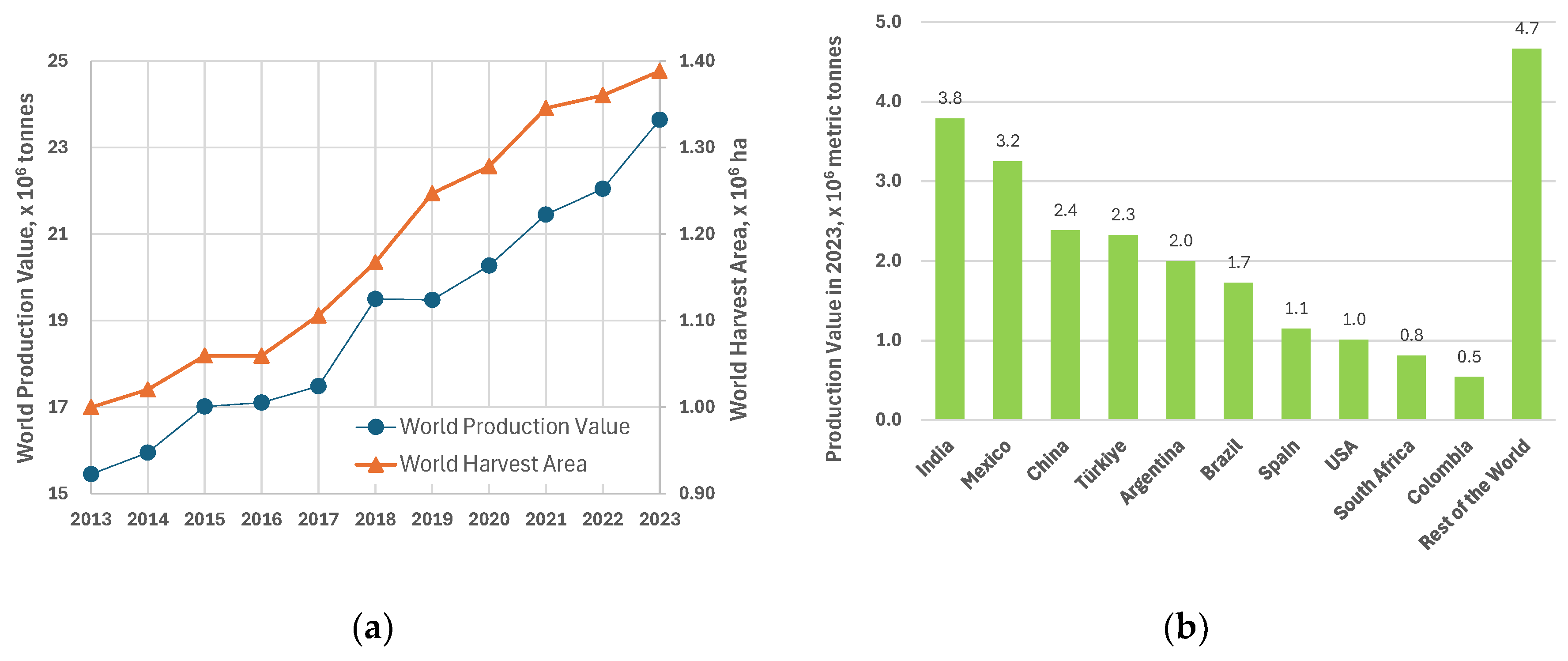
Figure 2.
Market dynamics and growth projections for the global lemon industry. Overview of key drivers, market valuation forecasts, and regional growth trends shaping the lemon sector through 2025.
Figure 2.
Market dynamics and growth projections for the global lemon industry. Overview of key drivers, market valuation forecasts, and regional growth trends shaping the lemon sector through 2025.
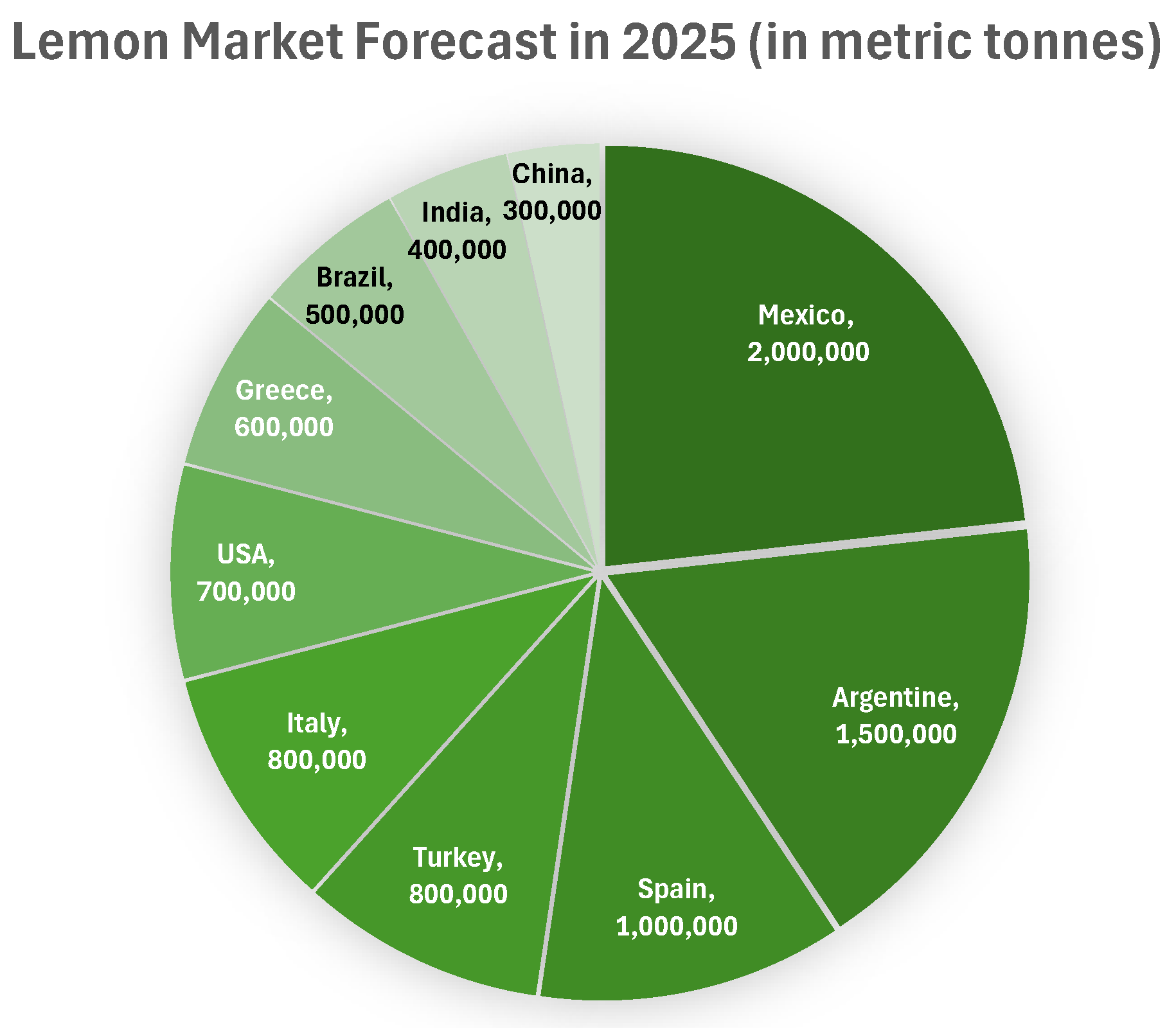
Figure 3.
Compositional distribution of lemon processing waste fractions. Representation of the relative proportions (g kg−1) of flavedo, albedo, pulp, and seeds generated during industrial-scale lemon juice extraction operations, alongside moisture content and key biochemical components.
Figure 3.
Compositional distribution of lemon processing waste fractions. Representation of the relative proportions (g kg−1) of flavedo, albedo, pulp, and seeds generated during industrial-scale lemon juice extraction operations, alongside moisture content and key biochemical components.
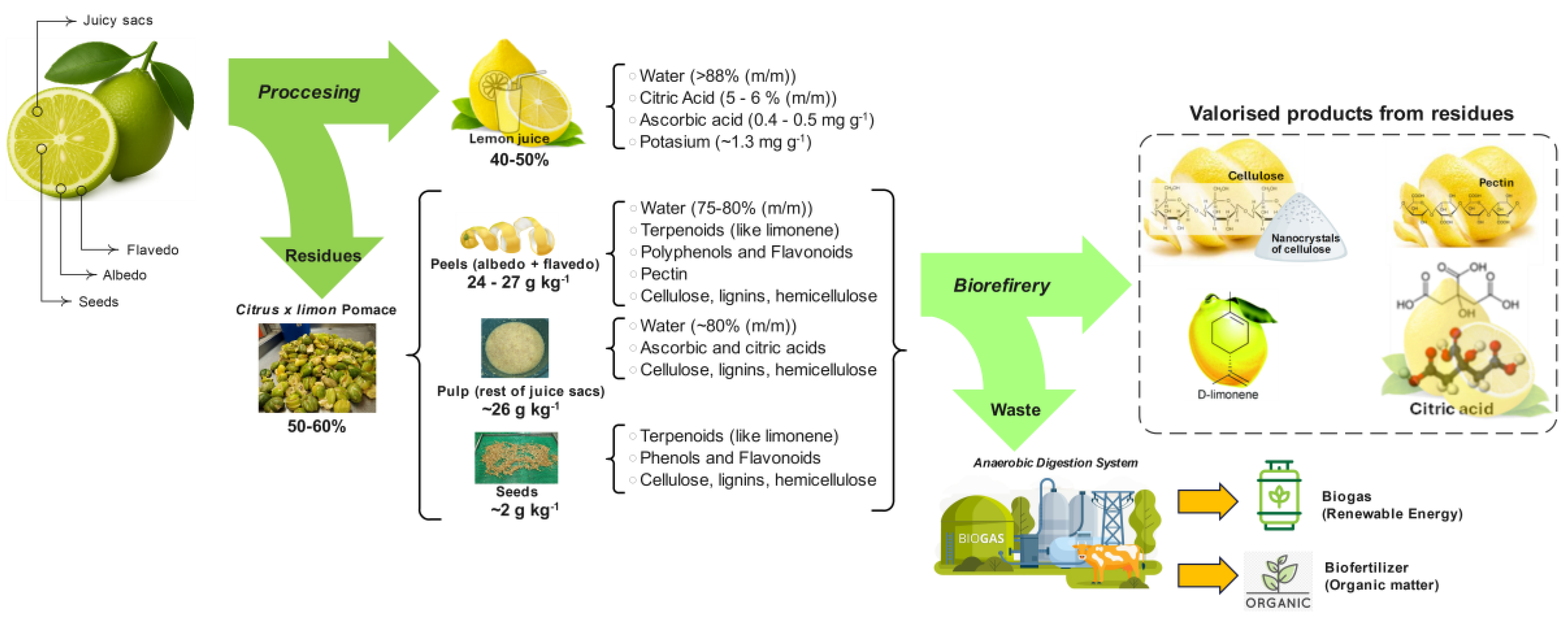
Figure 4.
Bibliometric network visualisation of research on lemon waste valorisation (2003–2025). Co-occurrence network of author keywords (minimum threshold: 5 occurrences) generated using VOSviewer, revealing thematic clusters, research priorities, and interconnections within the scientific literature on citrus waste biorefinery concepts. Node size reflects keyword frequency; proximity indicates conceptual relatedness.
Figure 4.
Bibliometric network visualisation of research on lemon waste valorisation (2003–2025). Co-occurrence network of author keywords (minimum threshold: 5 occurrences) generated using VOSviewer, revealing thematic clusters, research priorities, and interconnections within the scientific literature on citrus waste biorefinery concepts. Node size reflects keyword frequency; proximity indicates conceptual relatedness.
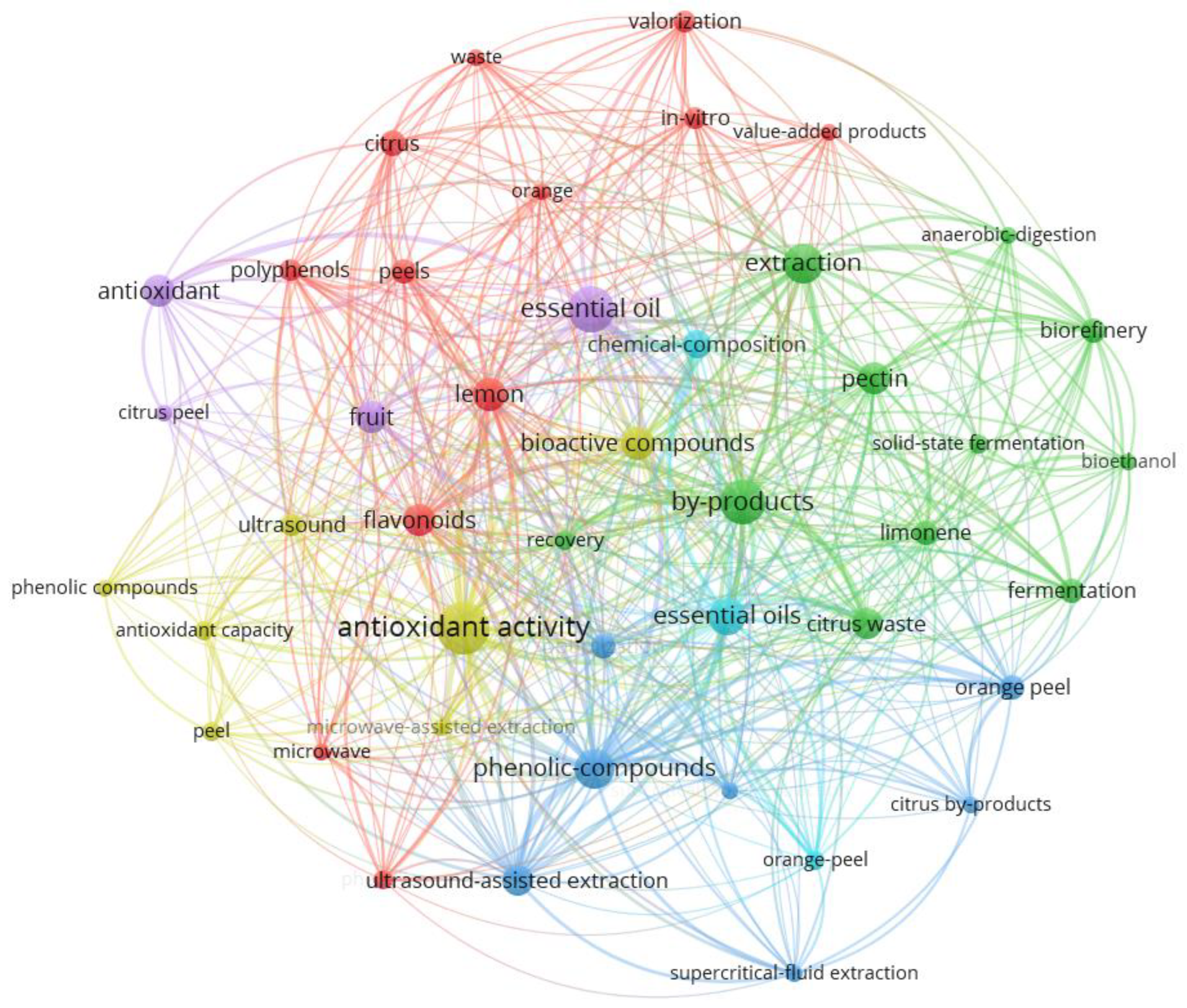
Figure 5.
Typical Mass Balance of Lemon Processing Residues at Industrial Scale. Typical yields of residue fractions (peel, pulp, seeds) obtained per tonne of fresh lemons processed, illustrating the quantitative distribution of waste streams available for cascading valorisation strategies.
Figure 5.
Typical Mass Balance of Lemon Processing Residues at Industrial Scale. Typical yields of residue fractions (peel, pulp, seeds) obtained per tonne of fresh lemons processed, illustrating the quantitative distribution of waste streams available for cascading valorisation strategies.
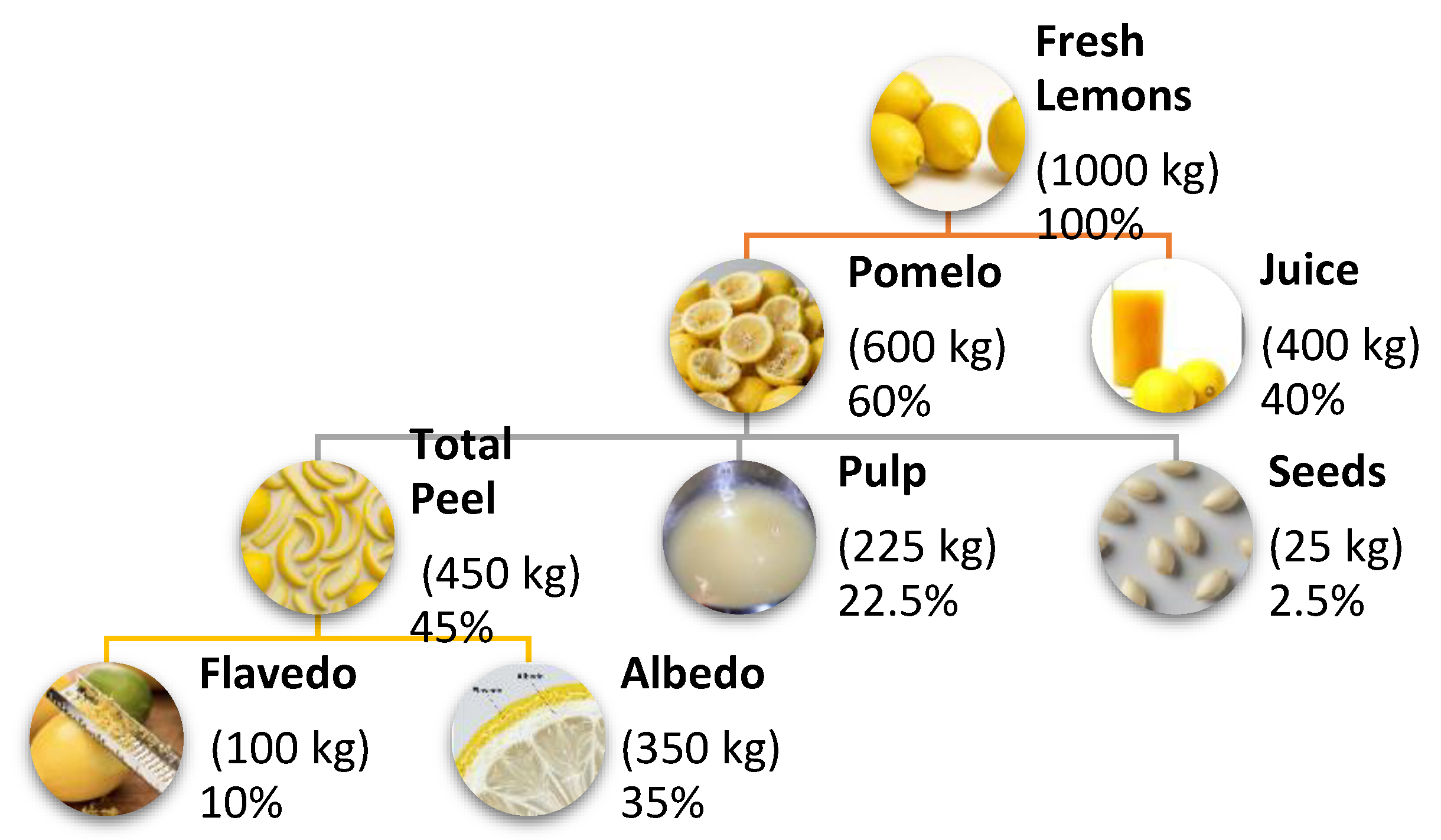
Figure 6.
Green Extraction Technologies for Valorisation of Lemon Processing Residues. Schematic overview of sustainable extraction methodologies—ultrasound-assisted (UAE), microwave-assisted (MAE), enzyme-assisted (EAE), deep eutectic solvent (DES-E), and supercritical CO2 (SC-CO2-E) extraction—employed in cascade biorefinery configurations for recovery of high-value bioproducts from citrus waste streams.
Figure 6.
Green Extraction Technologies for Valorisation of Lemon Processing Residues. Schematic overview of sustainable extraction methodologies—ultrasound-assisted (UAE), microwave-assisted (MAE), enzyme-assisted (EAE), deep eutectic solvent (DES-E), and supercritical CO2 (SC-CO2-E) extraction—employed in cascade biorefinery configurations for recovery of high-value bioproducts from citrus waste streams.
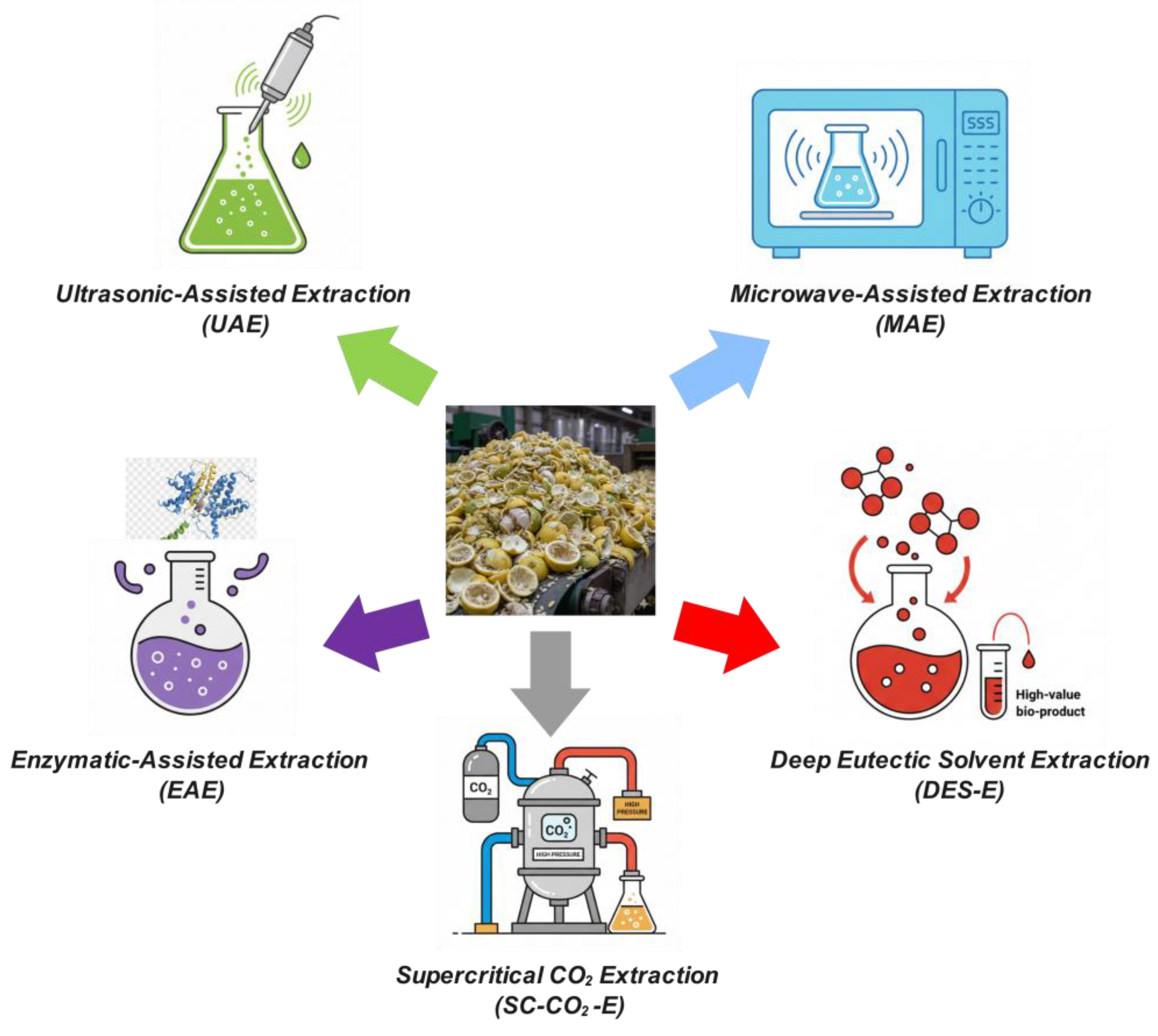
Table 1.
Critical research gaps in lemon biorefinery development and associated research priorities.
Table 1.
Critical research gaps in lemon biorefinery development and associated research priorities.
| Research Gap | Observation | Implication | Research Need |
|---|---|---|---|
| Fragmentation of Valorisation Research | Research remains predominantly focused on single-product pathways. Individual products (essential oils, pectin, bioactive extracts) are extensively investigated in isolation, with sparse integration within unified cascade frameworks. | Fragmentation hinders the development of economically viable biorefineries requiring diversified revenue streams. Techno-economic analyses demonstrate the superior performance of cascade approaches [71,84]. | Systematic investigations of cascade valorisation sequences, quantifying synergies and trade-offs. Process simulation and techno-economic models evaluating complete cascade configurations. |
| Dominance of Extraction Studies over Process Integration | Research on extraction methodologies constitutes the most intensively studied area, at the expense of downstream processing, product purification, and scale-up engineering. The extraction-to-process integration ratio exceeds 10:1. | Knowledge base disproportionately weighted towards laboratory-scale optimisation, with insufficient attention to industrial viability challenges, including continuous processing, solvent recovery, and energy integration [85]. | Engineering-focused research addressing scale-up challenges: continuous reactor design, intensified separation, energy-efficient drying. Pilot-scale validation studies. Alternative drying methods for nanocrystalline cellulose [79]. |
| Limited Attention to High-Value, Emerging Products | Advanced products (nanocrystalline cellulose, α-cellulose, citric acid) are underrepresented despite commercial potential. Bias towards well-established, low-value applications. NCC shows minimal connectivity to the biorefinery cluster. | Most economically transformative products—NCC commanding prices exceeding GBP 100/kg—remain underdeveloped. Citrus-derived NCC demonstrates properties comparable to wood-derived materials (crystallinity 65-71%) [46,86]. | Focused programmes on NCC production: process optimisation (yield, crystallinity), cost-reduction strategies (spray/supercritical drying), application development (nanocomposites, packaging, biomedical). α-cellulose production and derivatives. |
| Insufficient Integration of Economic and Environmental Assessment | LCA, TEA, economic viability, and sustainability metrics are notably absent or weakly represented. Less than 5% of publications incorporate a comprehensive economic or environmental evaluation. | Research remains technically focused, with limited consideration of economic feasibility or environmental impact, hampering industrial translation. Recent LCA studies identify hydrolysis and energy-intensive operations as major hotspots [78,83,86]. | Integrated LCA-TEA studies of complete cascade systems: capital/operating costs, revenue projections, sensitivity analyses, comparative environmental performance. Regional assessments accounting for local conditions. “Cradle-to-grave” approaches. |
| Underrepresentation of Industrial Implementation and Scale-Up | Minimal terminology related to industrial implementation (pilot plant, commercial scale, process control, regulatory compliance). Few case studies, predominantly at laboratory or small scale (≤10 tonnes/day). | Substantial gap between academic research (TRL 1-4) and commercial deployment (TRL 8-9). “Valley of death” refers to the challenges faced by novel products and integrated processes. Industrial pectin production was established, but integration was limited [82]. | Documentation of pilot-scale and commercial facilities: operational challenges, performance data, economic outcomes. Industry-academic partnerships. Regulatory pathway research (food safety, novel food status, nanomaterial regulations). |
| Geographical and Feedstock Specificity | Research disproportionately focuses on Mediterranean varieties with limited attention to regional variability. Compositional studies reveal pectin (15-25%) and essential oil (1-3%) range depending on variety, maturity, and conditions. | Optimised strategies may not transfer due to compositional variability, seasonal patterns, and differences in infrastructure. Assam lemon shows peak pectin content (3.07%) at 60 days, declining to 1.56% at 130 days [87,88]. | Comparative studies across varieties (Eureka, Lisbon, Femminello, Primofiori, Assam) and regions, documenting compositional ranges and implications for yields. Adaptation strategies for different scales (rural facilities versus industrial complexes). |
| Lack of Market Development and Application Research | Product extraction and characterisation are well-studied, but end-use applications and market development receive minimal attention. Antioxidant activity is extensively measured in vitro, but commercial incorporation is scarce. | Products remain “solution-seeking problems” rather than market responses. The disconnect between supply-push research and demand-pull innovation hinders commercialisation. The global pectin market (USD 1.4-1.6 billion) shows successful integration [79]. | Application-focused research: specific formulations, end-use validation, consumer acceptance, shelf-life assessments. Partnerships between biorefinery researchers and product formulators are essential. Pectin-based packaging films require commercial validation [89]. |
| 8. Limited Exploration of Biotechnological Valorisation | Biotechnological approaches remain secondary to physico-chemical extraction. Enzyme-assisted extraction, microbial production, and biocatalytic transformations are underexplored relative to their potential. | Biological processes offer advantages (mild conditions, selectivity, green chemistry) but remain underdeveloped. EAE demonstrates 65-88% pectin recovery with lower effluent volumes, but enzyme costs and longer times remain barriers [90,91,92]. | Enzyme engineering for improved hydrolysis; microbial cell factories for limonene/citric acid conversion to biochemicals; anaerobic digestion optimisation (addressing d-limonene inhibition). Co-digestion strategies combining extraction with biogas production [74]. |
Table 2.
Chemical Composition of Lemon Processing Residue Fractions.
| Component | Flavedo | Albedo | Seeds | Pomace | Unit | References | |||||
|---|---|---|---|---|---|---|---|---|---|---|---|
| Proximate Composition | |||||||||||
| Moisturea | 70-76 | 65-70 | 45-55 | 75-55 | % | [93,94] | |||||
| Ashb | 3.0-4.5 | 3.5-5.0 | 4.0-6.0 | 3.0-5.0 | % | [93,95] | |||||
| Proteinb | 4-7 | 5-9 | 8-15c | 4-8 | % | [95,96] | |||||
| Lipids and Essential Oils | |||||||||||
| Essential Oil content | 2.0-4.5 | 0.2-0.5 | 0.5-1.2 | 0.3-0.8 | % DWd | [30,97,98] | |||||
| Extractable Oil | - | - | 27-45 | - | % DW | [99] | |||||
| Limonene | 60-76 | 35-50 | 8-15 | 40-60 | % EOe | [30,97] | |||||
| β-Pinene | 8-12 | 5-8 | 3-6 | 6-10 | % EO | [98] | |||||
| γ-Terpinene | 6-10 | 4-7 | 2-5 | 5-8 | % EO | [30] | |||||
| Structural Carbohydrates | |||||||||||
| Cellulose | 8-12 | 15-22 | 10-16 | 12-18 | % DW | [96,100] | |||||
| Hemicellulose | 4-7 | 8-14 | 6-10 | 6-10 | % DW | [76,100] | |||||
| Lignin | 1-3 | 0.5-2.0 | 8-12 | 3-6 | % DW | [76] | |||||
| Pectin | 12-18 | 18-28 | 2-5 | 8-15 | % DW | [87,101] | |||||
| Soluble Sugars | |||||||||||
| Glucose | 2-5 | 1-4 | 1-3 | 3-7 | % DW | [66] | |||||
| Fructose | 2-5 | 1-4 | 1-3 | 3-7 | % DW | [66] | |||||
| Sucrose | 1-3 | 0.5-2.0 | 0.5-2.0 | 1-4 | % DW | [66] | |||||
| Organic Acids | |||||||||||
| Citric Acid | 0.5-1.5 | 0.3-1.0 | 0.2-0.8 | 8-15 | % DW | [76,102] | |||||
| Phenolic Compounds | |||||||||||
| Total Phenolics | 102-139 | 84-120 | 15-35 | 25-45 | mg GAE/g DW | [93] | |||||
| Hesperidin | 25-45 | 35-65 | 1.2-2.5 | 8-15 | mg/g DW | [93,103] | |||||
| Eriocitrin | 8-18 | 12-28 | 0.3-1.0 | 3-8 | mg/g DW | [30] | |||||
| Naringin | 3-8 | 5-12 | 0.5-1.5 | 2-6 | mg/g DW | [93] | |||||
| Tangeretin (PMF)f | 2-6 | 0.1-0.5 | NDg | 0.2-0.8 | mg/g DW | [103] | |||||
| Sinensetin (PMF) | 1-4 | 0.1-0.3 | ND | 0.1-0.5 | mg/g DW | [103] | |||||
| Seed-Specific Components | |||||||||||
| Oleic Acid (C18:1) | - | - | 24-32 | - | % tFAh | [99] | |||||
| Linoleic Acid (C18:2) | - | - | 34-42 | - | % tFA | [99] | |||||
| Palmitic Acid (C16:0) | - | - | 18-24 | - | % tFA | [95] | |||||
| Functional Properties | |||||||||||
| Water holding capacity | 4.2-6.8 | 8.5-10.9 | - | 5.5-8.2 | g/g | [93] | |||||
| Oil binding capacity | 2.8-4.5 | 5.2-6.3 | - | 3.5-5.0 | g/g | [93] | |||||
aFresh basis. bDry basis. cProtein content in defatted seed meal. dDry weight basis. eEssential Oil. fPolymethoxylated flavone. gNot Determined. htotal Fatty Acid.
Table 4.
Primary Valorisation Pathways for Lemon Processing Residues: Extraction Technologies, Yields, Industrial Applications, and Key References.
Table 4.
Primary Valorisation Pathways for Lemon Processing Residues: Extraction Technologies, Yields, Industrial Applications, and Key References.
| Pathway | Compounds | Source Fraction |
Extraction Technology | Optimal Conditions | Typical Yield | Purity/ Quality | Industrial Applications | Market Value (USD/kg) | Ref. |
|---|---|---|---|---|---|---|---|---|---|
| Essential Oils & d-Limonene | d-Limonene, β-pinene, γ-terpinene |
Flavedo | Cold pressing, hydrodistillation | 100 °C, 2–4 h | 0.5–5.0% FWa | Limonene: 70–95% |
Flavours, fragrances, cosmetics | 15–30 | [164,165] |
| d-Limonene, monoterpenes |
Flavedo | Microwave- assisted (MAE) |
360 W, 1–3 min, solvent-free | 2.0–3.5% DWb | Limonene: 65–79% |
Flavours, fragrances | 15–30 | [166,167] | |
| d-Limonene, terpenes |
Flavedo | Ultrasound- assisted (UAE) |
20–25 kHz, 60 °C, 20 min |
32.9 mg/g DW | Limonene: 95–97% |
Premium applications | 15–30 | [168] | |
| d-Limonene, sesquiterpenes | Flavedo | Supercritical CO2 | 100–200 bar, 40–60 °C, 2–5 h | 1.5–2.5% | Limonene: 95–99% |
Pharmaceutical-grade | 30–80 | [169,170] | |
| d-Limonene, terpenes | Flavedo | Bio-based solvent extraction | CPMEe, 2-MeTHFf, ambient |
40–80% higher than hexane | Limonene: 85–95% |
Food-grade, sustainable |
20–40 | [171] | |
| Pectin | High methoxyl pectin, galacturonic acid |
Albedo, peel | Conventional acid extraction | pH 1.5–3.0, HCl, 60–100 °C, 30–120 min | 18–35% DW | DEc: 55–75%, GalAd: 61–74% | Gelling agents, stabilisers | 8–15 | [172,173] |
| High methoxyl pectin |
Albedo, peel | Microwave- assisted (MAE) |
360 W, pH 2.2, 1–10 min, pulse | 7.6–18% | DE: 66.7%, GalA: 63.2% | Food gelling, pharmaceuticals | 8–15 | [174,175] | |
| High methoxyl pectin |
Albedo, peel | Ultrasound- assisted (UAE) |
60–75 °C, 15–45 min, citric acid | 10–17% | DE: 55.3% | Biodegradable packaging | 8–15 | [54] | |
| High methoxyl pectin |
Albedo, peel | Pulsed electric field (PEF) | 80 °C, 9 V/cm, 30–60 min | 14–18% | Excellent emulsifying | Active packaging | 10–18 | [176] | |
| High methoxyl pectin |
Albedo, peel | Citric acid extraction |
pH 2.2, 80 °C, 50 min | 32.5% | DE: 66.4%, methoxyl: 7.7% | Food-grade, clean-label | 10–16 | [177,178] | |
| Pectin with polyphenols |
Albedo, peel | Deep eutectic solvent (DES) | Citric acid-glycerol DESh, UAE | Variable | Comprehensive valorisation | Integrated biorefinery | 10–18 | [157] | |
| Seed Oil | Oleic (21–44%), linoleic (31–48%) | Seeds | Solvent extraction (Soxhlet) | Hexane, 60 °C, 6–8 h | 71.3% of seed oil | α-tocopherol: 110 mg/kg | Edible oils, biodiesel | 5–15 | [179,180] |
| Unsaturated fatty acids, tocopherols | Seeds | Cold pressing | Ambient, mechanical | 36.8% of seed oil | α-tocopherol: 155 mg/kg | Premium oils, cosmetics | 15–30 | [99,181] | |
| Fatty acids, phenolics, flavonoids | Seeds | Supercritical CO2 | 200–350 bar, 40–55 °C | Variable | Total phenolics: 165.9 mg/mL | Pharmaceutical, nutraceuticals | 30–80 | [99] | |
| Fatty acid methyl esters (FAME) | Seeds | Transesterification | Alkaline catalyst, 60 °C | 94% conversion | Meets ASTM D6751, EN 14214 | Biodiesel | 5–15 | [182] | |
| Citric Acid | Citric acid | Peel, pomace | SSFi (A. niger) | 28 °C, pH 4.5–6.5, 5–7 days | 193.2 mg/g DW | Fermentation-grade | Food acidulant, pharmaceuticals | 1–3 | [183,184] |
| Citric acid | Peel, pomace | SubFj (A. niger) | Hydrolysates, pH 4.5–6.5, 28–30 °C | Variable | Industrial-grade | Food processing | 1–3 | [71] | |
| Citric acid | Peel, pomace | Fermentation (Y. lipolytica) | 28 °C, pH 5–6, glucose/acetate | 72.3 g/L (glucose); 15.1 g/L (acetate) | Yield: 0.77 g/g; 0.51 g/g | Versatile substrates | 1–3 | [185] |
a FW: Fresh Weight; b DW: Dry Weight; c DE: Degree of Esterification; d GalA: Galacturonic Acid; e CPME: Cyclopentyl Methyl Ether; f 2-MeTHF: 2-Methyltetrahydrofuran; g RG-I: Rhamnogalacturonan-I; h DES: Deep Eutectic Solvent; i SSF: Solid-State Fermentation; j SubF: Submerged Fermentation.
Disclaimer/Publisher’s Note: The statements, opinions and data contained in all publications are solely those of the individual author(s) and contributor(s) and not of MDPI and/or the editor(s). MDPI and/or the editor(s) disclaim responsibility for any injury to people or property resulting from any ideas, methods, instructions or products referred to in the content. |
© 2025 by the authors. Licensee MDPI, Basel, Switzerland. This article is an open access article distributed under the terms and conditions of the Creative Commons Attribution (CC BY) license (http://creativecommons.org/licenses/by/4.0/).
Copyright: This open access article is published under a Creative Commons CC BY 4.0 license, which permit the free download, distribution, and reuse, provided that the author and preprint are cited in any reuse.


