
Submitted:
22 November 2025
Posted:
25 November 2025
You are already at the latest version
Abstract
This article proposes the "Heroic Self-Myth Hypothesis," a transdisciplinary framework explaining a specific pathology of modern identity construction. Through a detailed analysis of Dostoevsky’s Smerdyakov (The Brothers Karamazov) as a conceptual prototype for Joyce’s characters in Ulysses, the article argues that a pervasive psychological mechanism involves transforming banality into pseudo-heroism to compensate for a profound internal vacuum. The hypothesis posits a sequence of neurocognitive and clinical processes: a dysregulated Default Mode Network fails to generate a coherent self-narrative, creating an existential void. This void is managed through performative substitution, where a hyper-vigilant Salience Network directs attention to external appearances as a substitute for internal substance. This process is catalyzed by developmental traumas, including paternal conflict rooted in envy and a traumatic maternal relationship leading to a fixation on physicality as a threat. The resulting moral disengagement and annihilation of a stable ethical core, often justified by a vulgarized "death of God" liberal philosophy, create a psychic vacuum. This vacuum is subsequently colonized by an "epic self-deception," a grandiose cognitive narrative that reframes a mundane life as a mythic journey. Synthesizing literary analysis, neurobiology, and clinical psychology, the article concludes that Smerdyakov represents not merely a literary character but an archetype of moral disintegration. The modernist hero is thus revealed not as an artistic innovation but as the aesthetic realization of a pre-existing psychological type—the individual who, having lost their moral center, elevates their own insignificance to cosmic significance through a self-authored, illusory heroism.
Keywords:
heroic self-myth
; smerdyakov
; modernist hero
; default mode network
; moral disintegration
; epic self-deception
; neurophenomenology
; identity pathology
1. Introduction
The construction of self-identity is a fundamental, ongoing neurocognitive process, deeply intertwined with memory, social interaction, and the brain’s intrinsic capacity for narrative (Whitfield-Gabrieli & Ford, 2012). This process, which involves the continuous weaving of autobiographical episodes into a coherent life story, is a cornerstone of psychological well-being and a sense of purpose (Stowitzki et al., 2023). However, in specific socio-cultural and psychological conditions, this normative self-narrativization can become pathological, devolving into what this paper terms the “Heroic Self-Myth.” This hypothesis proposes a specific psychological syndrome wherein an individual, confronted with a profound sense of internal emptiness, a lack of authentic talent, and an attenuated moral framework, compensates by constructing an elaborate, self-aggrandizing narrative (Vogel, 2022).
The archetype for this syndrome finds one of its most potent precursors in Smerdyakov, a pivotal character from Fyodor Dostoevsky’s The Brothers Karamazov. Smerdyakov embodies a human type defined by a dual absence: a lack of pronounced talent and a lack of authentic spiritual depth (Allison & Miller, 2019). His existence is built upon an internal void, which he attempts to fill with external performances and a private mythology. This psychological profile finds its full cultural expression in the modernist epoch, particularly in the fragmented consciousness of characters populating James Joyce’s Ulysses (Sass & Pienkos, 2019). This article will develop the Heroic Self-Myth Hypothesis through a multi-disciplinary synthesis, arguing that Smerdyakov serves as a proto-clinical blueprint for a modern psychological condition.
2. The Neurocognitive Foundation: Internal Vacuum and Network Dysregulation
The Smerdyakov Model begins with a fundamental internal vacuum. Neurobiologically, this can be traced to the brain’s default mode network (DMN). The DMN is a highly interconnected set of brain regions that is most active during rest and self-referential thought (Whitfield-Gabrieli & Ford, 2012). It is critically involved in autobiographical planning and the construction of the narrative self. Dysregulation of the DMN, including hyperconnectivity, has been linked to maladaptive self-focused attention and a disrupted sense of self, conditions that create fertile ground for pathological narrativization (Vogel, 2022). When the DMN fails to generate a stable self-narrative, it creates a psychic void.
This void is often filled by a compensatory hyper-reliance on the salience network (SN). The SN is responsible for identifying and orienting attention towards salient external stimuli (Menon, 2023). In the Smerdyakovian individual, a hypoactive or incoherent DMN may lead to attention being compulsively directed outward, towards the immediately perceptible environment—clothing, gestures, social cues—because the internal landscape is experienced as empty or threatening.

Table 1.
Neural Correlates of the Heroic Self-Myth Components.
| Psychological Component | Neural Correlate | Function & Dysfunction |
| Internal Vacuum | Default Mode Network (DMN) | Function: Self-referential thought, autobiographical narrative. Dysfunction: Failure to generate coherent self-narrative; hyperconnectivity linked to rumination (Whitfield-Gabrieli & Ford, 2012). |
| Performative Substitution | Salience Network (SN) | Function: Detecting salient external stimuli. Dysfunction: Compulsive outward attention to manage internal void; hyper-vigilance to social cues (Menon, 2023). |
| Moral Annihilation | Ventromedial Prefrontal Cortex (vmPFC) | Function: Integrating emotion with social/moral reasoning. Dysfunction: Blunted empathy, utilitarian judgments; disengagement from moral consequences (Harenski & Kiehl, 2022). |
| Disgust/Physical Fixation | Anterior Insula | Function: Interoception, subjective experience of disgust. Dysfunction: Hyper-reactivity to stimuli perceived as unclean or contaminating (Harenski & Kiehl, 2022). |
| Stress & Trauma Basis | Hypothalamic-Pituitary-Adrenal (HPA) Axis | Function: Central stress response system. Dysfunction: Dysregulation due to early trauma, leading to heightened threat perception and irritability (Tottenham, 2020). |
3. The Developmental Catalyst: Parental Conflict and Traumatic Origins
The neurocognitive predisposition is catalyzed by early developmental trauma. The relationship with the paternal figure serves as a primary obstacle and justification for failure. Smerdyakov’s resentment towards his father is not moral condemnation but envy of his father’s crude vitality—a quality he lacks (Allison & Miller, 2019). This dynamic is replicated in Ulysses, where Stephen Dedalus’s struggle with symbolic fathers justifies his creative paralysis. This conflict is rooted in insecure paternal attachment, which impairs the capacity for agency and goal-directed behavior (Kerns & Brumariu, 2016). The individual engages in external attribution, blaming the father for their shortcomings, a key feature in models of depression and learned helplessness (Liu et al., 2023).
Furthermore, a traumatic maternal figure installs a deep conflict between the idealized and the abject aspects of embodiment. Smerdyakov’s psyche is marked by the association between his mentally ill mother and themes of degradation (Schalinski et al., 2019). This creates an unconscious fixation on “unwashedness” as a marker of inferiority, a pattern evident in Ulysses’s obsessive rejection of corporeality. This results in a dualistic structure: a demonstrative, ideological cult of the mother figure coexists with a hidden hatred for her actual, “dirty” bodily nature (Kim et al., 2020). The paternal figure is then seen as the barrier to achieving purification from this inherited “stain.”
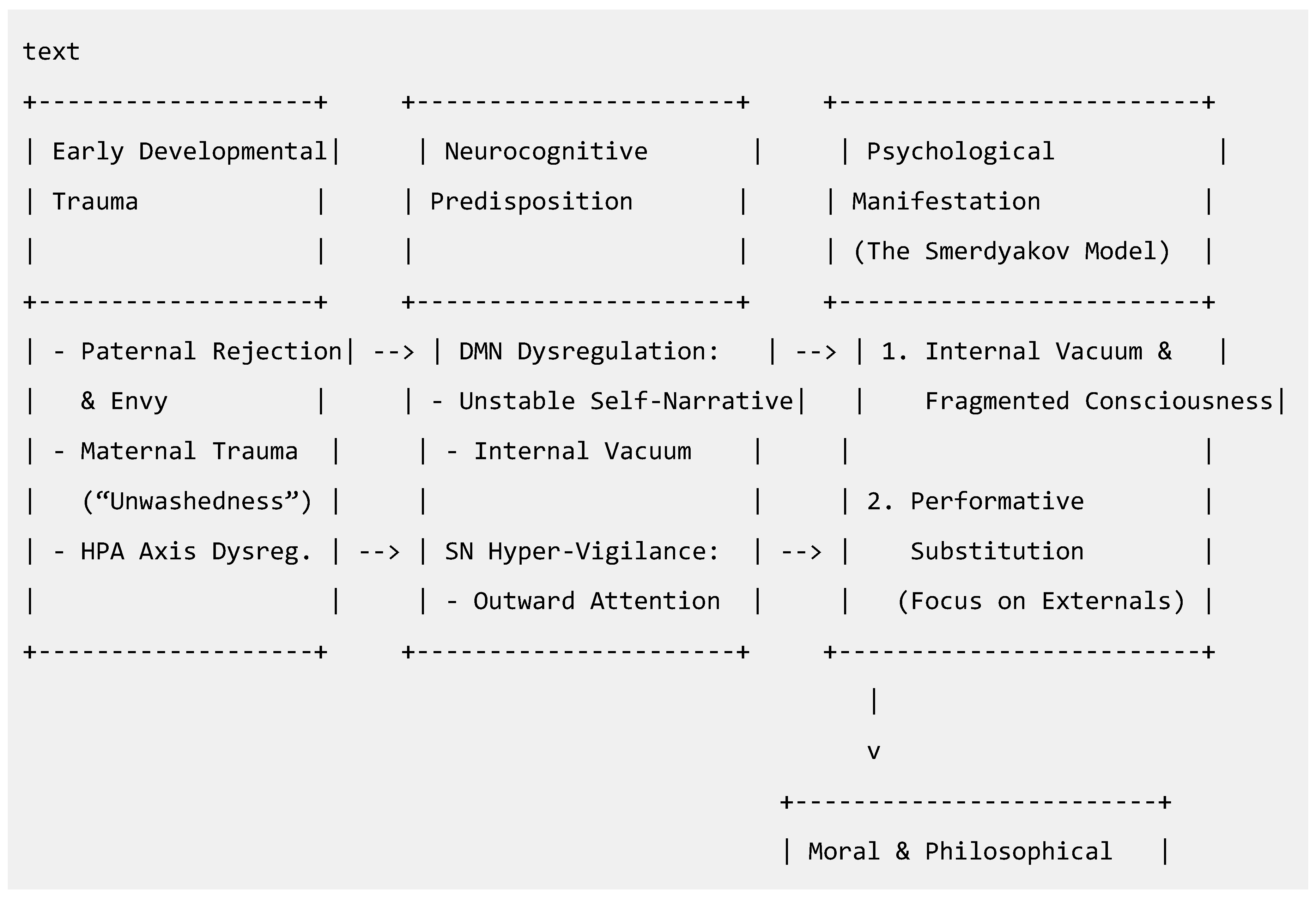
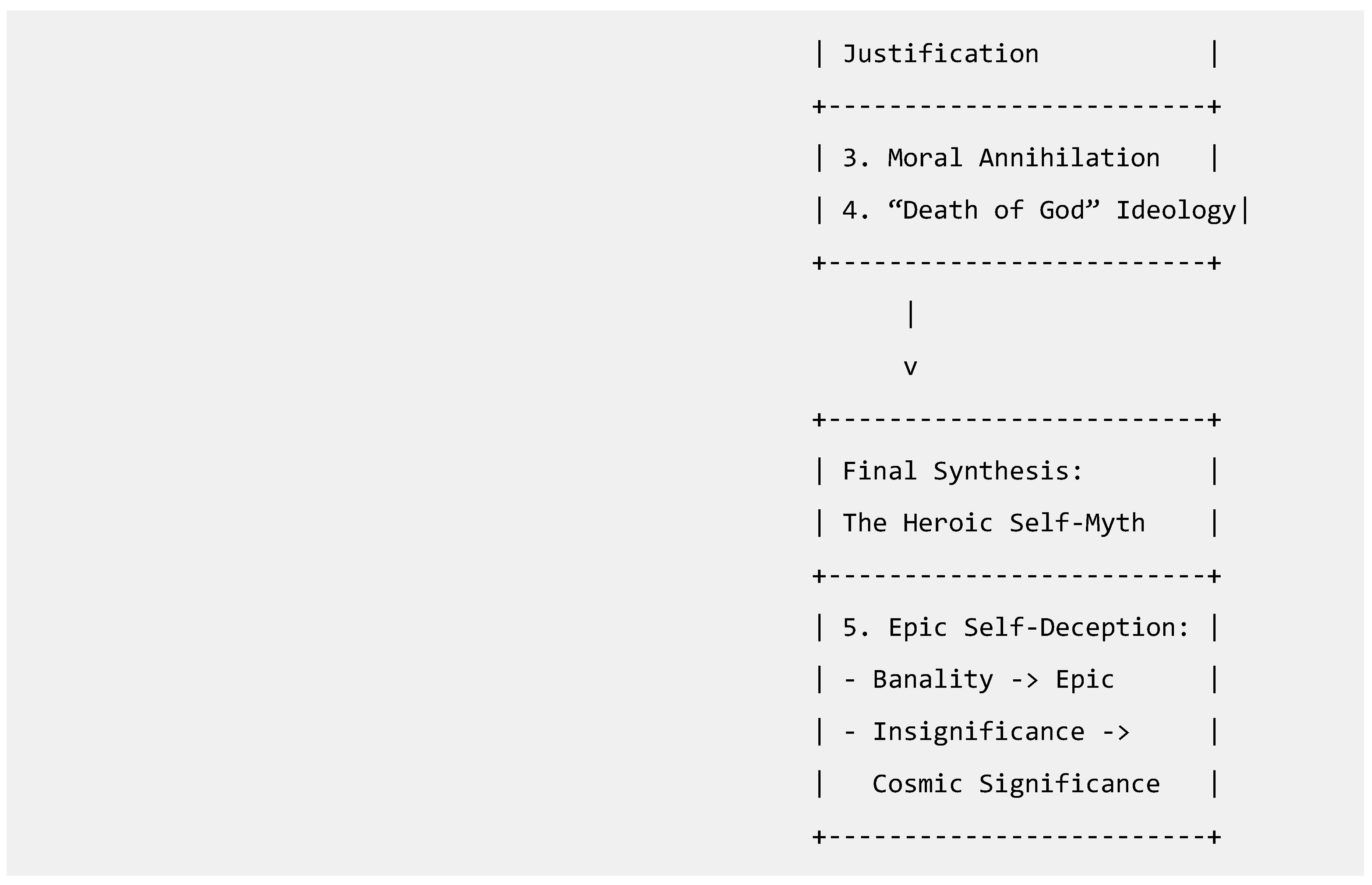
Figure 1.
The Etiological Pathway of the Heroic Self-Myth. (A conceptual flow chart illustrating the development of the syndrome).
Figure 1.
The Etiological Pathway of the Heroic Self-Myth. (A conceptual flow chart illustrating the development of the syndrome).
4. The Psychological Manifestation: Compensation and Self-Deception
The internal vacuum and trauma lead to distinct psychological manifestations. The first is Performative Substitution—replacing core identity with external signifiers. This aligns with research on perfectionistic self-presentation, a maladaptive strategy to conceal perceived inadequacies (Nepon et al., 2021). Smerdyakov’s fastidiousness with his appearance is a desperate attempt to control an external variable because his internal coordinates are missing.
The second, and most profound, manifestation is the “Epic Self-Deception.” This is the cognitive mechanism by which the individual transmutes the banal into the mythic. Smerdyakov romanticizes his insignificant biography, believing a trivial act could elevate him to epic scale. While Joyce’s Ulysses uses this as a conscious artistic technique, for Smerdyakov it is a psychological delusion (Kaufman & Gregoire, 2016). This grandiosity serves as a defense against underlying worthlessness, a recognized feature of narcissistic personality structures (Röper & van Nieuwenhuizen, 2023). The brain’s DMN, in its drive for narrative coherence, fabricates a grandiose story to avoid accepting a meaningless existence (Vogel, 2022).
5. The Philosophical Justification: Moral Annihilation
This entire process is catalyzed and sanctioned by Moral Annihilation. Smerdyakov’s readiness to abandon morality to construct a convenient narrative is a form of moral disengagement, a mechanism that allows individuals to bypass internal standards (Bandura, 2016). Neurobiologically, this may involve a functional disengagement of the “moral brain” (vmPFC, amygdala), leading to a cold, calculating detachment from consequences (Harenski & Kiehl, 2022).
This moral vacuum is then filled by a philosophical justification. The internal conflict between the desire for significance and the feeling of worthlessness leads to an embrace of the idea, “If God does not exist, everything is permitted.” This is not a rigorous philosophical stance but a psychological tool—a form of motivated reasoning that reduces psychological discomfort (Lopez et al., 2023). This “death of God” ideology, when adopted from a vulgarized strand of liberal thought, provides a high-minded excuse for the absence of a moral center, facilitating ethical decay (Green et al., 2022).
Table 2.
Clinical and Literary Parallels in the Heroic Self-Myth.
| Domain | Clinical/Neurocognitive Concept | Literary Manifestation in Smerdyakov | Literary Manifestation in Ulysses |
| Self-Structure | Fragmented Self (Sass & Pienkos, 2019); DMN Dysregulation (Whitfield-Gabrieli & Ford, 2012) | Lack of coherent identity; defined only by resentment and performance. | Stream-of-consciousness; fragmented thoughts and memories of Stephen and Bloom. |
| Self-Esteem Regulation | Pathological Narcissism (Röper & van Nieuwenhuizen, 2023); Perfectionistic Self-Presentation (Nepon et al., 2021) | Grandiose fantasies of significance; meticulous attention to dress and manners. | Stephen’s intellectual arrogance; Bloom’s social anxieties and curated public persona. |
| Moral Functioning | Moral Disengagement (Bandura, 2016); vmPFC Dysfunction (Harenski & Kiehl, 2022) | Justifies patricide through borrowed philosophy; feels no genuine remorse. | Characters’ minor ethical failings and justifications; lack of a central moral compass. |
| Cognitive Biases | External Attribution (Liu et al., 2023); Jumping to Conclusions (McLean et al., 2022) | Blames his father and Ivan for his actions and station in life. | Stephen blames history, church, and family for his paralysis. |
| Trauma & Embodiment | HPA Axis Dysregulation (Tottenham, 2020); Disgust Sensitivity (Harenski & Kiehl, 2022) | Fixation on his “stinking” origins; disgust for the physical. | Obsessive focus on bodily functions, smells, and decay throughout the novel. |
6. Discussion and Conclusion: Smerdyakov as Archetype
The synthesis of this evidence confirms that Smerdyakov is the archetype of the modernist hero. He possesses all the key traits: fragmented consciousness, an unreliable narrative “I,” a blurred moral structure, and a fixation on the external. The critical distinction is that in Ulysses, these qualities are an artistic technique, while in Smerdyakov, they are a socio-psychological defect.
The fundamental question is whether modernism creates a new hero or merely gives form to a pre-existing type. The neurocognitive and clinical evidence strongly suggests the latter. The components of the Heroic Self-Myth—DMN dysregulation, HPA axis effects, cognitive biases, narcissistic grandiosity—are enduring features of human psychology, not products of the 20th century. The modernist era universalized the condition that Dostoevsky diagnosed as a pathology. It provided the cultural ecosystem—secular, atomized, philosophically permissive—for the Smerdyakovian individual to flourish.
In conclusion, the Heroic Self-Myth Hypothesis provides a powerful framework for understanding a pervasive pattern of modern identity. It reveals the journey of the modernist anti-hero as a path of psychological retreat defined by moral annihilation, performative substitution, and epic self-deception. Dostoevsky, through Smerdyakov, diagnosed a spiritual sickness of the emerging modern world, while Joyce provided the intimate phenomenological report of its lived experience. To understand this archetype is to understand the deep structure of a modern despair that manifests as the tragic construction of a palace of self-worship on the vacant lot of a disappeared soul.
Funding
This research did not receive any specific grant from funding agencies in the public, commercial or not-for-profit sectors.
Authors’ contributions:
The Authors performed equally: study concept and design, acquisition of data, analysis and interpretation of data, drafting of the manuscript, critical revision of the manuscript for important intellectual content, statistical analysis, administrative, technical and material support, study supervision.
Ethics approval and consent to participate
This research does not contain any studies with human participants or animals performed by the Author.
Consent for publication
The Authors transfer all copyright ownership, in the event the work is published. The undersigned author warrants that the article is original, does not infringe on any copyright or other proprietary right of any third part, is not under consideration by another journal and has not been previously published.
Availability of data and materials
All data and materials generated or analyzed during this study are included in the manuscript. The Authors had full access to all the data in the study and take responsibility for the integrity of the data and the accuracy of the data analysis.
Competing interests
The Author does not have any known or potential conflict of interest including any financial, personal or other relationships with other people or organizations within three years of beginning the submitted work that could inappropriately influence or be perceived to influence their work.
Declaration of generative AI and AI-assisted technologies in the writing process
The author used ChatGPT to assist with data analysis and manuscript drafting and to improve spelling, grammar and general editing. The authors take full responsibility of the content.
Acknowledgments
None.
References
- Allison, K. L. & Miller, J. G. (2019). The behavioural system for managing social rank and its relationship to psychopathology. Current Opinion in Psychology 27, 66–70. [CrossRef]
- Bandura, A. (2016). Moral disengagement: How people do harm and live with themselves. Worth Publishers.
- Green, M. F. , Horan, W. P., & Lee, J. (2022). Social motivation and its neural correlates in schizophrenia: A review and a roadmap for future research. Schizophrenia Bulletin, 48(5), 1017-1026. [CrossRef]
- Harenski, C. L. , & Kiehl, K. A. (2022). The cognitive neuroscience of moral judgment and decision-making. In The Cognitive Neurosciences (pp. 1-12). MIT Press.
- Jaba, T. (2022). Dasatinib and quercetin: short-term simultaneous administration yields senolytic effect in humans. Issues and Developments in Medicine and Medical Research Vol. 2, 22-31. [CrossRef]
- Kaufman, S. B. , & Gregoire, C. (2016). The neuroscience of creativity. Cerebrum, 2016, cer-10-16.
- Kerns, K. A. , & Brumariu, L. E. (2016). Attachment in middle childhood: A review. Handbook of Attachment: Theory, Research, and Clinical Applications, 3rd ed., 349-365.
- Kim, S. , Kwok, S., Mayes, L. C., Potenza, M. N., Rutherford, H. J. V., & Strathearn, L. (2020). The paternal brain in humans: A review of neuroimaging studies. Pediatric Medicine, 3, 22. [CrossRef]
- Liu, R. T. Hamilton, J. L., & Alloy, L. B. (2023). A systematic review of cognitive biases and neurocognitive functioning in young adults with and without psychiatric disorders. Clinical Psychology Review 102, 102279.
- Lopez, R. B. , Denny, B. T., & Finkel, E. J. (2023). Cognitive control and ego depletion: A meta-analysis. Psychological Bulletin, 149(1-2), 113-154. [CrossRef]
- McLean, B. F. , Mattiske, J. K., & Balzan, R. P. (2022). The jumping to conclusions bias and the development of delusions: A systematic review. Clinical Psychology Review, 92, 102125. [CrossRef]
- Menon, V. (2023). Salience network. In Brain Mapping: An Encyclopedic Reference (Vol. 2, pp. 597-611). Academic Press.
- Nepon, T. , Flett, G. L., & Hewitt, P. L. (2021). Perfectionistic self-presentation and suicidal ideation: A test of the existential model of perfectionism. Journal of Psychoeducational Assessment, 39(2), 243–258.
- Röper, M. , & van Nieuwenhuizen, H. (2023). Grandiose and vulnerable narcissism: A meta-analysis of their relationship with self-esteem. Personality and Individual Differences, 200, 111897. [CrossRef]
- Sass, L. A. , & Pienkos, E. (2019). Self-disorder and subjective dimensions of schizophrenia. Current Opinion in Psychiatry, 32(3), 188–196. [CrossRef]
- Schalinski, I. , Teicher, M. H., Carolus, A. M., & Rockstroh, B. (2019). Early neglect and abuse predict diurnal cortisol patterns in adults: A study of patients with borderline personality disorder and healthy controls. Psychoneuroendocrinology, 100, 50-59. [CrossRef]
- Stowitzki, F. , Kollar, B., & Langeloh, M. (2023). Narrative coherence and its relationship to psychological well-being and brain structure. Frontiers in Psychology, 14, 1124581.
- Tottenham, N. (2020). Early adversity and the neocortical development of the HPA axis. Neuropsychopharmacology, 45(1), 1-14. [CrossRef]
- Vogel, D. H. (2022). The neural correlates of the narrative self: A meta-analysis of neuroimaging studies. Social Cognitive and Affective Neuroscience, 17(4), 385–398. [CrossRef]
- Tkemaladze, J. (2023). Reduction, proliferation, and differentiation defects of stem cells over time: a consequence of selective accumulation of old centrioles in the stem cells?. Molecular Biology Reports, 50(3), 2751-2761. doi : https://pubmed.ncbi.nlm.nih.gov/36583780/.
- Tkemaladze, J. (2024). Editorial: Molecular mechanism of ageing and therapeutic advances through targeting glycative and oxidative stress. Front Pharmacol. 2024 Mar 6;14:1324446. doi : 10.3389/fphar.2023.1324446. PMCID: PMC10953819. [PubMed]
- Tkemaladze, J. (2025). Through In Vitro Gametogenesis—Young Stem Cells. Longevity Horizon, 1(3). [CrossRef]
- Whitfield-Gabrieli, S. & Ford, J. M. (2012). Default mode network activity and connectivity in psychopathology. Annual Review of Clinical Psychology 8, 49–76. [CrossRef] [PubMed]
Disclaimer/Publisher’s Note: The statements, opinions and data contained in all publications are solely those of the individual author(s) and contributor(s) and not of MDPI and/or the editor(s). MDPI and/or the editor(s) disclaim responsibility for any injury to people or property resulting from any ideas, methods, instructions or products referred to in the content. |
© 2025 by the authors. Licensee MDPI, Basel, Switzerland. This article is an open access article distributed under the terms and conditions of the Creative Commons Attribution (CC BY) license (http://creativecommons.org/licenses/by/4.0/).
Copyright: This open access article is published under a Creative Commons CC BY 4.0 license, which permit the free download, distribution, and reuse, provided that the author and preprint are cited in any reuse.