
Submitted:
19 November 2025
Posted:
20 November 2025
You are already at the latest version
Abstract
Driven by the technology innovation, service diversification, and the evolution and defects of current networks, the 6th generation (6G) network architecture is starved for research. One of the challenges is that the architecture design should take into account multiple factors of customers, operators, and vendors. For service-oriented and network-oriented design requirements, this article proposes a data-driven distributed autonomous architecture towards 6G with three-layer-four-plane logical hierarchy. The architecture is simplified as four network function units and the interactions among which are carried on the dual-bus interfaces, i.e., service-based interface and data channel interface. In addition, it takes user data-centric as the fundamental principle and rendered as distributed autonomous domains with different scales to better adapt to customized services. We further provide the network simplification evaluation by going through several signaling procedures of the 3rd generation partnership project (3GPP), inspiring the advanced research and subsequent standardization of 6G network architecture.
Keywords:
data-driven distributed autonomous architecture
; three-layer-four-plane
; dual-bus
; network simplification
; 6G
; network architecture
1. Introduction
Network architecture is an essential issue in the 6th generation (6G) research. It should adapt the requirements of emerging service scenarios, and promote the implementation of promising innovative technologies. In addition, 6G is expected to solve the bottlenecks exposed by the current network, and consider the friendliness and sustainability of the communication industry ecology [1].
According to International Telecommunication Union-Radiocommunication (ITU-R), six typical 6G usage scenarios will be enhanced and expanded on the basis of the 5th generation (5G) scenarios [2], which call for 6G network to provide higher capabilities. For 5G enhancement, 6G is expected to optimize peak data rate and latency, improve reliability, mobility and connectivity density, enhance user experienced data rate and area traffic capability. In addition, it is also supposed to provide new capabilities, e.g., centimeter-precision positioning, radio interface sensing [3], ambient intelligence, seamless coverage, high energy efficiency, and high interoperability. So as to realize the 6G vision of “integrated communication and sensing of virtual-reality, all-domain intelligence connectivity”[4].
The above capability requirements have spawned various prospective technologies, while the landing of these technologies depends on the network architecture design. For example, to improve forwarding performance, network programming and SRv6 technology can be deployed on mobile networks, so the redesign of user plane framework and protocol stack is required. For connection extension and cross-network-domain interaction, block chain technology can be combined with discovery and trust mechanisms among distributed networks. To provide seamless coverage, multi-access adaptation design of the access network is required for enabling the space-air-ground-sea integration technology [5]. The combination of cloud-native technology with federated learning and semantic communication enriches network AI and also calls for the introduction of intelligent plane into the network logical function planes [6]. However, existing network capabilities cannot yet meet the requirements of these scenarios, and existing technologies cannot be well penetrated under the current network architecture. First, the network architecture is complex, the number of network functions (NFs) is large, the on-line of new capabilities will involve so much that the standardization, development and deployment will be difficult. Besides, the network is tightly coupled, the abilities of self-detection and self-healing are poor, and the reliability and service guarantee ability need to be significantly improved. In addition, due to deployment demands, technical implementation, vendor interoperability, numerous redundant data is scattered in multiple NFs, and the diversity of the data scale, read and write performance, life cycle, as well as the asynchrony of data status will increase the workload and reduce the efficiency of service-based interface (SBI) data transmission. To address the problems, [7] proposes a 6G logical architecture with three bodies, four layers and five planes. Distributed small cloud units can support flexible deployment and plug-and-play. [8] and [9] re-group the control plane by procedures instead of by functionalities to reduce the core network complexity. [10] adds some functions and a data and intelligence plane in the service-based architecture to support AIaaS (AI as a Service), CPaaS (Computing Power as a Service) and SaaS (Sensing as a Service). [11] proposes a virtualized network slicing based architecture for ensuring 6G flexibility. Besides providing more flexibility and less complexity, this paper also makes the following contributions.
- Comprehensive insights for architecture design requirements. Give insights for the architecture design requirements from the service and network perspectives. And consider the following visions: 1) Provide customers with more ubiquitous access and better service experience. 2) Provide operators with more convenient management and deployment. 3) Provide vendors with more scalable function layout and equipment development.
- Novel service framework and physical architecture. To cater to the above design requirements, we proposes a data-driven distributed autonomous architecture (DDAA) with three-layer-four-plane logical hierarchy. DDAA drives network tasks around user data. It improves the efficiency of function development and resource utilization, and optimizes network performance and user service experience. Distributed autonomy ensures network security and reduces signaling storm via intra-domain autonomy, and extends connectivity via inter-domain connectivity.
- Instantiated evaluation of network simplification. The masses of network functions are simplified and restructured into four network function units (NFUs) that interact via dual-bus interfaces. Network simplification and signaling reduction between 5G and 6G is detailed and evaluated by going through 3GPP underlying procedures.
2. Design Requirements for Network Architecture
Design requirements for 6G network architecture are driven by the emerging service scenarios and the current 5G network defects, corresponding to service-oriented and network- oriented respectively. The latter may contribute to the realization of the former.
2.1. Service-Oriented Design Requirements
Integration requirement of services. Emerging services represented by completely immersive XR, digital twins, industrial Internet, multidimensional sensory communication, and brain-computer interface are booming [12]. Meanwhile, higher performance requirements for 6G network are put forward, and new service measurement dimension such as quality-of-physical-experience may be introduced [13]. These burgeoning services will require more than the fundamental connectivity. For example, besides stable connectivity and low-latency high-reliability, tele-surgery in smart healthcare service also requires high-precision sensing for surroundings and physical motions. Large-scale modeling and simulation of this smart system also needs ubiquitous intelligence and computing resources. Therefore, 6G network is supposed to provide integrated services including connectivity, sensing, intelligence, and computing power, etc.
Flexible and customized service requirement of customers and industries. In order to meet the requirements of various customized networks, while absorbing more participants to build a more open industrial ecology, 6G network should be more scalability and agile [14], and need the enablement of network cloudification and servitization. To enhance the adaptability of the network to services, 6G network should support on-demand orchestration and deployment, on-demand service loading, and on-demand traffic scheduling. In addition, to-business (2B) and to- customer (2C) networks have obvious differences in service characteristics, network deployment and management schemes. Different industries and enterprises have significant differences in network requirements, so attention should also be paid to the overall planning of 2B and 2C in the network architecture design.
2.2. Network-Oriented Design Requirements
Simplification requirement of network architecture. With the support of new scenarios and functions, the number of 5G NFs is significantly increasing, and the number of logical interfaces and HTTP signaling links is increasing substantially. Due to the strong interdependence of NFs in signaling procedures and data interaction, the number of NFs and the workload of interoperability tests involved in malfunction location or new function deployment are huge, and the network operation and maintenance are complicated [15][16]. Therefore, 6G network is expected to achieve flat networking, flexible and dynamic cutting of NFs, data and service separation of interfaces and micro-service processing of procedures, thereby simplifying the overall network design and the difficulty of operation and maintenance.
User data centric requirement. Under the current 5G architecture, user provisioning is complicated, data redundancy is high, resulting in storage waste, data inconsistency, and sharing difficulty. Therefore, the 6G network should provide consistent services for data storage, access, management and security, and the unified and standard data organization is also more conducive to releasing the advantages of professional database technology in simplifying data processing logic. In addition, the reliability of 5G network mainly depends on the disaster recovery at the NF level, which has large spread range and long recovery time after malfunction. Therefore, stateless design of NFs around data is required to separate data from service logic, reduce storage resource occupation and data interaction overhead, and improve network reliability.
Endogenous intelligence requirement. 5G network intelligence mainly relies on the centralized analysis of independent AI function, e.g., network data analytics function (NWDAF), whereas other NFs do not have AI capabilities. Therefore, NWDAF needs to collect mass data and use highly aggregated computing power, occupying excessive communication network resources and idle plenty of available edge computing power. Especially in large-scale networking, real-time and efficiency are more difficult to be guaranteed by the centralized intelligent processing, analysis and feedback. Therefore, the collaboration of centralized AI and distributed AI is required, i.e., the mixture of independent AI and embedded AI, to achieve on-demand data collection, distributed model training and multi-point computing power collaboration, jointly constructing intelligent concise 6G network.
Robustness and security requirement. Existing networking mode mainly presents centralized 2C public network and dispersive 2B customized network. Centralized public network malfunction has large impact range and low reliability. The isolation among independent private networks remains to be improved and the security is low. In addition, the coverage enhancement should abandon the traditional thought of infinite coverage expansion of one net, so as to avoid high coupling among multiple NFs. Therefore, distributed network construction is urgently needed to reduce the signaling storm in the case of network malfunction. Improve the network isolation and security through intra-domain autonomy. Expand the network range through inter-domain connectivity without affecting the original network. Satisfy differentiated network requirements under the premise of high robustness and high security.
3. Network Architecture Towards 6G
This section describes the 6G network architecture. At the logical level, Section III-A provides the three-layer-four-plane service framework. At the physical level, Section III-B provides the functional entities and their organization architecture, i.e., proposed DDAA with four NFUs interacting via dual-bus interfaces.
3.1. Service Framework of Three-Layer-Four-Plane
The three-layer-four-plane service framework is shown as Figure 1.
- Three-layer. Adhering to the principle of network cloudification and servitization, the three layers from the bottom to the top are cloud-network resource layer, network function layer and application enablement layer, respectively.
- Cloud-network resource layer. As the fundamental bearing of network functions, it integrates the infrastructures and resources, including computing resources (e.g., CPU, GPU, FPGA), storage resources, transport networks, frequency spectrum and heterogeneous infrastructures.
- Network function layer. It provides network capabilities including the fundamental connectivity capability and the extended computing, intelligence, and integrated sensing and communication capabilities. This layer can be further zoned as: control plane, user plane, data plane and intelligent plane. The design of the network function layer is of vital importance in the network architecture evolution.
- Application enablement layer. It aggregates network service capabilities and common application service components and provides feature library, SDK and service plugin. By means of capability exposure and application enablement framework, services for the applications and surrounding ecosystems can be supplied and the integrated application enablement management can be achieved by the unified API.
- Four-plane. Inheriting and enhancing the current control plane and the user plane, the 6G network functional plane will be expanded to the intelligent plane and the data plane for the service requirements of “connectivity plus”.
- Control plane. It is regarded as the network control center. At the service level, it is responsible for the unified control of network services such as connectivity, intelligence, computing, sensing. At the network function level, it works in close collaboration with other layers to achieve the integrated management and control of multi-access convergence, authentication and authorization, mobility management, session management, policy control, resource scheduling and allocation.
- User plane. It supports network programming and can flexibly define data processing policies. The specific functions include tunnel management, data flow identification, service perception, data offloading and computing, data encapsulation and forwarding, traffic steering. The user data, surroundings and physical entity sensing data, AI and computing task data can be processed and forwarded on the user plane.
- Intelligent plane. As the intelligent center of 6G network, the intelligent plane supports the comprehensive intelligence of core network and access network. The intelligent plane not only serves the intelligence of 6G network endogenously, but also serves the intelligent requirements of users and applications. The intelligent plane provides network AI related functions, including data modeling, model training, reasoning, decision making, knowledge graph, feedback and evaluation.
- Data plane. The data plane is introduced to realize the separation of data and service logic. The data is presented as a dedicated and purified database, which is decoupled from the data processing. The data plane manages various kinds of data in the network, and exposes to the control plane, user plane, intelligent plane through the standardized interface. Static data and dynamic real-time data, such as user subscription data, user context data, network status data, connectivity data, resource utilization data, external application data are included in the data plane.
Cloud-network operation, security and management penetrate through all the network dimensions. Driven by the integration trend of cloud and network, 6G network operation and management will introduce new operational functions, such as cloud-network intelligent orchestration and scheduling, digital twin network management, block chain based co-construction and sharing management, based on the current network management, service acceptance, charging and settlement functions. Security is another essential issue in 6G, which can be guaranteed through the trust mechanism, security detection, defense and decision of cloud-network security and management. For example, the network security and user privacy can be guaranteed by means of distributed autonomous networking and management pattern in the next subsection.
3.2. DDAA Towards 6G
DDAA towards 6G is proposed and shown in Figure 2. The masses of NFs are simplified to four NFUs, i.e., network control unit (NCU), network packet unit (NPU), network intelligence unit (NIU) and network data unit (NDU), respectively corresponding to the four planes in the network function layer. Besides, the service discovery and selection, service topology and routing and gateway service among the NFUs are supported by the network assistance unit (NAU). The logical design of these NFUs requires the splitting and reassembling of the original NFs rather than simple stacking of them. These NFUs are interconnected through the dual-bus interface called SBI and data transmission interface (DTI) to adapt to the different transmission requirements of signaling and multiple types/sizes of data in the network.
Why data-driven? The ultimate service object of the network is user, one of the most critical information of whom is data. Therefore, the concept of data-driven is proposed. It refers to the rapid iterative development of network functions around user data, and the user-centric unified data organization and management to drive network tasks. Based on data-driven architecture, the control plane can provide capabilities around the user full data, and can avoid data inconsistency, invalid data redundancy and storage resource waste. The unified standard data organization is beneficial to simplify the data processing logic and reduce the existing intercall operations among NFs.
Why distributed autonomy? To satisfy the robustness and security requirement, distributed autonomous networking i.e., autonomous domains (ADs) are supposed to deployed and can interact with each other via block chain. As shown in Figure 3, the NFUs deployed in each AD can be different according to the service scenarios. Each AD can provide services independently. Only when the cross-AD communication is required, the interaction among ADs is performed by the NAUs while hiding the topology, ensuring security isolation and no private data leakage among ADs. The malfunction of one AD will not affect the running of other ADs. Therefore, when malfunction occurs, the signaling storm range, the operation and maintenance difficulty, and the recovery time will be reduced.
-
NCU in the control plane.NCU covers the basic capabilities of 5G NFs in the control plane and further provides adaptive access, digital twin UE (DUE) and other extended capabilities. First, as the primary element of the network control center, NCU is responsible for the signaling interaction and inherits existing network capabilities, such as access management, mobility management, session management, policy management, authentication and charging. Besides, driven by the emerging services, NCU will also provide a variety of scalable on demand, flexibly selectable capabilities, such as computing-networking collaboration, localization and sensing integration, deterministic connectivity enhancement, QoS monitoring and QoE assurance. In addition, based on the principle of compatibility with various access paradigms, NCU provides multi-access adaptor for user equipment (UE) with different access paradigms and capabilities. The access adaptor can flexibly achieve the access convergence, adaptation and management for satellite, fixed, mobile and WiFi. From the UE perspective, NCU can realize the plug and play of UE with no perception of multiple access paradigms and no dependence on chip maturity. Last but not least, NCU constructs digital twins revolving around the user’s intact data, i.e., DUE twins the physical UE (PUE) and dynamically presents and manages the PUE in the digital domain. Note that the critical capability of DUE is not only to twin PUEs, but also to drive and assist PUEs to accomplish their unattainable tasks. This significantly expands the capabilities of the PUEs from the network side without improving the capability requirements of PUEs.
-
NPU in the user plane.Following the design principle of control and forwarding separation, NPU implements the servitization enhancement based on UPF. NPU inherits the traditional functions of service data routing and forwarding, operation and policy execution, path measurement. And NPU evolves towards user plane programming, deterministic communication, cross-domain connectivity, and computing-networking services such as resource perception, service perception, task offloading, QoS identification and service routing. The on-demand and scenario-specific network customization can be realized, so as to meet the requirements of real-time mobile services such as drones, V2X, and brain-computer collaboration.
-
NDU in the data plane.The basic concept of NDU lies in the application development around data but separation from data. NDU is responsible for the unified storage, management and access of data. The load balance, access interface, security management, visual management and capability exposure are supported by the distributed database engine of NDU. The data contains user data, network data, core data and computing power data. User data refers to the end-to-end data information of users, e.g., access capability, low/medium/high speed label, real-time track, network capability in use, task/service in progress. Network data refers to the management data, running data, service level agreement (SLA) data of network nodes, such as slice management, network node load, and network service SLA data. Core data refers to the user static data, e.g., user subscription data, service policy data, service subscription data. Computing power data refers to the user’s consumption data of computing power resources and the service data built on them, including common computing power data, heterogeneous computing power data, computing power service data, etc. The data can be shared with other NFUs and exposed in the form of API interfaces.
-
NIU in the intelligent plane.NIU is the enabler for network endogenous intelligence. It can exist independently or be embedded in NCU, NPU, and NDU. Internally, NIU applies AI to the network, so as to improve the intelligence, flexibility and simplicity of network. Externally, NIU provides flexible AIaaS to assist applications to provide network services such as network performance analysis and prediction, routing selection, QoS configuration. NIU consists of three major functional modules: AI service, intelligent repository and distributed collaboration. AI service includes three layers. The data acquisition and collaboration layer can control and distribute the data of NDU and intelligent repository required for model training. Model training layer provides model training, evaluation and management, focusing on federated learning, transfer learning, and multi-agent reinforcement learning. Based on which, reasoning and decision suggestion layer executes AI reasoning tasks and provides decision-making results and suggestion for load analysis, congestion prediction, resource state prediction, service tailoring, etc. Intelligent repository has complete algorithm/model repository and knowledge repository to improve learning efficiency and intelligence level. Distributed collaboration enables cross-layer and cross-domain AI collaboration by interacting data and model parameters, and provides functions such as data/knowledge sharing, training/reasoning/decision assistance, and computing power allocation to achieve AIaaS.
Dual-bus interfaces. Dual-bus includes SBI and DTI, they can process data asynchronously without affecting each other, so as to achieve more efficient and diverse data services.
SBI will evolve towards HTTP 3.0 to deliver low-volume data that can be completed in a single signaling interaction, such as signaling messages on the service interface (generally less than 1304 bytes). SBI will also support the selection of data transmission channels and data transmission protocols.
DTI is dedicated to transferring high-volume data among NFUs, such as AI models, algorithms, etc. According to different data characteristics, DTI can provide extensive and adaptive data access methods (database, block, file, memory, etc.) and data transfer protocols with the assistance of SBI, so as to achieve the data query and processing with high throughput, efficiency and security. For example, RDMA (Remote Direct Memory Access) technologies for block data migration such as Infiniband, RDMA over Converged Ethernet and internet Wide Area RDMA Protocol or distributed file access technology and FTP (File Transfer Protocol) for file access and transfer.
4. Network Performance Evaluation and Analysis
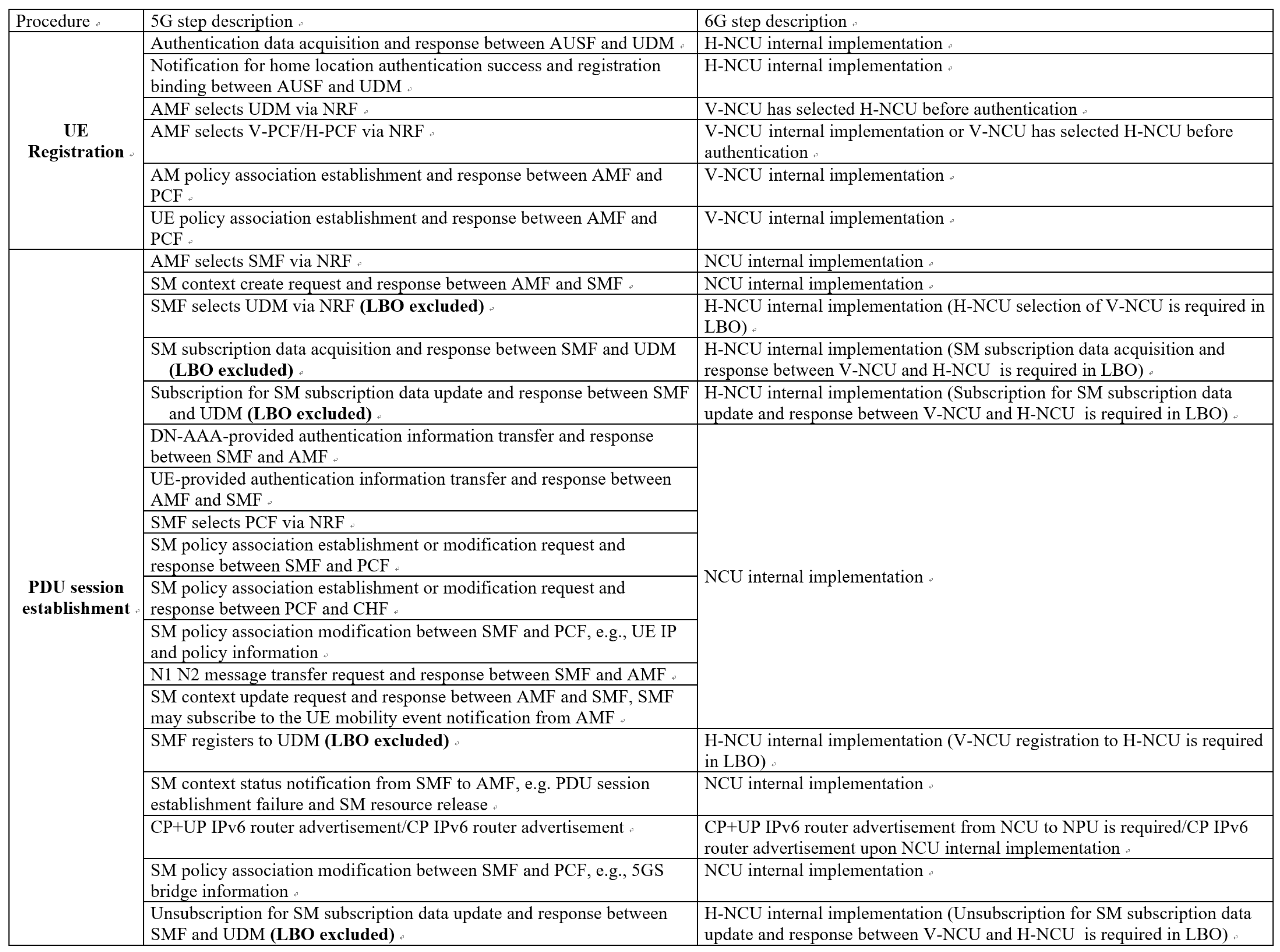
In the DDAA architecture, the functions of numerous coupled NFs are reorganized, the number of interfaces and the unnecessary redundant data scattered in the NFs are both decreased accordingly. By means of NF aggregation and reorganization, signaling interactions are expected to be significantly reduced which is evaluated in this section. We analyze the UE registration, protocol data unit (PDU) session establishment and handover procedures in different scenarios as supporting use cases. Note that in order to facilitate the analysis, we tentatively focus on the distinction between the visited and home networks for NFs/NFUs rather than considering the hierarchical deployment of them. The signaling volume of 5G/6G and simplified percentage are shown in Figure 4. It can be seen that, the PDU session establishment procedure in the non-roaming case has the highest signaling simplification percentage (55%) due to some NCU internal implementation. Specifically, the simplified signaling in the 5G and 6G procedures is listed in Figure 5.
In the general registration procedure, the interaction between authentication server function (AUSF) and unified data management (UDM) for authentication process can be implemented internally by the home-NCU. The UDM selection and home-policy control function (PCF) selection of access and mobility management function (AMF) can be integrated into the selection of home-NCU for authentication. The visited-PCF selection of AMF and the AM/UE policy association establishment process between AMF and PCF can be performed by visited-NCU. In the PDU session establishment procedure of non-roaming scenario, the session management function (SMF)/PCF/UDM selection can be omitted due to the aggregated session/policy management function of NCU. The interactions between AMF and SMF, such as SM context create/update/status notification, authentication information transfer, N1 N2 message transfer1 , control plane (CP) internet protocol version 6 (IPv6) router advertisement relies on the NCU internal implementation, so does the SM context update in the Xn-based handover2. But when the Control Plane CIoT 5GS Optimisation is not supported, the CP and user plane (UP) IPv6 router advertisement from NCU to NPU is performed. The interactions between SMF and UDM, such as SM subscription data acquisition, SM subscription data update subscription/unsubscription, registration of SMF, are omitted due to the aggregation of SMF and UDM. The SM policy association establishment and modification among SMF, PCF and charging function (CHF) can also rely on the session/policy management service in the NCU. However, in the case of local breakout (LBO), the UDM selection performed by SMF and the interactions between SMF and UDM cannot be ignored which should be performed by the interaction between visited-NCU and home-NCU.
5. Conclusion
Nowadays, 6G network architecture remains to be converged, and many promising technologies need to be tested and verified. Based on the current understanding and judgment, this article has presented the preliminary insights on 6G network architecture, and will be optimized iteratively as academia and industry research advances and technology matures. In line with the trends of network simplification and distributed autonomy, end-to-end collaboration of cross-network-layer and cross-network-domain will become more significant. And it is necessary to design cross-domain cooperation mechanism and cross-protocol information transfer method, and even cross-industry joint standard design.
Author Contributions
Conceptualization, Q. G., J. L. and Y. X.; methodology, Q. G.; software, Q. G.; validation, Q. G., J. L. and Y. X.; formal analysis, Q. G.; investigation, Q. G. and Y. X.; resources, Q. G. and J. L.; data curation, Q. G.; writing—original draft preparation, Q. G.; writing—review and editing, Q. G., J. L. and Y. X.; visualization, Q. G.; supervision, Q. G., J. L. and Y. X.; project administration, J. L.; funding acquisition, J. L. All authors have read and agreed to the published version of the manuscript.
Funding
This research was funded by National Science and Technology Major Project of China (No. 2025ZD1302500).
Acknowledgments
This work was funded and supported by the National Science and Technology Major Project of China (No. 2025ZD1302500), patially supported by the 2020 National Key R&D Program "Broadband Communication and New Network" special "6G Network Architecture and Key Technologies" (No. 2020YFB1806700).
Conflicts of Interest
The authors declare no conflicts of interest.
Abbreviations
The following abbreviations are used in this manuscript:
| 3GPP | The 3rd Generation Partnership Project |
| 5G | The 5th Generation |
| 6G | The 6th Generation |
| AI | Artificial Intelligence |
| AIaaS | Artificial Intelligence as a Service |
| AD | Atonomous Domains |
| AMF | Access and mobility Management Function |
| AUSF | Authentication Server Function |
| CHF | Charging Function |
| CP | Control Plane |
| CPaaS | Computing Power as a Service |
| CPU | Central Processing Unit |
| DDAA | Data-driven Distributed Autonomous Architecture |
| DTI | Data Transmission Interface |
| DUE | Digital Twin User Equipment |
| FPGA | Field Programmable Gate Array |
| FTP | File Transfer Protocol |
| GPU | Graphics Processing Unit |
| HTTP | Hypertext Transport Protocol |
| IPv6 | Internet Protocol Version 6 |
| ITU-R | International Telecommunication Union-Radiocommunication |
| LBO | Local Breakout |
| NAU | Network Assistance Unit |
| NCU | Network Control Unit |
| NDU | Network Data Unit |
| NF | Network Function |
| NFU | Network Function Unit |
| NIU | Network Intelligence Unit |
| NPU | Network Packet Unit |
| NWDAF | Network Data Analytics Function |
| PCF | Policy Control Function |
| PDU | Protocol Data Unit |
| PUE | Physical User Equipment |
| QoE | Quality of Experience |
| QoS | Quality of Service |
| RAN | Radio Access Network |
| RDMA | Remote Direct Memory Access |
| SaaS | Sensing as a Service |
| SBI | Service-based Interface |
| SLA | Service Level Agreement |
| SMF | Session Management Function |
| UDM | Unified Data Management |
| UE | User Equipment |
| UP | User Plane |
References
- C. -X. Wang, X.-H. You, X.-Q. Gao, et al. On the Road to 6G: Visions, Requirements, Key Technologies, and Testbeds. IEEE Communications Surveys & Tutorials 2023, 25, 905–974. [CrossRef]
- Framework and overall objectives of the future development of IMT for 2030 and beyond, ITU-R Draft New Recommendation, June 2023.
- U. Demirhan and A. Alkhateeb. Integrated Sensing and Communication for 6G: Ten Key Machine Learning Roles. IEEE Communications Magazine 2023, 61, 113-119. [CrossRef]
- S. Chen, Y. C. Liang, S. Sun, S. Kang, W. Cheng and M. Peng. Vision, Requirements, and Technology Trend of 6G: How to Tackle the Challenges of System Coverage, Capacity, User Data-Rate and Movement Speed. IEEE Wireless Communications 2020, 27, 218-228. [CrossRef]
- M. Giordani, M. Polese, M. Mezzavilla, S. Rangan and M. Zorzi. Toward 6G Networks: Use Cases and Technologies. IEEE Communications Magazine 2020, 58, 55-61. [CrossRef]
- K. B. Letaief, W. Chen, Y. Shi, J. Zhang and Y. J. A. Zhang. The Roadmap to 6G: AI Empowered Wireless Networks. IEEE Communications Magazine 2019, 57, 84-90. [CrossRef]
- X. D. Duan, X. Y. Wang, L. Lu, et al. 6G Architecture Design: from Overall, Logical and Networking Perspective. IEEE Communications Magazine 2023, 61, 158-164. [CrossRef]
- M. Corici, E. Troudt, P. Chakraborty and T. Magedanz. An Ultra-Flexible Software Architecture Concept for 6G Core Networks. In Proceedings of the 2021 IEEE 4th 5G World Forum (5GWF), Montreal, QC, Canada, 2021. [CrossRef]
- M. Corici, E. Troudt, T. Magedanz and H. Schotten. Organic 6G Networks : Decomplexification of Software-based Core Networks. In Proceedings of the 2022 Joint European Conference on Networks and Communications & 6G Summit (EuCNC/6G Summit), Grenoble, France, 2022. [CrossRef]
- Y. Xing, P. Li and J. Li. Discussion on 6G Network Architecture Based on Evolution. In Proceedings of the 2022 International Conference on Information Processing and Network Provisioning (ICIPNP), Beijing, China, 2022. [CrossRef]
- A. Dogra, R. K. Jha and S. Jain. A Survey on Beyond 5G Network With the Advent of 6G: Architecture and Emerging Technologies. IEEE Access 2021, 9, 67512-67547. [CrossRef]
- L. U. Khan, W. Saad, D. Niyato, Z. Han and C. S. Hong. Digital-Twin-Enabled 6G: Vision, Architectural Trends, and Future Directions. IEEE Communications Magazine 2022, 60, 74-80. [CrossRef]
- W. Saad, M. Bennis and M. Chen. A Vision of 6G Wireless Systems: Applications, Trends, Technologies, and Open Research Problems. IEEE Network 2020, 34, 134-142. [CrossRef]
- X. Wang, J. Mei, S. Cui, C. -X. Wang and X. S. Shen. Realizing 6G: The Operational Goals, Enabling Technologies of Future Networks, and Value-Oriented Intelligent Multi-Dimensional Multiple Access. IEEE Network 2023, 37, 10-17. [CrossRef]
- G. M. Karam, M. Gruber, I. Adam, F. Boutigny, Y. Miche and S. Mukherjee. The Evolution of Networks and Management in a 6G World: An Inventor’s View. IEEE Transactions on Network and Service Management 2022, 19, 5395-5407. [CrossRef]
- Lu, L.; Liu, C.; Zhang, C.; Hu, Z.; Lin, S.; Liu, Z.; Zhang, M.; Liu, X.; Chen, J. Architecture for Self-Evolution of 6G Core Network Based on Intelligent Decision Making. Electronics 2023, 12, 3255. [CrossRef]
| 1 | N1 is the interface between UE and the core network. N2 is the interface between the radio access network (RAN) and the core network. |
| 2 | Xn is the interface between RANs. |
Figure 1.
Service framework of three-layer-four-plane. Four plane belongs to the network function layer. Cloud-network operation, security and management penetrate through all the network dimensions to provide network orchestration, management and security guarantee.
Figure 1.
Service framework of three-layer-four-plane. Four plane belongs to the network function layer. Cloud-network operation, security and management penetrate through all the network dimensions to provide network orchestration, management and security guarantee.
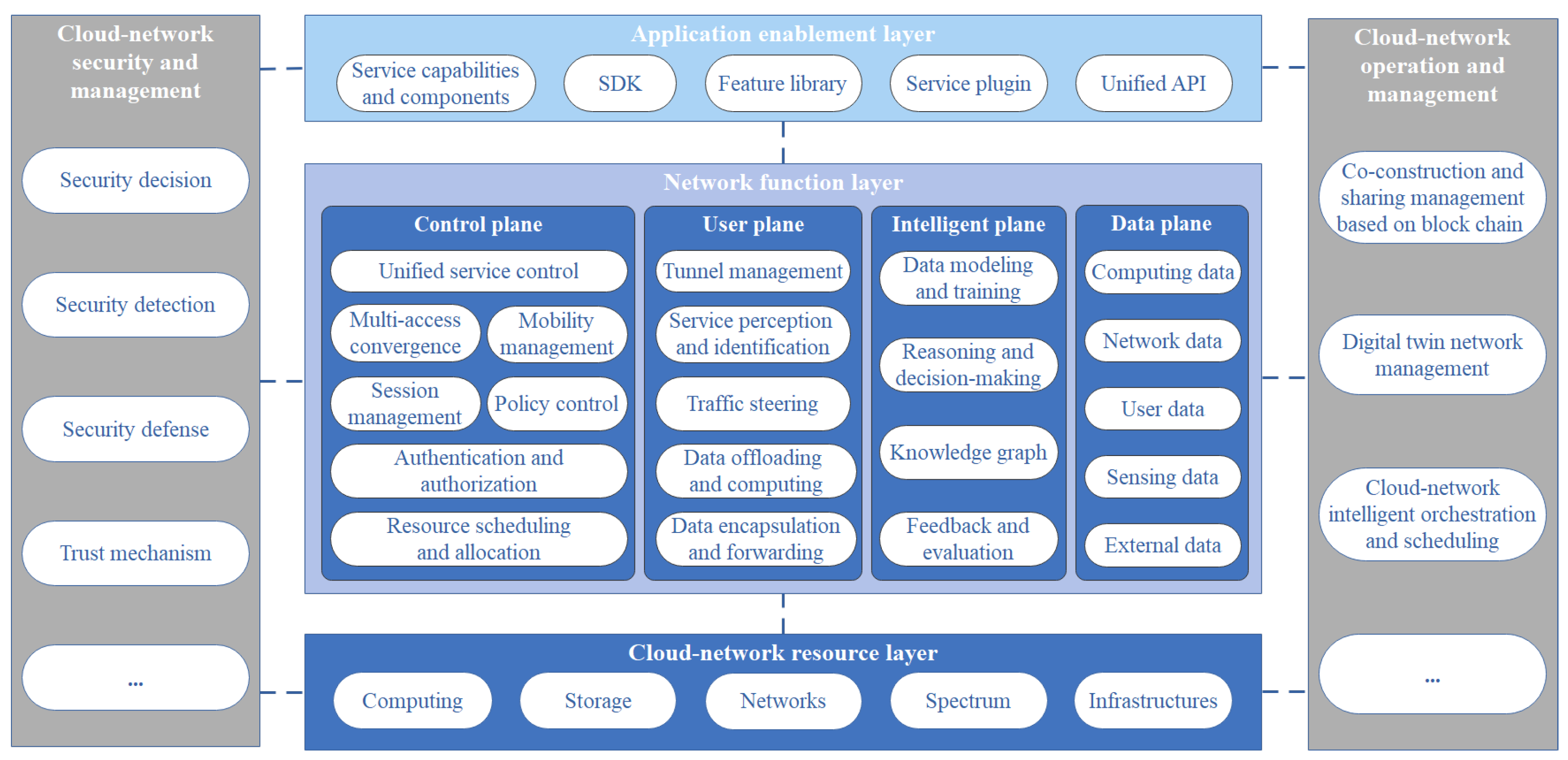
Figure 2.
DDAA towards 6G. NFUs include NCU, NPU, NIU, NDU, respectively corresponding to the control plane, user plane, intelligent plane and data plane in the network function layer. They interact via dual-bus interfaces i.e., SBI and DTI, for different transmission requirements. NAU provides the discovery, topology, routing and gateway service among NFUs.
Figure 2.
DDAA towards 6G. NFUs include NCU, NPU, NIU, NDU, respectively corresponding to the control plane, user plane, intelligent plane and data plane in the network function layer. They interact via dual-bus interfaces i.e., SBI and DTI, for different transmission requirements. NAU provides the discovery, topology, routing and gateway service among NFUs.
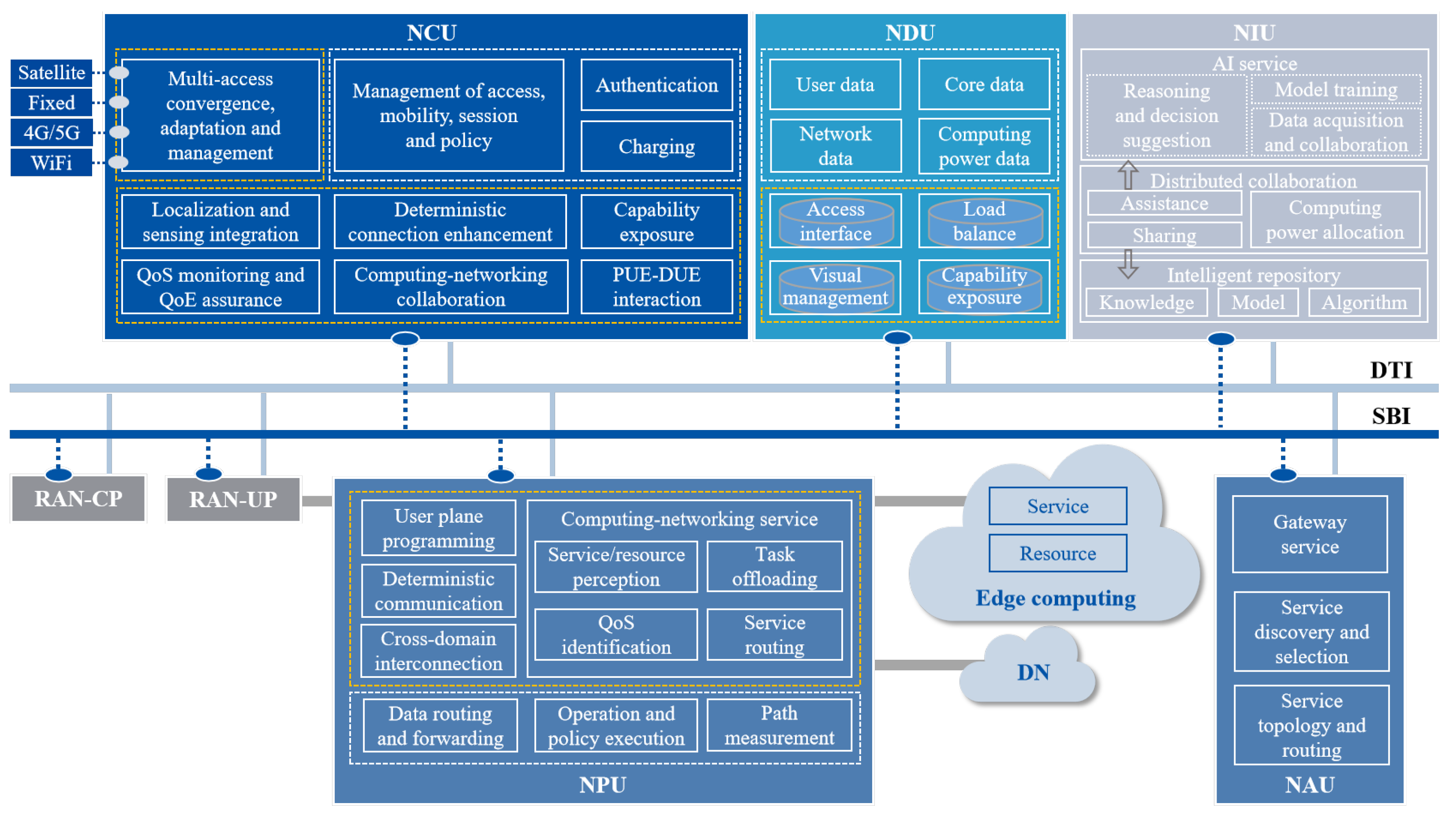
Figure 3.
Distributed autonomous networking towards 6G. The forms of centralized public network and dispersive customized network are expected to evolve into multiple distributed ADs. Network security and robustness can be better guaranteed in this way.
Figure 3.
Distributed autonomous networking towards 6G. The forms of centralized public network and dispersive customized network are expected to evolve into multiple distributed ADs. Network security and robustness can be better guaranteed in this way.
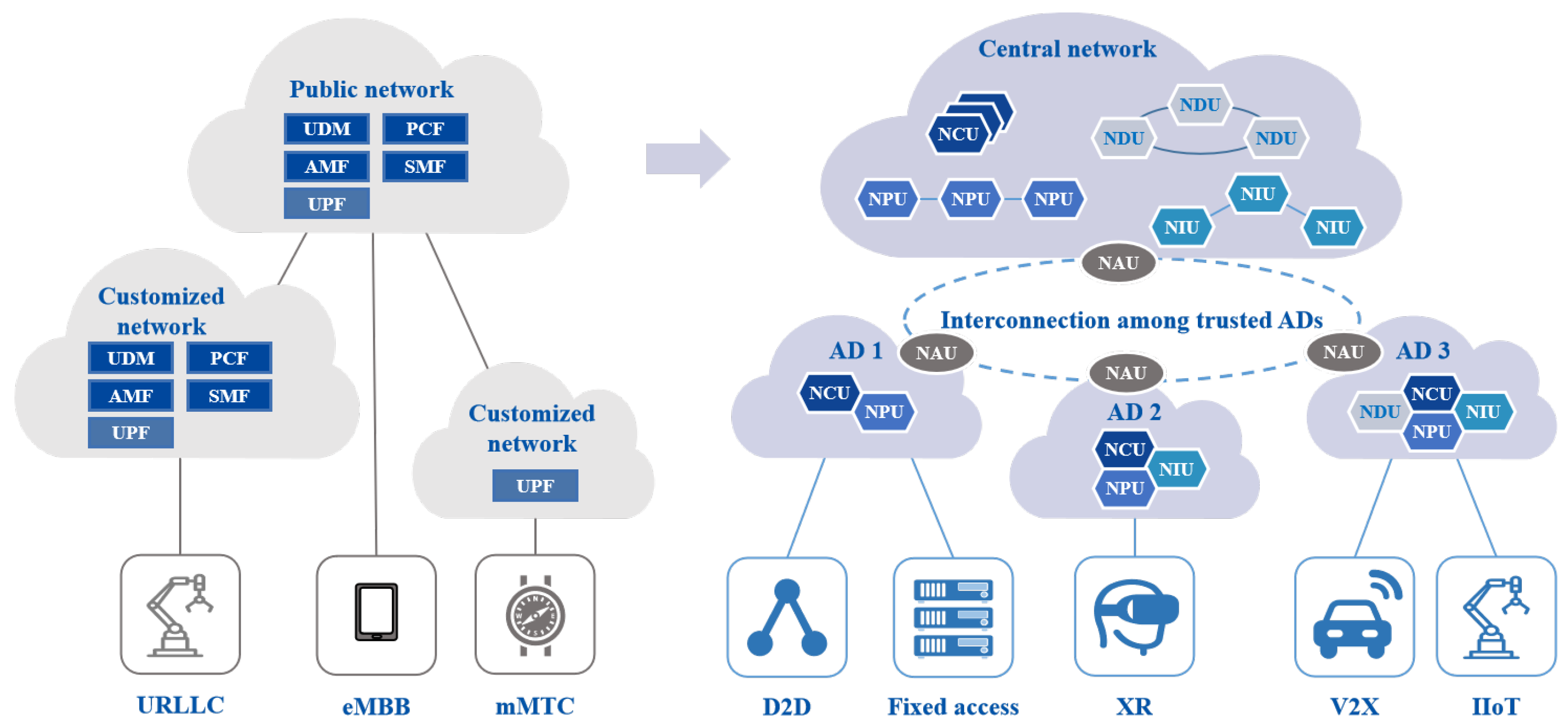
Figure 4.
Simplicity evaluation. The simplified percentage is defined as the ratio of signaling volume difference between 5G and 6G to signaling volume of 5G. Non-roaming PDU session establishment has the highest simplified percentage due to NCU internal implementation.
Figure 4.
Simplicity evaluation. The simplified percentage is defined as the ratio of signaling volume difference between 5G and 6G to signaling volume of 5G. Non-roaming PDU session establishment has the highest simplified percentage due to NCU internal implementation.
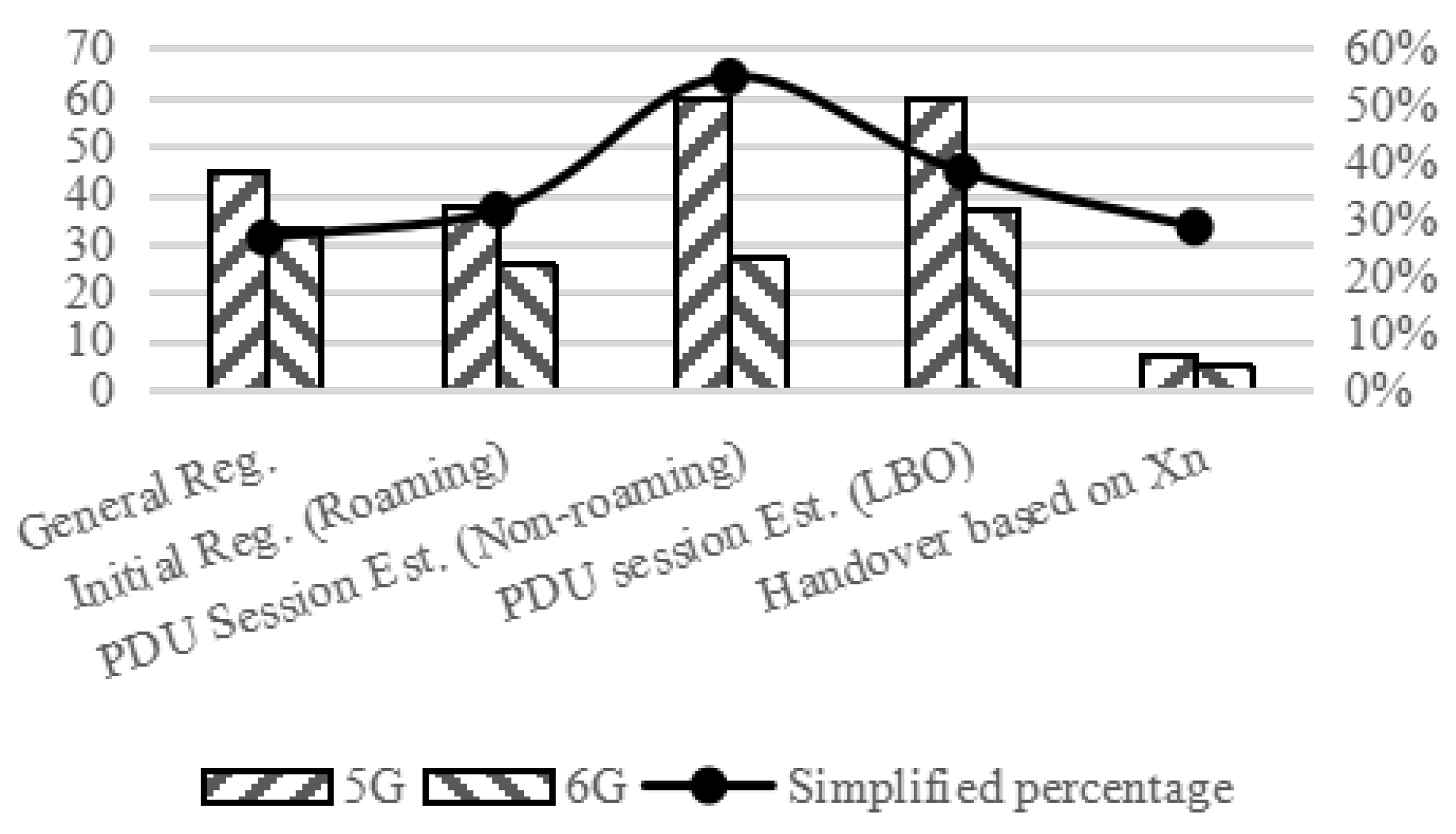
Figure 5.
Simplified signaling in the 5G and 6G procedures.
Disclaimer/Publisher’s Note: The statements, opinions and data contained in all publications are solely those of the individual author(s) and contributor(s) and not of MDPI and/or the editor(s). MDPI and/or the editor(s) disclaim responsibility for any injury to people or property resulting from any ideas, methods, instructions or products referred to in the content. |
© 2025 by the authors. Licensee MDPI, Basel, Switzerland. This article is an open access article distributed under the terms and conditions of the Creative Commons Attribution (CC BY) license (http://creativecommons.org/licenses/by/4.0/).
Copyright: This open access article is published under a Creative Commons CC BY 4.0 license, which permit the free download, distribution, and reuse, provided that the author and preprint are cited in any reuse.


