

Submitted:
12 November 2025
Posted:
13 November 2025
You are already at the latest version
Abstract
The paradigm of set, developed by the Georgian psychologist D.N. Uznadze, represents a foundational contribution to the science of non-conscious behavioral regulation. This preprint provides a comprehensive analysis of the set phenomenon, revisiting its core premise as a holistic, pre-conscious state that arises from the interaction of a subject's need and the objective situation. We systematically examine the classical haptic methodology and its modern modifications, including visual, computerized, and cross-modal paradigms. The analysis confirms the diagnostic power of set parameters, linking individual differences in set strength and lability to cognitive rigidity or flexibility. Furthermore, we integrate classical theory with contemporary neuroscience, framing set within the predictive coding framework and identifying its neurophysiological substrates in a distributed network including the basal ganglia, prefrontal cortex, and sensory association cortices. The preprint concludes by highlighting the paradigm's significant potential as a quantitative diagnostic tool and proposes future research directions, including the exploration of its neurochemical bases and its role in social cognition.
Keywords:
set
; D.N. Uznadze
; non-conscious regulation
; predictive coding
; cognitive rigidity
; cognitive flexibility
; fronto-striatal circuits
; implicit learning
; diagnostic methodology
1. Introduction
The human psyche is perpetually prepared by prior experience, a concept central to the school of thought founded by D.N. Uznadze. This article investigates set (Einstellung)—the cornerstone concept of Uznadze's theory, understood as a holistic, unconscious, and preliminary state that determines the direction of all subsequent mental activity (Uznadze, 1966). The relevance of set theory is pronounced in contemporary cognitive neuroscience, which is witnessing a significant resurgence of interest in non-conscious forms of mental regulation (Hassin, 2013). It provides a framework for studying the pre-conscious determinants of behavior crucial for implicit learning (Réber, 2013), decision-making (Kahneman, 2011), and cognitive biases (Tversky & Kahneman, 1974).
The experimental paradigm to objectify this construct is elegantly simple. The classic "haptic set" experiment involves a fixation phase, where a subject is repeatedly presented with two balls of different weights, and a critical phase, where two identical balls are presented. The manifestation of set is a compelling contrast illusion: despite objective equality, the individual perceives a difference (Uznadze, 1966). Despite its robustness, the "Uznadze balls" methodology is often reduced to a demonstration, and its potential as a diagnostic tool remains underutilized (Cheng & Tseng, 2021). This preprint aims to reclaim Uznadze’s set paradigm by synthesizing classical theory with modern neuroscience, systematizing its methodology, reviewing its diagnostic potential, and outlining its neurocognitive underpinnings.
2. Theoretical and Methodological Foundations
2.1. The Philosophical Approach: Set as a Holistic State
Set is not a discrete mental process but a fundamental mode of the entire personality, a primary state that modulates the psyche's reactivity (Uznadze, 1966). It emerges pre-consciously at the moment of the "meeting" between an actualized need and the objective situation (Bassin, 2021), aligning with modern dynamical systems approaches to cognition (Tognoli & Kelso, 2014).
2.2. The Two-Phase Structure of the Experiment
The paradigm objectifies this internal state through a distinct two-phase structure (Uznadze, 1966).
- The Fixation Phase (Set-Inducing Trials): Designed to establish the set through repetitive exposure to a constant stimulus relationship, a process of implicit, procedural learning (Seger, 2018) akin to developing a "perceptual expectation" (Kok et al., 2017).
- The Phase of Objectification (Critical Trials): Reveals the set's presence by presenting identical stimuli. The resulting contrast illusion is empirical proof of the set's power (Cheng & Tseng, 2021), demonstrating that perception is actively constructed by the brain's pre-activated models, a core tenet of predictive processing (Friston, 2010).
2.3. Key Diagnostic Parameters
The paradigm provides quantifiable metrics for assessing individual differences:
- Sensitization to Set (Speed of Formation): Reflects efficiency in implicit learning mechanisms (Ashby et al., 2010).
- Strength / Degree of Fixation (Persistence): A marker of cognitive rigidity, linked to prefrontal cortex function (Dajani & Uddin, 2015).
- Lability / Rigidity of Set (Adaptability): Indicates cognitive flexibility, associated with prefrontal integrity (Dajani & Uddin, 2015).

Table 1.
Key Diagnostic Parameters of the Uznadze Set Paradigm.
| Parameter | Operational Definition | Cognitive Interpretation | Neural Correlate (Example) |
| Sensitization | Number of fixation trials needed for a stable illusion. | Efficiency of implicit learning. | Cortico-striatal circuits (Ashby et al., 2010) |
| Strength | Number of critical trials where the illusion persists. | Cognitive rigidity; resistance to updating models. | Dorsolateral Prefrontal Cortex (Dajani & Uddin, 2015) |
| Lability | Speed of illusion extinction or set switching. | Cognitive flexibility; adaptability. | Anterior Cingulate Cortex (Cavanagh & Frank, 2014) |
3. Experimental Design and Modifications
3.1. The Classic Haptic Variant
The original method uses spheres varying in weight and volume (Uznadze, 1966). Key conditions include establishing a pure weight-based set, probing the size-weight illusion (Buckingham, 2014), and testing set specificity (Brayanov & Smith, 2010).
3.2. Modern Modifications and Paradigm Extensions
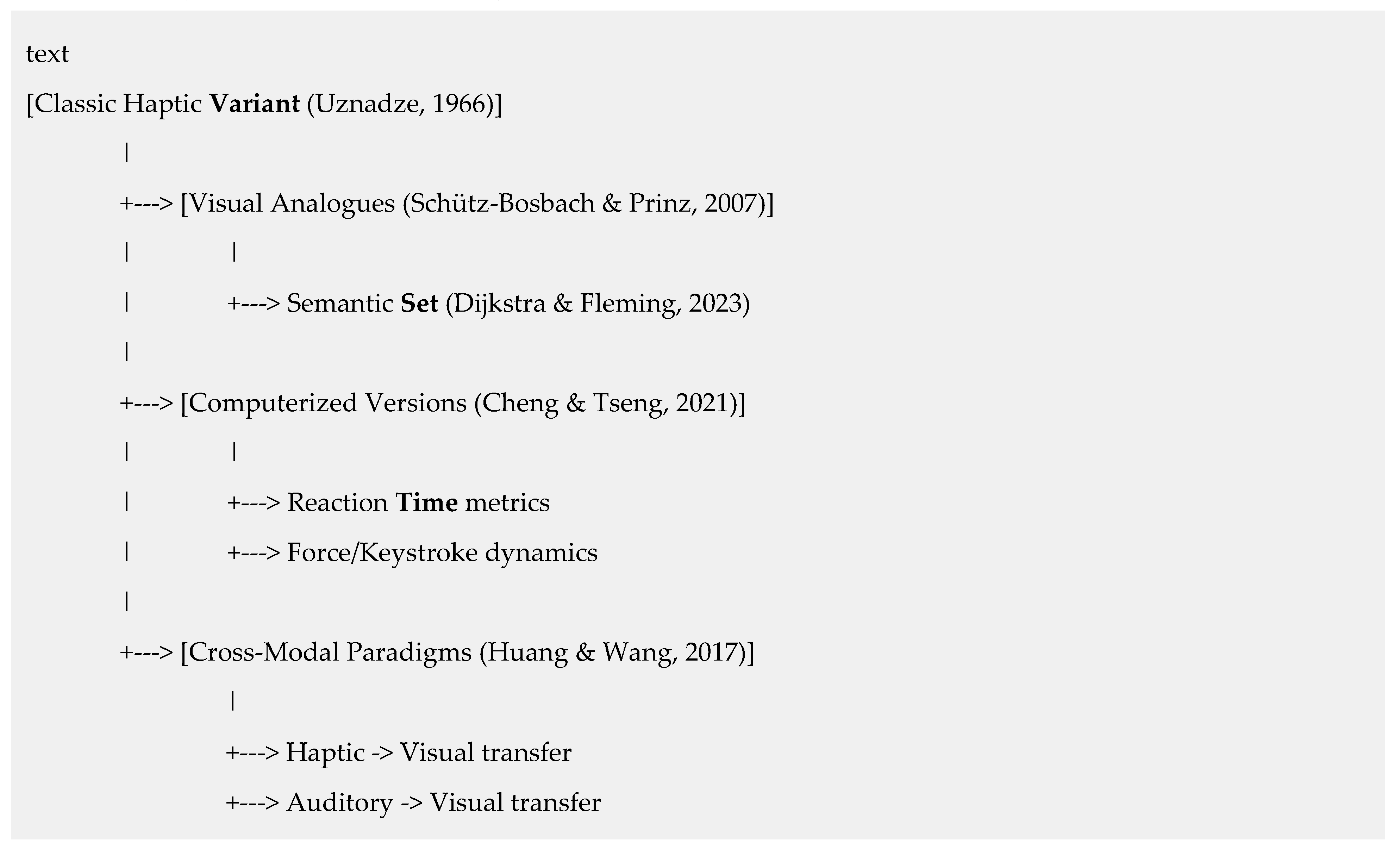
- Visual Analogues: Demonstrate domain-generality, producing a visual contrast illusion (Schütz-Bosbach & Prinz, 2007). Extended to semantic set (Dijkstra & Fleming, 2023).
- Computerized Versions: Enhance precision through millisecond-accurate reaction time measurement (Schütz-Bosbach & Prinz, 2007), objective motor metrics (Song & Nakayama, 2008), and perfect standardization (Cheng & Tseng, 2021).
- Cross-Modal Paradigms: Provide evidence for the amodal nature of set, showing transfer from haptic to visual perception (Huang & Wang, 2017), likely involving heteromodal association cortices (Driver & Noesselt, 2008).
Figure 1.
Evolution of the Uznadze Set Paradigm. A flow chart depicting the progression from the Classic Haptic Variant to Modern Modifications, with branches for Visual, Computerized, and Cross-Modal paradigms, listing key features and references for each.
Figure 1.
Evolution of the Uznadze Set Paradigm. A flow chart depicting the progression from the Classic Haptic Variant to Modern Modifications, with branches for Visual, Computerized, and Cross-Modal paradigms, listing key features and references for each.
4. Key Findings and Their Interpretation
4.1. The Universality of the Phenomenon
The contrast illusion is universal, signifying that set is a fundamental operating principle of the CNS (Uznadze, 1966). This aligns with the predictive coding framework, where the illusion is a behavioral manifestation of a strong prior overriding sensory evidence (Friston, 2010; Kok et al., 2017).
4.2. Individual Differences: From Cognitive Style to Neurological Signature
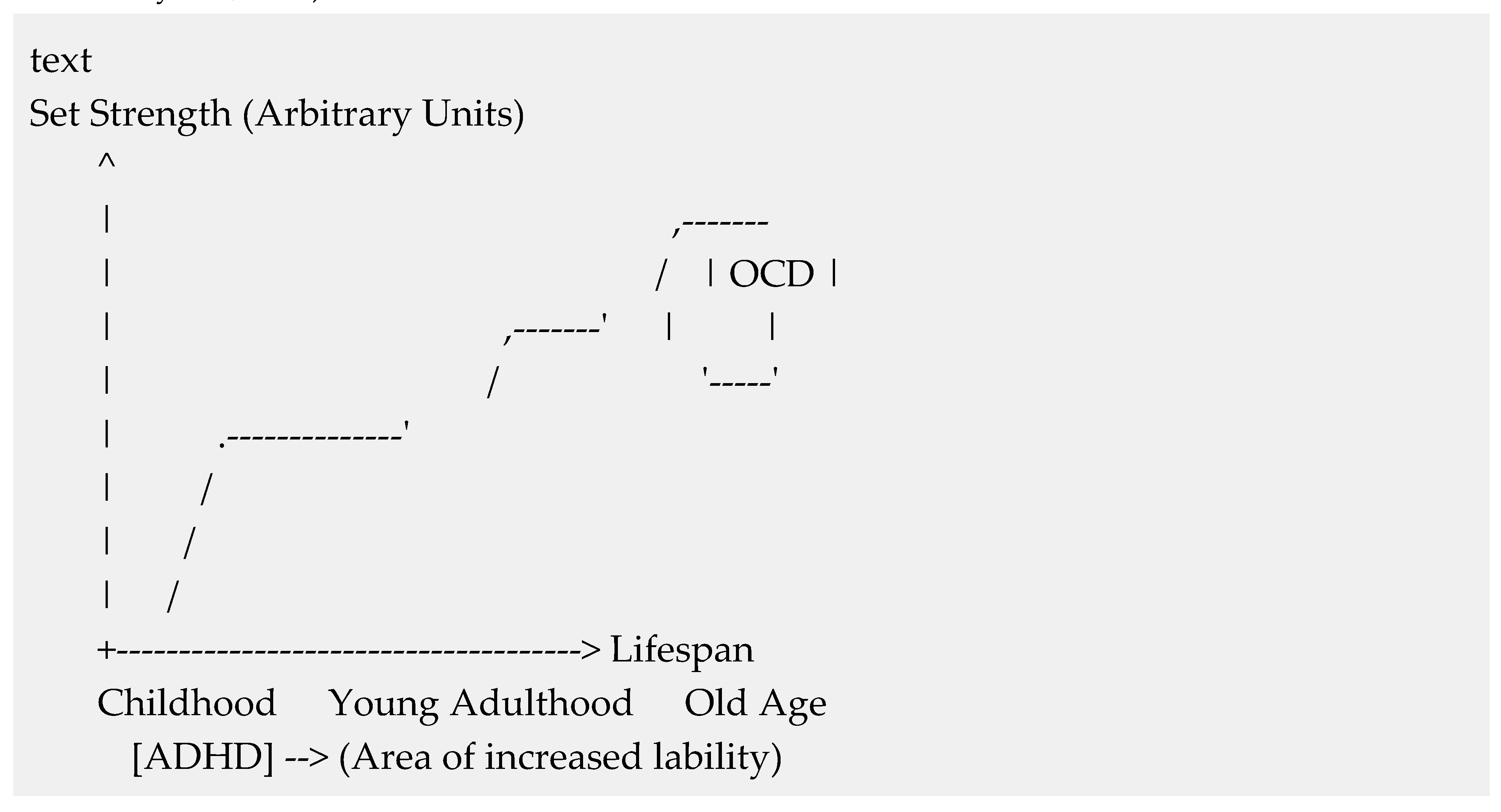
- "Strong" Set and Cognitive Rigidity: Persistent illusion is a marker of rigidity, linked to PFC function and observed in OCD and schizophrenia (Gómez-Ariza et al., 2017; Dajani & Uddin, 2015).
- "Weak" or Labile Set and Cognitive Flexibility: Rapid extinction indicates flexibility, but extreme lability can be pathological (e.g., ADHD, TBI) (Cheng & Tseng, 2021).
4.3. Diagnostic Potential in Applied Fields
- Clinical Psychology: Sensitive to cognitive dysregulation in schizophrenia (Sterzer et al., 2018), anxiety disorders (Gómez-Ariza et al., 2017), and Parkinson's disease (Ashby et al., 2010).
- Developmental Psychology: Trajectory mirrors brain maturation, from labile in childhood (Jolles & Crone, 2012) to rigid in aging (Tsvetkov et al., 2022).
- Sports and Professions: Assesses motor skill acquisition and cognitive-motor flexibility (Song & Nakayama, 2008).
Figure 2.
Diagnostic Potential of Set Parameters Across Populations. A line graph showing the hypothetical trajectory of Set Strength (Y-axis) across the Lifespan (X-axis: Childhood, Young Adulthood, Old Age). The line peaks in Young Adulthood. Overlaid are shaded areas indicating increased rigidity in clinical populations like OCD and Schizophrenia, and increased lability in populations like ADHD.
Figure 2.
Diagnostic Potential of Set Parameters Across Populations. A line graph showing the hypothetical trajectory of Set Strength (Y-axis) across the Lifespan (X-axis: Childhood, Young Adulthood, Old Age). The line peaks in Young Adulthood. Overlaid are shaded areas indicating increased rigidity in clinical populations like OCD and Schizophrenia, and increased lability in populations like ADHD.
5. Neurocognitive Correlates and Contemporary Interpretation
5.1. The Neurophysiological Substrate
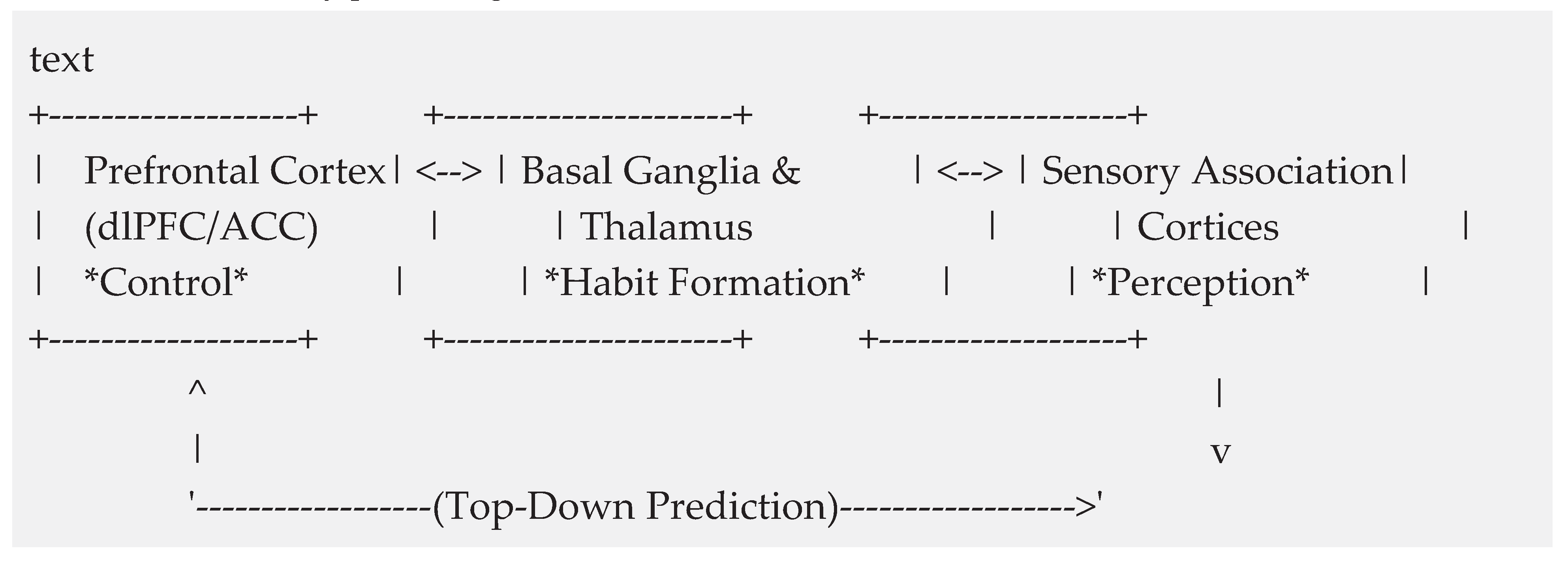
- Basal Ganglia and Thalamus: Critical for the implicit habit learning and reinforcement of the set "stereotype" (Ashby et al., 2010; Seger, 2018).
- Prefrontal Cortex (PFC): The executive controller, particularly the dlPFC and ACC, which monitor conflict and inhibit the prepotent set response (Dajani & Uddin, 2015; Cavanagh & Frank, 2014).
- Sensory Association Cortices: The locus of perceptual integration, where top-down predictions modulate sensory processing to create the illusion (Kok et al., 2017; Friston, 2010).
Figure 3.
Neurocognitive Model of Set Formation and Manifestation. A schematic diagram of a brain showing three interconnected neural circuits: 1. Basal Ganglia/Thalamus loop labeled "Habit Formation / Stereotype Engraving". 2. Prefrontal Cortex (dlPFC/ACC) labeled "Cognitive Control / Conflict Monitoring". 3. Sensory Cortex (e.g., Somatosensory) labeled "Perceptual Integration / Illusion Generation". Arrows indicate bidirectional communication, with a strong top-down arrow from PFC/Basal Ganglia to Sensory Cortex.
Figure 3.
Neurocognitive Model of Set Formation and Manifestation. A schematic diagram of a brain showing three interconnected neural circuits: 1. Basal Ganglia/Thalamus loop labeled "Habit Formation / Stereotype Engraving". 2. Prefrontal Cortex (dlPFC/ACC) labeled "Cognitive Control / Conflict Monitoring". 3. Sensory Cortex (e.g., Somatosensory) labeled "Perceptual Integration / Illusion Generation". Arrows indicate bidirectional communication, with a strong top-down arrow from PFC/Basal Ganglia to Sensory Cortex.
5.2. Interpretation within Cognitive Psychology
- Implicit Learning and Procedural Memory: Set formation is a classic example of non-conscious knowledge acquisition (Réber, 2013; Seger, 2018).
- The Priming Effect: The set acts as a prolonged form of negative priming, biasing subsequent perception (Henson, 2003).
- A Cognitive Heuristic ("Anchoring"): The fixation phase establishes a powerful "perceptual anchor" that distorts subsequent judgments (Tversky & Kahneman, 1974).
Table 2.
Mapping the Set Construct onto Modern Cognitive Frameworks.
| Uznadze's Concept | Modern Cognitive Framework | Key Reference |
| Set Formation | Implicit / Procedural Learning | Seger (2018) |
| Contrast Illusion | Predictive Coding / Perception as Inference | Friston (2010) |
| Set Persistence (Rigidity) | Deficits in Cognitive Control / Switching | Dajani & Uddin (2015) |
| Set as a prepared state | Priming (especially negative) | Henson (2003) |
| Fixation Phase | Establishment of a Cognitive "Anchor" | Tversky & Kahneman (1974) |
6. Discussion and Conclusions
This analysis repositions the Uznadze set paradigm as a vital tool for contemporary cognitive neuroscience. The set is a fundamental principle of mental organization—a non-conscious, integrative state at the heart of perception and action.
6.1. Theoretical Conclusions
The Uznadze methodology remains a valid and powerful tool for investigating non-conscious mental regulation (Hassin, 2013). The concept of set serves as a crucial bridge between classical psychology and modern predictive processing theories (Friston, 2010).
6.2. Practical Conclusions
The paradigm possesses significant, yet underappreciated, diagnostic potential in clinical and differential psychology (Gómez-Ariza et al., 2017; Sterzer et al., 2018). A critical goal is the standardization of computerized versions and the creation of normative databases (Cheng & Tseng, 2021).
6.3. Promising Avenues for Future Research
- Elucidating Neurochemical Foundations: Probing the role of the dopaminergic and GABAergic systems using pharmacological challenges (Cools & D'Esposito, 2011; Ashby et al., 2010).
- Social and Affective Neuroscience of Set: Establishing "social sets" to study implicit bias and stereotyping (Amodio, 2019).
- Developing Interventions: Using the paradigm for cognitive training to enhance behavioral flexibility in aging and pathology (Katz et al., 2018).
In summary, the Uznadze set paradigm is a testament to the enduring power of a profound psychological insight. By embracing its methodological versatility and grounding its findings in modern neuroscience, we can continue to unlock its potential to reveal the secrets of the non-conscious mind.
References
- Amodio, D. M. (2019). Social cognition 2.0: An interactive memory systems account. Trends in Cognitive Sciences, 23(1), 21–33. [CrossRef]
- Ashby, F. G., Turner, B. O., & Horvitz, J. C. (2010). Cortical and basal ganglia contributions to habit learning and automaticity. Trends in Cognitive Sciences, 14(5), 208–215. [CrossRef]
- Bassin, M. V. (2021). The problem of the unconscious in the context of the theory of set by D.N. Uznadze. Psychology. Journal of the Higher School of Economics, 18(1), 315-331. [CrossRef]
- Brayanov, J. B., & Smith, M. A. (2010). Bayesian and "anti-Bayesian" biases in sensory integration for action and perception in the size-weight illusion. Journal of Neurophysiology, 103(3), 1518–1531. [CrossRef]
- Buckingham, G. (2014). Getting a grip on heaviness perception: a review of weight illusions and their probable causes. Experimental Brain Research, 232(6), 1623–1629. [CrossRef]
- Cavanagh, J. F., & Frank, M. J. (2014). Frontal theta as a mechanism for cognitive control. Trends in Cognitive Sciences, 18(8), 414–421. [CrossRef]
- Cheng, C. H., & Tseng, Y. J. (2021). The neural correlates of motor-based and cognitive-based implicit learning. NeuroImage, 235, 118000. [CrossRef]
- Cools, R., & D'Esposito, M. (2011). Inverted-U-shaped dopamine actions on human working memory and cognitive control. Biological Psychiatry, 69(12), e113–e125. [CrossRef]
- Dajani, D. R., & Uddin, L. Q. (2015). Demystifying cognitive flexibility: Implications for clinical and developmental neuroscience. Trends in Neurosciences, 38(9), 571–578. [CrossRef]
- Dijkstra, N., & Fleming, S. M. (2023). Subjective signal strength distinguishes reality from imagination. Nature Communications, 14, 1627. [CrossRef]
- Driver, J., & Noesselt, T. (2008). Multisensory interplay reveals crossmodal influences on 'sensory-specific' brain regions, neural responses, and judgments. Neuron, 57(1), 11–23. [CrossRef]
- Friston, K. (2010). The free-energy principle: a unified brain theory? Nature Reviews Neuroscience, 11(2), 127–138. [CrossRef]
- Gómez-Ariza, C. J., Iglesias-Parro, S., García-López, L. J., Díaz-Castela, M. M., Espinosa-Fernández, L., & Muela, J. A. (2017). Cognitive flexibility and attentional bias in children and adolescents with anxiety disorders. Journal of Behavior Therapy and Experimental Psychiatry, 55, 66–73. [CrossRef]
- Hassin, R. R. (2013). Yes it can: On the functional abilities of the human unconscious. Perspectives on Psychological Science, 8(2), 195–207. [CrossRef]
- Henson, R. N. (2003). Neuroimaging studies of priming. Progress in Neurobiology, 70(1), 53–81. [CrossRef]
- Huang, Y., & Wang, L. (2017). The cross-modal effect of the haptic set on visual size perception. Frontiers in Psychology, 8, 1561. [CrossRef]
- Jaba, T. (2022). Dasatinib and quercetin: short-term simultaneous administration yields senolytic effect in humans. Issues and Developments in Medicine and Medical Research Vol. 2, 22-31.
- Jolles, D. D., & Crone, E. A. (2012). Training the developing brain: a neurocognitive perspective. Frontiers in Human Neuroscience, 6, 76. [CrossRef]
- Kahneman, D. (2011). Thinking, Fast and Slow. Farrar, Straus and Giroux.
- Katz, B., Shah, P., & Meyer, D. E. (2018). How to play 20 questions with nature and lose: Reflections on 100 years of brain-training research. Proceedings of the National Academy of Sciences, 115(40), 9897-9904. [CrossRef]
- Kok, P., Mostert, P., & de Lange, F. P. (2017). Prior expectations induce prestimulus sensory templates. Proceedings of the National Academy of Sciences, 114(39), 10473-10478. [CrossRef]
- Réber, A. S. (2013). Implicit learning and tacit knowledge: An essay on the cognitive unconscious. In The Oxford Handbook of Cognitive Psychology. Oxford University Press. [CrossRef]
- Schütz-Bosbach, S., & Prinz, W. (2007). Perceptual resonance: action-induced modulation of perception. Trends in Cognitive Sciences, 11(8), 349–355. [CrossRef]
- Seger, C. A. (2018). Corticostriatal foundations of habits. Current Opinion in Behavioral Sciences, 20, 153–160. [CrossRef]
- Song, J. H., & Nakayama, K. (2008). Target selection in visual search as revealed by movement trajectory. Vision Research, 48(7), 853–861. [CrossRef]
- Sterzer, P., Adams, R. A., Fletcher, P., Frith, C., Lawrie, S. M., Muckli, L., ... & Corlett, P. R. (2018). The predictive coding account of psychosis. Biological Psychiatry, 84(9), 634–643. [CrossRef]
- Tognoli, E., & Kelso, J. A. (2014). The metastable brain. Neuron, 81(1), 35-48. [CrossRef]
- Tsvetkov, A., Kuptsova, S., & Ivanova, M. (2022). Cognitive rigidity in healthy aging and frontotemporal degeneration. Frontiers in Aging Neuroscience, 14, 841647. [CrossRef]
- Tkemaladze, J. (2023). Reduction, proliferation, and differentiation defects of stem cells over time: a consequence of selective accumulation of old centrioles in the stem cells?. Molecular Biology Reports, 50(3), 2751-2761. https://pubmed.ncbi.nlm.nih.gov/36583780/.
- Tkemaladze, J. (2024). Editorial: Molecular mechanism of ageing and therapeutic advances through targeting glycative and oxidative stress. Front Pharmacol. 2024 Mar 6;14:1324446. [CrossRef] [PubMed] [PubMed Central]
- Tkemaladze, J. (2025). Through In Vitro Gametogenesis—Young Stem Cells. Longevity Horizon, 1(3). [CrossRef]
- Tversky, A., & Kahneman, D. (1974). Judgment under Uncertainty: Heuristics and Biases. Science, 185(4157), 1124–1131. [CrossRef]
- Uznadze, D. N. (1966). The Psychology of Set. Consultants Bureau.
Disclaimer/Publisher’s Note: The statements, opinions and data contained in all publications are solely those of the individual author(s) and contributor(s) and not of MDPI and/or the editor(s). MDPI and/or the editor(s) disclaim responsibility for any injury to people or property resulting from any ideas, methods, instructions or products referred to in the content. |
© 2025 by the authors. Licensee MDPI, Basel, Switzerland. This article is an open access article distributed under the terms and conditions of the Creative Commons Attribution (CC BY) license (http://creativecommons.org/licenses/by/4.0/).
Copyright: This open access article is published under a Creative Commons CC BY 4.0 license, which permit the free download, distribution, and reuse, provided that the author and preprint are cited in any reuse.


