

Submitted:
11 November 2025
Posted:
13 November 2025
You are already at the latest version
Abstract
This paper presents an innovative approach to the design and evaluation of intelligent software architecture for Digital Library Systems (DLSs) in the context of sustainable education. By leveraging Artificial Intelligence (AI) technologies, global cooperation, and best practices in Software Engineering, we propose the design of a model that enhances the management, access, and usability of digital libraries. Our framework introduces intelligent services for decision-making processes, research activities, and personalized learning experiences. Through global collaboration, our architecture aims to contribute significantly to achieving Sustainable Development Goal 4 (SDG4), ensuring inclusive and equitable education worldwide.
Keywords:
digital library system
; intelligence
; cooperation
; software architecture
; sustainable education
1. Introduction
This paper presents the design and evaluation of intelligent software architecture for Digital Library Systems (DLSs) as global intelligent systems for current developments in sustainable education.
Globalization and technologies are changing the way that information is used within societies. There are new global ways of dealing with knowledge all around the world. And foremost among these are the DLSs. These systems are being used in numerous sectors like culture, research, music, health or history. Further, they have been applied by the United Nations (UN) and related organizations to facilitate digital collections to developing nations at essentially “no cost” [1]. More recently, DLSs help in the achievement of the 17 Sustainable Development Goals (SDGs) [2,3] like “quality education for all” (SDG4), where DLSs could play a central role [4,5,6,7] once global cooperation has strongly contributed to national plans and strategies [8,9]. Thus, new cooperation insights need to be added to current DLSs in education; DLSs must work cooperatively at a global level to provide more sustainable educational services.
We have wide research experience with DLSs and real-world collections. For example, in [10] we have participated in presenting Chasqui to the DLS community as a digital collection on Pre-Columbian American archeology. Later, in [11,12], we contribute to evaluating Clavy as an experimental system for managing digital collections with reconfigurable metadata schemata. And we have also specialized our work in the creation, exploitation and management of DLS repositories in education [13]. Although we also intend to extend these investigations by adding new values and capacities to our educational DLS repositories. And, to this end, we have decided to augment our DLS architecture with, for example, new intelligent services based on Artificial Intelligence (AI) technology for decision-making processes and research activities, while improving current Software Engineering (SE) practices being applied with DLSs.
This year, we have presented several models to develop global intelligent systems [14] as part of the initial foundation of a new, global approach to AI that we have called Global Artificial Intelligence [15]. We have coined generic, computational and operative models to derive new artificial systems to support global intelligence abstractions and cooperative environments. Further, we have applied flexible refinement techniques like “service-oriented refinement” to design intelligent services abstractions prior to final software architectures design. In [14], for example, we evaluate these abstractions designing a generic global intelligent system to help with current advances towards SDG4 achievement by the year 2030.
Now, in this paper, we adapt and evolve this research work to model fully operational and intelligent software architecture for DLSs in sustainable education. We review our previous work with DLSs and intelligent models and present a new architectural design for DLSs as global intelligent systems. The definition of new management frameworks and global development methodologies for these software architectures are also part of our current research work. For example, we are running several publications where we provide and evaluate a management framework [16,17] based on our DLS software architecture for government organizations currently involved with digital transformations. These investigations show how our DLS architecture provides significant benefits in the integration and management of new cooperative processes and new AI-driven services within DLSs. Finally, in these investigations, we have used qualitative and statistical analysis methodologies [17] aimed at capturing participant perceptions regarding the applicability and feasibility of our framework with our embedded architecture widely described in this paper. These participants have been selected from a targeted sample of professionals in government IT departments, digital transformation offices, and AI-related policy roles.
Our main objective is designing flexible and efficient intelligent software architectures for current DLSs in sustainable education. Other, more specific research goals that we pursue with this article are as follows:
- Summarizing our ongoing investigations, including major influences and motivations.
- Adapting and evolving our most recent research work around the modelling and building of global intelligent systems.
- Presenting our intelligent software architectures for DLSs as global intelligent systems.
- Designing and evaluating a case study for our DLS software architectures in sustainable education.
- Defining an open research agenda with future research directions.
The paper has the following structure. Our ongoing investigations are shown in Section 2. Section 3 summarizes our current research with intelligent models in educational environments. The intelligent software architecture for DLSs is described in Section 4. Section 5 summarizes an evaluation case study for this architecture. An open research agenda with future directions for this work is presented in Section 6. Finally, conclusions and concrete future work are described in Section 7 and Section 8, respectively.
2. Ongoing Investigations
Since 2004, we have investigated DLSs and their application in numerous sectors such as health, archeology or education. Recently, we have concentrated our efforts on:
- solving the major limitations of the architecture of these software systems to add new intelligent values and services from a global, cooperative perspective,
- incorporating current AI technology,
- advancing the engineering methods and best practices that we apply and,
- contributing to sustainable education with our designs.
In this section we summarize most of our motivations for these investigations.
2.1. DLS Architectures
Digital Library Systems (DLSs) are software systems that support the operation of current digital libraries (organized collections of information) around the world [18,19]. Basically, as software systems, they are designed to respond to the needs of their final users and administrators, using current best practices in software design.
The traditional software architecture of DLSs (see Figure 1) usually incorporates three main components:
- a digital object store (resources of the digital library like videos, documents and audios),
- a metadata store (describing the digital resources) and,
- a suite of services (to provide access, maintain and manage the other two components).
The data and metadata stores (registries) are typically implemented using a combination of file systems, databases, etc. Services are provided by local and remote applications, usually with web-based interfaces. The precise mapping of these services to their applications varies from one software architecture to another. Typical services provided by this DLS architecture include submit, search, browse, navigation, import, manage, copy, annotate, authorize, help, export, link, filter and visualize. All these services help to create, store, classify, present, maintain and manage all the information of the digital library. For example, the browse service uses the metadata store to facilitate the presentation of digital objects according to final user random requests.
Some of these software architectures also interoperate with one another and with other technologies like LDAP (to handle final user authentication) or Web Services, publishing some of the services of the DLSs. Further, DLSs can be accessed and used over the global network that is currently provided by the Internet. However, from our point of view, there is no global, cooperative intelligence in these designs. DLSs do not seem to interact at a superior level of abstraction where global cooperation is required among DLSs and users. Indeed, DLSs interoperate using low-level protocols like, for example, OAI--PMH and DIDL, or low-level technologies like OAI-PMH between component DLSs using XML-based data exchange [18]. And some improvements have been obtained through the adoption of the principles and functions of the cooperation embodied with Web 2.0, publishing content through “syndication” or “re-using data services of others” [20]. But DLS users cannot cooperate to mean global, cooperative intelligence (as we initially introduced in [15] in dealing with the digital collections using these low-level protocols and mechanisms. DLSs cannot offer high quality, intelligent services operating over data objects [18,21]. Thus, we propose starting the design of DLSs interactions at the top level of global cooperation, enabling collaborations (across educational institutions, research centers, governments, etc.) and related decision-making processes in the wide DLS community. This will especially help DLSs in developing nations which do not have extensive or appropriate digital collections.
Other, major limitations that we have found with current DLSs architectures are their lack of cooperative intelligence, restricted interoperability, and limited integration of AI-driven services. Existing architectures mainly focus on local operations and isolated repositories, lacking advanced mechanisms to support cooperation between different DLSs. Furthermore, traditional DLS architecture does not provide adaptive and personalized services to users, limiting their effectiveness in modern educational environments. The absence of intelligent data processing and knowledge-sharing capabilities prevents DLSs from evolving into truly cooperative and intelligent systems.
Further, the integration among these DLSs architectures and current AI technology is not clear and cannot be easily solved since it faces numerous problems like legal and ethical considerations, technical complexities, job replacement or poor network connectivity [22]. Indeed, there is little adoption of AI to build intelligent services in, for example, educational DLSs [23,24]. Although there are clear foundations in how to make automatic classification systems (within the DLSs) based on Neural Networks and fast Learning algorithms [25]. Some of these features are described in more detail in Section 2.2. In Section 3 we explain how our intelligent models [14] and, more particularly, our computational models can be widely applied to solve a more general application of AI technology within the DLS software architecture.
2.2. Artificial Intelligence
One of the most successful AI systems used in DLS domains is the Recommender System. Basically, this system uses content-based filtering based on users’ content interests, and collaborative filtering based on ratings from different users with similar preferences [26]. In In [27], for example, a “social recommender system” is described as a new concept based on the use of social networks to generate the recommendations. Other Recommender Systems use AI techniques like Fuzzy Logic [28] or Deep Learning [29]. All these systems improve the DLS final user experience with the digital collection, incorporating some personalization capacities based on the recommendation techniques.
In the last few years, AI techniques have also been used in library network security predictions [30], library management decisions [31] or digital reading promotion [32]. Further, DLS has contributed to current AI’s regulatory advances and legislation. Indeed, DLSs operations are represented in national AI initiatives and strategies [33]. All these AI explorations suggest that AI techniques and applications can convert digital collections into dynamic and flexible systems, enhancing their overall success and efficiency, and providing new personalized capacities to final users. But we have not found any clear initiative to instantiate the software architecture of DLS incorporating all these efforts.
Currently, chatbots from Generative AI are being integrated also with DLSs [34,35], leading to important research advances in Conversational AI and opening new technological opportunities to automate “human-to-human communications” [36]. With these automatic language models, the final users of the digital libraries can get quick answers to their digital objects enquiries as well as general assistance on the DLS services. They are effective “virtual assistants” [37]. Further, chatbots like ChatGPT can make personalized recommendations to DLS final users and help them to navigate within the systems. But there are also problems with this recent DLS-chatbots integration like “potential for error” with non-trained data, “privacy concerns” or “dependence on technology” [36].
Soon, it seems clear that AI Applications will incorporate most of the behaviour-oriented insights of AI (initially introduced in [38]) and language models to reproduce Autonomous Agents (agents without human intervention) in many different DLS domains like customer service, or healthcare [39]. Indeed, these agents will perform many different tasks (behaviors), assisting in our “digital lifes”.
However, we think that these AI applications based on Autonomous Agents should not solve global cooperation. “The success of the human species is rooted in our ability to cooperate” and we must “equip our machines with the capabilities necessary to cooperate and to foster cooperation” building bridges between the “natural, social and behavioral sciences” [40]. But we must be careful we undertake cooperation, through AI applications, at the right level of abstraction so there is no “human replacement” or “human behaviour control” with our global approaches.
Additionally, developing countries do not have access to these AI systems, techniques and applications. They do not participate in the actual AI revolution although knowledge, intelligence, behavior and data are essential for current development. And we want to help in solving this issue by means of introducing global, cooperative intelligent systems where developing countries can participate and cooperate with other nations to improve their current developments [14].
2.3. Software Engineering
The best current practices in Software Engineering (SE) refer to (see also [41]) for more information on scientific SE):
- Efficient project management (collaboration platforms, workflows, control systems, etc.).
- Flexible, efficient and scalable design (e.g., to help with project management).
- Easy-to-use and modular code.
- Independence (using formats or open-source libraries).
- Using build-automation tools (to build and test the code).
- Good documentation (both high-level and detailed abstractions).
- Regular individual and integrated testing.
- Continuous deployment.
- Efficient software support and maintenance.
In software design, as part of SE, the principles that help to develop scalable and efficient software remain simple (see [42] for a complete description of traditional SOLID principles):
- Single responsibility principle (to avoid coupling)
- Keep components open for extension, but close for modification.
- Derived components must fully support the substitution of their base components.
- Clients should not be forced to depend upon interfaces they do not use.
- High level modules should not depend upon low level modules.
- Abstractions should not depend upon details.
Some of the major principles in DLS software design are simplicity, openness, independence of protocols, loose coupling and reuse. Other, more specific principles widely adopted by the DLS community are:
- DLS cooperation must be constructed as a distributed network of extended standards.
- All DLS services must be standard components for final users, administrators and other information systems.
- User interfaces, like web interfaces, must communicate with DLS services components.
However, these standardizations face several problems like the need for specialization of DLS repositories and services in some specific domains like health (see, for example, [43]).
With the adoption of AI technologies, SE practices and, more particularly, software design, have changed. Indeed, there are new approaches for “building, operating and maintaining AI-based systems” [44]. These systems’ rules and behaviours result from training data rather than extensively programming system code. They need focusing part of the SE projects in acquiring and applying large datasets to train the models during software testing.
During many years, software architecture was separated from the software development processes (how people organize and interact). Nowadays, processes (e.g., ITIL v4) seem to pay more attention to “architecture”. We have defined a management framework [16] that incorporates both interrelated architecture and processes abstractions. And we are currently integrating this research work with our EDLS software architecture to evaluate our engineering work with DLS experts.
The software architecture of a system represents a set of software elements and the relationships among them. It describes these structures in a clear and efficient way. It provides an early prediction of the behaviour of the system and defines a set of constraints for its final implementation. It is a key tool for system development, project management and developers training.
Software architecture design translates the architecture requirements (e.g., functionality of the system) into a set of software components. Other important SE activities strongly related to software architecture design are software architecture documentation, architecture evaluation and architecture implementation. All these activities are compatible with current Agile principles and practices [45].
The main levels of software architecture design are:
- Architectural design (“high-level view”).
- Software elements interaction design (“low-level detail”).
- Software elements internals design (“low-level detail”).
One major aspect in software architecture design is “decision making”. [46] provides the following 9 principles for the software architects in this respect:
- Use facts (not incomplete information).
- Check assumptions.
- Explore contexts (as conditions that influence software decisions).
- Anticipate risks.
- Assign priorities.
- Define time periods for decisions.
- Generate multiple solution options.
- Design around constraints.
- Weigh the pros and cons.
Current best practices in software architecture design are:
- Modular and scalable design to ensure flexibility and maintainability.
- Use of microservices architecture for efficient and independent service deployment.
- Implementation of cloud-based solutions to enhance accessibility and reliability.
- Adoption of DevOps practices for continuous integration and deployment.
- Incorporation of AI-driven optimization techniques to improve system performance.
- Use of standardized APIs for seamless interoperability between DLSs.
- Emphasis on cybersecurity measures to protect sensitive educational data.
The major principles in DLS software architecture design are (see [47] for complete descriptions of some of these principles):
- Adhere technical framework to current legal and social frameworks.
- Use standard terminology for the elements of DLS architecture.
- Separate architectural elements from the content stored within the DLS (so the architecture can apply to all digital collections).
- Name and identify the major components of architecture.
- Do not tie digital objects of the collection to technologies.
- Repositories (data and metadata) must take care of the information they hold.
- The architecture must support the abstraction of data to suit the needs of the final users (through appropriate services).
For several years, DLS architecture design has faced many problems from the user’s perspective like, for example, (see also [48]).
- Interface usability.
- Collection quality.
- Content accuracy.
- Services quality.
- Flexibility and scalability.
- Systems performance efficiency.
With current AI-based systems design, there are also important challenges in (see [44] for a complete view of this research):
- software architecture design (like ethics, predictions of models, real-world deployments, model management, etc.),
- design principles (e.g., “changing anything changes everything”) and,
- software quality (e.g., learning parameters customization).
In this paper, we look at all these principles, practices and challenges to design our software architecture for global DLSs.
2.4. Sustainable Education
Education is at the heart of the Sustainable Development Goals (SDGs) for the Agenda 2030. Education is a critical tool for obtaining sustainability across the world. Indeed, SDG4, based on sustainable education, promotes global sustainability. This goal ensures “inclusive and equitable” education promoting “lifelong learning opportunities for all” and providing “good education for all” through appropriate education plans [49]. Indeed, SDG4 can transform people’s knowledge and obtain new moral/ethical behaviors from all citizens. And all this requires new collaborative actions and strategic educational planning for providing good quality services. It requires a “reorientation” of the educational DLS so, for example, governments can incorporate and measure “sustainability”.
Academic libraries within developing countries should formulate their strategic plans integrating SDGs into their programs, services and resources [3]. And the developed world can globally help with this achievement through appropriate cooperative programs [8] improving, for example, the skills of the librarians or their resources and infrastructures [5,50]. Additionally, academic library activities across the world can be assessed with specific indicators of SDGs to reveal their contributions [51].
The digital object stores (repositories) of DLSs allow storing interrelated digital content with a clear didactic and academic objective [52]. The metadata store of DLSs can be used to describe these objects to later organize and classify them for final search and retrieval. And all these features are of intriguing interest for educational environments and, more particularly, for sustainable educational environments helping developing countries and “making” global citizens.
In the last few years, most research around the application of DLSs in education has been based on the establishment of new standards for most of the design aspects of these repositories like metadata schemas [53], educational objects aggregation mechanisms [54], or DLSs interoperability [55]. And, more recently, there have been some investigations in the integration of AI algorithms to exploit DLS data in education [23]. Further, there have been recent investigations around the benefits and limits of applying AI in education observing, for example, new “governance practices” [56] following UNESCO Beijing Consensus (May 2019) about this application. Basically, this consensus establishes that the major objective in applying AI in education must be to improve human capacities and to protect human rights towards an effective collaboration between humans and machines, advancing current progress to achieve SDG4.
This sustainable education must obtain and preserve appropriate global solutions across current educational institutions and related organizations, using, for example, social networks and media [57]. The educational sector needs global solutions where professionals and students can cooperate by accessing and using global educational services. “Digital tools, online platforms, and collaborative technologies” are transforming the educational environments into a “globalized and interconnected domain” [58]. And these global solutions can be especially relevant for sustainable education where developing countries need to cooperate with external, global contributors. Indeed, these countries can benefit from cross-cultural communications, improving the quality and efficiency of their education systems. Thus, with our work, we want to approximate the design of cooperative DLSs as global systems supporting these collaborations.
Finally, sustainable education must contribute to the formation of new global citizens through the development of new studies dealing with social and ethical values like “respect, equity, justice, transparency and honesty”.
3. Intelligent Models
DLS design becomes more complex when its final users belong to multiple institutions, cultures and states. But global cooperation with DLSs requires passing these boundaries.
We want to design DLSs as truly global intelligent systems. And, to this end, we have abstracted several models prior to final software architecture design. With these intelligent models, we also intend to extend the values of DLSs repositories into many educational processes.
Figure 2 shows our first abstraction. This is a generic model based on generic cooperative entities interacting with each other to mean global, cooperative intelligence.
In this top-level model, a generic educational institution cooperates with a generic research center, a generic government, a generic private sector and a generic socio/cultural entity (e.g., a museum). Further, within this generic educational institution we underline the relevance of the educational programs, and the cooperative strategies with the other entities. And the global model is observed to run cooperative interactions (C12 to C15) since cooperation arises from “interaction structures” [59].
We follow a top-down approach with more abstractions and refinements to continue designing the models prior to our software architecture design. And in the second abstraction, we have the first approximation of our computational model. Here the top educational programs are mapped into concrete educational processes implemented by a global DLS network (see Figure 3). There are still cooperative strategies within the educational institution that need to be designed. And the Educational DLS (EDLS) must incorporate this design.
The DLS community must design cooperative strategies based on concrete cooperative activities and actions, not only digital collection building, digital objects sharing or annotations to record and share with others, as traditionally approached (see, for example, [60,61]). They must also cooperate in processing their resources because, for example, in developing countries, the students will obviously benefit in their studies if DLSs cooperate with other DLSs. Indeed, in these countries, libraries should invest in cooperating with other institutions and promote low-level interoperability of digital resources [51].
The EDLSs also need to cooperate with DLSs of private sectors because they are “important actors in the innovation system” [62]. And, in research, DLSs users must cooperate with other colleagues and with educational institutions to complete their research tasks. They can share digital information with others and contribute to the registration and management of new digital information. Finally, EDLSs must also cooperate with DLSs in socio/cultural entities to access their digital collections for, for example, concrete educational activities and learning content.
In the next, third abstraction (second approximation to our computational model), these higher cooperative strategies are mapped into (supported by) cooperative system behaviours that will be implemented within the EDLS and interconnected DLSs (through a system behavioural network). With this new, lower-level global network, the EDLS acts as a provider of services (and of intelligent services, as we shall see later) for other, interconnected DLSs. This model (see Figure 4) represents the high-level abstraction of our DLS software architecture (described in Section 4).
To design this computational model, we have added an AI services abstraction based on new learning algorithms to exploit the DLS data and metadata stores to complement and expand current DLS services. Basically, these AI services abstractions use the available metadata and the grammatical structure of the educational objects (in the digital data store) to generate new digital content based on higher classification processes (not only cooperative system processes). Further, some of these AI services can be implemented using Autonomous Agent technologies to make intelligent decisions for sharing and retrieving DLS data supporting top cooperative learning and cooperative research. They can complement the DLS services by adding new computational values; they can automate most of the DLS services and facilitate many DLS administrative tasks through intelligent modules and trained models; they can make decisions and recommendations based on secure data inputs and trained models; they can automate knowledge reasoning techniques and execute cooperative system behaviors; they can optimize personalization services through collaboration agents. In other words, they can facilitate and personalize user’s access to information (knowledge). Section 4 provides low-level details of design for this AI services abstraction.
At this computational level, it is also necessary to establish all the legal and ethical aspects (regulations) that constrain the application of AI technology like, for example, privacy and data security in the data inputs used for decision making and recommendation processes. Further, any possible application of Autonomous Agent technologies must also be constrained so there is no human replacement and/or human behaviour control.
4. Intelligent Software Architecture
In this section we describe the design of our intelligent software architecture for Educational DLS (EDLS). We integrate the current best practices in SE with AI technologies to produce a complete (last approximation) computational model for EDLSs This architecture is shown in Figure 5.
The main software components of this architecture are:
- Web interface: allows final users, managers and administrators to use the system.
- EDLS Comm: allows other DLSs acting as users to communicate with EDLS for system behaviour executions.
- EDLS Authen: allows final users and administrators being authenticated within the system.
- Service Controller: communicates the web interface and EDLS Comm with the Service Registration & Management, and Delivery Modules. This component controls services accesses.
- Service Delivery Module: delivers the selected services (traditional and AI services) to final users and DLSs acting as users that cooperate with EDLS.
- Service Registration & Management Module: allows managers and administrators to register and publish new services (traditional and AI services) within the system using, for example, Web Services technologies.
- System Behaviour Controller: controls the execution of the system behaviours (or system behaviour network) of the system on behalf of the EDLS users (and DLSs acting as users).
- System Behaviours: includes cooperative system behaviours and system behaviour units that are mapped, for example, into low-level actions of the system activating and/or combining some of the services (traditional services and AI services).
- AI Services (see below).
- Traditional Services (see below).
- AI Applications: components that provide all the functionality of the AI services.
- Applications: components that provide all the functionality of the traditional EDLS services. Some of these applications connect with other DLSs acting as providers.
- Data Registry: collection of digital objects.
- Metadata Registry: digital objects descriptions (see below).
The metadata registry includes various kinds of information about digital objects like functional features (usage, etc.) or technical ones (e.g., low-level interoperability between DLSs). This metadata registry has inspired the use of tags (or keywords) that enhance, for example, traditional browsing, searching and navigation services within digital collections. These tags can be based on user’s vocabulary and help to create new associations among digital objects.
The set of traditional services includes:
- Help and user support services, which can be combined with AI services like GenAI services (see below).
- Ratings and corrections, which can add value to digital objects.
- Search, browse and navigation allow final users to find information and explore within the registries.
The AI services that are registered within the architecture can be divided into four main groups:
- Knowledge-Based AI services (KBAI services),
- Behaviour-Based AI services (BBAI services),
- Hybrid AI services (HAI services) and,
- Generative AI services (GenAI services).
We can use classical AI techniques (like Symbolic Reasoning or Fuzzy Logic) to implement KBAI services. Basically, these services are mapped to KBAI applications that implement decision making processes and recommendations based on traditional rules (e.g., Fuzzy Control Rules) over the knowledge of the system (data and metadata registries).
The BBAI services are based on more recent behavior-oriented techniques. These services are mapped to BBAI applications that implement decision making processes and recommendations based on trained models (using Neural Networks and Learning Algorithms) over the behaviours (high-level cooperative system behaviors, low-level system behaviour units) and low-level actions of the system using the services. These BBAI applications can also use Autonomous Agents or Software Agent technologies to implement these processes through system behaviour executions. Using BBAI services, the EDLS could also learn new system behaviors and low-level actions based on its experience. These BBAI services could be used, for example, to analyze performance data and preferences from students to create personalized lectures planning according to the strengths of the students.
HAI services can integrate both knowledge and system behaviours of the system. For example, an HAI application can transform the knowledge of the system (data objects and metadata) through new classification processes based on trained models and AI algorithms.
Finally, GenAI services are based on EDLS-chatbots integrations. These services are mapped to some AI applications based on conversational agents and language models.
The cooperative system bahaviours of the system allow, for example, sharing, activating and combining the services (traditional and AI services) for final users (also for DLS acting as users).
This software architecture facilitates the development of EDLS as global, cooperative intelligent systems and helps to define a new management model [16], as we introduce in Section 6 and Section 8. Further, this architecture, as we shall see in the evaluation case study (Section 5) influences the structure and functioning of our superior abstractions (first models) and final cooperative entities where they are implemented (as generally described in Section 5).
5. Evaluation Case Study
This evaluation case study makes our architectural design for EDLSs more concrete using current standards, specializations and specifications for its web interfaces, registries, system behaviors, services and applications. Further, with this case study, we test the validity of our architecture in sustainable education providing the basis for prototyping EDLSs in this sector (see Section 6).
5.1. Designing the Sustainable Environment
Figure 6 shows a generic model based on a sustainable environment where the educational institution of a developed nation cooperates with the educational institution of a developing nation. In this model, as shown in Figure 2, the two cooperative entities have cooperative strategies and educational programs. The cooperative strategies of the developed educational institution must include:
- Basic EDLS provisioning in the developing nation.
- Improving educational programs in the developing nation.
- Providing digital infrastructure and access to online educational materials.
- Providing digital collections for educational courses in the developing nation.
- Offering training programs for educators and librarians in the developing nation.
- Establishing frameworks for knowledge exchange and collaborative research.
- Supporting the development of localized educational content.
- Enhancing digital literacy initiatives to maximize the impact of DLS adoption.
At the same time, the developing nation might have cooperative initiatives with the developed nation like:
- Requesting technical support for the educational programs.
- Requesting training and management courses for the new educational programs.
- Identifying specific educational needs and gaps to tailor digital resources effectively.
- Engaging in capacity-building programs for educators and students.
- Establishing community-driven projects to sustain digital learning initiatives.
- Facilitating feedback loops to improve the effectiveness of shared resources.
Once the basic EDLS has been provided to the educational institution of the developing nation, we can draw the first approximation of our computational model (see Figure 7) where an EDLS network between the two nations allows basic educational processes like, for example:
- Remote access to quality learning materials for students and teachers.
- Real-time collaboration between institutions for curriculum development.
- AI-powered recommendations for personalized learning experiences.
- Automated translation services to enhance accessibility for diverse linguistic groups.
There are still cooperative strategies within both educational institutions that need to be designed. And this is solved with the third abstraction (see Figure 8). With this new computational model, the EDLSs of both nations can cooperate through EDLS system behaviours executions. They can cooperate through a system behavior network, at a superior level, and interoperate, when required, at a lower level. Further, the developed EDLS can act as a knowledge provider and/or a services provider for the developing EDLS. Indeed, the EDLS of the developing nation can communicate with the EDLS of the developed nation to use its knowledge (data and metadata registries) as well as services (traditional and AI services).
With this global network we can connect our EDLS with multiple DLSs of developed nations. As you can see in Figure 8, the EDLS of the developed nation cooperates with another DLS and uses its services. And the developing nation can take advantage of this cooperation.
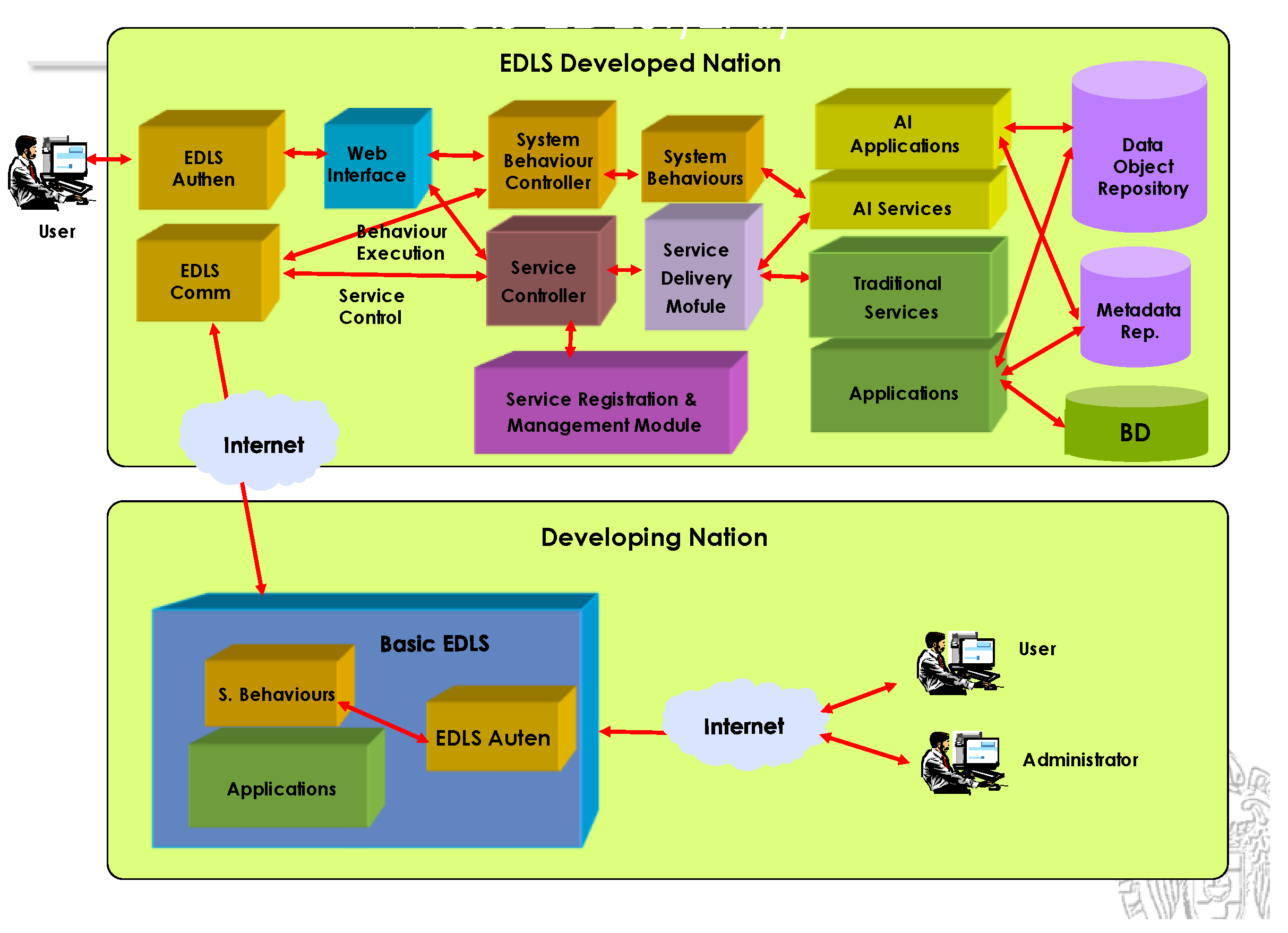
Finally, our EDLS architecture for the developed nation completes our computational model adding all the functional components described in Section 4. This architecture (see Figure 9) incorporates sustainability elements in the low-level design of the EDLS Authen component. It incorporates advanced accessibility functions for users with different capacities and technological limitations. Thanks to these functions, EDLS users and more particularly, developing EDLS users, can adjust their experience with the system according to their educational needs. This implementation of sustainable practices like the efficient use of computational resources during authentication processes and the secure store of data reinforces the ethical and technical impact of our EDLS architecture.
As you can see in Figure 9, the EDLS administrators of a developed nation can execute cooperative system behaviours (through the web interface) to register new educational services within the EDLS of a developing nation. These services, once selected by a user of a developing nation, could use the corresponding applications (traditional and AI applications) of the EDLS at the developed nation.
5.2. Possible Limitations and Concerns
We still have not concluded on specific AI applications for the computational level design that we have approximated with our software architecture in this case study. However, it is important to establish all the legal, ethical and moral aspects (regulations) that will constrain any AI technology application.
At this respect, we assume that all our systems fulfil current AI regulations in the European Union. In fact, this is one of the reasons why we insist in AI services design rather than general purpose AI design. Further, we incorporate “system behaviours” within our architectures to underline that “human behaviour” is never under control with our systems. Further, we constrain the application of Autonomous Agent technologies in our BBAI applications so there is no human replacement. In fact, system administrators are fully responsible for registering the new BBAI services i.e., there is no automatic control over these services. This last design aspect is more clearly established in the process orientation that we approach with our management framework [16].
There are also privacy and data security concerns with the data inputs used for decision making and recommendation processes. And, in this respect, we must be careful that the datasets used to train the models for BBAI and HAI applications do comply with current regulations in both developing and developed nations.
Finally, there are also important concerns regarding the infrastructure limitations of the developing countries to be able to use our EDLS software architecture. And this is one of the reasons why we have underlined the fact that they only need a basic EDLS provisioning, incorporating “just” some basic system behaviours, applications and EDLS Authen module to be able to start cooperating with the full EDLS architecture of the developed nation. The exact requirements for the basic EDLS depend on final implementation details. These are subject of our next research, as we outline in the following section.
6. Open Research Agenda
We propose an open research agenda based on the following research directions:
- Technical details for the implementation of the proposed software architecture, including concrete AI techniques for its AI applications.
- Operative models for EDLS based on concrete technologies.
- EDLS software architecture prototyping and testing.
- Management frameworks for EDLS based on our software architecture.
- Global development methodologies for EDLS.
The intelligent software architecture described in Section 4 completes our computational model for EDLS. It incorporates both SE practices (in software design) and AI components. But to continue with the development of EDLSs, we need to specify concrete implementation details for the architecture, including concrete AI techniques for the proposed AI applications. Further, we need operative models based on final technologies and detailed specifications for all the components of the architecture.
Prototyping and testing our EDLS software architecture requires an effective and efficient selection of components to test the overall functional validity of the system. Thus, it is necessary to select concrete cooperative environments where to perform these tests. Further, it is necessary to concentrate on concrete DLSs and how to evolve these to incorporate our software components and techniques. Then we will be able to demonstrate the feasibility, scalability and usability of our EDLS software architecture, planning our simulation plans, running appropriate prototype demonstrations and compiling quantitative analysis results.
We are currently defining an intelligent management framework [16], adding a new management model for our global intelligent systems. Basically, this framework is based on the vertical association of five abstractions and three refinement techniques to manage global, cooperative intelligent systems using models, services, architectures and processes (mainly inspired by ITIL v4 processes). We can adopt this framework to establish the basis of a new management framework for EDLSs. With this framework, we can pay special attention to the management of our EDLS repositories and AI services from new testing and evaluation processes. This framework evolves how traditional DL management systems are undertaken providing infrastructure for producing and administering EDLS. Further, this framework completes our SE processes including precise definitions for software modules implementation and management. Other possible management frameworks for EDLSs can have a clearer orientation to adapt ITIL v4 with current AI technologies.
Finally, on this open research agenda, we also include the definition of global development methodologies for EDLSs. With these methodologies, the software architecture that we propose can be taken from generic, conceptual to operative levels of development by means of using SE processes with AI technologies. These methodologies can establish how to develop all the core elements of the EDLS architecture and their interactions using concrete, evolved ES models (using AI techniques) and processes. However, we consider this research work will be better supported once previous management frameworks have been completed.
We leave all these research directions open so that new contributions are welcome.
7. Conclusions
We have designed and evaluated our intelligent software architecture for EDLS to provide intelligent services worldwide and to help developing countries in their current developments for SDG4. Basically, this architecture controls the registration and intelligent delivery of services (based on applications that use data and metadata registries) and the execution of cooperative (moral, principled) system behaviors like those required for helping developing nations. It drives both internal and external interactions (behaviours and low-level actions) to register and serve both traditional and AI services.
With the evaluation case study, we have analyzed how the developed and developing nations can cooperate by sharing knowledge and services with our EDLS architecture. Further, we have explained how the developing nations can benefit from the execution of active cooperative system behaviours to register developed EDLS services within their basic EDLS architecture.
In conclusion, this research introduces a novel intelligent software architecture for DLSs that fosters global cooperation and enhances sustainable education. The evaluation case study highlights its potential in bridging educational disparities and supporting digital transformation initiatives worldwide. Future work will focus on refining AI-driven services, optimizing system interoperability, and expanding the impact of intelligent DLSs across various educational domains.
8. Future Work
Future work will also include:
- Developing a standardized framework for the interoperability of EDLSs worldwide.
- Exploring the integration of blockchain technology for secure and verifiable digital credentials.
- Enhancing adaptive learning methodologies through AI-based content generation.
- Conducting large-scale pilot programs to validate the effectiveness of the proposed architecture.
- Establishing partnerships with international organizations to scale the implementation of EDLSs globally.
Author Contributions
Conceptualization, A.M.G.M. and A.S.C.; methodology, A.M.G.M. and A.S.C.; validation, A.M.G.M. and A.S.C.; formal analysis, A.M.G.M. and A.S.C.; investigation, A.M.G.M. and A.S.C.; resources, A.M.G.M. and A.S.C.; writing—original draft preparation, A.M.G.M. and A.S.C.; writing—review and editing, A.M.G.M. and A.S.C.; visualization, A.M.G.M.; supervision, A.S.C.; project administration, A.S.C.; funding acquisition, A.S.C.
Funding
This research was funded by the Spanish Ministry of Science and Innovation with project number PID2021-123048NB-I00.
Data Availability Statement
Not applicable.
Acknowledgments
We would like to thank the support of project number PID2021-123048NB-I00 from the Spanish Ministry of Science and Innovation. We also thank our colleague José Luis Sierra Rodriguez for his support and valuable suggestions to improve this research work.
Conflicts of Interest
The authors declare no conflicts of interest.
Abbreviations
The following abbreviations are used in this manuscript:
| EDLS | Educational Digital Library System |
| DLS | Digital Library System |
| AI | Artificial Intelligence |
| UN | United Nations |
| SDG | Sustainable Development Goal |
| SE | Software Engineering |
| KBAI | Knowledge-Based Artificial Intelligence |
| BBAI | Behaviour-Based Artificial Intelligence |
| GenAI | Generative Artificial Intelligence |
| HAI | Hybrid Artificial Intelligence |
References
- Witten, I.H.; Bainbridge, D.; Nichols, D.M. How to build a digital library. Morgan Kaufmann, 2009.
- Missingham, R. A new lens for evaluation–Assessing academic libraries using the UN Sustainable Development Goals. Journal of Library Administration 2021, 61, 386–401. [Google Scholar] [CrossRef]
- Mashroofa, M.M. Contribution of academic libraries towards sustainable development goals, 2022.
- Samantaray, M. Role of libraries in quality education for achieving SDG. Journal of Advances in Library and Information Science 2017, 6, 31–35. [Google Scholar]
- Nworie, J.C.; Obinyan, O.M.; Nworie, H.O.; Irunegbo, G.C. Exploring the roles of libraries in using digital platforms to achieve quality education for sustainable development in Nigeria. Information Impact: Journal of Information and Knowledge Management 2018, 9, 89–99. [Google Scholar] [CrossRef]
- Omona, W. The roles of library and information services in achieving Sustainable Development Goals (SDGs) in Uganda. Library Philosophy and Practice 2020, 1–19. [Google Scholar]
- Omar, A.M.; Mambo, H.L.; Samzugi, A.; Ali, Z.H. Assessing the Capacity of Public and School Libraries toward the Attainment of Sustainable Development Goal 4. International Information & Library Review 2024, 56, 19–37. [Google Scholar]
- Weiland, S.; Hickmann, T.; Lederer, M.; Marquardt, J.; Schwindenhammer, S. The 2030 agenda for sustainable development: transformative change through the sustainable development goals? Politics and Governance 2021, 9, 90–95. [Google Scholar] [CrossRef]
- Missingham, R. Australian academic libraries and the United Nations Sustainable Development Goals. IFLA Journal 2024, 03400352241252973. [Google Scholar] [CrossRef]
- Sierra, J.L.; Fernández-Valmayor, A.; Guinea, M.; Hernanz, H. From research resources to learning objects: process model and virtualization experiences. Educ. Technol. Soc 2006, 9, 56–68. [Google Scholar]
- Gayoso-Cabada, J.; Rodríguez-Cerezo, D.; Sierra, J.L. Multilevel browsing of folksonomy based digital collections. In Proceedings 17th Conference on Web Information Systems Engineering WISE ( 2016), 43–51.
- Gayoso-Cabada, J.; Rodríguez-Cerezo, D.; Sierra, J.L. Browsing digital collections with reconfigurable faceted thesauri. In Proceedings 25th International Conference on Information Systems Development ISD ( 2017), 69–86.
- Buendía-García, F.; Gayoso-Cabada, J.; Sierra, J.L. Generation of Standardized E-Learning Content from Digital Medical Collections. Journal of Medical Systems 2019, 43, 188. [Google Scholar] [CrossRef] [PubMed]
- Gonzalez de Miguel, A.M.; Sarasa-Cabezuelo, A. Intelligent models and architectures for global learning-oriented cooperation. IEEE Access 2025, 13, 16413–16426. [Google Scholar] [CrossRef]
- Gonzalez de Miguel, A.M.; Sarasa-Cabezuelo, A. A Global Approach to Artificial Intelligence. IEEE Access 2025, 13, 76946–76962. [Google Scholar] [CrossRef]
- Gonzalez de Miguel, A.M. ; Sarasa-Cabezuelo, A Intelligent Management Frameworks for Global Cooperation. International Journal of Intelligent Systems 2025, 2025. [Google Scholar]
- Gonzalez de Miguel, A.M.; Sarasa-Cabezuelo, A. An Intelligent Management Framework for Cooperative Digital Library Systems. Submitted for publication, 2025.
- Suleman, H. Open digital libraries”, PhD Dissertation, Virginia Polytechnic Institute and State University, 2002.
- Witten, I.H.; Boddie, S.J.; Bainbridge, D.; McNab, R.J. Greenstone: a comprehensive open-source digital library software system. In Proceedings, fifth ACM conference on Digital libraries (2000), 113-121.
- Maslov, A.; Mikeal, A.; Weimer, K.; Leggett, J. Cooperation or control? Web 2.0 and the digital library, 2009.
- Leidig, J.P.; Fox, E.A. Intelligent digital libraries and tailored services. Journal of Intelligent Information Systems 2014, 43, 463–480. [Google Scholar] [CrossRef]
- Udo-Okon, T.N.; Akpan, E.E.; Fcicn, D.P.; Ap, P. The challenges of artificial intelligence in library management system. Information Science 2024, 6, 1. [Google Scholar]
- Okunlaya, R.O.; Syed Abdullah, N.; Alias, R.A. Artificial intelligence (AI) library services innovative conceptual framework for the digital transformation of university education. Library Hi Tech 2022, 40, 1869–1892. [Google Scholar] [CrossRef]
- Borgohain, D.J.; Bhardwaj, R.K.; Verma, M.K. Mapping the literature on the application of artificial intelligence in libraries (AAIL): A scientometric analysis. Library Hi Tech 2022. [Google Scholar] [CrossRef]
- Kong, J. Application and research of artificial intelligence in digital library. In Proceedings Big Data Analytics for Cyber-Physical System in Smart City: BDCPS 2020, 28-29 December 2020, Shanghai, China, Springer Singapore (2021), 318-325.
- Urdaneta-Ponte, M.C.; Mendez-Zorrilla, A.; Oleagordia-Ruiz, I. Recommendation systems for education: Systematic review. Electronics 2021, 10, 1611. [Google Scholar] [CrossRef]
- Shokeen, J.; Rana, C. A Study on features of social recommender systems. Artificial Intelligence Review 2020, 53, 965–988. [Google Scholar] [CrossRef]
- Morawski, J.; Stepan, T.; Dick, S.; Miller, J. A fuzzy recommender system for public library catalogs. International Journal of Intelligent Systems 2017, 32, 1062–1084. [Google Scholar] [CrossRef]
- Da’u, A.; Salim, N. Recommendation system based on deep learning methods: a systematic review and new directions. Artificial Intelligence Review 2020, 53, 2709–2748. [Google Scholar] [CrossRef]
- Li, C. Construction of Intelligent Service System of University Library Based on Internet of Things in Artificial Intelligence Environment. In Proceedings 5th International Conference on Intelligent Computing and Control Systems (ICICCS) (2021), 471–474.
- Han, K. Research and Exploration of Metadata in Artificial Intelligence Digital Library. Journal of Physics: Conference Series 2021, 1915, 022061. [Google Scholar] [CrossRef]
- Lin, X.; Sun, Y.; Zhang, Y.; Kushalatha, M.R. Application of AI in Library Digital Reading Promotion Service. In Proceedings 2023 IEEE International Conference on Integrated Circuits and Communication Systems (ICICACS) (2023), 1–6.
- Bradley, F. Representation of Libraries in Artificial Intelligence Regulations and Implications for Ethics and Practice. Journal of the Australian Library and Information Association 2022, 71, 189–200. [Google Scholar] [CrossRef]
- Panda, S.; Chakravarty, R. Adapting intelligent information services in libraries: A case of smart AI chatbots. Library Hi Tech News 2022, 39, 12–15. [Google Scholar] [CrossRef]
- Brown, L.M. Gendered Artificial Intelligence in Libraries: Opportunities to Deconstruct Sexism and Gender Binarism. Journal of Library Administration 2022, 62, 19–30. [Google Scholar] [CrossRef]
- Verma, M. Novel study on AI-based chatbot (ChatGPT) impacts on the traditional library management. International Journal of Trend in Scientific Research and Development 2023, 7, 961–964. [Google Scholar]
- Adetayo, A.J. Artificial intelligence chatbots in academic libraries: The rise of ChatGPT. Library Hi Tech News 2023, 40, 18–21. [Google Scholar] [CrossRef]
- Brooks, R. A. Intelligence Without Representation. Artificial Intelligence 1991, 47, 139–160. [Google Scholar] [CrossRef]
- Barua, S. Exploring autonomous agents through the lens of large language models: A review. arXiv 2024, arXiv:2404.04442. [Google Scholar] [CrossRef]
- Dafoe, A.; Hughes, E.; Bachrach, Y.; Collins, T.; McKee, K. R.; Leibo, J. Z. . Graepel, T. Open problems in cooperative ai. arXiv 2020, arXiv:2012.08630. [Google Scholar]
- Haider, M.; Riesch, M.; Jirauschek, C. Realization of best practices in software engineering and scientific writing through ready-to-use project skeletons. Optical and Quantum Electronics 2021, 53, 1–17. [Google Scholar] [CrossRef]
- Singh, H.; Hassan, S.I. Effect of solid design principles on quality of software: An empirical assessment. International Journal of Scientific & Engineering Research 2015, 6, 1321–1324. [Google Scholar]
- Vasanthakumar, M. Medical Librarianship as a Specialisation: A Conceptual Review. DESIDOC Journal of Library & Information Technology 2013, 33, 2. [Google Scholar] [CrossRef]
- Martínez-Fernández, S.; Bogner, J.; Franch, X.; Oriol, M.; Siebert, J.; Trendowicz, A. . Wagner, S. Software engineering for AI-based systems: a survey. ACM Transactions on Software Engineering and Methodology (TOSEM) 2022, 31, 1–59. [Google Scholar] [CrossRef]
- Lagerberg, L. Skude, T.; Emanuelsson, P.; Sandahl, K.; Ståhl, D. (2013). The impact of agile principles and practices on large-scale software development projects: A multiple-case study of two projects at ericsson. In Proceedings ACM/IEEE International Symposium on Empirical Software Engineering and Measurement (2013), 348-356, IEEE.
- Cervantes, H.; Kazman, R. Designing software architectures: a practical approach, Addison-Wesley Professional, 2024.
- Chowdhury, G.G.; Chowdhury, S. Introduction to digital libraries”, Facet publishing, 2003.
- Xie, H. Evaluation of digital libraries: Criteria and problems from users’ perspectives. Library and Information Science Research 2006, 28, 433–452. [Google Scholar]
- Utama, Y.J. Sustainable Development Goals as the Basis of University Management towards Global Competitiveness. Journal of Physics: Conference Series.
- Echedom, A.U.; Okuonghae, O. Transforming academic library operations in Africa with artificial intelligence: Opportunities and challenges: A review paper. New Review of Academic Librarianship 2021, 27, 243–255. [Google Scholar] [CrossRef]
- Akinlolu, M.O.; Awujoola, O.A.; Olawale, Y.J. Library Cooperation and Use of Digital Library by Postgraduate Students in Selected Universities in South-West, Nigeria. Library Philosophy & Practice 2023. [Google Scholar]
- Polsani, P. Use and Abuse of Reusable Learning Objects. Journal of Digital Information 2003, 3, 2003. [Google Scholar]
- Barker, P.; Campbell, L.M. Metadata for learning materials: An overview of existing standards and current developments. Technology, Instruction, Cognition and Learning 2010, 7, 225–243. [Google Scholar]
- Gonzalez-Barbone, V.; Anido-Rifón, L.E. From SCORM to Common Cartridge: A step forward. Computers & Education 2010, 54, 88–102. [Google Scholar] [CrossRef]
- Justo-López, A.; López-Morteo, G.; Flores-Ríos, B.; Castro García, L. Process pattern and process capability evaluation model for interoperability in learning object environments. Array 2021, 10, 100059. [Google Scholar] [CrossRef]
- Filgueiras, F. Artificial intelligence and education governance. Education, Citizenship and Social Justice 2024, 19, 349–361. [Google Scholar] [CrossRef]
- Dong, X.; Zhang, X.; Zhang, C.; Bi, C. Building sustainability education for green recovery in the energy resource sector: a cross country analysis. Resources Policy 2023, 81, 103385. [Google Scholar] [CrossRef]
- Andrin, G.; Kilag, O.K.; Groenewald, E.; Benitez, J.; Dagala, F.; Ubay, R. Borderless Learning Environments: Impacts on Educational Management Strategies. International Multidisciplinary Journal of Research for Innovation, Sustainability, and Excellence (IMJRISE) 2024, 1, 43–49. [Google Scholar]
- Rand, D.G.; Nowak, M.A. Human Cooperation. Trends in Cognitive Science 2013, 17, 413–425. [Google Scholar] [CrossRef]
- Fox, E.A.; Marchionini, G. Toward a worldwide digital library. Communications of the ACM 1998, 41, 29–32. [Google Scholar] [CrossRef]
- Wilensky, R. Digital library resources as a basis for collaborative work. Journal of the American Society for Information Science 2000, 51, 228–245. [Google Scholar] [CrossRef]
- Pereira, R.; Franco, M. Cooperation between universities and SMEs: A systematic literature review. Industry and Higher Education 2022, 36, 37–50. [Google Scholar] [CrossRef]
Figure 1.
Traditional DLS Architecture.
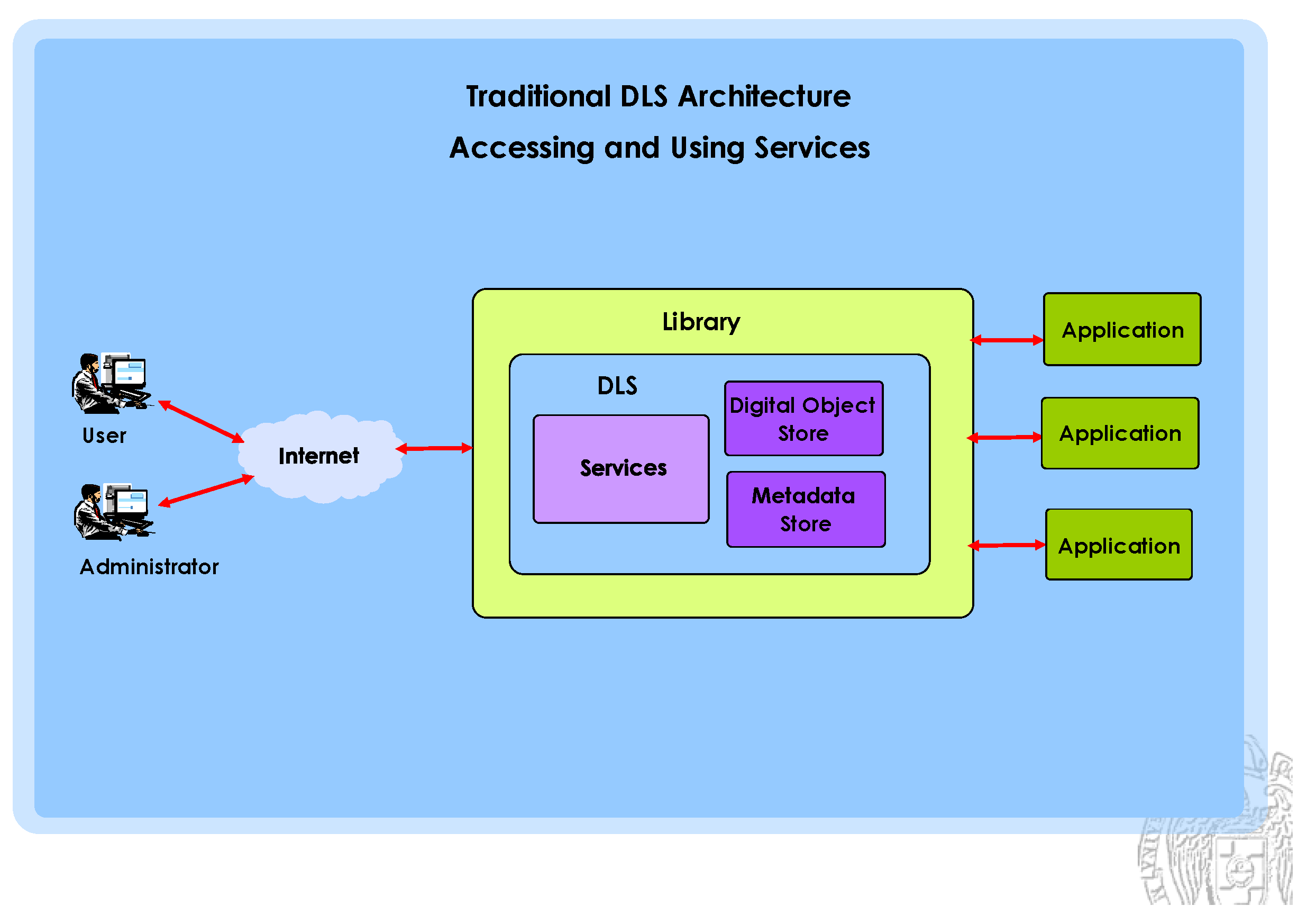
Figure 2.
First abstraction: generic model with entities and cooperative interactions in education.
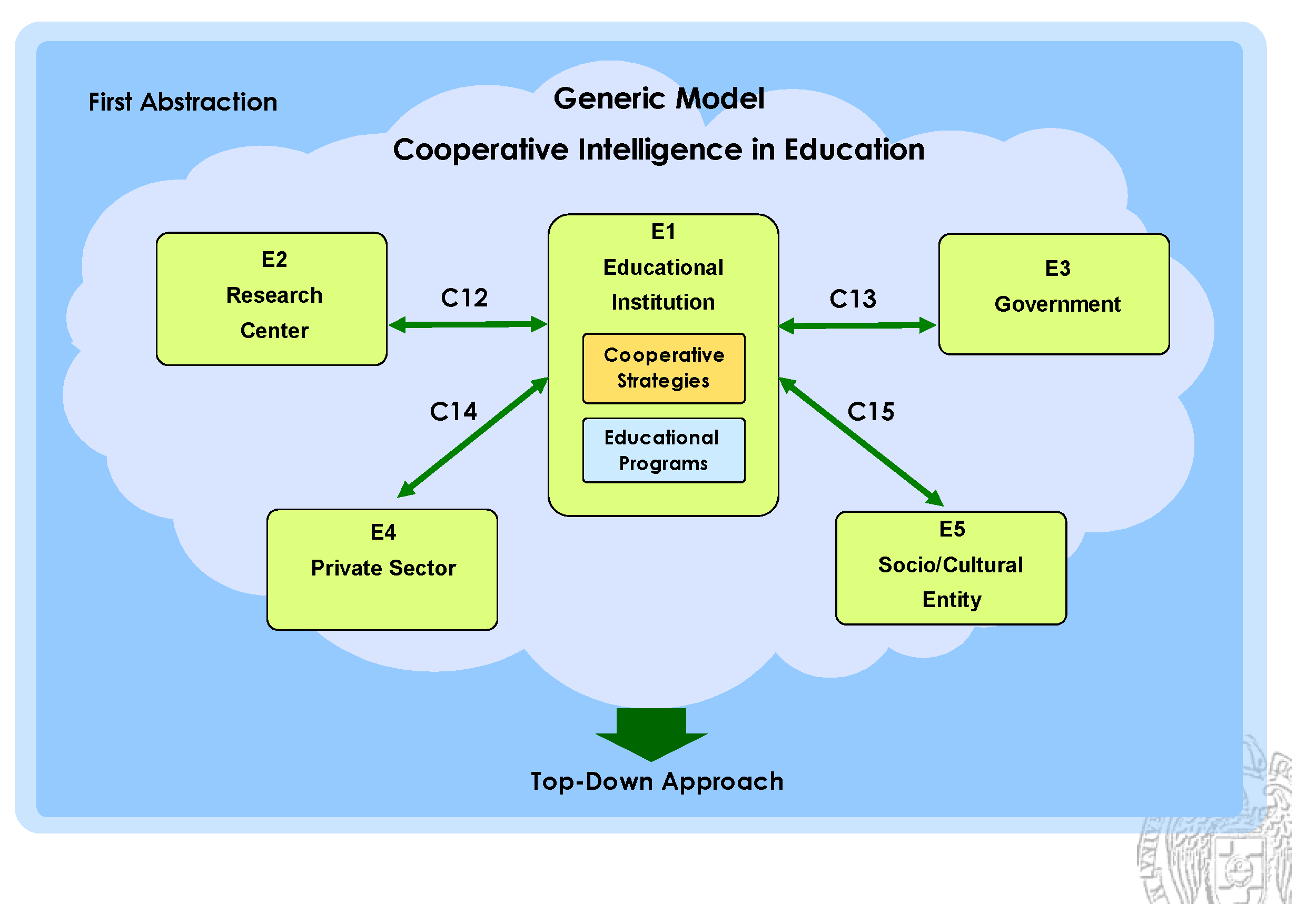
Figure 3.
Second abstraction: DLS network implementing higher educational processes.
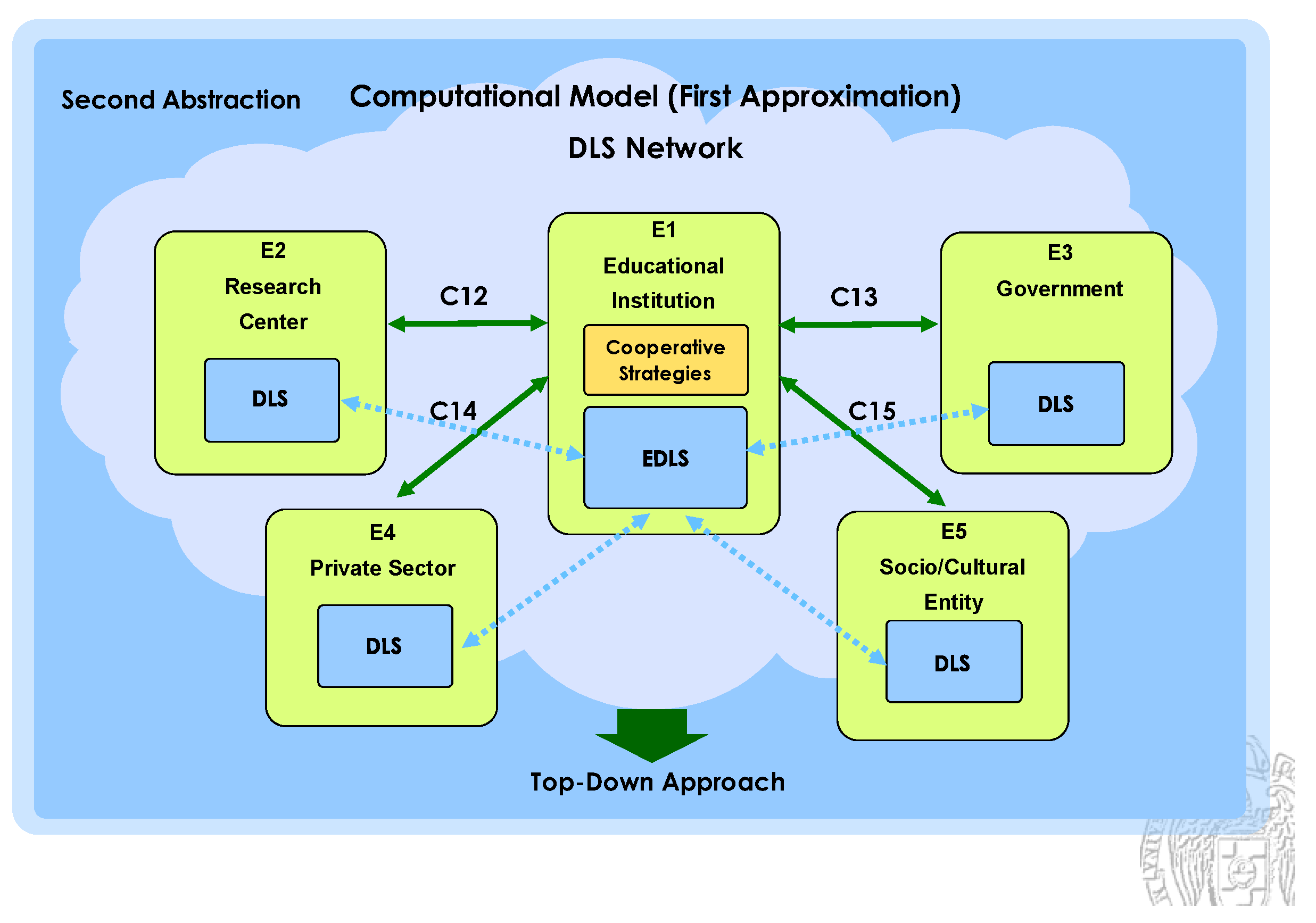
Figure 4.
Third abstraction: computational model for EDLS with digital object registry, metadata registry, traditional and AI services, and cooperative system behaviours.
Figure 4.
Third abstraction: computational model for EDLS with digital object registry, metadata registry, traditional and AI services, and cooperative system behaviours.
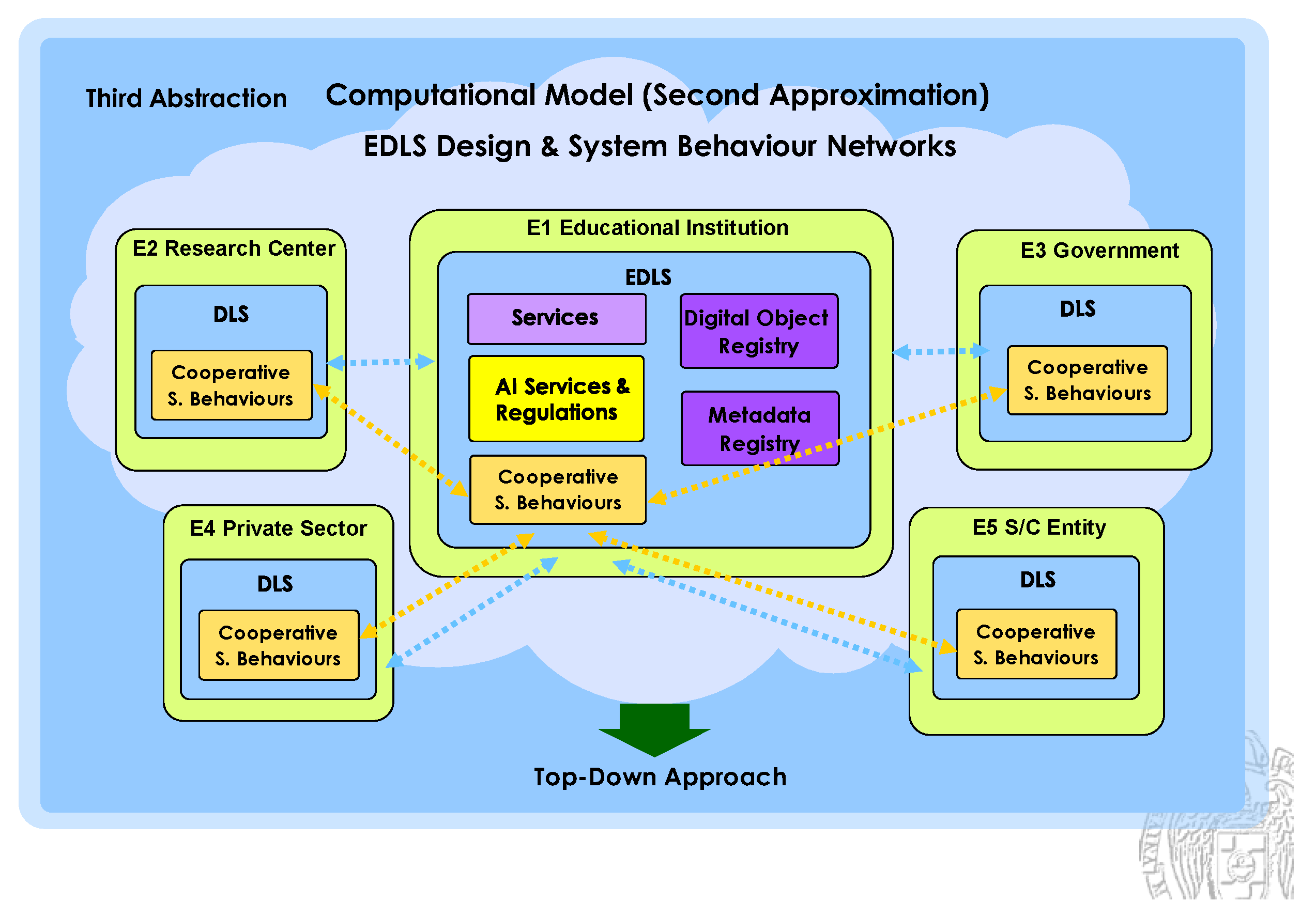
Figure 5.
Intelligent software architecture for EDLS.
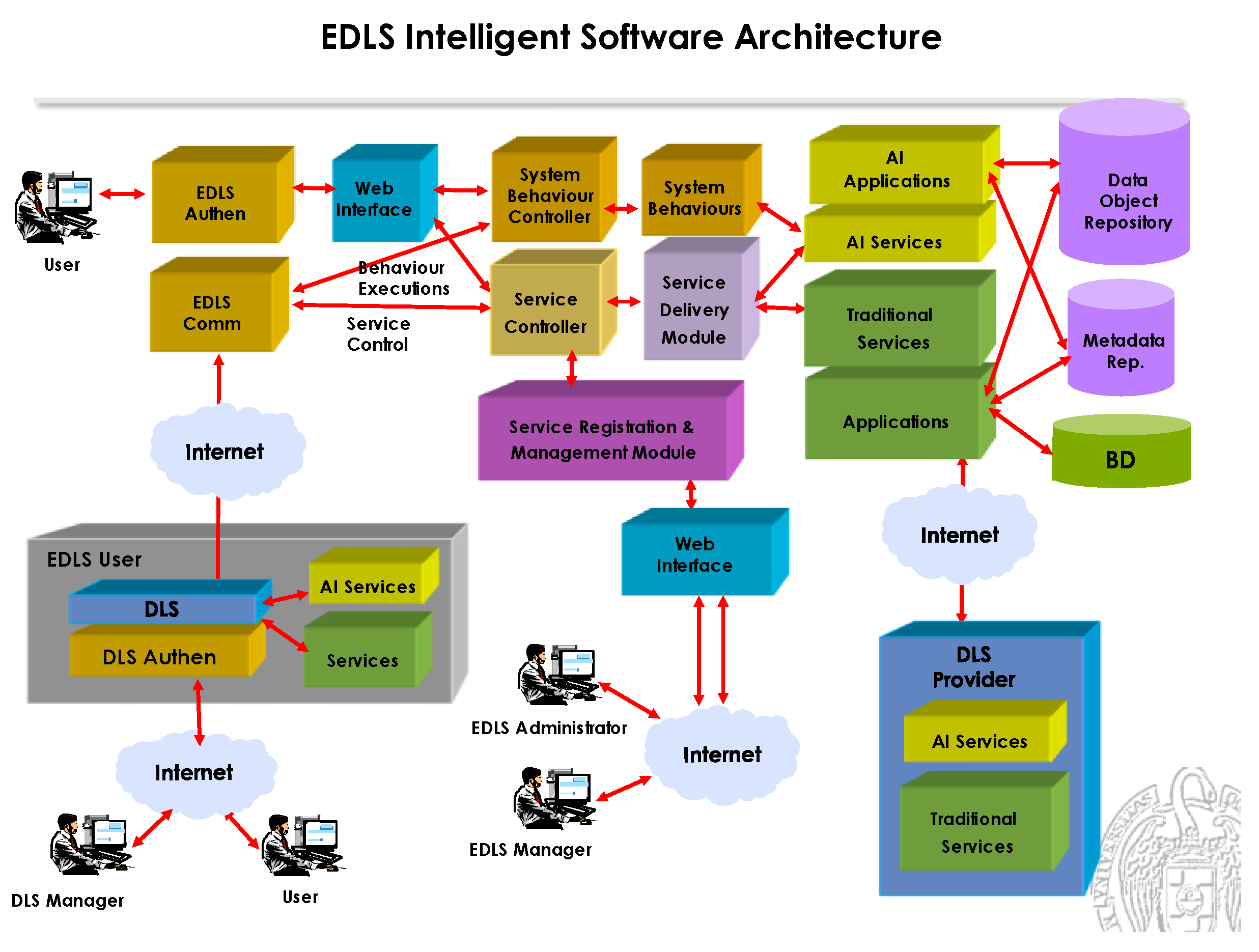
Figure 6.
First abstraction: generic model for a developed nation cooperating with a developing nation in a sustainable educational environment.
Figure 6.
First abstraction: generic model for a developed nation cooperating with a developing nation in a sustainable educational environment.
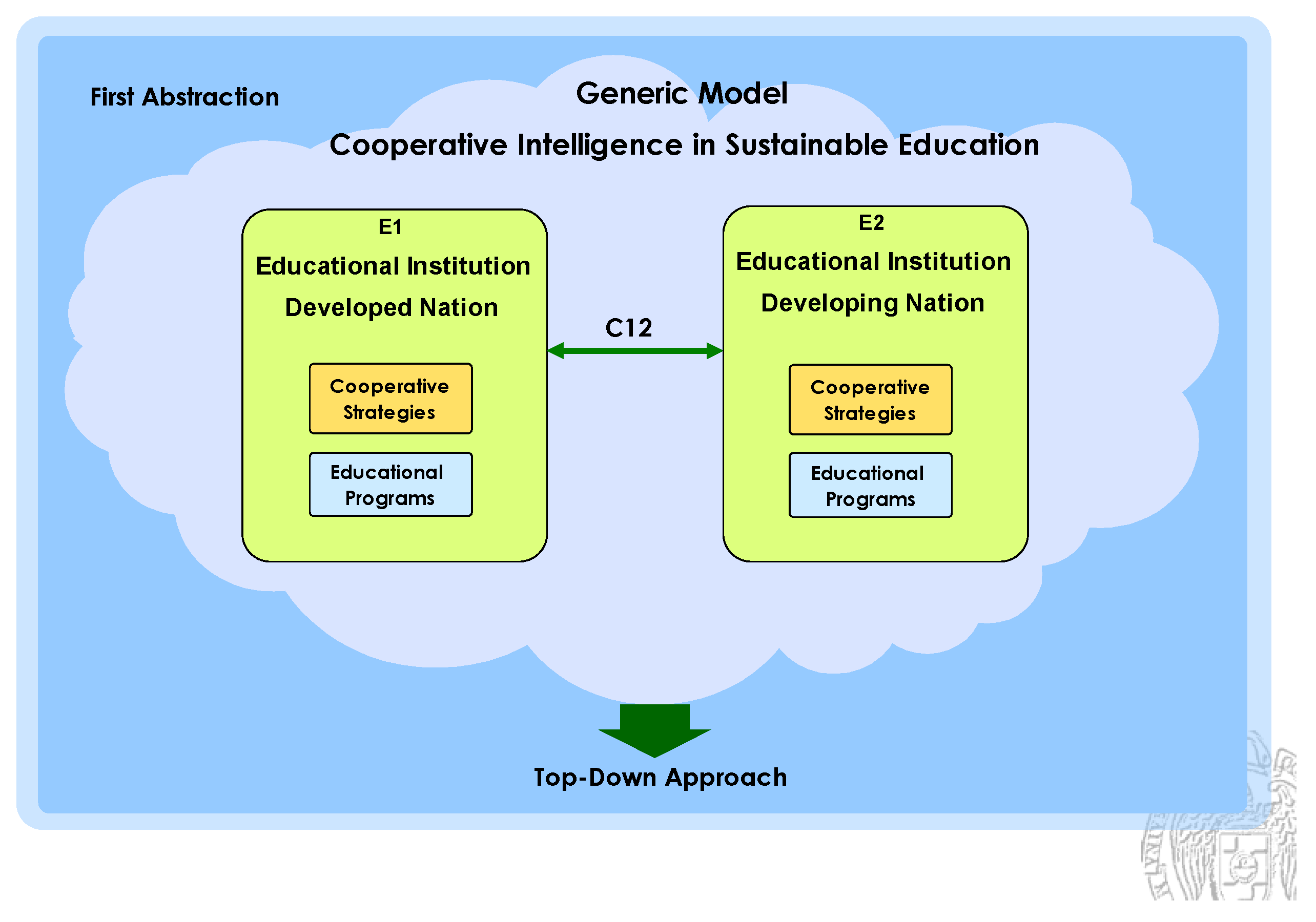
Figure 7.
Second abstraction: computational model (first approximation) with a basic EDLS network.
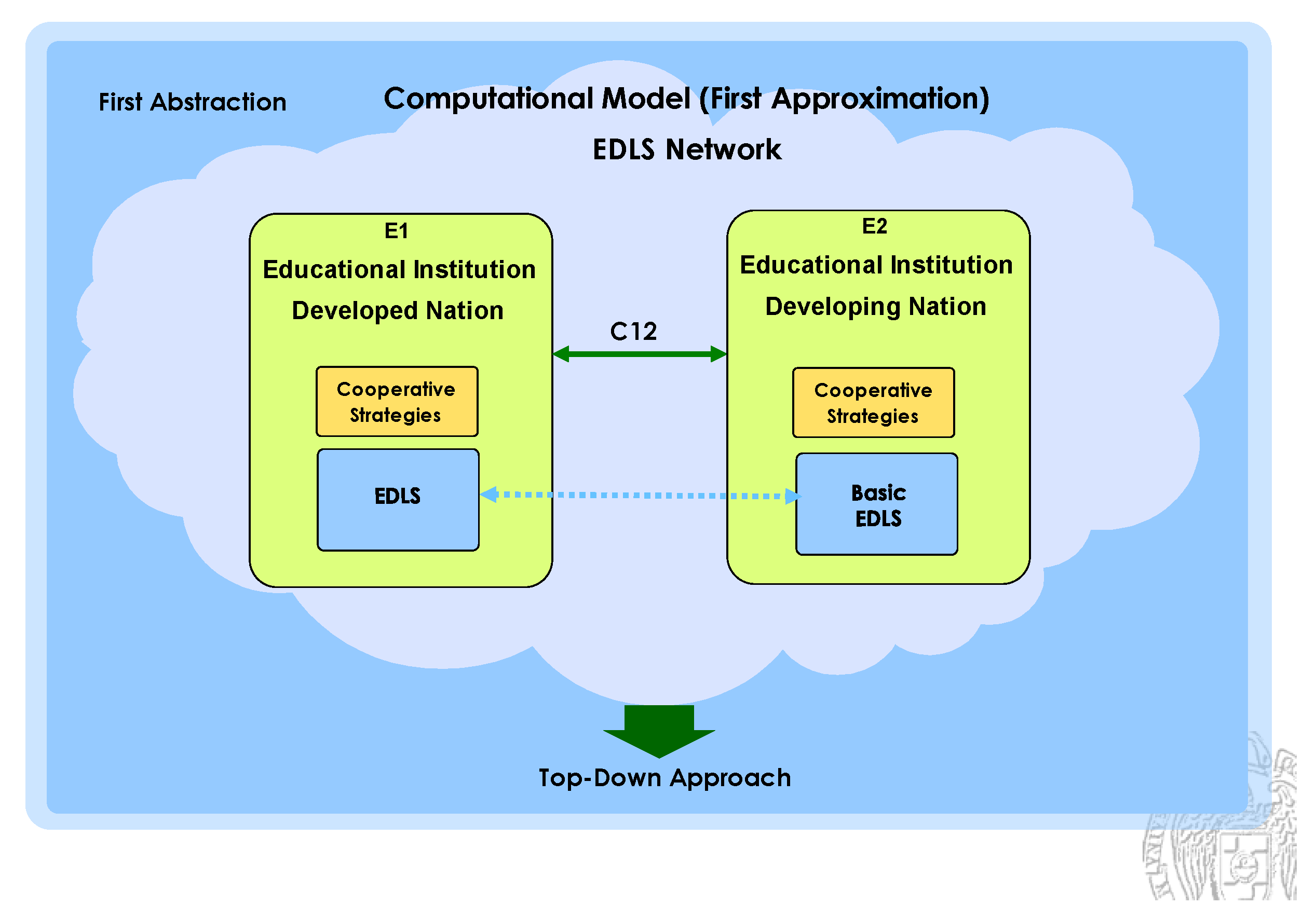
Figure 8.
Third abstraction: computational model (second approximation) with EDLS design and system behaviour networks.
Figure 8.
Third abstraction: computational model (second approximation) with EDLS design and system behaviour networks.
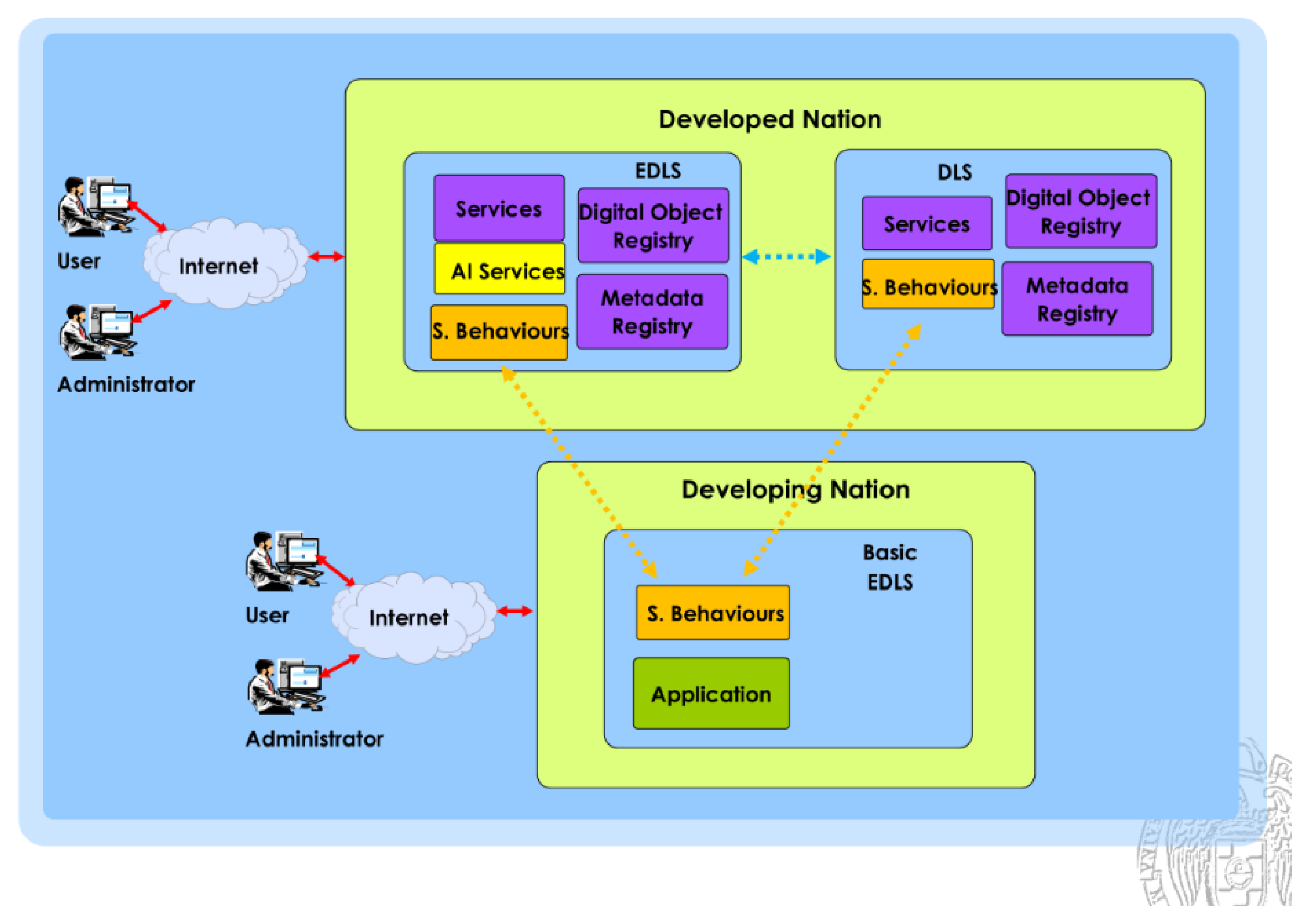
Figure 9.
EDLS software architecture in sustainable education.
Disclaimer/Publisher’s Note: The statements, opinions and data contained in all publications are solely those of the individual author(s) and contributor(s) and not of MDPI and/or the editor(s). MDPI and/or the editor(s) disclaim responsibility for any injury to people or property resulting from any ideas, methods, instructions or products referred to in the content. |
© 2025 by the authors. Licensee MDPI, Basel, Switzerland. This article is an open access article distributed under the terms and conditions of the Creative Commons Attribution (CC BY) license (http://creativecommons.org/licenses/by/4.0/).
Copyright: This open access article is published under a Creative Commons CC BY 4.0 license, which permit the free download, distribution, and reuse, provided that the author and preprint are cited in any reuse.


