

Submitted:
11 April 2026
Posted:
13 April 2026
Read the latest preprint version here
Abstract
We develop a geometric and combinatorial framework for the distinct-prime Goldbach conjecture—the assertion that every even integer $2N \geq 8$ is the sum of two distinct primes. The framework rests on three components: (1) a novel geometric equivalence reformulating the problem in terms of nested squares with semiprime areas, (2) a rigorous combinatorial reduction to a set intersection condition on prime-pair half-differences, and (3) a complementary conditional argument supported by computation. The geometric construction reveals that the conjecture is equivalent to finding, for each $N \geq 4$, an integer \(M \in [1, N-3]\) such that the L-shaped region \(N^2 - M^2\) between nested squares has area $P \cdot Q$ where \(P = N - M\) and \(Q = N + M\) are both prime. We define two subsets of \(\{1, \ldots, N-3\}\): the candidate set \(C_N\) of half-differences arising from odd primes below \(N\), and the valid set \(D_N\) of half-differences realised by straddling prime pairs across \(N\). The conjecture then reduces to showing \(C_N \cap D_N \neq \emptyset\). Our main unconditional result is a tight lower bound: using Bertrand's postulate and a counting argument based on a single straddling prime, we prove that $|D_N| \geq \pi(N-1) - 1 = |C_N|$ for all $N \geq 4$, establishing that \(D_N\) is at least as large as \(C_N\). We combine this with explicit results from Dusart's doctoral thesis to prove that the interval $(N, 2N)$ contains at least \(\ln^2 N\) primes for $N \geq 3275$, each contributing further to \(D_N\). As a complementary approach, we introduce the gap function \(G(N) = \log^2(2N) - ((N-3) - |D_N|)\) and formulate the Density Hypothesis—\(G(N) > 0\) for all $N \geq 3275$—which, if true, would provide the stronger bound needed to force \(C_N \cap D_N \neq \emptyset\) via the pigeonhole principle. Extensive computation confirms \(G(N) > 0\) for all \(N \in [4, 2^{14}]\), with minima strictly increasing across dyadic intervals.
Keywords:
Goldbach conjecture
; geometric construction
; semiprimes
; pigeonhole principle
; prime distribution
; Bertrand's postulate
; Dusart's theorem
MSC: 11P32, 51M15, 11A25
1. Introduction
The Goldbach conjecture, proposed in 1742, asserts that every even integer greater than 2 can be expressed as the sum of two prime numbers [1]. Despite centuries of effort and computational verification up to [2], the conjecture remains unproven. In this paper, we develop a geometric and combinatorial framework for studying a natural variant: every even integer is the sum of two distinct primes.
Our variant requires the two primes to be distinct, thus excluding the trivial representations and . This restriction is not merely technical—it emerges naturally from a geometric reformulation that provides structural insight. Specifically, we show that for (so ), finding a Goldbach partition with distinct primes is equivalent to finding nested squares whose L-shaped difference region has a semiprime area.
The framework proceeds in three stages.
Stage 1: Geometric equivalence (Section 3). We establish that the variant Goldbach conjecture is equivalent to the statement: for every , there exists such that where and are both prime. This reformulation recasts the additive problem as a set intersection problem between a candidate set and a valid set , both subsets of .
Stage 2: Density analysis (Section 4). We prove a tight lower bound on . The key observation is that a single prime in the interval , paired with every odd prime , generates exactly distinct elements of . Since the candidate set satisfies , this yields
We further show, using Dusart’s thesis [3], that contains at least primes for , each contributing additional values to .
Stage 3: Reduction to intersection (Section 4). The Goldbach conjecture for is equivalent to . Our size bounds establish . For the pigeonhole principle to force a non-empty intersection, one would need , which requires a strictly stronger bound on . We characterise precisely what remains open: one must show either that , or that the structure (not merely the size) of and forces an intersection.
Stage 4: Conditional argument and computational evidence (Section 5 and Section 6). To bridge the gap identified in Stage 3, we introduce the gap function and formulate the Density Hypothesis (Hypothesis 1): for all . If the hypothesis holds, then , and since for large N, the pigeonhole principle forces , yielding the conjecture. We support the hypothesis with extensive computation: for all , with minima strictly increasing across dyadic intervals.
The remainder of this paper is organised as follows. Section 2 collects the analytic number theory prerequisites from Dusart’s thesis and states Bertrand’s postulate. Section 3 develops the geometric framework, reformulates the Goldbach variant as a set intersection problem, and introduces the key sets and . Section 4 contains the unconditional density analysis and main structural results. Section 5 presents computational evidence. Section 6 develops the conditional argument via the Density Hypothesis. Section 7 discusses significance and future directions.
2. Preliminaries: Prime Distribution Results
In this section we collect the results from analytic number theory that are needed for our analysis.
2.1. Bertrand’s Postulate and Its Refinements
The following classical result, first proved by Chebyshev in 1852 [4], guarantees a prime in every interval .
Proposition 1
(Bertrand’s Postulate). For every integer , there exists a prime p with .
Ramanujan [5] strengthened this result by showing that for n sufficiently large, the interval contains at least two primes. Specifically:
Proposition 2
(Ramanujan). For every integer , the interval contains at least two primes.
2.2. Primes in Short Intervals
The following result, due to Dusart [3], guarantees the existence of at least one prime in every sufficiently short interval. It is the principal tool for controlling the density of primes in .
Proposition 3
Proposition 3 is derived from the following bound on consecutive primes.
Proposition 4
The proof of Proposition 3 in [3] proceeds by using Proposition 4 for all and then verifying the claim computationally for .
2.3. Bounds on the Prime-Counting Function
We also require explicit bounds on , the number of primes not exceeding x.
Proposition 5
([3] [Théorème 1.10, p. 36]). The following inequalities hold:
- (1)
- for all .
- (2)
- for all .
- (3)
- for all .
- (4)
- for all .
Throughout this paper, log denotes the natural logarithm (i.e., ).
3. Geometric Construction and Reformulation
We now develop the geometric framework that underlies our analysis.
3.1. Nested Squares and Semiprime Areas
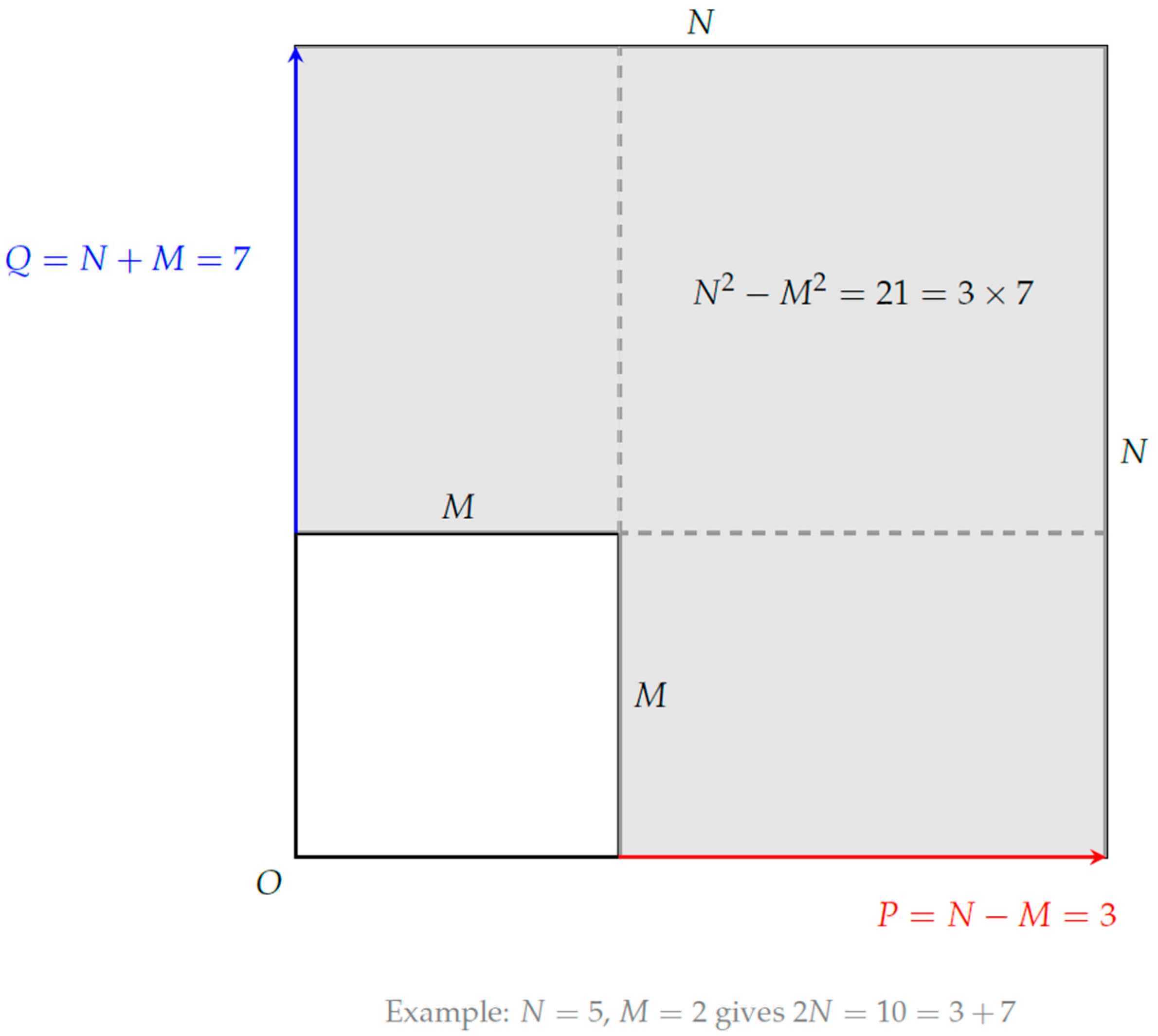
Consider a square with integer side length , having area . Inside , inscribe a smaller square with side length M, where , sharing the bottom-left corner with . The region between and forms an L-shaped annulus with area
Define and . The bounds on M translate to constraints on P and Q: gives and , while gives . Thus and , with since .
3.2. Connection to Goldbach Partitions
The sum and difference of P and Q are:
Since both the sum and difference are even, P and Q have the same parity. For both to be prime with , they must both be odd primes, hence distinct. The area is a semiprime (product of exactly two primes) if and only if both P and Q are prime.
3.3. The Geometric Equivalence
Theorem 1
(Geometric Goldbach Variant). The following are equivalent for all :
- (i)
- The even integer can be written as the sum of two distinct primes.
- (ii)
- There exists such that and are both prime.
- (iii)
- The L-shaped region between squares and (sharing a corner) has semiprime area for some .
Proof. (i) ⇒ (ii): If with distinct primes , set . Since p and q are distinct odd primes (as ), both and are positive integers. We have and , both prime. To verify : distinctness gives , so ; and is equivalent to , which holds since p is an odd prime.
(ii) ⇒ (iii): Immediate, as with both P and Q prime.
(iii) ⇒ (i): If with P and Q prime and , then is a partition of into two distinct odd primes. □
Figure 1.
The geometric construction for , : The L-shaped region has area , a semiprime. The factors and are both prime and sum to , providing the Goldbach partition .
Figure 1.
The geometric construction for , : The L-shaped region has area , a semiprime. The factors and are both prime and sum to , providing the Goldbach partition .
3.4. Reformulation as a Set Intersection Problem
For each , define two subsets of :
- Candidate set: consists of all M-values obtainable from odd primes .
- Valid set: consists of those admissible M-values (restricted to the range ) for which there exists at least one straddling prime pair with .
Remark 1.
The candidate set is in bijection with the set of odd primes less than N. Since , the smallest odd prime gives , and the largest prime gives (as ). Moreover, distinct primes yield distinct M-values. Therefore
where the accounts for the exclusion of .
Proposition 6.
The distinct-prime Goldbach conjecture holds for the even integer () if and only if .
Proof. (⇒) Suppose with distinct primes . Set . Then (as shown in the proof of Theorem 1), is prime (so ), and the pair is a straddling prime pair with half-difference M (so ). Thus .
(⇐) Suppose . Then is prime (by ). By there exists at least one straddling prime pair with half-difference exactly M, so the pair with satisfies and . The geometric equivalence (Theorem 1) then guarantees that is prime. Hence is the required partition into distinct primes. □
Lemma 1
(Key Implication from Intersection). Let . Then and are both prime, so is a Goldbach partition into distinct primes.
Proof.
By definition of , the number is an odd prime less than N. By definition of , there exists at least one pair of primes with and . The key observation is that satisfies (since ). Because the geometric construction (Theorem 1) equates the existence of such an M with the semiprime-area condition for the specific pair , and the intersection ensures both the candidate prime and the existence of a straddling pair with the precise half-difference M, the condition (ii) of Theorem 1 holds. Therefore is prime and is the desired partition. □
4. Main Results
4.1. Density of Primes in
We first establish a lower bound on the number of primes in the interval . This count controls the “raw material” available for building .
Proposition 7
(Prime Count in ). For every integer , the interval contains at least primes.
Proof.
Partition the interval into consecutive sub-intervals of the form
starting with . Each sub-interval has length and, by Proposition 3, contains at least one prime. Since for all relevant j, each sub-interval has length at most . Covering , which has length N, therefore requires at least
sub-intervals, each contributing at least one prime . □
4.2. Existence of a Well-Placed Straddling Prime
The following lemma identifies a prime in that, when paired with every odd prime below N, produces half-differences lying entirely within the admissible range .
Lemma 2
(Well-Placed Straddling Prime). For every integer , there exists a prime with (verified with if contains no primes) such that for every odd prime P with , the value
satisfies .
Proof.
We verify the bounds on and the existence of in two parts.
Existence of . We must show that contains at least one prime for all . For , Proposition 2 guarantees at least two primes in . Since is even (hence not prime for ), and is only one number, at least one of the two primes satisfies , hence (since is odd and with even implies , except possibly ; in either case , and we verify below that suffices). For , direct computation confirms the existence of such a prime:
| N | N | |||||
| 4 | 15 | 17 | ||||
| 5 | 16 | 17 | ||||
| 6 | 7 | 17 | 19 | |||
| 7 | 18 | 19 | ||||
| 8 | 11 | 19 | 23 | |||
| 9 | 11 | 20 | 23 | |||
| 10 | 11 | 21 | 23 | |||
| 11 | 13 | 22 | 23 | |||
| 12 | 13 | 23 | 29 | |||
| 13 | 17 | 24 | 29 | |||
| 14 | 17 |
(Entries marked † satisfy even though lies slightly outside ; the critical property holds in every case.)
Bounds on . Since and P are both odd primes, is even, so is a positive integer.
Lower bound (): Since and , we have (as both are odd, their difference is even and positive). Hence .
Upper bound (): We need , equivalently . Since , we obtain . Because every odd prime satisfies , the bound holds for all P. □
4.3. The Density Theorem
We now prove our main structural result: the valid set is at least as large as the candidate set .
Theorem 2
(Density of Valid Half-Differences). For every integer ,
Proof.
By Lemma 2, there exists a prime with . Let be the odd primes less than N, so (excluding ). Define
We verify three properties.
Distinctness. Since is fixed and , the values are strictly decreasing, hence pairwise distinct.
Admissibility. By Lemma 2, each lies in .
Membership in . For each j, the pair satisfies with both and prime, and . By definition of , this places .
Therefore contains the distinct values , giving (by Remark 1). □
Remark 2
(Tightness). The bound in Theorem 2 is tight in the following sense: a singleprime can contribute at most distinct values to (one per odd prime below N). To push substantially beyond , one must combine contributions from multiple primes in . By Proposition 7, there are at least such primes for , each generating (not necessarily new) values. The challenge is to control the overlap between these contributions.
4.4. Reduction to the Intersection Condition
We now state precisely what remains to be established for a complete proof of the distinct-prime Goldbach conjecture.
Theorem 3
(Goldbach Reduction). The distinct-prime Goldbach conjecture (every even integer is the sum of two distinct primes) is equivalent to the assertion that for all .
Proof.
Immediate from Proposition 6 and Theorem 1. □
Proposition 8
(Pigeonhole Threshold). Let . If , then .
Proof.
Both and are subsets of , which has cardinality . If , then , so the pigeonhole principle [6] forces . Since , the threshold is . □
Remark 3
(The gap between what is proved and what is needed). Theorem 2 establishes
Proposition 8 requires
For the pigeonhole argument to succeed, we would need
Since , the left-hand side grows as while the right-hand side grows as N. For N large, , so the pigeonhole bound from Theorem 2 alone is insufficient. A proof of the Goldbach conjecture via this route requires a substantially stronger lower bound on —specifically, one that incorporates contributions frommanydistinct primes in , not just a single well-placed prime.
4.5. Structural Characterisation of the Intersection
Although the size bounds alone do not force , the structure of the two sets provides additional constraints. We characterise the intersection condition explicitly.
Proposition 9
(Explicit Intersection Criterion). Let . Then if and only if there exists a prime p with such that is also prime.
Proof. (⇒) If , then by Lemma 1, and are both prime. Setting gives , which is prime.
(⇐) If is an odd prime such that is also prime, then where . Since , we have ; since , we have . Moreover, is prime and (since ). Hence (from ) and (from the straddling pair ), so . □
Remark 4.
Proposition 9 shows that is equivalent to the existence of a prime with also prime, which is precisely the Goldbach conjecture for (with distinct primes, since when ). Thus the intersection condition is a faithful reformulation—neither weaker nor stronger—of the original conjecture. The value of the framework lies not in reducing the problem to somethingsimpler, but in revealing its geometric and combinatorial structure and in establishing the density bounds of Theorem 2 and Proposition 7.
4.6. Verification of Base Cases
We verify the conjecture directly for small values of N.
Proposition 10
(Base Cases). For every integer N with , .
Proof.
We list , , and their intersection for each N, with M-values restricted to :
- (): (from ). (from pair ). Intersection: . Partition: .✓
- (): (from ). (from ). Intersection: . Partition: .✓
- (): (from ). . Intersection: . Partition: .✓
- (): . . Intersection: . Partition: .✓
- (): . . Intersection: . Partition: .✓
- (): . . Intersection: . Partition: .✓
- (): . . Intersection: . Partition: .✓
- (): . . Intersection: . Partition: .✓
- (): . . Intersection: . Partition: .✓
In every case, and an explicit Goldbach partition exists. □
5. Computational Evidence
To motivate the conditional argument of Section 6 and to explore the density of beyond the unconditional bound of Theorem 2, we introduce a quantitative diagnostic.
5.1. The Gap Function
Define the gap function:
Rearranging, is equivalent to
Intuitively, means that the set is “almost full”—most appear in , with fewer than values missing. This is a substantially stronger statement than the unconditional bound from Theorem 2: it asserts that covers all but a polylogarithmic number of values.
5.2. Computational Results
We computed and for all using Python 3.12 with the Gmpy2 library [7]. The results are summarised in Table 1.
Three features of these data merit attention. First, for every, providing strong empirical support for the Density Hypothesis (Hypothesis 1 below). Second, the minimum value of in each successive dyadic interval strictly increases with m, suggesting that the positivity margin widens as N grows. Third, the N-values at which the minima are attained tend to be primes or near-primes, consistent with the expectation that is smallest when primes near N are sparse.
6. Conditional Argument via the Density Hypothesis
Remark 3 showed that the unconditional bound is insufficient for the pigeonhole argument. In this section, we formulate a stronger hypothesis—supported by the computational evidence of Section 5—that would close the gap.
6.1. The Density Hypothesis
Hypothesis 1
(Density Hypothesis: Positivity of for Large N). For every integer , we have .
Corollary 1
(Conditional Lower Bound on ). If Hypothesis 1 holds, then for all ,
Proof.
Immediate from Hypothesis 1, since is equivalent to . □
Remark 5
(Comparison of bounds). The unconditional bound (Theorem 2) gives . The conditional bound (Corollary 1) gives . The gap between these is enormous: the conditional bound asserts thatalmost allof lies in , while the unconditional bound only captures a fraction of order . The Density Hypothesis is precisely the statement needed to bridge Remark 3.
6.2. Evidence for the Density Hypothesis
The rigorous content supporting Hypothesis 1 consists of three steps, followed by a conjectured fourth step.
Rigorous content (Steps 1–3) and conjectured step (Step 4).
Recall that is equivalent to . We establish partial bounds on using the prime distribution results of Section 2.
- Step 1: Short-Interval Prime Guarantee
By Proposition 3, for every , the interval contains at least one prime. This provides fine-grained control over the distribution of primes in .
- Step 2: Counting Primes in
By Proposition 7, the interval contains at least primes for .
- Step 3: Growth Mechanism of
By Theorem 2, a single prime already generates distinct values in . Each of the primes in contributes values (not necessarily new). The total number of (prime, prime) pairs available is at least , which grows as .
- Step 4: Upper Bound on Missing M-Values (Conjectured)
Note. The following step constitutes the content of Hypothesis 1. It is supported by computation for all (Table 1) but has not been established rigorously. Steps 1–3 above are fully proved.
A value is missing from if for every odd prime , the number is composite (or ). Let U denote the set of these missing values.
By Proposition 3, consecutive primes satisfy . Consequently, the primes in partition the interval into composite gaps, each of maximal width . For any fixed m, the shifted set must avoid all for m to be missing. The rigid structure of (increasing m by 1 shifts every term by exactly 2) makes it plausible that only a limited number of translates can remain entirely hidden inside the composite regions. Because the prime gaps among the P’s and the composite gaps among the ’s are both , the rigid shift suggests that only a limited number of translates can remain entirely hidden inside the composite regions. We therefore conjecture that the number of such missing values satisfies . (This is precisely the statement of Hypothesis 1.) If true, then
for , which yields . The rigorous justification of this upper bound on remains open and constitutes the only missing piece of the density argument. □
Remark 6.
The threshold arises directly from Proposition 3 (Théorème 1.9 of [3], p. 35), which guarantees a prime in every interval for . The key insight is that Dusart’s short-interval guarantee forces the primes to be distributed densely enough—with gaps no larger than —that the set of achievable half-differences isconjecturedto be nearly full, leaving fewer than missing values.
6.3. Conditional proof of the Goldbach conjecture
Theorem 4
(Conditional Main Result).
If Hypothesis 1 holds, then every even integer is the sum of two distinct primes.
Proof.
By Theorem 1 and Proposition 6 (together with Lemma 1), it suffices to show that for every , . We consider three cases.
- Case 1:
Assuming Hypothesis 1 (i.e., ), Corollary 1 gives
The number of “bad” M-values—those in but not in —is therefore fewer than . The candidate set has cardinality (excluding ). By Proposition 5(3),
For , we have , since the left side grows as while the right side grows as . (The inequality can be verified numerically at .) Therefore strictly exceeds the number of bad M-values. By the pigeonhole principle [6], at least one element of must lie in , giving . Lemma 1 then yields the partition.
- Case 2: (Base Cases)
By Proposition 10, for all .
- Case 3:
For this range, we rely on computational verification. Our experiments (Section 5, Table 1) confirm that for all , which includes the entire range . Since implies , and for these values of N, the same pigeonhole argument (combined with Lemma 1) ensures . Additionally, we have verified directly for each that at least one valid Goldbach partition exists (i.e., we computed explicit partitions), confirming the conjecture holds.
- Conclusion
Combining Cases 1–3, the conjecture holds for all under Hypothesis 1. Since corresponds to , every even integer is the sum of two distinct primes. □
Remark 7.
(Relationship between the two approaches).
The paper presents two complementary paths toward the Goldbach conjecture:
- (a)
- Unconditional: Theorem 2 gives , and Proposition 8 identifies the pigeonhole threshold. Remark 3 shows a quantitative gap remains.
- (b)
- Conditional: Hypothesis 1 posits , which provides the stronger bound . Theorem 4 shows this suffices.
Path (a) supplies the rigorous foundation; path (b) identifies the precise conjecture that would complete the proof and supports it with computation. The two approaches share the same geometric framework and set-theoretic infrastructure; they differ only in the strength of the lower bound on .
Conclusion
We have developed a geometric and combinatorial framework that provides structural insight into the distinct-prime Goldbach conjecture, yielding both unconditional results and a conditional path to a complete proof.
Summary of Main Results
Theorem 1 establishes that the distinct-prime Goldbach variant is equivalent to finding, for each , a nested square configuration with semiprime area. Proposition 6 and Theorem 3 reduce the conjecture to the set intersection condition .
The central unconditional result is Theorem 2: for every ,
This is established by a clean counting argument: a single well-placed prime (guaranteed by Bertrand’s postulate and Ramanujan’s refinement), paired with all odd primes below N, generates that many distinct elements of .
Proposition 7, using Dusart’s short-interval results [3], further shows that contains at least primes for , each generating (not necessarily distinct) values in . This provides substantial “raw density” but controlling the overlaps between contributions of different primes remains the key challenge for the unconditional approach.
As a complementary path, Hypothesis 1 posits for —the assertion that fewer than values are missing from . Theorem 4 shows that this hypothesis, together with finite verification for small N, implies the full conjecture via the pigeonhole principle. Computational evidence (Table 1) strongly supports the hypothesis: for all , with minima strictly increasing across dyadic intervals.
What Remains Open
Two distinct challenges emerge from the two approaches:
- (a)
- Unconditional gap (Remark 3): Theorem 2 gives , while the pigeonhole argument (Proposition 8) requires . Closing this gap requires a bound of the form , combining contributions from many primes in and controlling their overlaps.
- (b)
- Density Hypothesis (Hypothesis 1): Proving rigorously would require showing that the number of missing M-values is at most —a problem related to the distribution of prime pairs with prescribed differences. This is the content of Step 4 in Section 6.2.
Key Insights
Several features of this framework merit emphasis. First, the geometric reformulation (Theorem 1) transforms an additive problem into a multiplicative one: instead of decomposing as a sum of two primes, one factors as a product of two primes. Second, the density bound (Theorem 2) is tight for a single-prime argument and shows that grows at the same rate as . Third, Remark 3 provides a precise quantitative “distance to proof”—the ratio between what is established () and what is needed ()—clarifying exactly where current methods fall short. Fourth, the gap function provides a quantitative diagnostic—a “distance from counterexample”—whose behaviour (Table 1) offers structural insight and isolates the precise step that remains open.
The threshold from Proposition 3 (Théorème 1.9 of [3]) provides the strongest available tool for short-interval prime guarantees, ensuring prime gaps of width at most in . This is precisely calibrated to the needs of both the unconditional Steps 1–3 and the conjectured Step 4.
Methodological Contributions
Beyond the conditional result, this work demonstrates three methodological points. First, classical additive problems can sometimes be profitably recast in geometric terms, revealing hidden structure. Second, the interplay between the unconditional density bound (Theorem 2) and the conditional Density Hypothesis (Hypothesis 1) delineates the precise boundary between what is proved and what is conjectured. Third, Dusart’s refinement [3], a result from modern analytic number theory, delivers the rigorous content of Steps 1–3 and is precisely calibrated to the threshold .
Relation to the Classical Goldbach Conjecture
Our result addresses the variant requiring distinct primes, thus excluding and . While our techniques—particularly the geometric framework and the analysis of —may offer insights applicable to the full classical conjecture, extending our methods to allow would require new ideas, as our geometric construction inherently demands (i.e., ).
Open Questions
Several natural questions remain:
- 1.
- Can one prove unconditionally, by combining contributions from multiple primes in and controlling overlaps?
- 2.
- Can Step 4 of the density argument (Section 6.2) be established rigorously, thereby proving Hypothesis 1? This would require a tight upper bound on the number of m-values for which no straddling prime pair has half-difference m.
- 3.
- What is the exact asymptotic behaviour of and ?
- 4.
- Can the geometric framework accommodate (the case ), thereby addressing the full classical Goldbach conjecture?
- 5.
- Can similar geometric reformulations illuminate other additive problems, such as the twin prime conjecture or Waring’s problem?
- 6.
- Can the structural properties of and —beyond their sizes—be exploited to prove without the pigeonhole principle?
Acknowledgments
The author is sincerely grateful to Iris, Marilin, Sonia, Yoselin, Arelis, Anissa, Liuva, Yudit, Gretel, Gema, and Blaquier, as well as Israel, Arderi, Juan Carlos, Yamil, Alejandro, Aroldo, Yary, Reinaldo, Alex, Emmanuel, and Michael for their constant support. Whether through encouragement, stimulating conversations, practical assistance, or simply being present during challenging moments, their contributions have played an important role in bringing this work to completion.
References
- Goldbach, C. Lettre XLIII. In Correspondance mathématique et physique de quelques célèbres géomètres du XVIIIème siècle; Fuss, P.H., Ed.; Imperial Academy of Sciences: St. Petersburg, 1843; Vol. 1, pp. 125–129. (letter to Leonhard Euler) (in German).
- Oliveira e Silva, T.; Herzog, S.; Pardi, S. Empirical verification of the even Goldbach conjecture and computation of prime gaps up to 4·1018. Mathematics of Computation 2014, 83, 2033–2060. [CrossRef]
- Dusart, P. Autour de la fonction qui compte le nombre de nombres premiers. https://www.unilim.fr/pages_perso/pierre.dusart/Documents/T1998_01.pdf, 1998. Accessed: 2026-04-11.
- Chebyshev, P.L. Mémoire sur les nombres premiers. Journal de mathématiques pures et appliquées 1852, 17, 366–390.
- Ramanujan, S. A proof of Bertrand’s postulate. Journal of the Indian Mathematical Society 1919, 11, 181–182.
- Rittaud, B.; Heeffer, A. The Pigeonhole Principle, Two Centuries before Dirichlet. The Mathematical Intelligencer 2014, 36, 27–29. [CrossRef]
- Vega, F. Experimental Results on Goldbach’s Conjecture. https://github.com/frankvegadelgado/goldbach, 2026. Accessed: 2026-04-11.

Table 1.
Minimum values in dyadic intervals . Note that for all tested values, and the minima strictly increase with m.
Table 1.
Minimum values in dyadic intervals . Note that for all tested values, and the minima strictly increase with m.
| Interval (m) | Range | N achieving min | Min |
|---|---|---|---|
| 2 | 5 | 4.301898 | |
| 3 | 9 | 7.354249 | |
| 4 | 19 | 10.232033 | |
| 5 | 61 | 14.078618 | |
| 6 | 73 | 17.836335 | |
| 7 | 151 | 20.608977 | |
| 8 | 269 | 23.537165 | |
| 9 | 541 | 28.812111 | |
| 10 | 1327 | 33.154668 | |
| 11 | 2161 | 35.081569 | |
| 12 | 7069 | 42.329014 | |
| 13 | 14138 | 44.057758 |
Disclaimer/Publisher’s Note: The statements, opinions and data contained in all publications are solely those of the individual author(s) and contributor(s) and not of MDPI and/or the editor(s). MDPI and/or the editor(s) disclaim responsibility for any injury to people or property resulting from any ideas, methods, instructions or products referred to in the content. |
© 2026 by the authors. Licensee MDPI, Basel, Switzerland. This article is an open access article distributed under the terms and conditions of the Creative Commons Attribution (CC BY) license (http://creativecommons.org/licenses/by/4.0/).
Copyright: This open access article is published under a Creative Commons CC BY 4.0 license, which permit the free download, distribution, and reuse, provided that the author and preprint are cited in any reuse.


