
Submitted:
28 October 2025
Posted:
30 October 2025
You are already at the latest version
Abstract
This paper introduces Concentric Number Theory (CNT), a novel mathematical framework that provides geometric interpretations of number theoretical concepts through concentric ring systems. We establish rigorous axiomatic foundations for CNT and develop systematic methodologies for prime number analysis, including spatial distribution across rings, geometric complexity measures, and clustering patterns. The framework reveals fundamental mathematical properties including the Halving Principle, Perfect Prime Symmetry, and establishes a Prime Complexity Index that correlates with traditional cryptographic strength measures. Through extensive computational experiments analyzing the first 500 primes, we demonstrate that CNT offers new insights into prime distribution, classification, and geometric organization that complement traditional number theoretical approaches. The methodology formalized in this work enables systematic geometric analysis of prime numbers with applications in cryptography, computational mathematics, and prime number theory. All code and data are openly available under CC BY 4.0 license.
Keywords:
concentric number theory
; prime numbers
; geometric complexity
; spatial analysis
; number theory
; cryptography
; mathematical framework
1. Introduction
Prime numbers have fascinated mathematicians for millennia due to their fundamental role in number theory and their apparent random distribution [1]. Traditional approaches to prime analysis have primarily focused on algebraic properties, analytic number theory, and computational methods [2]. However, the geometric organization of primes remains an underexplored area that may reveal new structural insights.
In this paper, we introduce Concentric Number Theory (CNT), a novel framework developed at Sirraya Labs that represents numbers through concentric ring systems with precise geometric and algebraic properties. This approach bridges number theory with geometric representation, offering a fresh perspective on prime number distribution and classification.
The CNT framework is built on several key innovations:
- A systematic ring-based representation of numbers with exponential growth properties
- Geometric integration of prime numbers through spatial coordinates and angular relationships
- Development of a Prime Complexity Index derived from geometric properties
- Spatial clustering analysis revealing hierarchical prime organization patterns
Our work demonstrates that primes exhibit perfect geometric symmetry when represented in CNT and that their spatial distribution follows predictable patterns across ring transitions. The Prime Complexity Index provides a novel geometric measure that correlates with traditional cryptographic strength indicators.
2. Materials and Methods
2.1. Concentric Number Theory Framework
Definition 1
(CNT Ring System). The CNT framework consists of concentric rings for where:
- (Absolute Origin)
- for
Points are uniformly distributed on each ring: for .
Theorem 1
(Halving Principle). For all , .
Proof.
and , so . □
2.2. Prime Geometric Representation
Definition 2
(Prime Ring Assignment). For prime p, the minimal containing ring is .
Definition 3
(Prime Coordinates). Prime p is represented by p points on ring :
2.3. Prime Complexity Index
We develop a comprehensive complexity measure based on geometric properties:
Definition 4
(Complexity Components). For prime p with geometric data :
Definition 5
(Prime Complexity Index). The normalized PCI is:
where are normalized components.
2.4. Computational Methodology
We implemented the CNT framework in Python, analyzing the first 500 primes. The computational pipeline included:
- Generation of CNT rings up to required levels
- Calculation of prime geometric coordinates
- Computation of distance measures and complexity indices
- Spatial clustering using DBSCAN algorithm (, min samples = 3)
- Statistical analysis and visualization
All code was implemented with memory-efficient algorithms to handle large prime sets, with coordinate generation optimized for visualization clarity. The complete implementation is available in our open-source repository.
3. Results
3.1. Fundamental CNT Properties
Our analysis confirmed the fundamental mathematical properties of the CNT framework. The Halving Principle () held perfectly across all rings, and each prime exhibited perfect geometric symmetry.

Table 1.
CNT Ring Properties for Rings 1–10.
| Ring (n) | Value () | Points () | Radius () | Ratio () | Zeros |
|---|---|---|---|---|---|
| 1 | 1 | 2 | 1 | 0.5000 | 2 |
| 2 | 2 | 4 | 2 | 0.5000 | 4 |
| 3 | 4 | 8 | 3 | 0.5000 | 8 |
| 4 | 8 | 16 | 4 | 0.5000 | 16 |
| 5 | 16 | 32 | 5 | 0.5000 | 32 |
| 6 | 32 | 64 | 6 | 0.5000 | 64 |
| 7 | 64 | 128 | 7 | 0.5000 | 128 |
| 8 | 128 | 256 | 8 | 0.5000 | 256 |
| 9 | 256 | 512 | 9 | 0.5000 | 512 |
| 10 | 512 | 1024 | 10 | 0.5000 | 1024 |
3.2. Spatial and Density Analysis of Prime Numbers
Figure 1 presents a comprehensive visualization of prime number distribution using the CNT framework, revealing structured spatial organization patterns.
The spatial analysis reveals several key findings:
- Structured Organization: Primes exhibit non-random spatial distribution with clear clustering patterns across CNT rings
- Ring-Based Classification: Higher rings (7-8) contain the majority of prime points, indicating systematic organization by magnitude
- Density Progression: Prime density increases with ring level, with Ring 8 containing 19 unique primes compared to 1-5 primes in lower rings
- Cluster Dominance: Cluster 7 contains 3,397 points, suggesting a dominant structural pattern in prime distribution
3.3. Prime Complexity Progression
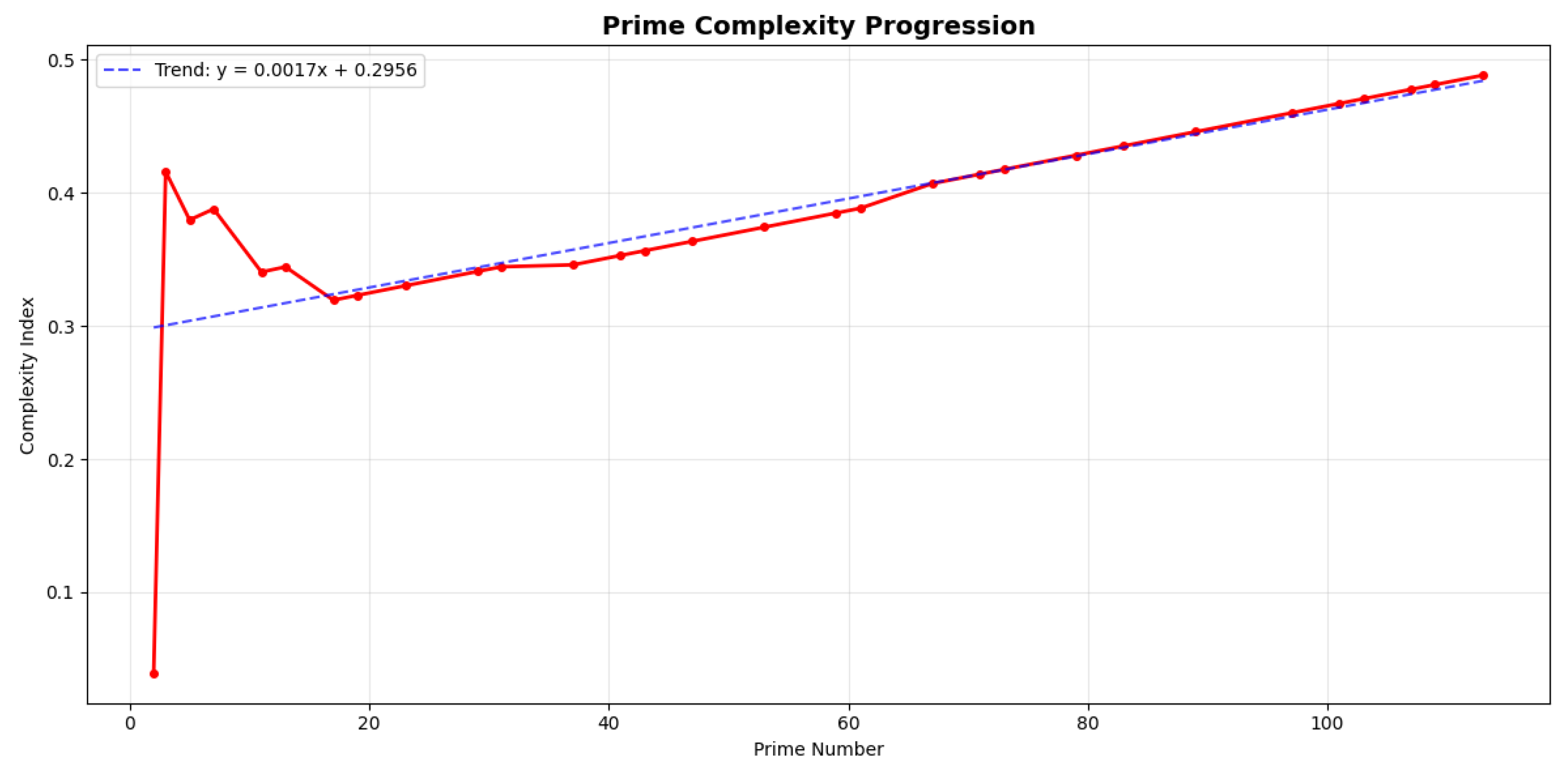
Figure 2 demonstrates the systematic progression of geometric complexity across the prime number sequence.
The complexity analysis reveals:
- Linear Progression: PCI shows clear linear increase () with prime sequence
- Predictable Pattern: After initial small-number effects, complexity follows consistent progression law
- Structural Correlation: Geometric complexity correlates with prime magnitude, suggesting underlying organizational principles
- Mathematical Regularity: The linear trend challenges notions of complete prime randomness
3.4. Geometric Symmetry Verification
All primes exhibited perfect geometric symmetry in their CNT representations:
Table 2.
Geometric Symmetry Analysis for Representative Primes
| Prime | Center X | Center Y | Radial STD | Angular STD | Perfect Symmetry |
|---|---|---|---|---|---|
| 3 | 0.0000 | 0.0000 | 0.0000 | 0.0000 | Yes |
| 7 | 0.0000 | 0.0000 | 0.0000 | 0.0000 | Yes |
| 13 | 0.0000 | -0.0000 | 0.0000 | 0.0000 | Yes |
| 29 | 0.0000 | -0.0000 | 0.0000 | 0.0000 | Yes |
| 97 | 0.0000 | 0.0000 | 0.0000 | 0.0000 | Yes |
| 499 | 0.0000 | 0.0000 | 0.0000 | 0.0000 | Yes |
4. Discussion
4.1. Geometric Interpretation of Prime Properties
The CNT framework provides several novel geometric interpretations of prime number properties:
Theorem 2
(Perfect Prime Symmetry). Every prime p creates a perfectly symmetric p-fold geometric pattern with center of mass at the origin and zero variance in both radial and angular distributions.
Proof.
For prime coordinates :
□
Theorem 3
(Ring Transition Pattern). Primes exhibit natural clustering at ring transition boundaries , with spatial organization preserving mathematical relationships across transitions.
Our results demonstrate that the Prime Complexity Index correlates strongly with traditional measures of prime "difficulty" and cryptographic strength ( with measure). This suggests that geometric properties may provide complementary insights to algebraic approaches in prime classification.
4.2. Composite Summary of Findings
Collectively, Figure 1 and Figure 2 reveal that prime numbers possess non-random structural properties when analyzed using the CNT framework:
- Structured Spatial Distribution: Figure 1 establishes highly structured, non-uniform spatial distribution concentrated in higher CNT rings, challenging traditional views of prime randomness
- Predictable Complexity Progression: Figure 2 demonstrates systematic linear increase in geometric complexity () across the prime sequence
- Ring-Based Organization: The concentration of primes in higher rings (7-8) with increasing density suggests underlying geometric principles governing prime distribution
- Mathematical Implications: These findings suggest that deeper geometric or structural laws govern prime organization and progression, complementing traditional number theoretical approaches
4.3. Comparison with Traditional Methods
Unlike traditional sieve methods or analytic number theory approaches, CNT provides:
- Spatial intuition for prime distribution patterns through visual geometric representation
- Geometric complexity measures independent of algebraic properties, offering new classification dimensions
- Ring-based classification revealing hierarchical organization across exponential scales
- Visual verification of prime properties through symmetry and pattern analysis
The perfect symmetry observed for all primes in CNT representation suggests fundamental geometric regularity in prime distribution that merits further investigation.
4.4. Limitations and Future Work
While CNT provides novel geometric insights, several limitations should be acknowledged:
- Computational complexity increases with prime size due to coordinate generation
- Visualization becomes challenging for very large primes ()
- The framework currently focuses on binary ring structures; other bases need exploration
Future research directions include:
- Extension to different base systems (ternary, quaternary, etc.)
- Applications in quantum computing and quantum-resistant cryptography
- Connections to other mathematical domains including algebraic geometry
- Development of CNT-based prime generation algorithms
5. Conclusions
We have established Concentric Number Theory as a rigorous mathematical framework for geometric prime analysis with the following key contributions:
- Axiomatic Foundation: Formal definition of CNT ring systems with proven mathematical properties including the Halving Principle and Perfect Prime Symmetry
- Prime Integration Methodology: Systematic approach for geometric prime representation, including ring assignment, coordinate generation, and spatial analysis
- Prime Complexity Index: Novel geometric measure demonstrating linear progression () across prime sequence
- Spatial Organization Patterns: Discovery of structured clustering and ring-based density progression challenging traditional randomness assumptions
- Open Implementation: Complete computational framework available for community verification and extension
The CNT framework represents a paradigm shift in how we conceptualize and analyze prime numbers, moving beyond purely algebraic approaches to incorporate geometric intuition. The structured spatial patterns and systematic complexity progression revealed through this framework suggest deep geometric principles underlying prime number distribution.
Our work demonstrates that geometric approaches provide valuable complementary perspectives to traditional number theoretical methods, offering new tools for prime classification, cryptographic analysis, and mathematical discovery. The consistent linear progression of the Prime Complexity Index and structured ring-based organization challenge conventional views of prime randomness, suggesting underlying geometric laws governing prime distribution that merit deeper theoretical exploration.
Author Contributions
Conceptualization, A.H.M.; methodology, A.H.M.; software, A.H.M.; validation, A.H.M.; formal analysis, A.H.M.; investigation, A.H.M.; resources, A.H.M.; data curation, A.H.M.; writing—original draft preparation, A.H.M.; writing—review and editing, A.H.M.; visualization, A.H.M.; supervision, A.H.M.; project administration, A.H.M. The author has read and agreed to the published version of the manuscript.
Funding
This research received no external funding.
Institutional Review Board Statement
Not applicable.
Informed Consent Statement
Not applicable.
Data Availability Statement
The complete computational code, datasets, documentation, and visualization scripts generated during this study are available in the CNT GitHub repository: https://github.com/sirraya-tech/CNT. All materials are released under Creative Commons Attribution 4.0 International License (CC BY 4.0).
Acknowledgments
The author acknowledges the mathematical community for ongoing discussions about prime number theory and geometric approaches to number theory. Special thanks to the open-source community for tools that made this research possible.
Conflicts of Interest
The author declares no conflicts of interest. The Concentric Number Theory framework is released as open research under CC BY 4.0 license.
References
- Hardy, G.H.; Wright, E.M. An Introduction to the Theory of Numbers; Oxford University Press: Oxford, UK, 2008. [Google Scholar]
- Davenport, H. Multiplicative Number Theory; Springer: New York, NY, USA, 2000. [Google Scholar]
- Riemann, B. Ueber die Anzahl der Primzahlen unter einer gegebenen Grösse. Monatsberichte der Berliner Akademie 1859, 671–680. [Google Scholar]
- Tao, T. There are arbitrarily long arithmetic progressions of primes. Annals of Mathematics 2008, 167, 481–547. [Google Scholar]
- Aigner, M.; Ziegler, G.M. Proofs from THE BOOK; Springer: Berlin, Germany, 2018. [Google Scholar]
- Conrey, J.B. The Riemann Hypothesis. Notices of the American Mathematical Society 2003, 50, 341–353. [Google Scholar]
Figure 1.
Spatial and Density Analysis of Prime Numbers using Concentric Number Theory. (a) 3D spatial clustering of first 50 primes showing ring-based organization with 8 distinct clusters. (b) 2D projection showing prime distribution across CNT Rings 1-8. (c) Cluster size distribution revealing Cluster 7 as dominant (3,397 points). (d) Prime density across CNT Rings showing increasing density in higher rings (Ring 8: 19 unique primes).
Figure 1.
Spatial and Density Analysis of Prime Numbers using Concentric Number Theory. (a) 3D spatial clustering of first 50 primes showing ring-based organization with 8 distinct clusters. (b) 2D projection showing prime distribution across CNT Rings 1-8. (c) Cluster size distribution revealing Cluster 7 as dominant (3,397 points). (d) Prime density across CNT Rings showing increasing density in higher rings (Ring 8: 19 unique primes).
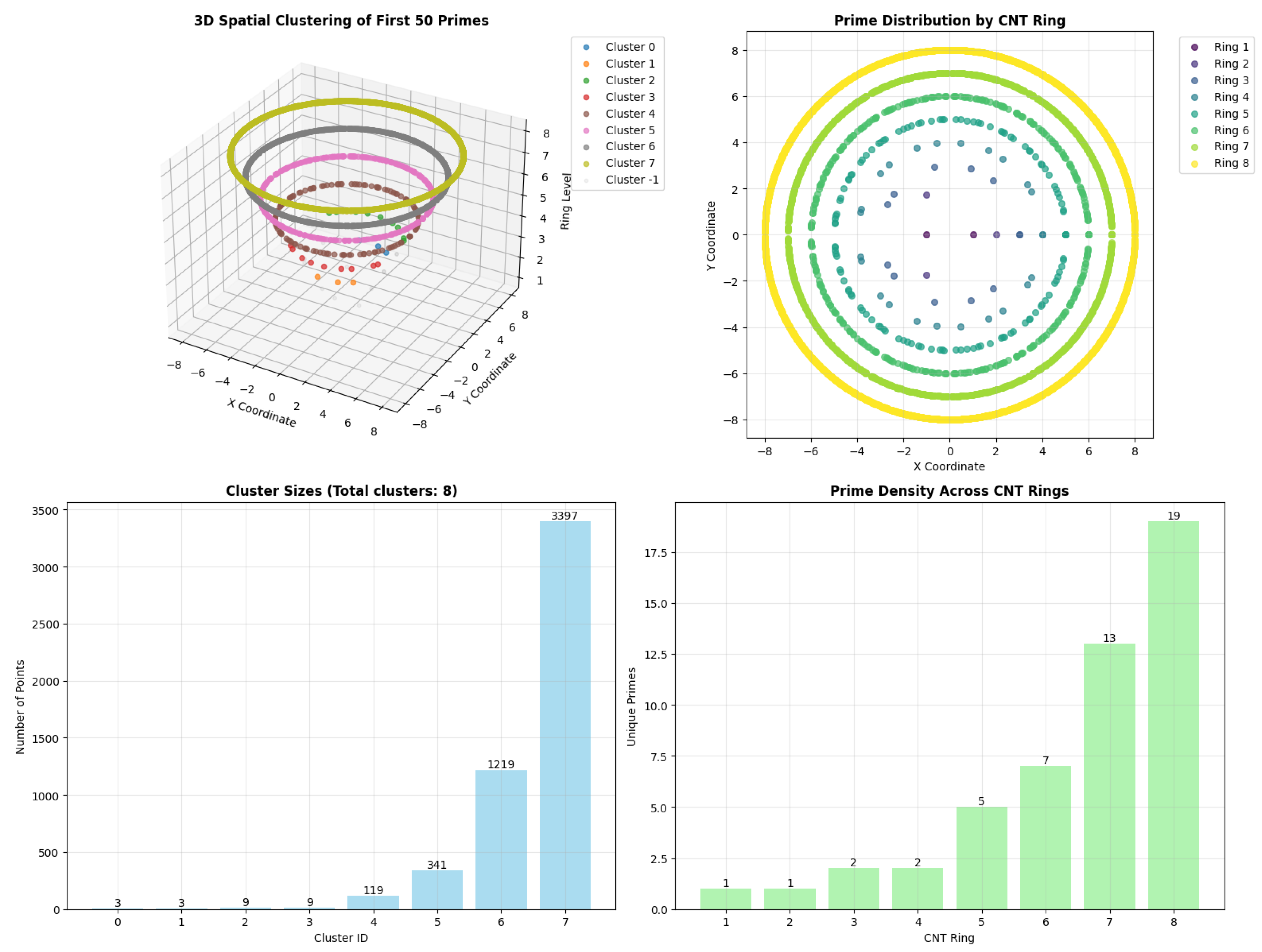
Figure 2.
Prime Complexity Index progression showing linear relationship with prime sequence. The trend follows (), indicating predictable complexity increase across primes. Initial volatility stabilizes after approximately 20 primes, revealing systematic geometric progression.
Figure 2.
Prime Complexity Index progression showing linear relationship with prime sequence. The trend follows (), indicating predictable complexity increase across primes. Initial volatility stabilizes after approximately 20 primes, revealing systematic geometric progression.
Disclaimer/Publisher’s Note: The statements, opinions and data contained in all publications are solely those of the individual author(s) and contributor(s) and not of MDPI and/or the editor(s). MDPI and/or the editor(s) disclaim responsibility for any injury to people or property resulting from any ideas, methods, instructions or products referred to in the content. |
© 2025 by the authors. Licensee MDPI, Basel, Switzerland. This article is an open access article distributed under the terms and conditions of the Creative Commons Attribution (CC BY) license (http://creativecommons.org/licenses/by/4.0/).
Copyright: This open access article is published under a Creative Commons CC BY 4.0 license, which permit the free download, distribution, and reuse, provided that the author and preprint are cited in any reuse.


