

Submitted:
16 October 2025
Posted:
23 October 2025
You are already at the latest version
Abstract
Rapid methadone metabolism in patients with opioid use disorder could complicate methadone treatment. Toxicology screenings to monitor methadone levels may show negative for methadone, despite adherence regular regimen. A patient receiving treatment for opioid use disorder tested negative for methadone in 11 out of 22 toxicology screenings (50.0%). We hypothesized that the patient was a rapid methadone metabolizer. After tapering doses to a maintenance level and using supervised urine collection, the patient was negative for methadone in 7 out of 7 tests (100.0%) but positive for cocaine in 5 out of 7 tests (71.4%). Chronic cocaine use and genetic factors, particularly CYP2B6 polymorphisms, have been found to cause rapid methadone metabolism. Clinicians should be vigilant for unusual metabolic reactions and modify dose and monitoring schedules accordingly. More investigation into the physiological and genetic aspects of methadone metabolism is needed.
Keywords:
methadone metabolism
; opioid use disorder
; CYP2B6 polymorphism
; individualized treatment
; urine toxicology
; cocaine interaction
1. Introduction
Opioid use disorder is a problem worldwide. Every year opioid-related deaths increase. There are different treatment options for opioid use disorder. Like heroin or opium, methadone is an opioid. Since the 1950s, methadone maintenance therapy has been used to treat opioid dependence [1]. The patient who is dependent on opioids takes a pill or liquid form of methadone once a day. This lessens their opioid cravings and withdrawal symptoms [2]. Intensive outpatient programs (IOPs) for substance abuse are direct services for individuals with co-occurring mental and substance use disorders or substance use disorders without a history of medical detoxification or round-the-clock supervision. IOPs are substitutes for residential and inpatient care [3]. Patients regularly follow up at these clinics to continue the regular lifestyle to be minimally affected by opioid withdrawal. The clinics are intended to provide coping mechanisms, relapse prevention, and psychosocial support. The number of times a person needs to pick up doses from a methadone clinic is reduced to three times per week after the initial 90-day period. Every time a participant comes in for treatment, they are given a two-day supply of methadone because it is a daily requirement. If the patient maintains their regularity, the visits can be further decreased to once a week followed by twice a month and lastly once a month but it takes a long time to reach up to that level. CYP3A4 and CYP2B6 are the major CYP isoforms involved in methadone metabolism, with CYP2D6 only contributing in a negligible manner, with close to no impact on methadone dosage requirements [4]. We present a unique case of a patient exhibiting rapid methadone metabolism without experiencing opioid abstinence syndrome (OAS) upon presentation at a methadone clinic. This case discusses the importance of individual treatment plans and the challenges in treating patients with typical metabolic responses to methadone. This will add clinical practice knowledge by informing dosing strategies and monitoring protocols, ultimately improving patient outcomes in Opioid Use Disorder (OUD) .
2. Methadone Metabolism and Serum Concentration
Methadone metabolism, monitoring serum levels and peak concentrations provides critical insights into the pharmacokinetic profile of the patient. Individual differences in methadone pharmacokinetics are quite significant. Methadone’s half-life varies from 8 to 59 hours based on the patient. The average time is 24 hours [5]. Thus, methadone induction should start low and increase gradually over a few days or weeks while being monitored every day. Serum levels at steady daily doses peak two to four hours after dosing and then gradually drop, allowing for a full day without overdosing or withdrawal [6]. Although CYP2B6 and CYP2D6 enzymes are also involved, the liver’s CYP450 3A4 enzyme is principally in charge of metabolizing methadone [7]. Draw peak and trough blood specimens approximately 3 hours and 24 hours after dose administration, respectively, to measure serum methadone levels. Serum methadone levels and dose generally correlate, but because patient response varies greatly, there is no established therapeutic window based on serum methadone levels [8]. Methadone minimum trough levels between 300 and 400 ng/mL may be linked to a lower risk of heroin use; however, the patient’s overall response should be the primary consideration when determining the appropriate therapeutic dose, not the patient’s serum plasma levels. Peak: trough ratios greater than 2:1 might point to a quick metabolism [9,10].
3. Case Discussion
The patient is a 44-year-old Hispanic female with a psychiatric history notable for substance use disorder, including opioid, cocaine and tobacco use disorder and substance-induced mood disorder. Her treatment history includes one prior detoxification and rehabilitation attempt , but no long-term inpatient residential programs or outpatient addictions services. She has no history of prior suicide attempt/self-injurious behavior. however, has had three unintentional drug overdoses in the past while seeking to get high, leading to admission into the hospital. Her medical history is significant for rheumatoid arthritis, gastric ulcer, celiac disease and migraine headaches. She presented to the opioid treatment program ( OTP) Clinic for Methadone maintenance therapy to address her opioid use disorder.
4. Substance Use History
The patient began smoking cigarettes during her teenage years, initially starting with a few cigarettes and then gradually increasing to 1 pack per day. She currently smokes approximately 2-3 cigarettes daily. At the age of 36, She began abusing Tylenol # 3 (Tylenol-Codeine) for arthritis pain but no longer engaging in this behavior. She was prescribed oxycodone pills for toothache at the age 38, which marked the onset of her opioid addiction. She reported abusing Percocet, originally prescribed by her dentist, leading to a 9-month history of oxycodone misuse. During this period, she consumed approximately 9-10 mg oxycodone pills orally. The patient began sniffing cocaine around the same time she started purchasing oxycodone from the street. She also has a history of intermittent benzodiazepine use, as evidenced by positive toxicology results. She illustrated that last use of oxycodone was 6 yeras ago,, when she was discharged from the hospital after unintentional overdose on oxycodone pills to alleviate withdrawal symptoms. The patient denied any history of heroin use, recreational substance use, or intravenous drug use. She reports maintaining sobriety from Opioids by consuming methadone daily and actively participating in group sessions and meetings at OTP.
5. Psychiatric History
The patient was first admitted to a psychiatric hospital for depression and the ingestion of 8 to 10 mg Oxycodone Pills 6 years ago. She reported that she was self-medicating but denied any suicidal intent. Additionally, she disclosed unintentional overdoses with Percocet twice and once with methadone in the past, which led to admission into the ED ( Emergency Department ) or inpatient medical/psychiatric facilities. She was diagnosed with substance-induced mood disorder and prescribed zoloft, trazodone and melatonin in the past, but she is not currently taking any psychotropic medications. She has never experienced anxiety, mood swings, or any type of perceptual disturbances.
6. Medical and Surgical History
The patient has a medical history of migraine headaches, rheumatoid arthritis, gastric and duodenal ulcers with duodenal stricture, and celiac disease. Her surgical history includes the Cholecystectomy and Tubal ligation. She used to take Topomax and amitriptyline for migraine headaches, prescribed by her Neurologist, and Gabapentin for hand joint pain. However, She is not currently taking any medication.
7. History of Presenting Illness and Clinical Course Along with Lab Findings
The patient has been sober since her discharge from the Psychiatric hospital 6 years ago, when she was referred to the OTP Clinic to initiate methadone maintenance treatment. Based on examination and assessment at the OTP, it was determined that the patient had physiological dependence on opioids for at least one year and was diagnosed with opioid dependence. She was started on a six-day-a-week schedule (Monday to Saturday clinical visits and take home bottle for Sunday) and began methadone induction at a low dose (10 mg daily) with titration accordingly. EKG finding on admission date revealed normal sinus rhythm and QTc 428 milliseconds.
During her treatment, the patient reported experiencing opiate cravings and withdrawal symptoms in the early morning, including sweating, body aches, nausea, discomfort, and persistent cravings of opioids. During subsequent visits, her methadone dosage was gradually increased from 10 mg to 100 mg, at which point she no longer reported any cravings or withdrawal symptoms. Toxicology screenings conducted for 16 months after admission showed negative results for methadone in 11 out of 22 tests. Eleven tests were positive for methadone, and one test was positive for cocaine with a low urine creatinine level of 11 mg/dl.
The patient was asked about negative methadone in her Urine toxicology, and she mentioned that she takes methadone regularly without any skip in the schedule. Even on 04/12/2019, the Patient was on supervised urine submission and still came out negative for methadone consistently. So we ordered serum methadone level and urine toxicology for comparison on 04/17/19 to determine the presence of methadone or not and rule out tampering with urine toxicology. The results showed negative methadone in urine toxicology and no methadone detected in the blood. The patient’s urine collection was supervised on 4/23/19 and still came out negative for methadone and opiates. The patient may be a fast methadone metabolizer and we plan to repeat serum methadone at peak level 2-3 hours after taking methadone, which showed no detected trough level on 4/17/19 and a peak level of 170 on 05/02/19. ECG (5/9/19): NSR @ 77, QTc 448.
In June 2022, the Patient stated she was ready to start being tapered down with eventual discontinuation of methadone and would like to start with a 10 mg decrease from 100 mg dose gradually. She also stated to continue to maintain sobriety regarding heroin and other illicit drugs. Currently, Pt feels well; denies opiate withdrawal symptoms and depression and is currently on 5mg per day without complaint of withdrawal symptoms or craving/ relapse. Urine toxicology from 01/02/24 to 3/14/2024 positive for cocaine 5 out of 7 times and all negative for methadone and other opiates. She has 2 low urine creatinine levels of 4 and 18 respectively on 2 occasions. The patient appeared to be a fast metabolizer of her methadone based on previous assessments with serum methadone levels.
Important Lab findings:

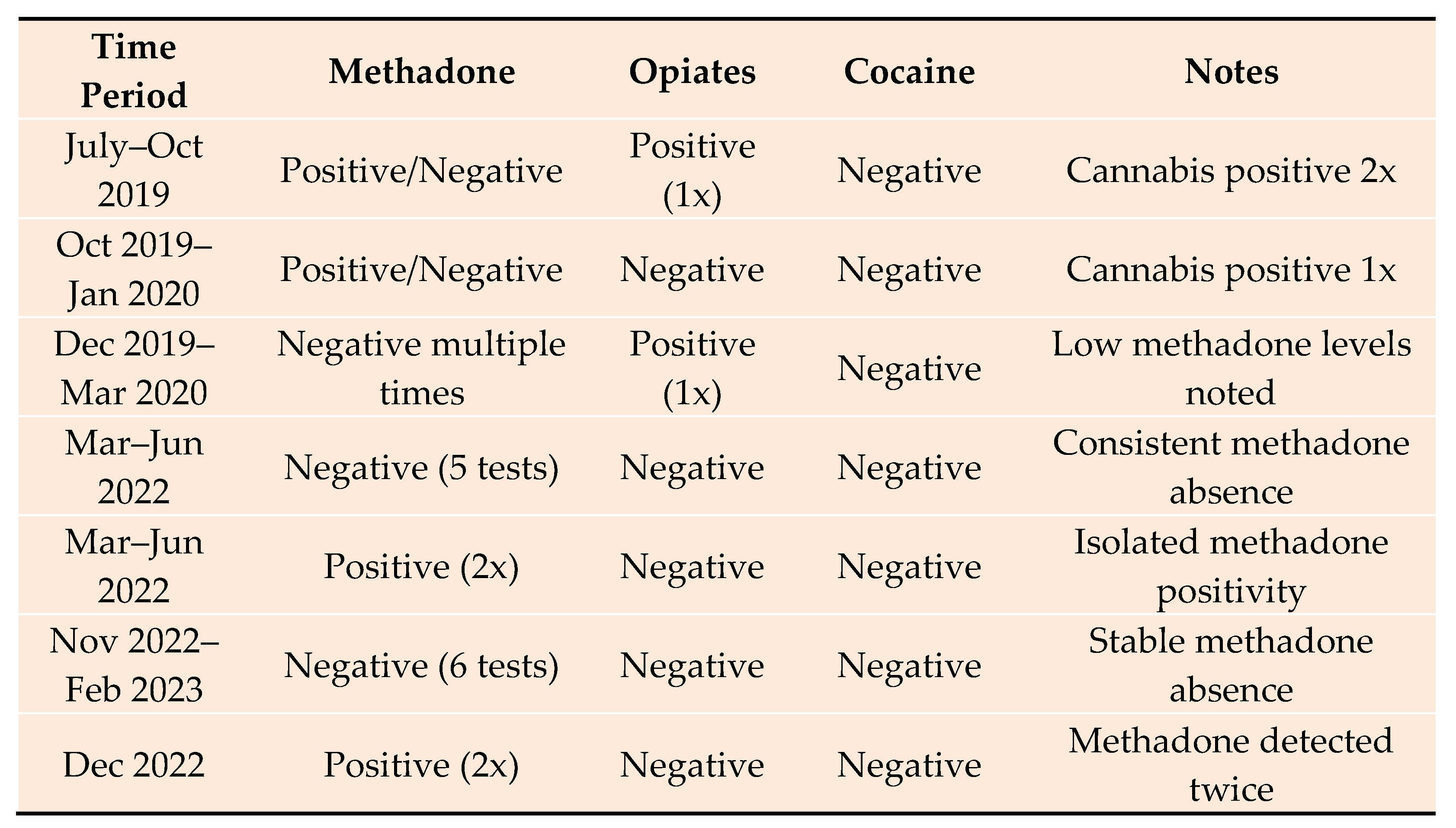
| 1. Results of the Patient’s Urine Toxicology Screening Tests During Treatment | ||||||
| Testing Perioda | Methadone | Benzodiazepine | Cannabis | Opiates | Cocaine | Notes |
| Months 1–4 | (+)(-) | (+) 2x | (+) 2x | (+) 1x | (-) | Negative for other illicit substances |
| Months 1–5 | (+)(-) | (+) 2x | (+) 2x | (+) 1x | (-) | Negative for other illicit substances |
| Months 4–7 | (+)(-) | (-) | (+) 1x | (-) | (-) | Negative for opiates and other illicit substances |
| Months 6–9 | (-) | (-) | (-) | (+) 1x | (-) | Negative for methadone in 7 tests |
| Months 33–36 | (-) | (-) | (-) | (-) | (-) | Negative for methadone in 5 tests |
| Months 33–35 | (+) | (-) | (-) | (-) | (-) | Positive for methadone in 2 tests |
| Months 41–44 | (-) | (-) | (-) | (-) | (-) | Negative for methadone in 6 tests |
| Month 42 | (+) | (-) | (-) | (-) | (-) | Positive for methadone in 2 tests |
| Maintenance period | (-) | (-) | (-) | (-) | (+) | Low urine creatinine (4, 18) in 2 tests Positive for cocaine in 5 of 7 tests |
a Month 1: index month when treatment began.
Important Lab Findings
The table below summarizes urine toxicology results over specified periods, categorized by substance, with relevant notes.
 |
 |
Important Lab Findings
Table 1.
Results of the patient’s urine toxicology screening tests during treatment.
| Testing Perioda | Methadone | Benzodiazepine | Cannabis | Opiates | Cocaine | Notes | |
| Months 1-6 | july to dec 2019 | (+) 2x (-) 2x |
(+) 4x | (+) 4x | (+) 2x | (-) | Negative for other illicit substances |
| Months 6-12 | jan to june | (+)1x (-) 2x |
(+) 2x | (+) 2x | (+) 1x | (-) | Negative for other illicit substances |
| Months 12-18 | jul to dec 2020 | (+) | (-) | (+) 1x | (-) | (-) | Negative for opiates and other illicit substances |
| Months 18-24 | jan to jun 2021 | (-) 7x | (-) | (-) | (+) 1x | (-) | Negative for methadone in 7 tests |
| Months 24-30 | jul to dec 2021 | (-) | (-) | (-) | (-) | (-) | Negative for methadone in 5 tests |
| Months 30-36 | jan to jun 2022 | (+) 2x | (-) | (-) | (-) | (-) | Positive for methadone in 2 tests |
| Months 36-42 | jul to dec 2022 | (-) | (-) | (-) | (-) | (-) | Negative for methadone in 6 tests |
| Months 30-36 | jan to dc 2023 | (-) | (-) | (-) | (-) | (-) | Positive for methadone in 2 tests |
| Maintenance period | jan to june 2024 | (-) | (-) | (-) | (-) | (+) | Low urine creatinine (4, 18) in 2 tests Positive for cocaine in 5 of 7 tests |
Besides what we found in the lab summary, we’ve put together a timeline of urine toxicology result. This table works with the earlier summaries to give a better view of what happened with the patient from December 2022 to March 2024. The results keep showing no methadone, even though the patient took it as directed and was watched while doing so. Cocaine, on the other hand, keeps showing up. This fits with the idea that the patient processes methadone quickly and points out some management difficulties.
Table 2.
Detailed Urine Toxicology Results (Dec 2022 – Mar 2024).
| Date / Testing Period | Methadone | Benzodiazepine | Cannabis | Opiates | Cocaine | Notes |
| 10 Jan 2023 | (-) | (-) | (-) | (-) | (-) | Methadone negative; Cannabis negative; Cocaine negative |
| 10 Oct 2023 | (-) | (-) | (-) | (-) | (-) | Methadone negative; Cannabis negative; Cocaine negative |
| 12 Sep 2023 | (-) | (-) | (-) | (-) | (-) | Methadone negative; Cannabis negative; Cocaine negative |
| 13 April 2023 | (-) | (-) | (+) | (-) | (-) | Cannabis Positive |
| 14 Feb 2023 | (-) | (-) | (-) | (-) | (-) | Methadone negative; Cannabis negative; Cocaine negative; Ethanol level - mg/dL |
| 14 March 2023 | (-) | (-) | (+) | (-) | (-) | Cannabis Positive |
| 14 March 2024 | (-) | (-) | (-) | (-) | (+) | Cocaine positive |
| 15 Feb 2024 | (-) | (-) | (-) | (-) | (-) | Methadone negative; Cannabis negative; Cocaine negative |
| 16 May 2023 | (-) | (-) | (-) | (-) | (-) | Methadone negative; Cannabis negative; Cocaine negative |
| 17 Aug 2023 | (-) | (-) | (-) | (-) | (-) | Methadone negative; Cannabis negative; Cocaine negative |
| 18 Jan 2024 | (-) | (-) | (-) | (-) | (+) | Cocaine positive |
| 19 Jan 2023 | (-) | (-) | (-) | (-) | (-) | Methadone negative; Cannabis negative; Cocaine negative; Ethanol level - mg/dL |
| 2 Jan 2024 | (-) | (-) | (-) | (-) | (+) | Cocaine positive; Ethanol level - mg/dL |
| 2 March 2023 | (+) | (-) | (-) | (-) | (-) | Methadone Positive |
| 2 may 2023 | (-) | (-) | (-) | (-) | (-) | Methadone negative; Cannabis negative; Cocaine negative; Ethanol level - mg/dL |
| 20 June 2023 | (-) | (-) | (+) | (-) | (-) | Cannabis Positive |
| 23 Jan 2024 | (-) | (-) | (-) | (-) | (+) | Cocaine positive |
| 24 oct 2023 | (-) | (-) | (+) | (-) | (-) | Cannabis Positive |
| 26 July 2023 | (-) | (-) | (-) | (-) | (-) | Methadone negative |
| 26 dec 2023 | (-) | (-) | (-) | (-) | (+) | Cocaine positive; Ethanol level - mg/dL |
| 26 sept 2023 | (-) | (-) | (-) | (-) | (-) | Methadone negative; Cannabis negative; Cocaine negative; Ethanol level - mg/dL |
| 27 dec 2022 | (-) | (-) | (-) | (-) | (-) | Ethanol level + mg/dL |
| 28 March 2024 | (-) | (-) | (-) | (-) | (+) | Cocaine positive; Ethanol level 10 mg/dL |
| 29 Aug 2023 | (-) | (-) | (-) | (-) | (-) | Methadone negative; Cannabis negative; Cocaine negative; Ethanol level - mg/dL |
| 29 Feb 2024 | (-) | (-) | (-) | (-) | (+) | Cocaine positive; Ethanol level 10 mg/dL |
| 30 may 2023 | (-) | (-) | (-) | (-) | (-) | Methadone negative; Cannabis negative; Cocaine negative; Ethanol level - mg/dL |
| 31 Jan 2023 | (-) | (-) | (-) | (-) | (-) | Methadone negative; Cannabis negative; Cocaine negative; Ethanol level - mg/dL |
| 5 April 2023 | (-) | (-) | (-) | (-) | (-) | Methadone negative; Cannabis negative; Cocaine negative; Ethanol level - mg/dL |
| 6 July 2023 | (-) | (-) | (-) | (-) | (-) | Methadone negative; Cannabis negative; Cocaine negative; Ethanol level - mg/dL |
| 6 feb 2024 | (-) | (-) | (-) | (-) | (-) | Methadone negative; Cannabis negative; Cocaine negative; Ethanol level 10 mg/dL |
| 6 jun 2023 | (-) | (-) | (-) | (-) | (-) | Methadone negative; Cannabis negative; Cocaine negative; Ethanol level - mg/dL |
| 7 Nov 2023 | (-) | (-) | (-) | (-) | (-) | Methadone negative; Cannabis negative; Cocaine negative; Ethanol level - mg/dL |
| 9 Aug 2023 | (-) | (-) | (-) | (-) | (-) | Ethanol level - mg/dL |
Note: ‘Ethanol level 10’ refers to a urine alcohol concentration of 10 mg/dL, measured concurrently with the urine toxicology screening.
8. Discussion
This is a unique case as the patient even being a rapid metabolizer was stable on a relatively normal dose of methadone. A similar case was found by Hobbins et al, but that patient being an ultra-rapid metabolizer required a daily methadone dose of 1200 mg, split 400/400/400 [11], and showed symptoms of opioid abstinence syndrome (OAS) when a normal dose was given which is not seen in our patient. Our patient can have multiple factors that can cause the rapid metabolization without symptoms of OAS. One of the factors can be genetic allelic variation. The primary CYP2B6 metabolizer of methadone is an individual’s phenotype, which can impact serum methadone levels [12,13]. Homozygotes of the highly active CYP2B6*5 allele will metabolize methadone quickly and with little chance of toxicity [14]. So, this can be a case of CYP2B6*5 polymorphism. Another cause may be regular use of cocaine which may affect the levels of methadone. Regular cocaine users demonstrated a trend toward a lower AUC (p =.09) and faster methadone clearance (p =.08), as well as a significant decrease in C (min) (p =.04). Because it reduces methadone exposure, regular cocaine use may hurt treatment outcomes for opioid dependence in people receiving methadone maintenance [15]. Demographic causes such as age, sex, and ethnicity may be thought of as a few other factors contributing to rapid metabolism. The metabolism of (R)-methadone and (S)-methadone was significantly impacted by female sex (p = 0.016 and p = 0.044, respectively) [16]. The metabolism of (S)-methadone was significantly impacted by CYP2B6 loss of function (LOF) alleles (p = 0.012) [16]. The metabolism of (R)-methadone was significantly impacted by body mass index (BMI) (p = 0.034). Males, those with LOF alleles, and those with higher body mass index seemed to have lower methadone metabolism [16]. Considering the patient’s stable condition on a standard methadone dose, the potential genetic, behavioral, and demographic factors discussed—such as the presence of the CYP2B6*5 allele, regular cocaine use, and individual demographic characteristics—warrant further investigation.
9. Conclusions
The intricacy of methadone metabolism and its consequences for treating opioid use disorder are highlighted in this case. The patient’s quick methadone metabolism, combined with the absence of the anticipated opioid abstinence syndrome, emphasizes the need for individualized treatment plans in methadone maintenance therapy. Clinicians need to be on the lookout for unusual metabolic reactions and modify their dose and monitoring schedules accordingly. More investigation into the physiological and genetic aspects affecting methadone metabolism may yield deeper understandings and, ultimately, more efficient and customized treatments for those suffering from opioid use disorder. This instance adds to the increasing amount of data demonstrating the necessity for a comprehensive comprehension of methadone pharmacokinetics in a range of patient demographics.
Disclosures: No sources of support were received for this study. None of the authors have any financial conflicts of interest to disclose.
References
- World Health Organization. Regional Office for the Western Pacific.: Clinical guidelines for withdrawal management and treatment of drug dependence in closed settings. World Health Organization, Western Pacific Region; 2009 https://www.ncbi.nlm.nih.gov/books/NBK310654/.
- Veilleux JC, Colvin PJ, Anderson J, York C, Heinz AJ: A review of opioid dependence treatment: Pharmacological and psychosocial interventions to treat opioid addiction. Clin Psychol Rev. 2010, 30:155–66. [CrossRef]
- McCarty D, Braude L, Lyman DR, Dougherty RH, Daniels AS, Ghose SS, Delphin-Rittmon ME: Substance Abuse Intensive Outpatient Programs: Assessing the Evidence. Psychiatric Services. 2014, 65:718–26. [CrossRef]
- Landau R: Pharmacogenomic considerations in opioid analgesia. Pharmgenomics Pers Med. 2012, 73. [CrossRef]
- Strain E: The Treatment of Opioid Dependence. Johns Hopkins University Press; 2005. [CrossRef]
- Samhsa: TIP 63: Medications for Opioid Use Disorder. 2006.
- Eap CB, Buclin T, Baumann P: Interindividual Variability of the Clinical Pharmacokinetics of Methadone. Clin Pharmacokinet. 2002, 41:1153–93. [CrossRef]
- Leavitt: TIP 63: Medications for Opioid Use Disorder. 2009.
- Samhsa: TIP 63: Medications for Opioid Use Disorder. 2014.
- Hallinan R, Ray J, Byrne A, Agho K, Attia J: Therapeutic thresholds in methadone maintenance treatment: A receiver operating characteristic analysis. Drug Alcohol Depend. 2006, 81:129–36. [CrossRef]
- Hobbins DF: Case Report. J Addict Nurs. 2010, 21:22–36. [CrossRef]
- Miaskowski C: Understanding the Genetic Determinants of Pain and Pain Management. Semin Oncol Nurs. 2009, 25:S1–7. [CrossRef]
- Landau R: Pharmacogenomic considerations in opioid analgesia. Pharmgenomics Pers Med. 2012, 73. [CrossRef]
- Dobrinas M, Crettol S, Oneda B, et al.: Contribution of CYP2B6 alleles in explaining extreme (S)-methadone plasma levels. Pharmacogenet Genomics. 2013, 23:84–93. [CrossRef]
- McCance-Katz EF, Jatlow P, Rainey PM: Effect of Cocaine Use on Methadone Pharmacokinetics in Humans. Am J Addict. 2010. 19:47–52. [CrossRef]
- Talal AH, Ding Y, Venuto CS, et al.: Toward precision prescribing for methadone: Determinants of methadone deposition. PLoS One. 2020, 15:e0231467. [CrossRef]
Disclaimer/Publisher’s Note: The statements, opinions and data contained in all publications are solely those of the individual author(s) and contributor(s) and not of MDPI and/or the editor(s). MDPI and/or the editor(s) disclaim responsibility for any injury to people or property resulting from any ideas, methods, instructions or products referred to in the content. |
© 2025 by the authors. Licensee MDPI, Basel, Switzerland. This article is an open access article distributed under the terms and conditions of the Creative Commons Attribution (CC BY) license (http://creativecommons.org/licenses/by/4.0/).
Copyright: This open access article is published under a Creative Commons CC BY 4.0 license, which permit the free download, distribution, and reuse, provided that the author and preprint are cited in any reuse.