

Submitted:
16 October 2025
Posted:
17 October 2025
You are already at the latest version
Abstract
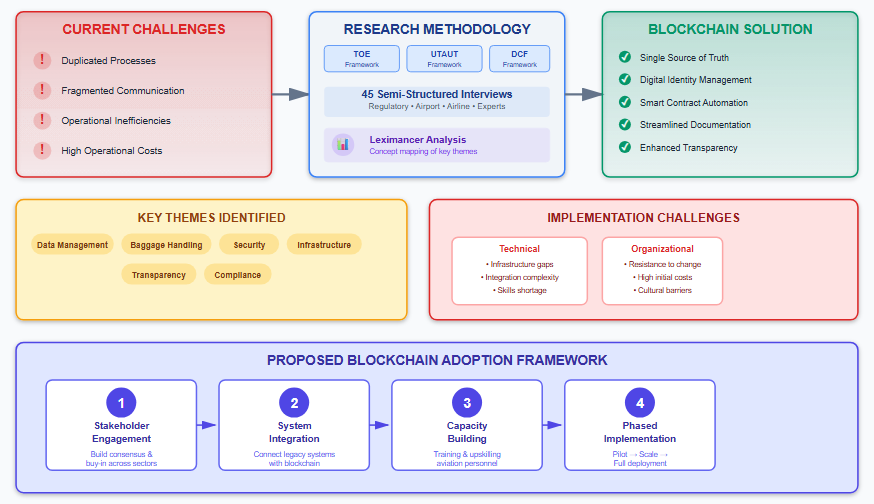
The Nigerian aviation sector faces persistent challenges of duplicated processes, fragmented communication systems, and inefficiencies in passenger, baggage, and administrative operations. These redundancies increase operational costs, compromise service delivery, and hinder compliance with international aviation standards. This study investigates how blockchain technology can be adopted to reduce such redundancies and enhance efficiency in Nigerian airport management. Guided by the Technology–Organization–Environment (TOE) framework, the Unified Theory of Acceptance and Use of Technology (UTAUT), and the Dynamic Capabilities Framework (DCF), the research employs a qualitative design based on 45 semi-structured interviews with stakeholders, including regulatory authorities, airport managers, airline officials, and aviation experts. Data were analyzed using Leximancer software to generate concept maps highlighting key themes such as data management, baggage handling, security, infrastructure, and transparency. Findings reveal that blockchain can provide a single source of truth, enable secure digital identity management, automate verification processes through smart contracts, and streamline documentation, thereby reducing redundancies across operational, administrative, and data domains. However, implementation faces technical and organizational challenges, including infrastructural limitations, resistance to change, and high initial costs. The study proposes a framework for blockchain adoption in Nigerian airports, emphasizing stakeholder engagement, system integration, and capacity building. This research contributes to the growing body of knowledge on blockchain applications in aviation management and provides practical insights for policymakers and airport administrators seeking to modernize the Nigerian aviation sector.
Keywords:
blockchain
; redundancies
; operations
; airports
; aviation
1. Introduction
The global aviation industry is undergoing significant digital transformation, with blockchain technology emerging as a revolutionary force in modernizing airport operations and management systems. [1] Traditional airport management practices are often characterized by redundant processes, duplicated data entries, and fragmented communication channels, leading to operational inefficiencies and increased costs [2]. In the context of Nigerian airports, these challenges are particularly pronounced, necessitating innovative technological solutions to enhance operational efficiency and service delivery.
Blockchain technology, with its inherent characteristics of transparency, immutability, and decentralized data management, presents a promising solution for addressing these operational redundancies. Research by Ahmad, et al [3] indicates that blockchain implementation in airport operations can reduce process duplications by up to 40% while improving data accuracy and accessibility. This technology’s potential to create a unified, transparent, and efficient operational framework aligns with the growing need for modernization in Nigerian airport management systems. The current state of airport management in Nigeria is characterized by multiple interconnected challenges. Operational processes often suffer from; Multiple data entry points causing information inconsistencies, Fragmented baggage and cargo tracking systems, Disconnected security and identity verification processes, Redundant passenger processing procedures and Inefficient resource allocation across different airport functions [4].
Recent research have brought to light the role blockchain technology can address administrative and management challenges through integrated management approaches. For instance, Kumar et al [5] highlighted how blockchain-based technology systems can unify baggage handling, passenger processing, and security operations under a single, transparent and visible framework [6]. This integration not only reduces operational redundancies but also enhances security and improves passenger experience [7] The implementation of blockchain based technology in airport management will incorporates several key areas such as Data Management and Security, blockchain’s distributed ledger technology enables safe and secure, transparent and efficient data management across all airport operations [8] This ability is remarkably relevant for Nigerian airports, where operational data management challenges often lead to operational inefficiencies and security concerns[4] . Operational Integration, blockchain technology has the capacity to facilitate hitch free integration of most of the airport functions, from check-in to baggage handling and security checks. This integration is very important for significantly reducing process redundancies and enhancing operational efficiency. Infrastructure Development, adopting blockchain technology requires major infrastructural development and modernization, aligning with Nigeria’s aviation sector overall development goals [9], until then the industry cannot adopt blockchain technology.
1.1. Research Aim
The research aim is to investigate and analyze how blockchain technology adoption and implementation can effectively reduce operational redundancies in Nigerian airport management systems while improving overall operational efficiency and service delivery. The following questions will serve as guide as we embark on this research endeavor;
1.What are the major operational, administrative, and data redundancies in Nigerian airport management systems?
2.How can blockchain technology address these redundancies through improved data management, process integration, and transparency?
3.What technical and organizational challenges could hinder blockchain adoption in the Nigerian aviation sector?
4.What framework can guide the effective implementation of blockchain technology in Nigerian airports?
1.2. Research Objectives
This research has the following objectives;
- − To undertake a robust and comprehensive assessment of the current operational redundancies in Nigerian airport management systems and narrowing down on specific areas where the blockchain technology can drive advancement.
- − To gauge the potential impact of blockchain technology on, process integration and streamlining, Data management efficiency, operational cost reduction and service delivery enhancement.
- − We also developed a framework for the implementing blockchain technology in Nigerian airports to address redundancy.
- − The research will also identify potential bottlenecks in the implementation and develop suggest mitigation strategies that is specific to the Nigerian aviation context.
This research is specifically timely and important as Nigerian airports are on the verge of modernizing their infrastructure and restructure to suit international aviation best practices [10]. This findings will be an addition to the growing body of knowledge on blockchain technology applications in airport management while issuing practical insights for stakeholders in the Nigerian aviation sector to adopt immediately. By narrowing down on redundancy reduction through blockchain implementation, this research aims to address a vital gap in current aviation management practices and processes while suggesting innovative solutions for operational efficiency improvement. Additionally, the findings will be specifically be relevant for airport administrators, policy makers and technologically skilled implementers working collectively towards the sole aim of modernizing Nigeria’s aviation infrastructure and sector in general.
1.3. Theoretical Framework
This research adopted three complementary theoretical frameworks which provides a leverage for understanding blockchain adoption for airport management: the Technology-Organization-Environment (TOE) Framework, the Unified Theory of Acceptance and Use of Technology (UTAUT), and the Dynamic Capabilities Framework (DCF).
The Technology-Organization-Environment (TOE) Framework was first introduced by Tornatzky and Fleischer [11] , this theory examines technological innovation adoption from the view point of three critical contexts. The technological context focuses on the characteristics and availability of blockchain technology; the organizational framework looks into internal factors such as resource availability and support from management and the environmental context looks into external influences including demands from regulators and industry requirements [12] . This framework is majorly important for analyzing the multifaceted and multidimensional nature of blockchain technology adoption in airport operations. On the other hand the Unified Theory of Acceptance and Use of Technology (UTAUT), developed by Venkatesh et al.[13] , mainly focuses is on the users acceptance through four key constructs: performance expectancy, effort expectancy, social influence, and facilitating conditions. Williams et al [14] in his work on UTAUT’s demonstrated the effectiveness in forecasting technology adoption success rates, making it very important for understanding how airport stakeholders will embrace blockchain technology solutions. The theory implies that user acceptance rate is important for successful adoption and implementation, majorly in complex operational environments like airports.
The Dynamic Capabilities Framework (DCF), introduced by Teece et al [15] and further reworked by Teece [16], this examines how organizations evolve and reconfigure their competencies to tackle rapidly changing environments. This framework stresses on three primary capabilities: sensing (the ability to identify opportunities and threats), seizing (putting or mobilizing resources to address opportunities), and reconfiguring (this is the ability to maintain competitive edge through enhancement and transformation). Helfat and Peteraf [17] opined that DCF is majorly relevant for studying technological transformations in already established industries, like Airports.
Figure 1.
Relationship between Redundancies and theoretical frameworks.
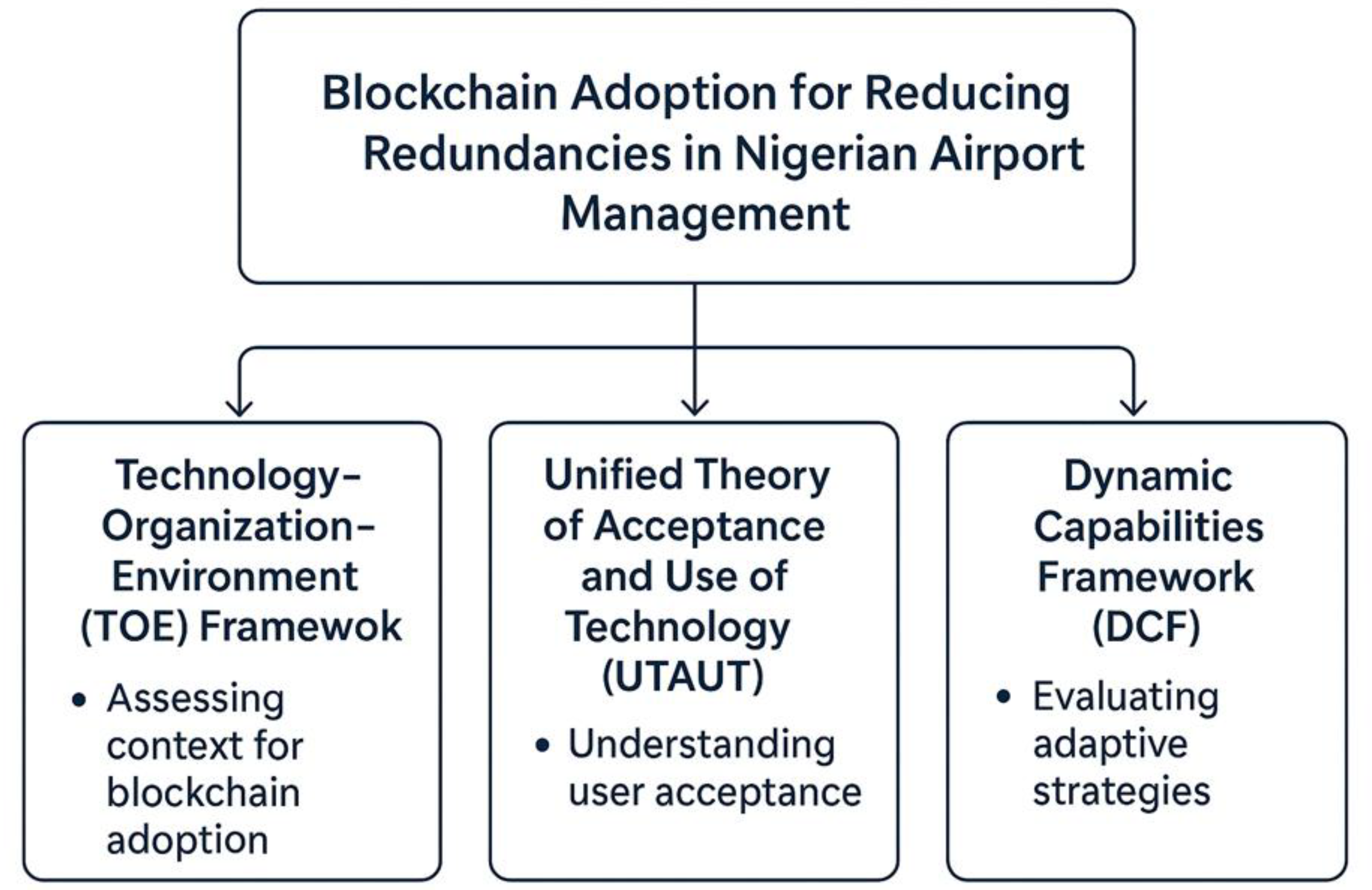
The adoption of these frameworks provides a robust theoretical foundation for researching into blockchain technology adoption in airport management. While TOE handles the contextual features affecting the adoption of technology [18] , UTAUT addresses the issue of the users acceptance and challenges that comes with the implementation [14] and DCF x-rays organizational adaptation and capacity development [19]. Together, these frameworks will the researchers to analyze the technical, organizational, and human factors that stimulate blockchain adoption while looking into the dynamic nature of the aviation industry and its need for constant adaptation to technological changes.
The TOE Framework can be adopted to address the Nigeria’s aviation sector challenges by focusing on the crucial contextual elements, technologically, it looks into the country’s infrastructure challenges and the readiness to adopt digital solutions; organizationally, it focuses on the hierarchical structure of Nigerian airports and the constraints of resources and environmentally, it addresses Nigeria’s specific regulatory landscape and competitive burdens in West African aviation sector. UTAUT is majorly important given Nigeria’s diverse workforce and different levels of technological literacy. It gives us a perspective as to how Nigerian airport staff, from ground handlers to management, might welcome blockchain technology, taking into consideration local cultural nuances and pre-existing technological barriers.
The Dynamic Capabilities Framework is in alignment with the Nigerian aviation sector’s need to compete on a global platform while confronting local challenges. It helps in analyzing how Nigerian airports can develop capabilities to adapt to blockchain despite resource limitations and infrastructural hinderances, particularly in the adaptation to international aviation requirements.
2. Literature Review
2.1. Blockchain Technology in Airport Management: A Literature Review with Focus on Nigerian Aviation Sector
Blockchain technology was first introduced as the framework for Bitcoin in 2008 but since then it evolved far beyond its cryptocurrency framework. At its root, blockchain is simply a distributed ledger technology (DLT) that meticulously maintains a constantly growing list of records, that are called blocks, which are linked or connected and secured using with the aid of cryptography[20] . Each block accommodates or holds transaction data, a timestamp, and additionally a cryptographic hash of the previous block, thereby creating an immutable chain of data or information. Its significant characteristics are immutability, decentralization, transparency, and consensus, these makes it particularly suitable for an environments requiring secure data exchange among multiple stakeholders [21]. In the aviation industry, blockchain technology has been used for passenger identity verification, baggage tracking, maintenance records, and revenue management [22]. These applications underscores its potential to reduce duplication, improve accountability, and enhance efficiency in complex operational settings. In IATA [23] had this to say about blockchain technology and commercial civil aviation.
“Blockchain comes with tangible benefits, however, in order to leverage its benefits, the approach from the outset should be a solution driven discovery, investigation and implementation, while maintaining an open mindset about alternative solutions throughout the entire process.”
The core characteristics or features that make blockchain particularly appealing and relevant to the aviation, as listed by IATA’s 2018 report on blockchain technology adoption for the aviation industry in general, includes;
- I.
- Smart Contracts; Self-executing contracts with terms directly written into code [22]. Aircraft manufacturers, airlines, travel agencies, airports, ground handlers, and other industry suppliers are just a few of the numerous organizations that make up the commercial aviation value chain. These businesses rely on one another for goods and services in order to serve the clients. By utilizing Smart Contracts, Blockchain technology can effectively expedite the procure-to-pay procedure.
- II.
- Tokenization; In addition to making accounting and reconciliation easier, tokenizing assets stops digital assets from being used twice [24] . For example, a passenger’s compensation voucher shouldn’t be used more than once. Until the traveler uses them, compensation vouchers—and especially frequent flyer loyalty points remain listed as a liability on the balance sheet.
- III.
- Provenance; Blockchain can make it easier to track the location and status of valuable assets that frequently change custody, like passenger bags, cargo, spare parts, and even airplanes. This is especially useful if there is a lack of trust between the parties or between the people and organizations involved in the process[25]. Blockchain technology provides an easy-to-use method for tamper-proof and immutable event recording. The ability of blockchain technology to create an immutable record of baggage transfer could ones and for all address the reoccurring challenge of lost luggage in Nigerian airports. Adopting of blockchain-based baggage tracking systems has revealed potentials to cut down on mishandling of passengers’ luggage by up to 47% in pilot studies carried out at major international airports
- IV.
- Certification; Airlines and the larger value chain place a high priority on safety and security, and blockchain technology can help the sector maintain these standards by streamlining the certification process for people, equipment, and other entities [26]. The certification would facilitate the authentication procedure for, Employees of the company, such as pilots, crew, airport employees, security personnel and secondly for Partners along the value chain, such as fuel into-plane service providers, ground handlers, providers of upkeep, repairs, and overhauls. Maintenance, Repair, and Overhaul (MRO)The blockchain technology offers major potentials for enhancing aircraft maintenance records[20], by creating permanent, tamper-proof maintenance histories, guaranteeing compliance with regulatory requirements, ensuring or facilitating parts tracking and authentication and Reducing documentation errors and fraud.
- V.
- Digital Identity; It is increasingly common in the commercial aviation sector and beyond to conduct business online. Companies want to advertise their goods and services, gain access to a wide audience, and manage the risks involved in doing so while being aware of who they are doing business with. Blockchain technology is ideally suited to serve as the foundation for digital identity management systems because to its intrinsically strong security features (such as integrity and immutability)[27]. Research suggests that blockchain-based digital identity systems have the possibility to revolutionize passengers processing in Nigerian airports. In research by [3] they suggested that adopting blockchain-based ID verification could significantly reduce check-in times by about 65% while improving the overall security protocols.
In a work by [28] , they talked about Blockchain-based systems and divided them into two variants based on their level of openness: permissioned blockchain and permissionless blockchain (public blockchain). Permissioned blockchains are further classified as private and consortium blockchains. A. Private Blockchain; is one in which the write permission is controlled completely by an organization or individual, but the read permission is available to the public [29]. The private blockchain system is the most restrictive, with access limited to enterprises, government institutions, and people. It does not fully address the trust issue, but it does increase auditability. B. Public Blockchain. The phrase “public blockchain” refers to a blockchain that anybody on the earth may view, transmit transactions, and successfully validate, as well as participate in the consensus process. The public blockchain represents the apex of decentralization. Consortium Blockchain is a blockchain in which only the consortium members may participate [29]. The consortium rules control read and write permissions on the Blockchain, as well as participation in accounting rights. Each consortium blockchain participant does not have to worry about the location of their data. The data they create is solely available to themselves or authorized personnel. It will address data privacy and security concerns while also decentralizing. It is a combination of public and private blockchains.
The Nigerian aviation sector has continually experienced several problems that blockchain technology can aid in solving, among them are firstly a Complex documentation procedure which is a paper-based systems, Inadequate infrastructure for data sharing among key stakeholders and players within the aviation eco-system, Security concerns in passenger identification and baggage handling, Ineffective maintenance tracking and monitoring systems, Challenges in regulatory adherence and reporting and lastly limited transparency in revenue collection and management.
2.2. Redundancies in Airport Management
Understanding Redundancies as a Concept
The English language presents us with a striking curiosity. Its lexicons establish an instance of redundancy as a “liability” and yet it is precisely the liberal use of redundancy that provides linguistic expression with an extraordinary measure of “reliability. In the context of ordinary language, redundancy is said to exist whenever there is an excess or superfluity of anything [30]. The excess may be of parts, of rules, of words, of anything. Excess, as defined lexically, is something which is more than the normal, the required, the usual, the specified. It is useless, superfluous, needless terms which are variously employed to define redundancy. This linguistic habit directs a negative judgment. It points to features of a situation which are of no value, which are wasteful, which are bad. The force of this habit is immediately to be seen by noting that the synonyms for the adjective “excessive” are: immoderate, intemperate, inordinate, extravagant, exorbitant, and extreme. If we need a time scale here, we can note that excessive has been used to define redundancy for some 400 years [30]. To observe an excess of parts is to observe an unnecessary duplication which, almost automatically, is seen as waste. To confront an excess of rules is, naturally, to make unhappy contact with red tape. And so on. In each case, more than is necessary is apparent, a condition which is sometimes regarded as affluent but more often as profligate
Redundancy in the context of an organization refers to the duplication or overlap of functions or responsibilities, processes or data that results in inefficiency, increased costs and room or potential for errors. Streeter [31] was of the opinion that, The majority of planning and management theories emphasize organizational efficiency. They place a strong emphasis on coordinating, decreasing, or eliminating what they consider to be superfluous redundancy [31]. The goal is to build streamlined organizations with minimal operational units and individuals, while still meeting organizational goals. During the 1980s, limited financing for public and commercial social services led to a focus on removing redundancy to maximize efficiency. Some other scholars see redundancies differently, they argue that the focus on reducing duplication and overlap inside businesses has overshadowed the benefits of redundancy. Scholars like, Richard Scott suggests that duplication adds diversity and reactivity to a system, while also protecting against component failure. Redundancy is considered as additional capacity that gives alternatives in uncertain situations. Such solutions are thought to improve the system’s effectiveness since if one component fails, the entire system fails.
Four broad areas in organizations were redundancies have been identified are, communications, decision making, acquisition of resources, and operations [32] . Communication; Organizations frequently purposefully build redundancy in communication. Redundant communication routes are assumed to prevent communication breakdowns and ensure messages reach their intended recipients. Many companies use an informal communication system to augment the “official” system, creating redundancy. The informal system, often known as the “grapevine,” does not follow the organization’s hierarchical structure. Consequently, it is frequently more inclusive than the formal system. Furthermore, it typically involves not just sending but also analyzing signals. This adds to uncertainty, Nonredundant systems are thought to be more efficient and accurate because to their ability to manage information flow through single channels. Redundancy in decision-making refers to the number of individuals engaged in the process. In nonredundant systems, decisions are often made by a single person or a small group of professionally qualified planners and supervisors [32]. Due to the limited number of participants, resources for gathering information, integrating ideas, and reaching an agreement are significantly decreased. Having comparable training, experiences, and perspectives on the system reduces conflict and promotes consistency in decision-making.
Redundant operations are those that duplicate daily tasks inside an organization. The most prevalent argument against redundancy is that “redundancy produces waste.” This role focuses on identifying and eliminating inefficiencies in everyday operations. Critics believe that having several organizational structures, people, programs, or buildings is unnecessary and inefficient. This argument assumes that individuals and organizations operate predictably and reliably [33]. In the context of resource acquisition, redundancy refers to the number of distinct exchanges via which resources enter the system. Nonredundant systems obtain resources from a single or restricted number of sources. Non-redundant systems function effectively when resource flow is steady. Disrupting the flow of resources through a single exchange connection can have major consequences for the system[34] . Redundancy in acquiring resources frequently complicates the agency’s financial management and necessitates higher attention to resource monitoring.
There are at least three main arguments against redundant organizational and interorganizational systems. One typical complaint aimed toward redundancy is the high expense of maintaining redundant components. While redundant systems may be more dependable, they are less efficient due to the costs associated with maintaining redundancies [31]. However, as redundancy minimizes the need to remedy component failures, the expenses associated with identifying and fixing problems, as well as system downtime, are reduced [32]. Backup redundancy is a feasible option when the cost of carrying an uncorrected failed connection is less than the expenses associated with system breakdown, diagnosis, and repair.
The second critique of redundancy is connected to the first, focusing on the opportunity costs involved with redundant systems. Given a finite budget, allocating resources to redundancy results in fewer resources available for other demands as they occur [35] . Overlap in one area means missed opportunity in other others. While redundancy may improve one aspect of the organizational system, it may reduce the system’s overall performance. Eliminating duplication can improve efficiency and effectiveness by freeing up resources for other objectives. However, if some components of the organization’s operations are more important than others to its overall objective, the allocation of limited resources to preserve redundancy in those areas may offset the missed chances [31] . The third critique of redundancy is that it leads to issues with accountability. Systems with active redundancies are more susceptible to this kind of criticism than systems with standby redundancy. Overlapping authorities make it harder to assign blame when things go wrong [30] . Clearly defining responsibilities and assigning administrative authority reduces ambiguity about who is responsible for problems. Identifying and correcting a “weak link” in redundant systems can be challenging. Redundancy may prevent finger-pointing and scapegoating when issues appear in the system, allowing the business to focus on finding effective solutions.
The question then becomes: How much redundancy is required to provide a reliable outcome? Systems with no redundancy are extremely susceptible to complete system failure in changing and unstable environments.” On the other hand, a completely redundant system would not only be inefficient but also likely chaotic unless it included well-developed procedures for coordination and control. Organizational effectiveness occurs when organizations are able to discover balanced solutions to their difficulties.To apply redundancy theory to organizational systems, further information regarding the appropriate degree of redundancy required to assure system efficiency under varying environmental conditions is required. Redundancy in organizational systems will only be helpful if it balances the advantages of redundancy without wasting the system’s resources.
2.3. Current Redundancies in Airport Management
For the sake of this work, we will be separating redundancies in the Nigerian Airport Management into three aspects, this is to aid us in painting a clearer perspective, we have the Operational Redundancies, Administrative Redundancies and Data Redundancies
Operational Redundancies
This is evident from the multiple check-in processes across different systems, this is also visible in the repeated passenger identity verification at various touchpoints or terminals, duplicated baggage scanning and tracking process, Numerous systems maintaining similar flight information and lastly Overlapping or intersecting documentation for regulatory compliance [36]. One of the most common complaints from passengers going through Nigerian airports is the excessive amount of luggage and body inspections. Passengers pass through a sequence of tables, each staffed by an officer from a different agency. Customs is in charge of detecting illegal items and undeclared currencies; NDLEA is in charge of narcotics control; Immigration is in charge of border security; and Quarantine Services oversees the movement of animals and agricultural products [37] . While each agency performs a vital function, the fragmented approach frequently results in duplicated procedures and redundancies.
The disconnected approach has resulted in not just congestion, but also instances in which people feel bullied. Many travelers are exposed to several screenings for comparable dangers, despite the fact that each agency has specialized equipment for their unique mission. For example, the NDLEA uses a scanner to identify drugs intake, whereas Immigration and Quarantine Services have their own specialized equipment. Despite these new capabilities, agencies continue to use manual inspections, which contributes to long lines and delays at security checkpoints [38]. Furthermore, the exposure of these organizations and their equipment in public places has contributed to a feeling of harassment. This outward show of power makes passengers feel unsafe since they don’t know what function each agency performs in the security procedure
Administrative Redundancies
This is evident from the multiple departments maintaining separate copies of the same records, Repetitive data entry across different systems, Duplicated copies of financial record-keeping, Different versions of maintenance logs and lastly overlapping security clearance processes. In a work by [39], they emphasized that overstaffing is one of the major problems bedeviling the aviation sector in Africa. In a research by Ugochukwu et al [40] they pointed out the overwhelming role of politicians in influencing appointments in airports and other aviation parastatals, which leaves the institution populated with politicians and their likes rather than experts. Managers favour certain applicants and will go to any length to achieve their goals, even if it means harming the firm. They also pointed out the issue of corruption and bureaucratic inconsistencies and a major problem in the sector.
Data Redundancies
Multiple databases storing and maintaining identical passenger information, Separate or independent systems maintaining similar flight data [41]. Duplicate records for storage of aircraft maintenance records Multiple copies of crew manifesto documentation and lastly redundant storage regulatory compliance. The current organization of the aviation sector is out of date and fragmented because most systems operated in isolation with little or no interconnection with other air traffic control systems, making it difficult to transmit data quickly and seamlessly across the interconnected and complex network of industry actors.
2.4. Impact of Redundancies on Airport Operations
- Financial Impact; One usual measure of redundancy is the expense of maintaining redundant elements. While redundant systems may be more dependable, they are less efficient because of the costs of maintenance[42]. Higher operational costs as a result of higher staffing requirements. On the flip side, there will be additional expenses on IT infrastructure, increase in data storage costs and lastly higher maintenance and support costs.
- Operational Impact; Longer processing times for every given task, secondly, increased possibility of errors because of many interferences, reduced efficiency and effectiveness. Customer satisfaction challenges and resource allocation inadequacies [36]. Proponents claim that duplicating organizational structures, people, programs, or facilities are unnecessary and wasteful.
2.5. Blockchain Solutions for Reducing Redundancies
Single Source of Truth
Blockchain technology provides a platform for unified and distributed ledger accessible to only authorized parties, secondly real-time data synchronization across stakeholders ‘outlets. Thirdly elimination of duplicate record-keeping additional consistent view of operational data and lastly reduced need for reconciliation. Blockchain is a database made up of information “blocks” that are “chained” together and are constantly validated and authenticated by independent users of the database [22]. Database users may safely upload encrypted data into time-stamped chunks. Decentralized indicates that data is not stored in a single location, such as a server, but rather is distributed throughout a network of nodes. Internal authentication allows the database to function autonomously, eliminating the requirement for an external authenticator, such as a bank or government.
Smart Contract Automation
Smart contracts can eradicate the process redundancies through, Automatic verification processes, Single-point data entry, automatic compliance checking, streamlined approval workflows and lastly automatic record updates [43]. Many aviation related businesses (e.g., aircraft manufacturers, airlines, travel agencies, airports, ground handlers, and other industry suppliers) rely on one another to provide products and services to clients in the commercial aviation value chain [23]. Blockchain technology, through smart contracts, has the potential to streamline the purchase and payment process. For example, a smart contract may be used to manage payment upon delivery of services by encoding the amount to be paid, the services to be provided, and the terms agreed upon by the parties involved [26]. To reduce conflicts, automated impartial data sources can be used to monitor service delivery and situations. Monitoring, invoicing, reconciling, and the settlement procedure may be removed as a consequence.
Digital Identity Management
Blockchain-based identity management solutions will significantly reduce redundancies in, Passenger verification processes, staff authentication process, access to control systems, security clearance procedures and other documentation requirements [44]. Doing business online is becoming the norm in the commercial aviation industry and beyond. Businesses want to expose their products and services to a large distribution network while also recognizing who they’re doing business with and controlling the risks that come with such relationships [23]. Blockchain technology’s inherent security features, such as authenticity, make it a good choice as the foundation for digital identity management systems in aviation.
Document Management
The of blockchain technology Implementation benefits include, Single version of critical documents with no room for alterations, automated document validation to know authenticity, a reduction in duplicate storage, simplified audit trails and a streamlined compliance reporting[45]. The aviation industry is very complicated, highly dynamic, competitive, and is globally classified as a ‘safety-critical industry’. Data-driven decision-making in the aviation business for airlines and airports are influenced by aspects such as accuracy, data availability, and data consistency [46]. However, data inconsistency in the aviation business can have an impact on airworthiness, safety, and financial performance. Blockchain can provide a unified view of data to represent the true airworthiness score, hence improving safety and information exchange [47] . Aircraft maintenance logbooks are manually kept in the aviation industry as a physical ledger in the airline’s possession. A physical maintenance logbook, on the other hand, can easily get missing or fabricated, decreasing the aircraft’s airworthiness even if it is in excellent flying condition. As a result, a lost maintenance logbook decreases trust in the aircraft’s integrity and dependability, requiring the aircraft owner to reconstruct maintenance logbooks from the beginning, which is both time-consuming and resource-intensive [48]. To solve these problems, Blockchain technology combined with a decentralized storage service can permanently save aircraft service data on the Blockchain ledger while also maintaining immutable transaction logs. It shares the same information with all authorized participants in order to promote transparency, dependability, availability, and Federal Aviation Administration (FAA) compliance.
2.6. Implementation Challenges in Nigerian Context
There are a number of challenges that serve as barriers to blockchain technology adoption in Nigerian airports have been identified, for the sake of clarity we will be dividing these hurdles into two, which are the Technical challenges and the Organizational challenges.
- a.
- Technical Challenges
Limited technological infrastructure, the current infrastructure needs to be upgraded to create synergy [41] Secondly, intermittent power supply issue, this is problem not just only in Nigeria but the sub-Saharan region, this is a major challenge, as adoption will require stability in power supply and last integration with existing legacy systems, integrating blockchain technology to the existing legacy system maybe a hurdle but can be crossed.
- b.
- Organizational Challenges
One of the major problems is firstly the resistance to change from stakeholders, this is not just with the in house civil servants but the broader stakeholders, including airline, for instance sharing airlines maintenance record may be a major issue for foreign airlines [49] . Secondly, the need for extensive staff training, this is necessary to aid the adoption of blockchain technology. Thirdly, the very high initial implementation cost, this will be because of the upgrade of facilities and devices to accommodate blockchain technology and lastly, the Nigeria Civil Aviation framework for adoption needs to be robust.
3. Methodology
3.1. Research Design
This study employed a qualitative research design to explore the potential implementation of blockchain technology in Nigerian airport management. The choice of qualitative methodology was informed by the need to gain deep insights into experts’ perspectives and experiences regarding blockchain adoption in the aviation sector [50] . This approach allowed for rich, detailed data collection through semi-structured interviews with industry experts.
3.2. Research Population and Sampling
The study utilized purposive sampling[51] to select 45 participants from key stakeholder organizations in the Nigerian aviation industry[52] .The sample distribution included. Nigeria Civil Aviation Authority (NCAA), Nigerian Airport Authority (NAA) management personnel, Nigeria College of Aviation Technology (NCAT) experts, Airline operations officials and Academic experts from African Aviation and Aerospace University. This diverse sample this was meant to ensure a robust coverage of varying perspectives within the aviation ecosystem.
3.3. Data Collection Method
Semi-structured Interviews
Primary data was gathered through in-depth, semi-structured interviews with the 45 partakers[53]. Each interview lasted approximately 30-60 minutes and was conducted mostly virtually with the aid of Zoom and google meet, and a couple of them personally, which mostly depended on the participant’s availability and location. The interviews were all recorded with the consent of the participants’ and later transcribed for analysis.
3.4. Interview Protocol
The interview questions were designed and asked around the three chosen theoretical frameworks [53]:
-TOE Framework questions narrowed down on technological, organizational, and environmental factors
-UTAUT-based questions focused on the attitudes toward technology adoption
-DCF-related questions examined organizational readiness and capability development
3.5. Data Analysis
The study made use of Leximancer software (version 4.5), a computer-assisted qualitative data analysis software (CAQDAS), to analyze the interview transcripts. Leximancer makes use of text mining and natural language processing techniques to recognize key concepts, themes, and their interrelationships within textual data. Leximancer is a handy tool for exploring the meaning in a passage of text, using algorithms to draw out the main ideas [54]. Several steps were followed to derive the concept map. First, 45 interviews were recorded using a professional-grade digital voice recorder. Each interview or conversation was saved in a cloud storage for security. The audio files were arranged by the category of stakeholders and date. Each file was marked using a standardized naming convention (e.g., NAA_001_DATE). The transcription process started with the first the conversion of the audio interviews to text systematically. Initial transcription, verbatim transcription of all interactions, Timestamping of major discussion points. Recognition and notation of verbal and non-verbal cues and pauses. Documentation of technical terms and acronyms, and finally the identification of unclear or inaudible segments.
Next, we generated concept seeds at step two and they reflected the beginning of the concept definition. Here, some words make up keywords that differentiate one concept from another. The next phase is thesaurus derivation which relates to each seed [55]. Using Leximancer analysis, it is possible to examine the relationships between words, concepts and themes in order to generate a concept map. In the map, these concepts are shown as small grey nodes and their relational and semantic combinations are grouped into themes and identified with circles in the chart.
Figure 2.
Concept Map.
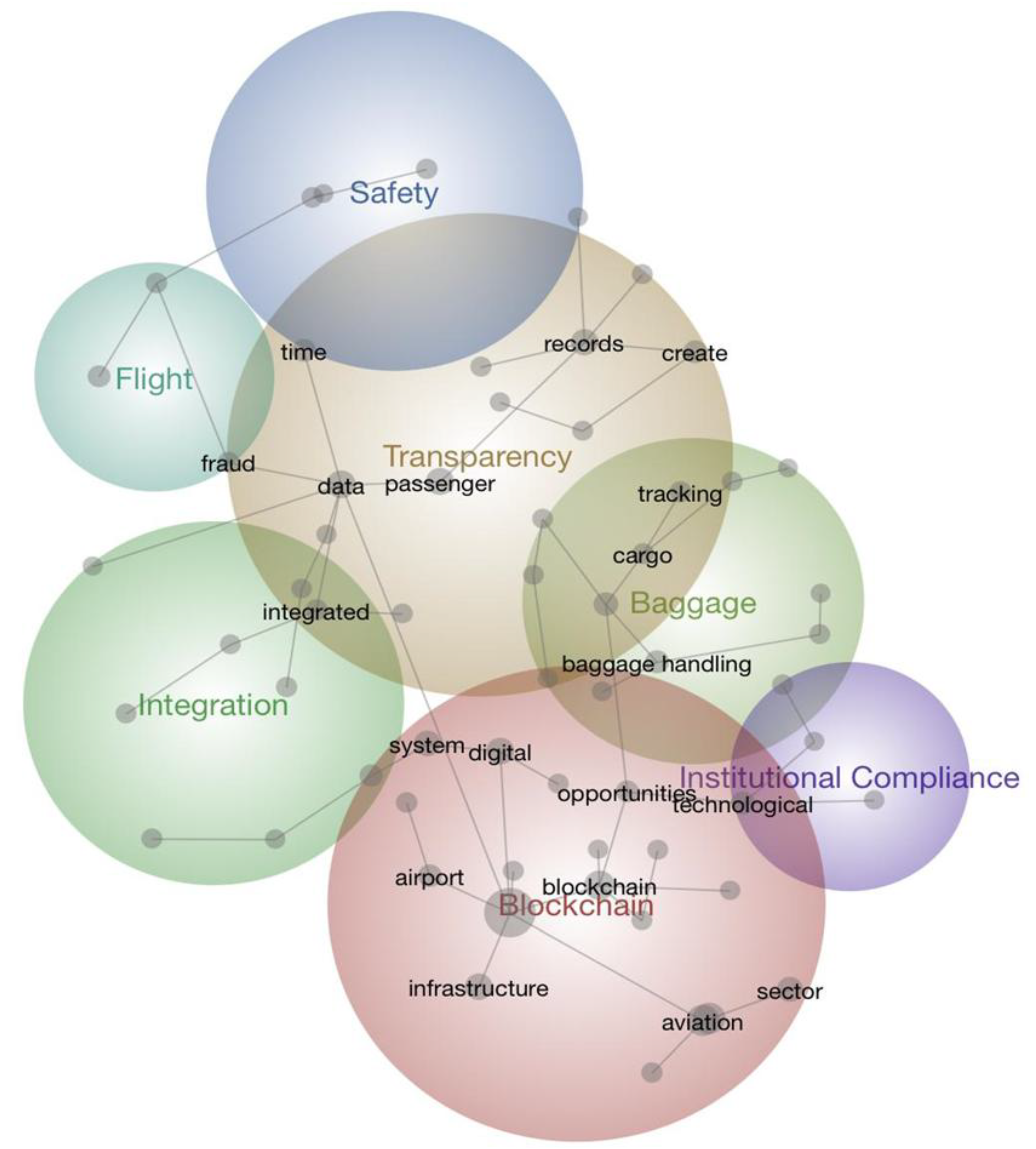

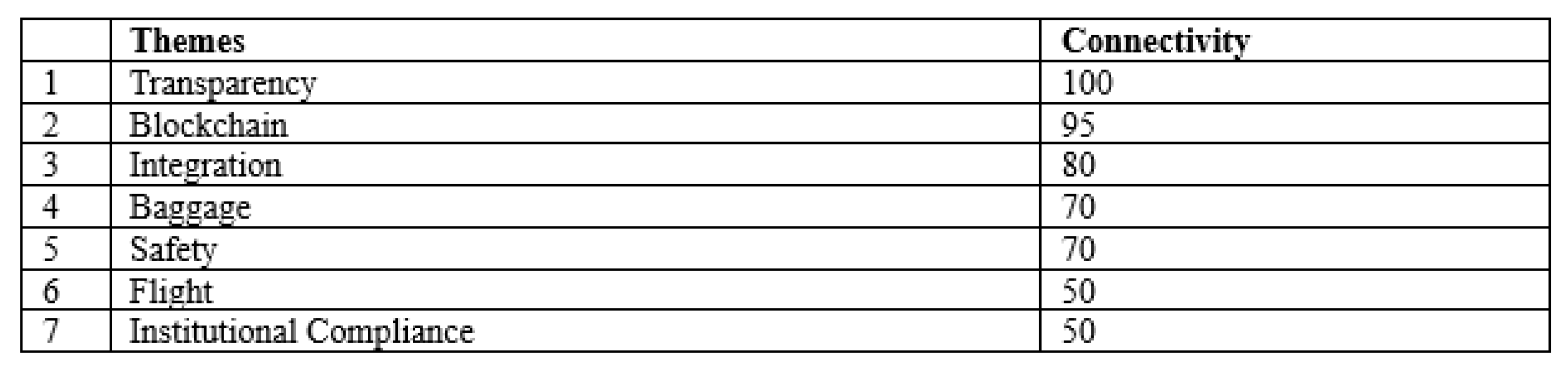
Table 1.
Themes Connectivity.
 |
4. Findings
4.1. Blockchain Theme (Large Beige Circle)
Blockchain appears to be a centralized theme reflecting blockchain as a major technology. The connection to “institutional compliance,” “baggage,” “integration” and “transparency” implies that blockchain is mainly being considered and contemplated as a major technological shift, so the compliance to laid down rules and regulations of presiding institutions is considered and also the global community under the watch of IATA. The connection between “Blockchain” and “Integration” implies that the ability of Blockchain technology to be merged with other legacy technologies should also be looked at. Baggage, is a major part of operations and blockchain technology can be of help in that regard. “Transparency” is a central theme, and it is linked to Blockchain, implying a relationship between the two. Within the Blockchain circle we have “airport” “opportunity” “infrastructure” “systems” “digital” “aviation” “sector” implying blockchains relationships with all these
4.2. Baggage and Operations Theme (Green Cluster)
The large green cluster reflects a strong operational focus around baggage handling. The existence of “tracking” and “cargo” implies a comprehensive logistics management system. “Use” and “operations” implies practical implementation part. The linkage or connection to the blockchain cluster means an integration of blockchain to enhance baggage tracking systems. The overlap with the flight cluster indicates a well coordinated baggage-flight operations.
4.3. Flight (Light Blue/Turquoise)
A noticeable intersect between flight operations and fraud prevention. The strategic positioning near “Transparency” “safety” implies adopting blockchain for fraud prevention in flight operations. As one of the interviewees said, that;
“blockchain technology can help with the airlines loyalty program help prevent double taxation.”
The cluster’s size implies that it is significant but not major concern. The connection to baggage handling suggests a holistic approach to security.
4.4. Safety Themes (Purple/Blue Circles)
The safety theme are two definite and related clusters with key emphasis on securing life and property, through prevention. The digital cluster is closely connected, advocating technologically driven solution to prevailing security breaches in the airport. The positioning of safety intersecting transparency and very close to flight is indicative of the fact that, transparency improves security, data transparency, transparent maintenance report of planes, transparent data sharing among security agencies. One of the interviewees has this to say about the two;
“Safety and security are two sides of the same coin. Safety is concerned with preventing inadvertent harm from physical risks like accidents or natural catastrophes, whereas security is concerned with protecting against purposeful damage caused by outside forces like theft or cyberattacks.”
4.5. Integration
Clear focus on integrating new technologies into existing operations, This concept map effectively visualizes a comprehensive modernization effort in Nigerian aviation, with blockchain as a key enabling technology, particularly focusing on security, operational efficiency, and infrastructure development. The interconnections suggest a well-thought-out approach to implementing these improvements across multiple aspects of aviation operations.
4.6. Institutional Compliance
This stresses the importance of the blockchain technology adhering to laid down guidelines of the aviation industry both in Nigeria and globally to ensure aviation best practices are upheld in high regards. Blockchain technology must be in coherence with the policy framework of the Federal Aviation Authority of Nigeria (FAAN) or easily adaptable. One of the interviewee, was of the opinion that due to corrupt practices this technology may be fought against at the early stage but after awhile, it will gain traction, in his very words;
“ Corruption prevails in this industry for years and years, it’s now endemic, the failed Nigerian airline is the hight of it. This technology will revolutionize the entire industry but it will be fought against, but you cannot fight change for too long”
From his point of view, he perceived institutional compliance from the point of view of prevailing corrupt practice fighting change. There have been instances were civil servant with the Ministry of Aviation and FAAN sabotaged efforts of technological innovation which was intended to make the operational capabilities of the airports.
4.7. Central Role of Transparency
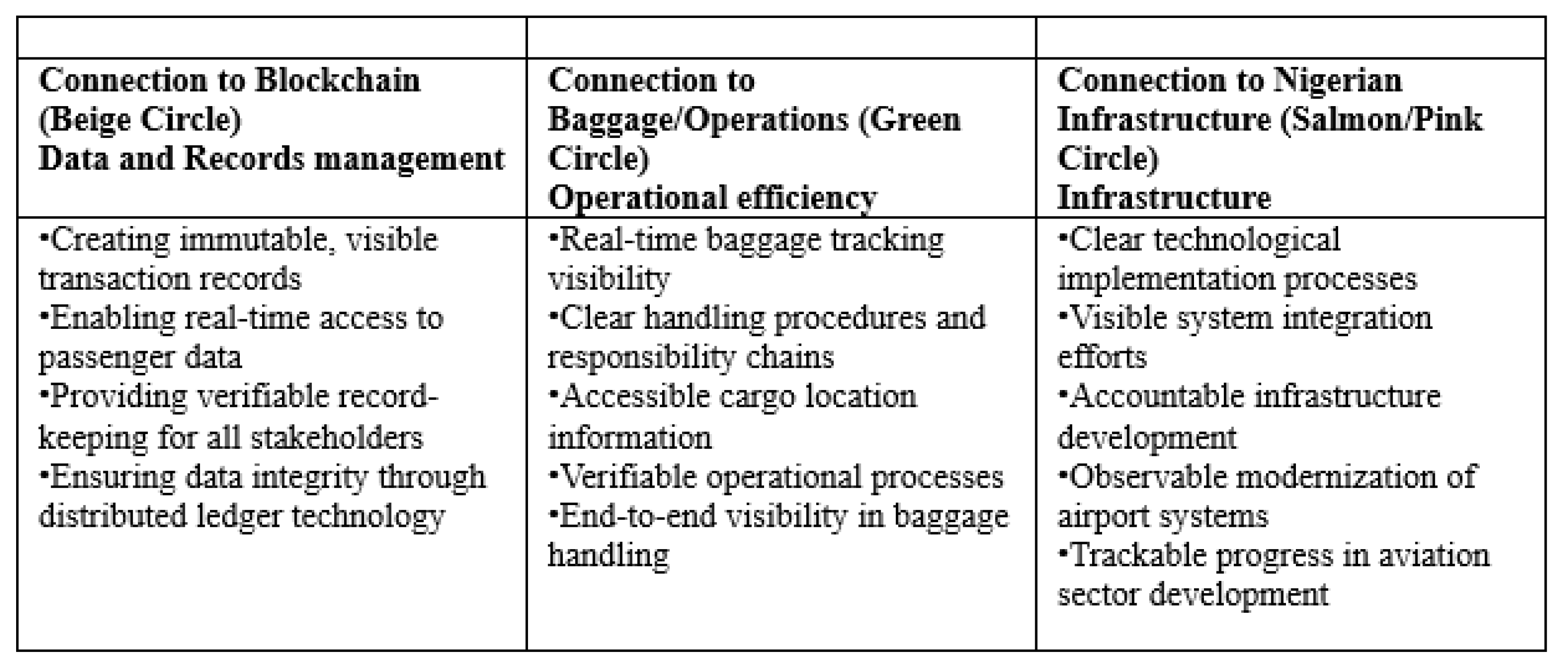
The word “transparency” is visible in the technology/operations area, strategically placed to connect multiple interrelated and related themes. Its location hints that it is a key benefit or objective of the blockchain adoption and implementation. The table below explains further;
Table 2.
Central Role of Transparency.
 |
The Strategic Importance
Transparency can bridge between technological solutions and operational adoption or implementation. It can also serve as a major performance indicator for infrastructure development, in addition it can serve as a bridge among stakeholder trust across all three major areas operations, data managements and Nigerian aviation infrastructure and lastly, it aids or facilitates compliance with international aviation regulations and standards.
4.2. Reducing Operational Redundancies in Nigerian Airport Management Through Blockchain Technology
Primary Thematic Analysis
Central Integration Theme: The distinction of “Integration” as a major cluster, connected to “system,” “data,” and “integrated,” implies that participants strongly stressed the relevance of unified systems. This is directly in line with blockchain’s ability to create interoperable platforms that could eradicate redundant data entry and disjointed processes across airport operations.
Transparency-Safety Nexus: The overlapping of “Transparency” and “Safety” clusters implies that participants view these as interrelated concerns. This is predominantly significant for blockchain implementation, as distributed ledger technology inherently provides transparent, immutable records that could augment both operational visibility and safety protocols simultaneously.
Operational Redundancy Insights
Baggage-Cargo Intersection: The aligning of “Baggage” near “cargo,” “tracking,” and “baggage handling” infers the current operational overlaps identified by participants. This clustering likely mirrors redundant tracking systems, duplicate security checks, or parallel processing workflows that blockchain could streamline through unified tracking protocols.
Flight/safety/Time Relationships: The interconnectedness between “Flight,” “Safety,” and temporal concepts (“time”) indicates that safety redundancies may be instigating time inefficiencies. Participants discussed how multiple safety verification procedures, while is deemed necessary by global standards, creates operational bottlenecks that smart contracts could optimize.
Blockchain Implementation Implications
Institutional Compliance Cluster: The evident “Institutional Compliance” cluster, connected to “technological” and “opportunities,” implies that participants acknowledge regulatory challenges but also see technological potential. This indicates awareness of the need for blockchain solutions to align with Nigerian Civil Aviation Authority requirements and also global best practices.
Infrastructure-Aviation Sector Concerns: The “Blockchain” cluster’s connection to “infrastructure,” “airport,” and “aviation sector” implies that participants have a rich understanding of blockchain’s dependency on robust technological infrastructure and that is a critical consideration for implementation in Nigerian airports.
Research Implications
The map implies that rather than viewing operational redundancies as discrete inefficiencies, the participants view them as systemic integration issues. Since all clusters are interrelated, blockchain solutions must target several operational domains at once rather than just one activity at a time. The prevalence of the phrases “data,” “records,” and “create” across several clusters suggests that data management issues are well understood, and that this is the exact area where blockchain’s immutable ledger capabilities should yield the most operational gains. Instead of using component solutions, this theme structure encourages a comprehensive blockchain deployment plan that concurrently addresses integration, transparency, and compliance.
7. Framework for Adoption of Blockchain Technology
Assessment of Current Redundancies, this is the first step in the entire process, identify redundant processes and data silos this goes hand in hand with the analysis of pain points and inefficiencies. The next step will be the Evaluation of blockchain, this involves assess blockchain capabilities for airport operations, in terms technologically inclined infrastructure, computers, wireless internet and so on, and in this stage a decision has to be made on the type of blockchain, (permission blockchain or permission less blockchain) in this same stage the determination critical use cases for redundancy reduction has to evaluated. The next stage is the Stakeholder Engagement and Alignment, at this level the buy in of stakeholders have to be secured from airport management airline partners and regulatory bodies and the Establish cross-functional working groups.
Figure 3.
Framework for the Adoption of Blockchain.
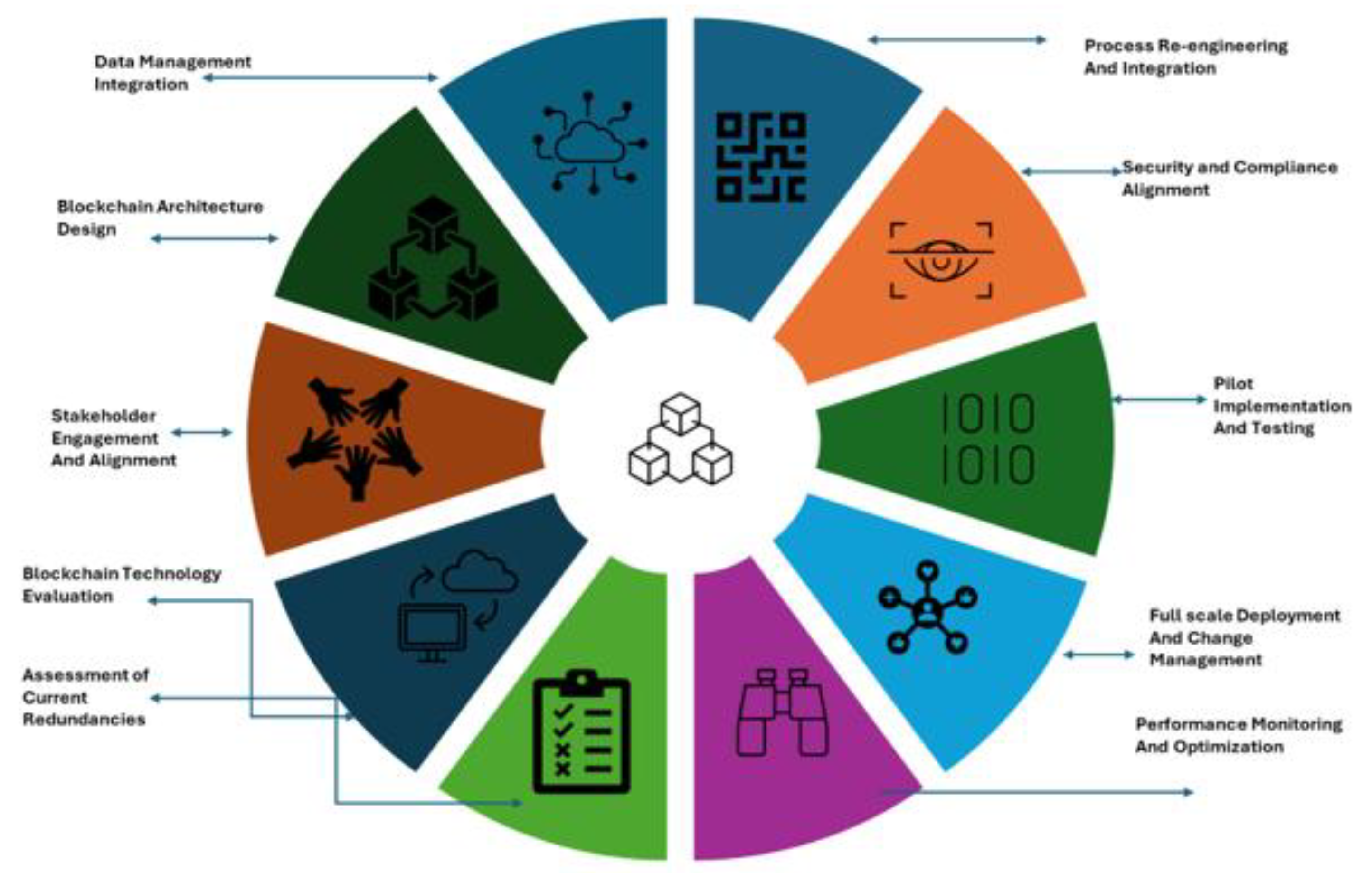
Then we go to the Blockchain Architecture Design phase which will start from the Development of blockchain network structure then proceed to the integration with existing airport IT systems and lastly in the phase, scalability and performance has to be guaranteed. The next stage will be the Data Management Integration, firstly Consolidate data sources and eliminate duplicates, then Establish secure, transparent data sharing and lastly for this stage Enablement real-time data access for all stakeholders. The next stage will be Process Reengineering and Integration, where the operational workflow will be streamlined, then there will be an integration of passenger, baggage, and cargo processes and lastly for this stage there will be an Implementation of automated, blockchain-based triggers.
The next stage will be Security and Compliance, which will have to start from the Alignment to pre-existing aviation safety and security standards to ensure full adherence. Then the Integration of blockchain-based identity management, all security protocols will be enhanced to improve cybersecurity.
Pilot Implementation and Testing stage, this will see the deployment of blockchain solution in a controlled environment, probably in the International Airport in Lagos, which is the Murtala Mohammed International Airport. Performance will be monitored and feedback gathered. There will be systems refinement based on pilot results. Full-Scale Deployment and Change Management, this will be the Rolling out blockchain solution across all airport operations, there will be massive and comprehensive training and support for staff across board. There will have to be a system put in place or policy to ensure a continuous optimization which will enhance the system and improve the systems performance. Lastly Performance Monitoring and Optimization, firstly there has to be an establishment of key performance indicators (KPIs), to track redundancy reduction and efficiency improvements and as earlier stated Continuously refine the blockchain-based system.
8. Discussion
In reconciling the Leximancer concept map and our topic, Blockchain-Enabled Redundancy Reduction in Nigerian Airport Management, we realized that our research touched on several key areas. Thematic Convergence Analysis, taking a closer look at the thematic convergence analysis, we realized that the Leximancer concept map substantiates a multi-dimensional redundancy framework across airport operations in Nigerian, with blockchain strategically positioned as an integrative technological intercession. The thematic clusters brings to light three cardinal redundancy typologies:
- a).
- Informational Redundancies (Data-Records-Integration Nexus)
The convergence of “data,” “records,” and “integrated” within overlapping clusters validates the prevalence of duplicative data management practices. Multiple departmental silos maintain parallel datasets for identical transactions, creating avenues for computational overhead and error propagation risks. Blockchain’s distributed ledger architecture perfectly addresses this issue through single-source-of-truth protocols, doing away with redundant data entry while sustaining cryptographic verification across stakeholder nodes.
- b).
- Procedural Redundancies (Flight-Safety-Passenger-Baggage Intersections)
The spatial proximity of “Flight,” “Safety,” “passenger,” and “Baggage” clusters indicates repetitive verification workflows all through the passenger journey. The current systems in use require multiple authentication touchpoints security screening, check-in, boarding, security, immigration, boarding[56] . Each stage requiring independent credential verification. In the same vein, baggage tracking employs parallel systems across airline and airport operators. Blockchain-enabled smart contracts can automate verification cascades, reducing process duplication while ensuring the maintenance of audit trail integrity[57]
- c).
- Structural Redundancies (Integration-System-Infrastructure Linkages)
The prominence of “Integration” and “system” concepts, interconnected with “Blockchain” and “infrastructure,” is indicative of fragmented operational architectures demanding duplicate resources across all functional domains. This suggests legacy systems operating in isolation, imposing redundant security protocols, observing mechanisms, and compliance checks across the entire airport zones.
Critical Implementation Dimensions
Institutional-Technological Interface: The distinct "Institutional Compliance" cluster's connection to
"technological opportunities" brings a new revelatory insight into a regulatory innovation tension.
Participants in the interview acknowledge blockchain's disruptive potential while recognizing the
necessity for Nigerian Civil Aviation Authority alignment. This is suggestive of the fact that
implementation must navigate between technological optimization and regulatory conformity.
Transparency as Operational Linchpin: The centrality of Transparency and interconnection with
Safety, Baggage, and Blockchain clusters positions it as the mediating mechanism through which
redundancy reduction takes place or occurs. Blockchain's immutable audit trails ability provides
stakeholders visibility that eradicates duplicative reporting requirements while augmenting
accountability across operational touchpoints.
Synthesized Findings
The concept map validates that operational redundancies in Nigerian airport management
manifest as systemic integration failures and not as isolated inefficiencies. Blockchain technology
appears as a horizontal integration platform with the ability to address;
- I.
- Administrative redundancy through unified record management (Data-Integration cluster)
- II.
- Process redundancy via automated verification protocols (Passenger-Safety-Baggage intersection)
- III.
- Verification redundancy via a transparent, distributed consensus mechanisms (Transparency-Safety nexus)
Implementation Imperatives
The BCT can be successfully deployed if some critical issues are addressed at the onset,
successful deployment will require addressing the infrastructure-readiness, the gap evident in the
Blockchain-Infrastructure-Airport cluster positioning. The thematic structure supports a work by
[25], which is indicative of the fact that blockchain adoption cannot advance as a standalone
technological insertion but will demand a supportive ecosystem transformation that goes beyond
infrastructure modernization, stakeholder capacity development, and governance framework
establishment are all necessary for the BCT to strive.
Academic Contribution: This analysis sheds light on the potentials of BCT redundancyreduction
capacity in Nigerian aviation operates through structural and holistic disintermediation
replacing multiple redundant verification nodes with distributed consensus protocols and not just a
mere process automation. The concept map confirms blockchain as an institutional technology that
restructures operational relationships and entire workflow, not simply a technical upgrade to existing
workflows.
9. Conclusions
The assessment reveals that blockchain technology provides a significant opportunity for the drastic reduction of redundancies in Nigerian airport holistic management framework. The interconnected themes derived in the concept map showcases how blockchain can effectively serve as a platform for unifying many technologies, incorporating and integrating various airport operations and concurrently eliminating duplicate processes and redundant systems. The prominence on transparency and integrated management suggests that blockchain technology adoption could fundamentally change airport operations, resulting in a robust and effective, secure and streamlined processes.
Blockchain technology will presents major avenues for rebranding the entire airport management in Nigeria. While hurdles exist, specifically in infrastructure and implementation, the prospective benefits in terms of efficiency, security, and transparency make it a convincing solution for the future of aviation management in the country.
10. Theoretical Implications
The research extends the Technology-Organization-Environment (TOE) framework by showcasing its applicability in highly complex, multi-stakeholder environments. In infrastructure-heavy industries, environmental factors become particularly critical due to regulatory pressures and international compliance requirements,[58]. This study reveals that traditional UTAUT constructs needs modification when dealing with compulsory adoption scenarios necessitated by operational necessities instead of voluntary choice. In addition to this, the Dynamic Capabilities Framework application reveals that reconfiguring capabilities will become paramount in blockchain implementation, as organizations must profoundly restructure their data management processes. By providing empirical support for differentiating between useful and detrimental redundancy, this work also contributes to the development of redundancy theory. The study suggests a new typology: data redundancy (information storage duplications causing inconsistencies), administrative redundancy (record-keeping duplications raising expenses without boosting security), and operational redundancy (process duplications that can be eliminated without affecting safety). This categorization proposes context-dependent evaluations that connect systems theory with redundancy theory, going beyond binary conceptualizations.
By analyzing consensus processes in multi-organizational settings, the paper advances the field of blockchain governance theory. Theoretically, consortium blockchain models are better suitable for infrastructure management than either private or public methods, according to the findings. By establishing “technological trust” as a separate concept and showing how blockchain functions as a “trust machine” where several parties collaborate without direct trust relationships, the study expands on the idea of trust intermediation. By demonstrating how infrastructural limitations influence adoption trends in nations with limited resources, the study advances the theory of digital transformation in line with a work by [59]. Infrastructure-heavy industries undergo digital transformation in different ways than service-based industries, necessitating longer durations and significant upfront investments. The multi-stakeholder nature contributes to an understanding of “ecosystem-level” digital transformation by exposing that adoption success depends on concurrent buy-in across various organizational kinds.
References
- Cheung, T.; Li, B.; Lei, Z. Chapter 11: A Paradigm Shift in the Aviation Industry with Digital Twin, Blockchain, and AI Technologies. In Handbook on Artificial Intelligence and Transport; Edward Elgar Publishing: Cheltenham, UK, 2023; pp. 323–346 ISBN 9781803929545.
- Mazhar, S.; Wu, P.P.-Y.; Rosemann, M. Designing Complex Socio-Technical Process Systems – the Airport Example. Business Process Management Journal 2019, 25, 1101–1125. [CrossRef]
- Ahmad, R.W.; Salah, K.; Jayaraman, R.; Hasan, H.R.; Yaqoob, I.; Omar, M. The Role of Blockchain Technology in Aviation Industry. IEEE Aerospace and Electronic Systems Magazine 2021, 36, 4–15. [CrossRef]
- Patunola-Ajayi, B.J. PROBLEMS ASSOCIATED WITH THE MANAGEMENT OF AIRPORT FACILITIES: THE CASE STUDY OF MURITALA MUHAMMED AIRPORT, LAGOS, NIGERIA; 2019; Vol. 1;.
- Sahoo, R.; Bhowmick, B.; Tiwari, M.K. Smart Integration of Blockchain in Air Cargo Handling for Profit Maximization. In; 2021; pp. 107–114.
- Jiang, Y.; Tran, T.H.; Williams, L. Journal of Airline Operations and Aviation Management The Netherlands Press Article Journal of Airline Operations and Aviation Management Volume 2 Issue 2 Journal of Airline Operations and Aviation Management. 2023, 2. [CrossRef]
- Haq, I.U.; Nandal, V.; Uppal, H. Blockchain Applications in Aviation Securing Transactions, Streamlining Operations, and Improving Passenger Experience. In; 2025; pp. 131–154.
- Bierrings, M.J.; Sivakumar, G.; Wunderlich, N. Blockchain in the Aviation Industry: A Decentralized Solution to the Transparency Issue in Baggage Handling. In Business Digital Transformation; Springer International Publishing: Cham, 2024; pp. 45–72.
- Ashiru, A.; Ariff, O.K. Rural Air Mobility in Developing Countries: Opportunities, Challenges, and Requirements in the Use of Blockchain to Enhance Growth. In Proceedings of the AIAA AVIATION FORUM AND ASCEND 2024; American Institute of Aeronautics and Astronautics: Reston, Virginia, July 29 2024.
- Ojonemi Paul, S.; Ofuebe, C.; Ojonemi PAUL salisupaul, S. AVIATION ROADMAP AND DEVELOPMENT OF AIRPORTS IN NIGERIA. Journal of Good Governance and Sustainable Development in Africa (JGGSDA) 2019, 5. [CrossRef]
- 1990; 11. Louis Tornatzky; M Fleischer The Processes of Technological Innovation; Lexington, MA, 1990;
- Oliveira, T.; Martins, M.F. Information Technology Adoption Models at Firm Level: Review of Literature; 2010;
- Venkatesh; Morris; Davis; Davis User Acceptance of Information Technology: Toward a Unified View. MIS Quarterly 2003, 27, 425. [CrossRef]
- Williams, M.D.; Rana, N.P.; Dwivedi, Y.K. The Unified Theory of Acceptance and Use of Technology (UTAUT): A Literature Review. Journal of Enterprise Information Management 2015, 28, 443–488. [CrossRef]
- Teece, D.J.; Pisano, G.; Shuen, A. Dynamic Capabilities and Strategic Management. Strategic Management Journal 1997, 18, 509–533. [CrossRef]
- Teece, D.J. Explicating Dynamic Capabilities: The Nature and Microfoundations of (Sustainable) Enterprise Performance. Strategic Management Journal 2007, 28, 1319–1350. [CrossRef]
- Helfat, C.E.; Peteraf, M.A. Managerial Cognitive Capabilities and the Microfoundations of Dynamic Capabilities. Strategic Management Journal 2015, 36, 831–850. [CrossRef]
- Malik, S.; Chadhar, M.; Vatanasakdakul, S.; Chetty, M. Factors Affecting the Organizational Adoption of Blockchain Technology: Extending the Technology–Organization–Environment (TOE) Framework in the Australian Context. Sustainability 2021, 13, 9404. [CrossRef]
- Lin, Y.; Wu, L.-Y. Exploring the Role of Dynamic Capabilities in Firm Performance under the Resource-Based View Framework. J Bus Res 2014, 67, 407–413. [CrossRef]
- Crosby Nachiappan Pradan Pattanayak Sanjeev Verma, M.; Kalyanaraman, V. BlockChain Technology: Beyond Bitcoin; 2016;
- Bhutta, M.N.M.; Khwaja, A.A.; Nadeem, A.; Ahmad, H.F.; Khan, M.K.; Hanif, M.A.; Song, H.; Alshamari, M.; Cao, Y. A Survey on Blockchain Technology: Evolution, Architecture and Security. IEEE Access 2021, 9, 61048–61073. [CrossRef]
- Pilkington, M. Blockchain Technology: Principles and Applications. In Research Handbook on Digital Transformations; Edward Elgar Publishing, 2016.
- Blockchain-in-Aviation-White-Paper.
- Risius, M.; Spohrer, K. A Blockchain Research Framework: What We (Don’t) Know, Where We Go from Here, and How We Will Get There. Business and Information Systems Engineering 2017, 59, 385–409. [CrossRef]
- Wang, Z.; Yu, L.; Zhou, L. Navigating the Blockchain-Driven Transformation in Industry 4.0: Opportunities and Challenges for Economic and Management Innovations. Journal of the Knowledge Economy 2024, 16, 3507–3549. [CrossRef]
- Cuccuru, P. Beyond Bitcoin: An Early Overview on Smart Contracts. International Journal of Law and Information Technology 2017, 25, 179–195. [CrossRef]
- Nikhil Ghadge Analyzing the Role of Blockchain in Identity and Access Management Systems. International Journal of Science and Research Archive 2024, 12, 2249–2256. [CrossRef]
- Falazi, G.; Hahn, M.; Breitenbücher, U.; Leymann, F. Modeling and Execution of Blockchain-Aware Business Processes. In Proceedings of the Software-Intensive Cyber-Physical Systems; Springer, June 1 2019; Vol. 34, pp. 105–116.
- Politou, E.; Casino, F.; Alepis, E.; Patsakis, C. Blockchain Mutability: Challenges and Proposed Solutions. IEEE Trans Emerg Top Comput 2021, 9, 1972–1986. [CrossRef]
- Landau, M. Redundancy, Rationality, and the Problem of Duplication and Overlap. Public Adm Rev 1969, 29, 346. [CrossRef]
- Streeter, C.L. Redundancy in Organizational Systems. Social Service Review 1992, 66, 97–111. [CrossRef]
- Thornhill, A.; Saunders, M.N.K. The Meanings, Consequences and Implications of the Management of Downsizing and Redundancy: A Review. Personnel Review 1998, 27, 271–295. [CrossRef]
- Chewning, L. V.; Lai, C.-H.; Doerfel, M.L. Organizational Resilience and Using Information and Communication Technologies to Rebuild Communication Structures. Manag Commun Q 2013, 27, 237–263. [CrossRef]
- Gibson, D. V.; Mendleson, B.E. Redundancy. Journal of Business Communication 1984, 21, 43–61. [CrossRef]
- Jonathan B. Bendor Parallel Systems: Redundancy in Government; University of California, 1985;
- Adeniran, A.O., & G.K.T. Concessioning a Strategy for Enhancing Nigeria’s Airport Operational Efficiency - Lessons from Developed Countries. International journal of research in industrial engineering 2017, 6, 228–245.
- Patience E. Orukpe; Christian T. Onianwa; Abdullahi Abuh; Adebisi K. Aderanti Reliability Assessment of Power Distribution System in the Nigerian Aviation Industry. The Journal of Engineering, Science and Computing 2020, 2.
- Waribugo Sylva; Chiedu Florence Amah Challenges of Airlines Operations in Sub-Saharan Africa: An Empirical Investigation of the Nigerian Civil Aviation Sector. International Journal of Business and Management Invention 2021, 10.
- Okafor, C.C.; Ezeoyili, M.N. Assessment of Infrastructure Maintenance Practices of Three Airports in Southern Nigeria. Nigerian Journal of Technology 2020, 39, 744–751. [CrossRef]
- Ugochukwu, O.; Fasola, O.O. TMLAI TRANSACTIONS ON MACHINE LEARNING AND ARTIFICIAL INTELLIGENCE A Proposed Control System for Checkmating an Aeronautics Agency Riddled with Fraud. 2018. [CrossRef]
- Momoh, M.O.; Shobowale, K.O.; Abubakar, Z.M.; Yahaya, B.; Ibrahim, Y. Blockchain Adoption in Aviation: Opportunities and Challenges. IJEEC - INTERNATIONAL JOURNAL OF ELECTRICAL ENGINEERING AND COMPUTING 2022, 6. [CrossRef]
- Zolghadri, A. A Redundancy-Based Strategy for Safety Management in a Modern Civil Aircraft. Control Eng Pract 2000, 8, 545–554. [CrossRef]
- Lee, J.; L’heureux, F. A Regulatory Framework for Cryptocurrency. European Business Law Review 2020, 31, 423–446. [CrossRef]
- Woodside, J.M.; Augustine, F.K.; Giberson, W. Blockchain Technology Adoption Status and Strategies. Journal of International Technology and Information Management 2017, 26, 65–93. [CrossRef]
- Korolyuk, T.; Spivak, S.; Seniv, B.; Stetsko, M.; Horodetskyy, M.; Ivanova, A. Advantages of Blockchain for Efficient Electronic Documents Flow in the Enterprise Accounting System. In Proceedings of the 2024 14th International Conference on Advanced Computer Information Technologies (ACIT); IEEE, September 19 2024; pp. 434–438.
- Pinto Lopes, D.; Rita, P.; Treiblmaier, H. The Impact of Blockchain on the Aviation Industry: Findings from a Qualitative Study. Research in Transportation Business & Management 2021, 41, 100669. [CrossRef]
- Li, X.; Lai, P.-L.; Yang, C.-C.; Yuen, K.F. Determinants of Blockchain Adoption in the Aviation Industry: Empirical Evidence from Korea. J Air Transp Manag 2021, 97, 102139. [CrossRef]
- Aktas, E.; Demir, S.; Paksoy, T. The Use of Blockchain in Aviation Safety Reporting Systems: A Framework Proposal. The International Journal of Aerospace Psychology 2022, 32, 283–306. [CrossRef]
- Hammoud, G.A.; Tawfik, H.F.; Elseyoufi, T.S. Challenges Facing Airline’s Social Innovation. Journal of Tourism and Hospitality Management 2017. [CrossRef]
- Tenny, S.; Brannan, J.M.; Brannan, G.D. Qualitative Study; 2022;
- 2015; 51. Neetij Rai; Bikash Thapa A STUDY ON PURPOSIVE SAMPLING METHOD IN RESEARCH; 2015;
- Maxwell, J.A. Designing a Qualitative Study;
- Adams, W.C. Conducting Semi-Structured Interviews. In Handbook of Practical Program Evaluation; Wiley, 2015; pp. 492–505.
- Olorunsola, V.O.; Saydam, M.B.; Lasisi, T.T.; Eluwole, K.K. Customer Experience Management in Capsule Hotels: A Content Analysis of Guest Online Review. Journal of Hospitality and Tourism Insights 2023, 6, 2462–2483. [CrossRef]
- Arasli, H.; Saydam, M.B.; Kilic, H. Cruise Travelers’ Service Perceptions: A Critical Content Analysis. Sustainability 2020, 12, 6702. [CrossRef]
- Azman, M.; Sharma, K. Smart Boarding System with E-Passports for Secure and Independent Interoperability. SN Comput Sci 2022, 3, 52. [CrossRef]
- Yadav, J.K.; Verma, D.C.; Jangirala, S.; Srivastava, S.K.; Aman, M.N. Blockchain for Aviation Industry: Applications and Used Cases. In; 2022; pp. 475–486.
- Sánchez, E.; Calderón, R.; Herrera, F. Artificial Intelligence Adoption in SMEs: Survey Based on TOE–DOI Framework, Primary Methodology and Challenges. Applied Sciences 2025, 15, 6465. [CrossRef]
- Schulz, K.A.; Gstrein, O.J.; Zwitter, A.J. Exploring the Governance and Implementation of Sustainable Development Initiatives through Blockchain Technology. Futures 2020, 122, 102611. [CrossRef]
Disclaimer/Publisher’s Note: The statements, opinions and data contained in all publications are solely those of the individual author(s) and contributor(s) and not of MDPI and/or the editor(s). MDPI and/or the editor(s) disclaim responsibility for any injury to people or property resulting from any ideas, methods, instructions or products referred to in the content. |
© 2025 by the authors. Licensee MDPI, Basel, Switzerland. This article is an open access article distributed under the terms and conditions of the Creative Commons Attribution (CC BY) license (http://creativecommons.org/licenses/by/4.0/).
Copyright: This open access article is published under a Creative Commons CC BY 4.0 license, which permit the free download, distribution, and reuse, provided that the author and preprint are cited in any reuse.


