

Submitted:
16 October 2025
Posted:
17 October 2025
You are already at the latest version
Abstract
The Prime Representing Constant generates prime numbers infinitely in order. The number 2 is the smallest prime number. The smallest prime number that does not divide succeeding prime numbers is 2.
Keywords:
prime representing constant
; riemann zeta function
; critical strip
MSC: Primary 11M99; Secondary 11M38; 11M26
1. Introduction
Leonhard Euler first introduced and studied the function over the reals in the first half of the eighteenth century. In 1737, the connection between the zeta function and prime numbers was discovered by Euler, who proved the identity.
This study is about the Prime Representing Constant. It shows that the probability of is the smallest prime that does not divide n. Shows the relation of the critical strip and the Prime Representing Constant. Shows the composition of the Prime Representing Constant and how it infinitely generates all prime numbers in order. Demonstrate the relation of Riemann Zeta function and the Prime Representing Constant.
2. Method
The sequence 2, 3, 2, 3, 2, 5, 2,.., is a sequence of smallest primes that do not divide n. The probability of is the smallest prime that does not divide n, for some natural number can be written as:
The average of the sequence is therefore given by
which is the definition of Prime Representing Constant [1].
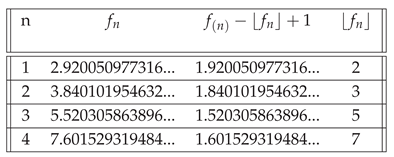 The floor of are all prime numbers
2.1. Riemann Zeta Function
The Euler product formula can be used to calculate the asymptotic probability that s randomly selected integers are set-wise coprime. The asymptotic probability that s numbers are coprime is given by a product over all primes,
Bernhard Riemann’s 1859 article "On the Number of Primes Less Than a Given Magnitude" [2] extended the Euler definition to a complex variable, proved its meromorphic continuation and functional equation, and established a relation between its zeros and the distribution of prime numbers.
If we substitute s = 1 then,
2.2. Euler–Mascheroni Constant
2.3. Analytical Continuation
The equation relates values of the Riemann zeta function at the points s and in particular relating even positive integers with odd negative integers, except for a simple pole at s = 1. The continuation to can be obtained from the formula
Using algebra, if we substitute with x then.
Substituting s with ,
all trivial zeros have interval of -2.
The number 2 is the smallest prime number. The smallest prime number that does not divide succeeding prime number is 2. Starting from 3, all prime numbers are odd numbers. The smallest prime that does not divide odd number is 2.

Table 1.
Sequence of smallest prime that does not divide n.
| n | 1 | 2 | 3 | 4 | 5 | 6 | 7 | 8 | 9 | 10 | 11 | 12 | 13 | 14 | 15 | 16 | 17 | 18 | 19 | 20 | 21 | 22 | 23 | 24 | 25 | 26 | 27 | 28 | 29 | 30 |
|---|---|---|---|---|---|---|---|---|---|---|---|---|---|---|---|---|---|---|---|---|---|---|---|---|---|---|---|---|---|---|
| Prime | 2 | 3 | 2 | 3 | 2 | 5 | 2 | 3 | 2 | 3 | 2 | 5 | 2 | 3 | 2 | 3 | 2 | 5 | 2 | 3 | 2 | 3 | 2 | 5 | 2 | 3 | 2 | 3 | 2 | 7 |
Table 2.
In the Total row, 87/30 is equal to 2.9. It is approximately the Prime Representing Constant.
Table 2.
In the Total row, 87/30 is equal to 2.9. It is approximately the Prime Representing Constant.
| k | Count | Product | Count/Product | |
|---|---|---|---|---|
| 1 | 2 | 15 | 30 | 15/30 |
| 2 | 3 | 10 | 30 | 10/30 |
| 3 | 5 | 4 | 20 | 4/30 |
| 4 | 7 | 1 | 7 | 1/30 |
| Total | 30 | 87 | 30/30 |
In the 1st row, 15/30 is equal to 1/2 and in the total row 30/30 is equal to 1.
if k = 1, then
2.4. Critical Strip and Prime Representing Constant
which tends very quickly to zero.
So
the whole product tends to 0
The
Riemann Zeta function has the Prime Representing Constant in the critical line.
The is - 1.4600254886580673560462814585560097340...The result divided by is equal to the Prime Representing Constant.
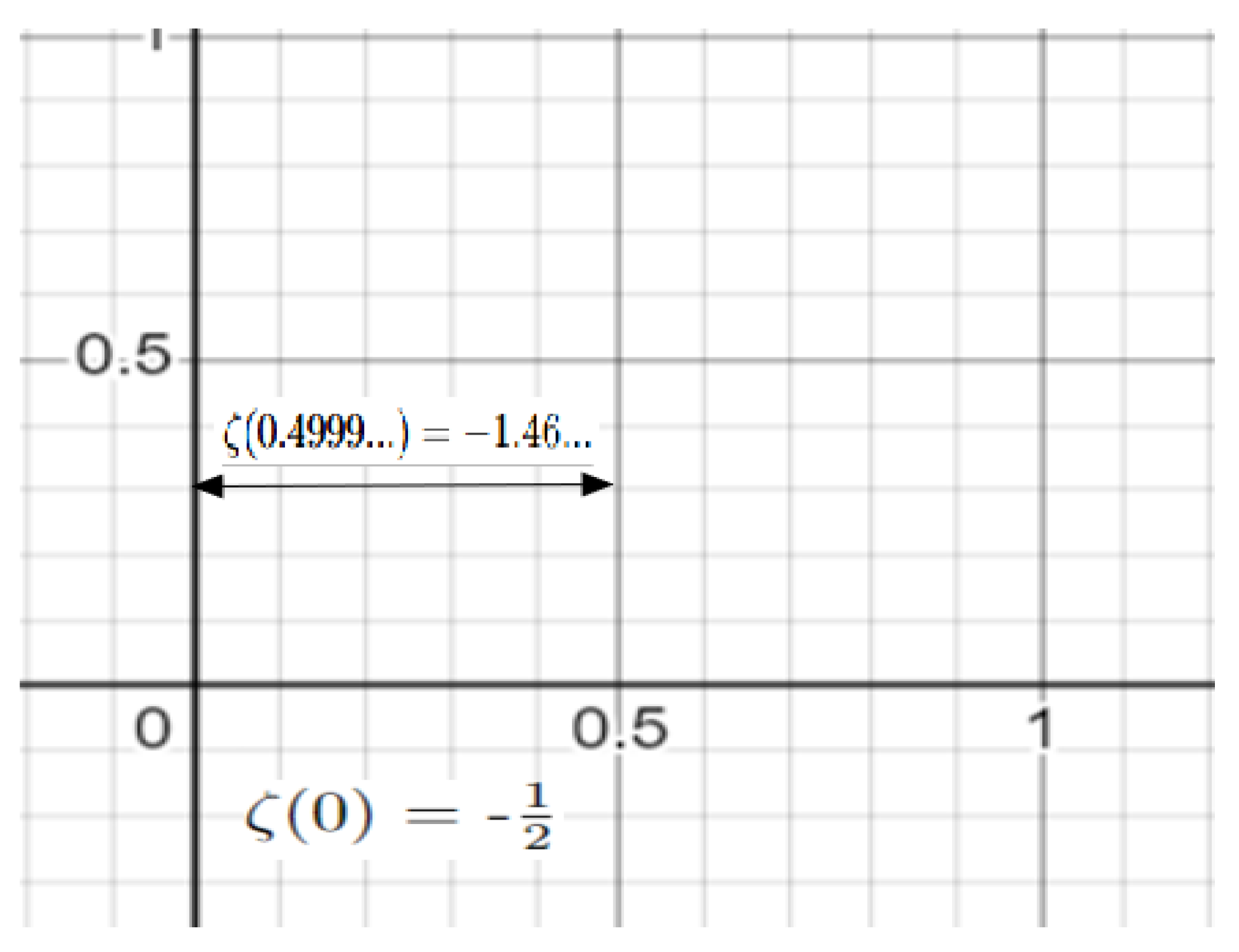
Figure 1.
Nontrivial zeros are aligning in the critical line.
3. Result
4. Discussion
The probability of is the smallest prime that does not divide n, for some natural number can be written as:
The average of the sequence is therefore given by
Prime Representing Constant, the prime generator/operator, infinitely generates prime numbers in order.
This is a telescoping sum equal to 1.
The product of
tends to 0
The average of 0 and 1 is 1/2. The number 2 is the smallest prime number. This study shows that the smallest prime that does not divide up to is 2. The probability of 2 is the smallest prime that does not divide n to be 1/2.
These show the relation of prime numbers in the critical line 1/2 of the Riemann Zeta function.
Acknowledgments
The author is grateful to Angeles Bulanhagui, Lance Rougil Bulanhagui and Heart Bulanhagui.
References
- Dylan Fridman, Juli Garbulsky, Bruno Glecer, James Grime, and Massi Tron Florentin. A prime-representing constant. The American Mathematical Monthly, 126(1):70–73, 2019. [CrossRef]
- Riemann, Bernhard, Ueber die Anzahl der Primzahlen unter einer gegebenen Grösse, 1859.
Disclaimer/Publisher’s Note: The statements, opinions and data contained in all publications are solely those of the individual author(s) and contributor(s) and not of MDPI and/or the editor(s). MDPI and/or the editor(s) disclaim responsibility for any injury to people or property resulting from any ideas, methods, instructions or products referred to in the content. |
© 1996 by the author. Licensee MDPI, Basel, Switzerland. This article is an open access article distributed under the terms and conditions of the Creative Commons Attribution (CC BY) license (https://creativecommons.org/licenses/by/4.0/).
Copyright: This open access article is published under a Creative Commons CC BY 4.0 license, which permit the free download, distribution, and reuse, provided that the author and preprint are cited in any reuse.


