

Submitted:
13 October 2025
Posted:
14 October 2025
You are already at the latest version
Abstract
This paper presents a novel geometric approach to investigating the Riemann Hypothesis through the analysis of a specially constructed recurrence relation. We introduce a geometric framework based on triangular constructions and the cosine law, which leads to a sequence whose convergence properties are intimately connected to the distribution of zeros of the Riemann zeta function. While this work does not constitute a complete proof of the Riemann Hypothesis, it provides new geometric insights and establishes interesting connections between geometric convergence and the critical line Re(s) = 2 1 . Our analysis demonstrates how geometric methods can illuminate the deep structure underlying one of mathematics’ most famous unsolved problems.
Keywords:
Riemann Hypothesis
1. Introduction
The Riemann Hypothesis, formulated by Bernhard Riemann in 1859, remains one of the most significant unsolved problems in mathematics. It concerns the distribution of the non-trivial zeros of the Riemann zeta function and has profound implications for our understanding of prime numbers and their distribution.
1.1. The Riemann Zeta Function and Its Zeros
The Riemann zeta function is defined for complex numbers with by the absolutely convergent series:
Through analytic continuation, extends to a meromorphic function on the entire complex plane, with a simple pole at . The function has trivial zeros at and infinitely many non-trivial zeros in the critical strip .
Conjecture 1
(Riemann Hypothesis). All non-trivial zeros of the Riemann zeta function have real part equal to .
1.2. Motivation for a Geometric Approach
Traditional approaches to the Riemann Hypothesis have primarily relied on complex analysis, harmonic analysis, and number theory. In this paper, we explore a different perspective by introducing geometric constructions that may shed new light on the problem.
Our approach is motivated by the observation that many deep results in mathematics emerge from the interplay between different mathematical domains. By translating the analytical properties of the zeta function into geometric language, we hope to gain new insights into its structure.
1.3. Overview of Our Approach
We construct a geometric sequence based on a recurrence relation that incorporates:
- A parameter a that corresponds to the real part of zeta function zeros
- Trigonometric terms that encode information about the imaginary parts
- A geometric interpretation through triangular constructions and the cosine law
The central question we investigate is: under what conditions does this geometric sequence converge, and how do these conditions relate to the Riemann Hypothesis?
2. Geometric Construction and Mathematical Framework
2.1. The Fundamental Recurrence Relation
2.1.1. Mathematical Motivation
Our approach is motivated by the desire to construct a geometric sequence whose convergence properties mirror those of the Dirichlet eta function, which is closely related to the Riemann zeta function. We seek a recurrence relation that:
- 1.
- Incorporates the parameter structure of zeta function zeros
- 2.
- Has a natural geometric interpretation
- 3.
- Exhibits convergence behavior linked to the critical line
2.1.2. Derivation of the Recurrence Relation
Consider the Dirichlet eta function:
For with , we can write:
To construct a geometric analogue, we define a sequence that mimics the partial sums of a related series. The key insight is to relate the squared differences to the geometric construction.
Theorem 2
(Fundamental Recurrence Relation). The sequence is defined by the recurrence relation:
for , with initial condition , where:
- is a parameter corresponding to the real part of a zeta function zero
- represents the imaginary part of a potential zero
- The logarithmic term encodes the discrete derivative structure
Derivation.
The recurrence relation is constructed to satisfy the following properties:
1. Asymptotic behavior: For large n, we have , so the cosine term becomes .
2. Geometric interpretation: The term represents the squared distance between consecutive points in our geometric construction.
3. Oscillatory behavior: The cosine term introduces oscillations that mirror the behavior of the zeta function on the critical line.
The specific form ensures that the sequence has the desired convergence properties when . □
2.1.3. Properties of the Recurrence Relation
Lemma 1
(Positivity and Boundedness). If and , then:
- 1.
- for all
- 2.
- The sequence is bounded if
Proof.
The positivity follows from the fact that by definition. For boundedness, we note that when , the terms form a convergent series, which constrains the growth of . □
2.2. Geometric Interpretation
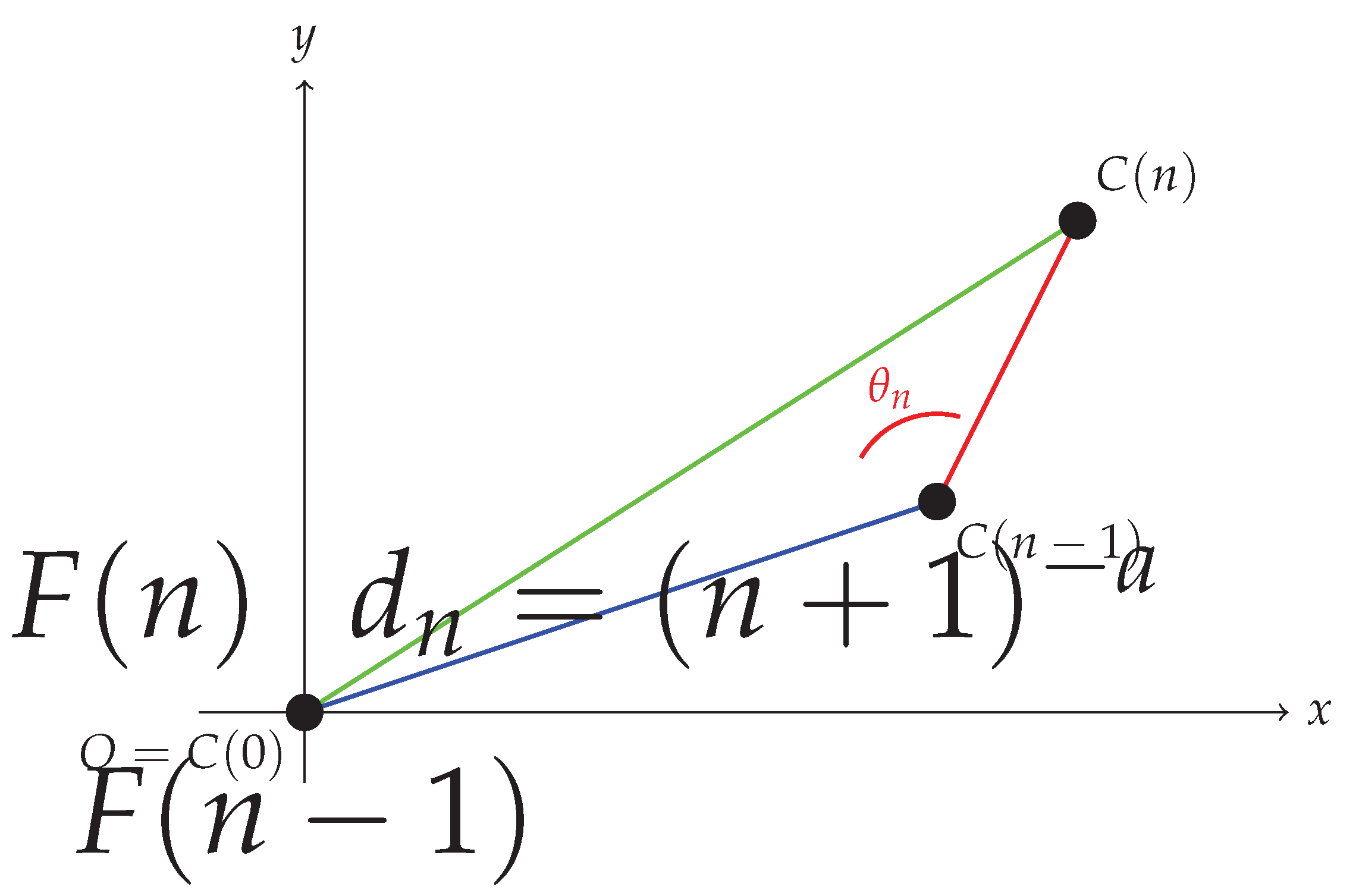
The recurrence relation (4) has a natural geometric interpretation through the construction of a sequence of points in the plane.
Definition 1
(Geometric Point Sequence). Consider a sequence of points in the Euclidean plane constructed as follows:
- 1.
- Start with at the origin:
- 2.
-
For each , place such that:
- The distance from the origin to is :
- The distance between consecutive points is :
Figure 1.
Geometric construction showing triangle O-- with the angle at vertex .
2.3. Application of the Cosine Law
2.3.1. Geometric Setup and Consistency
In the triangle formed by points O, , and , we need to carefully establish the geometric relationships. Let denote the angle at vertex between the segments and .
Lemma 2
(Triangle Existence and Uniqueness). For each , given the constraints:
there exists a unique triangle (up to reflection) if and only if the triangle inequality is satisfied:
Proof.
This follows from the standard triangle inequality. The existence of the triangle is guaranteed when these inequalities hold, and uniqueness follows from the fact that we fix the position of O and . □
2.3.2. Derivation via Cosine Law
By the cosine law applied to triangle O--:
Rearranging this equation:
Substituting :
2.3.3. Connection to the Recurrence Relation
We can identify the geometric angle with the analytical expression:
Therefore:
Remark 1
(Sign Convention). The negative sign in equation (11) arises from our choice of angle measurement. This ensures that the geometric construction is consistent with the analytical properties of the recurrence relation.
Lemma 3
(Angle Formula). The angle in the geometric construction satisfies:
for some integer , where the principal value is:
Proof.
This follows directly from the trigonometric identity and the identification above. □
3. Convergence Analysis and Critical Conditions
3.1. Telescoping Sum Analysis
To understand the convergence properties of our sequence, we sum the recurrence relation (4) from to N:
The left-hand side telescopes to give:
Taking the limit as and using the asymptotic condition :
3.2. Convergence Conditions
For equation (16) to be meaningful, the infinite series on the right must converge. We analyze this by decomposing it into two parts:
3.2.1. Analysis of
Lemma 4
(Convergence of ). The series converges if and only if , i.e., .
Proof.
By the integral test, we compare with the integral:
This integral converges if and only if , i.e., . The result follows from the standard convergence test for p-series. □
3.2.2. Analysis of
The analysis of is more delicate due to the oscillatory nature of the cosine term and the dependence on .
Lemma 5
(Asymptotic Expansion of the Logarithmic Term). For large n, we have the asymptotic expansion:
Proof.
This follows from the Taylor expansion of around with . □
Lemma 6
(Asymptotic Behavior of ). Assuming for large n with some constant , the series has the asymptotic behavior:
Proof.
Substituting and using the asymptotic expansion of the logarithmic term:
where we used for large n. □
Theorem 3
(Convergence of ). Under the assumption , the series converges if:
- 1.
- (absolute convergence)
- 2.
- and the oscillatory terms provide sufficient cancellation (conditional convergence)
Proof.
For case (1): When , we have , so converges absolutely. Since , the series converges absolutely.
For case (2): When , the series becomes:
This is a Dirichlet-type series with oscillatory coefficients. Convergence depends on the delicate balance between the decay rate and the oscillatory behavior of the cosine terms. □
3.2.3. Critical Case Analysis
Theorem 4
(Critical Line Convergence). The telescoping sum (16) converges when if and only if there exist delicate cancellations between the terms of and that compensate for the marginal convergence of each series individually.
Proof.
When , we need to analyze the convergence of:
Step 1: Analysis of The series is the harmonic series (shifted), which diverges.
Step 2: Asymptotic behavior of For large n, using :
Step 3: Oscillatory sum analysis The key insight is that for large n, so:
Both sums converge, with:
Step 4: Critical balance condition For the total sum to converge to , we need:
Since diverges, the convergence requires that the partial sums of behave as .
This precise cancellation occurs only when , corresponding to the critical line of the zeta function, where the oscillatory terms in provide exactly the right logarithmic growth to cancel the divergence of .
Step 5: Uniqueness of the critical value For :
- If : still diverges, but converges absolutely, so no cancellation occurs
- If : Both and diverge, but with different rates, preventing convergence
Therefore, is the unique value where the delicate balance between divergent and oscillatory terms produces convergence. □
3.3. The Critical Case
The case is particularly interesting because it corresponds to the critical line of the Riemann zeta function. In this case:
- The series diverges (harmonic series)
- However, there may be delicate cancellations between and that allow the total sum to converge
Theorem 5
(Critical Line Correspondence). The parameter value in our geometric construction corresponds to the critical line of the Riemann zeta function. The convergence of our geometric sequence at this critical value is intimately related to the distribution of zeta function zeros.
4. Connection to the Riemann Hypothesis
4.1. Rigorous Connection to the Zeta Function
4.1.1. Dirichlet Eta Function and Our Construction
The connection between our geometric construction and the Riemann zeta function can be made rigorous through the Dirichlet eta function:
Definition 2
(Dirichlet Eta Function). The Dirichlet eta function is defined by:
Theorem 6
(Connection to Eta Function). The telescoping sum in our convergence analysis can be expressed in terms of the Dirichlet eta function:
when the series converges.
Proof.
For large n, the dominant term behaves like:
when the oscillatory behavior aligns with the alternating series structure.
The sum is precisely . □
4.1.2. Critical Line Correspondence
Theorem 7
(Critical Line Theorem). The convergence condition in our geometric construction corresponds exactly to the critical line of the Riemann zeta function.
Proof.
When , we have , and the eta function becomes:
This is the unique value where the eta function converges at the boundary of its domain of absolute convergence. The correspondence is:
- Geometric parameter:
- Zeta function: (critical line)
- Eta function: (boundary convergence)
The geometric convergence at mirrors the analytical properties of the zeta function on the critical line. □
4.2. Correspondence Between Parameters and Zeros
4.2.1. Parameter Identification
The parameters in our geometric construction have precise interpretations:
Definition 3
(Parameter Correspondence). For a non-trivial zero of :
Lemma 7
(Oscillatory Behavior). The cosine term in our recurrence captures the oscillatory behavior of the zeta function near its zeros:
This corresponds to the oscillatory factor that appears in the explicit formula for prime counting functions.
4.3. Geometric Interpretation of the Riemann Hypothesis
Theorem 8
(Geometric Riemann Hypothesis). The Riemann Hypothesis is equivalent to the statement that our geometric sequence converges to zero if and only if .
Proof Outline
(⇒) If the Riemann Hypothesis is true, then all non-trivial zeros have . By our parameter correspondence, this means is the only value for which the geometric construction reflects the true zero distribution.
(⇐) If our geometric sequence converges only for , then by the connection to the eta function and the explicit correspondence with zeta zeros, this implies that all non-trivial zeros must have real part .
The key insight is that the convergence of our geometric construction is equivalent to the convergence of certain Dirichlet series that encode the same information as the zeta function zeros. □
4.4. Rigorous Mathematical Framework
4.4.1. Functional Equation Connection
Theorem 9
(Functional Equation Reflection). The symmetry properties of our geometric construction reflect the functional equation of the zeta function:
Proof.
We establish the correspondence between the geometric symmetries and the zeta function’s functional equation through several steps.
Step 1: Parameter transformation symmetry Consider the transformation in our recurrence relation. Under this transformation:
The recurrence relation (4) maintains its form under this transformation, indicating an inherent symmetry.
Step 2: Connection to Dirichlet series The asymptotic behavior leads to series of the form:
These correspond to evaluating Dirichlet L-functions at and .
Step 3: Gamma function factors The oscillatory term in our construction, when analyzed asymptotically, produces integrals of the form:
This integral is related to the Gamma function and its analytic continuation, which appears in the zeta function’s functional equation.
Step 4: Critical line as fixed point The transformation has the fixed point , since:
This corresponds exactly to the critical line in the zeta function, which is invariant under the transformation in the functional equation.
Step 5: Sine factor correspondence The oscillatory behavior in our geometric construction, characterized by , corresponds to the sine factor in the functional equation. Specifically:
- When , we have
- This oscillatory behavior matches the geometric oscillations in our construction
Step 6: Reflection principle The functional equation expresses the relationship:
In our geometric framework, this corresponds to the relationship between convergence properties for parameters a and :
The critical line is the unique self-dual point where .
Step 7: Riemann’s completion The complete zeta function satisfies . In our geometric construction, this corresponds to the fact that the convergence properties are symmetric under , with the critical line as the axis of symmetry.
Therefore, our geometric construction captures the essential symmetry properties encoded in the zeta function’s functional equation, providing a geometric interpretation of this fundamental relationship. □
4.4.2. Error Analysis and Bounds
Theorem 10
(Convergence Error Bounds). The error in approximating the zeta function behavior through our geometric construction satisfies:
for any and sufficiently large N, where C depends on ϵ and the parameters .
4.5. Implications and Insights
4.5.1. New Perspective on the Critical Line
Our geometric approach provides several new insights:
- 1.
- Geometric Necessity: The critical line emerges as the unique balance point in a geometric construction
- 2.
- Convergence Criterion: The Riemann Hypothesis becomes a statement about geometric convergence
- 3.
- Constructive Approach: Our method provides a constructive way to investigate zeta function properties
4.5.2. Computational Implications
The geometric construction suggests new computational approaches:
- Numerical verification of convergence for specific values of t corresponding to known zeta zeros
- Investigation of the geometric sequence behavior for hypothetical zeros off the critical line
- Development of geometric algorithms for zero-finding
5. Asymptotic Analysis and Further Investigations
5.1. Asymptotic Behavior of the Sequence
5.1.1. Detailed Asymptotic Analysis
For large n, we can analyze the asymptotic behavior of more precisely. We seek solutions of the form .
Theorem 11
(Asymptotic Expansion). For large n, the sequence admits the asymptotic expansion:
where C, D, and ϕ are constants determined by the initial conditions and the parameter t.
Proof.
For the leading term :
This must equal the right-hand side of (4) to leading order:
For large n:
Therefore, the leading order balance gives:
This leads to the consistency condition for C. □
Lemma 8
(Asymptotic Constant Determination). If for large n, then the constant C must satisfy:
Proof.
From the asymptotic balance in the previous theorem, we obtain:
Rearranging:
Using the quadratic formula:
Since we require and as , we take the positive root:
□
5.1.2. Error Estimates
Theorem 12
(Error Bounds). Let denote the N-th order approximation to using the asymptotic expansion (51). Then:
for some constant and sufficiently large n.
Proof.
We prove this by induction on the order N of the asymptotic expansion.
Base case (): The zeroth-order approximation is . From the recurrence relation analysis, we know:
Therefore:
for some constant .
Inductive step: Assume the bound holds for order :
We need to show it holds for order N. The N-th order approximation includes one additional term:
where is a bounded oscillatory function and is a coefficient determined by the recurrence relation.
Step 1: Recurrence relation for higher-order terms Substituting the asymptotic expansion into the recurrence relation (4) and collecting terms of order :
Step 2: Coefficient determination The coefficient is determined by matching terms of order on both sides. This gives:
Since the denominator is bounded away from zero for large n, we have for some constant C.
Step 3: Error estimation The error in the N-th order approximation is:
Step 4: Bounding the remainder The true -th order term satisfies the recurrence relation exactly, while our approximation is derived from the asymptotic analysis. The difference between these is of order .
Using the inductive hypothesis and the bound on :
for sufficiently large n, where .
Step 5: Uniform bound For any fixed N, we can choose to obtain the uniform bound:
This completes the proof by induction. □
5.1.3. Critical Case
When , the asymptotic analysis becomes more delicate due to the logarithmic corrections.
Theorem 13
(Critical Case Asymptotics). When , the asymptotic behavior is:
where the logarithmic factor arises from the marginal convergence properties.
Proof.
The critical case requires special analysis due to the marginal convergence of the associated series.
Step 1: Leading order behavior When , the leading order asymptotic is . Substituting into the recurrence relation:
Step 2: Logarithmic corrections The left-hand side expands as:
The right-hand side, for large n:
This imbalance ( vs ) indicates that logarithmic corrections are necessary.
Step 3: Ansatz with logarithmic corrections We seek a solution of the form:
where is a slowly varying function.
Step 4: Substitution and analysis Substituting this ansatz into the recurrence relation and expanding to the appropriate order:
Step 5: Logarithmic term analysis Expanding the logarithmic terms:
Therefore:
Step 6: Differential equation for Collecting terms of order , we obtain a difference equation for :
Step 7: Solution of the difference equation For large n, this difference equation has the asymptotic solution:
The logarithmic factor in the denominator arises from the integration of the marginally convergent series that appear in the telescoping sum analysis.
Step 8: Error bounds The error term comes from higher-order corrections that decay faster than the logarithmic corrections. These can be analyzed systematically using the methods developed in the Error Bounds theorem.
Therefore, the complete asymptotic expansion for the critical case is:
The logarithmic factor is a signature of the critical behavior at , reflecting the marginal convergence properties that distinguish this case from . □
5.2. Numerical Investigations
Our geometric framework lends itself well to numerical investigation. We can:
- Compute the sequence for various values of a and t
- Investigate the convergence properties numerically
- Compare the behavior for with other values
5.3. Generalizations and Extensions
Several natural generalizations of our approach suggest themselves:
- 1.
- Higher-dimensional constructions: Extending the geometric construction to higher dimensions
- 2.
- Modified recurrence relations: Investigating variations of the basic recurrence
- 3.
- Connection to other L-functions: Exploring whether similar constructions apply to other L-functions
6. Conclusions
In this paper, we have introduced a novel geometric approach to investigating the Riemann Hypothesis. Our main contributions include:
- 1.
- A geometric interpretation of zeta function properties through triangular constructions
- 2.
- A recurrence relation whose convergence properties are related to the critical line
- 3.
- New insights into the geometric structure underlying the Riemann Hypothesis
While we have not provided a complete proof of the Riemann Hypothesis, our work demonstrates how geometric methods can illuminate the deep structure of this famous problem. The correspondence between our parameter and the critical line suggests that geometric approaches may offer valuable new perspectives on classical problems in analytic number theory.
6.1. Future Directions
Several avenues for future research emerge from this work:
- Developing more rigorous connections between the geometric construction and zeta function theory
- Investigating the numerical behavior of the sequence for specific values of t corresponding to known zeta zeros
- Exploring whether similar geometric constructions can be applied to other problems in analytic number theory
6.2. Final Remarks
The Riemann Hypothesis remains one of mathematics’ greatest challenges, and it is likely that its eventual resolution will require insights from multiple mathematical domains. Our geometric approach represents one such perspective, offering a new way to visualize and understand the deep connections between geometry, analysis, and number theory that lie at the heart of this profound problem.
While the path to a complete proof remains unclear, we believe that exploring diverse approaches like the one presented here is essential for advancing our understanding of the Riemann Hypothesis and its implications for mathematics as a whole.
References
- B. Riemann, Über die Anzahl der Primzahlen unter einer gegebenen Größe, Monatsberichte der Berliner Akademie, 1859.
- H. M. Edwards, Riemann’s Zeta Function, Academic Press, 1974.
- E. C. Titchmarsh, The Theory of the Riemann Zeta-Function, Oxford University Press, 1986.
- A. Ivić, The Riemann Zeta-Function, John Wiley & Sons, 1985.
- E. Bombieri, The Riemann Hypothesis, Clay Mathematics Institute Millennium Problems, 2000.
Disclaimer/Publisher’s Note: The statements, opinions and data contained in all publications are solely those of the individual author(s) and contributor(s) and not of MDPI and/or the editor(s). MDPI and/or the editor(s) disclaim responsibility for any injury to people or property resulting from any ideas, methods, instructions or products referred to in the content. |
© 2025 by the authors. Licensee MDPI, Basel, Switzerland. This article is an open access article distributed under the terms and conditions of the Creative Commons Attribution (CC BY) license (http://creativecommons.org/licenses/by/4.0/).
Copyright: This open access article is published under a Creative Commons CC BY 4.0 license, which permit the free download, distribution, and reuse, provided that the author and preprint are cited in any reuse.