

Submitted:
10 October 2025
Posted:
11 October 2025
You are already at the latest version
Abstract
The C1858T PTPN22 (R620W) variant has been implicated in the pathogenesis of several autoimmune disorders and represents a promising immunotherapeutic target for Type 1 diabetes. We have been implementing a novel immunotherapeutic approach based on the use of lipoplexes that deliver siRNA duplexes. Efficacy and safety of lipoplexes halting variant expression was demonstrated in the peripheral blood of patients in vitro. According to regulatory authorities in Europe preclinical safety and efficacy must be ascertained in vivo in appropriate animal models before undertaking clinical investigations. In the light of the foregoing the aim of this study was to verify that lipoplexes against the murine Ptpn22-R619W, equivalent to the human PTPN22-R620W, could be used for animal experimentation. The murine fibroblast cell line L929 was transfected with the PF62-pLentiPtpn22-R619W plasmid. We designed siRNA duplexes specific for the Ptpn22-R619W allele and formulated them into cationic lipoplexes in order to halt the variant expression in the transfected L929 cell line. Transfection of fibroblasts expressing R619W using lipoplexes resulted in efficient silencing at 100 pmol siRNA after 48 hours post-transfection reaching higher significant knock‑down after 72 hours. Lipoplexes efficiently suppress the pathogenic Ptpn22 variant expression in vitro, supporting the feasibility of a pre‑clinical platform for in vivo lipoplexes testing in CRISPR‑engineered NOD/ShiLtJ mice carrying the R619W mutation.
Keywords:
1. Introduction
2. Results
2.1. Transfection of the R619W-Ptpn22 Variant in the L929 Mouse Fibroblast Cell Line
2.2. siRNAs Are Delivered in R619W-L929 Cell Line by a Commercial Transfection System and Efficiently Block the Variant Ptpn22 Expression
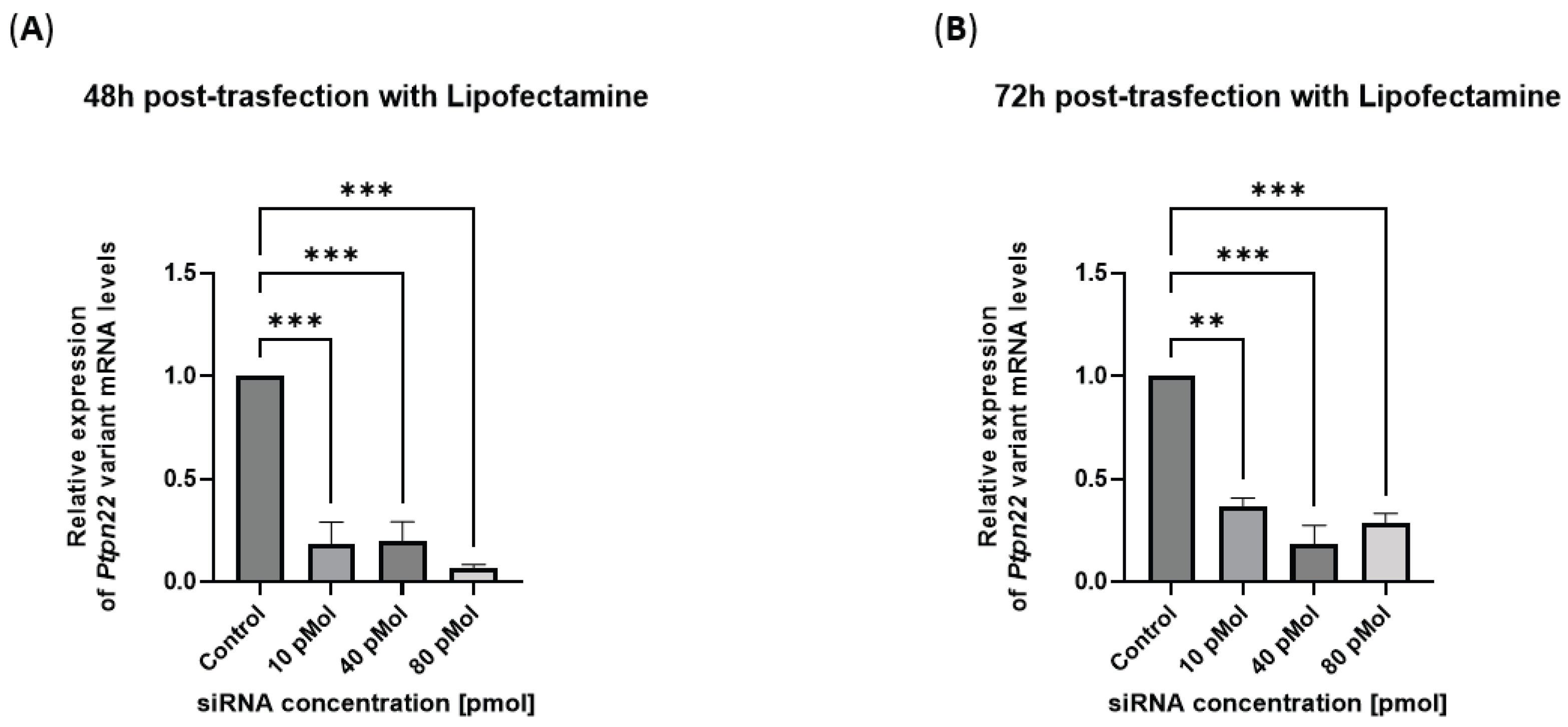
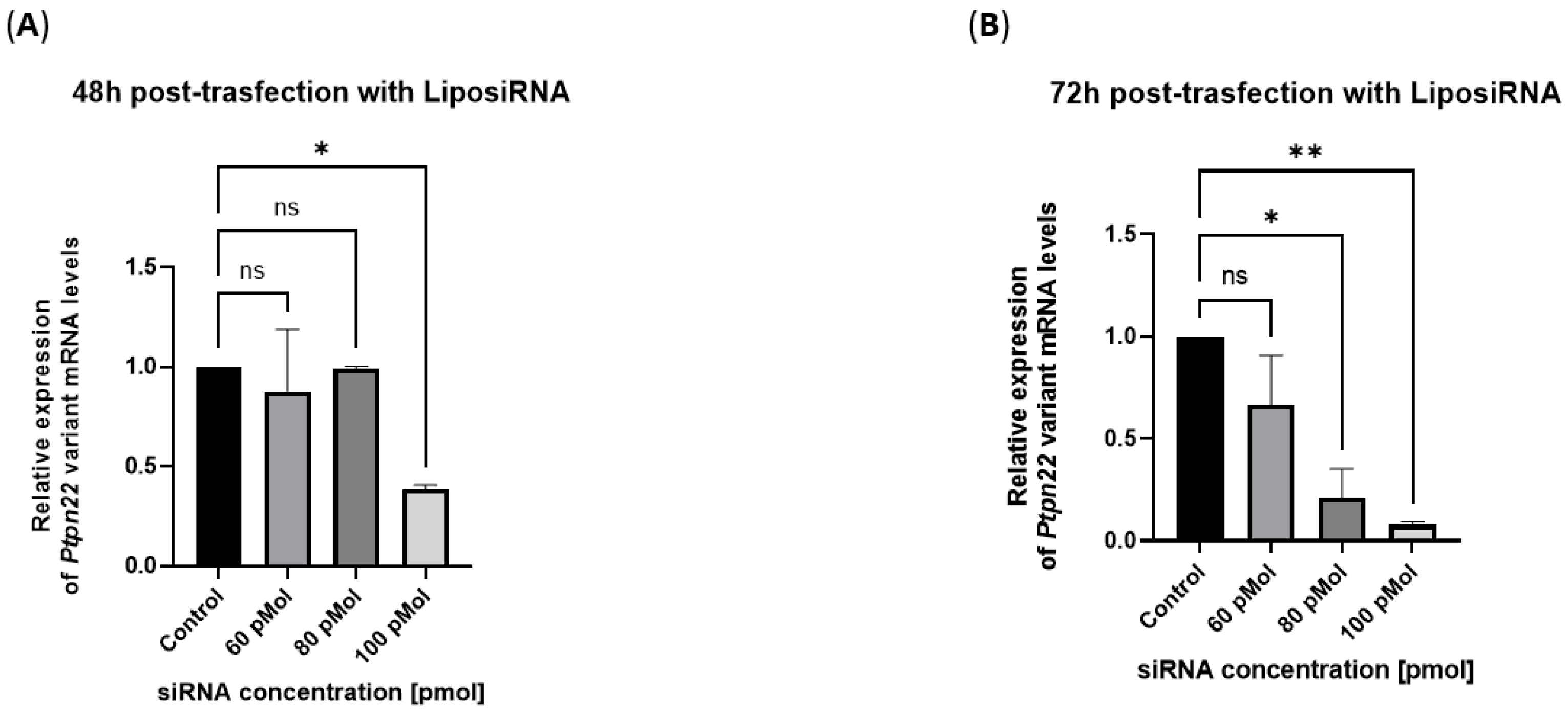
2.3. Efficient Silencing of Variant Ptpn22 in R619W-L929 Cells by siRNA Delivery Using Lipoplexes
3. Discussion
4. Materials and Methods
4.1. siRNA Design
4.2. Liposome/Lipoplexes Preparation
4.3. Generation of R619W Transfected L929 Murine Fibroblast Cell Line
4.4. L929 Cell Culture
4.5. Mutant Ptpn22 Gene Silencing in Transfected L929 Fibroblast Line (R619W-L929)
4.5.1. siRNA Transfection with Commercial Transfection System
4.5.2. Custom Liposome Transfection Protocol for R619W-L929 Cells
4.5.3. qRT-PCR
- R619W forward (R619W-forward): 5’-TCCCCTCCGAATAGTGCTGA-3’
- R619W reverse (R619W-reverse): 5’-CATTCAGGGAGTGGCGG-3’
- GAPDH forward (GAPDH-FW): 5’-ATTCAACGGCACAGTCAAGG-3’
- GAPDH reverse (GAPDH-RV): 5’-ATCATAAACATGGGGGCATC-3’
4.6. Statistical Analysis
5. Conclusions
6. Patents
Author Contributions
Funding
Institutional Review Board Statement
Informed Consent Statement
Data Availability Statement
Acknowledgments
Conflicts of Interest
Abbreviations
| Ptpn22 | Protein tyrosine phosphatase N22 |
| Lyp | Lymphoid phosphatase |
| NOD | Non-Obese Diabetic mice |
| siRNA | Small interfering RNA |
| T1D | Type 1 Diabetes |
| ATD | Autoimmune Thyroid Disease |
| Ct | Cycle Threshold |
| APS3v | Autoimmune Polyglandular Syndrome type 3 variant |
| L-T4 | Levotiroxine |
| Arg | Arginine |
| Trp | Tryptophan |
| SAM | Siglec 10 sialoside mimetic |
| CRISPR- Cas9 | Clustered Regularly Interspaced Short Palindromic Repeats (CRISPR) associated protein 9 (Cas9) |
| RISC | RNA-Induced Silencing Complex |
| s/a | sense/antisense |
| EMA | European Medicinal Agency |
| FDA | Food and Drug Administration |
| DOPE | Phospholipids [1,2-Dioleoyl-sn-glycero-3-phosphoethanolamine |
| DOTAP | N-[1-(2,3-Dioleoyloxy) propyl]-N, N, N-trimethylammonium chloride |
| DSPE-PEG2000-Maleimide | 1,2-distearoyl-sn-glycero-3-phosphoethanolamine-N- [maleimide (polyethylene glycol)-2000] (ammonium salt) |
| Min. | Minutes |
| ATCC | American Type Culture Collection |
| DMEM HG | Dulbecco’s Modified Eagle Medium High Glucose |
References
- Redondo, M.J.; Morgan, N.G. Heterogeneity and endotypes in type 1 diabetes mellitus. Nat Rev Endocrinol 2023, 9, 542–554. [Google Scholar] [CrossRef] [PubMed]
- Dittmar, M.; Kahaly, G.J. Genetics of the autoimmune polyglandular syndrome type 3 variant. Thyroid 2010, 20, 737–743. [Google Scholar] [CrossRef] [PubMed]
- Norris, J.M.; Johnson, R.K.; Stene, L.C. ; Type 1 diabetes-early life origins and changing epidemiology. Lancet Diabetes Endocrinol 2020, 8, 226–238. [Google Scholar] [CrossRef] [PubMed]
- Rapini, N.; Schiaffini, R.; Fierabracci, A. Immunotherapeutic Strategies for the Prevention and Treatment of Distinct Stages of Type 1 Diabetes: An Overview. Int J Mol Sci 2020, 21, 2103. [Google Scholar] [CrossRef] [PubMed]
- Woittiez, N.J.C.; Roep, B.O. Impact of disease heterogeneity on treatment efficacy of immunotherapy in Type 1 diabetes: different shades of gray. Immunotherapy 2015, 7, 163–174. [Google Scholar] [CrossRef] [PubMed]
- Gianchecchi, E.; Palombi, M.; Fierabracci, A. The putative role of the C1858T polymorphism of protein tyrosine phosphatase PTPN22 gene in autoimmunity. Autoimmun Rev 2013, 12, 717–725. [Google Scholar] [CrossRef] [PubMed]
- Vang, T.; Congia, M.; Macis, M.D.; Musumeci, L.; Orrú, V.; Zavattari, P.; Nika, K.; Tautz, L.; Taskén, K.; Cucca, F.; et al. Autoimmune-associated lymphoid tyrosine phosphatase is a gain-of-function variant. Nat Genet 2005, 37, 1317–1319. [Google Scholar] [CrossRef] [PubMed]
- Bottini, N.; Musumeci, L.; Alonso, A.; Rahmouni, S.; Nika, K.; Rostamkhani, M.; MacMurray, J.; Meloni, G.F.; Lucarelli, P.; Pellacchia, M.; et al. A functional variant of lymphoid tyrosine phosphatase is associated with type I diabetes. Nat Genet 2004, 36, 337–338. [Google Scholar] [CrossRef] [PubMed]
- Perri, V.; Pellegrino, M.; Ceccacci, F.; Scipioni, A.; Petrini, S.; Gianchecchi, E.; Lo Russo, A.; De Santis, S.; Mancini, G.; Fierabracci, A. Use of short interfering RNA delivered by cationic liposomes to enable efficient down-regulation of PTPN22 gene in human T lymphocytes. PLoS One 2017, 12, e0175784. [Google Scholar] [CrossRef] [PubMed]
- Pellegrino, M.; Ceccacci, F.; Petrini, S.; Scipioni, A.; De Santis, S.; Cappa, M.; Mancini, G.; Fierabracci, A. Exploiting novel tailored immunotherapies of type 1 diabetes: Short interfering RNA delivered by cationic liposomes enables efficient down-regulation of variant PTPN22 gene in T lymphocytes. Nanomedicine 2019, 18, 371–379. [Google Scholar] [CrossRef] [PubMed]
- Arena, A.; Belcastro, E.; Accardo, A.; Sandomenico, A.; Pagliarosi, O.; Rosa, E.; Petrini, S.; Conti, L.A.; Giorda, E.; Corsetti, T.; et al. Preparation and In Vitro Evaluation of RITUXfab-Decorated Lipoplexes to Improve Delivery of siRNA Targeting C1858T PTPN22 Variant in B Lymphocytes. I J Mol Sci 2021, 23, 408. [Google Scholar] [CrossRef] [PubMed]
- Arena, A.; Belcastro, E.; Ceccacci, F.; Petrini, S.; Conti, L.A.; Pagliarosi, O.; Giorda, E.; Sennato, S.; Schiaffini, R.; Wang, P.; et al. Improvement of Lipoplexes With a Sialic Acid Mimetic to Target the C1858T PTPN22 Variant for Immunotherapy in Endocrine Autoimmunity. Front Immunol 2022, 13, 838331. [Google Scholar] [CrossRef] [PubMed]
- Büll, C.; Heise, T.; Adema, G.J.; Boltje, T.J. Sialic Acid Mimetics to Target the Sialic Acid-Siglec Axis. Trends Biochem Sci 2016, 41, 519–531. [Google Scholar] [CrossRef] [PubMed]
- Rillahan, C.D.; Schwartz, E.; McBride, R.; Fokin, V.V.; Paulson, J.C. Click and pick: Identification of sialoside analogues for siglec-based cell targeting. Angew Chem Int Ed Engl 2012, 51, 11014–11018. [Google Scholar] [CrossRef] [PubMed]
- Cavagnaro, J.; Silva Lima, B. Regulatory acceptance of animal models of disease to support clinical trials of medicines and advanced therapy medicinal products. Eur J Pharmacol 2015, 759, 51–62. [Google Scholar] [CrossRef] [PubMed]
- Bernard, N.F.; Ertug, F.; Margolese, H. High incidence of thyroiditis and anti-thyroid autoantibodies in NOD mice. Diabetes 1992, 41, 40–46. [Google Scholar] [CrossRef] [PubMed]
- Beales, P. E.; Castri, F.; Valiant, A.; Rosignoli, G.; Buckley, L.; Pozzilli, P. Adrenalitis in the non-obese diabetic mouse. Autoimmunity 2002, 35, 329–333. [Google Scholar] [CrossRef] [PubMed]
- Chen, D.; Thayer, T.C.; Wen, L.; Wong, F.S. Mouse Models of Autoimmune Diabetes: The Nonobese Diabetic (NOD) Mouse. Methods Mol Biol 2020, 2128, 87–92. [Google Scholar] [CrossRef] [PubMed]
- Lin, X.; Pelletier, S.; Gingras, S.; Rigaud, S.; Maine, C.J.; Marquardt, K.; Dai, Y.D. , Sauer, K.; Rodriguez, A.R.; Martin, G. et al. CRISPR-Cas9-Mediated Modification of the NOD Mouse Genome With Ptpn22R619W Mutation Increases Autoimmune Diabetes. Diabetes 2016, 65, 2134–2138. [Google Scholar] [CrossRef] [PubMed]

| Sample ID | Ptpn22 Ct | β-Actin Ct | ΔCt | ΔΔCt | Fold Change (2^-ΔΔCt) |
| L929-EV | 36.86 | 16.99 |
-19.60 |
0.00 |
1.00 |
| L929-EV | 36.93 | 17.09 | |||
| L929-EV | 36.98 | 17.35 | |||
| L929-Ptpn22-R619W | 26.43 | 17.10 |
-10.46 |
-10.46 |
1409.15 |
| L929-Ptpn22-R619W | 26.21 | 17.14 | |||
| L929-Ptpn22-R619W | 26.24 | 17.21 |
Disclaimer/Publisher’s Note: The statements, opinions and data contained in all publications are solely those of the individual author(s) and contributor(s) and not of MDPI and/or the editor(s). MDPI and/or the editor(s) disclaim responsibility for any injury to people or property resulting from any ideas, methods, instructions or products referred to in the content. |
© 2025 by the authors. Licensee MDPI, Basel, Switzerland. This article is an open access article distributed under the terms and conditions of the Creative Commons Attribution (CC BY) license (http://creativecommons.org/licenses/by/4.0/).