

Submitted:
02 October 2025
Posted:
11 October 2025
You are already at the latest version
Abstract
A Soft Set is a parameterized family of subsets of a universe, where each parameter selects elements relevant under that condition. A ContraSoft Set is a parameterized soft set in which each parameter’s values are linked with a contradiction degree, and a threshold mechanism is applied to retain only those values that do not exceed a specified level of contradiction with respect to a chosen reference. In this paper, we explore two new concepts, namely the Contra-HyperSoft Set and the Contra-SuperHyperSoft Set, extending the framework of contradiction-aware modeling.
Keywords:
soft set
; contradiction
; ContraSoft set
; Contra-HyperSoft set
; Contra-SuperHyperSoft set
1. Preliminaries
We collect the basic terminology and notation used in what follows. The definitions in this paper are assumed to be finite.
1.1. Soft Set
A Soft Set is a parameterized family of subsets selecting universe elements relevant to each parameter, supporting flexible decision modeling [1,2,3]. The definitions of the Soft Set are provided below.
Definition 1
(Soft Set). [1] Let U be a universal set and E a set of parameters. A soft set over U is defined as an ordered pair , where F is a mapping from E to the power set :
For each parameter , represents the set of e-approximate elements in U, with forming a parameterized family of subsets of U.
Example 1
(Soft Set — Hotel Filtering with Parameterized Conditions). Universe and parameters.Let the universe of candidate hotels be
Let the parameter set be
Define a soft set with by
Concrete queries and explicit computations.
These results illustrate how a soft set supports multi-criterion filtering by standard set operations with exact outputs.
1.2. ContraSoft Set
A ContraSoft Set is a parameterized soft set where each parameter’s values are associated with a contradiction degree, and thresholding is used to aggregate only those values that are not too contradictory with respect to a chosen reference. This allows soft-set modeling to filter or weight information based on contradiction, rather than uncertainty.
Definition 2
(Contradiction on attribute values). Let V be a nonempty finite set of attribute values. A contradiction function on V is a map
such that
The quantity measures the degree of contradiction between v and w (larger means more contradictory).
Example 2 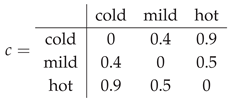
(Contradiction on attribute values — temperature preference). Let . Define the symmetric contradiction (with ) by
so, e.g., expresses a strong contradiction, while is moderate.
Definition 3
(ContraSoft structure). Let U be a nonempty universe and E a nonempty set of parameters. For each fix:
- a nonempty finite value set ;
- a contradiction function (Definition 2);
- a designated reference value .
Write for the disjoint union of all parameter–value pairs.
Example 3 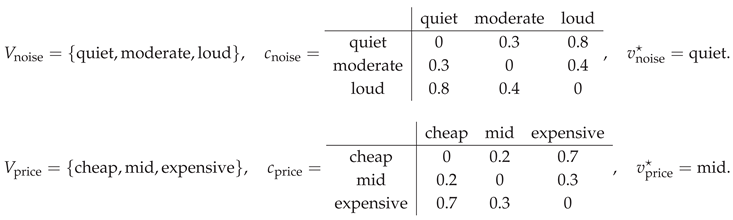
(ContraSoft structure — hotels by noise and price). Let the universe be and parameters . For each fix a finite value-set , a contradiction , and a reference value :
These choices realize Definition (ContraSoft structure) by specifying value domains, their contradiction degrees, and per-parameter references.
Definition 4
(ContraSoft Set). Let U be a finite universe of objects and E a finite set of parameters. A ContraSoft Set is a quadruple
where
- is the (crisp) soft mapping; is the set of objects accepted (or classified as positive) under parameter e;
- is a contradiction degree on parameters, symmetric and reflexive on the diagonal:
For and , the atomic lemma “x is accepted by e” is represented by
with truth value if and otherwise.
Example 4 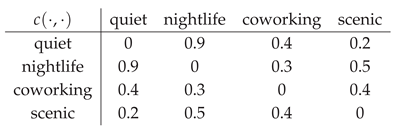
(ContraSoft Set — Noise-Aware Hotel Selection with Contradiction Thresholding). Universe, parameters, and soft mapping. Let the same universe U be as above. Consider parameters
Define by
Contradiction degrees on parameters. Let be symmetric with
(diagonal 0, larger values mean more contradictory).
Reference and thresholded aggregation. Fix the reference parameter and threshold . Define the accepted envelope
Eligible parameters are those within the contradiction radius:
Hence
Tighter threshold for comparison.With , only and are admitted:
Thus is monotone in τ, and the contradiction metric controls how widely we aggregate across potentially conflicting parameters.
1.3. HyperSoft Set and SuperHyperSoft Set
HyperSoft Set maps each multi-attribute tuple from a Cartesian product to a subset of the universe consistent with those values [4,5,6,7,8]. SuperHyperSoft Set maps tuples of subsets from power-set domains to universe subsets, generalizing HyperSoft; singletons in each coordinate recover HyperSoft [9,10].
Definition 5
(HyperSoft Set). [4] Let U be a finite universe and let be m attribute value domains. Consider the Cartesian product
so that each parameter chooses a single value for every attribute. A HyperSoft Set over U is a pair where
assigns to each multi-attribute parameter γ a subset . Equivalently,
Example 5
(HyperSoft Set — Multi-Attribute Restaurant Finder). Universe and attributes. Let the universe of candidate restaurants be
Let the attribute domains be
The parameter space is the Cartesian product . A HyperSoft Set is a mapping that assigns a subset of restaurants to each single-valued tuple .
Specification (nonempty images).
and for all other .
Concrete queries with exact set calculations.
The HyperSoft Set captures single-value choices per attribute; each tuple pinpoints a crisp slice of U.
Definition 6
(SuperHyperSoft Set). [9,11] Let U be a finite universe. Let be distinct attributes with finite, pairwise disjoint value-sets (i.e., for ). Write for the power set of and form
A SuperHyperSoft Set over U is a pair with
so that for each (where ) we have a subset . Formally,
Example 6
(SuperHyperSoft Set — Flexible Restaurant Finder with Set-Valued Coordinates). Universe and attributes.Use the same U and attribute value-sets , , . In the SuperHyperSoft setting, the parameter space is
so each coordinate is asubsetof admissible values (a flexible filter).
Mapping (nonempty images).Define by
and otherwise.
Reading the parameters. For example, means: cuisine is Japanese or Italian, price is low or mid, diet is vegetarian. Then is the recommended subset.
Coherence with HyperSoft via singletons. If we restrict to singletons in each coordinate, SuperHyperSoft reduces to HyperSoft. Concretely,
so the singleton tuple reproduces the HyperSoft slice exactly. Moreover,
exhibiting the intended flexible expansion when coordinates are broadened from single values to sets of values.
Cardinality checks.
Thus SuperHyperSoft enables compact specification of multi-value preferences per attribute and directly returns the filtered subset of U.
2. Main Results
In this section, we present and analyze the principal outcomes of our study.
2.1. Contra-HyperSoft Set
Contra-HyperSoft Set augments HyperSoft with a tuple-wise contradiction metric, reference selector, and threshold, uniting parameter slices within the admissible radius.
Definition 7
(Coordinatewise contradiction). Let be nonempty finite sets. For each acontradiction function is a map
When needed for exact reductions, we assume the zero-separation property .
Definition 8
(Tuple-level contradiction). Let and write , . Define the aggregated contradiction by
Then and . If each is zero-separating, then .
Definition 9
(Reference selector). Areference selectoris a map . Two canonical choices are
(Definition 10 (Contra-HyperSoft Set (CHS)). Let U be a finite universe and let be a HyperSoft mapping. Fix contradiction kernels , a reference selector ρ, and a threshold . The associated Contra-HyperSoft Set is the tuple
together with the filtered mapping
Example 7 (Contra-HyperSoft Set —Candidate Shortlisting under Conflicting Signals (self-centered selector)). Universe and attributes. Let the candidate pool be . Consider three single-valued attribute domains:
The parameter space is .
Coordinatewise contradictions. All are symmetric with 0 on the diagonal.
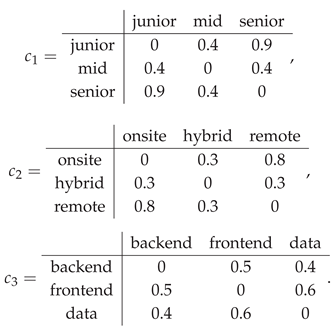
Aggregate tuple-contradiction: .
HyperSoft mapping (nonempty images).
CHS filter. Choose the self-centered selector and threshold . Let . Compute on the above tuples:
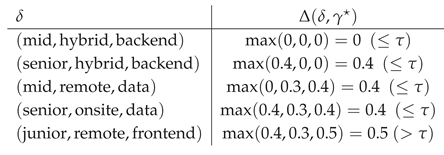
Hence
With a tighter threshold , only the base slice survives: , illustrating monotonicity in τ.
Example 8 (Contra-HyperSoft Set — Travel Package Selection (fixed reference)). Universe and attributes. Let be travel packages. Attributes:
Contradiction matrices (symmetric, 0 on diagonal).
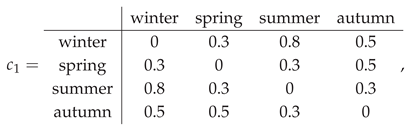
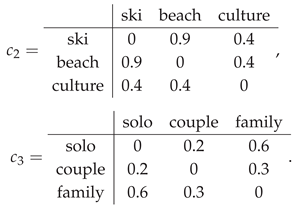
Aggregate .
HyperSoft mapping (nonempty images).
CHS filter (fixed reference).Choose the fixed reference and threshold . Evaluate :
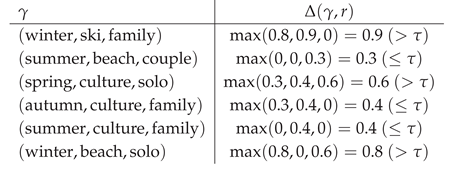
Thus the accepted tuples are the 2nd, 4th, and 5th. The CHS envelope at r is
with cardinality 5. If we tighten to , only the 2nd tuple remains, so , demonstrating the control afforded by the contradiction threshold.
Proposition 1
(Basic properties). For fixed the family is monotone in τ: if then for all . Moreover for all γ.
Proof.
If then , hence the unions are nested. For the constraint is vacuous since . □
Theorem 1
(CHS generalizes the HyperSoft Set). Assume each is zero-separating and take the self-centered selector . Then for one has
Proof.
By definition, . Since always, the inequality forces . Zero-separation gives , thus the union is . □
Definition 11
(Neighborhood-based ContraSoft on a single attribute). Let V be a finite set with contradiction , and let . For , theneighborhood-basedContraSoft transform is
Fixing yields thefixed-referencevariant .
Example 9 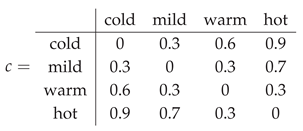
(Neighborhood-based ContraSoft — Destination Selection by Climate Preference). Universe and attribute. Let the universe of candidate destinations be
Consider a single attribute “preferred climate” with value set
Contradiction on V.
Let be symmetric with :
Baseline soft mapping. Define by
Neighborhood-based ContraSoft transform. For threshold and center ,
Case 1 (moderate neighborhood). Let and . Eligible neighbors satisfy :
Therefore
Case 2 (tight neighborhood). Let . Only satisfies , hence
These computations show how increasing τ expands the accepted neighborhood in V and unions the corresponding destination sets in U.
Theorem 2
(CHS generalizes ContraSoft). Suppose , so , and let . Identify with F. Then:
- (a)
- With the self-centered selector , one has
- (b)
- With the fixed-reference selector , one has
Hence, for the CHS construction recovers both standard ContraSoft variants.
Proof.
When , . Substituting gives (a); substituting gives (b). The set-theoretic unions agree by definition in both cases. □
2.2. Contra-SuperHyperSoft Set
Contra-SuperHyperSoft Set extends to set-valued coordinates, using lifted subset contradictions and aggregate radius; selector-threshold filtering unions nearby SuperHyperSoft slices effectively.
Definition 12
(Base and lifted contradictions). Let be nonempty finite sets of attribute values and let becontradiction functions(symmetric and reflexive: , ). Assume thezero-separationproperty . For subsets define theliftedcontradiction
(With finiteness, the are attained.)
Lemma 1
(Symmetry, reflexivity, and zero-separation on subsets). For each i and :
- (a)
- and .
- (b)
- If is zero-separating, then implies .
Proof. (a) Symmetry follows by exchanging the two max terms; reflexivity is immediate. (b) If with , then and . Thus, for each there is with , hence by zero-separation, so . The second equality gives . The cases with empties are by definition. □
Definition 13
(Product parameter space and aggregate contradiction). Let and write , . Define the tuple-level contradiction by
Then and ; if each is zero-separating, then by Lemma 1 we have .
Definition 14
(Reference selector). A reference selector is any map . Two common choices are the self-centered selector and a fixed-reference selector for a fixed .
(CSHS)).Definition 15 (Contra-SuperHyperSoft Set Let U be a finite universe and let be a SuperHyperSoft mapping. Fix contradiction kernels , their lifts , an aggregate Δ, a selector ρ, and a threshold . The associated Contra-SuperHyperSoft Set is the tuple
together with the filtered mapping
Example 10 (CSHS in E-commerce Fraud Review (self-centered selector)). Setup. Let the universe of orders be . Take two attribute domains:
Base contradictions (symmetric, 0 on the diagonal):

Lift to subsets by Definition (lifted contradiction) and aggregate
The SuperHyperSoft mapping is specified by
Choose the self-centered selector and threshold .
Filtering at .
To avoid overfull lines, we list the computations in an aligned display:
Hence
Filtering at .
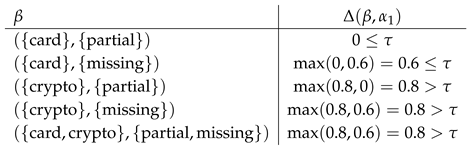
Therefore
This illustrates how the CSHS envelope aggregates nearby subset-parameters under the contradiction metric.
Example 11 (CSHS in Cloud Deployment Recommendation (self-centered selector)) Setup. Let the universe of candidate nodes be . Attributes:
Base contradictions (0 on the diagonal, symmetric):

Lift to subsets by and aggregate by .
SuperHyperSoft mapping F (nonempty images shown):
Choose the self-centered selector and threshold .
Filtering at .For each β with , compute :
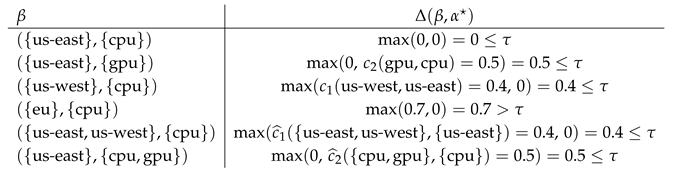
Hence
with . Nodes requiring a European region are excluded by the contradiction bound.
Proposition 2 (Monotonicity in the threshold)If , then for all . Moreover, for all α.
Proof. The index sets are nested as grows, hence so are the unions. For the constraint is vacuous since . □
Theorem 3 (CSHS generalizes SuperHyperSoft)
Assume zero-separation for each and take the self-centered selector . Then for we have
Proof. By definition, . Since , the inequality forces . By Definition 13 and Lemma 1, this occurs iff . Hence the union collapses to . □
Definition 16 (Singleton embedding of HyperSoft into SuperHyperSoft).
Let be
We say issingleton-supportedfor if for all γ and whenever some is not a singleton.
Lemma 2 (Compatibility of contradictions on singletons).
For any we have . Consequently, for ,
Proof. From Definition 12 with singletons, by symmetry, and the product case follows. □
Theorem 4 (CSHS generalizes Contra-HyperSoft)
Let be a HyperSoft set and F be a singleton-supported extension (Definition 16). Let be a selector on and define on by , with arbitrary values elsewhere. Then for every γ and ,
i.e. the CSHS filtered mapping restricted to singleton parameters coincides with the Contra-HyperSoft mapping for G built from and the same threshold.
Proof. By Definition 15,
Since F is singleton-supported, only of the form contribute. By Lemma 2 and the definition of , . Substitute and use to obtain the stated equality. □
Theorem 5 (CSHS generalizes ContraSoft)
Let with base set and contradiction . Let be singleton-supported for some via and if . Then, with the self-centered selector, for all and ,
which is exactly the neighborhood-based ContraSoft transform on . With a fixed reference , the same construction yields the fixed-reference ContraSoft variant.
Proof. Specialize Theorem 4 to with and observe that . Singleton support reduces the union to singletons, yielding the stated form. □
3. Conclusion
In this paper, we examined the concepts of the ContraSoft Set, the Contra-HyperSoft Set, and the Contra-SuperHyperSoft Set.
Future work will focus on extending these ideas by integrating them with richer frameworks, including Neutrosophic Sets[12,13], Plithogenic Sets[14,15,16], Rough Sets[17,18], and TreeSoft Sets[19,20]. Moreover, we anticipate the development of generalized structures that apply these contra-based approaches to Graphs[21,22], HyperGraphs[23,24,25], SuperHyperGraphs[26,27,28], and broader HyperStructures[29,30,31]. Such investigations are expected to open new directions in handling contradiction-aware representations across diverse domains.
Funding
This study did not receive any financial or external support from organizations or individuals.
Institutional Review Board Statement
As this research is entirely theoretical in nature and does not involve human participants or animal subjects, no ethical approval is required.
Data Availability Statement
This research is purely theoretical, involving no data collection or analysis. We encourage future researchers to pursue empirical investigations to further develop and validate the concepts introduced here.
Acknowledgments
We extend our sincere gratitude to everyone who provided insights, inspiration, and assistance throughout this research. We particularly thank our readers for their interest and acknowledge the authors of the cited works for laying the foundation that made our study possible. We also appreciate the support from individuals and institutions that provided the resources and infrastructure needed to produce and share this paper. Finally, we are grateful to all those who supported us in various ways during this project.
Use of Artificial Intelligence
I use generative AI and AI-assisted tools for tasks such as English grammar checking, and I do not employ them in any way that violates ethical standards.
Conflicts of Interest
The authors confirm that there are no conflicts of interest related to the research or its publication.
References
- Maji, P.K.; Biswas, R.; Roy, A.R. Soft set theory. Computers & mathematics with applications 2003, 45, 555–562. [Google Scholar]
- Jose, J.; George, B.; Thumbakara, R.K. Soft directed graphs, their vertex degrees, associated matrices and some product operations. New Mathematics and Natural Computation 2023, 19, 651–686. [Google Scholar] [CrossRef]
- Molodtsov, D. Soft set theory-first results. Computers & mathematics with applications 1999, 37, 19–31. [Google Scholar]
- Smarandache, F. Extension of soft set to hypersoft set, and then to plithogenic hypersoft set. Neutrosophic sets and systems 2018, 22, 168–170. [Google Scholar]
- Ihsan, M.; Rahman, A.U.; Saeed, M.H. Hypersoft Expert Set With Application in Decision Making for Recruitment Process. 2021.
- Musa, S.Y.; Asaad, B.A. Bipolar Hypersoft Homeomorphism Maps and Bipolar Hypersoft Compact Spaces. International Journal of Neutrosophic Science (IJNS) 2022, 19. [Google Scholar] [CrossRef]
- Musa, S.Y. N-bipolar hypersoft sets: Enhancing decision-making algorithms. Plos one 2024, 19, e0296396. [Google Scholar] [CrossRef] [PubMed]
- Musa, S.Y.; Asaad, B.A. Mappings on bipolar hypersoft classes. Neutrosophic Sets and Systems 2023, 53, 36. [Google Scholar]
- Mohamed, M.; AbdelMouty, A.M.; Mohamed, K.; Smarandache, F. SuperHyperSoft-Driven Evaluation of Smart Transportation in Centroidous-Moosra: Real-World Insights for the UAV Era. Neutrosophic Sets and Systems 2025, 78, 149–163. [Google Scholar]
- Salamai, A.A. A SuperHyperSoft Framework for Comprehensive Risk Assessment in Energy Projects. Neutrosophic Sets and Systems 2025, 77, 614–624. [Google Scholar]
- Smarandache, F. Foundation of the SuperHyperSoft Set and the Fuzzy Extension SuperHyperSoft Set: A New Vision. Neutrosophic Systems with Applications 2023, 11, 48–51. [Google Scholar] [CrossRef]
- Wang, H.; Smarandache, F.; Zhang, Y.; Sunderraman, R. Single valued neutrosophic sets; Infinite study, 2010.
- Broumi, S.; Talea, M.; Bakali, A.; Smarandache, F. Single valued neutrosophic graphs. Journal of New theory, 2016, pp. 86–101.
- Smarandache, F. Plithogenic set, an extension of crisp, fuzzy, intuitionistic fuzzy, and neutrosophic sets-revisited; Infinite study, 2018.
- Sultana, F.; Gulistan, M.; Ali, M.; Yaqoob, N.; Khan, M.; Rashid, T.; Ahmed, T. A study of plithogenic graphs: applications in spreading coronavirus disease (COVID-19) globally. Journal of ambient intelligence and humanized computing 2023, 14, 13139–13159. [Google Scholar] [CrossRef] [PubMed]
- Kandasamy, W.V.; Ilanthenral, K.; Smarandache, F. Plithogenic Graphs; Infinite Study, 2020.
- Pawlak, Z. Rough sets. International journal of computer & information sciences 1982, 11, 341–356. [Google Scholar]
- Broumi, S.; Smarandache, F.; Dhar, M. Rough neutrosophic sets. Infinite Study 2014, 32, 493–502. [Google Scholar]
- Myvizhi, M.; A Metwaly, A.; Ali, A.M. TreeSoft Approach for Refining Air Pollution Analysis: A Case Study. Neutrosophic Sets and Systems 2024, 68, 17. [Google Scholar]
- Smarandache, F. TreeSoft Set vs. HyperSoft Set and Fuzzy-Extensions of TreeSoft Sets. HyperSoft Set Methods in Engineering, 2024.
- Diestel, R. Graph theory; Springer (print edition); Reinhard Diestel (eBooks), 2024.
- Gross, J.L.; Yellen, J.; Anderson, M. Graph theory and its applications; Chapman and Hall/CRC, 2018.
- Bretto, A. Hypergraph theory. An introduction. Mathematical Engineering. Cham: Springer 2013, 1. [Google Scholar]
- Feng, Y.; You, H.; Zhang, Z.; Ji, R.; Gao, Y. Hypergraph neural networks. In Proceedings of the Proceedings of the AAAI conference on artificial intelligence, 2019; Vol. 33, pp. 3558–3565.
- Gao, Y.; Feng, Y.; Ji, S.; Ji, R. HGNN+: General hypergraph neural networks. IEEE Transactions on Pattern Analysis and Machine Intelligence 2022, 45, 3181–3199. [Google Scholar] [CrossRef] [PubMed]
- Smarandache, F. Extension of HyperGraph to n-SuperHyperGraph and to Plithogenic n-SuperHyperGraph, and Extension of HyperAlgebra to n-ary (Classical-/Neutro-/Anti-) HyperAlgebra; Infinite Study, 2020.
- Hamidi, M.; Taghinezhad, M. Application of Superhypergraphs-Based Domination Number in Real World; Infinite Study, 2023.
- Ghods, M.; Rostami, Z.; Smarandache, F. Introduction to Neutrosophic Restricted SuperHyperGraphs and Neutrosophic Restricted SuperHyperTrees and several of their properties. Neutrosophic Sets and Systems 2022, 50, 480–487. [Google Scholar]
- Al Tahan, M.; Davvaz, B. Weak chemical hyperstructures associated to electrochemical cells. Iranian Journal of Mathematical Chemistry 2018, 9, 65–75. [Google Scholar]
- Ruggero, M.S.; Vougiouklis, T. Hyperstructures in Lie-Santilli admissibility and iso-theories. Ratio Mathematica 2017, 33, 151. [Google Scholar]
- Vougiouklis, T. Hv-groups defined on the same set. Discrete Mathematics 1996, 155, 259–265. [Google Scholar] [CrossRef]
Disclaimer/Publisher’s Note: The statements, opinions and data contained in all publications are solely those of the individual author(s) and contributor(s) and not of MDPI and/or the editor(s). MDPI and/or the editor(s) disclaim responsibility for any injury to people or property resulting from any ideas, methods, instructions or products referred to in the content. |
© 2025 by the authors. Licensee MDPI, Basel, Switzerland. This article is an open access article distributed under the terms and conditions of the Creative Commons Attribution (CC BY) license (http://creativecommons.org/licenses/by/4.0/).
Copyright: This open access article is published under a Creative Commons CC BY 4.0 license, which permit the free download, distribution, and reuse, provided that the author and preprint are cited in any reuse.


