

Submitted:
01 October 2025
Posted:
02 October 2025
You are already at the latest version
Abstract
This study utilized the high salt concentrations of salted duck egg by-product (liquid albumen; LA) to develop an improved traditional pickling process for hog casing (HC). Specifically, this study investigated the feasibility of substituting salt brine with LA at varying concentrations and different pickling periods. In addition, physicochemical properties, textural profile analysis (TPA), aroma analysis, and sensory evaluation were performed on the post-production sausages to assess the recycling value of LA. This study showed that there were no significant differences among all groups compared to the control group in terms of the proximate compositions, apparent color, and aroma component profiles of the sausages. However, HC pickled in 50% LA for 7 days exhibited excellent sausage hardness, cohesiveness, and elasticity performance. It also received the highest scores for mouthfeel, aroma, and overall preference, indicating it was a suitable concentration for brine substitution. According to the findings of this study, the application of LA to substitute traditional brine in pickling HC showed potential for improving the texture and sensory properties of sausage products, which contributed to the accomplishment of the circular bioeconomy. The limitation of this study was that the HC pickling conditions (concentration and duration) required deeper optimization to facilitate subsequent large-scale production and application.
Keywords:
aroma
; circular bioeconomy
; pickling liquid
; sodium content
1. Introduction
The global salted duck egg market was estimated at approximately USD 395 million in 2024, with a projected market value of around USD 500 million in 2025 [1]. The conservative compound annual growth rate (CAGR) is assumed to be 5% [1]. Salted duck eggs are a classic pickled egg product popular in Asia, which can be steamed or boiled before peeling and eating [2]. The preserved yolks can fill other foods (such as mooncakes, buns, or zongzi) [3]. However, the volatility of raw material prices [duck eggs and feed (corn and soybeans)], transportation, energy costs, and potential health issues associated with high sodium content may act as restraints [1,4]. Moreover, climate change, frequent avian influenza outbreaks, duck manure wastewater treatment, and the disposal of redundant salted duck egg LA were not yet sufficiently addressed [3,4,5,6].
HCs, including natural, plastics, collagen, and cellulose [7,8], where the global market size of natural HC is expected to reach USD 2.1 billion by 2024, and the market is expected to grow at a CAGR of 3.8% to reach approximately USD 2.97 billion by 2033 [9]. Moreover, the production of sausages is expected to drive further demand for HCs associated with changing consumer preferences, sustained growth in consumption, and a growing inclination towards convenience foods and ready-to-eat products [8]. This also signifies that natural HCs without synthetic food additives align with this trend, and their premium profile endears them to producers of gastronomy and meats [7,8]. Typically, all HC from animal sources cleaned and preserved in a 15–20 °C brine solution will never be stored for more than two days without refrigeration to avoid weakening the casings and loss of elasticity and hardness [7]. However, the demand for kosher and halal food puts pressure on the availability of HC from non-pork sources, despite the utilization of HC being an important by-product included in the assessment of sustainable animal production [7].
The food industry is exploring ecologically conscious value-added systems that operate under the circular bioeconomy concept with the goal of low waste generation [5,10,11]. These systems enhance economic performance and promote sustainable development by transforming residual resources—such as waste or discarded materials— into value-added products based on integrating existing technologies [5,10,11,12]. Therefore, this study employed LA rich in protein and high salt concentration to replace the traditional high-salt solution for pickling HCs before sausage manufacturing. Afterwards, the effects of the alternative pickling solution on HCs were verified through physicochemical, TPA, and aroma of the sausages, followed by sensory evaluation. These synergistic processes were expected to enhance the recycling of LA while minimizing the high-salinity wastewater generated from the pickling HCs process.
2. Materials and Methods
2.1. Materials
Commercially available salted HCs (small and large intestines; initial salt concentration about 50%, thickness about 0.03 mm) were purchased from Yun Jian Industrial Co., Ltd. (Chiayi, Taiwan). Salted duck egg by-product (LA, salt concentration about 25%) purchased from Yong Hao egg merchants (Tainan, Taiwan). All the essential chemicals employed in this research were procured from Sigma-Aldrich® (Merck KGaA, Darmstadt, Germany), and they were used directly without any pre-treatment, unless specifically stated otherwise.
2.2. Processing of Samples and Pickling Solutions
2.2.1. Desalting of Commercially Available Salted HC
All commercially available salted HCs were cut into 10 cm lengths and cleaned with deionized water (DW) to remove the surface salt [13]. Afterwards, immersing them in hypochlorite water produced by electrolyzing the salted water for 2 min before using them.
2.2.2. Processing of Pickling Solution
The LA was sieved through a 40 mesh and then prepared in different ratios to formulate the pickling solution for the HCs. Specifically, 25, 50, 75, and 100% of the LA were diluted with 0, 75, 50, and 25% of the DW, respectively, named HCLA 25, 50, 75, and 100 (Figure 1A). In addition, the control group was the commercially available HCs without any treatment.
2.2.3. Pickling Process
Based on the weight of the HC, 2-fold weight of the above-mentioned pickling solution (w/w) was added and vacuum-packed, followed by refrigerated salting at 4 °C for 1, 7, 14, and 21 days before Chinese sausage production (Figure 1B).
2.2.4. Preparation of Chinese Sausages
The formulation for the Chinese sausage is based on the approach described in Huang et al. [14] with minor modifications. The recipe for Chinese sausages was listed in Table A1. The primary process involved twisting the lean pork (10,000 g each) into 1.27 and 2.54 cm³, adding all the seasonings, sodium nitrite, and polyphosphate, and mixing for 3 min. Afterwards, add the cooking rice wine and mix for 2 min, then add the back fat (which has been ground to 0.95 cm³) for 3 min. Eventually, Chinese sausages were obtained (Figure 1C) by filling the meat mixtures into the HCs (Section 2.2.3), and randomly selected samples were analyzed for the following physicochemical characterization.
2.3. Proximate Analysis
The components of the samples were examined by measuring the water activity (AW; 978.18), moisture content (934.01), crude protein (984.13), crude fat (954.01), saturated and trans fats (996.06), sugars (982.14), ash (942.05), and sodium content (976.25). These measurements were carried out in accordance with the standard method performance requirements (SMPRs®) and as described by AOAC [15].
2.4. Determination of Salted HC Appearance Color
The HC’s appearance color analysis was carried out according to the method described by Lin et al. [16]. The L* (brightness, with 100 being the brightest and 0 the darkest), a* (reddish-greenish color, positive for reddish, negative for greenish), and b* (yellowish-blueish color, positive for yellowish, negative for blueish) values of the samples (cooked) were measured using a hand-held imaging spectrocolorimeter (Lovibond® LC 100, Tintometer GmbH, Dortmund, Germany). Specifically, each sausage was measured at three points in the front, center, and end of the sausage
2.5. TPA
The TPA of Chinese sausage (un-diced) was determined following the method described by Huang et al. [17], with minor modifications. TPA was performed using a texture analyzer (TA-XT2, Stable Micro Systems Ltd., Godalming, UK) with an HDP/VB probe. The specific parameters were as follows: initial, test, and post-test probe movement speed of 2 mm/sec, compression ratio of 50%, recoverable time of 5 sec, and trigger point load of 5 g. Then, the values of hardness (Newton; N), springiness, cohesiveness, and chewiness (N) were obtained.
2.6. Aroma Analysis
This study followed the method described by Wang et al. [18] with some modifications for analyzing volatile compounds in Chinese sausages. The samples were extracted using the solid-phase microextraction (SPME)-arrow tool (Thermo Fisher Scientific Inc., Waltham, USA). Specifically, 3 g of sausage was placed into a 20 mL precision thread headspace-vial (Thermo Fisher Scientific Inc.), and 10 μL of ethyl decanoate (50 μg/mL as internal standard) was added. The magnetic screw cap was immediately locked, and the volatile compounds were extracted using a multifunctional autosampler system AOC-6000 (Shimadzu Co., Kyoto, Japan). Briefly, the samples were shaken at 60 °C for 7.5 min and then adsorbed with 120 μm/20 mm divinylbenzene/polydimethylsiloxane (DVB/PDMS) fiber for 10 min. After extraction, the SPME-arrow tool was removed from the injection port at 250 °C for 3 min, and the volatile compounds were separated and identified by gas chromatography–mass spectrometry (GC-MS; GC-2010 Plus-TQ™8040, Shimadzu Co.) analysis. Specifically, the GC was equipped with a fused silica capillary column SH-Rxi-5Sil-MS (30 m × 0.25 mm i.d. × 0.25 μm, (Shimadzu, Co., Ltd.); the oven was maintained at an initial temperature of 40 °C for 1 min, then increased at a rate of 2 °C/min to 128 °C, followed by an increase at a rate of 80 °C/min to 240 °C for 3 min. The flow rate was 1 mL/min, and helium (99.9995%) was used as the mobile phase. The MS parameters are in electron ionization mode (positive ions, 70 eV), with the ion source temperature set to 250 °C and a scanning range of 40–400 m/z. The retention index (RI) values were established by an Alkane standard mixture (Restek Co., Bellefonte, USA), and the MS similarity of volatile compounds was compared with the software National Institute of Standards and Technology (NIST; Gaithersburg, USA) 17-1 and flavors/fragrances (FFNSC) 3rd Edition Wiley Library (John Wiley & Sons, Inc., Hoboken, USA) databases. In addition, the concentration of volatile compounds was calculated as shown in the following equation:
(1)
where, C represents the volatile compound peak area, I represents the internal standard peak area, 50 represents the weight (μg/mL) of the internal standard, and Ws represents the weight (g) of the Chinese sausage sample.
2.7. Sensory Evaluation
This study used different ratios of LA-pickled HCs to manufacture Chinese sausages, and invited volunteers aged 18 to 40 years (30 members of the consumer-type evaluation panel) to perform a hobby sensory evaluation according to the methodology described in Huang et al. [19], with slight modifications. All members were informed of the agreement, experiment settings, and could withdraw at any time, which was agreed to by written consent prior to the test (template as in Supplementary Material). Briefly, they have been notified that their answers (were statistically analyzed; no personal privacy or information involved) would be published anonymously in a scientific journal with no financial or other compensation for their participation. While the evaluation was in progress, the room temperature was maintained at 25±1 °C, silent and noiseless. Each panelist was seated on a partitioned seat and could not talk or discuss with the other. After sampling, panelists rinsed their mouths twice with drinking water until the taste was removed before the following sample was tasted. The evaluation scale was based on a 9-point scale, with 1–extremely disliked, 2–very disliked, 3–disliked, 4–somewhat disliked, 5–neither disliked nor liked, 6–slightly liked, 7–liked, 8–liked very much, and 9–liked immensely. The panelists rated the HCs’ appearance, aroma, mouthfeel, elasticity, crispness, integration of HC and filling, saltiness, and overall preference. Higher sensory scores indicate higher consumer preference for the HC.
2.8. Statistical Analysis
This study was repeated thrice for each test (n=3), and the data were expressed as mean ± standard deviation (SD). Except for proximate analyses in Table A2, which are only conducted once (n=1). The analysis of variance (ANOVA) was conducted with XLSTAT statistical software (version 2019, Lumivero, Denver, USA), and Duncan’s multiple range test was used to compare the variability among groups, with p< 0.05 indicating a significant difference.
3. Results and Discussion
3.1. Physicochemical Properties of the Sausage
3.1.1. Moisture Content
This study utilized HC pickled in LA (on 0–21 days and at different concentrations), followed by sausage manufacturing. The moisture content exhibited an increasing and then decreasing trend with HC picking time and LA concentration in all groups of sausages (Table 1), which were significantly different from each other (p< 0.05). However, HC pickled at LA for 14 days showed the highest moisture content in all groups. In particular, the HCLA 50 group exhibited the highest moisture content (44.34 ± 2.25%), with a significant difference compared to the HCLA 75 and 100 groups, whereas there was no significant difference compared to the HCLA 25 and control groups. Notably, the lowest moisture content (22.57 ± 5.78%) was detected in the HCLA50 group of sausages, which were pickled in LA for 21 days. These variations were attributed to organic acid accumulation, which resulted in the denaturation of muscle proteins and contraction of muscle bundles, thereby leading to a loss of water between the networks of muscle fibers [20]. It has also been reported that proper water vapor permeability (WVP) facilitates the efficient release of water from the sausage during the process, thus regulating and preventing the fermented sausage from drying out or humidifying excessively [21]. Notably, Guan et al. [21] reported that when producing HC with materials sensitive to moisture, these materials absorb water from the environment and meat fillings. Then, they form hydrogen bonds with water molecules, which ultimately impacts the tensile strength of HC. In addition, the same authors have also demonstrated that insufficient water absorbed by the sausage casings affects the elongation. Therefore, the surface of the outer casing of the HCLA sausages remained intact, and no cracks were observed during the production of the sausages until they were cooked. It also indicated that the HC pickled in LA retained the structural integrity even in contact with the meat filling and was unaffected by the filling and the ambient environment.
3.1.2. AW
This study showed that the AW of all groups ranged from 0.92 to 0.96 (Table 1), whereas some groups were exhibiting significant differences (p< 0.05). The AW values fall within the range characteristic of semi-dry fermented sausages, specifically in the range of 0.90 < AW < 0.95 [22]. It is worth noting that when the AW drops to 0.86–0.88 during the aging process of Chinese dry-fermented sausages, it can effectively inhibit the growth of most microorganisms [20]. However, all groups were classified as high AW with no threshold for effective inhibition of foodborne microbial growth (below 0.65) [23]. Zhang et al. [20] also reported that fermented sausage moisture content and AW decrease as the fermentation period is prolonged. Namely, the microorganisms in the sausage will produce lactic acid and other chemicals, while lactobacillus will inhibit the growth of different bacteria [20]. It has also been reported that incorporating Chinese red and yellow wines in sausage recipes yielded sausages with less water loss and higher AW values [24]. Therefore, the substitution of salted duck egg by-product (LA) for salt-pickling HC showed that there were no adverse effects on the AW of the sausages in this study. Moreover, such results also suggested the feasibility of LA as an alternative to salt, providing sustainable reuse value for both quality and application in the HC process.
3.1.3. Appearance Color
This study indicated that the L* values of the sausages of all groups except the control group and the HCLA 100 group showed a gradual decreasing trend with the increase in the duration of HC pickling in the LB (Table 1). There were significant differences (p< 0.05) between the groups. However, in the control and HCLA 100 groups, there was a slight increase and then a decrease. The L* values for sausages in all groups were lowest using HC with a 21-day pickling period in LA. In addition, these results also implied that pickling of HC in LA at a concentration of 25–75% for one day contributed to the improvement of the L* value of the sausages. The decrease in the L* value of sausages has been attributed to water loss, nitrite fermentation, or changes in light scattering on the sausage surface [25]. R. Huang et al. [26] have also revealed that the elevated L* value of low-sodium-treated sausages might be associated with improved water retention ability. However, this study failed to observe the effect of HC pickling with different salt concentrations of LA on the moisture content and L* value of the sausages.
Regarding a* and b* values, all groups exhibited no degree of regularity in their variations compared to the control group (Table 1), albeit with significant differences (p< 0.05) under some conditions. Moreover, the a* values of the sausages in this research were partially ascribed to the positive influence of the coloring agent (sodium nitrite) [21,22]. Specifically, sodium nitrite was converted to nitrous acid, whereby nitric oxide reacted with myoglobin and metmyoglobin in the meat to develop the characteristic red color (nitroso–myoglobin) of the sausage [27,28,29,30]. However, the sampling variations likely led to the a* and b* values changing irregularly among the groups. R. Huang et al. [26] also reported that the elevated b* values were probably related to the reduced loss of sausage color at lower salt concentrations. Conversely, the shrinkage of muscle fragments and fibers at high salt concentrations promotes the leaching of myoglobin and residual hemoglobin with water during the heating process, decreasing the b* values of the samples [26]. Moreover, it has also been reported that b* values were related to yellow pigments generated by lipid oxidation products reacting with amines in the phospholipid head groups or amines in proteins [21]. Therefore, this study revealed that all HCLAs did not interfere with the sausage coloring effect, and the trends of color changes observed in the groups agreed with those of the control group. Furthermore, the color values were exhibited very similarly to each other, resulting in differences that the color appearances of the sausage groups were not distinguishable to the naked eye [31].
3.1.4. TPA
This study showed that the TPA values for all groups varied to different degrees while without significant regularity of HC pickling with LA (different durations and concentrations) (Table 2). There were significant differences (p< 0.05) between all groups compared to the control group. Specifically, the hardness of the HCLA 25 and 100 groups exhibited an increase followed by a decrease, then a slight increase, according to the duration of HC pickling with LB. Conversely, the HCLA 50 and 75 groups showed a decrease followed by a slight increase and then a slight decrease.
In terms of springiness, the HCLA50 and 75 groups showed a slight increase at days 1 and 7 of HC pickling (Table 2). However, the other groups were similar to the control group, which showed a gradual decrease in springiness with the increase in pickling period, and there were significant differences between the groups (p< 0.05).
Based on the results of this study, the values of cohesiveness, gumminess, and chewiness for each group indicated an increase with increasing HC pickling time (Table 2). In addition, the cohesiveness and gumminess of all groups were higher and significantly different (p< 0.05) than the control group, except for the pickled conditions for 21 days. It is worth mentioning that HC showed higher gumminess values in groups HCLA 75 and 100 than the control group under pickling conditions for 21 days, but there was no significant difference. The variations in chewiness for the HCLA 75 and 100 groups were similar to those described above, but were significantly different (p< 0.05) compared to the control group. These changes observed in this study were attributable to the differences associated with the moisture changes experienced by the sausages encased in different HCLAs [21]. Interestingly, Xu et al. [30] reported that the inoculation of a complex fermenting agent in the formulation of Sichuan-style fermented sausages decreased the pH (the generation of acids such as organic acids) and the water-holding capacity of the proteins. The same authors also indicated that this would facilitate the acceleration of the drying process (reduction of water content) and enhance the textural properties of the sausage. In a low-sodium Vienna sausage study, the use of different concentrations of KCl and glycine to reduce NaCl has been reported to reduce the hardness and firmness of the sausage significantly [32]. Low-salt meat products with the TPA properties declined due to the interactions between adjacent myosin monomers [28]. These interactions occur through electrostatic forces within their tails, forming regular self-assembling filamentous structures [28]. Consequently, the process diminishes the solubility of myofibrillar proteins and contributes to their destabilization. Karla dos Santos et al. [27] reported on the application of microcapsules of alginate-encapsulated açaí oil to fresh sausage production, indicating that the TPA of the sausages was more resistant due to the encapsulation of the microcapsules. In particular, adding microcapsules altered the parameters of hardness, adhesiveness, and chewiness. Following the Zhao et al. [33] report, these relative TPA results were not directly indicative of the quality of the sausages concerned, which needed to be exploited in combination with the sensory evaluation results. In contrast, the small size of particles of the sausage composition through Pickering’s emulsion particles effectively fills the three-dimensional gel network matrix of the proteins, forming a finer gel structure, which enhances the texture of the emulsified sausage [34]. The same authors also suggested that oil droplet-based interfacial particles in Pickering’s emulsion augment the gelatinization and texture of emulsified sausages via the interaction with myofibrillar proteins. In addition, Chung et al. [13] have determined by Taguchi orthogonality that the indices and levels in sausage recipes that have an essential influence on mouthfeel were the pork lean-to-fat ratio. Consistent recipes for all the sausages in this study (Table A1), the effect of HC on the TPA in sausages appears negligible, as in the results described above. Therefore, HCs were pickled in LA for 1–21 days before sausage production. Different LA concentrations showed satisfactory performance in improving the TPA characteristics of the sausage to a certain extent. However, from a health point of view, we strongly recommend that pickling conditions with low salt concentration be used as far as possible for subsequent HC processing.
3.1.5. Aroma Heat-Map Analysis
This study revealed that the changes in the primary volatile component contents related to flavor were similar in all groups of sausages manufactured by pickling HC in LA (with different concentrations and pickling days) or control (Figure 2A–E). However, the aroma component of Chinese sausage, as a standard processed meat product, generally consists of a variety of volatile compounds, which have been classified into the following categories according to their chemical properties and flavor sources. (I) Aldehydes (such as hexanal, nonanal, benzaldehyde, etc.) provide fat, grassy, and fruity flavors as products of lipid oxidation and Strecker degradation, while serving as one of the most critical sources of flavor during meat processing [33,35]. (II) Maillard reaction (MR) derivatives (such as ethyl maltol, (Z)-3-phenylacrylaldehyde) derived from the heating reaction of proteins with reducing sugars give products with sweet and bakery fragrance characteristics [18,36]. It has been reported that phenylalanine (Phe) can enhance the aromatic strength of products by MR [37]. Moreover, Phe is transformed by microbial development to form phenylpyruvic acid, which is further oxidized to yield aldehydes, alcohols, acids, and key volatile compounds such as benzaldehyde, phenylacetic acid, and other substances with specific aromatic fragrances [30,38]. (III) Terpenes and sesquiterpenes (such as limonene, eugenol, caryophyllene, γ-terpinene, α-copaene, cis-anethol, etc.) originated from the spice or the inner HCs, which express in citrus-like, herbal, woody, sweet, pleasant aroma, or pungent flavor characteristics [37,38,39,40]. Hu et al. [38] also showed that 33 volatile compounds positively affected the fat odor in dried sausage flavors with different lactobacillus. The volatile compounds, such as cis-anethol, D-camphor, etc., showed a positive correlation with the content of most of the free amino acids. (IV) Partial free, medium, and long-chain fatty acids (such as octanoic acid, nonanoic acid, etc.) and hydrocarbons reflected the changes in fatty acid oxidized, β-oxidated, and aging state [33,40,41]. Specifically, these reactions form precursors of fermented sausage flavor substances, such as aldehydes, ketones, alcohols, esters, and other substances [40,42]. In addition, microorganisms in Chinese fermented sausages significantly facilitated the hydrolysis of proteins and the generation of numerous flavor precursors [20]. Therefore, food scientists have also focused on the development of natural functional food ingredients [19]. Specifically, it has been reported that using 3,4′-di-O-butanoylresveratrol (ED2) and 3-O-butanoylresveratrol (ED4) in different structural monomers of Resveratrol butyrate esters reduces sodium nitrite by 83% in Chinese sausage recipes while inhibiting lipid oxidation and providing a degree of antibacterial activity [19].
Interestingly, in the Cai et al. [37] study on the volatile contents of five-spice sausages, the results suggested an abundance of 2-methyl-1-butanol-D, 2-heptanone, 1-butanol, 2-pentanone, butyl benzene, and 2-pentanol-D. The same authors also indicated that these substances imparted a fruity and sweet flavor to the sausages. The microbial or endogenous proteases (fructose-bisphosphate-α, photosynthesized hydrogenase, and creatine kinase M−type) also hydrolyze the meat proteins during the initial stage of Chinese sausage fermentation (the first 10 days) to develop and stabilize the flavor [43,44]. Consequently, the composition and content of the food matrix, such as proteins and lipids, in the sausage interact with the flavor compounds and influence the retention of the aroma compounds and release of the flavors [39]. Furthermore, Chen et al. [40] also reported that one of the major factors for the formation of the distinctive aroma of Sichuan- and Cantonese-style sausages was the differences in the distribution of microbes. Despite the benefits of fermented sausages through microorganisms, one should not overlook that Enterococcus has been published to cause increased levels of biogenic amines (e.g., histamine, etc.) in the product, and poses a potential health risk to the consumer [45]. Zhou et al. [39] also noted that sausage recipes that are not sufficiently acidified may be at risk of higher enterobacterial counts during the drying process. Notably, all the sausages in this study were frozen and preserved upon completion of production, which also contributed to delaying the onset of lipid oxidation. Thus, avoiding the adverse effects on the flavor of traditional Chinese (fermented) sausages caused by prolonged storage at ambient temperature. Based on the above results, the application of HCLA in sausage production would not adversely affect the flavor of the sausage.
3.2. Sensory Evaluation
All the sensory evaluation results for all groups of sausages revealed that all groups received similar scores to those of the control group (Figure 3A–D). The numerical differences were minor despite significant differences (p< 0.05) in several evaluation indicator scores compared to the control group. The HCLA50 scored higher than the control group in terms of mouthfeel, elasticity, and crispness, regardless of whether the HCs were pickled for 1–21 days. Despite a report of a slight difference in sensory evaluation scores for all sensory attributes between laboratory-scale and commercially produced low-salt sausages (with a lower score for salty), no significant differences were observed [32]. As mentioned above, the present study only involved using HCs pickled in different LAs (concentrations and days) for sausage production without altering the sausage recipe. Hence, there were no significant changes in the sensory properties of the recipes [23,31]; rather, the primary differences were due to the HCs. Therefore, it is possible to substitute the use of LA for the pickling of HCs with a high salt solution without affecting the quality indicators of the final sausage product in terms of pickling days. In practical operation, considering the time savings, curing HCs in 50% LA takes only 1–7 days to obtain HCs that would be satisfactory for consumer use in the production of sausage products.
3.3. Proximate Composition
This study showed that the HCs obtained in the control and HCLA50 groups do not affect the proximate composition of the same recipe sausage products (Table A2). Therefore, the findings of this study exhibited a similar tendency to those previously published [19,24,27,46]. It is worth mentioning that the sodium content of the HCLA50 group was also lower than that of the control group; namely, a niche for consumers with limited daily sodium consumption. Specifically, identifying ways to improve digestive characteristics and sensory qualities (taste balance and saltiness perception) and extend the shelf-life of reduced/low-sodium sausages contributes to a viable solution for the meat processing industry to meet consumer acceptance and requirements for a healthier product demand [6,23,26,32].
4. Conclusions
This study showed that 50% LA has the potential to substitute traditional brine pickling with HCs, achieving a win-win outcome for residual resource recycling without adversely affecting the quality indicators of sausage products. This also suggested that LA possesses practical value and potential for application in meat processing. Furthermore, the process of HC pickling and preservation conditions under LA can be optimized in the future, which is expected to broaden its application value in the food processing industry. Therefore, it would benefit the food-related industries in achieving sustainable development across environmental, economic, and social dimensions by contributing to emission reduction and pollution control.
Author Contributions
Conceptualization and data curation, Wen-Chang Chang and Wei-Ting Hou; methodology, software and formal analysis, Wei-Ting Hou and Ping-Hsiu Huang; writing—original draft preparation, Wen-Chang Chang, Wei-Ting Hou and Ping-Hsiu Huang; writing—review and editing, Wen-Chang Chang and Ping-Hsiu Huang;; visualization, Ping-Hsiu Huang; supervision, project administration and funding acquisition, Wen-Chang Chang. All authors have read and agreed to the published version of the manuscript.
Funding
This research received no external funding.
Data Availability Statement
The raw data supporting the conclusions of this article will be made available by the authors on request.
Conflicts of Interest
The authors declare that they have no known competing financial interests or personal relationships that could have influenced the work reported in this paper.
Abbreviations
The following abbreviations are used in this manuscript:
| LA | Liquid albumen |
| HC | Hog casing |
| TPA | Textural profile analysis |
| CAGR | Conservative compound annual growth rate |
| DW | Deionized water |
| AW | Water activity |
| N | Newton |
| SPME | Solid-phase microextraction |
| DVB/PDMS | Divinylbenzene/polydimethylsiloxane |
| GC-MS | Gas chromatography–mass spectrometry |
| RI | Retention index |
| NIST | National Institute of Standards and Technology |
| FFNSC | Flavors/fragrances |
| SD | Standard deviation |
| ANOVA | Analysis of variance |
| WVP | Water vapor permeability |
| MR | Maillard reaction |
| Phe | Phenylalanine |
| ED2 | 3,4′-di-O-butanoylresveratrol |
| ED4 | 3-O-butanoylresveratrol |
Appendix A

Table A1.
List of Chinese sausage recipes.
| Ingredient | Weight | Ratio | |
| (g) | (%) | ||
| Lean pork | 20000 | 69.79 | |
| Back fat | 5000 | 17.45 | |
| Seasonings | Salt | 358.3 | 1.25 |
| Sugar | 2278.47 | 7.95 | |
| Monosodium glutamate (MSG) |
126.1 | 0.44 | |
| Five-spice powder | 11.5 | 0.04 | |
| White pepper | 74.5 | 0.26 | |
| Cooking rice wine | 753.8 | 2.63 | |
| Polyphosphate | 51.6 | 0.18 | |
| Sodium nitrite | 2.5 | 0.01 | |
| Total | 28656.77 | 100 | |
Table A2.
Effects of hog casing (HC) pickled in salted duck egg by-product (liquid albumen; LA) for different days before use in sausage production on the proximate composition.
Table A2.
Effects of hog casing (HC) pickled in salted duck egg by-product (liquid albumen; LA) for different days before use in sausage production on the proximate composition.
| Item | Control | HCs pickled in 50% salted duck egg by-product (LA) for 7 days HCLA50 |
|||
| Each serving (40 g) | Per 100 g | Each serving (40 g) | Per 100 g | ||
| Calories (kcal) | 115.8 | 289.6 | 130.5 | 326.3 | |
| Protein (g) | 5.5 | 13.7 | 5.2 | 13.1 | |
| Fat (g) | 9.3 | 23.3 | 14.4 | 28.6 | |
| Saturated fat (g) | 3.5 | 8.6 | 4.4 | 11.1 | |
| Trans fat (g) | 0 | ||||
| Carbohydrate (g) | 2.5 | 6.2 | 1.7 | 4.3 | |
| Sugar (g) | 2.6 | 6.5 | 2.4 | 6 | |
| Sodium (g) | 235 | 587 | 214 | 535 | |
| The proximate analyses were conducted just once (n = 1). Consequently, no statistical analyses were carried out. | |||||
References
- DiMarket. “Salted duck egg analysis uncovered: Market drivers and forecasts 2025-2033.” Pune, Maharashtra: PRDUA Research & Media Private Limited, 2025. https://www.datainsightsmarket.com/reports/salted-duck-egg-1236257#segments (accessed on 8th Aug 2025). (accessed on 8 August 2025).
- Wongnen, C., W. Panpipat, N. Saelee, S. Rawdkuen, L. Grossmann and M. Chaijan. “A novel approach for the production of mildly salted duck egg using ozonized brine salting.” Foods 12 (2023): 2261. [CrossRef]
- Ye, Y., N. Wu, Y. Yao, S. Chen, L. Xu, Y. Zhao and Y. Tu. “Effects of ammonium chloride on physicochemical properties, aggregation behavior and microstructure of duck egg yolk induced by salt.” LWT 229 (2025): 118151. [CrossRef]
- Wang, H.-C. Y.-C. Chen and J.-W. Chen. “The current production and export situation of the duck egg industry in taiwan.” FFTC Agricultural Policy Platform (FFTC-AP), 2025. https://ap.fftc.org.tw/article/3766 (accessed on 7th Aug 2025). (accessed on 7 August 2025).
- Wang, X., J. Zhang, S. K. Vidyarthi, M. Xu, Z. Liu, C. Zhang and H. Xiao. “A comprehensive review on salted eggs: Quality formation mechanisms, innovative pickling technologies and value-added applications.” Sustainable Food Technology 2 (2024): 1409–27. [CrossRef]
- Cui, Y., W. Lu, P. Zalewski, J. He, X. Li, Y. Cao, Y. Zhao, C. Sun, J. Wu, H. Chen, et al. “Innovative approaches to sodium reduction in pickled foods: A review of recent developments.” Trends in Food Science & Technology 163 (2025): 105133. [CrossRef]
- Suurs, P. and S. Barbut. “Collagen use for co-extruded sausage casings – A review.” Trends in Food Science & Technology 102 (2020): 91–101. [CrossRef]
- Global-Market-Insights. “Sausage casings market size.” Selbyville, USA: Global Market Insights Inc., 2023. https://www.gminsights.com/industry-analysis/sausage-casings-market (accessed on 8th Aug 2025). (accessed on 8 August 2025).
- Anuradha. Natural sausage casings market research report 2033. Ontario, USA: 2024, 288. https://growthmarketreports.com/report/natural-sausage-casings-market (accessed on 8th Aug 2025).
- Venugopal, V. “Green processing of seafood waste biomass towards blue economy.” Current Research in Environmental Sustainability 4 (2022): 100164. [CrossRef]
- Lin, C.-H. Y.-T. Huang, J.-Y. Ciou, C.-M. Cheng, G.-T. Wang, C.-M. You, P.-H. Huang and C.-Y. Hou. “Circular economy and sustainable recovery of Taiwanese tilapia (Oreochromis mossambicus) byproduct—the large-scale production of umami-rich seasoning material application.” Foods 12 (2023): 1921. [CrossRef]
- Huang, P.-H. Y.-W. Chen, C.-H. Chen, H.-J. Fan, C.-W. Hsieh, Y.-L. Tain, W.-T. Tsai, M.-K. Shih and C.-Y. Hou. “Characterization and evaluation of the adsorption of uremic toxins through the pyrolysis of pineapple leaves and peels and by forming a bio-complex with sodium alginate.” International Journal of Biological Macromolecules 302 (2025): 138843. [CrossRef]
- Chung, P.-L. K.-S. Lufaniyao and M. Gavahian. “Development of chinese-style sausage enriched with djulis (chenopodium formosanum koidz) using taguchi method: Applying modern optimization to indigenous people’s traditional food.” Foods 13 (2024): 91. [CrossRef]
- Huang, P.-H. Y.-W. Chen, C.-K. Shie, S.-Y. Chen, B.-H. Lee, L.-J. Yin, C.-Y. Hou and M.-K. Shih. “Chinese sausage simulates high calorie–induced obesity in vivo, identifying the potential benefits of weight loss and metabolic syndrome of resveratrol butyrate monomer derivatives.” Journal of Nutrition and Metabolism 2025 (2025): 8414627. [CrossRef]
- AOAC. “Official methods of analysis: 22nd edition (2023).” In Official methods of analysis of aoac international. G. W. Latimer, Jr. and G. W. Latimer, Jr. Oxford University Press, 2023.
- Lin, Y.-W. C.-L. Tsai, C.-J. Chen, P.-L. Li and P.-H. Huang. “Insights into the effects of multiple frequency ultrasound combined with acid treatments on the physicochemical and thermal properties of brown rice postcooking.” LWT (2023): 115423. [CrossRef]
- Huang, P.-H., Y. Y. Wu, P.-H. Huang, C.-M. Lin, H.-L. Chen, M.-H. Chen, M.-K. Shih and C.-Y. Hou. “Characterization of the effects of micro-bubble treatment on the cleanliness of intestinal sludge, physicochemical properties, and textural quality of shrimp (litopenaeus vannamei).” Food Chemistry (2025): 142909. [CrossRef]
- Wang, B.-H. P.-H. Huang, C.-Y. Lo and W.-C. Chang. “Metabolomic analysis elucidates the dynamic changes in aroma compounds and the milk aroma mechanism across various portions of tea leaves during different stages of oolong tea processing.” Food Research International 209 (2025): 116203. [CrossRef]
- Huang, P.-H. Y.-W. Chen, H.-J. Fan, S.-Y. Chen, Y.-L. Tain, C.-W. Hsieh, C.-Y. Hou and M.-K. Shih. “Application of resveratrol butyric acid derivatives in the processing, physicochemical characterization, and the shelf-life extension of chinese sausages low in sodium nitrite.” Journal of Food Safety 44 (2024): e13144. [CrossRef]
- Zhang, Y., J. Jia, Q. Qian, H. Ma, J. Zhou, Y. Lin, P. Zhang, Q. Chen, Q. Zeng, Q. Li, et al. “Effect of isolated bacteria on nitrite degradation and quality of sichuan dry sausages.” LWT 212 (2024): 117039. [CrossRef]
- Guan, D., X. Yang, J. Tao, F. Zhan, Y. Qiu, J. Jin and L. Zhao. “Novel biodegradable polyamide 4/chitosan casing films for enhanced fermented sausage packaging.” Food Packaging and Shelf Life 47 (2025): 101444. [CrossRef]
- Liu, Y., M. Mijiti, Z. Xu and B. Abulikemu. “Effect of a combination of probiotics on the flavor profiling and biogenic amines of composite fermented mutton sausages.” Food Bioscience 61 (2024): 104835. [CrossRef]
- Seibt, A. C. M. D., P. Nerhing, M. B. Pinton, S. P. Santos, Y. S. V. Leães, F. D. C. De Oliveira, S. S. Robalo, B. C. Casarin, B. A. Dos Santos, J. S. Barin, et al. “Green technologies applied to low-nacl fresh sausages production: Impact on oxidative stability, color formation, microbiological properties, volatile compounds, and sensory profile.” Meat Science 209 (2024): 109418. [CrossRef]
- Dai, Y., Y. Yuan, J.-X. Chen, S.-Y. Chen, C.-H. Li, Y. Huang and H.-J. Chang. “Quality properties of chinese sichuan-style sausages as affected by chinese red wine, yellow rice wine and beer.” International Journal of Food Properties 26 (2023): 3291–304. [CrossRef]
- Huang, J., H. Wei, Z. Luo, L. Li, Z. Liu and N. Xie. “Enhancing the textural properties of tibetan pig sausages via zanthoxylum bungeanum aqueous extract: Polyphenol-mediated quality improvements.” Foods 14 (2025): 1639. [CrossRef]
- Huang, R., Y. Fang, H. Yin, Y. Zhong, W. Lu and Y. Deng. “Al-optimized synergy of kcl and κ-carrageenan in low-sodium sausages: Integrated enhancement of saltiness perception, gel stability, and protein digestibility.” Food Hydrocolloids 168 (2025): 111574. [CrossRef]
- Karla dos Santos, A., N. Marques da Silva, M. A. Matiucci, A. Rech de Marins, T. A. Ferreira de Campos, L. Waleska de Brito Sodré, R. A. Dias Bezerra, C. R. Alcalde and A. C. Feihrmann. “Use of encapsulated açaí oil with antioxidant potential in fresh sausage.” LWT 204 (2024): 116469. [CrossRef]
- Zhang, J., X. Li, B. Kong, C. Cao, F. Sun, H. Zhang and Q. Liu. “Application of lysine as a potential alternative to sodium salt in frankfurters: With emphasis on quality profile promotion and saltiness compensation.” Meat Science 217 (2024): 109609. [CrossRef]
- Dong, Z., L. Wang, Y. Ge, Y. An, X. Sun, K. Xue, H. Xie, R. Wang, J. Li and L. Chen. “Screening, identification, and application of superior starter cultures for fermented sausage production from traditional meat products.” Fermentation 11 (2025): 306. [CrossRef]
- Xu, B., W. Qiu, Y. Liu, F. Gong, Q. Liu, J. Chen, Y. Tang, C. Su, J. Tang, D. Zhang, et al. “Exploring the regulation of metabolic changes mediated by different combined starter cultures on the characteristic flavor compounds and quality of sichuan-style fermented sausages.” Food Research International 208 (2025): 116114. [CrossRef]
- Feng, T., R. Ye, H. Zhuang, Z. Rong, Z. Fang, Y. Wang, Z. Gu and Z. Jin. “Physicochemical properties and sensory evaluation of mesona blumes gum/rice starch mixed gels as fat-substitutes in chinese cantonese-style sausage.” Food Research International 50 (2013): 85–93. [CrossRef]
- Sriwattana, S., N. Chokumnoyporn and W. Prinyawiwatkul. “Reduced-sodium vienna sausage: Selected quality characteristics, optimized salt mixture, and commercial scale-up production.” Journal of Food Science 86 (2021): 3939–50. [CrossRef]
- Zhao, P., Y. An, Z. Dong, X. Sun, W. Zhang, H. Wang, B. Yang, J. Yan, B. Fang, F. Ren, et al. “Comparative analysis of commercially available flavor oil sausages and smoked sausages.” Molecules 29 (2024): 3772. [CrossRef]
- Zhang, Q., J. Shen, G. Meng, C. Liu, H. Wang, Q. Zhang, C. Zhu, G. Zhao and X. Wang. “Characterization of wheat bran nanocellulose and its application in low-fat emulsified sausage.” Cellulose 31 (2024): 11101–14. [CrossRef]
- He, W., Z. Liu, H. Liu, J. Sun, H. Chen and B. Sun. “Characterization of key volatile flavor compounds in dried sausages by hs-spme and safe, which combined with GC-MS, GC-O and OAV.” Journal of Food Composition and Analysis 133 (2024): 106438. [CrossRef]
- Bleicher, J., E. E. Ebner and K. H. Bak. “Formation and analysis of volatile and odor compounds in meat—a review.” Molecules 27 (2022): 6703. [CrossRef]
- Cai, X., Y. Zeng, K. Zhu, Y. Peng, P. Xv, P. Dong, M. Qiao and W. Fan. “Characterization of the quality and flavor in Chinese sausage: Comparison between cantonese, five-spice, and mala sausages.” Foods 14 (2025): 1982. [CrossRef]
- Hu, Y., J. Wang, Q. Liu, Y. Wang, J. Ren, Q. Chen and B. Kong. “Unraveling the difference in flavor characteristics of dry sausages inoculated with different autochthonous lactic acid bacteria.” Food Bioscience 47 (2022): 101778. [CrossRef]
- Zhou, H., B. Zhao, S. Zhang, Q. Wu, N. Zhu, S. Li, X. Pan, S. Wang and X. Qiao. “Development of volatiles and odor-active compounds in Chinese dry sausage at different stages of process and storage.” Food Science and Human Wellness 10 (2021): 316–26. [CrossRef]
- Chen, X., F. Yan, D. Qu, T. Wan, L. Xi and C. Y. Hu. “Aroma characterization of Sichuan and Cantonese sausages using electronic nose, gas chromatography–mass spectrometry, gas chromatography-olfactometry, odor activity values and metagenomic.” Food Chemistry: X 24 (2024): 101924. [CrossRef]
- Mei, L., D. Pan, T. Guo, H. Ren and L. Wang. “Role of lactobacillus plantarum with antioxidation properties on Chinese sausages.” LWT 162 (2022): 113427. [CrossRef]
- Xia, L., M. Qian, F. Cheng, Y. Wang, J. Han, Y. Xu, K. Zhang, J. Tian and Y. Jin. “The effect of lactic acid bacteria on lipid metabolism and flavor of fermented sausages.” Food Bioscience 56 (2023): 103172. [CrossRef]
- Xing, B., T. Zhou, H. Gao, L. Wu, D. Zhao, J. Wu and C. Li. “Flavor evolution of normal- and low-fat Chinese sausage during natural fermentation.” Food Research International 169 (2023): 112937. [CrossRef]
- Zhou, T., B. Sheng, H. Gao, X. Nie, H. Sun, B. Xing, L. Wu, D. Zhao, J. Wu and C. Li. “Effect of fat concentration on protein digestibility of Chinese sausage.” Food Research International 177 (2024): 113922. [CrossRef]
- Zheng, S.-s. C.-y. Wang, Y.-y. Hu, L. Yang and B.-c. Xu. “Enhancement of fermented sausage quality driven by mixed starter cultures: Elucidating the perspective of flavor profile and microbial communities.” Food Research International 178 (2024): 113951. [CrossRef]
- Wang, Y., C. Lv, P. Zhang, F. Wang, T. Zhang, Y. Ma and M. Xu. “Formulation optimization and quality evaluation of walnut protein sausage based on fuzzy mathematics sensory evaluation combined with random centroid optimization.” Food Science & Nutrition 13 (2025): e70747. [CrossRef]
Figure 1.
The hog casings (HC) were pickled in salted duck egg by-product (liquid albumen; LB) for different days and then used for manufacturing sausages: (A) pickling solution, (B) pickling process, and (C) HCLB sausages.
Figure 1.
The hog casings (HC) were pickled in salted duck egg by-product (liquid albumen; LB) for different days and then used for manufacturing sausages: (A) pickling solution, (B) pickling process, and (C) HCLB sausages.
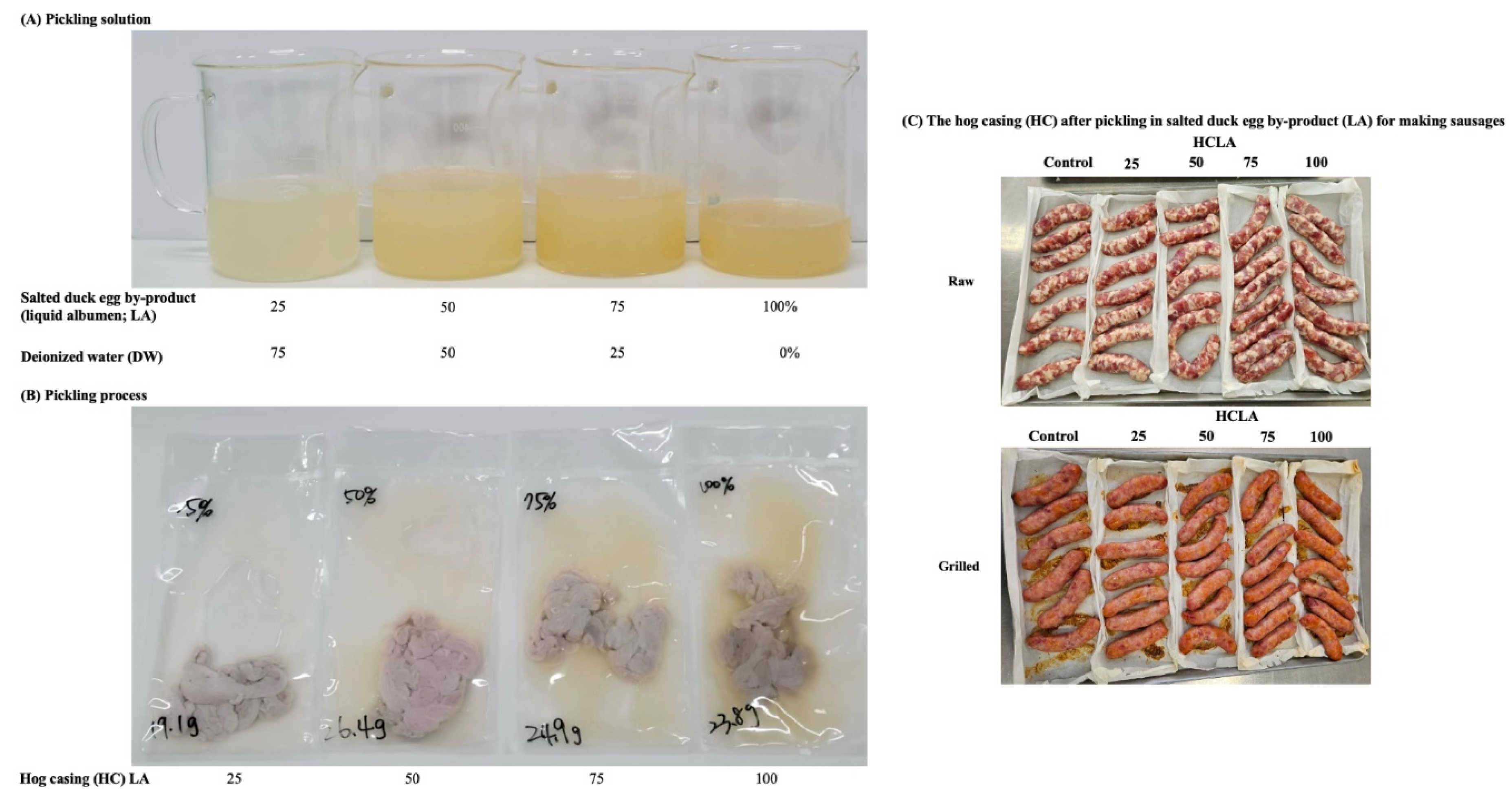
Figure 2.
Effects of hog casing (HC) pickled in salted duck egg by-product (liquid albumen; LB) and then used in sausage making on the aroma heatmap analysis of the sausage: (A) control, (B) HCLB 25: HC pickling with 25% LB, (C) HCLB 50: HC pickling with 50% LB, (D) HCLB 75: HC pickling with 75% LB, and (E) HCLB 100: HC pickling with 100% LB.
Figure 2.
Effects of hog casing (HC) pickled in salted duck egg by-product (liquid albumen; LB) and then used in sausage making on the aroma heatmap analysis of the sausage: (A) control, (B) HCLB 25: HC pickling with 25% LB, (C) HCLB 50: HC pickling with 50% LB, (D) HCLB 75: HC pickling with 75% LB, and (E) HCLB 100: HC pickling with 100% LB.
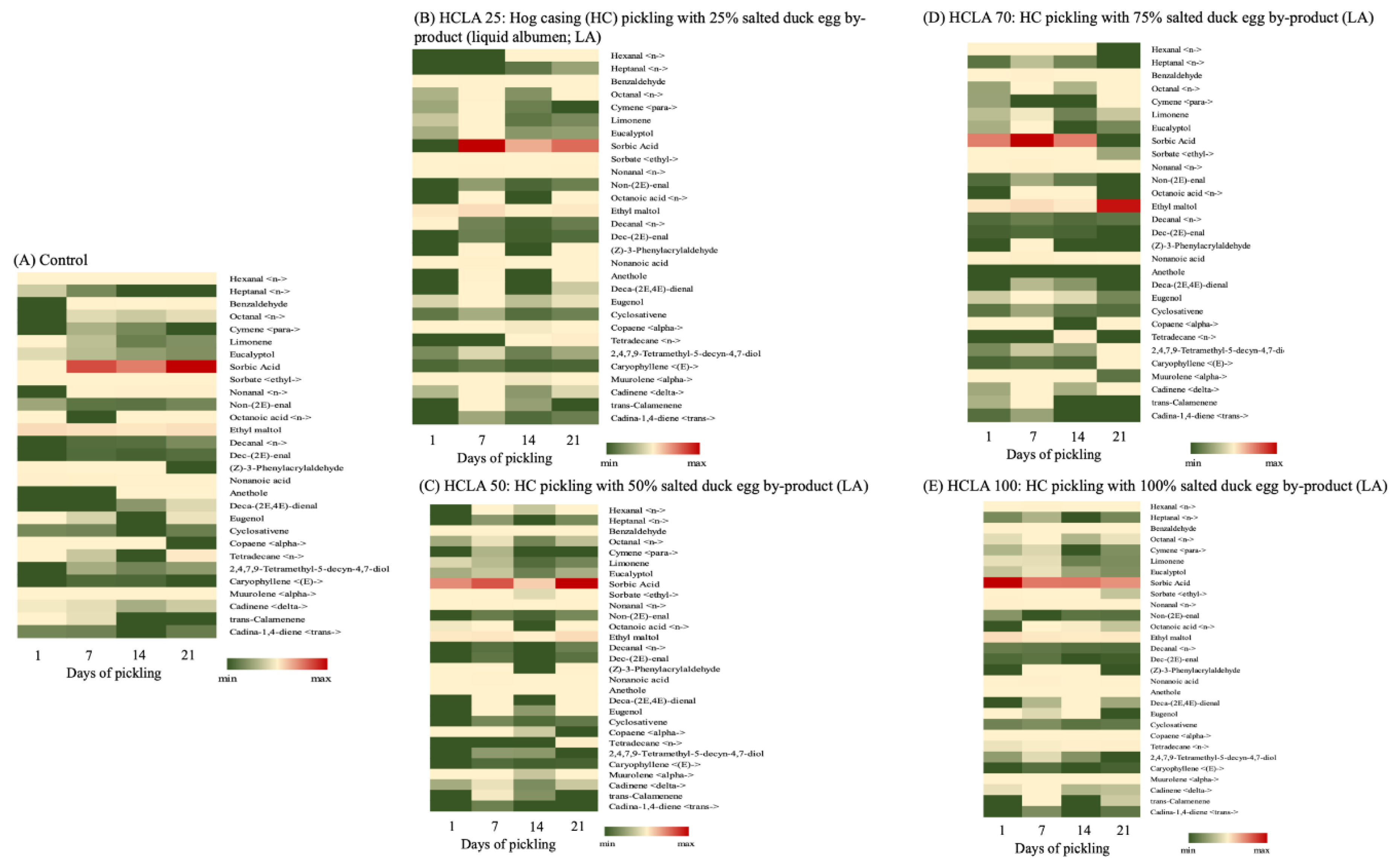
Figure 3.
Effects of hog casing (HC) pickled in salted duck egg by-product (liquid albumen; LB) on its sensory properties for the manufacture of sausages: (A) Pickled for 0 days, (B) Pickled for 7 days, (C) Pickled for 14 days, and (D) Pickled for 21 days. *: Represents a significant difference (p< 0.05) compared to the control group.
Figure 3.
Effects of hog casing (HC) pickled in salted duck egg by-product (liquid albumen; LB) on its sensory properties for the manufacture of sausages: (A) Pickled for 0 days, (B) Pickled for 7 days, (C) Pickled for 14 days, and (D) Pickled for 21 days. *: Represents a significant difference (p< 0.05) compared to the control group.
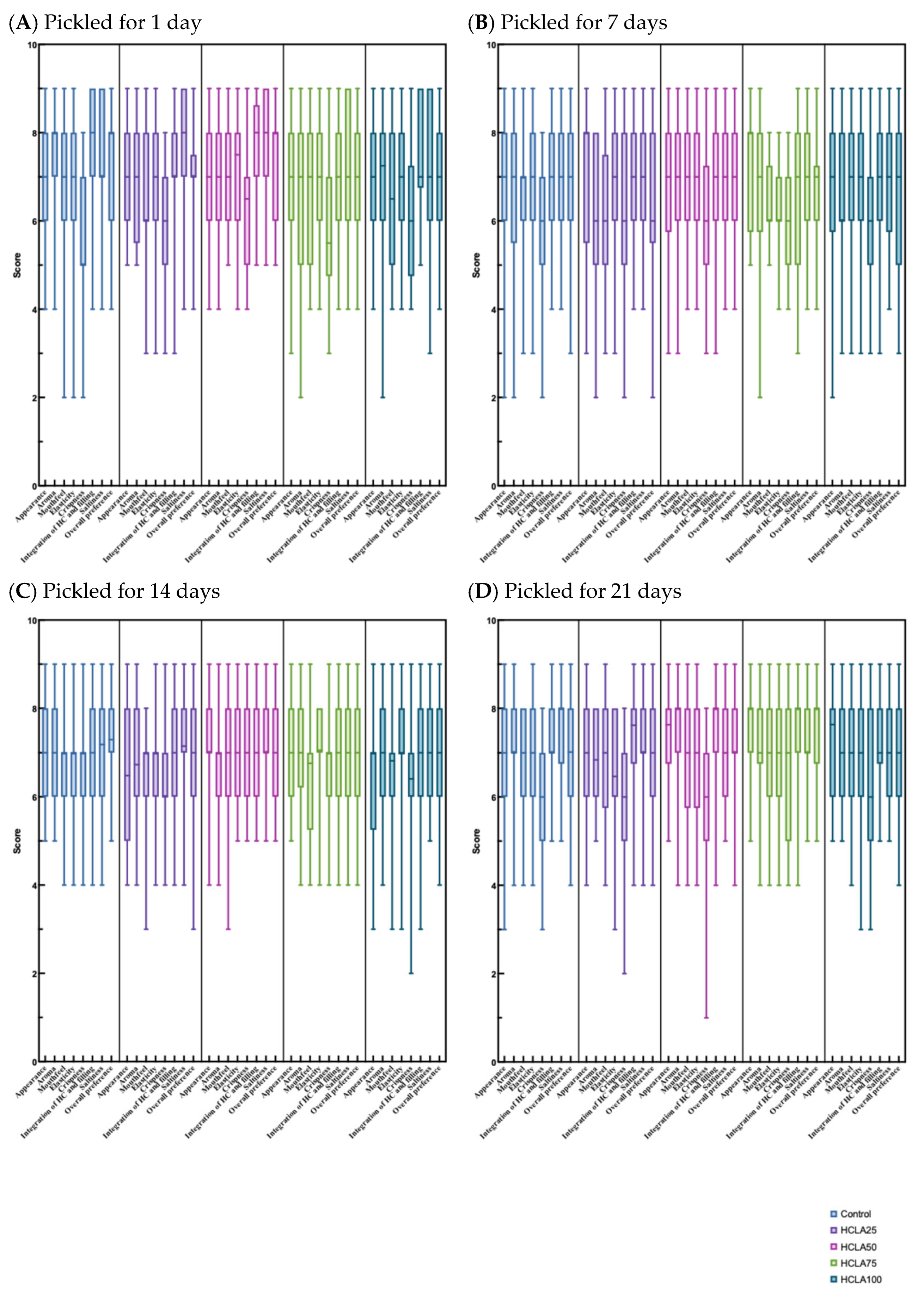
Table 1.
Effects of hog casing (HC) pickled in salted duck egg by-product (liquid albumen; LA) for different days before use in sausage production on the moisture, water activity (AW), and color (L*, a*, and b* values) of the sausage.
Table 1.
Effects of hog casing (HC) pickled in salted duck egg by-product (liquid albumen; LA) for different days before use in sausage production on the moisture, water activity (AW), and color (L*, a*, and b* values) of the sausage.
| Analysis | Days of pickling | Control (commercially available salted HC) |
HCLA | ||||
| LA concentration (%) |
25 | 50 | 75 | 100 | |||
| Deionized water (DW; %) |
75 | 50 | 25 | 0 | |||
| Moisture content (%) | 1 | 34.49 ± 2.58ᵃ | 30.71 ± 0.09ᵇ | 33.26 ± 1.33ᵃᵇ | 27.73 ± 1.28ᶜᵈ | 26.36 ± 2.95ᵈ | |
| 7 | 33.97 ± 1.60ᵃ | 34.91 ± 1.35ᵃ | 36.37 ± 4.15ᵃ | 32.17 ± 2.34ᵃ | 33.76 ± 1.34ᵃ | ||
| 14 | 41.19 ± 3.42ᵃᵇ | 38.69 ± 3.84ᵃᵇ | 44.34 ± 2.25ᵃ | 38.30 ± 4.09ᵇ | 36.62 ± 1.82ᵇ | ||
| 21 | 34.71 ± 8.10ᵃ | 29.65 ± 0.46ᵃ | 22.57 ± 5.78ᵃ | 29.30 ± 2.81ᵃ | 31.14 ± 3.75ᵃ | ||
| Water activity (AW) | 1 | 0.92 ± 0.01ᵇ | 0.93 ± 0.01ᵃᵇ | 0.94 ± 0.01ᵃ | 0.94 ± 0.00ᵃ | 0.94 ± 0.00ᵃ | |
| 7 | 0.94 ± 0.01ᵃ | 0.94 ± 0.01ᵃ | 0.94 ± 0.00ᵃ | 0.94 ± 0.00ᵃ | 0.95 ± 0.00ᵃ | ||
| 14 | 0.96 ± 0.01ᵃ | 0.95 ± 0.01ᵃ | 0.96 ± 0.00ᵃ | 0.95 ± 0.01ᵃ | 0.96 ± 0.00ᵃ | ||
| 21 | 0.93 ± 0.01b | 0.94 ± 0.01ᵃᵇ | 0.93 ± 0.01b | 0.94 ± 0.01ᵇᶜ | 0.95 ± 0.00ᵃ | ||
| L* | 1 | 51.40 ± 0.46ᵈ | 54.43 ± 0.15ᶜ | 58.60 ± 0.10ᵃ | 55.33 ± 0.42ᵇ | 48.23 ± 0.21ᵉ | |
| 7 | 50.67 ± 0.29ᶜ | 51.43 ± 0.15ᵇ | 51.80 ± 0.10ᵃ | 50.13 ± 0.15ᵈ | 51.27 ± 0.15ᵇ | ||
| 14 | 53.57 ± 0.46ᵇ | 49.23 ± 0.32ᵈ | 50.60 ± 0.26ᶜ | 50.33 ± 0.29ᶜ | 54.53 ± 0.15ᵃ | ||
| 21 | 42.27 ± 0.21ᵃ | 46.63 ± 0.29ᵇ | 45.43 ± 0.12ᶜ | 48.90 ± 0.46ᵈ | 39.27 ± 0.46ᵉ | ||
| a* | 1 | 9.60 ± 0.89ᵇ | 7.90 ± 0.56ᶜ | 6.87 ± 0.95ᶜ | 7.80 ± 0.98ᶜ | 12.27 ± 1.02ᵃ | |
| 7 | 9.57 ± 1.10ᵇ | 8.53 ± 1.00ᵇ | 10.33 ± 0.78ᵇ | 13.37 ± 1.10ᵃ | 9.23 ± 1.85ᵇ | ||
| 14 | 7.40 ± 0.62ᵇ | 9.67 ± 0.55ᵃ | 8.63 ± 0.57ᵃᵇ | 8.10 ± 1.44ᵇ | 4.07 ± 0.06ᶜ | ||
| 21 | 11.70 ± 1.18ᵃᵇ | 10.10 ± 1.31ᵇ | 13.13 ± 0.65ᵃ | 10.20 ± 2.26ᵇ | 12.80 ± 0.20ᵃᵇ | ||
| b* | 1 | 15.50 ± 1.91ᵃᵇ | 12.37 ± 3.29ᵇ | 20.73 ± 1.12ᵃ | 21.20 ± 3.51ᵃ | 15.27 ± 3.07ᵇ | |
| 7 | 13.43 ± 1.80ᵇ | 13.90 ± 1.37ᵇ | 15.77 ± 2.61ᵇ | 23.87 ± 0.55ᵃ | 20.63 ± 6.61ᵃᵇ | ||
| 14 | 13.87 ± 1.97ᵃᵇ | 17.73 ± 2.51ᵃ | 16.97 ± 4.97ᵃᵇ | 19.73 ± 1.60ᵃ | 11.73 ± 0.45ᵇ | ||
| 21 | 18.00 ± 4.07ᵃ | 13.47 ± 2.27ᵇ | 18.93 ± 1.50ᵃ | 16.97 ± 1.90ᵃᵇ | 18.53 ± 0.60ᵃ | ||
| All group data are expressed as mean ± standard deviation (SD; n=3). Different superscripted lowercase letters (p< 0.05) in groups of the same pickling day indicated significant differences. | |||||||
Table 2.
Effects of hog casing (HC) pickled in salted duck egg by-product (liquid albumen; LA) for different days before use in sausage production on the textual profile analysis (TPA) of the sausage.
Table 2.
Effects of hog casing (HC) pickled in salted duck egg by-product (liquid albumen; LA) for different days before use in sausage production on the textual profile analysis (TPA) of the sausage.
| Analysis | Days of pickling | Control (commercially available salted HCs) |
HCLA | ||||
| LA concentration (%) | 25 | 50 | 75 | 100 | |||
| Deionized water (DW; %) |
75 | 50 | 25 | 0 | |||
| Hardness (Newton; N) |
1 | 123.58 ± 22.75ᵃᵇ | 84.71 ± 9.34ᵈ | 115.22 ± 8.08ᵇᶜ | 146.03 ± 19.25ᵃ | 106.05 ± 6.82ᶜᵈ | |
| 7 | 72.59 ± 5.38ᵇ | 130.22 ± 34.57ᵃ | 84.79 ± 6.69ᵃb | 72.86 ± 7.25ᵇ | 74.28 ± 6.62ᵇ | ||
| 14 | 104.13±13.23ᵇ | 64.95±7.36ᶜ | 142.36±16.26ᵃ | 128.73±8.00ᵃᵇ | 60.27±3.87ᶜ | ||
| 21 | 105.74±12.07ᵇᶜ | 95.78±6.21ᶜ | 103.62±2.17ᵇᶜ | 139.72±17.97ᵃ | 127.20±14.97ᵃᵇ | ||
| Springiness | 1 | 0.78 ± 0.05ᵇ | 0.89 ± 0.03ᵃᵇ | 0.93 ± 0.03ᵃ | 0.84 ± 0.14ᵃᵇ | 0.46 ± 0.04ᶜ | |
| 7 | 0.57 ± 0.02ᵇᶜ | 0.65 ± 0.08ᵇᶜ | 0.93 ± 0.10ᵃᵇ | 1.02 ± 0.35ᵃ | 0.41 ± 0.06ᶜ | ||
| 14 | 0.47±0.08ᵃᵇ | 0.53±0.03ᵃ | 0.45±0.05ᵇ | 0.48±0.03ᵃᵇ | 0.34±0.05ᶜ | ||
| 21 | 0.26±0.01ᶜ | 0.42±0.11ᵇ | 0.44±0.04ᵇ | 0.56±0.05ᵃ | 0.50±0.02ᵃᵇ | ||
| Cohesiveness | 1 | 0.24 ± 0.08ᵇ | 0.54 ± 0.18ᵃ | 0.40 ± 0.03ᵃᵇ | 0.51 ± 0.12ᵃ | 0.34 ± 0.09ᵃᵇ | |
| 7 | 0.27 ± 0.10ᵇ | 0.58 ± 0.13ᵃ | 0.38 ± 0.19ᵃᵇ | 0.60 ± 0.25ᵃ | 0.25 ± 0.02ᵇ | ||
| 14 | 0.37±0.09ᵇ | 0.79±0.03ᵃ | 0.77±0.03ᵃ | 0.85±0.05ᵃ | 0.79±0.01ᵃ | ||
| 21 | 0.86±0.04ᵃ | 0.79±0.02ᵃᵇ | 0.53±0.06ᶜ | 0.75±0.07ᵇ | 0.80±0.02ᵃᵇ | ||
| Gumminess | 1 | 28.08 ± 3.75ᵇ | 46.55 ± 20.56ᵇ | 46.68 ± 6.59ᵇ | 74.09 ± 13.52ᵃ | 35.70 ± 7.27ᵇ | |
| 7 | 19.21 ± 6.41ᶜ | 72.83 ± 6.44ᵃ | 31.48 ± 13.59ᵇc | 43.86 ± 19.70ᵇ | 18.93 ± 3.02ᶜ | ||
| 14 | 38.86±12.40ᵇ | 51.42±7.27ᵇ | 109.53±8.19ᵃ | 109.77±1.12ᵃ | 47.86±2.77ᵇ | ||
| 21 | 90.77±12.81ᵃ | 75.97±6.47ᵃᵇ | 54.62±5.61ᵇ | 106.10±22.84ᵃ | 101.27±13.17ᵃ | ||
| Chewiness (N) | 1 | 21.84 ± 3.72ᵇᶜ | 41.20 ± 16.84ᵃᵇ | 43.68 ± 7.34ᵃᵇ | 63.59 ± 20.23ᵃ | 16.58 ± 4.28ᶜ | |
| 7 | 10.88±3.66ᵇ | 47.99±10.35ᵃ | 28.60 ± 9.61ᵃᵇ | 49.07±32.41ᵃ | 7.83±2.20ᵇ | ||
| 14 | 18.24±7.52ᵇᶜ | 27.41±5.12ᵇ | 49.00±5.02ᵃ | 52.49±3.23ᵃ | 16.43±3.33ᶜ | ||
| 21 | 23.51±4.07ᶜ | 32.47±10.98ᵇᶜ | 24.22±3.76ᶜ | 59.94±15.36ᵃ | 50.64±7.09ᵃᵇ | ||
| All group data are expressed as mean ± standard deviation (SD; n=3). Different superscripted lowercase letters (p< 0.05) in groups of the same pickling day indicated significant differences. | |||||||
Disclaimer/Publisher’s Note: The statements, opinions and data contained in all publications are solely those of the individual author(s) and contributor(s) and not of MDPI and/or the editor(s). MDPI and/or the editor(s) disclaim responsibility for any injury to people or property resulting from any ideas, methods, instructions or products referred to in the content. |
© 2025 by the authors. Licensee MDPI, Basel, Switzerland. This article is an open access article distributed under the terms and conditions of the Creative Commons Attribution (CC BY) license (http://creativecommons.org/licenses/by/4.0/).
Copyright: This open access article is published under a Creative Commons CC BY 4.0 license, which permit the free download, distribution, and reuse, provided that the author and preprint are cited in any reuse.