

Submitted:
21 June 2026
Posted:
23 June 2026
You are already at the latest version
Abstract
Reliable battery operation requires not only detecting accelerated degradation, but also knowing whether the available history is sufficient to localize that transition. We analyse a public cycle-level dataset comprising 14 reconstructed lithium-ion battery records, using the charging-to-discharge duration ratio as an empirical degradation indicator. A linear reference, continuous broken-stick regression, smoothing-spline curvature analysis, an aggregate Bayesian smooth-transition model, and a hierarchical Bayesian smooth-hinge model are compared. The hierarchical model estimates battery-specific transition midpoints and slope changes under partial pooling. Its population transition midpoint is 553.9 cycles (95% highest-density interval: 547.1–560.9), with substantial between-battery variability (posterior median standard deviation: 142.0 cycles); all batteries have posterior probability one of a positive slope increment. Removing approximately half the observations throughout the trajectories widens uncertainty but preserves the acceleration conclusion and nearly preserves battery ordering. In contrast, truncating late-life observations strongly destabilizes transition localization and extrapolative coverage. The practical implication is that distributed sparse monitoring can remain informative, whereas dense early-life data cannot replace continued observation through the post-transition regime. The framework supports retrospective, uncertainty-aware screening and confirmation of accelerated ageing in battery-monitoring data, but it is not a prospective changepoint or remaining-useful-life predictor.
Keywords:
lithium-ion battery
; degradation acceleration
; changepoint analysis
; hierarchical Bayesian model
; uncertainty quantification
; incomplete observations
; monitoring design
; identifiability
1. Introduction
Lithium-ion batteries underpin electrified transport, renewable-energy integration, grid services, backup power, and distributed energy systems. Their value depends not only on initial energy and power capability, but also on how reliably those capabilities are retained under calendar ageing and repeated cycling [1,2,3,4]. In electric vehicles, accelerated deterioration affects range, power availability, warranty exposure, and service timing. In stationary storage, it affects dispatch capability, reserve provision, economic scheduling, and compliance with energy or power commitments. Monitoring methods that identify a persistent increase in degradation rate can therefore support intensified inspection, confirmatory testing, maintenance prioritization, and replacement planning.
Such a transition is difficult to define uniquely. Lithium-ion ageing reflects interacting processes including solid-electrolyte-interphase growth, loss of cyclable lithium, active-material loss, lithium plating, impedance growth, particle cracking, and contact degradation [5,6,7]. Their relative importance changes with chemistry, temperature, state of charge, current, depth of discharge, and manufacturing variability. A visible acceleration in one health indicator may consequently lag an underlying mechanism, and different geometric or statistical definitions may locate different points on the same trajectory [8,9]. A reported “knee cycle” is therefore meaningful only together with the indicator, observation structure, and mathematical definition used to obtain it.
Observability imposes a second constraint. Laboratory studies can use reference capacity tests, electrochemical impedance spectroscopy, incremental-capacity or differential-voltage analysis, and controlled thermal measurements. Operational battery-management systems usually rely on current, terminal voltage, limited temperature sensing, and features derived from repeatable portions of normal operation [10,11,12,13,14]. The present study uses the ratio of charging to discharge duration, denoted by , because it is available in the distributed cycle-level data and forms a reproducible long-term trajectory. It is treated as an empirical, protocol-dependent degradation indicator rather than a direct capacity measure or mechanism-specific diagnostic.
Cell-to-cell heterogeneity and incomplete observation further complicate transition analysis. Nominally similar commercial cells can exhibit markedly different degradation trajectories [15,16]. A population average can hide early and late transitions, whereas independent fits discard information shared across cells. Hierarchical Bayesian modelling provides partial pooling: battery-specific parameters retain individual behaviour while population distributions regularize weakly informed estimates [17,18]. At the same time, missing observations are not all equivalent. Distributed data loss reduces resolution, whereas trajectory truncation removes evidence about the late regime. The latter may leave strong evidence that acceleration exists while making its location poorly identifiable.
This distinction is directly relevant to monitoring design. A reduced sampling schedule may remain useful if observations continue across the full operating history, but a dense early-life record cannot by itself confirm where a later transition occurred. The output of a retrospective changepoint model should therefore be interpreted as uncertainty-aware evidence for acceleration and its localization after sufficient data are available. It should not be presented automatically as a prospective alarm, a prediction of a future knee, or a remaining-useful-life forecast [9,18,19,20].
This paper investigates these issues using a public cycle-level dataset containing concatenated records from 14 batteries. The analysis separates four questions: whether the trajectory accelerates, how large the slope change is, where a selected breakpoint or midpoint is located, and whether the observed post-transition history is sufficient to identify that location. The principal contributions are:
- 1.
- a reproducible preprocessing workflow that reconstructs battery sequences and preserves both aggregate and battery-resolved observation structures;
- 2.
- a comparison of sharp, curvature-based, and Bayesian smooth-transition definitions as related but non-equivalent estimands;
- 3.
- a computationally validated hierarchical Bayesian model for battery-specific transition timing and degradation-rate acceleration; and
- 4.
- a controlled comparison of distributed random thinning with trajectory truncation, linking localization stability to the observed post-transition horizon.
The intended application is retrospective, uncertainty-aware battery monitoring: identifying batteries whose degradation indicator has accelerated, quantifying uncertainty in the transition, and determining whether additional late-life observation is needed before acting on its estimated location. Physical attribution, prospective transition prediction, and long-horizon RUL forecasting remain outside the validated scope.
Section 2 establishes the battery and degradation context, and Section 3 reviews relevant health-indicator, knee-point, Bayesian, and incomplete-trajectory studies. Section 4 describes the data. Section 5, Section 6 and Section 7 define the models and assessment design, Section 8 reports the results, and Section 9 discusses their monitoring implications and limitations.
2. Battery Technologies, Degradation Mechanisms, and Diagnostic Observability
2.1. Battery Applications and the Value of Degradation Monitoring
Rechargeable battery technologies address different combinations of energy density, power response, lifetime, safety, cost, and operating temperature. Lead–acid and nickel-based systems remain important in selected backup and industrial applications; sodium-ion is emerging for cost- and resource-sensitive stationary storage; and lithium–sulfur retains long-term interest for weight-sensitive applications. Lithium-ion batteries currently cover the broadest range of transport, portable, and stationary uses because of their favourable efficiency, energy and power density, and manufacturing maturity [1,2,3,4,21,22,23].

Table 1.
Application-oriented context for representative rechargeable battery technologies. The entries are qualitative because performance and lifetime depend strongly on chemistry, design, duty cycle, and operating conditions.
Table 1.
Application-oriented context for representative rechargeable battery technologies. The entries are qualitative because performance and lifetime depend strongly on chemistry, design, duty cycle, and operating conditions.
| Technology | Application context and principal strengths | Lifecycle limitations | Monitoring relevance |
|---|---|---|---|
| Lead–acid | Backup power, starting, and industrial standby; mature, low initial cost, high surge power, and established recycling | High mass, moderate cycle life, sulfation and corrosion, and maintenance sensitivity | Voltage, current, temperature, charge acceptance, and resistance provide useful ageing information |
| Nickel-based | Industrial equipment and legacy hybrid or portable systems; robust operation and good power capability in selected conditions | Self-discharge, memory effects for NiCd, cadmium toxicity, and lower energy density than Li-ion | Thermal and charging-control history are important for interpreting health |
| Lithium-ion | Electric mobility, portable electronics, and stationary storage; high efficiency, energy and power density, low self-discharge, and broad commercial maturity | Coupled calendar and cycle ageing, thermal sensitivity, cell variability, and safety-management requirements | Strong need for cell-level voltage and temperature supervision and uncertainty-aware SOH estimation |
| Sodium-ion | Emerging stationary and cost-sensitive storage; abundant raw materials and potential cost and sustainability benefits | Lower energy density and less mature field experience; chemistry-dependent cycle life | Monitoring concepts resemble Li-ion but require chemistry-specific calibration and validation |
| Lithium–sulfur | Prospective weight-sensitive applications; high theoretical specific energy and low-cost active sulfur | Polysulfide shuttle, limited cycle life, and lithium-metal-anode challenges | Health indicators must capture rapidly changing electrochemistry and loss mechanisms |
For lithium-ion assets, degradation monitoring is part of economic and operational management. Grid services, energy arbitrage, renewable smoothing, peak shaving, fast charging, high discharge power, and low-temperature operation impose different combinations of throughput, state of charge, depth of discharge, and thermal exposure. A transition observed at a given cycle count is therefore not automatically transferable to another duty cycle. Its practical meaning depends on the operating protocol and on whether the monitored quantity is related to usable energy, power capability, or another health-relevant response.
2.2. Ageing Mechanisms and Observable Acceleration
Lithium-ion degradation arises from coupled processes at the electrodes, electrolyte interfaces, current collectors, and mechanical contacts. Common macroscopic modes include loss of lithium inventory, loss of active material, and increasing resistance or transport limitation [5,6]. These can result from SEI growth, lithium plating, particle cracking, loss of electrical contact, electrolyte oxidation, gas generation, or connection degradation. Their rates and interactions depend on temperature, current, state of charge, depth of discharge, rest conditions, and cell variability [7,16,24,25,26].
The resulting ageing trajectory need not be linear. Hidden-state accumulation, thresholds, and positive-feedback mechanisms can produce a gradual or late-life acceleration [8]. The visible bend in a measured trajectory may occur after the underlying process has begun, and different health indicators can reveal different portions of the same evolution. Table 2 therefore presents a many-to-many mapping between representative mechanisms, macroscopic effects, and possible observables; no single external signature is assumed to identify one mechanism uniquely.
Safety and degradation should also be distinguished. Progressive ageing can reduce energy and power capability and may increase susceptibility to abnormal heating or imbalance, but a statistical transition in a health indicator is not evidence of imminent thermal runaway. Acute faults may arise from shorts, mechanical damage, overcharge, or thermal abuse without following the gradual trajectory analysed here [27,28]. The proposed model is consequently a degradation-monitoring component, not a replacement for protection logic or safety diagnostics.
2.3. Operational Observability and the Meaning of
Controlled capacity tests provide an interpretable SOH measure, while pulse resistance, impedance spectroscopy, incremental-capacity analysis, differential-voltage analysis, temperature, strain, pressure, acoustic, and optical measurements provide complementary diagnostic information [11,12,29,30,31,32,33]. In operational systems, however, health indicators are often derived from current, voltage, temperature, charging-stage duration, relaxation, or pulse-response data that are already available or can be collected with limited additional hardware.
The derivative dataset studied here contains only cycle index, charging duration, discharge duration, and their ratio . A rising value indicates that the two protocol phases evolve at different relative rates. This makes the ratio suitable for analysing whether the rate of change accelerates, but both numerator and denominator depend on protocol, temperature, current, cut-off conditions, and control logic. is therefore an empirical health indicator, not a direct definition of capacity SOH or a mechanism-specific diagnostic.
A statistical changepoint is a property of a model fitted to such an indicator; a physical transition is a change in internal ageing processes or their rates. The two may be related but need not coincide. The intersection of two linear regimes, the midpoint of a smooth slope transition, and the point of maximum curvature are also different locations even on the same deterministic curve. This distinction motivates the comparison of operational transition definitions, the battery-specific hierarchy, and the analysis of whether enough post-transition data are available to localize the transition reliably.
3. Related Work
3.1. Health Indicators and Battery Ageing Knees
Battery SOH and lifetime have been estimated from reference capacity, power capability, internal resistance, voltage response, temperature, and electrochemical signatures [10,24]. Because full reference tests are often impractical, operational indicators are commonly extracted from partial charge or discharge data. Incremental-capacity and differential-voltage analysis use changes in voltage-curve shape [6,11,12]; voltage-difference and partial-curve indicators support online estimation [13,14]; and charging-stage durations, relaxation, temperature, and impedance features provide further alternatives [29,30,31,34,35]. Gaussian-process, deep-learning, transfer-learning, and small-sample approaches typically map such features to SOH, capacity, or RUL [36,37,38,39,40]. The present work instead estimates a transition in the trajectory of an observed indicator.
Accelerated ageing is often described through a knee, but the term covers different estimands. A knee may be defined by maximum curvature, segmented-regression intersection, threshold departure from an early trajectory, or a nonlinear model; knee onset and knee point can also differ materially [8,9]. Sharp broken-stick models offer an interpretable breakpoint and slope change, smooth-transition models describe gradual acceleration through a midpoint and width, and curvature methods depend strongly on smoothing. The comparison in this paper therefore treats B0, D1, S1, and A1 as different operational definitions rather than interchangeable estimates of one physical event.
3.2. Bayesian and Hierarchical Battery Models
Bayesian battery models have been used for capacity-fade estimation, SOH and RUL prediction, uncertainty propagation, and prognostics. Examples include Bayesian cycles-to-failure models, Gaussian-process trajectory forecasts, and probabilistic small-sample transfer approaches [36,38,41]. Their shared motivation is that degradation trajectories are noisy and heterogeneous, so uncertainty should be represented within the model rather than appended to a deterministic prediction.
Hierarchical models are particularly useful when several cells belong to a common population but retain individual trajectories. Previous work has used Bayesian hierarchies for battery prognostics and early lifetime prediction [17,18]. The H5.1 model applies the same partial-pooling principle directly to degradation-rate transitions: levels, pre-transition slopes, slope increments, and transition midpoints vary by battery, while population distributions quantify shared behaviour and heterogeneity.
Reliable Bayesian inference also requires more than one convergence statistic. Sampler diagnostics determine whether the specified posterior has been explored; posterior predictive checks determine whether the observation model reproduces relevant data features; and sensitivity analyses determine whether conclusions persist under changed data availability. These roles are kept separate through rank-normalized , effective sample sizes, geometry checks, predictive coverage, residual diagnostics, and transition-identifiability analyses [42,43,44,45].
3.3. Incomplete Trajectories and the Contribution of This Study
Battery data scarcity can mean few cells, sparse measurements, irregular sampling, incomplete late-life histories, or limited operating-condition coverage. Early-life prediction studies infer lifetime or knee-related outcomes from features observed before substantial degradation [18,19,20]. That prospective task differs from retrospective changepoint localization, which relies on contrast between observations before and after the transition.
Removing measurements throughout a trajectory can preserve this contrast while increasing uncertainty. Removing the terminal segment can eliminate the post-transition regime, creating a boundary problem in which several transition locations and slopes explain the observed prefix. Partial pooling regularizes such estimates but cannot reconstruct battery-specific evidence that was never observed. Robustness should therefore be described by the temporal geometry of missingness, not only by the percentage retained.
The present study combines four elements that are usually treated separately: comparison of non-equivalent transition definitions, hierarchical battery-specific transition inference, explicit posterior predictive limitations, and a controlled contrast between endpoint-preserving random thinning and trajectory truncation. The post-transition horizon is then used to explain when localization remains stable. The contribution is thus not a new health indicator or RUL predictor, but an uncertainty-aware framework for deciding whether degradation-rate acceleration is supported, how it varies across batteries, and whether the observed history is sufficient to localize it.
4. Dataset and Preprocessing
4.1. Data Source, Battery Reconstruction, and Response
The analysis uses a publicly distributed derivative table of lithium-ion battery ageing experiments; access information is provided in the Data Availability Statement. Its upstream provenance is associated with controlled cycling experiments on commercial 18650 cells reported by Devie et al. [15], but the transformation to the derivative table is not fully documented. The file is therefore treated as the dataset of record. It contains 15,064 rows and four numeric source fields: cycle index, discharge duration, charging duration, and the charging-to-discharge duration ratio. Raw voltage, current, temperature, capacity, impedance, battery identifiers, and protocol labels are unavailable.
Source order was preserved by attaching a zero-based _source_row. Let denote Cycle_Index in that order. Sequential battery records were reconstructed as
with a strict comparison. Thirteen decreases produced 14 reconstructed records. These are reproducible sequence labels rather than recovered physical cell identifiers. Exact repeated numeric rows were reported but not removed globally, because identical values in different records remain distinct observations.
The analysed response is
The supplied ratio agreed with the reconstructed value to a maximum absolute error of . In these data, generally increases with cycle index; a positive slope increment is therefore interpreted as acceleration of this empirical indicator, not as direct measurement of capacity, resistance, or a particular degradation mechanism.
4.2. Reversible Cycle Classification
All source rows were retained and assigned independent flags before one primary class was selected. Candidate long-duration cycles satisfy
and candidate incomplete cycles satisfy
Both comparisons are strict. Primary-class precedence is long duration, candidate incomplete, and regular eligible. The rules identified 184 long-duration and 32 incomplete observations, with no overlap, leaving 14,848 regular-eligible battery–cycle observations. Table 3 summarizes the partition.
4.3. Aggregate and Battery-Resolved Representations
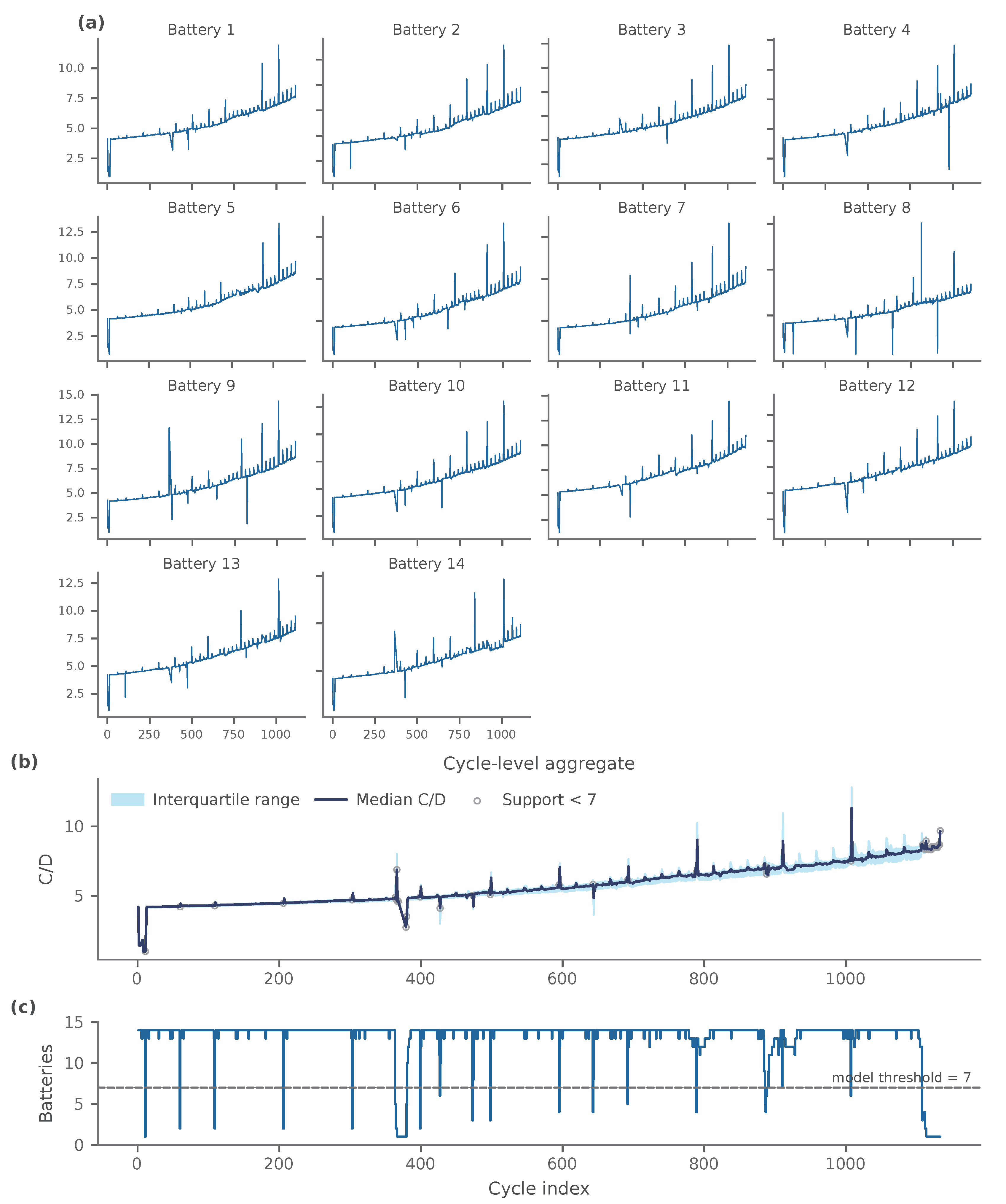
For the aggregate comparisons, regular-eligible observations were grouped by original cycle index and represented by median . Because cycle indices increase strictly within each reconstructed battery, group size is also the number of contributing batteries. The complete aggregate contained 1,121 cycle indices. Requiring
retained 1,071 aggregate observations and excluded 50 low-support tail medians. The hierarchical analysis instead retained all 14,848 battery–cycle rows and battery membership. These likelihoods therefore use different observation units and implicit battery weighting.
Bayesian models use global, rather than battery-specific, standardization. For A1, ; for H5.1 the corresponding values are . Standard deviations use divisor n. The transformations are defined in Section 5.1.
The preprocessing is deterministic, reversible, and reproducible, but it cannot recover information absent from the derivative source. Battery identity depends on row order, and the cycle classes are operational rules rather than experimental protocol labels.
5. Changepoint Definitions and Aggregate Models
5.1. Notation, Scaling, and Inferential Targets
Let c denote cycle index and y the response defined in Equation (2). The deterministic aggregate models are reported in original cycle and units. The Bayesian models use standardized coordinates
where and are population standard deviations computed with divisor n. Scaling is global over the relevant model input and is not performed separately by battery. For a standardized transition location , width w, slope , and residual scale , original-unit summaries are obtained from
The main inferential distinction is between evidence that the empirical degradation indicator accelerates and localization of the transition. Acceleration is represented by a positive slope increment. Transition location is definition-dependent: a sharp broken-stick intersection, a smooth-transition midpoint, and a maximum-curvature knee are related but non-equivalent estimands. Table 4 summarizes the five model roles used in the study.
Figure 1.
Battery-level and aggregate evolution of the charging-to-discharge duration ratio. Panel (a) shows the 14 regular-eligible battery trajectories. Panel (b) shows the cycle-level median and interquartile range; open markers identify cycles supported by fewer than seven batteries. Panel (c) shows aggregate support and the model threshold.
Figure 1.
Battery-level and aggregate evolution of the charging-to-discharge duration ratio. Panel (a) shows the 14 regular-eligible battery trajectories. Panel (b) shows the cycle-level median and interquartile range; open markers identify cycles supported by fewer than seven batteries. Panel (c) shows aggregate support and the model threshold.
5.2. Aggregate Deterministic References
All deterministic references use the same 1,071-cycle median aggregate described in Section 4.3.
5.2.1. No-Transition Linear Model B0
The no-transition reference is
The coefficients are estimated by ordinary least squares using the design matrix . B0 intentionally has no changepoint parameter. Its role is to provide a constant-slope reference for assessing whether a change in degradation rate is needed.
5.2.2. Continuous broken-stick model D1
The sharp-transition model is the continuous broken stick
with post-transition slope . For a fixed , a, , and are obtained by least squares. The breakpoint minimizes the resulting residual sum of squares using bounded scalar optimization with tolerance . The admissible domain excludes the first and last aggregate observations, ensuring an interior breakpoint. The implementation uses bounded optimization directly; it does not construct the dense candidate grid mentioned in an earlier code comment.
Breakpoint uncertainty is estimated by a moving-block residual bootstrap [46]. Residuals are centred, contiguous blocks of length 25 are sampled uniformly from all valid start positions, concatenated until n values are available, truncated to length n, added to the fitted trajectory, and the model is refitted. The final analysis uses 500 successful replicates and seed 20260614. The reported 95% interval is the equal-tailed percentile interval obtained from the 0.025 and 0.975 empirical quantiles. The resulting breakpoint is conditional on the selected preprocessing, aggregation, support threshold, and broken-stick definition.
5.2.3. Smoothing-Spline Curvature Reference S1
S1 fits a cubic smoothing spline to the aggregate trajectory and defines the candidate knee by maximum geometric curvature,
Curvature is evaluated on a 500-point grid after excluding 5% of the observations at each boundary. Exact ties are resolved by the first grid maximum.
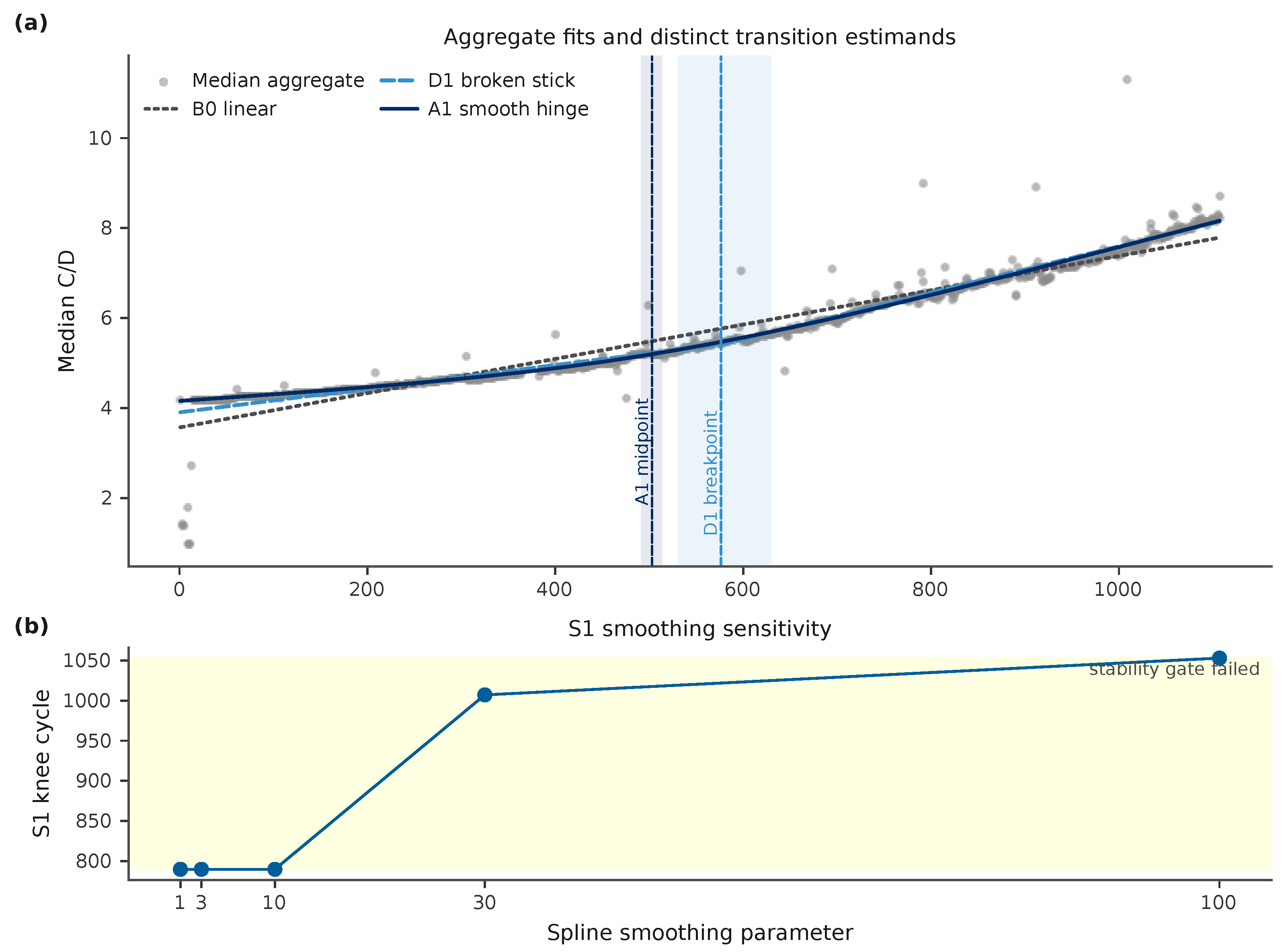
Because curvature knees depend on the smoothing penalty, the procedure is repeated for , with designated as the primary setting. A knee is considered stable only if all fits succeed and the range of selected locations does not exceed 100 cycles. Optional standard-deviation and same-local-region criteria are disabled in the locked configuration. The method is retained to quantify smoothing sensitivity and is interpreted only when the stability gate passes.
5.3. Aggregate Bayesian Smooth-Transition Model A1
The aggregate Bayesian model uses the standardized aggregate response. Its smooth hinge is unanchored:
The latent mean is
with asymptotic post-transition slope . The observation model is
The parameter is the midpoint of a gradual slope transition, not the intersection of two sharp linear segments.
All A1 priors are defined on the standardized scale:
Here, and are the standardized cycle values at the lower and upper 10% interior limits of the 1,071-observation aggregate. Thus, unlike H5.1, A1 imposes a hard interior support on its transition midpoint.
6. Hierarchical Bayesian Degradation Model
6.1. Hierarchical Bayesian Smooth-Transition Model H5.1
The principal model retains the 14 battery trajectories and partially pools battery-specific levels, slopes, slope increments, and transition midpoints. For observation i from battery j, define the anchored hinge
which satisfies . The standardized mean and likelihood are
The battery-specific post-transition slope is . The common transition width w and residual scale are shared across batteries, while the Student-t degrees of freedom are fixed at four.
The four active battery hierarchies use centred parameterizations:
The quantity is the standardized midpoint of the common preferred transition interval derived from battery-specific 10% interior ranges. The Normal priors on are unbounded: the preferred interval is used for prior centering and identifiability diagnostics, not for truncation.
The common width prior is a shifted log-normal construction,
so the positive component has median 100 cycles and the total width has a 5-cycle floor and prior median 105 cycles in original units. The common residual scale is
H5.1 has no battery-specific residual-scale hierarchy. Configuration fields for such a hierarchy are inactive at this stage and are not part of the fitted model.
6.2. Population and Battery-Level Summaries
Scientific summaries are transformed to original units using Equation (7). At posterior draw m, the population transition midpoint is defined as the arithmetic mean of the 14 battery midpoints,
and between-battery heterogeneity is summarized by the draw-wise population standard deviation with divisor J,
Population pre-transition, post-transition, and slope-change summaries are defined analogously as draw-wise means of the battery-specific values. These exported summaries are functions of the battery-level posterior and are distinct from the hyperparameters , , and .
Evidence of accelerated degradation for battery j is quantified by
and the corresponding population statement is evaluated from the draw-wise mean slope increment.
The width w is a smooth-hinge scale, not the duration of a uniquely defined physical phase. For the associated logistic slope transition, the approximate 25–75% and 10–90% spans are and , respectively. These spans are used only to communicate transition smoothness.
6.3. Posterior Computation and Diagnostic Gates
Bayesian inference was implemented in PyMC [43] using the No-U-Turn Sampler as implemented in the Stan/PyMC computational framework [45]. Posterior summaries and diagnostics were computed with ArviZ [44]. Rank-normalized split and bulk and tail effective sample sizes follow Vehtari et al. [42].
The accepted A1 run used four chains, 2,000 tuning iterations, and 2,000 retained draws per chain, with seed 20260614, target acceptance 0.95, maximum tree depth 10, and PyMC automatic initialization. No dense metric was explicitly requested. The accepted H5.1 run used four chains, 3,000 tuning iterations, and 2,000 retained draws per chain, with seed 20260615, target acceptance 0.95, maximum tree depth 10, and jitter+adapt_full initialization, which adapts a dense mass matrix.
Interpretation was permitted only after the production gates in Table 5 were passed. Divergences were counted from the post-warm-up diverging indicator; tree-depth saturation was defined as a post-warm-up draw with tree depth at least the configured maximum; and E-BFMI was the minimum ArviZ value across chains. For A1, convergence summaries were evaluated over the model variables returned by the diagnostic pipeline. The final H5.1 gate used the maximum rank-normalized across all exported posterior coordinates, bulk and tail ESS for predefined key parameters, and global geometry checks.
The archived posterior files report PyMC 5.25.1 and ArviZ 0.21.0; H5.1 execution metadata records Python 3.11.15 on macOS arm64. Exact sampling-time versions of several lower-level dependencies were not archived.
7. Model Assessment Under Complete and Incomplete Observations
7.1. Posterior Predictive Assessment
The hierarchical posterior predictive assessment reused the accepted H5.1 posterior. Five hundred draw indices were sampled without replacement and applied to each chain, yielding 2,000 chain-balanced posterior states. Central equal-tailed intervals were evaluated at 50%, 80%, 90%, and 95%. Residuals were defined as observed minus the posterior median latent mean in original units. Diagnostics included pooled and battery-specific coverage, residual bias, associations of signed and absolute residuals with cycle index, battery-specific scale discrepancies, within-battery autocorrelation at lags 1–20, and standardized tail discrepancies. These checks assess observation-model adequacy separately from MCMC convergence.
7.2. Sparse-Observation Experiments
Two missing-data geometries were analysed. Endpoint-preserving random thinning retained approximately 50% of observations within each battery, always including the first and last rows; four masks used seeds 20260616–20260619. The same battery-row mask was applied before A1 aggregation and H5.1 fitting. Held-out battery-level rows therefore remained within the observed cycle range and represented interpolation.
Trajectory truncation retained observations satisfying
Withheld H5.1 rows were consequently extrapolation. For each scenario, the analysis reported transition displacement relative to the full-data median, the 95% HDI-width ratio, battery-rank preservation, held-out error, and predictive coverage.
7.3. Post-Transition Support and Comparison Limits
For battery j and scenario s, post-transition horizon was defined as
where is the observed endpoint and is the accepted full-data midpoint. Its association with absolute transition displacement and HDI-width inflation was evaluated by Spearman correlation. Availability classes distinguished endpoints before the full-data interval, within it, and less than one, one to two, or at least two common transition widths beyond the midpoint. A full-data battery was labelled boundary-sensitive when its transition interval lay close to a preferred boundary or substantial posterior mass fell outside the preferred interior range; the label was diagnostic, not an exclusion rule.
A1 and H5.1 were not ranked by pointwise LOO or WAIC because their likelihood contributions refer to different observation units: cycle medians and battery–cycle rows. Predictive comparisons were therefore restricted to explicit model, scenario, representation, and held-out domains. Likewise, convergence diagnostics establish computational reliability, not scientific parsimony.
8. Results
8.1. Aggregate Transition Estimates
Table 6 compares the transition definitions on the common 1,071-cycle median aggregate. B0 estimated a constant slope of per cycle. D1 located a sharp breakpoint at 576.4 cycles (95% moving-block-bootstrap interval 531.5–628.8), with slopes increasing from to per cycle.
A1 placed the midpoint of a gradual transition earlier, at 503.0 cycles (95% HDI 492.3–512.9), with width 129.2 cycles (112.7–146.9). Its slope increased from to per cycle, and . The fitted degrees of freedom concentrated near two, indicating the need for very heavy tails in the aggregate likelihood. S1 failed its smoothing-stability gate: candidate knees spanned 263.2 cycles across the smoothing ladder. Figure 2 shows why the D1 breakpoint, A1 midpoint, and S1 curvature maximum should not be treated as repeated estimates of one parameter.
Figure 2.
Operational transition definitions on the aggregate trajectory. Panel (a) compares B0, D1, and A1; vertical bands denote the D1 bootstrap interval and A1 95% HDI. Panel (b) shows the smoothing dependence of S1, which failed its stability gate.
Figure 2.
Operational transition definitions on the aggregate trajectory. Panel (a) compares B0, D1, and A1; vertical bands denote the D1 bootstrap interval and A1 95% HDI. Panel (b) shows the smoothing dependence of S1, which failed its stability gate.
The accepted A1 posterior passed all production diagnostics, including zero divergences and tree-depth saturations, maximum , and minimum bulk ESS 1,723.
8.2. Hierarchical Transition Timing and Acceleration
H5.1 provided strong evidence of acceleration at both population and battery levels. The draw-wise mean of battery-specific transition midpoints was 553.9 cycles (95% HDI 547.1–560.9), while the between-battery midpoint standard deviation was 142.0 cycles (130.1–154.6; Table 7).
The shared width was 183.7 cycles (172.4–195.7), indicating a broad transition rather than an abrupt switch. The population slope increased from to per cycle; the slope increment was (0.005327–0.005829), with posterior probability one of being positive. All 14 batteries likewise had posterior probability one of a positive increment. Battery 14 had the earliest midpoint, 351.8 cycles (324.8–376.3), and Battery 11 the latest, 928.8 cycles (880.3–974.8); Battery 11 was boundary-sensitive but retained.
Figure 3.
Battery-specific H5.1 transition midpoints. Points are posterior medians and intervals are 95% HDIs; the population marker is the draw-wise mean. Battery 14 is earliest and Battery 11 is latest and boundary-sensitive.
Figure 3.
Battery-specific H5.1 transition midpoints. Points are posterior medians and intervals are 95% HDIs; the population marker is the draw-wise mean. Battery 14 is earliest and Battery 11 is latest and boundary-sensitive.
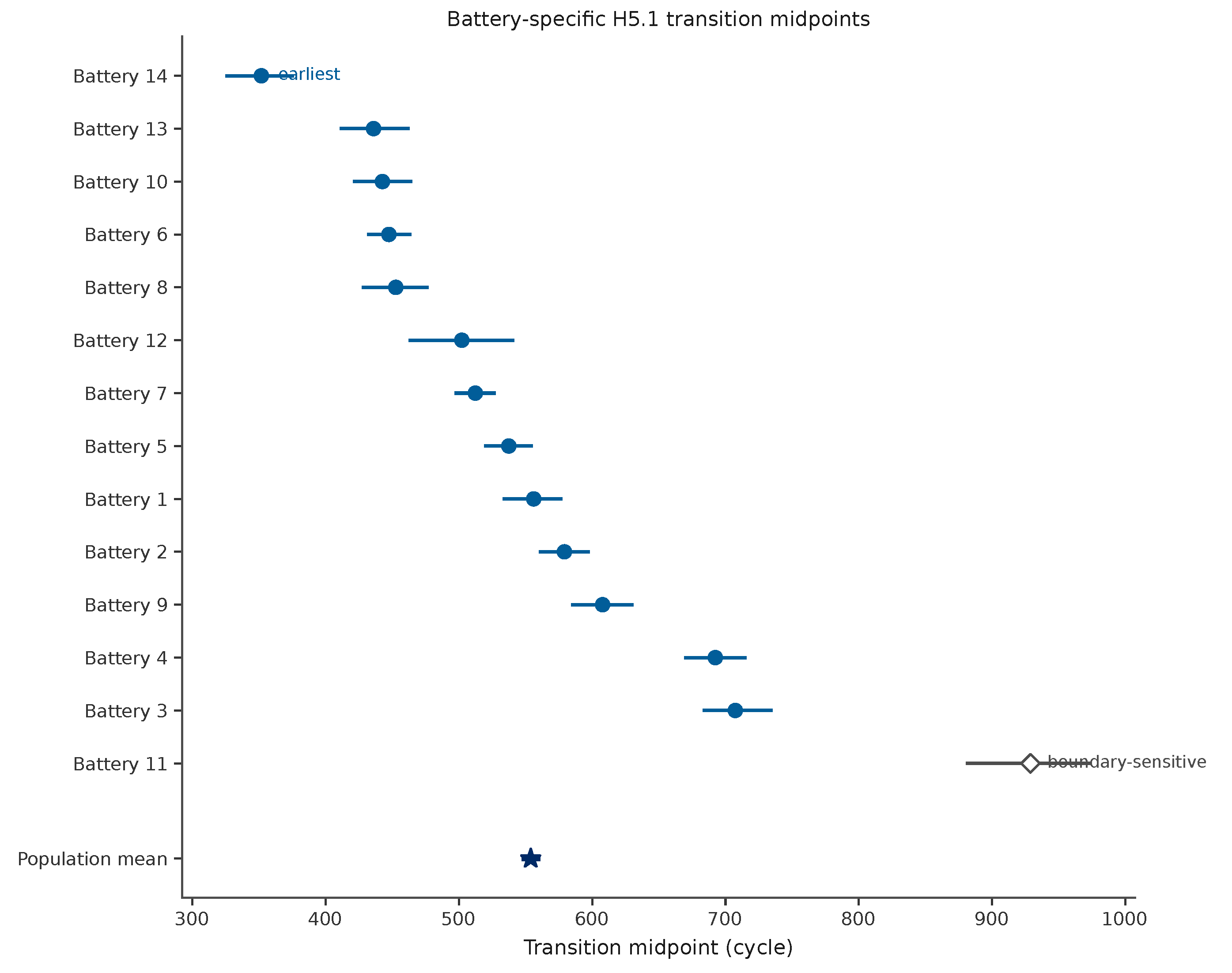
Figure 4.
Battery-specific degradation-rate acceleration. Panel (a) compares posterior-median pre- and post-transition slopes. Panel (b) shows slope increments and 95% HDIs; all are positive with posterior probability one.
Figure 4.
Battery-specific degradation-rate acceleration. Panel (a) compares posterior-median pre- and post-transition slopes. Panel (b) shows slope increments and 95% HDIs; all are positive with posterior probability one.
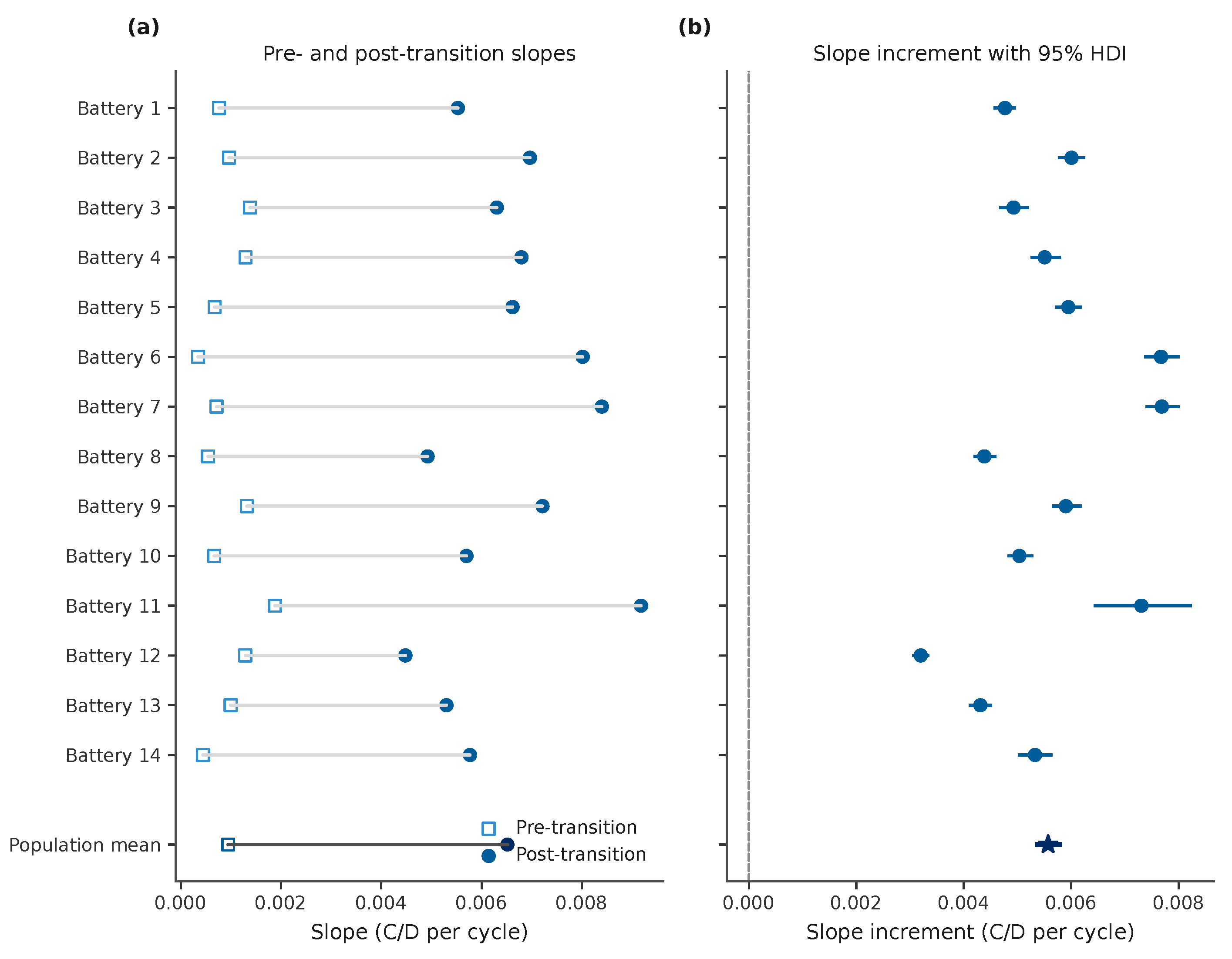
Figure 5.
Representative H5.1 fits for an early transition (Battery 14), a midpoint near the population value (Battery 1), a later well-identified transition (Battery 3), and boundary-sensitive Battery 11. Curves show posterior median latent means with 90% intervals; vertical markers show transition summaries.
Figure 5.
Representative H5.1 fits for an early transition (Battery 14), a midpoint near the population value (Battery 1), a later well-identified transition (Battery 3), and boundary-sensitive Battery 11. Curves show posterior median latent means with 90% intervals; vertical markers show transition summaries.
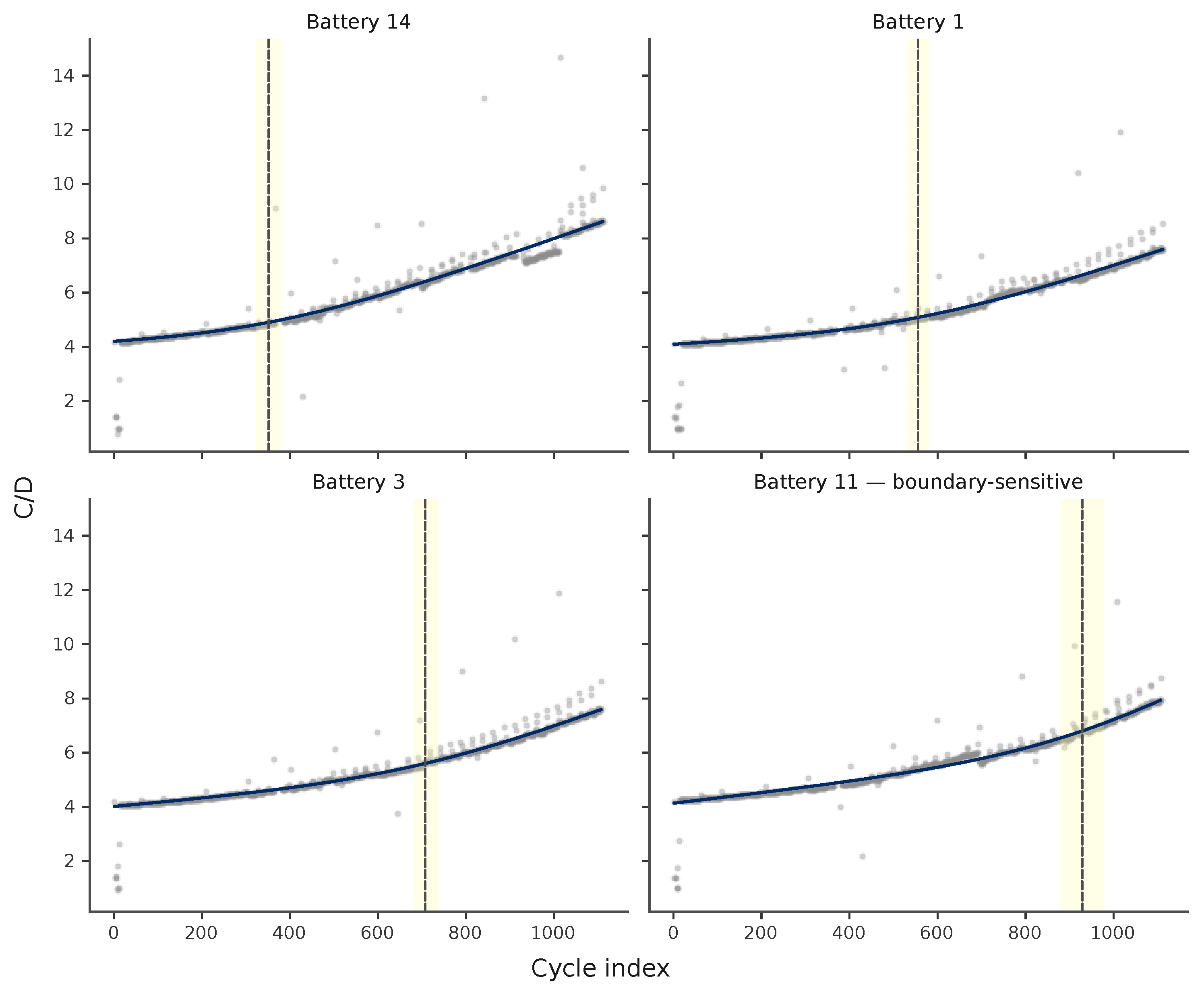
The final H5.1 run passed all production gates: maximum rank-normalized , minimum key-parameter bulk and tail ESS of 4,577.7 and 4,964.6, zero divergences and tree-depth saturations, and minimum E-BFMI 0.939.
8.3. Posterior Predictive Adequacy
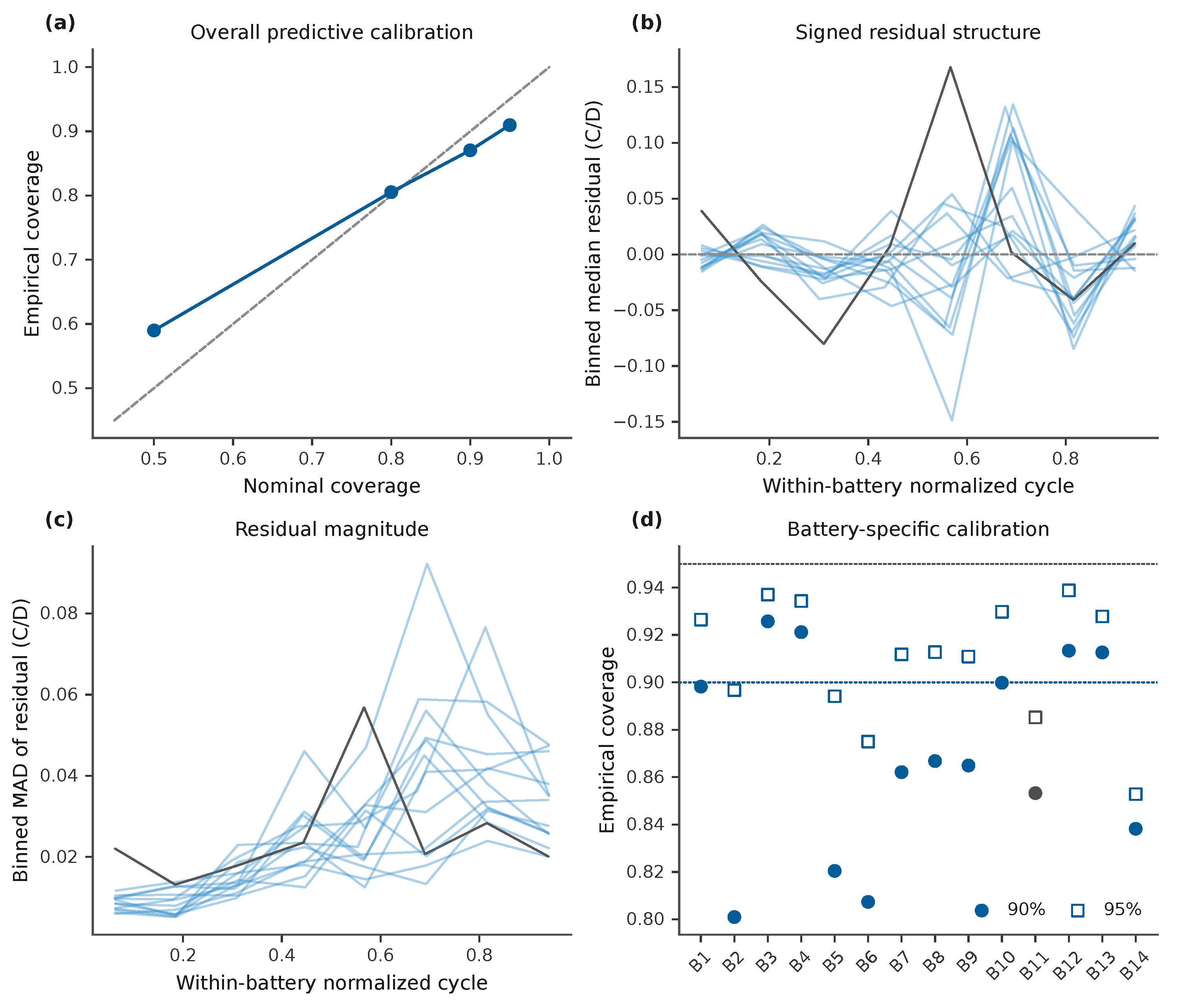
Across 14,848 observations, empirical coverage was 0.590, 0.805, 0.870, and 0.910 for nominal 50%, 80%, 90%, and 95% intervals. Mean and median residuals were 0.01244 and , and signed residuals had little monotone association with cycle (). Absolute residuals increased with cycle (), while battery-level checks retained short-range dependence and tail discrepancies. H5.1 therefore captures the mean transition structure required for inference but not all late-life heteroscedasticity or temporal variation.
Figure 6.
Posterior predictive assessment of H5.1. Panel (a) compares nominal and empirical coverage; panels (b) and (c) show signed residuals and residual magnitude over normalized cycle position; panel (d) shows battery-specific 90% and 95% coverage.
Figure 6.
Posterior predictive assessment of H5.1. Panel (a) compares nominal and empirical coverage; panels (b) and (c) show signed residuals and residual magnitude over normalized cycle position; panel (d) shows battery-specific 90% and 95% coverage.
8.4. Incomplete Observations and Transition Identifiability
Random thinning.
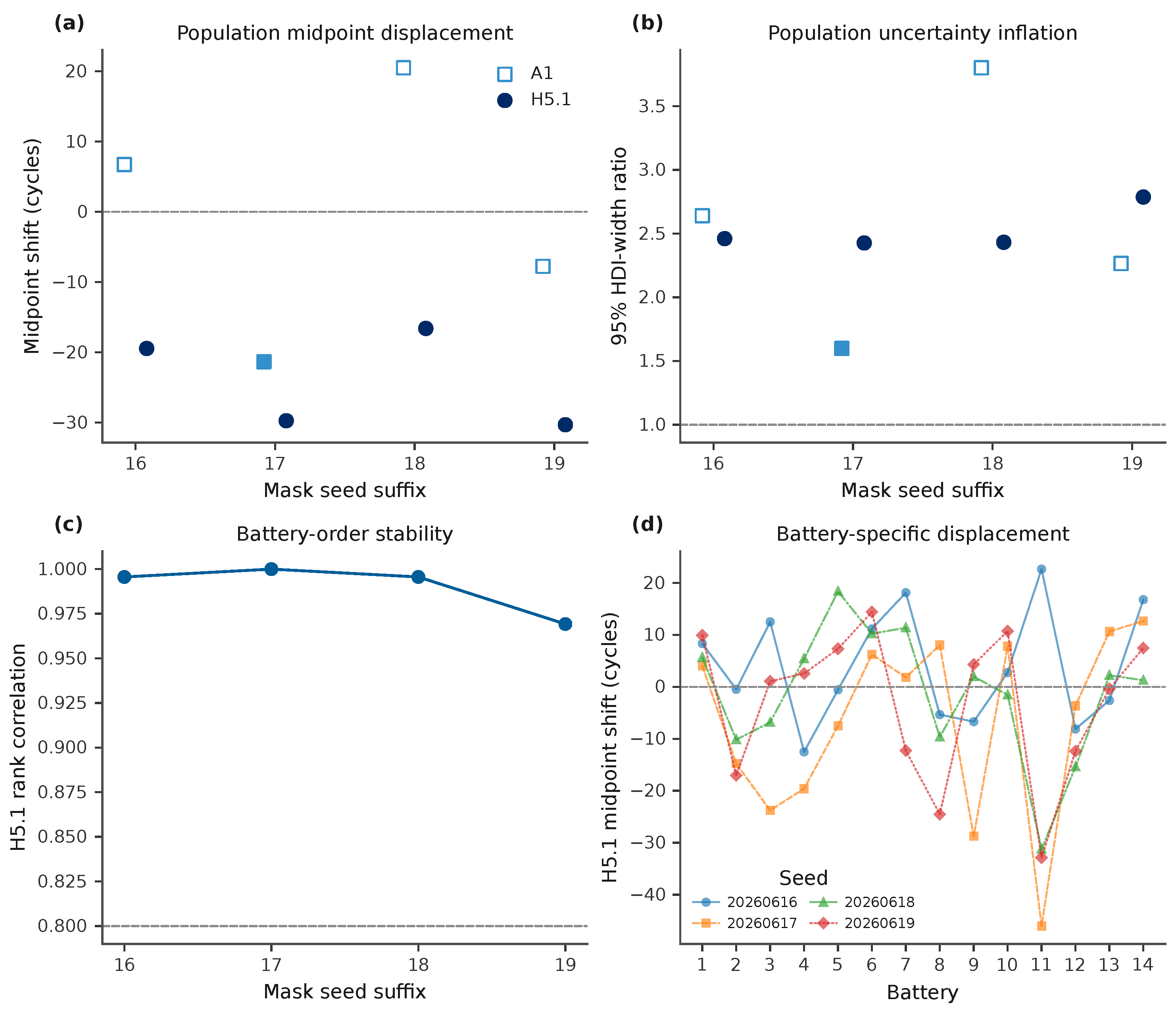
Across four endpoint-preserving masks retaining approximately 50% of observations, A1 midpoint shifts ranged from to cycles and averaged cycles. For H5.1, the population shift averaged cycles, while battery ordering remained highly stable (mean Spearman , minimum 0.969). Uncertainty roughly doubled, but positive slope-change probabilities remained one. Held-out H5.1 interpolation achieved RMSE 0.418 and mean 90%/95% coverage of 0.874/0.911.
Figure 7.
Robustness to endpoint-preserving removal of approximately half the observations. Panels show population midpoint displacement, uncertainty inflation, H5.1 battery-rank correlation, and battery-specific midpoint shifts. Open A1 markers denote diagnostic-only fits that failed an ESS criterion.
Figure 7.
Robustness to endpoint-preserving removal of approximately half the observations. Panels show population midpoint displacement, uncertainty inflation, H5.1 battery-rank correlation, and battery-specific midpoint shifts. Open A1 markers denote diagnostic-only fits that failed an ESS criterion.
Trajectory truncation.
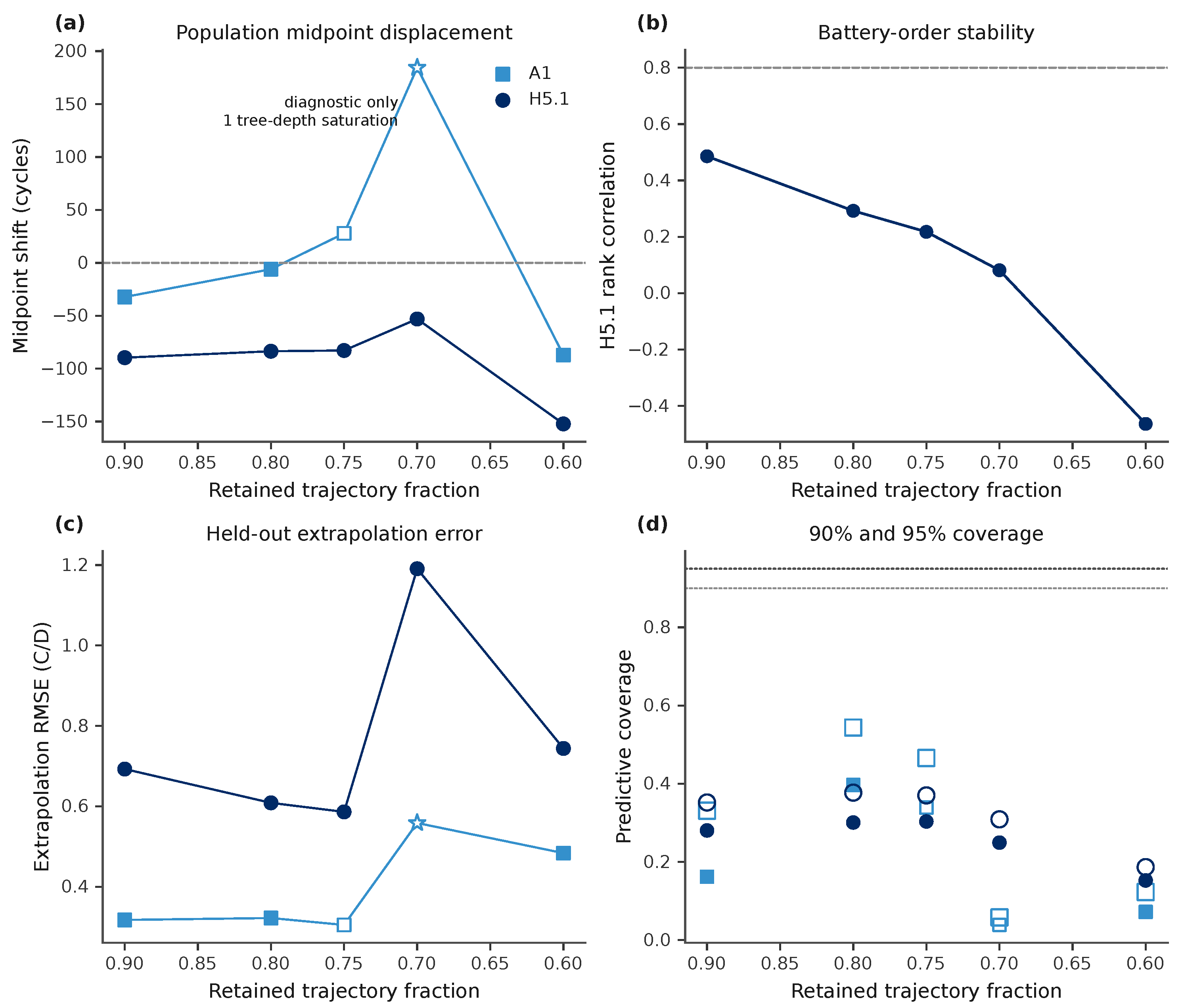
Removing late observations produced a qualitatively different result. Positive slope-change probability remained one, but midpoint localization, battery ordering, and extrapolative coverage deteriorated (Table 8). H5.1 population shifts ranged from to cycles, and rank correlation fell from 0.486 at 90% retention to at 60%. The A1 result at 70% retention had one tree-depth saturation and is descriptive only.
Figure 8.
Sensitivity to shortened observation horizons. Panel (a) shows population midpoint shifts for A1 and H5.1. Panel (b) shows H5.1 battery-rank correlation. Panel (c) reports extrapolation RMSE, and panel (d) reports empirical 90% and 95% coverage. Open markers denote diagnostic-only fits; the starred A1 result at 70% retention contained one tree-depth saturation.
Figure 8.
Sensitivity to shortened observation horizons. Panel (a) shows population midpoint shifts for A1 and H5.1. Panel (b) shows H5.1 battery-rank correlation. Panel (c) reports extrapolation RMSE, and panel (d) reports empirical 90% and 95% coverage. Open markers denote diagnostic-only fits; the starred A1 result at 70% retention contained one tree-depth saturation.
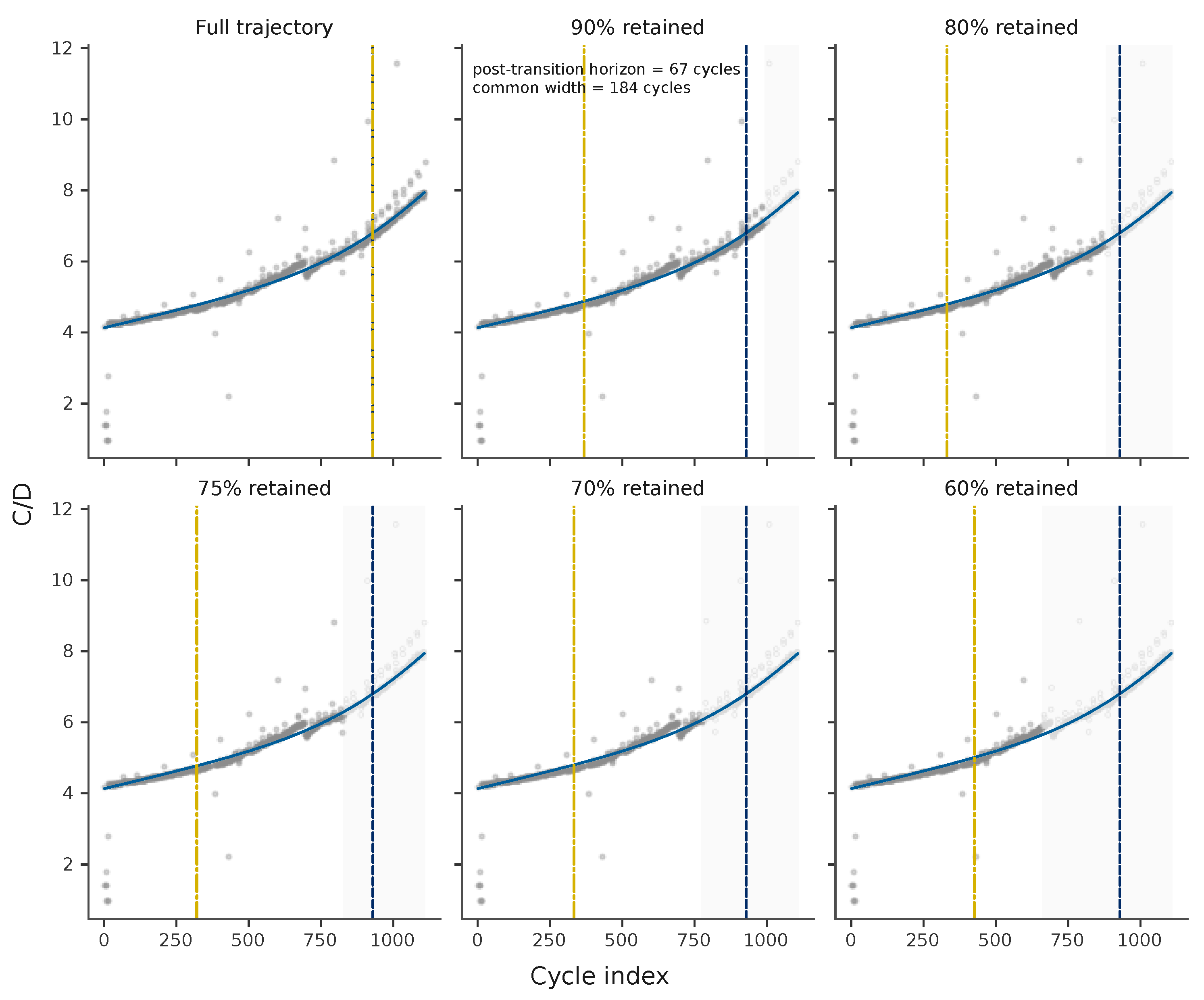
Across battery–scenario combinations, post-transition horizon correlated strongly with absolute midpoint displacement () but more weakly with HDI-width inflation (). Thus, a posterior may be narrow around a displaced location. Battery 11 was the clearest limit case: at 90% retention its endpoint lay 67 cycles beyond the full-data midpoint, still short relative to the 184-cycle common width, and its midpoint shifted by cycles. At 80% retention or less, the endpoint preceded the full-data midpoint.
Figure 9.
Post-transition support and identifiability. Panel (a) relates horizon to absolute midpoint displacement; panel (b) relates it to HDI-width change. Marker shape denotes availability class, and Battery 11 scenarios are labelled.
Figure 9.
Post-transition support and identifiability. Panel (a) relates horizon to absolute midpoint displacement; panel (b) relates it to HDI-width change. Marker shape denotes availability class, and Battery 11 scenarios are labelled.
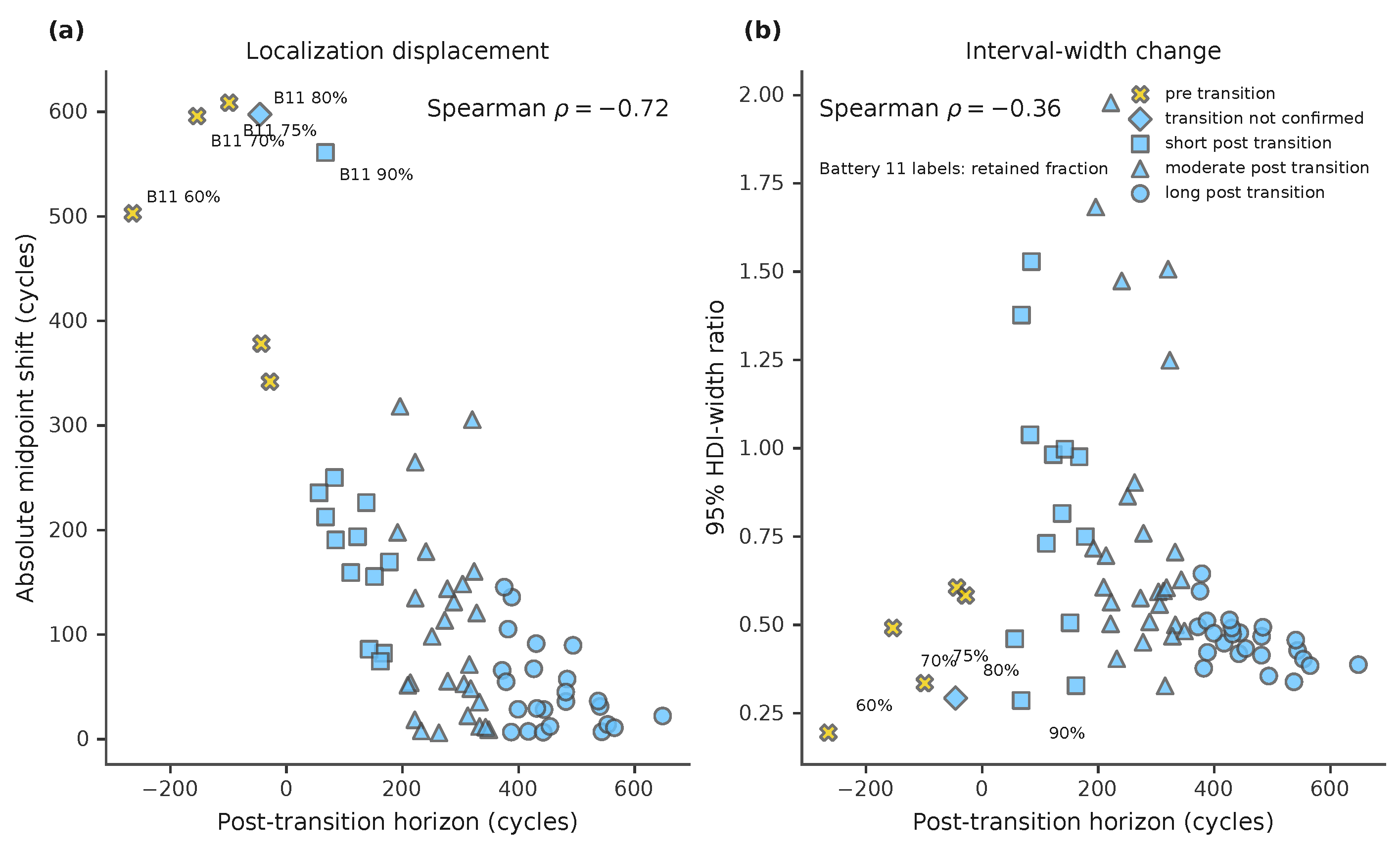
Figure 10.
Battery 11 as a localization limit case. The full-data fit is followed by five truncation scenarios showing retained and withheld observations, the full-data midpoint, and the scenario midpoint. Partial pooling preserves evidence of acceleration but cannot recover an unobserved battery-specific late regime.
Figure 10.
Battery 11 as a localization limit case. The full-data fit is followed by five truncation scenarios showing retained and withheld observations, the full-data midpoint, and the scenario midpoint. Partial pooling preserves evidence of acceleration but cannot recover an unobserved battery-specific late regime.
Overall, acceleration detection was substantially more robust than transition localization. Distributed sparsity primarily increased uncertainty, whereas loss of the late trajectory removed the evidence needed to place the transition and predict the withheld regime.
9. Discussion
9.1. Battery Interpretation and Heterogeneity
The estimated transition is a change in the trajectory of the empirical indicator, not a universal physical failure cycle. combines two protocol-dependent phase durations and is neither a direct capacity measure nor a mechanism-specific diagnostic. The transition may reflect the combined consequences of several electrochemical, thermal, and mechanical processes, and its physical interpretation would require raw signals, protocol metadata, and independent diagnostics [6,29,30,32].
The different locations produced by D1, A1, and H5.1 are therefore informative rather than contradictory. D1 estimates the intersection of two sharp linear regimes, A1 the midpoint of a gradual aggregate transition, and H5.1 the mean of battery-specific smooth midpoints. S1 additionally showed that a geometric curvature knee can be highly smoothing-sensitive. Battery studies should consequently report the transition definition and observation structure together with the cycle estimate. The broad H5.1 width, about 184 cycles, further supports interpretation as gradual acceleration rather than an instantaneous regime change.
The hierarchical results show why one aggregate trajectory is insufficient. Acceleration was supported for every reconstructed battery, yet the between-battery standard deviation of transition timing was about 142 cycles. This is consistent with known variability among nominally similar commercial cells [15]. In practical packs and fleets, manufacturing tolerances, thermal gradients, imbalance, and heterogeneous use can add further dispersion. A fixed maintenance or alarm cycle for an entire population would therefore be poorly aligned with individual trajectories.
Partial pooling provides a useful compromise: it stabilizes battery-specific estimates while retaining heterogeneity. It does not, however, create evidence that was never observed. Battery 11 illustrates this boundary. Its positive slope change remained supported, but its late transition was boundary-sensitive in the full data and displaced by several hundred cycles after truncation. This is not a failure of hierarchy; it is a direct indication that population information cannot replace battery-specific observations of the late regime.
9.2. Applicability to Battery and Energy-Storage Monitoring
The strongest practical result is the contrast between distributed sparsity and shortened histories. Removing approximately half the measurements across the full trajectory widened uncertainty but preserved the acceleration conclusion and almost preserved battery ordering. Removing the late segment destabilized transition localization, ranking, and extrapolative coverage. Monitoring performance therefore depends more on when measurements are available than on their nominal count.
This distinction can guide data-acquisition and maintenance workflows. When telemetry, storage, or test capacity is limited, a reduced measurement schedule may remain adequate if it preserves observations throughout the battery lifetime. Conversely, dense early-life measurements cannot establish the location of a later transition. Once acceleration is suspected, continued observation through a sufficiently long post-transition interval is needed before the estimated midpoint is used for service planning, repurposing assessment, or escalation to more informative diagnostics. The post-transition horizon offers a practical way to express this evidential requirement.
The framework can support three retrospective monitoring tasks. First, the posterior slope increment quantifies whether degradation has accelerated. Second, battery-specific transition distributions identify heterogeneity and cases requiring additional observation. Third, posterior uncertainty prevents an apparently precise population cycle from becoming a universal intervention threshold. In a fleet or stationary-storage setting, these outputs could be used to prioritize batteries for confirmatory capacity, resistance, impedance, or thermal testing rather than to trigger an automatic safety action.
The results also delimit the role of the method. Stable evidence for a positive slope change under truncation did not imply accurate transition localization or late-trajectory prediction. The model is therefore not a validated prospective alarm or RUL predictor. Sequential detection would require fitting and evaluating the model using only information available at each cycle, while operational deployment would require comparable protocols, temperature and current covariates, decision thresholds, computational benchmarking, and prospective validation. The output should complement, not replace, SOH/RUL estimators, BMS protection logic, and safety diagnostics [27,28,47].
The same modelling structure is not tied to . It could be applied to capacity, resistance, voltage-curve, temperature, or impedance-derived indicators, and richer sensing could improve physical attribution [13,14,31,33]. Each application would nevertheless require a new observation model and validation under the relevant measurement protocol.
9.3. Limitations and Further Work
The analysis uses one derivative public dataset containing cycle-level summaries. Battery identifiers were reconstructed from row order, and long-duration and incomplete-cycle classes were defined by reproducible but heuristic rules. The original waveform extraction, detailed protocol variables, and environmental covariates are unavailable. The reported results are therefore conditional on the supplied representation, classification thresholds, and seven-battery aggregate-support rule.
The response is empirical and protocol-dependent. It cannot distinguish capacity fade, resistance growth, lithium plating, active-material loss, or thermal degradation. External validation should compare inferred transitions with reference capacity, resistance, voltage-curve, temperature, and impedance measurements across chemistries, formats, and cycling conditions.
Posterior predictive checks also show that H5.1 is not a complete stochastic degradation model. Residual magnitude increases with cycle, short-range dependence remains, and upper predictive intervals under-cover. Battery-specific or cycle-dependent variance, temporal residual models, and multivariate latent health indicators are plausible extensions, but they should be accepted only when they improve predictive calibration without undermining identifiability. Convergence of the current posterior establishes computational reliability, not unique model optimality.
Finally, the missing-data study considered random thinning and deterministic truncation. Real monitoring may involve clustered outages, irregular sampling, sensor drift, protocol changes, or state-dependent missingness. Future work should include these structures and evaluate genuinely sequential inference and decision-oriented metrics. The central distinction should remain explicit: detecting acceleration, localizing its transition, and forecasting future battery life are related but separate tasks.
10. Conclusions
This study developed an uncertainty-aware framework for identifying acceleration in a cycle-level lithium-ion battery degradation indicator. Comparison of sharp, curvature-based, and Bayesian smooth-transition definitions showed that a reported transition cycle depends on the estimand: D1 located a sharp breakpoint near 576 cycles, A1 placed the midpoint of gradual aggregate acceleration near 503 cycles, and the curvature knee was not stable to smoothing.
The hierarchical H5.1 model provided the main battery-level result. The population mean of battery-specific midpoints was about 554 cycles, with a between-battery standard deviation of about 142 cycles and a shared transition width of about 184 cycles. All 14 batteries had posterior probability one of a positive slope increment. Acceleration was therefore common, but its timing was heterogeneous and gradual rather than an instantaneous population-wide switch.
Incomplete observations revealed a practical asymmetry. Endpoint-preserving removal of approximately half the data increased uncertainty but retained the acceleration conclusion and nearly preserved battery ordering. Trajectory truncation produced large transition shifts, deteriorating rankings, and poor extrapolative coverage. Reliable localization depended on observing a sufficiently long post-transition segment, not simply on retaining a large percentage of the trajectory.
For monitoring applications, the framework can support retrospective confirmation of accelerated ageing, battery-specific uncertainty assessment, and prioritization of assets for further diagnostic testing. It should not be interpreted as a prospective changepoint alarm or a long-horizon RUL predictor. The analysis is also limited by the derivative dataset, reconstructed identifiers, heuristic cycle classes, and the protocol-dependent indicator. Validation on independent datasets and richer electrical, thermal, capacity, resistance, or impedance measurements is required before operational deployment.
The main conclusion is therefore that transition detection and transition localization are not equally robust. Degradation-rate acceleration can remain strongly supported under substantial distributed observation loss, whereas precise localization requires an explicit transition definition and adequate evidence from the post-transition regime.
Author Contributions
Conceptualization, A.J.-K., W.B. and J.B.; Methodology, W.B. and A.J.-K.; Software, W.B. and J.B; Validation, A.J.-K. and J.B; Formal analysis, W.B.; Investigation, A.J.-K.; Resources, A.J.-K.; Data curation, W.B.; Visualization, A.J.-K.; Writing—original draft, A.J.-K.; Writing—review and editing, J.B., A.J.-K. and W.B.; Supervision, J.B.; Project administration, J.B.; Funding acquisition, J.B. All authors have read and agreed to the published version of the manuscript.
Funding
Work of all authors was financed by AGH University of Krakow subvention for scientific research
Institutional Review Board Statement
Not applicable.
Informed Consent Statement
Not applicable.
Data Availability Statement
The analysis uses the public “Battery Remaining Useful Life (RUL)” cycle-level dataset curated by I. Viñuales (accessed 21 June 2026). The analysis replication package is in the repository battery-degradation-changepoint-public on Github.
Acknowledgments
During preparation of the manuscript, the authors used an AI-assisted language model (ChatGPT 5.5) for language refinement and structural review. All scientific content, numerical results, interpretations, and references were reviewed by the authors, who take full responsibility for the manuscript.
Conflicts of Interest
The authors declare no conflicts of interest.
Symbols
The following symbols are used in this manuscript:
| Charging-to-discharge duration ratio | |
| Aggregate and battery-specific transition midpoint | |
| Aggregate and battery-specific slope increment | |
| w | Smooth-transition width |
| Residual scale | |
| Degrees of freedom of the Student-t distribution | |
| Normal distribution with mean and variance | |
| Half-normal distribution with scale | |
| Uniform distribution on | |
| Exponential distribution with rate | |
| Student-t distribution with degrees of freedom , location , and scale |
References
- Dunn, B.; Kamath, H.; Tarascon, J.M. Electrical Energy Storage for the Grid: A Battery of Choices. Science 2011, 334, 928–935. [Google Scholar] [CrossRef] [PubMed]
- Hesse, H.C.; Schimpe, M.; Kucevic, D.; Jossen, A. Lithium-Ion Battery Storage for the Grid—A Review of Stationary Battery Storage System Design Tailored for Applications in Modern Power Grids. Energies 2017, 10, 2107. [Google Scholar] [CrossRef]
- Zubi, G.; Dufo-López, R.; Carvalho, M.; Pasaoglu, G. The Lithium-Ion Battery: State of the Art and Future Perspectives. Renew. Sustain. Energy Rev. 2018, 89, 292–308. [Google Scholar] [CrossRef]
- Deng, D. Li-Ion Batteries: Basics, Progress, and Challenges. Energy Sci. Eng. 2015, 3, 385–418. [Google Scholar] [CrossRef]
- Vetter, J.; Novák, P.; Wagner, M.R.; Veit, C.; Möller, K.C.; Besenhard, J.O.; Winter, M.; Wohlfahrt-Mehrens, M.; Vogler, C.; Hammouche, A. Ageing Mechanisms in Lithium-Ion Batteries. J. Power Sources 2005, 147, 269–281. [Google Scholar] [CrossRef]
- Birkl, C.R.; Roberts, M.R.; McTurk, E.; Bruce, P.G.; Howey, D.A. Degradation Diagnostics for Lithium Ion Cells. J. Power Sources 2017, 341, 373–386. [Google Scholar] [CrossRef]
- O’Kane, S.E.J.; Ai, W.; Madabattula, G.; Alonso-Alvarez, D.; Timms, R.; Sulzer, V.; Edge, J.S.; Wu, B.; Offer, G.J.; Marinescu, M. Lithium-Ion Battery Degradation: How to Model It. Phys. Chem. Chem. Phys. 2022, 24, 7909–7922. [Google Scholar] [CrossRef] [PubMed]
- Attia, P.M.; Bills, A.; Brosa Planella, F.; Dechent, P.; dos Reis, G.; Dubarry, M.; Gasper, P.; Gilchrist, R.; Greenbank, S.; Howey, D.; et al. Review—“Knees” in Lithium-Ion Battery Aging Trajectories. J. Electrochem. Soc. 2022, 169, 060517. [Google Scholar] [CrossRef]
- Fermín-Cueto, P.; McTurk, E.; Allerhand, M.; Medina-Lopez, E.; Anjos, M.F.; Sylvester, J.; dos Reis, G. Identification and Machine Learning Prediction of Knee-Point and Knee-Onset in Capacity Degradation Curves of Lithium-Ion Cells. Energy AI 2020, 1, 100006. [Google Scholar] [CrossRef]
- Berecibar, M.; Gandiaga, I.; Villarreal, I.; Omar, N.; Van Mierlo, J.; Van den Bossche, P. Critical Review of State of Health Estimation Methods of Li-Ion Batteries for Real Applications. Renew. Sustain. Energy Rev. 2016, 56, 572–587. [Google Scholar] [CrossRef]
- Dubarry, M.; Svoboda, V.; Hwu, R.; Liaw, B.Y. Incremental Capacity Analysis and Close-to-Equilibrium OCV Measurements to Quantify Capacity Fade in Commercial Rechargeable Lithium Batteries. Electrochem. Solid-State Lett. 2006, 9, A454–A457. [Google Scholar] [CrossRef]
- Dubarry, M.; Anseán, D. Best Practices for Incremental Capacity Analysis. Front. Energy Res. 2022, 10, 1023555. [Google Scholar] [CrossRef]
- Naha, A.; Han, S.; Agarwal, S.; Yoon, J.; Oh, B. An Incremental Voltage Difference Based Technique for Online State of Health Estimation of Li-Ion Batteries. Sci. Rep. 2020, 10, 9526. [Google Scholar] [CrossRef] [PubMed]
- Yu, B.; Qiu, H.; Weng, L.; Liu, S.; Liu, H. A Health Indicator for the Online Lifetime Estimation of an Electric Vehicle Power Li-Ion Battery. World Electr. Veh. J. 2020, 11, 59. [Google Scholar] [CrossRef]
- Devie, A.; Baure, G.; Dubarry, M. Intrinsic Variability in the Degradation of a Batch of Commercial 18650 Lithium-Ion Cells. Energies 2018, 11, 1031. [Google Scholar] [CrossRef]
- Preger, Y.; Barkholtz, H.M.; Fresquez, A.J.; Campbell, D.L.; Juba, B.W.; Román-Kustas, J.; Ferreira, S.R.; Chalamala, B.C. Degradation of Commercial Lithium-Ion Cells as a Function of Chemistry and Cycling Conditions. J. Electrochem. Soc. 2020, 167, 120532. [Google Scholar] [CrossRef]
- Mishra, M.; Martinsson, J.; Rantatalo, M.; Goebel, K. Bayesian Hierarchical Model-Based Prognostics for Lithium-Ion Batteries. Reliab. Eng. Syst. Saf. 2018, 172, 25–35. [Google Scholar] [CrossRef]
- Zhou, Z.; Howey, D.A. Bayesian Hierarchical Modelling for Battery Lifetime Early Prediction. IFAC-PapersOnLine 2023, 56, 6117–6123. [Google Scholar] [CrossRef]
- Severson, K.A.; Attia, P.M.; Jin, N.; Perkins, N.; Jiang, B.; Yang, Z.; Chen, M.H.; Aykol, M.; Herring, P.K.; Fraggedakis, D.; et al. Data-Driven Prediction of Battery Cycle Life before Capacity Degradation. Nat. Energy 2019, 4, 383–391. [Google Scholar] [CrossRef]
- Attia, P.M.; Grover, A.; Jin, N.; Severson, K.A.; Markov, T.M.; Liao, Y.H.; Chen, M.H.; Cheong, B.; Perkins, N.; Yang, Z.; et al. Closed-Loop Optimization of Fast-Charging Protocols for Batteries with Machine Learning. Nature 2020, 578, 397–402. [Google Scholar] [CrossRef] [PubMed]
- Nitta, N.; Wu, F.; Lee, J.T.; Yushin, G. Li-Ion Battery Materials: Present and Future. Mater. Today 2015, 18, 252–264. [Google Scholar] [CrossRef]
- Goodenough, J.B.; Park, K.S. The Li-Ion Rechargeable Battery: A Perspective. J. Am. Chem. Soc. 2013, 135, 1167–1176. [Google Scholar] [CrossRef] [PubMed]
- Vishnumurthy, K.A.; Girish, K.H. A Comprehensive Review of Battery Technology for E-Mobility. J. Indian Chem. Soc. 2021, 98, 100173. [Google Scholar] [CrossRef]
- Barré, A.; Deguilhem, B.; Grolleau, S.; Gérard, M.; Suard, F.; Riu, D. A Review on Lithium-Ion Battery Ageing Mechanisms and Estimations for Automotive Applications. J. Power Sources 2013, 241, 680–689. [Google Scholar] [CrossRef]
- Ecker, M.; Nieto, N.; Käbitz, S.; Schmalstieg, J.; Blanke, H.; Warnecke, A.; Sauer, D.U. Calendar and Cycle Life Study of Li(NiMnCo)O2-Based 18650 Lithium-Ion Batteries. J. Power Sources 2014, 248, 839–851. [Google Scholar] [CrossRef]
- Schmalstieg, J.; Käbitz, S.; Ecker, M.; Sauer, D.U. A Holistic Aging Model for Li(NiMnCo)O2-Based 18650 Lithium-Ion Batteries. J. Power Sources 2014, 257, 325–334. [Google Scholar] [CrossRef]
- Ould Ely, T.; Kamzabek, D.; Chakraborty, D. Batteries Safety: Recent Progress and Current Challenges. Front. Energy Res. 2019, 7, 71. [Google Scholar] [CrossRef]
- Lai, X.; Yao, J.; Jin, C.; Feng, X.; Wang, H.; Xu, C.; Zheng, Y. A Review of Lithium-Ion Battery Failure Hazards: Test Standards, Accident Analysis, and Safety Suggestions. Batteries 2022, 8, 248. [Google Scholar] [CrossRef]
- Nováková, K.; Papež, V.; Sadil, J.; Knap, V. Review of Electrochemical Impedance Spectroscopy Methods for Lithium-Ion Battery Diagnostics and Their Limitations. Monatshefte Für Chem. – Chem. Mon. 2024, 155, 227–232. [Google Scholar] [CrossRef]
- Bakenhaster, S.T.; Dewald, H.D. Electrochemical Impedance Spectroscopy and Battery Systems: Past Work, Current Research, and Future Opportunities. J. Appl. Electrochem. 2025, 55, 1657–1681. [Google Scholar] [CrossRef]
- Xiao, Z.; Liu, C.; Zhao, T.; Kuang, Y.; Yin, B.; Yuan, R.; Song, L. Review—Online Monitoring of Internal Temperature in Lithium-Ion Batteries. J. Electrochem. Soc. 2023, 170, 050521. [Google Scholar] [CrossRef]
- Wang, W.; Liu, S.; Ma, X.Y.; Jiang, J.; Yang, X.G. Advancing Smart Lithium-Ion Batteries: A Review on Multi-Physical Sensing Technologies for Lithium-Ion Batteries. Energies 2024, 17, 2273. [Google Scholar] [CrossRef]
- Liu, Z.; Lu, Y.; Ma, X.; He, Y.; Fu, M.; Yan, S.; Li, C.; Song, X.; Zhou, H.; Liu, K. Advanced Functional Optical Fiber Sensors for Smart Battery Monitoring. Energy Mater. Adv. 2024, 5, 0142. [Google Scholar] [CrossRef]
- Qin, H.; Fan, X.; Fan, Y.; Shang, Q.; Zhang, D. A Computationally Efficient Approach for the State-of-Health Estimation of Lithium-Ion Batteries. Energies 2023, 16, 5414. [Google Scholar] [CrossRef]
- Bao, J.; Mao, Y.; Zhang, Y.; Xu, H.; Jiang, Y.; Yang, Y. Critical Review of Temperature Prediction for Lithium-Ion Batteries in Electric Vehicles. Batteries 2024, 10, 421. [Google Scholar] [CrossRef]
- Richardson, R.R.; Osborne, M.A.; Howey, D.A. Gaussian Process Regression for Forecasting Battery State of Health. J. Power Sources 2017, 357, 209–219. [Google Scholar] [CrossRef]
- Yi, Y.; Xia, C.; Feng, C.; Qian, L.; Chen, S. Digital Twin–Long Short-Term Memory (LSTM) Neural Network Based Real-Time Temperature Prediction and Degradation Model Analysis for Lithium-Ion Battery. J. Energy Storage 2023, 64, 107203. [Google Scholar] [CrossRef]
- Qin, H.; Fan, X.; Fan, Y.; Shang, Q.; Zhang, D. A Transferable Prediction Approach for the Remaining Useful Life of Lithium-Ion Batteries Based on Small Samples. Appl. Sci. 2023, 13, 8498. [Google Scholar] [CrossRef]
- Rahmanian, F.; Lee, R.M.; Linzner, D.; Nuss, L.; Stein, H.S. Attention towards Chemistry-Agnostic and Explainable Battery Lifetime Prediction. npj Comput. Mater. 2024, 10, 100. [Google Scholar] [CrossRef]
- Venugopal, P.; Shankar, S.S.; Jebakumar, C.P.; Reka, S.S.; Golshan, M.E.H. Analysis of Optimal Machine Learning Approach for Battery Life Estimation of Li-Ion Cell. IEEE Access 2021, 9, 159616–159626. [Google Scholar] [CrossRef]
- Guo, J.; Li, Z.; Pecht, M. A Bayesian Approach for Li-Ion Battery Capacity Fade Modeling and Cycles to Failure Prognostics. J. Power Sources 2015, 281, 173–184. [Google Scholar] [CrossRef]
- Vehtari, A.; Gelman, A.; Simpson, D.; Carpenter, B.; Bürkner, P.C. Rank-Normalization, Folding, and Localization: An Improved R^ for Assessing Convergence of MCMC. Bayesian Anal. 2021, 16, 667–718. [Google Scholar] [CrossRef]
- Abril-Pla, O.; Andreani, V.; Carroll, C.; Dong, L.; Fonnesbeck, C.J.; Kochurov, M.; Kumar, R.; Lao, J.; Luhmann, C.C.; Martin, O.A.; et al. PyMC: A Modern and Comprehensive Probabilistic Programming Framework in Python. PeerJ Comput. Sci. 2023, 9, e1516. [Google Scholar] [CrossRef] [PubMed]
- Kumar, R.; Carroll, C.; Hartikainen, A.; Martin, O.A. ArviZ: A Unified Library for Exploratory Analysis of Bayesian Models in Python. J. Open Source Softw. 2019, 4, 1143. [Google Scholar] [CrossRef]
- Carpenter, B.; Gelman, A.; Hoffman, M.D.; Lee, D.; Goodrich, B.; Betancourt, M.; Brubaker, M.; Guo, J.; Li, P.; Riddell, A. Stan: A Probabilistic Programming Language. J. Stat. Softw. 2017, 76, 1–32. [Google Scholar] [CrossRef] [PubMed]
- Künsch, H.R. The Jackknife and the Bootstrap for General Stationary Observations. Ann. Stat. 1989, 17, 1217–1241. [Google Scholar] [CrossRef]
- Mulpuri, S.K.; Sah, B.; Kumar, P. An Intelligent Battery Management System (BMS) with End–Edge–Cloud Connectivity – A Perspective. Sustain. Energy Fuels 2025, 9, 1142–1159. [Google Scholar] [CrossRef]
Table 2.
Representative lithium-ion degradation mechanisms, their possible macroscopic consequences, and diagnostic observability. The mapping is many-to-many and does not support mechanism identification from one signal alone.
Table 2.
Representative lithium-ion degradation mechanisms, their possible macroscopic consequences, and diagnostic observability. The mapping is many-to-many and does not support mechanism identification from one signal alone.
| Mechanism or degradation mode | Possible consequence | Potential observable signatures | Availability in the present dataset |
|---|---|---|---|
| SEI growth and electrolyte side reactions | Loss of cyclable lithium, impedance increase, capacity and power fade | Capacity loss, resistance or EIS change, altered charge acceptance, and heat generation | Only indirect influence through charge/discharge durations and |
| Lithium plating | Loss of lithium, local deposits, accelerated ageing, and potential safety concern | Voltage relaxation, coulombic efficiency, impedance, and temperature response; confirmation often requires dedicated diagnostics | Not directly observed |
| Loss of active material and particle cracking | Reduced electrode utilization, contact loss, and capacity fade | Changes in capacity, incremental-capacity or differential-voltage features, resistance, and mechanical response | Not directly observed |
| Electrolyte oxidation, gas evolution, and interfacial degradation | Increased impedance, pressure, transport limitation, and possible swelling | EIS, pressure or gas sensing, thermal response, and voltage behaviour | Not directly observed |
| Current-collector, tab, or connection degradation | Ohmic loss, voltage drop, non-uniform heating, and local power limitation | DC resistance, pulse response, voltage differences, thermal signals, and vibration diagnostics | Only indirect influence through cycle durations |
| Thermal gradients and operational imbalance | Unequal ageing rates across cells and locally accelerated degradation | Distributed temperature, cell-voltage imbalance, current, and usage history | Temperature and pack context unavailable in the derivative file |
Table 3.
Dataset partition produced by the locked preprocessing pipeline. Candidate classifications are reversible operational labels and do not assert measurement corruption or exact protocol identity.
Table 3.
Dataset partition produced by the locked preprocessing pipeline. Candidate classifications are reversible operational labels and do not assert measurement corruption or exact protocol identity.
| Quantity | Count | Share | Definition |
|---|---|---|---|
| Source observations | 15,064 | 100.00% | All rows in the distributed file |
| Cycle-index resets | 13 | — | Strict decreases in preserved source order |
| Inferred battery records | 14 | — | One plus the cumulative reset count |
| Candidate long-duration rows | 184 | 1.22% | Either duration s |
| Candidate incomplete rows | 32 | 0.21% | Discharge s or charge s |
| Overlap of candidate flags | 0 | 0.00% | Rows satisfying both candidate rules |
| Regular-eligible rows | 14,848 | 98.57% | Neither candidate flag |
| Complete regular aggregate | 1,121 cycles | — | Median at every represented cycle |
| Retained aggregate | 1,071 cycles | — | At least seven contributing batteries |
| Excluded low-support aggregate | 50 cycles | — | Fewer than seven contributing batteries |
Table 4.
Operational model roles and transition definitions. The reported locations are related but non-equivalent estimands.
Table 4.
Operational model roles and transition definitions. The reported locations are related but non-equivalent estimands.
| Code | Observation structure | Model role and estimand | Uncertainty or stability assessment |
|---|---|---|---|
| B0 | 1,071 cycle medians | Constant-slope no-transition reference | No changepoint parameter |
| D1 | 1,071 cycle medians | Sharp breakpoint joining two continuous linear regimes | Moving-block residual bootstrap |
| S1 | 1,071 cycle medians | Interior cycle of maximum smoothing-spline curvature | Smoothing-ladder stability gate |
| A1 | 1,071 cycle medians | Midpoint of an aggregate gradual slope transition | Bayesian posterior interval |
| H5.1 | 14,848 battery–cycle rows | Battery-specific gradual-transition midpoints and draw-wise population summaries | Hierarchical Bayesian posterior intervals and boundary diagnostics |
Table 5.
Sampling configurations and accepted diagnostic results for the final A1 and H5.1 runs. H5.1 ESS values refer to the predefined key-parameter gate; its maximum rank-normalized was evaluated over all exported posterior coordinates.
Table 5.
Sampling configurations and accepted diagnostic results for the final A1 and H5.1 runs. H5.1 ESS values refer to the predefined key-parameter gate; its maximum rank-normalized was evaluated over all exported posterior coordinates.
| Setting or diagnostic | A1 | H5.1 | Acceptance rule |
|---|---|---|---|
| Chains / cores | 4 / 4 | 4 / 4 | — |
| Tuning iterations per chain | 2,000 | 3,000 | — |
| Retained draws per chain | 2,000 | 2,000 | — |
| Random seed | 20260614 | 20260615 | Fixed by configuration |
| Target acceptance | 0.95 | 0.95 | — |
| Maximum tree depth | 10 | 10 | No saturated post-warm-up draws |
| Initialization / metric | auto; PyMC automatic metric | jitter+adapt_full; dense metric | — |
| Maximum rank/default | 1.000 | 1.002229 | |
| Minimum bulk ESS | 1,723 | 4,577.67 | |
| Minimum tail ESS | 2,151 | 4,964.57 | |
| Divergences | 0 | 0 | 0 |
| Tree-depth saturations | 0 | 0 | 0 |
| Minimum E-BFMI | 0.9593 | 0.9394 | |
| Final gate | Passed | Passed | All applicable criteria |
Table 6.
Aggregate transition results for the common 1,071-cycle median representation. Intervals are 95% bootstrap or posterior intervals as appropriate. S1 did not pass the smoothing-stability gate.
Table 6.
Aggregate transition results for the common 1,071-cycle median representation. Intervals are 95% bootstrap or posterior intervals as appropriate. S1 did not pass the smoothing-stability gate.
| Model | Transition estimand | Location, cycles | Pre-slope | Post-slope | Status or additional result |
|---|---|---|---|---|---|
| B0 | No transition | — | 0.003810 | 0.003810 | Constant-slope reference |
| D1 | Sharp continuous breakpoint | 576.4 [531.5, 628.8] | 0.002620 | 0.005148 | Slope increment 0.002528 |
| A1 | Smooth-transition midpoint | 503.0 [492.3, 512.9] | 0.001343 | 0.005520 | Width 129.2 [112.7, 146.9] cycles; |
| S1 | Maximum-curvature knee | Not reported | — | — | Smoothing-sensitive; candidate range 263.2 cycles |
Table 7.
Population-level summaries from the accepted H5.1 posterior. Slopes are reported in per cycle. The population transition midpoint and slopes are draw-wise means of battery-specific quantities.
Table 7.
Population-level summaries from the accepted H5.1 posterior. Slopes are reported in per cycle. The population transition midpoint and slopes are draw-wise means of battery-specific quantities.
| Quantity | Posterior median | 95% HDI |
|---|---|---|
| Population transition midpoint, cycles | 553.872 | [547.128, 560.886] |
| Between-battery midpoint SD, cycles | 141.973 | [130.079, 154.577] |
| Shared transition width, cycles | 183.742 | [172.397, 195.682] |
| Population pre-transition slope | 0.000947 | [0.000829, 0.001058] |
| Population post-transition slope | 0.006516 | [0.006367, 0.006667] |
| Population slope increment | 0.005569 | [0.005327, 0.005829] |
| Shared residual scale, | 0.064493 | [0.063415, 0.065586] |
Table 8.
Sensitivity of transition localization and extrapolative prediction to battery-wise trajectory truncation.
Table 8.
Sensitivity of transition localization and extrapolative prediction to battery-wise trajectory truncation.
| A1 aggregate | H5.1 hierarchical | |||||||
|---|---|---|---|---|---|---|---|---|
| Retained |
(cycles) |
90% coverage |
95% coverage |
(cycles) |
Rank |
RMSE |
90% coverage |
95% coverage |
| 90% | 0.162 | 0.331 | 0.486 | 0.693 | 0.280 | 0.352 | ||
| 80% | 0.397 | 0.544 | 0.292 | 0.609 | 0.301 | 0.377 | ||
| 75% | 0.339 | 0.466 | 0.218 | 0.586 | 0.303 | 0.370 | ||
| 70% | 0.039 | 0.058 | 0.081 | 1.191 | 0.249 | 0.309 | ||
| 60% | 0.072 | 0.123 | 0.744 | 0.152 | 0.187 | |||
Note: Δτ is the scenario posterior median minus the corresponding full-data posterior median. Coverage refers to withheld late observations. †The A1 fit at 70% retention contained one post-warm-up tree-depth saturation and is treated as diagnostic rather than as an accepted robustness estimate.
Disclaimer/Publisher’s Note: The statements, opinions and data contained in all publications are solely those of the individual author(s) and contributor(s) and not of MDPI and/or the editor(s). MDPI and/or the editor(s) disclaim responsibility for any injury to people or property resulting from any ideas, methods, instructions or products referred to in the content. |
© 2026 by the authors. Licensee MDPI, Basel, Switzerland. This article is an open access article distributed under the terms and conditions of the Creative Commons Attribution (CC BY) license (http://creativecommons.org/licenses/by/4.0/).
Copyright: This open access article is published under a Creative Commons CC BY 4.0 license, which permit the free download, distribution, and reuse, provided that the author and preprint are cited in any reuse.


