

Submitted:
27 September 2025
Posted:
28 September 2025
You are already at the latest version
Abstract
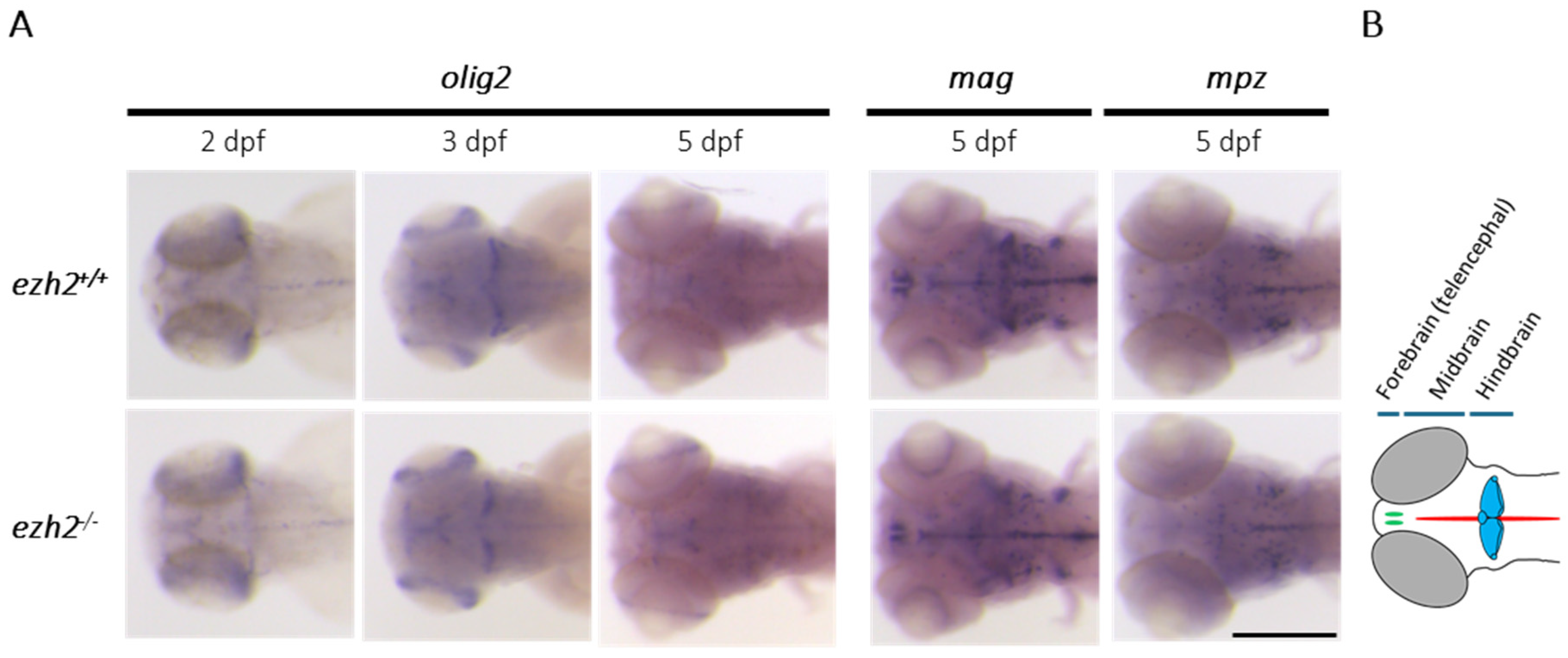
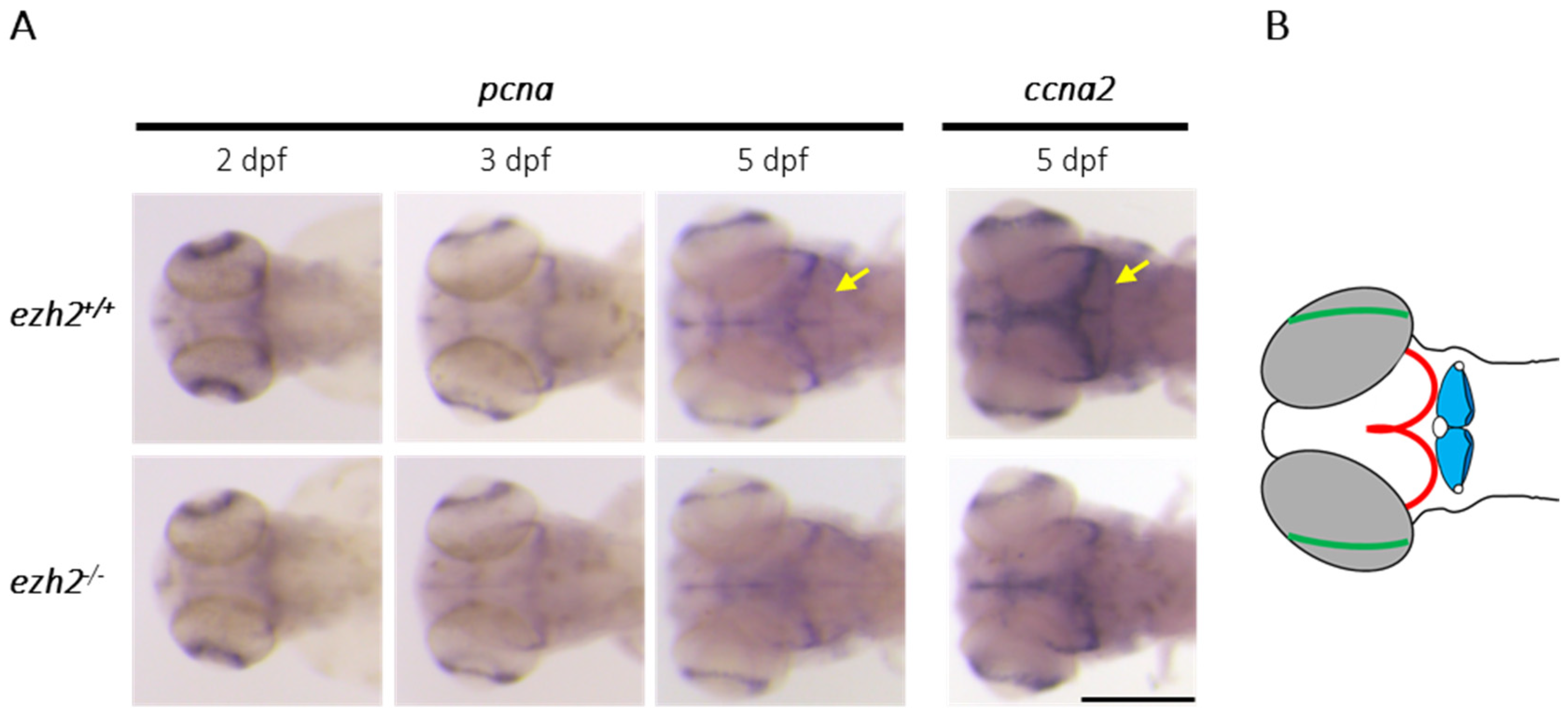
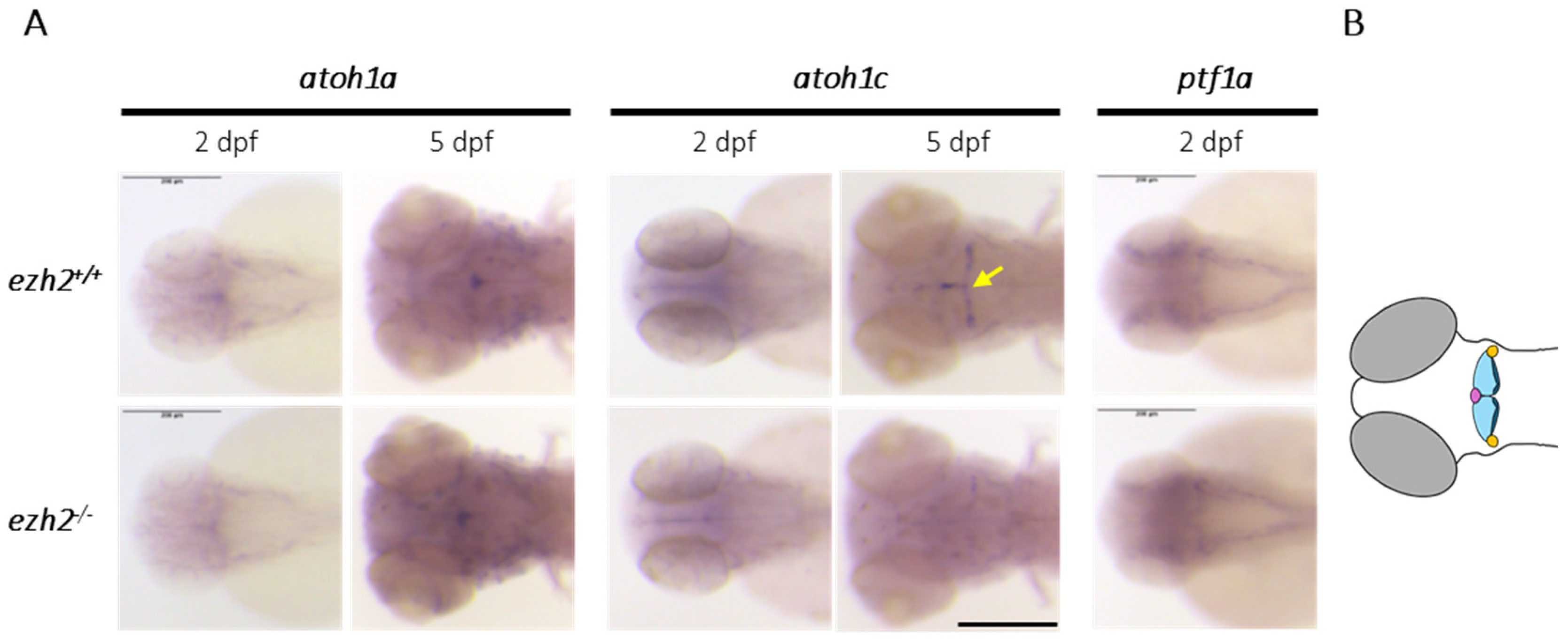
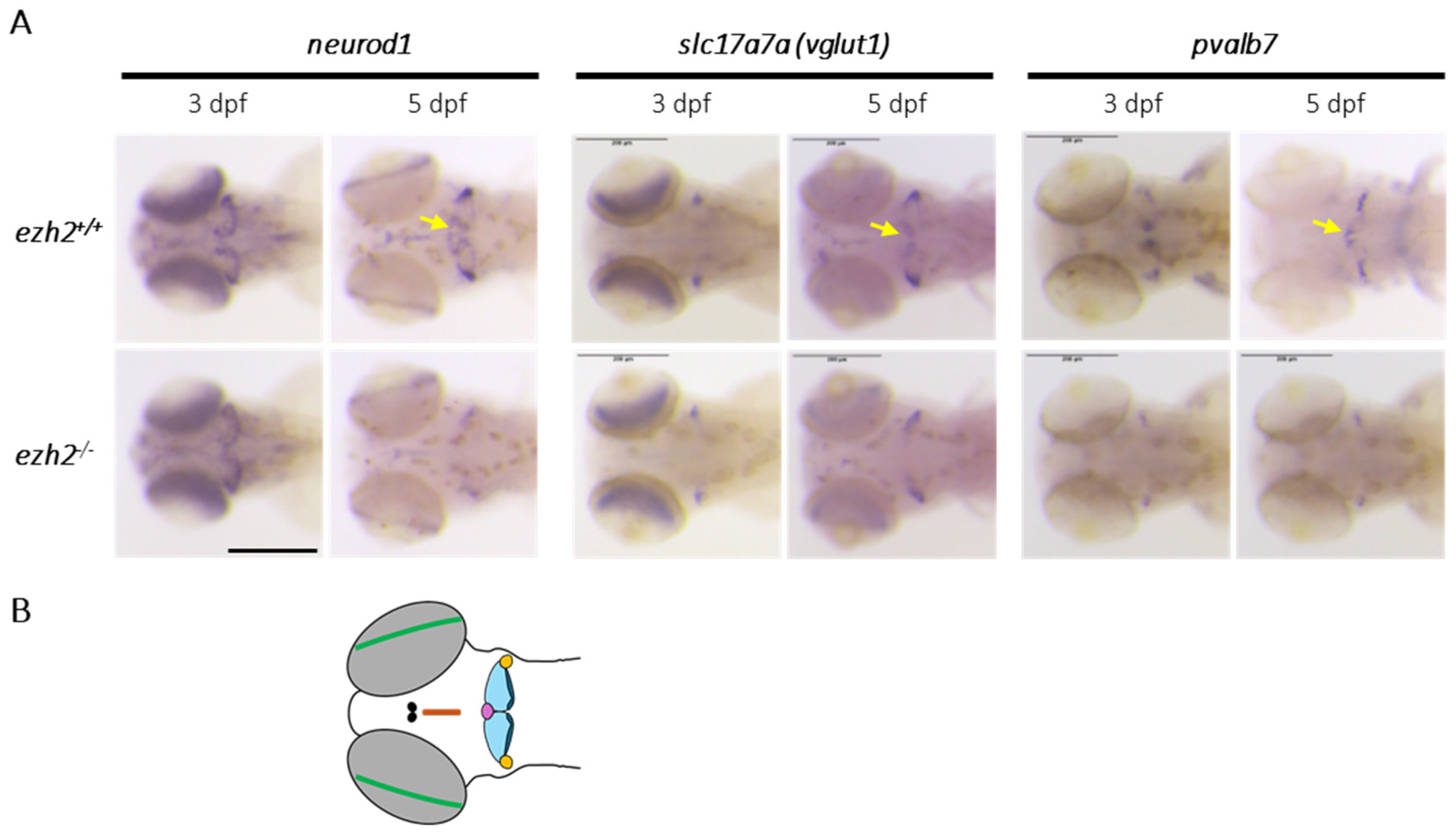
EZH2, the catalytic subunit of PRC2, plays a critical role in neural development by regulating gene expression through trimethylation of lysine 27 on histone H3 (H3K27me3), which promotes chromatin remodeling and transcriptional repression. Although PRC2 is known to regulate cell fate specification and gliogenesis, its in vivo functions during vertebrate neurodevelopment, particularly at the level of neuronal subtype differentiation, remain incompletely understood. Here, we investigated the consequences of ezh2 loss-of-function during zebrafish brain development, focusing on oligodendrocyte differentiation, cerebellar neurogenesis, and the formation of neurotransmitter-specific neuronal populations. Using whole-mount in situ hybridization, we found that ezh2 inactivation does not alter the expression of oligodendrocyte lineage markers, indicating that early oligodendrocyte precursor cell specification and myelination are preserved. However, a significant reduction in cerebellar proliferation was observed in ezh2-deficient larvae, as evidenced by the downregulation of pcna and cyclin A2, while other brain regions remained unaffected. Notably, expression of atoh1c, a key marker of glutamatergic cerebellar progenitors, was strongly reduced at 5 days post-fertilization, suggesting a selective role for ezh2 in maintaining cerebellar progenitor identity. This was associated with impaired differentiation of both glutamatergic granule cells and GABAergic Purkinje cells in specific cerebellar subregions. In contrast, the expression of markers for other major neurotransmitter systems remained unaffected, indicating a region-specific requirement for ezh2 in neuronal development. Finally, behavioral analysis revealed a hyperlocomotor phenotype in ezh2-/- larvae, consistent with cerebellar dysfunction. Together, these findings identify ezh2 as a key regulator of progenitor maintenance and neuronal differentiation in the cerebellum, highlighting its crucial role in establishing functional cerebellar circuits.
Keywords:
1. Introduction
2. Results
2.1. Role of Ezh2 in Oligodendrocyte Development
2.2. Loss of Ezh2 Function Selectively Impairs Cerebellar Progenitor Proliferation
2.3. Loss of Ezh2 Function Selectively Affects Atoh1c-Expressing Cerebellar Progenitors
2.4. Loss of Ezh2 Function Impairs the Differentiation of Cerebellar Granule and Purkinje Cells
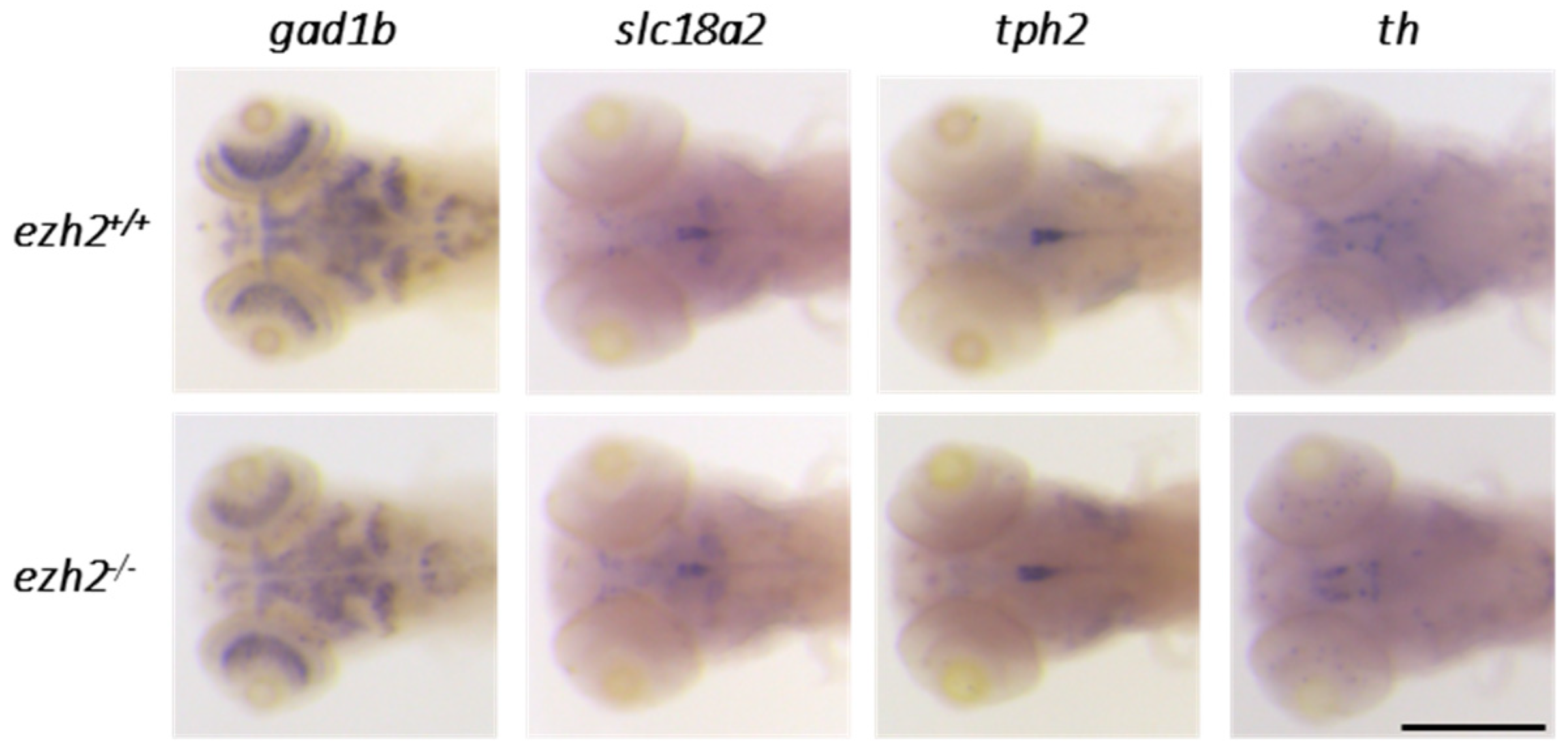
2.5. Loss of Ezh2 Function Does Not Affect The Development of Most Neurotransmitter-Specific Neuronal Populations
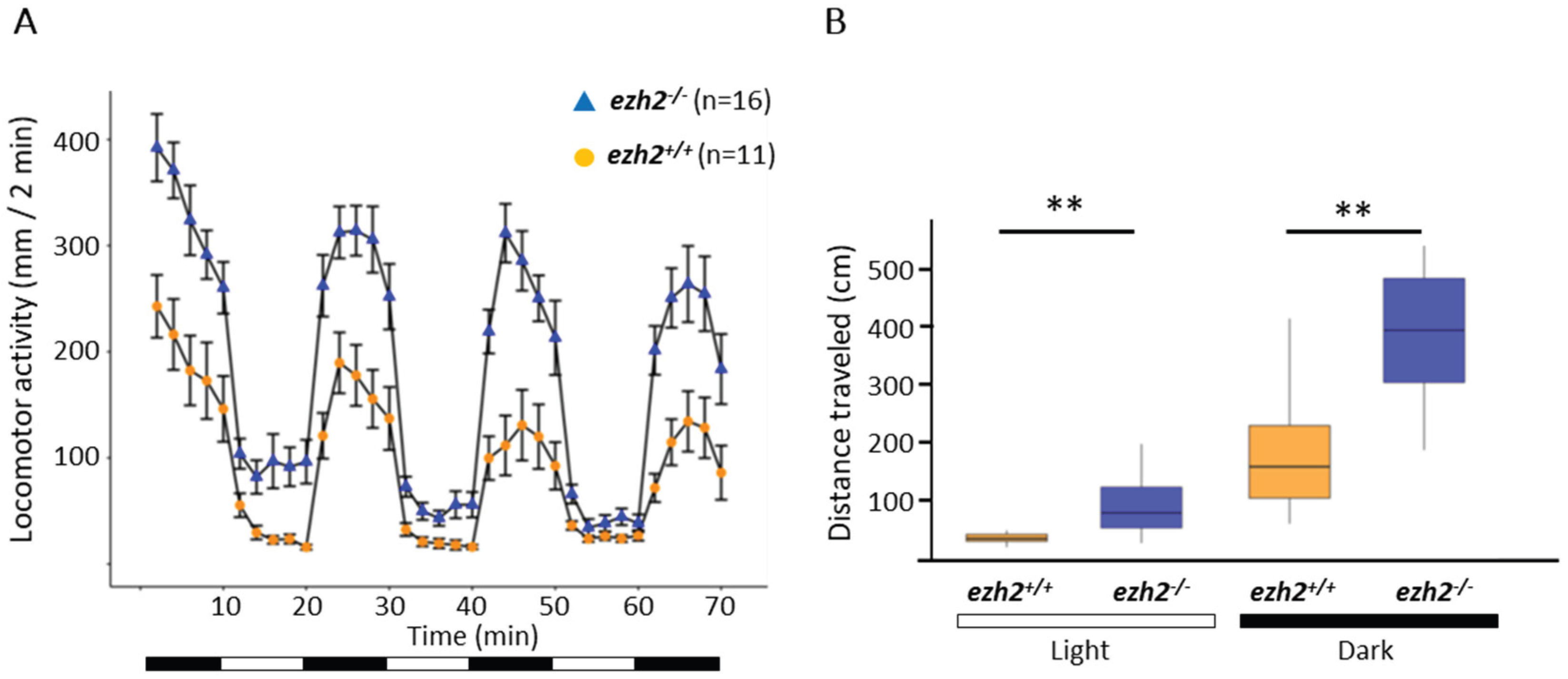
2.6. Loss of Ezh2 Function Alters Locomotor Activity
3. Discussion
4. Materials and Methods
4.1. Zebrafish Maintenance and Embryo Preparation
4.2. Whole-Mount in situ Hybridization
| ISH_olig2_F: | TAATACGACTCACTATAGGGATGGACTCTGACACGAGC |
| ISH_olig2_R: | GATTTAGGTGACACTATAGGGGCTGAGGAAGGTTTGCCAT |
| ISH_mag_F: | TAATACGACTCACTATAGGGCCGTGAGGGTGTTCAGTGTGTGT |
| ISH_mag_R: | GATTTAGGTGACACTATAGCGTCTCCCGTGCCTTCCTCT |
| ISH_mpz_F: | TAATACGACTCACTATAGGGGTGGTGCTCTTGGGCATAGCCTCTC |
| ISH_mpz_R: | GATTTAGGTGACACTATAGGGAGCCCGTTATCACACCAGCC |
| ISH_pcna_F: | TAATACGACTCACTATAGGGGGCAACATCAAGCTCTCACA |
| ISH_pcna_R: | GATTTAGGTGACACTATAGAAATCCCACAGATGACAGGC |
| ISH_ccna2_F: | TAATACGACTCACTATAGGGGGAAGGATGTCAACACAAGGAAG |
| ISH_ccna2_R: | GATTTAGGTGACACTATAGGAGAGAACTGTCAGCACCAGATG |
| ISH_atoh1a_F: | TAATACGACTCACTATAGGGCCAACGTCGTGCAGAAA |
| ISH_atoh1a_R: | GATTTAGGTGACACTATAGAACCCATTACAAAGCCCAGATA |
| ISH_atoh1c_F: | TAATACGACTCACTATAGGGTTTCTCAGCGCACACGACCCT |
| ISH_atoh1c_R: | GATTTAGGTGACACTATAGTTTGGTCTCTTCGGTCATAGGCAAC |
| ISH_ptf1a_F: | TAATACGACTCACTATAGGGCACAGGCTTAGACTCTTTCTCC |
| ISH_ptf1a_R: | GATTTAGGTGACACTATAGCCCGTAGTCTGGGTCATTTG |
| ISH_neurod1_F: | TAATACGACTCACTATAGGGTCGAGACGCTCCGACTAGCCAA |
| ISH_neurod1_R: | GATTTAGGTGACACTATAGGCGTCGAGCCCGCGTAAAGA |
| ISH_vglut1_F: | TAATACGACTCACTATAGGGTGCCAGGGACTTGTGGAGGG |
| ISH_vglut1_R: | GATTTAGGTGACACTATAGCTGGCGTAGCGTGGTGCGA |
| ISH_pvalb7_F: | TAATACGACTCACTATAGGGTTATCCGTCTCTCACCTCCAGCCA |
| ISH_pvalb7_R: | GATTTAGGTGACACTATAGCGTGTTCGGTGGCTCTATCACAA |
| ISH_gad1b_F: | TAATACGACTCACTATAGGGTGAGCGGCATTGAGAGGGCA |
| ISH_gad1b_R: | GATTTAGGTGACACTATAGCGTAGGCGACCACTGAGCC |
| ISH_slc18a2_F: | TAATACGACTCACTATAGGGGCACTGGGAGGACTAGCAATGGG |
| ISH_slc18a2_R: | GATTTAGGTGACACTATAGGTTGGCGGGAGGATTTCGCAG |
| ISH_tph2_F: | TAATACGACTCACTATAGGGCGGACACCTGCCATGAACTGCTT |
| ISH_tph2_R: | GATTTAGGTGACACTATAGTGAGTAAGTCGATGCTCTGCGTGT |
| ISH_th_F: | TAATACGACTCACTATAGGGCCTGTCGGATGTTAGCACGCTGG |
| ISH_th_R: | GATTTAGGTGACACTATAGGGCCTCAACTGAAATCCTGTGCGT |
| ISH_pax2a_F: | TAATACGACTCACTATAGGGACACTGGAGCAGACGCAACCA |
| ISH_pax2a_R: | GATTTAGGTGACACTATAGAGGTCGCCGTCTCGCCTTGA. |
4.3. Genotype Analyses
4.4. Locomotor Activity Assays
4.5. Statistical Analyses
Supplementary Materials
Author Contributions
Funding
Institutional Review Board Statement
Informed Consent Statement
Data Availability Statement
Acknowledgments
Conflicts of Interest
Abbreviations
| DMG | Diffuse Mideline Glioma |
| dpf | days post-fertilization |
| EG | Eminentia Granularis |
| ESC | Embryonic Stem Cell |
| hpf | hours post-fertilization |
| LCa | Lobus Caudalis cerebelli |
| NSC | Neuronal Stem Cell |
| OPC | Oligodendrocyte Precursor Cell |
| pMN | progenitor domain of Motor Neurons |
| PRC2 | Polycomb Repressive Complex 2 |
| URL | Upper Rhombic Lip |
| Va | Valvula cerebelli |
| CCe | Corpus Cerebelli |
References
- Liu, P.P.; Tang, G.B.; Xu, Y.J.; Zeng, Y.Q.; Zhang, S.F.; Du, H.Z.; Teng, Z.Q.; Liu, C.M. MiR-203 Interplays with Polycomb Repressive Complexes to Regulate the Proliferation of Neural Stem/Progenitor Cells. Stem Cell Reports 2017, 9, 190–202. [Google Scholar] [CrossRef]
- Ronan, J.L.; Wu, W.; Crabtree, G.R. From neural development to cognition: unexpected roles for chromatin. Nat Rev Genet 2013, 14, 347–359. [Google Scholar] [CrossRef] [PubMed]
- Feng, X.; Juan, A.H.; Wang, H.A.; Ko, K.D.; Zare, H.; Sartorelli, V. Polycomb Ezh2 controls the fate of GABAergic neurons in the embryonic cerebellum. Development 2016, 143, 1971–1980. [Google Scholar] [CrossRef]
- Paskeh, M.D.A.; Mehrabi, A.; Gholami, M.H.; Zabolian, A.; Ranjbar, E.; Saleki, H.; Ranjbar, A.; Hashemi, M.; Ertas, Y.N.; Hushmandi, K.; Mirzaei, S.; Ashrafizadeh, M.; Zarrabi, A.; Samarghandian, S. EZH2 as a new therapeutic target in brain tumors: Molecular landscape, therapeutic targeting and future prospects. Biomed Pharmacother 2022, 146, 112532. [Google Scholar] [CrossRef] [PubMed]
- Lewis, P.W.; Müller, M.M.; Koletsky, M.S.; Cordero, F.; Lin, S.; Banaszynski, L.A.; Garcia, B.A.; Muir, T.W.; Becher, O.J.; Allis, C.D. Inhibition of PRC2 activity by a gain-of-function H3 mutation found in pediatric glioblastoma. Science 2013, 340, 857–861. [Google Scholar] [CrossRef]
- Jain, S.U.; Do, T.J.; Lund, P.J.; Rashoff, A.Q.; Diehl, K.L.; Cieslik, M.; Bajic, A.; Juretic, N.; Deshmukh, S.; Venneti, S.; Muir, T.W.; Garcia, B.A.; Jabado, N.; Lewis, P.W. PFA ependymoma-associated protein EZHIP inhibits PRC2 activity through a H3 K27M-like mechanism. Nat Commun 2019, 10, 2146. [Google Scholar] [CrossRef]
- Cassim, A.; Dun, M.D.; Gallego-Ortega, D.; Valdes-Mora, F. EZHIP's role in diffuse midline glioma: echoes of oncohistones? Trends Cancer 2024, 10, 1095–1105. [Google Scholar] [CrossRef]
- Silveira, A.B.; Kasper, L.H.; Fan, Y.; Jin, H.; Wu, G.; Shaw, T.I.; Zhu, X.; Larson, J.D.; Easton, J.; Shao, Y.; Yergeau, D.A.; Rosencrance, C.; Boggs, K.; Rusch, M.C.; Ding, L.; Zhang, J.; Finkelstein, D.; Noyes, R.M.; Russell, B.L.; Xu, B.; Broniscer, A.; Wetmore, C.; Pounds, S.B.; Ellison, D.W.; Zhang, J.; Baker, S.J. H3.3 K27M depletion increases differentiation and extends latency of diffuse intrinsic pontine glioma growth in vivo. Acta Neuropathol 2019, 137, 637–655. [Google Scholar] [CrossRef]
- Robinson, G.; Parker, M.; Kranenburg, T.A.; Lu, C.; Chen, X.; Ding, L.; Phoenix, T.N.; Hedlund, E.; Wei, L.; Zhu, X.; Chalhoub, N.; Baker, S.J.; Huether, R.; Kriwacki, R.; Curley, N.; Thiruvenkatam, R.; Wang, J.; Wu, G.; Rusch, M.; Hong, X.; Becksfort, J.; Gupta, P.; Ma, J.; Easton, J.; Vadodaria, B.; Onar-Thomas, A.; Lin, T.; Li, S.; Pounds, S.; Paugh, S.; Zhao, D.; Kawauchi, D.; Roussel, M.F.; Finkelstein, D.; Ellison, D.W.; Lau, C.C.; Bouffet, E.; Hassall, T.; Gururangan, S.; Cohn, R.; Fulton, R.S.; Fulton, L.L.; Dooling, D.J.; Ochoa, K.; Gajjar, A.; Mardis, E.R.; Wilson, R.K.; Downing, J.R.; Zhang, J.; Gilbertson, R.J. Novel mutations target distinct subgroups of medulloblastoma. Nature 2012, 488, 43–48. [Google Scholar] [CrossRef]
- Gabriel, N.; Balaji, K.; Jayachandran, K.; Inkman, M.; Zhang, J.; Dahiya, S.; Goldstein, M. Loss of H3K27 Trimethylation Promotes Radiotherapy Resistance in Medulloblastoma and Induces an Actionable Vulnerability to BET Inhibition. Cancer Res 2022, 82, 2019–2030. [Google Scholar] [CrossRef]
- Rougeot, J.; Chrispijn, N.D.; Aben, M.; Elurbe, D.M.; Andralojc, K.M.; Murphy, P.J.; Jansen, P.W.T.C.; Vermeulen, M.; Cairns, B.R.; Kamminga, L.M. Maintenance of spatial gene expression by Polycomb-mediated repression after formation of a vertebrate body plan. Development 2019, 146, dev178590. [Google Scholar] [CrossRef]
- Hanot, M.; Raby, L.; Völkel, P.; Le Bourhis, X.; Angrand, P.-O. The Contribution of the Zebrafish Model to the Understanding of Polycomb Repression in Vertebrates. Int J Mol Sci 2023, 24, 2322. [Google Scholar] [CrossRef] [PubMed]
- O'Carroll, D.; Erhardt, S.; Pagani, M.; Barton, S.C.; Surani, M.A.; Jenuwein, T. The polycomb-group gene Ezh2 is required for early mouse development. Mol Cell Biol 2001, 21, 4330–4336. [Google Scholar] [CrossRef]
- San, B.; Chrispijn, N.D.; Wittkopp, N.; van Heeringen, S.J.; Lagendijk, A.K.; Aben, M.; Bakkers, J.; Ketting, R.F.; Kamminga, L.M. Normal formation of a vertebrate body plan and loss of tissue maintenance in the absence of ezh2. Sci Rep 2016, 6, 24658. [Google Scholar] [CrossRef]
- Dupret, B.; Völkel, P.; Vennin, C.; Toillon, R.-A.; Le Bourhis, X.; Angrand, P.-O. The histone lysine methyltransferase Ezh2 is required for maintenance of the intestine integrity and for caudal fin regeneration in zebrafish. Biochim Biophys Acta Gene Regul Mech 2017, 1860, 1079–1093. [Google Scholar] [CrossRef]
- Schmidt, R.; Strähle, U.; Scholpp, S. Neurogenesis in zebrafish - from embryo to adult. Neural Dev 2013, 8, 3. [Google Scholar] [CrossRef]
- Mohn, F.; Weber, M.; Rebhan, M.; Roloff, T.C.; Richter, J.; Stadler, M.B.; Bibel, M.; Schübeler, D. Lineage-specific polycomb targets and de novo DNA methylation define restriction and potential of neuronal progenitors. Mol Cell 2008, 30, 755–766. [Google Scholar] [CrossRef]
- Corley, M.; Kroll, K.L. The roles and regulation of Polycomb complexes in neural development. Cell Tissue Res 2015, 359, 65–85. [Google Scholar] [CrossRef] [PubMed]
- Sher, F.; Rössler, R.; Brouwer, N.; Balasubramaniyan, V.; Boddeke, E.; Copray, S. Differentiation of neural stem cells into oligodendrocytes: involvement of the polycomb group protein Ezh2. Stem Cells 2008, 26, 2875–2883. [Google Scholar] [CrossRef] [PubMed]
- Sher, F.; Boddeke, E.; Olah, M.; Copray, S. Dynamic changes in Ezh2 gene occupancy underlie its involvement in neural stem cell self-renewal and differentiation towards oligodendrocytes. PLoS One 2012, 7, e40399. [Google Scholar] [CrossRef]
- Wang, W.; Cho, H.; Kim, D.; Park, Y.; Moon, J.H.; Lim, S.J.; Yoon, S.M.; McCane, M.; Aicher, S.A.; Kim, S.; Emery, B.; Lee, J.W.; Lee, S.; Park, Y.; Lee, S.K. PRC2 Acts as a Critical Timer That Drives Oligodendrocyte Fate over Astrocyte Identity by Repressing the Notch Pathway. Cell Rep 2020, 32, 108147. [Google Scholar] [CrossRef]
- Ackerman, S.D.; Monk, K.R. The scales and tales of myelination: using zebrafish and mouse to study myelinating glia. Brain Res 2016, 1641, 79–91. [Google Scholar] [CrossRef] [PubMed]
- Emery, B.; Lu, Q.R. Transcriptional and Epigenetic Regulation of Oligodendrocyte Development and Myelination in the Central Nervous System. Cold Spring Harb Perspect Biol 2015, 7, a020461. [Google Scholar] [CrossRef]
- Park, H.C.; Shin, J.; Roberts, R.K.; Appel, B. An olig2 reporter gene marks oligodendrocyte precursors in the postembryonic spinal cord of zebrafish. Dev Dyn 2007, 236, 3402–3407. [Google Scholar] [CrossRef]
- McFarland, K.A.; Topczewska, J.M.; Weidinger, G.; Dorsky, R.I.; Appel, B. Hh and Wnt signaling regulate formation of olig2+ neurons in the zebrafish cerebellum. Dev Biol 2008, 318, 162–171. [Google Scholar] [CrossRef]
- Bae, Y.K.; Kani, S.; Shimizu, T.; Tanabe, K.; Nojima, H.; Kimura, Y.; Higashijima, S.; Hibi, M. Anatomy of zebrafish cerebellum and screen for mutations affecting its development. Dev Biol 2009, 330, 406–426. [Google Scholar] [CrossRef]
- Kani, S.; Bae, Y.K.; Shimizu, T.; Tanabe, K.; Satou, C.; Parsons, M.J.; Scott, E.; Higashijima, S.; Hibi, M. Proneural gene-linked neurogenesis in zebrafish cerebellum. Dev Biol 2010, 343, 1–17. [Google Scholar] [CrossRef]
- Wullimann, M.F.; Knipp, S. Proliferation pattern changes in the zebrafish brain from embryonic through early postembryonic stages. Anat Embryol (Berl) 2000, 202, 385–400. [Google Scholar] [CrossRef] [PubMed]
- Adolf, B.; Bellipanni, G.; Huber, V.; Bally-Cuif, L. atoh1.2 and beta3.1 are two new bHLH-encoding genes expressed in selective precursor cells of the zebrafish anterior hindbrain. Gene Expr Patterns 2004, 5, 35–41. [Google Scholar] [CrossRef]
- Volkmann, K.; Rieger, S.; Babaryka, A.; Köster, R.W. The zebrafish cerebellar rhombic lip is spatially patterned in producing granule cell populations of different functional compartments. Dev Biol 2008, 313, 167–180. [Google Scholar] [CrossRef] [PubMed]
- Lüffe, T.M.; D'Orazio, A.; Bauer, M.; Gioga, Z.; Schoeffler, V.; Lesch, K.P.; Romanos, M.; Drepper, C.; Lillesaar, C. Increased locomotor activity via regulation of GABAergic signalling in foxp2 mutant zebrafish-implications for neurodevelopmental disorders. Transl Psychiatry 2021, 11, 529. [Google Scholar] [CrossRef]
- Wen, L.; Wei, W.; Gu, W.; Huang, P.; Ren, X.; Zhang, Z.; Zhu, Z.; Lin, S.; Zhang, B. Visualization of monoaminergic neurons and neurotoxicity of MPTP in live transgenic zebrafish. Dev Biol 2008, 314, 84–92. [Google Scholar] [CrossRef]
- Teraoka, H.; Russell, C.; Regan, J.; Chandrasekhar, A.; Concha, M.L.; Yokoyama, R.; Higashi, K.; Take-Uchi, M.; Dong, W.; Hiraga, T.; Holder, N.; Wilson, S.W. Hedgehog and Fgf signaling pathways regulate the development of tphR-expressing serotonergic raphe neurons in zebrafish embryos. J Neurobiol 2004, 60, 275–288. [Google Scholar] [CrossRef]
- Pose-Méndez, S.; Schramm, P.; Valishetti, K.; Köster, R.W. Development, circuitry, and function of the zebrafish cerebellum. Cell Mol Life Sci 2023, 80, 227. [Google Scholar] [CrossRef]
- MacPhail, R.C.; Brooks, J.; Hunter, D.L.; Padnos, B.; Irons, T.D.; Padilla, S. Locomotion in larval zebrafish: Influence of time of day, lighting and ethanol. Neurotoxicology 2009, 30, 52–58. [Google Scholar] [CrossRef] [PubMed]
- Batista, M.F.; Lewis, K.E. Pax2/8 act redundantly to specify glycinergic and GABAergic fates of multiple spinal interneurons. Dev Biol 2008, 323, 88–97. [Google Scholar] [CrossRef]
- Pose-Méndez, S.; Schramm, P.; Winter, B.; Meier, J.C.; Ampatzis, K.; Köster, R.W. Lifelong regeneration of cerebellar Purkinje cells after induced cell ablation in zebrafish. Elife 2023, 12, e79672. [Google Scholar] [CrossRef]
- Auer, F.; Nardone, K.; Matsuda, K.; Hibi, M.; Schoppik, D. Cerebellar Purkinje cells control posture in larval zebrafish (Danio rerio). Elife 2025, 13, RP97614. [Google Scholar] [CrossRef]
- Barth, P.G.; Aronica, E.; Fox, S.; Fluiter, K.; Weterman, M.A.J.; Poretti, A.; Miller, D.C.; Boltshauser, E.; Harding, B.; Santi, M.; Baas, F. Deregulated expression of EZH2 in congenital brainstem disconnection. Neuropathol Appl Neurobiol 2017, 43, 358–365. [Google Scholar] [CrossRef] [PubMed]
- Anderson, J.L.; Muraleedharan, R.; Oatman, N.; Klotter, A.; Sengupta, S.; Waclaw, R.R.; Wu, J.; Drissi, R.; Miles, L.; Raabe, E.H.; Weirauch, M.L.; Fouladi, M.; Chow, L.M.; Hoffman, L.; DeWire, M.; Dasgupta, B. The transcription factor Olig2 is important for the biology of diffuse intrinsic pontine gliomas. Neuro Oncol 2017, 19, 1068–1078. [Google Scholar] [CrossRef] [PubMed]
- Monje, M.; Mitra, S.S.; Freret, M.E.; Raveh, T.B.; Kim, J.; Masek, M.; Attema, J.L.; Li, G.; Haddix, T.; Edwards, M.S.; Fisher, P.G.; Weissman, I.L.; Rowitch, D.H.; Vogel, H.; Wong, A.J.; Beachy, P.A. Hedgehog-responsive candidate cell of origin for diffuse intrinsic pontine glioma. Proc Natl Acad Sci USA 2011, 108, 4453–4458. [Google Scholar] [CrossRef] [PubMed]
- Kimmel, C.B.; Ballard, W.W.; Kimmel, S.R.; Ullmann, B.; Schilling, T.F. Stages of embryonic development of the zebrafish. Dev Dyn 1995, 203, 253–310. [Google Scholar] [CrossRef] [PubMed]
- Thisse, C.; Thisse, B. High-resolution in situ hybridization to whole-mount zebrafish embryos. Nat Protoc 2008, 3, 59–69. [Google Scholar] [CrossRef] [PubMed]
- Posit team (2025). RStudio: Integrated Development Environment for R. Posit Software, PBC, Boston, MA. Available online: http://www.posit.co/ (accessed on day month year).
Disclaimer/Publisher’s Note: The statements, opinions and data contained in all publications are solely those of the individual author(s) and contributor(s) and not of MDPI and/or the editor(s). MDPI and/or the editor(s) disclaim responsibility for any injury to people or property resulting from any ideas, methods, instructions or products referred to in the content. |
© 2025 by the authors. Licensee MDPI, Basel, Switzerland. This article is an open access article distributed under the terms and conditions of the Creative Commons Attribution (CC BY) license (http://creativecommons.org/licenses/by/4.0/).


