
Submitted:
18 March 2026
Posted:
18 March 2026
You are already at the latest version
Abstract
Mammalian cells contain numerous membrane-bound organelles, among which endosomes serve as the initial destination for endocytosed materials. Drugs and pathogens are internalized by cells and transported to endosomes or phagosomes, and are subsequently delivered to lysosomes for degradation. Therefore, internalized drugs must escape from endosomes into the cytosol before lysosomal degradation occurs. However, endosomal escape is often inefficient in artificial drug delivery systems (DDSs). In contrast, many pathogens such as bacteria are phagocytosed and subsequently escape into the cytosol where they proliferate successfully. Studies on bacterial phagosomal escape have revealed molecular mechanisms by which host cells detect damage to organelle membrane. These host cellular machineries for sensing membrane damage can also detect membrane damage caused by artificial drugs. In this review, we summarize current knowledge of the cellular machinery involved in sensing membrane damage, including galectins, ESCRT complexes, sphingomyelin, stress granules, phosphatidylinositol 4-phosphate (PI4P) at membrane contact sites, and annexins. Although the aim of this review is to identify the molecules involved in endosomal membrane damage, many of these molecules were initially discovered through studies of bacterial infection and damage to the plasma membrane or lysosomes. Research on membrane damage not only advances our understanding of cellular responses to organelle damage, but also provides insights into the toxicity induced by inorganic materials and contributes to the rational design of more effective DDSs.
Keywords:
membrane damage
; galectin
; ESCRT
; sphingomyelin
; secretory MVBs
1. Introduction
Mammalian cells internalize nutrients, solutes, growth factors, or hormones that bind to specific receptors on the plasma membrane through endocytosis. These cargos are internalized together with their receptors. Several endocytic pathways have been described, including clathrin-mediated endocytosis (CME), fast endophilin-mediated endocytosis (clathrin-independent but dynamin-dependent), clathrin-independent carrier (CLIC)/glycosylphosphatidylinositol-anchored protein enriched early endocytic compartment (GEEC) endocytosis, macropinocytosis, phagocytosis, and caveolin-dependent endocytosis [1,2,3]. In addition, there may be uncharacterized endocytic pathways. Solutes that do not bind to specific receptors can also be internalized through these pathways together with extracellular fluid by bulk flow. Cargos can be internalized through different endocytic pathways depending on their size [3,4,5]. Although pharmacological inhibitors of these pathways are not entirely specific, cargos smaller than ~200nm can be internalized through CME, FEME, caveolin-dependent endocytosis, or CLIC/GEEC pathways. Cargos with ~250-500 nm can be internalized by macropinocytosis or phagocytosis. Large cargos such as bacteria or nanoparticles larger than ~500 nm are typically internalized by Phagocytosis. In phagocytosis, the space between the membrane and the cargo is relatively small, whereas macropinocytosis involves large membrane ruffles that enclose extracellular fluid with a larger space between the membrane and the cargo [6,7]. Through these endocytic pathways, most of the cargoes are encapsulated by transport career such as vesicles, tubules, macropinosomes or phagosomes that subsequently fuse with early endosomes and mature into lysosomes [8,9].
Early endosomes function as sorting hubs that direct cargos to their respective destinations. Endosomal maturation has been extensively reviewed elsewhere [8,9,10,11,12,13]. Briefly, following internalization, early endosomes mature into late endosomes/multi-vesicular bodies (MVBs) and subsequently into lysosomes for degradation. In parallel, specific cargos are sorted within early endosomes and transported to recycling endosomes for return to the plasma membrane or via retrograde transport pathways to the Golgi apparatus. Cargos that reach the Golgi apparatus are either recycled back to endosomes or further transported retrogradely to the endoplasmic reticulum (ER). The bulk flow route is generally considered to represent the degradation pathway to lysosomes, as early endosomes matures into late endosomes rather than delivering cargos to pre-existing late endosomes [12,14].
Drug Delivery Systems (DDSs) designed to promote the transport of drugs from endosomes into the cytosol have been extensively studied to prevent lysosomal degradation of therapeutic cargos. Strategies of endosomal escape used by pathogens are often applied to DDS design. Several pathogenic bacteria, such as Shigella flexneri (S. flexneri) and Listeria monocytogenes (L. monocytogenes) are well known to escape from phagosomes [15,16]. In the case of L. monocytogenes, pore forming toxin (PFT) whose activity is dependent on acidic pH [17,18]. Along endocytic pathway, early endosomes are acidified to a pH of approximately 6.2-6.8, followed by further acidification to pH 5.2-6.0 in late endosomes, and finally to pH 4.5-4.8 in lysosomes, where proteins are degraded [19,20,21,22]. PFT activated by acidic pH is thought to promote bacterial replication in the cytosol while limiting host cell death, compared with pH-independent PFT activity. Therefore, endosomal escape could be less toxic to host cells than damaging plasma membrane in this case [23,24]. Consequently, sensitivity to acidic pH has frequently been incorporated into the design of DDSs as a trigger for drug release, including pH-sensitive amphiphilic polymers or peptides [23,24,25].
Studies of membrane damage can be also beneficial to understand the toxicity of DDS, nanoparticles or artificial treatments to cells. MVBs can be damaged by internalized wear debris derived from joint replacement [26] (see Section 2.7.2). Early endosomes can be damaged by osmotic shock [27], or by magnetic nanoparticles under an external magnetic field [28]. Recycling endosomes can be damaged by an ionophore Monensin [29]. Recycling endosomes have been also implicated as sites of endosomal escape induced by lipid nanoparticles [30]. Moreover, Rab GTPases associated with recycling endosomes, such as Rab11, 8 and 35, play important roles in phagosomal escape by S. flexneri [31,32,33,34]. These findings suggest that recycling endosomes may play critical roles in endosomal membrane disruption.
Membrane damage can be detected by host cell-derived sensor molecules. These molecules often participate in membrane repair processes and ultimately trigger autophagy to eliminate damaged organelles. Although many of these sensing mechanisms were initially identified through studies of bacterial infection, the same host cell molecules are also capable of detecting “sterile” membrane damage, such as lysosomal membrane damage induced by L-leucyl-L-leucine methyl ester (LLOMe). As a non-bacterial damaging agent, LLOMe is widely used as a tool to induce lysosomal membrane damage in experimental settings [35].
In this review, we describe molecules implicated in cellular responses to membrane damage with the aim of identifying those that may be capable of detecting endosomal escape. However, many of these molecules were originally identified through studies of damage to the plasma membrane, phagosomes or lysosomes, and are therefore not specific to damaged endosomes. There are several differences between endosomal escape induced by DDS and other types of membrane damage. Whereas damage to the plasma membrane can be highly toxic to cells, damage to endosomal membrane may be less detrimental. Whereas bacteria secrete biological factors that regulate host cell activities [36], DDS do not secrete such factors. In addition, whereas lysosomal damage releases highly acidic contents into the cytosol, the contents released form damaged endosomes may be less acidic than those from lysosomes. To describe the characteristics of these sensor molecules, we discuss how they were initially identified, including studies of phagosomes in bacterial infection. We also describe molecules involved in sensing “sterile” membrane damage caused by laser-induced plasma membrane injury or lysosomal damage induced by LLOMe. These studies provide insights into cellular responses when DDSs are introduced into cells.
We focus on the early phase of membrane damage detection (typically within 1-30 min), rather than on later cellular responses such as autophagy or inflammation. Autophagy has been extensively reviewed elsewhere [37,38]. We compiled the reported recruitment times of these molecules to damaged membranes from the literature (see Table 1). Although advances in imaging technologies may enable the detection of membrane damage at much earlier time points in the future, side-by-side comparison of recruitment timing based on currently available data provides a useful framework for understanding how cells sense damaged organelles and the subsequent cellular events that follow membrane damage.
2. Molecular Sensors of Membrane Damage in Mammalian Cells
2.1. Galectins
2.1.1. Galectin-3
During phagosomal escape of S. flexneri in HeLa, J774 macrophage, or CHO cells, Galectin-3 (Gal-3) is recruited to the phagosomal membrane surrounding the bacterium [39,40]. Galectins are glycan-binding proteins, and Gal-3 preferentially binds to LacNAc (Galβ(1-4)GlcNAc), which is present internally in glycan residues [41,42]. Gal-3 is recruited to the phagosomal membrane, encapsulating the bacterium as well as tubular structures connected to the limiting membrane of phagosomes. The glycan-binding ability of Gal-3 is required for this localization, suggesting that Gal-3 recognizes glycans exposed on the internal leaflet of damaged phagosomal membranes rather than lipopolysaccharide (LPS) present on cell wall of S. flexneri [40]. In addition to bacteria-containing phagosomes, Gal-3 is also recruited to “sterile” membrane damage in endosomes or lysosomes. For example, Gal-3 is recruited to damaged phagosomes induced by internalized 3 μm latex beads coated with cationic lipid transfection reagents [43]. Gal-3 is also recruited to early endosomes damaged by 20 nm magnetic nanoparticles under an external magnetic field [28]. Furthermore, Gal-3 accumulates on lysosomes damaged by L-leucyl-L-leucine methyl ester (LLOMe) [44]. LLOMe destabilizes the lysosomal lipid bilayer by forming a polymer from a dipeptide of Leucine in a Cathepsin C-dependent manner [35].
Gal-3 colocalizes with internalized S. flexneri together with ubiquitin, p62 and LC3 [39]. Autophagy is a process in which cytosolic components are sequestered and degraded within double-membrane structures marked by lipidated LC3, and it plays crucial role in preventing Shigella proliferation [45]. p62 is an autophagy adaptor that binds polyubiquitin chains and links ubiquitinated cargos to LC3 [46,47].
Upon LLOMe treatment, K48- and K63-linked ubiquitin chains are conjugated to damaged lysosomes, indicating that ubiquitination occurs to damaged organelles under these conditions [48]. Screening of E2 ubiquitin-conjugating enzymes identified UBE2QL1, and both UBE2QL1 and K48- and K63-linked ubiquitin signals are detected 30-60 min after LLOMe treatment. Depletion of UBE2QL1 abolishes ubiquitin signals as well as the recruitment of LC3 and p97, which are required for the clearance of damaged lysosomes [48,49]. Interestingly, Gal-3 recruitment to damaged lysosomes is enhanced upon UBE2QL1 depletion, indicating that Gal-3 is recruited independently of ubiquitination. However, Gal-3 accumulation is indirectly influenced by impaired clearance of damaged lysosomes.
S. flexneri can be directly ubiquitinated on its LPS by the host E3 ligase RNF213 at approximately 2 h post-infection, leading to the induction of autophagy [50,51]. In Mycobacterium tuberculosis (Mtb), bacterial ubiquitination is likewise mediated by E3 ligases, including Parkin within ~4 h, and Smad ubiquitination regulatory factor 1 (Smurf1) within ~15 hours after infection [52,53]. In addition, the E3 ligase Leucine-rich repeat and sterile alpha motif-containing protein 1 (LRSAM1) is recruited to internalized Salmonella enterica serovar Typhimurium (S. Typhimurium) and S. flexneri within ~45 min [54]. Although ubiquitination of cytosolic bacteria plays an essential role in triggering antibacterial autophagy, Gal-3 recruitment occurs much earlier, within ~10 min, preceding detectable bacterial ubiquitination (see Table 1). These observations indicate that host cell detection of damaged organelles occurs prior to bacterial ubiquitination during the early stages of host defense.
Gal-3 can promote autophagy through interactions with components of the autophagy machinery. Gal-3 interacts with Tripartite motif-containing Protein 16 (TRIM16) which in turn recruits ATG16L to damaged lysosomes [55]. ATG16L is a core component of the autophagy machinery and is recruited to ubiquitin-positive Salmonella as well as ubiquitin-positive latex-beads in ubiquitin- and FIP200-dependent manner [43]. ATG16L further determines the site of LC3 lipidation and localization [56]. Depletion of TRIM16 inhibits ubiquitination of damaged lysosomes and partially reduces LC3 recruitment [55]. Similarly, depletion of Gal-3 partially decreases LC3 recruitment following LLOMe treatment [57]. Consistent with these cellular observations, Gal-3 KO mice show increased susceptibility to infection by Mtb [55]. Together, these findings indicate that Gal-3 and TRIM16 contribute, at least in part, to LC3 recruitment and promote autophagic clearance of damaged organelles.
However, autophagy can be triggered by multiple distinct signals, as described in Section 2.2.3, Section 2.3.2 and Section 2.5. In addition to its pro-autophagic roles, depletion of Gal-3 has also been reported to enhance autophagy. Deletion of Gal-3 resulted in increased LC3 recruitment to phagosomes in L. monocytogenes-infected macrophages [58]. These findings suggest that Gal-3 may function to suppress LC3 recruitment to phagosomes, or alternatively, that depletion of Gal-3 impairs phagosomal membrane repair, thereby leading to enhanced LC3 recruitment [58]. Thus, whether Gal-3 inhibits or promotes antibacterial autophagy is likely context dependent and may vary according to the invading bacterium, the type of membrane-damaging agent, the cell type, and the presence of compensatory pathways activated upon Gal-3 depletion.
2.1.2. Galectin-8, 9
Although Gal-3, -8, and -9 were recruited to Salmonella-containing Vacuoles (SCVs) at 1 hour after infection with S. Typhimurium in HeLa cells, depletion of only Gal-8 increased proliferation of S. Typhimurium [59], suggesting that Gal-3 and Gal-9 are not directly involved in inhibiting S. Typhimurium proliferation. Gal-8 binds to LacNAc in a manner similar to Gal-3 [42], but preferentially interact with the autophagy adaptor NDP-52 rather than p62 [60]. Consistently, depletion of NDP-52 also increased S. Typhimurium proliferation [59], supporting roles for Gal-8 and NDP-52 in antibacterial activity against S. Typhimurium. Notably, after 4 h post-infection, Gal-8-independent recruitment of NDP-52 was observed, indicating that Gal-8 is an early detector for intracellular pathogens.
Gal-9 has been reported to be preferentially recruited to damaged endosomes and lysosomes by damaging agents, such as chloroquine and siramesine, to a greater extent than Gal-3 or Gal-8 [61]. Gal-9 has been utilized as a readout in high-throughput screening to identify efficient lipid nanoparticle formulations [62]. In cells, depletion of Gal-9 resulted in reduced ubiquitination of damaged lysosomes [63]. Upon LLOMe treatment, Gal-9 interacts with the deubiquitinating enzyme, USP9X, thereby inhibiting deubiquitination and promoting downstream ubiquitin-dependent processes, including autophagy [63]. Consistently, Gal-9 depletion suppressed lysosomal ubiquitination and inhibited LC3 lipidation following LLOMe treatment [63].
Although Gal-9 has been used as a marker to detect endosomal escape, it may also influence immune function. Gal-9 is expressed in a wide variety of immune cells, and soluble Gal-9 binding to Tim-3 on the surface of CD4+ T cells suppresses T cell activity [64]. Gal-9-Tim-3 interaction has been reported to downregulate coreceptors on CD4+ T cells, and to upregulates p21, thereby inhibiting HIV infection in these cells. In contrast, Gal-9 binding to secreted protein disulfide isomerase (PDI) on the surface of CD4+ T cells enhances HIV infection in resting CD4+ T cells [65]. These findings suggest that alterations in immune responses associated with Gal-9 expression should be taken into consideration when immune cells are employed as experimental systems.
2.2. ESCRTs
2.2.1. Overview of ESCRT Proteins
Endosomal sorting complexes required for transport (ESCRT) proteins have been identified as class E vacuolar protein sorting (Vps) proteins, including ESCRT-0, I, II, III, and the Vps4 ATPase [66,67,68,69,70,71]. Studies on ESCRT proteins in the trafficking of the epidermal growth factor receptor (EGFR), a well-known receptor tyrosine kinase [72,73,74], have deepened our understanding of the roles of the ESCRT complexes. Upon EGF binding, EGFR is ubiquitinated [75,76,77,78,79], and Hrs and STAM complexes and ESCRT-0 components bind to the ubiquitinated EGFR and transfer EGFR to ESCRT-I, II, and III, inducing inward budding of the limiting membrane to produce intraluminal vesicles (ILVs) that form [11,80,81]. Through inward budding, the phosphorylated cytosolic region of EGFR—which binds signaling complexes such as Grb2 [82,83]—is incorporated into ILVs and degraded in lysosomes together with the luminal region of EGFR [73,74]. CHMP4A and CHMP4B, which are ESCRT-III proteins, form filaments [84], and ESCRT-III mediates membrane scission to form ILVs [85,86]. ESCRT-III assembles at the bud neck and constricts the membrane with Vps4 to sever the remaining membrane [87,88]. Thus, ESCRT proteins form vesicles by pushing the membrane from the cytosol into the lumen, which is an inverse mechanism compared to coat proteins such as clathrin or COPI, which invaginate vesicles by pulling the membrane from the lumen to the cytosol. At present, ESCRT proteins are known to have many functions beyond ILV formation, and their unique membrane scission activities plays important roles in diverse cellular events [81].
2.2.2. ESCRT in Plasma Membrane Damage
When the plasma membrane is damaged by digitonin, streptolysin O, or UV laser ablation, CHMP4B—an ESCRT-III component—is recruited to the wound site prior to the initiation of membrane repair [89]. Depletion of CHMP4B decreases cell survival following wounding, indicating that the ESCRT machinery plays a critical role in plasma membrane repair [89]. It has been proposed that ESCRT-III and Vps4 function in membrane repair by constricting intact membrane regions, thereby shedding damaged membrane portions as extracellular vesicles [89].
How cells detect plasma membrane damage and what initial events precede CHMP4B recruitment, have been actively investigated. The ESCRT subunits involved in plasma membrane damage repair are not identical to those functioning in EGFR sorting into ILVs. While ALG2, TSG101, ALIX and CHMP4B are recruited to the plasma membrane in Ca2+ -dependent manner, ESCRT-0 components Hrs and STAM, the ESCRT-I subunit Vps37, and the ESCRT-II subunit Vps25 are not detected [89,90]. ALIX binds both TSG101 and CHMP4B, thereby bridging Tsg101/ESCRT-I and ESCRT-III [91,92,93,94]. ALIX was originally identified as a binding partner of Apoptosis-linked-gene 2 (ALG2), and was therefore named ALG-2 interacting protein 1 or X (AIP1/ALIX) [95,96]. Under steady-state conditions, ALIX localizes to MVBs in a manner dependent on lysobisphosphatidic acid (LBPA) [97,98,99]. ALIX binds ALG2 in a Ca2+-dependent manner, and ALG-2 itself exhibits oscillatory localization between the cytosol and ER-exit sites in response to Ca2+ [95,96,100,101]. Upon plasma membrane injury, ALIX is recruited to plasma membrane lesions independently of MVBs [89,90]. Notably, ALG2 and ALIX are recruited earlier than CHMP4B and Vps4B to damaged sites, and depletion of ALG2 impairs the recruitment of ALIX, CHMP4B and Vps4B to the plasma membrane [90], suggesting that Ca2+-dependent binding of ALG2 to damaged membrane is critical for the initial detection of plasma membrane injury and subsequent recruitment of ESCRT components. A recent study further demonstrated that ALG2 binds Annexin A7, another Ca2+ -dependent membrane-binding protein [102](see Section 2.7). Annexin A7 knockout delays ALG2 recruitment to the plasma membrane lesions and inhibits CHMP4B accumulation required for membrane shedding, suggesting that Annexin A7 and ALG2 cooperatively detect plasma membrane injury in a Ca2+ -dependent manner and subsequently recruit ESCRT components for plasma membrane repair [102]. Ubiquitin is also observed at damaged plasma membrane; however, its accumulation occurs after CHMP4B recruitment. Whereas CHMP4B is detected within 10-60 sec following injury, ubiquitination becomes evident only after approximately 6 min [89], indicating that ubiquitin conjugation is a downstream event relative to ESCRT assembly.
Recent studies have further shown that ALIX is not always required for plasma membrane repair, whereas TSG101 plays an essential role [103]. Furthermore, other Ca2+-dependent proteins, including IQGAP1 (see Section 2.6.2), have been implicated in membrane repair. Collectively, these findings suggest that multiple, potentially parallel pathways contribute to plasma membrane repair.
2.2.3. ESCRT in Lysosomal Membrane Damage
ESCRT proteins are also involved in the repair of damaged lysosomal membranes [104,105]. The lysosome-damaging agents, LLOMe, and glycyl-L-phenylalanine 2-naphthylamide (GPN)—a substrate of Cathepsin C that induces osmotic lysis of lysosomes [106,107,108]—have been shown to recruit the ESCRT components ALIX and CHMP4B to damaged lysosomes. Depletion of ALIX and TSG101 impairs CHMP4B recruitment and compromises lysosomal repair [57,104,105]. These findings indicate that, similar to plasma membrane lesions, ALIX, TSG101, and ESCRT-III are recruited to damaged lysosomes and play critical roles in lysosomal repair.
Ca2+ are also involved in this process and facilitate the recruitment of ALIX and CHMP4B [105]. Ca2+ is required for the recruitment of ALIX and CHMP4A to damaged lysosomes within 10-15 minutes after lysosomal injury [57]. At later time points, approximately 30 min after damage, Gal-3 depletion reduces ALIX and CHMP4B recruitment to damaged lysosomes [57], suggesting Gal-3 contributes to CHMP4B recruitment during the later phase of lysosomal repair. However, CHMP4B recruitment precedes of Gal-3 accumulation [104,105], and depletion of ALIX and TSG101 does not inhibit Gal-3 recruitment within 10 min after LLOMe treatment [57,104]. ESCRT machinery is also preferentially recruited to small membrane lesions [105]. These observations suggest that ESCRT is recruited during the early phase of lysosomal damage in a Ca2+ -dependent manner, followed by Gal-3 recruitment. Gal-3 is known to interact with ALIX [109,110], and forms a complex with ALIX and CHMP4B at 30 minutes after lysosomal damage [57]. Thus, while the initial recruitment of ALIX is primarily Ca2+ -dependent, ALIX can be recruited during later stages through both Ca2+ -dependent and Gal-3-mediated mechanisms. Recruitment of ALIX and CHMP4B precedes that of Gal-3 and lysosomal ubiquitination [104,105]. Gal-3 depletion compromises the recruitment of LC3 as well as the autophagy machinery components ATG13 and ATG16L, supporting a role for Gal-3 in promoting autophagy of damaged lysosomes [57].
Lysosomes damaged by LLOMe or silica nanoparticle recruit IST1 and SPG20 [111]. IST1 is an ESCRT-III-like protein containing a CHMP-like domain [112]. IST1 binds to ALG-2 in a Ca2+-dependent manner and forms a complex with CHMP1A and CHMP1B [112], suggesting that IST1 acts as an additional Ca2+-dependent adaptor linking ALG-2 to ESCRT-III. Although IST1 binds to SPG20, deletion of the IST1-binding domain in SPG20 only partially reduces SPG20 recruitment to damaged lysosomes [111]. SPG20 has an SC domain that binds to loosely packed lipids generated by lipid peroxidation. Lipid peroxidation induces SPG20 recruitment to damaged lysosomes, whereas Ca2+ release without lipid-packing defects—induced by ML-SA1, an agonist of lysosomal Ca2+ channel TRPML1— does not recruit SPG20, even though IST1 can be recruited under these conditions [111]. These findings indicate that SPG20 can recognize damaged membranes directly, as in addition to being recruited via IST1. SPG20 forms a complex with ubiquitin ligase ITCH, which is also recruited to damaged lysosomes. Depletion of ITCH reduces K63-linked ubiquitination on lysosomes, leading to decreased LC3 recruitment and reduced cell survival [111]. These observations implicate a lipid damage-dependent pathway of lysosomal ubiquitination in lysophagy.
2.2.4. ESCRT in Endosomal Membrane Damage
Recruitment of ALIX, CHMP4B, and CHMP1B has been observed at damaged early endosomes positive for early endosome markers EEA1 and Rab5, and the depletion of ALIX and TSG101 inhibits CHMP4B recruitment [27]. Rupture of early endosomes can be induced by hypertonic shock, which promotes water efflux to extracellular space, and a decrease in membrane tension has been detected using the tension probe, FliptR, whose fluorescent lifetime decreases when membrane tension is reduced [113,114]. Reduced membrane tension in early endosomes correlates with the recruitment of ESCRT proteins [27]. A decrease in membrane tension can also be caused by the fusion of many endocytic vesicles with endosomes following EGF treatment, which likewise triggers ESCRT recruitment [27].
Membrane damage in early endosomes can also be induced by the internalization of 20 nm of magnetic nanoparticles under a 100 mT of magnetic field for 5 min [28]. Under these conditions, recruitment of Gal-3 together with CHMP4B was observed to EEA1-positive early endosomes, whereas LC3 recruitment was not detected [28]. These observations are consistent with the idea that the ESCRT machinery is recruited to small membrane lesions during the early phase of damage, and that once membrane integrity is restored, LC3 recruitment is not required.
2.2.5. ESCRT in Bacteria-Containing Vacuoles
Internalized bacteria often form specialized intracellular compartments for proliferation, and ESCRT proteins are recruited to these bacteria-containing vacuoles. Coxiella burnetii—a Gram-negative bacterium that proliferates within lysosomes—also induces ESCRT recruitment to lysosomes [104,105]. Salmonella-containing vacuoles (SCVs) are specialized organelles in which Salmonella proliferates without escaping into the cytosol. Depletion of CHMP3, an ESCRT-III component, induces enlargement of SCVs and significantly increases cytosolic proliferation of S. Typhimurium [115]. These findings suggest that ESCRT proteins play important roles in controlling the size and morphology of SCVs and in restricting bacterial proliferation.
The deubiquitination enzyme USP8 removes ubiquitin from ESCRT-III components such as CHMP2B and CHMP4 [116]. Depletion of USP8 increases the levels of CHMP4B that colocalize with intracellular Mtb and enhances autophagic responses that restrict Mtb proliferation [117]. In LLOMe-treated cells, USP8 depletion also causes CHMP4B to persist on damaged lysosomes even after wash out; however, recruitment of Vps4 is impaired, suggesting that deubiquitination of CHMP4B is required for Vps4 recruitment. USP8 depletion further enhances recruitment of autophagy receptors such as SQSTM1/p62, indicating that defects of ESCRT-mediated membrane repair promotes autophagy [117].
2.3. Sphingomyelin
2.3.1. Sphingomyelin Exposure in Phagosomal Escape
Sphingomyelin is an important component of lipid rafts. Lipid rafts are membrane microdomains originally characterized as detergent-resistant membranes (DRMs) and are sensitive to methyl-β-cyclodextrin (MβCD), which depletes cholesterol and disrupts liquid-ordered phase of the membrane [118,119]. Sphingomyelin is synthesized from ceramide in the lumen of the Golgi apparatus [120] and is subsequently transported to the plasma membrane, endosomes, and lysosomes [121,122,123,124]. Sphingomyelin predominantly localizes to the luminal leaflet of intracellular organelles or the outer leaflet of the plasma membrane [121].
Phagosomal membrane damage induced by S. Typhimurium, S. flexneri, L. monocytogenes, and Streptococcus pyogenes exposes sphingomyelin to the cytosolic side of the membrane [125]. Cytosolic exposure of sphingomyelin is detected by the C-terminal region of lysenin, a sphingomyelin-binding proteinaceous toxin isolated from the earthworm Eisenia foetida [126]. Recruitment of lysenin to S. Typhimurium- and S. flexneri- containing phagosomes precedes that of Gal-8. Electron microscopy revealed that damaged membranes positive only for lysenin contain gaps of approximately 100–200 nm, whereas membranes positive for both lysenin and Gal-8 display larger discontinuities and no longer enclose S. Typhimurium. These observations suggest that exposure of sphingomyelin to the cytosol occurs at an earlier stage than galectin recruitment during phagosomal membrane damage [125].
TECPR1 was identified as an endogenous receptor for sphingomyelin exposed to the cytosol by sphingomyelin-containing liposomes [127]. TECPR1 localized to phagosomes containing S. flexneri, S. Typhimurium, L. monocytogenes, as well as endosomes or lysosomes damaged by osmotic shock or LLOMe [127]. TECPR1 has been shown to bind ATG5 and to promote LC3 recruitment to S. flexneri-containing phagosomes, thereby inducing autophagy [128]. However, depletion of ATG5 does not inhibit TECPR1 recruitment to bacteria-containing phagosomes [127]. Instead, depletion of sphingomyelin by expression of neutral sphingomyelinase 2 (nSMase 2) impairs TECPR1 recruitment, suggesting that TECPR1 is recruited to sphingomyelin exposed on damaged membranes. Although depletion of TECPR1 alone does not inhibit LC3 localization to Salmonella-containing vacuoles (SCVs), simultaneous depletion of ATG16L and TECPR1 contributes to LC3 recruitment to SCVs. These findings indicate that while TECPR1 contributes to LC3 recruitment and autophagy, the ATG16L-dependent pathway is the primary route for LC3 recruitment in mouse embryonic fibroblast (MEF) cells [127]. TECPR1 recruitment precedes that of Gal-8; however, depletion of TECPR1 does not affect Gal-8 localization, suggesting that Gal-8 is recruited to SCVs independently of TECPR1 [127].
In addition to endogenous TECPR1 and earthworm toxin lysenin, sphingomyelin can also be detected by equinatoxin II (EqtII), a PFT isolated from Actinia equina [129], and EqtII-GFP detects organelles after permeabilization [130,131]. Interestingly, Lysenin and EqtII do not colocalize completely [131]. In the presence of glycolipids that are miscible with sphingomyelin, the binding of lysenin to SM was decreased [132], indicating that lysenin binds to highly clustered sphingomyelin but not to sphingomyelin mixed with glycolipids. Lysenin stained large puncta in the plasma membrane as well as sphingomyelin in late endosomes, but not in the Golgi apparatus, early endosomes, or recycling endosomes [131]. In contrast, EqtII detects sphingomyelin in smaller puncta in the plasma membrane as well as in late endosomes and recycling endosomes [131]. EqtII can bind to sphingomyelin dispersed in glycolipids, thus EqtII can detect more sphingomyelin in diverse organelles. EqtSM is the modified EqtII domain without signal peptide and can be expressed in the cytosol to detect cytosol-exposed sphingomyelin [133].
2.3.2. Sphingomyelin Exposure in “Sterile” Membrane Damage
Sphingomyelin exposure has been detected in damaged endosomes or lysosomes induced by osmotic shock or LLOMe within 5-10 min, using Lysenin or EqtSM [127,133]. Sphingomyelin exposure is also rapidly observed at is the plasma membrane following laser-induced injury, occurring within 5 sec [133]. EqtSM is recruited to damaged plasma membrane upon treatment with streptolysin O (SLO), a PFT from Streptococcus pyogenes, as well as to damaged lysosomes following LLOMe or GPN treatment. Chelation of Ca2+ by EGTA or BAPTA-AM significantly reduced Eqt-SM recruitment to both damaged plasma membrane and lysosomes [133]. Depletion of TMEM16F, a calcium-activated phospholipid scramblase localized in the plasma membrane, abolished EqtSM recruitment to SLO-damaged plasma membrane and to ionomycin-induced Ca2+ flux sites at the plasma membrane, but did not affect EqtSM recruitment to LLOMe-damaged lysosomes. These findings indicate that TMEM16F mediates sphingomyelin exposure at the plasma membrane but is dispensable for lysosomal sphingomyelin exposure. Notably, because BAPTA-AM also suppressed EqtSM recruitment to LLOMe-damaged lysosomes, an alternative Ca2+ -dependent scramblase is likely involved in lysosomal membranes. Depletion of ESCRT components, including CHMP3, ALIX, and TSG101, did not inhibit EqtSM recruitment, indicating that sphingomyelin exposure occurs independently of ESCRT-mediated membrane repair [133]. However, cell survival following LLOMe treatment was reduced upon depletion of either sphingomyelin synthase or ALIX and TSG101. These results suggest that sphingomyelin-dependent membrane responses contribute to cell survival through a pathway that is functionally distinct from, yet complementary to the ESCRT repair machinery [133].
2.4. Stress Granules
Lysosomal damage induces stress granule formation. Various stress granule components were found to be associated with lysosomes via lysosomal immunoprecipitation after LLOMe treatment [134]. G3BP1 is a core protein to drive stress granule assembly by interacting with cytosolic RNAs by liquid–liquid phase separation [135,136]. Interestingly, stress granule formation occurs in a different location than lysosomes. After their formation, stress granules associate with damaged lysosomes [134,137]. The stress granule protein, NUFIP2, supports the inactivation of mTOR upon lysosomal damage to induce autophagy. Depletion of NUFIP2 keeps mTOR active, resulting in maintained autophagy pathway inactive [134]. G3BP1 forms condensates in damaged artificial vesicles with poly(A)-RNA at low pH, implicating the mixing of lower osmolarity and low pH solution with RNA leading to condensation of G3BP1 [137]. Depletion of G3BP1 and 2 increased replication of M. tuberculosis, suggesting that stress granule plugs restrict bacterial proliferation in host cells [137]. Stress granule formation is triggered by various stresses, leading to phosphorylation of eIF2α and inhibiting global translation, thus resulting in the accumulation of untranslated mRNAs [138]. A search for proteins binding to eIF2α under LLOMe treatment identified PKR and its activator PACT as upstream kinases upon lysosomal damage to eIF2α [139]. ALIX binds to PKR and PACT under LLOMe treatment, and depletion of Ca2+ or ALIX inhibits phosphorylation of eIF2α, suggesting that Ca2+ leakage and recruitment of ALIX/ALG2 lead to phosphorylation of eIF2α for stress granule formation. The stress granule protein, NUFIP2, binds to Gal-8; however, depletion of Gal-8 does not inhibit stress granule formation [134]. On the other hand, depletion of Gal-3 increases stress granule formation, indicating that the Gal-3 pathway contributes to the repair of lysosomal damage [139]. Stress granule formation can be induced by various pathogenic lysosomal damage, including M. tuberculosis, Adenovirus infection, SARS-Cov-2 ORF3a protein, malarial pigment hemozoin, silica crystals, and Tau aggregates [134,139], indicating the importance of stress granule formation in attenuating the effects of lysosomal damage.
2.5. Rabaptin-5 and Rabs in Inducing Autophagy
Rabaptin-5 is a protein that binds to the small GTPases Rab5 and Rab4 and localizes to early and recycling endosomes [140,141,142,143]. Early and recycling endosomes can be damaged by chloroquine and monensin treatment [29]. Chloroquine accumulates in acidic compartments, where it acts as a weak base, absorbs protons, and induces swelling of endosomes or lysosomes through osmotic water influx. Monensin is an ionophore that perturbs Na+ / H+ exchange, thereby preventing acidification, primarily in recycling endosomes and the Golgi apparatus. Although Rabaptin-5 is a cytosolic protein and partially localizes in early and recycling endosomes under basal conditions [143], chloroquine treatment induces increased recruitment of Rabaptin-5 to endosomes within 15 min [29]. Chloroquine also promotes the recruitment of Gal-3, Gal-8, ubiquitin, FIP200, ATG16L and LC3 to endosomes within 15-30 min. Rabaptin-5 binds to the autophagy initiating factors FIP200 and ATG16L, and depletion of Rabaptin-5 inhibited LC3 recruitment to early or recycling endosomes [29], suggesting Rabaptin-5 promotes autophagy of damaged endosomes. In addition, depletion of Rabaptin-5 increases the survival of Salmonella internalized in HeLa and HEK293A cells, suggesting Rabaptin-5 contributes to the restriction of Salmonella survival.
Recently, many Rab GTPases have been shown to interact with autophagy receptors, predominantly NDP52 but also other receptors, thereby promoting autophagic degradation of the Rab proteins themselves [144]. Degradation of Rab proteins and their interaction with autophagy receptors depend on GTP-bound state of Rabs, suggesting that membrane-associated Rabs are selectively targeted for autophagy. Multiple Rabs (Rab1,2,5,8,14,18,19,21,27,28,34) are translocated to damaged mitochondria, and mutant of NDP52 that lacks Rab-binding domains impaired mitophagy. Rab2 and Rab18 are also recruited to lipid droplets, and depletion of Rab2 inhibited lipophagy. Salmonella-containing vacuoles (SCVs) recruit Rab9 and Rab14. While depletion of autophagy receptors does not impair recruitment of Rab9 and Rab14 to SCVs, mutation of the prenylation site of Rab9 and Rab14 disrupts their recruitment to SCVs, suggesting that translocation of Rabs to damaged organelles occurs upstream of NDP52-mediated recognition [144]. Together, these findings raise the possibility that Rabs function as upstream signals linking damaged organelles to selective autophagy pathways.
2.6. Membrane Contact Sites in Membrane Repair
2.6.1. Phosphatidylinositol-4 Phosphate (PI4P) in Lysosomal Damage
Phosphatidylinositol-4 phosphate (PI4P) localizes in the Golgi, endosomes/lysosomes and the plasma membrane [145]. Proteomic and lipidomic analyses of damaged lysosomes have revealed that PI4P is generated upon lysosomal injury [146,147]. PI4P can be visualized using PI4P-binding probes such as the pleckstrin homology (PH) domain of oxysterol-binding protein (OSBP-PH) and SidM(P4M) [148,149]. SidM is recruited to damaged lysosomes 5-10 min after LLOMe [146], and OSBP-PH is also recruited to damaged lysosomes within 30 min [147].
PI4P serves as a binding platform for lipid transfer proteins, including OSBP and OSBP-related proteins (ORPs) [145,150,151]. ORPs frequently localize to membrane contact sites in a PI4P-dependent manner at post-Golgi organelles, where they mediate the transfer of sterols or phosphatidylserine (PS) between post-Golgi organelles and the ER. Localization of OSBP-PH to the Golgi depends on both PI4P and Arf1, a small GTP-binding protein essential for vesicle budding at the Golgi [152]. Treatment of Brefeldin A (BFA), which inhibits the guanine nucleotide exchange factor required for Arf1 activation [153,154,155], disrupts Golgi localization of OSBP-PH [148], indicating that Golgi targeting of OSBP-PH requires both PI4P and Arf1. Notably, recruitment of OSBP-PH to damaged lysosomes after LLOMe treatment is independent of Arf proteins, as BFA treatment does not inhibit OSBP-PH recruitment [147].
PI4P production at damaged lysosomes requires phosphatidylinositol 4-kinase type IIα, PI4KIIA, since PI4KIIA depletion abolishes OSBP-PH recruitment to damaged lysosomes [147]. PI4KIIA itself is recruited to damaged lysosomes about 10 min after LLOMe treatment [147]. Importantly, activation of the lysosomal Ca2+ channel TRPML1 by its agonist ML-SA1 is sufficient to trigger PI4KIIA recruitment, suggesting that Ca2+ leakage is a key signal for recruitment of PI4KIIA to damaged lysosomes [147]. Interestingly, PI4KIIA recruitment is independent of ESCRT machinery. Depletion of ALIX and TSG101 does not affect PI4P production in damaged lysosomes, and conversely, depletion of PI4KIIA does not impair the recruitment of ALIX, CHMP4B, and Gal-3 to damaged lysosomes [146].
Within 10 min after LLOMe treatment, ORP1L, ORP9, 10, 11, and OSBP are recruited to damaged lysosomes [146,147]. ORP9, OSBP, and ORP1L contain an FFAT motif that binds to VAP-A and VAP-B localized in the ER and form membrane contact sites [145,151]. LLOMe treatment extensively increased ER–lysosome membrane contact sites [146,147]. Depletion of VAP-A/B attenuates the formation of ER–lysosome membrane contact sites [146]. Similarly, ORP9, 10, 11, and OSBP quadruple knockout (QKO) diminished VAP-A clustering around damaged lysosomes [147], suggesting that VAP-A/B and ORP form membrane contact sites in lysosomes upon lysosomal damage. ORP9 and 11 transfer phosphatidylserine (PS) to PI4P liposomes in vitro, and LLOMe treatment increased PS in lysosomes [147]. PS accumulation is rescued by any of two ORPs, ORP9/10, 9/11, or 10/11, and reduced Gal-3 recruitment to damaged lysosomes, implicating that PS transfer to damaged lysosomes plays a role in the repair of lysosomes.
Cholesterol also plays a role in repairing damaged lysosomes. OSBP transfers cholesterol, and depletion of OSBP decreased the survival of cells after LLOMe treatment. Accumulation of cholesterol in lysosomes decreases Gal-3 recruitment to damaged lysosomes, indicating that the presence of cholesterol protects lysosomes from damage as well as PS [146].
PI4P also accumulates in lysosomes when the production of PI(3,5)P2 is inhibited [156]. The inhibitors of the PIKfyve complex, which converts PI(3)P to PI(3,5)P2, promote the translocation of PI4KIIA from the TGN to lysosomes. While LLOMe treatment induces Gal-3 recruitment to damaged lysosomes, pretreatment with PIKfyve inhibitors attenuates Gal-3 recruitment. These findings suggest that increased levels of PI4P and PI4KIIA in lysosomes upon PIKfyve inhibition mitigate lysosomal damage [156]. Although Apilimod, a PIKfyve inhibitor, preserves lysosomal acidity and thus limits overt lysosomal membrane damage, it enhances recruitment of ORP1L to membrane contact sites between the ER, lysosomes and mitochondria, suggesting membrane repair processes are activated [156]. Apilimod has also emerged as a potential therapeutic strategy for neurodegenerative diseases by promoting the secretion of neurotoxic proteins [157]. Apilimod treatment increases the secretion of aggregation-prone proteins, including phosphorylated TDP-43. This secretion is inhibited by GW4869, an inhibitor of neutral sphingomyelinase 2, as well as by suppression of genes involved in exosome exocytosis [158] or amphisome-mediated secretion [157,159]. Together, these findings suggest that mild lysosomal stress induced by inhibition of PI(3)P-to-PI(3,5)P2 conversion enhances another endosome/lysosome repair pathway, namely, the exocytic disposal of contents of MVBs and lysosomes. Interestingly, CD63-positive MVBs are also positive for PI4P (See also Section 2.7.3), and inhibition of PI4KIIA resulted in inhibition of recruitment of Exocyst complex that mediates the fusion of secretory vesicles to the plasma membrane [160]. Future studies will reveal the role of PI4P in secretory MVBs.
2.6.2. ATG2-ATG9 in Membrane Damage
ATG2, originally discovered as a required component for autophagy in yeast [37,38,161,162], possesses a cavity to bind to lipids and has lipid transfer activity [163,164,165]. Similarly, the human homologs ATG2A and ATG2B have PS transfer activity [165,166]. ATG2A localizes in lysosomes after LLOMe treatment in 5-10 min [147]. Expression of mutant ATG2A that lost lipid transfer activity of PS to PI4P-positive liposomes in vitro, maintains Gal-3 puncta longer than WT ATG2A expression, suggesting that PS transfer of ATG2A to lysosomes helps to repair damaged lysosomes [147].
ATG9, another essential protein for autophagy [167,168], helps to repair the damaged plasma membrane [103] and lysosomes [169]. ATG9 is a multi-membrane spanning protein and cycles between TGN and late and recycling endosomes [170,171]. When the autophagy pathway is activated, ATG9 relocalizes to precursors of the autophagosome [171,172]. ATG9 forms a homotrimer complex [173] and has lipid scramblase activity [174]. ATG9 binds to ATG2 and is thought to supply phospholipids to the autophagosome for autophagosome membrane expansion [174,175]. ATG9 binds to many of the vesicle budding machineries. ATG9 binds to clathrin adaptors, AP-2 [176,177], AP-4 [178,179], AP-1 [180], and AP-3 [169], as well as retromer complex [176]. When AP-2 or AP-4 are depleted, ATG9 remains in the recycling endosomes or TGN even under starvation conditions, and the autophagy pathway is inhibited, suggesting proper transport of ATG9 is required for autophagosome formation [176,177,178].
When the plasma membrane was damaged by digitonin, SLO, or glass-beads injury for 1-10 min, ATG9 can be recruited to the plasma membrane [103]. Plasma membrane permeabilization was exacerbated in ATG9-depleted cells indicating that ATG9 protects plasma membrane from damage [103]. ATG9 is recruited to the injured plasma membrane in a manner dependent on IQGAP1, which responds to Ca2+, and depletion of Ca2+ outside of cells inhibits ATG9 recruitment to the injured plasma membrane [103]. IQGAP1 interacts with ATG9 and CHMP2A, ESCRT-III protein, and double knockout of ATG9 and CHMP2B does not exacerbate PM permeabilization compared to single knockout of ATG9 or CHMP2B, which indicates that ATG9 and CHMP2B function in the same pathway for plasma membrane repair.
ATG9 has also been reported to play a role in lysosomal repair as well [169]. In LLOMe-treated cells, ATG9 is recruited to damaged lysosomes within 15-45 min [169]. Depletion of cellular Ca2+ inhibited ATG9 recruitment, indicating that Ca2+ promotes ATG9 recruitment [169]. ATG9 vesicles contain ARFIP2/Arfaptin 2, an Arf-GTP binding protein [152], and bind to PI4P and PI4PK2A [169,181]. Depletion of ARFIP2 increases ATG9, PI4KIIA, and PI4P localization in damaged lysosomes, and lysosomes are repaired faster [169]. ARFIP2 forms a complex with AP-3 and, when AP-3 is depleted, ATG9 increases in damaged lysosomes, implicating that AP-3 helps to retrieve ATG9 from the endolysosomal compartment to the Golgi and attenuates lysosomal repair [169]. ARFIP2 binds to ORP9 and interferes with the PS lipid transfer activity of ORP9/11 in vitro [169]. Depletion of ARFIP2 restricts Mtb and Salmonella infection, demonstrating that ARFIP2 inhibits lysosomal repair under normal conditions, while depletion of ARFIP2 promotes lysosomal repair [169]. These findings indicate that the transfer of PS and cholesterol at the expense to PI4P contributes to membrane repair, mediated by ORP9-11, OSBP, or ATG2-ATG9 complex. In contrast, clathrin adaptors and ARFIP2 restrict the repair process by regulating ATG9 trafficking.
ATG9 vesicles transport PI4KIIA from the TGN to lysosomes [156]. Inhibition of the PIKfyve complex, which converts PI(3)P to PI(3,5)P2, increases the levels of PI4P and PI4KIIA in lysosomes. In contrast, depleting ATG9 prevents PI4KIIA localization to lysosomes, indicating that ATG9 is required for PI4KIIA transport from the TGN to lysosomes.
2.7. Annexins
2.7.1. Annexins in Plasma Membrane Repair
Annexins are a family of Ca2+-dependent phospholipid-binding proteins [182,183]. Annexins bind to negatively charged phospholipids, including PS, PI, and PI(4,5) P2, in a manner dependent on Ca2+ [184,185,186,187,188,189,190]. Among them, PS is most characterized and largely used for Ca2+-dependent binding of Annexins to lipids. In addition, Annexin A2 binds to cholesterol independent of Ca2+ [191].
Annexins A1 and A2 associate with Dysferlin, whose mutation causes dysferlinopathy [192]. Dysferlin-deficient myotubules lose the ability to reseal the damaged plasma membrane [192]. Lack of Annexin A2 impairs repair of injury in a Cholesterol-dependent manner in muscle cells [193]. Annexins also affect plasma membrane repair in non-muscle cells. As shown via the scraping procedure in HeLa and kidney epithelial cells, Annexin A1 deficient for Ca2+ binding loses the ability to reseal plasma membrane injury [194]. Annexins A4, 5, 6, and 7 are also involved in plasma membrane repair [102,195,196].
Annexins A1, 2, and 6 translocate to the wound area in a wave-like manner and form a ring-like structure around the wound within 2-30 sec [197]. Annexins A1, 2, 5, and 6 localize in the repair cap as well after injury in 50 sec, dependent on Ca2+ and actin [198]. Annexin A5 forms a trimer to form a 2D array via self-assembly on PS-exposed membranes [196]. An Annexin A5 mutant that disrupt its trimer structure inhibited membrane repair; however, membrane binding was not inhibited [196], suggesting that self-assembly of Annexin A5 is required for membrane repair but not membrane binding.
Annexins A4 and A6 can regulate membrane curvature [195]. Annexin A4 binds to the edge of the membrane and rolls up the membrane. In contrast, Annexin A6 can constrict the planar membrane. As determined via live imaging, Annexin A6 was recruited to the damaged area before Annexin A4 and localized as a ring-like structure around the wound. It has been proposed that Annexin A6 binds to the edge and Annexin A4 rolls up the hole of the edge, following which Annexin A6 constricts to close the membrane. This process completed within 15 sec in a mammary carcinoma cell line, MCF7 cells [195].
Annexin A7 also plays a role in plasma membrane repair [102]. Annexin A7 binds to ALG2 and recruits ALG2 to the plasma membrane wound within 100 sec. ALG2 is accumulated at the edge of the membrane in an Annexin A7-dependent manner. A mutant of Annexin A7 that cannot be recruited to the lesion of the plasma membrane inhibited ALG2 recruitment. CHMP4B localized at the repair site, and shed vesicles were observed from the plasma membrane within 2-15 min. The ESCRT complex induces shedding of the plasma membrane as microvesicles/ectosomes for membrane repair. The findings of these studies indicate that Annexins function as first-line machinery for plasma membrane damage detection and repair. ESCRT-mediated membrane repair follows the repair initiated by Annexin A7.
2.7.2. Annexins in Endolysosomal Repair
Annexin A2 is recruited to damaged multi-vesicular bodies (MVBs) as well as lysosomes in dendritic cells (DCs) [26]. Ultra-high molecular weight polyethylene is released from joint replacement as wear debris, and induces inflammation when endocytosed by macrophages and DCs [199]. Wear debris comprising nanometer- to micrometer-sized particles are incorporated into MVBs and release lysosomal enzymes such as Cathepsin S and B [26,199], suggesting the internalization of wear debris damages MVBs and lysosomes. Depletion of Annexin A2 results in increases in the release of Cathepsin B and IL-1b [26]; therefore, Annexin A2 would repair damaged MVBs and lysosomes.
Annexins A1 and 2 play critical roles in lysosomal repair following LLOMe treatment in human osteosarcoma U2OS cells [200]. Although multiple Annexins are recruited to damaged lysosomes within 10-30 min, only Annexins A1 and A2 exhibit lysosomal repair activity. Notably, CHMP4B is recruited to damaged lysosomes even in cells depleted of Annexin A1 and A2, and conversely, Annexin A1 and A2 are recruited to damaged lysosomes in ALIX and TSG101-depleted cells. These findings indicate that the Annexin A1 and A2-mediated repair pathway operates independently of ESCRT machinery, in contrast to plasma membrane repair (see Section 2-7-1). Recruitment of Annexin A1 and A2 is impaired by Ca2+ chelation, demonstrating that their recruitment to damaged lysosomes is also calcium dependent [200]. Furthermore, Annexins A1 and 2 are preferentially recruited to lysosomes sustaining larger injuries that permit the release 10-KDa dextran, whereas ESCRT components can be recruited to even to lysosomes with smaller membrane injuries.
Annexin A7 has also been reported to be important for lysosomal repair in MCF7 and HeLa cells [201]. Annexin A7 can be recruited to damaged lysosomes by LLOMe within 15 min, and depletion of Annexin A7 exacerbates Gal-3 recruitment to damaged lysosomes. Although Annexin A7 is known to bind to ALG2 [102], CHMP4B recruitment to damaged lysosomes is not affected in Annexin A7-depleted cells [201]. In addition, Annexin A7 depletion does not affect lysophagy or alter lipid composition, which is regulated by the PI4P pathway [146,147]. Thus, Annexin A7 facilitates lysosomal repair through other mechanisms.
We also note that the timing of Annexin recruitment to damaged lysosomes occur more slowly (10-30 min) than recruitment to damaged plasma membrane (2-50 sec; see Table 1). Together, these findings suggest that Annexins contribute to lysosomal repair through mechanisms distinct from those operating during plasma membrane repair.
2.7.3. Annexins for Plasma Membrane Repair by Fusion of Secretory Lysosome/MVB
Upon plasma membrane damage, it is proposed that secretory lysosomes fuse with the damaged area of the plasma membrane in a Ca2+-dependent manner to repair plasma membrane damage [202]. Exosomes are endosome-derived extracellular vesicles, which are secreted by a wide variety of cells, including cancer cells and platelets [158]. When multivesicular bodies (MVBs) fuse with the plasma membrane, their internal luminal vesicles (ILVs) are released as exosomes [203,204,205]. The tetraspanin protein CD63 localizes in ILVs of MVBs and is secreted on exosomes [206]. Exosomal release can be induced by Ca2+ in HCT116, a human colon cancer cell line, and plasma membrane damage by streptolysin O (SLO) also stimulates exosome secretion [207].
Annexins A2 and 6 have been identified as proteins recruited to CD63-positive MVBs in a Ca2+ dependent manner [207]. Depletion of Annexin A6 inhibited MVB fusion and release of exosomes stimulated by Ca2+ ionophore [207]. Moreover, an antibody against Annexin A6 prevents SLO-stimulated exosome release, indicating that Annexin A6 mediates the fusion of MVBs to the damaged plasma membrane. The depletion of Annexin A2 also inhibited CD63-posivite exosomal release in hepatocellular carcinoma [208]. It has been known that Annexin A2 has endosome fusion activity [209], and plays a role in exocytosis of secretory granules in chromaffin cells [210]. Annexin A2 is translocated to the plasma membrane after exocytosis, in a manner dependent on lipid rafts. It has been proposed that Annexin A2 forms a lipid raft domains in the plasma membrane in a Ca2+-dependent manner and mediates the fusion of secretory granules with the plasma membrane [210]. Similar mechanisms may also be involved in the fusion of CD63-positive MVBs to the plasma membrane.
These findings suggest that Annexin A2 and A6 play roles in the fusion of CD63-positive MVBs with the damaged plasma membrane to facilitate plasma membrane repair as well as releasing exosomes.
4. Conclusions
Studies of bacterial infection and damage to organelle membranes have significantly advanced our understanding of how cells detect organelle membrane damage. Some molecules are shared between the detection of plasma membrane and lysosomal membrane damage, whereas others are specific to each organelle. The key molecules are summarized in Table 1, and Figure 1 illustrates their association with each organelle.

Table 1.
Molecules recruited to damaged organelles. This table summarizes the molecules discussed in this review. Binding sites are listed only for interactions that occur upon membrane damage and do not include sites or proteins to which the listed molecules bind under non-damaged conditions (e.g., OSBP binding to Arf1, or Rabaptin-5 binding to Rab4 and Rab5). The “Timing” column indicates when each molecule is recruited to damaged organelles following damage-inducing treatments. Earlier recruitment events may be identified in future studies using improved live-cell imaging or advanced microscopy techniques.
Table 1.
Molecules recruited to damaged organelles. This table summarizes the molecules discussed in this review. Binding sites are listed only for interactions that occur upon membrane damage and do not include sites or proteins to which the listed molecules bind under non-damaged conditions (e.g., OSBP binding to Arf1, or Rabaptin-5 binding to Rab4 and Rab5). The “Timing” column indicates when each molecule is recruited to damaged organelles following damage-inducing treatments. Earlier recruitment events may be identified in future studies using improved live-cell imaging or advanced microscopy techniques.
| Molecule | Binding sites upon membrane damage | Recruitment upon membrane damage | Timing | reference |
| Galectin-3 | luminal glycosylation | lysosomes, endosomes | 10-30min | [39,40,43,44] |
| Galectin-8 | luminal glycosylation | lysosomes, endosomes | 30-60min | [59] |
| Galectin-9 | luminal glycosylation | lysosomes, endosomes | 5-10min | [61,62,63] |
| LC3 | lysosomes, endosomes, BCVa | 30min | [39,40,43,44,59] | |
| Ubiquitin | Lysosomes, BCV, endosomes plasma membrane |
30-60min 6min |
[29,48,51,89] | |
| RNF213 | BCV | 2hr | [50] | |
| Parkin | BCV | 4hr | [52] | |
| Smurf1 | BCV | 15hr | [53] | |
| LRSAM1 | BCV | 45min | [54] | |
| UBE2QL1 | Lysosomes | 30min | [48] | |
| ALIX | ALG2 binding under Ca2+, Gal-3 binding | Lysosomes plasma membrane |
10min 30sec |
[27,57,89,90,104,105] |
| ALG2 | Ca2+ | plasma membrane | 30sec | [90,100,102] |
| CHMP4B | ALIX/TSG101 | lysosomes, endosomes plasma membrane |
10min 10-60sec |
[27,57,89,90,104,105] |
| IST1 | ALG2 binding under Ca2+ | Lysosomes | 60sec | [111,112] |
| SPG20 | Peroxidized lipids, IST1 | Lysosomes | 5min | [111] |
| ITCH | SPG20 binding | Lysosomes | 15min | [111] |
| Lysenin | Sphingomyelin exposure to cytosol | lysosomes, endosomes BCV |
10min 30min |
[125,126] |
| EqtSM | Sphingomyelin exposure to cytosol | lysosomes plasma membrane |
5min 5sec |
[131,133] |
| TECPR1 | Sphingomyelin exposure to cytosol | BCV, lysosomes | 5-30min | [127,128] |
| G3BP1/2 | Stress granules partially overlapped with damaged lysosomes | 2-30min | [134,137,139] | |
| Rabaptin-5 | Endosomes | 30min | [29] | |
| PI4KIIA | Ca2+ leakage | Lysosomes | 10min | [147] |
| SidM | PI4P | Lysosomes | 5-10min | [146,169] |
| ORP9-11 | PI4P | Lysosomes | 10min | [147] |
| OSBP-PH | PI4P | Lysosomes | 30min | [146,147] |
| ATG2A | Lysosomes | 10 min | [147] | |
| ATG9A | Ca2+ | Lysosomes plasma membrane |
15-45min 1-10min |
[103,169] |
| Annexin A1,2,4,5,6,7 Annexin A1,2,7 |
Ca2+, negative-charged lipids |
plasma membrane MVBs, lysosomes, |
2-50 sec 10-30min |
[26,102,195,196,197,198,200,201,207] |
a BCV; bacteria-containing vacuoles.
In general, early recruitment events are largely dependent on calcium release, which triggers the recruitment of ALG2/ALIX together with the ESCRT complex, ATG9 vesicles, and annexins. These events occur at both the plasma membrane and damaged lysosomes, although not all molecules are universally involved in both contexts. Notably, the recruitment of sensor molecules occurs considerably faster following plasma membrane damage than after lysosomal membrane damage, suggesting that plasma membrane damage requires more rapid repair than lysosomal damage.
Although we attempted to identify molecules involved in sensing endosomal membrane damage, we also noted that membrane damage in one organelle may indirectly affect the function of other organelles. For example, when the plasma membrane is damaged, secretory MVBs/lysosomes may fuse with the plasma membrane, suggesting that endosomal/lysosomal molecular machineries, such as Annexin A6 are altered in response to plasma membrane damage. Similarly, when lysosomes are damaged, PI4KIIA is recruited from the TGN, suggesting that TGN-associated machineries are also affected by lysosomal damage. Therefore, alterations in molecules associated with a particular organelle may include indirect effects induced by membrane damage in other organelles. These processes remain incompletely understood and will require further investigation in future studies.
Membrane damage responses are increasingly recognized as integral components of broader cellular stress responses, with implications extending to autophagy, inflammation, and unexpectedly, exosome biology. Continued discoveries in this field are expected to expand the list of key factors involved, thereby contributing to the development of DDS strategies and advancing a wide range of biomedical research.
Author Contributions
Conceptualization, writing—original draft preparation, and writing—review and editing, Y.S.; figure preparation and editing, N.S.
Funding
This work was supported by JSPS KAKENHI (Grant Number 23K05676) to YS, by The Watanabe Foundation (Grant Number 280214); by Yamada Science Foundation (Grant Number 1078); and a SPERC grant of Iwate University.
Acknowledgments
We thank Dr. Hsin-I Chang (National Chiayi University, Taiwan) for critical reading of the manuscript and helpful comments.
References
- Doherty, G.J.; McMahon, H.T. Mechanisms of endocytosis. Annu Rev Biochem 2009, 78, 857–902. [Google Scholar] [CrossRef] [PubMed]
- Mercer, J.; Schelhaas, M.; Helenius, A. Virus entry by endocytosis. Annu Rev Biochem 2010, 79, 803–833. [Google Scholar] [CrossRef]
- Rennick, J.J.; Johnston, A.P.R.; Parton, R.G. Key principles and methods for studying the endocytosis of biological and nanoparticle therapeutics. Nat Nanotechnol 2021, 16, 266–276. [Google Scholar] [CrossRef] [PubMed]
- Gratton, S.E.; Ropp, P.A.; Pohlhaus, P.D.; Luft, J.C.; Madden, V.J.; Napier, M.E.; DeSimone, J.M. The effect of particle design on cellular internalization pathways. Proc Natl Acad Sci U S A 2008, 105, 11613–11618. [Google Scholar] [CrossRef] [PubMed]
- Rejman, J.; Oberle, V.; Zuhorn, I.S.; Hoekstra, D. Size-dependent internalization of particles via the pathways of clathrin- and caveolae-mediated endocytosis. Biochem J 2004, 377, 159–169. [Google Scholar] [CrossRef]
- Amyere, M.; Mettlen, M.; Van Der Smissen, P.; Platek, A.; Payrastre, B.; Veithen, A.; Courtoy, P.J. Origin, originality, functions, subversions and molecular signalling of macropinocytosis. Int. J. Med. Microbiol. 2002, 291, 487–494. [Google Scholar] [CrossRef]
- Cardelli, J. Phagocytosis and macropinocytosis in Dictyostelium: phosphoinositide-based processes, biochemically distinct. Traffic 2001, 2, 311–320. [Google Scholar] [CrossRef]
- Jones, A.T. Macropinocytosis: searching for an endocytic identity and role in the uptake of cell penetrating peptides. J Cell Mol Med 2007, 11, 670–684. [Google Scholar] [CrossRef]
- Lu, N.; Zhou, Z. Membrane trafficking and phagosome maturation during the clearance of apoptotic cells. Int. Rev. Cell Mol. Biol. 2012, 293, 269–309. [Google Scholar] [CrossRef]
- Dong, J.; Tong, W.; Liu, M.; Liu, M.; Liu, J.; Jin, X.; Chen, J.; Jia, H.; Gao, M.; Wei, M.; et al. Endosomal traffic disorders: a driving force behind neurodegenerative diseases. Transl Neurodegener 2024, 13, 66. [Google Scholar] [CrossRef]
- Raiborg, C.; Rusten, T.E.; Stenmark, H. Protein sorting into multivesicular endosomes. Curr Opin Cell Biol 2003, 15, 446–455. [Google Scholar] [CrossRef] [PubMed]
- Huotari, J.; Helenius, A. Endosome maturation. EMBO J 2011, 30, 3481–3500. [Google Scholar] [CrossRef] [PubMed]
- Scott, C.C.; Vacca, F.; Gruenberg, J. Endosome maturation, transport and functions. Semin Cell Dev Biol 2014, 31, 2–10. [Google Scholar] [CrossRef] [PubMed]
- Dunn, K.W.; Maxfield, F.R. Delivery of ligands from sorting endosomes to late endosomes occurs by maturation of sorting endosomes. J Cell Biol 1992, 117, 301–310. [Google Scholar] [CrossRef]
- Sansonetti, P.J.; Ryter, A.; Clerc, P.; Maurelli, A.T.; Mounier, J. Multiplication of Shigella flexneri within HeLa cells: lysis of the phagocytic vacuole and plasmid-mediated contact hemolysis. Infect Immun 1986, 51, 461–469. [Google Scholar] [CrossRef]
- High, N.; Mounier, J.; Prevost, M.C.; Sansonetti, P.J. IpaB of Shigella flexneri causes entry into epithelial cells and escape from the phagocytic vacuole. EMBO J 1992, 11, 1991–1999. [Google Scholar] [CrossRef]
- Jones, S.; Portnoy, D.A. Characterization of Listeria monocytogenes pathogenesis in a strain expressing perfringolysin O in place of listeriolysin O. Infect Immun 1994, 62, 5608–5613. [Google Scholar] [CrossRef]
- Provoda, C.J.; Lee, K.D. Bacterial pore-forming hemolysins and their use in the cytosolic delivery of macromolecules. Adv Drug Deliv Rev 2000, 41, 209–221. [Google Scholar] [CrossRef]
- Murphy, R.F.; Powers, S.; Cantor, C.R. Endosome pH measured in single cells by dual fluorescence flow cytometry: rapid acidification of insulin to pH 6. J Cell Biol 1984, 98, 1757–1762. [Google Scholar] [CrossRef]
- Kielian, M.C.; Marsh, M.; Helenius, A. Kinetics of endosome acidification detected by mutant and wild-type Semliki Forest virus. EMBO J 1986, 5, 3103–3109. [Google Scholar] [CrossRef]
- Yamashiro, D.J.; Maxfield, F.R. Acidification of morphologically distinct endosomes in mutant and wild-type Chinese hamster ovary cells. J Cell Biol 1987, 105, 2723–2733. [Google Scholar] [CrossRef]
- Ohkuma, S.; Poole, B. Fluorescence probe measurement of the intralysosomal pH in living cells and the perturbation of pH by various agents. Proc Natl Acad Sci U S A 1978, 75, 3327–3331. [Google Scholar] [CrossRef]
- Pei, D.; Buyanova, M. Overcoming Endosomal Entrapment in Drug Delivery. Bioconjug. Chem. 2019, 30, 273–283. [Google Scholar] [CrossRef]
- Wang, S. pH-Responsive Amphiphilic Carboxylate Polymers: Design and Potential for Endosomal Escape. Front Chem 2021, 9, 645297. [Google Scholar] [CrossRef]
- Ahmad, A.; Khan, J.M. pH-sensitive endosomolytic peptides in gene and drug delivery: Endosomal escape and current challenges. J. Drug Deliv. Sci. Technol. 2022, 76. [Google Scholar] [CrossRef]
- Scharf, B.; Clement, C.C.; Wu, X.X.; Morozova, K.; Zanolini, D.; Follenzi, A.; Larocca, J.N.; Levon, K.; Sutterwala, F.S.; Rand, J.; et al. Annexin A2 binds to endosomes following organelle destabilization by particulate wear debris. Nat Commun 2012, 3, 755. [Google Scholar] [CrossRef]
- Mercier, V.; Larios, J.; Molinard, G.; Goujon, A.; Matile, S.; Gruenberg, J.; Roux, A. Endosomal membrane tension regulates ESCRT-III-dependent intra-lumenal vesicle formation. Nat Cell Biol 2020, 22, 947–959. [Google Scholar] [CrossRef] [PubMed]
- Yonekawa, Y.; Oikawa, K.; Bayarkhuu, B.; Kobayashi, K.; Saito, N.; Oikawa, I.; Yamada, R.; Chen, Y.H.; Oyanagi, K.; Shibasaki, Y.; et al. Magnetic control of membrane damage in early endosomes using internalized magnetic nanoparticles. Cell Struct Funct 2025, 50, 25–39. [Google Scholar] [CrossRef] [PubMed]
- Millarte, V.; Schlienger, S.; Kalin, S.; Spiess, M. Rabaptin5 targets autophagy to damaged endosomes and Salmonella vacuoles via FIP200 and ATG16L1. EMBO Rep 2022, 23, e53429. [Google Scholar] [CrossRef]
- Paramasivam, P.; Franke, C.; Stoter, M.; Hoijer, A.; Bartesaghi, S.; Sabirsh, A.; Lindfors, L.; Arteta, M.Y.; Dahlen, A.; Bak, A.; et al. Endosomal escape of delivered mRNA from endosomal recycling tubules visualized at the nanoscale. J Cell Biol 2022, 221. [Google Scholar] [CrossRef]
- Mellouk, N.; Weiner, A.; Aulner, N.; Schmitt, C.; Elbaum, M.; Shorte, S.L.; Danckaert, A.; Enninga, J. Shigella subverts the host recycling compartment to rupture its vacuole. Cell Host Microbe 2014, 16, 517–530. [Google Scholar] [CrossRef] [PubMed]
- Weiner, A.; Mellouk, N.; Lopez-Montero, N.; Chang, Y.Y.; Souque, C.; Schmitt, C.; Enninga, J. Macropinosomes are Key Players in Early Shigella Invasion and Vacuolar Escape in Epithelial Cells. PLoS Pathog. 2016, 12, e1005602. [Google Scholar] [CrossRef]
- Chang, Y.Y.; Stevenin, V.; Duchateau, M.; Giai Gianetto, Q.; Hourdel, V.; Rodrigues, C.D.; Matondo, M.; Reiling, N.; Enninga, J. Shigella hijacks the exocyst to cluster macropinosomes for efficient vacuolar escape. PLoS Pathog. 2020, 16, e1008822. [Google Scholar] [CrossRef] [PubMed]
- Mellouk, N.; Lensen, A.; Lopez-Montero, N.; Gil, M.; Valenzuela, C.; Klinkert, K.; Moneron, G.; Swistak, L.; DiGregorio, D.; Echard, A.; et al. Post-translational targeting of Rab35 by the effector IcsB of Shigella determines intracellular bacterial niche formation. Cell Rep. 2024, 43, 114034. [Google Scholar] [CrossRef]
- Repnik, U.; Borg Distefano, M.; Speth, M.T.; Ng, M.Y.W.; Progida, C.; Hoflack, B.; Gruenberg, J.; Griffiths, G. L-leucyl-L-leucine methyl ester does not release cysteine cathepsins to the cytosol but inactivates them in transiently permeabilized lysosomes. J Cell Sci 2017, 130, 3124–3140. [Google Scholar] [CrossRef]
- Coburn, B.; Sekirov, I.; Finlay, B.B. Type III secretion systems and disease. Clin. Microbiol. Rev. 2007, 20, 535–549. [Google Scholar] [CrossRef]
- Mizushima, N.; Yoshimori, T.; Ohsumi, Y. The role of Atg proteins in autophagosome formation. Annu Rev Cell Dev Biol 2011, 27, 107–132. [Google Scholar] [CrossRef]
- Ohsumi, Y. Historical landmarks of autophagy research. Cell Res. 2014, 24, 9–23. [Google Scholar] [CrossRef]
- Dupont, N.; Lacas-Gervais, S.; Bertout, J.; Paz, I.; Freche, B.; Van Nhieu, G.T.; van der Goot, F.G.; Sansonetti, P.J.; Lafont, F. Shigella phagocytic vacuolar membrane remnants participate in the cellular response to pathogen invasion and are regulated by autophagy. Cell Host Microbe 2009, 6, 137–149. [Google Scholar] [CrossRef]
- Paz, I.; Sachse, M.; Dupont, N.; Mounier, J.; Cederfur, C.; Enninga, J.; Leffler, H.; Poirier, F.; Prevost, M.C.; Lafont, F.; et al. Galectin-3, a marker for vacuole lysis by invasive pathogens. Cell Microbiol 2010, 12, 530–544. [Google Scholar] [CrossRef]
- Marino, K.V.; Cagnoni, A.J.; Croci, D.O.; Rabinovich, G.A. Targeting galectin-driven regulatory circuits in cancer and fibrosis. Nat. Rev. Drug Discov. 2023, 22, 295–316. [Google Scholar] [CrossRef] [PubMed]
- Troncoso, M.F.; Elola, M.T.; Blidner, A.G.; Sarrias, L.; Espelt, M.V.; Rabinovich, G.A. The universe of galectin-binding partners and their functions in health and disease. J Biol Chem 2023, 299, 105400. [Google Scholar] [CrossRef] [PubMed]
- Fujita, N.; Morita, E.; Itoh, T.; Tanaka, A.; Nakaoka, M.; Osada, Y.; Umemoto, T.; Saitoh, T.; Nakatogawa, H.; Kobayashi, S.; et al. Recruitment of the autophagic machinery to endosomes during infection is mediated by ubiquitin. J Cell Biol 2013, 203, 115–128. [Google Scholar] [CrossRef] [PubMed]
- Maejima, I.; Takahashi, A.; Omori, H.; Kimura, T.; Takabatake, Y.; Saitoh, T.; Yamamoto, A.; Hamasaki, M.; Noda, T.; Isaka, Y.; et al. Autophagy sequesters damaged lysosomes to control lysosomal biogenesis and kidney injury. EMBO J 2013, 32, 2336–2347. [Google Scholar] [CrossRef]
- Ogawa, M.; Yoshimori, T.; Suzuki, T.; Sagara, H.; Mizushima, N.; Sasakawa, C. Escape of intracellular Shigella from autophagy. Science 2005, 307, 727–731. [Google Scholar] [CrossRef]
- Bjorkoy, G.; Lamark, T.; Johansen, T. p62/SQSTM1: a missing link between protein aggregates and the autophagy machinery. Autophagy 2006, 2, 138–139. [Google Scholar] [CrossRef]
- Seibenhener, M.L.; Babu, J.R.; Geetha, T.; Wong, H.C.; Krishna, N.R.; Wooten, M.W. Sequestosome 1/p62 is a polyubiquitin chain binding protein involved in ubiquitin proteasome degradation. Mol Cell Biol 2004, 24, 8055–8068. [Google Scholar] [CrossRef]
- Koerver, L.; Papadopoulos, C.; Liu, B.; Kravic, B.; Rota, G.; Brecht, L.; Veenendaal, T.; Polajnar, M.; Bluemke, A.; Ehrmann, M.; et al. The ubiquitin-conjugating enzyme UBE2QL1 coordinates lysophagy in response to endolysosomal damage. EMBO Rep 2019, 20, e48014. [Google Scholar] [CrossRef]
- Papadopoulos, C.; Kirchner, P.; Bug, M.; Grum, D.; Koerver, L.; Schulze, N.; Poehler, R.; Dressler, A.; Fengler, S.; Arhzaouy, K.; et al. VCP/p97 cooperates with YOD1, UBXD1 and PLAA to drive clearance of ruptured lysosomes by autophagy. EMBO J 2017, 36, 135–150. [Google Scholar] [CrossRef]
- Otten, E.G.; Werner, E.; Crespillo-Casado, A.; Boyle, K.B.; Dharamdasani, V.; Pathe, C.; Santhanam, B.; Randow, F. Ubiquitylation of lipopolysaccharide by RNF213 during bacterial infection. Nature 2021, 594, 111–116. [Google Scholar] [CrossRef]
- Naydenova, K.; Boyle, K.B.; Pathe, C.; Pothukuchi, P.; Crespillo-Casado, A.; Scharte, F.; Hammoudi, P.M.; Otten, E.G.; Alto, N.M.; Randow, F. Shigella flexneri evades LPS ubiquitylation through IpaH1.4-mediated degradation of RNF213. Nat. Struct. Mol. Biol. 2025, 32, 1741–1751. [Google Scholar] [CrossRef]
- Manzanillo, P.S.; Ayres, J.S.; Watson, R.O.; Collins, A.C.; Souza, G.; Rae, C.S.; Schneider, D.S.; Nakamura, K.; Shiloh, M.U.; Cox, J.S. The ubiquitin ligase parkin mediates resistance to intracellular pathogens. Nature 2013, 501, 512–516. [Google Scholar] [CrossRef] [PubMed]
- Franco, L.H.; Nair, V.R.; Scharn, C.R.; Xavier, R.J.; Torrealba, J.R.; Shiloh, M.U.; Levine, B. The Ubiquitin Ligase Smurf1 Functions in Selective Autophagy of Mycobacterium tuberculosis and Anti-tuberculous Host Defense. Cell Host Microbe 2017, 21, 59–72. [Google Scholar] [CrossRef] [PubMed]
- Huett, A.; Heath, R.J.; Begun, J.; Sassi, S.O.; Baxt, L.A.; Vyas, J.M.; Goldberg, M.B.; Xavier, R.J. The LRR and RING domain protein LRSAM1 is an E3 ligase crucial for ubiquitin-dependent autophagy of intracellular Salmonella Typhimurium. Cell Host Microbe 2012, 12, 778–790. [Google Scholar] [CrossRef] [PubMed]
- Chauhan, S.; Kumar, S.; Jain, A.; Ponpuak, M.; Mudd, M.H.; Kimura, T.; Choi, S.W.; Peters, R.; Mandell, M.; Bruun, J.A.; et al. TRIMs and Galectins Globally Cooperate and TRIM16 and Galectin-3 Co-direct Autophagy in Endomembrane Damage Homeostasis. Dev. Cell 2016, 39, 13–27. [Google Scholar] [CrossRef]
- Fujita, N.; Itoh, T.; Omori, H.; Fukuda, M.; Noda, T.; Yoshimori, T. The Atg16L complex specifies the site of LC3 lipidation for membrane biogenesis in autophagy. Mol Biol Cell 2008, 19, 2092–2100. [Google Scholar] [CrossRef]
- Jia, J.; Claude-Taupin, A.; Gu, Y.; Choi, S.W.; Peters, R.; Bissa, B.; Mudd, M.H.; Allers, L.; Pallikkuth, S.; Lidke, K.A.; et al. Galectin-3 Coordinates a Cellular System for Lysosomal Repair and Removal. Dev. Cell 2020, 52, 69–87 e68. [Google Scholar] [CrossRef]
- Weng, I.C.; Chen, H.L.; Lo, T.H.; Lin, W.H.; Chen, H.Y.; Hsu, D.K.; Liu, F.T. Cytosolic galectin-3 and -8 regulate antibacterial autophagy through differential recognition of host glycans on damaged phagosomes. Glycobiology 2018, 28, 392–405. [Google Scholar] [CrossRef]
- Thurston, T.L.; Wandel, M.P.; von Muhlinen, N.; Foeglein, A.; Randow, F. Galectin 8 targets damaged vesicles for autophagy to defend cells against bacterial invasion. Nature 2012, 482, 414–418. [Google Scholar] [CrossRef]
- Morishita, H.; Mizushima, N. Diverse Cellular Roles of Autophagy. Annu Rev Cell Dev Biol 2019, 35, 453–475. [Google Scholar] [CrossRef]
- Du Rietz, H.; Hedlund, H.; Wilhelmson, S.; Nordenfelt, P.; Wittrup, A. Imaging small molecule-induced endosomal escape of siRNA. Nat Commun 2020, 11, 1809. [Google Scholar] [CrossRef]
- Munson, M.J.; O’Driscoll, G.; Silva, A.M.; Lazaro-Ibanez, E.; Gallud, A.; Wilson, J.T.; Collen, A.; Esbjorner, E.K.; Sabirsh, A. A high-throughput Galectin-9 imaging assay for quantifying nanoparticle uptake, endosomal escape and functional RNA delivery. Commun Biol 2021, 4, 211. [Google Scholar] [CrossRef]
- Jia, J.; Bissa, B.; Brecht, L.; Allers, L.; Choi, S.W.; Gu, Y.; Zbinden, M.; Burge, M.R.; Timmins, G.; Hallows, K.; et al. AMPK, a Regulator of Metabolism and Autophagy, Is Activated by Lysosomal Damage via a Novel Galectin-Directed Ubiquitin Signal Transduction System. Mol Cell 2020, 77, 951–969 e959. [Google Scholar] [CrossRef] [PubMed]
- Zhu, C.; Anderson, A.C.; Schubart, A.; Xiong, H.; Imitola, J.; Khoury, S.J.; Zheng, X.X.; Strom, T.B.; Kuchroo, V.K. The Tim-3 ligand galectin-9 negatively regulates T helper type 1 immunity. Nat. Immunol. 2005, 6, 1245–1252. [Google Scholar] [CrossRef] [PubMed]
- Elahi, S.; Niki, T.; Hirashima, M.; Horton, H. Galectin-9 binding to Tim-3 renders activated human CD4+ T cells less susceptible to HIV-1 infection. Blood 2012, 119, 4192–4204. [Google Scholar] [CrossRef] [PubMed]
- Katzmann, D.J.; Stefan, C.J.; Babst, M.; Emr, S.D. Vps27 recruits ESCRT machinery to endosomes during MVB sorting. J Cell Biol 2003, 162, 413–423. [Google Scholar] [CrossRef]
- Katzmann, D.J.; Babst, M.; Emr, S.D. Ubiquitin-dependent sorting into the multivesicular body pathway requires the function of a conserved endosomal protein sorting complex, ESCRT-I. Cell 2001, 106, 145–155. [Google Scholar] [CrossRef]
- Babst, M.; Katzmann, D.J.; Snyder, W.B.; Wendland, B.; Emr, S.D. Endosome-associated complex, ESCRT-II, recruits transport machinery for protein sorting at the multivesicular body. Dev. Cell 2002, 3, 283–289. [Google Scholar] [CrossRef]
- Babst, M.; Katzmann, D.J.; Estepa-Sabal, E.J.; Meerloo, T.; Emr, S.D. Escrt-III: an endosome-associated heterooligomeric protein complex required for mvb sorting. Dev. Cell 2002, 3, 271–282. [Google Scholar] [CrossRef]
- Odorizzi, G.; Katzmann, D.J.; Babst, M.; Audhya, A.; Emr, S.D. Bro1 is an endosome-associated protein that functions in the MVB pathway in Saccharomyces cerevisiae. J Cell Sci 2003, 116, 1893–1903. [Google Scholar] [CrossRef]
- Williams, R.L.; Urbe, S. The emerging shape of the ESCRT machinery. Nat. Rev. Mol. Cell Biol. 2007, 8, 355–368. [Google Scholar] [CrossRef] [PubMed]
- Citri, A.; Yarden, Y. EGF-ERBB signalling: towards the systems level. Nat. Rev. Mol. Cell Biol. 2006, 7, 505–516. [Google Scholar] [CrossRef] [PubMed]
- von Zastrow, M.; Sorkin, A. Mechanisms for Regulating and Organizing Receptor Signaling by Endocytosis. Annu Rev Biochem 2021, 90, 709–737. [Google Scholar] [CrossRef] [PubMed]
- Tomas, A.; Futter, C.E.; Eden, E.R. EGF receptor trafficking: consequences for signaling and cancer. Trends Cell Biol. 2014, 24, 26–34. [Google Scholar] [CrossRef]
- Haglund, K.; Shimokawa, N.; Szymkiewicz, I.; Dikic, I. Cbl-directed monoubiquitination of CIN85 is involved in regulation of ligand-induced degradation of EGF receptors. Proc Natl Acad Sci U S A 2002, 99, 12191–12196. [Google Scholar] [CrossRef]
- Petrelli, A.; Gilestro, G.F.; Lanzardo, S.; Comoglio, P.M.; Migone, N.; Giordano, S. The endophilin-CIN85-Cbl complex mediates ligand-dependent downregulation of c-Met. Nature 2002, 416, 187–190. [Google Scholar] [CrossRef]
- Szymkiewicz, I.; Kowanetz, K.; Soubeyran, P.; Dinarina, A.; Lipkowitz, S.; Dikic, I. CIN85 participates in Cbl-b-mediated down-regulation of receptor tyrosine kinases. J Biol Chem 2002, 277, 39666–39672. [Google Scholar] [CrossRef]
- Soubeyran, P.; Kowanetz, K.; Szymkiewicz, I.; Langdon, W.Y.; Dikic, I. Cbl-CIN85-endophilin complex mediates ligand-induced downregulation of EGF receptors. Nature 2002, 416, 183–187. [Google Scholar] [CrossRef]
- Huang, F.; Zeng, X.; Kim, W.; Balasubramani, M.; Fortian, A.; Gygi, S.P.; Yates, N.A.; Sorkin, A. Lysine 63-linked polyubiquitination is required for EGF receptor degradation. Proc Natl Acad Sci U S A 2013, 110, 15722–15727. [Google Scholar] [CrossRef]
- Katzmann, D.J.; Odorizzi, G.; Emr, S.D. Receptor downregulation and multivesicular-body sorting. Nat. Rev. Mol. Cell Biol. 2002, 3, 893–905. [Google Scholar] [CrossRef]
- Vietri, M.; Radulovic, M.; Stenmark, H. The many functions of ESCRTs. Nat. Rev. Mol. Cell Biol. 2020, 21, 25–42. [Google Scholar] [CrossRef]
- Sorkin, A.; McClure, M.; Huang, F.; Carter, R. Interaction of EGF receptor and grb2 in living cells visualized by fluorescence resonance energy transfer (FRET) microscopy. Curr Biol 2000, 10, 1395–1398. [Google Scholar] [CrossRef]
- Surve, S.; Watkins, S.C.; Sorkin, A. EGFR-RAS-MAPK signaling is confined to the plasma membrane and associated endorecycling protrusions. J Cell Biol 2021, 220. [Google Scholar] [CrossRef]
- Hanson, P.I.; Roth, R.; Lin, Y.; Heuser, J.E. Plasma membrane deformation by circular arrays of ESCRT-III protein filaments. J Cell Biol 2008, 180, 389–402. [Google Scholar] [CrossRef] [PubMed]
- Wollert, T.; Wunder, C.; Lippincott-Schwartz, J.; Hurley, J.H. Membrane scission by the ESCRT-III complex. Nature 2009, 458, 172–177. [Google Scholar] [CrossRef] [PubMed]
- Elia, N.; Sougrat, R.; Spurlin, T.A.; Hurley, J.H.; Lippincott-Schwartz, J. Dynamics of endosomal sorting complex required for transport (ESCRT) machinery during cytokinesis and its role in abscission. Proc Natl Acad Sci U S A 2011, 108, 4846–4851. [Google Scholar] [CrossRef] [PubMed]
- Shen, Q.T.; Schuh, A.L.; Zheng, Y.; Quinney, K.; Wang, L.; Hanna, M.; Mitchell, J.C.; Otegui, M.S.; Ahlquist, P.; Cui, Q.; et al. Structural analysis and modeling reveals new mechanisms governing ESCRT-III spiral filament assembly. J Cell Biol 2014, 206, 763–777. [Google Scholar] [CrossRef]
- Adell, M.A.Y.; Migliano, S.M.; Upadhyayula, S.; Bykov, Y.S.; Sprenger, S.; Pakdel, M.; Vogel, G.F.; Jih, G.; Skillern, W.; Behrouzi, R.; et al. Recruitment dynamics of ESCRT-III and Vps4 to endosomes and implications for reverse membrane budding. Elife 2017, 6. [Google Scholar] [CrossRef]
- Jimenez, A.J.; Maiuri, P.; Lafaurie-Janvore, J.; Divoux, S.; Piel, M.; Perez, F. ESCRT machinery is required for plasma membrane repair. Science 2014, 343, 1247136. [Google Scholar] [CrossRef]
- Scheffer, L.L.; Sreetama, S.C.; Sharma, N.; Medikayala, S.; Brown, K.J.; Defour, A.; Jaiswal, J.K. Mechanism of Ca(2)(+)-triggered ESCRT assembly and regulation of cell membrane repair. Nat Commun 2014, 5, 5646. [Google Scholar] [CrossRef]
- Katoh, K.; Shibata, H.; Suzuki, H.; Nara, A.; Ishidoh, K.; Kominami, E.; Yoshimori, T.; Maki, M. The ALG-2-interacting protein Alix associates with CHMP4b, a human homologue of yeast Snf7 that is involved in multivesicular body sorting. J Biol Chem 2003, 278, 39104–39113. [Google Scholar] [CrossRef] [PubMed]
- von Schwedler, U.K.; Stuchell, M.; Muller, B.; Ward, D.M.; Chung, H.Y.; Morita, E.; Wang, H.E.; Davis, T.; He, G.P.; Cimbora, D.M.; et al. The protein network of HIV budding. Cell 2003, 114, 701–713. [Google Scholar] [CrossRef] [PubMed]
- Strack, B.; Calistri, A.; Craig, S.; Popova, E.; Gottlinger, H.G. AIP1/ALIX is a binding partner for HIV-1 p6 and EIAV p9 functioning in virus budding. Cell 2003, 114, 689–699. [Google Scholar] [CrossRef] [PubMed]
- Martin-Serrano, J.; Yarovoy, A.; Perez-Caballero, D.; Bieniasz, P.D. Divergent retroviral late-budding domains recruit vacuolar protein sorting factors by using alternative adaptor proteins. Proc Natl Acad Sci U S A 2003, 100, 12414–12419. [Google Scholar] [CrossRef]
- Vito, P.; Pellegrini, L.; Guiet, C.; D’Adamio, L. Cloning of AIP1, a novel protein that associates with the apoptosis-linked gene ALG-2 in a Ca2+-dependent reaction. J Biol Chem 1999, 274, 1533–1540. [Google Scholar] [CrossRef]
- Missotten, M.; Nichols, A.; Rieger, K.; Sadoul, R. Alix, a novel mouse protein undergoing calcium-dependent interaction with the apoptosis-linked-gene 2 (ALG-2) protein. Cell Death Differ 1999, 6, 124–129. [Google Scholar] [CrossRef]
- Matsuo, H.; Chevallier, J.; Mayran, N.; Le Blanc, I.; Ferguson, C.; Faure, J.; Blanc, N.S.; Matile, S.; Dubochet, J.; Sadoul, R.; et al. Role of LBPA and Alix in multivesicular liposome formation and endosome organization. Science 2004, 303, 531–534. [Google Scholar] [CrossRef]
- Bissig, C.; Lenoir, M.; Velluz, M.C.; Kufareva, I.; Abagyan, R.; Overduin, M.; Gruenberg, J. Viral infection controlled by a calcium-dependent lipid-binding module in ALIX. Dev. Cell 2013, 25, 364–373. [Google Scholar] [CrossRef]
- Larios, J.; Mercier, V.; Roux, A.; Gruenberg, J. ALIX- and ESCRT-III-dependent sorting of tetraspanins to exosomes. J Cell Biol 2020, 219. [Google Scholar] [CrossRef]
- la Cour, J.M.; Mollerup, J.; Berchtold, M.W. ALG-2 oscillates in subcellular localization, unitemporally with calcium oscillations. Biochem Biophys Res Commun 2007, 353, 1063–1067. [Google Scholar] [CrossRef]
- Suzuki, H.; Kawasaki, M.; Inuzuka, T.; Okumura, M.; Kakiuchi, T.; Shibata, H.; Wakatsuki, S.; Maki, M. Structural basis for Ca2+ -dependent formation of ALG-2/Alix peptide complex: Ca2+/EF3-driven arginine switch mechanism. Structure 2008, 16, 1562–1573. [Google Scholar] [CrossRef]
- Sonder, S.L.; Boye, T.L.; Tolle, R.; Dengjel, J.; Maeda, K.; Jaattela, M.; Simonsen, A.C.; Jaiswal, J.K.; Nylandsted, J. Annexin A7 is required for ESCRT III-mediated plasma membrane repair. Sci. Rep. 2019, 9, 6726. [Google Scholar] [CrossRef] [PubMed]
- Claude-Taupin, A.; Jia, J.; Bhujabal, Z.; Garfa-Traore, M.; Kumar, S.; da Silva, G.P.D.; Javed, R.; Gu, Y.; Allers, L.; Peters, R.; et al. ATG9A protects the plasma membrane from programmed and incidental permeabilization. Nat Cell Biol 2021, 23, 846–858. [Google Scholar] [CrossRef] [PubMed]
- Radulovic, M.; Schink, K.O.; Wenzel, E.M.; Nahse, V.; Bongiovanni, A.; Lafont, F.; Stenmark, H. ESCRT-mediated lysosome repair precedes lysophagy and promotes cell survival. EMBO J 2018, 37. [Google Scholar] [CrossRef] [PubMed]
- Skowyra, M.L.; Schlesinger, P.H.; Naismith, T.V.; Hanson, P.I. Triggered recruitment of ESCRT machinery promotes endolysosomal repair. Science 2018, 360. [Google Scholar] [CrossRef]
- Jadot, M.; Colmant, C.; Wattiaux-De Coninck, S.; Wattiaux, R. Intralysosomal hydrolysis of glycyl-L-phenylalanine 2-naphthylamide. Biochem J 1984, 219, 965–970. [Google Scholar] [CrossRef]
- Berg, T.O.; Stromhaug, E.; Lovdal, T.; Seglen, O.; Berg, T. Use of glycyl-L-phenylalanine 2-naphthylamide, a lysosome-disrupting cathepsin C substrate, to distinguish between lysosomes and prelysosomal endocytic vacuoles. Biochem J 1994, 300 Pt 1, 229–236. [Google Scholar] [CrossRef]
- Berg, T.O.; Stromhaug, P.E.; Berg, T.; Seglen, P.O. Separation of lysosomes and autophagosomes by means of glycyl-phenylalanine-naphthylamide, a lysosome-disrupting cathepsin-C substrate. Eur J Biochem 1994, 221, 595–602. [Google Scholar] [CrossRef]
- Chen, H.Y.; Fermin, A.; Vardhana, S.; Weng, I.C.; Lo, K.F.; Chang, E.Y.; Maverakis, E.; Yang, R.Y.; Hsu, D.K.; Dustin, M.L.; et al. Galectin-3 negatively regulates TCR-mediated CD4+ T-cell activation at the immunological synapse. Proc Natl Acad Sci U S A 2009, 106, 14496–14501. [Google Scholar] [CrossRef]
- Wang, S.F.; Tsao, C.H.; Lin, Y.T.; Hsu, D.K.; Chiang, M.L.; Lo, C.H.; Chien, F.C.; Chen, P.; Arthur Chen, Y.M.; Chen, H.Y.; et al. Galectin-3 promotes HIV-1 budding via association with Alix and Gag p6. Glycobiology 2014, 24, 1022–1035. [Google Scholar] [CrossRef]
- Gahlot, P.; Kravic, B.; Rota, G.; van den Boom, J.; Levantovsky, S.; Schulze, N.; Maspero, E.; Polo, S.; Behrends, C.; Meyer, H. Lysosomal damage sensing and lysophagy initiation by SPG20-ITCH. Mol Cell 2024, 84, 1556–1569 e1510. [Google Scholar] [CrossRef]
- Okumura, M.; Takahashi, T.; Shibata, H.; Maki, M. Mammalian ESCRT-III-related protein IST1 has a distinctive met-pro repeat sequence that is essential for interaction with ALG-2 in the presence of Ca2+. Biosci Biotechnol Biochem 2013, 77, 1049–1054. [Google Scholar] [CrossRef] [PubMed]
- Dal Molin, M.; Verolet, Q.; Colom, A.; Letrun, R.; Derivery, E.; Gonzalez-Gaitan, M.; Vauthey, E.; Roux, A.; Sakai, N.; Matile, S. Fluorescent flippers for mechanosensitive membrane probes. J Am Chem Soc 2015, 137, 568–571. [Google Scholar] [CrossRef] [PubMed]
- Goujon, A.; Colom, A.; Strakova, K.; Mercier, V.; Mahecic, D.; Manley, S.; Sakai, N.; Roux, A.; Matile, S. Mechanosensitive Fluorescent Probes to Image Membrane Tension in Mitochondria, Endoplasmic Reticulum, and Lysosomes. J Am Chem Soc 2019, 141, 3380–3384. [Google Scholar] [CrossRef] [PubMed]
- Goser, V.; Kehl, A.; Roder, J.; Hensel, M. Role of the ESCRT-III complex in controlling integrity of the Salmonella-containing vacuole. Cell Microbiol 2020, 22, e13176. [Google Scholar] [CrossRef]
- Mathieu, J.; Michel-Hissier, P.; Boucherit, V.; Huynh, J.R. The deubiquitinase USP8 targets ESCRT-III to promote incomplete cell division. Science 2022, 376, 818–823. [Google Scholar] [CrossRef]
- Chandra, P.; Philips, J.A. USP8 promotes intracellular infection by enhancing ESCRT-mediated membrane repair, limiting xenophagy, and reducing oxidative stress. Autophagy 2025, 21, 298–314. [Google Scholar] [CrossRef]
- Simons, K.; Gerl, M.J. Revitalizing membrane rafts: new tools and insights. Nat. Rev. Mol. Cell Biol. 2010, 11, 688–699. [Google Scholar] [CrossRef]
- Sanchez, S.A.; Gunther, G.; Tricerri, M.A.; Gratton, E. Methyl-beta-cyclodextrins preferentially remove cholesterol from the liquid disordered phase in giant unilamellar vesicles. J Membr Biol 2011, 241, 1–10. [Google Scholar] [CrossRef]
- Futerman, A.H.; Stieger, B.; Hubbard, A.L.; Pagano, R.E. Sphingomyelin synthesis in rat liver occurs predominantly at the cis and medial cisternae of the Golgi apparatus. J Biol Chem 1990, 265, 8650–8657. [Google Scholar] [CrossRef]
- Koval, M.; Pagano, R.E. Intracellular transport and metabolism of sphingomyelin. Biochim Biophys Acta 1991, 1082, 113–125. [Google Scholar] [CrossRef] [PubMed]
- Hannun, Y.A.; Luberto, C. Ceramide in the eukaryotic stress response. Trends Cell Biol. 2000, 10, 73–80. [Google Scholar] [CrossRef] [PubMed]
- Taniguchi, M.; Okazaki, T. The role of sphingomyelin and sphingomyelin synthases in cell death, proliferation and migration-from cell and animal models to human disorders. Biochim Biophys Acta 2014, 1841, 692–703. [Google Scholar] [CrossRef] [PubMed]
- Bandet, C.L.; Tan-Chen, S.; Bourron, O.; Le Stunff, H.; Hajduch, E. Sphingolipid Metabolism: New Insight into Ceramide-Induced Lipotoxicity in Muscle Cells. Int. J. Mol. Sci. 2019, 20. [Google Scholar] [CrossRef]
- Ellison, C.J.; Kukulski, W.; Boyle, K.B.; Munro, S.; Randow, F. Transbilayer Movement of Sphingomyelin Precedes Catastrophic Breakage of Enterobacteria-Containing Vacuoles. Curr Biol 2020, 30, 2974–2983 e2976. [Google Scholar] [CrossRef]
- Yamaji, A.; Sekizawa, Y.; Emoto, K.; Sakuraba, H.; Inoue, K.; Kobayashi, H.; Umeda, M. Lysenin, a novel sphingomyelin-specific binding protein. J Biol Chem 1998, 273, 5300–5306. [Google Scholar] [CrossRef]
- Boyle, K.B.; Ellison, C.J.; Elliott, P.R.; Schuschnig, M.; Grimes, K.; Dionne, M.S.; Sasakawa, C.; Munro, S.; Martens, S.; Randow, F. TECPR1 conjugates LC3 to damaged endomembranes upon detection of sphingomyelin exposure. EMBO J 2023, 42, e113012. [Google Scholar] [CrossRef]
- Ogawa, M.; Yoshikawa, Y.; Kobayashi, T.; Mimuro, H.; Fukumatsu, M.; Kiga, K.; Piao, Z.; Ashida, H.; Yoshida, M.; Kakuta, S.; et al. A Tecpr1-dependent selective autophagy pathway targets bacterial pathogens. Cell Host Microbe 2011, 9, 376–389. [Google Scholar] [CrossRef]
- Bakrac, B.; Gutierrez-Aguirre, I.; Podlesek, Z.; Sonnen, A.F.; Gilbert, R.J.; Macek, P.; Lakey, J.H.; Anderluh, G. Molecular determinants of sphingomyelin specificity of a eukaryotic pore-forming toxin. J Biol Chem 2008, 283, 18665–18677. [Google Scholar] [CrossRef]
- Bakrac, B.; Kladnik, A.; Macek, P.; McHaffie, G.; Werner, A.; Lakey, J.H.; Anderluh, G. A toxin-based probe reveals cytoplasmic exposure of Golgi sphingomyelin. J Biol Chem 2010, 285, 22186–22195. [Google Scholar] [CrossRef]
- Yachi, R.; Uchida, Y.; Balakrishna, B.H.; Anderluh, G.; Kobayashi, T.; Taguchi, T.; Arai, H. Subcellular localization of sphingomyelin revealed by two toxin-based probes in mammalian cells. Genes Cells 2012, 17, 720–727. [Google Scholar] [CrossRef] [PubMed]
- Ishitsuka, R.; Yamaji-Hasegawa, A.; Makino, A.; Hirabayashi, Y.; Kobayashi, T. A lipid-specific toxin reveals heterogeneity of sphingomyelin-containing membranes. Biophys J 2004, 86, 296–307. [Google Scholar] [CrossRef] [PubMed]
- Niekamp, P.; Scharte, F.; Sokoya, T.; Vittadello, L.; Kim, Y.; Deng, Y.; Sudhoff, E.; Hilderink, A.; Imlau, M.; Clarke, C.J.; et al. Ca(2+)-activated sphingomyelin scrambling and turnover mediate ESCRT-independent lysosomal repair. Nat Commun 2022, 13, 1875. [Google Scholar] [CrossRef] [PubMed]
- Jia, J.; Wang, F.; Bhujabal, Z.; Peters, R.; Mudd, M.; Duque, T.; Allers, L.; Javed, R.; Salemi, M.; Behrends, C.; et al. Stress granules and mTOR are regulated by membrane atg8ylation during lysosomal damage. J Cell Biol 2022, 221. [Google Scholar] [CrossRef]
- Yang, P.; Mathieu, C.; Kolaitis, R.M.; Zhang, P.; Messing, J.; Yurtsever, U.; Yang, Z.; Wu, J.; Li, Y.; Pan, Q.; et al. G3BP1 Is a Tunable Switch that Triggers Phase Separation to Assemble Stress Granules. Cell 2020, 181, 325–345 e328. [Google Scholar] [CrossRef]
- Guillen-Boixet, J.; Kopach, A.; Holehouse, A.S.; Wittmann, S.; Jahnel, M.; Schlussler, R.; Kim, K.; Trussina, I.; Wang, J.; Mateju, D.; et al. RNA-Induced Conformational Switching and Clustering of G3BP Drive Stress Granule Assembly by Condensation. Cell 2020, 181, 346–361 e317. [Google Scholar] [CrossRef]
- Bussi, C.; Mangiarotti, A.; Vanhille-Campos, C.; Aylan, B.; Pellegrino, E.; Athanasiadi, N.; Fearns, A.; Rodgers, A.; Franzmann, T.M.; Saric, A.; et al. Stress granules plug and stabilize damaged endolysosomal membranes. Nature 2023, 623, 1062–1069. [Google Scholar] [CrossRef]
- Kedersha, N.; Chen, S.; Gilks, N.; Li, W.; Miller, I.J.; Stahl, J.; Anderson, P. Evidence that ternary complex (eIF2-GTP-tRNA(i)(Met))-deficient preinitiation complexes are core constituents of mammalian stress granules. Mol Biol Cell 2002, 13, 195–210. [Google Scholar] [CrossRef]
- Duran, J.; Salinas, J.E.; Wheaton, R.P.; Poolsup, S.; Allers, L.; Rosas-Lemus, M.; Chen, L.; Cheng, Q.; Pu, J.; Salemi, M.; et al. Calcium signaling from damaged lysosomes induces cytoprotective stress granules. EMBO J 2024, 43, 6410–6443. [Google Scholar] [CrossRef]
- Stenmark, H.; Vitale, G.; Ullrich, O.; Zerial, M. Rabaptin-5 is a direct effector of the small GTPase Rab5 in endocytic membrane fusion. Cell 1995, 83, 423–432. [Google Scholar] [CrossRef]
- Vitale, G.; Rybin, V.; Christoforidis, S.; Thornqvist, P.; McCaffrey, M.; Stenmark, H.; Zerial, M. Distinct Rab-binding domains mediate the interaction of Rabaptin-5 with GTP-bound Rab4 and Rab5. EMBO J 1998, 17, 1941–1951. [Google Scholar] [CrossRef] [PubMed]
- Lippe, R.; Miaczynska, M.; Rybin, V.; Runge, A.; Zerial, M. Functional synergy between Rab5 effector Rabaptin-5 and exchange factor Rabex-5 when physically associated in a complex. Mol Biol Cell 2001, 12, 2219–2228. [Google Scholar] [CrossRef] [PubMed]
- Shiba, Y.; Takatsu, H.; Shin, H.W.; Nakayama, K. Gamma-adaptin interacts directly with Rabaptin-5 through its ear domain. J. Biochem. 2002, 131, 327–336. [Google Scholar] [CrossRef] [PubMed]
- Zhao, P.; Tian, R.; Song, D.; Zhu, Q.; Ding, X.; Zhang, J.; Cao, B.; Zhang, M.; Xu, Y.; Fang, J.; et al. Rab GTPases are evolutionarily conserved signals mediating selective autophagy. J Cell Biol 2025, 224. [Google Scholar] [CrossRef]
- Nakatsu, F.; Kawasaki, A. Functions of Oxysterol-Binding Proteins at Membrane Contact Sites and Their Control by Phosphoinositide Metabolism. Front Cell Dev Biol 2021, 9, 664788. [Google Scholar] [CrossRef]
- Radulovic, M.; Wenzel, E.M.; Gilani, S.; Holland, L.K.; Lystad, A.H.; Phuyal, S.; Olkkonen, V.M.; Brech, A.; Jaattela, M.; Maeda, K.; et al. Cholesterol transfer via endoplasmic reticulum contacts mediates lysosome damage repair. EMBO J 2022, 41, e112677. [Google Scholar] [CrossRef]
- Tan, J.X.; Finkel, T. A phosphoinositide signalling pathway mediates rapid lysosomal repair. Nature 2022, 609, 815–821. [Google Scholar] [CrossRef]
- Balla, A.; Tuymetova, G.; Tsiomenko, A.; Varnai, P.; Balla, T. A plasma membrane pool of phosphatidylinositol 4-phosphate is generated by phosphatidylinositol 4-kinase type-III alpha: studies with the PH domains of the oxysterol binding protein and FAPP1. Mol Biol Cell 2005, 16, 1282–1295. [Google Scholar] [CrossRef]
- Hammond, G.R.; Machner, M.P.; Balla, T. A novel probe for phosphatidylinositol 4-phosphate reveals multiple pools beyond the Golgi. J Cell Biol 2014, 205, 113–126. [Google Scholar] [CrossRef]
- Prinz, W.A.; Toulmay, A.; Balla, T. The functional universe of membrane contact sites. Nat. Rev. Mol. Cell Biol. 2020, 21, 7–24. [Google Scholar] [CrossRef]
- Arora, A.; Taskinen, J.H.; Olkkonen, V.M. Coordination of inter-organelle communication and lipid fluxes by OSBP-related proteins. Prog Lipid Res 2022, 86, 101146. [Google Scholar] [CrossRef]
- Dejgaard, S.Y.; Presley, J.F. Arfs on the Golgi: four conductors, one orchestra. Front Mol Biosci 2025, 12, 1612531. [Google Scholar] [CrossRef]
- Lippincott-Schwartz, J.; Yuan, L.C.; Bonifacino, J.S.; Klausner, R.D. Rapid redistribution of Golgi proteins into the ER in cells treated with brefeldin A: evidence for membrane cycling from Golgi to ER. Cell 1989, 56, 801–813. [Google Scholar] [CrossRef] [PubMed]
- Donaldson, J.G.; Lippincott-Schwartz, J.; Klausner, R.D. Guanine nucleotides modulate the effects of brefeldin A in semipermeable cells: regulation of the association of a 110-kD peripheral membrane protein with the Golgi apparatus. J Cell Biol 1991, 112, 579–588. [Google Scholar] [CrossRef] [PubMed]
- Niu, T.K.; Pfeifer, A.C.; Lippincott-Schwartz, J.; Jackson, C.L. Dynamics of GBF1, a Brefeldin A-sensitive Arf1 exchange factor at the Golgi. Mol Biol Cell 2005, 16, 1213–1222. [Google Scholar] [CrossRef] [PubMed]
- Kutchukian, C.; Casas, M.; Dixon, R.E.; Dickson, E.J. Disruption of the PIKfyve complex unveils an adaptive mechanism to promote lysosomal repair and mitochondrial homeostasis. Nat Commun 2025, 16, 10761. [Google Scholar] [CrossRef]
- Hung, S.T.; Linares, G.R.; Chang, W.H.; Eoh, Y.; Krishnan, G.; Mendonca, S.; Hong, S.; Shi, Y.; Santana, M.; Kueth, C.; et al. PIKFYVE inhibition mitigates disease in models of diverse forms of ALS. Cell 2023, 186, 786–802 e728. [Google Scholar] [CrossRef]
- Raposo, G.; Stoorvogel, W. Extracellular vesicles: exosomes, microvesicles, and friends. J Cell Biol 2013, 200, 373–383. [Google Scholar] [CrossRef]
- Ganesan, D.; Cai, Q. Understanding amphisomes. Biochem J 2021, 478, 1959–1976. [Google Scholar] [CrossRef]
- Liu, D.A.; Tao, K.; Wu, B.; Yu, Z.; Szczepaniak, M.; Rames, M.; Yang, C.; Svitkina, T.; Zhu, Y.; Xu, F.; et al. A phosphoinositide switch mediates exocyst recruitment to multivesicular endosomes for exosome secretion. Nat Commun 2023, 14, 6883. [Google Scholar] [CrossRef]
- Tsukada, M.; Ohsumi, Y. Isolation and characterization of autophagy-defective mutants of Saccharomyces cerevisiae. FEBS Lett. 1993, 333, 169–174. [Google Scholar] [CrossRef]
- Harding, T.M.; Morano, K.A.; Scott, S.V.; Klionsky, D.J. Isolation and characterization of yeast mutants in the cytoplasm to vacuole protein targeting pathway. J Cell Biol 1995, 131, 591–602. [Google Scholar] [CrossRef] [PubMed]
- Maeda, S.; Otomo, C.; Otomo, T. The autophagic membrane tether ATG2A transfers lipids between membranes. Elife 2019, 8. [Google Scholar] [CrossRef] [PubMed]
- Osawa, T.; Kotani, T.; Kawaoka, T.; Hirata, E.; Suzuki, K.; Nakatogawa, H.; Ohsumi, Y.; Noda, N.N. Atg2 mediates direct lipid transfer between membranes for autophagosome formation. Nat. Struct. Mol. Biol. 2019, 26, 281–288. [Google Scholar] [CrossRef] [PubMed]
- Valverde, D.P.; Yu, S.; Boggavarapu, V.; Kumar, N.; Lees, J.A.; Walz, T.; Reinisch, K.M.; Melia, T.J. ATG2 transports lipids to promote autophagosome biogenesis. J Cell Biol 2019, 218, 1787–1798. [Google Scholar] [CrossRef]
- Osawa, T.; Ishii, Y.; Noda, N.N. Human ATG2B possesses a lipid transfer activity which is accelerated by negatively charged lipids and WIPI4. Genes Cells 2020, 25, 65–70. [Google Scholar] [CrossRef]
- Lang, T.; Reiche, S.; Straub, M.; Bredschneider, M.; Thumm, M. Autophagy and the cvt pathway both depend on AUT9. J Bacteriol 2000, 182, 2125–2133. [Google Scholar] [CrossRef]
- Noda, T.; Kim, J.; Huang, W.P.; Baba, M.; Tokunaga, C.; Ohsumi, Y.; Klionsky, D.J. Apg9p/Cvt7p is an integral membrane protein required for transport vesicle formation in the Cvt and autophagy pathways. J Cell Biol 2000, 148, 465–480. [Google Scholar] [CrossRef]
- De Tito, S.; Almacellas, E.; Dai Yu, D.; Millard, E.; Zhang, W.; de Heus, C.; Queval, C.; Hervas, J.H.; Pellegrino, E.; Panagi, I.; et al. ATG9A and ARFIP2 cooperate to control PI4P levels for lysosomal repair. Dev. Cell 2025. [Google Scholar] [CrossRef]
- Young, A.R.; Chan, E.Y.; Hu, X.W.; Kochl, R.; Crawshaw, S.G.; High, S.; Hailey, D.W.; Lippincott-Schwartz, J.; Tooze, S.A. Starvation and ULK1-dependent cycling of mammalian Atg9 between the TGN and endosomes. J Cell Sci 2006, 119, 3888–3900. [Google Scholar] [CrossRef]
- Orsi, A.; Razi, M.; Dooley, H.C.; Robinson, D.; Weston, A.E.; Collinson, L.M.; Tooze, S.A. Dynamic and transient interactions of Atg9 with autophagosomes, but not membrane integration, are required for autophagy. Mol Biol Cell 2012, 23, 1860–1873. [Google Scholar] [CrossRef]
- Kageyama, S.; Omori, H.; Saitoh, T.; Sone, T.; Guan, J.L.; Akira, S.; Imamoto, F.; Noda, T.; Yoshimori, T. The LC3 recruitment mechanism is separate from Atg9L1-dependent membrane formation in the autophagic response against Salmonella. Mol Biol Cell 2011, 22, 2290–2300. [Google Scholar] [CrossRef]
- Guardia, C.M.; Tan, X.F.; Lian, T.; Rana, M.S.; Zhou, W.; Christenson, E.T.; Lowry, A.J.; Faraldo-Gomez, J.D.; Bonifacino, J.S.; Jiang, J.; et al. Structure of Human ATG9A, the Only Transmembrane Protein of the Core Autophagy Machinery. Cell Rep. 2020, 31, 107837. [Google Scholar] [CrossRef]
- Matoba, K.; Kotani, T.; Tsutsumi, A.; Tsuji, T.; Mori, T.; Noshiro, D.; Sugita, Y.; Nomura, N.; Iwata, S.; Ohsumi, Y.; et al. Atg9 is a lipid scramblase that mediates autophagosomal membrane expansion. Nat. Struct. Mol. Biol. 2020, 27, 1185–1193. [Google Scholar] [CrossRef] [PubMed]
- van Vliet, A.R.; Chiduza, G.N.; Maslen, S.L.; Pye, V.E.; Joshi, D.; De Tito, S.; Jefferies, H.B.J.; Christodoulou, E.; Roustan, C.; Punch, E.; et al. ATG9A and ATG2A form a heteromeric complex essential for autophagosome formation. Mol Cell 2022, 82, 4324–4339 e4328. [Google Scholar] [CrossRef] [PubMed]
- Popovic, D.; Dikic, I. TBC1D5 and the AP2 complex regulate ATG9 trafficking and initiation of autophagy. EMBO Rep 2014, 15, 392–401. [Google Scholar] [CrossRef] [PubMed]
- Imai, K.; Hao, F.; Fujita, N.; Tsuji, Y.; Oe, Y.; Araki, Y.; Hamasaki, M.; Noda, T.; Yoshimori, T. Atg9A trafficking through the recycling endosomes is required for autophagosome formation. J Cell Sci 2016, 129, 3781–3791. [Google Scholar] [CrossRef]
- Mattera, R.; Park, S.Y.; De Pace, R.; Guardia, C.M.; Bonifacino, J.S. AP-4 mediates export of ATG9A from the trans-Golgi network to promote autophagosome formation. Proc Natl Acad Sci U S A 2017, 114, E10697–E10706. [Google Scholar] [CrossRef]
- Davies, A.K.; Itzhak, D.N.; Edgar, J.R.; Archuleta, T.L.; Hirst, J.; Jackson, L.P.; Robinson, M.S.; Borner, G.H.H. AP-4 vesicles contribute to spatial control of autophagy via RUSC-dependent peripheral delivery of ATG9A. Nat Commun 2018, 9, 3958. [Google Scholar] [CrossRef]
- Jia, S.; Wang, Y.; You, Z.; Liu, B.; Gao, J.; Liu, W. Mammalian Atg9 contributes to the post-Golgi transport of lysosomal hydrolases by interacting with adaptor protein-1. FEBS Lett. 2017, 591, 4027–4038. [Google Scholar] [CrossRef]
- Cruz-Garcia, D.; Ortega-Bellido, M.; Scarpa, M.; Villeneuve, J.; Jovic, M.; Porzner, M.; Balla, T.; Seufferlein, T.; Malhotra, V. Recruitment of arfaptins to the trans-Golgi network by PI(4)P and their involvement in cargo export. EMBO J 2013, 32, 1717–1729. [Google Scholar] [CrossRef] [PubMed]
- Moss, S.E.; Morgan, R.O. The annexins. Genome Biol 2004, 5, 219. [Google Scholar] [CrossRef] [PubMed]
- Gerke, V.; Creutz, C.E.; Moss, S.E. Annexins: linking Ca2+ signalling to membrane dynamics. Nat. Rev. Mol. Cell Biol. 2005, 6, 449–461. [Google Scholar] [CrossRef] [PubMed]
- Gerke, V. Consensus peptide antibodies reveal a widespread occurrence of Ca2+/lipid-binding proteins of the annexin family. FEBS Lett. 1989, 258, 259–262. [Google Scholar] [CrossRef]
- Blackwood, R.A.; Ernst, J.D. Characterization of Ca2(+)-dependent phospholipid binding, vesicle aggregation and membrane fusion by annexins. Biochem J 1990, 266, 195–200. [Google Scholar] [CrossRef]
- Meers, P.; Mealy, T. Calcium-dependent annexin V binding to phospholipids: stoichiometry, specificity, and the role of negative charge. Biochemistry 1993, 32, 11711–11721. [Google Scholar] [CrossRef]
- Junker, M.; Creutz, C.E. Ca(2+)-dependent binding of endonexin (annexin IV) to membranes: analysis of the effects of membrane lipid composition and development of a predictive model for the binding interaction. Biochemistry 1994, 33, 8930–8940. [Google Scholar] [CrossRef]
- Tokumitsu, H.; Mizutani, A.; Minami, H.; Kobayashi, R.; Hidaka, H. A calcyclin-associated protein is a newly identified member of the Ca2+/phospholipid-binding proteins, annexin family. J Biol Chem 1992, 267, 8919–8924. [Google Scholar] [CrossRef]
- Hayes, M.J.; Merrifield, C.J.; Shao, D.; Ayala-Sanmartin, J.; Schorey, C.D.; Levine, T.P.; Proust, J.; Curran, J.; Bailly, M.; Moss, S.E. Annexin 2 binding to phosphatidylinositol 4,5-bisphosphate on endocytic vesicles is regulated by the stress response pathway. J Biol Chem 2004, 279, 14157–14164. [Google Scholar] [CrossRef]
- Rescher, U.; Ruhe, D.; Ludwig, C.; Zobiack, N.; Gerke, V. Annexin 2 is a phosphatidylinositol (4,5)-bisphosphate binding protein recruited to actin assembly sites at cellular membranes. J Cell Sci 2004, 117, 3473–3480. [Google Scholar] [CrossRef]
- Harder, T.; Kellner, R.; Parton, R.G.; Gruenberg, J. Specific release of membrane-bound annexin II and cortical cytoskeletal elements by sequestration of membrane cholesterol. Mol Biol Cell 1997, 8, 533–545. [Google Scholar] [CrossRef] [PubMed]
- Lennon, N.J.; Kho, A.; Bacskai, B.J.; Perlmutter, S.L.; Hyman, B.T.; Brown, R.H., Jr. Dysferlin interacts with annexins A1 and A2 and mediates sarcolemmal wound-healing. J Biol Chem 2003, 278, 50466–50473. [Google Scholar] [CrossRef] [PubMed]
- Bittel, D.C.; Chandra, G.; Tirunagri, L.M.S.; Deora, A.B.; Medikayala, S.; Scheffer, L.; Defour, A.; Jaiswal, J.K. Annexin A2 Mediates Dysferlin Accumulation and Muscle Cell Membrane Repair. Cells 2020, 9. [Google Scholar] [CrossRef] [PubMed]
- McNeil, A.K.; Rescher, U.; Gerke, V.; McNeil, P.L. Requirement for annexin A1 in plasma membrane repair. J Biol Chem 2006, 281, 35202–35207. [Google Scholar] [CrossRef]
- Boye, T.L.; Maeda, K.; Pezeshkian, W.; Sonder, S.L.; Haeger, S.C.; Gerke, V.; Simonsen, A.C.; Nylandsted, J. Annexin A4 and A6 induce membrane curvature and constriction during cell membrane repair. Nat Commun 2017, 8, 1623. [Google Scholar] [CrossRef]
- Bouter, A.; Gounou, C.; Berat, R.; Tan, S.; Gallois, B.; Granier, T.; d’Estaintot, B.L.; Poschl, E.; Brachvogel, B.; Brisson, A.R. Annexin-A5 assembled into two-dimensional arrays promotes cell membrane repair. Nat Commun 2011, 2, 270. [Google Scholar] [CrossRef]
- Koerdt, S.N.; Gerke, V. Annexin A2 is involved in Ca(2+)-dependent plasma membrane repair in primary human endothelial cells. Biochim Biophys Acta Mol Cell Res 2017, 1864, 1046–1053. [Google Scholar] [CrossRef]
- Demonbreun, A.R.; Quattrocelli, M.; Barefield, D.Y.; Allen, M.V.; Swanson, K.E.; McNally, E.M. An actin-dependent annexin complex mediates plasma membrane repair in muscle. J Cell Biol 2016, 213, 705–718. [Google Scholar] [CrossRef]
- Maitra, R.; Clement, C.C.; Scharf, B.; Crisi, G.M.; Chitta, S.; Paget, D.; Purdue, P.E.; Cobelli, N.; Santambrogio, L. Endosomal damage and TLR2 mediated inflammasome activation by alkane particles in the generation of aseptic osteolysis. Mol Immunol 2009, 47, 175–184. [Google Scholar] [CrossRef]
- Yim, W.W.; Yamamoto, H.; Mizushima, N. Annexins A1 and A2 are recruited to larger lysosomal injuries independently of ESCRTs to promote repair. FEBS Lett. 2022, 596, 991–1003. [Google Scholar] [CrossRef]
- Ebstrup, M.L.; Sonder, S.L.; Fogde, D.L.; Heitmann, A.S.B.; Dietrich, T.N.; Dias, C.; Jaattela, M.; Maeda, K.; Nylandsted, J. Annexin A7 mediates lysosome repair independently of ESCRT-III. Front Cell Dev Biol 2023, 11, 1211498. [Google Scholar] [CrossRef] [PubMed]
- Andrews, N.W.; Almeida, P.E.; Corrotte, M. Damage control: cellular mechanisms of plasma membrane repair. Trends Cell Biol. 2014, 24, 734–742. [Google Scholar] [CrossRef] [PubMed]
- Harding, C.; Heuser, J.; Stahl, P. Receptor-mediated endocytosis of transferrin and recycling of the transferrin receptor in rat reticulocytes. J Cell Biol 1983, 97, 329–339. [Google Scholar] [CrossRef] [PubMed]
- Harding, C.; Heuser, J.; Stahl, P. Endocytosis and intracellular processing of transferrin and colloidal gold-transferrin in rat reticulocytes: demonstration of a pathway for receptor shedding. Eur J Cell Biol 1984, 35, 256–263. [Google Scholar]
- Pan, B.T.; Teng, K.; Wu, C.; Adam, M.; Johnstone, R.M. Electron microscopic evidence for externalization of the transferrin receptor in vesicular form in sheep reticulocytes. J Cell Biol 1985, 101, 942–948. [Google Scholar] [CrossRef]
- Heijnen, H.F.; Schiel, A.E.; Fijnheer, R.; Geuze, H.J.; Sixma, J.J. Activated platelets release two types of membrane vesicles: microvesicles by surface shedding and exosomes derived from exocytosis of multivesicular bodies and alpha-granules. Blood 1999, 94, 3791–3799. [Google Scholar] [CrossRef]
- Williams, J.K.; Ngo, J.M.; Lehman, I.M.; Schekman, R. Annexin A6 mediates calcium-dependent exosome secretion during plasma membrane repair. Elife 2023, 12. [Google Scholar] [CrossRef]
- Zhang, J.; Gu, Y.; Zhao, F.; Chen, Y.; Xia, Y.; Gao, D.; Yuan, Q.; Bai, X. Targeting the ANXA2-CD63-exosomal PD-L1 axis in hepatocellular carcinoma: A novel mechanism of immune evasion and its implications for precision immunotherapy. Neoplasia 2026, 73, 101280. [Google Scholar] [CrossRef]
- Emans, N.; Gorvel, J.P.; Walter, C.; Gerke, V.; Kellner, R.; Griffiths, G.; Gruenberg, J. Annexin II is a major component of fusogenic endosomal vesicles. J Cell Biol 1993, 120, 1357–1369. [Google Scholar] [CrossRef]
- Chasserot-Golaz, S.; Vitale, N.; Umbrecht-Jenck, E.; Knight, D.; Gerke, V.; Bader, M.F. Annexin 2 promotes the formation of lipid microdomains required for calcium-regulated exocytosis of dense-core vesicles. Mol Biol Cell 2005, 16, 1108–1119. [Google Scholar] [CrossRef]
Figure 1.
Schematic model of molecules recruited to damaged organelles and artificial damaging methods. This figure illustrates the key factors involved in membrane damage detection in different organelles, as described in this review. Various artificial methods used to induce organelle damage are also indicated. Abbreviations not used in the main text: NP, nanoparticle; MNP, magnetic nanoparticle; MF, magnetic field; UHMWPE, Ultra-high molecular weight polyethylene.
Figure 1.
Schematic model of molecules recruited to damaged organelles and artificial damaging methods. This figure illustrates the key factors involved in membrane damage detection in different organelles, as described in this review. Various artificial methods used to induce organelle damage are also indicated. Abbreviations not used in the main text: NP, nanoparticle; MNP, magnetic nanoparticle; MF, magnetic field; UHMWPE, Ultra-high molecular weight polyethylene.
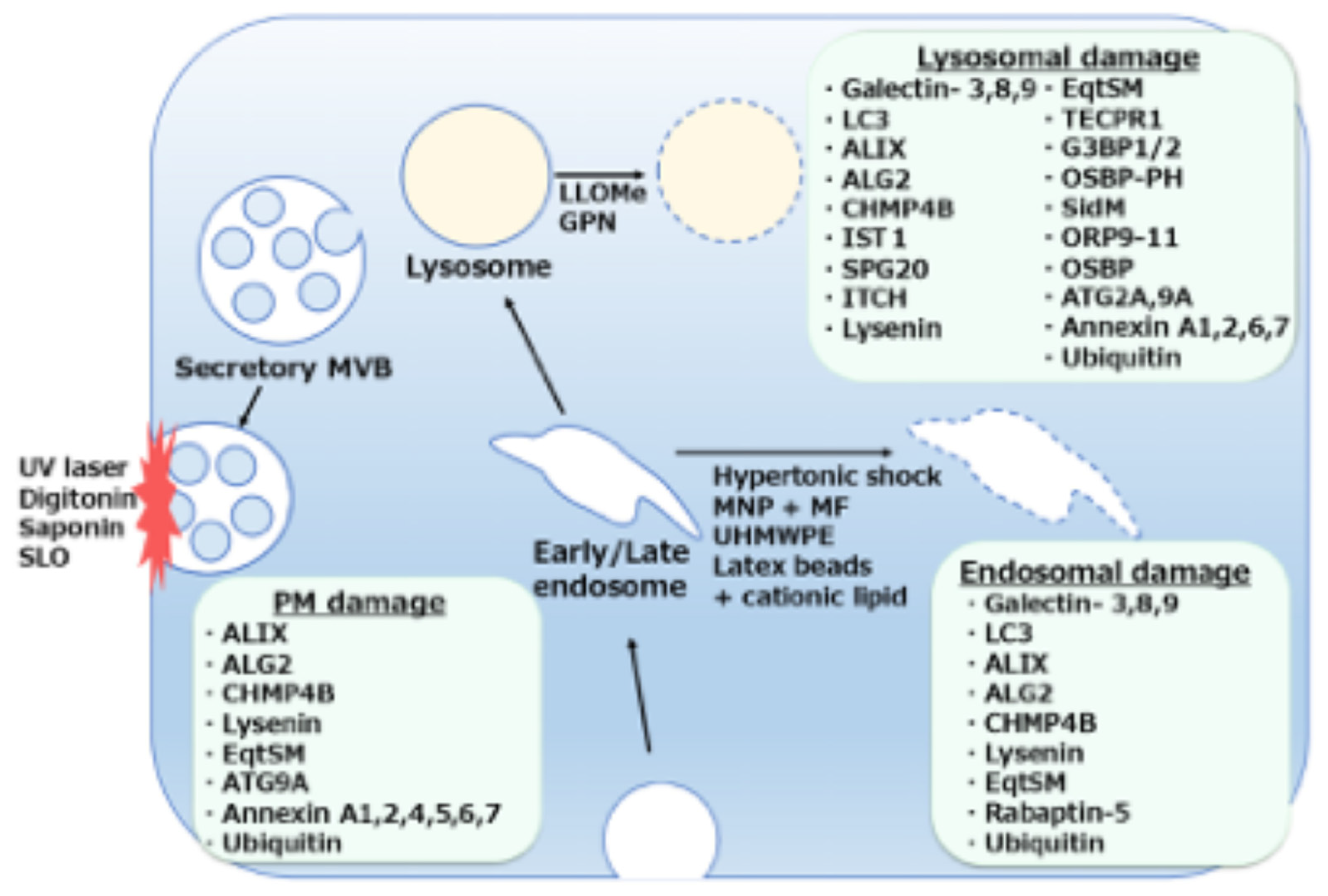
Disclaimer/Publisher’s Note: The statements, opinions and data contained in all publications are solely those of the individual author(s) and contributor(s) and not of MDPI and/or the editor(s). MDPI and/or the editor(s) disclaim responsibility for any injury to people or property resulting from any ideas, methods, instructions or products referred to in the content. |
© 2026 by the authors. Licensee MDPI, Basel, Switzerland. This article is an open access article distributed under the terms and conditions of the Creative Commons Attribution (CC BY) license.
Copyright: This open access article is published under a Creative Commons CC BY 4.0 license, which permit the free download, distribution, and reuse, provided that the author and preprint are cited in any reuse.


