

Submitted:
23 September 2025
Posted:
23 September 2025
You are already at the latest version
Abstract
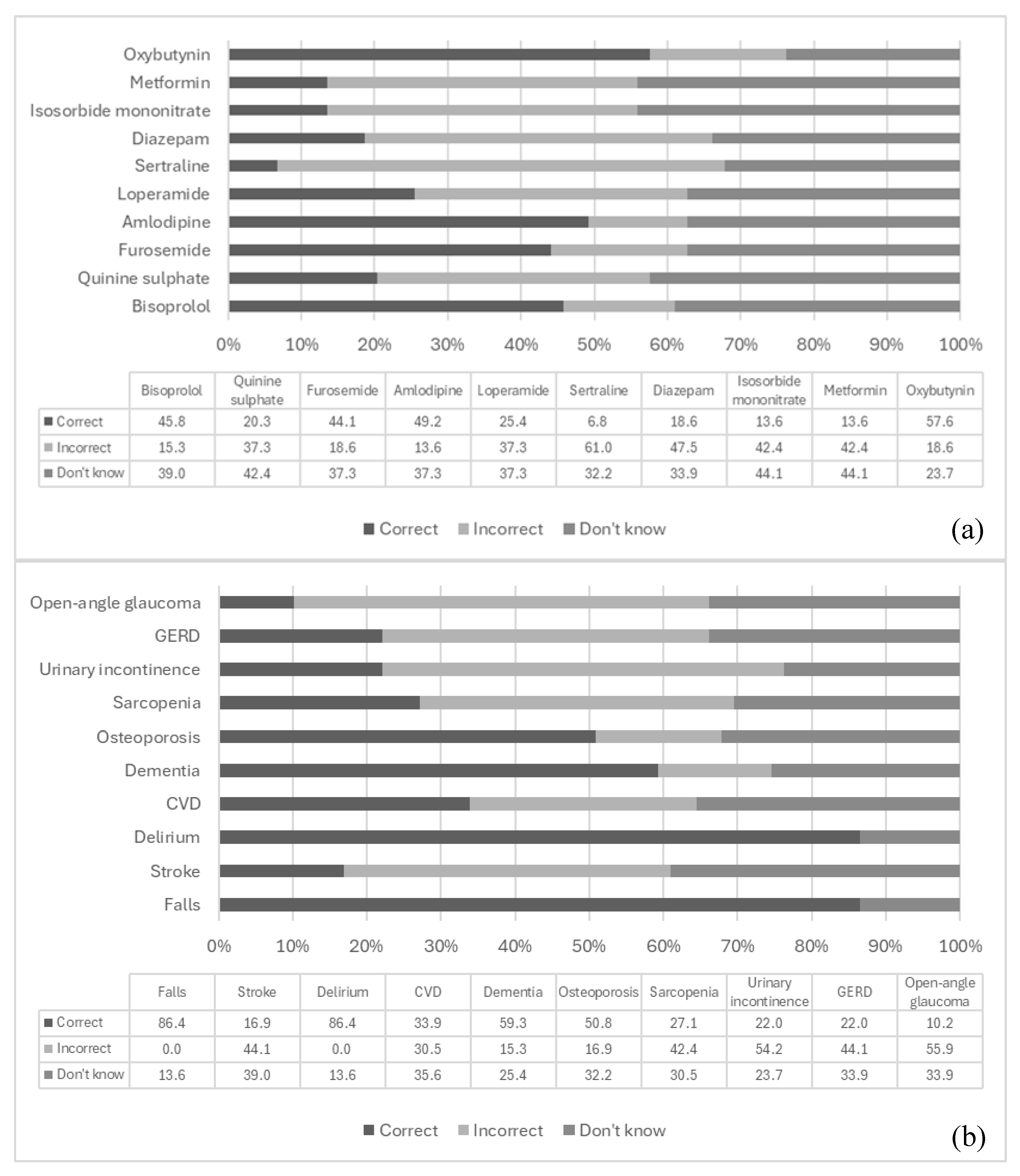
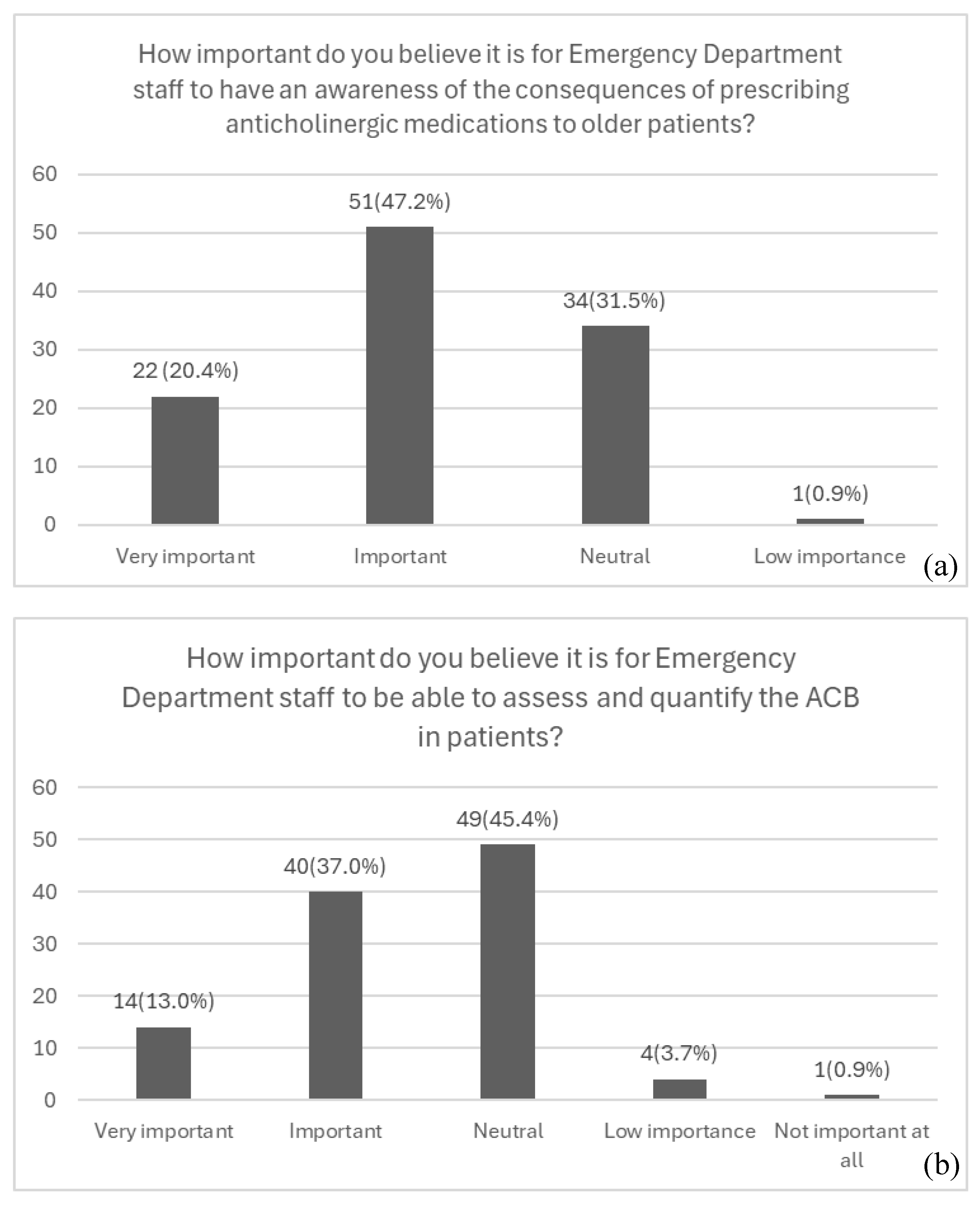
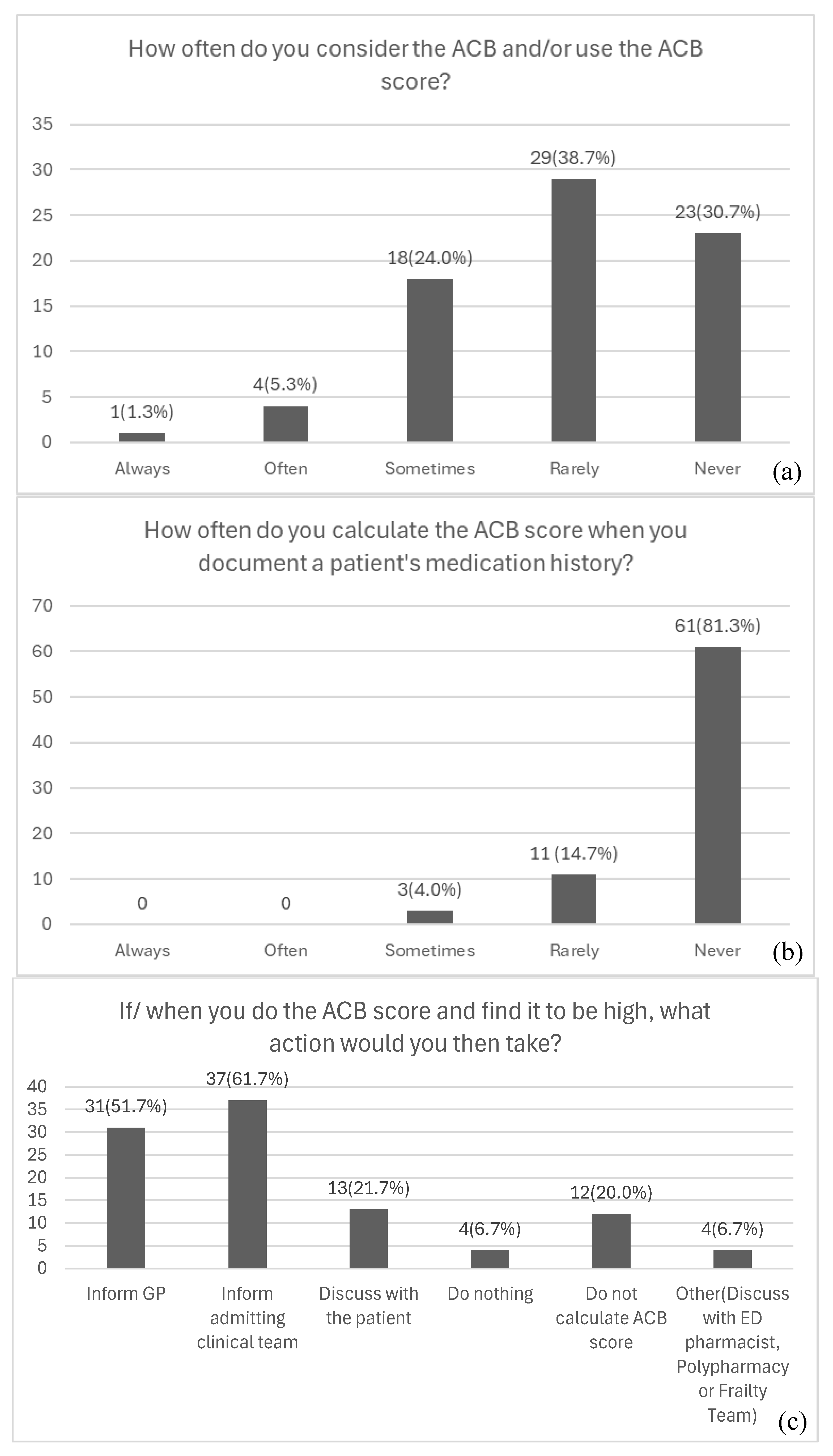
Introduction Older patients are often exposed to medications with anticholinergic activity. Anticholinergic burden (ACB) from medicines is linked to adverse health outcomes. However, healthcare professionals’ familiarity with ACB remains poor, and there is a lack of literature in knowledge, attitudes, or practices (KAP) of ACB among Emergency department (ED) clinicians. Methods A nationwide survey of ACB (using https://www.acbcalc.com) based on a pilot survey was developed using the KAP framework and assessed for face and content validity by ACB experts. It was distributed to ED physicians across the UK using REDCap through social media and professional networks. Results Among the 108 ED physicians who responded, 54.6% (n=59) were aware of the term ACB, but 54.2% (n=32/59) of them were unable to describe it. Their mean scores for quantifying the ACB score and identifying side effects in older patients were 2.9 and 4.1 out of 10, respectively. 88.9% (n=96) believed that ACB is an important consideration in older patients. 67.6% (n=73) agreed that awareness of the consequences of prescribing anticholinergic medications to older patients is important. 50% (n=54) emphasized the importance of being able to assess and quantify the ACB score. Of the 75 physicians who prescribed these medications, 40% (n=30/75) were unaware of ACB. 38.7% (n=29/75) rarely considered ACB, 30.7% (n=23/75) never considered it, and only 1.3% (n=1/75) always considered it. The majority of respondents (88.9%, n=96) agreed that more education on ACB is needed in the ED. Conclusion ED physicians in the UK have limited knowledge and awareness of ACB management and prescribing practices for older patients. However, they show positive attitudes towards their role in ACB management and a willingness to receive further education.
Keywords:
1. Introduction
2. Materials and Methods
2.1. Study Design and Population
2.1.1. Potential Participants
2.1.2. Inclusion Criteria
2.1.3. Exclusion Criteria
2.1.4. Recruitment
2.2. Survey Content and Administration
2.2.1. Survey Content
2.2.2. Survey Administration
2.3. Data analysis and Reporting
3. Results
3.1. Demographics
3.2. Knowledge
3.3. Attitudes
3.4. Practice
4. Discussion
5. Conclusions
Supplementary Materials
Author Contributions
Funding
Institutional Review Board Statement
Informed Consent Statement
Data Availability Statement
Acknowledgments
Conflicts of Interest
Abbreviations
| ACB | Anticholinergic burden |
| KAP | Knowledge, Attitudes, and Practices |
| ED | Emergency Department |
| PIL | Participant Information Leaflet |
| EM | Emergency Medicine |
| TERN | The Royal College of Emergency Medicine Trainee Emergency Research Network |
References
- Overview of the UK population: January 2021. Available online: https://www.ons.gov.uk/peoplepopulationandcommunity/populationandmigration/populationestimates/articles/overviewoftheukpopulation/january2021 (accessed on 1 August 2023).
- Hospital Accident & Emergency Activity 2021-2022. Available online: https://digital.nhs.uk/data-and-information/publications/statistical/hospital-accident--emergency-activity/2021-22 (accessed on 1 August 2023).
- Ghossein, N.; Kang, M.; Lakhkar, A.D. Anticholinergic Medications; StatPearls Publishing: Treasure Island, FL, USA, 2022. [Google Scholar]
- Pierce, H.; Thomas, D.; Asfaw, T.; Chughtai, B. Anticholinergic burden in the elderly population: an emerging concern. Eur Urol 2019, 76(1), 7–8. [CrossRef]
- Nishtala, P.S.; Salahudeen, M.S.; Hilmer, S.N. Anticholinergics: Theoretical and clinical overview. Expert Opin Drug Saf 2016, 15(6), 753–768. [CrossRef]
- Boustani, M.; Campbell, N.; Munger, S.; Maidment, I.; Fox, C. Impact of anticholinergics on the aging brain: A review and practical application. Aging Health 2008, 4(3), 311–320. [CrossRef]
- Anticholinergic Burden Calculator. Available online: https://www.acbcalc.com (accessed on 29 March 2022).
- Mehdizadeh, D.; Hale, M.; Todd, O.; Zaman, H.; Marques, I.; Petty, D.; et al. Associations between anticholinergic medication exposure and adverse health outcomes in older people with frailty: A systematic review and meta-analysis. Drugs Real World Outcomes 2021, 8, 431–458. [Google Scholar] [CrossRef] [PubMed]
- Campbell, N.L.; Perkins, A.J.; Bradt, P.; Perk, S.; Wielage, R.C.; Boustani, M.A.; et al. Association of anticholinergic burden with cognitive impairment and health care utilization among a diverse ambulatory older adult population. Pharmacotherapy 2016, 36(11), 1123–1131. [CrossRef]
- Wilson, N.M.; Hilmer, S.N.; March, L.M.; Cameron, I.D.; Lord, S.R.; Seibel, M.J.; et al. Associations between Drug Burden Index and falls in older people in residential aged care. J Am Geriatr Soc 2011, 59(5), 875–880. [CrossRef]
- Best, O.; Gnjidic, D.; Hilmer, S.N.; Naganathan, V.; McLachlan, A.J. Investigating polypharmacy and drug burden index in hospitalised older people. Intern Med J 2013, 43(8), 912–918. [CrossRef]
- Vetrano, D.L.; La Carpia, D.; Grande, G.; Casucci, P.; Bacelli, T.; Bernabei, R.; et al. Anticholinergic medication burden and 5-year risk of hospitalization and death in nursing home elderly residents with coronary artery disease. J Am Med Dir Assoc 2016, 17(11), 1056–1059. [CrossRef]
- Hsu, W.H.; Huang, S.T.; Lu, W.H.; Wen, Y.W.; Chen, L.K.; Hsiao, F.Y. Impact of multiple prescriptions with anticholinergic properties on adverse clinical outcomes in the elderly: A longitudinal cohort study in Taiwan. Clin Pharmacol Ther 2021, 110(4), 966–974. [CrossRef]
- Cardwell, K.; Hughes, C.M.; Ryan, C. The association between anticholinergic medication burden and health related outcomes in the “oldest old”: A systematic review of the literature. Drugs Aging 2015, 32(10), 835–848. [CrossRef]
- Nickel, C.H.; Ruedinger, J.M.; Messmer, A.S.; Maile, S.; Peng, A.; Bodmer, M.; et al. Drug-related emergency department visits by elderly patients presenting with non-specific complaints. Scand J Trauma Resusc Emerg Med 2013, 21, 15. [Google Scholar] [CrossRef] [PubMed]
- The Royal College of Emergency Medicine. RCEM Workforce Recommendations 2018: Consultant Staffing in Emergency Departments in the UK. London: Royal Charter; 2019.
- Andrade, C.; Menon, V.; Ameen, S.; Kumar Praharaj, S. Designing and conducting knowledge, attitude and practice surveys in psychiatry: Practical guidance. Indian J. Psychol. Med. 2020, 42(5), 478–481. [CrossRef]
- Warren-Miell, H.; Alexander, K.; Moss, P. Anticholinergic burden in older patients: A survey to investigate knowledge, attitudes and practice amongst Emergency Department staff. Br. J. Clin. Pharmacol. 2023, 89, 1245–1246. [Google Scholar]
- Harris, P.A.; Taylor, R.; Thielke, R.; Payne, J.; Gonzalez, N.; Conde, J.G. Research electronic data capture (REDCap) – A metadata-driven methodology and workflow process for providing translational research informatics support. J. Biomed. Inform. 2009, 42(2), 377–381. [CrossRef]
- Harris, P.A.; Taylor, R.; Minor, B.L.; Elliott, V.; Fernandez, M.; O’Neal, L.; et al. The REDCap consortium: Building an international community of software partners. J. Biomed. Inform. 2019, 95, 103208. [Google Scholar] [CrossRef] [PubMed]
- Moss, P.; Pizzorrusso, M.; Uthayakumar, T.; Pieper, N.; Jarman, H. ACB scoring in the ED: Application of the anticholinergic burden score in ED. In Proceedings of the RCEM Annual Scientific Conference 2020; St George’s University Hospitals: London, UK, September, 2020; pp. 1–10. [Google Scholar]

| Grade of participants | n(%) |
|---|---|
| Consultant | 54 (50.0) |
| Core trainee | 17 (15.7) |
| Registrar | 37 (34.3) |
| Total | 108 (100) |
| ACB score* | 0 | 1 | 2 | 3 |
| Medication | Bisoprolol | Metformin | Oxybutynin | |
| Quinine sulphate | Diazepam | |||
| Furosemide | Isosorbide mononitrate | |||
| Amlodipine | Loperamide |
Disclaimer/Publisher’s Note: The statements, opinions and data contained in all publications are solely those of the individual author(s) and contributor(s) and not of MDPI and/or the editor(s). MDPI and/or the editor(s) disclaim responsibility for any injury to people or property resulting from any ideas, methods, instructions or products referred to in the content. |
© 2025 by the authors. Licensee MDPI, Basel, Switzerland. This article is an open access article distributed under the terms and conditions of the Creative Commons Attribution (CC BY) license (http://creativecommons.org/licenses/by/4.0/).