

Submitted:
22 September 2025
Posted:
23 September 2025
You are already at the latest version
Abstract
Computer vision is commonly defined as the technical ability of machines to interpret visual data. Yet, by drawing an analogy with human vision, it becomes evident that perception is not confined to information processing alone [1]. Human sight is also a source of immediate emotional reactions and cultural experience [2]. This work introduces the concept of visual emotivity the capacity of visual stimuli to evoke affective responses prior to rational analysis and considers its possible relevance for the future of computer vision [3]. Examples from art, cultural traditions of contemplation, and findings in neuroscience indicate that visual emotivity may represent an important dimension of perception [4]. Incorporating this perspective could be regarded as an upgrade to computer vision [5], opening pathways toward more human-centered interfaces and therapeutic applications, while also raising questions about ethical risks and the potential for manipulation. In this light, computer vision may be seen as a field situated at the intersection of biology, culture, and technology.
Keywords:
computer vision
; visual perception
; visual emotivity
; affective computing
; cultural cognition
; neuromorphic vision
; bio-inspired systems
; human-centered AI
Introduction
Computer vision has traditionally been defined through the tasks of object detection, image classification, and scene understanding [6]. These approaches mirror the technical side of human sight, treating vision primarily as a matter of data processing. Yet if one draws an analogy with human vision, it becomes evident that perception is not limited to such functions. Human sight is deeply intertwined with emotion, attention, and cultural practice [7]. When a person encounters a particular image, the reaction often occurs instantly, before any conscious reasoning takes place [8]. Such immediacy reveals that vision is not neutral but inherently emotive [9].
This dimension may be referred to as visual emotivity. By this term is meant the capacity of visual stimuli to trigger affective responses that shape behavior and cognition prior to conscious interpretation [10]. The phenomenon can be observed in works of art, such as Edvard Munch’s The Scream, which conveys existential anxiety through distorted lines and colors, or in Japanese traditions of contemplation, where the eye is trained to perceive rhythm, harmony, and subtle transitions of light and shadow [11]. Neuroscientific research further confirms that visual pathways to the amygdala enable rapid emotional reactions, bypassing the slower cortical routes of analysis [12].
Acknowledging visual emotivity opens a perspective for rethinking computer vision [13]. Machines should not only recognize objects but may also be designed to account for the potential emotional impact of visual stimuli [14]. This orientation aligns with ongoing technological developments, including AI-powered cameras and neuromorphic sensors, which increasingly approximate the biological and cultural dimensions of vision [3]. Computer vision may thus be understood as a bridge between biology, culture, and technology a perspective that situates technical progress within the broader human context.
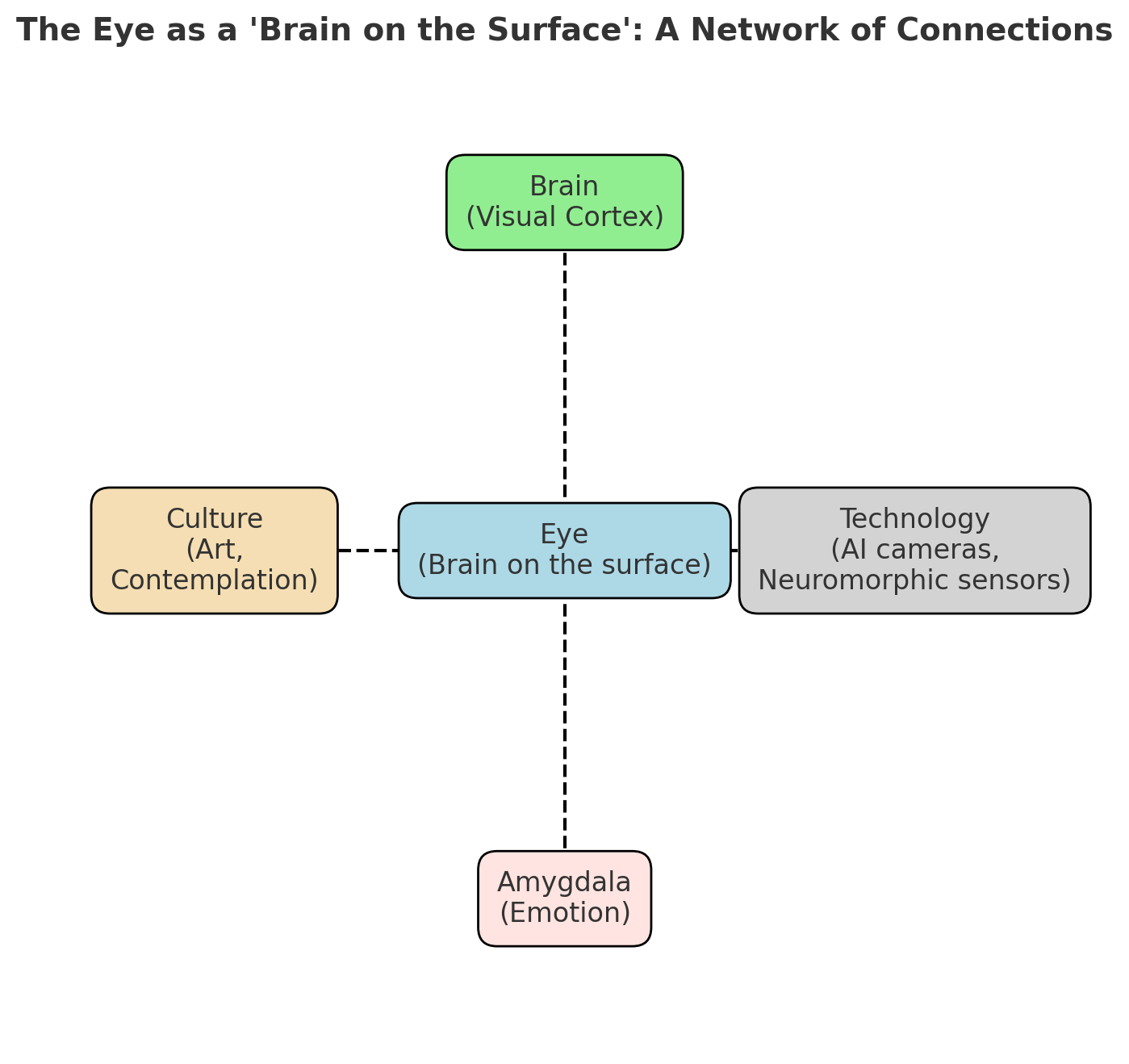
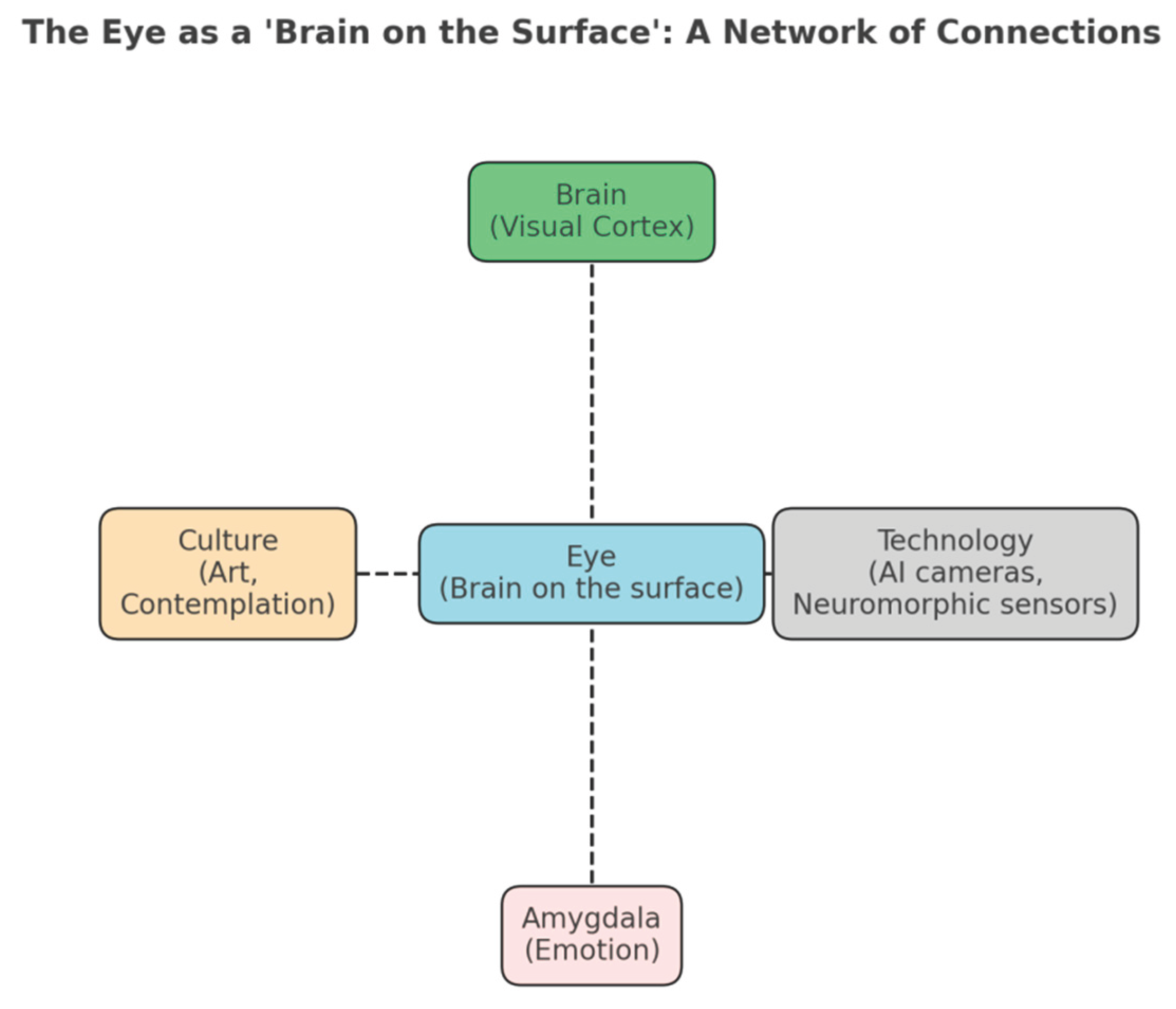
As illustrated in Figure 1, the eye may be regarded as a “brain on the surface,” situated at the intersection of biological processes, cultural practices, and technological innovation.
The diagram illustrates its role as a node connecting biological processing (visual cortex, amygdala), cultural dimensions (art, contemplation), and technological developments (AI-powered cameras, neuromorphic sensors).
Art provides some of the most striking illustrations of visual emotivity, where an image provokes an immediate response that bypasses rational analysis [15]. Certain works invite states of harmony and contemplation: the balanced play of light and shadow in Renaissance masters, or the abstract compositions of František Kupka, where rhythm and color evoke an inner sense of equilibrium.
Others, however, awaken anxiety, horror, or existential unease. Hieronymus Bosch, in his allegorical paintings, reveals a world of chaos and sin that unsettles the viewer with its density and strangeness. Pieter Bruegel the Elder, in works such as The Triumph of Death and The Fall of the Rebel Angels, presents monumental scenes of disorder and destruction that overwhelm perception and evoke fear of worldly chaos. Caravaggio and Artemisia Gentileschi, through dramatic chiaroscuro, confront the spectator with violence, pain, and religious intensity.
In later centuries, Francisco Goya and Käthe Kollwitz depicted suffering, war, and injustice in ways that leave no room for neutrality, while Théodore Géricault’s Raft of the Medusa captured collective despair. Pablo Picasso, in Guernica, condensed the terror of war into distorted forms and stark contrasts, creating a universal symbol of anguish that continues to resonate. In the twentieth century, Francis Bacon’s distorted figures embodied existential dread, Salvador Dalí destabilized perception through surreal dreamscapes, and Zdzisław Beksiński offered nightmarish visions of post-apocalyptic worlds. Even William-Adolphe Bouguereau, known for idealized beauty, embedded subtle undertones of melancholy that disturb the apparent harmony of his compositions.
Taken together, these works demonstrate the full range of visual emotivity from contemplative calm to horror and despair. Across styles and epochs, they show that art does not merely communicate information but directly engages the affective system, shaping experiences that may leave the viewer shaken, unsettled, or transformed.
In several cultural traditions, the eye is regarded not only as a receptor but also as an educator of the inner self. Japanese practices of contemplation observing stone gardens, the play of light and shadow, or the movement of water cultivate attentiveness and the ability to perceive rhythms and connections rather than isolated objects [16]. In such practices, the eye becomes a teacher of contemplation rather than a mere sensor [6]. This perspective may serve as a prototype for computer vision systems designed not only to recognize objects but also to discern what is meaningful and to filter noise in a structured way.
The biological basis of visual emotivity lies in the fact that visual stimuli are processed not only in the visual cortex but also through rapid pathways involving the amygdala and brainstem [17]. This enables immediate responses to threats, sudden changes in the visual field, or the appearance of faces and movement. Such mechanisms emerged evolutionarily as a means of survival and may explain why certain images influence emotions while bypassing rational control.
Contemporary technologies increasingly reproduce these mechanisms. AI-powered cameras are now able to detect key objects and events directly at the sensor level, while neuromorphic devices such as the Dynamic Vision Sensor operate on retinal principles, reacting to changes in the scene rather than capturing static frames. Engineering solutions are thus moving closer to the biological model of the eye as a “brain on the surface.”
The potential of such approaches, however, is accompanied by risks. In art and therapy, visual emotivity can provide catharsis and harmony, yet in advertising, political communication, and propaganda it may become a tool of manipulation. Emotional reactions often arise more rapidly than rational analysis, making vision vulnerable to external influence. In the age of AI this risk is amplified, as computer vision and generative algorithms are capable of producing images at scale that exploit emotional archetypes and subconscious responses.
For this reason, visual emotivity may be considered not only as a phenomenon of psychology and culture but also as a technological factor. Computer vision could evolve not only toward improving recognition accuracy but also toward understanding the emotional impact of the visual stream. Such a perspective opens possibilities for new interfaces, therapeutic practices, and artistic forms, while also demanding ethical safeguards to minimize manipulative uses.
Discussion
The concept of visual emotivity makes it possible to view vision not solely as a technical process of registering images but as a field of emotional and cultural experience. Traditional neuroscience often describes the eye through retinal physiology and cortical processing, yet cultural practices and art suggest that perception is never confined to biology alone. Emotion and attention are embedded in the very act of seeing, and overlooking this dimension in computer vision development risks leaving the technology incomplete [18].
Recent advances in AI-powered cameras and neuromorphic sensors indicate that science is gradually moving toward bio-inspired solutions [19]. However, the emotional aspect of perception has so far received less attention. It is precisely this dimension that may determine which images are perceived as threats, which inspire trust, and which evoke anxiety or aversion. This observation opens a direction for further research. The task is not only to model object recognition but also to explore the prediction of emotional effects triggered by visual stimuli.
The connection between technology and culture is of particular importance. Lessons of contemplation, practiced for centuries in Japan [15], may serve as a prototype for algorithms of “visual attentiveness” that enable systems to highlight what is meaningful and to harmonize perception. Approaches of this kind could help prevent computer vision from overwhelming users with raw data, instead providing a more balanced and structured experience.
At the same time, the emotional nature of vision makes it vulnerable to manipulation. The history of advertising, propaganda, and branding illustrates how visual triggers have long been used to guide attention and behavior. With the spread of generative AI this risk becomes more pronounced. Such systems can mass-produce images that exploit emotional archetypes and unconscious responses [20].
For these reasons, computer vision may be seen as facing a dual challenge. On one side, it may evolve to take into account the emotional impact of images, creating new human-centered interfaces. On the other, there is a need for ethical frameworks to mitigate the misuse of visual emotivity. Striking this balance could allow computer vision to be regarded not as a tool of external control but as a technology that extends and enriches human capacities.
Conclusion
The eye as a “brain on the surface” may be regarded as a concept that brings together biology, culture, and technology in a single perspective. Recognizing the role of visual emotivity suggests an upgrade to computer vision: moving beyond technical detection toward incorporating the emotional and cultural dimensions of perception. The task is to translate these subtle and intangible aspects into representations accessible to machines, which requires technical and mathematical approaches. Current developments already indicate such a shift. AI-powered cameras and neuromorphic sensors can be seen as early steps toward systems that approximate the integrative character of human vision.
References
- D. H. Hubel, Eye, brain, and vision. in Eye, brain, and vision. New York, NY, US: Scientific American Library/Scientific American Books, 1995, pp. viii, 242.
- R. E. Nisbett, The geography of thought: How Asians and Westerners think differently and why. in The geography of thought: How Asians and Westerners think differently... and why. New York, NY, US: Free Press, 2003, pp. xxiii, 263.
- Marczak-Czajka, T. Redgrave, M. Mitcheff, M. Villano, and A. Czajka, ‘Assessment of human emotional reactions to visual stimuli “deep-dreamed” by artificial neural networks’, Front. Psychol., vol. 15, Dec. 2024. [CrossRef]
- J. E. LeDoux, The emotional brain: The mysterious underpinnings of emotional life. in The emotional brain: The mysterious underpinnings of emotional life. New York, NY, US: Simon & Schuster, 1996, p. 384.
- H. Wang, B. Sun, S. S. Ge, J. Su, and M. L. Jin, ‘On non-von Neumann flexible neuromorphic vision sensors’, Npj Flex. Electron., vol. 8, no. 1, p. 28, May 2024. [CrossRef]
- G. Sandini and G. Metta, ‘Retina-Like Sensors: Motivations, Technology and Applications’, in Sensors and Sensing in Biology and Engineering, F. G. Barth, J. A. C. Humphrey, and T. W. Secomb, Eds, Vienna: Springer Vienna, 2003, pp. 251–262. [CrossRef]
- L. Pessoa, ‘On the relationship between emotion and cognition’, Nat. Rev. Neurosci., vol. 9, no. 2, pp. 148–158, Feb. 2008. [CrossRef]
- B. Heider, L. Spillmann, and E. Peterhans, ‘Stereoscopic illusory contours--cortical neuron responses and human perception’, J. Cogn. Neurosci., vol. 14, no. 7, pp. 1018–1029, Oct. 2002. [CrossRef]
- L. Spillmann, ‘Phenomenology and neurophysiological correlations: two approaches to perception research’, Vision Res., vol. 49, no. 12, pp. 1507–1521, June 2009. [CrossRef]
- P. Vuilleumier and J. Driver, ‘Modulation of visual processing by attention and emotion: windows on causal interactions between human brain regions’, Philos. Trans. R. Soc. Lond. B. Biol. Sci., vol. 362, no. 1481, pp. 837–855, May 2007. [CrossRef]
- P. Vuilleumier and J. Driver, ‘Modulation of visual processing by attention and emotion: windows on causal interactions between human brain regions’, Philos. Trans. R. Soc. Lond. B. Biol. Sci., vol. 362, no. 1481, pp. 837–855, May 2007. [CrossRef]
- P. Vuilleumier and G. Pourtois, ‘Distributed and interactive brain mechanisms during emotion face perception: evidence from functional neuroimaging’, Neuropsychologia, vol. 45, no. 1, pp. 174–194, Jan. 2007. [CrossRef]
- R. Amorim, B. Bret, and J. M. González-Méijome, ‘Opto-Mechanical Eye Models, a Review on Human Vision Applications and Perspectives for Use in Industry’, Sensors, vol. 22, no. 19, p. 7686, Jan. 2022. [CrossRef]
- Posch, T. Serrano-Gotarredona, B. Linares-Barranco, and T. Delbruck, ‘Retinomorphic Event-Based Vision Sensors: Bioinspired Cameras With Spiking Output’, Proc. IEEE, vol. 102, no. 10, pp. 1470–1484, Oct. 2014. [CrossRef]
- Juniper, Wabi Sabi: The Japanese Art of Impermanence. Tuttle Publishing, 2011.
- R. Ohno, ‘Studies on environmental perception during locomotion—a review of empirical studies by the Ohno laboratory’, Jpn. Archit. Rev., vol. 1, no. 2, pp. 194–206, 2018. [CrossRef]
- P. Rotshtein, R. Malach, U. Hadar, M. Graif, and T. Hendler, ‘Feeling or Features: Different Sensitivity to Emotion in High-Order Visual Cortex and Amygdala’, Neuron, vol. 32, no. 4, pp. 747–757, Nov. 2001. [CrossRef]
- F. J. Otamendi and D. L. Sutil Martín, ‘The Emotional Effectiveness of Advertisement’, Front. Psychol., vol. 11, Sept. 2020. [CrossRef]
- Shukla, S. S. Gullapuram, H. Katti, M. Kankanhalli, S. Winkler, and R. Subramanian, ‘Recognition of Advertisement Emotions with Application to Computational Advertising’, Apr. 03, 2019, arXiv: arXiv:1904.01778. [CrossRef]
- S. A. Kadir and A. M. L. and T. Tsuchiya, ‘Emotion and Techniques of Propaganda in YouTube Videos’, Indian J. Sci. Technol., vol. 9, no. Special Issue 1, pp. 1–8, May 2016. [CrossRef]
Disclaimer/Publisher’s Note: The statements, opinions and data contained in all publications are solely those of the individual author(s) and contributor(s) and not of MDPI and/or the editor(s). MDPI and/or the editor(s) disclaim responsibility for any injury to people or property resulting from any ideas, methods, instructions or products referred to in the content. |
© 2025 by the authors. Licensee MDPI, Basel, Switzerland. This article is an open access article distributed under the terms and conditions of the Creative Commons Attribution (CC BY) license (http://creativecommons.org/licenses/by/4.0/).
Copyright: This open access article is published under a Creative Commons CC BY 4.0 license, which permit the free download, distribution, and reuse, provided that the author and preprint are cited in any reuse.


