

Submitted:
19 September 2025
Posted:
22 September 2025
You are already at the latest version
Abstract
The biological accumulation of microcontaminants and associated antibiotic resistance in food poses significant threats to both human and environmental health. Therefore, it is particularly important to design and develop methods of efficient identification and detection. Recently, molecularly imprinted polymers (MIPs) and aptamers (Apts), as an emerging hybrid recognition element, have received widespread attention from researchers. Because the dual recognition-based sensors have exhibited improved properties and desirable features, such as high sensitivity, low limit of detection, high stability under harsh environmental conditions, high binding affinity, which are expected to be applied in food safety fields. This paper compares the characteristics of MIP and Apt, highlighting the significant advantages of aptamer-integrated MIP (MIP@Apt) dual recognition. It then systematically discusses three synthetic strategies for MIP-Aptamer hybrid recognition systems and their applications for food safety detection, focusing on analyzing their detection strategies, sensing mechanisms, construction methodologies, performance evaluations, and potential application value. It also offers substantive perspectives on both the prevailing limitations and promising developmental pathways for MIP-aptamer hybrid recognition-based sensing platforms.
Keywords:
Food safety
; Molecularly imprinted polymer
; Aptamer
; Dual recognition
; Biosensor
Introduction
Food safety has continuously been a research hotspot due to its direct implications for public health and well-being. According to 2024 World Health Organization (WHO) surveillance data, the global burden of foodborne diseases accounts for an estimated 600 million incident cases annually, resulting in approximately 420,000 attributable deaths. Pediatric populations exhibit particular vulnerability, with children under 5 years of age experiencing 125,000 annual mortality cases - representing 30% of total foodborne disease fatalities[1]. More than 200 diseases are linked to eating food contaminated with bacteria[2], mycotoxin[3], illicit additives[4], viruses[5],etc. In addition, the accumulation of pesticide residues in the human body through the food chain is also a critical factor leading to relevant diseases[6]. Therefore, a sensitive and efficient analysis and detection technology for food microcontaminants is urgently required[7].
Biosensors, renowned for their rapid response, high sensitivity, and portability, have become essential tools in food safety testing. These analytical devices integrate biological recognition components with signal transmitters(such as electrochemical electrodes, optical detectors, piezoelectric crystals, etc.) to detect specific targets and generate measurable signals[8,9]. Their core function resides in converting biomolecular recognition events into quantifiable electrical or optical changes, enabling highly sensitive and selective detection of target substances. The core of biosensors lies in their recognition components, as the efficiency and accuracy of output signals depend on whether these components can rapidly and precisely identify target molecules and interact with them[10-12]. Typical recognition components include antibodies, peptides, aptamers (Apts), enzymes, and molecularly imprinted polymers (MIPs)[10]. Among these components, antibodies have become the mainstay in numerous practical applications of biomolecular recognition owing to their exceptional properties such as high specificity, strong affinity, and multifunctionality[13]. However, issues like high production costs, short shelf life, and stringent storage requirements for antibodies have compelled researchers to seek more effective alternatives[14].
Aptamers are single-stranded DNA or RNA molecules selected through the exponential enrichment of ligand system evolution (SELEX) technology[15,16]. They exhibit high specificity[17], low toxicity[18], reversible thermal denaturation, excellent biocompatibility, and easy functional customization[19]. These molecules can bind target substances (such as small molecules, proteins, and cells) with their high affinity and specificity. Their binding mechanism relies on three-dimensional structural folding to form specific binding pockets or surface complementarity, similar to antibody antigen recognition. Additionally, through modification, labeling, and immobilization methods, aptamers can combine with other nanomaterials to achieve various signal transduction functions[20]. However, their preparation costs are relatively high, and as biomolecules, their applications are limited by insufficient stability. In contrast, molecular imprinting polymers (MIPs) are synthetic macromolecular materials with specific recognition sites[21]. These polymers are engineered through molecular imprinting technology to selectively bind target molecules (template molecules). Compared to biological recognition elements like antibodies and aptamers, MIPs offer advantages such as high stability (resistant to extreme conditions including strong acids, strong bases, and organic solvents), high selectivity, shorter development cycles, and lower costs[22]. However, they face challenges including relatively weak affinity, template leakage, long response time, cross-selectivity issues, and low sensitivity to interference from structurally similar compounds[23].
Given the limitations of single recognition elements in complex environments, in recent years, many scholars have considered integrating aptamers with predetermined affinities into polymer cavities to generate hybrid receptors with enhanced recognition properties[24-27]. As shown in Figure 1, the hybrid MIP-aptamer demonstrates several advantages compared to individual MIPs or aptamers alone. For example, MIP provides rigid structural recognition for spatial matching, while Apt offers molecular-level specific complementary binding. This synergy reduces nonspecific adsorption and significantly improves recognition accuracy in complex samples. Additionally, stability and activity are balanced: the chemical stability of MIP protects Apt from environmental degradation (enzyme hydrolysis resistance and extreme condition tolerance), and the superior binding affinity of aptamers effectively compensates for the constrained molecular recognition capacity inherent to molecularly imprinted polymers, thereby synergistically enhancing the overall sensor performance. Furthermore, the combination of MIP's porous structure (enhancing mass transfer) and Apt's easy modification enables signal amplification (electrochemical or fluorescence signal enhancement), expanding the detection range from trace to macro levels. In addition, under the same detection conditions, the detection limit and detection range obtained by different detection methods are listed in Table 1. It is not difficult to find that the sensors incorporating MIP-Aptamer dual recognition elements exhibit a broader linear range and lower detection limit compared to those relying solely on MIPs or aptamers, which can be attributed to the synergistic effect of MIPs and aptamers.
This paper systematically reviews the research progress of various sensing platform applications based on the aptamer-integrated MIP (MIP@Apt) dual recognition elements from 2018 to 2025, focusing on two core dimensions: first, the preparation methods of these elements, and second, their applications in detecting food contaminants and antibiotic resistance. The first section analyzes the characteristics of single recognition elements (Apt or MIP) and their synergistic enhancement advantages. The second part systematically discusses the preparation processes of the aptamer-integrated MIP (MIP@Apt) dual recognition elements, examining how different modification methods and material selection impact sensor performance. The third section categorizes sensors based on sensing mechanisms (electrochemical and optical) using aptamer-molecular imprint polymer technology, then delves into key indicators such as sensitivity, detection limit, linear range, modification methods, response time, and stability for each platform in food sample analysis. It also discusses challenges and potential solutions for dual recognition sensing technologies across different platforms, along with their prospects for field applications in food analysis. Finally, the paper explores common issues in the aptamer-integrated MIP (MIP@Apt) dual recognition sensor development, summarizing the future prospects and challenges.
Fabrication Approaches of MIP-Apt Recognition Components
According to the spatial arrangement and synergistic mechanisms between the MIP and Apt, sensor structures employing MIP-Apt dual recognition elements can be roughly classified into three primary configurations: embedded, sandwich and separated[30], as shown in Figure 2, each offering distinct performance in molecular recognition.
The key feature of the embedded structure is the close spatial coupling between MIP and Apt, where Apt is either embedded in the MIP matrix (Embedded type Ⅰ) or co-modified on the same carrier (such as Fe3O4) surface (Embedded type Ⅱ). Spatially, Apt acts as an auxiliary recognition site for MIP, directly contributing to the formation of the MIP cavity. From a synergistic mechanism perspective, Apt enhances the selectivity of MIP, while MIP provides pre-enrichment to improve the sensitivity of the Apt. In Embedded type Ⅰ, Apt is chemically bonded (such as through amino or thiol modifications) as one of the functional monomers of MIP, directly participating in the formation of the imprinting cavity, making it suitable for small molecule target detection. In Embedded type Ⅱ, Apt is post-modified and fixed on the surface of the synthesized MIP, making it suitable for large molecules (such as proteins and cells) detection.
The sandwich structure is characterized by MIP and Apt being located at different levels of the sensor, capturing targets through a sandwich structure. MIP and Apt are physically separated, serving as the capture layer and the signal amplification layer, respectively, with the synergistic mechanism involving the coordinated action of target capture, secondary recognition, and signal transduction. They work by capturing target molecules with MIP and amplifying signals with the Apt probe, combining high affinity and stable output, which is ideal for complex sample detection.
The separation type achieves parallel detection through physical isolation, making it suitable for multi-target synchronous analysis. This system classification not only reflects the spatial organization logic of the recognition elements but also demonstrates a differentiated strategy for functional synergy, providing clear guidance for sensor design tailored to various detection requirements.
2.1. Embedded Type
Depending on their preparation methods and the types of sensors they are suitable for, Embedded type MIP-Apt dual recognition elements can be further divided into Embedded Type I and Embedded Type II.
2.1.1. Embedded Type I
The fabrication process of embedded Type I MIP-Aptamer hybrid sensors roughly includes the following four steps, as shown in Figure 2A.
(1) Modification of electrodes. Firstly, the commonly employed categories of electrodes currently include glassy carbon electrode (GCE)[31-33], screen-printed electrode (SPE)[34], etc. Then, the selected electrode surface is modified by various materials, such as metal nanomaterials, carbon nanomaterials, carbon nanotubes (CNT)[35]and oxide nanomaterials[33]. For metal nanomaterials, they are mainly applied for Apt fixation through Au-S bonds (such as gold nanoparticles (AuNPs) [36,37]and silver nanoparticles[38]). While carbon nanomaterials enhance the sensitivity of sensors through two key properties: their exceptionally high specific surface area (providing abundant binding sites) and superior electrical conductivity (facilitating efficient signal transduction)[39].
(2) Fixation of Apt-target molecular complexes. The immobilization strategy of the aptamer is crucial for the performance of the sensor. The gold-sulfur bond between the thiol group (-SH) and gold is a common aptamer modification strategy, which provides good stability. However, certain substances, such as Acrylamide (AAM), can easily undergo addition reactions with -SH, affecting the selectivity of the aptamer modification and thus reducing the specificity of the sensor. To address this issue, aptamers modified with -NH2 are immobilized on the surface of the gold electrode, thereby enhancing the sensor's specificity and stability. Therefore, common fixation methods include Au-S bonds[24,28] or-CO-NH-bonds.
(3) Preparation of MIP membrane. Use electro-polymerization to polymerize the selected functional monomers onto the surface of the previously modified electrode, and coat them onto the Apt target molecule complex[23]. The electro-polymerization methodology effectively controls the thickness of synthesized MIP films by controlling the polymerization cycle[40]. Representative functional monomers include dopamine (DA)[32]and o-phenylenediamine (o-PD)[34,41]. It mainly due to its unique electrochemical properties, polymerization controllability and the advantage of interaction with target molecules. DA exhibits self-polymerization properties, forming polydopamine (PDA) through oxidative self-polymerization in weakly alkaline environments (pH 8.5) without requiring external oxidants, demonstrating compatibility with biological templates. Additionally, PDA can be modified on various substrates (gold, ITO, graphene), effectively addressing electrode modification challenges. The hydrophilic surface of PDA reduces protein (or cell) adhesion to minimize non-specific adsorption, making it suitable for complex sample detection. Furthermore, the conjugated structure of PDA resists oxidative degradation, ensuring long-term stability and extending sensor lifespan. O-phenylenediamine (O-Phen) undergoes electro-polymerization under neutral or mildly acidic conditions (pH 5-7), avoiding damage to biomolecular templates such as proteins and DNA. The resulting Po-phenylenediamine (Po-phen) film maintains controllable thickness at the nanoscale, further reducing non-specific adsorption. Moreover, O-Phenylenediamine (O-Phen) contains abundant amino and hydroxyl groups that form hydrogen bonds or electrostatic interactions with target molecules (phenolic compounds and antibiotics), enhancing detection efficiency. Therefore, as for the functional monomer selection, electrochemical sensing for small molecule prioritizes O-Phenylene diamine (O-Phen), while biomacromolecule detection favors DA.
(4) Removal of template molecule. The eluent removes the template molecule from the electrode surface by destroying inter molecular forces such as hydrogen bonds and van der Waals forces between the target molecule and the Apt, as well as the target molecule and the MIP, generating complementary imprinted cavities. These cavities exhibit specific recognition capabilities for the target molecules.
2.1.2. Embedded Type II
The fabrication process of embedded Type II sensors primarily involves four key steps: carrier selection, formation of template-molecule aptamer complexes, MIP membrane preparation, and template molecule elution (as shown in Figure 2B). It is not difficult to observe this process has many similarities with embedded type I. The core distinction lies in the carrier selection methodology[42,43].
2.2. Sandwich Type
As shown in Figure 2C, the sandwich-type sensor based on MIP-Apt achieves high-selectivity capture and signal amplification of target analytes through spatially separated dual recognition layers (Apt layer + MIP layer). Its core features include stepwise recognition and cascaded signal amplification. Apt-modified substrates (electrodes, nanoparticles) specifically bind to target analytes. MIP further captures these analytes, forming an "Apt-target-MIP" sandwich structure. The fabrication process involves: firstly, substrate modification and MIP synthesis, which is similar to embedded structure. Secondly, sandwich assembly. Apts are typically paired with signal molecules that trigger specific responses. The Apts are responsible for identifying target analytes while the signal molecule detects the transition between recognition states. Signal molecule selection depends on sensing mechanisms: In electrochemical sensors, electrochemically active substances like ferrocene[44] and methylene blue[16] [45]are commonly used. In optical sensors, nanomaterials with outstanding optical characteristics are typically chosen as signal molecules, such as CdS quantum dots, carbon quantum dots (CD) and quantum dots(QDs) [46,47], etc.
2.3. Separated Type
Loosely speaking, a separation based dual recognition sensor can be understood as (Figure 2D): firstly, MIPs perform sample pretreatment to preliminarily enrich and isolate target analytes. However, they are frequently interfered with molecules structurally similar to the analytes. To address this, Apt-independent detection is employed for secondary molecular separation. Current literature reports limited studies on detection methods utilizing separation-based MIP-Apt recognition components. For instance, Li et al. demonstrated a dual-recognition microfluidic chip leveraging MIPs and aptamers (Apt) in an electrochemical system for furan monitoring[48].
Molecularly Imprinted Polymer-Aptamer Hybrid Systems for Food Analysis Applications
3.1. Electrochemical Sensing Platforms Leveraging MIP-Aptamer Dual Recognition Mechanisms
An electrochemical sensor is a detection device based on the principles of electrochemistry. When the target substance to be measured specifically binds with the recognition element modified on the electrode surface, it triggers changes in electrochemical signals such as current, voltage, impedance or resistance[49]. Therefore, qualitative and quantitative analysis of the target substance can be achieved by detecting these changes in electrical parameters. Based on the research of existing literature,The majority of reported MIP-Apt hybrid sensors employ an embedded Type I architecture. Moreover, the detection strategy of them predominantly adopts electrochemical method[50], which exhibits remarkable performance in terms of high specificity, sensitivity, stability as well as a low limit of detection (LOD) and cost-effectiveness, as shown in Table 2.
In recent years, significant efforts have been directed toward enhancing the sensitivity of MIP-Aptamer hybrid electrochemical sensors through strategic nanomaterial modifications of electrode surfaces with the development of emerging materials, such as graphene oxide(GO) with high specific surface area and abundant active sites and gold nanoparticles (AuNPs) with excellent electron transfer capability[32], platinum nanoparticles (PtNPs) featuring exceptional catalytic performance and strong resistance to corrosion[51] as well as nanocubes (NCs) with specific morphology.
As shown in Figure 3A, Roushani et al.[33] developed an innovative electrochemical sensor for aflatoxin B1 (AFB1) detection, combining a molecularly imprinted polymer (MIP) with an aptamer on a Cu2O nanocube (NC)-modified glassy carbon electrode. The unique morphology of the Cu2O NCs enhanced aptamer immobilization by providing active binding sites, while the NH₂-aptamer was stabilized via Cu-N bond formation on the electrode surface. In 2023, Ali et al.[31]developed an innovative dual-recognition electrochemical aptamer sensing platform, which demonstrated exceptional sensitivity and selectivity for the detection of acrylamide (AAM) in heat-processed carbohydrate-based food products, addressing a critical need in food analytical chemistry. Figure 3B illustrates the key steps involved in the fabrication of the aptasensor and subsequent detection of acrylamide (AAM). As illustrated in Figure 3C, Niran et al. [34]developed a molecularly imprinted polymer-aptamer (MIP-Apt) hybrid electrochemical biosensor for the detection of the food allergen lysozyme (Lyz). The sensor fabrication process involved multiple steps: First, the screen-printed electrode (SPE) surface was functionalized with graphene oxide (GO) and gold nanoparticles (AuNPs) to enhance conductivity and increase the effective surface area. Subsequently, additional AuNPs were electrodeposited via cyclic voltammetry (CV). Following this, lysozyme-specific aptamers were immobilized on the modified SPE surface through Au-S covalent bonding, forming an aptamer-lysozyme complex (Apt[Lyz]).
In the process of constructing biosensors, while electrode surface modification with nanomaterials is crucial for performance enhancement, the immobilization strategy of aptamers proves equally vital. The gold-thiol bond (Au-S) formed between thiols (-SH) and gold (Au) constitutes a common aptamer modification approach[52]. Sun et al. [28]employed electro-deposited gold nanoparticles to immobilize aptamers, utilizing O-phenylenediamine (O-Phen) as the functional monomer. This innovative strategy enabled the successful construction of an MIP-Apt electrochemical sensor for high-sensitivity detection of dexamethasone (Dex) in natural aquatic environments, as demonstrated in Figure 3D.
In addition to the Embedded structure, the dual recognition element electrochemical sensor also uses the sandwich structure, as seen in Table 3. Liu et al. [61] developed a dual-recognition sandwich biosensor for Staphylococcus aureus (S. aureus) detection, integrating a bacterial imprinted polymer (BIF) with a metal-organic framework (MOF)-based signal amplification strategy. The biosensor fabrication comprised two key components (Figure 4I): A signal amplification nanoprobe was constructed by functionalizing Fe-MIL-88 MOF with Au nanoparticles (AuNPs), followed by aptamer conjugation via Au–S bonding (Apt/Au/Fe-MIL-88). This nanoprobe served dual functions: selective recognition and signal enhancement through methylene blue (MB)-mediated redox cycling. A bacterial-imprinted electrode (BIF/GCE) was prepared via rapid (15 min) electro-polymerization of 3-thiopheneethanol (TE) in the presence of S. aureus, followed by template removal to generate selective recognition cavities. This modular design allows for broad applicability by substituting the template and aptamer, enabling adaptation to diverse analytical targets. The dual-recognition mechanism, combining BIF’s molecular imprinting and aptamer specificity, ensures high selectivity, while the MOF-AuNP nanocomposite enhances detection sensitivity through electrochemical signal amplification. Yang et al. [62]designed a novel competition-specific sensing sandwich platform for Aflatoxin M1 (AFM1) by integrating the dual-recognition MIP with the MIL-101 (Cr)-assisted weak signal amplification strategy. As presented in Figure 4II, the platform was fabricated by immobilizing aptamers (Apt) on AuNP-modified GCE (Apt/AuNPs/GCE), followed by electro-polymerization of resorcinol (RE) to form a Re-Apt/AuNPs/GCE interface. For signal enhancement, MIL-101(Cr) was functionalized with PEI and AuNPs (Au@PEIM) to improve conductivity and biomolecule loading capacity, then conjugated with complementary aptamer (cApt) to prepare the cApt-Au@PEIM probe. Due to the improved selectivity and reactivity of the dual-recognition sensing system, the sensor exhibited remarkable specificity despite the presence of AFM1 and various interfering substances at identical concentrations.
Although most sensors based on dual recognition elements use electrochemical sensing methods, the advancement of MIP-Apt electrochemical sensors is constrained by several critical limitations:
The uniformity and stability of surface modification on the sensing chip need improvement and it is necessary to introduce novel nanomaterials to enhance the stability and lifespan of sensors.
While MIP-Apt dual recognition enhances selectivity, a significant difference in affinity between the two can lead to insufficient signal amplification. In the future, combining nanomaterials (such as carbon nanotubes and MXene) to enhance electron transfer or using enzyme-catalyzed reactions (such as horseradish peroxidase-HRP) could be considered.
The incomplete elution of MIP template molecules can lead to the failure of the imprint site. Future efforts could focus on developing new eluents or adopting mild elution conditions to improve the elution efficiency of template molecules.
3.2. Dual-recognition Fluorescence Biosensors Integrating Molecularly Imprinted Polymers with Aptamers for Food Safety Monitoring
In fluorescence sensors, the fluorescence intensity in the system changes when the recognition element binds to the target molecule. By establishing the relationship between changes in fluorescence intensity and the concentration of target molecules, qualitative or quantitative detection of solutions with unknown concentrations has been achieved[64,65].
Duan et al. [66]developed a paper-based fluorescence sensor based on the metal-organic frameworks capped with aptamer and molecularly imprinted polymer (MOF-Apt@MIP) for sensitively detecting malachite green (MG) by using digital image colorimetry with the help of smartphone. The synthesis of MOF-Apt@MIP was shown in Figure 5ⅠA and Figure 5ⅠB. To enable on-site detection, a portable paper-based fluorescence aptasensor was developed by integrating MOF-Apt@MIP with a smartphone platform. A fluorometric sandwich biosensing system combining molecularly imprinted polymer with aptamer proposed by Chi et al.[67] has successfully applied in the detection of AFB1 in edible oil. The preparation process of the MIP/PC(Porous carbon) imprint layer is shown in A of Figure 5Ⅱ. Next is the preparation of signal probes, as shown in B of Figure 5Ⅱ. Ultimately, the aptamer-modified CdTe/ZnS and AFB1 on MIP/PC achieved outstanding optimal binding affinity and stable fluorescence signals. The fabricated biosensor demonstrated outstanding selectivity and ultrahigh sensitivity, achieving a wide linear dynamic range (0.01-20 ng/mL) and reliable detection in spiked edible oil samples at concentrations as low as 4.0 pg/mL. These results demonstrate that the proposed sensing platform represents a robust and practical solution for AFB1 monitoring in food products, suggesting significant commercial translation potential for food safety applications.
Despite considerable progress have been made in the development of fluorescence sensing platforms incorporating MIP-aptamer hybrid recognition systems, several key issues remain that need to be addressed:
(1) Some MIP materials (such as conductive polymers) can quench the fluorescence of labels,
and it is necessary to make efforts to develop and use quencher-resistant fluorescent probes to enhance detection sensitivity.
(2) High efficiency and low-cost nano-quenching agents are expected to be developed to quench the autofluorescence in a specific wavelength range to solve the phenomenon of autofluorescence in complex samples.
(3) Ratio fluorescence analysis is a dual-signal quantification method that measures two emission outputs simultaneously and computes their intensity ratio. This method significantly improves detection accuracy and sensitivity, expands the dynamic detection range, enhances interference resistance, and makes data presentation more intuitive and readable.
(4) While dual recognition improves selectivity, if the target concentration is extremely low (such as early cancer markers), the fluorescence signal may be difficult to detect. Signal amplification techniques, such as enzyme-linked fluorescence amplification, the introduction of nanoparticles, or plasma-enhanced fluorescence maybe can address this issue.
3.3. Surface-enhanced Raman Spectroscopy Sensor Based on MIP-Apt for Ultrasensitive Detection
Surface-enhanced Raman spectroscopy (SERS) is an analytical technique that builds upon conventional Raman spectroscopy by attaching the sample to metal particles or rough metal surfaces (such as gold, silver, and copper). This process enhances the sample's Raman signal by 5 to 7 orders of magnitude, making it a highly sensitive spectroscopic analysis method. SERS not only reflects the structural information of substances but also enables quantitative detection. Because of its high specificity, high sensitivity, nondestructive testing, less sample consumption,multiple detection and other excellent performance[68], it has been widely used in the field of food safety testing.
As illustrated in the Figure 6A, a three-dimensional SiO2@AuAg@rMIP material was prepared as a SERS substrate. MOFs@Au@TB was used as the Raman signal carrier composite material to develop an SERS sensor based on molecularly imprinted polymers (MIP) for ultra-sensitive detection of chloramphenicol (CAP)[69]. The sensor utilizes MOFs@Au, with its large specific surface area and porous structure, as the signal carrier, and the three-dimensional SiO2@AuAg substrate as an efficient SERS platform. This setup provides more 'hot spots' that significantly enhance the Raman signal, thereby further improving the detection sensitivity. After systematic optimization of the experimental parameters, the sensor exhibited a broad detection range from 1.0×10⁻¹² to 1.0×10⁻⁶mol/L, with an ultra-low detection limit of 7.59×10⁻¹³mol/L, demonstrating exceptional potential for practical applications.
With the rise of multimodal detection technology, He et al.[70] developed an innovative multimodal sensing platform integrating Surface-enhanced Raman spectroscopy (SERS), resonance Rayleigh scattering (RRS), and surface plasmon resonance absorption (Abs) for ultrasensitive glyphosate (Gly) detection(Figure 6B). The system employs a dual-functional CDNAg@MIP-Apt nanoprobe combining molecularly imprinted polymer (MIP)-aptamer dual recognition with catalytic signal amplification. The nanoprobe catalyzes the formation of silver nanoparticles (AgNPs) through PEG400/AgNO₃ redox reactions, generating three distinct optical signals. Glyphosate binding inhibits this catalytic activity, leading to reduced AgNP formation and corresponding signal attenuation. The platform demonstrates exceptional sensitivity with detection limits of 0.034 nM (SERS), 0.071 nM (RRS), and 0.18 nM (Abs), and linear ranges spanning 0.1-5nM across all three modes. Successful validation in various water samples (tap, grass, irrigation, and field water) confirms its practical applicability for food monitoring. This robust analytical approach overcomes limitations of single-mode detection through built-in signal cross-verification, while the dual-recognition strategy ensures high specificity. The integration of catalytic amplification with multimodal readout provides a powerful framework for trace contaminant analysis in complex matrices, with potential extensions to food safety and biomedical applications.
Surface-enhanced Raman scattering technology, with its ultra-high sensitivity for single-molecule detection and fingerprint-like characteristics, offers unique advantages for the dual recognition strategy of molecularly imprinted polymers (MIPs) and aptamers (Apts). However, the enhancement mechanisms of SERS, substrate stability, and compatibility issues pose specific challenges:
The rigid cavities of MIPs may hinder target molecules from accessing the SERS active region. In the future, flexible MIP designs, such as temperature-sensitive hydrogels, could be considered to allow the MIP cavity to contract after capturing the target, pushing the molecule to the ‘hotspot’ area (such as the gaps between nanoparticles).
The performance of the SERS substrate is crucial for the sensitivity and accuracy of the detection. However, the polymerization process of MIPs, such as free radical initiation, possibly damage the surface morphology of the SERS substrate, affecting its performance. Future research should focus on in-situ polymerization techniques, where photoinitiated polymerization directly generates MIPs on the SERS substrate, avoiding high-temperature or chemical treatments that could damage the substrate.
Non-specific binding of MIPs or Apts can mask the Raman fingerprint signals of target molecules. One of the future research directions is to modify the biomimetic anti-fouling coatings (such as polyethylene glycol or choline phosphate) to reduce non-specific adsorption.
3.4. Colorimetric Biosensing Platforms Integrating Molecularly Imprinted Polymers with Aptamers for Food Analytical Applications.
The combination of MIP-Apt dual recognition strategy and colorimetric sensor has shown unique advantages in the detection field, such as simple operation, low cost and visual visualization.
Yang et al.[71] engineered an innovative smartphone-integrated colorimetric platform employing a dual-recognition mechanism for the simultaneous quantification of aflatoxin B1 (AFB1) and ochratoxin A (OTA)(Figure 7I). In their work, the sensor employs a sandwich-type architecture that combines the selective recognition capabilities of molecularly imprinted polymers (Fe3O4@MIP) with the signal amplification properties of aptamer-functionalized Au/ZIF-8 nanocomposites (APT/Au/ZIF-8). The system leverages the intrinsic peroxidase-like activity of APT/Au/ZIF-8 to generate distinct colorimetric responses, achieving exceptional detection sensitivities with limits of detection of 0.08 ngmL-1 for AFB1 and 0.09 ngmL-1 for OTA. Future research will focus on expanding the color-coding system to detect additional contaminants and further miniaturizing the platform for field applications. Shen et al. [63]developed a highly sensitive, selective, and easily extensible PEC-colorimetric dual-modal detecting platform for small molecule dibutyl phthalate (DBP), integrating MIP-target-Apt sandwich recognition assay with nanozyme, as shown in Figure 7IIA. In this work, they coated the peroxidase mimic Fe3O4 nanoparticles with a MIP layer (Fe3O4@MIPs), which was made of DBP as a template and dopamine as a functional monomer through self-polymerization of dopamine. The other layer consists of the alkaline phosphatase mimics Zr-MOF modified on the aptamer (Zr-MOF@Apt) to amplify the signal. In the presence of DBP, the sandwich structure was formed by the recognition of enriched DBP by Zr-MOF@Apt. Subsequently, ascorbic acid (AA) generated in situ by Zr-MOF catalyzed substrate L-Ascorbic acid 2-phosphate sesquimagnesium salt hydrate (AAPS) in the sandwich structure could be detected in PEC or colorimetric mode, which also possessed effect of both quenching PEC signal and enhancing the colorimetric signal. Notably, the good accuracy of the proposed system was obtained by its built-in cross-reference correction. Not only were the recoveries of dual-mode sensing platform good enough to be utilized for actual sample, but the method was also expected to be extended for other small molecules in food. In Figure 7Ⅲ, A fluorescence/colorimetric sensor integrating aptamer-MIP synergistic recognition was constructed for ultrasensitive aflatoxin B1 (AFB1) detection[72]. Fe3O4@MIP serves as the capture probe to specifically enrich AFB1 from complex matrices, subsequently forming a sandwich complex with Apt-CDs@MOF via specific binding. After magnetic separation of the sandwich structure, the residual Apt-CDs@MOF in the supernatant enables dual-mode detection. This sensor exhibits linear ranges of 0.05-150 ng/mL (fluorescence) and 0.1-100 ng/mL (colorimetric), with limits of detection down to 37.0 pg/mL and 13.0 pg/mL, respectively. Validation in untreated edible oil samples confirms its potential for interference-free AFB1 quantification.
Currently, colorimetric sensors still face numerous challenges and issues:
Colorimetry typically relies on the naked eye or simple spectrometers, which have limited sensitivity for detecting low-concentration targets such as trace antibiotics and toxins, making it difficult to meet ultra-trace analysis requirements. Future development should focus on multimodal signal enhancement strategies. For example, combining catalytic coloring (such as nanozyme-catalyzed TMB coloring) with plasma effects (such as Au/Ag nanoparticles localized surface plasmon resonance) can amplify the colorimetric signal. Developing stimulus-responsive materials (such as pH or photothermal responsive hydrogels) is another approach to achieve controllable signal amplification.
Colorimetric nanomaterials, such as gold nanoparticles, are susceptible to aggregation or degradation due to salinity and pH, affecting the reproducibility of detection. Developing intelligent materials to address material stability issues is essential.
In the future, integrating MIP-Apt recognition units with microfluidic chips will be an inevitable trend, enabling integrated sample preprocessing and detection. Additionally, developing portable colorimetric devices compatible with smartphones and combining them with image algorithms for quantitative analysis is also a priority.
3.5. Dual-Recognition FET Sensors Based on MIP@Aptamer
Field Effect Transistor (FET) sensors are detection devices that modulate the conductivity of a semiconductor channel by detecting changes in gate surface charge due to the binding of target substances. The core principle is that when a target substance binds to the gate-modified recognition element, such as an antibody or aptamer, it alters the charge distribution at the interface, which in turn modulates the carrier concentration between the source and drain, leading to changes in the output current (IDS) or threshold voltage (Vth). This technology is characterized by high sensitivity, label-free operation, and ease of integration, making it widely used in the detection of biomolecules[73].
Tao et al.[74] proposed an MIP-aptamer hybrid functionalized extended gate field-effect transistor (EGFET) sensor array that enables high-affinity detection of ampicillin (AMP), amoxicillin (AMO), and kanamycin (KAN). The fabrication of extended gate electrode functionalized with MIP-aptamer hybrids is shown in Figure 8a, gold nanoparticles-loaded metal-organic framework (MOF)nanosheets (AuNPs/Cu-TCPP(Fe)) are modified on the extended gate electrode, and aptamers are immobilized through Au-S bond coordination. Controllable oriented surface imprinting is then carried out through electro-polymerization to construct the MIP layer. When detecting the presence of target molecules, the induced voltage of the extended gate electrode will generate a change, which subsequently induces a change in the threshold voltage (Vth) of the EGFET because the target molecules entered the imprinting cavity and replaced the water and buffer inside the cavity. As depicted in Figure 8b, the multi-channel EGFET sensor is constructed with a commercial n-type MOSFET and an array of three extended gate electrodes. The sensor based on specifically engineered MIP-aptamer hybrid can be applied for multi-target detection of antibiotics in foodstuffs, environmental samples, and biological matrices by varying the aptamer and precisely regulating the imprint layer thickness (Figure 8c). It is noteworthy that the dual-recognition strategy-based sensor array is not limited to these three antibiotics, and can be expanded to more complex detection array according to actual requirements. Therefore, this novel EGFET sensor array with promising analytical performances can lead to broad application directions in chemical and biological sensing.
Field-effect transistor (FET) sensors combined with molecularly imprinted polymers (MIPs) and aptamers (Apts) can significantly enhance detection selectivity and sensitivity. However, they still face numerous challenges. The main issues and future optimization directions are as follows:
(1) The sensitive areas of FET sensors, such as graphene and silicon nanowires, are typically only a few nanometers thick. Traditional MIP layers, which are several dozen to hundreds of nanometers thick, may impede charge transfer between the target molecules and the channel, leading to signal attenuation. To address this, ultra-thin MIP layers can be prepared using atomic layer deposition (ALD), electro-polymerization, or controlled self-assembly monolayers (SAM) techniques. Additionally, optimizing nanostructures, such as modifying the FET gate surface with nanoporous materials like MOFs or mesoporous SiO2, can increase the specific surface area of MIPs while maintaining charge transfer efficiency.
(2) In biological samples with high ionic strength, such as blood and urine, the charge of target molecules is often shielded by counterions in the solution, making it difficult for FETs to detect weak surface potential changes and achieve ultra-sensitive detection (at the fM level). In the future, researchers could explore using two-dimensional materials with short Debye lengths (<1 nm), such as graphene or MoS₂, as FET channels to reduce the impact of ion shielding, or using plasma nanoparticles (such as AuNPs) to enhance the local electric field and improve signal strength.
(3) Besides, field effect transistor biosensors (bioFET) which is based on the voltage change of the gated electrode after binding with charged biomolecules, shows great performance including high sensitivity, rapid response, and label-free detection. However, bioFET devices suffer from poor stability in physiological fluids and the fabrication process is complicated, which limits their clinical application.
4. Summary and Future Directions
This article commences with MIP-Apt dual recognition elements and provide a detailed analysis of the advantages and limitations of single recognition elements (aptamers or MIPs) alongside the unique benefits of dual recognition. It then elaborates on the preparation processes of three types of dual-recognition elements. Based on sensing mechanisms (electrochemical and optical), the paper categorizes sensors into five types and compares the sensitivity, response time, and stability in real food samples across different platforms. Additionally, it discusses the current challenges and potential solutions for each type of sensor utilizing MIP-Apt dual-recognition elements.
The MIP-Apt dual recognition element combines the high specificity of Apt and the high stability of MIP in harsh detection environments. Meanwhile, the combination of MIP and Apt significantly increases the available binding sites within the imprinting cavities, effectively reducing non-specific recognition of interfering substances in complex substances, improving detection accuracy, and achieving the effect of "1+1>2".
Although some progress has been made in the research of MIP-Apt dual recognition components, there are still numerous important issues remain to be addressed. For example, Batch variations in MIP and degradation of aptamers may affect sensor reliability. Moreover, during the preparation process of MIP, it is easy for elution or incomplete elution to occur, resulting in damage to the imprinting chamber or leakage of template molecules, thereby affecting the performance and reliability of the final products. Additionally, the majority of sensors based on MIP-Apt dual recognition components are still limited to laboratory environments and have not been commercialized for large-scale production applications, which significantly restricts their practical utilization and dissemination in the market.
Therefore, future research directions could focus on the following aspects:
Symmetry, as a fundamental principle in both natural science and design, plays a crucial role in optimizing sensor platform performance. Future research could explore complementary target capture through symmetrical site design (such as the cavity structure of MIP and the folded architecture of Apt), thereby enhancing specificity and signal stability.
The synthesis of MIP (e.g., template molecule removal) and aptamer immobilization processes are complex. It is necessary to establish standardized preparation protocols to enhance batch reproducibility of sensors.
Balancing dynamic range with detection limits remains a challenge. Dual recognition may compromise either detection range or sensitivity, requiring optimization of signal conversion efficiency through nanomaterials like graphene and metal-organic frameworks.
Currently, most dual recognition signal outputs (electrochemical or fluorescence) require amplification strategies to improve signal-to-noise ratios. Future researchers could consider incorporating various nanomaterials (such as nanowires) to enable detection in ultra-low trace concentration samples without additional amplification strategies.
Electrocoagulation polymerization requires precise control of electrochemical parameters and reaction conditions to regulate polymer thickness. However, practical applications often encounter edge effects where concentrated electric fields at electrode edges cause localized over-thickness. This can be mitigated by employing microelectrode arrays or shielded ring electrodes. Additionally, high-potential conditions may induce polymer degradation and excessive oxidation. Future strategies include implementing pulse potential methods with alternating voltage to mitigate these issues. Emerging trends also encompass machine learning-assisted parameter optimization and the development of atomic layer electro-polymerization (ALE) technology.
In recent years, single nanowire electrodes have attracted widespread attention due to their improved sensitivity and detection speed, meeting the demand for real-time food testing. Future development directions could focus on creating novel nanowire electrodes with stable anchoring structures and simplified manufacturing processes, enabling ultra-sensitive detection without requiring complex signal amplification operations.
The symmetrical design of microfluidic technology offers innovative approaches for high-efficiency biosensor detection. The central-axis symmetric dual-channel microfluidic structure enables parallel processing of dual samples and coordinated detection through dual recognition elements, significantly enhancing analytical throughput and accuracy. This advancement provides robust real-time detection solutions for precision medicine, environmental monitoring, and food safety applications.
Author Contribution
Jiuyi W, Jinyu W: writing the original draft and revising the manuscript; Xiao L, Jay W: thoroughly reviewing and revising the manuscript; Xiao Lv, Bin D and Ke Wang: revising the manuscript. All authors read and approved the final manuscript.
Funding
This research was funded by the National foreign expert project (NO. S20240042).Natural Science Foundation of Chongqing, China (NO. CSTB2022NSCQ‐MSX0560).
Data availability
Not applicable.
Clinical trial number not applicable.
Declarations
Competing Interests
The authors declare no competing interests.
References
- Food safety. https://www.who.int/health-topics/food-safety/food-safety#tab=tab_1.
- Yang, Q.; Zu, J.; Zhang, S.H.; Liu, C.; Qin, X.H.; Xu, W.T. An overview of rapid detection methods for Salmonella. Food Control 2025, 167, 110771. [Google Scholar] [CrossRef]
- Jallow, A.; Xie, H.L.; Tang, X.Q.; Qi, Z.; Li, P.W. Worldwide aflatoxin contamination of agricultural products and foods: From occurrence to control. Compr. Rev. Food Sci. Food Saf. 2021, 20, 2332. [Google Scholar] [CrossRef]
- Chen, Z.; Fu, Z.Y.; Du, X.Y.; Xie, J.; Ding, Z.Y. Novel aptamer fluorescence assays for malachite green and leucomalachite green detection. Microchem. J. 2024, 205, 111391. [Google Scholar] [CrossRef]
- Jiang, H.; Sun, Z.K.; Zhang, C.; Weng, X. 3D-architectured aptasensor for ultrasensitive electrochemical detection of norovirus based on phosphorene-gold nanocomposites. Sensors Actuators B: Chem. 2022, 354, 131232. [Google Scholar] [CrossRef]
- Khosropour, H.; Keramat, M.; Laiwattanapaisal, W. A dual action electrochemical molecularly imprinted aptasensor for ultra-trace detection of carbendazim. Biosensors Bioelectron. 2024, 243, 115754. [Google Scholar] [CrossRef]
- Xiao, X.Y.; Hu, S.; Lai, X.C.; Peng, J.; Lai, W.H. Developmental trend of immunoassays for monitoring hazards in food samples: A review. Trends Food Sci. Technol. 2021, 111, 68. [Google Scholar] [CrossRef]
- Xiao, Y.; Zhang, T.; Zhang, H. Recent advances in the peptide-based biosensor designs. Colloids Surf. B. Biointerfaces 2023, 231, 113559. [Google Scholar] [CrossRef]
- Shi, X.J.; Sun, J.F.; Yao, Y.; Liu, H.M.; Huang, J.C.; Guo, Y.M.; Sun, X. Novel electrochemical aptasensor with dual signal amplification strategy for detection of acetamiprid. Sci. Total Environ. 2020, 705, 135905. [Google Scholar] [CrossRef]
- Shivaram, K.B.; Bhatt, P.; Verma, M.S.; Clase, K.; Simsek, H. Bacteriophage-based biosensors for detection of pathogenic microbes in wastewater. Sci. Total Environ. 2023, 901, 165859. [Google Scholar] [CrossRef]
- Hagness, D.E.; Yang, Y.; Tilley, R.D.; Gooding, J.J. The application of an applied electrical potential to generate electrical fields and forces to enhance affinity biosensors. Biosensors Bioelectron. 2023, 238, 115577. [Google Scholar] [CrossRef]
- Al Mamun, M.; Wahab, Y.A.; Hossain, M.A.M.; Hashem, A.; Johan, M.R. Electrochemical biosensors with Aptamer recognition layer for the diagnosis of pathogenic bacteria: Barriers to commercialization and remediation. TrAC Trends in Analytical Chemistry 2021, 145, 116458. [Google Scholar] [CrossRef]
- Peltomaa, R.; Barderas, R.; Benito-Peña, E.; Moreno-Bondi, M.C. Recombinant antibodies and their use for food immunoanalysis. Anal. Bioanal. Chem. 2021, 414, 193. [Google Scholar] [CrossRef] [PubMed]
- Chen, F.F.; Lv, C.K.; Xing, Y.K.; Luo, L.; Wang, J.Y.; Cheng, Y.L.; Xie, X.Y. Electrospinning carbon fibers based molecularly imprinted polymer self-supporting electrochemical sensor for sensitive detection of glycoprotein. Sensors Actuators B: Chem. 2023, 396, 134552. [Google Scholar] [CrossRef]
- Li, P.; Wang, B.H.; Qi, M.Y.; Jiang, H.; Li, Y.F.; Zhang, X. Construction of aptamer sensor based on Au nanozymes for ultrasensitive SERS detection of tobramycin. J. Food Compos. Anal. 2023, 123, 105617. [Google Scholar] [CrossRef]
- Gao, X.L.; Sun, Z.C.; Wang, X.Y.; Zhang, W.Q.; Xu, D.Y.; Sun, X.; Guo, Y.M.; Xu, S.C.; Li, F.L. Construction of a dual-model aptasensor based on G-quadruplexes generated via rolling circle amplification for visual/sensitive detection of kanamycin. Sci. Total Environ. 2022, 839, 156276. [Google Scholar] [CrossRef]
- Roushani, M.; Ghanbarzadeh, M.; Shahdost-Fard, F. Fabrication of an electrochemical biodevice for ractopamine detection under a strategy of a double recognition of the aptamer/molecular imprinting polymer. Bioelectrochemistry 2021, 138, 107722. [Google Scholar] [CrossRef]
- Ali, G.K.; Omer, K.M. Molecular imprinted polymer combined with aptamer (MIP-aptamer) as a hybrid dual recognition element for bio(chemical) sensing applications. Review. Talanta 2022, 236, 122878. [Google Scholar] [CrossRef]
- Yang, H.; Wang, W.; Zeng, Y.; Tang, R.; Yan, H.; Yang, Y.; Wang, H.; Wang, J.; Guo, L.; Xu, J.; Li, L. A novel composite of aptamer-based Ti3C2Tx and molecularly imprinted polymer with double recognition property for sensitive electrochemical detection of Ofloxacin. Journal of Analysis and Testing 2024, 9, 109. [Google Scholar] [CrossRef]
- Yao, X.; Yang, L.Y.; Yang, S.Y.; Shen, J.H.; Huo, D.Q.; Fa, H.B.; Hou, C.J.; Yang, M. A sensitive sandwich-type electrochemical aptasensing platform based on Ti3C2Tx/MoS2/MWCNT@rGONR composites for simultaneous detection of kanamycin and chloramphenicol in food samples. Anal. Methods 2024, 16, 3867. [Google Scholar] [CrossRef]
- Bogdanowicz, N.; Lusina, A.; Nazim, T.; Cegłowski, M. Rapid quantification of 2,4-dichlorophenol in river water samples using molecularly imprinted polymers coupled to ambient plasma mass spectrometry. J. Hazard. Mater. 2023, 450, 131068. [Google Scholar] [CrossRef]
- Ayankojo, A.G.; Boroznjak, R.; Reut, J.; Tuvikene, J.; Timmusk, T.; Syritski, V. Electrochemical sensor based on molecularly imprinted polymer for rapid quantitative detection of brain-derived neurotrophic factor. Sensors Actuators B: Chem. 2023, 397, 134656. [Google Scholar] [CrossRef]
- Geng, L.J.; Huang, J.C.; Fang, M.X.; Wang, H.F.; Liu, J.J.; Wang, G.X.; Hu, M.J.; Sun, J.S.; Guo, Y.M.; Sun, X. Recent progress of the research of metal-organic frameworks-molecularly imprinted polymers (MOFs-MIPs) in food safety detection field. Food Chem. 2024, 458, 140330. [Google Scholar] [CrossRef]
- Agar, M.; Laabei, M.; Leese, H.S.; Estrela, P. Aptamer-molecularly imprinted polymer sensors for the detection of bacteria in water. Biosensors Bioelectron. 2025, 272, 117136. [Google Scholar] [CrossRef]
- Chen, S.Y.; Luo, L.H.; Wang, L.Y.; Chen, C.Y.; Gong, H.; Cai, C.Q. A sandwich sensor based on imprinted polymers and aptamers for highly specific double recognition of viruses. The Analyst 2021, 146, 3924. [Google Scholar] [CrossRef]
- Feng, D.W.; Ren, M.X.; Miao, Y.F.; Liao, Z.R.; Zhang, T.J.; Chen, S.; Ye, K.D.; Zhang, P.J.; Ma, X.L.; Ni, J.T.; Hu, X.Q.; Li, H.J.; Peng, J.R.; Luo, A.Q.; Geng, L.N.; Deng, Y.L. Dual selective sensor for exosomes in serum using magnetic imprinted polymer isolation sandwiched with aptamer/graphene oxide based FRET fluorescent ignition. Biosensors Bioelectron. 2022, 207, 114112. [Google Scholar] [CrossRef]
- Chunta, S.; Khongwichit, S.; Watanasin, P.; Lieberzeit, P.A.; Amatatongchai, M. Design of hybrid aptamer-molecularly imprinted polymer nanoparticles for selective binding of oxidized low-density lipoprotein in an ELISA-mimic system. Talanta 2025, 287, 127605. [Google Scholar] [CrossRef]
- Sun, X.Y.; Liu, M.M.; Liu, H.; Li, L.; Ding, Y.P. A molecularly imprinted electrochemical aptasensor-based dual recognition elements for selective detection of dexamethasone. Talanta 2024, 277, 126404. [Google Scholar] [CrossRef]
- Huang, Y.; Ye, D.X.; Yang, J.; Zhu, W.Y.; Li, L.; Ding, Y.P. Dual recognition elements for selective determination of progesterone based on molecularly imprinted electrochemical aptasensor. Anal. Chim. Acta 2023, 1264, 341288. [Google Scholar] [CrossRef]
- Geng, L.; Wang, H.; Liu, M.; Huang, J.; Wang, G.; Guo, Z.; Guo, Y.; Sun, X. Research progress on preparation methods and sensing applications of molecularly imprinted polymer-aptamer dual recognition elements. Sci. Total Environ. 2024, 912, 168832. [Google Scholar] [CrossRef]
- Ali, R.; El-Wekil, M.M. A dual-recognition-controlled electrochemical biosensor for selective and ultrasensitive detection of acrylamide in heat-treated carbohydrate-rich food. Food Chem. 2023, 413, 135666. [Google Scholar] [CrossRef] [PubMed]
- Geng, L.; Sun, J.; Liu, M.; Huang, J.; Dong, J.; Guo, Z.; Guo, Y.; Sun, X. Molecularly imprinted polymers-aptamer electrochemical sensor based on dual recognition strategy for high sensitivity detection of chloramphenicol. Food Chem. 2024, 437, 137933. [Google Scholar] [CrossRef]
- Roushani, M.; Farokhi, S.; Rahmati, Z. Development of a dual-recognition strategy for the aflatoxin B1 detection based on a hybrid of aptamer-MIP using a Cu2O NCs/GCE. Microchem. J. 2022, 178, 107328. [Google Scholar] [CrossRef]
- Erdoğan, N.Ö.; Uslu, B.; Aydoğdu Tığ, G. Development of an electrochemical biosensor utilizing a combined aptamer and MIP strategy for the detection of the food allergen lysozyme. Microchim. Acta 2023, 190, 471. [Google Scholar] [CrossRef]
- Chen, Y.F.; Sun, Y.F.; Waterhouse, G.I.N.; Gao, H.J.; Xu, Z.X. Highly selective molecularly imprinted gel-based electrochemical sensor with CuS@COOH-MWCNTs signal amplification for simultaneous detection of vanillin and tartrazine in foods. Sensors Actuators B: Chem. 2023, 377, 133045. [Google Scholar] [CrossRef]
- Mir, A.; Shabani-Nooshabadi, M.; Ziaie, N. Determination of methotrexate in plasma and environmental samples using an electrochemical sensor modified by UiO66-NH2/mesoporous carbon nitride composite and synergistic signal amplification with decorated AuNPs. Chemosphere 2023, 338, 139427. [Google Scholar] [CrossRef]
- Hamdi, F.; Roushani, M.; Hoseini, S.J. Novel biosensor for sarcosine detection in prostate cancer: Combining molecular imprinted polymer and aptamer strategies. Microchem. J. 2025, 208, 112429. [Google Scholar] [CrossRef]
- Ma, X.M.; Yu, J.Y.; Wei, L.; Zhao, Q.; Ren, L.Y.; Hu, Z.Y. Electrochemical sensor based on N-CQDs/AgNPs/β-CD nanomaterials: Application to simultaneous selective determination of Fe(Ⅱ) and Fe(Ⅲ) irons released from iron supplement in simulated gastric fluid. Talanta 2023, 253, 123959. [Google Scholar] [CrossRef] [PubMed]
- Beluomini, M.A.; da Silva, J.L.; de Sá, A.C.; Buffon, E.; Pereira, T.C.; Stradiotto, N.R. Electrochemical sensors based on molecularly imprinted polymer on nanostructured carbon materials: A review. J. Electroanal. Chem. 2019, 840, 343. [Google Scholar] [CrossRef]
- Indah Wardani, N.; Kanatharana, P.; Thavarungkul, P.; Limbut, W. Molecularly imprinted polymer dual electrochemical sensor for the one-step determination of albuminuria to creatinine ratio (ACR). Talanta 2023, 265, 124769. [Google Scholar] [CrossRef]
- Chi, H.; Liu, G.Q. Carbon nanomaterial-based molecularly imprinted polymer sensors for detection of hazardous substances in food: Recent progress and future trends. Food Chem. 2023, 420, 136100. [Google Scholar] [CrossRef]
- Wei, Q.; Yan, Y.; Ge, Q.; Liu, M.; Jiang, N.; Cong, H.; Zhao, J.-L. A photoelectrochemical sensor of g-C3N4 QDs with synergistical sensitization by rGO and hemicucurbit[12]uril for detection of chloramphenicol. Microchem. J. 2023, 193, 108980. [Google Scholar] [CrossRef]
- Du, T.; Huang, L.J.; Wang, J.; Sun, J.; Zhang, W.T.; Wang, J.L. Luminescent metal-organic frameworks (LMOFs): An emerging sensing platform for food quality and safety control. Trends Food Sci. Technol. 2021, 111, 716. [Google Scholar] [CrossRef]
- Wang, C.; Liu, L.Y.; Zhao, Q. Low temperature greatly enhancing responses of aptamer electrochemical sensor for Aflatoxin B1 using aptamer with short stem. ACS Sensors 2020, 5, 3246. [Google Scholar] [CrossRef]
- Yang, L.; Wang, X.; Zhang, F.; Yu, L.; Bai, B.; Zhang, J.; Zhang, B.; Tian, Y.; Qin, S.; Yang, Y. Two birds with one stone: A universal design and application of signal-on labeled fluorescent/electrochemical dual-signal mode biosensor for the detection of tetracycline residues in tap water, milk and chicken. Food Chem. 2024, 430, 136904. [Google Scholar] [CrossRef] [PubMed]
- Wang, Y.B.; Li, L.F.; Li, H.; Peng, Y.F.; Fu, L.L. A fluorometric sandwich biosensor based on rationally imprinted magnetic particles and aptamer modified carbon dots for the detection of tropomyosin in seafood products. Food Control 2022, 132, 108552. [Google Scholar] [CrossRef]
- Tan, J.; Guo, M.; Tan, L.; Geng, Y.; Huang, S.; Tang, Y.; Su, C.; Lin, C.C.; Liang, Y. Highly efficient fluorescent QDs sensor for specific detection of protein through double recognition of hybrid aptamer-molecular imprinted polymers. Sensors Actuators B: Chem. 2018, 274, 627. [Google Scholar] [CrossRef]
- Li, S.; Zhang, Q.; Muennig, P. Subjective assessments of income and social class on health and survival: An enigma. SSM - Population Health 2018, 6, 295. [Google Scholar] [CrossRef]
- Liu, Y.; Dykstra, G. Recent progress on electrochemical (bio)sensors based on aptamer-molecularly imprinted polymer dual recognition. Sensors and Actuators Reports 2022, 4, 100112. [Google Scholar] [CrossRef]
- Ning, K.P.; Shen, Y.Z.; Yao, Y.; Xie, W.Z.; Ma, C.; Xu, Q. Aptamer-molecularly imprinted polymer multiple-recognition system: construction and application. Chemosensors 2023, 11, 465. [Google Scholar] [CrossRef]
- Ozcelikay, G.; Kurbanoglu, S.; Yarman, A.; Scheller, F.W.; Ozkan, S.A. Au-Pt nanoparticles based molecularly imprinted nanosensor for electrochemical detection of the lipopeptide antibiotic drug Daptomycin. Sensors Actuators B: Chem. 2020, 320, 128285. [Google Scholar] [CrossRef]
- Liu, J.; Zhang, N.L.; Li, J.S.; Li, M.Y.; Wang, G.X.; Wang, W.L.; Fan, Y.X.; Jiang, S.; Chen, G.L.; Zhang, Y.; Sun, X.; Liu, Y. A novel umami electrochemical biosensor based on AuNPs@ZIF-8/Ti3C2 MXene immobilized T1R1-VFT. Food Chem. 2022, 397, 133838. [Google Scholar] [CrossRef] [PubMed]
- Liu, Y.; Meng, X.Z.; Ma, Z.R.; Gu, H.W.; Luo, X.; Yin, X.L.; Yi, H.C.; Chen, Y. Hybrid recognition-enabled ratiometric electrochemical sensing of Staphylococcus aureus via in-situ growth of MOF/Ti3C2Tx-MXene and a self-reporting bacterial imprinted polymer. Food Chem. 2025, 463, 141496. [Google Scholar] [CrossRef] [PubMed]
- Mahmoud, A.M.; Alkahtani, S.A.; Alyami, B.A.; El-Wekil, M.M. Dual-recognition molecularly imprinted aptasensor based on gold nanoparticles decorated carboxylated carbon nanotubes for highly selective and sensitive determination of histamine in different matrices. Anal. Chim. Acta 2020, 1133, 58. [Google Scholar] [CrossRef] [PubMed]
- El-Wekil, M.M.; Halby, H.M.; Darweesh, M.; Ali, M.E.; Ali, R. An innovative dual recognition aptasensor for specific detection of Staphylococcus aureus based on Au/Fe3O4 binary hybrid. Sci. Rep. 2022, 12, 12502. [Google Scholar] [CrossRef]
- Yu, L.Y.; Shen, Y.Z.; Gao, P.W.; Zhang, Q.; Hu, X.Y.; Xu, Q. A novel molecularly imprinted photoelectrochemical aptasensor based on dual recognition mechanism for ultratrace detection of plasticizer dibutyl phthalate. Chem. Eng. J. 2023, 472, 144925. [Google Scholar] [CrossRef]
- Rahimi, F.; Peyman, H.; Roshanfekr, H.; Paimard, G. Fabrication of a molecularly imprinted polymer-aptamer receptor towards an ultrasensitive detection of Aflatoxin B1 and its optimization by response surface methodology. Microchem. J. 2024, 199, 110050. [Google Scholar] [CrossRef]
- Rad, A.O.; Azadbakht, A. An aptamer embedded in a molecularly imprinted polymer for impedimetric determination of tetracycline. Microchim. Acta 2019, 186, 56. [Google Scholar] [CrossRef]
- Lu, H.; Huang, Y.; Cui, H.; Li, L.; Ding, Y. A molecularly imprinted electrochemical aptasensor based on zinc oxide and co-deposited gold nanoparticles/reduced graphene oxide composite for detection of amoxicillin. Microchim. Acta 2022, 189, 421. [Google Scholar] [CrossRef]
- Sadak, S.; Aydoğdu Tığ, G.; Uslu, B. Design of novel hybrid probe based on double recognition of aptamer-molecularly imprinted polymer-gold nanoparticles for food allergen gliadin sensing. Talanta 2025, 295, 128344. [Google Scholar] [CrossRef]
- Liu, Y.; Meng, X.Z.; Luo, X.; Gu, H.W.; Yin, X.L.; Han, W.L.; Yi, H.C.; Chen, Y. Molecularly imprinted polymer combined with MOF-assisted redox recycling amplification: A powerful electrochemical sensing strategy for pathogenic bacteria. Sensors Actuators B: Chem. 2024, 410, 135682. [Google Scholar] [CrossRef]
- Yang, D.; Hui, Y.Y.; Liu, Y.Y.; Wang, W.Z.; He, C.; Zhao, A.Q.; Wei, L.S.; Wang, B.N. Novel dual-recognition electrochemical biosensor for the sensitive detection of AFM1 in milk. Food Chem. 2024, 433, 137362. [Google Scholar] [CrossRef]
- Shen, Y.Z.; Xie, W.Z.; Wang, Z.; Ning, K.P.; Ji, Z.P.; Li, H.B.; Hu, X.Y.; Ma, C.; Qin, X. A generalizable sensing platform based on molecularly imprinted polymer-aptamer double recognition and nanoenzyme assisted photoelectrochemical-colorimetric dual-mode detection. Biosensors Bioelectron. 2024, 254, 116201. [Google Scholar] [CrossRef]
- Liao, Z.R.; Peng, J.R.; Chen, S.; Zhang, P.J.; Chen, H.; Feng, D.W.; Zhang, T.J.; Ye, K.D.; Deng, Y.L.; Dong, Y.P.; Geng, L.N. Sensitive fluorescent sensor for the fuzzy exosomes in serum based on the exosome imprinted polymer sandwiched with aggregation induced emission. Sensors Actuators B: Chem. 2022, 358, 131182. [Google Scholar] [CrossRef]
- Cheng, P.G.; Guo, W.J.; Li, R.Q.; Yang, Y.L.; Du, Q.Z. Dual recognition ratio fluorescence-based sensor for sensitive detection of adenosine. Microchem. J. 2023, 195, 109392. [Google Scholar] [CrossRef]
- Duan, N.; Chen, X.W.; Lin, X.F.; Ying, D.C.; Wang, Z.P.; Yuan, W.B.; Wu, S.J. Paper-based fluorometric sensing of malachite green using synergistic recognition of aptamer-molecularly imprinted polymers and luminescent metal-organic frameworks. Sensors Actuators B: Chem. 2023, 384, 133665. [Google Scholar] [CrossRef]
- Chi, H.; Liu, G.Q. A fluorometric sandwich biosensor based on molecular imprinted polymer and aptamer modified CdTe/ZnS for detection of aflatoxin B1 in edible oil. Lwt 2023, 180, 114726. [Google Scholar] [CrossRef]
- Han, X.X.; Rodriguez, R.S.; Haynes, C.L.; Ozaki, Y.; Zhao, B. Surface-enhanced Raman spectroscopy. Nat. Rev. Methods Primers 2022, 1, 87. [Google Scholar] [CrossRef]
- Zhang, R.Z.; Zhang, Q.Y.; Yang, J.; Yu, S.P.; Yang, X.; Luo, X.J.; He, Y. Ultrasensitive detection strategy for CAP by molecularity imprinted SERS sensor based on multiple synergistic enhancement of SiO2@AuAg with MOFs@Au signal carrier. Food Chem. 2024, 445, 138717. [Google Scholar] [CrossRef]
- He, X.; He, Y.Y.; Li, C.N.; Jiang, Z.L. A new di-recognition and di-functional nanosurface aptamer molecularly imprinted polymer probe for trace glyphosate with SERS/RRS/Abs trimode technique. Biosensors Bioelectron. 2024, 261, 116487. [Google Scholar] [CrossRef]
- Yang, Y.F.; Feng, Y.J.; Hu, X.P.; Gu, H.W.; Yan, X.F.; Yin, X.L. Smartphone-based visual sensing platform based on molecular imprinted polymers and aptamers synergistic recognition for simultaneous detection of aflatoxin B1 and ochratoxin A. Microchem. J. 2025, 212, 113361. [Google Scholar] [CrossRef]
- Hu, X.P.; Wang, K.; Yang, Y.F.; Ding, B.M.; Yu, C.Q. Fluorescence/colorimetric sensor based on aptamers-molecular imprinted polymers synergistic recognition for ultrasensitive and interference-free detection of aflatoxin B1. Food Chem. 2025, 467, 142387. [Google Scholar] [CrossRef] [PubMed]
- Sun, J.; Deng, L.; Dong, H.; Bao, Z.; Jiang, Y.; Wang, T.; Chen, H. Ultra-Sensitive instant detection of carcinoembryonic antigen protein using dual-gate field effect transistors. Electrochimica Acta 2025, 538, 146983. [Google Scholar] [CrossRef]
- Tao, T.; Wei, X.J.; Ye, Z.W.; Zong, B.Y.; Li, Q.J.; Mao, S. Dual recognition strategy-based transistor sensor array for ultrasensitive and multi-target detection of antibiotics. Adv. Funct. Mater. 2024, 35, 2413485. [Google Scholar] [CrossRef]
Figure 1.
Comparison between MIP and Apt and advantages of MIP-Apt over single recognition.
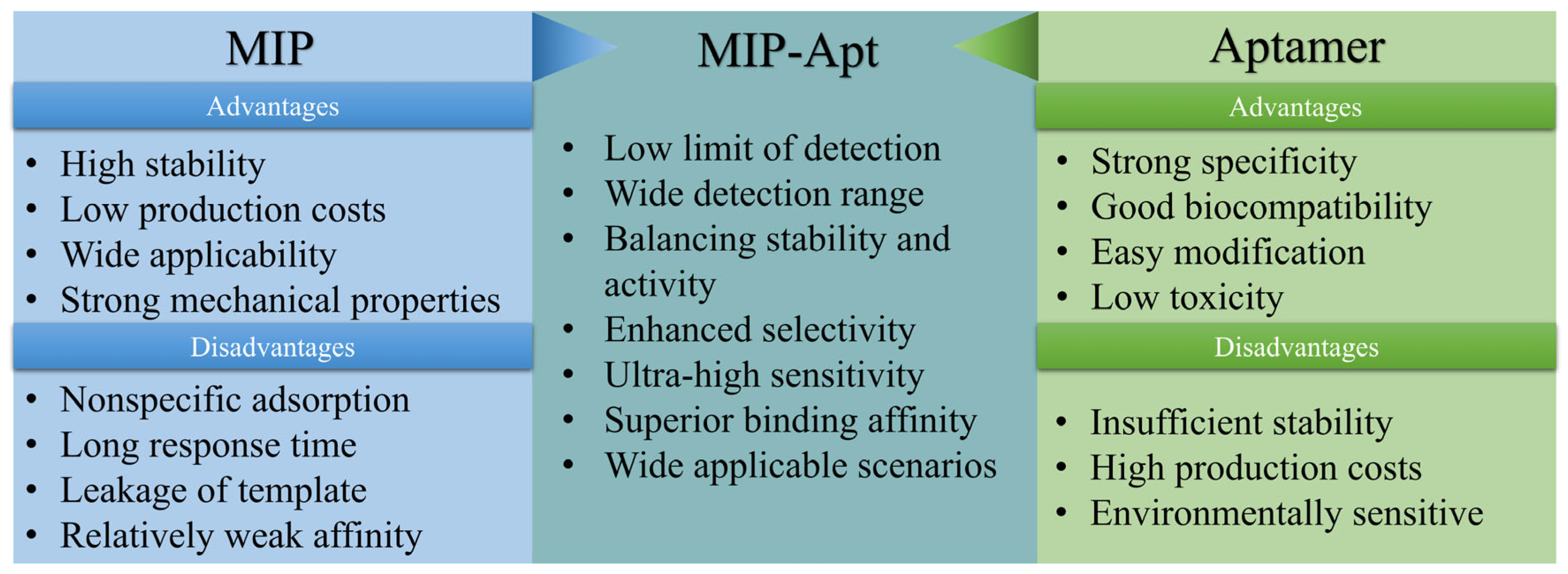
Figure 2.
Schematic diagram of the preparation process of MIP-Apt dual recognition elements:(A) Embedded Type I. (B) Embedded Type II. (C) Sandwich Type. (D) Separated Type.
Figure 2.
Schematic diagram of the preparation process of MIP-Apt dual recognition elements:(A) Embedded Type I. (B) Embedded Type II. (C) Sandwich Type. (D) Separated Type.
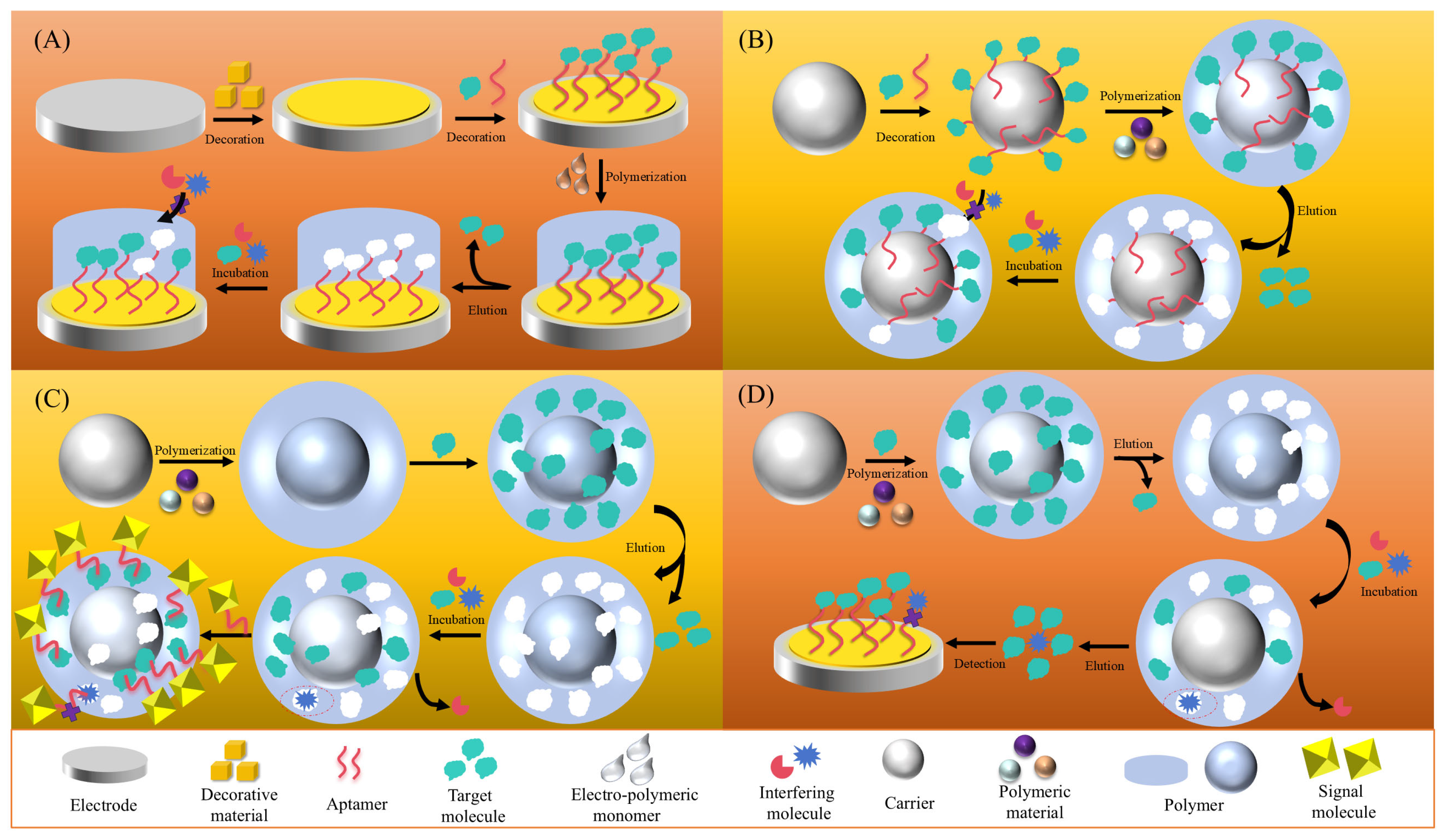
Figure 3.
(A)Stepwise preparation process of the molecularly imprinted polymer-aptamer hybrid sensor for AFB1 analysis[33]. (B)Key fabrication steps and detection mechanism of the acrylamide (AAM) sensor[31]. (C)Schematic illustration of the MIP-Apt hybrid sensor preparation for Lyz detection[34]. (D)Schematic diagram of detection procedures of DEX sensing platform[28].
Figure 3.
(A)Stepwise preparation process of the molecularly imprinted polymer-aptamer hybrid sensor for AFB1 analysis[33]. (B)Key fabrication steps and detection mechanism of the acrylamide (AAM) sensor[31]. (C)Schematic illustration of the MIP-Apt hybrid sensor preparation for Lyz detection[34]. (D)Schematic diagram of detection procedures of DEX sensing platform[28].
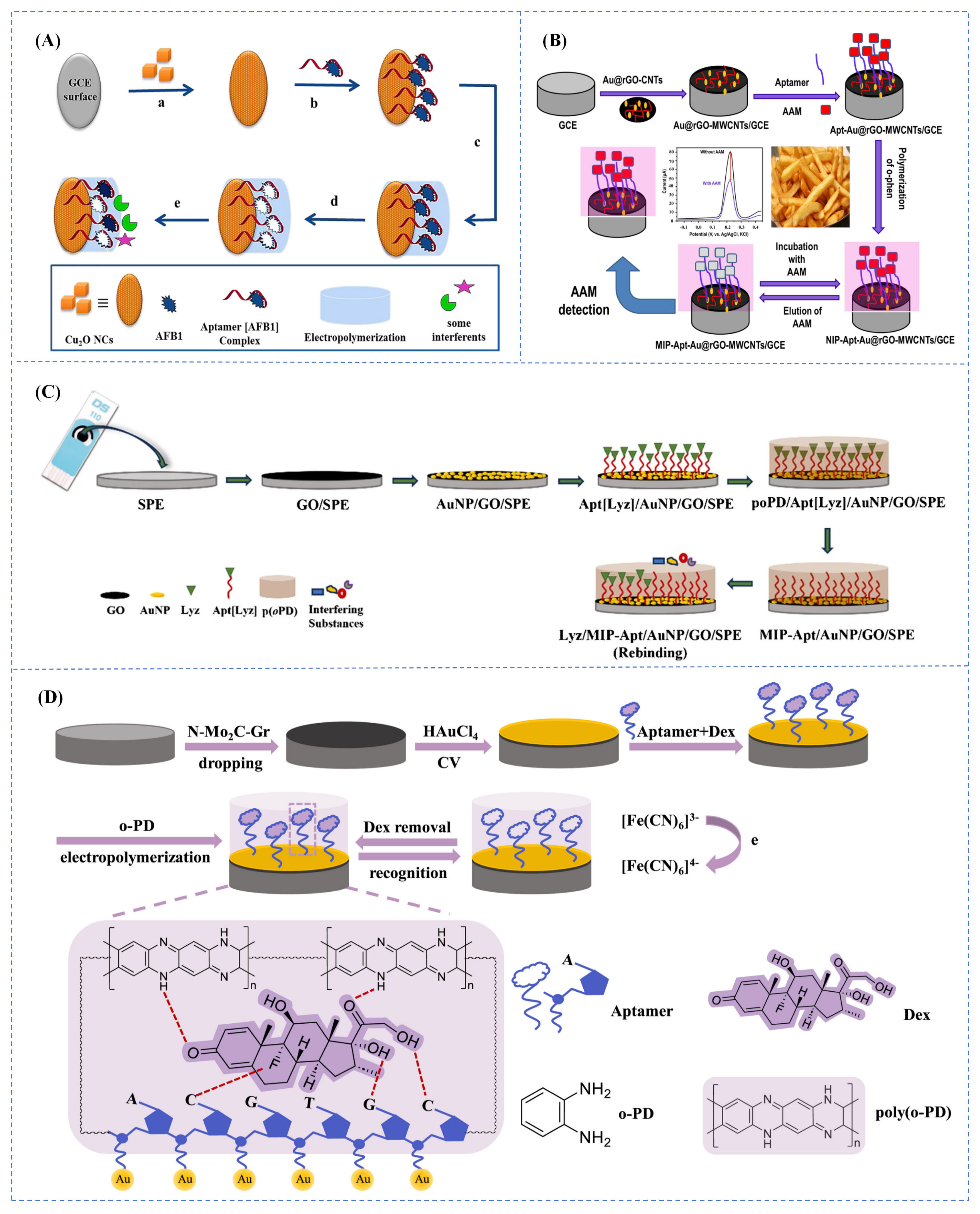
Figure 4.
(Ⅰ)Schematic illustrations of fabrication strategy of Apt/Au/Fe-MIL-88 and detection principle[61]. (Ⅱ)Schematic representations of A preparation of cApt–Au@ PEIM and B the sensor construction process[62].
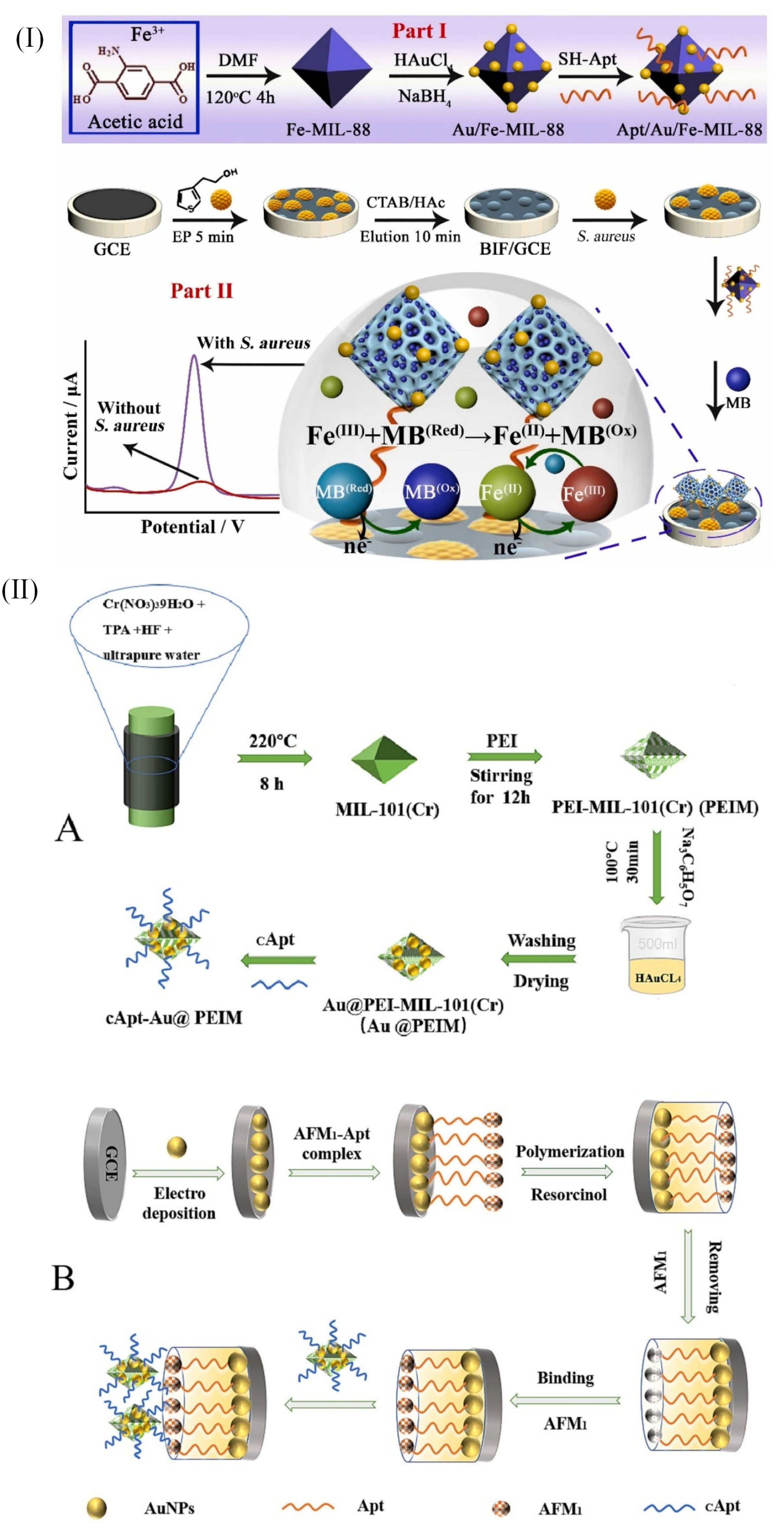
Figure 5.
(Ⅰ) Schematic representation of MOF-Apt@MIP fluorescence sensor for MG detection[66]. (Ⅱ)Schematic illustration of A fabrication process for the MIP/PC recognition layer; B design of the aptamer-functionalized CdTe/ZnS (CdTe/ZnS-Apt) fluorescent probe; and C principle of sandwich-type biosensing platform for AFB1 quantification[67].
Figure 5.
(Ⅰ) Schematic representation of MOF-Apt@MIP fluorescence sensor for MG detection[66]. (Ⅱ)Schematic illustration of A fabrication process for the MIP/PC recognition layer; B design of the aptamer-functionalized CdTe/ZnS (CdTe/ZnS-Apt) fluorescent probe; and C principle of sandwich-type biosensing platform for AFB1 quantification[67].
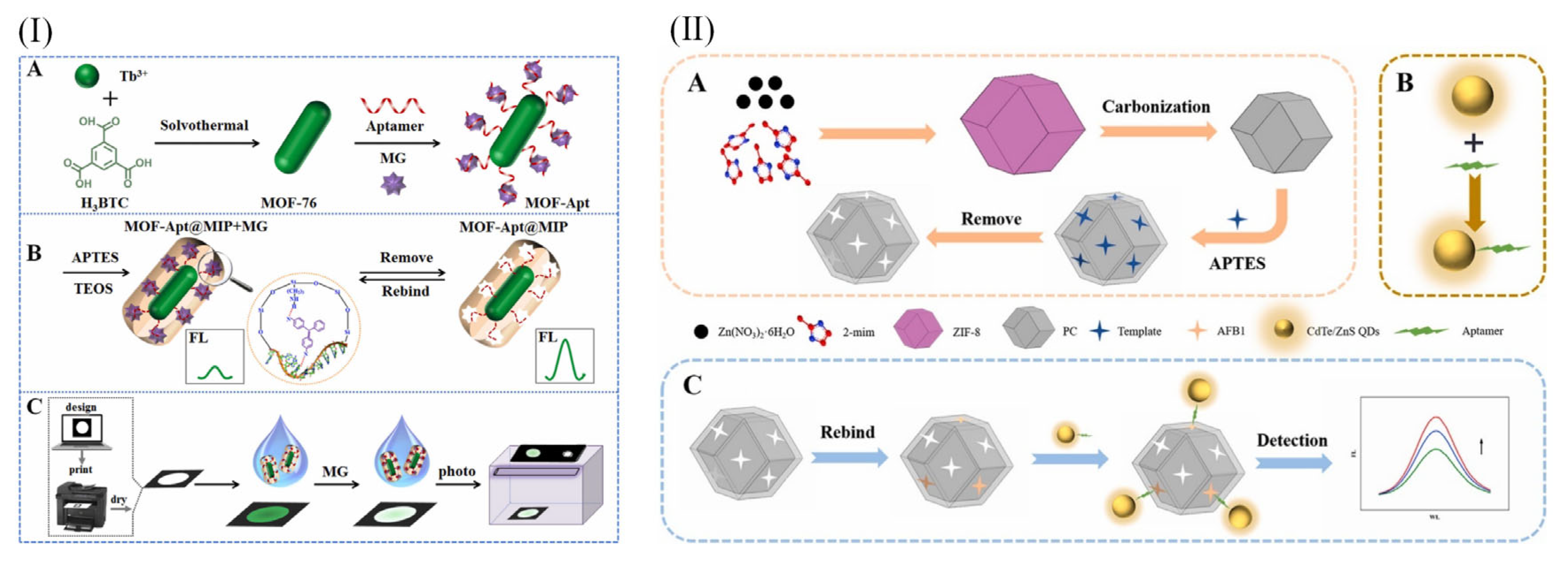
Figure 6.
(A)Illustration of the step-by-step fabrication of the SERS biosensor and its detection principle for CAP[69]. (B)Diagram of the SERS/RRS/Abs multi-mode Gly sensing strategy employing catalytic signal enhancement and MIP-Apt recognition[70].
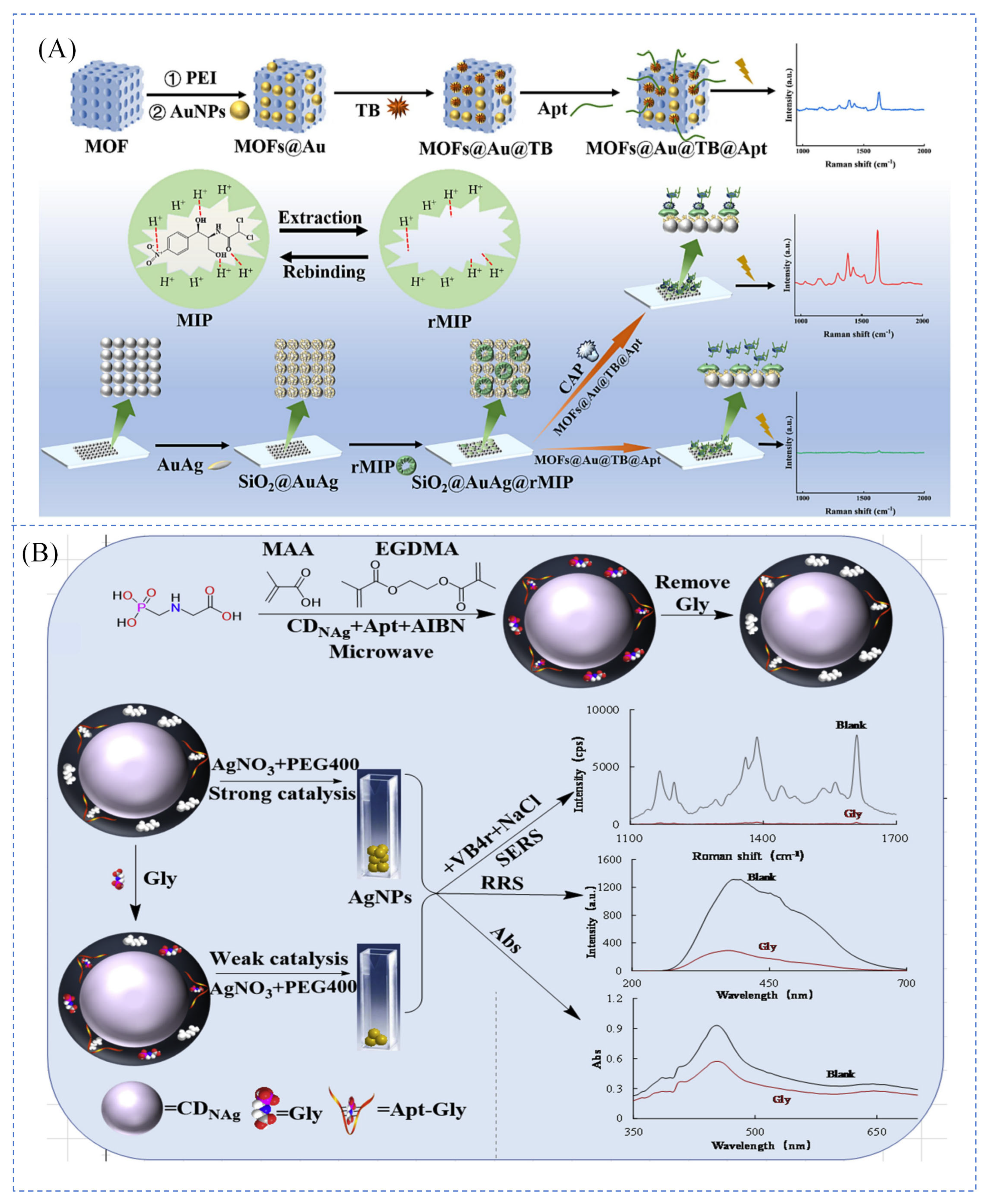
Figure 7.
(Ⅰ) The construction of the sandwich sensor. (A) the preparation of APTAFB1/Au/ZIF-8 and APTOTA/Au/ZIF-8; (B) the detection principle of the proposed dual-mode sandwich sensor[71]. (Ⅱ) (A) Scheme of the sandwich structure construction process and (B) The detection mechanism of the dual-modal PEC-colorimetric sensing platform[63]. (Ⅲ) (A) Construction mechanism of the sandwich-type biosensor. (B) Working principle of dual-mode fluorescence/colorimetric sensing for AFB1[72].
Figure 7.
(Ⅰ) The construction of the sandwich sensor. (A) the preparation of APTAFB1/Au/ZIF-8 and APTOTA/Au/ZIF-8; (B) the detection principle of the proposed dual-mode sandwich sensor[71]. (Ⅱ) (A) Scheme of the sandwich structure construction process and (B) The detection mechanism of the dual-modal PEC-colorimetric sensing platform[63]. (Ⅲ) (A) Construction mechanism of the sandwich-type biosensor. (B) Working principle of dual-mode fluorescence/colorimetric sensing for AFB1[72].
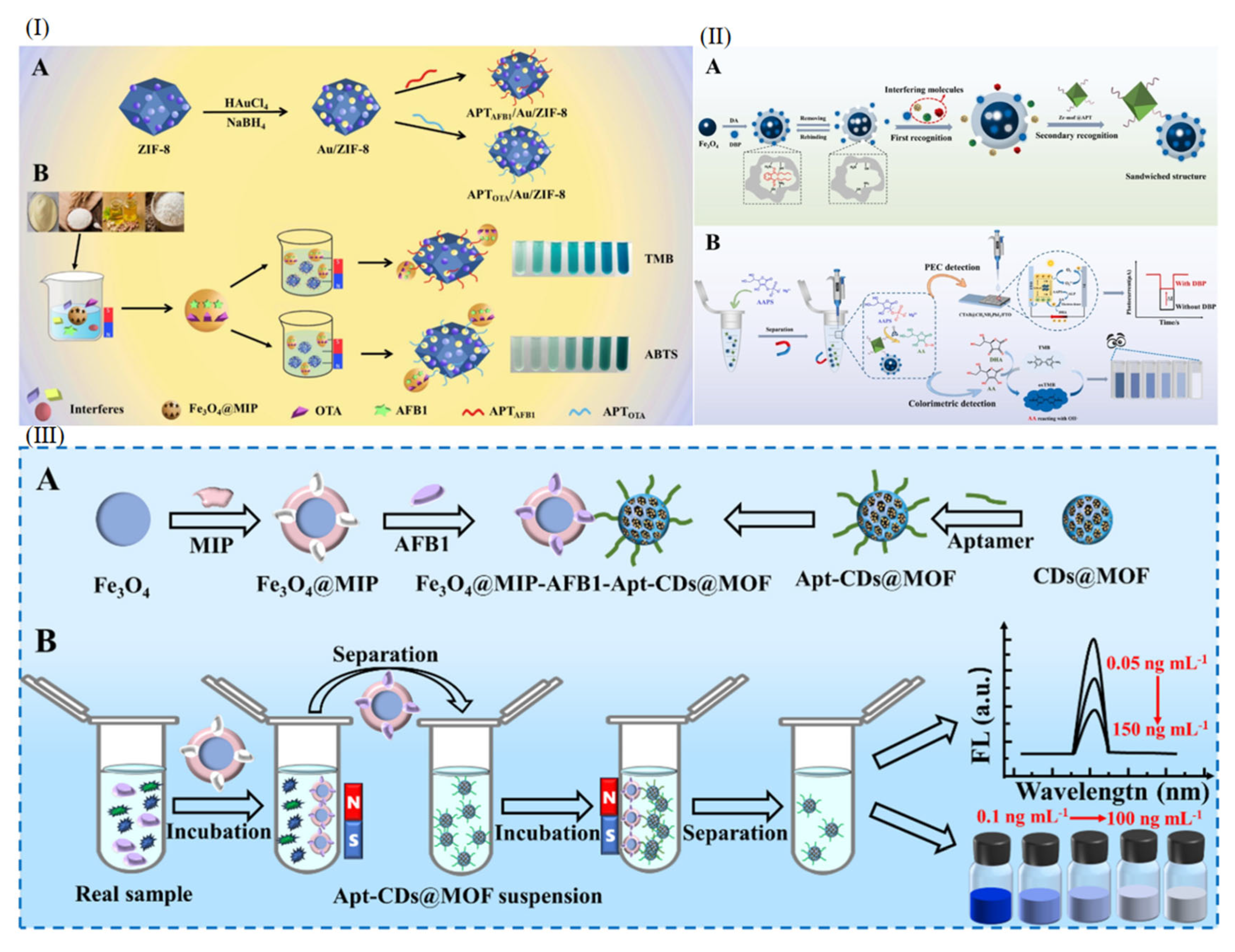
Figure 8.
a. Schematic diagram of the MIP-aptamer hybrid functionalized extended gate electrode. The black dotted lines represent the current response of the EGFET sensor after washing off antibiotic or without antibiotic, while the red solid lines represent the current response after antibiotic recognition. b. The EGFET sensor array with MIP-aptamer hybrids functionalized extended gate for simultaneously detection of three antibiotics. C. The extended grid array detects antibiotics in multiple scenarios[74].
Figure 8.
a. Schematic diagram of the MIP-aptamer hybrid functionalized extended gate electrode. The black dotted lines represent the current response of the EGFET sensor after washing off antibiotic or without antibiotic, while the red solid lines represent the current response after antibiotic recognition. b. The EGFET sensor array with MIP-aptamer hybrids functionalized extended gate for simultaneously detection of three antibiotics. C. The extended grid array detects antibiotics in multiple scenarios[74].
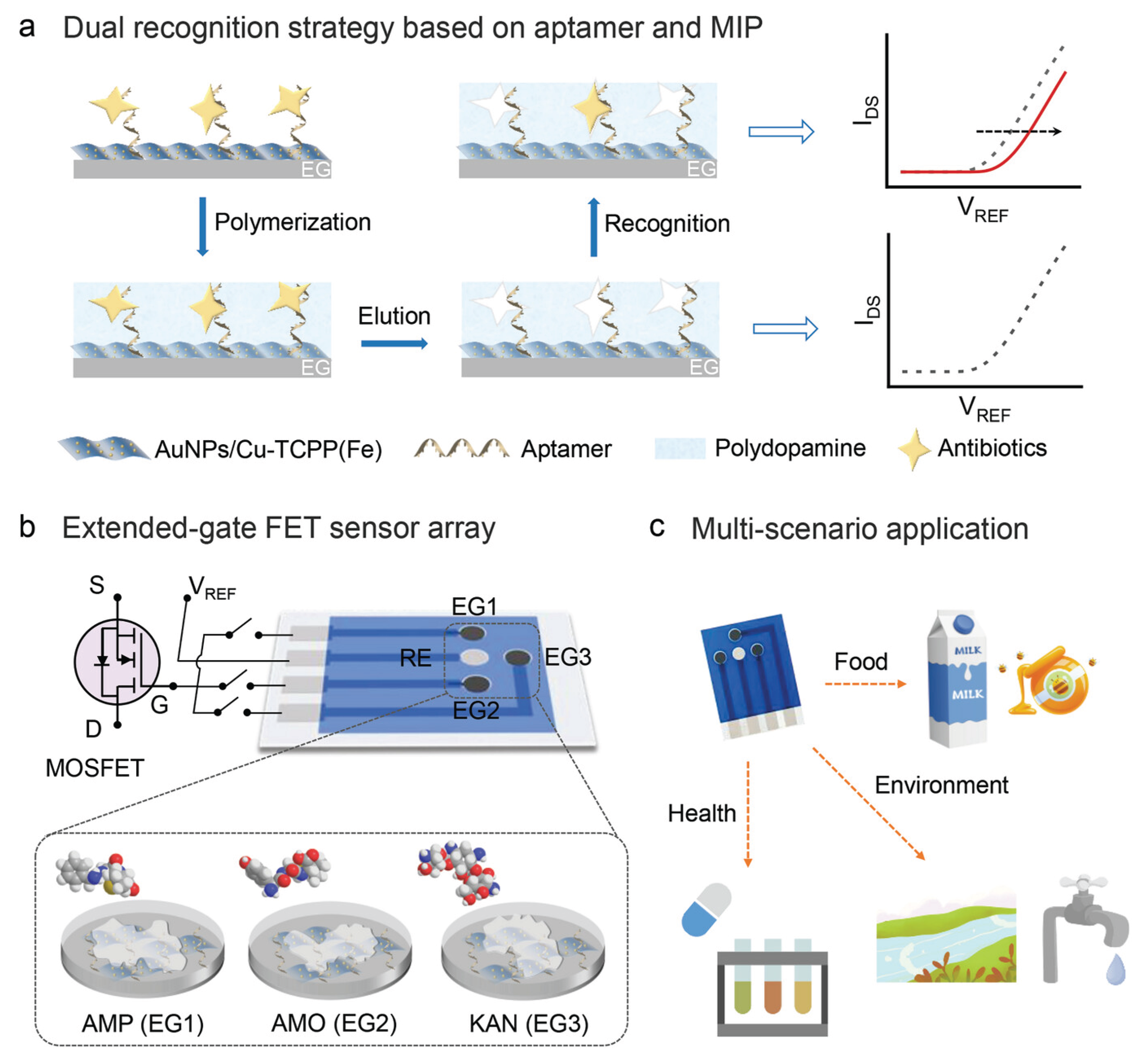

Table 1.
Performance comparison of three sensors based on MIP, Apt or MIP-Apt under the same test conditions.
Table 1.
Performance comparison of three sensors based on MIP, Apt or MIP-Apt under the same test conditions.
| Target | Methods | Linear range | Limit of detection | Ref. |
| Dexamethasone (Dex) | Aptamer sensor | 1.00×10⁻¹¹M - 1.00×10⁻⁵M | 2.98×10⁻¹²M | [28] |
| MIP sensor | 1.00×10⁻¹²M - 1.00×10⁻⁶M | 2.02×10⁻¹³M | ||
| MIP-Aptamer sensor | 1.00×10⁻¹³M - 1.00×10⁻⁵M | 1.79×10⁻¹⁴M | ||
| Progesterone (P4) |
Aptamer sensor | 10-12mol·L-1-10-6mol·L-1 | 3.08×10⁻¹³mol·L-1 | [29] |
| MIP sensor | 10-13mol·L-1-10-7mol·L-1 | 2.04×10⁻¹⁴mol·L-1 | ||
| MIP-Aptamer sensor | 10-14mol·L-1-10-5mol·L-1 | 1.73×10⁻¹⁵mol·L-1 |
Table 2.
Performance metrics of embedded-type MIP-Aptamer dual-recognition electrochemical sensors.
| Detection Method | Target |
MIP monomer |
Electrode Configuration | Detection Range | LOD |
Recovery (RSD) |
Application | Ref. |
| DPV CA |
CAB |
DA |
H-Al-MOF@AuNPs/SPE |
0.3fmolL-1-10pmolL-10.7fmolL-1-10pmolL-1 | 80 amolL-1and300 amolL-1 |
95.5%-106.0% (1.6%-7.1%) |
tap water apple juice tomato juice | [6] |
| CV EIS DPV |
AAM | O-phen | Au@rGO/MWCNTs/GCE | 1-600nM | 0.104nM | 98.7%-103.4% (/) |
potato fries samples |
[31] |
| DPV | CAP | DA | AuNPs/CS-MWNTs/GCE |
10−8 g/L-10−2 g/L |
3.3 × 10⁻⁹ g/L |
98.13%-107.85% (1.09%-4.21%) |
Sewage Milk Honey |
[32] |
| CV EIS |
AFB1 | DA | Cu2O NCs/GCE | 50.0 pgL−1 to 3.5 ng L−1 3.5 to 40.0 ngL−1 | 12.0 pgL−1 | 97%-104% (2.3%-2.6%) |
Milk | [33] |
| CV DPV EIS |
Lyz | O-phen | AuNP/GO/SPE | 0.001-100pM | 3.67fM | 98.4%-105.4% (0.618%-2.4%) |
Cherry juice Fruit juice Red wine |
[34] |
| DPV CV EIS |
Dex | O-phen | AuNPs/N–Mo2C-Gr/GCE | 10-13-10-5M | 1.79 × 10⁻¹⁴M |
96.3% - 105% (2.1%-6.0%) |
pond water, sewage water and tablet samples | [28] |
| DPV CV |
S. aureus | DA | AuE | 10–108 CFUmL−1 | 1.2 CFUmL−1 | 89.83 %- 104.62 % (<6.02%) |
juice, milk, and tap water | [53] |
| DPV EIS |
HIS | O-phen | AuNPs/cCNTs/GCE | 0.46-35 nmolL-1 and 0.35-35 nmolL-1 | 0.15 nmolL-10.11 nmolL-1 |
95.3%-104.4% (2.59%-3.96%) |
Canned tuna samples | [54] |
| CV EIS DPV |
S. aureus | O-phen | AuNPs@Fe3O4/GCE | 101–107 CFUmL−1 | 1 CFUmL−1 | 96%-104% (<3.4%) |
Milk conduit water and apple juice |
[55] |
| PEC | DBP | DA | Cu3(BTC)2/Cu2O/ITO | 0.1 pM to 1.0 nM | 0.035 pM | 99.7%-104.7% | bottled water | [56] |
| DPV | AFB1 | PPY | AuNPs/GCE | 12.58 agml−1 to 6.3 μgml−1 | 0.6 agml−1 | 98.6%-100.9% (2.12%-2.32%) |
wheat flour | [57] |
| CV EIS |
TET | DA | AuNP/GCE | 0.5–100 pM 1–1000 nM |
144 fM | 94.9–106.2% (0.10%-0.61%) |
Milk |
[58] |
| CV DPV EIS |
P4 | p-ATP | AuNPs/SnO2-Gr/GCE | 10−14 M to 10−5 M | ×10−15 M | 95.6% - 105.1% (2.33%-5.06%) |
Tap water Milk |
[29] |
| CV EIS |
AMOX | DA | AuNPs/ZnO-rGO/GCE | 10-14-10-8M | 3.3 ×10⁻¹⁵M | 96.4% - 104.7% (3.64%-4.15%) |
Water Milk |
[59] |
| DPV | Gliadin | o-Phen | AuNPs/SPGE | 0.25 fg/mL-1000 pg/mL | 0.011 fg/mL | 98.4%-105.9% (1.6%-7.9%) |
Bread, cookie, cracker and brown rice cakes |
[60] |
Acrylamide, AAM; Aflatoxin B1,AFB1; Histamine, HIS; Lysozyme, Lyz; carbendazim, CAB; chloramphenicol ,CAP; dexamethasone,Dex; staphylococcus aureus ,S. aureus; dibutyl phthalate ,DBP; tetracycline ,TET; ampicillin ,AMP; amoxicillin ,AMO; kanamycin ,KAN; Progesterone ,P4; O-phenylenediamine , O-phen; dopamine, DA; pyrrole ,PPY; p-aminothiophenol, p-ATP; reduced graphene oxide , rGO; multiwalled carbon nanotubes ,MWCNTs; glassy carbon electrode, GCE; nanocubes, NCs; gold nanoparticles ,AuNPs; carboxylated carbon nanotubes, cCNTs; graphene oxide ,GO; screen-printed electrode ,SPE; hemin-Al-metal organic framework, H-Al-MOF; Chitosan-multi-walled carbon nanotubes ,CS-MWNTs; differential pulse voltammetry, DPV; chronoamperometry, CA; photoelectrochemical, PEC; cyclic voltammetry, CV; screen-printed gold electrode ,SPGE.
Table 3.
Performance of electrochemical sensing platform using sandwich MIP-Apt dual recognition elements.
Table 3.
Performance of electrochemical sensing platform using sandwich MIP-Apt dual recognition elements.
| Method |
Target/ Template |
Signal probe | Capture probe | MIP reagent | Detection Range | LOD |
Recovery (RSD) |
Application | Ref. |
| CV DPV |
S. aureus | Apt-Au@ Fe-MIL-88 |
BIF/GCE | TE | 10 to 108 CFUmL−1 | 1 CFU mL−1 | 88.47% to 102.36% (<13%) |
juice, milk and tap water | [61] |
| CV EIS DPV |
AFM1 | cApt- Au@PEIM |
MIP/AuNPs/GCE | RE | 0.01-200 nM | 0.07 nM (S/N=3) |
95.4%-105.6% (0.64%-1.34%) |
goat milk, sheep milk, and cow milk | [62] |
| PEC | DBP | Zr-MOF @Apt |
Fe3O4 @MIPs |
DA | 1.0 pM to 10 μM |
0.263 nM (PEC) (S/N=3) |
100.48 %-108.30 % (3.25 %-5.66 %) |
plastic bottled water and boxed milk | [63] |
Bacterial imprinted polymer film, BIF; 3-thiopheneethanol, TE; resorcinol, RE; photoelectrochemical, PEC; dibutyl phthalate, DBP; dopamine, DA; Aflatoxin M1, AFM1.
Disclaimer/Publisher’s Note: The statements, opinions and data contained in all publications are solely those of the individual author(s) and contributor(s) and not of MDPI and/or the editor(s). MDPI and/or the editor(s) disclaim responsibility for any injury to people or property resulting from any ideas, methods, instructions or products referred to in the content. |
© 2025 by the authors. Licensee MDPI, Basel, Switzerland. This article is an open access article distributed under the terms and conditions of the Creative Commons Attribution (CC BY) license (http://creativecommons.org/licenses/by/4.0/).
Copyright: This open access article is published under a Creative Commons CC BY 4.0 license, which permit the free download, distribution, and reuse, provided that the author and preprint are cited in any reuse.