
Submitted:
09 September 2025
Posted:
10 September 2025
You are already at the latest version
Abstract
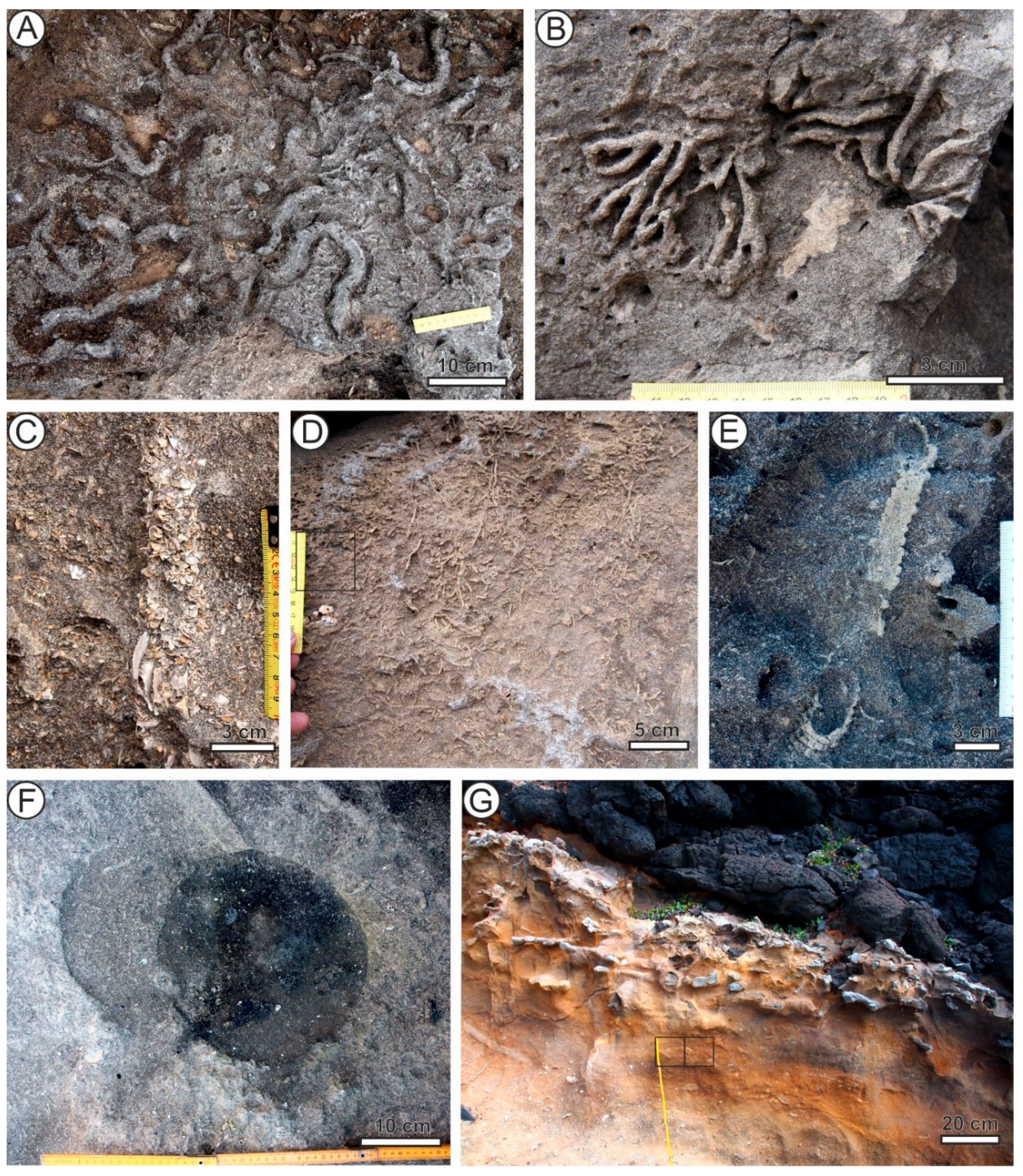
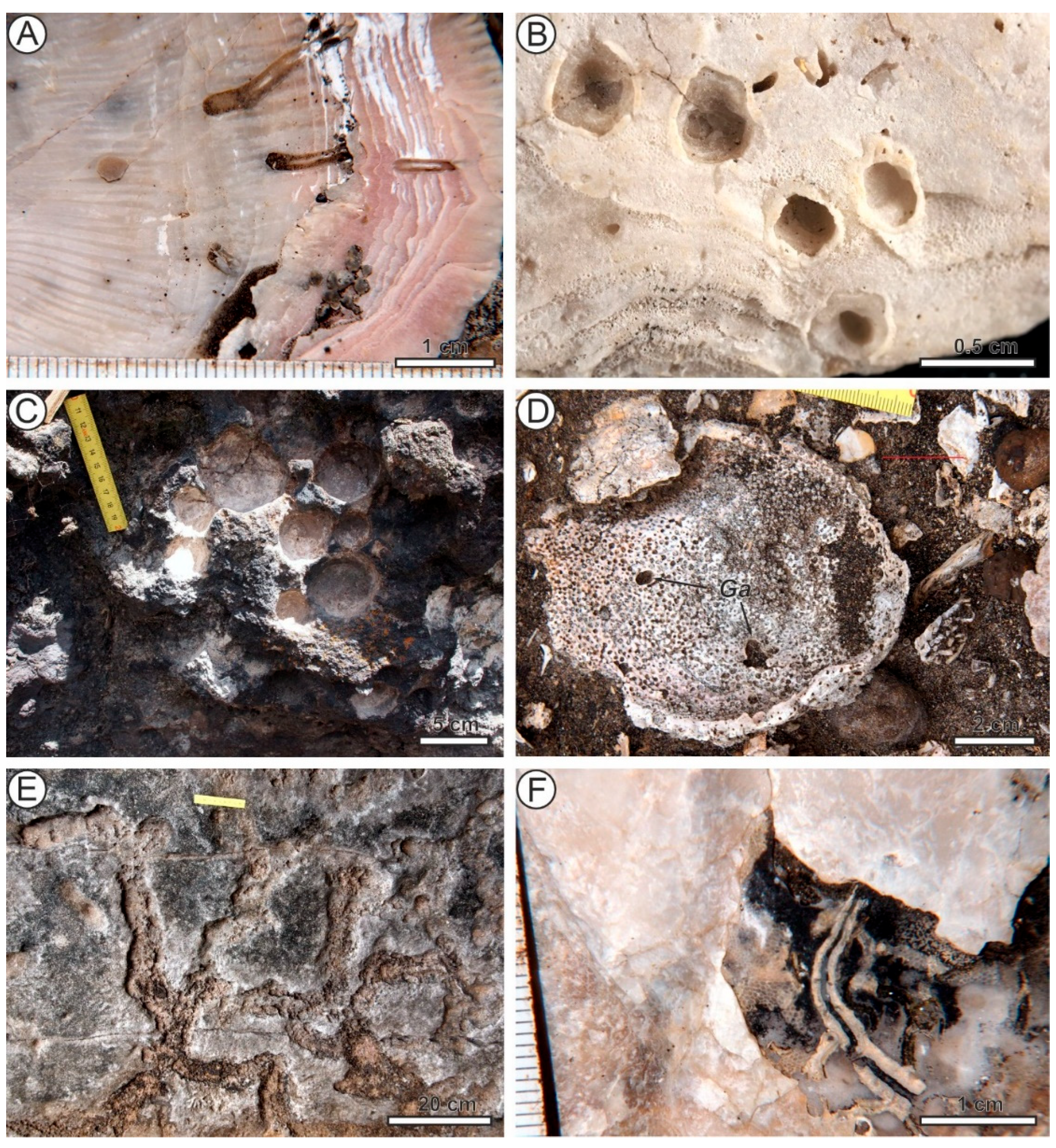
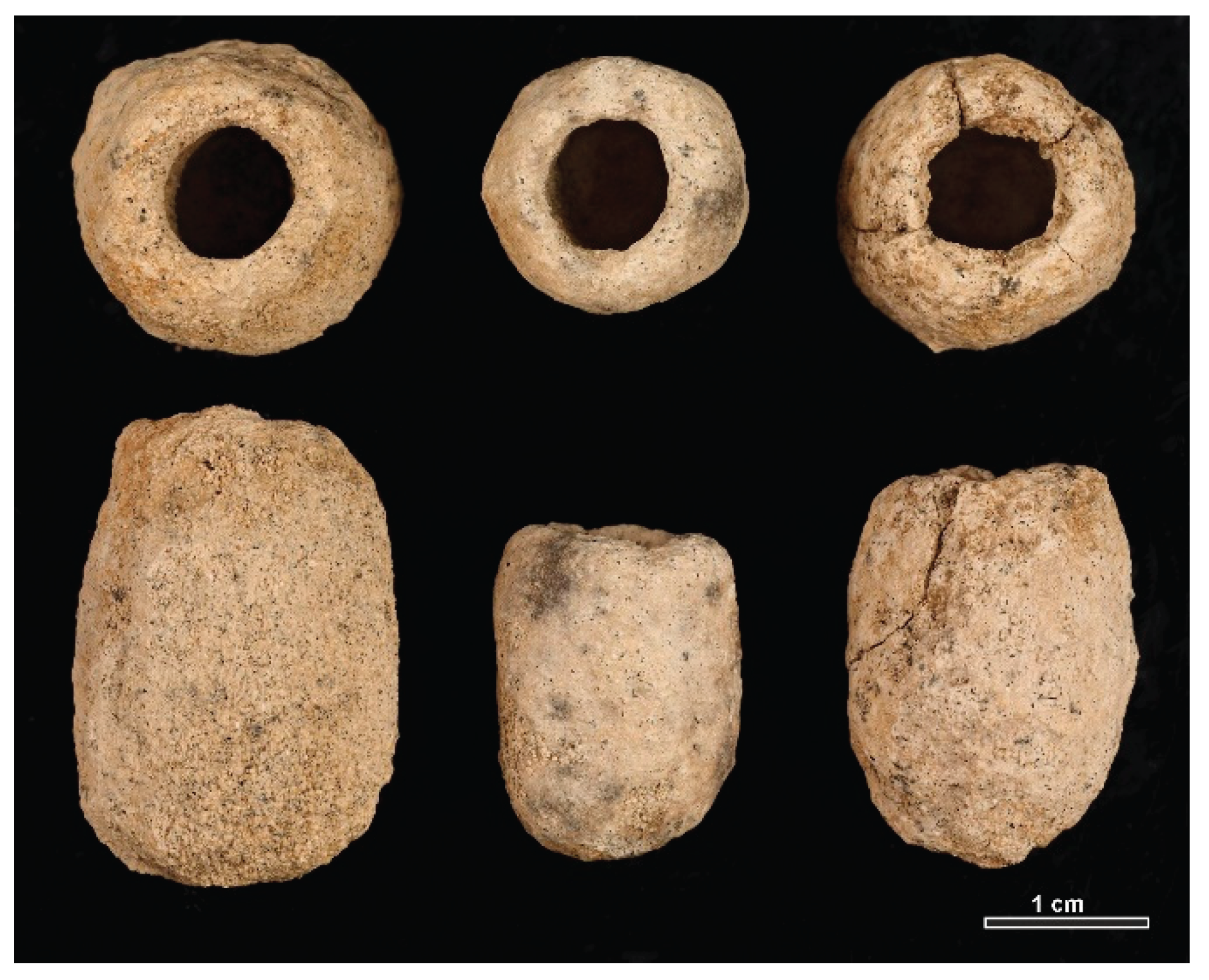
Ichnological research on trace fossils from the volcanic islands of Macaronesia (North Atlantic) is reviewed in light of significant advances over the past two decades. These studies contribute to the interpretation of paleoenvironments and enhance our understanding of the biota preserved in Miocene–Holocene shallow marine and non-marine deposits across the Azores, Cape Verde, Canary, Madeira, and Salvagens archipelagos. Trace fossils provide evidence of organisms not always known from body fossils, or whose potential tracemakers are absent from the extant island fauna. They include sedimentary burrows, borings in hard substrates, and traces of plant–insect interactions. Some ichnotaxa are widespread and common (e.g., Bichordites monastiriensis, Dactyloidites ottoi, Macaronichnus segregatis, Ophiomorpha nodosa, Thalassinoides isp.), whereas others are rare. Several new ichnotaxa have also been described from the islands, including Alaichnus kabuverdiensis (cumulative trace of bivalve siphons), Centrichnus dentatus (attachment trace of verrucid barnacles), Diopatrichnus santamariaensis (polychaete tubes armored with shell debris), Ericichnus bromleyi and E. asgaardi (bioerosion grooves of regular echinoids), and Rebuffoichnus guanche (coleopteran pupation chambers). Despite these advances, ichnological research in Macaronesia remains uneven, with many topics still underexplored and significant gaps in the geographic and inventory record.
Keywords:
1. Introduction
2. Synopsis of Selected Trace Fossils
2.1. Burrows in Marine Deposits
2.2. Marine Borings
2.3. Trace Fossils in Continental Deposits
3. Ichnological Investigations in Macaronesia
3.1. Burrows in Marine Deposits
3.2. Marine Bioerosion Structures
3.3. Trace Fossils in Continental Environments
4. Concluding Remarks
Funding
Institutional Review Board Statement
Informed Consent Statement
Conflicts of Interest
References
- Ramalho, R.S.; Quartau, R.; Trenhaile, A.S.; Mitchell, N.C.; Woodroffe, C.D.; Ávila, S.P. Coastal evolution on volcanic oceanic islands: A complex interplay between volcanism, erosion, sedimentation, sea level change and biogenic production. Earth-Sci. Rev. 2013, 127, 140–170. [Google Scholar] [CrossRef]
- Johnson, M.E.; Baarli, B.G.; Cachão, M.; Mayoral, E.; Ramalho, R.S.; Santos, A.; da Silva, C.M. On the rise and fall of oceanic islands: Towards a global theory following the pioneering studies of Charles Darwin and James Dwight Dana. Earth-Sci. Rev. 2018, 180, 17–36. [Google Scholar] [CrossRef]
- Ávila, S.P.; Madeira, P.; Zazo, C.; et al. Palaeoecology of the Pleistocene (MIS 5.5) outcrops of Santa Maria Island (Azores) in a complex oceanic tectonic setting. Palaeogeogr. Palaeoclimatol. Palaeoecol. 2009, 274, 18–31. [Google Scholar] [CrossRef]
- Ávila, S.P.; Ramalho, R.; Vullo, R. Systematics, palaeoecology and palaeobiogeography of the Neogene fossil sharks from the Azores (Northeast Atlantic). Ann. Paleontol. 2012, 98, 167–189. [Google Scholar] [CrossRef]
- Ávila, S.P.; Ramalho, R.; Vullo, R. Systematics, palaeoecology and palaeobiogeography of the Neogene fossil sharks from the Azores (Northeast Atlantic). Ann. Paleontol. 2012, 98, 167–189. [Google Scholar] [CrossRef]
- Bromley, R.G. Trace Fossils: Biology, Taphonomy and Applications; Chapman and Hall: London, UK, 1996; 361p. [Google Scholar]
- Buatois, L.A.; Mángano, M.G. Ichnology: Organism–Substrate Interactions in Space and Time; Cambridge University Press: Cambridge, UK, 2011. [Google Scholar]
- Knaust, D.; Bromley, R.G. (Eds.) . Trace Fossils as Indicators of Sedimentary Environments; Developments in Sedimentology, Volume 64; Elsevier: Amsterdam, The Netherlands, 2012. [Google Scholar]
- Plaziat, J.-C.; Mahmoudi, M. Trace fossils attributed to burrowing echinoids: A revision including new ichnogenus and ichnospecies. Geobios 1988, 21, 209–233. [Google Scholar] [CrossRef]
- Uchman, A. Taxonomy and palaeoecology of flysch trace fossils: The Marnoso-arenacea Formation and associated facies (Miocene, Northern Apennines, Italy). Beringeria 1995, 15, 3–115. [Google Scholar]
- Uchman, A.; Krenmayr, H.G. Trace fossils from Lower Miocene (Ottnangian) molasse deposits of Upper Austria. Paläontol. Z. 1995, 69, 503–524. [Google Scholar] [CrossRef]
- D’Alessandro, A.; Uchman, A. Bichordites and Bichordites–Rosselia ichnoassemblages from the Lower Pleistocene Tursi Sandstone (southern Italy). In Sediment–Organism Interactions: A Multifaceted Ichnology; Bromley, R.G., Buatois, L.A., Mángano, M.G., Genise, J.F., Melchor, R.N., Eds.; SEPM (Society for Sedimentary Geology) Special Publication 88; Tulsa, OK, USA, 2007; pp. 213–221.
- Fürsich, F.T.; Bromley, R.G. Behavioural interpretation of a rosetted spreite trace fossil: Dactyloidites ottoi (Geinitz). Lethaia 1985, 18, 199–207. [Google Scholar] [CrossRef]
- Gibert, J.M. de; Martinell, J.; Domènech, R. The rosetted feeding trace fossil Dactyloidites ottoi (Geinitz) from the Miocene of Catalonia. Geobios 1995, 28, 769–776. [Google Scholar] [CrossRef]
- Curran, H.A.; Glumac, B. Dactyloidites ottoi (Geinitz, 1849) in Bahamian Pleistocene carbonates: A shallowest-marine indicator. In The Ichnology of Shallow-Marine and Transitional Environments; Cónsole-Gonella, C., de Valais, S., Díaz-Martínez, I., Citton, P., Verde, M., McIlroy, D., Eds.; Geological Society, London, Special Publications, 2023. [CrossRef]
- Uchman, A.; Quintino, V.; Rodrigues, A.M.; Johnson, M.E.; Melo, C.; Cordeiro, R.; Ramalho, R.S.; Ávila, S.P. The trace fossil Diopatrichnus santamariensis isp. nov.—A shell-armored tube from Pliocene sediments of Santa Maria Island, Azores (NE Atlantic Ocean). Geobios 2017, 50, 459–469. [Google Scholar] [CrossRef]
- Clifton, H.E.; Thompson, J.K. Macaronichnus segregatis: A feeding structure of shallow marine polychaetes. J. Sediment. Petrol. 1978, 48, 1293–1302. [Google Scholar] [CrossRef]
- Nara, M.; Seike, K. Macaronichnus segregatis-like traces found in the modern foreshore sediments of the Kujukurihama Coast, Japan. J. Geol. Soc. Jpn. 2004, 110, 545–551. [Google Scholar] [CrossRef]
- Seike, K.; Yanagishima, S.; Nara, M.; Sasaki, T. Large Macaronichnus in modern shoreface sediments: Identification of the producer, the mode of formation, and palaeoenvironmental implications. Palaeogeogr. Palaeoclimatol. Palaeoecol. 2011, 311, 224–229. [Google Scholar] [CrossRef]
- Knaust, D. Atlas of Trace Fossils in Well Core: Appearance, Taxonomy and Interpretation; Springer: Cham, Switzerland, 2017; 271p. [Google Scholar]
- Frey, R.W.; Howard, J.D.; Pryor, W.A. Ophiomorpha: Its morphologic, taxonomic, and environmental significance. Palaeogeogr. Palaeoclimatol. Palaeoecol. 1978, 23, 199–229. [Google Scholar] [CrossRef]
- Bromley, R.G. Trace Fossils. Biology and Taphonomy; Special Topics in Palaeontology Series; Unwin Hyman: London, UK; Boston, MA, USA; Sydney, Australia; Wellington, New Zealand, 1990; 280p.
- Schlirf, M. Upper Jurassic trace fossils from the Boulonnais (northern France). Geol. Palaeontol. 2000, 34, 145–213. [Google Scholar]
- Chrząstek, A. Palaeoenvironmental interpretation of the Late Cretaceous Idzików Conglomerate Member (SW Poland, Sudetes, Idzików Quarry) based on analysis of trace fossils. Ann. Soc. Geol. Pol. 2020, 90, 149–194. [Google Scholar] [CrossRef]
- Pemberton, S.G.; Frey, R.W. Trace fossil nomenclature and the Planolites–Palaeophycus dilemma. J. Paleontol. 1982, 56, 843–881. [Google Scholar]
- Keighley, D.G.; Pickerill, R.K. The ichnotaxa Palaeophycus and Planolites: Historical perspectives and recommendations. Ichnos 1995, 3, 301–309. [Google Scholar] [CrossRef]
- Frey, R.W.; Curran, A.H.; Pemberton, G.S. Trace-making activities of crabs and their environmental significance: The ichnogenus Psilonichnus. J. Paleontol. 1984, 58, 333–350. [Google Scholar]
- Giannetti, A.; Monaco, P.; Caracuel, J.E.; Soria, J.; Yébenes, A. Functional morphology and ethology of decapod crustaceans gathered by Thalassinoides branched burrows in Mesozoic shallow-water environments. Mem. Soc. Ital. Sci. Nat. Mus. Civ. Stor. Nat. Milano 2007, 35, 48–52. [Google Scholar]
- Bromley, R.G.; D’Alessandro, A.S. Bioerosion in the Pleistocene of southern Italy: Ichnogenera Caulostrepsis and Maeandropolydora. Riv. Ital. Paleontol. Stratigr. 2020, 89, 283–309. [Google Scholar]
- Gaaloul, N.; Uchman, A.; Ben Ali, S.; Janiszewska, K.; Stolarski, J.; Kołodziej, B.; Riahi, S. In vivo and post-mortem bioerosion traces in solitary corals from the upper Pliocene deposits of Tunisia. Acta Palaeontol. Pol. 2023, 68, 659–681. [Google Scholar] [CrossRef]
- Uchman, A.; Wisshak, M.; Madeira, P.; Melo, C.S.; Sacchetti, C.; Ávila, G.C.; Ávila, S.P. A new attachment trace of a verrucid barnacle on Pliocene bivalve shells, Santa Maria Island, Azores (Central Atlantic). Acta Palaeontol. Pol. 2025, 70, 143–157. [Google Scholar] [CrossRef]
- Mikuláš, R. Early Cretaceous borings from Štramberk (Czechoslovakia). Čas. Mineral. Geol. 1992, 37, 297–312. [Google Scholar]
- Johnson, M.E.; da Silva, C.M.; Santos, A.; Baarli, B.G.; Cachão, M.; Mayoral, E.J.; Rebelo, A.C.; Ledesma-Vázquez, J. Rhodolith transport and immobilization on a volcanically active rocky shore: Middle Miocene at Cabeço das Laranjas on Ilhéu de Cima (Madeira Archipelago, Portugal). Palaeogeogr. Palaeoclimatol. Palaeoecol. 2011, 300, 113–127. [Google Scholar] [CrossRef]
- Bromley, R.G. Borings as trace fossils and Entobia cretacea Portlock, as an example. Geol. J. 1970, 3, 49–90. [Google Scholar]
- Kelly, S.R.A.; Bromley, R.G. Ichnological nomenclature of clavate borings. Palaeontology 1984, 27, 793–807. [Google Scholar]
- Straus, A. Gallen, Minen und andere Fraßspuren im Pliokän von Willershauen am Harz. Verh. Bot. Ver. Prov. Brandenbg. 1977, 113, 43–80. [Google Scholar]
- Pokorný, R.; Borges, P.A. Uma descoberta interessante de folhas fósseis com vestígios de interações planta-animal nas colecções do Museu Vulcanoespeleológico “Os Montanheiros”. Pingo Lava 2022, 44, 76–78. [Google Scholar]
- Robledo, J.M.; Sarzetti, L.C.; Anzótegui, L.M. New records and ichnospecies of linear leaf mines from the Late Miocene–Pliocene from Argentina and the establishment of leaf-mining ichnotaxobases. Riv. Ital. Paleontol. Stratigr. 2016, 122, 55–70. [Google Scholar] [CrossRef]
- La Roche, F.; Genise, J.F.; Castillo, C.; Quesada, M.L.; García-Gotera, C.M.; De la Nuez, J. Fossil bee cells from the Canary Islands: Ichnotaxonomy, palaeobiology and palaeoenvironments of Palmiraichnus castellanosi. Palaeogeogr. Palaeoclimatol. Palaeoecol. 2014, 409, 249–264. [Google Scholar] [CrossRef]
- Genise, J.F.; Alonso-Zarza, A.M.; Verde, M.; Meléndez, A. Insect trace fossils in aeolian deposits and calcretes from the Canary Islands: Their ichnotaxonomy, producers, and palaeoenvironmental significance. Palaeogeogr. Palaeoclimatol. Palaeoecol. 2013, 377, 110–124. [Google Scholar] [CrossRef]
- Genise, J.F. Upper Cretaceous trace fossils in permineralized plant remains from Patagonia, Argentina. Ichnos 1995, 3, 287–299. [Google Scholar] [CrossRef]
- Mayoral, E.; Ledesma-Vázquez, J.; Baarli, B.G.; Santos, A.; Ramalho, R.; Cachão, M.; da Silva, C.M.; Johnson, M.E. Ichnology in oceanic islands: Case studies from the Cape Verde Archipelago. Palaeogeogr. Palaeoclimatol. Palaeoecol. 2013, 381, 47–66. [Google Scholar] [CrossRef]
- Johnson, M.E.; Baarli, B.G.; Cachão, M.; da Silva, C.M.; Ledesma-Vázquez, J.; Mayoral, E.J.; Ramalho, R.S.; Santos, A. Rhodoliths, uniformitarianism, and Darwin: Pleistocene and Recent carbonate deposits in the Cape Verde and Canary archipelagos. Palaeogeogr. Palaeoclimatol. Palaeoecol. 2012, 329, 83–100. [Google Scholar] [CrossRef]
- Johnson, M.E.; Baarli, B.G.; da Silva, C.M.; Cachão, M.; Ramalho, R.S.; Ledesma-Vázquez, J.; Mayoral, E.J.; Santos, A. Coastal dunes with high content of rhodolith (coralline red algae) bioclasts: Pleistocene formations on Maio and São Nicolau in the Cape Verde Archipelago. Aeolian Res. 2013, 8, 1–9. [Google Scholar] [CrossRef]
- Johnson, M.E.; Ramalho, R.S.; Baarli, B.G.; Cachão, M.; da Silva, C.M.; Mayoral, E.J.; Santos, A. Miocene–Pliocene rocky shores on São Nicolau (Cape Verde Islands): Contrasting windward and leeward biofacies on a volcanically active oceanic island. Palaeogeogr. Palaeoclimatol. Palaeoecol. 2014, 395, 131–143. [Google Scholar] [CrossRef]
- Baarli, B.G.; Santos, A.G.; Mayoral, E.J.; Ledesma-Vázquez, J.; Johnson, M.E.; da Silva, C.M.; Cachão, M. What Darwin did not see: Pleistocene fossil assemblages on a high-energy coast at Ponta das Bicudas, Santiago, Cape Verde Islands. Geol. Mag. 2013, 150, 183–189. [Google Scholar] [CrossRef]
- Melo, M.; Madeira, J.; Ramalho, R.S.; Rebelo, A.C.; Rasser, M.; González, E.; Uchman, A.; Madeira, P.; Rolán, E.; Silva, L.; da Silva, C.M.; Ryan, D.; Rovere, A.; Cachão, M.; Ávila, S.P. Last Interglacial fossiliferous sequences from Santiago Island (Cabo Verde Archipelago): The palaeoecology of the Nossa Senhora da Luz section, a rare example of a protected bay in volcanic oceanic islands. EGU Gen. Assem. 2020, EGU2020–10423. [Google Scholar] [CrossRef]
- Mayoral, E.; Santos, A.; Vintaned, J.G.; Ledesma-Vázquez, J.; Baarli, B.G.; Cachão, M.; da Silva, C.M.; Johnson, M.E. Upper Pleistocene trace fossils from Ponta das Bicudas, Santiago, Cape Verde Islands: Systematics, taphonomy and palaeoenvironmental evolution. Palaeogeogr. Palaeoclimatol. Palaeoecol. 2018, 498, 83–98. [Google Scholar] [CrossRef]
- Sanchez-Pinto, L.; García-Talavera, F.; López Rondón, J.; Martín Oval, M. Sobre la presencia del icnofósil Dactyloidites ottoi (Geinitz, 1849) en sedimentos neógenos de la costa occidental de Fuerteventura (Islas Canarias). In Homenaje al Profesor Dr. Wolfredo Wildpret de la Torre; Beltrán Tejera, E., Afonso-Carrillo, J., García Gallo, A., Rodríguez Delgado, O., Eds.; Instituto de Estudios Canarios: La Laguna, Tenerife, Islas Canarias, 2009; Monografía LXXVIII, pp. 229–244. [Google Scholar]
- Martín González, E. Paleontología de Canarias: Los yacimientos marinos fósiles. Macaronesia 2009, 11, 70–87. [Google Scholar]
- Martín-González, E.; Castillo, C. Los yacimientos marinos del Neógeno de Lanzarote y Fuerteventura (Islas Canarias). Correlaciones con el sur de la Península Ibérica y otros archipiélagos de la Macaronesia. In III Congreso Ibérico de Paleontología, Lisboa, Portugal, 2010; Volume 1, 5 pp.
- Schneider, J.L.; Torrado, F.J.P.; Torrente, D.G.; Wassmer, P.; Santana, M.D.C.C.; Carracedo, J.C. Sedimentary signatures of the entrance of coarse-grained volcaniclastic flows into the sea: The example of the breccia units of the Las Palmas Detritic Formation (Mio–Pliocene, Gran Canaria, Eastern Atlantic, Spain). J. Volcanol. Geotherm. Res. 2004, 138, 295–323. [Google Scholar] [CrossRef]
- Mayoral, E.; Santos, A.; Galindo, I.; Martín-González, E.; Mangas, J. Contenido icnológico del Miembro medio de la Formación Detrítica Las Palmas (Mio–Plioceno) en el yacimiento de Cuevas del Guincho, Gran Canaria. In Libro de Resúmenes, XXXV Jornadas de la SEP; Martínez-Navarro, B., Ed.; 2019; pp. 183–185.
- Uchman, A.; Martín-González, E.; Madeira, J.; Madeira, P.; Hipólito, A.; Ávila, S.P. Ichnofabrics controlled by transgressive-regressive regimes in marine Neogene deposits from Gran Canaria, Canary Islands, Spain. In XVIII International Ichnofabric Workshop, New Trends in Ichnofabrics Analysis; Dorador, J., Rodríguez-Tovar, F.J., Eds.; Universidad de Granada: Granada, Spain, 2025; pp. 93–94.
- Rebelo, C.; Uchman, A.; Johnson, M.E.; Melo, C.S.; Vegas, J.; Galindo, I.; Mayoral, E.J.; Santos, A.; González-Rodríguez, A.; Afonso-Carrillo, J.; Ávila, S.P.; Martín-González, E. Rhodoliths and trace fossils record stabilization of a fan-delta system: An example from the Mio–Pliocene deposits of Gran Canaria (Canary Islands, Spain). J. Paleogeogr. 2025, 14(4), 100266. [Google Scholar] [CrossRef]
- Meireles, R.P.; Quartau, R.; Ramalho, R.S.; Rebelo, A.C.; Madeira, J.; Zanon, V.; Ávila, S.P. Depositional processes on oceanic island shelves: Evidence from storm-generated Neogene deposits from the mid-North Atlantic. Sedimentology 2013, 60, 1769–1785. [Google Scholar] [CrossRef]
- Santos, A.; Mayoral, E.; Dumont, C.P.; da Silva, C.M.; Ávila, S.P.; Baarli, B.G.; Cachão, M.; Johnson, M.E.; Ramalho, R.S. Role of environmental change in rock-boring echinoid trace fossils. Palaeogeogr. Palaeoclimatol. Palaeoecol. 2015, 432, 1–14. [Google Scholar] [CrossRef]
- Ávila, S.P.; Ramalho, R.S.; da Silva, C.M.; Uchman, A.; Berning, B.; Johnson, M.E.; Melo, C.S.; Madeira, P.; Rebelo, A.C.; Câmara, R.; Quartau, R.; Baptista, L.; Arruda, S.; Hipólito, A.; González, E.; Rasser, M.W.; Raposo, V.; Pombo, J.; Cachão, M.; Madeira, J. Os fósseis de Santa Maria (Açores). 3. O Trilho marítimo da Rota dos Fósseis; OVGA - Observatório Vulcanológico e Geotérmico dos Açores: Lagoa, Portugal, 2022; 120 pp. ISBN 978-989-8164-27-8.
- Kirby, M.X.; Jones, D.S.; Ávila, S.P. Neogene shallow-marine paleoenvironments and preliminary strontium isotope chronostratigraphy of Santa Maria Island, Azores. In Proceedings of the 1st Atlantic Islands Neogene; Ávila, S.P., de Frias Martins, A.M., Eds.; Açoreana Suplemento 2007, 5, 112–125.
- Ávila, S.P.; Ramalho, R.S.; Habermann, J.M.; Quartau, R.; Kroh, A.; Berning, B.; Johnson, M.E.; Kirby, M.X.; Zanon, V.; Titschack, J.; Goss, A.; Rebelo, A.C.; Melo, C.; Madeira, P.; Cordeiro, R.; Meireles, R.P.; Bagaço, L.; Hipólito, A.; Uchman, A.; da Silva, C.M.; Cachão, M.; Madeira, J. Palaeoecology, taphonomy, and preservation of a lower Pliocene shell bed (coquina) from a volcanic oceanic island (Santa Maria Island, Azores, NE Atlantic Ocean). Palaeogeogr. Palaeoclimatol. Palaeoecol. 2015, 430, 57–73. [Google Scholar] [CrossRef]
- Ávila, S.P.; Ramalho, R.S.; da Silva, C.M.; Johnson, M.E.; Uchman, A.; Berning, B.; Quartau, R.; Madeira, P.; Melo, C.S.; Rebelo, A.C.; Baptista, L.; Arruda, S.; González, E.; Rasser, M.W.; Hipólito, A.; Cordeiro, R.; Meireles, R.; Raposo, V.; Pombo, J.; Câmara, R.; Silva, L.; Kirby, M.X.; Titschack, J.; Habermann, J.M.; Vullo, R.; Kroh, A.; Lipps, J.H.; Cachão, M.; Madeira, J. Os fósseis de Santa Maria (Açores). 2. Pedra-que-pica: Uma história com 5 milhões de anos; OVGA - Observatório Vulcanológico e Geotérmico dos Açores: Ponta Delgada, Portugal, 2022; 160 pp.
- Uchman, A.; Johnson, M.E.; Rebelo, A.C.; Melo, C.; Cordeiro, R.; Ramalho, R.S.; Ávila, S.P. Vertically-oriented trace fossil Macaronichnus segregatis from Neogene of Santa Maria Island (Azores, NE Atlantic). In 13th International Ichnofabric Workshop, Ichnofabric Studies Linking Past, Present, and Future, Kochi, Japan, 2015; Nara, M., Ed.; Abstract Book, p. 27. [CrossRef]
- Uchman, A.; Johnson, M.E.; Rebelo, A.C.; Melo, C.; Cordeiro, R.; Ramalho, R.S.; Ávila, S.P. Vertically-oriented trace fossil Macaronichnus segregatis from Neogene of Santa Maria Island (Azores, NE Atlantic) records a specific palaeohydrological regime on a small oceanic island. Geobios 2016, 49, 229–241. [Google Scholar] [CrossRef]
- Rebelo, A.C.; Rasser, M.W.; Kroh, A.; Johnson, M.E.; Melo, C.; Ramalho, R.S.; Uchman, A.; Zanon, V.; Silva, L.; Neto, A.I.; Berning, B.; Cachão, M.; Ávila, S.P. Rocking around a volcanic island shelf: Pliocene rhodolith beds from Malbusca, Santa Maria Island (Azores, NE Atlantic). Facies 2016, 62(3), 1–22. [Google Scholar] [CrossRef]
- Johnson, M.E.; Uchman, A.; Costa, P.J.M.; Ramalho, R.S.; Ávila, S.P. Intense hurricane transports sand onshore: Example from the Pliocene Malbusca section on Santa Maria Island (Azores, Portugal). Mar. Geol. 2017, 385, 244–249. [Google Scholar] [CrossRef]
- Uchman, A.; Torres, T.; Johnson, M.E.; Berning, B.; Ramalho, R.S.; Rebelo, A.C.; Melo, C.S.; Baptista, L.; Madeira, P.; Cordeiro, R.; Ávila, S.P. Feeding traces of recent ray fish and abundant occurrences of the trace fossil Piscichnus waitemata from the Pliocene of Santa Maria Island, Azores (Northeast Atlantic). Palaios 2018, 33, 361–375. [Google Scholar] [CrossRef]
- Uchman, A.; Johnson, M.E.; Ramalho, R.S.; Quartau, R.; Berning, B.; Hipólito, A.; Melo, C.; Rebelo, A.C.; Cordeiro, R.; Ávila, S.P. Neogene marine sediments and biota encapsulated between lava flows on Santa Maria Island (Azores, NE Atlantic): An interplay between sedimentary, erosional, and volcanic processes. Sedimentology 2020, 67, 3595–3618. [Google Scholar] [CrossRef]
- Hyžný, M.; Melo, C.S.; Ramalho, R.S.; Cordeiro, R.; Madeira, P.; Baptista, L.; Rebelo, A.C.; Gómez, C.; Torres, P.; Uchman, A.; Johnson, M.E.; Berning, B.; Ávila, S.P. Pliocene and late Pleistocene (MIS 5e) decapod crustaceans from Santa Maria Island (Azores Archipelago: NE Atlantic): Systematics, palaeoecology and palaeobiogeography. J. Quat. Sci. 2021, 36, 91–109. [Google Scholar] [CrossRef]
- Baarli, B.G.; Cachão, M.; da Silva, C.M.; Johnson, M.E.; Mayoral, E.J.; Santos, A. A Middle Miocene carbonate embankment on an active volcanic slope: Ilhéu de Baixo, Madeira Archipelago, Eastern Atlantic. Geol. J. 2014, 49, 90–106. [Google Scholar] [CrossRef]
- Santos, A.; Mayoral, E.; Johnson, M.E.; Baarli, B.G.; Cachão, M.; da Silva, C.M.; Ledesma-Vázquez, J. Extreme habitat adaptation by boring bivalves on volcanically active paleoshores from North Atlantic Macaronesia. Facies 2012, 58, 325–338. [Google Scholar] [CrossRef]
- Ramalho, R.; Helffrich, G.; Schmidt, D.N.; Vance, D. Tracers of uplift and subsidence in the Cape Verde Archipelago. J. Geol. Soc. Lond. 2010, 167, 519–538. [Google Scholar] [CrossRef]
- Martín-González, E.; Castillo, C.; Castillo Ruiz, C.; Gutiérrez González, M.; Aguirre, J. Estudio paleoambiental de los depósitos litorales someros del Plioceno inferior de Fuerteventura (Islas Canarias). Rev. Esp. Paleontol. 2001, 16(3), 47–57. [Google Scholar] [CrossRef]
- Verde, M.; Castillo, C.; Martín-González, E.; Cruzado-Caballero, P.; Mayoral, E.; Santos, A. A new Miocene–Pliocene ichnotaxon for vermetid anchoring bioerosion structures. Front. Earth Sci. 2022, 10, 906493. [Google Scholar] [CrossRef]
- Santos, A.; Mayoral, E.J.; da Silva, C.M.; Cachão, M.; Johnson, M.E.; Baarli, B.G. Miocene intertidal zonation on a volcanically active shoreline: Porto Santo in the Madeira Archipelago, Portugal. Lethaia 2011, 44, 26–32. [Google Scholar] [CrossRef]
- Santos, A.; Mayoral, E.; Johnson, M.E.; Baarli, B.G.; da Silva, C.M.; Cachão, M.; Ledesma-Vázquez, J. Basalt mounds and adjacent depressions attract contrasting biofacies on a volcanically active Middle Miocene coastline (Porto Santo, Madeira Archipelago, Portugal). Facies 2012, 58(4), 573–585. [Google Scholar] [CrossRef]
- Santos, A.; Mayoral, E.; Baarli, B.G.; da Silva, C.M.; Cachão, M.; Johnson, M.E. Symbiotic association of a pyrgomatid barnacle with a coral from a volcanic Middle Miocene shoreline (Porto Santo, Madeira Archipelago, Portugal). Palaeontology 2012, 55(1), 173–182. [Google Scholar] [CrossRef]
- Bertling, M.; Braddy, S.; Bromley, R.G.; Demathieu, G.D.; Genise, J.F.; Mikuláš, R.; Nielsen, J.-K.; Nielsen, K.S.S.; Rindsberg, A.K.; Schlirf, M.; Uchman, A. Names for trace fossils: A uniform approach. Lethaia 2006, 39, 265–286. [Google Scholar] [CrossRef]
- Bertling, M.; Buatois, L.A.; Knaust, D.; Laing, B.; Mángano, M.G.; Meyer, N.; Mikuláš, R.; Minter, N.J.; Neumann, C.; Rindsberg, A.K.; Uchman, A.; Wisshak, M. Names for trace fossils 2.0: Theory and practice in ichnotaxonomy. Lethaia 2022. [19 pp.]. [CrossRef]
- John, G. Über bohrende Seeigel. In Inaugural Dissertation zur Erlangung des Doctorgrades der Philosophischen Facultät der Universität Leipzig; Adolph Mehnert: Leipzig, Germany, 1888; 46 pp.
- Otter, G.W. Rock-boring echinoids. Biol. Rev. 1932, 7, 89–107.
- Ávila, S.P.; Rebelo, A.; Medeiros, A.; Melo, C.; Gomes, C.; Bagaço, L.; Madeira, P.; Borges, P.A.; Monteiro, P.; Cordeiro, R.; Meireles, R.; Ramalho, R. Os fósseis de Santa Maria (Açores). 1. A jazida da Prainha; Marine PalaeoBiogeography Working Group: Ponta Delgada, Portugal, 2010; 105 pp.
- Johnson, M.E.; Uchman, A.; Costa, P.J.M.; Ramalho, R.S.; Ávila, S.P. Intense hurricane transports sand onshore: Example from the Pliocene Malbusca section on Santa Maria Island (Azores, Portugal). Mar. Geol. 2017, 385, 244–249. [Google Scholar] [CrossRef]
- Rebelo, A.C.; Rasser, M.W.; Ramalho, R.S.; Johnson, M.E.; Melo, C.S.; Uchman, A.; Quartau, R.; Berning, B.; Neto, A.I.; Mendes, A.R.; Basso, D.; Ávila, S.P. Pleistocene coralline algal buildups on a mid-ocean rocky shore – insights into the MIS 5e record of the Azores. Palaeogeogr. Palaeoclimatol. Palaeoecol. 2021, 579, 110598. [Google Scholar] [CrossRef]
- Dávid, Á.; Uchman, A.; Ramalho, R.S.; Madeira, J.; Melo, C.S.; Madeira, P.; Rebelo, A.C.; Berning, B.; Johnson, M.E.; Ávila, S.P. Diverse bioerosion structures in lower Pliocene deposits from a volcanic oceanic island: Baía de Nossa Senhora section, Santa Maria Island, Azores (central North Atlantic). Palaeogeogr. Palaeoclimatol. Palaeoecol. 2021, 569, 110284. [Google Scholar] [CrossRef]
- Wisshak, M.; Tribollet, A.; Golubic, S.; Jakobsen, J.; Freiwald, A. Temperate bioerosion: Ichnodiversity and biodiversity from intertidal to bathyal depths (Azores). Geobiology 2011, 9, 492–520. [Google Scholar] [CrossRef]
- Hernández-Pacheco, E. Exploración geológica de Lanzarote y de las Isletas Canarias. Bol. R. Soc. Esp. Hist. Nat. 1907, 7, 339–348. [Google Scholar]
- Hernández-Pacheco, E. Estudio geológico de Lanzarote y de las Islas Canarias. Mem. Real Soc. Esp. Hist. Nat. 1909, 6, 107–342. [Google Scholar]
- Aranda Millán, F. Sobre Moluscos de Lanzarote (Canarias). Bol. Real Soc. Esp. Hist. Nat. 1909, 9, 112–114. [Google Scholar]
- Ellis, W.N.; Ellis-Adam, A.C. Fossil brood cells of solitary bees on Fuerteventura and Lanzarote, Canary Islands (Hymenoptera: Apoidea). Entomol. Ber. 1993, 53, 161–173. [Google Scholar]
- Edwards, N.; Meco, J. Morphology and palaeoenvironment of brood cells of Quaternary ground-nesting solitary bees (Hymenoptera, Apidae) from Fuerteventura, Canary Islands, Spain. Proc. Geol. Assoc. 2000, 111, 173–183. [Google Scholar] [CrossRef]
- Alonso-Zarza, A.M.; Silva, P.G. Quaternary laminar calcretes with bee nests: Evidences of small-scale climatic fluctuations, Eastern Canary Islands, Spain. Palaeogeogr. Palaeoclimatol. Palaeoecol. 2002, 178(1-2), 119–135. [Google Scholar] [CrossRef]
- Von Suchodoletz, H.; Kühn, P.; Hambach, U.; Dietz, M.; Zöller, L.; Faust, D. Loesslike and palaeosol sediments from Lanzarote (Canary Islands / Spain) — indicators of palaeoenvironmental change during the Late Quaternary. Palaeogeogr. Palaeoclimatol. Palaeoecol. 2009, 278, 71–87. [Google Scholar] [CrossRef]
- Genise, J.F. The ichnofamily Celliformidae for Celliforma and allied ichnogenera. Ichnos 2000, 7, 267–284. [Google Scholar] [CrossRef]
- Meco, J.; Petit-Maire, N.; Ballester, J.; Betancort, J.F.; Ramos, A.J.G. The Acridian plagues, a new Holocene and Pleistocene palaeoclimatic indicator. Glob. Planet. Change 2010, 72, 318–320. [Google Scholar] [CrossRef]
- Meco, J.; Muhs, D.R.; Fontugne, M.; Ramos, A.J.G.; Lomoschitz, A.; Patterson, D. Late Pliocene and Quaternary Eurasian locust infestations in the Canary Archipelago. Lethaia 2011, 44, 440–454. [Google Scholar] [CrossRef]
- Genise, J.F.; Edwards, N. Ichnotaxonomy, origin, and paleoenvironment of Quaternary insect cells from Fuerteventura, Canary Islands, Spain. J. Kans. Entomol. Soc. 2003, 320–327. [Google Scholar]
- Alonso-Zarza, A.M.; Genise, J.F.; Cabrera, M.C.; Mangas-Viñuela, J.; Martín-Pérez, A.; Valdeolmillos-Rodríguez, A.; Dorado-Valiño, M. Megarhizoliths in Pleistocene aeolian deposits from Gran Canaria (Spain): Ichnological and palaeoenvironmental significance. Palaeogeogr. Palaeoclimatol. Palaeoecol. 2008, 265, 39–51. [Google Scholar] [CrossRef]
- Pokorný, R.; Borges, P.A. Plant–insect interactions in the Quaternary fossil record of the Azores Archipelago (Portugal). J. Quat. Sci. 2023, 38(4), 597–607. [Google Scholar] [CrossRef]
- Gois-Marques, C.A.; Madeira, J.; de Sequeira, M.M. Comment on: Plant–insect interactions in the Quaternary fossil record of the Azores Archipelago (Portugal). Pokorný and Borges (2023). J. Quat. Sci. 2024, 39(2), 340–344. [Google Scholar]
- Henríquez-Valido, P.; Brito-Mayor, A. Taphonomy on the beach: Experimental approach to bone modifications made by insects on an island (Gran Canaria, Canary Island, Spain). Archaeol. Anthropol. Sci. 2024, 16(11), 192. [Google Scholar] [CrossRef]
- Alonso-Zarza, A.M.; Genise, J.; Valdeolmillos Rodríguez, A.; Cabrera Santana, M.D.C.; Mangas, J.; Martín-Pérez, A.; Dorado-Valiño, M. Los megarrizolitos de las eolianitas de Tufia (Gran Canaria): procesos de formación, ichnología y paleoambiente. Geotemas (Madrid) 2008, 10, 1377–1380. [Google Scholar]
- Coello Bravo, J.J. Escrito en la arena: tubos y diques sedimentarios en paleodepósitos costeros de El Médano (Granadilla de Abona, Tenerife). Macaronesia 2012, 14, 124–135. [Google Scholar]
- Alonso-Zarza, A.M.; Casillas Ruiz, R. El Médanomegarhizoliths field, Tenerife: origin and paleoenvironmental significance. Geogaceta 2019, 65, 27–30. [Google Scholar]
- Pokorný, R. Rhizobial root nodules in aeolian sandstones on Madeira (Piedade Beds, Pleistocene) and their significance for palaeoenvironmental and “originator” hypotheses. Rev. Palaeobot. Palynol. 2022, 306, 104740. [Google Scholar] [CrossRef]
Disclaimer/Publisher’s Note: The statements, opinions and data contained in all publications are solely those of the individual author(s) and contributor(s) and not of MDPI and/or the editor(s). MDPI and/or the editor(s) disclaim responsibility for any injury to people or property resulting from any ideas, methods, instructions or products referred to in the content. |
© 2025 by the authors. Licensee MDPI, Basel, Switzerland. This article is an open access article distributed under the terms and conditions of the Creative Commons Attribution (CC BY) license (http://creativecommons.org/licenses/by/4.0/).