Preprint
Article

This version is not peer-reviewed.

New Insight into the Mechanism of Oxidative Degradation of Artistic White Acrylic Paint Based on Zinc Oxide: Uneven Distribution of Damage in the Paint Layer Under Artificial Aging Conditions

A peer-reviewed article of this preprint also exists.

Submitted:

02 September 2025

Posted:

03 September 2025

You are already at the latest version

Abstract

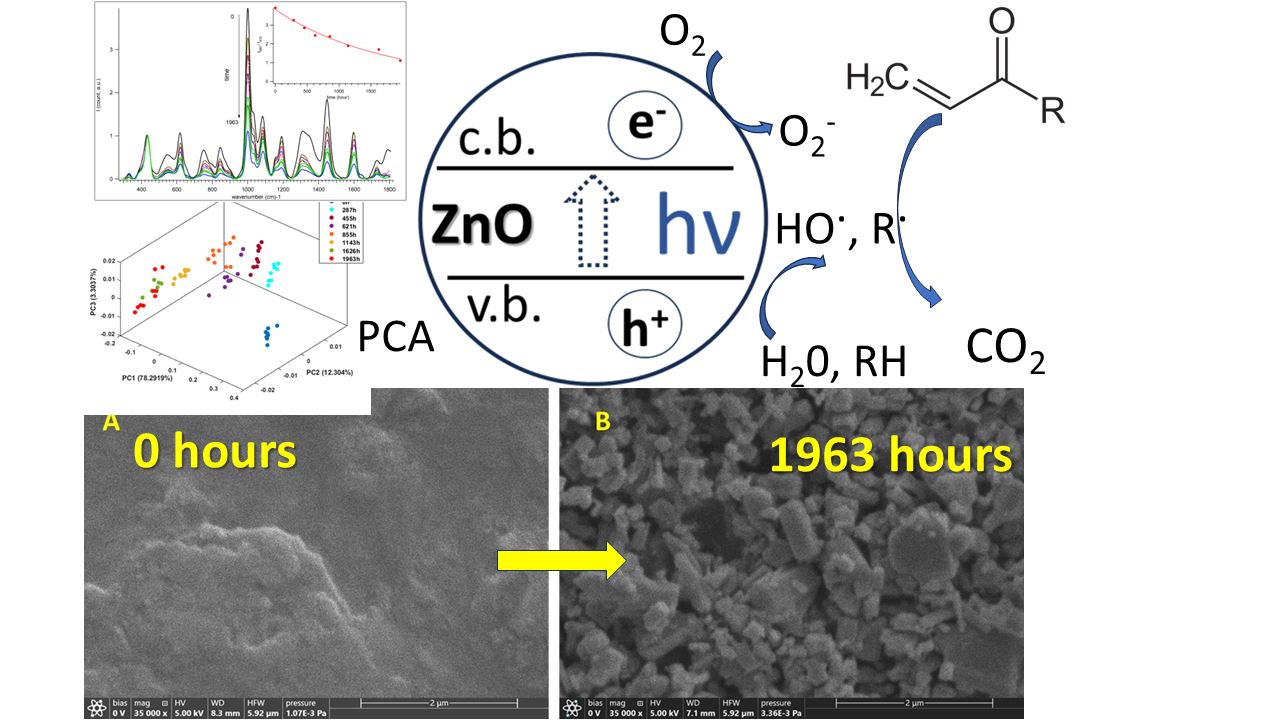
Accelerated artificial aging of ZnO PW4 acrylic artist’s paints was carried out for a total of 1963 hours (~8 107 lux.h) with aging assessment at specific intervals. Color change ΔE* < 2 (CIELab-76 system) over 1725 hours of aging, while the human eye notices color change at ΔE* > 2. Oxidative degradation of organic components in the paint to form volatile products was revealed by ATR-FTIR, Raman spectroscopy-microscopy and scanning electron microscopy with energy dispersive X-ray spectroscopy (SEM-EDS). It appears that deep oxidation of organic intermediates and volatilization of organic matter may be responsible for the relatively small value of ΔE* color difference during aging of the samples. To elucidate the degradation pathways, principal component analysis (PCA) was applied to the spectral data, revealing: 1) the catalytic role of ZnO in accelerating photodegradation, 2) the Kolbe photoreaction, 3) the decomposition of the binder to form volatile degradation products, 4) the relative photoinactivity of CaCO3 compared to ZnO, showing slower degradation in areas with higher CaCO3 content compared to those dominated by ZnO. These results provide fundamental insights into formulation-specific degradation processes, offering practical guidance for the development of more durable artist paints and conservation strategies for acrylic artworks.
Keywords: 
;  ;  ;  ;  ;  ;  ;  
Subject: 
Arts and Humanities  -   Art

1. Introduction

Acrylic binder paint appeared on the American art market in the early 1950s under the commercial name “Magna” and immediately gained popularity among artists. The advertising slogan of the Bocour Artist Colors company, which produced the paint, presented the new product as “the first new painting technique in 500 years”, which was essentially fair, given the two techniques that had dominated throughout the history of easel painting - oil-based and emulsion-based (tempera). [1] Painters quickly appreciated the advantages of the new product over traditional techniques, which consisted of the rapid drying of the paint, the intensity of color that was preserved even in the thinnest translucent layers, and the durability of the new product. Due to the high homogeneity of the paint mass, the new technique was well suited for creating large, uniform in color and texture painting planes, uniform in color, shine and texture, where the brushstroke was completely leveled. All these properties of paints gave artists new pictorial possibilities, and accordingly it can be said that the invention of acrylic had a direct and significant impact on artistic technique (in the understanding of not only the material, but also the direct creative work - the formation of an image, the creation of texture, the application of layers) and in general on the pictorial art of the second half of the twentieth century. The scale of the use of acrylic paints is evidenced, in particular, by the fact that the collection of the State Tretyakov Gallery in Russia contains about 500 works from the second half of the 20th century, executed in the technique of acrylic painting. As it turns out, acrylic paints can degrade over time, showing noticeable changes in color, gloss, and surface texture. [2,3,4,5,6]. This deterioration has been demonstrated through accelerated aging studies involving thermal and light-induced ageing[2,7,8,9,10,11,12,13]. Artists’ acrylic emulsion paints contain various additives, such as coalescing agents, thickeners, defoamers, pH buffers, preservatives, surfactants, and wetting/dispersing agents, that influence performance properties[4,5,6]. These additives are designed to adsorb or chemically bond to pigment and extender surfaces to enhance dispersion stability, viscosity control, opacity, and durability [14]. However, environmental factors (UV exposure, heat, moisture, oxidation) can degrade destabilize these additives over time, altering the paint performance[4,5,6]. Accelerated aging studies have shown that degradation processes significantly enhance the migration of surfactants (polyethylene oxide (PEO)-based types, which predominate in acrylic emulsion formulations) from the base polymer matrix to the surface [3,7,15]. In particular, PEOs exhibit a tendency to oxidative degradation over time. [16,17]. To investigate acrylic paint degradation mechanisms, Attenuated Total Reflection Fourier Transformed Infrared (ATR-FTIR) and Raman spectroscopy are employed as powerful, rapid analytical techniques [8,18,19]. However, the interpretation of spectral data in acrylic paint aging studies presents a significant challenge due to the complexity and size of the data sets. [8,20]. Chemometric algorithms, particularly principal component analysis PCA [20,21] can be effective for investigating the aging of acrylic paints using ATR-IR and Raman spectroscopy.
The aim of this study is to investigate the aging of white acrylic ZnO-based artistic paints under artificial conditions: 1) checking color changes; 2) characterizing the evolution of the paint layer structure and assessing changes in the chemical composition of aged paint; 4) clarifying the mechanism of paint degradation. The acquired findings provide a comprehensive understanding of degradation processes in commercial ZnO acrylic artists’ paint, demonstrating chemometrics (PCA) as an effective analytical methodology for spectral data analysis.

2. Materials and Methods

2.1. Samples Preparation

Commercial white acrylic artist’s paint based on ZnO pigment P.W.4 was used. A uniform layer of ZnO-based white acrylic paint was applied to aluminum foil substrate using a medium brush, and then dried at ambient conditions (approximately 22 °C and 40% RH) for two weeks.

2.2. Artificial Daylight Ageing

The accelerated UV ageing of the paint samples conducted in Q-sun chamber under controlled conditions (38°C, 65% relative humidity RH). The radiation was produced by a Xe lamp simulating outdoor solar conditions (λ > 290 nm) with a radiation intensity of about 60 W/m2. To study the kinetics of aging, individual probes of the sample were periodically taken. The maximum aging time in the chamber was 1963 hours, which, taking into account that for the spectrum of sunlight 685 Lux = 1 W/m2, corresponds to 8.1107 Lux.hour.

2.3. Colorimetric Measurements

Determination of colorimetric characteristics and reflectance spectra in the range of 400–700 nm was carried out on a ColorFlex spectrophotometer (HunterLab, USA) in the following mode: 45/0°, observation angle 10°, light source D65. The value of color difference ΔE in the CIELab-76 system was used as the main criterion. [22]

2.4. Scanning Electron Microscopy (SEM)

Electron microscopy images of aged samples were obtained using Prisma E (Thermo Fisher Scientific, Czech Republic). Samples intended for secondary electron imaging only were pre-coated with 40 nm layer of gold by Q150R ES plus sputter coater (Quorum Technologies, Great Britain) and additionally mounted by a copper tape for better charge drain. Chemical mapping and elemental analysis of aged samples was carried out using energy-dispersive X-ray spectroscopy (EDS) in a low vacuum mode.

2.5. Attenuated Total Reflection Fourier Transform Infrared Spectroscopy (ATR-FTIR)

The infrared spectra of the paint samples were acquired in attenuated total reflectance (ATR) mode using a Vertex -70 FTIR spectrometer (Bruker, Germany), Platinum Diamond ATR. Spectra were recorded in the range of 600–4000 cm−1 with a resolution of 4 cm−1, averaging 64 scans per measurement. For each sample, ten ATR-FTIR measurements were collected from different randomly selected surface areas.

2.6. Raman Spectroscopy

For comprehensive chemical analysis and complete molecular fingerprint, Raman spectroscopy was used as a complementary technique to ATR-FTIR. Raman spectra were acquired using Raman microscope spectrometer Senterra (Bruker) equipped with a λ=785 nm excitation laser and a 50× objective with numerical aperture NA=0.75. The spatial resolution of microscope in measuring Raman spectra was estimated as 1.22* λ/NA≈1.3 μm. For each sample, 10 Raman spectra were collected from different randomly selected points on the sample surface.

2.7. ATR-FTIR, Raman Spectra Preprocessing

The obtained raw spectral data of ATR-FTIR and Raman scattering were pre-processed: smoothing, baseline correction, wavenumber range selection, normalization and analysis of outlier. Smoothing was performed using spectral filters removing random noise using the Savitzky-Golay (SG) algorithm.[23] An iterative polynomial fitting method was applied for the estimate of the baseline in Raman spectra.[24] The derivative treatment of data by the SG algorithm emphasize band widths, positions, and separations while simultaneously reducing or eliminating baseline and background effects. Differentiating data using the SG algorithm emphasizes the width of bands, positions, and splits while reducing or eliminating baseline and background effects.[25] The positions of the peaks of the ATR-FTIR spectra were determined by recording the minima of the second derivative of the ATR-FTIR spectra or, in the case of poorly separated bands, additionally by measuring the positions of the maxima of the fourth derivative of the same spectra. Principal component analysis (PCA) is a class of so-called unsupervised learning or pattern recognition methods. [26] In the present study, the purpose of using PCA was primarily to discover hidden structure, such as a pattern or grouping, in a dataset without prior knowledge of the pattern itself. Mean centering was performed in PCA [27]. PCA was also used to detect outliers.[28]

3. Results

3.1. Colometry

The results of color change due to samples aging are shown in Table 1. The results include the colorimetric changes in the values of the lightness/ darkness (L*), red/green (a*), yellow/blue (b*), and the total color change from 0 to 970 hours exposure (ΔE*). The color difference value ΔE in the CIELab-76 system used as the main criterion was determined using equation (1):
ΔE = [(ΔL*)2 + (Δa*)2 + (Δb*)2]1/2
where ∆L* = L*i – L*0, ∆a* = ai - a0, ∆b* = bi* - b0*, where index 0 refers to the sample before aging, and index i to the sample after a certain period of aging.
Table 1. Colorimetric characteristics of the aged layer of ZnO white acrylic paint PW4.
time, hours L* a* b* ΔΕ*
0 94.75 -1.29 4.04 0.77
120 95.06 -0.71 3.63 0.78
240 95.19 -0.7 3.78 0.75
360 95.17 -0.68 3.92 1.19
480 95.76 -0.66 4.14 1.18
730 95.72 -0.62 4.05 1.08
850 95.63 -0.69 4.22 1.08
970 95.61 -0.63 4.03 1.53
1090 95.81 -0.62 3.66 1.31
1240 94.96 -0.53 4.36 0.85
1360 95.56 -0.55 4.07 1.1
1480 95.60 -0.49 3.88 1.18
1600 95.64 -0.44 3.74 1.27
1725 95.56 -0.51 3.67 1.18
∆E* value below 2 indicates a color difference that is barely perceptible to the average human observer. ∆E* must be >2 to be., while a ΔE* value greater than 2 becomes perceptible by the human eye. By comparing the colorimetric values of the white paint samples during 1725 hours of photoaging, we can realize that the ΔE* value is below 2. However, there is a slight increase in a* value (shifted to red). The rise in L* parameter suggests the increase in L* due to the changes in the surface roughness, as a rougher surface will scatter more light, increasing L*[29]. Also, the surfactant migration to the paint film surface can affect the gloss of this film [15] which in turn affect the L* values.

3.2. SEM Images

Figure 1 demonstrates SEM images of the sample before aging and samples aged for 1963 hours. Detailed changes in the SEM images of the paint layer at different aging times are shown in Figure SI1. (Supplementary Information). In the unaged sample, a uniform paint layer consisting of binder and pigment is observed (Figure 1A1, A2). After 1963 hours of aging (Figure 1B1, B2), significant microstructural changes were observed, including pronounced surface roughness and the appearance of pigment microcrystals zinc oxide (ZnO) and calcium carbonate (CaCO3) [23]. The observed changes suggest the binder degradation. To reduce paint costs and increase its volume, CaCO3 is commonly used as an extender, partially replacing ZnO [2]. While CaCO3 influences paint stability, opacity, gloss, and film toughness, it indirectly influences acrylic binder deterioration[30,31]. CaCO3 scatters and reflects UV radiation, reducing direct UV exposure and offering partial protection to the paint film[17]. Particle size analysis (Figure1,B1) further indicated that the CaCO3 (calcite) grains ranged from 0.2 to 1 μm in size with the typical euhedral to subhedral habit[32], while ZnO particles (~100-200 nm) with hexagonal sectional shape (wurtzite crystal structure)[33].

3.3. SEM-EDS Analysis of the Zinc White PW4 Acrylic Paint

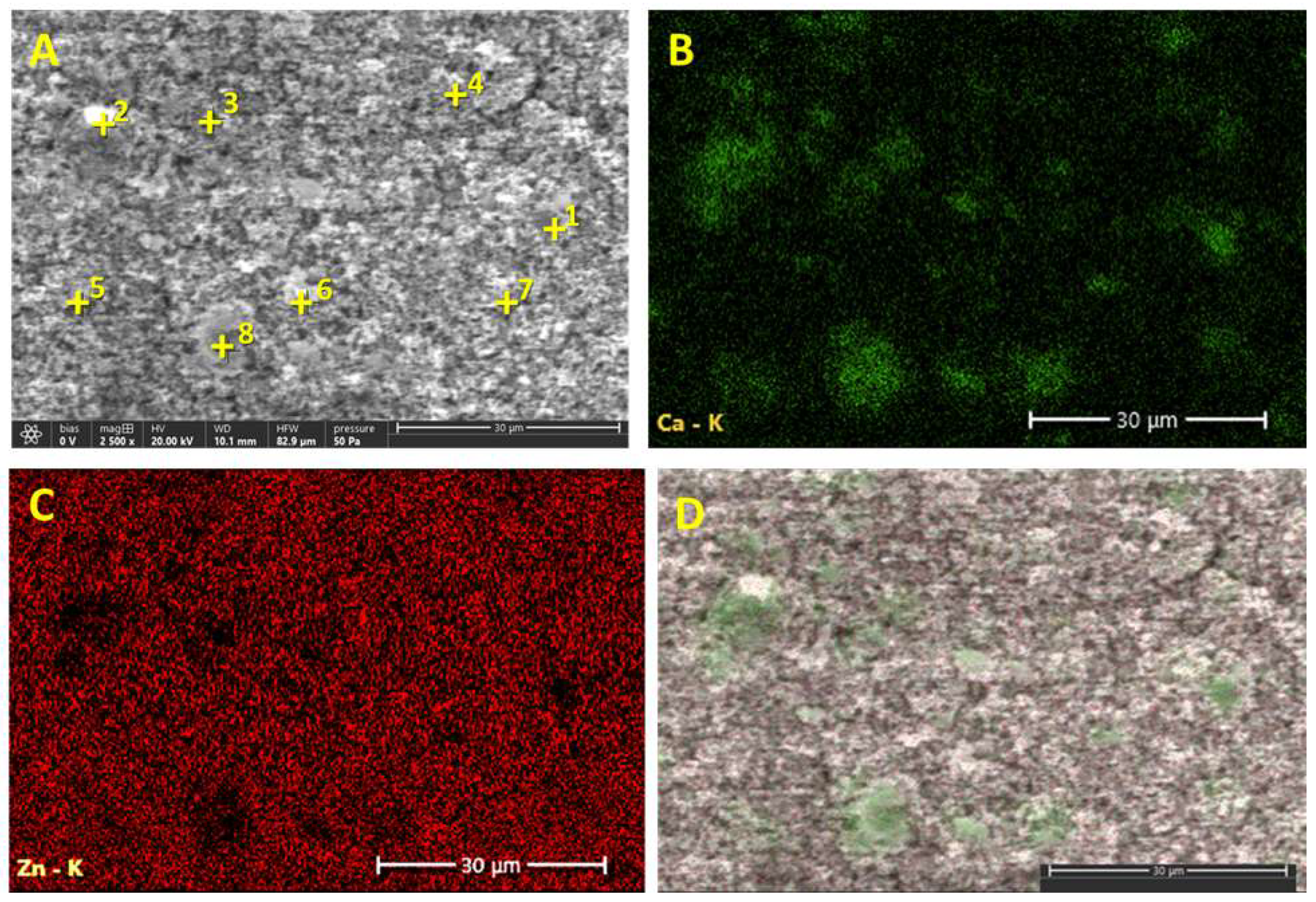
The results of the SEM-EDS analysis of the zinc white PW4 acrylic paint are summarized in Figure 2, and the analysis details are presented in Figure SI2, Table SI1. In addition to carbon (C) and oxygen (O) peaks from the polymeric binder, zinc (Zn) peaks confirmed the ZnO as the primary pigment, while calcium (Ca) peaks corresponded with the CaCO3 as an extender. SEM-EDS analysis shows significant differences in the distribution of ZnO and CaCO3 nanocrystals in the dyed layer of the sample, as shown in Figure 2. Areas of the sample with elevated calcium content are clearly visible, shown in green in Figure 2B and Figure 2D. The regions where zinc oxide dominates over CaCO3 are clearly visible in Figure 2C and Figure 2D (red dots). The approximate size of the region of increased CaCO3 concentration is from ~3 to ~15 μm. Apparently, such heterogeneity of the sample layer can be manifested when measuring spectra on a Raman microscope with a resolution of about 1.3 μm and, possibly, when measuring ATR-FTIR spectra (see below).
The SEM-EDS results of paint samples indicated spatial heterogeneity in elemental distribution across the paint surface (SI2). While most areas showed strong ZnO predominance (ZnO/CaCO3 > 20:1), isolated regions revealed near-equivalent ZnO and CaCO3 content (∼1:1 ratio) indicating CaCO3 agglomeration. This indicates that the surfactant and dispersant system used in the paint formulation do not provide a sufficiently uniform distribution of ZnO and CaCO3. Trace of elements (Si, S, and K <1 wt%) was detected in localized regions likely due to incidental impurities or residual processing additives.

3.4. Aging of Acryl Zinc White PW4 Paint Revealed by ATR-FTIR Spectroscopy
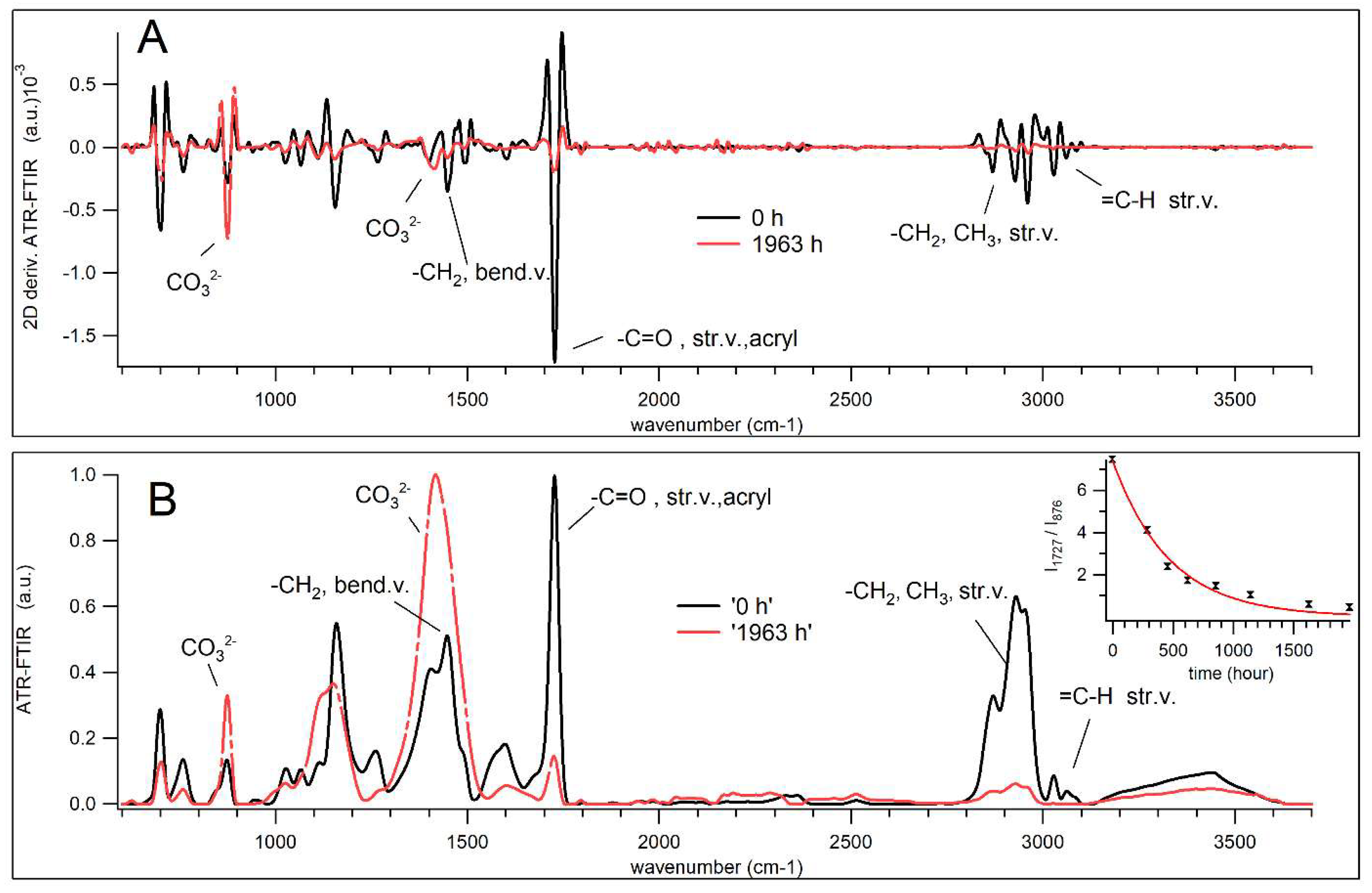
Figure 3 manifests the main motif of changes in the ATR-FTIR averaged spectra of a zinc white layer during aging using a fresh and aged 1963-hour sample as an example. In the ATR-FTIR spectrum of the fresh sample, the bands of the organic components of the paint dominate, whereas in the aged sample, the bands of the organic component are inferior in intensity to the band of the inorganic components, in particular CaCO3. Figure 3 and Figure SI3 (the detailed evolution of average spectra during aging) depicts a pronounced degradation of the acrylic component peak at 1727 cm−1.The intensity of the CO32- peaks associated with CaCO3, in particular the peak of 876 cm-1, increases relative to peaks of the organic component. These changes suggest the degradation of organic components of the paint. The acquired ATR-FTIR spectra of the unaged paint sample (summarized in Table 2) were dominated bands of the acrylic binder. The stretching vibrations of carbonyl ether groups C=O were observed at 1727 cm−1, the stretching vibrations of the C–H bond at (2873, 2930 and 2956 cm−1) and the vibrations of ether groups (–C–C(=O)–O–) at (1159 and 1254 cm−1) can be tentative attributed to acrylic chains. The bands corresponding to =C–H stretching (at 3083, 3061, and 3027 cm−1), C=C aromatic stretching (at 1603 and 1493 cm−1), and C–H bending (at 759 and 698 cm−1) obtained due to ν(C=C) bending and out-of-plane C–H bending (759 and 698 cm−1) suggest the presence of a styrene-acrylic copolymer blend as a binder. The stretching vibrations of C-O-C groups (at 1102, 1118, 992, and 1060 cm−1) were ascribed to a non-ionic surfactant polyethylene oxides (PEO) [3]. Weak bands at 1414, 874, and 712 cm−1 indicated the presence of calcium carbonate (CaCO3) [34]. A broad, weak band at 1563 cm−1 assigned to asymmetric stretching vibrations of COO groups, suggested the presence of a poly(acrylic acid) (PAA) used likely as a dispersant, likely forming metal–carboxylate complexes with the extender and pigment particles [3,35,36]. PAA shows also characteristic peaks of ester groups as acrylic chain. Additionally, a weak shoulder at 1670 cm−1, assigned to the hydrogen-bonded C=O stretching vibration from the interactions between residual carboxylic acid (-COOH) groups and binder carbonyl (C=O) groups.
The use of averaged spectra Figure 3 is due to the fact that the spectra obtained from different points of the sample differ somewhat (see Figure SI4). The deviation of spectra measured from different random points relative to the average spectrum increases in the region of organic compound bands as the sample ages, which is not observed for bands of inorganic compounds, such as CaCO3. These deviations in the spectra of the aged sample are apparently due to the uneven distribution of the paint components ZnO and CaCO3, revealed by SEM (Figure 2), as well as different degradation rates in different areas of the sample.
Figure 3. ATR-FTIR average spectra of the nonaged 0 hour and aged 1963-hour acrylic zinc white PW4 samples. The averaged spectra were obtained from ten spectra measured at random points on the sample. Spectra are normalized to the minimum-maximum scale (SI1). A, ATR-FTIR spectra in the form of second derivatives. B, averaged ATR-FTIR spectra. Insert, kinetics of decay of the I1727/I876 ratio, exponential fit with rate constant 0.00213 ± 0.00016 1/hour.
Preprints 175019 g003
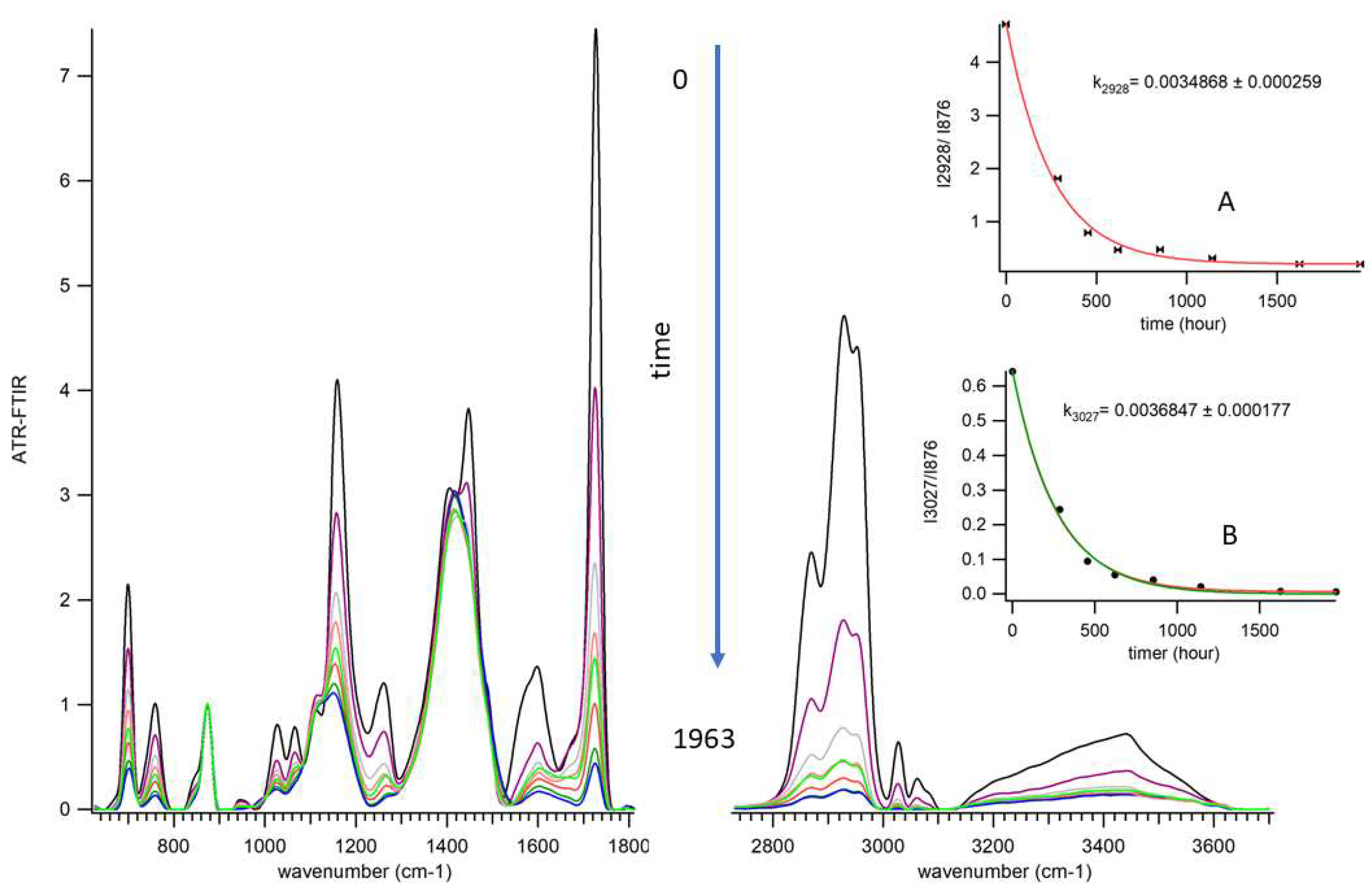
It can be assumed that the concentration of CaCO3 during the aging process of the sample is almost constant, since chemically inert inorganic CaCO3 is stable compared to the organic components of the paint. Therefore, to quantitatively characterize the kinetics of degradation of an organic binder, the ratio of the acrylate band intensity to the CaCO3 band intensity I1727/I876 can be used as a marker. The ratio of the intensity of the C-H band to the CaCO3 band (I2928/I876 and I3027/I876 ) can also be used as an additional marker. Figure 4 shows the averaged FTIR spectra normalized to the peak intensity at 876 cm-1. In this representation, Figure 4 manifests the kinetics of all markers I1727/I876, I2928/I876 and I3027/I876. The exponential fit predicts a characteristic degradation time of 469 hour for the acrylic component of 1727 cm-1 (insert Figure 3B). The decay time is equal to 287 hours for the band of 2928 cm-1 and 271 hours for the band of 3027 cm-1.

3.5. Aging of Acryl Zinc White PW4 Paint Revealed by Raman Spectroscopy-Microscopy
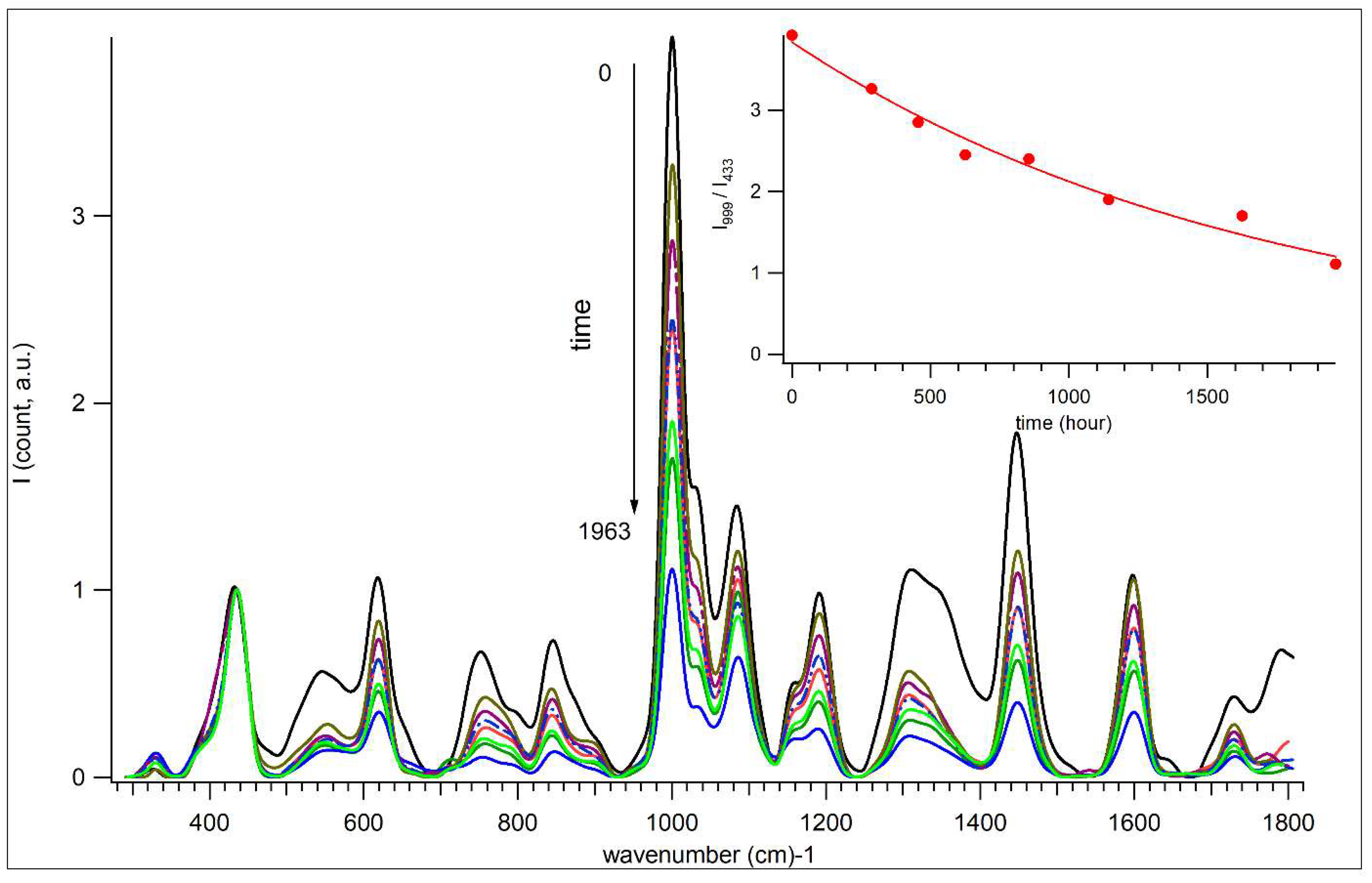
Due to the high spatial resolution Raman microscopy (~1.3 µm) and the complex composition of the paint with non-uniform distribution of paint components in the layer (see Figure 2), the Raman spectra measured from different points of the same sample turned out to be variable (see Figure SI5). This fact apparently indicates a different rate of degradation of the binder at different points of the sample (see Figure SI5). The averaged spectra for all points measured in the sample and their derivatives were analyzed to determine the positions of the Raman band peaks (Figure SI6). Raman peaks are summarized in Table 3. Raman spectra of the samples (Table 3) revealed characteristic peaks corresponding to the vibrational modes of ZnO, which confirms the presence of ZnO as a pigment in the wurtzite phase. The most intense peak at 438 cm−1 was attributed to the E2(high) mode, the shoulder at 328 cm−1 was attributed to second-order scattering (E2), a very weak shoulder around 384 cm−1 corresponded to the A1(TO) mode, and a weak peak at 546 cm−1 was associated with defective ZnO or probably originated from impurities [54,55]. Additionally, overlapping peaks in the region (700 -900 cm−1) were attributed to vibrations in acrylic binder, PEO and polystyrene. A strong peak appeared at 1006 cm−1 accompanied by a shoulder at 1033 cm−1, corresponded to aromatic ring vibrations in styrene. The peaks at 284, 712, and 1086 cm−1 were associated with CaCO3[53,56,57]. These findings are consistent with the ATR-FTIR results.
Raman method is effective in detecting the ZnO peaks and aromatic ring changes corresponding to polystyrene. It is reasonable to assume that zinc oxide is not destroyed during the aging process of the sample. Based on this assumption, the peak intensity ratio I999/I876 can be used as a marker for quantitative characterization of the aromatic ring degradation kinetics. The averaged Raman spectra normalized to the 433 cm-1 peak associated with ZnO (SI3.2) corresponding to different aging times are shown in Figure 5. The kinetics of the decay of the aromatic ring at 999 cm-1 is shown in the inset to Figure 5. The rate constant of aromatic ring decay estimated as an exponential fit is ~0.001 1/hour. This is ~3.5 times slower than the C-H decay estimate made from the ATR-IR data (Figure 4). It can be assumed that such a difference in the degradation rate of different organic groups is due to their different localization relative to the ZnO crystals (see below).
Figure 5. Raman spectra of PW4 acrylic paint samples at different aging times. Scaling: all average spectra are normalized to the peak of 433 cm-1 associated with ZnO. Inset A shows the decay of the peak of 999 cm-1 over time.
Preprints 175019 g005
Spectral variations that exist between different points of the same sample may be due to different rates of sample degradation or other uncontrolled experimental factor. All this makes the interpretation of Raman and ATR-FTIR spectra difficult without the use of chemometrics, which has become indispensable for eliminating confounding effects and extracting subtle spectral variations of interest from the measured spectra (see below).

3.6. PCA Analysis of ATR-FTIR Spectra

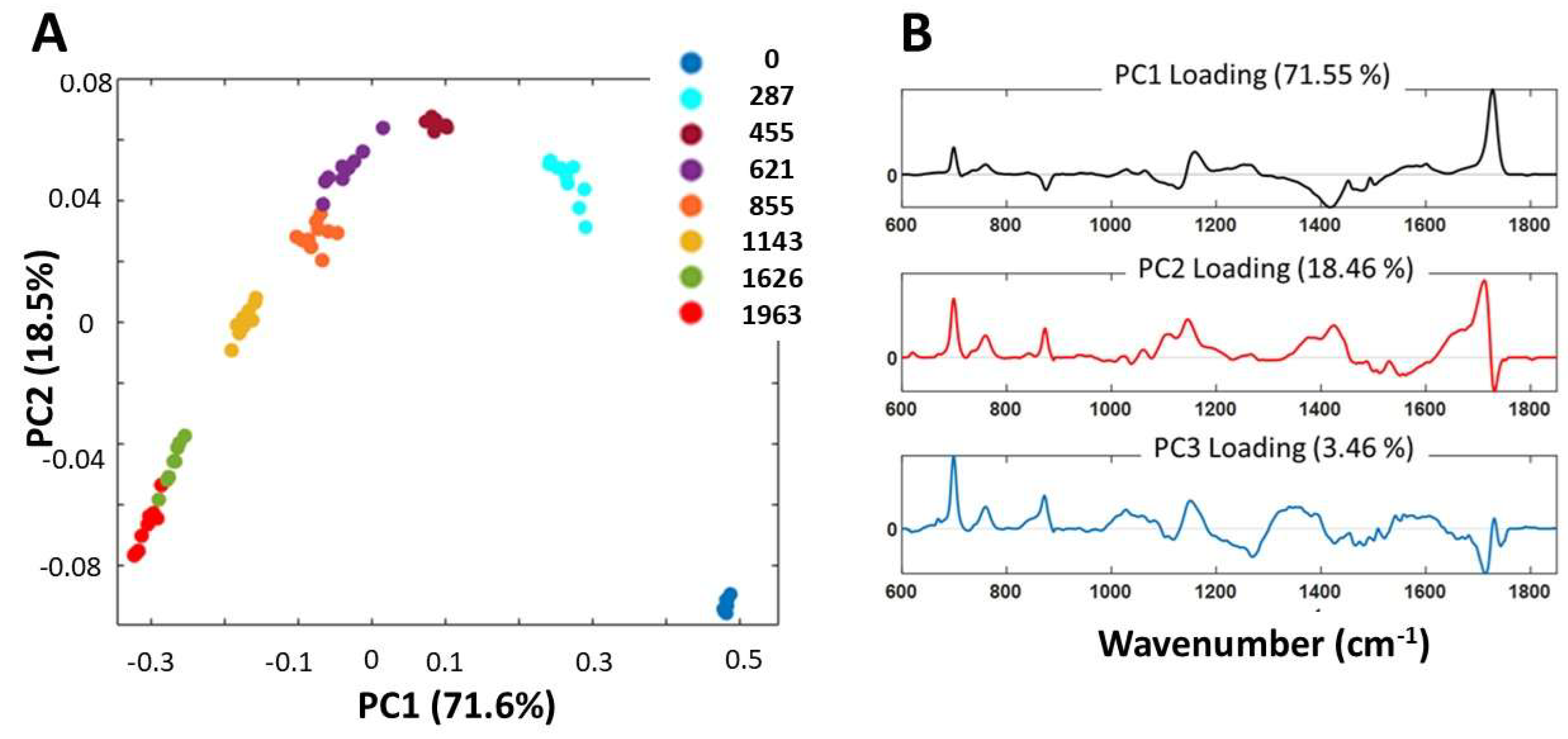
PCA analysis was performed separately on the ATR spectra in the ranges (600–1850 cm−1) and (2700-3700 cm−1), considering all samples over the aging period. The scores plots (PC1 vs. PC2) for both spectral ranges (Figure 6) displayed distinct sample clustering by aging time, confirming progressive degradation.
In the Spectral Range (600–1850 cm−1)
Principal component 1 (PC1, 71.5% variance) captured the dominant photodegradation trends in total (Figure 6A). Where, the positive loadings (representing decreasing peaks intensities) revealed decreases in:
a)
C–O stretching vibrations (at 1027, 1060, 1159, 1254, and 1267 cm−1) and carbonyl C=O stretching (at 1725 cm−1), indicating the degradation of the acrylic chains.
b)
Characteristic polystyrene vibrations (at 700, 732, 760, and 1604 cm−1) and out-of-plane deformations (906-940, 963 cm−1), confirming the polystyrene degradation.
c)
COO stretching (at 1562 cm−1), suggesting disruption of metal-carboxylate complex.
d)
C=O (H-bonded) stretching vibration (at 1675, shoulder) attributed to the degradation of the dispersant PAA and further degradation of degradation products.
Conversely, negative peaks (representing increasing intensities) showed: a) CaCO3 bands (at 712, 874 and 1414 cm−1), as well as a broadening at (1527–1307 cm−1), reflecting a relative increase in the intensity of the CaCO3 band as a result of the degradation of the binder and dispersant (PAA); b) increased C-O-C stretching (at 992, 1102, and 1118 cm−1), consistent with the surfactant PEO migration to the film surface.
PC2 (18.46 % variance) elucidated initial chemical changes in the paint film during the light exposure period (287 - 455 hours). The spectra after 455 hours of exposure exhibited the highest positive value in the PC2 scores plot, indicating most advanced degradation state in this period. The PC2 loading highlighted the following spectral changes:
a)
Asymmetric broadening of the carbonyl peak (at 1725 cm−1) toward lower wavenumbers (~1710 cm−1), indicating the formation of new C=O species from oxidative degradation of the PAA, acrylic , and styrene chains[7];
b)
Narrowing of the carbonyl ester peak on the higher wavenumber side, consistent with oxidative cleavage ester groups in the acrylic binder;
c)
Increase in the shoulder intensity at 1675 cm−1, due to change in hydrogen-bonding induced shifts in carbonyl (C=O) stretching frequencies, providing additional evidence for the formation of new C=O groups;
d)
Broadening of the CaCO3 absorption band (1414cm-1) especially, near 1427 cm−1 and 1370 cm−1), due to the binder degradation and CaCO3 exposure;
e)
Broadening of C-O-C stretching bands (at the peak 1102cm−1 and shoulder 1118 cm−1) reflecting the migration and reorganization of the surfactant (PEO);
f)
Decreased intensity at ~1620, consistent with the loss of the adsorbed water[3,45].
PC3 (3.46% Variance) tracked intermediate aging changes in the paint film, where the spectra acquired after 621 hours of light exposure showed the highest positive value in the PC3 scores plot (Figure SI8, SI9). The corresponding PC3 loading plot (Figure 6B) revealed narrowing of the ester carbonyl peak, accompanied by a reduction in the (H-bonded C=O) band at 1675 cm−1, suggesting a decline in carboxylic acid (–COOH) groups due to further degradation;

3.7. In the Spectral Range (2700–3700 cm−1)

PC1 (78.29% Variance) represented the dominant degradation pattern, with positive loadings corresponding to a decrease in peak intensity for:
a)
Stretching vibrations of CH3 and CH2 (at 2868, 2927, and 2959 cm−1) and =C–H (3027, 3044, 3060, 3086 cm−1), indicating the breakdown and degradation of the (acrylic-styrene) binder chains;
b)
The broad IR band (3130–3600 cm−1), attributed to O–H groups, suggesting weakened H-bonding between PEO and paint components, and initial water desorption at the beginning of the aging, and the formation of volatile products as aging advances.
PC2 (12.3 % variance) reflected the significant baseline variations during the aging process. In the PC2 scores plot (Figure 7A), the sample aged for 455 hours showed the highest value, confirming the early-stage transformations detected by PC2 in the 600–1850 cm−1 range. The corresponding loadings plot (Figure 7B) highlighted the transient changes including:
a)
Asymmetric broadening of C-H stretching vibrations band (at∼ 2700-2850 cm−1), likely corresponds to the formation of the degradation products e.g., aldehyde 2695-2830 cm−1 (weak Fermi doublet at 2720, 2820 cm−1 that are registered for aged samples);
b)
Non-uniform reduction in peak intensity, where the PC2 positive loadings represented the spectral regions which were more resistant to decrease, such as (symmetric stretching vibrations at 2873cm-1). In contrast, negative loadings represented bands more susceptible to radical attack, including asymmetric stretching vibrations of the –C–H groups of alkenes and aromatic compounds.
Figure 7. PCA analysis results of ATR-FTIR spectra in the range (2700–3700 cm−1). Vector normalization was used (SI3.3). A. PC2 vs PC1 scores. B. PC1, PC2 and PC3 loadings.
Preprints 175019 g007

3.8. PCA Analysis of Raman Spectra

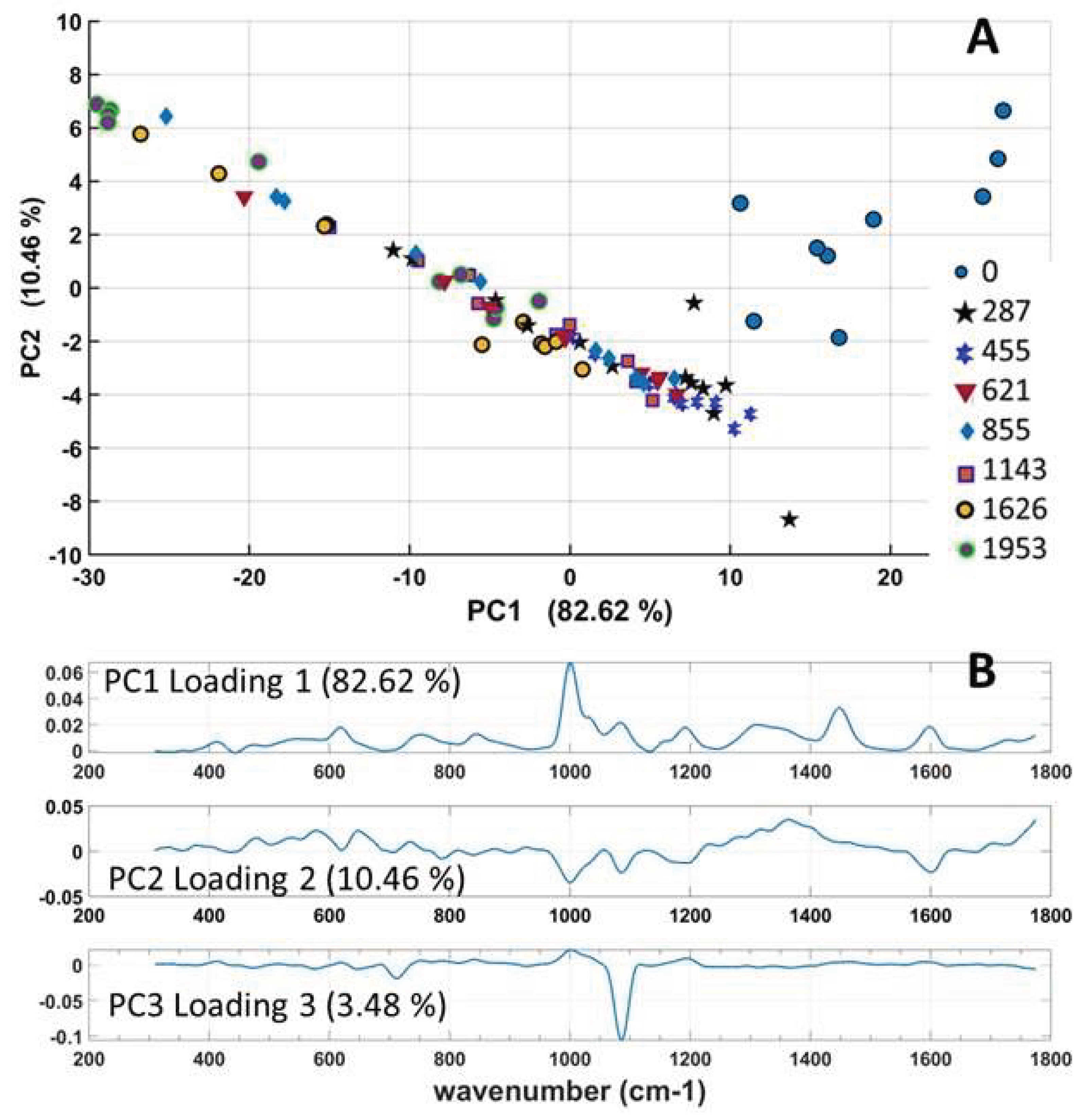
Raman technique is particularly more effective for detecting the changes of ZnO and aromatic ring (PS), owing to its high sensitivity to these characteristic molecular vibrations. In this study, PCA was applied to the spectral range of 150–1130 cm−1 and which 300-1800 cm-1 covers key vibrational modes of ZnO, PS, CaCO3, and C=O groups. Due to the high spatial resolution Raman spectroscopy-microscopy (spot size ~1.3 μm) and the complex distribution of ZnO and CaCO3 in the paint layer (Figure 2), the Raman spectra were quite variable, as mentioned above. Before mean centering, two Raman spectral scaling procedures were used for PCA analysis: vector normalization was applied to the spectral range 150–1130 cm−1 and normalization was applied to the intensity of the ZnO peak at 433 cm−1 to the spectral window of 300-1800 cm-1. Scaling according to vector normalization leads to greater scattering in the score plot (see SI7. PCA analysis of Raman spectra). Figure 8 shows a plot of the scores and loadings when the spectra are normalized to the ZnO peak at 433 cm−1. The score plot (Figure 8) shows trends in PC1(82.6%) and PC2 (10.46%) changes with aging time similar to those observed PC1 and PC2 of the ATR-FTIR spectra (Figure 6 and 7). At the same time, PCA analysis of Raman spectra shows a wider spread of PC1, PC2 scores associated with each specific aged sample, compared to similar scores for ATR-FTIR spectroscopy. The high spatial resolution of Raman microscopy makes it possible to detect areas with different rates of degradation of the organic binder, i.e., areas with a high ZnO content and areas with an increased CaCO3 content. For example, in Fig. SI 13e, SI 14 show that the Raman spectra of the sample aged for 1963 hours can be divided into two groups of similar spectra, which can apparently be attributed to the region of fast and slow degradation of the polymer binder. This observation, together with the SEM-EDS data confirming the non-uniform dispersion of the filler with high ZnO or CaCO3 content, indicates localized heterogeneous degradation of organics.
The spectrum of PS1 Loading 1 (82.6 %) is similar in shape to the spectrum of the organic component of the paint (Figure 8B). This suggests that changes in the PC1 scores during sample aging are associated with organic degradation. The spectrum of PC2 Loading 2 (10.5%) shows that the change in PC2 during sample aging is associated with peaks at ~1000 cm-1 related to the aromatic ring, 1086 cm-1 CaCO3, 1600 cm-1 C=O and a broad band consisting of several overlapping bands between 1230 cm-1 and 1450 cm-1, which can be tentatively attributed to various carbon-carbon and carbon-hydrogen bonds. The spectrum of PC3 Loading 3 (~3.5%) reveals the peak of 1086 cm-1 CaCO3. This suggests that the changes in the PC3 score correspond to an increase in the CaCO3 peak intensity relative to the organic matter peaks during sample aging.

4. Discussion

4.1. Degradation Mechanism of Acrylic Paint ZnO PW4

The main degradation characteristics of ZnO PW4 paint can be summarized as follows: a) ATR-FTIR and Raman spectroscopy studies show that the degradation of ZnO PW4 acrylic paint is associated with the oxidation of the organic binder; b) SEM reveals deep oxidation with the formation of volatile low molecular weight products. Apparently, deep oxidation of organic semi-products and volatilization of organics may be the reason for the relatively small value of color difference ΔE during aging of samples; c) Raman spectroscopy-microscopy and ATR-FTIR spectroscopy display the uneven degradation of organic substances in the paint layer.
It is known that the presence of oxygen, light and heat leads to the degradation of polymers.[62] Chain radical reactions can be initiated in primary photochemical reactions followed by the autoxidation process (Scheme 1). Peroxy (O2•−), hydroperoxy HO2 radical and peroxyl radicals RO2 are far more stable than either HO radical or the carbon-centered radical R and the related alkoxyl radicals RO. The simplified Scheme 1 does not emphasize that the peroxyl radical ROO is a low-reactivity radical and reaction (11) may be kinetically thermodynamically disfavored for most organic components in polymer [62]. Thus, the deep and uneven oxidation of organic matter in ZnO paint is difficult to explain based solely on photochemically initiated autoxidation.
Photocatalytic reactions involving inorganic substances should be taken into account. CaCO3 are wide band gap materials. The indirect energy gap is estimated to be 5.07 eV (245 nm) and the direct allowed optical transitions along high symmetry directions in the Brillouin zone give the fundamental absorption edge of ∼6.0 eV (207 nm)[63] . As a result, CaCO3 is photochemically inert in aging experiments. ZnO is a direct bandgap semiconductor with a bandgap energy Eg of ~3.2-3.4 eV[64]. It absorbs light in the ultraviolet (UV) range, approximately below a wavelength of ~385 nm. The flat band potential of ZnO ECB is around -0.46 to -0.88 eV vs. NHE (Normal Hydrogen Electrode). The EVB is the highest energy level in the valence band. It can be calculated using the formula: EVB = ECB + Eg ~ 2.3 eV. The electron and hole can act as highly reactive agents. [64] Lipovsky et al. reported that ZnO nanoparticles induce increased formation of reactive oxygen species, namely hydroxyl radicals and singlet oxygen, not only under UV light, but a remarkable enhancement of the oxy radicals was also found under visible light (400–500 nm). [65]
Scheme 1
Photocatalytic reactions
ZnO + hν → ecb + h+ vb
(O2)ads + ecb → O2•−+ H+↔ HO2
h+vb + (H2O ↔ H+ + OH)ads → H+ + HO
ZnO induced photo-Kolbe reaction
R-COO- + h+(ZnO) → R + CO2
Norrish type I mechanism (α-cleavage).
R1–C(=O)–OR’ + hν → R1 + C(=O)–OR’
R”H + C(=O)–OR’→ R” + Volatile Organic Compounds (VOC)+ CO2
Autooxidation
HO + RH → R + H2O
RO + R’H → ROH + R’
R → β-scission → R’ + low molecular weight products
R + O2 → RO2
RO2 + R’H → ROOH + R’
HO2 + RH→ R+ H2O2
2RO2 → inactive products
RO2 + R → ROOR
R + R → R-R
ROOH → RO + HO
R-O-O-R → RO + RO
2ROOH → RO2 + RO + H2O
RO2, RO→ (carboxylic acid, aldehyde, ketone, and vinyl groups…)
Since ZnO is photocatalytically active and CaCO3 is not, the oxidation of the organic components in the region of high CaCO3 concentration is slower than in the region of enhanced ZnO concentration, where active radicals and oxygen species can be formed. This is probably the main reason for the uneven degradation rate of the organic binder.
PCA analysis of the ATR and Raman spectra showed that the degradation mechanism of acrylic paint ZnO has clearly defined stages associated with the formation of intermediate products of organic oxidation. For example, the accumulation of carboxyl compounds leads to the formation of radicals due to photo-Kolbe reaction (4) with the formation of R radicals [66,67]. Due to the reduction in the content of ester bonds revealed by ATR-FTIR, it can be assumed that in parallel with the photocatalytic process, an important degradation pathway may occur through the oxidation of the C=O ester group, leading to cleavage at the α-carbon via the reactions (5), (6) of Norrish type I mechanism (α-cleavage) . This side chain scission mechanism generates two radical intermediates: (1) an α-carbon ester radical (COOR’) that undergoes hydrogen abstraction from another organic molecule, forming volatile fragments, and (2) a new centered radical [36,43,68,69].
The PC3 of ATR-FTIR spectra revealed the dominant chemical changes occurring at the aging intervals (621 and 855 hours), indicating an advanced stage of degradation. The narrowing in C=O peak, along with the decline of the hydrogen-bonded C=O peak and the OH peak, suggested the oxidation of -COOH groups forming low-molecular-weight degradation products [70]. The progressive decrease in ester C=O and aromatic ring peaks intensities without emergence of new carbonyl shoulders confirmed that the binder degradation mechanism primarily involved the formation of volatile fragments.
The final aging intervals (1143–1963 hours) and was primarily represented by PC1 analysis of the ATR-FTIR, Raman data, reflecting the complete degradation pathway . The PC1 loadings (Figure 6 and Figure 8) revealed the key changes after 1963 hours of aging compared to the unaged paint. Here, the progressive decline in the aromatic ring content, the reduction in (bonded/ non-bonded) carbonyl bands, and the absence of the C=C peak indicated more severe stage of binder degradation driven by oxidation and volatile loss [7]. Consistent with the SEM observations, no significant crosslinking between the binder chains was detected, since the IR bands of (C-O-C) assosited to PEO did not show shift or emergence of new shoulder in this rigion. The continued decrease in the ATR-FTIR and Raman characteristic binder signals with the aging, further demonstrated that the primary degradation mechanisms were chain scission and volatile loss. On the other hand, PC1 and PC2 of the Raman data revealed significant spectra discrimination at this stage due to heterogeneous degradation, reflecting extreme degradation of the organic binder in ZnO-rich regions (Figure SI 13e)

5. Conclusion

The color change caused by aging of ZnO white PW4 was measured by the color difference value ΔE* in the CIELab-76 system. The colorimetric values ΔE* value is below 2 the during 1725 hours of sample aging (~7 107 Lux.h). It is generally accepted that the human eye notices a change in color when ΔE*>2. At the same time, SEM, ATR-FTIR and Raman spectroscopy show significant changes in the structure and chemical composition of the ZnO PW4 white paint layer during ~1000-1963 hours of aging. SEM showed increased surface roughness, cavitation, and chalkiness with the progressive degradation of the binder. The SEM results indicate deep oxidation with the formation of volatile low-molecular products. Apparently, deep oxidation of organic semi-products and volatilization of organics may be the reason for the relatively small value of the color difference ΔE during aging of the samples.
Raman spectroscopy microscopy and, to some extent, ATR -FTIR spectroscopy revealed uneven degradation of organic components on the surface of the paint layer. Analysis of spectral data using the principal component PCA method showed that the degradation of organic components of the paint occurs through the mechanism of chain radical oxidation with the initiation of the reaction as a result of the photocatalytic oxidation on ZnO microparticles. The uneven distribution of ZnO and CaCO3 in the paint layer has been demonstrated at a micro scale by SEM-EDS. Carboxyl compounds present in paint or accumulated during oxidation of organic components can also serve as a source of active radicals due to the photo-Kolbe reaction. PCA of Raman data confirmed the photocatalytic role of ZnO in binder degradation, showing higher degradation rates in ZnO-rich regions compared to areas dominated by CaCO3.
This study demonstrated the effectiveness of principal component analysis (PCA) in analyzing complex data sets related to the degradation kinetics of acrylic art paints and can provide guidance for the development of more durable ZnO-based acrylic paints. Importantly, since ZnO-based paint is highly susceptible to photoinduced degradation, the results highlight the need for careful selection of additives, particularly dispersants and surfactants. In this study, it was shown that dispersant (PAA) decarboxylation induced by ZnO photo-Kolbe reaction accelerates active radicals generation and binder degradation. In addition, the surfactant-dispersant system plays an important role in optimal dispersion of the filler in the paint matrix, thereby avoiding differences in degradation rates throughout the paint film.

Supplementary Materials

The following supporting information can be downloaded at the website of this paper posted on Preprints.org, SI1, Figure SI1: SEM images of the ZnO-based white acrylic artists’ paint SEM images. SI2, Figure SI2: SEM image of the sample after 1963-hour aging; Table SI1: The relative content of elements at the points shown in Figure SI2. SI3, equation SI3.1: Scaling and normalization of spectra; equation SI3.2: Scaling and normalization of spectra. SI4, Figure SI3: ATR-IR spectra of acrylic zinc white paint PW4 during aging at time points of 0, 287, 455, 621, 855, 1143, 1626 and 1963 hours; Figure SI4: ATR-FTIR spectra of acrylic zinc white PW4 samples at different aging time. SI5, Figure SI5: Raman spectra of acrylic zinc white PW4 samples at different aging time; Figure SI6: Raman spectra of acrylic zinc white paint PW4 during aging at time points of 0, 287, 455, 621, 855, 1143, 1626 and 1963 hours in the form of the 2d derivative. SI6, Figure SI7: 3D plot of PC1, PC2 and PC3 scores of ATR-FTIR spectra in the range of 600–1850 cm−1; Figure SI8: PC1 vs PC3 scores of ATR-FTIR spectra in the range of 600–1850 cm−1; Figure SI9: PC2 vs PC3 scores of ATR-FTIR spectra in the range of 600–1850 cm−1; Figure SI 10: 3D plot of PC1, PC2 and PC3 scores of ATR-FTIR spectra in the range of 2700–3700 cm−1; Figure SI 11: PC1 vs. PC2 scores of ATR-FTIR spectra in the range of 2700–3700 cm−1; Figure SI 12: PC1 vs. PC3 scores of ATR-FTIR spectra in the range of 2700–3700 cm−1; Figure SI 12: PC1, PC2 and PC3 loadings of ATR-FTIR spectra in the range of 2700–3700 cm−1. SI 7, Figure SI 13: PC1, PC2 and PC3 scores and loadings of Raman spectra: Figure SI 14: Hierarchical cluster analysis of the 1963-hour sample spectra.

Author Contributions

Investigation, formal analysis, methodology, writing—original draft preparation, Mais Khadur, resources, formal analysis Victor Ivanov, resources, data curation Artem Gusenkov, resources, data curation Alexandr Gulin, funding Marina Solovyeva, methodology, writing—original draft preparation Yulia Diakonova, methodology, writing—original draft preparation Yulian Khalturin, conceptualization, methodology, formal analysis, supervision, funding acquisition, writing—review and editing Victor Nadtochenko

Funding

This research was funded by the Russian Science Foundation, grant #25-78-20011.

Data Availability Statement

Data will be available on request.

Acknowledgments

The experiments were carried out using the equipment of the Center for Collective Use of the Federal Research Center for Chemical Physics of the Russian Academy of Sciences “Analysis of Chemical-Biological Systems and Natural Materials”.

Conflicts of Interest

The authors declare no conflicts of interest.

Abbreviations

The following abbreviations are used in this manuscript:
MDPI Multidisciplinary Digital Publishing Institute
DOAJ Directory of open access journals
ATR-FTIR Attenuated Total Reflectance Fourier-Transform Infrared spectroscopy
SEM Scanning electron microscopy
SEM-EDS Scanning electron microscopy with energy dispersive X-ray spectroscopy
PEO Polyethylene oxide
VIS Visible
UV Ultraviolet
PCA Principal component analysis
RH Relative humidity
SG Savitzky-Golay algorithm

References

  1. Jablonski, E.; Learner, T.; Hayes, J.; Golden, M. Conservation Concerns for Acrylic Emulsion Paints. Stud. Conserv. 2003, 48, 3–12. [Google Scholar] [CrossRef]
  2. Alonso-Villar, E.M.; Rivas, T.; Pozo-Antonio, J.S. Resistance to Artificial Daylight of Paints Used in Urban Artworks. Influence of Paint Composition and Substrate. Prog. Org. Coatings 2021, 154, 106180. [Google Scholar] [CrossRef]
  3. Doménech-Carbó, M.T.; Silva, M.F.; Aura-Castro, E.; Fuster-López, L.; Kröner, S.; Martínez-Bazán, M.L.; Más-Barberá, X.; Mecklenburg, M.F.; Osete-Cortina, L.; Doménech, A.; et al. Study of Behaviour on Simulated Daylight Ageing of Artists’ Acrylic and Poly(Vinyl Acetate) Paint Films. In Proceedings of the Analytical and Bioanalytical Chemistry; March 2011; Vol. 399, pp. 2921–2937.
  4. Hagan, E.W.S.; Charalambides, M.N.; Young, C.R.T.; Learner, T.J.S. The Effects of Strain Rate and Temperature on Commercial Acrylic Artist Paints Aged One Year to Decades. Appl. Phys. A Mater. Sci. Process. 2015, 121, 823–835. [Google Scholar] [CrossRef]
  5. Learner, T.; Chiantore, O.; Scalarone, D. Ageing Studies of Acrylic Emulsion Paints. 13th Trienn. Meet. ICOM CC Rio Janiero Prepr. 2002, 911–919. [Google Scholar]
  6. Learner, T. A Review of Synthetic Binding Media in Twentieth-century Paints. Conserv. 2000, 24, 96–103. [Google Scholar] [CrossRef]
  7. Pagnin, L.; Calvini, R.; Sterflinger, K.; Izzo, F.C. Data Fusion Approach to Simultaneously Evaluate the Degradation Process Caused by Ozone and Humidity on Modern Paint Materials. Polymers (Basel). 2022, 14. [Google Scholar] [CrossRef]
  8. Hamidi, F.; Aslani, F. Tio2-Based Photocatalytic Cementitious Composites: Materials, Properties, Influential Parameters, and Assessment Techniques. Nanomaterials 2019, 9. [Google Scholar] [CrossRef] [PubMed]
  9. Whitmore, P.M.; Colaluca, V.G. The Natural and Accelerated Aging of an Acrylic Artists’ Medium. Stud. Conserv. 1995, 40, 51–64. [Google Scholar] [CrossRef]
  10. Nguyen, T.V.; Dao, P.H.; Duong, K.L.; Duong, Q.H.; Vu, Q.T.; Nguyen, A.H.; Mac, V.P.; Le, T.L. Effect of R-TiO2 and ZnO Nanoparticles on the UV-Shielding Efficiency of Water-Borne Acrylic Coating. Prog. Org. Coatings 2017, 110, 114–121. [Google Scholar] [CrossRef]
  11. Nguyen, T.V.; Dao, P.H.; Nguyen, T.A.; Dang, V.H.; Ha, M.N.; Nguyen, T.T.T.; Vu, Q.T.; Nguyen, N.L.; Dang, T.C.; Nguyen-Tri, P.; et al. Photocatalytic Degradation and Heat Reflectance Recovery of Waterborne Acrylic Polymer/ZnO Nanocomposite Coating. J. Appl. Polym. Sci. 2020, 137. [Google Scholar] [CrossRef]
  12. Dodd, A.C.; McKinley, A.J.; Saunders, M.; Tsuzuki, T. Effect of Particle Size on the Photocatalytic Activity of Nanoparticulate Zinc Oxide. J. Nanoparticle Res. 2006, 8, 43–51. [Google Scholar] [CrossRef]
  13. Garcia-Segura, S.; Brillas, E. Applied Photoelectrocatalysis on the Degradation of Organic Pollutants in Wastewaters. J. Photochem. Photobiol. C Photochem. Rev. 2017, 31, 1–35. [Google Scholar] [CrossRef]
  14. Vu, T.V.; Nguyen, T.V.; Tabish, M.; Ibrahim, S.; Huong, T.; Hoang, T.; Gupta, R.K.; My, T.; Dang, L.; Nguyen, T.A.; et al. Water-Borne ZnO/Acrylic Nanocoating: Fabrication, Characterization, and Properties. 2021, 1–10.
  15. Digney-Peer, S.; Burnstock, A.; Learner, T.; Khanjian, H.; Hoogland, F.; Boon, J. The Migration of Surfactants in Acrylic Emulsion Paint Films. Stud. Conserv. 2004, 49, 202–207. [Google Scholar] [CrossRef]
  16. Anghelone, M.; Jembrih-Simbürger, D.; Pintus, V.; Schreiner, M. Photostability and Influence of Phthalocyanine Pigments on the Photodegradation of Acrylic Paints under Accelerated Solar Radiation. Polym. Degrad. Stab. 2017, 146, 13–23. [Google Scholar] [CrossRef]
  17. Tao, Y.; Mao, Z.; Yang, Z.; Zhang, J. CaCO3 as a New Member of High Solar-Reflective Filler on the Cooling Property in Polymer Composites. J. Vinyl Addit. Technol. 2021, 27, 275–287. [Google Scholar] [CrossRef]
  18. Joseph, E.; Ricci, C.; Kazarian, S.G.; Mazzeo, R.; Prati, S.; Ioele, M. Macro-ATR-FT-IR Spectroscopic Imaging Analysis of Paint Cross-Sections. Vib. Spectrosc. 2010, 53, 274–278. [Google Scholar] [CrossRef]
  19. Gomes De Oliveira, A.G.; Wiercigroch, E.; De Andrade Gomes, J.; Malek, K. Infrared and Raman Spectroscopy of Automotive Paints for Forensic Identification of Natural Weathering. Anal. Methods 2018, 10, 1203–1212. [Google Scholar] [CrossRef]
  20. Mokari, A.; Guo, S.; Bocklitz, T. Exploring the Steps of Infrared (IR) Spectral Analysis: Pre-Processing, (Classical) Data Modelling, and Deep Learning. Molecules 2023, 28, 1–21. [Google Scholar] [CrossRef]
  21. Pagnin, L.; Calvini, R.; Wiesinger, R.; Weber, J.; Schreiner, M. Photodegradation Kinetics of Alkyd Paints: The Influence of Varying Amounts of Inorganic Pigments on the Stability of the Synthetic Binder. Front. Mater. 2020, 7, 1–15. [Google Scholar] [CrossRef]
  22. Mokrzycki, W.S.; Tatol, M. Color Difference Delta E - A Survey. Mach. Graph. Vis. 2012, 20, 383–411. [Google Scholar]
  23. Bromba, M.U.A.; Ziegler, H. Application Hints for Savitzky-Golay Digital Smoothing Filters. Anal. Chem. 1981, 53, 1583–1586. [Google Scholar] [CrossRef]
  24. Liland, K.H.; Kohler, A.; Afseth, N.K. Model-Based Pre-Processing in Raman Spectroscopy of Biological Samples. J. Raman Spectrosc. 2016, 47, 643–650. [Google Scholar] [CrossRef]
  25. Rinnan, Å.; Berg, F. van den; Engelsen, S.B. Review of the Most Common Pre-Processing Techniques for near-Infrared Spectra. TrAC Trends Anal. Chem. 2009, 28, 1201–1222. [Google Scholar] [CrossRef]
  26. Coccato, A.; Caggiani, M.C. An Overview of Principal Components Analysis Approaches in Raman Studies of Cultural Heritage Materials. J. Raman Spectrosc. 2024, 55, 125–147. [Google Scholar] [CrossRef]
  27. Kim, D.; You, K. PCA, SVD, and Centering of Data. 2023. arXiv preprint arXiv:2307.15213.
  28. Mujica, L.E.; Rodellar, J.; Fernández, A.; Güemes, A. Q-Statistic and T2-Statistic Pca-Based Measures for Damage Assessment in Structures. Struct. Heal. Monit. 2011, 10, 539–553. [Google Scholar] [CrossRef]
  29. Whitmore, P.M.; Colaluca, V.G. The Natural and Accelerated Aging of an Acrylic Artists’ Medium. Stud. Conserv. 1995, 40, 51–64. [Google Scholar] [CrossRef]
  30. Senler, S.; Eren, M.; Mert, S. Progress in Organic Coatings Effect of Wollastonite Extender on the Properties of Exterior Acrylic Paints. 2016, 93, 34–40. [CrossRef]
  31. Alvarez, V.; Paulis, M. Effect of Acrylic Binder Type and Calcium Carbonate Filler Amount on the Properties of Paint-like Blends. Prog. Org. Coatings 2017, 112, 210–218. [Google Scholar] [CrossRef]
  32. Ševčík, R.; Šašek, P.; Viani, A. Physical and Nanomechanical Properties of the Synthetic Anhydrous Crystalline CaCO3 Polymorphs: Vaterite, Aragonite and Calcite. J. Mater. Sci. 2018, 53, 4022–4033. [Google Scholar] [CrossRef]
  33. Manabeng, M.; Mwankemwa, B.S.; Ocaya, R.O.; Motaung, T.E.; Malevu, T.D. A Review of the Impact of Zinc Oxide Nanostructure Morphology on Perovskite Solar Cell Performance. Processes 2022, 10, 1–19. [Google Scholar] [CrossRef]
  34. Cai, G. Bin; Chen, S.F.; Liu, L.; Jiang, J.; Yao, H. Bin; Xu, A.W.; Yu, S.H. 1,3-Diamino-2-Hydroxypropane-N,N,N′,N′-Tetraacetic Acid Stabilized Amorphous Calcium Carbonate: Nucleation, Transformation and Crystal Growth. CrystEngComm 2010, 12, 234–241. [Google Scholar] [CrossRef]
  35. Zhang, Y.; Gard, T.; Theron, C.; Apostoluk, A.; Masenelli-Varlot, K.; Canut, B.; Daniele, S.; Masenelli, B. Visible Luminescence Improvement of ZnO/PAA Nano-Hybrids by Silica Coating. Appl. Surf. Sci. 2021, 540, 148343. [Google Scholar] [CrossRef]
  36. Yousif, E.; El-Hiti, G.A.; Haddad, R.; Balakit, A.A. Photochemical Stability and Photostabilizing Efficiency of Poly(Methyl Methacrylate) Based on 2-(6-Methoxynaphthalen-2-Yl)Propanoate Metal Ion Complexes. Polymers (Basel). 2015, 7, 1005–1019. [Google Scholar] [CrossRef]
  37. Bosi, A.; Ciccola, A.; Serafini, I.; Guiso, M.; Ripanti, F.; Postorino, P.; Curini, R.; Bianco, A. Street Art Graffiti: Discovering Their Composition and Alteration by FTIR and Micro-Raman Spectroscopy. Spectrochim. Acta - Part A Mol. Biomol. Spectrosc. 2020, 225. [Google Scholar] [CrossRef]
  38. Yabagi, J.A.; Kimpa, M.I.; Muhammad, M.N.; Rashid, S. Bin; Zaidi, E.; Agam, M.A. The Effect of Gamma Irradiation on Chemical, Morphology and Optical Properties of Polystyrene Nanosphere at Various Exposure Time. IOP Conf. Ser. Mater. Sci. Eng. 2018, 298. [Google Scholar] [CrossRef]
  39. Zamo, A.; Rond, C.; Hamdan, A. Polystyrene (PS) Degradation Induced by Nanosecond Electric Discharge in Air in Contact with PS/Water. Plasma 2024, 7, 49–63. [Google Scholar] [CrossRef]
  40. Wu, S.; Luo, Y.; Ran, Q.; Shen, J. Effects of Comb Copolymer PAA-g-MPEO on Rheological and Dispersion Properties of Aqueous CaCO3 Suspensions. Polym. Bull. 2007, 59, 363–370. [Google Scholar] [CrossRef]
  41. Melo, M.J.; Bracci, S.; Camaiti, M.; Chiantore, O.; Piacenti, F. Photodegradation of Acrylic Resins Used in the Conservation of Stone. Polym. Degrad. Stab. 1999, 66, 23–30. [Google Scholar] [CrossRef]
  42. Beigzadeh, A.M.; Vaziri, M.R.R. Z-Scan Dosimetry of Gamma-Irradiated PMMA. Nucl. Instruments Methods Phys. Res. Sect. A Accel. Spectrometers, Detect. Assoc. Equip. 2021, 991, 165022. [Google Scholar] [CrossRef]
  43. Wochnowski, C.; Metev, S.; Sepold, G. UV-Laser-Assisted Modification of the Optical Properties of Polymethylmethacrylate. Appl. Surf. Sci. 2000, 154, 706–711. [Google Scholar] [CrossRef]
  44. Yousif, E.; Haddad, R. Photodegradation and Photostabilization of Polymers, Especially Polystyrene: Review. Springerplus 2013, 2, 1–32. [Google Scholar] [CrossRef]
  45. Xu, J.J.; Lu, Y.N.; Tao, F.F.; Liang, P.F.; Zhang, P.A. ZnO Nanoparticles Modified by Carbon Quantum Dots for the Photocatalytic Removal of Synthetic Pigment Pollutants. ACS Omega 2023, 8, 7845–7857. [Google Scholar] [CrossRef]
  46. Budlayan, M.L.M.; Patricio, J.N.; Lagare-Oracion, J.P.; Arco, S.D.; Alguno, A.C.; Basilio, A.; Latayada, F.S.; Capangpangan, R.Y. Improvised Centrifugal Spinning for the Production of Polystyrene Microfibers from Waste Expanded Polystyrene Foam and Its Potential Application for Oil Adsorption. J. Eng. Appl. Sci. 2021, 68, 1–11. [Google Scholar] [CrossRef]
  47. Pasichnyk, M.; Václavíková, M.; Gaálová, J.; Melnyk, I. Functional Finishing of Polyester Fabric With Polystyrene-Acrylic/Zno Nanocomposite for Effective Dyes Filtration. 2021.
  48. Bandyopadhyay, A.; Basak, G.C. Studies on Photocatalytic Degradation of Polystyrene. Mater. Sci. Technol. 2007, 23, 307–314. [Google Scholar] [CrossRef]
  49. Rodriguez-Blanco, J.D.; Shaw, S.; Benning, L.G. The Kinetics and Mechanisms of Amorphous Calcium Carbonate (ACC) Crystallization to Calcite, via Vaterite. Nanoscale 2011, 3, 265–271. [Google Scholar] [CrossRef]
  50. Zhang, Z.; Xie, Y.; Xu, X.; Pan, H.; Tang, R. Transformation of Amorphous Calcium Carbonate into Aragonite. J. Cryst. Growth 2012, 343, 62–67. [Google Scholar] [CrossRef]
  51. Oriols, N.; Salvadó, N.; Pradell, T.; Butí, S. Amorphous Calcium Carbonate (ACC) in Fresco Mural Paintings. Microchem. J. 2020, 154. [Google Scholar] [CrossRef]
  52. Dinoop lal, S.; Sunil Jose, T.; Rajesh, C.; Anju Rose Puthukkara, P.; Savitha Unnikrishnan, K.; Arun, K.J. Accelerated Photodegradation of Polystyrene by TiO2-Polyaniline Photocatalyst under UV Radiation. Eur. Polym. J. 2021, 153, 110493. [Google Scholar] [CrossRef]
  53. Kim, Y.; Caumon, M.C.; Barres, O.; Sall, A.; Cauzid, J. Identification and Composition of Carbonate Minerals of the Calcite Structure by Raman and Infrared Spectroscopies Using Portable Devices. Spectrochim. Acta - Part A Mol. Biomol. Spectrosc. 2021, 261, 119980. [Google Scholar] [CrossRef] [PubMed]
  54. Li, C.; Lv, J.; Zhou, B.; Liang, Z. Influence of Annealing Atmosphere on Optical Properties of Al-Doped ZnO Powders. Phys. Status Solidi Appl. Mater. Sci. 2012, 209, 1538–1542. [Google Scholar] [CrossRef]
  55. Bognár, S.; Jovanović, D.; Despotović, V.; Jakšić, S.; Panić, S.; Milanović, M.; Finčur, N.; Putnik, P.; Šojić Merkulov, D. Advanced Photocatalytic Degradation of Organic Pollutants Using Green Tea-Based ZnO Nanomaterials Under Simulated Solar Irradiation in Agri-Food Wastewater. Foods 2025, 14, 1–20. [Google Scholar] [CrossRef]
  56. Barroso-Solares, S.; Mediavilla-Martinez, I.; Sanz-Velasco, C.; Prieto, A.C.; Pinto, J. Pigments Identification and Analysis of the State of Conservation of the Decorative Elements of the Castle of Coca (XV-XVI AC, Segovia, Spain) by Raman Spectroscopy. J. Phys. Conf. Ser. 2022, 2204. [Google Scholar] [CrossRef]
  57. Donnelly, F.C.; Purcell-Milton, F.; Framont, V.; Cleary, O.; Dunne, P.W.; Gun’ko, Y.K. Synthesis of CaCO3 Nano- and Micro-Particles by Dry Ice Carbonation. Chem. Commun. 2017, 53, 6657–6660. [Google Scholar] [CrossRef] [PubMed]
  58. Fan, Y.; Cornelius, C.J. Raman Spectroscopic and Gas Transport Study of a Pentablock Ionomer Complexed with Metal Ions and Its Relationship to Physical Properties. J. Mater. Sci. 2013, 48, 1153–1161. [Google Scholar] [CrossRef]
  59. Bertoldo Menezes, D.; Reyer, A.; Benisek, A.; Dachs, E.; Pruner, C.; Musso, M. Raman Spectroscopic Insights into the Glass Transition of Poly(Methyl Methacrylate); 2021; Vol. 23; ISBN 0000000175.
  60. Boyden, M.N.; Kleist, E.M.; Asztalos, C.K.; Korter, T.M. Determination of the Polymer Composition of Mid-Twentieth Century Purses by Raman Spectroscopy. Herit. Sci. 2022, 10, 1–10. [Google Scholar] [CrossRef]
  61. Wang, Z.; Su, S.; Ling, F.C.C.; Anwand, W.; Wagner, A. Thermal Evolution of Defects in Undoped Zinc Oxide Grown by Pulsed Laser Deposition. J. Appl. Phys. 2014, 116. [Google Scholar] [CrossRef]
  62. Smith, L.M.; Aitken, H.M.; Coote, M.L. The Fate of the Peroxyl Radical in Autoxidation: How Does Polymer Degradation Really Occur? Acc. Chem. Res. 2018, 51, 2006–2013. [Google Scholar] [CrossRef]
  63. Hossain, F.M.; Murch, G.E.; Belova, I. V.; Turner, B.D. Electronic, Optical and Bonding Properties of CaCO3 Calcite. Solid State Commun. 2009, 149, 1201–1203. [Google Scholar] [CrossRef]
  64. Ishchenko, O.; Rogé, V.; Lamblin, G.; Lenoble, D.; Fechete, I. TiO2, ZnO, and SnO2-Based Metal Oxides for Photocatalytic Applications: Principles and Development. Comptes Rendus Chim. 2021, 24, 103–124. [Google Scholar] [CrossRef]
  65. Lipovsky, A.; Tzitrinovich, Z.; Friedmann, H.; Applerot, G.; Gedanken, A.; Lubart, R. EPR Study of Visible Light-Induced Ros Generation by Nanoparticles of ZnO. J. Phys. Chem. C 2009, 113, 15997–16001. [Google Scholar] [CrossRef]
  66. Kraeutler, B.; Jaeger, C.D.; Bard, A.J. Direct Observation of Radical Intermediates in the Photo Kolbe Reaction—HeterogeneousPhotocatalytic Radical Formation by Electron Spin Resonance. J. Am. Chem. Soc. 1978, 100, 4903–4905. [Google Scholar] [CrossRef]
  67. Schmitt, M. ZnO Nanoparticle Induced Photo-Kolbe Reaction, Fragment Stabilization and Effect on Photopolymerization Monitored by Raman-UV-Vis Measurements. Macromol. Chem. Phys. 2012, 213, 1953–1962. [Google Scholar] [CrossRef]
  68. Ibraheem, H.A.; El-Hiti, G.A.; Yousif, E.; Ahmed, D.S.; Hashim, H.; Kariuki, B.M. Investigation of the Impact of Chemical Modifications on the Photostability of Polymethyl Methacrylate. Int. J. Polym. Sci. 2024, 2024. [Google Scholar] [CrossRef]
  69. Sansul, S.; Yousif, E.; Ahmed, D.S.; El-Hiti, G.A.; Kariuki, B.M.; Hashim, H.; Ahmed, A. Pendant Modification of Poly(Methyl Methacrylate) to Enhance Its Stability against Photoirradiation. Polymers (Basel). 2023, 15, 1–15. [Google Scholar] [CrossRef] [PubMed]
  70. Kaczmarek, H.; Szalla, A. Photochemical Transformation in Poly(Acrylic Acid)/Poly(Ethylene Oxide) Complexes. J. Photochem. Photobiol. A Chem. 2006, 180, 46–53. [Google Scholar] [CrossRef]
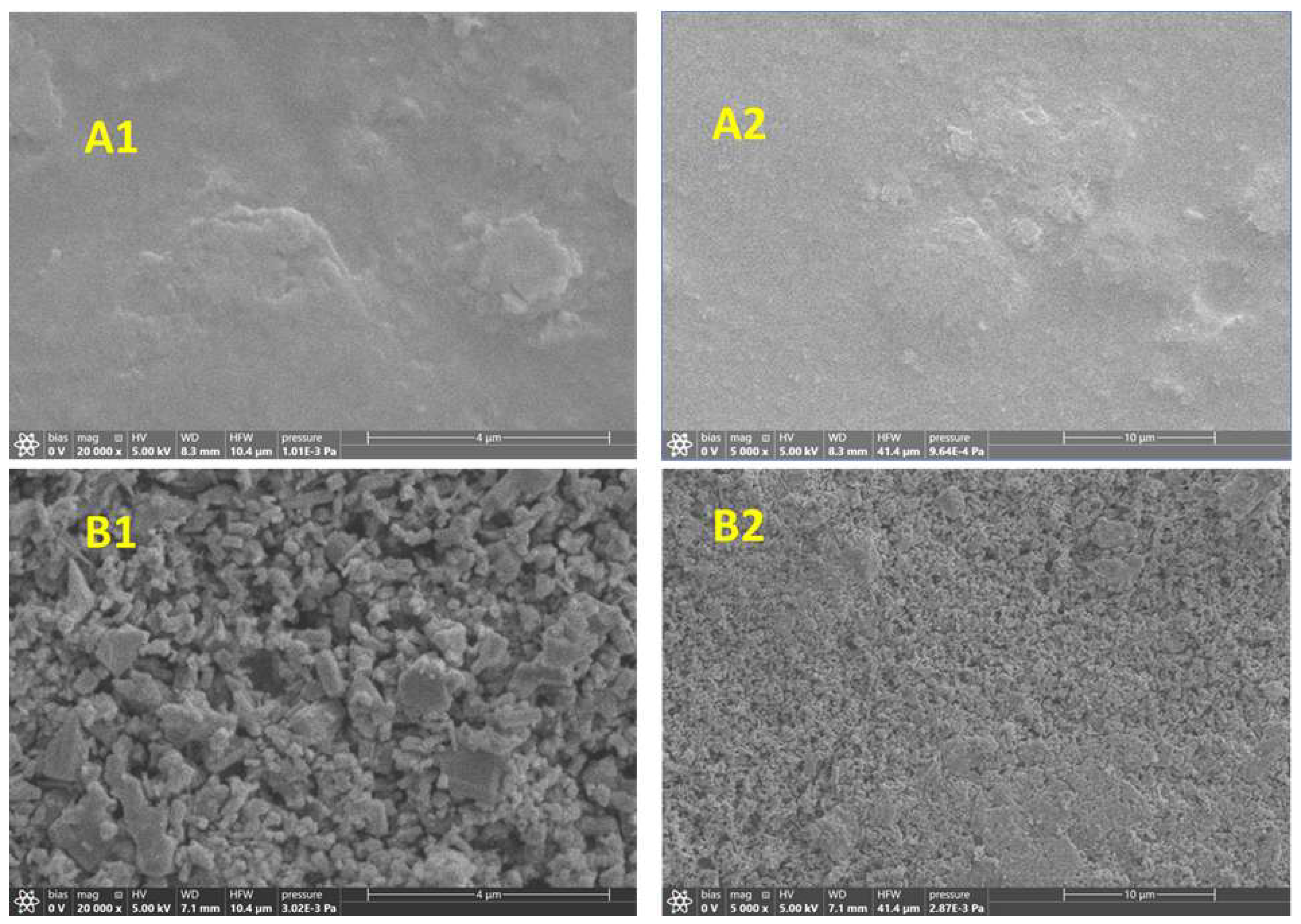
Figure 1. SEM images of the sample before aging (A1, scale bar 4 µm, A2, scale bar 10 µm) and samples aged for 1963 hours (B1, scale bar 4 µm, B2, scale bar 10 µm).
Preprints 175019 g001
Figure 2. SEM-EDS images of the sample stained with acrylic paint PW4. A. SEM image, points indicate areas of EDS analysis (the analysis results are documented in SI 2). B. SEM-EDS image of calcium distribution in the stained sample. C. SEM-EDS image of zinc distribution in the stained sample. D. Superimposed SEM-EDS/SEM image, zinc (red) and calcium (green).
Preprints 175019 g002
Figure 4. ATR-FTIR average spectra at aging time of 0, 287, 455, 621, 855, 1143, 1626, and 1963 hours. Spectra are normalized to the peak at 876 cm-1(SI3.2). Insert A, experimental points of kinetics I2928/I876. Solid line is exponential fit exp(-k.time), k=0.0035 1/hour. Insert B, experimental points of kinetics I3027/I876. Solid line is exponential fit exp(-k.time), k=0.0037 1/hour.
Preprints 175019 g004
Figure 6. PCA Analysis results of ATR-FTIR Spectra in the range (600–1850 cm−1). Vector normalization was used (SI3.3). A. PC2 vs PC1 scores. B. PC1, PC2 and PC3 loadings.
Preprints 175019 g006
Figure 8. PCA Analysis results of Raman spectra in the range (300–1800 cm−1). A. PC2 vs PC1 scores. B. PC1, PC2 and PC3 loadings.
Preprints 175019 g008
Table 2. Characteristic ATR-FTIR bands in white acrylic artists’ paint PW 4. A tentative assignment of peaks was made based on the analysis of the spectra in the form of second or fourth derivatives.
ATR-FTIR IR absorption band (cm−1) Functional group assignment Compound assignment
(cm-1)
the present study
31130-3600 3130-3600 –OH associated stretching vibration PAA, Aging products, Water, and H-bonded[2,37]
3027, 3044, 3060, 3086 3027-3059-3085 =C-H stretch (aromatic) Polystyrene [20,25]
2927, 2959, 2956 -2930- –CH2 and –CH3 asymmetric stretching vibration Polyethylene oxides (PEO) non-ionic surfactant PAA, Acrylic medium[3,38,39]
2853, 2868 2873, 2856 –CH2, -CH3 symmetric stretching vibrations Polyethylene oxides (PEO)non-ionic surfactant, Acrylic medium, PAA[3,38,39]
1727 1725 –C=O stretching vibration Acrylic medium[3]
1675, 1686, 1699 1675 –C=O (H-bonded) stretching vibration Acrylic medium , PAA [40]
1624, 1637 1632 C=C stretching Aging product[11,41,42,43]
1603 1600 Polystyrene [7,44]
1596 - 1624 1600 to1636 O–H bending vibration Adsorbed water[3,45]
1560, 1576 1562 COO asymmetric stretching (carboxylate) Metal carboxylate complexes[35,36]
1487, 1500, 1516 1492 Aromatic C=C in-plane bending, C–C ring stretching.[7] Polystyrene [37,38,44,46]
1448, 1458 1452 -CH2 bending vibrations Polystyrene [44], PAA, Acrylic medium [3,39,47,48]
1414 1414 CO32− stretching vibration (ν3) Calcium carbonate extender [3,34,49,50,51]
1371, 1387, 1401 1395-1300 –CH3 , –CH2 Bending vibration Polyethylene oxides (PEO) non-ionic surfactant ,Acrylic medium[3]
1156, 1180, 1206, 1222, 1244, 1266 1267, 1254, 1159 C-O stretching vibration PAA, Acrylic medium [15]
1095, 1110, 1122 1118, 1102 –C–O–C– stretching vibration Polyethylene oxides (PEO) non-ionic surfactant [3,7]
1026, 1066 1027-1064 -C–O- stretching vibration PAA, Acrylic medium [38]
902,912,922,940,963 906-940-963 C-H out-of-plane bending vibration Polystyrene [38,52]
876 874 CO32− stretching vibration (ν2) Calcium carbonate extender[8,53]
843 846 C_H rocking vibration Acrylic medium, Polystyrene [42,44]
712 712 CO32− stretching vibration (ν4) Calcium carbonate extender[8,53]
701 700, 732, 760 C–H bending vibration Acrylic medium [7,8], Polystyrene[44]
Table 3. Raman peak assignments for ZnO acrylic paint film before and after 1963 hours of simulated daylight exposure.
Raman shift (cm−1) Functional group assignment Compound assignment
1086 1086 Symmetric CO32− Stretch (ν1) Calcium carbonate extender[53,56,57]
1034 1038 C-H in-plane bending (aromatic ring) Polystyrene [58]
999 1000 C-H symmetric in-plane vibrations (aromatic ring) Polystyrene[20,38,58]
752,799,843 700-900 Vibrations of C-O, –C–COO, C-O-C, C-C and= C-H groups Polystyrene, Polyethylene oxides (PEO) non-ionic surfactant (PEO), Acrylic medium [59]
708 712 In-plane CO32−Bend (ν4) Calcium carbonate extender[53,56,57]
619 612, 760 C-H out-of-plane bending ( aromatic ring) Polystyrene [38,58,60]
543 546 A1(LO) phonon mode (defective ZnO) Zinc Oxide pigment[55,61]
433 438 E2(high) mode Zinc Oxide pigment[54,55]
380 384 A1(TO) mode Zinc Oxide pigment[54,55]
332 328 E2(low) mode Zinc Oxide pigment[54]
Disclaimer/Publisher’s Note: The statements, opinions and data contained in all publications are solely those of the individual author(s) and contributor(s) and not of MDPI and/or the editor(s). MDPI and/or the editor(s) disclaim responsibility for any injury to people or property resulting from any ideas, methods, instructions or products referred to in the content.
Copyright: This open access article is published under a Creative Commons CC BY 4.0 license, which permit the free download, distribution, and reuse, provided that the author and preprint are cited in any reuse.
Prerpints.org logo

Preprints.org is a free preprint server supported by MDPI in Basel, Switzerland.

Subscribe

Disclaimer

Terms of Use

Privacy Policy

Privacy Settings

© 2025 MDPI (Basel, Switzerland) unless otherwise stated