

Submitted:
02 September 2025
Posted:
03 September 2025
You are already at the latest version
Abstract
Research on government is abundant, but a management perspective is yet to be established as a research paradigm. Conversely, management research has yet to firmly accommodate government as an organizational object of study. This paper advances the study of government through a management lens, proposing “Management in Government” (MIG) as a distinct paradigm beyond the domains of political science and public administration. Drawing on reform literature, longitudinal studies of Bangladesh, and field-level observations of institutional practices, the paper establishes the conceptual foundations of MIG and introduces a contextualized research agenda (MIG-BD). Traditional top-down reforms have yielded limited improvements in citizen services, highlighting the limits of strategies that overlook operational realities. The proposed paradigm emphasizes citizen-centric service delivery, bottom-up perspectives, and the application of business management tools in public agencies. Ultimately, it offers a framework to study government as an organization and governance effectiveness through the disciplinary lens of management.
Keywords:
management in government research
; government effectiveness
; public sector reform
; citizen trust
; bottom-up approach
; governance
1. Introduction
Government as an organization has been studied in multifaceted forms traditionally in public administration and its mother discipline, political science. This conceptual paper initiates a discourse that emphasizes the study of government as a sub-sector in the overall discipline of ‘Management’ where management is concerned achieving the organizational objectives with both effectiveness and efficiency, and is characterized by the customer satisfaction, stakeholder return on investment, and overall value maximization for the society in general.
Earlier papers of the author highlighted the conceptual evolution of management in government (MIG) and its implications for reform as well as the gaps in development theory when management basics are overlooked in government practice ((Khaled, 2021; 2015). In addition, longitudinal analyses of reform regimes and institutional transformations in Bangladesh together with field-based observations of recent reform initiatives and managerial improvement efforts provide an empirical foundation for setting a research paradigm for Bangladesh context (Khaled, 2025, 2019). After introducing the conceptual foundations of MIG, the paper sets the scope and direction for a broader research agenda in the Bangladeshi context, and clarifies the operational terms and definitions that underpin this line of inquiry.
2. Government as an Institution and Sector for Research
2.1. Government Effectiveness: A Declining Trust
The trust in government as an organization in terms to capacity to serve the citizens and fulfill their ever-increasing expectations has been in decline for quite some time (Behn, 1995, 1998; Fukuyama, 1995; Ruscio 1996). It is not a developing country phenomenon only but a global trend. Over recent decades and in many nations, the level of citizen trust and support for government has been declining (Ferlie, Lynn, & Pollitt, 2005). For example:
- -
- In the United States, the proportion of Americans who reply that they "trust the government in Washington to do the right thing" some or most of the time has fallen steadily from 70 percent in1966, to 25 percent in 1992 (Putnam, 1995), and to only 15 percent in 1995 (Nye, Zelikow, & King 1997).
- -
- Public confidence in government has also declined in Canada (Zussman, 1997), some European countries (OECD 2011; Pollitt & Bouckaert, 2011), New Zealand (Barnes and Gill 2000) and other nations.
- -
- As summarized in The Trust Issue of Oxford Government Review in 2016, the developed countries’ populations are fed up with globalization for the benefit of the few, letting trade drive away jobs, and encouraging immigration so as to provide cheaper labor and to fill skills-gaps without having to invest in training. As a result, the ‘anti-government’, ‘anti-expert’, ‘anti-immigration’ movements are rapidly gathering support (Woods, 2016). So bridging the gap became a challenge in itself between citizens and their governments (Woods, 2017).
- -
- Over the same period, a wave of ongoing governmental reform has washed over much of the developed world (Kettl, 2002; Kickert, 1997; Pollitt & Bouckaert, 2011).
This widespread erosion of trust in government is not confined to developed nations alone. While the manifestations may differ, the underlying causes—bureaucratic inefficiency, lack of responsiveness, perceived corruption, and failure to meet citizen expectations—resonate strongly within developing country contexts as well. Bangladesh, despite notable developmental gains, is no exception to this trend. The disconnect between citizen expectations and the actual performance of government institutions has become increasingly evident, underscoring the urgent need to re-evaluate how government is managed and how public services are delivered.
In summary, the general perception backed by many research evidences is that the trust in government is low and has decreased over years (Khaled, 2013). Citizens perceive government as inefficient, ‘bureaucratic’ procedure oriented, not responsive to changes, and that government is not citizen (customer) centric.
Following is a list adapted from a citizen-expectations gap summarized by Kotler in his book ‘Marketing in Public Sector’ (Kotler & Lee, 2006):
- -
- Tax collection is emphasized but citizens don’t get our money’s worth.
- -
- Some government agencies pay scandalous prices for common goods, and there are million-dollar overruns on government contracts (inefficiency and corruption).
- -
- The nation’s public infrastructure (bridges, roads, etc.) is deteriorating in spite of road taxes (and we have roads without bridges and vice versa).
- -
- Public agencies are often slow and inflexible because of excessive bureaucracy and rules.
- -
- Public employees are overprotected even in the face of incompetence or unethical behavior.
- -
- Public schools and university failures lead to poor education that leads to poor workforce and that lead to poor human capacity of the nation.
- -
- Poorer citizens are given inadequate help to improve their conditions and to escape the cycle of poverty.
- -
- System problems create long waiting times, lost correspondence, dirty streets, and more.
- -
- Inept communications create confusion.
- -
- Lack of responsiveness creates anger, pessimism, distrust, and helplessness.
- -
- Being out of touch with citizenry creates programs doomed for failure and in turn wastes for the whole country and economy.
Interestingly, the original list originated in a developed country experience. Then, this is needless to mention the actual citizen’s condition in a developing country like Bangladesh. This is quite evident in our research in exploratory phase, media reports, citizen experience survey, and in-depth analysis.
Now, the discussion of how to increase trust on ‘government as an organization’ can be categorized in two distinct streams. One is along political science and public administration. Another one is ‘management’ of government as an organization. Here, we are concerned about the later - more specifically management of citizen service delivery affairs – how to improve management in government agencies that are responsible for ensuring varied citizen service, on behalf of the government.
As far as political science dimension is concerned, how much importance citizens get from the government determine the tone and spirit of democracy, in its true meaning. Even in autocratic forms of governments, government do care about citizen perception and expectations. The reason for caring about citizen perception, expectation, and satisfaction is that ultimately the government, however autocratic it seems, become vulnerable when it cannot satisfy the basic needs of the citizens. The goal of maintaining or improving support for government is to win legitimacy of government in power and also to achieve performance gains (Olsen & Peters, 1996; Newman, 2001) in Oxford Handbook of Public Management (Ferlie, Lynn, & Pollitt, 2005).
In Indian subcontinent, the British ruled for 190 years and saw many zealous modernizers, both British and native, who wanted to make every institution as British as possible in a land ‘which resembled England in nothing’. Thus, after two centuries of the British rule in Bengal and India, major institutions crafted by the British turned out to be isomorphic mimicries, meaning looking same in form, but not working the same in functions. Khan (2015) mentioned, for example, Isomorphic mimicry in judiciary; Isomorphic mimicry in police; Isomorphic mimicry in land records; and Isomorphic mimicry in the design of bureaucracy.
Apart from the debate of colonial legacy, however reformed the government looks like in shape and look, the perception of service by government organizations (agencies, directorates, department, etc.) among the citizens is that management is very poor, mismanagement abound; regardless of corruption, management know-how is absent, they are ‘rule bound and procedure centric’, NOT ‘objective or citizen service centric’.
So management matters regardless of form of government if the imperative is doing more with less, where management is concerned about goals and objective achievement, with given resources, and with effectiveness and efficiency. This sets the imperative for MIG research.
2.2. State of the Nation and Development: Bangladesh Conundrum
Bangladesh has emerged as a notable case in global development discourse. Reports from international organizations and consulting firms such as the World Bank, McKinsey, Goldman Sachs, and PricewaterhouseCoopers consistently highlight the country’s progress in key economic and social indicators. With steady GDP growth, rising tax revenues, growing urbanization, and expansion in sectors like garments, technology, and real estate, Bangladesh presents a compelling narrative of development. According to the World Bank (2017), Bangladesh’s economy has remained stable despite global volatility, with growth between 6.4% and 6.8% projected for 2017–2018. Goldman Sachs (2005) lists it among the "Next 11" economies, while McKinsey & Company (2012) recognizes it as a top destination for garment sourcing. The country has also achieved improvements in maternal and child health, women's labor force participation, and poverty reduction (World Bank, 2022a). Notably, Bangladesh's development trajectory does not neatly align with either income-led or welfare-led models, as observed by Amartya Sen, highlighting its unique "support-lite" pathway.
However, this developmental success coexists with persistent governance weaknesses. The World Bank’s Governance Matters reports, along with academic analyses, underscore consistent underperformance in key governance indicators, including corruption control, rule of law, and regulatory quality (World Bank, 2002; 2022b). This disconnect—strong development amid weak governance—has been termed the "Bangladesh Conundrum." This paradox suggests that growth alone does not guarantee institutional strength or effective public service delivery. As such, the real challenge lies in improving the management capacity of government institutions to align development outcomes with citizen expectations. Addressing this requires a shift in focus—from macro-level planning to micro-level operational effectiveness, which is where management research becomes critical (World Bank, 2022c).
2.3. Development, Governance, and Government Effectiveness
Development may not always mean good governance, where ‘management failure in government’ or poor ‘management in government’ (MIG) is quite evident in developing countries like Bangladesh (Khaled, 2011). Despite the impressive example of development Bangladesh in many social and economic indicators, overall governance weakness in political and institutional arena is quite illustrated (World Bank, 2007; 2011). So, the paradox of development remained on surface. This leads us to the fact that there is a lack of consensus on ‘tools and indicators’ of measurement of good governance that is supposed to accompany with development.
Problems of definition, measurement and inference are obvious in applying the concept of good governance and give rise to challenges in developing priorities and the allocation of funds, organizational capacity, human resources and skills, knowledge and leadership (Grindle, 2011). Others pointed that broad country coverage and enticing labels such as 'Rule of Law' make the aggregate indicators attractive as they may provide general information about differences between nations, but their availability may well have crowded out efforts at measuring the impact of institutions (Langbein & Knack, 2010). In a policy brief published by the OECD Development Center, Oman and Arndt (2010) acknowledged that most used, and misused, governance indicators were composite perceptions-based indicators. These observations give rise to questions about the existing indicators and the accuracy of their measures (Huque, 2016).
However, as a general starting point, a table like World Governance Indicators (WGI) can serve well for developing more specific analysis on particular dimension of governance. World Bank uses meta-data on following types of governance indicators from many sources to construct the WGI1: Voice and Accountability, Political Stability, Government Effectiveness, Regulatory Quality, Rule of Law, and Control of Corruption.

Table 1.
Governance Indicators in WGI.
| Governance Indicators | Description of Indicators |
|---|---|
| Voice and Accountability | the extent to which a country's citizens are able to participate in selecting their government; freedom of expression, association, and a free media. |
| Political Stability | the likelihood that the government will be destabilized by unconstitutional or violent means, including terrorism |
| Government Effectiveness | the quality of public services, quality of policy formulation, the capacity of the civil service and its independence from political pressures; |
| Regulatory Quality | the ability of the government to provide sound policies and regulations that enable and promote private sector development |
| Rule of Law | The extent to which agents have confidence in in and abide by the rules of society, including police and courts |
| Control of Corruption | the extent to which public power is exercised for private gain, including both petty and grand forms of corruption, as well as “capture” of the state by elites and private interests. |
According to WGI, Governance includes the process by which governments are selected, monitored and replaced, and the capacity of the government to effectively formulate and implement sound policies. Particularly the later one, the capacity of effective policy formulation and implementation is directly related to management as a discipline capability in government as an organization.
Table 2.
Bangladesh in World Governance Indicators: South Asian Context.
| Indicator | Bangladesh | India | Pakistan | Nepal | Sri Lanka | Bhutan | Maldives |
|---|---|---|---|---|---|---|---|
| Voice and accountability | 31 | 59 | 29 | 39 | 43 | 45 | 26 |
| Political stability and absence of violence | 10 | 14 | 1 | 19 | 50 | 83 | 60 |
| Government effectiveness | 25 | 57 | 29 | 20 | 45 | 70 | 41 |
| Regulatory quality | 22 | 42 | 27 | 24 | 51 | 27 | 35 |
| Rule of law | 31 | 52 | 20 | 20 | 54 | 68 | 36 |
| Control of Corruption | 21 | 47 | 19 | 24 | 48 | 83 | 29 |
* Percentile rank of the countries. 0 corresponds lowest rank, 100 corresponds to highest or most desirable rank. Source: http://info.worldbank.org/governance/WGI/#reports; Compiled by Author.
We can see that, taken both individually and in South Asian comparative context, the scenario is not very impressive on governance front, despite Bangladesh Conundrum.
Though all the six indicators of World Bank are correlated to bureaucratic performance (in terms of serving the citizens or public administration) in varying degrees, Government Effectiveness is the most direct measure of bureaucratic performance in a country (Khan, 2015).
Government Effectiveness indicator of World Bank survey captures - the perceptions of public service, the quality of civil service and the degree of its independence from political pressures, the quality of policy formulation and the implementation and credibility of government's commitment to such policies. So, this indicator - Government Effectiveness - may be used as a proxy for the efficiency of bureaucracy in a country.
Table 2-3.
Government Effectiveness Percentile Ranking.
| Year | Bangladesh | India | Pakistan | Nepal | Sri Lanka | Bhutan | Maldives |
|---|---|---|---|---|---|---|---|
| 2011 | 25 | 55 | 22 | 18 | 51 | 72 | 45 |
| 2012 | 24 | 49 | 26 | 18 | 48 | 69 | 48 |
| 2013 | 24 | 48 | 24 | 18 | 48 | 65 | 45 |
| 2014 | 23 | 45 | 23 | 18 | 56 | 63 | 42 |
| 2015 | 24 | 56 | 28 | 13 | 53 | 68 | 41 |
| 2016 | 25 | 57 | 29 | 20 | 45 | 70 | 41 |
Source: Compiled by Author, from http://info.worldbank.org/governance/WGI/#reports; Percentile rank of the countries. 0 corresponds lowest rank, 100 corresponds to highest or most desirable rank.
The table above clearly shows that the credibility of Government as an organization is very low in Bangladesh. And the low level has been consistent over the years, despite economic and social development otherwise, which has been interestingly termed as Bangladesh conundrum.
The persistent low rankings in government effectiveness for Bangladesh, despite notable economic and social development, highlight a critical disconnect between institutional performance and policy outcomes. This disparity suggests that traditional approaches rooted in public administration alone may be insufficient to address the operational and delivery-side challenges facing government agencies. The consistent underperformance points not only to governance deficits but also to a deeper management failure—characterized by weak planning, inadequate coordination, poor performance monitoring, and limited responsiveness to citizen needs. These findings underscore the urgent need for a shift toward management-focused research that interrogates how internal administrative mechanisms, managerial capabilities, and service delivery models can be improved to enhance governmental effectiveness. A management lens, therefore, offers a pragmatic, operationally grounded pathway to reform that is essential for translating policy into performance at the grassroots level.
3. Management in Government: Doing More with Less
Good Governance, then, has many components - constitution, legislative bodies, judiciary, executive organs, central institutions, central bank, financial system, citizen groups, labor groups, employer groups, along with public administration, what we call Management in Government (MIG), in this paper. MIG as a ‘craft’ dimension of good governance, is concerned about day-to-day institutional management aspects of service delivery - policy, mechanism, and processes - to the citizens, and meeting their pressing needs regularly.
A starting proposition is, organizational and institutional level management as a discipline (MAD) emphasizes the systematic process of achieving the core objectives effectively and efficiently - doing more with less. There are many different types of organizations and objectives may vary in its name and expressions.
- -
- If it is a business organization, that proposition is easy to conceive - ultimately leading to more profit, more revenue, less cost, more quality, and as a whole, value for shareholders. The objectives of businesses are profit, revenue, market share etc. The resources are made available by shareholders in expectation of return of investment (ROI).
- -
- When it comes to non-profits it may lead to better resource utilization and endowment management for the greater benefit of targeted recipients of the society and value for the society, as a whole. The objectives of NGO/NPO are social welfare, health, education, etc. for poor. The resources are made available by trustees and philanthropists, or CSR funds (corporate social responsibility).
- -
- When it comes to government, the MAD proposition will lead to better government, efficient government, effective government, innovative government, engaged citizenry, and ultimately to better value for the citizens. The dominant objective of government as a whole, governmental units, and agencies is to protect and serve the citizen through various institutional and service delivery mechanism. The resources are made available by state budget and foreign aid, loan and grants, in case of government, and ultimately by citizens.
Figure 1.
Management is Central to all Types of Organization.
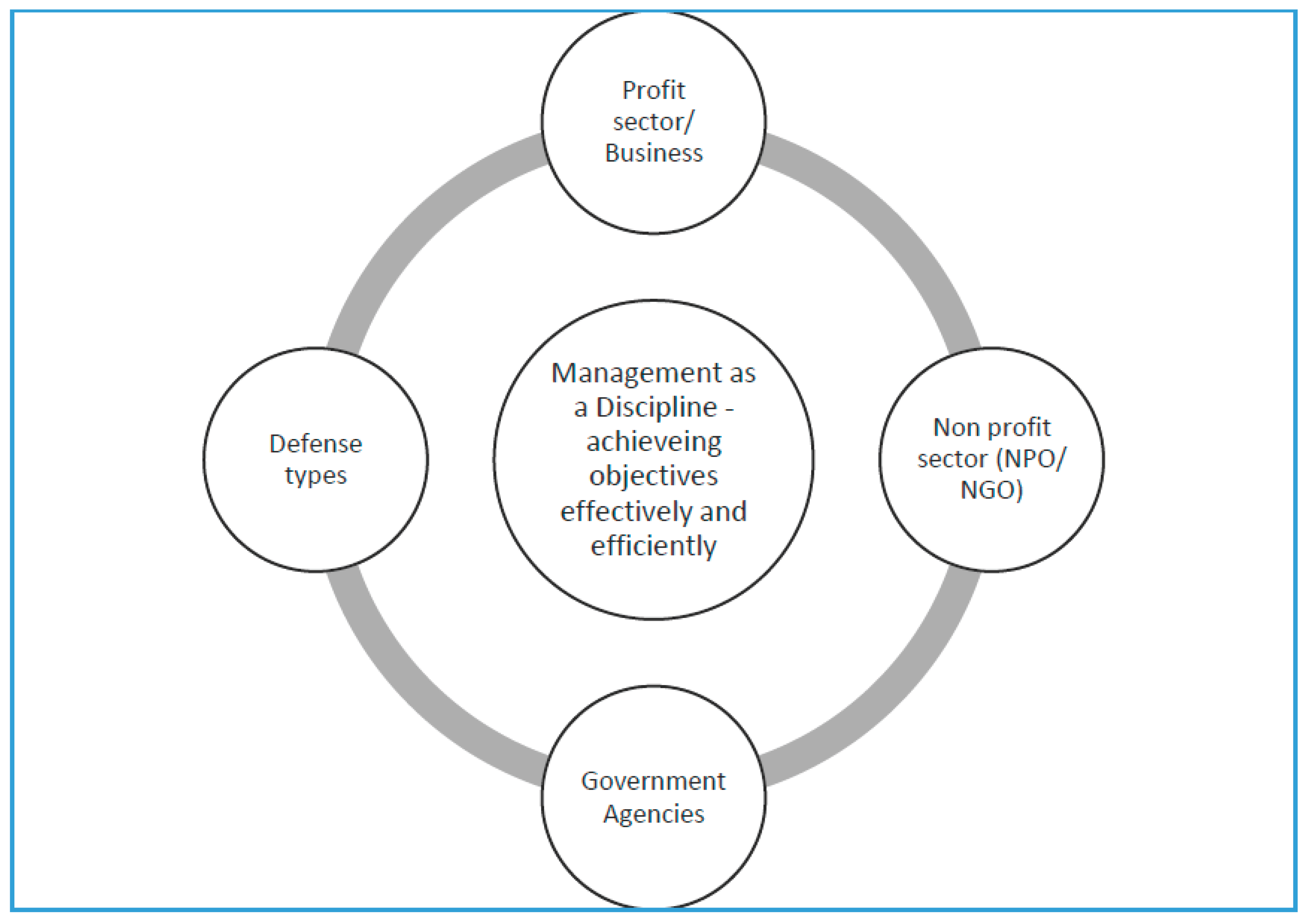
As far as MAD is concerned, the textbooks are quite similar in their presentation of these basic constructs of management which evolved over the last hundred years (Griffin, 2011; Hill & McShane, 2008; Jones & George, 2003; Robbins, Coulter, & Vohra, 2010; Weihrich, Cannice, & Koontz, 2008; Certo & Certo, 2013). It is almost universally accepted regardless of the type of organizations that ‘management’ is about achieving objectives of an organization, given the conditions, restrictions, or limitations of resources. The common idea is organizational objectives need to be achieved within the given resources available, with effectiveness and efficiency, both. That means, it may sound different things to different types of organizations, but it essentially means the same to all organizations – doing more with less or creating value for all stakeholders.
4. Studying Government from Management Perspective: A Paradigm Shift
Government machinery and its effectiveness was dominantly a public administration paradigm. Now here is a shift, management as a discipline (MAD), which is much needed. In government, MAD is bound to be even more important in the upcoming days. In many instances it is mentioned by all – politicians, government officials, and citizens - that it is not always ‘scarcity of resources’ in government, rather the ‘management’ or ‘lack of it’, is the cause of poor service delivery and citizen dissatisfaction.
Too many development initiatives have limited impact - schools are built but children do not learn, clinics are built but sickness persists. Governments adopt reforms but too little changes for their citizens. Many development initiatives promoting irrelevant interventions, fail to address this complexity (Andrews, Pritchett, Samji, & Woolcock, 2015). This creates the imperative that the countries need a shift from ‘Government that looks better’, to ‘Government that works better’, a state that is managed better, for effectiveness and efficiency.
When it comes to effectiveness and efficiency in government, the emergence of New Public Management (NPM), the idea of applying business like management in government, has been there for quite some time, pioneered by the UK and other Anglo-Saxon countries and international donor organizations.
While we compiled the citizen service delivery scenario from media and filed observation, we found that there is a long list of mismanagement scenario in government offices. The list of field notes could go for pages. Citizens see the reforms happening at the TOP (top of the pyramid) of TOG (top of the government), but they do not get it fully on the ground. Citizens want government performance – real service from public management or say government. The problem of ‘not reaching at the bottom’ is well known even by government while always looking for ways – how to make it work for citizens at the bottom, or how to reach citizens’ doorsteps.
Now sharply zooming into the paradigm of study of government from management perspective can illustrate a number of research options.
- -
- How to make government work better regardless of its political dimensions or party in power
- -
- Given the past and ongoing reforms of government of Bangladesh so far, which are mostly top down, how to develop an alternative, effective, and complementary bottom-up approach to improving management in government agencies for ensuring better citizen service
- -
- What is a theory of government in terms of management in government (MIG), what are the theoretical paradigms of MIG within and beyond the traditional approach of public administration
- -
- What is the nature of management (lack of it) and poor services in government at the agency level (department, directorate, etc.) and at the field level (district, sub-district, union etc.)?
- -
- What are the ongoing initiatives like A2I (digital Bangladesh), GIU, Shebakunjo (service portal), and others – how and whether those are working?
- -
- What are the ongoing programs for different donor programs and work area? What are the status of those?
- -
- What are the experiences and perspectives of bottom level or field officers, at upazila and zila level, about top of the government, how it works, and how it should work from the top? How the policy and structural bottlenecks discourage initiatives or simply, perpetuate mediocre bureaucratic behavior both at the citizen level and at the organizational level?
- -
- What are the root cause and reasons of management bottlenecks of policies, incentives, and implementation at the bottom and at citizen level, according to the field officers at upazila and zila level? What are the structural imperatives at organizational level to make government work better for citizens at the bottom or at service delivery level?
- -
- What can be a framework for thoughts and action, to make meaningful qualitative change at the bottom? What can be a road map for MIG improvement, for political actors and bureaucratic actors?
4.1. Operational Terms: Definitions and Clarifications
The proposed management paradigm of studying government relies on certain basic terms and phrases that may be clarified for the sake of specificity. They are: Government – Management – Bottom-up Approach - Better Citizen Services – top down approach – reforms, etc.
- -
- Management: A systematic process involving Planning, Organizing, Leading, and Controlling (POLC) to achieve organizational objectives efficiently and effectively within resource constraints. While the objectives differ across sectors—profit in business, welfare in non-profits, and public value in government—the underlying principle remains the same: creating maximum value with minimum resources.
- -
- Management in Government (MIG): Refers to the application of management principles in public sector institutions. It focuses on improving service delivery, optimizing internal processes, and enhancing decision-making, leadership, coordination, and resource utilization in government agencies. MIG is distinct from traditional public administration in its emphasis on results, citizen orientation, and operational efficiency.
- -
- Government Agencies: The units and offices of government that serves the citizen or interacts with the citizens or are relatively more directly responsible for citizen service delivery and citizen satisfaction. There are different names that co-exists in the government machinery when it comes to different implementing or executing agencies of government functions under different ministries, including PMO. For example, Division – Department – Directorates - Subordinate office – Authority - Board – Corporation – Commission – Bureau – Academy – Center, etc.
- -
- Better Citizen Services: Citizens wants services from government without hassle, harassment. A2I program (Digital Bangladesh) of PMO terms it as less TCV (time, cost, visits) in getting service from government offices. Public mangers should not deny service showing them excuses of rules and regulations. They should facilitate citizens getting the right service in right way without making them move here to there. It needs commitment and know-how from the managers. Getting service is not a privilege, rather a right of the citizens. Providing ‘good service’ is not an option, rather a prerogatives for the managers. This simple idea is better citizen service in this research.
- -
-
Bottom-up Approach: It means two things in this thesis, complementary to each other:
- 1)
- that public managers at the bottom- local offices, can be proactive actors of change and improvement by applying various management concepts, which might be rather appreciated and replicated by the top of the government.
- 2)
- that the TOG (top of government) may develop a mechanism to get the instant and continuous flow of ideas from the bottom of government (BOG), who know their clients, here citizens, from their day to day experience.
Contrary to top-down approach or trickle-down reforms and innovation, bottom up approach give importance to ground level ‘stories’ – experiences of managers at the ground, facing the citizens. If we can consolidate the ‘stories’ and evidences (complex and holistic amalgamation of data in terms of citizens’ and managers’ interactional experience) from different citizen serving units of government, that can help change, improve, reinforce, and redesign of the typical top down policy reforms. - -
- Reforms: Reforms are, simply speaking, effort to redesigning the government structure and processes. Time to time, government take initiative to make government work or at least look good to the citizens. Different reforms commission is formed by government. Donor agencies and international organizations also bring forth their own studies for reform. All these reform efforts end up with piles of recommendations which are good on papers. But many of these reforms do not see the light of full-scale implementation either due to inability of government, inertia of status-quo civil service, or political unwillingness. But still new reforms commissions are needed, and they are commissioned usually with each subsequent change of power in government.
- -
-
Top-down and Trickle-down Approach: The reality of a less developed country like Bangladesh is most of its reforms efforts prescribed, or heavily influenced by developed country public administration or governmental reforms in terms of paradigms, assumptions, preoccupations, and contextual predispositions.Reforms and recommendations are made and celebrated the TOG (top of the government), - ministries and secretariats. Then those reforms start trickling down to divisions, districts, sub-districts, and union level. At each level the thrust of reforms may lose the originality. We, for this research, do not suppose, top-down reforms and associated innovation are all round ineffective. Rather our position is emphasis should be balanced, if not dramatically shifted, in favor of the bottom-up approach, ground view, or worm’s eye view. What does that mean- that will be detailed in the following chapters first through desk research and review of literature, and then through extensive field observation.
- -
- Idea of Management in Government (MIG): The core idea of management as a systematic process of organizational objective achievement, effectively and efficiently, first evolved in private sector as a fully developed construct. Eventually many scholars and practitioners believed that ‘management’ ideas, tools and techniques, can be and should be used in ‘management’ of other types of organizations, including in government. In management in government (MIG), this idea that private sector management can be applied in government, has been termed as New Public Management (NPM). After 1980s, scholars has used this term for the sake of identification of this paradigm, and since then the term has gone through long way of discussion and debates, paving the way for network organizations theory and much touted governance discourse along with other models like New Public administration (NPA), Strategic Management and pubic value model (PVM), Strategic Management, Public Value Management (PVM), Digital and Electronic Government (DEG), Governance, New Governance, etc.
Now, in terms of a developing country like Bangladesh, where this ‘idea’ of MIG stands. Can the management be improved? What about the reforms made at the top? Did they work at bottom up to citizens? Is there scope for improvement? And what could be an alternative or complimentary approach to typical top-down approach? All these contextual questions set the boundaries of MIG-BD research paradigm.
4.2. Core Assumptions of the MIG-BD Paradigm
Any paradigm comes along with some basic premises or assumptions to start with. In MIG-BD research, this may include the following:
- MIG is currently weak: Management in government agencies is characterized by excessive rule-following, low responsiveness, and inefficiency. This is evident in public perceptions, media reports, and empirical observations.
- Private sector management is comparatively stronger: Though not without flaws, private sector organizations generally demonstrate clearer goal orientation, better accountability, and more flexible use of tools and resources.
- Political and institutional culture is resistant to change: Entrenched dynastic politics, weak intra-party democracy, and low civic awareness present long-term challenges to systemic reform.
- Educational progress has not translated into governance maturity: Although literacy has improved, quality of education and civic competence remain limited, constraining bottom-up accountability and collective rational choice.
- MIG can still be improved through internal reform: Despite unfavorable macro conditions, strategic application of management tools and leadership development can significantly enhance institutional performance and citizen satisfaction.
- Dual pathways to improvement are required: Both enabling policy environments (top-down) and empowered, capable local management (bottom-up) are essential for sustainable reform.
That the management in government, as a craft, can be improved, despite all these macro variables – political, economic, social, cultural as fixed over the short run, can be the starting premise of further studies in management in government.
The improvement in MIG may result from two streams:
- A.
- Government needs to create enabling environment through policy and regulatory reforms and
- B.
- Government also needs to develop capacity to apply, in a customized form, business management principles and practices at the institutional level, from top to bottom, down the hierarchy.
5. Conclusion: Improving Government Through Management Research
Building on the emerging discourse that distinguishes management in government (MIG) from the conventional study of government through the discipline of public administration, this paper proposes a contextualized paradigm for management in government in Bangladesh (MIG-BD).
In almost 50 years, Bangladesh has had a mixed policy performance when it comes to management in government (MIG) in terms of citizen service delivery. Regardless of governance and political chaos, the country has achieved impressive gains in social sectors in some cases (for example, health, education, access to credits, etc.). But governance and effectiveness of government remained consistently low. As Ahmed (2016) rightly pointed out in introduction chapter of his edited volume, the discourse of policymaking and policy research in Bangladesh has been about 'development' and 'planning', and public sector reform was governed by five-year plans, which was typical of the time and post-colonial nation states. But now we need management-based discourse – how to get things done, how to make government work better.
That effort led to various reforms commissions in Public Administration. So far these reforms and their consequences, including slow or total non-implementation have been studied from public administration discipline, dominantly. But our proposed research paradigm will create and strengthen the discourse that heavily draws of business management discipline. This we would call Management in Government (MIG-BD) which is directly related to citizen service at ‘retail level’ or ‘customer interaction’ or ‘touch point’. Now in a management-based research paradigm should have a closer look at government agency level. Each and every agency must go through essential value addition test what it is creating, in terms of revenue, costs, or costs and benefits, whether they are operating efficiently, whether it can do more with less, and so on.
References
- Ahmed, N. (Ed.). (2016). Public policy and governance in Bangladesh: forty years of experience. Routledge. Routledge.
- Barnes, C., & Gill, D. (2000). Declining government performance? Why citizens don't trust government. New Zealand: State Services Commission.
- Behn, R. D. The big questions of public management. Public administration review 1995, 313–324. [Google Scholar] [CrossRef]
- Behn, R. D. The new public management paradigm and the search for democratic accountability. International Public Management Journal 1998, 1(2), 131–164. [Google Scholar] [CrossRef]
- Ferlie, E., Lynn, L. E., & Pollitt, C. (Eds.). (2005). The Oxford handbook of public management. Oxford University Press, USA.
- Fukuyama, F. (1995). Trust: The social virtues and the creation of prosperity. Free Press. Free Press.
- Goldman Sachs. (2005). The Next Eleven: A global growth market. Retrieved from https://www.goldmansachs.com.
- Grindle, M. S. (2011). Good enough governance revisited. Development Policy Review, 29(1).
- Huque, A.S. (2016). The ‘holy grail’ of governance. Routledge: London and New York.
- Kettl, D. F. (2002). The transformation of governance: Public administration for the 21st century (p. 119). Baltimore, MD: Johns Hopkins University.
- Khaled, M. C. (2013). Improving environment through policy and regulatory reforms and applying modern business management practices in government: Case of a developing country like Bangladesh. (Unpublished M. Phil. Thesis), University of Chittagong.
- Khaled, M. What is missing in government: Development theories or management basics? Cases from Bangladesh . Chittagong University Journal of Business Administration 2015, 26. [Google Scholar]
- Khaled, M. Reforms and improvement initiatives in government of Bangladesh: Field observation and analysis (2010–2018) . American Economic & Social Review 2019, 13(1), 1–11. [Google Scholar]
- Khaled, M. The idea of management in government: Evolution of the concepts and implications for reform . CIU Journal 2021, 4(1). [Google Scholar]
- Khaled, M. Making government work: An analysis of the regimes and reforms in Bangladesh, 1971–2021 . CIU Journal 2025, 7(1). [Google Scholar]
- Khan, A. A. (2015). Gresham's law syndrome and beyond. Dhaka: University Press Limited.
- Khan, M. M. (2015). Administrative reforms in Bangladesh. Dhaka: University Press Limited.
- Kickert, W. J. M. (Ed.). (1997). Public management and administrative reform in Western Europe. Edward Elgar Pub.
- Kotler, P. & Lee, N. (2006). Marketing in the public sector: A roadmap for improved performance. Pearson Education.
- Langbein, L.; Knack, S. The worldwide governance indicators: Six, one, or none? The Journal of Development Studies 2010, 46(2), 350–370. [Google Scholar] [CrossRef]
- McKinsey & Company. (2012). Bangladesh: The next hot spot in apparel sourcing. Retrieved from https://www.mckinsey.com.
- Newman, J. (2001). Modernizing governance: New labour, policy and society. Sage.
- Nye, J. S., Zelikow, P., & King, D. C. (Eds.). (1997). Why people don't trust government. Harvard University Press.
- Oman, C. P., & Arndt, C. (2010). Measuring governance. (No. 39). OECD Publishing.
- OECD (2011). Government at a glance. OECD publications.
- Olsen, J. P., & Peters, B. G. (Eds.). (1996). Lessons from experience: Experiential learning in administrative reforms in eight democracies. Scandinavian University Press.
- Pollitt, C., & Bouckaert, G. (2011). Public management reform: A comparative analysis-new public management, governance, and the Neo-Weberian state. Oxford: Oxford University Press.
- Ruscio, K. P. Trust, democracy, and public management: A theoretical argument. Journal of Public Administration Research and Theory 1996, 6(3), 461–477. [Google Scholar] [CrossRef]
- Woods, N. 2016. The trust issue: Introduction. Oxford government review number 1 / August 2016.
- Woods, N. 2017. Bridging the gap: Introduction. Oxford government review. Number 2 / October 2017.
- World Bank. (2002). Taming the leviathan: Reforming governance in Bangladesh. Washington, D.C.: The World Bank.
- World Bank. (2011). Governance matters. Washington, D.C.
- World Bank. (2017). Bangladesh Development Update: Breaking Barriers. Retrieved from https://www.worldbank.org.
- World Bank. (2022a). Bangladesh: Maternal and Reproductive Health at a Glance. Retrieved from https://openknowledge.worldbank.org.
- World Bank. (2022b). Bangladesh: World Bank Country-Level Engagement on Governance and Anticorruption. Retrieved from https://openknowledge.worldbank.org.
- World Bank. (2022c). Bangladesh: Curbing Corruption and Strengthening Governance: A Note on Strengthening Anticorruption Initiatives. Retrieved from https://openknowledge.worldbank.org.
- Zussman, D. Do citizens trust their governments? Canadian Public Administration 1997, 40(2), 234–254. [Google Scholar] [CrossRef]
| 1 | Worldwide Governance Indicators (www.govindicators.org) |
Disclaimer/Publisher’s Note: The statements, opinions and data contained in all publications are solely those of the individual author(s) and contributor(s) and not of MDPI and/or the editor(s). MDPI and/or the editor(s) disclaim responsibility for any injury to people or property resulting from any ideas, methods, instructions or products referred to in the content. |
© 2025 by the authors. Licensee MDPI, Basel, Switzerland. This article is an open access article distributed under the terms and conditions of the Creative Commons Attribution (CC BY) license (http://creativecommons.org/licenses/by/4.0/).
Copyright: This open access article is published under a Creative Commons CC BY 4.0 license, which permit the free download, distribution, and reuse, provided that the author and preprint are cited in any reuse.


