

Submitted:
29 August 2025
Posted:
01 September 2025
You are already at the latest version
Abstract
Sufficient capacity of railway lines is a key prerequisite for stable and sustainable transport, not only on main or high-speed lines but also on lines of regional importance that complement the network. Their indispensable role is manifested not only daily but especially in the event of incidents on the backbone network. One of the main characteristics of these support lines is that they are largely single-track. Another important characteristic is that they alternate between sections with different traffic loads, which significantly changes the capacity requirements along the whole line. In this paper, the authors focus on developing a new, widely applicable method that identifies, based on objective criteria, the sections for which it is appropriate to proceed with a partial infrastructure measure. It also defines a mathematical apparatus that can be used to determine the new infrastructure parameters required. Each measure must be dimensioned to meet future requirements for rail traffic volume. The article thus provides a new perspective on the dimensioning of appropriate measures for increasing the capacity of the railway in general.
Keywords:
capacity
; railway infrastructure
; railway line
; journey time
; throughput
; modernisation
1. Introduction
A major issue today is the change of the modal split. Namely, due to the environmental impact, our society would like to shift more cargo from roads to rails. However, this effort is often in stark contrast to the available (free) capacity. This will require, among other things, modernisation of the rail infrastructure, particularly electrification and increasing capacity, not only on the main corridors but also on other railway lines, which can act as diversionary routes by increasing their parameters. [1 - 4]. In cooperation with the PSOs (Public Service Obligations) and other RUs (Railway Undertakings), each infrastructure manager addresses this issue individually. Thus, there is no general approach to solving this question using an appropriate mathematical apparatus. This paper aims to provide such a systematic approach.
Although rail transport has a lower environmental impact than, for example, road transport, some aspects can still be improved. For example, the environmental cost of turnouts can be reduced by using under-sleeper pads [5]. A predictive maintenance system that uses big data and materials reuse can also help reduce negative environmental impacts [6,7]. Recycling old asphalt material from roads is also suitable for use as sub-ballast [8]. Train journeys also consume a lot of energy, but with electric traction, trains can reduce their energy consumption through regenerative braking [9]. All these aspects increase the sustainability of the whole system and mean that rail is even more environmentally friendly than other modes of transport.
Although high-speed lines are regarded as a means of releasing capacity on conventional freight corridors, there may be insufficient released capacity once operational due to the development of regional passenger services during the daytime. One potential solution to this issue the implementation of traffic optimisation strategies, which aim to maximise the utilisation of train capacity by passengers [10]. However, this may prove insufficient, considering the projected growth in rail traffic. It is therefore important to consider not only the construction of high-speed lines and the upgrading of existing corridors but also the development of other lines that are tangential (and mostly single-track) and have the potential to relieve the main corridors, major railway nodes and to serve as diversionary alternatives in the event of closures, emergencies, or even maintenance works on the main lines [11,12]. In such cases, re-routing can help reduce delays and improve passenger satisfaction.
At the same time, these lines can complement the high-speed network and thus increase its reach. Freight traffic will also benefit from the increased capacity of these lines, not only because of the possibility of diverting traffic and avoiding the main nodes but also through the possibility of running more freight trains with higher parameters (train length 740 metres, higher line load class). A modern infrastructure can help to ensure that rail becomes more integrated into Industry 4.0 [7]. With regard to the transport of goods, tangential rail lines can also be used to optimise the logistics chains [13].
This article aims to present a new methodology that will facilitate the selection of sections of routes that require modification to achieve the desired level of capacity utilisation. Route modifications and railway infrastructure expansions are primarily implemented when the existing capacity is inadequate to meet the demands of the transportation system. [14,15]. Usually, the initial step towards route modernisation is undertaking a feasibility study. This study addresses the development of traffic, the economic potential of the line and the possibilities for infrastructure development. However, the return on investment is difficult to compare as there is no consistency in determining future traffic or timetables [16].
The first step is to analyse the existing line and its current operational status, including the timetable. This analysis is then used for the division of the line into segments with a consistent number of trains, ensuring logical continuity or prioritisation. This assessment, coupled with capacity calculations, enables the identification of critical points (segments). When lines are modernised, certain infrastructure measures must be implemented to increase the capacity. These include increasing line speed or speed at switch point areas by upgrading switches to allow higher speeds in the direction of divergence. It is recommended that these speed-related measures be implemented in any line upgrade.
In addition to the measures affecting speed, one way to increase the railway's capacity is to implement infrastructure measures. These may include, for example, the double-tracking of the line, the construction of a new passing bay, the modernisation or installation of line signalling equipment (or the increase of the number of block sections on the line). This methodology addresses which sections are to be selected for implementing these measures.
2. State of Art
Many methods can be employed to ascertain the capacity of a railway line. Capacity can be determined on line sections or in a station, where the problem is more sophisticated due to collisions of train paths in switch point areas, which are determined by the complexity of the given station [17,18]. Static models can be used to calculate station capacity. One of these is the "Kaban" tool used in Sweden [19].
The fundamental approach is the utilisation of analytical calculations, which are founded upon the compression method. Generally, the higher the capacity utilisation, the more susceptible the line is to transmission delays between trains and poorer timetable performance [20,21].
An alternative approach is using simulation software, specifically OpenTrack, which can incorporate stochastic phenomena [22]. With the help of simulation, infrastructure planning can be as efficient as possible within the framework of possible investments [23].
Another option is to use graph theory, linear programming and polyhedral geometry [24]. However, an additional approach is using probability, for example, based on Markov chains and queueing theory [25,26]. Further option for rail capacity management is using multi-objective capacity models, which are a more comprehensive approach to the problem [27].
Alternatively, graphical methods may be designed to interact with the timetable and utilise the ratio of the timetable area to the area occupied by the train on the infrastructure element under consideration [28].
Consequently, the graphical method does not necessitate compression like the analytical method [29,30,31]. The compression can be carried out on the entire line or individual sections. This is done in different ways depending on the method used [32]. To transform heterogeneous traffic, where the train sequence is important and decisive, into homogeneous traffic, it is possible to use an equalised train, which is artificially created and whose parameters are determined by weighted parameters of different types of trains [33].
Each of these methods has its own set of advantages and disadvantages. They differ in terms of the number of input parameters, the level of knowledge required regarding the traffic on the line, and the complexity of the results. However, the analytical method has the advantage of not necessitating a detailed knowledge of numerous specifics while still enabling the attainment of a result.
There are several ways to increase the capacity of the line. One is to change the organisation, both on the part of the infrastructure manager (more staff, timetabling, rerouting in cooperation with railway undertakings) and also on the part of the railway undertakings, especially if there are more RUs. Mutual coordination can reduce dwell times, especially for freight transport, and thus increase the whole system's efficiency [34 - 37].
The other way to reach higher capacity is to upgrade the infrastructure by increasing the speed and the number of compartments on the line or using ERTMS and its benefits (in particular, ETCS L2 and higher). The number of block sections (even moving ones at a higher implementation level) can be increased using this system [38 - 40].
3. Materials and Methods
The question thus arises as to how one might determine the specific sections of the line in which infrastructure measures should be carried out in a manner that is both context-specific and coherent.
The methodology for determining journey time limits provides a framework for selecting the sections where capacity enhancement measures must be implemented.
The following inputs are employed in the calculation [30]:
A – The analysis period defines the duration of the assessment phase, which is used to ascertain the number of trains and capacity. [h]
ND9 – The ninth decile of the number of trains in the critical section represents the value of the ninth decile of the daily number of trains, ranked from highest to lowest. [-]
- d – The item corresponding to the ninth decile is ordered as follows. [-]
- a – The length of the observation period is defined as the number of days over which the observation is conducted. [-]
NVÝHL – The prospective number of trains for the period (the expected number of trains for the period). [-]
b – Unit occupation time. [min]
bn – The most unfavourable journey time is the highest journey time observed in the critical section of the sub-track. If the highest journey time differs significantly from the others, the next journey time in order from the highest is used as the reference point. [min]
n – Infrastructural capacity is defined as the number of feasible journeys that can be accommodated on a given infrastructure within a specified time period. The relation between capacity and unit occupancy time over the course of a one-hour monitoring period is pictured in Figure 1. [-]
k – Step of unit occupation time by which the unit occupation time is gradually reduced. The value of this variable can be arbitrarily small (which makes it possible to obtain a value of utilisation closer to the desired utilisation), but in the reality of railways and timetabling, values of 0.5 or 1 minute are appropriate. [min]
Kp – Target capacity utilisation – targeted utilisation for a given line segment. [-]
4. Calculation
When examining the relationship between unit occupancy time and capacity, it was found that the percentage change in unit occupancy time between a value of b and a value of b one step k higher is the same as the percentage change in capacity for values of b one step k higher and b two steps k higher:
Which, according to the formulas and adjustments, is as follows:
The result that k is equal to k proves that the two procedures reach the same values and are applicable.
Subsequently, the calculated values are as follows:
• K – Capacity utilisation - the ratio of the number of journeys to the total capacity over a specified time period. [-]
• KVÝHL – Capacity utilisation of current infrastructure with the prospective number of trains - the utilisation of the capacity for the expected number of trains on the existing infrastructure. This formula is based on inserting the formula for capacity n into the formula for capacity utilisation K, where the reference number of trains is the prospective number of trains Nvýhl. [-]
• Kb – Capacity utilisation for given occupation time, with the prospective number of trains – is used to calculate the capacity utilisation for different values of b, which are successive with a distance between them determined by the value of k. [-]
blim – limiting journey time – a value of a journey time b in minutes, beyond which it is necessary to implement infrastructure measures. The value of this variable is defined by the relation of , which must be respected to ensure that the infrastructure meets future demands placed on it and has sufficient capacity headroom to allow for traffic development. [min]
The element indicates the number of steps required to change from bn to b.
The process of identifying infrastructure modifications must be divided into three steps:
- division of the line into segments,
- determination of the limiting journey time for each segment,
- identification of an infrastructure measure to increase capacity.
- The individual steps are introduced in the following text.
4.1. Division of the Line into Segments
The first step of establishing an infrastructure measure is to divide the line into smaller segments, which contain several line sections connected to each other with similar traffic volume.
The route is divided into segments using a moving average. Initially, a new segment must be created, and then the 9th decile moving average values must be compared in each section with the previous one in the segment. In addition, the routing of passenger lines should also be considered in the comparison. According to this criterion, the line is divided into several segments. The procedure is illustrated in Figure 2.
4.2. Determination of the Limiting Journey Time for a Segment
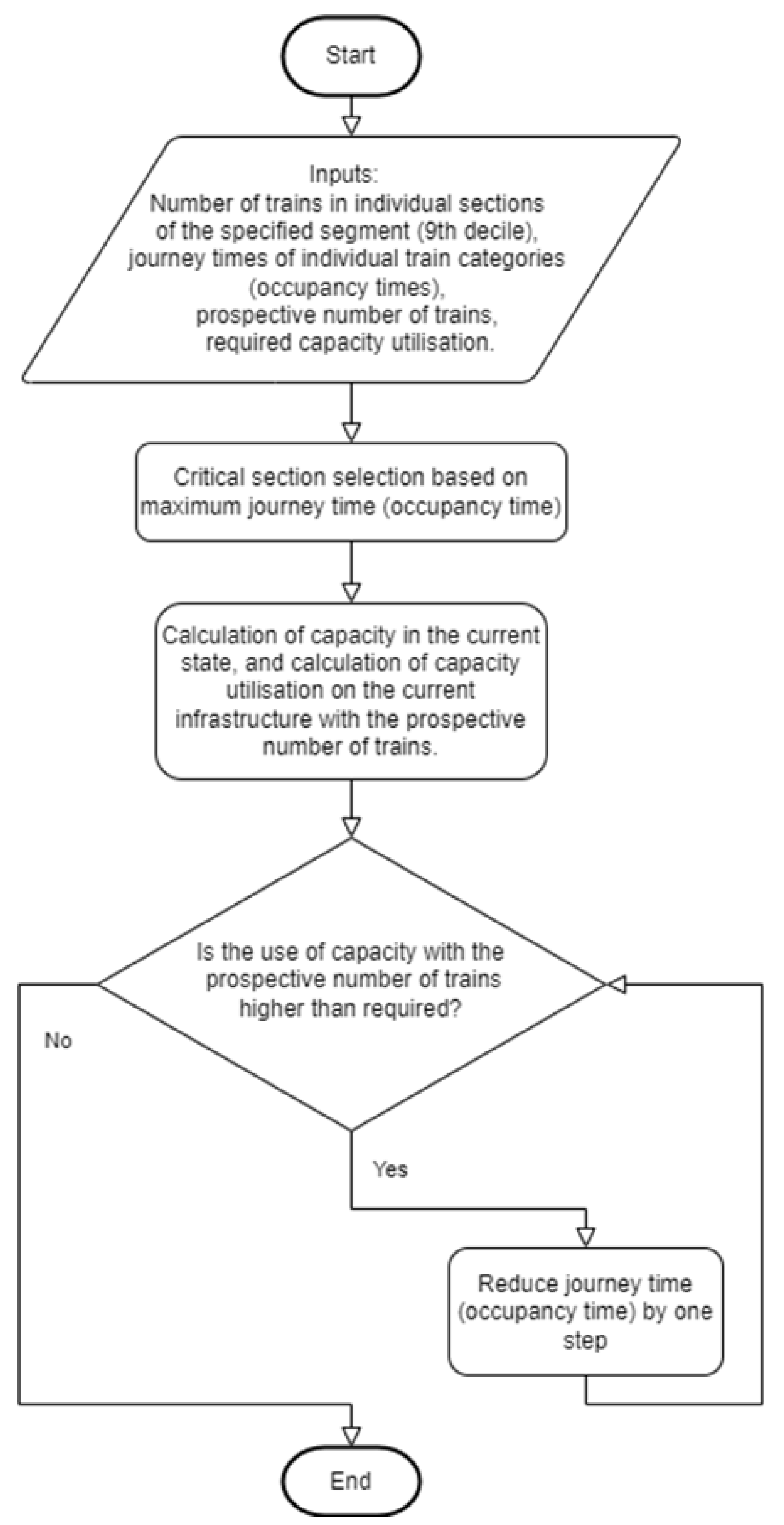
The second step is to ascertain the limiting journey time of the given segment. The initial step is to select the segment with the highest travel time (occupancy time). If this value differs significantly from the others, the next highest in the sequence is selected.
Subsequently, this occupancy time is reduced stepwise until the desired capacity utilisation with the prospective number of trains is reached. This reduction is achieved by a gradual decrease of one step at a time.
Figure 3.
Diagram of determination of the limiting journey time for a segment.
4.3. Identification of an Infrastructure Measure to Increase Capacity
The final step is determining the appropriate course of action for each section.
Subsequently, the calculated limiting journey time can be compared with the current train journey times (or their average or weighted average, which may consider the diversity of traffic). If these current journey times exceed the limiting journey time, an infrastructure measure must be proposed.
For the sake of simplicity, the infrastructure measures will be divided into three categories:
• division of the track section into discrete block sections,
• division of the line with a track branching (station, passing loop),
• increasing the number of tracks (double tracking).
To ascertain the precise infrastructure measure, it is essential to consider, in addition to the magnitude of the deviation from the prescribed journey time, the potential operational concept under evaluation and the resulting tact nodes and transport facilities for tact crossing. Furthermore, the infrastructure arrangements must be modified to align with these constraints.
Figure 4.
Diagram of identification of an infrastructure measure to increase capacity.
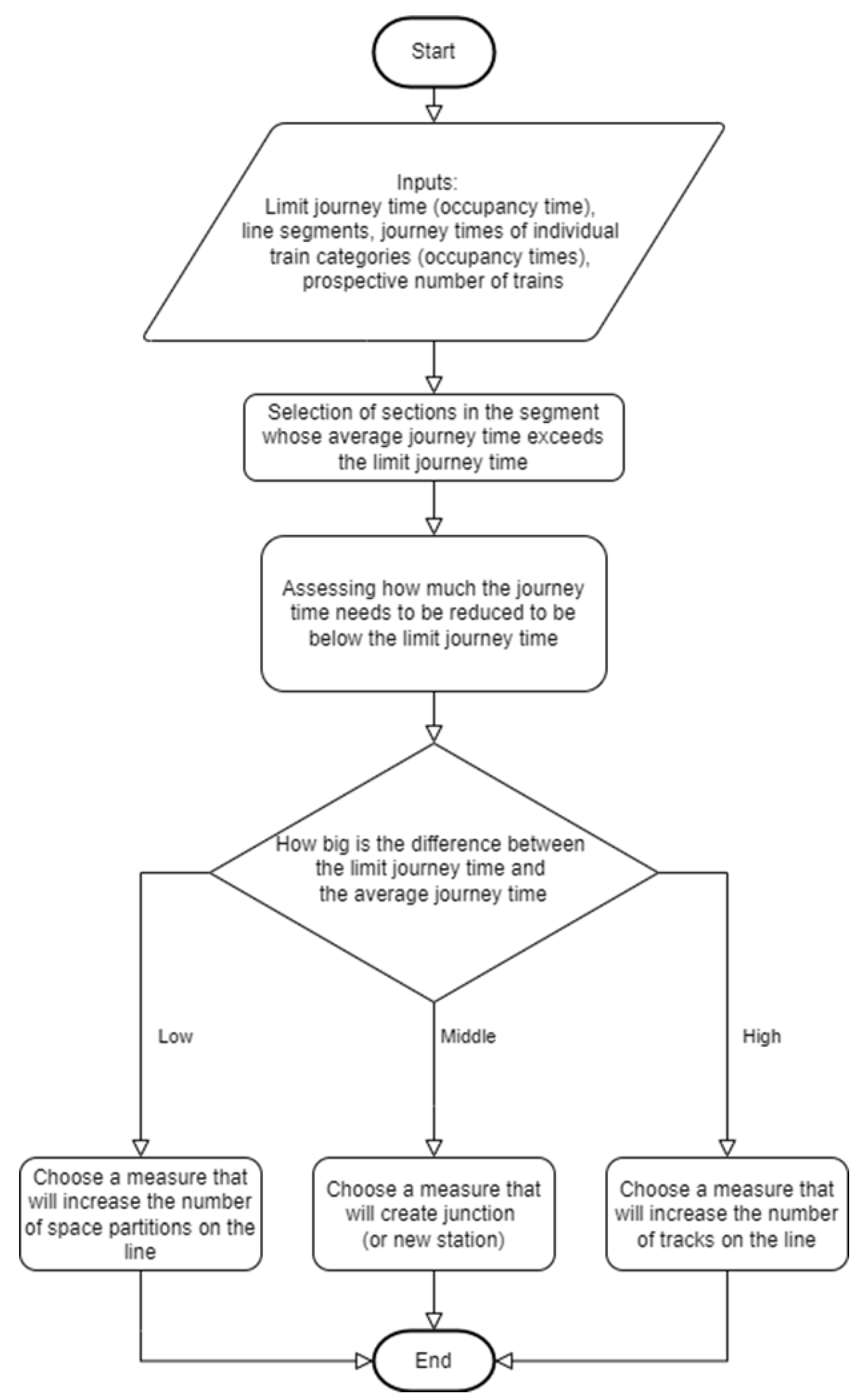
In instances where the permitted journey time is exceeded significantly, it is recommended that double-track or multiple-track alignment, or the line splitting by traffic with track branching, be considered. In such cases, it is essential to consider the spatial conditions to ensure the feasibility of constructing a station or a second track, while also aligning with the investment capabilities of the infrastructure manager.
In the event of a lower exceedance of the limiting value or the inability to implement alternative infrastructure measures, it is recommended that the line section be divided into additional block compartments. This approach will be particularly beneficial when coupling trains of the same direction.
5. Results
This procedure has been applied to the Havlíčkův Brod - Jihlava - Znojmo line, potentially relieving the Brno node. However, it is necessary to modernise and electrify the line to increase its capacity, which will enable the transfer of part of the freight traffic not only from the Havlíčkův Brod - Brno - Břeclav branch but also from other modes of transport to this line. Modernizing the infrastructure can significantly increase operational safety and significantly save traffic management staff.
Critical points were identified through an analysis of traffic and infrastructure. At these locations, measures were proposed to improve the existing condition, rendering the line suitable for future needs.
The average number of trains in each section was determined based on the ninth decile of train counts from 2019 to 2023 (each year between 1 January and 31 March). This is shown in Table 1 and Figure 5, where the graph is interlaced with the moving average.
Table 2 presents the journey times of trains between stations in both directions. The data has been classified into three categories: passenger trains (Os), fast trains (R) and regular freight trains (Pn; journey times of Pn 62331/62330, running with the 742 series).
Cells highlighted in green indicate the most unfavourable journey time. In the case of the Olbramkostel - Znojmo section, the second highest value was chosen because the highest value (marked in red) was too different from the others.
Based on the algorithm described, Table 3 shows the inputs used to calculate the limiting journey time output values.
From these values, the mean and limiting journey times were calculated, resulting in 5 minutes in the Havlíčkův Brod - Jihlava section, 8 minutes in the Jihlava - Okříšky section and 9 minutes in the Okříšky - Znojmo section.
The specified journey time limit was exceeded in the following sections: Havlíčkův Brod - Stařeč, Moravské Budějovice - Grešlové Mýto and Olbramkostel - Znojmo.
From an analysis of the 9th decile values, it is evident that the most significant adjustments must be made in the Havlíčkův Brod - Jihlava section, due to the flexibility of the Havlíčkův Brod and Jihlava interchanges. Therefore, it is proposed that this section should be fully double-tracked.
It is similarly important to consider the Jihlava-Okříšky section. In light of the proposed operational concept and the anticipated increase in freight transport, it is suggested that two passing bays (Kosov and Rokštejn) be established, along with a double-track extension of the Okříšky station. This latter point is also regarded as a tact node for crossing and connecting links.
In the remaining section, Okříšky - Znojmo, the number of trains is not as high, and the modifications to the line may not be as significant as in the previous sections. It is therefore proposed that the line be divided into two spatial sections in these sections (Okříšky - Stařeč and Moravské Budějovice - Grešlové Mýto). In the section Olbramkostel - Znojmo, given the lengthy journey times, the Mašovice passing bay is proposed to be constructed. Figure 6 presents a current and proposed line diagram illustrating the type of station interlocking and track-side signalling equipment.
The local line Moravské Budějovice - Jemnice is currently operated under simplified control according to the SŽ D3 regulation, where safety is ensured by telephone communication between the driver and the dispatcher. As passenger traffic on the line is only operated on weekends and seasonally, and freight traffic is organised regularly (but with only one pair of trains), it is proposed that this type of control be maintained. In the long term, however, it would be advisable to modernise and secure this line as well, preferably by introducing remote control and transferring the operation to SŽ D1 regulation, as well as on the rest of the line. This will also increase safety and capacity on this branch line [41].
The journey time limit has facilitated the identification of sections of the line where it is appropriate to implement infrastructure measures to enhance capacity. In the case of the Havlíčkův Brod–Znojmo line, the implemented modifications resulted in a notable increase in capacity, from the initial 14 journeys in the peak period to 22 journeys.
The aforementioned increase in capacity, in conjunction with other related infrastructure modifications (including alterations to station configurations, the extension of station tracks, an increase in line speed and electrification), have rendered this line a fully-fledged diversionary alternative to the Brno node.
Modernizing signalling equipment has also permitted the implementation of remote traffic control across the entire section, reducing CZK 17.488 million per annum in personnel costs. This equates to CZK 140,000 per kilometre of line [42].
4. Discussion
This methodology provides valuable insights into optimising railway network performance, focusing on the limitation of journey time and its utilisation and the factors that influence them. The methodology outlined within this study emphasises the significance of accurately determining limiting journey times as a critical component in evaluating railway operations.
The analysis emphasises that infrastructure enhancements, including track upgrades, improved signalling, and station layouts, can lead to substantial improvements in performance. Furthermore, incorporating advanced technologies, such as ERTMS and automated train operation systems, will likely offer significant gains in operational efficiency and reliability.
The applicability of this method is contingent upon the condition that the line under consideration is not divided into multiple block sections. If the line is segmented into several sections, the method is deemed incompatible due to the complexity inherent in integrating train bundling. Nevertheless, under circumstances where trains on such a line do not frequently undergo bundling and, for instance, trains intersect at each station, particularly during periods of peak traffic, the implementation of this method becomes feasible (a scenario that is analogous to the Havlíčkův Brod - Jihlava segment). The method's merits lie in its simplicity and potential for universal application on single-track lines. In the future, examining the problem of existing tangent lines and attempting to upgrade them to release capacity around agglomerations would be advisable.
Finally, while the present study focuses chiefly on the technical aspects of railway system optimisation, it underscores the significance of collaboration among various stakeholders, including railway operators, infrastructure managers and regulatory bodies. Effective coordination across these groups is imperative for implementing pragmatic solutions aligned with long-term transportation objectives.
In conclusion, the study provides a solid foundation for improving railway network efficiency, focusing on the determination of limiting journey times and identifying key areas for enhancement. While further research is needed to refine these strategies, the study provides valuable insights that can guide the future optimization of railway systems, balancing technical improvements with broader operational and policy objectives.
5. Conclusions
This article proposes a robust analytical framework for evaluating and enhancing railway line performance, with a particular emphasis on assessing journey times and identifying opportunities for efficiency improvements. Utilising a data-driven approach, the methodology facilitates a comprehensive understanding of the factors influencing overall operational performance. It underscores the significance of precise data collection and the employment of analytical techniques to identify areas necessitating attention, thereby contributing to the optimisation of service delivery. The methodology is comprised of three constituent elements:
- Segmentation of the Railway Line - the initial step in this process is the division of the railway line into segments, with the basis of this division being the similarity of traffic volumes. This segmentation uses a moving average, with each segment comprising several connected line sections. This division is of crucial importance to identify areas in which infrastructure improvements are most required.
- Determination of Limiting Journey Times - the subsequent stage of the process is to calculate the limiting journey times for each segment. The segment with the longest journey time (occupancy time) is identified first. The second-longest value is chosen if there are significant differences in journey times. This limiting time is progressively reduced to achieve the desired capacity utilisation for the expected number of trains. Based on this, the maximum acceptable travel times are determined for each segment.
- The identification of infrastructure improvements - the methodology has been developed to facilitate the identification of critical sections of the railway line where infrastructure improvements are necessary. These improvements may include dividing the track into discrete block sections, adding track branches such as stations or passing loops, or increasing the number of tracks. These measures are proposed for sections where journey times exceed the limiting value, ensuring that the railway system can meet future demands effectively and efficiently.
The approach is of significant value to railway operators and planners, providing insights that can inform strategic decisions to enhance the railway network's capacity, reliability, and sustainability. It underscores the necessity for continual assessment and adaptation to ensure that the system can meet growing demands and maintain efficiency in the long term. In essence, this methodology promotes a more effective use of resources, ensures better management of railway operations, and contributes to developing a well-functioning transportation network that benefits operators and passengers alike.
Supplementary Materials
The following supporting information can be downloaded at: https://www.mdpi.com/article/doi/s1, Figure S1: title; Table S1: title; Video S1: title.
Author Contributions
For research articles with several authors, a short paragraph specifying their individual contributions must be provided. The following statements should be used “Conceptualization, J.G. and M.D.; methodology, M.VYH.; software, M.VYH.; validation, M.VOJ., P.N. and M.D.; formal analysis, M.D.; investigation, M.VOJ.; resources, M.VYH.; data curation, M.VYH.; writing—original draft preparation, M.VYH.; writing—review and editing, M.VOJ.; visualization, J.G.; supervision, P.N.; project administration, M.D.; funding acquisition, J.G. All authors have read and agreed to the published version of the manuscript.” Please turn to the CRediT taxonomy for the term explanation. Authorship must be limited to those who have contributed substantially to the work reported.
Funding
The work was supported as part of the sustainability of the project "Cooperation in Applied Research between the University of Pardubice and companies in the Field of Positioning, Detection, and Simulation Technology for Transport Systems (PosiTrans)" (No. CZ.02.1.01/0.0/0.0/17 049/0008394) supported by ERDF.
Institutional Review Board Statement
In this section, please add the Institutional Review Board Statement and approval number for studies involving humans or animals. You might choose to exclude this statement if the study did not require ethical approval. Please note that the Editorial Office might ask you for further information. Please add “The study was conducted in accordance with the Declaration of Helsinki, and approved by the Institutional Review Board (or Ethics Committee) of NAME OF INSTITUTE (protocol code XXX and date of approval).” for studies involving humans. OR “The animal study protocol was approved by the Institutional Review Board (or Ethics Committee) of NAME OF INSTITUTE (protocol code XXX and date of approval).” for studies involving animals. OR “Ethical review and approval were waived for this study due to REASON (please provide a detailed justification).” OR “Not applicable” for studies not involving humans or animals.
Informed Consent Statement
Any research article describing a study involving humans should contain this statement. Please add “Informed consent was obtained from all subjects involved in the study.” OR “Patient consent was waived due to REASON (please provide a detailed justification).” OR “Not applicable.” for studies not involving humans. You might also choose to exclude this statement if the study did not involve humans.
Written informed consent for publication must be obtained from participating patients who can be identified (including by the patients themselves). Please state “Written informed consent has been obtained from the patient(s) to publish this paper” if applicable.
Data Availability Statement
We encourage all authors of articles published in MDPI journals to share their research data. In this section, please provide details regarding where data supporting reported results can be found, including links to publicly archived datasets analyzed or generated during the study. Where no new data were created, or where data is unavailable due to privacy or ethical restrictions, a statement is still required. Suggested Data Availability Statements are available in section “MDPI Research Data Policies” at https://www.mdpi.com/ethics.
Acknowledgments
In this section, you can acknowledge any support given which is not covered by the author contribution or funding sections. This may include administrative and technical support, or donations in kind (e.g., materials used for experiments). Where GenAI has been used for purposes such as generating text, data, or graphics, or for study design, data collection, analysis, or interpretation of data, please add “During the preparation of this manuscript/study, the author(s) used [tool name, version information] for the purposes of [description of use]. The authors have reviewed and edited the output and take full responsibility for the content of this publication.”
Conflicts of Interest
Declare conflicts of interest or state “The authors declare no conflicts of interest.” Authors must identify and declare any personal circumstances or interest that may be perceived as inappropriately influencing the representation or interpretation of reported research results. Any role of the funders in the design of the study; in the collection, analyses or interpretation of data; in the writing of the manuscript; or in the decision to publish the results must be declared in this section. If there is no role, please state “The funders had no role in the design of the study; in the collection, analyses, or interpretation of data; in the writing of the manuscript; or in the decision to publish the results”.
References
- Ljubaj, I., Mikulčić, M., & Mlinarić, T. J. Possibility of Increasing the Railway Capacity of the R106 Regional Line by Using a Simulation Tool. Transportation Research Procedia, 44, 137-144. 2020. Avialable at:. [CrossRef]
- Abril, M., Barber, F., Ingolotti, L., Salido, M. A., Tormos, P., & Lova, A. An assessment of railway capacity. Transportation Research Part E: Logistics and Transportation Review, 44(5), 774-806. 2008. [CrossRef]
- Khadem Sameni, M., & Moradi, A. Railway capacity: A review of analysis methods. Journal of Rail Transport Planning & Management, 24, 100357. 2022a. Available at:. [CrossRef]
- Francesco, R., Gabriele, M., & Stefano, R. Complex railway systems: capacity and utilisation of interconnected networks. European Transport Research Review, 8(4), 29. 2016. Available at:. [CrossRef]
- Landgraf, M., Zeiner, M., Knabl, D., & Corman, F. Environmental impacts and associated costs of railway turnouts based on Austrian data. Transportation Research Part D: Transport and Environment, 103, 103168. 2022. Available at:. [CrossRef]
- Giunta, M. Trends and Challenges in Railway Sustainability: The State of the Art regarding Measures, Strategies, and Assessment Tools: The State of the Art regarding Measures, Strategies, and Assessment Tools. Sustainability, 15(24). 2023. Available at:. [CrossRef]
- Kljaić, Z., Pavković, D., Cipek, M., Trstenjak, M., Mlinarić, T. J., & Nikšić, M. An Overview of Current Challenges and Emerging Technologies to Facilitate Increased Energy Efficiency, Safety, and Sustainability of Railway Transport. Future Internet, 15(11). 2023. Available at:. [CrossRef]
- Guerrero-Bustamante, O., Guillen, A., Moreno-Navarro, F., Rubio-Gámez, M. C., & Sol-Sánchez, M. Toward sustainable railway track foundation: Recycling RAP from road asphalt pavements: Recycling RAP from road asphalt pavements. Construction and Building Materials, 439, 137436. 2024. Available at:. [CrossRef]
- Zhou, F., Tang, Z., Tan, D., & Xie, Y. Capacity configuration optimization of regenerative braking energy utilization system for electrified railways based on power sharing and energy storage. Electric Power Systems Research, 239, 111275. 2025. Available at:. [CrossRef]
- Ortega Riejos, F. A., Barrena, E., Canca Ortiz, J. D., & Laporte, G. Analyzing the theoretical capacity of railway networks with a radial-backbone topology. Transportation Research Part A: Policy and Practice, 84, 83-92. 2016a. Available at:. [CrossRef]
- Marcel, B., & T., A. B. Assessing the Effects of Closure-Free Periods on Railway Intervention Costs and Service. Journal of Infrastructure Systems, 28(3), 04022015. 2022. Available at:. [CrossRef]
- de Weert, Y. R., Gkiotsalitis, K., & van Berkum, E. C. Improving the scheduling of railway maintenance projects by minimizing passenger delays subject to event requests of railway operators. Computers & Operations Research, 165, 106580. 2024. Available at:. [CrossRef]
- Gan, M., Li, D., Yao, Z., Yu, H., & Ou, Q. Intelligent decision modeling for optimizing railway cold chain service networks under uncertainty. Information Sciences, 679, 121112. 2024. Available at:. [CrossRef]
- Burdett, R. L. Optimisation models for expanding a railway's theoretical capacity. European Journal of Operational Research, 251(3), 783-797. 2016. Available at:. [CrossRef]
- Rais, N. M., Jaafar, H. S., Samsudin, M. R. H., Rahman, H. A., Towel, R. M., & Burhanuddin, S. N. Z. A. Measuring railway track capacity and utilization for KERETAPI tanah melayu berhad (ktmb). Advances in Transportation and Logistics Research, 3, 908-916. 2020.
- Eliasson, J., & Börjesson, M. On timetable assumptions in railway investment appraisal. Transport Policy, 36, 118-126. 2014. Available at:. [CrossRef]
- Jovanović, P., Pavlović, N., Belošević, I., & Milinković, S. Graph coloring-based approach for railway station design analysis and capacity determination. European Journal of Operational Research, 287(1), 348-360. 2020. Available at:. [CrossRef]
- Mussone, L., & Wolfler Calvo, R. An analytical approach to calculate the capacity of a railway system. European Journal of Operational Research, 228(1), 11-23. 2013. Available at:. [CrossRef]
- Ekman, J. Kaban. A tool for analysis of railway capacity. WIT Transactions on Modelling and Simulation, 693-702. 2011. Available at: http://urn.kb.se/resolve?urn=urn:nbn:se:ri:diva-23904.
- Francesco, R., Elena, N. C., Stefano, R., & Gabriele, M. Methodological Review for Capacity and Punctuality Assessment Procedures. In International Congress on. 2015.
- Zhang, C., Gao, Y., Cacchiani, V., Yang, L., & Gao, Z. Train rescheduling for large-scale disruptions in a large-scale railway network. Transportation Research Part B: Methodological, 174, 102786. 2023. Available at:. [CrossRef]
- Bulíček, J., Nachtigall, P., Široký, J., & Tischer, E. Improving single-track railway line capacity using extended station switch point area. Journal of Rail Transport Planning & Management, 24, 100354. 2022. Available at. [CrossRef]
- Quaglietta, E. A simulation-based approach for the optimal design of signalling block layout in railway networks. Simulation Modelling Practice and Theory, 46, 4-24. 2014. Available at:. [CrossRef]
- Zhong, Q., & Xu, R. Analytical railway line capacity methods from graph-theoretical and polyhedral perspectives. Transportmetrica A: Transport Science, 2414224. 2024. Available at:. [CrossRef]
- Emunds, T., & Nießen, N. Evaluating railway junction infrastructure: A queueing-based, timetable-independent analysis: A queueing-based, timetable-independent analysis. Transportation Research Part C: Emerging Technologies, 165, 104704. 2024. Available at:. [CrossRef]
- Weik, N., Niebel, N., & Nießen, N. Capacity analysis of railway lines in Germany – A rigorous discussion of the queueing-based approach. Journal of Rail Transport Planning & Management, 6(2), 99-115. 2016. Available at:. [CrossRef]
- Burdett, R. L. Multi-objective models and techniques for analysing the absolute capacity of railway networks. European Journal of Operational Research, 245(2), 489-505. 2015. Available at:. [CrossRef]
- Gašparík, J., Abramović, B., & Halás, M. New Graphical Approach to Railway Infrastructure Capacity Analysis. Promet - Traffic&Transportation, 27(4). 2015. Available at:. [CrossRef]
- Správa železnic, státní organizace. Portál provozování dráhy. Retrieved November 10, 2024, from https://provoz.spravazeleznic.cz/Portal/.
- Správa železniční dopravní cesty. SŽDC SM124 Zjišťování kapacity dráhy. 2019.
- Huber, H. -P., & Herbacek, R. UIC Leaflet 406 – Capacity, New Release 2012. Available at: https://railknowledgebank.com/Presto/pl/MTk4MTRjNDUtNWQ0My00OTBmLTllYWUtZWFjM2U2OTE0ZDY3LjIzMjg=.
- Zhong, Q., Xu, C. ’an, Yang, R., & Zhong, Q. Equivalences between analytical railway capacity methods. Journal of Rail Transport Planning & Management, 25, 100367. 2023. Available at:. [CrossRef]
- Min, K. K., Suk-Mun, O., Suk-Joon, K., & Hwan, P. B. New Headway-Based Analytical Capacity Model Considering Heterogeneous Train Traffic. Journal of Transportation Engineering, Part A: Systems, 146(12), 04020135. 2020. Available at:. [CrossRef]
- Haalboom, D., & Bešinović, N. Freight train scheduling for industrial lines with multiple railway undertakings. Journal of Rail Transport Planning & Management, 31, 100466. 2024. Available at:. [CrossRef]
- Khadem Sameni, M., & Moradi, A. Railway capacity: A review of analysis methods: A review of analysis methods. Journal of Rail Transport Planning & Management, 24, 100357. 2022b. Available at:. [CrossRef]
- Ortega Riejos, F. A., Barrena, E., Canca Ortiz, J. D., & Laporte, G. Analyzing the theoretical capacity of railway networks with a radial-backbone topology. Transportation Research Part A: Policy and Practice, 84, 83-92. 2016b. Available at:. [CrossRef]
- Szymula, C., Bešinović, N., & Nachtigall, K. Quantifying periodic railway network capacity using petri nets and macroscopic fundamental diagram. Transportation Research Part C: Emerging Technologies, 158, 104436. 2024. Available at:. [CrossRef]
- Jansen, D. N., Klabes, S. G., & Wendler, E. The impact of GSM-R on railway capacity. WIT Transactions on State of the Art in Science and Engineering, 46, 143-151. 2008. Available at:. [CrossRef]
- Ranjbar, V., Olsson, N. O. E., & Sipilä, H. Impact of signalling system on capacity – Comparing legacy ATC, ETCS level 2 and ETCS hybrid level 3 systems. Journal of Rail Transport Planning & Management, 23, 100322. 2022. Available at:. [CrossRef]
- Cuppi, F., Vignali, V., Lantieri, C., Rapagnà, L., Dimola, N., & Galasso, T. High density European Rail Traffic Management System (HD-ERTMS) for urban railway nodes: The case study of Rome: The case study of Rome. Journal of Rail Transport Planning & Management, 17, 100232. 2021. Available at:. [CrossRef]
- Široký, J., Nachtigall, P., Tischer, E., & Gašparík, J. Simulation of Railway Lines with a Simplified Interlocking System. Sustainability, 13(3). 2021. Available at:. [CrossRef]
- Vyhnanovský, M. Návrh dopravní technologie na trati Havlíčkův Brod – Znojmo. Diploma thesis, University of Pardubice, Faculty of Transport Engineering. 2024. Available at: https://theses.cz/id/fnsrpo/.
Figure 1.
Dependence of capacity and unit occupancy time for a monitoring period of one hour.
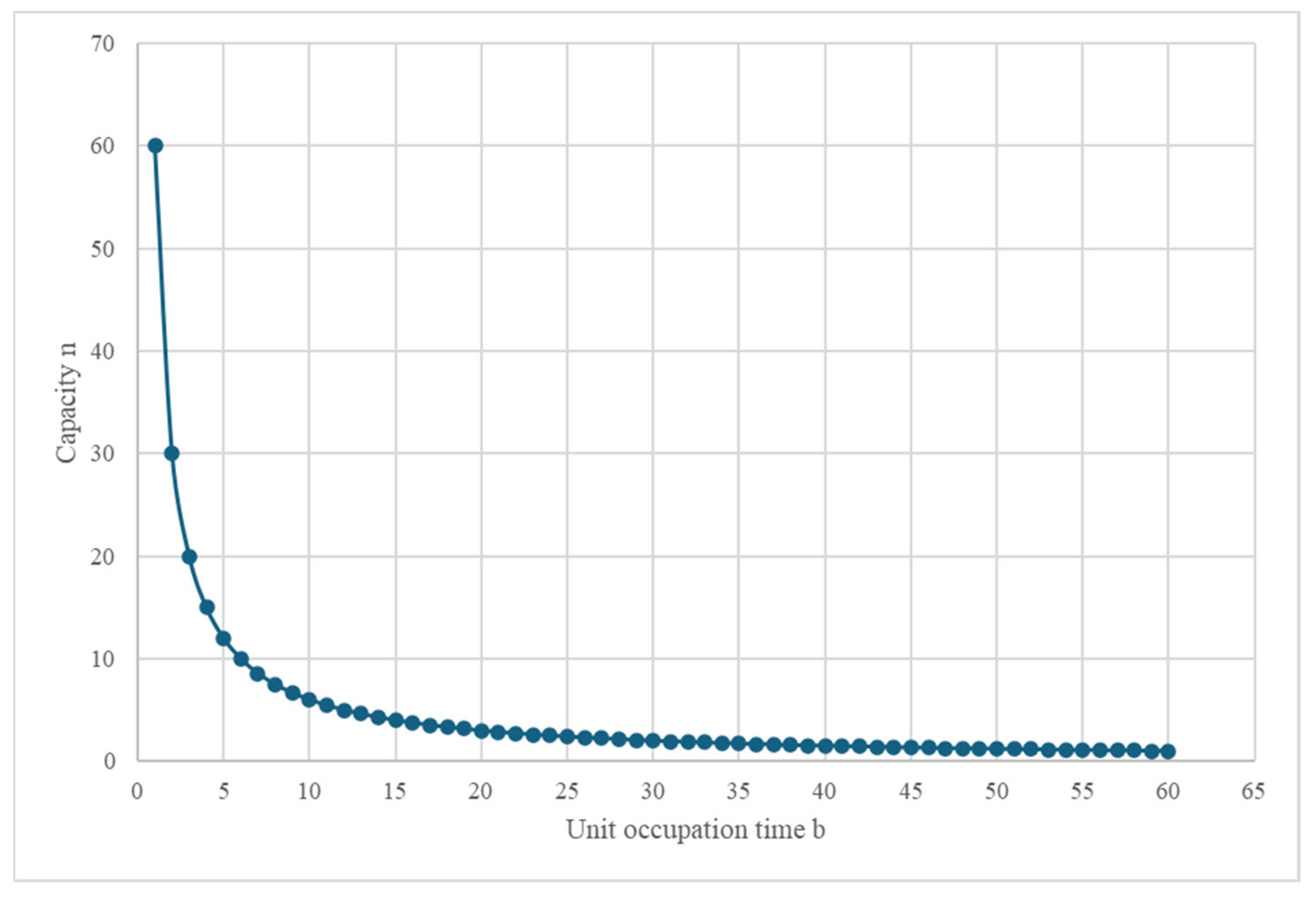
Figure 2.
Diagram of segmentation.
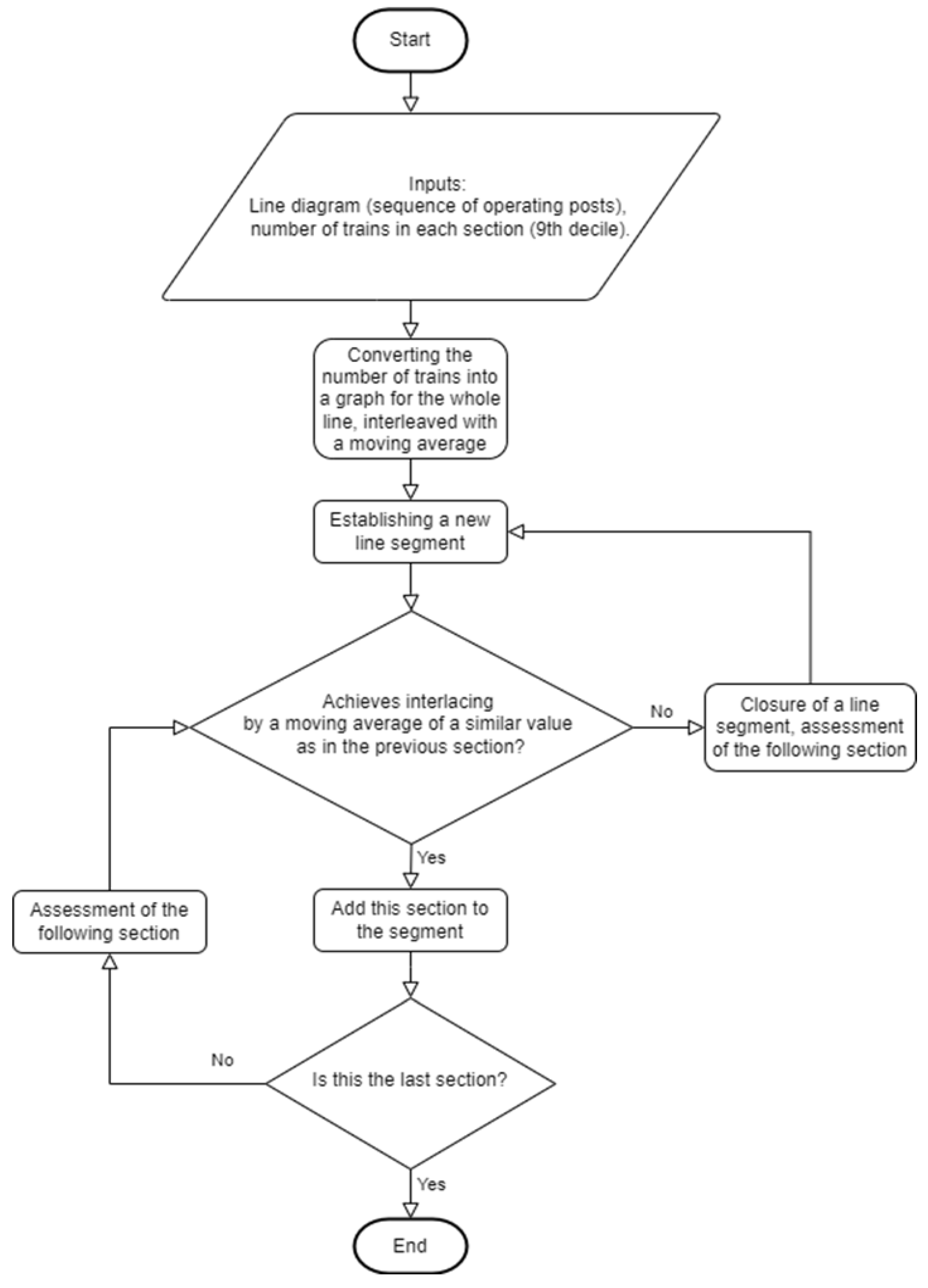
Figure 5.
Average 9th decile interlaced with moving average (2019-2023).
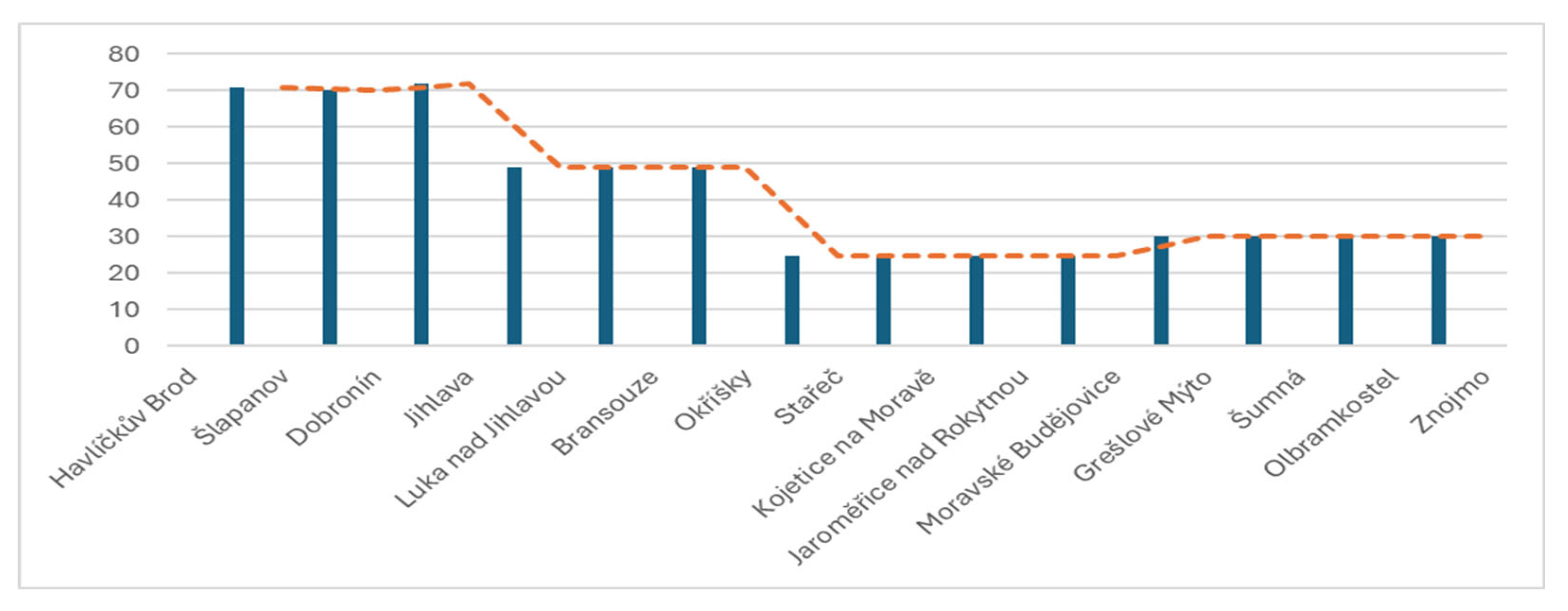
Figure 6.
Line scheme.
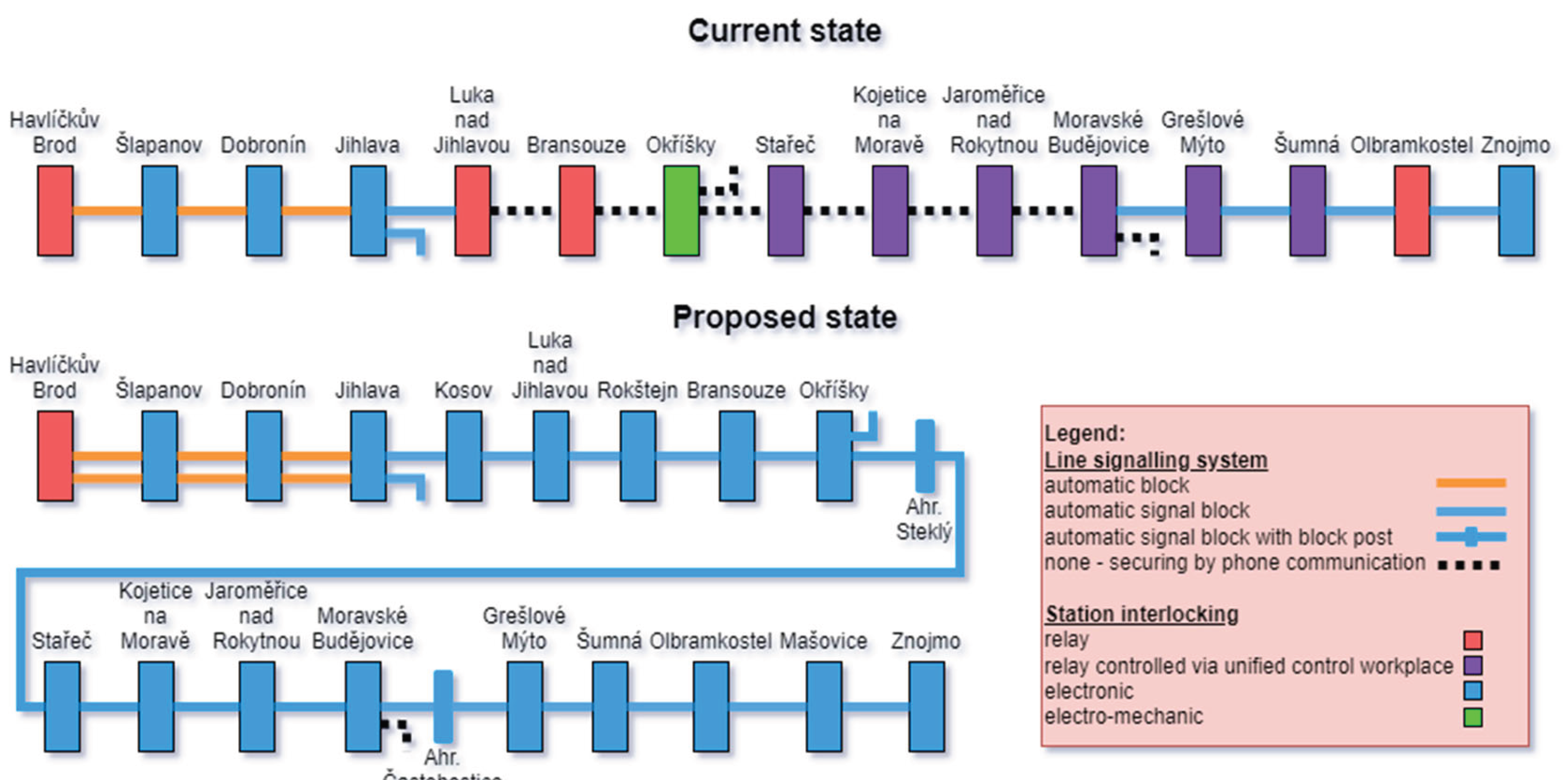

Table 1.
9th Decile of the number of all trains in each section
| Section / year | 2023 | 2022 | 2021 | 2020 | 2019 | Average |
| Havlíčkův Brod | 70 | 75 | 75 | 80 | 55 | 71 |
| Šlapanov | 70 | 70 | 75 | 80 | 55 | 70 |
| Dobronín | 70 | 75 | 80 | 80 | 55 | 72 |
| Jihlava | 50 | 50 | 45 | 55 | 45 | 49 |
| Louka nad Jihlavou | 50 | 50 | 45 | 55 | 45 | 49 |
| Bransouze | 50 | 50 | 45 | 55 | 45 | 49 |
| Okříšky | 24 | 25 | 25 | 25 | 25 | 24.8 |
| Stařec | 24 | 25 | 25 | 25 | 25 | 24.8 |
| Kojetice na Moravě | 24 | 25 | 25 | 25 | 25 | 24.8 |
| Jaroměřice nad Rokytnou | 24 | 25 | 25 | 25 | 25 | 24.8 |
| Moravské Budějovice | 30 | 30 | 30 | 35 | 25 | 30 |
| Grešlové Mýto | 30 | 30 | 30 | 35 | 25 | 30 |
| Šumná | 30 | 30 | 30 | 35 | 25 | 30 |
| Olbramkostel | 30 | 30 | 30 | 35 | 25 | 30 |
| Znojmo |
1 Tables may have a footer.
Table 2.
Journey times [min] on the original infrastructure.
| Direction / category | Znojmo | Havl. Brod | Average | Limiting journey time | |||||||||
| Os | R | Pn | Os | R | Pn | ||||||||
| Havlíčkův Brod | 9 | 7 | 12.5 | 9.5 | 7.5 | 10 | 9.3 | 5 | |||||
| Šlapanov | 8 | 6 | 12.5 | 8 | 6 | 8 | 8.1 | ||||||
| Dobronín | 9 | 6 | 13 | 8.5 | 6.5 | 10 | 8.8 | ||||||
| Jihlava | 11.5 | 11.5 | 13 | 12.5 | 10 | 16.5 | 12.5 | 8 | |||||
| Louka nad Jihlavou | 10.5 | 7.5 | 8.5 | 11.5 | 7.5 | 10.5 | 9.3 | ||||||
| Bransouze | 9 | 7.5 | 13 | 9 | 8 | 8.5 | 9.2 | ||||||
| Okříšky | 10 | 7.5 | 14 | 9.5 | 8 | 10 | 9.8 | 9 | |||||
| Stařec | 6.5 | 5.5 | 9.5 | 6.5 | 5.5 | 13.5 | 7.8 | ||||||
| Kojetice na Moravě | 8 | 7 | 9.5 | 9 | 7 | 13.5 | 9.0 | ||||||
| Jaroměřice nad Rokytnou | 9 | 7.5 | 8.5 | 8.5 | 7 | 7 | 7.9 | ||||||
| Moravské Budějovice | 12.5 | 9.5 | 11.5 | 12.5 | 9 | 19 | 12.3 | ||||||
| Grešlové Mýto | 7 | 6 | 12 | 7 | 6.5 | 9 | 7.9 | ||||||
| Šumná | 6.5 | 6 | 7.5 | 7 | 6 | 14.5 | 7.9 | ||||||
| Olbramkostel | 13.5 | 12 | 12 | 14 | 12 | 29 | 15.4 | ||||||
| Znojmo | |||||||||||||
Source: Authors based on data [29].
Table 3.
Inputs and outputs of the calculation.
| Segment | Prospective number of trains for a given period | Capacity in current state (with most unfavourable journey time) | Capacity utilisation | The most unfavourable journey time | Target capacity utilisation | Future capacity utilisation | Limiting journey time | |
| Nvýhl | n | Kvýhl | bn | Kp | Kb | blim | ||
| Havl. Brod – Jihlava |
27 | 19,2 | 140 % | 12,5 | 60 % | 56 % | 5 | |
| Jihava – Okříšky | 16 | 14,55 | 110 % | 16,5 | 55 % | 53 % | 8 | |
| Okříšky - Znojmo | 13 | 17,14 | 75 % | 14 | 50 % | 49 % | 9 | |
Disclaimer/Publisher’s Note: The statements, opinions and data contained in all publications are solely those of the individual author(s) and contributor(s) and not of MDPI and/or the editor(s). MDPI and/or the editor(s) disclaim responsibility for any injury to people or property resulting from any ideas, methods, instructions or products referred to in the content. |
© 2025 by the authors. Licensee MDPI, Basel, Switzerland. This article is an open access article distributed under the terms and conditions of the Creative Commons Attribution (CC BY) license (http://creativecommons.org/licenses/by/4.0/).
Copyright: This open access article is published under a Creative Commons CC BY 4.0 license, which permit the free download, distribution, and reuse, provided that the author and preprint are cited in any reuse.


