

Submitted:
21 August 2025
Posted:
22 August 2025
You are already at the latest version
Abstract
Regenerative agriculture, with its holistic approach to ameliorate ecosystems, particularly their soil health, aims to obtain more sustainable and resilient ecosystems, increasing food production and mitigating climate change. This type of agriculture is based on the use of vegetal compost, which contains macro and micronutrients that together with selected microorganisms such as mycorrhizae can improve plant growth and ameliorate soil properties, decreasing the use of chemical fertilizers and pesticides. Thus, advances in waste management and microbes such as inoculation of mycorrhizas and bacteria are nowadays deeply investigated. Innovations have increased worldwide since most plant species, including grasses, are associated with microorganisms, especially with arbuscular mycorrhizas, being used in agriculture together decreasing the great quantities of waste distributed in the environment and transformed into soil amendments, such as compost or biochar. Despite the higher cost of active farm regeneration, which requires planting plantlets, or direct seedling, inoculation of microorganisms despite disturbance mitigation. The use of composted waste could decrease many costs as the recovery of litter from trees and grass is also increasingly used; however, these must be originated from free-pesticide sites. Rhizosphere engineering is also directed for better plant growth or for soil carbon sequestration. Composting organic waste is increasingly adopted due to continued interest in solving environmental issues.
Keywords:
agrotoxics
Introduction: Regenerative agriculture presented a holistic approach to ameliorate ecosystems, particularly soil health, obtaining more sustainable resilient ecosystems (Schreefel et al.2020), increasing fo od production and mitigating climate change. this type of agriculture is based on the use of natural biodiversity and amendments such as vegetal compost, which contains macro and micronutrients that together with selected microorganisms such as mycorrhizae can improve plant growth and ameliorate soil properties, decreasing the use of chemical fertilizers and pesticides. Thus, advances in waste management and mixture with microbes such as inoculation of mycorrhizas and bacteria are nowadays deeply investigated. Innovations have increased worldwide since most plant species, including grasses, are associated with microorganisms, especially with arbuscular mycorrhizas, being used in agriculture together decreasing the great quantities of waste distributed in the environment and transformed into soil amendments, such as compost or biochar. Despite the higher cost of active farm regeneration, which requires planting seedlings, or direct seedling, inoculation of microorganisms and disturbance mitigation. The use of composted waste could decrease costs as the recovery of litter from trees and grass is also increasingly used; however, these materials must be originated from free-pesticide sites. Rhizosphere engineering is also directed for better plant growth or for soil carbon sequestration. Composting organic waste is increasingly adopted due to continued interest in solving environmental issues.
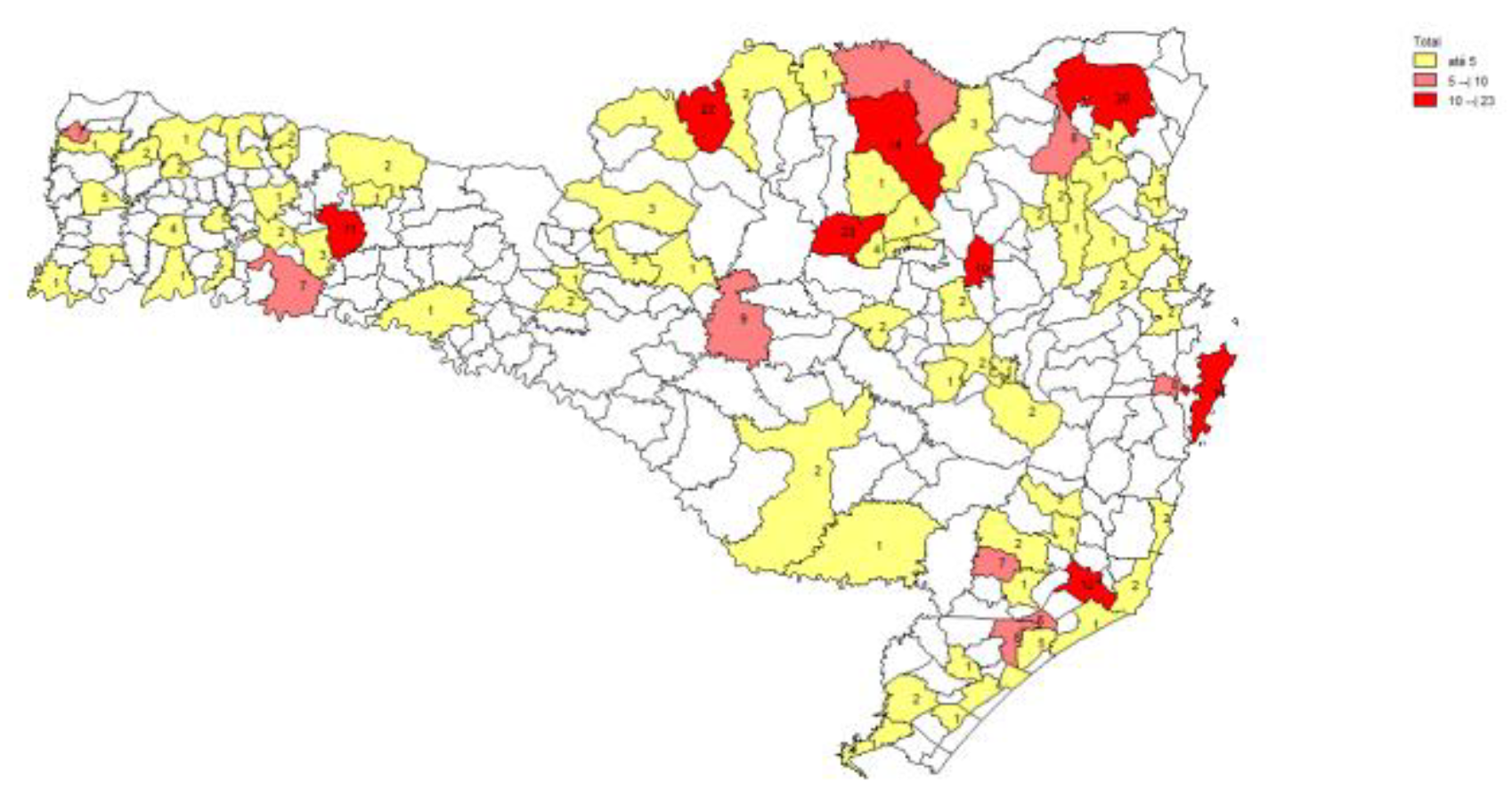
The increasing use of pesticides worldwide has led to intoxication of the human populations. As an example, we show the monitoring system of intoxication by pesticides, which register the cases of intoxication related to the agrotoxics used in each region from Brazil. In urban exposure areas such as Florianópolis, Joinville, and Tubarão and in rural areas, the municipalities of Irineópolis, Itaiópolis, and Rio do Campo, had shown the highest number of notifications. Considering notifications recorded in the Notifiable Injuries Information System (SINAN) in Brazil, during 2019, those municipalities presented the highest number of intoxication cases (Figure 1). There is another monitoring system, the Toxicological information and assistance center, CIATOX, which registers cases of intoxication by venomous animals among cases in general.
The effects of pesticides on the Arbuscular the Mycorrhizal Symbiosis with plants was investigated by Pagano et al. (2023), who pointed out that most pesticides constitute hazardous molecules for humans and the environment also influencing soil microbial communities including organisms that engage in mutualistic plant symbioses.
Massive amounts of pesticides are used in agricultural production systems to control pests, diseases, and weeds, and thereby attain high product quantity and quality. The amount of pesticides used and, hence, the presence of pesticides in food, for example, is associated with the farming system used for their production, being higher in conventional > integrated pest management > organic systems [1] Atkinson et al, 2009).
Regenerative agriculture adopts the CO2 aspects related to climatic change, and carbon stability in soils. Therefore, it aims to decrease the use of pesticides in crop cultivation besides increasing plant and soil health, and undoubtedly, human welfare.
Parte superior do formulário
Parte inferior do formulário
Regarding pesticides, a relevant issue worldwide, which merits detailed attention, as its use is growing, putting at risk human welfare as noted in increased notifications in the Notifiable Injuries Information Systems like SINAN system in Brazil, which during 2019 have registered the municipalities with the highest number of pesticide intoxication cases in urban exposure areas such as Florianópolis, Joinville, and Tubarão, while in rural areas, the municipalities of Irineópolis, Itaiópolis, and Rio do Campo had the most notifications (Figure 1). Thus, more than 189 cases of acute agrotoxic intoxication and 2 cases of chronic intoxication by tobacco plant cultivation were reported. Figure 1 shows the distribution of cases in Santa Catarina state [1].
Figure 1.
Number of cases of pesticide intoxication reported in 2019 in Santa Catarina, South Brazil. (Source: SINAN).
Figure 1.
Number of cases of pesticide intoxication reported in 2019 in Santa Catarina, South Brazil. (Source: SINAN).
The SINAN system provides information to the surveillance System of exposed to agrotoxic populations (VSPEA) which monitors pesticide intoxication to track cases, identify the epidemiological profile, and verify the completeness of data entered by healthcare professionals, who are required to report suspected cases of pesticide intoxication to the SINAN system on a weekly basis. Moreover, monitoring of Pesticide Packaging is performed by the National Institute for Empty Packaging Processing (INPEV), who collects empty pesticide packaging and organizes its mobile collection, as the collection is mandatory according to current legislation. Glyphosate, one of the most widely sold herbicides worldwide, is being used in agriculture, amateur gardening, and on roadsides to control unwanted plants. is the main pesticide involved in cases of exogenous intoxication in the state of Santa Catarina, Brazil, in recent years.
Pesticides are applied on crops in most conventional agroecosystems; however, they impact the biological communities influencing their occurrence on the soil. Among soil components, the mycorrhizal fungi symbiosis prevails in most ecosystems, being affected by diverse pesticides (Pagano et al., 2023) [1]. Agrotoxics 2, 337-354.
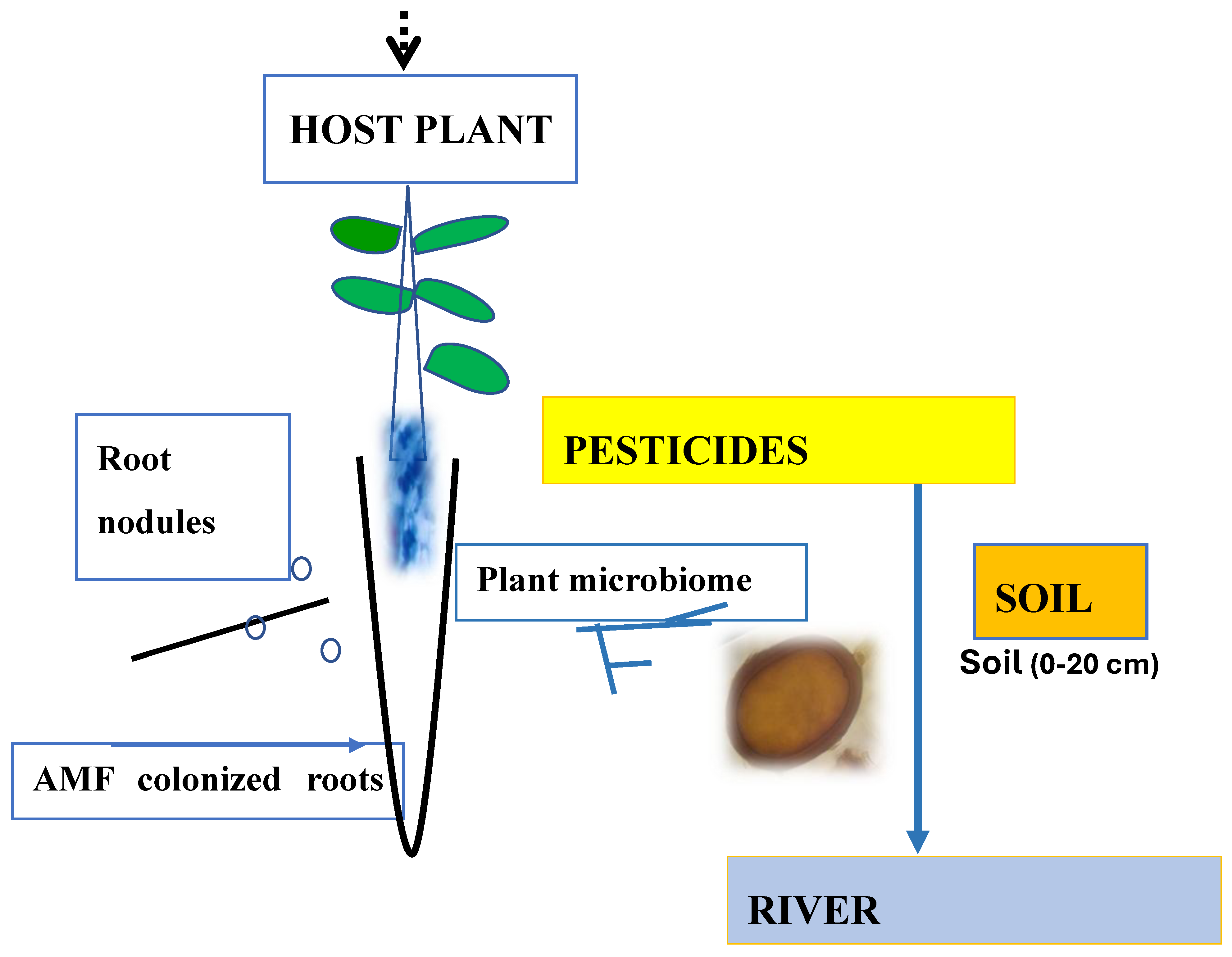
As pesticides are carried out with rainwater towards rivers, monitoring of drinking water is required. Thus, the municipalities cooperate in this task as follows, the monitoring water schedule is prepared and published monthly by the state Environmental Health Management Division, according to the prioritization of municipalities with the highest probability of pesticide occurrence in drinking water for human consumption.
Figure 2.
Illustration of pesticide movement used in soil towards rivers.
References
- Atkinson, D. Soil microbial resources and agricultural policies. In Mycorrhizas-Functional Processes and Ecological Impact; Azcón-Aguilar, C., Barea, J.M., Gianinazzi, S., Gianinazzi-Pearson, V., Eds.; Springer: Berlin/Heidelberg, Germany, 2009; pp. 1–16.
- Schreefel, L., R.P.O. Schulte b, I.J.M. de Boer , A. Pas Schrijver , H.H.E. van Zanten.
- Regenerative agriculture – the soil is the base, Global Food Security, 2020, 100404.
- Pagano MC, M Kyriakides, Kuyper T.2023. The effects of Pesticides on the Arbuscular Mycorrhizal Symbiosis. Agrotoxics, MDPI 2, 337-354.
- Neuberger et al. Biochar is colonized by select arbuscular mycorrhizal fungi in agricultural soils. Mycorrhiza 34, 191–201 (2024).
Disclaimer/Publisher’s Note: The statements, opinions and data contained in all publications are solely those of the individual author(s) and contributor(s) and not of MDPI and/or the editor(s). MDPI and/or the editor(s) disclaim responsibility for any injury to people or property resulting from any ideas, methods, instructions or products referred to in the content. |
© 2025 by the authors. Licensee MDPI, Basel, Switzerland. This article is an open access article distributed under the terms and conditions of the Creative Commons Attribution (CC BY) license (http://creativecommons.org/licenses/by/4.0/).
Copyright: This open access article is published under a Creative Commons CC BY 4.0 license, which permit the free download, distribution, and reuse, provided that the author and preprint are cited in any reuse.


