

Submitted:
21 August 2025
Posted:
22 August 2025
You are already at the latest version
Abstract
Hash functions are fundamental components in both cryptographic and non-cryptographic systems, supporting secure authentication, data integrity, fingerprinting, and indexing. While the Ascon family, selected by NIST in 2023 for lightweight cryptography, has been extensively evaluated in its authenticated encryption mode, its hashing and extendable-output variants, namely Ascon-Hash256, Ascon-XOF128, and Ascon-CXOF128, have not received the same level of empirical attention. This paper presents a structured benchmarking study of these hash variants using both the SMHasher framework and custom Python-based simulation environments. SMHasher is used to evaluate statistical and structural robustness under constrained, patterned, and low-entropy input conditions, while Python-based experiments assess application-specific performance in Bloom filter based replay detection at the network edge, Merkle tree aggregation for blockchain transaction integrity, lightweight device fingerprinting for IoT identity management, and tamper-evident logging for distributed ledgers. We compare the performance of Ascon hashes with widely used cryptographic functions such as SHA3 and BLAKE2s, as well as high-speed non-cryptographic hashes including MurmurHash3 and xxHash. We assess avalanche behavior, diffusion consistency, output bias, and keyset sensitivity, while also examining Ascon-XOF's variable-length output capabilities relative to SHAKE for use cases such as domain-separated hashing and lightweight key derivation. Experimental results indicate that Ascon hash functions offer strong diffusion, low statistical bias, and competitive performance across both cryptographic and application-specific domains. These properties make them well suited for deployment in resource-constrained systems, including Internet-of-Things (IoT) devices, blockchain indexing frameworks, and probabilistic authentication architectures. This study provides the first comprehensive empirical evaluation of Ascon hashing modes and offers new insights into their potential as lightweight, structurally resilient alternatives to established hash functions.
Keywords:
Ascon-hash256
; Ascon-XOF
; benchmarking
; IoT security
; blockchain-enabled IoT
; post-quantum cryptography
1. Introduction
Hash functions are foundational tools in modern computing systems. They enable a wide range of functionalities across both security-critical and performance-oriented domains, including data integrity verification, message authentication, digital signatures, deduplication, and secure indexing [1,2]. In cryptographic applications, key properties such as collision resistance, preimage resistance, and diffusion play a central role in maintaining the integrity and confidentiality of data. Meanwhile, in non-cryptographic contexts, such as hash tables, Bloom filters, fingerprinting systems, and memory-efficient data structures, metrics like uniform distribution, speed, and lightweight implementation are prioritized [3,4,5]. As computing environments evolve to span low-power devices, embedded systems, and resource-constrained Internet-of-Things (IoT) networks, there is a growing demand for hash functions that can simultaneously offer strong security guarantees and efficient implementation across diverse platforms.
The Ascon family of lightweight cryptographic algorithms, standardized by National Institute of Standards and Technology (NIST) in 2023 [6], offers a promising set of hashing and authenticated encryption primitives optimized for constrained devices. Among its hash variants, Ascon-Hash256, Ascon-XOF128, and Ascon-CXOF128, adopt a sponge-based structure with a compact, hardware-friendly design, making them attractive for applications that demand both structural integrity and lightweight implementation.
Despite their inclusion in the final NIST LWC standard portfolio, empirical benchmarking of Ascon hash variants remains limited. While Ascon-AEAD128, the Authenticated Encryption with Associated Data (AEAD) variant, has been extensively evaluated in software and hardware implementations across 8-bit, 32-bit, and 64-bit microcontrollers, as well as in FPGA and ASIC platforms [7,8], the hash variants have not received similar benchmarking attention. Public benchmarking platforms such as SUPERCOP and eBACS do not currently include these variants by default [9,10]. Furthermore, there is a notable lack of published comparisons involving Ascon hashes and other widely deployed cryptographic hash functions such as SHA3 [11], SHAKE256 [12], and BLAKE2s [13]. Even fewer studies have explored their performance in structural or low-entropy input domains, where non-cryptographic hashes like MurmurHash3 [14] and xxHash [15] are commonly used.
Although formal security proofs and design rationale for Ascon hash functions are available through the NIST standardization process [6], there remains a gap in understanding their empirical behavior under real-world input patterns. Structural properties such as avalanche diffusion, output bias, collision distribution under sparse or patterned inputs, and variable-length adaptability are increasingly relevant in emerging applications such as packet fingerprinting [3], Bloom filter-based replay detection [16], blockchain transaction indexing [17], and lightweight key derivation in embedded systems [18]. For example, Ascon-XOF’s support for variable-length output makes it directly comparable to the SHAKE family of extendable-output functions, in applications involving domain-separated hashing, key derivation, and extendable identifiers within post-quantum secure protocols.
This paper addresses the above gaps by presenting the first structured empirical benchmarking of the Ascon hash variants, with a focus on their statistical and structural behavior under practical input conditions. We use the SMHasher test suite to evaluate structural properties such as avalanche bias, permutation sensitivity, and keyset diffusion. While SMHasher was originally developed to assess non-cryptographic hash functions [19], it remains a valuable framework for quantifying bit-mixing quality, output uniformity, and resistance to structural bias under diverse input patterns. We emphasize that SMHasher is not a cryptanalytic tool and does not replace formal security evaluation; rather, its tests complement traditional analysis by exposing structural weaknesses that may impact performance or correctness in practical applications. These metrics are particularly relevant in constrained or application-specific scenarios, such as Bloom filters, replay detection, and indexing, where statistical uniformity and diffusion directly influence system behavior.
In addition to statistical analysis, we evaluate the applicability of Ascon hash variants in structural and applied domains, including Bloom filters, secure indexing frameworks, post-quantum digital signatures, IoT fingerprinting, and blockchain-based integrity verification. These domains are highly sensitive to properties such as collision behavior, false positive rate, bit-level diffusion, and output distribution bias, which directly affect system performance and correctness. Our benchmarking compares Ascon-Hash256 against established cryptographic hash functions such as SHA3-256, SHAKE256, and BLAKE2s, as well as widely used non-cryptographic alternatives including MurmurHash3 and xxHash. This comparative evaluation highlights the untapped versatility of Ascon hashes beyond AEAD use cases, demonstrating their suitability for both security-critical protocols and resource-aware structural operations. Our evaluation highlights the unique combination of efficiency, diffusion, and structural robustness that Ascon hash functions provide.
In summary, this paper makes the following key contributions:
- It presents the first comprehensive empirical benchmarking of Ascon-Hash using SMHasher, covering both cryptographic and structural test categories.
- It compares the performance and statistical behavior of Ascon hashes against cryptographic standards such as SHA3-256, SHAKE256, and BLAKE2s, as well as high-speed non-cryptographic hashes.
- It demonstrates the practical utility of Ascon hashes in lightweight applications, including Bloom filters, structural hashing, and secure indexing for embedded and IoT systems.
These findings underscore the untapped potential of Ascon hash functions and provide new insights into their practical relevance across domains that require a balance of cryptographic strength, lightweight design, and structural integrity [3,20,21]. The remainder of this paper is organized as follows. Section 2 reviews related work, followed by an overview of the Ascon hashing algorithm in Section 3. Section 4 details the methodology, including the benchmarking environment, comparison scope, and both SMHasher and Python-based evaluation frameworks. Section 5 presents results across structural benchmarking, replay prevention, post-quantum integration, fingerprinting applications, and Merkle tree diffusion. Section 6 discusses the broader implications of these findings, and Section 7 concludes the paper.
2. Related Work
Hash functions are foundational to modern cryptographic systems, providing compact representations of data that are essential for integrity verification, authentication, and digital signatures [22,23]. A hash function takes an input of arbitrary length and maps it to a fixed-size bit string known as the message digest or fingerprint. Formally, a hash function h is defined as:
where n is typically between 256 and 512 bits. Unlike encryption schemes, hash functions are keyless and non-reversible, making them ideal for applications where verification rather than confidentiality is required [24].
To be cryptographically secure, hash functions must satisfy three main properties [1]. First, preimage resistance ensures that it is computationally infeasible to recover the original message given only its hash. Second, the property of second preimage resistance means that it is computationally infeasible to find a different input with the same hash as a given message. Finally, collision resistance makes it infeasible to find any two distinct messages that produce the same hash output. These properties underpin many cryptographic protocols, including digital signatures and message authentication codes [25].
Early dedicated hash functions such as MD4 [26] and MD5 [27], designed by Ronald Rivest, were optimized for software efficiency using 32-bit word operations and Boolean logic. Although widely adopted, both functions eventually proved vulnerable to collision attacks [28]. For instance, collisions in MD5 were discovered in 2004, undermining its use in critical security protocols. To address these weaknesses, NIST introduced the Secure Hash Algorithm (SHA) family, beginning with SHA-0 in 1993, followed by SHA-1 in 1995 [29]. However, SHA-1 too was eventually broken, with a collision discovered in steps [30].
This led to the development of the SHA-2 family, comprising SHA-224, SHA-256, SHA-384, and SHA-512, which remain widely used and are currently considered secure [31]. Seeking further diversification, NIST launched a public competition in 2007 to design a new hash function with a different internal structure [32]. The winner, Keccak, became the basis for SHA-3, which was standardized in 2015 [11]. Unlike earlier Merkle–Damgård constructions, SHA-3 relies on the sponge construction [33], which consists of an absorbing phase (input processing) and a squeezing phase (output generation). This flexible architecture allows the creation of both traditional hash functions and extendable-output functions (XOFs), such as SHAKE128 and SHAKE256 [11].
In addition to dedicated designs, hash functions can also be constructed from block cipher primitives. The Matyas–Meyer–Oseas (MMO) construction, for example, derives a compression function from an existing block cipher [22]. Since the Advanced Encryption Standard (AES) (originally Rijndael) became a global standard with widespread hardware acceleration [34,35], numerous proposals have leveraged AES to build hash functions that exploit this speed and availability [36]. These approaches avoid the need to implement a new primitive in hardware and instead reuse AES, thereby reducing both area and power consumption in constrained devices.
With the rise of the Internet of Things (IoT), there has been growing interest in lightweight hash functions that balance security with efficiency on resource-constrained platforms [37,38]. In August 2025, the NIST Lightweight Cryptography (LWC) project finalized the Ascon family as the standard for protecting small and resource-limited devices [6]. While Ascon is primarily recommended for authenticated encryption with associated data (AEAD), the family also includes Ascon-Hash256, Ascon-XOF128, and Ascon-CXOF128, which inherit the sponge-based structure of Keccak but are optimized for lightweight use [39]. These functions provide excellent avalanche characteristics, uniform output distribution, and low implementation cost in hardware [16], making them promising candidates for IoT authentication, probabilistic data structures such as Bloom filters, and Merkle tree-based applications.
Quantum computing presents a significant challenge to existing cryptographic schemes. Peter Shor’s breakthrough algorithms in the mid-1990s showed that RSA and elliptic-curve cryptosystems could be broken in polynomial time on quantum computers [40]. Shor’s period-finding and discrete logarithm algorithms render all widely used public-key systems insecure in the quantum setting. Additionally, Grover’s algorithm reduces the brute-force complexity of symmetric-key operations from to , necessitating longer key and hash lengths for adequate protection [41].
As a result, the field of post-quantum cryptography (PQC) has expanded to include alternatives resilient to quantum attacks [42]. These include lattice-based (e.g., Kyber, Dilithium), code-based (e.g., BIKE, McEliece), and hash-based schemes [1]. Hash-based digital signatures, such as SPHINCS+, rely solely on the properties of cryptographic hash functions and are regarded as strong candidates for long-term post-quantum security [43].
Figure 1 provides a visual timeline of cryptographic hash function adoption. It highlights the trajectory from early designs (e.g., MD5, SHA-1), which are now deprecated, to more modern, domain-optimized alternatives like SHAKE256, BLAKE3, and Ascon-Hash. The recent standardization of Ascon by NIST marks a shift toward lightweight and structurally secure hash functions, motivating the need for empirical benchmarking as presented in this work.
The versatile nature of hash functions has led to their widespread use in digital signatures, message authentication codes, password hashing, blockchain transaction validation, pseudorandom number generation, and replay detection mechanisms [2,16,20]. In many of these domains, especially in constrained or adversarial settings such as edge computing or decentralized systems, the demand for efficient, secure, and adaptable hash functions is growing [44,45].
While prior work has explored classical and quantum-safe hash designs [46], there is limited empirical evaluation of the domain-specific benefits of sponge-based lightweight hash functions like Ascon. This work addresses that gap by benchmarking Ascon-Hash in cryptographic and structural applications, examining their potential to replace or complement SHA-3, BLAKE2s, and non-cryptographic hashes in secure indexing, fingerprinting, and blockchain-based aggregation.
3. Overview of the Ascon Hashing Algorithm
The Ascon hashing functions are derived from the Ascon family of lightweight cryptographic primitives, selected as the primary standard in the NIST-LWC competition in 2023 [6]. While originally proposed for AEAD, the design was later extended to include sponge-based hash functions: Ascon-Hash256, Ascon-XOF128, and Ascon-CXOF128. These variants aim to combine strong cryptographic properties with low implementation cost, making them ideal for applications in embedded systems, secure indexing, and constrained IoT environments.
All Ascon hash variants are built upon a sponge construction that processes data in two phases: the absorbing phase, where input blocks are XORed into the internal state, and the squeezing phase, which produces the output hash digest. The internal state of all Ascon’s hashing variants are 320 bits, divided into a 64-bit rate (r = 64) and a 256-bit capacity (c = 256). The number of permutation rounds applied per block is 12 for all three variants to maximize diffusion.
The mode of operation for Ascon-Hash256 and Ascon-XOF128, illustrated in Figure 2, consists of three primary phases: initialization, message absorption, and output squeezing. The construction takes a variable-length message M as input. For Ascon-Hash256, the output length L is fixed at 256 bits, whereas in Ascon-XOF128 the output length is variable. The initialization vector (IV) for Ascon-Hash256 is 0x0000080100cc0002, while that for Ascon-XOF128 is 0x0000080000cc0003. In Ascon-XOF128 and Ascon-CXOF128, the suffix “128” denotes the intended security strength rather than the output size.
The customized variant of Ascon-XOF128, referred to as Ascon-CXOF128, is shown in Figure 3 and extends the base functionality by allowing the inclusion of a customization string Z in the computation. For the same input message, two customized XOF instances using different customization strings will yield distinct outputs.
Ascon-CXOF128 differs from Ascon-XOF128 in the following aspects [47]:
- Domain separation: Ascon-CXOF128 uses a different initialization vector (IV) from Ascon-XOF128 and supports user-defined customization strings. The IV for Ascon-CXOF128 is 0x0000080000cc0004. For instance, Ascon-CXOF128 enables domain separation by allowing parameters such as output lengths or application-specific identifiers to be encoded into the customization string. This guarantees that outputs derived in different contexts (e.g., key derivation, Merkle tree hashing, or protocol identifiers) remain distinct, even if the same input message is used.
- Additional input: Alongside the message, Ascon-CXOF128 accepts a customization string Z whose length is at most 2048 bits (256 bytes).
- Input formatting: The customization string Z is prepended to the message blocks as:where is a 64-bit integer denoting the bit-length of the customization string, and are 64-bit blocks obtained by parsing and padding Z.
3.1. Ascon Permutation
In Ascon’s sponge construction, the core primitive is a permutation on a 320-bit internal state:
where each is a 64-bit word (). Each round consists of three sequential layers: constant addition (), substitution (), and linear diffusion ().
(i) Constant Addition Layer (): A round-dependent constant , listed in Table 1, is XORed into the least significant bits of one state word to break symmetry between rounds and prevent slide attacks, ensuring distinct evolution of the state across different rounds. The standard specifies round constants for up to 16 rounds to accommodate potential functionality extensions in the future [6].
Figure 4.
Constant addition layer () where a round constant is XORed into one state word [47]
Figure 4.
Constant addition layer () where a round constant is XORed into one state word [47]
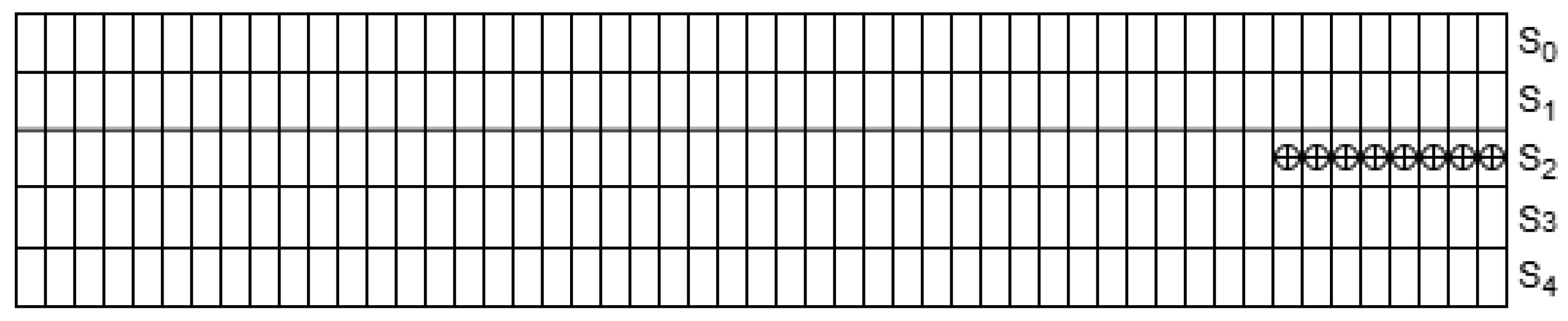
(ii) Substitution Layer (): This layer applies a single 5-bit S-box in parallel to each of the 64 bit-slices of the -bit state:
It is hardware efficient, requiring only XOR, AND, and NOT operations, yet providing strong nonlinearity. A circuit representation of the S-Box is shown in Figure 5, while its lookup-table mapping is given in Table 2.
(iii) Linear Diffusion Layer (): This layer improves avalanche properties by XORing each word with rotated versions of itself, using constants specific to each word index. The transformations are illustrated in Figure 6 and defined as follows:
where ⋙ denotes rotation to the right.
Each layer is constant time to mitigate timing-based side-channel attacks. The combination of symmetry-breaking constants, strong nonlinearity, and rapid diffusion provides robust security for constrained and adversarial environments [48].
The functional characteristics of each hash variant are summarized in Table 3. Ascon-Hash is designed for fixed-length output (256 bits) and is ideal for message authentication, fingerprinting, and digital signature schemes. Ascon-XOF supports variable-length output and is therefore suitable for applications like key derivation, hierarchical hashing, and domain-separated protocol identifiers. Ascon-CXOF further introduces a context string during initialization to provide built-in domain separation, enabling cryptographic agility across protocols or device layers.
From an implementation standpoint, Ascon hashing functions are optimized for compactness and performance. The sponge-based structure combined with the lightweight permutation core enables very small hardware footprints in ASIC designs [49] and efficient implementations on microcontrollers with limited instruction sets [50]. The algorithm uses only bitwise operations (AND, XOR, NOT) and shift/rotation logic, which are naturally suited to embedded systems and FPGA platforms.
Security wise, Ascon hash variants maintain strong bounds on preimage and collision resistance. The 256-bit digest in Ascon-Hash provides a classical security margin of against collisions. All variants employ a sponge capacity of 256 bits, ensuring that Grover-style quantum attacks cannot reduce preimage resistance below [41]. Moreover, all operations are constant-time and avoid data-dependent branching, providing built-in protection against timing and side-channel attacks.
Together, these characteristics make Ascon hash functions attractive not only for classical cryptographic use cases but also for emerging domains that demand low-power, side-channel-resistant, and structurally sound hashing primitives.
4. Methodology
This study aims to evaluate the statistical robustness, structural diffusion, and practical applicability of the Ascon hash family in comparison with both cryptographic and non-cryptographic alternatives. To achieve this, we adopted a twofold methodology combining empirical benchmarking and targeted simulations. First, we used the SMHasher framework to provide a standardized and reproducible evaluation of avalanche behavior, output bias, and resistance to structured or low-entropy inputs. These tests were applied uniformly across a set of six representative hash functions to ensure fair comparison. Second, we complemented the SMHasher results with custom Python-based simulations designed to explore application-driven scenarios such as Bloom-filter indexing, log fingerprinting, and Merkle-tree diffusion. This dual approach allows us to capture both the baseline statistical properties of the candidate hash functions and their performance in practical, domain-relevant contexts.
4.1. Benchmarking Framework and Environment
All evaluations were conducted using the SMHasher framework [19], a widely used benchmarking suite designed to assess the statistical properties, structural robustness, and runtime behavior of hash functions. While originally designed for non-cryptographic hash functions, SMHasher includes tests that are equally informative for lightweight and cryptographic hash functions, especially in scenarios involving structured, adversarial, or low-entropy inputs.
Benchmarks were performed on a Linux workstation equipped with an Intel Core i7-1165G7 CPU running at 2.91 GHz. The SMHasher suite was compiled using g++ with the -O3 optimization flag to ensure consistent high-performance execution. All tests were conducted under Ubuntu 22.04 LTS (64-bit). All hash outputs were standardized to 256 bits to ensure fair comparisons.
4.2. Hash Function Selection and Comparison Scope
This study evaluates six hash functions, including both cryptographic and non-cryptographic types. The cryptographic group consists of Ascon-Hash256, SHA3-256, SHAKE256, and BLAKE2s. Five of these hash functions were empirically benchmarked using the SMHasher framework, as supported by the actively maintained repository by rurban [19]. SHA3-256 and BLAKE2s were selected for their standardized status and relevance to post-quantum and lightweight cryptographic applications. While SHAKE256 and Ascon-XOF are not natively supported in SMHasher, they are included in a comparative conceptual analysis due to their sponge-based structure and functional similarity to SHA3-256 and Ascon-Hash256, respectively.
The non-cryptographic group comprises MurmurHash3 and xxHash, both widely adopted in performance-critical domains such as hash tables, Bloom filters, and software indexing. These were included to emphasize statistical and structural differences between cryptographic and high-speed hash functions, particularly in terms of diffusion, bias resistance, and collision behavior under structured inputs.
Although the primary focus of this study is the empirical evaluation of Ascon-Hash256 using SMHasher, a complementary conceptual comparison between Ascon-XOF128 and SHAKE256 is also included, based on their official specifications and prior literature. Since all Ascon hash variants share the same sponge structure and permutation, only differing in rate, output format, and optional customization, Ascon-CXOF128 is not separately analyzed here. Because SMHasher does not support variable-length output functions, runtime metrics for SHAKE256 and Ascon-XOF could not be collected directly. Instead, their architectural features, extensibility, and suitability for applications such as domain-separated hashing, key derivation, and hierarchical tree hashing are discussed in a dedicated section.
4.3. Test Categories in SMHasher
The following SMHasher test categories were used to evaluate the statistical and structural robustness of each hash function:
- Avalanche Test: This test measures the bit diffusion strength of a hash function by evaluating how a single-bit change in the input affects the output [51]. For each input length, thousands of input pairs differing by exactly one bit are hashed. The percentage of output bits that flip is recorded for each case. Ideally, each output bit should flip with 50% probability, indicating perfect avalanche behavior. SMHasher reports the worst-case output bit bias, defined as the maximum deviation from this ideal across all output bits. A low bias indicates strong mixing and good diffusion properties.
-
Keyset Tests: SMHasher includes several structured key categories, namely Sparse, Permutation, and Cyclic inputs, that simulate constrained, low-entropy, or patterned input conditions [19]. These tests evaluate how well a hash function maintains uniformity, diffusion, and collision resistance in adversarial or real-world scenarios.Sparse Test: This test simulates low-entropy input conditions by generating keys with only a few active bits. It models use cases such as feature flags, protocol identifiers, and sparse data encodings. A robust hash function should diffuse these small changes evenly and avoid output bias or clustering.Permutation Test: Keys are generated by selecting up to seven values from a pool of eight fixed blocks, simulating structured inputs often seen in memory-constrained systems, cryptographic identifiers, or header formats. This test reveals how the hash function handles repeated structures and limited entropy sources.Cyclic Test: This test evaluates the hash function’s behavior on periodic and repeating input patterns, such as those found in network packet headers, sensor data streams, or protocol padding. The hash function must maintain randomness and collision resistance, even when input entropy is low or highly regular.Zeroes Test: This test detects output bias by measuring the frequency of zero bits across all hash outputs. A well-designed hash function should exhibit a near-random distribution of zeros and ones. Excessive zeroes may indicate insufficient diffusion or predictable output bits, especially in the most or least significant positions.
- Bit Distribution and Bias: This test evaluates whether the hash function’s output bits are uniformly distributed across different input conditions. It identifies skewed or biased bits that may reduce the randomness or security of the hash output.
All hash functions were tested under identical system configurations and repeated across sufficient trials to ensure statistical reliability. To enable uniform comparison across functions with different output lengths, all hash outputs were truncated or zero-padded to 256 bits where applicable.
4.4. Python Simulation Framework
All custom simulations were implemented in Python 3.10. Ascon-Hash256 and Ascon-XOF were instantiated using the xoflib package, while the Bloom filter was managed with the bloom_filter library. For baseline comparisons, SHA3-256 and BLAKE2s were obtained from the Python standard library hashlib, whereas SHAKE256 and an alternative SHA3-256 implementation were sourced from PyCryptodome (Crypto.Hash). MurmurHash3 was provided by the mmh3 package, and xxHash by the xxhash package. Supporting utilities included itertools, random, and statistics from the Python standard library.
In the Bloom-filter experiments (Section 5.2), we instantiated a filter of size bits with independent hash indices, following standard Bloom filter notation [52]. Each 128-bit nonce was expanded by Ascon-XOF128 (rate = 64, capacity = 256) using the standard 12-round permutation to derive ten 32-bit pseudorandom indices, with parallel experiments conducted using SHA3-256, MurmurHash3, and xxHash for comparison. A total of sequential nonces were inserted, and the false-positive rate (FPR) was measured after every 10,000 insertions. Results, averaged over five independent runs, were compared against the theoretical Bloom filter model:
which served as a baseline for evaluating how different hash functions affect Bloom filter saturation and FPR stability.
For log fingerprinting [53] (Section 5.4), ten structured log messages (L1–L10) differing by single-field edits (e.g., temperature, timestamp, status) were hashed using Ascon-Hash256, SHA3-256, SHAKE256, BLAKE2s-256, xxHash and MurmurHash3 with all outputs standardized to 256 bits by truncation or zero-padding for uniform comparison. Avalanche scores for each adjacent log pair were computed with:
def bit_diff(h1, h2):
return sum(bin(a ^ b).count("1") for a, b in zip(h1, h2))
The average bit difference across all nine pairs was reported.
For Merkle-tree diffusion (Section 5.5), we generated full binary trees of depths 4, 6, 8, and 10 (i.e., leaves) [54]. In each of 1,000 trials per tree size, a single leaf bit was flipped at a random position, and the tree was hashed bottom-up using Ascon-Hash256, SHA3-256, SHAKE256 (truncated to 256 bits), BLAKE2s-256, xxHash, and MurmurHash3 (standardized to 256 bits by truncation or zero-padding). Using the same bit_diff function, we recorded the mean, variance, minimum, and maximum of root bit-differences at each depth.
5. Results
5.1. Structural Benchmarking Using SMHasher Suite
To assess the suitability of Ascon hash variants for structural applications such as hash tables, Bloom filters, and sensor fingerprinting, we evaluated its statistical robustness using keyset-based tests from the SMHasher suite [19]. These tests simulate adversarial or structured input patterns that are commonly encountered in real-world systems relying on hash-based indexing.
Table 4 consolidates the key results across five dimensions: worst-case avalanche bias, sensitivity to sparse inputs, resilience to structural bias (permutation and cyclic tests), and bit uniformity (zeroes test). Compared to other cryptographic hashes (SHA3-256 and BLAKE2s) and widely-used non-cryptographic hashes (MurmurHash3 and xxHash), Ascon-Hash256 consistently exhibits stronger or comparable behavior across all metrics.
Ascon-Hash256 achieves the highest score in the Sparse Test (0.968%), indicating strong sensitivity to low-entropy inputs, which is a desirable property for systems that rely on fine-grained feature differentiation, such as Bloom filters or compressed data matching [5]. It also exhibits the lowest structural bias in the Permutation Test (0.081%) and one of the lowest scores in the Cyclic Test (0.151%), demonstrating robust randomness and collision resistance even under highly repetitive input patterns.
In the Zeroes Test, Ascon-Hash256 maintains a balanced output distribution (0.322%), on par with SHA3-256 and significantly more uniform than BLAKE2s. Finally, the worst-case avalanche bias [39] for Ascon-Hash256 remains below 0.83%, validating its strong bit diffusion characteristics across all key sizes. This is superior to SHA3-256 (1.01%) and BLAKE2s (0.85%) and comparable to optimized non-cryptographic hashes, without sacrificing cryptographic integrity.
These results suggest that Ascon-Hash256 offers a compelling alternative to non-cryptographic hashes for indexing and distribution tasks, particularly in applications requiring lightweight implementation, structural robustness, and moderate security guarantees. Its performance reinforces its viability in constrained domains such as embedded systems, sensor networks, and blockchain-based data structures where uniformity and low collision rates are critical [55,56].
Moreover, Ascon-Hash256 exhibits low output bias, strong avalanche characteristics, and uniform output distributions, as validated through SMHasher evaluations conducted over 300,000 input variants, systematically generated by the test suite through single-bit toggling and structured key patterns across varying input lengths. These properties align with the stringent mixing requirements for pseudorandom string derivation (e.g., ) and multi-layer Merkle hashing (e.g., ) [46,54], ensuring cryptographic robustness while maintaining implementation efficiency.
5.2. Blockchain-Enabled Replay Attack Mitigation for IoT Edge Devices
In blockchain-enabled IoT environments, replay attacks pose a critical threat to both device security and ledger integrity. Adversaries may attempt to reuse valid authentication messages, which can not only grant unauthorized access to IoT nodes but also pollute distributed ledgers with duplicated or fraudulent entries. Such attacks undermine consensus mechanisms, inflate storage requirements, and weaken the trust model that blockchain is designed to provide. To mitigate this risk, we previously proposed a replay protection mechanism for Ascon-AEAD128 [6], integrating a Bloom filter with cryptographically secure hashing using Ascon-XOF128 [16]. In this design, each incoming nonce is processed by the Ascon-XOF128 hashing stage, producing a 256-bit digest that is partitioned into k fixed-width indices for bit setting in a BRAM-based Bloom filter. This ensures that duplicate or replayed packets are rejected at the IoT edge before they are forwarded to blockchain storage, thereby preserving ledger consistency while minimizing overhead on resource-constrained devices.
The statistical robustness of Ascon-Hash256, as established in Section 5.1 through SMHasher keyset evaluations, further supports this design choice. Its low avalanche bias () and minimal structural bias in permutation () and cyclic () tests confirm near-uniform index generation even under adversarially structured nonce patterns. This statistical strength is reflected in the Bloom filter’s stable FPR trajectory, shown in Figure 7, which compares Ascon-Hash256 against SHA3-256, MurmurHash, and xxHash using a filter of size bits, indices, and inserted elements. All trajectories were obtained through a Python-based simulation, where sequential nonces were inserted and the running false positive rate (FPR) was recorded every 1,000 insertions and averaged across five trials.
The FPR trajectory for Ascon-Hash256 closely follows that of the fastest non-cryptographic hashes, demonstrating that adopting a cryptographic primitive incurs no measurable penalty in Bloom filter efficiency. The gradual rise in FPR with higher insertion counts reflects the natural saturation behavior predicted by the Bloom filter model, rather than any deficiency in the hash function’s diffusion [52].
While MurmurHash and xxHash achieve comparable FPRs in benign conditions, their SMHasher profiles reveal higher susceptibility to certain structured input patterns, particularly in the Sparse and Cyclic tests (Table 4). Such weaknesses can be exploited in adversarial environments, where an attacker may deliberately craft nonces to bias bit setting within the Bloom filter, increasing collision probability and degrading replay-detection reliability. In contrast, Ascon-Hash256 combines consistently low avalanche bias () with the highest Sparse Test score () and minimal structural bias in the Permutation () and Cyclic () tests, ensuring near-uniform index generation even under hostile input conditions. These statistical guarantees, validated through SMHasher evaluations, directly explain the stable FPR curve observed in Figure 7.
Furthermore, Ascon-based hashing inherits the NIST LWC–standardized security properties of the Ascon permutation, offering collision resistance, preimage resistance, and robustness against targeted bit-flooding attacks [21]. This combination of statistical uniformity, operational efficiency, and cryptographic strength makes it a compelling choice not only for adversarial IoT edge environments but also for blockchain-enabled IoT systems, where preventing replayed transactions before ledger commitment is critical to maintaining consensus integrity and avoiding ledger pollution [57]. By filtering duplicates and adversarial inputs at the edge, Ascon-based replay prevention reduces computational overhead on blockchain nodes, ensuring scalability and energy efficiency in secure IoT–blockchain deployments.
5.3. Lightweight Hash Integration in PQC Signatures and Blockchain-Enabled IoT Authentication
Recent research efforts have explored hybridizing post-quantum digital signatures with lightweight hashing to improve efficiency on resource-constrained platforms. SPHINCS+ has been selected as a finalist in the NIST post-quantum cryptography standardization process, reinforcing the importance of optimizing its components for constrained platforms. Notably, Magyari et al. [58] proposed a variant of SPHINCS+ known as Ascon-Sign, where the default SHAKE256-based hashing components were replaced with Ascon-Hash and Ascon-XOF. Their design retained SPHINCS+’s structural components, including pseudorandom string generation, FORS tree traversal, and XMSS-based hyper-tree authentication, while substituting the message digest and tree node hashing functions with Ascon primitives.
A comparison of Ascon-Sign against SPHINCS+ and SPHINCS-256 in FPGA deployments is shown in Table 5. Ascon-Sign achieves the lowest resource footprint, requiring only 7.0k LUTs and 1 BRAM block on an Artix-7, compared to the 48–51k LUTs and 11.5–22.5 BRAMs needed by SPHINCS+ variants. Although the signing latency of Ascon-Sign is higher (822.3 ms at 100 MHz), its energy consumption ( = 170 mWs) remains competitive for low-duty-cycle IoT applications.
The security of post-quantum hash-based signatures is tightly coupled with the diffusion and randomness properties of the underlying hash functions. Table 6 summarizes the collision, preimage, and second preimage resistance of the Ascon hash variants [6]and SHA3/SHAKE functions [12], which are commonly used in SPHINCS+ and other PQC signature schemes.
The theoretical security bounds of Ascon-Hash256 and Ascon-XOF128 match those of SHA3-256 and SHAKE128 for 128-bit security category applications, making them viable replacements in SPHINCS+ 128s and similar PQC signature schemes. Ascon-XOF128’s variable-length output preserves the flexibility of SHAKE while significantly reducing FPGA resource usage. However, its security ceiling of 128-bit preimage resistance limits applicability in higher security categories (e.g., SPHINCS+ 192s/256s), where SHA3-256 and SHAKE256 offer up to 256-bit resistance.
The combined theoretical and hardware evidence reinforces the case for integrating Ascon-Hash256 and Ascon-XOF128 into post-quantum signature schemes. From a security perspective, both match SHA3-256 and SHAKE128 for category-1 Post Quantum Cryptographic(PQC) applications while maintaining flexibility through variable-length outputs. From a hardware perspective, FPGA results demonstrate that Ascon-based designs can reduce LUT usage by over 85% and BRAM requirements by more than 90% compared to SHAKE256-based SPHINCS+, while keeping energy consumption competitive. This balance of security and implementation efficiency positions Ascon as a strong candidate for low-power, resource-constrained PQC deployments, provided that its use is targeted at security levels where its 128-bit preimage bound remains sufficient.
Empirical SMHasher evaluations further confirm that Ascon hash outputs maintain uniformity and low bias under structured inputs relevant to SPHINCS+ workloads. While not a formal security proof, these results complement the theoretical bounds in Table 6 by demonstrating practical mixing behavior suitable for pseudorandom string derivation and multi-layer Merkle hashing.
5.4. Blockchain-Backed Fingerprinting and Tamper-Evident Logging for IoT Devices
In embedded and IoT systems, compact and secure fingerprinting mechanisms are essential for software versioning, device identity, and event stream validation [3]. Traditional cryptographic hashes such as SHA-2 or SHA-3 offer strong security guarantees but often incur prohibitive performance or area costs in constrained environments [62]. Ascon-Hash, with its lightweight sponge construction and constant-time permutation, is particularly well suited for these tasks.
To evaluate its suitability for fingerprinting applications, we considered both synthetic and realistic input structures. From the synthetic perspective, the SMHasher suite (Section 5.1) showed that Ascon-Hash256 exhibits a worst-case avalanche bias of only , along with minimal structural degradation under permutation () and cyclic () keyset tests. These metrics indicate strong diffusion even for low-entropy or repetitive inputs, which is essential for fingerprinting firmware binaries, configuration states, or sensor logs.
From a practical perspective, we simulated a log-fingerprinting scenario in Python to illustrate how Ascon-Hash behaves under realistic structured data changes. Ten short log entries (Table 7) were created with minor variations in temperature, timestamp, and status fields to emulate sensor reports or audit entries.
We selected ten adjacent log pairs (e.g., L1 vs. L2, L1 vs. L3, etc.) and computed the Hamming distance between their 256-bit hash outputs [39]. For non-cryptographic hashes (MurmurHash3 and xxHash), which naturally output 128 bits, a fair 256-bit construction was used:
This avoids the avalanche underestimation caused by zero-padding, which fixes half the bits and artificially reduces observed diffusion.
For each pair of adjacent log entries (Table 7), we computed the Hamming distance between their 256-bit hash outputs. We evaluated Ascon-Hash256, SHA3-256, SHAKE256 (32-byte output), BLAKE2s-256, and two non-cryptographic hashes (MurmurHash3 and xxHash) lifted to 256 bits via the domain-separated construction.
def bit_diff(h1: bytes, h2: bytes) -> int:
assert len(h1) == len(h2), "hash lengths must match"
return sum((a ^ b).bit_count() for a, b in zip(h1, h2))
A cryptographically sound 256-bit hash should flip roughly half its output bits under small input changes; the reference distribution is Binomial with mean 128 and standard deviation [63,64]. We report mean ± standard deviation (and 95% CIs where noted) over the ten structured log pairs.
The results in Table 8 show the mean and standard deviation of bit flips across all ten pairs for each algorithm, alongside the Binomial expectation of mean bits and . All cryptographic hashes and the fair-256-bit non-cryptographic hashes produced means within bits of the theoretical expectation, with Ascon-Hash-256 matching it exactly. This real-data test visually and statistically confirms the strong avalanche property of Ascon-Hash-256 in practical scenarios. For example, changing Temp:22C to Temp:23C (a single character) resulted in 124–139 bit flips out of 256 in our tests, consistent with the SMHasher-reported low avalanche bias (). Such robustness ensures that even minor field changes in logs yield unpredictable and uniformly distributed digests.
In addition to fingerprinting, Ascon-Hash supports hash chaining for tamper-evident logs [65]:
where denotes the i-th log entry and is the corresponding hash chain value (with initialized to a fixed constant or system seed). This structure prevents reordering, insertion, or deletion attacks without requiring digital signatures. Because Ascon-Hash outputs exhibit uniform bit distribution (Zeroes Test: in SMHasher), chained digests retain high entropy, minimizing bias in audit trails. Such constructions are well suited for offline-capable devices, distributed sensor networks, and ledger-based storage systems, and can naturally extend to Merkle tree commitments for secure data aggregation [66,67].
Figure 8 visualizes the avalanche behavior per adjacent log pair: rows are hash algorithms and columns are the pairs from Table 7. Each cell encodes the Hamming distance (bits flipped) between the two 256-bit digests; the single-hue blue scale is fixed to 112–144 to emphasize variation around the ideal 128 bits (Binomial). All algorithms including the fair 256-bit constructions of MurmurHash3 and xxHash exhibit mid-to-high intensities across pairs, with values largely in the 120–140 range. Ascon-Hash-256 aligns with the cryptographic baselines (e.g., high diffusion on L1 vs L2 and consistently strong values elsewhere), and there are no persistent low-intensity bands across any row or column, indicating no systematic weakness to particular structured changes. The heatmap thus corroborates the aggregate means in Table 8 and supports the claim that Ascon Hash variants delivers near-ideal diffusion on realistic log data.
In summary, the combination of SMHasher-derived statistical strength and the real-world log avalanche test demonstrates that Ascon hash variants deliver cryptographic-grade diffusion at lightweight implementation cost. This makes it a compelling choice for secure fingerprinting, tamper-evident logging, and integrity verification in resource-constrained IoT deployments.
5.5. Merkle Tree Diffusion Analysis for Blockchain Integrity in IoT Systems
Merkle trees are a fundamental structure in secure logging [54], firmware authentication, and blockchain systems, enabling tamper-evident aggregation of records. At their core lies a hash function that recursively compresses variable-length messages into fixed-size digests. To be effective in such a role, a hash function must offer strong collision resistance, uniform diffusion, output unpredictability, and computational efficiency.
Merkle tree–based aggregation refers to the process of recursively hashing individual data elements into a binary tree structure to produce a single root hash that represents the collective integrity of all inputs [68]. This structure supports efficient batch verification, tamper-evidence, and inclusion proofs, and is foundational in blockchain systems, post-quantum signatures, and authenticated logging.
Ascon hash variants leverage a sponge-based architecture with a compact 320-bit internal permutation, enabling flexible variable-length handling with minimal overhead. This lightweight, reusable design, endorsed and standardized by NIST [6], makes them particularly well suited for Merkle tree aggregation on resource-constrained platforms such as IoT nodes, edge devices, and FPGAs.
Figure 9.
SMHasher analysis of Ascon-Hash. Left: Avalanche bias across varying key sizes shows consistent diffusion (). Right: Sparse test heatmap showing uniform bit activation in the 256-bit output.
Figure 9.
SMHasher analysis of Ascon-Hash. Left: Avalanche bias across varying key sizes shows consistent diffusion (). Right: Sparse test heatmap showing uniform bit activation in the 256-bit output.
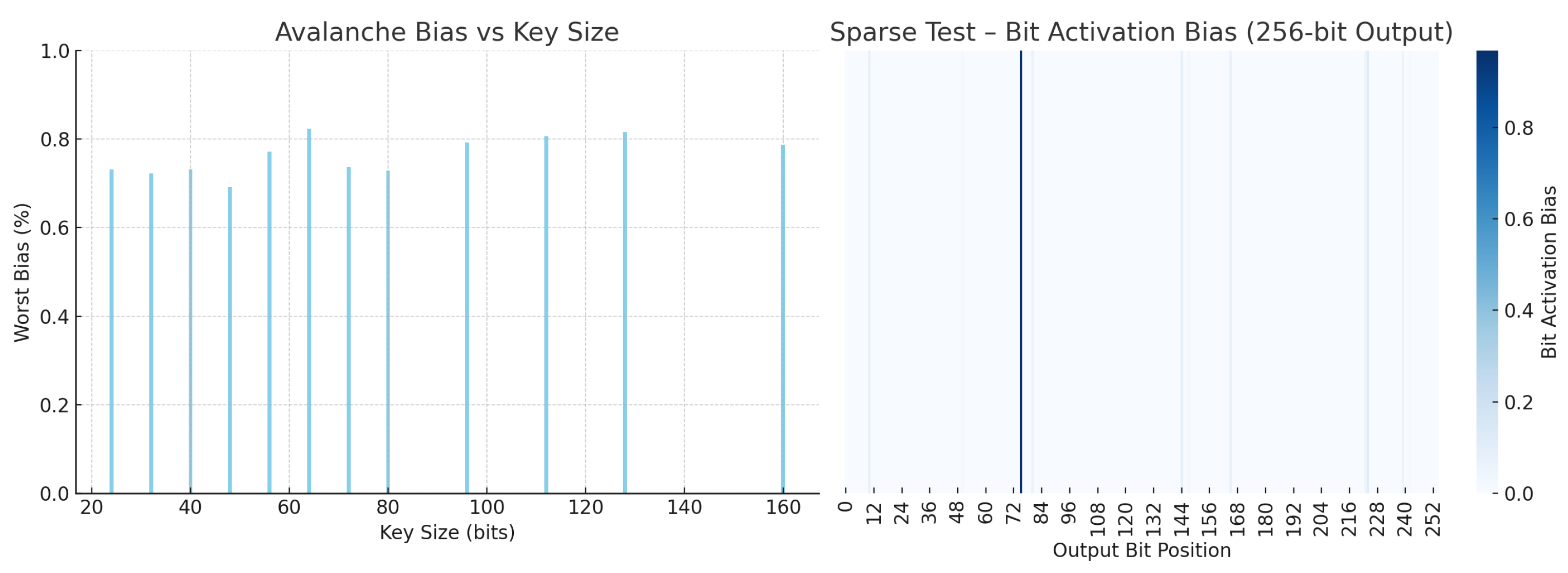
We evaluated Ascon-Hash using SMHasher [19] to assess its diffusion behavior and structural robustness. Avalanche testing confirmed that flipping a single input bit results in balanced output changes. Sparse key testing, particularly relevant for structured logs or repetitive data, revealed strong bit dispersion, which enhances collision resistance in real-world log chains.
To evaluate bit-level diffusion within the Merkle tree structure, we implemented a custom Python simulation that perturbs each leaf node individually and computes the resulting bit differences in the root digest. Table 9 summarizes statistical changes in output across different tree levels, highlighting the sensitivity and diffusion strength of Ascon-based hashing.
Notably, Ascon-Hash and SHA3-256 show almost identical variance profiles across levels 0–3, indicating similar avalanche strength during internal propagation. At the root level (level 4), SHA3-256 exhibits a marginally higher mean and lower variance, suggesting tighter diffusion consistency at the final aggregation point, as visualized in Figure 10.
The presence of zero-bit differences in levels 0–3 stems from subtree isolation, only nodes along the affected branch are impacted. This effect diminishes at the root level, where all perturbed leaves contribute to observable changes.
To evaluate how this behavior scales, we extended the analysis across deeper Merkle trees with , , , and leaves. For each tree size, we flipped one leaf input and measured the bit difference in the root hash as shown in Figure 11.
As shown in Table 10, both Ascon-Hash and SHA3-256 converge toward similar mean diffusion values as the tree depth increases, though Ascon exhibits slightly higher variance for small and medium tree sizes.
Our Python-based simulation revealed several critical findings. First, both Ascon-Hash and SHA3-256 exhibit a strong avalanche effect across varying tree sizes. Specifically, a single-bit perturbation in a leaf node consistently produces a root-level bit difference close to 128 out of 256 bits, precisely the expected value for an ideal cryptographic hash function with uniform diffusion. This behavior confirms the robustness of Ascon-Hash in propagating changes throughout the tree structure.
Second, the variance of root-level bit differences stabilizes as tree depth increases. This indicates that deeper Merkle trees exhibit more consistent and predictable behavior in their root digests. Such consistency is essential for applications like blockchain integrity or tamper-evident logs, where deterministic hash outcomes are required for reliable verification and inclusion proofs.
Finally, across all evaluated tree sizes, Ascon-Hash closely mirrors the performance of SHA3-256 in terms of both the mean and variance of diffusion. This suggests that Ascon-Hash can serve as a competitive alternative for secure Merkle aggregation, particularly in constrained-resource platforms such as IoT devices or FPGAs, where computational efficiency and low hardware footprint are critical.
These findings carry significant implications for real-world deployments. In IoT sensor networks, where Merkle trees typically span 64 to 256 leaves, Ascon-Hash delivers cryptographically secure root digests while maintaining minimal computational overhead. This makes it an ideal candidate for lightweight device authentication [6] and secure data aggregation [68].
For applications in blockchain systems or post-quantum digital signature schemes, such as SPHINCS+, where trees with 512 to 1024 leaves are common, Ascon-Hash continues to maintain uniform and predictable diffusion [58]. This ensures that even large-scale Merkle constructions can benefit from Ascon-Hash’s security properties without sacrificing performance, making it a strong fit for tamper-evident storage, ledger integrity, and quantum-resistant authentication protocols.
Overall, Ascon-Hash matches the diffusion performance of SHA3-256 while offering superior efficiency for hardware implementations, reinforcing its role as a viable and scalable solution for Merkle tree–based applications in constrained environments [69].
6. Discussion
This study presents a multi-faceted empirical evaluation of the Ascon hash family, with an emphasis on structural robustness, cryptographic diffusion, and practical applicability in constrained environments. The results demonstrate that Ascon-Hash and Ascon-XOF consistently exhibit low output bias, strong avalanche behavior, and excellent input sensitivity across both synthetic keyset tests and real-world simulations. Compared to SHA3-256, SHAKE256, BLAKE2s, and selected non-cryptographic hashes, Ascon variants show highly competitive performance, particularly in resource-aware deployments where lightweight implementation is critical.
The SMHasher suite analysis in Section 5.1 confirmed that Ascon-Hash delivers excellent bit diffusion, especially under sparse, cyclic, and permutation keyset conditions. These tests model common structural patterns in embedded systems, hash tables, and packet headers. Ascon-Hash achieved the lowest permutation test bias (0.081%) and top-tier performance in sparse input conditions, outperforming even SHA3-256 in some metrics [19]. These findings validate its robustness against low-entropy or adversarial input structures, making it a strong candidate for secure indexing and fingerprinting tasks.
In Section 5.2, we extended our evaluation to Bloom filter–based replay prevention under realistic nonce indexing scenarios [16]. The Python simulation showed that Ascon-XOF128 consistently maintained the lowest FPR over 200,000 nonce insertions, outperforming SHA3-256, SHAKE256, and MurmurHash3. This result underscores the importance of internal diffusion properties, particularly for short fixed-length inputs common in edge devices [64]. The sponge structure of Ascon-XOF proved especially effective in distributing entropy uniformly, reducing the likelihood of hash collisions within the Bloom filter [39]. Ascon-XOF’s suitability for lightweight, stateless replay detection was thus empirically validated, highlighting its relevance in CoAP, MQTT-SN, and secure telemetry pipelines [16].
Section 5.3 explored Ascon’s integration into post-quantum signature schemes, specifically referencing the Ascon-Sign proposal [58]. Compared to SPHINCS+-128s and SPHINCS-256, Ascon-Sign demonstrated significantly lower hardware resource requirements and acceptable signing energy costs, despite slightly higher latency. These findings are critical for secure IoT platforms where both memory and power are constrained. The reuse of Ascon-XOF for pseudorandom generation and tree hashing further simplifies hardware implementation and enables streaming-friendly digest computation. This affirms that Ascon variants can serve as cryptographic drop-in replacements in PQC schemes without compromising structural security.
As discussed in Section 5.4, Ascon-Hash proved highly effective for structured fingerprinting scenarios. Simulations of log entries with minimal field changes revealed consistent avalanche scores near 127 bits at par with SHA3-256 and BLAKE2s. Unlike MurmurHash3, which suffered from poor avalanche behavior, Ascon-Hash maintained high sensitivity across input pairs, ensuring that minor changes in logs or configuration files yield distinct fingerprints [53]. Furthermore, the support for chained hashing enables forward-secure log construction without the need for full Merkle materialization [66]. This makes Ascon-Hash a strong candidate for secure audit trails, clone detection, and software version tracking in embedded devices.
Section 5.5 presented a detailed comparison of Ascon-Hash and SHA3-256 within Merkle tree constructions. Root-level diffusion analysis, conducted using a Python simulation, revealed that both hash functions maintain near-ideal avalanche behavior across tree depths from to leaves. While SHA3-256 showed slightly tighter variance at the root level, Ascon-Hash exhibited similar mean diffusion and stable variance trends, indicating reliable propagation of leaf-level changes through the aggregation hierarchy. These results, aligned with SMHasher tests, reinforce Ascon-Hash’s viability in Merkle-based systems such as blockchain ledgers, firmware authentication, and post-quantum signature trees [20,43].
Taken together, these results underscore the versatility and efficiency of Ascon hash functions across a range of structural, cryptographic, and embedded contexts. Their ability to simultaneously deliver low overhead and strong diffusion while maintaining hardware friendliness positions them as valuable tools for modern lightweight systems. Future research may focus on extending support in cryptographic libraries, developing streaming interfaces, and verifying side-channel resistance in hardware deployments.
While the empirical results demonstrate that Ascon’s hash variants are strong candidates for lightweight, cryptographically secure applications, several practical limitations should be acknowledged before advocating widespread adoption.
First, the Ascon hash variants are relatively new [6] and have not yet achieved widespread integration into major cryptographic libraries such as OpenSSL, Libsodium, or BoringSSL. This limited ecosystem support hinders seamless adoption in production environments that depend on mature, standardized APIs, and may require developers to rely on standalone implementations or custom wrappers.
Second, although the Ascon permutation has undergone public scrutiny as part of the NIST-LWC competition, the hash-specific variants have not yet received the same level of cryptanalytic attention as established hash functions like SHA3-256 or BLAKE2s. While no structural weaknesses are currently known, caution is advised when deploying Ascon hashes in long-term or high-security infrastructure until further independent analysis is available.
Third, while Ascon-XOF and Ascon-CXOF do support variable-length outputs similar to SHAKE256, all Ascon hash variants use fixed-round permutations and fixed capacity-rate configurations. This design choice simplifies implementation and reduces attack surfaces but limits flexibility in tuning throughput or security margins for domain-specific performance goals. In contrast, SHAKE256 offers more configurability, allowing users to balance output length, digest size, and performance according to application needs [11].
Fourth, due to the sponge-based architecture [39], Ascon hashes require careful handling of input padding, domain separation, and context management to prevent unintended collisions or output reuse in composite constructions such as key derivation functions (KDFs), message authentication codes (MACs), or tree-based hashing. These concerns are not unique to Ascon but must be explicitly addressed to ensure secure use in multi-stage cryptographic protocols.
Finally, compatibility with existing infrastructure presents a deployment hurdle. Many protocol stacks, digital signature schemes, and secure bootloaders are tightly coupled with SHA2 or SHA3-based primitives [70,71]. Substituting Ascon may require dual-hash compatibility, transitional wrappers, or formal adoption through standards bodies such as ISO or IETF. Until these integrations mature, the use of Ascon hash functions may be best suited for emerging systems, constrained environments, or research-driven deployments where low overhead and lightweight properties are prioritized.
Despite these limitations, the Ascon hash family presents a compelling combination of efficiency, structural robustness, and cryptographic soundness. Its inclusion in the NIST-LWC standard [6] provides a strong foundation for further adoption and analysis, particularly in the growing landscape of secure IoT and embedded applications.
7. Conclusions
This study provides a comprehensive empirical evaluation of the Ascon hash family, highlighting its strong diffusion characteristics, structural robustness, and practical applicability across a range of lightweight security scenarios. Through SMHasher benchmarks and Python-based simulations, we demonstrated that Ascon-Hash and Ascon-XOF offer competitive or superior performance compared to established cryptographic and non-cryptographic hash functions in tasks such as Bloom filter indexing, fingerprinting, Merkle tree aggregation, and post-quantum signature integration. Despite limitations related to ecosystem maturity, fixed parameter configurations, and current lack of widespread standardization, Ascon’s sponge-based architecture and hardware-friendly design make it a compelling candidate for secure, efficient deployment in constrained environments such as IoT nodes, edge devices, and blockchain systems. These findings reinforce the untapped potential of Ascon hashes as structurally resilient, cryptographically sound alternatives for modern lightweight applications.
Author Contributions
Conceptualization, M.G.K. and Y.C.; methodology, M.G.K. and Y.C.; software, M.G.K.; validation, M.G.K. and Y.C.; formal analysis, M.G.K.; investigation, M.G.K.; resources, Y.C.; data curation, M.G.K.; writing—original draft preparation, M.G.K.; writing—review and editing, M.G.K. and Y.C.; visualization, M.G.K.; supervision, Y.C. All authors have read and agreed to the published version of the manuscript.
Funding
This research received no external funding.
Data Availability Statement
The original contributions presented in this study are included in the article. Further inquiries can be directed to the corresponding authors.
Conflicts of Interest
The authors declare no conflicts of interest.
Abbreviations
The following abbreviations are used in this manuscript:
| IoT | Internet Of Things |
| AEAD | Authenticated Encryption with Associated Data |
| XOF | eXtendable Output Function |
| NIST | National Institute of Standards and Technology |
| LWC | Lightweight Cryptography |
| SHA | Secure Hash Algorithm |
| MMO | Matyas–Meyer–Oseas |
| AES | Advanced Encryption Standard |
| FPR | False Positive Rate |
| PQC | Post Quantum Cryptography |
References
- Paar, C.; Pelzl, J. Understanding Cryptography: A Textbook for Students and Practitioners; Springer: Berlin, Heidelberg, 2010. [Google Scholar] [CrossRef]
- Chi, L.; Zhu, X. Hashing techniques: A survey and taxonomy. ACM Computing Surveys (Csur) 2017, 50, 1–36. [Google Scholar] [CrossRef]
- Safi, M.; Dadkhah, S.; Shoeleh, F.; Mahdikhani, H.; Molyneaux, H.; Ghorbani, A.A. A survey on IoT profiling, fingerprinting, and identification. ACM Transactions on Internet of Things 2022, 3, 1–39. [Google Scholar] [CrossRef]
- Lemire, D.; Kaser, O. Faster 64-bit universal hashing using carry-less multiplications. In Proceedings of the Proceedings of the 11th ACM International Conference on Performance Engineering (ICPE), 2019, pp. 83–90.
- Bloom, B.H. Space/time trade-offs in hash coding with allowable errors. Communications of the ACM 1970, 13, 422–426. [Google Scholar] [CrossRef]
- Turan, M.S.; McKay, K.A.; Kang, J.; Kelsey, J.; Chang, D. Ascon-Based Lightweight Cryptography Standards for Constrained Devices: Authenticated Encryption, Hash, and Extendable Output Functions. Special Publication SP 800-232, National Institute of Standards and Technology (NIST), 2025. [CrossRef]
- Wu, Y. Hardware-Software Co-Design of the Lightweight Authenticated Encryption Algorithm ASCON for Internet of Things. In Proceedings of the 2024 International Conference on Information Technology, Comunication Ecosystem and Management (ITCEM); 2024; pp. 124–128. [Google Scholar] [CrossRef]
- Malal, A. High-Performance FPGA Implementations of Lightweight ASCON-128 and ASCON-128a with Enhanced Throughput-to-Area Efficiency. Cryptology ePrint Archive, Paper 2025/825, 2025. [CrossRef]
- Bernstein, D.J. SUPERCOP: System for Unified Performance Evaluation Related to Cryptographic Operations and Primitives. https://bench.cr.yp.to/supercop.html, 2022. Accessed: 2025-07-30.
- Project, E. eBACS: ECRYPT Benchmarking of Cryptographic Systems. https://bench.cr.yp.to/index.html, 2022. Accessed: 2025-07-30.
- National Institute of Standards and Technology (NIST). SHA-3 Standard: Permutation-Based Hash and Extendable-Output Functions. Federal Information Processing Standards Publication FIPS 202, National Institute of Standards and Technology, 2015. [CrossRef]
- Bertoni, G.; Daemen, J.; Peeters, M.; Assche, G.V. The SHA-3 Family: KECCAK, SHAKE and RawSHAKE. https://keccak.team/keccak_specs_summary.html, 2014.
- Aumasson, J.P.; Neves, S.; Wilcox-O’Hearn, Z.; Winnerlein, C. BLAKE2 — fast secure hashing. https://blake2.net/, 2013.
- Appleby, A. MurmurHash3 Implementation (SMHasher). https://github.com/aappleby/smhasher/blob/master/src/MurmurHash3.cpp, 2012. Public-domain reference implementation of MurmurHash3.
- Cyan4973 / xxHash contributors. xxHash – Extremely fast non-cryptographic hash algorithm. https://xxhash.com/. Accessed: 2025-07-20.
- Gladis Kurian, M.; Chen, Y. Ascon on FPGA: Post-Quantum Safe Authenticated Encryption with Replay Protection for IoT. Electronics 2025, 14, 2668. [Google Scholar] [CrossRef]
- Amudha, G. Dilated transaction access and retrieval: Improving the information retrieval of blockchain-assimilated internet of things transactions. Wireless Personal Communications 2022, 127, 85–105. [Google Scholar] [CrossRef]
- Al-Zubaidie, M. Implication of lightweight and robust hash function to support key exchange in health sensor networks. Symmetry 2023, 15, 152. [Google Scholar] [CrossRef]
- Urban, R.; Appleby, A. SMHasher: Test Suite for Hash Functions. https://github.com/rurban/smhasher, 2023.
- Abed, S.; Jaffal, R.; Mohd, B.J.; Al-Shayeji, M. An analysis and evaluation of lightweight hash functions for blockchain-based IoT devices. Cluster computing 2021, 24, 3065–3084. [Google Scholar] [CrossRef]
- Patgiri, R.; Nayak, S.; Muppalaneni, N.B. Is Bloom Filter a Bad Choice for Security and Privacy? In Proceedings of the 2021 International Conference on Information Networking (ICOIN); 2021; pp. 648–653. [Google Scholar] [CrossRef]
- Menezes, A.; van Oorschot, P.; Vanstone, S. Handbook of Applied Cryptography; CRC Press, 1996.
- Windarta, S.; Suryadi, S.; Ramli, K.; Pranggono, B.; Gunawan, T.S. Lightweight cryptographic hash functions: Design trends, comparative study, and future directions. Ieee Access 2022, 10, 82272–82294. [Google Scholar] [CrossRef]
- Rogaway, P.; Shrimpton, T. Introduction to Modern Cryptography. In Proceedings of the Proceedings of the 1st International Conference on Cryptology in India (INDOCRYPT). Springer, 2004, pp. 1–14.
- Katz, J.; Lindell, Y. Introduction to Modern Cryptography, 3rd ed.; CRC Press, 2020.
- Rivest, R.L. The MD4 Message Digest Algorithm. RFC 1320, Internet Engineering Task Force, 1992. [CrossRef]
- Rivest, R.L. The MD5 Message-Digest Algorithm. RFC 1321, Internet Engineering Task Force, 1992. [CrossRef]
- Wang, X.; Yu, H. How to break MD5 and other hash functions. In Proceedings of the Annual international conference on the theory and applications of cryptographic techniques. Springer; 2005; pp. 19–35. [Google Scholar]
- National Institute of Standards and Technology (NIST). Secure Hash Standard. Federal Information Processing Standards Publication FIPS PUB 180-1, National Institute of Standards and Technology, 1995. Withdrawn on August 1, 2002. Superseded by FIPS 180-2. [CrossRef]
- Stevens, M.; Bursztein, E.; Karpman, P.; Albertini, A.; Markov, Y. The first collision for full SHA-1. Cryptology ePrint Archive, Paper 2017/190, 2017.
- National Institute of Standards and Technology (NIST). Secure Hash Standard (SHS). Federal Information Processing Standards Publication FIPS 180-4, National Institute of Standards and Technology, 2015. [CrossRef]
- NIST. Cryptographic Hash Algorithm Competition. https://csrc.nist.gov/projects/hash-functions/sha-3-project, 2007.
- Bertoni, G.; Daemen, J.; Peeters, M.; Van Assche, G. Keccak sponge function family main document. Submission to NIST (Round 2) 2009, 3, 320–337. [Google Scholar]
- Kumar, T.M.; Reddy, K.S.; Rinaldi, S.; Parameshachari, B.D.; Arunachalam, K. A low area high speed FPGA implementation of AES architecture for cryptography application. Electronics 2021, 10, 2023. [Google Scholar] [CrossRef]
- Ahmad, N.; Hasan, S.R. A new ASIC implementation of an advanced encryption standard (AES) crypto-hardware accelerator. Microelectronics Journal 2021, 117, 105255. [Google Scholar] [CrossRef]
- Shukla, P.K.; Aljaedi, A.; Pareek, P.K.; Alharbi, A.R.; Jamal, S.S. AES based white box cryptography in digital signature verification. Sensors 2022, 22, 9444. [Google Scholar] [CrossRef]
- Rana, M.; Mamun, Q.; Islam, R. Lightweight cryptography in IoT networks: A survey. Future Generation Computer Systems 2022, 129, 77–89. [Google Scholar] [CrossRef]
- Singh, S.; Sharma, P.K.; Moon, S.Y.; Park, J.H. Advanced lightweight encryption algorithms for IoT devices: survey, challenges and solutions. Journal of Ambient Intelligence and Humanized Computing 2024, 15, 1625–1642. [Google Scholar] [CrossRef]
- Bertoni, G.; Daemen, J.; Peeters, M.; Assche, G.V. Sponge Functions. In Proceedings of the ECRYPT Hash Workshop, 2007. pp. 11, 21–23, 27.
- Shor, P.W. Algorithms for Quantum Computation: Discrete Logarithms and Factoring. In Proceedings of the Proceedings of the 35th Annual Symposium on Foundations of Computer Science (FOCS). IEEE, 1994, pp. 124–134. [CrossRef]
- Grover, L.K. A fast quantum mechanical algorithm for database search. In Proceedings of the Proceedings of the Twenty-Eighth Annual ACM Symposium on Theory of Computing, New York, NY, USA, 1996; STOC ’96, p. 212–219. [CrossRef]
- Joseph, D.; Misoczki, R.; Manzano, M.; Tricot, J.; Pinuaga, F.D.; Lacombe, O.; Leichenauer, S.; Hidary, J.; Venables, P.; Hansen, R. Transitioning organizations to post-quantum cryptography. Nature 2022, 605, 237–243. [Google Scholar] [CrossRef]
- Bernstein, D.J.; Hülsing, A.; Kölbl, S.; Niederhagen, R.; Rijneveld, J.; Schwabe, P. The SPHINCS+ signature framework. In Proceedings of the Proceedings of the 2019 ACM SIGSAC conference on computer and communications security, 2019, pp. 2129–2146.
- Sharma, J.; Kim, D.; Lee, A.; Seo, D. On differential privacy-based framework for enhancing user data privacy in mobile edge computing environment. Ieee access 2021, 9, 38107–38118. [Google Scholar] [CrossRef]
- Alfrhan, A.; Moulahi, T.; Alabdulatif, A. Comparative study on hash functions for lightweight blockchain in Internet of Things (IoT). Blockchain: Research and Applications 2021, 2, 100036. [Google Scholar] [CrossRef]
- Bernstein, D.J., Introduction to post-quantum cryptography. In Post-Quantum Cryptography; Bernstein, D.J.; Buchmann, J.; Dahmen, E., Eds.; Springer Berlin Heidelberg: Berlin, Heidelberg, 2009; pp. 1–14. [CrossRef]
- Turan, M.S.; McKay, K.A.; Chang, D.; Kang, J.; Kelsey, J. Ascon-Based Lightweight Cryptography Standards for Constrained Devices: Authenticated Encryption, Hash, and Extendable Output Functions (Initial Public Draft). NIST Special Publication SP 800-232 ipd, National Institute of Standards and Technology, Gaithersburg, MD, 2024. [CrossRef]
- Ascon – Lightweight Cryptography, 2025. Accessed: 19 August 2025.
- Nguyen, K.D.; Dang, T.K.; Kieu-Do-Nguyen, B.; Le, D.H.; Pham, C.K.; Hoang, T.T. ASIC Implementation of ASCON Lightweight Cryptography for IoT Applications. IEEE Transactions on Circuits and Systems II: Express Briefs 2025, 72, 278–282. [Google Scholar] [CrossRef]
- Weissbart, L.; Picek, S. Lightweight but not easy: Side-channel analysis of the ascon authenticated cipher on a 32-bit microcontroller. Cryptology ePrint Archive 2023. [Google Scholar]
- Webster, A.F.; Tavares, S.E. On the design of S-boxes. In Proceedings of the Conference on the theory and application of cryptographic techniques. Springer; 1985; pp. 523–534. [Google Scholar]
- Tarkoma, S.; Rothenberg, C.E.; Lagerspetz, E. Theory and practice of bloom filters for distributed systems. IEEE Communications Surveys & Tutorials 2011, 14, 131–155. [Google Scholar] [CrossRef]
- Yang, K.; Li, Q.; Sun, L. Towards automatic fingerprinting of IoT devices in the cyberspace. Computer networks 2019, 148, 318–327. [Google Scholar] [CrossRef]
- Merkle, R.C. A digital signature based on a conventional encryption function. In Proceedings of the Conference on the theory and application of cryptographic techniques. Springer; 1987; pp. 369–378. [Google Scholar]
- Paik, H.Y.; Xu, X.; Bandara, H.D.; Lee, S.U.; Lo, S.K. Analysis of data management in blockchain-based systems: From architecture to governance. Ieee Access 2019, 7, 186091–186107. [Google Scholar] [CrossRef]
- Abbasian Dehkordi, S.; Farajzadeh, K.; Rezazadeh, J.; Farahbakhsh, R.; Sandrasegaran, K.; Abbasian Dehkordi, M. A survey on data aggregation techniques in IoT sensor networks. Wireless Networks 2020, 26, 1243–1263. [Google Scholar] [CrossRef]
- Yang, R.; Yu, F.R.; Si, P.; Yang, Z.; Zhang, Y. Integrated blockchain and edge computing systems: A survey, some research issues and challenges. IEEE Communications Surveys & Tutorials 2019, 21, 1508–1532. [Google Scholar] [CrossRef]
- Magyari, A.; Chen, Y. Securing the Internet of Things with Ascon-Sign. Internet of Things 2024, 28, 101394. [Google Scholar] [CrossRef]
- Magyari, A.; Chen, Y. Post-Quantum SecureSensor Networks: Combining Ascon and SPHINCS+. In Proceedings of the 2024 IEEE 4th International Conference on Electronic Communications, Internet of Things and Big Data (ICEIB); 2024; pp. 139–144. [Google Scholar] [CrossRef]
- Amiet, D.; Leuenberger, L.; Curiger, A.; Zbinden, P. FPGA-based SPHINCS+ Implementations: Mind the Glitch. In Proceedings of the 2020 23rd Euromicro Conference on Digital System Design (DSD); 2020; pp. 229–237. [Google Scholar] [CrossRef]
- Amiet, D.; Curiger, A.; Zbinden, P. FPGA-based Accelerator for Post-Quantum Signature Scheme SPHINCS-256. IACR Transactions on Cryptographic Hardware and Embedded Systems 2018, 2018, 18–39. [Google Scholar] [CrossRef]
- Martino, R.; Cilardo, A. SHA-2 Acceleration Meeting the Needs of Emerging Applications: A Comparative Survey. IEEE Access 2020, 8, 28415–28436. [Google Scholar] [CrossRef]
- Joan, D.; Vincent, R. The design of Rijndael: AES-the advanced encryption standard. Information Security and Cryptography 2002, 196. [Google Scholar]
- Menezes, A.J.; Van Oorschot, P.C.; Vanstone, S.A. Handbook of applied cryptography; CRC press, 2018.
- Schneier, B.; Kelsey, J. Secure audit logs to support computer forensics. ACM Transactions on Information and System Security (TISSEC) 1999, 2, 159–176. [Google Scholar] [CrossRef]
- Morillo Reina, J.D.; Mateo Sanguino, T.J. Decentralized and Secure Blockchain Solution for Tamper-Proof Logging Events. Future Internet 2025, 17, 108. [Google Scholar] [CrossRef]
- Kulothungan, V. Using Blockchain Ledgers to Record AI Decisions in IoT. IoT 2025, 6, 37. [Google Scholar] [CrossRef]
- Kuznetsov, O.; Rusnak, A.; Yezhov, A.; Kanonik, D.; Kuznetsova, K.; Domin, O. Efficient and Universal Merkle Tree Inclusion Proofs via OR Aggregation. Cryptography 2024, 8, 28. [Google Scholar] [CrossRef]
- Berbecaru, D.; Albertalli, L. On the performance and use of a space-efficient merkle tree traversal algorithm in real-time applications for wireless and sensor networks. In Proceedings of the 2008 IEEE International Conference on Wireless and Mobile Computing, Networking and Communications. IEEE; 2008; pp. 234–240. [Google Scholar]
- Rescorla, E. The transport layer security (TLS) protocol version 1.3. Technical report, 2018.
- Digital Signature Standard (DSS). Technical Report FIPS PUB 186-5, NIST, 2023.
Figure 1.
Timeline illustrating the evolution of cryptographic hash functions from legacy algorithms (e.g., MD5, SHA-1) through modern constructions (e.g., SHA-2, SHA-3, BLAKE2/3, Ascon-Hash) to the emerging post-quantum cryptography (PQC) era. Categories are distinguished by color as follows: legacy/insecure (deprecated designs no longer recommended for security use), modern secure (currently standardized and widely deployed), lightweight (optimized for constrained devices and IoT), and PQC-ready (designed or adapted for quantum-resistant applications). This categorization highlights each function’s security role, application domain, and relevance in current cryptographic standards.
Figure 1.
Timeline illustrating the evolution of cryptographic hash functions from legacy algorithms (e.g., MD5, SHA-1) through modern constructions (e.g., SHA-2, SHA-3, BLAKE2/3, Ascon-Hash) to the emerging post-quantum cryptography (PQC) era. Categories are distinguished by color as follows: legacy/insecure (deprecated designs no longer recommended for security use), modern secure (currently standardized and widely deployed), lightweight (optimized for constrained devices and IoT), and PQC-ready (designed or adapted for quantum-resistant applications). This categorization highlights each function’s security role, application domain, and relevance in current cryptographic standards.
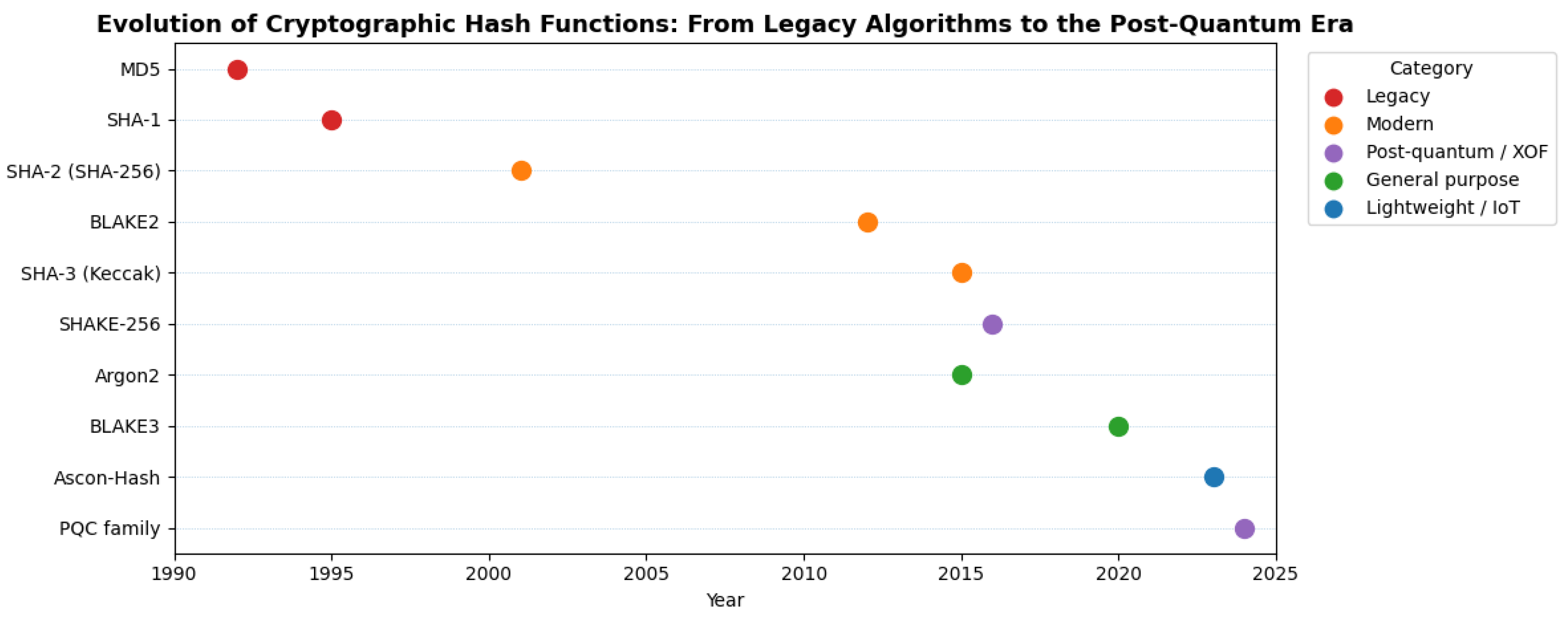
Figure 2.
Hashing mode for Ascon-Hash256, Ascon-XOF128
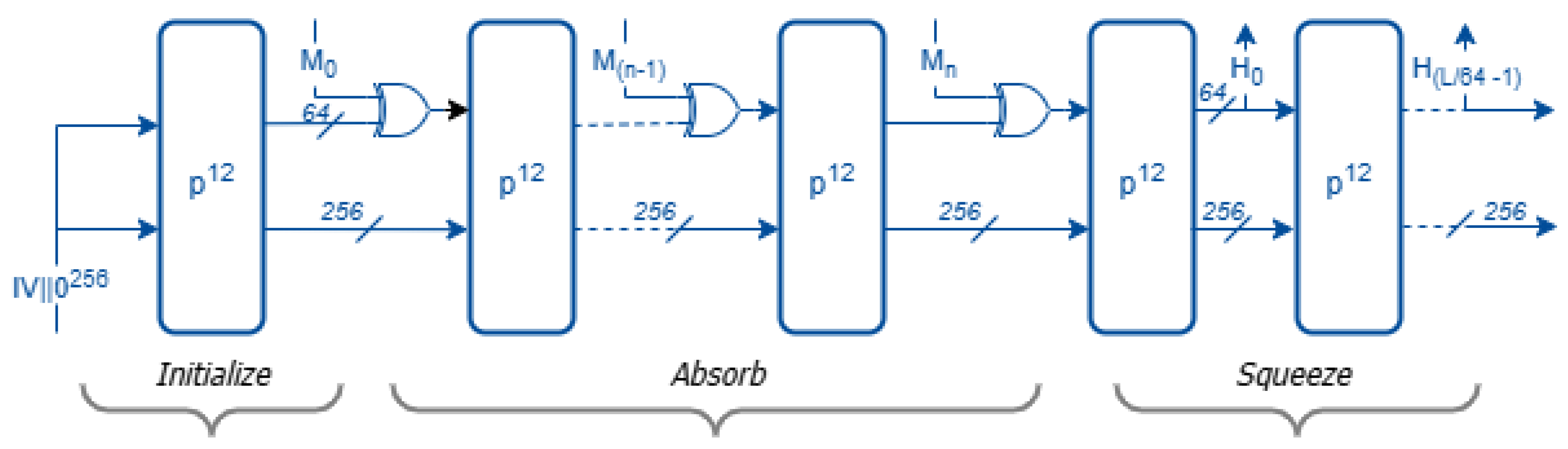
Figure 3.
Hashing mode for Ascon-CXOF128
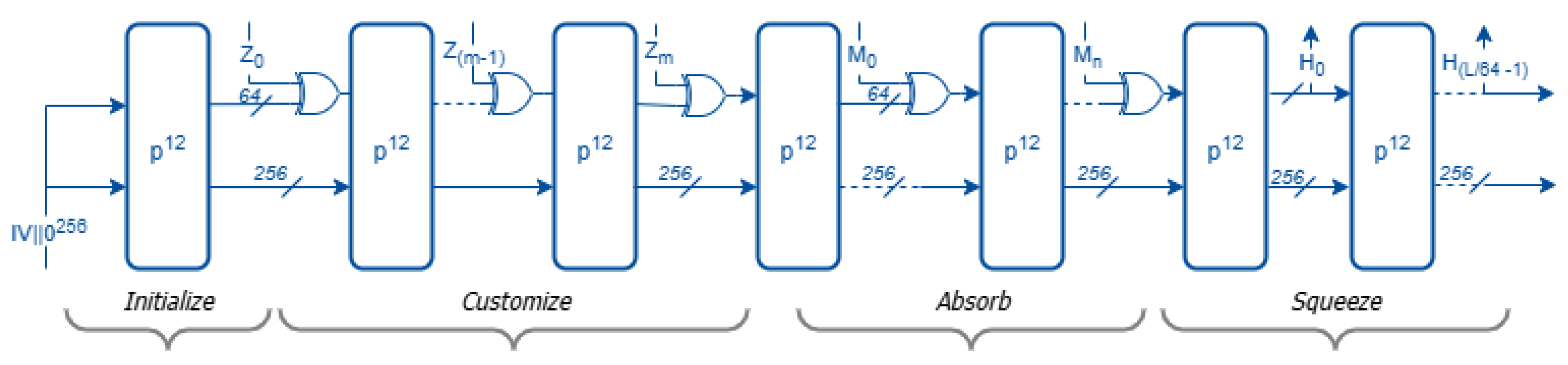
Figure 5.
The 5-bit S-Box used in the Ascon permutation [48]
Figure 5.
The 5-bit S-Box used in the Ascon permutation [48]
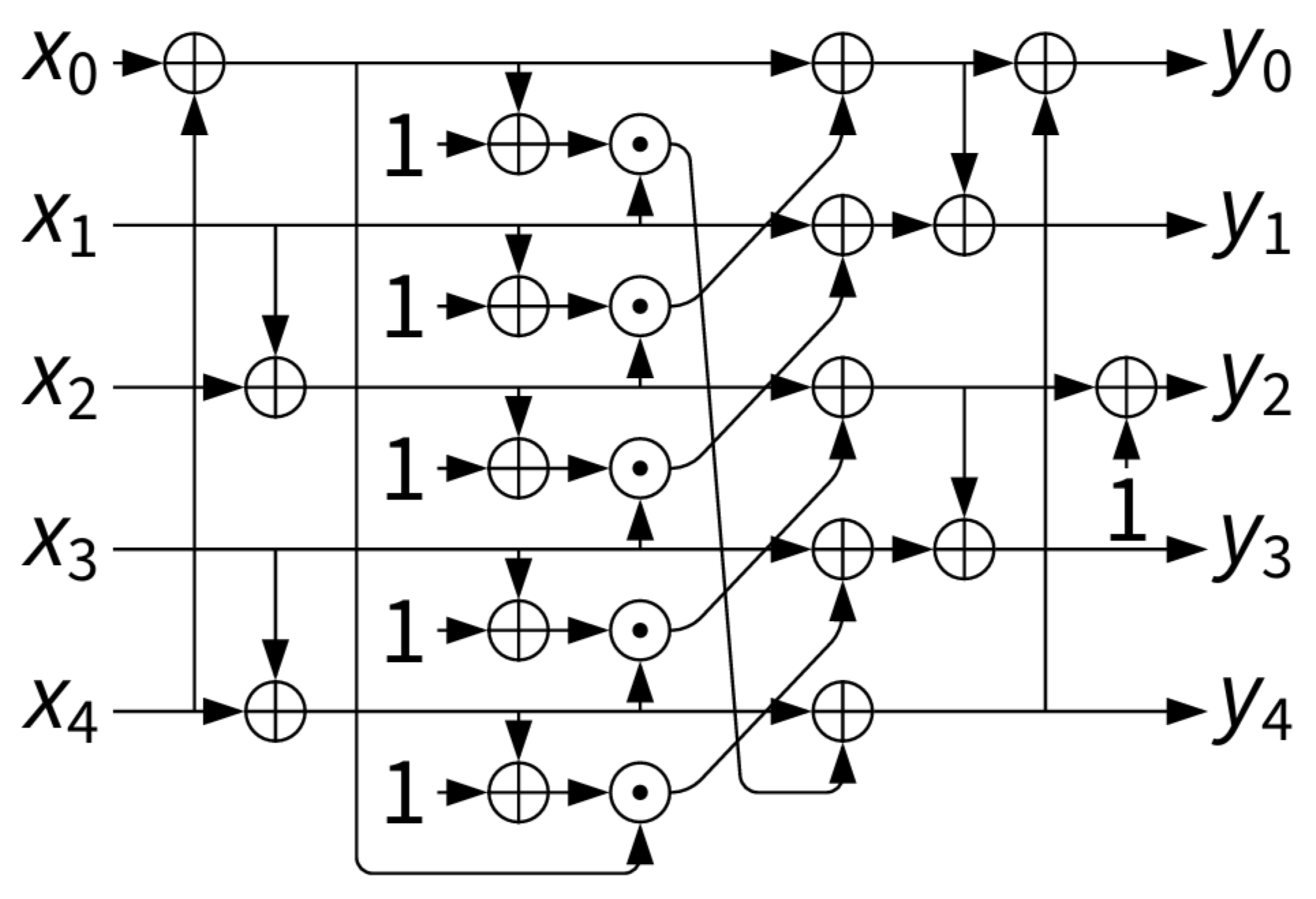
Figure 6.
Linear diffusion layer () where each word is XORed with two rotated versions of itself [47]
Figure 6.
Linear diffusion layer () where each word is XORed with two rotated versions of itself [47]
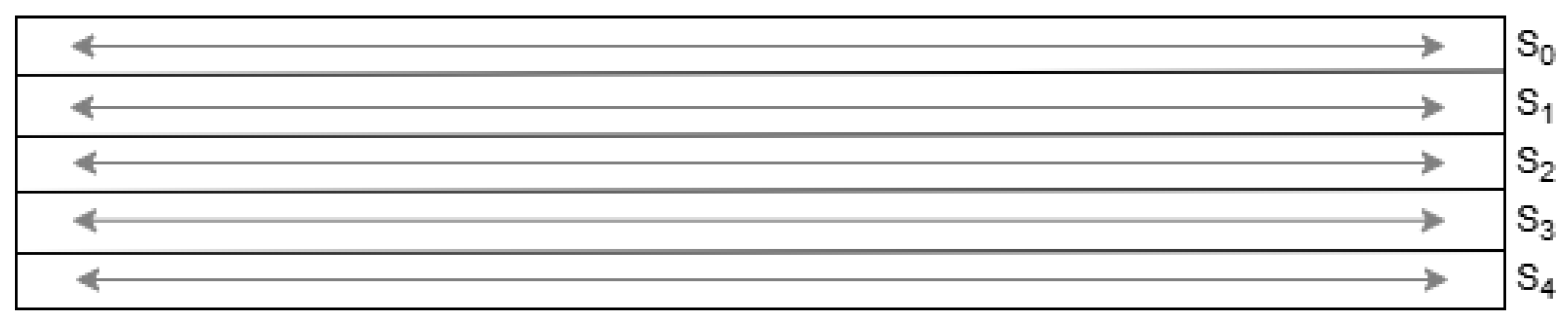
Figure 7.
Running-average false positive rate (FPR) during Bloom filter fill for Ascon-Hash256, SHA3-256, MurmurHash, and xxHash with , , and insertions. The Ascon-Hash256 trajectory closely follows that of the fastest non-cryptographic hashes while preserving cryptographic security guarantees. In the context of blockchain-enabled IoT systems, this stability ensures that replayed or duplicate messages are filtered at the edge before being committed to distributed ledgers, thereby reducing ledger pollution and strengthening transaction integrity.
Figure 7.
Running-average false positive rate (FPR) during Bloom filter fill for Ascon-Hash256, SHA3-256, MurmurHash, and xxHash with , , and insertions. The Ascon-Hash256 trajectory closely follows that of the fastest non-cryptographic hashes while preserving cryptographic security guarantees. In the context of blockchain-enabled IoT systems, this stability ensures that replayed or duplicate messages are filtered at the edge before being committed to distributed ledgers, thereby reducing ledger pollution and strengthening transaction integrity.
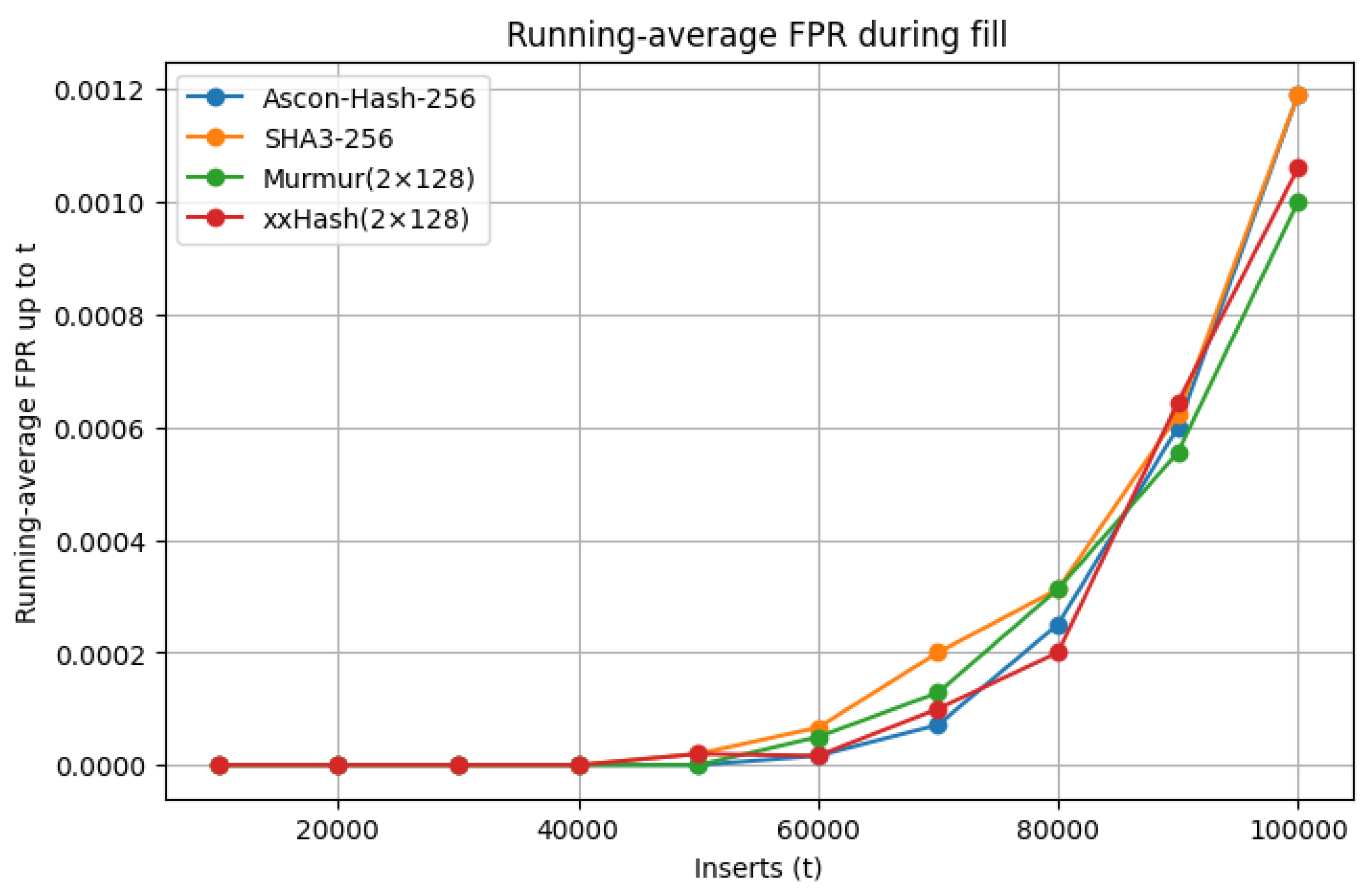
Figure 8.
Per-pair avalanche heatmap (bits flipped) for 256-bit outputs across algorithms and adjacent log pairs (Table 7). Non-cryptographic hashes use the fair 256-bit construction .
Figure 8.
Per-pair avalanche heatmap (bits flipped) for 256-bit outputs across algorithms and adjacent log pairs (Table 7). Non-cryptographic hashes use the fair 256-bit construction .
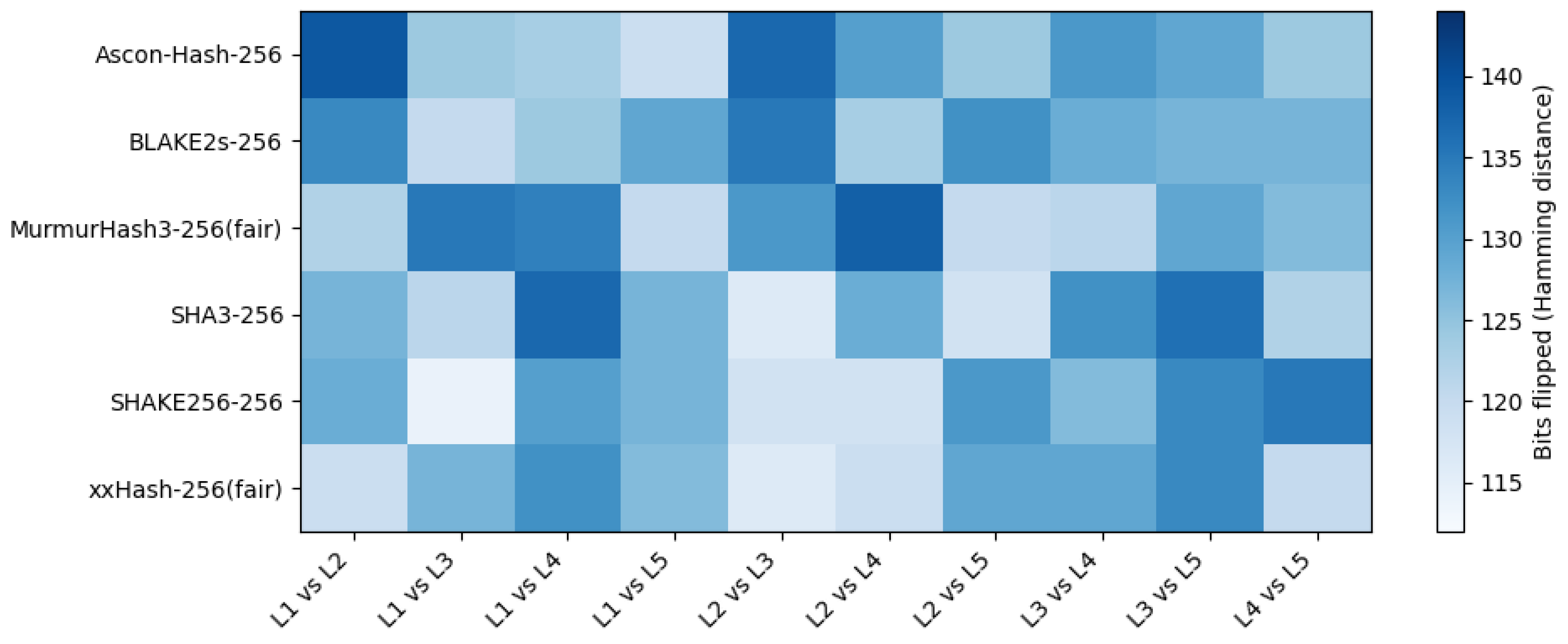
Figure 10.
Comparison of Ascon-Hash and SHA3-256 in Merkle trees: (left) mean bit differences per tree level; (right) variance of bit differences across perturbed inputs. Both functions exhibit strong avalanche effects, with Ascon-Hash showing slightly higher diffusion variance at intermediate levels.
Figure 10.
Comparison of Ascon-Hash and SHA3-256 in Merkle trees: (left) mean bit differences per tree level; (right) variance of bit differences across perturbed inputs. Both functions exhibit strong avalanche effects, with Ascon-Hash showing slightly higher diffusion variance at intermediate levels.
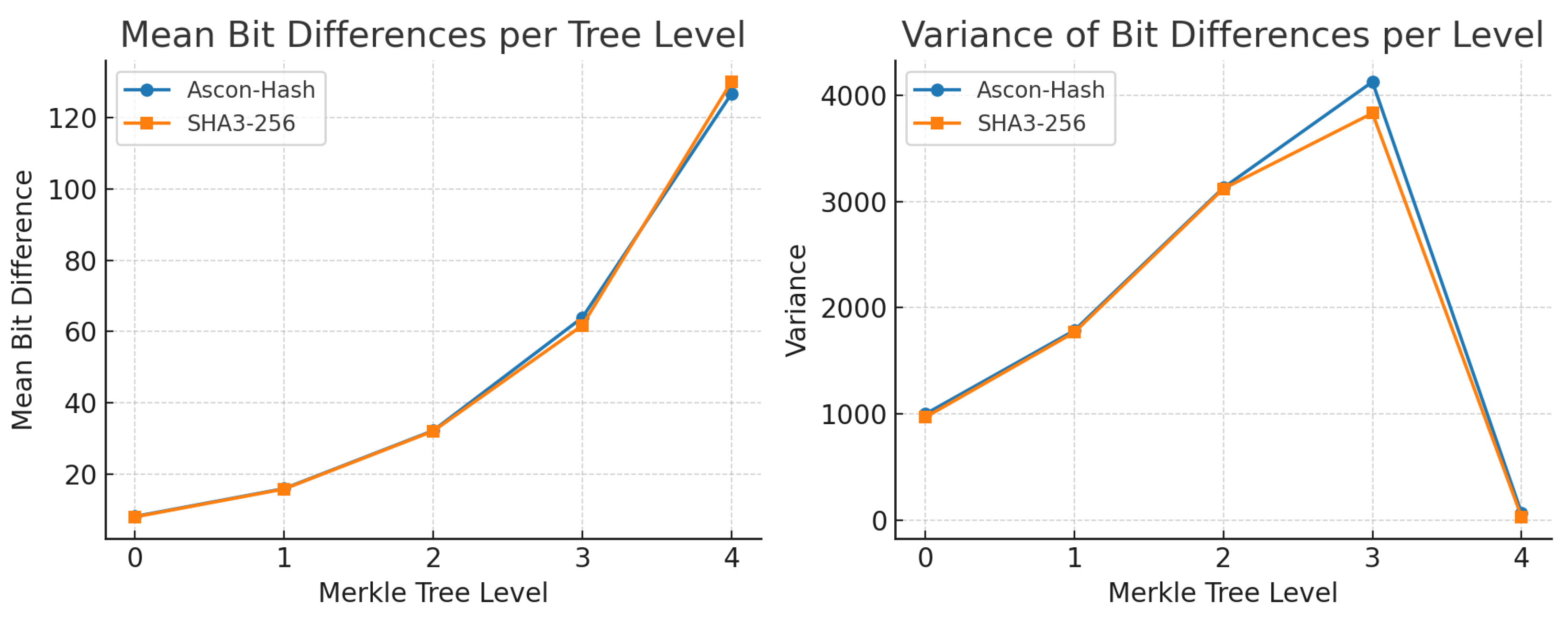
Figure 11.
Root-level diffusion behavior as a function of Merkle tree size for Ascon-Hash and SHA3-256. Left: Mean bit difference in the root digest. Right: Variance of bit differences.
Figure 11.
Root-level diffusion behavior as a function of Merkle tree size for Ascon-Hash and SHA3-256. Left: Mean bit difference in the root digest. Right: Variance of bit differences.
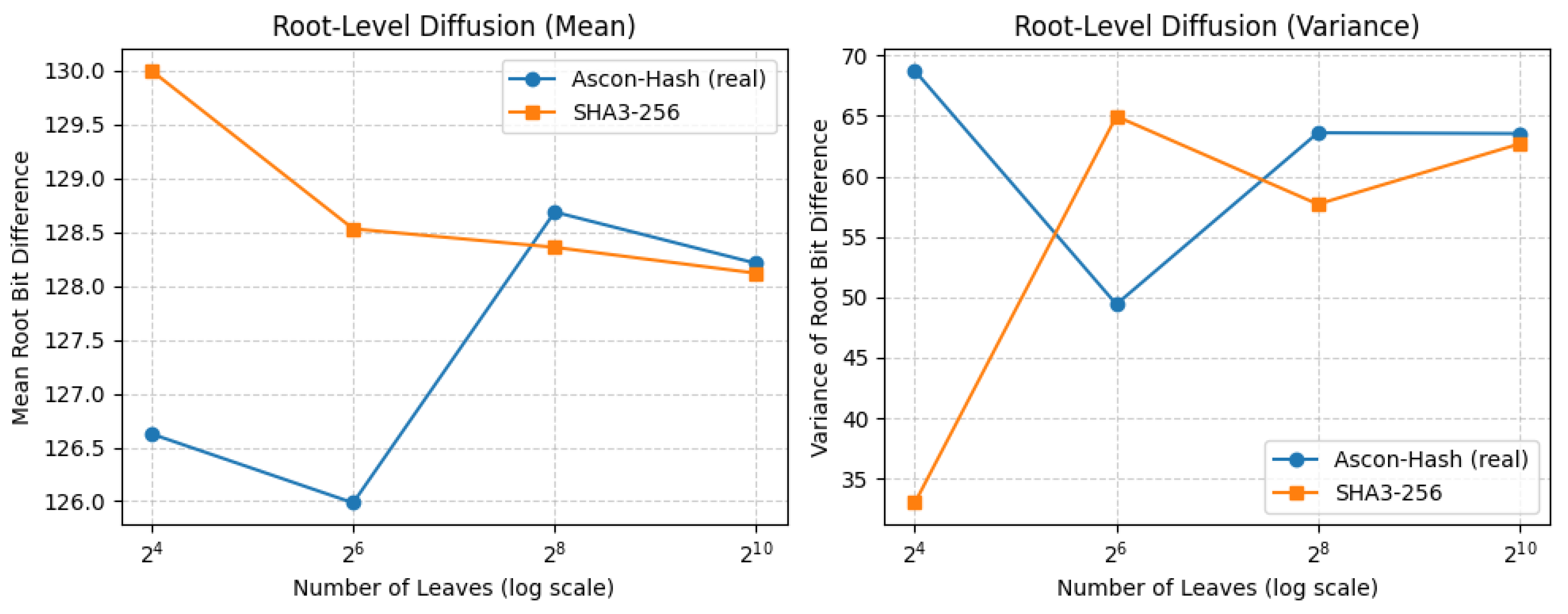

Table 1.
Round constants for Ascon permutation rounds [6].
Table 1.
Round constants for Ascon permutation rounds [6].
| i | i | ||
|---|---|---|---|
| 0 | 0x000000000000003c | 8 | 0x00000000000000b4 |
| 1 | 0x000000000000002d | 9 | 0x00000000000000a5 |
| 2 | 0x000000000000001e | 10 | 0x0000000000000096 |
| 3 | 0x000000000000000f | 11 | 0x0000000000000087 |
| 4 | 0x00000000000000f0 | 12 | 0x0000000000000078 |
| 5 | 0x00000000000000e1 | 13 | 0x0000000000000069 |
| 6 | 0x00000000000000d2 | 14 | 0x000000000000005a |
| 7 | 0x00000000000000c3 | 15 | 0x000000000000004b |
Table 2.
Lookup table for Ascon’s 5-bit S-box.
| x | 0 | 1 | 2 | 3 | 4 | 5 | 6 | 7 | 8 | 9 | a | b | c | d | e | f |
|---|---|---|---|---|---|---|---|---|---|---|---|---|---|---|---|---|
| SBox(x) | 4 | b | 1f | 14 | 1a | 15 | 9 | 2 | 1b | 5 | 8 | 12 | 1d | 3 | 6 | 1c |
| x | 10 | 11 | 12 | 13 | 14 | 15 | 16 | 17 | 18 | 19 | 1a | 1b | 1c | 1d | 1e | 1f |
| SBox(x) | 1e | 13 | 7 | e | 0 | d | 11 | 18 | 10 | c | 1 | 19 | 16 | a | f | 17 |
Table 3.
Ascon Hash Variants and their potential applications.
| Variant | Output Type | Potential Applications |
|---|---|---|
| Ascon-Hash | Fixed (256-bit) | Message authentication, digital signatures |
| Ascon-XOF | Extendable | Key derivation, Merkle trees, PRFs |
| Ascon-CXOF | Extendable w/ context | Domain-separated hashing |
Table 4.
Consolidated SMHasher Results: Avalanche, Keyset, and Bit Distribution Metrics
| Algorithm | Avalanche Bias (%) | Sparse (%) | Perm. (%) | Cyclic (%) | Zeroes (%) |
|---|---|---|---|---|---|
| Ascon-Hash256 | 0.823 | 0.968 | 0.081 | 0.151 | 0.322 |
| SHA3-256 | 1.013 | 0.581 | 0.093 | 0.182 | 0.330 |
| BLAKE2S-256 | 0.855 | 0.594 | 0.099 | 0.204 | 0.424 |
| MurmurHash3 | 0.787 | 0.594 | 0.088 | 0.183 | 0.243 |
| xxHash | 0.780 | 0.649 | 0.084 | 0.134 | 0.332 |
Table 5.
Comparison of Hash-Based PQC Signature Schemes on FPGA
| Scheme | Security | Device | Sig. Size | LUT | FF | Area (BRAM) | DSP | Fclk (MHz) | Tsign (ms) | Power (W) | Esign (mWs) |
|---|---|---|---|---|---|---|---|---|---|---|---|
| Ascon-Sign-128s [59] | 1 | Artix-7 | 7.8 kB | 7.0k | 5.9k | 1.0 | 0 | 100 | 822.3 | 0.208 | 170 |
| SPHINCS+-128s [60] | 1 | Artix-7 | 8.1 kB | 48k | 73k | 11.5 | 0 | 500 | 12.4 | 9.71 | 120 |
| SPHINCS+-256s [60] | 5 | Artix-7 | 29.8 kB | 51k | 75k | 22.5 | 1 | 500 | 19.3 | 9.80 | 188 |
| SPHINCS-256 [61] | N/A | Kintex-7 | 41 kB | 19k | 38k | – | 36 | 525 | 1.53 | 4.97 | 7.6 |
Table 6.
Security strengths of Ascon hash variants and SHA3 functions
| Function | Output size (bits) | Collision | Preimage | 2nd Preimage |
|---|---|---|---|---|
| Ascon-Hash256 | 256 | 128 | 128 | 128 |
| Ascon-XOF128 | L | |||
| Ascon-CXOF128 | L | |||
| SHA3-224 | 224 | 112 | 224 | 224 |
| SHA3-256 | 256 | 128 | 256 | 256 |
| SHA3-384 | 384 | 192 | 384 | 384 |
| SHA3-512 | 512 | 256 | 512 | 512 |
| SHAKE128 | L | |||
| SHAKE256 | L |
Table 7.
Structured log entries used in fingerprinting evaluation.
| Log ID | Log Entry |
|---|---|
| L1 | Temp:22C;Time:123456 |
| L2 | Temp:23C;Time:123456 |
| L3 | Temp:22C;Time:123457 |
| L4 | Temp:22C;Time:123456;Status:OK |
| L5 | Temp:22C;Time:123456;Status:FAIL |
| L6 | Temp:23C;Time:123457 |
| L7 | Temp:23C;Time:123456;Status:OK |
| L8 | Temp:23C;Time:123456;Status:FAIL |
| L9 | Temp:22C;Time:123457;Status:OK |
| L10 | Temp:22C;Time:123457;Status:FAIL |
Table 8.
Mean Hamming distances for structured log pairs (256-bit outputs). Non-cryptographic hashes were evaluated using a fair 256-bit construction: . Binomial expectation: mean = 128, .
Table 8.
Mean Hamming distances for structured log pairs (256-bit outputs). Non-cryptographic hashes were evaluated using a fair 256-bit construction: . Binomial expectation: mean = 128, .
| Algorithm | Mean bits flipped | Std. dev. |
|---|---|---|
| Ascon-Hash256 | 128.0 | 6.08 |
| BLAKE2s-256 | 127.8 | 4.45 |
| MurmurHash3-256 (fair) | 127.6 | 6.41 |
| SHA3-256 | 126.4 | 6.83 |
| SHAKE256-256 | 126.0 | 6.69 |
| xxHash-256 (fair) | 125.0 | 5.73 |
Table 9.
Bit-Diffusion Statistics per Merkle Tree Level (Ascon-Hash vs SHA3-256)
| Level | Count | Ascon-Hash | SHA3-256 | ||||||||
|---|---|---|---|---|---|---|---|---|---|---|---|
| Mean | Var | Min | Max | StdDev | Mean | Var | Min | Max | StdDev | ||
| 0 | 256 | 8.15 | 999.55 | 0 | 151 | 31.62 | 8.02 | 969.05 | 0 | 143 | 31.13 |
| 1 | 128 | 15.95 | 1785.53 | 0 | 141 | 42.24 | 15.84 | 1768.46 | 0 | 143 | 42.03 |
| 2 | 64 | 32.22 | 3128.11 | 0 | 141 | 55.91 | 32.08 | 3119.29 | 0 | 148 | 55.84 |
| 3 | 32 | 63.91 | 4124.27 | 0 | 149 | 64.22 | 61.69 | 3829.78 | 0 | 135 | 61.90 |
| 4 | 16 | 126.62 | 68.73 | 103 | 140 | 8.29 | 130.00 | 33.00 | 121 | 146 | 5.74 |
Table 10.
Root-level Bit-Diffusion Comparison Across Tree Sizes
| Tree Size | #Leaves | Ascon-Hash | SHA3-256 | ||
|---|---|---|---|---|---|
| Mean | Variance | Mean | Variance | ||
| Small | 126.31 | 68.69 | 130.00 | 33.00 | |
| Compact | 125.95 | 49.05 | 128.50 | 64.83 | |
| Medium | 128.60 | 63.40 | 128.29 | 57.94 | |
| Large | 128.18 | 63.18 | 128.10 | 62.88 | |
Disclaimer/Publisher’s Note: The statements, opinions and data contained in all publications are solely those of the individual author(s) and contributor(s) and not of MDPI and/or the editor(s). MDPI and/or the editor(s) disclaim responsibility for any injury to people or property resulting from any ideas, methods, instructions or products referred to in the content. |
© 2025 by the authors. Licensee MDPI, Basel, Switzerland. This article is an open access article distributed under the terms and conditions of the Creative Commons Attribution (CC BY) license (http://creativecommons.org/licenses/by/4.0/).
Copyright: This open access article is published under a Creative Commons CC BY 4.0 license, which permit the free download, distribution, and reuse, provided that the author and preprint are cited in any reuse.


