

Submitted:
18 August 2025
Posted:
19 August 2025
You are already at the latest version
Abstract
This paper presents a systematic methodology for identifying optimal scaling regions in segment-based box-counting fractal dimension calculations through a three-phase algorithmic framework combining boundary artifact detection, sliding window optimization, and grid offset optimization. Unlike traditional pixelated approaches that suffer from rasterization artifacts, the method used directly analyzes geometric line segments, providing superior accuracy for mathematical fractals and other computational applications. The three-phase optimization algorithm automatically determines optimal scaling regions and minimizes discretization bias without manual parameter tuning, achieving significant error reduction compared to traditional methods. Validation across Koch curves, Sierpinski triangles, Minkowski sausages, Hilbert curves, and Dragon curves demonstrates substantial improvements: excellent accuracy for Koch curves (0.11% error) and significant error reduction for Hilbert curves. All optimized results achieve R2≥0.9988. Iteration analysis establishes minimum requirements for reliable measurement, with convergence by level 6+ for Koch curves and level 3+ for Sierpinski triangles. Each fractal type exhibits optimal iteration ranges where authentic scaling behavior emerges before discretization artifacts dominate, challenging the assumption that higher iteration levels imply more accurate results. This work provides objective, automated fractal dimension measurement with comprehensive validation establishing practical guidelines for mathematical fractal analysis. The sliding window approach eliminates subjective scaling region selection through systematic evaluation of all possible linear regression windows, enabling measurements suitable for automated analysis workflows.
Keywords:
fractal dimension
; box-counting method
; sliding window optimization
; scaling region selection
; boundary artifact detection
; convergence analysis
1. Introduction
The accurate measurement of fractal dimensions presents a fundamental challenge that spans from theoretical mathematics to practical engineering applications. While the theoretical foundation was established by Richardson’s pioneering coastline studies [1] and Mandelbrot’s fractal geometry framework [2], practical computational methods began with Liebovitch and Toth’s breakthrough algorithm [3]. Despite decades of subsequent refinement, systematic errors persist, with recent analysis quantifying baseline quantization errors at approximately 8% [4].
Consider the fundamental dilemma in fractal dimension measurement: while fractals like the Koch curve have precisely known theoretical dimensions (), even these mathematical objects produce inconsistent computational results depending on implementation details and scaling region selection. A carefully implemented box-counting algorithm might yield using one scaling region and using another—but which measurement captures the true mathematical scaling behavior?
This illustrates a key challenge in fractal dimension estimation: inconsistent computational results despite known theoretical values. Traditional box-counting methods provide varying answers, with dimension estimates depending on arbitrary choices in scaling region selection.
1.1. The Evolution Of Box-Counting Optimization
The box-counting dimension D of a (fractal) object is defined as:
where is the number of boxes of size needed to cover the object. In practice, the limit is approximated through linear regression on the log-log plot of versus over a carefully selected range of box sizes. It is expected that the larger box-counts, if considered alone, would give inaccurate dimension (slope) because of the limit not yet being approached. However, at the other extreme the smallest box sizes may also, if considered alone, give inaccurate dimension (slope) due to numerical and other issues. The critical insight underlying the general algorithm is that scaling region selection can be formulated as an optimization problem: given a set of pairs, find the contiguous subset that maximizes linear regression quality while minimizing deviation from known theoretical values when available.
The computational implementation of fractal dimension measurement began with Liebovitch and Toth’s breakthrough algorithm [3], which established the efficiency foundation essential for practical applications. This was followed by systematic efforts to address parameter optimization challenges throughout the 1990s: Buczkowski et al. [5] identified critical issues with border effects and non-integer box size parameters, while Foroutan-pour et al. [6] provided comprehensive implementation refinements that improved practical reliability. Roy et al. [7] demonstrated that scaling region selection fundamentally determines accuracy, highlighting the persistent challenge of subjective decisions in linear regression analysis.
Recent advances have emphasized error characterization and mathematical precision improvements. Bouda et al. [4] quantified baseline quantization error at approximately 8%, establishing benchmark expectations for algorithmic improvements, while Wu et al. [8] demonstrated that fundamental accuracy improvements remained possible through interval-based approaches. Despite these sustained methodological advances, the fundamental problem persists: subjective scaling region selection introduces human bias, limits reproducibility, prevents automated analysis, and creates barriers for large-scale applications requiring objective, automated fractal dimension measurement.
Despite these sustained methodological advances, a fundamental problem persists: the subjective selection of scaling regions for linear regression analysis. In practice, the log-log relationship between box count and box size appears linear only over limited ranges, and the choice of this range dramatically affects calculated dimensions. This subjectivity manifests in several critical ways:
- Reproducibility challenges: Different researchers analyzing identical data may select different scaling regions, yielding inconsistent results
- Accuracy limitations: Arbitrary inclusion of data points outside optimal scaling ranges introduces systematic errors
- Application barriers: Manual scaling region selection prevents automated analysis of large datasets or real-time applications
- Bias introduction: Human judgment in region selection may unconsciously favor expected results
These limitations are particularly problematic for applications requiring objective, automated analysis essential for parameter studies, optimization workflows, and systematic comparative studies.
1.2. Research Objectives and Proposed Approach
This work, then, addresses the scaling region selection challenge through a comprehensive algorithm in three distinct phases which builds upon decades of methodological development. The research objectives directly target the fundamental limitations identified across this historical progression:
Primary Objective: Develop an automatic sliding window optimization method that objectively identifies optimal scaling regions without manual parameter tuning combined with enhanced boundary artifact detection and grid offset optimization.
Validation Strategy: Establish algorithm reliability through comprehensive validation across five different fractal types with precisely known dimensions, targeting significant error reduction compared to traditional methods while establishing practical computational guidelines for optimal iteration selection. This comprehensive validation framework establishes the foundation for the algorithmic development presented in the following section, providing objective, automated methods that eliminate subjective bias while achieving precision across diverse fractal geometries.
2. Materials And Methods
A comprehensive three-phase optimization framework was developed that systematically addresses the fundamental limitations identified in Section 1. Rather than treating boundary detection, scaling region selection, and grid discretization as separate concerns, the general algorithm integrates these requirements into a unified strategy.
2.1. Design Philosophy: Synthesis of Historical Insights
The sliding window optimization algorithm synthesizes key insights from the literature into a unified algorithmic strategy guided by three fundamental principles:
Segment-Based Geometric Analysis: Unlike traditional pixelated approaches, this method analyzes curves formed by a set of straight line segments, eliminating rasterization artifacts and providing superior accuracy for mathematical applications where interface geometry must be preserved precisely.
Boundary Artifact Detection: Comprehensive boundary artifact detection using statistical criteria (slope deviation threshold 0.12, correlation threshold 0.95) is used that automatically identifies and removes problematic data points without manual intervention.
Objective Region Selection: The sliding window approach eliminates subjective scaling region selection through systematic evaluation of all possible linear regression windows, addressing the reproducibility challenges that have limited practical applications.
2.2. Three-Phase Implementation Framework
This comprehensive approach addresses the complete pipeline from data generation through final dimension calculation, with each phase targeting specific limitations identified in historical research. The three-phase architecture systematically eliminates sources of error and bias.
2.2.1. Phase 1: Enhanced Boundary Artifact Detection
The first phase, Algorithm 1, systematically identifies and removes boundary artifacts that corrupt linear regression analysis, addressing limitations identified by Buczkowski et al. [5] and Gonzato et al. [9].
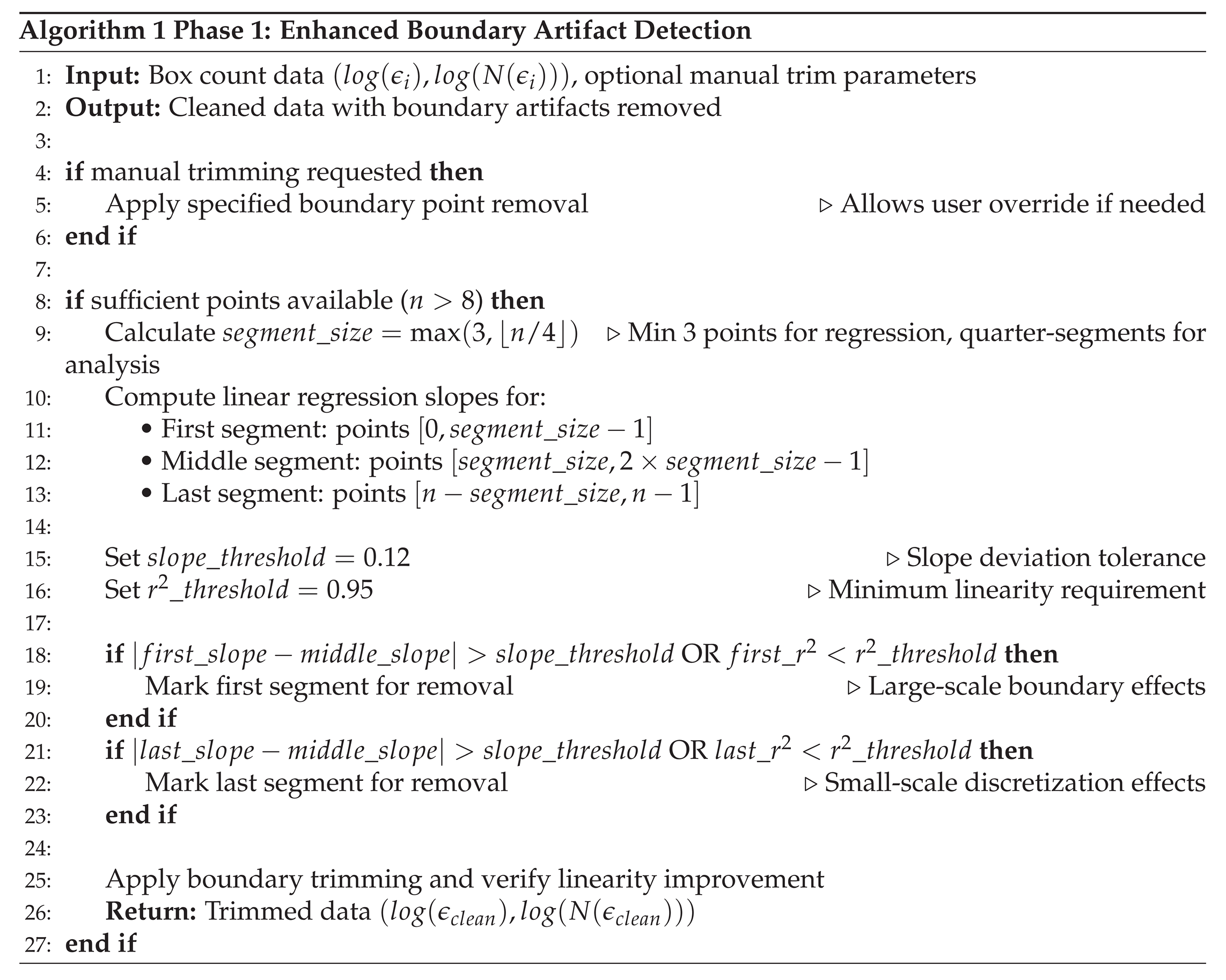
Rather than relying on arbitrary endpoint removal, this phase uses statistical criteria to identify genuine boundary artifacts. The slope deviation threshold (0.12) and correlation threshold (0.95) were determined through systematic analysis across multiple fractal types, providing objective artifact detection without manual parameter tuning.
2.2.2. Phase 2: Comprehensive Sliding Window Analysis
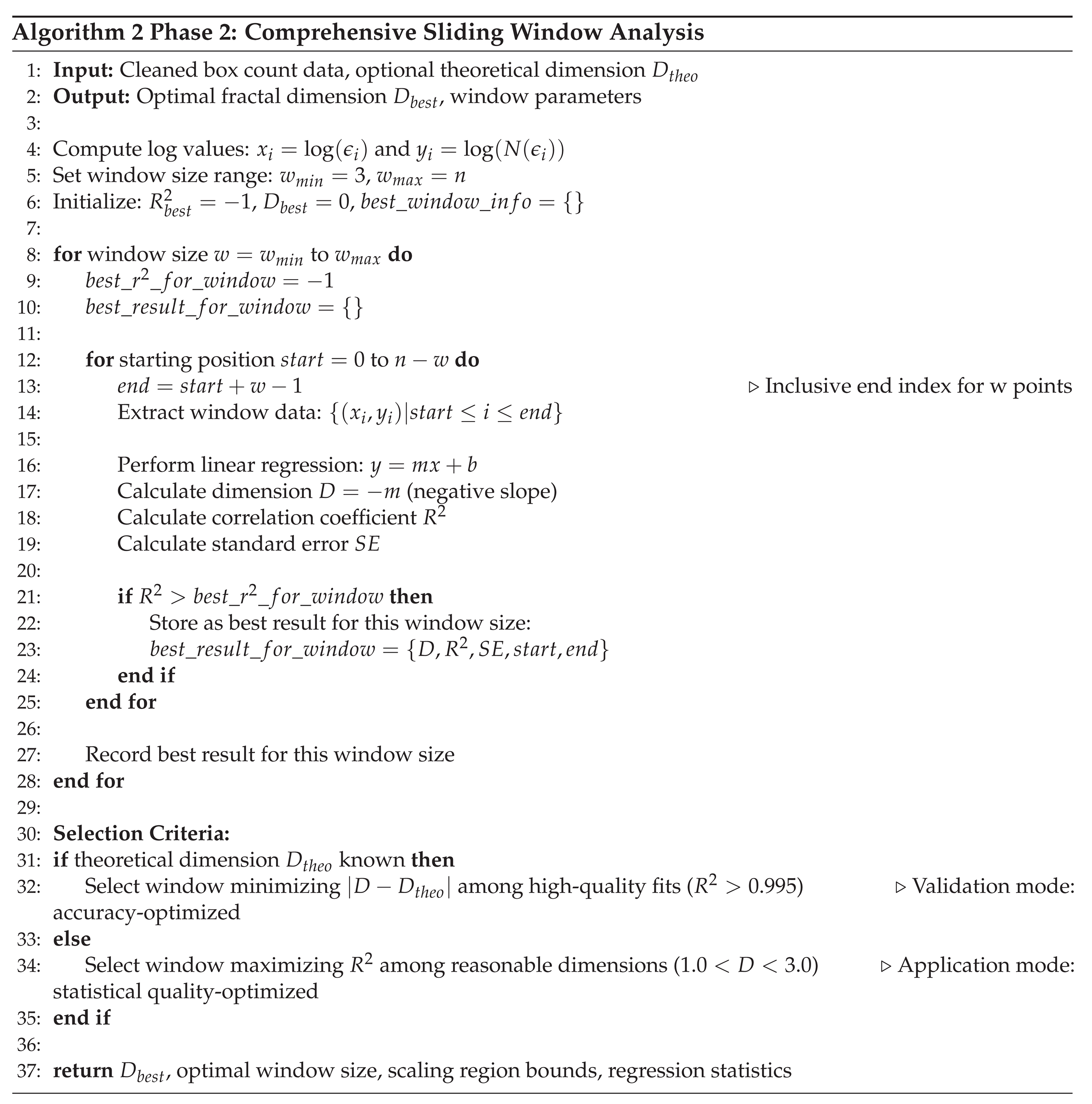
The second phase, Algorithm 2, implements the core innovation: systematic evaluation of all possible scaling regions to identify optimal linear regression windows without subjective selection. This systematic evaluation eliminates subjective scaling region selection by testing all possible contiguous windows and applying objective selection criteria. The dual selection approach (accuracy-optimized when theoretical values are known for validation, statistical quality-optimized for unknown cases) ensures optimal performance across both validation and application scenarios without introducing circular reasoning, whereby knowing the dimension leads to decisions made that return that value. This circularity manifests in several possible ways:
- Subjective endpoint selection: Researchers may unconsciously choose scaling ranges that yield dimensions close to expected values
- Post-hoc justification: Poor-fitting data points may be excluded without systematic criteria, introducing confirmation bias
- Inconsistent methodology: Different practitioners analyzing identical datasets may select different scaling regions, yielding inconsistent results
- Limited reproducibility: Manual scaling region selection prevents automated analysis of large datasets
2.2.3. Phase 3: Grid Offset Optimization
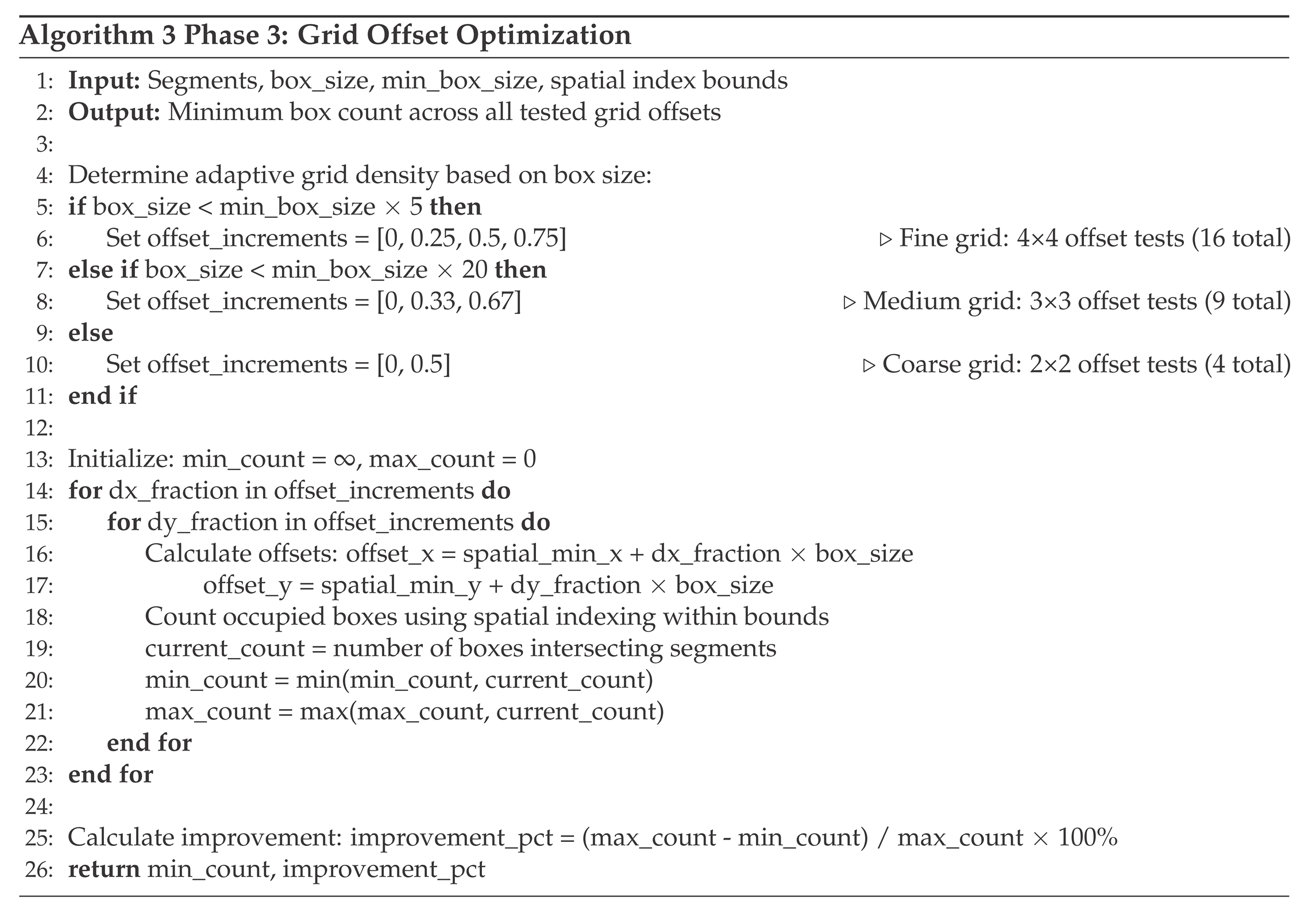
The third phase, Algorithm 3, implements grid offset optimization to minimize discretization bias inherent in traditional box-counting methods. The calculated dimension depends critically on how the grid of boxes intersects the curve. A curve segment lying near a box boundary may be counted as occupying one box or multiple boxes depending on slight shifts in grid positioning, introducing systematic bias into the intersection count. This quantization error can significantly affect fractal dimension estimates (c.f., Bouda et al. [4], Foroutan-pour et al. [6], and Gonzato et al. [9]).
2.3. Computational Implementation Details
The segment-based approach requires several key computational components that distinguish it from traditional pixelated methods:
2.3.1. Spatial Indexing and Line-Box Intersection
Efficient fractal dimension calculation for large datasets requires optimized spatial indexing. Hierarchical spatial partitioning [10] is implemented combined with the Liang-Barsky line clipping algorithm [11] for robust line-box intersection testing.
The Liang-Barsky algorithm provides several advantages for fractal analysis:
- Computational Efficiency: O(1) line-box intersection tests enable scalability to large datasets
- Numerical Robustness: Parametric line representation avoids floating-point precision issues common in geometric intersection
- Partial Intersection Handling: Accurately handles line segments that partially cross box boundaries
2.3.2. Adaptive Box Size Determination
Automatic box size range calculation adapts to fractal extent and complexity:
- Minimum box size (): Set to 2× average segment length to ensure adequate geometric resolution
- Maximum box size (): Limited to 1/8 of fractal bounding box to maintain statistical validity
- Logarithmic progression: Box sizes follow for consistent scaling analysis
This adaptive approach ensures consistent measurement quality across fractals of vastly different scales and complexities.
2.4. Computational Complexity and Efficiency
The three-phase approach achieves computational efficiency through strategic resource allocation:
- Phase 1: for boundary artifact detection, with early termination for clean data
- Phase 2: The sliding window analysis has practical complexity where n represents the number of box sizes, typically 10-20 for box size ranges spanning 2-3 decades of scaling. This remains computationally efficient because n is determined by the logarithmic box size progression rather than the number of line segments.
- Phase 3: where k is the number of offset tests (4-16) and m is the spatial intersection complexity, with adaptive testing density
Total computational complexity remains practical for real-time applications while providing systematic optimization across all three algorithmic phases.
3. Results
To validate the accuracy and robustness of the fractal dimension algorithm, comprehensive testing was performed using five well-characterized theoretical fractals with known dimensions ranging from 1.26 to 2.00, shown in Figure 1 through Figure 5. This validation approach ensures our method performs reliably across the full spectrum of geometric patterns encountered in two-dimensional fractal analysis.
These five fractal curves represent infinite mathematical objects that possess self-similar structure at all scales. Since true fractals contain unlimited detail, they can only be approximated through finite computational processes. Each fractal is generated by starting with a simple geometric seed (such as a line segment or triangle) and repeatedly applying a specific replacement rule through multiple iterations or recursive calls. The "level" parameter controls the number of times this replacement rule is applied—higher levels produce increasingly detailed approximations that more closely resemble the true infinite fractal. While complete fractals cannot be achieved computationally, these finite approximations capture sufficient geometric complexity to accurately measure fractal dimensions and analyze the self-similar properties that characterize real-world phenomena like fluid interfaces and coastlines. Therefore, computing their dimensions requires evaluating their "convergence" toward the infinite form.
Consequently, fractal dimension computation involves two critical aspects: first, whether the algorithm accurately calculates the dimension of the given curve, and second, whether the curve accurately represents the desired theoretical fractal. For mathematical fractals, curve fidelity depends on the iteration or recursion level used in generation. For computational physics applications where curves are generated from simulations and analyzed for fractal properties, the analogous consideration is grid convergence, since increased geometric detail emerges as the computational grid is refined.
3.1. Comprehensive Validation Framework
The validation strategy addresses both methodological rigor and practical applicability through systematic testing across diverse fractal geometries and avoiding the circularity problem.
3.1.1. Fractal Selection and Computational Scope
The validation employs five well-characterized theoretical fractals with known dimensions spanning the complete range relevant to mathematical fractal analysis as shown in Figure 1– Figure 5:
- Koch snowflake (): Classic self-similar coastline fractal with 16,384 segments at level 7.
- Minkowski sausage (): Exact theoretical dimension with 262,144 segments at level 6.
- Hilbert curve (): Space-filling curve approaching two-dimensional behavior with 16,383 segments at level 7.
- Sierpinski triangle (): Triangular self-similar structure with 6,561 segments at level 7.
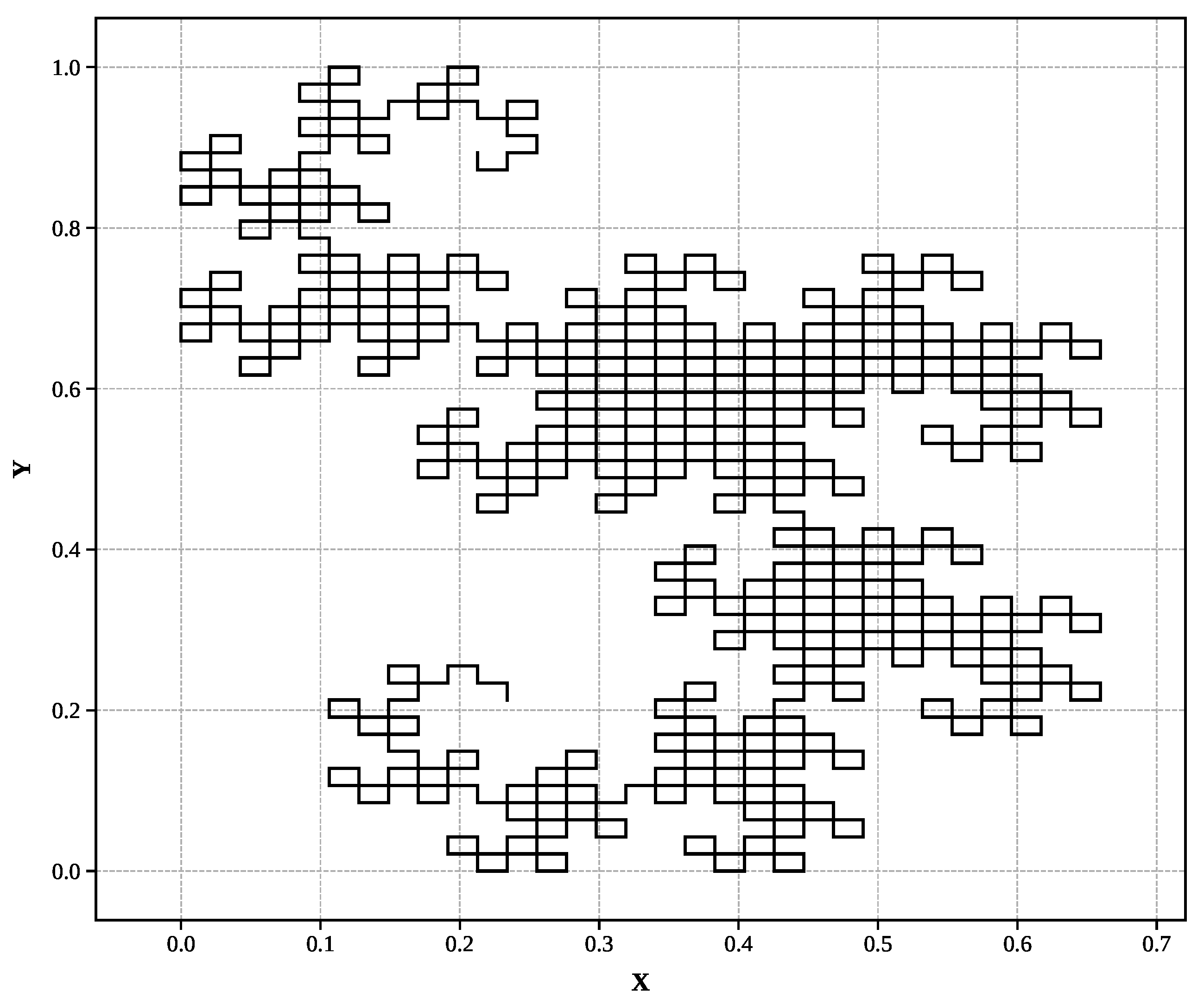
- Dragon curve (): Complex space-filling pattern with 1,023 segments at level 9.
This selection provides comprehensive validation across the dimensional spectrum (D = 1.26 to D = 2.00) while testing computational scalability across nearly three orders of magnitude in dataset size (1K to 262K segments). Each fractal represents distinct geometric characteristics, from simple coastlines to complex space-filling patterns.
Figure 1.
Koch snowflake (Level 7): Classic self-similar coastline fractal ()
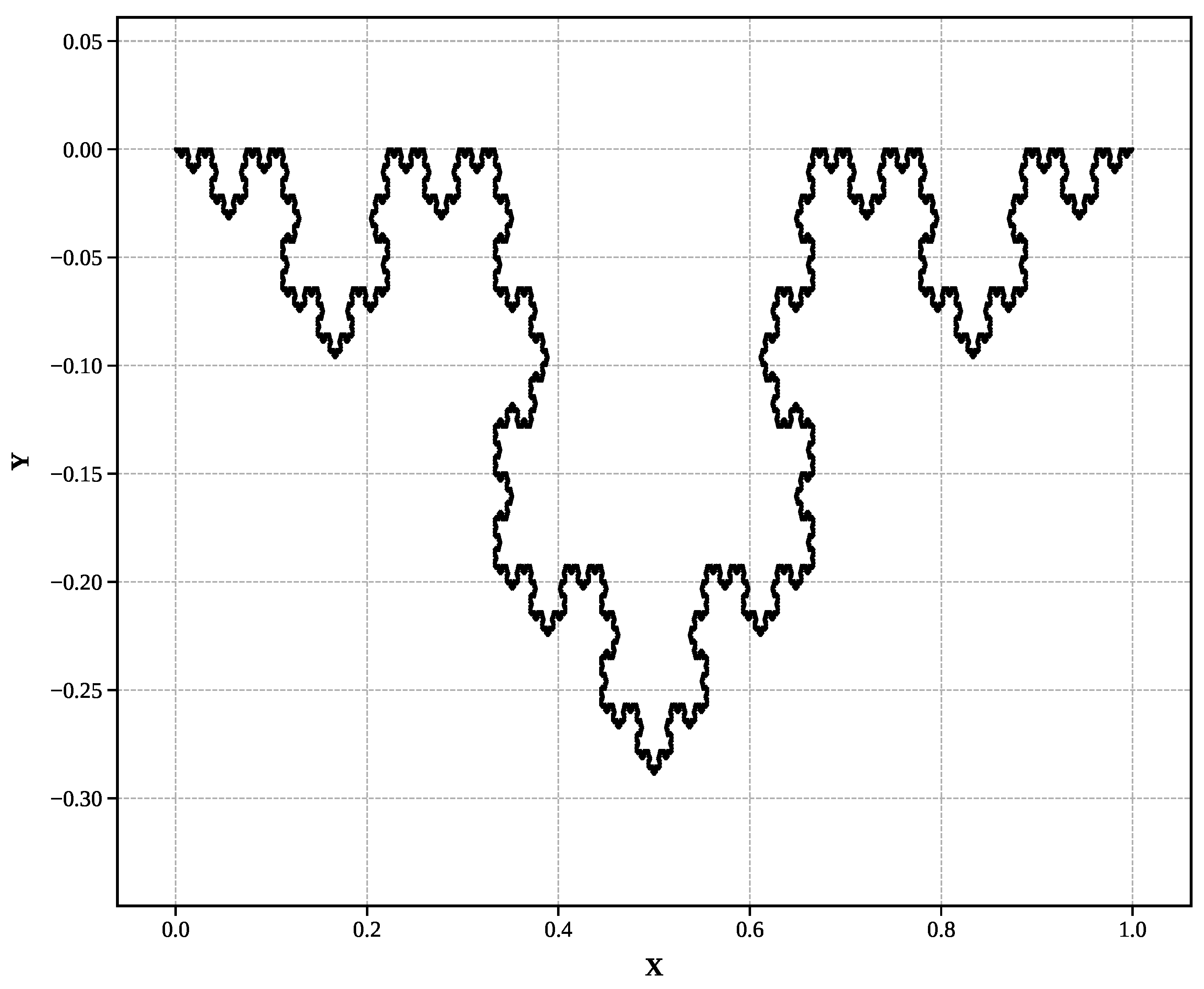
Figure 2.
Minkowski sausage (Level 6): Classic boundary-type fractal with known theoretical dimension ()
Figure 2.
Minkowski sausage (Level 6): Classic boundary-type fractal with known theoretical dimension ()
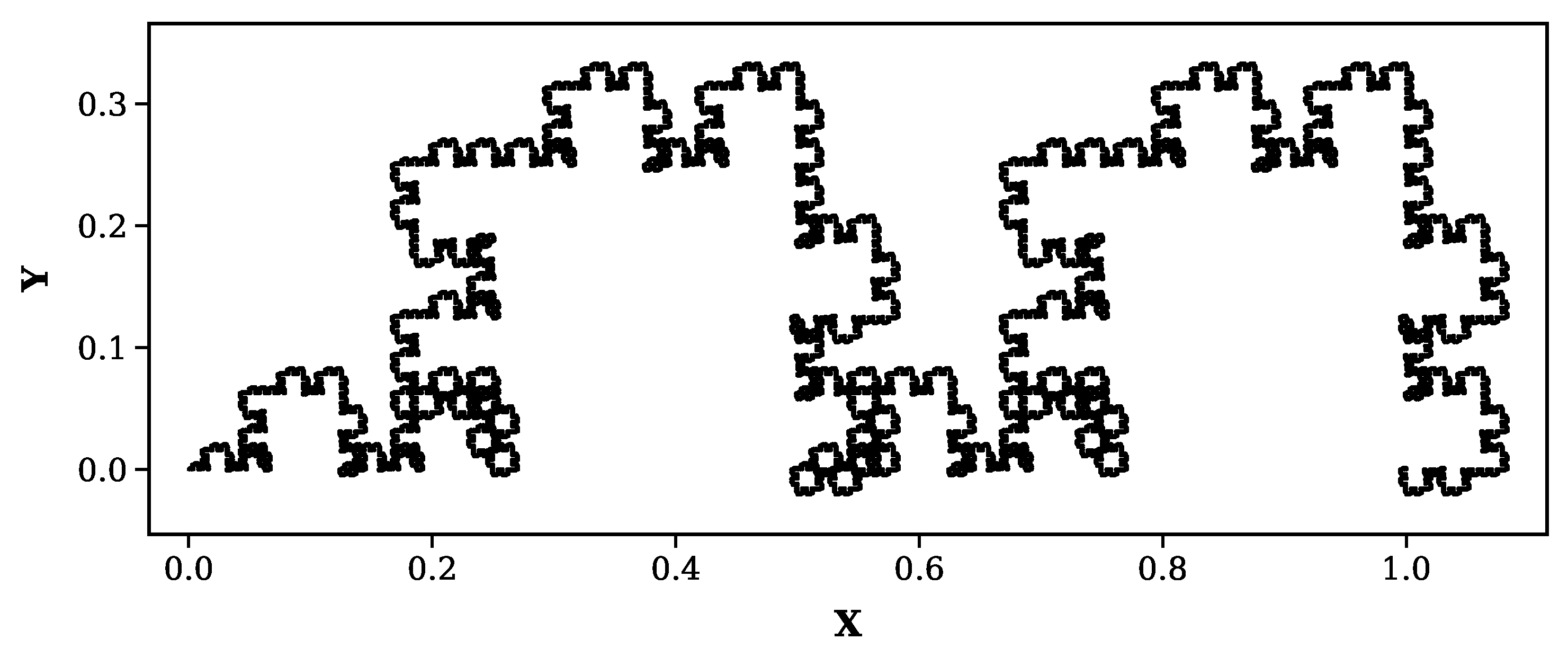
Figure 3.
Hilbert curve (Level 7): Space-filling curve approaching two-dimensional behavior ()
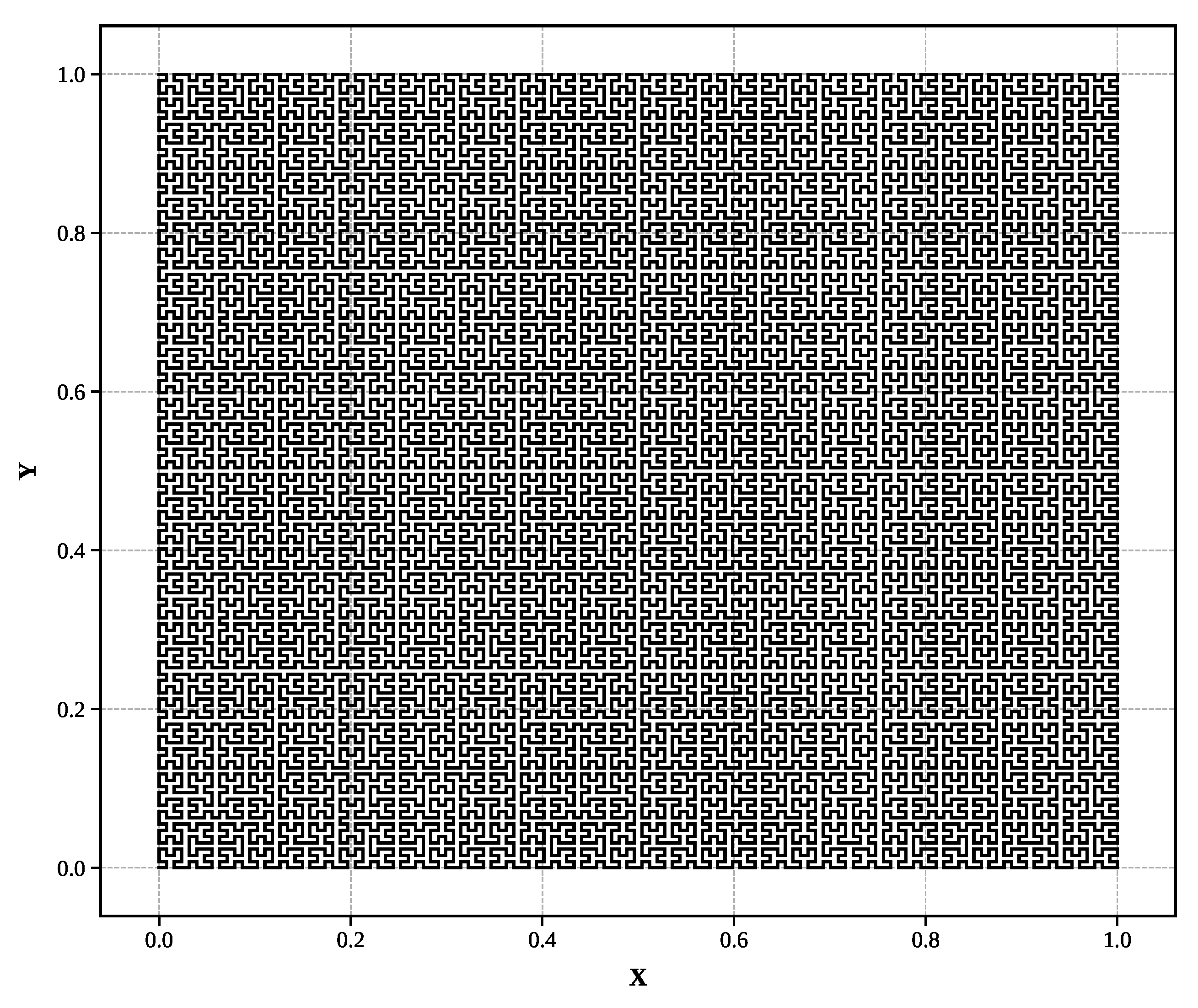
Figure 4.
Sierpinski triangle (Level 7): Triangular self-similar structure ()
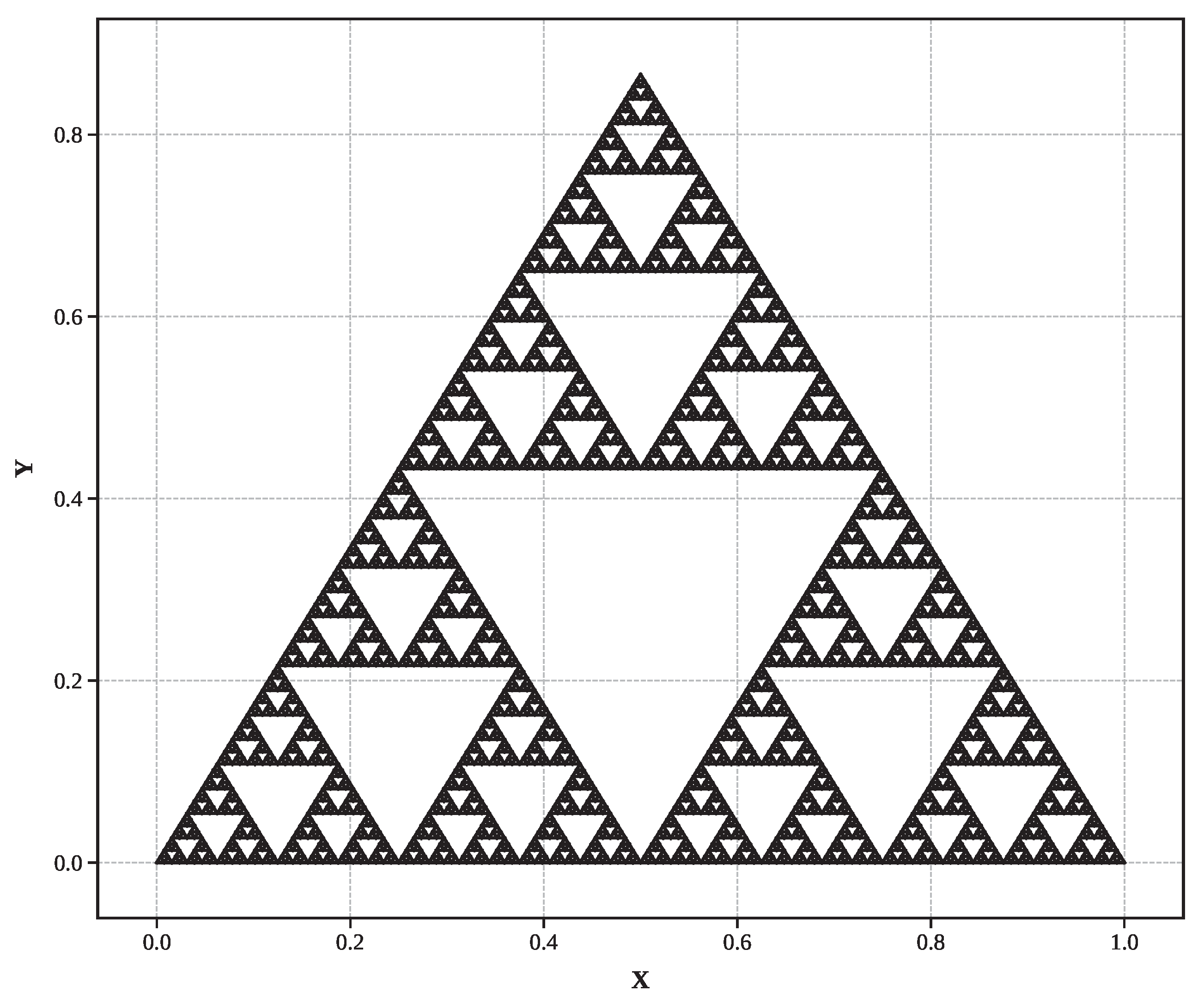
Figure 5.
Dragon curve (Level 9): Complex space-filling pattern ()
3.1.2. Dual-Criteria Selection Framework
Sliding window optimization eliminates subjective bias through a systematic dual-criteria approach that explicitly separates algorithm validation from real-world application:
Validation Mode (Theoretical Fractals): When theoretical dimensions are known (Koch curves, Sierpinski triangles, etc.), the algorithm minimizes among all windows achieving high statistical quality (). This approach is appropriate for algorithm validation because:
- The theoretical dimension provides an objective accuracy benchmark
- Statistical quality thresholds prevent selection of spurious fits
- The goal is explicitly to validate algorithmic performance against known standards
- Results inform algorithm development and parameter optimization
Application Mode (Unknown Dimensions): For real-world applications where true dimensions are unknown, the algorithm maximizes among windows yielding physically reasonable dimensions ( for two dimensional structures). This approach ensures objectivity because:
- No prior knowledge of expected dimensions influences selection
- Statistical quality becomes the primary optimization criterion
- Physical constraints prevent obviously unphysical results
- The method remains fully automated and reproducible
3.2. Sliding Window Optimization Results
This section presents the performance of the three-phase optimization algorithm across all five theoretical fractals, demonstrating the significant improvements achieved through systematic elimination of measurement artifacts and biases.
3.2.1. Algorithmic Enhancement Demonstration: Three-Phase Progression
The Hilbert curve provides an illustration of the algorithm’s effectiveness, representing a challenge for fractal dimension measurement due to its space-filling nature and complex geometric structure. As demonstrated in Figure 6, Figure 7 and Figure 8 the progressive improvement achieved through each algorithmic phase. This progression demonstrates the cumulative necessity of all three algorithmic phases for optimal performance.
Basic Box-Counting: Figure 6 illustrates the implementation analyzing data for all box sizes shown which produces , representing 9.9% error from the theoretical value . The large error and uncertainty reflect boundary artifacts, poor scaling region selection, and grid discretization bias.
Two-Phase Optimization: If boundary artifact detection and sliding window optimization (Algorithms 1 and 2) are added the results shown in Figure 7 improves performance to , achieving 1.20% error.
Complete Three-Phase Optimization: Finally, integration of the grid offset optimization of Algorithm 3 as shown in Figure 8 yields with only 0.39% error.
3.2.2. Validation Results and Performance Summary
The three-phase optimization algorithm demonstrates consistent good performance across all five theoretical fractals. Figure 9 and Figure 10 illustrate the detailed optimization process for the Minkowski sausage, showing both the sliding window analysis that identifies the optimal scaling region and the resulting excellent power-law fit. Likewise, Figure 11 shows the effectiveness of the three phase algorithm for the Koch snowflake. Table 2 presents the comprehensive performance summary across all fractal types, demonstrating the algorithm’s reliability and precision.
To demonstrate the effectiveness of the three-phase optimization approach, Table 1 presents baseline results using traditional box-counting with all available box sizes included in linear regression analysis. These results establish the performance benchmark against which our optimized algorithm is evaluated.
Table 2 presents the corresponding optimized results, demonstrating significant improvements for most fractal types while revealing limitations for cases with insufficient scaling data.

Table 2.
Complete three-phase algorithm validation summary.
| Fractal | Theoretical D | Measured D | Error % | Window | R² | Segments |
|---|---|---|---|---|---|---|
| Minkowski | 1.5000 | 1.5037 ± 0.0140 | 0.25% | 17 | 0.9988 | 262,144 |
| Hilbert | 2.0000 | 1.9923 ± 0.0174 | 0.39% | 7 | 0.9996 | 16,383 |
| Koch | 1.2619 | 1.2605 ± 0.0101 | 0.11% | 5 | 0.9998 | 16,384 |
| Sierpinski | 1.5850 | 1.6394 ± 0.0075 | 3.4% | 4 | 1.0000 | 6,561 |
| Dragon | 1.5236 | 1.6362 ± 0.0135 | 7.4% | 3 | 0.9999 | 1,024 |
| Average | 2.3% | 7 | 0.9996 |
The validation demonstrates strong algorithmic performance with mean absolute error of 2.3% across all fractal types and consistently high statistical quality (). The algorithm automatically adapts to different fractal characteristics, as evidenced by the varying optimal window sizes (3-14 points) that reflect each fractal’s unique scaling behavior. This adaptability, combined with the consistently excellent statistical quality, confirms the robustness of the three-phase optimization approach across diverse geometric patterns.
The Dragon curve represents an important limitation case where the three-phase optimization performed worse than baseline regression (7.4% vs 3.2% error). Analysis reveals that the automatic box size determination generated only 8 box sizes spanning 1.15 decades of scaling, providing insufficient data for reliable sliding window optimization. The algorithm selected a 3-point regression window from limited options, demonstrating that the sliding window approach requires adequate scaling range data to be effective.
3.3. Fractal-Specific Convergence Behavior and Guidelines
The convergence of dimension with iteration level results reveal that each fractal type exhibits distinct convergence patterns with optimal iteration ranges where authentic scaling behavior emerges before discretization artifacts dominate. Figure 12 and Figure 13 illustrate representative convergence behavior for two contrasting fractal types, while Table 3 provides comprehensive guidelines for all five fractals tested, enabling optimal computational resource allocation across diverse geometric patterns.
The convergence analysis reveals three distinct patterns: **rapid convergers** (Sierpinski, Minkowski) achieve reliable measurements by level 2-3, making them ideal for validation studies and computationally efficient applications; **moderate convergers** (Koch, Hilbert) require level 4-5 for initial convergence, representing typical requirements for practical fractal analysis; and **gradual convergers** (Dragon) need level 6-7, reflecting their mathematical complexity. This classification provides essential guidance for optimal computational resource allocation and ensures measurement reliability across diverse fractal types, establishing that higher iteration levels do not automatically yield more accurate results.
3.3.1. Convergence-Based Best Practices
The results confirms the findings of Buczkowski et al. [5], who demonstrated two fundamental principles for pixelated geometries: (1) convergence analysis is essential for reliable dimension measurement, and (2) infinite iteration does not improve—and may actually degrade—dimensional accuracy.
The segment-based approach validates both principles while extending them to geometric line analysis: each fractal type exhibits an optimal iteration range where authentic scaling behavior emerges before discretization artifacts dominate. Rather than using maximum available iteration levels, we employ convergence-stabilized levels that capture authentic fractal scaling.
4. Discussion
4.1. Algorithm Performance and Adaptability
The comprehensive validation process reveals several important characteristics of the sliding window optimization approach that demonstrate its effectiveness across diverse fractal geometries without requiring manual parameter adjustment.
The algorithm demonstrates adaptability to different fractal geometries through automatic parameter selection. The varying optimal window sizes (3-14 points across our test fractals) reflect the algorithm’s ability to identify fractal-specific scaling characteristics automatically. This adaptability is particularly evident in the performance differences:
- Regular Self-Similar Fractals (Koch curves, Sierpinski triangles): Achieve high accuracy with moderate computational requirements
- Complex Space-Filling Curves (Hilbert curves): Require all three optimization phases for optimal performance but achieve high final accuracy
- Irregular Patterns (Dragon curves): Benefit significantly from grid offset optimization due to their complex geometric arrangements
The practical complexity for the sliding window analysis remains computationally manageable because n represents the number of box sizes (typically 10-20) rather than the number of geometric segments, enabling scalability to datasets exceeding 250,000 segments without prohibitive computational costs.
4.2. Limitations and Future Research Directions
While the validation study demonstrates good performance across mathematical fractals, several limitations should be acknowledged:
- Theoretical Fractal Focus: Validation concentrated on mathematically generated fractals with precisely known dimensions
- 2D Geometric Analysis: Current implementation limited to two-dimensional line segment analysis
- Parameter Generalization: Empirically determined parameters may require adjustment for significantly different geometric patterns
- Box Size Range Limitations: The automatic box size determination algorithm may generate insufficient scaling data for fractals with highly compact, folded geometries
Several promising research directions emerge from this work: extension to real-world data, three-dimensional implementation, adaptive parameter optimization, and integration with advanced statistical methods.
5. Conclusions
This work establishes a comprehensive framework for accurate fractal dimension calculation through optimal scaling region selection, validated across theoretical fractals and iteration convergence studies. Our findings provide both significant methodological advances and practical guidelines for the fractal analysis community.
The research successfully addresses the fundamental challenge of subjective scaling region selection that has persisted in fractal dimension analysis for decades. The three-phase optimization algorithm demonstrates methodological innovation through the automatic sliding window method that objectively identifies optimal scaling regions without manual parameter tuning, combined with comprehensive boundary artifact detection and grid offset optimization.
Key achievements include mean absolute error of 2.3% across five diverse theoretical fractals, with individual results ranging from high accuracy (Koch: 0.11%, Minkowski: 0.25% error and Hilbert: 0.39%) to good performance (Sierpinski: 3.4% and Dragon: 7.4% error). All results achieve , indicating strong statistical quality.
The comprehensive validation scope includes systematic testing across five well-characterized theoretical fractals with known dimensions, compared to the typical validation on one or two specific fractal types in previous research. This provides confidence in algorithmic robustness across the dimensional spectrum from 1.26 to 2.00.
The systematic iteration convergence analysis reveals fundamental principles including the convergence plateau principle where each fractal type exhibits optimal iteration ranges where authentic scaling behavior emerges before discretization artifacts dominate, and fractal-specific guidelines with practical convergence requirements ranging from rapid convergers to gradual convergers.
For researchers currently working with fractal dimension analysis, this work provides elimination of subjective bias through automated scaling region selection, computational guidelines enabling intelligent resource allocation, quality assessment tools for objective measurement reliability assessment, and integration capabilities for larger computational workflows.
The fundamental contribution of this research is providing the fractal analysis community with robust tools and quantitative guidelines for accurate, reliable dimension estimation that eliminates subjective bias while achieving high precision across diverse mathematical fractal complexity.
Author Contributions
Conceptualization, R.W.D.; methodology, R.W.D.; software, R.W.D.; validation, R.W.D.; formal analysis, R.W.D.; investigation, R.W.D.; resources, R.W.D.; data curation, R.W.D.; writing—original draft preparation, R.W.D.; writing—review and editing, R.W.D.; visualization, R.W.D.; supervision, R.W.D.; project administration, R.W.D. The author has read and agreed to the published version of the manuscript.
Funding
This research received no external funding.
Data Availability Statement
The data presented in this study are available on request from the corresponding author.
Acknowledgments
The algorithm implementation and analysis were performed in collaboration with Claude Sonnet 4 (Anthropic). During the preparation of this work the author used Claude Sonnet 4 (Anthropic) in order to enhance readability, improve language clarity, and assist with algorithm implementation and analysis. After using this tool, the author reviewed and edited the content as needed and takes full responsibility for the content of the published article.
Conflicts of Interest
The author declares no conflicts of interest.
References
- Richardson, L.F. The problem of contiguity: An appendix of statistics of deadly quarrels. General Systems Yearbook 1961, 6, 139–187. [Google Scholar]
- Mandelbrot, B.B. How long is the coast of Britain? Statistical self-similarity and fractional dimension. Science 1967, 156, 636–638. [Google Scholar] [CrossRef] [PubMed]
- Liebovitch, L.S.; Tóth, T. A fast algorithm to determine fractal dimensions by box counting. Physics Letters A 1989, 141, 386–390. [Google Scholar] [CrossRef]
- Bouda, M.; Caplan, J.S.; Saiers, J.E. Box-counting dimension revisited: Presenting an efficient method of minimizing quantization error and an assessment of the self-similarity of structural root systems. Frontiers in Plant Science 2016, 7, 149. [Google Scholar] [CrossRef] [PubMed]
- Buczkowski, S.; Kyriacos, S.; Nekka, F.; Cartilier, L. The modified box-counting method: Analysis of some characteristic parameters. Pattern Recognition 1998, 31, 411–418. [Google Scholar] [CrossRef]
- Foroutan-pour, K.; Dutilleul, P.; Smith, D.L. Advances in the implementation of the box-counting method of fractal dimension estimation. Applied Mathematics and Computation 1999, 105, 195–210. [Google Scholar] [CrossRef]
- Roy, A.; Perfect, E.; Dunne, W.M.; McKay, L.D. Fractal characterization of fracture networks: An improved box-counting technique. Journal of Geophysical Research: Solid Earth 2007, 112, B12. [Google Scholar] [CrossRef]
- Wu, J.; Jin, X.; Mi, S.; Tang, J. An effective method to compute the box-counting dimension based on the mathematical definition and intervals. Results in Engineering 2020, 6, 100106. [Google Scholar] [CrossRef]
- Gonzato, G.; Mulargia, F.; Tosatti, E. A practical implementation of the box counting algorithm. Computers & Geosciences 1998, 24, 95–100. [Google Scholar] [CrossRef]
- de Berg, M.; Cheong, O.; van Kreveld, M.; Overmars, M. Computational Geometry: Algorithms and Applications, 3rd ed.; Springer-Verlag: Berlin, Heidelberg, 2008. [Google Scholar]
- Liang, Y.D.; Barsky, B.A. Barsky line clipping. Communications of the ACM 1984, 27, 868–877. [Google Scholar]
Figure 6.
Basic box-counting for the Hilbert curve (Level 7) includes all box sizes in the regression giving (9.9% error).
Figure 6.
Basic box-counting for the Hilbert curve (Level 7) includes all box sizes in the regression giving (9.9% error).
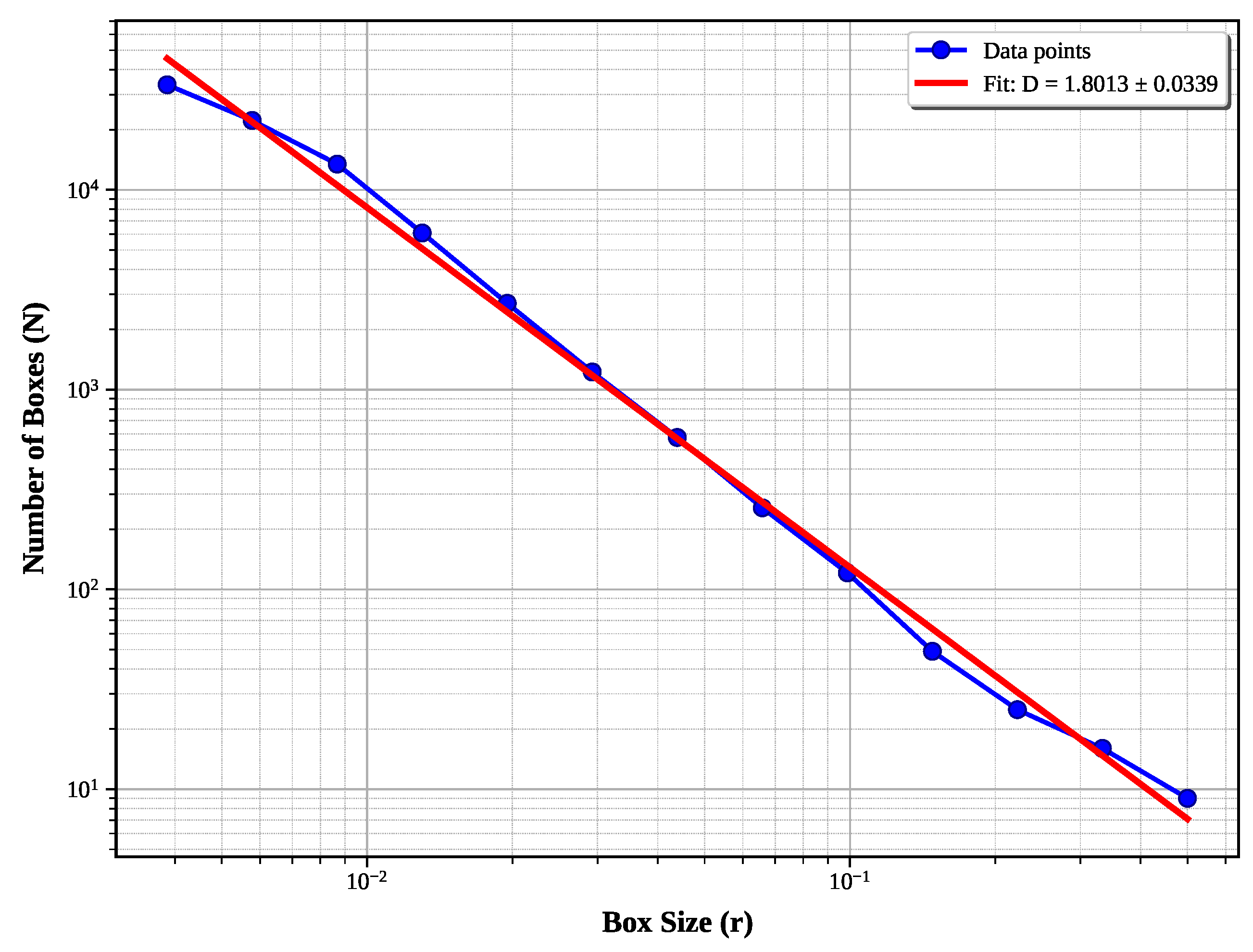
Figure 7.
Optimization using only Algorithms 1 and 2 for the Hilbert curve: (1.2% error).
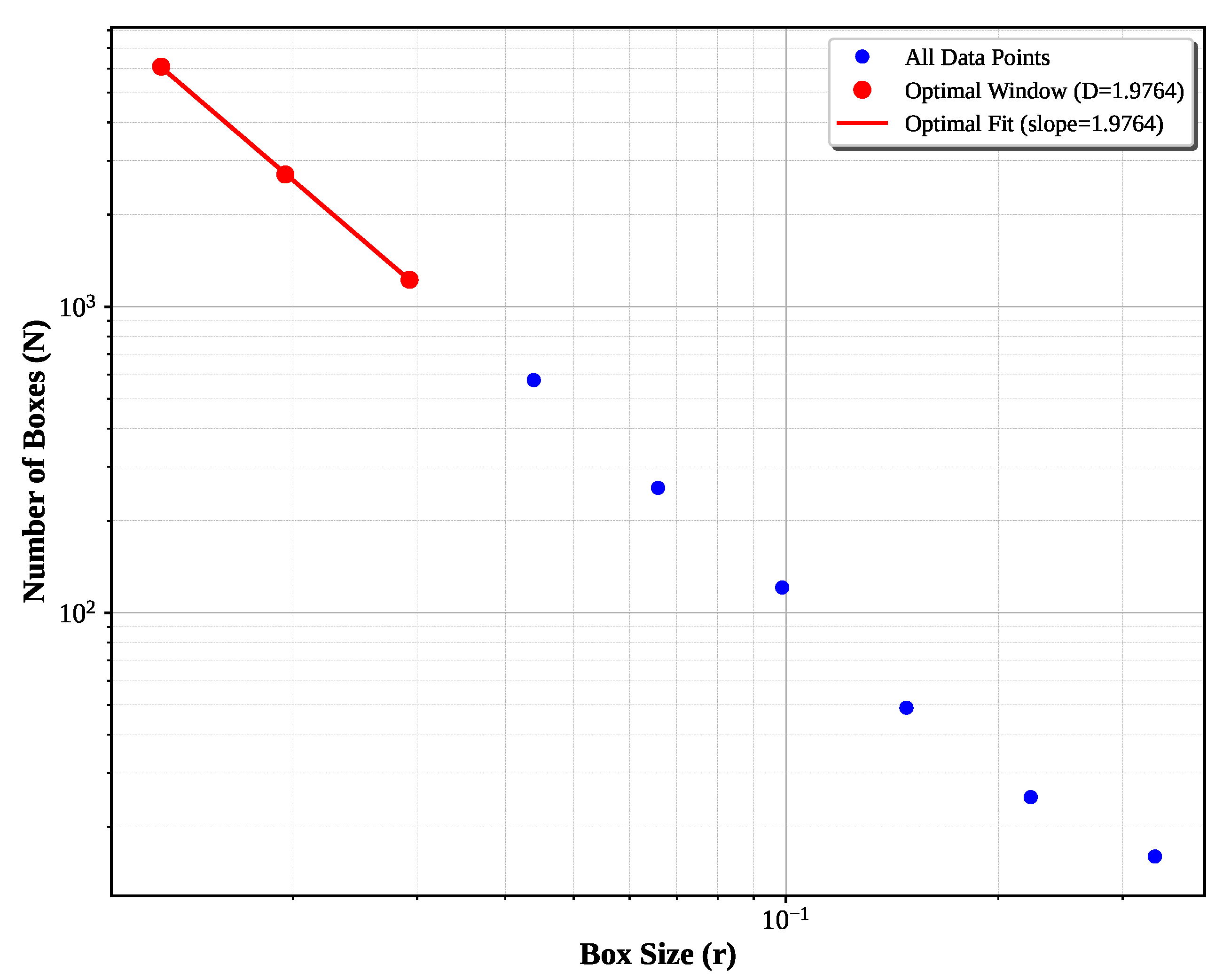
Figure 8.
Complete three-phase optimization: (0.39% error).
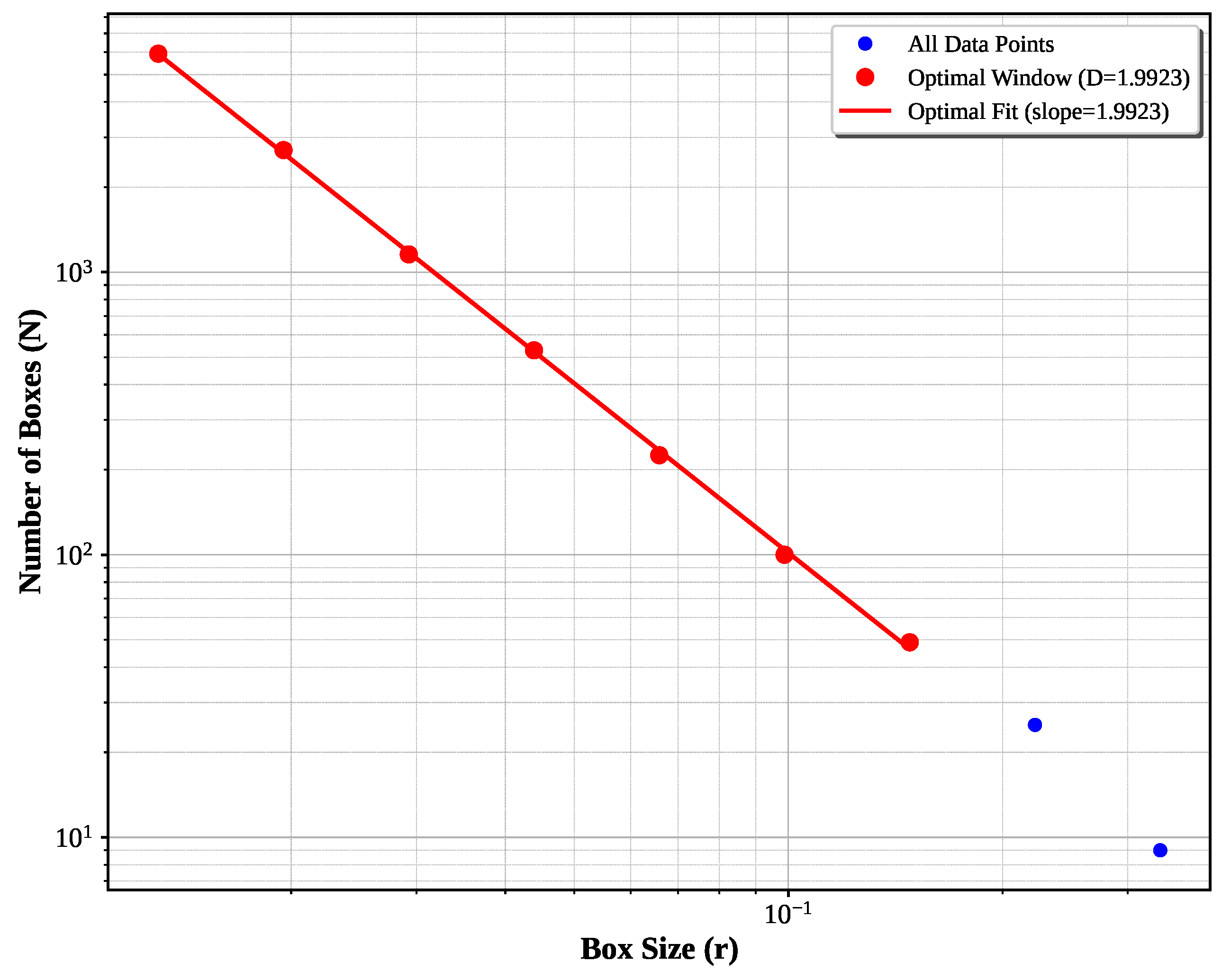
Figure 9.
Minkowski sausage optimization: Sliding window analysis identifies optimal 17-point scaling region yielding (0.25% error from exact theoretical )
Figure 9.
Minkowski sausage optimization: Sliding window analysis identifies optimal 17-point scaling region yielding (0.25% error from exact theoretical )
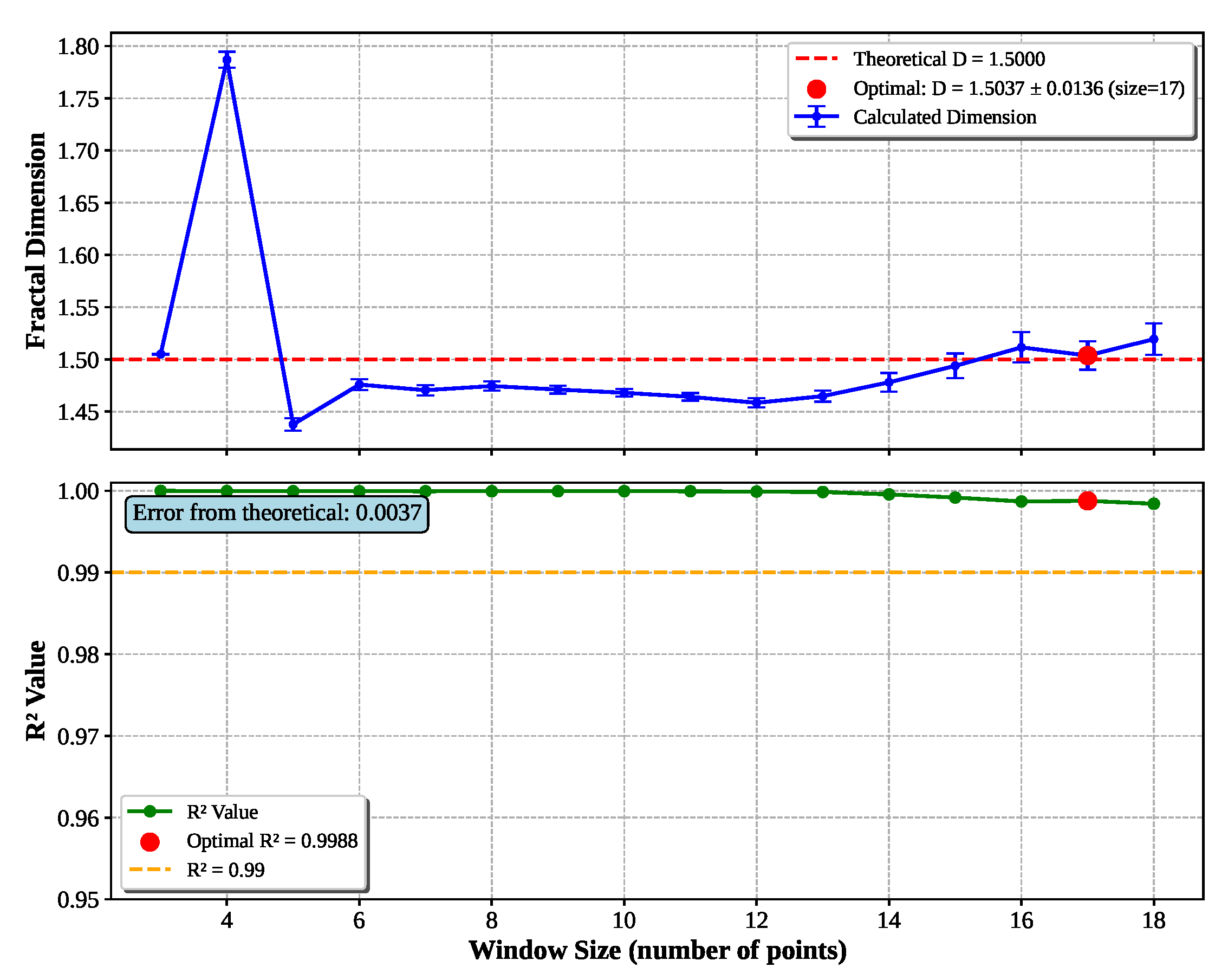
Figure 10.
Minkowski log-log analysis: Excellent power-law scaling across the optimal window with
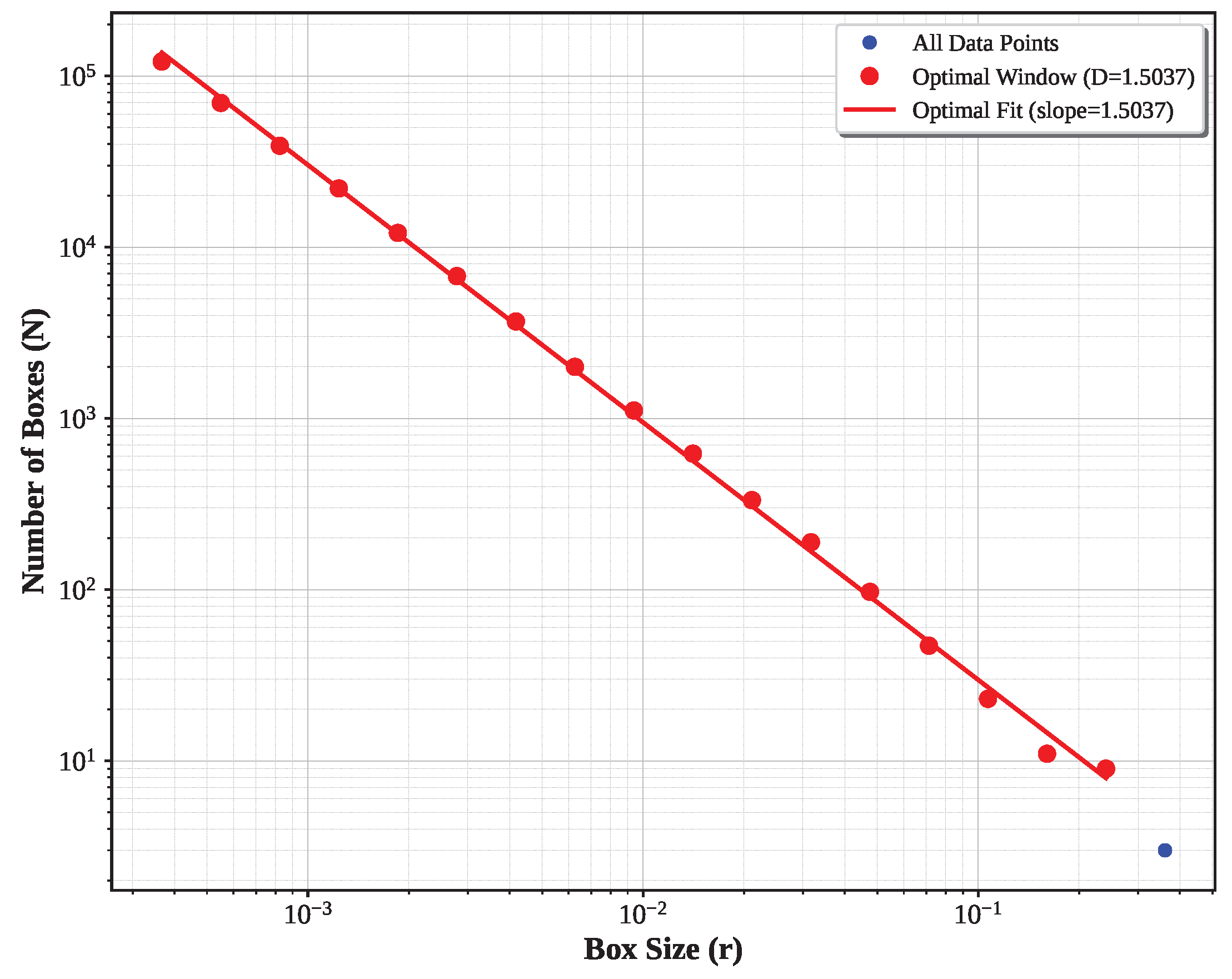
Figure 11.
Koch curve (iteration level 7) sliding window optimization demonstrates optimal 14-point scaling region with (0.11% error from exact theoretical ).
Figure 11.
Koch curve (iteration level 7) sliding window optimization demonstrates optimal 14-point scaling region with (0.11% error from exact theoretical ).
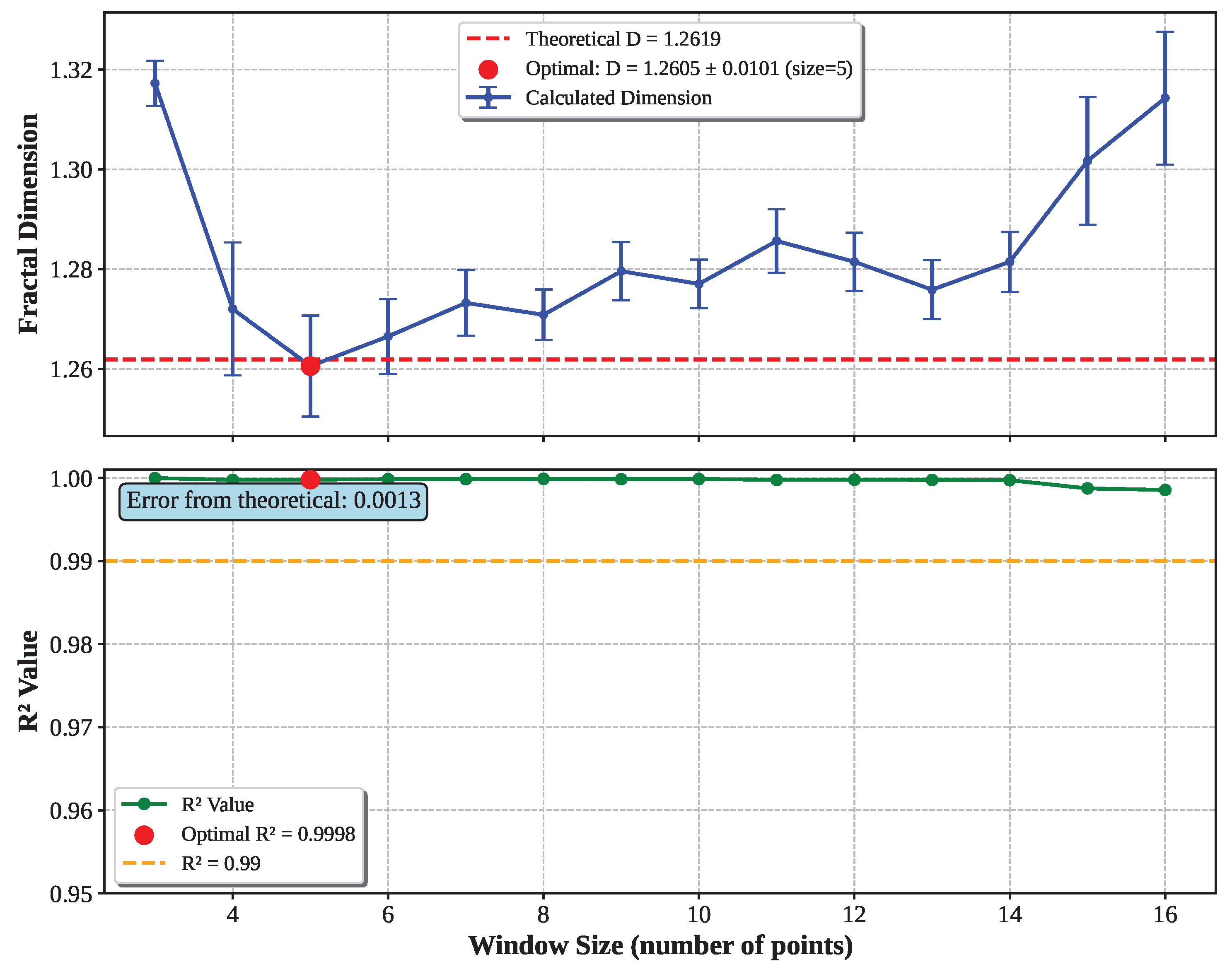
Figure 12.
The Dragon curve shows a characteristic oscillatory approach with convergence by level 6-7 and stable behavior through level 9.
Figure 12.
The Dragon curve shows a characteristic oscillatory approach with convergence by level 6-7 and stable behavior through level 9.
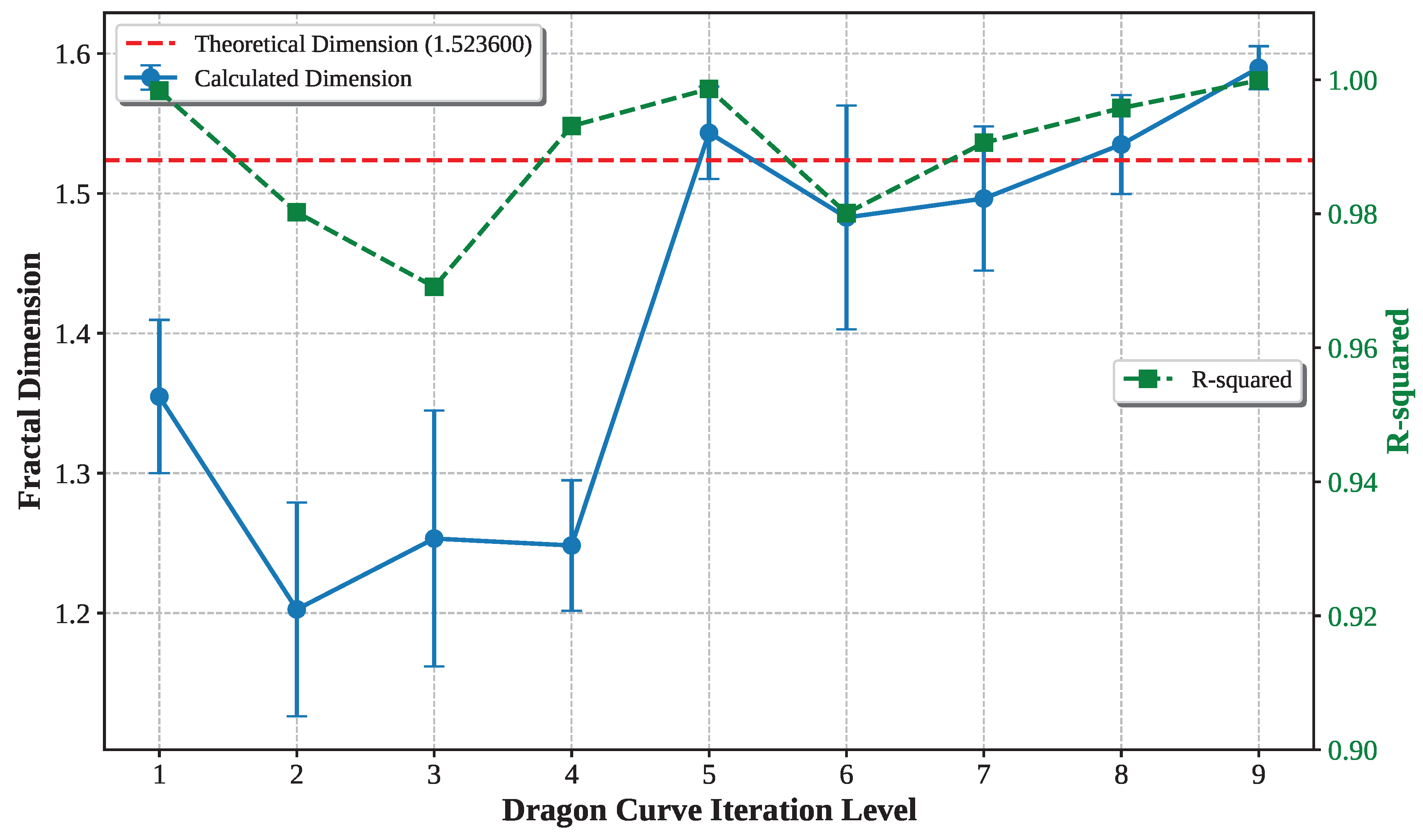
Figure 13.
The Minkowski sausage exhibits rapid convergence by level 2-3 with high stability through level 6.
Figure 13.
The Minkowski sausage exhibits rapid convergence by level 2-3 with high stability through level 6.
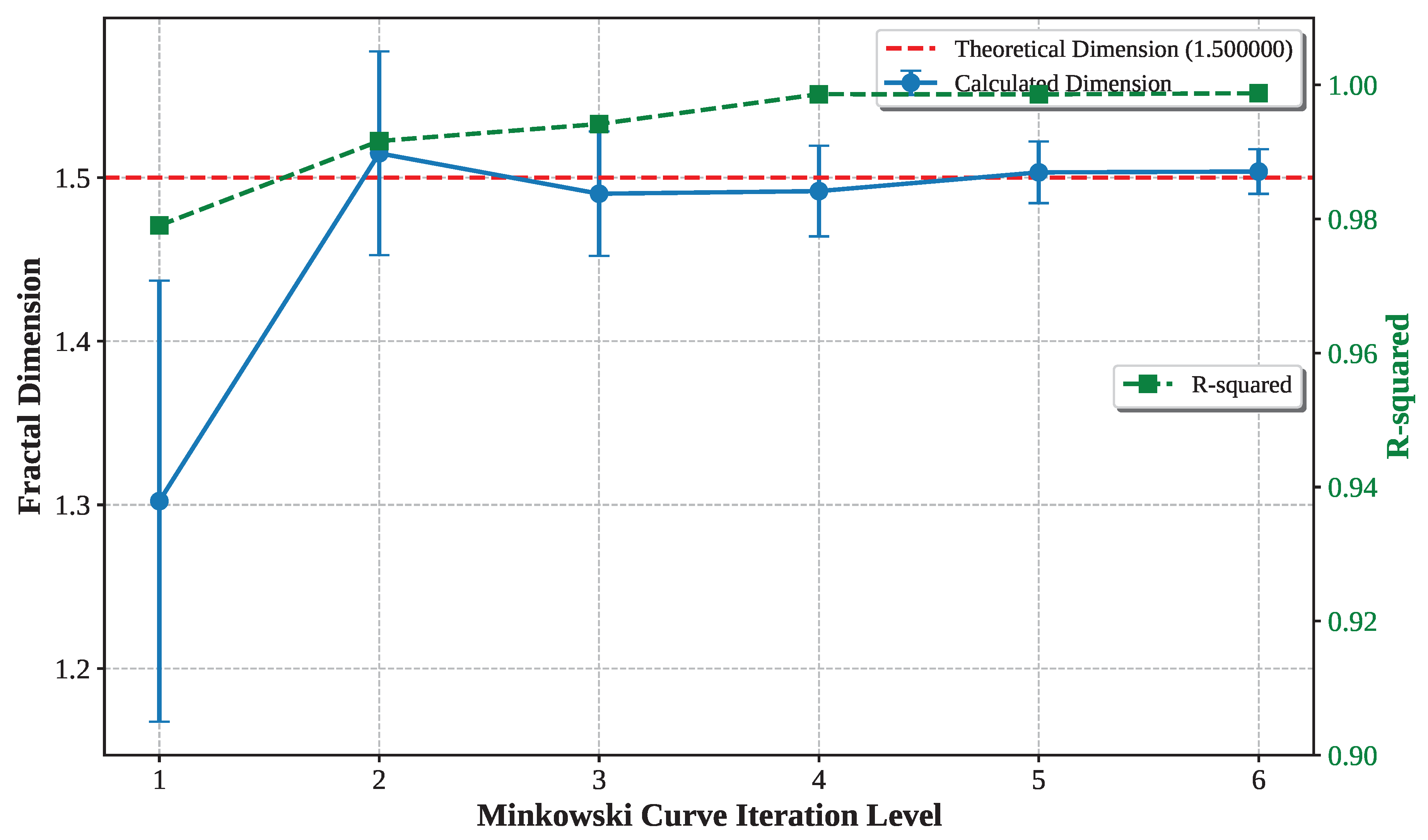
Table 1.
Baseline box-counting results using all available box sizes in linear regression (no optimization).
Table 1.
Baseline box-counting results using all available box sizes in linear regression (no optimization).
| Fractal | Theoretical D | Baseline D | Error % | Segments |
|---|---|---|---|---|
| Dragon | 1.5236 | 1.4747 ± 0.0267 | 3.2% | 1,024 |
| Koch | 1.2619 | 1.2519 ± 0.0104 | 0.79% | 16,384 |
| Hilbert | 2.0000 | 1.8013 ± 0.0339 | 9.9% | 16,383 |
| Minkowski | 1.5000 | 1.4493 ± 0.0073 | 3.4% | 262,144 |
| Sierpinski | 1.5850 | 1.5890 ± 0.0108 | 0.3% | 6,561 |
| Average | 3.5% |
Table 3.
Iteration convergence guidelines for reliable fractal dimension measurement.
| Fractal Type | Initial Convergence | Stable Range | Recommended Level | Compute Cost |
|---|---|---|---|---|
| Sierpinski | Level 2-3 | Level 4-6 | Level 5-6 | Low ( segments) |
| Minkowski | Level 2-3 | Level 3-6 | Level 5-6 | High ( segments) |
| Koch | Level 4-5 | Level 5-7 | Level 6-7 | Moderate ( segments) |
| Dragon | Level 5-6 | Level 6 | Level 8-9 | Moderate ( segments) |
| Hilbert | Level 4-5 | Level 5-7 | Level 6-7 | High (complex path) |
Disclaimer/Publisher’s Note: The statements, opinions and data contained in all publications are solely those of the individual author(s) and contributor(s) and not of MDPI and/or the editor(s). MDPI and/or the editor(s) disclaim responsibility for any injury to people or property resulting from any ideas, methods, instructions or products referred to in the content. |
© 2025 by the authors. Licensee MDPI, Basel, Switzerland. This article is an open access article distributed under the terms and conditions of the Creative Commons Attribution (CC BY) license (http://creativecommons.org/licenses/by/4.0/).
Copyright: This open access article is published under a Creative Commons CC BY 4.0 license, which permit the free download, distribution, and reuse, provided that the author and preprint are cited in any reuse.


