

Submitted:
17 August 2025
Posted:
18 August 2025
You are already at the latest version
Abstract
This note aims to prove that the anomalies detected on the cosmic microwave background are in fact remnants of phantom black holes from a primitive universe predating the Big Bang. These remnants appear on one hand as a concentric circle known as a “Hawking point”, and on the other as a Penrose “trapped surface”. The various aspects mentioned are in fact at the origin of the inhomogeneity observed in the cosmic microwave background. In this investigation, we use the Jordan and Ehlers metric associated with Einstein's field equations in the theory of general relativity, whose mathematical resolution by inverse scattering method of this different equation leads to gravitational solitons. With this in mind, we suggest that these hypothetical black holes in CCC are actually spins$\pm $2. Their observation could be possible by combining the $‘’+'‘$ and $’'\times''$ polarizations of the general theory at the Planck scale. This approach puts a different face on general relativity, resembling a form of quantum gravity that clarifies the concept of the accelerating expansion of the universe, which, in contrast to the Standard Model $\Lambda CDM $, postulates the existence of dark energy.
Keywords:
$\Lambda CDM $
; Soliton
; CCC
; (ISM) Pomeransky's
; Phantom black holes
1. Introduction
The need to introduce saddle points into the ‘Euclidean’ path integral in general relativity theory, as recently suggested by Witten [1], has led to the identification of a number of permissible complex metrics with interesting physical solutions, whose application finds a favorable echo in cosmology and quantum gravity. Focusing on cosmology, Witten [1] has shown that, using Euclidean action in gravity, the Hartle-Hawking [2] wavefunction can behave differently with the absence of a critical point, thus consolidating the dominance of complex critical points in the path integral. Although a number of restrictions have been raised concerning the complex metrics allowed [1] for the study of phenomena emanating from quantum gravity and cosmology, Briscese [3] has drawn attention to the condition developed in the work [1,4] concerning the class of complex metrics that solves the problem of generalizing quantum gravity from the equivalence principle to complex spacetimes. If we assume that the conditions previously described in ref. [1,3,4] are valid, then we should expect the complex metrics allowed within the framework of quantum gravity to be able to predict the existence of spins in a curved spacetime, thus showing the existence of a complex solution of Einstein’s field equations in vacuum, as suggested by Penrose [5]. By introducing spins ±2 as a means of quantizing general relativity, we should expect the phenomenon of superposition to exist at the level of authorized complex metrics [6]. This idea of superposition was evoked by Everett [7], giving a simple means of constructing quantum gravity. In this approach, it will be useful to consider the notion of relative state in the context of quantum mechanics, where we can expect a division of a world into several branches corresponding to a specific outcome. This principle was implemented by Penrose [6] in the case of Schrödinger’s cat, where we observe the notion of relative state. This view has recently been confirmed in the context of gravitational wave observations, where certain authors [8,9] have demonstrated that the gravitational wave, during its propagation in space-time, has the facility to split into explosive and implosive waves, thus producing a signal close to that of the Ligo-Virgo [10]. It is important to note that during the observation of gravitational waves as evoked in the work [8,9,10] resulting from the collision of two massive black holes in the theory of general relativity, an unexpected phenomenon was observed in the various detectors, namely the presence of noise during the propagation of the gravitational wave in the different interferometers. This noise was interpreted as being due to the presence of gravitons in the various interferometers [11]. This evidence, although difficult to observe as suggested by Dyson [12], constitutes one of the strong proofs that general relativity independently is able to provide spins ±2 indirectly. Although the success of gravitational wave observations has confirmed the coherence of relativity theory predictions, it’s not out of the question to ask how black holes behave in their ability to absorb and emit radiation in spacetime, as Hawking[13] has pointed out. This contradiction between quantum mechanics and relativity in the context of black holes was observed following the use of the Feynman integral, and Everett’s [7] interpretation associated with a metric made it possible to note the troubling face of black holes. This remark on the behavior of black hole radiation is one of the fundamental questions for quantum gravity and cosmology. To explore this concept further in the two fields mentioned above, it is pertinent to understand the nature of the particles present during emission and absorption by a black hole. On this subject, Hawking [13] proposed that the introduction of the inverse of time reveals that black holes are composed of photons and gravitons. Hawking [14] made use of the graviton concept (spins ) to analyze the various quantum states of the universe’s evolution through a wave function. In this investigation, he demonstrates the relationship between the degrees of freedom of the gravitational field and matter in cosmological models, based on the path integral. Although some cosmological models have used gravitons as the origin of the Big Bang [15], it is pertinent to ask whether the path integral should be integrated into relativity theory and to explore possible results in cosmology [1]. In this study, we build on the condition established in refs.[1,3,4] research to demonstrate the direct link between general relativity theory and Penrose’s conformal cyclic cosmology (CCC) predictions, based on work [16,17,18,19] . It’s clear that the predictions of CCC theory are bold, notably concerning the existence of traces of phantom black holes existing before the Big-Bang [16,19] and the interpretation of the present-day universe as a continuous cycle. Using the notion of gravitational soliton as an investigative argument in relativity theory, we return to a hypothesis that supports a priori the idea of phantom black hole tracks emanating from the CCC, namely that of Gibbons and Perry [20], who showed a few decades ago that virtual black holes have this ability to absorb and then emit particles via Hawking radiation. This idea, while interesting, is extremely difficult to observe because of their smallness if they haven’t disappeared and their rarity if they do exist [21]. By examining the CCC’s work [16,17,18,19] through general relativity in the form of quantum gravity, we obviously find the cause of the universe’s accelerating expansion without the need for the notion of dark energy and dark matter [22].
2. Complex Metric
The introduction of and polarizations, governed by the Jordan and Ehlers [23] metric in general relativity theory, has recently been confirmed by experimental observations in the detection of gravitational waves [8,9,10], as well as in many other duly referenced phenomena [23,24,25]. Based on the experimental data for this metric, we hypothesize that it is complex and satisfies the conditions specified in refs. [1,3,4]. Subject to the validity of this hypothesis, we investigate its applicability to cosmology and quantum gravity. In this context, we present the Jordan and Ehlers [23] metric and the Einstein field equations in the following form:
where represents the cylindrical coordinates and t the time. The different arbitrary functions , and depend on and t. It is also noted that the previous quantities written with comma as subscript denote their partial derivatives with the associated variables. It is important for the next step to simplify Equations (2)–(5), representing the Einstein field equations, using the Piran et al. [26] approach, and we obtain the following form:
We would like to point out that Equations (4) and (5) have an extremely important foundation in the understanding of energy in spacetime, as is the case in the work refs.[8,9]. Our intention in this investigation is to focus on the observation of cosmological phenomena such as the cosmic microwave background, post-Big Bang events, and phantom black holes.
2.1. Cosmic Microwave Background
This phenomenon is widely recognized in the CCC [16], where it is interpreted as resulting from the remnants of phantom black holes from an earlier universe. Although this approach remains ambiguous in comparison with other established cosmological models [27], it provides further reason to examine this hypothesis. In this analysis, we assume that the arguments presented are valid and employ the equations of relativity theory to support this demonstration. To this end, we consider the following equation:
By integrating ISM Pomeransky’s [28] into Equation (10), in accordance with refs. [8,9,24,25], which has been successfully applied to obtain gravitational solitons, we exploit these solutions together with Sahkarov’s [29] cosmological conditions to arrive at the following picture:
We would like to point out that the expression a represents the gravitational field within Einstein’s field equations [8,9]. The latter plays an essential role in the observation of the phenomenon mentioned. We observe, as illustrated in Figure 1, an equivalent amount of matter and antimatter, interpreted in conventional cosmology [27] as resulting from quantum fluctuations in spacetime. It should be stressed that the choice of coordinate values was made in order to obtain a better approximation of the image. It is also important to note that the CMB can be reproduced whatever the value of the parameters and , provided that the value of the gravitational field remains constant. The inhomogeneity observed on the CMB can be explained by the presence of the two polarization modes and , likely to appear when the universe is in a quantum state, as suggested by Halliwell and Hawking [30]. At this stage, it is difficult to say with any certainty what the CCC [16] is. Ideally, we’d like to follow the evolution of the universe after the Big Bang to get a better idea of the CCC [16] situation.
2.2. After the Big Bang
According to the CCC formulated by Penrose [19], there is a fundamental relationship between the second law of thermodynamics and the Big Bang, arising from the singularity of black (or white) holes, thus implying extremely high entropy resulting from the thermalization of the various gravitational degrees of freedom. This approach quickly explains why entropy was low during the Big Bang period, due to the inactivity of gravitational degrees of freedom. This hypothesis is largely corroborated by Figure 1, where we observe that the value of the gravitational field , being extremely low, keeps the various gravitational polarizations and inactive. As the gravitational field increases, these polarizations become active, leading to a different interpretation of the Big Bang. In the case of black holes, entropy reaches very high values due to the activity of the and polarizations. If we adhere to the hypothesis developed by Penrose [19], according to which the increase in entropy in the universe results from the activation of gravitational degrees of freedom, this process, although in agreement with the second law of thermodynamics, leads to a loss of information in the context of black holes. We will not concern ourselves with the loss of information observed in the case of black holes, as there are recovery mechanisms, as Hawking [31] has pointed out. We adopt Penrose’s [19] proposal to re-examine Equation (10) with the aim of obtaining the following configurations:
Looking at Figure 2, Figure 3 and Figure 4 as a whole, it becomes clear that the gravitational field and the coordinates t and exert a significant influence on the behavior of the universe after the Big Bang phase, characterized by a succession of diverse phenomena. Figure 2a shows the emission of small black holes escaping towards another universe characterized by spin , while Figure 2b shows black holes evolving towards the trapped surface of Penrose [19,32] characterized by the presence of spin .We can see that after the first stage of Big Bang evolution, when the gravitational field is still weak, matter dominates over antimatter. However, in Figure 3 and Figure 4, when the gravitational field begins to be strong, antimatter becomes extremely important over matter, as confirmed by the refs. [33,34,35] this anomaly translates into the loss of information in the case of black holes [19]. Figure 2a,b, Figure 3a and Figure 4a inevitably point us towards the universe’s wave function [2,14,19,27,30,36,37,38,39], generally described by quantum geometrodynamics according to Wheeler-DeWitt. We have thus obtained a description of the states of the universe corresponding to different stages of its evolution, as a function of the parameters explicitly mentioned. As for Figure 3b and Figure 4b, they complete the conditions rigorously established by Penrose [19] in order to confirm the behavior of the universe within the framework of the CCC model. It’s worth pointing out that all these configurations are clearly in line with the predictions made by Penrose [19]. While these various phenomena are consistent with CCC [19], it would be pertinent to examine what took place prior to the Big Bang period. Such an interrogation could give us a better understanding of why matter and antimatter were equivalent during the Big Bang.
2.3. Phantom Black Hole
The predictions formulated by CCC [16,17,18,19] theory become particularly relevant when we refer to previous results relating to the evolution of the universe after the Big Bang, which appears as a succession of multiple universes. These events are made possible by focusing on the behavior of the gravitational field and the different t and coordinates associated with the coupling of the and ’ polarizations. The configurations obtained after the Big Bang demonstrate that acceleration of the universe is achievable if the various gravitational degrees of freedom and are active. At this stage, this acceleration will depend on the gravitational field and the coordinates t and , which will rapidly manifest themselves in the event that one of the or modes prevails, depending on the parameters mentioned. This observation, while essential to understanding the acceleration of cosmic expansion, also leads us to note that after the Big Bang, the universe evolved asymmetrically in terms of matter and antimatter. Indeed, considering that the Big Bang is accompanied by an equivalent presence of matter and antimatter, if a pre-Big Bang universe exists in accordance with CCC theory[16,17,18,19], then it is appropriate to consider that this universe evolved symmetrically in terms of matter and antimatter. To deepen this analysis, let’s examine Equation (8) with the previously mentioned conditions. We obtain the following diagrams:
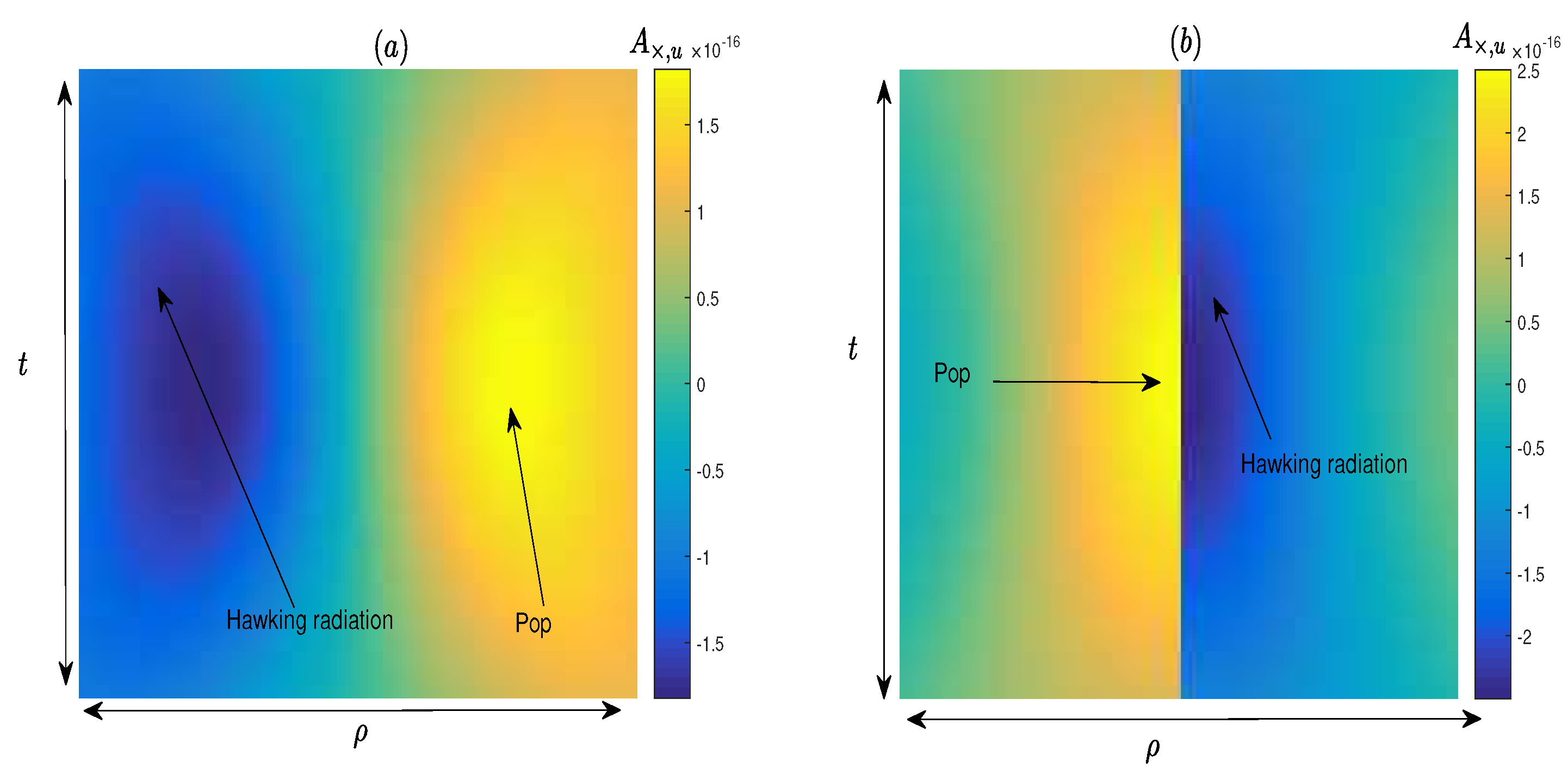
Before any analysis, it is essential to point out that all the configurations presented in this work are based on one of the conditions formulated by Witten [1], according to which the wave function of the universe must oscillate at the values and . Taking this observation into account, it becomes easier for us to examine the still little-known aspects of CCC [16,17,18,19] theory . We note that Figure 5a,b illustrate an extremely ancient universe, predating the birth of the Big Bang. These images reveal an equivalent presence of matter and antimatter, with amplitudes reaching the value of , which makes their detection difficult with current technologies. It should be stressed that this value is well below the Planck scale. The solutions we use allow us to explore lower amplitudes by constraining only the gravitational field. Furthermore, the values assigned to the coordinates t and are of the utmost importance: if we go below the chosen values, it becomes complex to display these images, while if we go above them, they shrink and then disappear. Referring to Figure 6a,b, we find the fundamental principle (CCC) [16] theory, according to which the images observed on the (CMB) are in fact the remnants of black holes from a pre-Big Bang universe. Measured amplitudes reach the order of , which corresponds precisely to the observations made on the CMB. It has been pointed out that the image of the CMB can be obtained independently of the values of the coordinates t and , as well as the angle of rotation , with the notable exception of the value of the gravitational field. An important observation: considering , as in Figure 6a,b, we obtain an identical image with the same amplitudes on the CMB. This result confirms the notion of symmetry between matter and antimatter whatever the value attributed to the gravitational field, implying the conservation of information in the context of black holes [31], a notion recently called into question concerning the evolution of the universe after the Big Bang [19]. We emphasize that by using Equation (9) as a means of investigation in this subsection, we have obtained results inverse to those contained in this subsection. This result confirms the Zakharov [40] hypothesis, according to which a virtual graviton among these six states can only emit two helicity states, and the other four states, their probabilities of existence tend towards zero.
3. Conclusion
By validating the demonstrations put forward by the CCC [16,17,18,19] theory, it is established that the image of the Big Bang is in reality the imprint of phantom black holes, located in a universe subsequent to the Big Bang. This theory fits into the framework of general relativity, which is akin to quantum gravity respecting the previously defined conditions [1,3,4]. An in-depth analysis of the results obtained reveals a correlation between our understanding of the universe and Everett’s [7] many-world theory. Based on Everett’s [7] approach, we can see that we’re dealing with a universe that takes it upon itself to create its own problems without giving us any fundamental explanation but still ends up solving them without informing us. This vicious behavior of the universe is verified by Equations (10) and (8), which evolve differently with regard to the phenomena mentioned. Clearly, the use of quantum gravity is essential for understanding how the universe works, but the fundamental question that is intriguing is whether the theory of general relativity can behave like quantum gravity [5,6,7,19,40] without us really knowing. Should we really listen to nature as Rivolli [41] suggests?. Although certain questions in the light of observations deserve further explanation, notably concerning the sign and real value of the cosmological constant and the mechanism of domination of matter over antimatter in the evolution of the universe, these various remarks confirm Einstein’s metaphor: ”What interests me is whether God had any choice in the creation of the world” [42].
References
- E. Witten, arXiv:2111.06514.
- J. B. Hartle and S. Hawking, Phys. Rev. D 28 2960 (1983). [CrossRef]
- F. Bricesse, Phys. Rev. D 105 126028 (2022). [CrossRef]
- M. Kontsevich and G. Segal, arXiv:2105.10161.
- R. Penrose, Gen. Relativ. Grav. 7 pp.31-52 (1976).
- R. Penrose, Found. Phys. 44: 557-575 (2014). [CrossRef]
- H. Everett, Rev. Mod. Phys. 29 454 (1957). [CrossRef]
- J. Defo and K. Kuetche, JETP. 135 3 (2022).
- J. Defo and K. Kuetche, arXiv:2506.10053.
- B. P. Abbott and al., LIGO-Virgo scientific collaboration, Phys. Rev. Lett. 116 061102 (2016). [CrossRef]
- M. Parikh, F. Wilczek, and G. Zahariade, arXiv:2005.07211.
- F. Dyson, Int. J. Mod. Phys. A. 28 25 (2013).
- S. Hawking, Phys. Rev. D 13 2 (1976).
- S. Hawking, Nuclear. Physic B239 257-276 (1984).
- M. Carmeli and C. Charach, Found. Phys. 14 , 10, (1984).
- V. Gurzadyan and R. Penrose, arXiv:1011.3706.
- V. Gurzadyan and R. Penrose, arXiv:1302.5162.
- K. Meissner and R. Penrose, arXiv:2503.24263.
- R. Penrose, Found. Phys. 44: 873-890 (2014). [CrossRef]
- G. Gibbons and M. Perry, Phys. Rev. D 22 2 (1980).
- G. Gibbons, Commun. math. Phys. 44 , 245-264 (1975). [CrossRef]
- S. Farnes, arXiv:1712.07962.
- P. Jordan, J. Ehlers, and W. Kundt, Abh. Akad. Wiss. Mainz. Math. Naturwiss; A.S. Kompaneets, Zh. Eksp. Teor. Fiz. 34 953 (1958); Sov. Phys. JETP 7 659 (1958).
- S. Tomizawa and T. Mishima, Phys. Rev. D 91 124058 (2015). [CrossRef]
- A. Tomimatsu, Gen. Relativ. Grav. 21 613 (1989). [CrossRef]
- T. Piran, P. Sarfier and R. Stark, Phys. Rev. D 32 3101 (1985). [CrossRef]
- J. Hartle, S. Hawking and T. Hertog, arXiv:0803.1663.
- A. Pomeransky, Phys. Rev. D 73 044004 (2006). [CrossRef]
- A. Sakharov, Sov. Phys. JETP 52 3 (1980).
- J. Halliwell and S. Hawking, Phys. Rev. D 31 8 (1985). [CrossRef]
- S. Hawking, arXiv:hep-th/0507171.
- R. Penrose, Phys. Rev. Lett. 14 3 (1965). [CrossRef]
- G. Steigman, arXiv:0808.1122.
- A. Dolgov and J. Sil, Phys. Rev. D 47 10 (1993). [CrossRef]
- L. Canetti, M. Drewes and M. Shaposhnikov, arXiv:1204.4186.
- K. Rajeev, Phys. Rev. D 106 023511 (2022). [CrossRef]
- J. Dorronsoro, J. Halliwell, J. Hartle, T. Hertog,and O. Janssen, Phys. Rev. D 96 043505 (2017). [CrossRef]
- T. Shestakova, arXiv:1909.05588.
- J. Lehners, Phys. Rev. D 111 063503 (2025).
- V. Zakharov, ZhETF Pis. Red. 12 9 447-449 (1970).
- C. Rovelli, arXiv:2111.07828.
- W. Bonnor, Gen. Relativ. Grav. 21 11 (1989). [CrossRef]
Figure 1.
represents the total amplitude of matter and antimatter obeying the following conditions: = . It has localized features moving in spacetime
Figure 1.
represents the total amplitude of matter and antimatter obeying the following conditions: = . It has localized features moving in spacetime
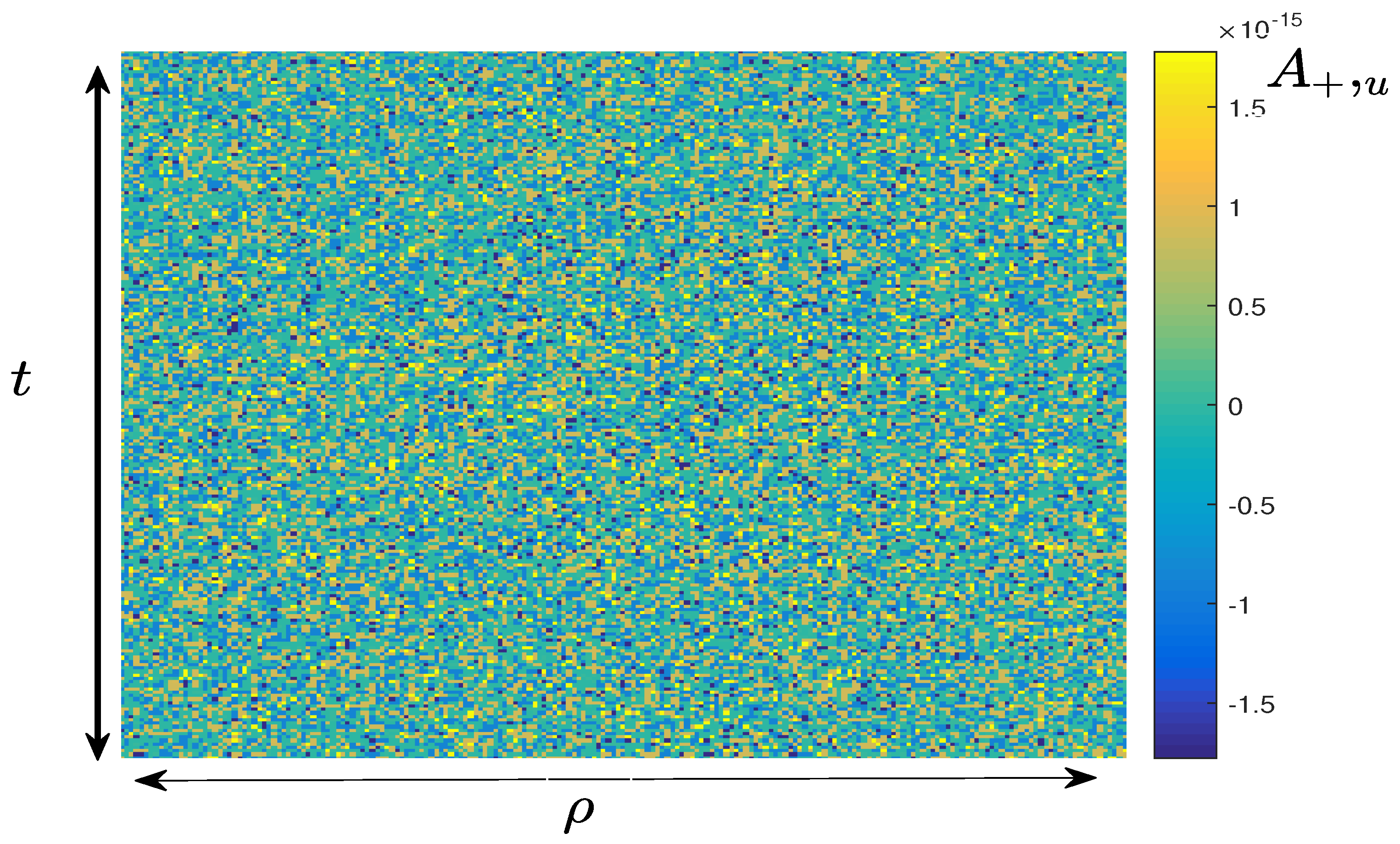
Figure 2.
: represents the total amplitude of antimatter obeying the following conditions:: = . It has localized features moving in spacetime : represents the total amplitude of matter obeying the following conditions: = .It has localized features moving in spacetime .
Figure 2.
: represents the total amplitude of antimatter obeying the following conditions:: = . It has localized features moving in spacetime : represents the total amplitude of matter obeying the following conditions: = .It has localized features moving in spacetime .
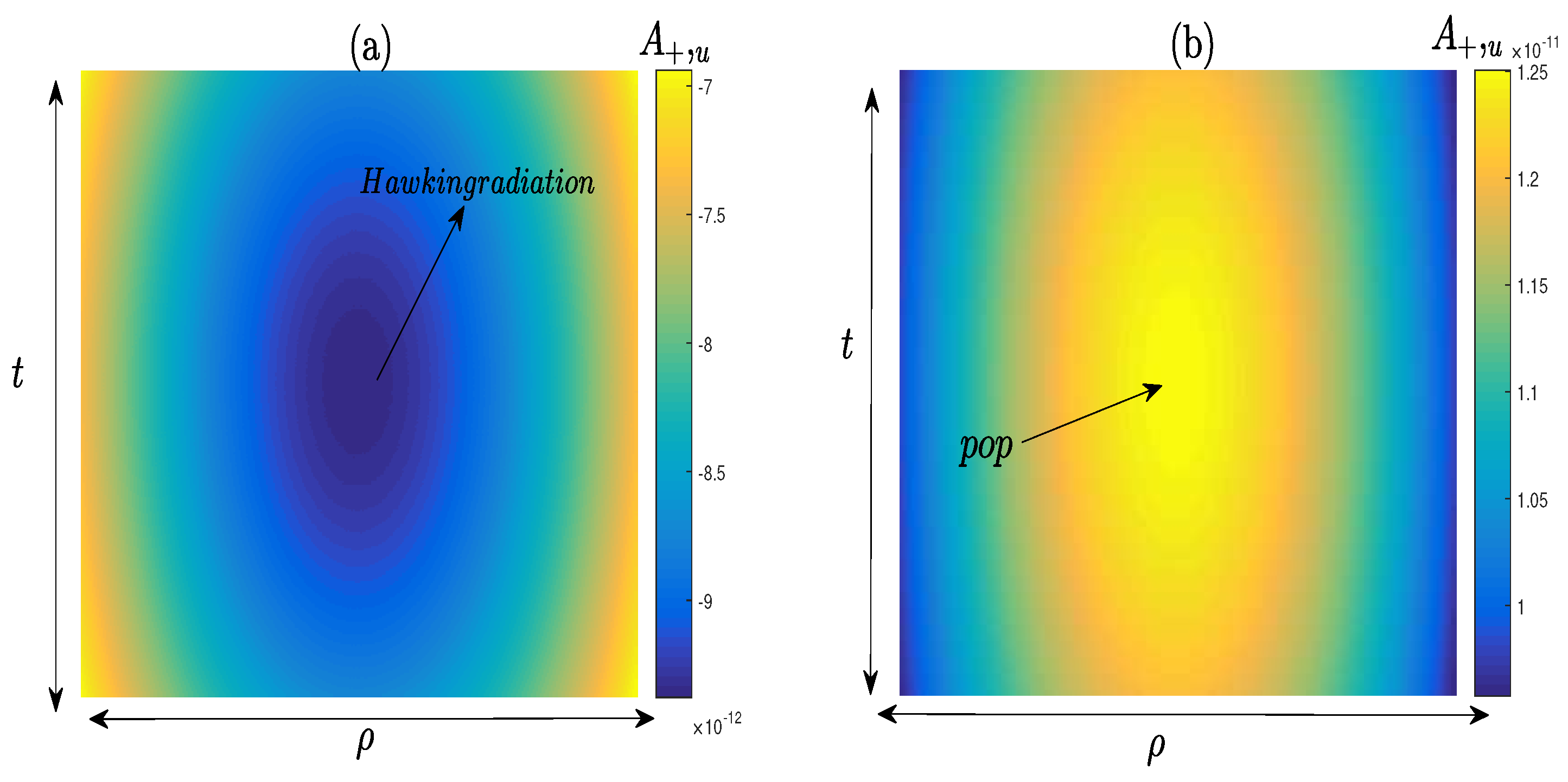
Figure 3.
: represents the different paths that matter and antimatter can take in a quantum universe obeying the following conditions: = . It has localized features moving in spacetime : represents the different paths that matter and antimatter can take in the special theory of relativity, subject to the following conditions: = .It has localized features moving in spacetime
Figure 3.
: represents the different paths that matter and antimatter can take in a quantum universe obeying the following conditions: = . It has localized features moving in spacetime : represents the different paths that matter and antimatter can take in the special theory of relativity, subject to the following conditions: = .It has localized features moving in spacetime
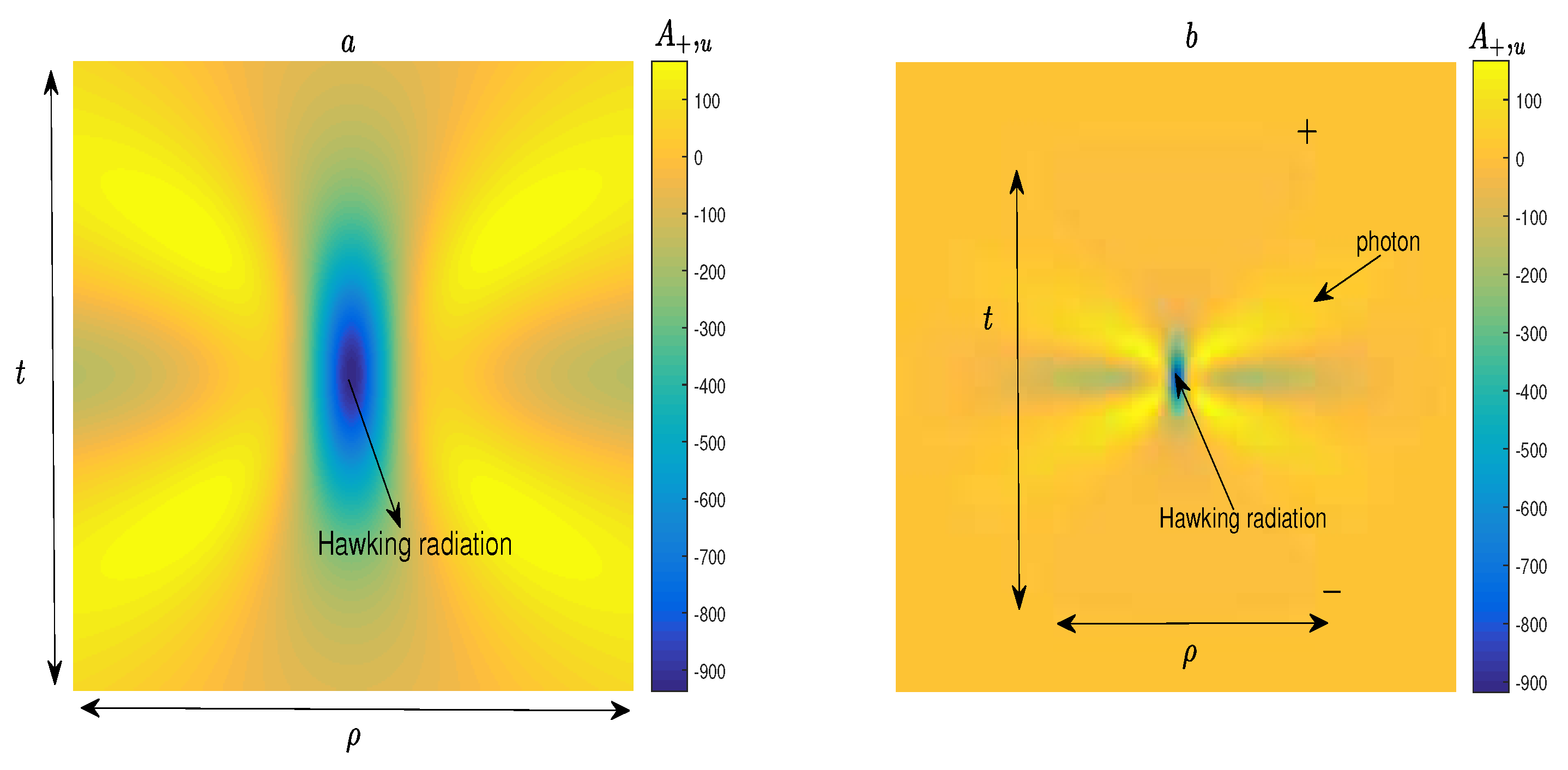
Figure 4.
: represents the different paths that matter and antimatter can take in a quantum universe obeying the following conditions: = . It has localized features moving in spacetime : represents the different paths that matter and antimatter can take in the theory of general relativity, subject to the following conditions: = .It has localized features moving in spacetime .
Figure 4.
: represents the different paths that matter and antimatter can take in a quantum universe obeying the following conditions: = . It has localized features moving in spacetime : represents the different paths that matter and antimatter can take in the theory of general relativity, subject to the following conditions: = .It has localized features moving in spacetime .
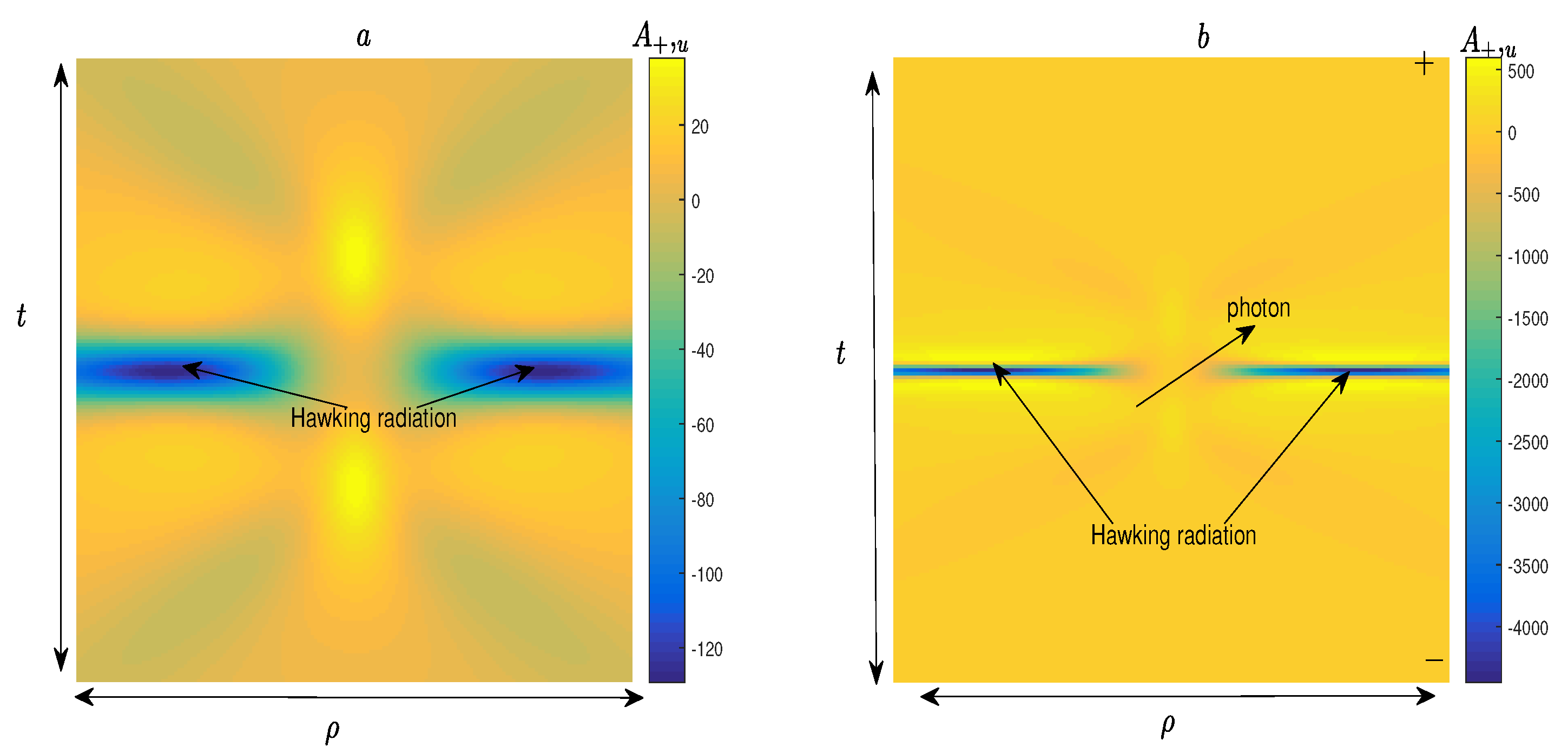
Figure 5.
: represents the size of various virtual black holes from a pre-Big Bang universe emitting equivalent particles of matter and antimatter under the following conditions: = . It has localized features moving in spacetime : represents the size of various virtual black holes from a pre-Big Bang universe emitting equivalent particles of matter and antimatter under the following conditions: = . It has localized features moving in spacetime
Figure 5.
: represents the size of various virtual black holes from a pre-Big Bang universe emitting equivalent particles of matter and antimatter under the following conditions: = . It has localized features moving in spacetime : represents the size of various virtual black holes from a pre-Big Bang universe emitting equivalent particles of matter and antimatter under the following conditions: = . It has localized features moving in spacetime
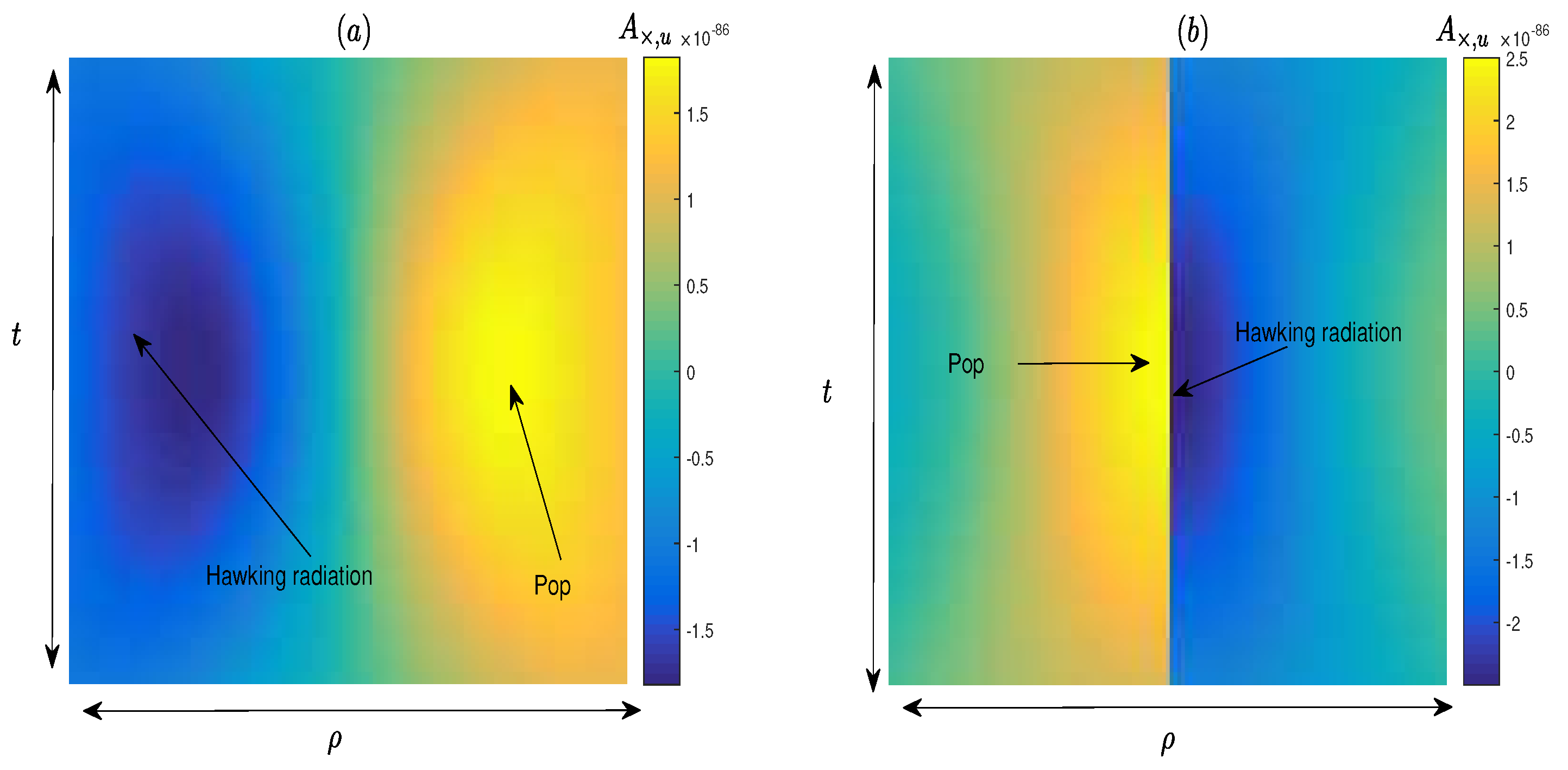
Figure 6.
: represents the size of the various virtual black holes present on the CMB emitting equivalent particles of matter and antimatter under the following conditions: = . It has localized features moving in spacetime : represents the size of the various virtual black holes present on the CMB emitting equivalent particles of matter and antimatter under the following conditions: = .It has localized features moving in spacetime
Figure 6.
: represents the size of the various virtual black holes present on the CMB emitting equivalent particles of matter and antimatter under the following conditions: = . It has localized features moving in spacetime : represents the size of the various virtual black holes present on the CMB emitting equivalent particles of matter and antimatter under the following conditions: = .It has localized features moving in spacetime
Disclaimer/Publisher’s Note: The statements, opinions and data contained in all publications are solely those of the individual author(s) and contributor(s) and not of MDPI and/or the editor(s). MDPI and/or the editor(s) disclaim responsibility for any injury to people or property resulting from any ideas, methods, instructions or products referred to in the content. |
© 2025 by the authors. Licensee MDPI, Basel, Switzerland. This article is an open access article distributed under the terms and conditions of the Creative Commons Attribution (CC BY) license (http://creativecommons.org/licenses/by/4.0/).
Copyright: This open access article is published under a Creative Commons CC BY 4.0 license, which permit the free download, distribution, and reuse, provided that the author and preprint are cited in any reuse.


