
Submitted:
19 August 2025
Posted:
20 August 2025
You are already at the latest version
Abstract
This paper examines Babalú-Ayé’s identity as both a healer and a sender of disease focusing on Afro-Caribbean healing practices. Connections between Babalú-Ayé and healing will be examined with special attention to vaccination, the uses of cundeamor, and wholistic medicine. The efficacy of beliefs and practices associated with Babalú-Ayé will be considered with attention to the expanding influence of Babalú-Ayé in contemporary Caribbean societies and in the United States.
Keywords:
Sakpona
; Babalu-Aye
; vaccination
; cundeamor
; mental health
; Trinidad
; Cuba
; Florida
Introduction
Representations of Babalú-Ayé’ have changed over time and space. As Karen Richman correctly pointed out, images of African gods have been strongly influenced by changes in media and technology.2 Images of Babalú’s are encompassed in his bodily representations (statues, offerings, dance steps, rhythms, and ritual objects) which, in turn, are reflected in his healing powers.3 As George Brandon asserts, Babalu-Aye is readily identifiable despite the various names and distinctive ethnic colorations different groups have given him.4 He is always associated with the Earth. He is frequently, but not always, associated with smallpox. Among the Yoruba, he is associated with forms of mental illness.
Babalú-Ayé exerts power over all things “Earthly.” But his power is not absolute. Moreover, he does not always choose to exert his power. He aids some of his followers in their pursuit of wealth and success. But some followers do not receive what they ask for. Why? This paper explores possible explanations for this seeming ambiguity.
Cuban-born bandleader Desi Arnaz is alleged to have asked three things from Babalú: professional success, financial success, and a beautiful wife. In return, Arnaz promised to spread Babalú’s name around the globe. Arnaz fulfilled this promise to Babalu, and his three requests were granted. Babalú is not predictable. As one of James Titus Houk’s Trinidad informants stated 5: “there are certain things that Shakpana would not do. Shakpana will do the things he wants to do if he finds pleasure with you. Shakpana won’t do nothing for you that he don’t find pleasure.” The major requirement is that one be “serious” in what one asks for and be respectful in one’s dealings with Babalú-Ayé.
Babalú is not transactional. He helps some overcome their illnesses. He helps others deal with their illness by changing their perspective. As Joseph M. Murphy cogently observed, “Babalú-Ayé is the spirit of sickness and health and the transformed vision of the world that disease affords.” 6 His worship is a plea and commitment to transform the pain of suffering into wisdom.
Babalu’s major contributions to biomedicine are: 1) his association with vaccination and 2) his promotion of the medical uses of cundeamor (which has had a long history as a salve for wounds and a cure for gastritis and colitis and other digestive disorders);7 and 3) in the areas of holistic medicine. 8 Babalu helps devotees deal with their illnesses, and he also helps them deal with the inevitability of death.9 In Haiti and Cuba, Babalú directs his devotees to the cemetery (e. g. Baron Samedi in Haiti, where as Yvonne Daniel notes, dance facilitates transition). Drumbeats, movements, rhythms, and vibrations bring about an experience of community. 10
Martin A. Tsang 11 has convincingly argued that Babalú Aye’s ceremonies reorder bodily equilibrium. Tsang asserts that the act of sweeping, and other carefully choreographed rituals serve to detach, catch, and remove fear of Ikú/death and Arun/sickness. Ritual performance, Tsang contends, is how Babalú-Ayé restores health, and the rituals associated with Babalú-Ayé establish a “spiritually aligned” system of healthcare. Dance and prayer are the major components within Babalú Aye’s healing repertoire, and these components have become foundational for Caribbean (and other) people in their efforts to promote healing and prolong life.
Vaccination
One of the most prominent images of Babalú-Ayé could once be found at the Center for Disease Control headquarters in Washington D. C. relating Babalú-Ayé and the eradication of smallpox and other pandemic diseases. Since the eradication of smallpox in 1980, Babalú Aye’s efficacy has expanded to include AIDS/HIV, tuberculosis, Ebola, and covid.12
In 2024, Babalú-Ayé occupied a prominent place on the Center for Disease Control’s official website. The website also featured Pierre Verger’s 1982 report linking Babalu and vaccination in the US. 13 According to Verger, “Babalú-Ayé -- or as he is more cautiously referred to as Obalouayé or Omolou) -- was carried to the Caribbean and Brazil by African slaves.” Verger noted that many different names were given to Babalú-Ayé to avoid mentioning his “real,” Ifa-inspired, name: “Sakpona.”
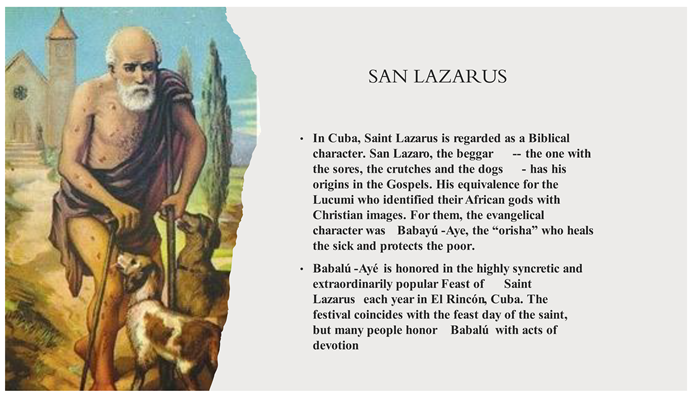
Babalú-Ayé is identified as Saint Roque and Saint Sebastian in Brazil and as Saint Lazarus in Cuba.14 In both Africa and the Americas, Babalú-Ayé’s devotees follow, and continue to follow, strict rules regarding diet, bodily scarification, and the manipulation of ritual objects.
In eighteenth-century Africa, many of Babalú’s followers had been inoculated. When European slave traders boarded African slaves in Benin and Nigeria, they observed that some slaves had inoculation scars on their arms. They also noted that slaves with inoculation scars were not as susceptible to smallpox as uninoculated slaves. Slaves with scars commanded higher prices in the slave market.
In the United States, inoculation became widely known as “vaccination.” Puritan preacher Cotton Mather popularized vaccination as a treatment for smallpox; nineteenth-century theologian Jonathan Edwards was (unsuccessfully) vaccinated against smallpox15, and George Washington16 ordered soldiers of the Continental Army to be vaccinated in what was to become the first large-scale state-sponsored immunization campaign in North America.
Not all African slaves had been inoculated. Some Africans (including followers of Babalú) resisted vaccination. In Nigeria, for example, members of the Abakaliki Faith Tabernacle refused to be vaccinated following local epidemics. In the twentieth century, the CDC in Washington encountered resistance to vaccination in Dahomey, Togo, and western Nigeria. Local priests resisted inoculation incorrectly assuming that they were being asked to make war on their own deities.17
Sakpona, the Yoruba god of smallpox
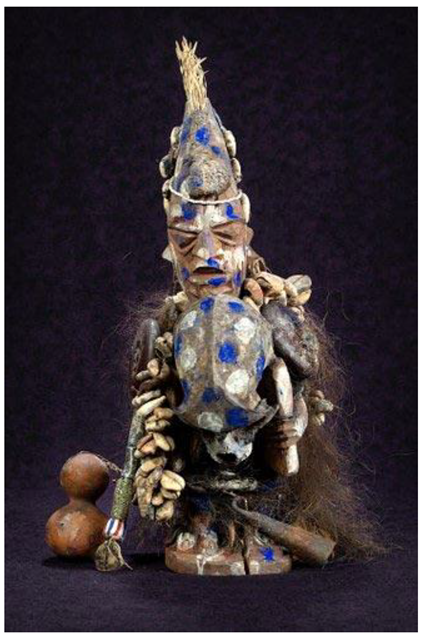
<This site was removed in April 2025 but (as of this writing) has been partially restored.>
The CDC website once stated: “One of the most iconic objects in the David J. Sencer CDC Museum is a carved statue of Sakpona, the Yoruba god of smallpox. This statue (one of four in the CDC’s collection) was a gift of Rafe and Ilze Henderson, 1995.014, CDCM Collection. The CDC’s website stated that the figure was commissioned along with several others in 1969 from a carver from Abeokuta (near Lagos) shortly before the Inter-regional Seminar on Smallpox Eradication which was held in Lagos.
The statue is layered with monkey skulls, cowrie shells, and fur.
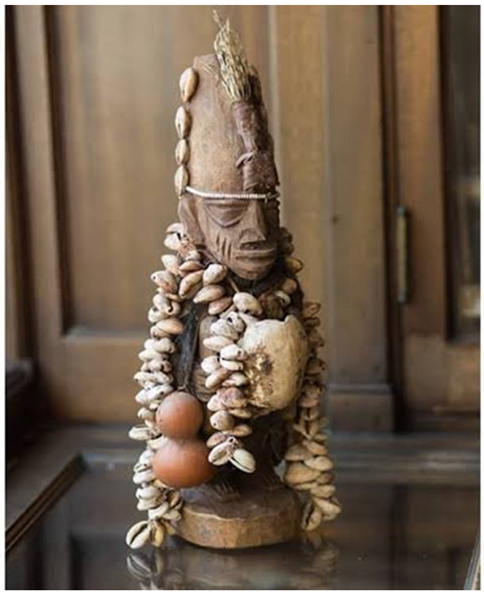
The CDC website also situated Babalú-Ayé within the context of Yoruba cosmology. According to Yoruba tradition, the supreme god Olodumare delegated authority over two realms of the cosmos to his two sons. To his second son, Sango18, he granted control of the sky. To his first (eldest) son, Sakpona, he granted control of the earth. Sakpona, in his role as guardian of the earth, granted humans dominion over all earthly grains. But when angered, Sakpona caused the grains that were eaten by humans to erupt on their skin as smallpox. Smallpox is represented as an indication of divine displeasure.
As noted, Sakpona worship in Africa was once controlled by priests who managed his shrines. These priests could either cause or cure smallpox. In 1907, British colonial officers banned Sakpona worship because the British thought his Sakpona’s priests were deliberately spreading disease.
Uses of Cundeamor
Many devotees of Babalú-Ayé are also botanicas and/or bush healers.19 In Trinidad and elsewhere, Babalú-Ayé is strongly associated with Osain, the orisa who specializes in herbal medicines. Oba Ecun20 identifies Osain and Babalú as two manifestations of the same orisa.
According to Joseph M. Murphy, “no plant is more closely associated with Babalú-Ayé than cundeamor.” 21 Devotees cover his vessel with this herb, and Babalú’s followers place strands of cundeamor vines around their necks at the end of each ceremony. These necklaces (eleke) are later thrown into a basket.
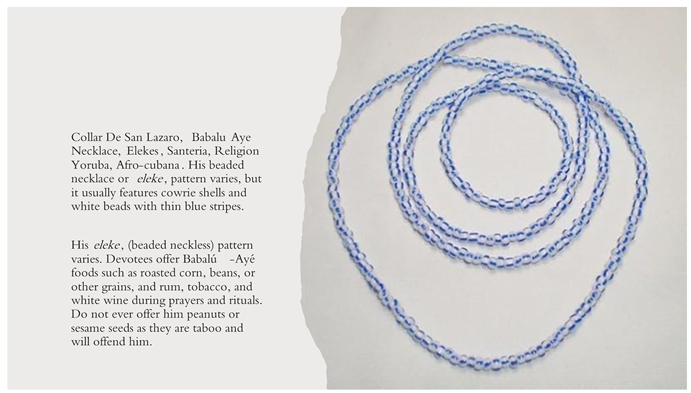
Cundeamor grows abundantly at the end of the rainy season near Babalú’s feast day (December 17th). After his feast day, the plant dries up and often disappears entirely. Cundeamor’s fruits are most notable for their distinctive yellow-orange color and bright red seeds.
As noted, Cundeamor’s growth cycle roughly follows the feast days of Babalú-Ayé.
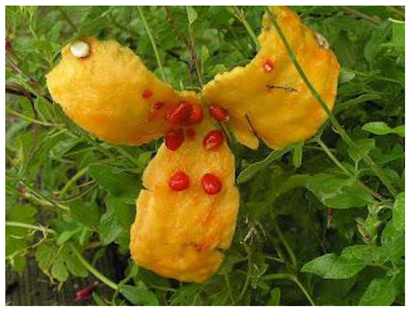
In Cuba, two related plants Momordica charantia and Momordica balsamica are both called cundeamor.
Cundeamor has been proven useful in the treatment of eczema, herpes, leprosy, malaria, cancer, and diabetes. It has antibacterial and antiviral properties, and there is evidence that cundeamor is a strong regulator of the immune system. Babalú’s long association with skin disorders and infectious diseases links Babalú and cundeamor.
Steps to a “Spiritually Aligned” System of Health Care
There is a longstanding interest in religious healing in the Caribbean. Nineteenth-century travelers like Mrs. Carmichael (1834, especially in chapters VIII and X) and Edward Underhill (1862) provided extensive reports on African healing practices in the region. During the 1970s and 1980s, psychiatrists Michael Beaubrun (1924-2002) and Ezra E. H. Griffith explored the therapeutic potential of African-derived healing practices notably among followers of the orisa and the Spiritual Baptists of Trinidad.22 Beaubrun and Griffith also posited multiple ways orisa rituals provided ways for Caribbean peoples to celebrate their African “roots.” 23
As Sutherland, Moodley and Chavannes emphasized, “Any critical and reflective view of Caribbean healing traditions must take into account the complex and traumatic experience of slavery, the racism of colonialism, and the post-colonial need for social stability and economic development” 24
Sutherland, Moodley and Chavannes underscored the failure of mainstream biomedicine to treat the “whole” person. They warned against the dangers of compartmentalization. Afro-Caribbean healing techniques, they suggested, should focus on “holism, collectivism and spirituality.” 25
Kumar Mahabir 26 concluded that orisa religions in Trinidad were part of what he identified as a “hidden health care system.” Mahabir outlined six major components within this system: 1) trance or possession, 2) sacrifice, 3) offerings, 4) direct consultations, 4) exorcisms, 5) hands-on healing, and 6) conveying information about the treatment and causes of illnesses.27
Babalú-Ayé is not associated with all the components Mahabir identified within the “hidden health system.” In Trinidad, Babalú/Sakpona does not possess his followers; he does not speak (except through dreams and Ifa divination), and he is not involved in exorcisms. He receives sacrifices but does not demand them. He avoids direct physical contact with devotees (which would preclude the laying on of hands). Mahabir acknowledged the presence of herbal medicines, baths, fasting, and divination but failed to recognize the overarching importance of prayers and supplication in Babalú-Ayé healing rituals.
As Martin A. Tsang 28 astutely pointed out, healing rituals performed in the name of Babalú-Ayé are primarily intended to restore balance, establish equilibrium, and provide “spiritual realignment.” Babalú-Ayé gives guidance to his followers through divination, dreams, and by personal example. He encourages his devotees to embrace life and to accept death. Tsang highlighted ways in which sweeping and other carefully choreographed acts serve to detach, catch, and remove Ikú/death and Arun/sickness. These acts exemplify an Afro-Caribbean response to the need for spiritual re-alignment.
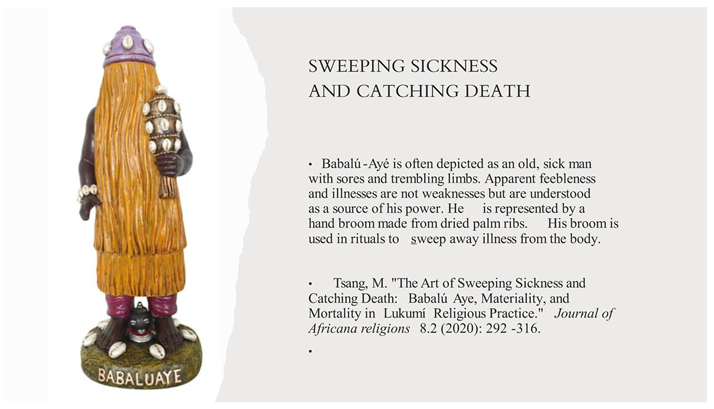
In Africa, Babalú-Ayé is usually depicted as a strong man carrying a crutch and wrapped in braided raffia (mariwó) formed from strips of palm leaves. This attire both conceals the marks of smallpox and highlights his connections to this disease. In the Americas, depictions of Babalú-Ayé often depict him with signs of leprosy. He is believed to have power over this affliction.
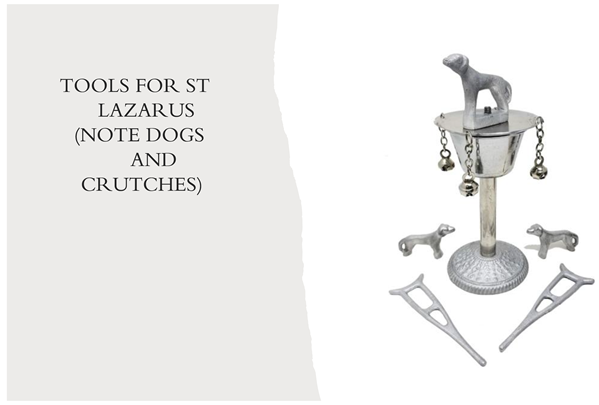
Babalú-Ayé’s major ritual tools include a broom for purification29, covered terra-cotta vessels, crutches, dogs, and cowry shells. His crutches symbolize the support he offers to those suffering from illness. Dogs are his constant companions and aid him in his healing rituals.
Who is Babalu?30
Babalú-Ayé navigates the delicate balance between sickness and health, life and death. He is most often depicted as an old, sick man with sores and trembling limbs. His apparent feebleness, crutches, and scars are not understood as signs of weakness but indicative of his power. His broom is used to sweep away illness.31 Wednesday is Babalu-Aye’s Day. Babalú-Ayé’s garments are purple, and made of burlap, and his traditional colors are earth tones, yellow, and royal purple. These resemble the colors of a bruise. Burlap depicts Babalú-Ayé’s humility and vulnerability. His gemstones (tanzanite, obsidian, and jasper) signify his healing power and his ability to protect. Statues of Babalú often feature a broom that covers his face. But the broom does not interfere with his sight. Babalú sees all. His fearsome appearance highlights his wounds and, at the same time, underscores his triumph over his afflictions. His scars and open wounds show that his victory is incomplete.
In Africa, Babalú-Ayé’s title translates as “Father of the World.” He is closely associated with the Yoruba supreme creator god Olodumare. As noted, Babalú has multiple names, identities, and manifestations. To his devotees, he is an embodiment of mercy. Devotees point out that he was the sole orisa to come to the aid of Sango during Sango’s illnesses.
He can also be cruel. Accounts of Babalú-Ayé’s relations with other orisa underscores his cruelty. Babalú-Ayé is a son of Yemanja and a brother of Sango. When Babalú was invited to a celebration at the palace of Obatala, the father of all orisa, he tried to dance. He stumbled and fell. Other orisa in attendance laughed at him. He took revenge on them by infecting them with smallpox. As a result, Obatala banished him from his palace and sent him to the bush where he was forced to live as an outcast. He thus became associated with the forest and movement.
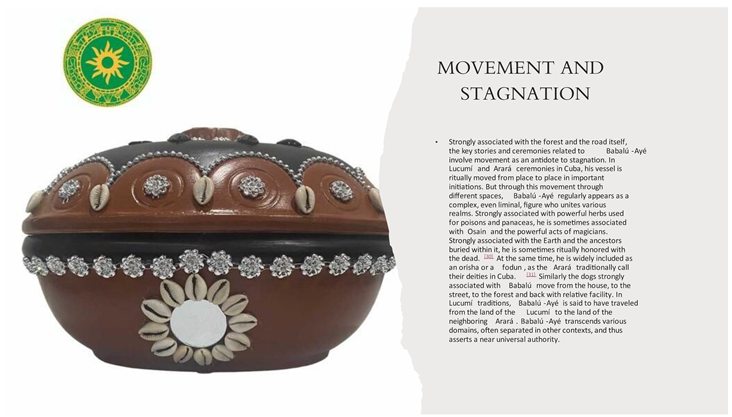
Shrines to Babalú are never permanent and are often located “off the beaten path.” Major ceremonies related to Babalú-Ayé emphasize movement as an antidote to stagnation. Babalú-Ayé and his dogs are portrayed as a constantly moving, liminal figures, who deliberately cross boundaries. Babalú-Ayé s vessels are ritually moved from place to place, and Babalú’s dogs are never still. They move from house to house, from street to street, and run into the forest. Babalú-Ayé and his dogs transgress physical and cosmological boundaries that are usually kept separate.
His associations vary by country and by region. 32 In Africa, Babalú-Ayé is part of ewe Fon pantheon where he is referred to by his Ifa-inspired name: Sakpona.33 In Haiti, Babalú-Ayé is known as Legba Pied Casse; in the Dominican Republic, Legba; in Trinidad and Tobago, Sakpona, and in Brazil, Omolu, Shapanan, Sakpata, Obaluaie and Alapo. In Santeria, Babalú-Ayé is also known as Ọsanyìn and identified with Saint Joseph. He appears in Afro-Cuban religious traditions as Palo Mayombe, Pata en Llaga (Legba), or as Kobayende.
In Cuba, Babalú-Ayé is most strongly associated with Saint Lazarus and is honored with a pilgrimage on December 17. Thousands of devotees gather at the Church of Saint Lazarus in El Rincón. Arará communities in Cuba honor Babalú as Asojano.
Babalú-Aye does not “speak” during ceremonies. In Cuban Santeria, he usually communicates indirectly through dreams and by Ifá divination. But there is one exception in Cuba. When he manifests as Asojano. he mumbles incoherently in a nasal voice that Cubans refer to as fañosa.34 In areas outside Havana, Babalú possesses uninitiated devotees in what is referred to as santo parado. Those possessed in santo parado “speak,” giving good, reliable advice as was reported to David H. Brown by Oswaldo García Villamil 35 Santo parado may be the oldest form of orisa worship in Matanzas.36
All devotees consider Ifa the most authoritative form of communication.37 This posed a major problem for believers in the 18th and early19th centuries. Few ifa diviners were taken into slavery, and most diviners came to the Caribbean following Emancipation. Today, however, Caribbean clients have access to multiple African-trained and local Babalawo as well as multiple websites.38
Ifa is a complex divination system centering on verses performed by a Babalawo or initiated priest. In traditional Ifa, cowrie shells are thrown. The diviner then recites multiple verses associated with each of 200+ configurations. The client chooses which verse is most applicable to her/her situation. The more verses a diviner knows, the more likely he can recite verses that address the client’s needs. But ifa is not simply a matter of reciting verses. The critical role of the individual Babalawo’s performance belie the perception of Ifa as mere repetition. Ifa diviners actively direct their clients to the most appropriate verse by their skilled dramatic recitations. 39
In Trinidad, Babalú never speaks. He sometimes makes himself known through rhythmic stomps, grunts40, and – most important -- dreams. Before the 1980s, there were few African-trained ifa diviners in Trinidad. Today, ifa divination is readily available in person or on websites.41 Sakpona communicates mostly through reams. Only followers of Babalu/Sakpana understand these communications. If/when Sakpona appears to “speak” (as in Cuba), it is assumed that another orisa is “playing” Babalú.
Regional variations abound. Babalú-Ayé in Cuban Santeria is not the same as Babalú-Ayé in South Florida. In Trinidad (where he is known by his Ifa name Sakpona) But even in Trinidad, Sakpona in Moruga differs from Sakpona in Port of Spain. Writers, poets, and artists have struggled to capture the multiple, sometimes contradictory, voices of Babalú. 42 Among the most notable of these voices was that of the late Raúl J. Cañizares. In the arts, Babalú-Ayé’s gait, age, and accent changes to fit new audiences.43
While Babalu has many names and regional identities, there is also consistency. As George Brandon 44 correctly emphasizes, Babalú-Ayé is primarily an Earth god. He is also primarily known as a smallpox deity, despite many names connecting him with a variety of other diseases. Other associations are also significant; especially those relating to heat, wind, and the Earth These multiple associations connect him to diseases and other misfortunes in West Africa and in African-derived religions of the Americas.
Babalú-Ayé is a protector of the sick, the weak, the aged, and the injured, but he is first-and-foremost a spirit of the Earth. His association with the Earth expands and enhances his seemingly ambiguous role as both healer and transmitter of disease. Because Babalú-Ayé’s responsibilities encompass the entire Earth, he cannot always privilege humans over cosmic concerns -- nor can he always privilege his own devotees over non-devotees. Outcomes are indeterminant.
Babalú-Ayé is sometimes depicted as white, but he does not focus on skin color. His devotees include all racial and ethnic groups. In Trinidad, Whites, Chinese, Indian, and Syrians follow Babalú-Ayé. He treats all races and ethnicities much the same. Babalu deals with his devotees as individuals – not as a member of an ethnic or racial group.
In Trinidad ceremonies, Babalú-Ayé is both at the forefront and in the background. He is present at every feast, but he does not always command the centerstage. He has no permanent altars.
In Trinidad, orisa ceremonies are never sponsored exclusively for Sakpona. But in Haiti and Cuba, Babalú commands center stage. He “opens the gates.” No ceremonies can begin without him.
At times, Babalú seemsdetached from his ceremonies and his followers. This detachment was aptly expressed by Paul Simon in “Rhymn of the Saints:“
- Do my prayers remain unanswered
- Like a beggar at your sleeve?
- Babalu-aye spins on his crutches
- Says, “Leave if you want
- If you want to leave”
Simon also featured Babalú-Ayé as a character in his Broadway show “The Capeman.”
Babalú-Ayé accepts a variety of offerings, but he favors roasted corn, beans, and other grains. He also likes rum, tobacco, and white wine. He will not accept offerings of peanuts or sesame seeds because these grains resemble the pox that afflicts him. 45
Babalú does not demand blood sacrifice, but he is willing to accept it. 46 In the eyes of many Cuban priests of Babalú-Ayé, blood sacrifice is a necessary component of worship. There can be no “real” ceremony without blood sacrifice.
Legal opposition to blood sacrifices at the Church of Lulumi Babalu-Aye in Hialeah, Florida, centered on animal sacrifices. In 1987, Florida’s Attorney General Bob Butterworth ruled that “ritual sacrifice of animals for purposes other than food consumption” is not “necessary” killing, and therefore, should be illegal. Lucumi church leaders disagreed. They brought their case to the US Supreme Court. The Supreme Court ruled in favor of the Hialeah church, and Butterworth’s earlier ruling was overturned 47
Contrary to Florida Attorney General Butterworth’s assertion, sacrificial meat is never wasted. It is consumed. In Trinidad, it is boiled in a rich stew (called “pelau”) which is served after service. All parts of the animals are cooked -- bones, beaks, hoofs, and eyeballs. Leftovers are taken home.48
As noted, Babalú prefers grain offerings. Animal sacrifice is usually part of a public ceremony and entails much preparation. Grain offerings can be conducted privately and utilize items that are readily available.
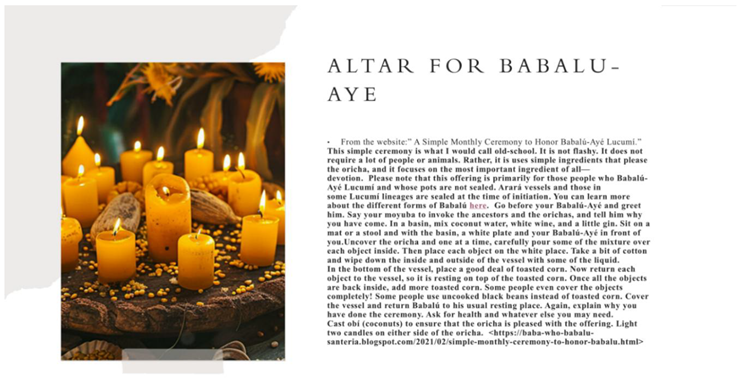
What follows is a transcript from the website “A Simple Monthly Ceremony to Honor Babalú-Ayé Lucumi:“
Offerings to Babalu are usually performed by individuals in their own homes. Grain offerings are preferred because they do not require multiple officiants, special plants, and/or animals. Rather, they utilize common ingredients that are believed to please the orisa. The most important component is devotion.
Offerings to Babalu follow a standard ritual formula. First, the supplicant greets Babalú-Ayé and invokes the ancestors (moyuba). Next, the supplicant tells Babalú why he/she has come. Next, he/she mixes coconut water, white wine, and a little gin in a basin and pours the white wine mixture over Babalu’s vessel. Toasted corn is placed in the bottom of the vessel. The vessel is covered and Babalú is returned to his resting place. One must explain to Babalú why he/she is doing this ceremony. Ask Babalu for health and whatever else is needed. If desired, may cast obí (coconuts) to ensure that the orisa is pleased with the offering. Last, light two candles on either side of the orisa. https://baba-who-babalu-santeria.blogspot.com/2021/02/simple-monthly-ceremony-to-honor-babalu.html.

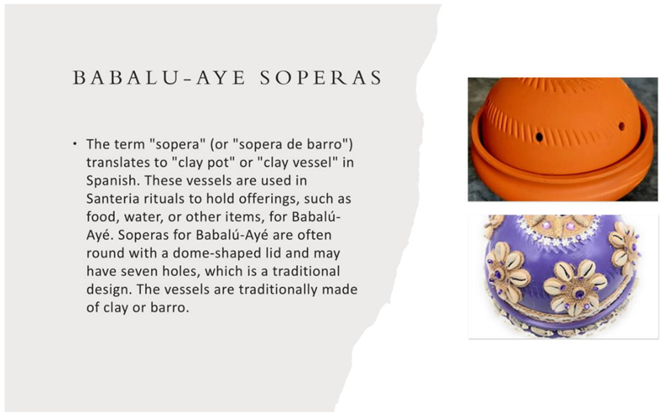
Permeability of vessels and impermanence.
My Spiritual Father is a son of Sango 49 (orisa of the Sky) and my Spiritual Mother (now deceased) was a daughter of Babalu/Sakpona (orisa of the Earth). In some respects, these deities appear to be opposites. Sango is impulsive, quick to anger, and demands obedience. Sakpona is detached, patient, and aloof. Sango punishes immediately. Sakpona is patient.
Despite his erratic nature, many followers see Sango as more approachable because he understands human frailties. Sango was a king who lost his thrown; he was betrayed by family, and – most important -- he is the only orisa to have experienced death.
As noted, Olodumare, the creator, delegated authority over various realms of the cosmos to his two sons. To Sango, he gave dominion of the sky; to Sakpona, he gave dominion over the earth. Sakpona’s major gift to humans was grain, but when he is displeased, he punished humans by causing grains they had eaten to come out on their skins as pox.
Both Sango and Babalú seem to have mellowed over time. By dealing with humans and observing human frailties, they may have gained insight for dealing with their own limitations.
My Spiritual Mother, who followed both Sakpona and Osain, sought healing plants when one of her daughters became ill. She traveled to forested areas around Mount Benedict. Plants “talked” to her and instructed her how to use them. Her major struggle, she said, was to learn the “true” names of plants. Her experience was much the same as that reported by Lydia Cabrera, 50 Cabrera wrote: “When a godfather realizes that his godson is able to call the plants by their proper names without confusing one with the other, then he starts sending the godson out into the world alone.” My Spiritual Mother came to recognize that plants could be either good or bad. As one of Lydia Cabrera’s informants also noted, “A breeze is good and refreshing. But what about a hurricane? 51
Not all bush healers maintain connections with the orisa, In Trinidad, many older followers of the orisa have not been formally initiated into the religion. Their initiation was conducted in a Spiritual Baptist church. My Spiritual Mother considered herself to be a Spiritual Baptist who was also a devotee of Osain and Sakpona.52
Those needing medical leaves53 came to Mother’s house from as far away as Toco. Her door was never locked. Visitors left grains, ears of corn, other medicinal plants, and coins (mostly pennies) in exchange for medicines. Exchanges were never monetary.54 Mother did not keep track of what was given or what was taken away. She was absent from her house most days and nights minding her grandchildren in another town. Nevertheless, as a devotee of Sakpona, Mother scrupulously swept her patio every morning and every evening.
This pattern of exchange continued long after her death. Her daughters swept her patio daily and provided fresh plants for twelve years. Her house was torn down in 2014.
My connection to Sakpona was solely through my Spiritual Mother. She introduced me to Sakpona (and not Osain) because Sakpona is male, white, and scholarly – a better match for me. She considered herself to be closest to Osain. Mother directed me to make offerings to Sakpona (usually an ear of corn which I bought to the altar of a Spiritual Baptist church). She did not have a permanent altar for Sakpona in her home. She created a temporary altar to serve special needs. These altars were taken down after a few weeks. She emphasized that one is never certain how Salpona will respond to an offering. Sakpona demands respect, but he does not demand worship. Nor does he take responsibility for outcomes that are beyond his control.
Because Babalú-Ayé both cures and sends disease, he is both feared and loved. He punishes people for their transgression. But relations with Babalu are less predictable than with other orisa. He is not always swayed by offerings. He has a broad perspective. His concern is for the well-being of the whole Earth and all of its creatures.
Yoruba cosmology --- like many religious systems -- is complex. As French anthropologist Claude Levi-Strauss 55 pointed out, the Yoruba developed one the world’s most theologically sophisticated cosmologies. As in many religious systems, orisa are not bound to logical consistency. Babalú-Ayé integrates and transcends the apparent dichotomy between power and mercy. How can a powerful and merciful god still allow suffering? The answer is that the universe is not perfect. (Olodumare was drunk when he created the earth and Babalú was drunk when he created humans). Apparent ambiguities are reconciled when Babalú is seen not in terms of transactions but in terms of his obligations to the whole Earth and its creatures.
Conclusions
Representations of Babalú-Ayé’ have changed over time and space. As Karen Richman correctly noted, images of gods have been strongly influenced by changes in media and technology.56
Images of Babalú are united in his bodily representations, statues, material objects, and healing practices.57 Babalú-Ayé is a protector of the earth and obligated to maintain the delicate balance between sickness and health, life and death. His goals are like what the late Max Beauvoir saw as ecological balance in Haitian vodun.
In theory, Babalú-Ayé was granted power over all things “earthly,” but he cannot be relied on to assert that power in all cases; for example, he aids some followers in their pursuit of wealth and success, but he does not promise wealth and success to all.
Babalú-Ayé’s main contributions to biomedicine relate to vaccination and the eradication of smallpox; the use of cundeamor -- which has had a long history as a medicinal herb and is widely used as a salve for wounds and as a cure for gastritis and colitis, and other digestive disorders.58 But perhaps Babalú-Ayé’s greatest contribution is in affecting spiritual cures.59
His journey of exile, debilitation, and finally restoration address the cyclic nature of life. He embraces the inevitability of death. 60
Babalú is a transgressor. He was condemned to exile because he broke social norms. The physical pain of his lame leg is related to the emotional pain of his exile. He spends much time in isolation. He is reclusive.
Babalú-Ayé’ is lauded as the most righteous of all orisa, and he punishes humans for their offences. His fearsome appearance contrasts with his mild demeanor.
Babalú-Ayé is scarred by a disease so terrifying that he is covered by raffia that covers his entire body. His scars are not signs of weakness. His imperfections illustrate his ability to overcome and transcend (but not completely) disease and suffering.
Babalú-Aye does not “speak.” He communicates through dreams and Ifá divination.
Babalú-Ayé is characterized by permeability. His vessels always have holes in their lids symbolizing the difficulty in containing illness completely. These holes are often compared to the sores that pock the orisa’s skin. Permeability is represented by his dress of burlap cloth and raffia fringe.
Babalu Aye is associated with the forest and the journey itself. Stories related to Babalú-Ayé involve movement as an antidote to stagnation.
He is known as an orisa of mercy. Babalú-Ayé has efficacy in the treatment of smallpox, monkey pox, influenza, leprosy, AIDs, and covid.
He disregarded the rules and customs of his time and did things his own way, which were often very reckless. His careless lifestyle caused him to become stricken with smallpox and other diseases (hence his connection to disease). He was shunned by other orisa and banished for his lack of discipline.
Karen Richman adumbrates an acute challenge for the future of Afro-Caribbean religions; namely, the issue of displaced gods and displaced devotees. Many devotees cannot return to their spiritual homes. Haitians cannot return to Haiti; Florida santeros cannot return to Cuba, and Trinidadians cannot return to the Spiritual Baptist and orisa centers where we were initiated. Laventille and Belmont in Port of Spain (where I was initiated) have been taken over by street gangs. All-night feasts and mourning ceremonies can no longer be held in the area. Nevertheless, Babalu’s flexibility, permeability, and focus on movement augur well for his continuing popularity and expansion of the religion. 61
References
- Aelion, David Maurice. “Freedom of Religion: A Case Study of the Church of Lukumí Babalú Ayé v. City of Hialeah, 2010. FIU Electronic Theses and Dissertations. 1105. https://digitalcommons.fiu.edu/etd/1105.
- Aiyejina, F., & Gibbons, R. (1999). Orisa (Orisha) Tradition in Trinidad. Caribbean Quarterly, 45(4), 35–50. [CrossRef]
- Brandon, George. Light from the forest: How Santería heals through plants. Blue Unity Press, 1991.
- Brandon, George. Santeria from Africa to the New World: The Dead Sell Memories. Indiana University Press, 1997.
- Brandon, George and Leslie Desmangles. “Introduction: Good Spirit, Good Medicine; Religious Foundations of Healing in the Caribbean.” Anthropologica 54, no. 2 (2012): 159–61. http://www.jstor.org/stable/24467398.
- Brown, David H. “Conjure/Doctors: An Exploration of a Black Discourse in America, Antebellum to 1940.” Folklore Forum, 1990.
- Brown, David H. “Thrones of the Orichas: Afro-Cuban Altars in New Jersey, New York, and Havana.” African Arts 26, no. 4 (1993): 44–87. [CrossRef]
- Brown, David H. Santería Enthroned: Art, Ritual and Innovation in an Afro-Cuban Religion. University of Chicago Press, 2003.
- Buckley, Anthony D. Yoruba Medicine. Oxford: Clarendon, 1985.
- Cabrera, Lydia. El Monte: Notes on the Religions, Magic, Superstitions, and Follore of the Blact and Creole People of Cuba. trans. David Font-Navarrete. Duke University Press, 2003.
- Cañizares, Raúl J. Babalú-Ayé: Santeria and the Lord of Pestilence. New York: Original Publishers, 2000.
- Castor, Nicole Fadeke. “Shifting Multicultural Citizenship: Trinidad Orisha Opens the Road.” Cultural Anthropology, 28 475-489, 2013. [CrossRef]
- Castor, Nicole Fadeke. Spiritual Citizenship: Transnational Pathways from Black Power to Ifá in Trinidad. Duke University Press, 2017.
- Daniel, Yvonne. Caribbean and Atlantic Diaspora Dance: Igniting Citizenship. Urbana: University of Illinois Press, 2011.
- Dianteill, Erwan, and Martha Swearingen. “From Hierography to Ethnography and Back: Lydia Cabrera’s Texts and the Written Tradition in Afro-Cuban Religions.” The Journal of American Folklore 116, no. 461 (2003): 273–92. http://www.jstor.org/stable/4137792.
- Dixon, P. J. “Uneasy Lies the Head: Politics, Economics, and the Continuity of Belief among Yoruba of Nigeria.” Comparative Studies in Society and History. 1991;33(1):56-85. [CrossRef]
- Ecun, Oba. Ita: Mythology of the Yoruba Religion. Miami: Oba Ecun Books, 1996.
- Ellis, A. B. The Yoruba-speaking peoples of the Slave Coast of West Africa. Their religion, manners, customs, laws, language, etc. London: Chapman and Hall, 1894.
- Forde, Maarit. “The Moral Economy of Spiritual Work: Money and Rituals in Trinidad and Tobago.” in Obeah and Other Powers: The Politics of Caribbean Religion and Healing. eds. Maarit Forde and Diana Patton. Duke University Press, 2012.
- Friedson, Steven M. Remains of Ritual: Northern Gods in a Southern Land. Chicago: University of Chicago Pres, 2009.
- Glazier, Stephen D. “African Cults and Christian Churches in Trinidad.” Journal of Religious Thought, 39, no. 2 (1982): 17-25.
- Glazier, Stephen D. “Wither Sango? An Inquiry into Sango’s ‘Authenticity’ and Prominence in the Caribbean.” in Sango in Africa and the African Diaspora. Joel E. Tishken, Toyin Falola, and A. Akinyemi, editors. Bloomington: Indiana University Press, 2009. pp. 233–247.
- Glazier, Stephen D. “Health and Illness” (with Mary J. Hallin) in 21st Century Anthropology, H. James Birx, editor. Thousand Oaks, CA: Sage Reference, volume 2, 2010, pp. 925–935.
- Glazier, Stephen D. “Religious Developments in the Caribbean Between 1865 and 1945” in The Cambridge History of Religions in America. Vol. II: Religions in America, 1790–1945. Stephen J. Stein, editor. Cambridge University Press, 2012, pp. 727–748.
- Glazier, Stephen D. “If ‘Old Heads’ Could Talk.” Anthropologica 54 no. 2 (2012): 199-209.
- Glazier, Stephen D. “Sango Healers and Healing in the Caribbean.” in Patsy Sutherland, Roy Moodley and Barry Chavannes, eds. Caribbean Healing Traditions: Implications for Health and Mental Health. Routledge, 2014, pp. 89-101.
- Griffith, E. H., Mahy, G. E. “Spiritual Baptist Mourning: A Model of Contemplative Meditation.” in: Pichot, P., Berner, P., Wolf, R., Thau K. (eds) Psychiatry: The State of the Art. Springer, 1985. [CrossRef]
- Griffith, Ezra E. H. Ye Shall Dream: Patriarch Granville Williams and the Barbados Spiritual Baptists. University of the West Indies Press, 2010.
- Hagedorn, Katherine J. Divine Utterances: The Performance of Afro-Cuban Santería Smithsonian Institution Press, 2001.
- Hagedorn, Katherine J. “Long Day’s Journey to Rincón: From Suffering to Resistance in the Procession of San Lázaro/Babalú Ayé.” British Journal of Ethnomusicology 11, no. 1 (2002): 43–69. http://www.jstor.org/stable/4149885.
- Herskovits, Melville. Dahomey: An Ancient West African Kingdom. J.J. Augustin, 1938.
- Idowu, E. Bolaji. Olodumare: God in Yoruba Belief. London: Longmans, Green, and Co, 1962.
- Lele, Ocha’ni. The Diloggun: The Orishas, Proverbs, Sacrifices, and Prohibitions of Cuban Santeria. Rochester, Vt.: Destiny Books, 2003.
- Levi-Strauss, Claude. The Savage Mind. University of Chicago Press, 1966.
- Lovell, Nadia. Cord of Blood: Possession and the Making of Voodoo. London: Pluto Press, 2002.
- Lucas, J. Olumide. 1996. The Religion of the Yoruba: Being an Account of the Religious Beliefs and Practices of the Yoruba People of Southwest Nigeria; especially in Relation to the Religion of Egypt. Brooklyn, NY: Athelia Henrietta Press, 1996.
- Mahabir, Kumar. Traditional Medicines and Women Healers in Trinidad” NALIS, 2002.
- Mason, Michael Atwood. 2009. “Baba Who? Babalú! Blog.” http://baba-who-babalu-santeria.blogspot.com/.
- McKenzie, Peter. Hail Orisha! A Phenomenology of a West African Religion in the Mid-Nineteenth Century. Brill, 1997.
- McNeal, Keith E. “Embodied Minds, Cultural Corpses, and the Work of the Dead: On Teaching the Anthropology of Death and Mortuary Ritual.” Embodied Pedagogies in the Study of Religion. Routledge, 2025. 225-234.
- Murphy, Joseph M. Working the Spirit: Ceremonies of the African Diaspora, Beacon Press. 1994.
- O’Brien, David M. Animal Sacrifice and Religious Freedom: Church of the Lukumi Babalu-Aye v. City of Hialeah. University of Kansas, 2004.
- Olupona, Jacob K., and Rowland O. Abiodun, eds. Ifá Divination, Knowledge, Power, and Performance. Indiana University Press, 2016. http://www.jstor.org/stable/j.ctt1b7x4sw.
- Oripelaye M. M., Olasode O. A. and Onayemi O. 2016. “Smallpox Eradication and Cultural Evolution among the Yoruba Race.” Journal of Dermatology 3 no. 5 (2016): 1067.
- Perez, Elizabeth. 2025. A subjective response to ‘transitional phenomena’ and case study of chinoiseries in “Afro-Cuban” religions. Religion, 55 no. 2 (2025): 525–541. [CrossRef]
- Ramos, Miguel “Willie.” Afro-Cuban Orisha Worship. in A. Lindsey, ed., Santería Aesthetics in Contemporary Latin American Art, pp. 51–76. Washington, DC: Smithsonian Institution Press. 1996.
- Richman, Karen. Migration and Vodou. Gainesville: University Press of Florida, 2007.
- Rosenthal, Judy. Possession, Ecstasy, and Law in Ewe Voodoo. Charlottesville: University of Virginia Press, 1999.
- Sandoval, Mercedes Cros, ‘Shopono/Babalú Ayé: God of Diseases and Plagues’, Worldview, the Orichas, and Santería: Africa to Cuba and Beyond (Gainesville, FL, 2007; online edn, Florida Scholarship Online, 14 Sept. 2011) . [CrossRef]
- Sutherland, Patsy, Roy Moodley, and J. Barry Chevannes eds. “Introduction” Caribbean Healing Traditions: Implications for Health and Mental Health. New York: Routledge, 2014, pp. 2-11.
- Thompson, Robert Faris. Face of the Gods: Art and Altars of Africa and the African Americas. The Museum for African Art, 1993. pp. 334. ISBN 9780945802136.
- Tsang, Martin A. “The Art of Sweeping Sickness and Catching Death: Babalú Aye, Materiality, and Mortality in Lukumí Religious Practice.” Journal of Africana Religions 13 July 2020; 8 no. 2 (2020): 292–316. [CrossRef]
- Tsang, Martin A. “Write into Being: The Production of the Self and Circulation of Ritual Knowledge in Afro-Cuban Religious Libretas.” Material Religion 17 no. 2 (2021): 228–61. [CrossRef]
- Verger, Pierre F. Notes sur le culte des orisa et vodun a Bahia, la Baie de tous les Saints, au Brésil, et à l’ancienne Côte des Esclaves en Afrique. Dakar: IFAN, 1957.
- Verger, Pierre (Fatumbi). Orisha. Les dieuxYorouba en Afrique et ou nouveau monde. Ed. A.M. Métailié, Paris 1982.
- Voeks, Robert A. 1997. Sacred Leaves of Candomblé: African Magic, Medicine, and Religion in Brazil. University of Texas Press, 1997.
- Ward, Colleen, & Beaubrun, Michael. “Trance induction and hallucination in spiritualist Baptist mourning.” Journal of Psychological Anthropology, 2 no. 4 (1979): 479–488.
- Warner-Lewis, Maureen. Trinidad Yoruba: From Mother Tongue to Memory University of Alabama Press, 1996.
- Wedenoja, William and Claudette Anderson. “Revival: an indigenous religion and spiritual healing practice in Jamaica.” In Patsy Sutherland, Roy Moodley and Barry Chavannes, eds. Caribbean Healing Traditions. New York: Routledge, 2014, pp. 128-139.
- Wenger, Susanne. 1983. A Life with the Gods in their Yoruba Homeland. Wörgl, Austria: Perlinger Verlag, 1983.
- Wumkes, Jake.” The Spirit of the Pluriverse: Africana Spirit-Based Epistemologies and Interepistemic Thinking,” Journal of the American Academy of Religion, Volume 91, Issue 4, (2023): 737–756, . [CrossRef]
- Zane, Wallace W. “Spiritual Baptists in the Caribbean.” in Patsy Sutherland, Roy Moodley and Barry Chavannes, eds. Caribbean Healing Traditions. New York: Routledge, 2014, pp. 140-149.
| 1 | An earlier version of this paper was presented at the 24th Annual Austin Africa Conference: “Health and Illness in Africa and the African Diaspora.” I thank George Brandon, Toyin Falola, Leslie G. Desmangles, Karen Richman. J. Brent Crosson, F. N. Castor, Ken Bilby, and Alexander Rocklin for helpful comments on earlier drafts. |
| 2 | Karen Richman. Migration and Vodou. (University Press of Florida, 2007). |
| 3 | Health and illness have been broadly defined. See, Stephen D. Glazier and Mary J. Hallen, "Health and Illness" in 21st Century Anthropology. H. James Birx, ed. (Sage Reference, volume 2, 2010): 925–935; David. H. Brown, “Thrones of the Orichas: Afro-Cuban Altars in New Jersey, New York, and Havana.” African Arts 26, no. 4 (1993): 44–87. https://doi.org/10.2307/3337075. |
| 4 | George Brandon, “The Wind that Walks Like a Man: Seeing, Naming, and the Negotiation of Contexts of Babaluaie’s Worship in Cuba and the United States”, unpublished paper. See also: https://www.caribbeanyardcampus.org/enrol/sweet-broom-and-bitter-bush/ by Rawley Gibbons. |
| 5 | James Titus Houk, Spirits, Blood, and Drums: The Orisha Religion in Trinidad (Temple University Press, 1995): 143. |
| 6 | Joseph M. Murphy, Working the Spirit: Ceremonies of the African Diaspora (Beacon Press, 1994): 105. |
| 7 | George Brandon, Light from the forest: How Santería heals through plants. (Blue Unity Press, 1991). |
| 8 | Jake Wumkes..“ The Spirit of the Pluriverse: Africana Spirit-Based Epistemologies and Interepistemic Thinking,” Journal of the American Academy of Religion, Volume 91, Issue 4, (2023): 737–756, https://doi.org/10.1093/jaarel/lfae028
|
| 9 | Keith E. McNeal, "Embodied Minds, Cultural Corpses, and the Work of the Dead: On Teaching the Anthropology of Death and Mortuary Ritual," Embodied Pedagogies in the Study of Religion (Routledge, 2025): 225-234. |
| 10 | Yvonne Daniel, Caribbean and Atlantic Diaspora Dance: Igniting Citizenship (University of Illinois Press, 2011). |
| 11 | Martin A. Tsang, “The Art of Sweeping Sickness and Catching Death: Babalú Aye, Materiality, and Mortality in Lukumí Religious Practice. “Journal of Africana Religions 8, no. 2 (2020): 292–316. doi: https://doi.org/10.5325/jafrireli.8.2.0292
|
| 12 | Mercedes Cros Sandova. 'Shopono/Babalú Ayé: God of Diseases and Plagues', Worldview, the Orichas, and Santería: Africa to Cuba and Beyond (Gainesville, FL, 2007; online edn, Florida Scholarship Online, 14 Sept. 2011), https://doi.org/10.5744/florida/9780813030203.003.0019, accessed 18 May 2025. Sandoval suggests that contemporary Cuban worshippers do not fear Sakpona as much as he was feared in Africa. |
| 13 | Pierre Fatumbi Verger, Orisha. Les dieux Yorouba en Afrique et ou nouveau monde. Ed. A.M. Métailié (Paris 1982). See also Pierre Fatumbi Verger, Notes sur le culte des orisa et vodun a Bahia, la Baie de tous les Saints, au Brésil, et à l’ancienne Côte des Esclaves en Afrique (IFAN, 1957). |
| 14 | Katherine J. Hagedorn, “Long Day’s Journey to Rincón: From Suffering to Resistance in the Procession of San Lázaro/Babalú Ayé.” British Journal of Ethnomusicology 11, no. 1 (2002): 43–69. http://www.jstor.org/stable/4149885. |
| 15 | Edwards, newly installed as president of Princeton, participated in a controversial inoculation program against smallpox. He reacted adversely to the vaccine, became ill, and died at the age of fifty-five. |
| 16 | George Washington was never inoculated. He had contracted smallpox in 1751 while visiting Barbados. He believed that he had acquired resistance to the disease. |
| 17 | M. M. Oripelaye, O. A. Olasode, and O. Onayemi, “Smallpox Eradication and Cultural Evolution among the Yoruba,” Journal of Dermatology. 2 no. 5 (2016)): 1067. |
| 18 | Stephen D. Glazier, "Wither Sango? An Inquiry into Sango's 'Authenticity' and Prominence in the Caribbean." in Sango in Africa and the African Diaspora. eds. Joel E. Tishken, Toyin Falola, and A. Akinyemi, (Indiana University Press, 2009): 233–247. |
| 19 | William Wedenoja and Claudette Anderson, “Revival: An Indigenous Religion and Spiritual Healing Practice in Jamaica.” in Patsy Sutherland, Roy Moodley, and Barry Chavannes, eds. Caribbean Healing Traditions. (Routledge, 2014): 128-139. |
| 20 | Osain is said to be from India. See, Oba Ecun, Ita: Mythology of the Yoruba Religion. (Oba Ecun Books, 1996). Other interpretations have been provided by E. Bolaji in Olodumare: God in Yoruba Belief. (Longmans, Green, and Co, 1952 and Ocha'niLele, The Diloggun: The Orishas, Proverbs, Sacrifices, and Prohibitions of Cuban Santeria. (Destiny Books, 2003). |
| 21 | Joseph M. Murphy, Working the Spirit: Ceremonies of the African Diaspora (Beacon Press, 1994):106. |
| 22 | Ezra E. Griffith and George E. Mahy, “Spiritual Baptist Mourning: A Model of Contemplative Meditation.” in: P. Pichot, P, Berner, R. Wolf, R., and K. Thau (eds) Psychiatry: The State of the Art. (Springer, 1985): 109. https://doi.org/10.1007/978-1-4757-1853-9. |
| 23 | Wallace W. Zane. “Spiritual Baptists in the Caribbean.” in Patsy Sutherland, Roy Moodley and Barry Chavannes, eds. Caribbean Healing Traditions. (New York: Routledge, 2014): 146; Colleen Ward and Michael Beaubrun. 1979. “Trance induction and hallucination in Spiritual Baptist mourning.” Journal of Psychological Anthropology, 2, no. 4 (1979): 479–488. |
| 24 | Patsy Sutherland, Roy Moodley, and Barry Chevannes. “Introduction” Caribbean Healing Traditions: Implications for Health and Mental Health. (Routledge, 2014): 4. |
| 25 | Stephen D. Glazier and Mary J. Hallen, “Health and Illness" in 21st Century Anthropology, H. James Birx, ed. Sage Reference, volume 2, 2010): 928. |
| 26 | Kumar Mahabir, “Traditional Medicines and Women Healers in Trinidad. (NALIS, 2022): 21. |
| 27 | See also, David H. Brown. “Conjure/Doctors: An Exploration of a Black Discourse in America, Antebellum to 1940.” Folklore Forum, 1990. |
| 28 | Martin A. Tsang, “The Art of Sweeping Sickness and Catching Death,” 311. |
| 29 | J. Brent Crosson, Experiments with Power: Obeah and the Remaking of Religion in Trinidad (University of Chicago Press, 2020): 262. |
| 30 | Michael Atwood Mason, “Baba Who? Babalú! Blog,” 2009. http://baba-who-babalu-santeria.blogspot.com/
|
| 31 | Martin A. Tsang, "The Art of Sweeping Sickness and Catching Death," 296. |
| 32 | Elizabeth Pérez. “A subjective response to ‘transitional phenomena’ and case study of chinoiseries in “Afro-Cuban” religions.” Religion, 55 no 2 (2025): 525–541. https://doi.org/10.1080/0048721X.2024.2444131; Steven M. Friedson. Remains of Ritual: Northern Gods in a Southern Land. (University of Chicago Press, 2009). |
| 33 | Judy Rosenthal. Possession, Ecstasy, and Law in Ewe Voodoo. (University of Virginia Press, 1999). |
| 34 | Katherine J. Hagedorn, Divine Utterances: The Performance of Afro-Cuban Santería. (Smithsonian Institution Press, 2001). |
| 35 | David H. Brown, Santería Enthroned: Art, Ritual and Innovation in an Afro-Cuban Religion. (University of Chicago Press, 2003): 142. |
| 36 | David H. Brown “Thrones of the Orichas: Afro-Cuban Altars in New Jersey, New York, and Havana.” African Arts 26, no. 4 (1993): 44–87. https://doi.org/10.2307/3337075. See also, David H. Brown, Santería Enthroned: Art, Ritual, and Innovation in an Afro-Cuban Religion. (University of Chicago Press, 2003). |
| 37 | William Russell Bascom, Ifa Divination: Communication Between Gods and Men in West Africa (Indiana University Press, 1991). |
| 38 | F. Aiyejina and Rawle Gibbons, “Orisa (Orisha) Tradition in Trinidad.” Caribbean Quarterly, 45 no. 4 (1999):, 35–50. https://doi.org/10.1080/00086495.1999.11671867; Nicole Fadeke Castor, “Shifting Multicultural Citizenship: Trinidad Orisha Opens the Road. “Cultural Anthropology, 28 (2013): 475-489. https://doi.org/10.1111/cuan.12015; Nicole Fadeke Castor. Spiritual Citizenship: Transnational Pathways from Black Power to Ifá in Trinidad (Duke University Press, 2017). |
| 39 | Jacob K. Olupona and Rowland O. Abiodun, eds. Ifá Divination, Knowledge, Power, and Performance (Indiana University Press, 2016). http://www.jstor.org/stable/j.ctt1b7x4sw; Katherine J. Hagedorn, Divine Utterances: The Performance of Afro-Cuban Santería (Smithsonian Institution Press, 2001). |
| 40 | Only Babalu’s followers recognize his grunts and stomps. |
| 41 | Nicole Fedeke Castor. Spiritual Citizenship: Transnational Pathways from Black Power to Ifá in Trinidad (Duke University Press, 2017). |
| 42 | Martin A. Tsang, “Write into Being: The Production of the Self and Circulation of Ritual Knowledge in Afro-Cuban Religious Libretas.” Material Religion 17 no. 2 (2021): 228–61. doi:10.1080/17432200.2021.1897282 |
| 43 | Raul J. Canizares. Babalu-Aye: Santeria and the Lord of Pestilence. (Original Publishers, 2000). |
| 44 | George Brandon. Santeria from Africa to the New World: The Dead Sell Memories (Indiana University Press, 1997). |
| 45 | Maureen Warner-Lewis, Trinidad Yoruba: From Mother Tongue to Memory (University of Alabama Press, 1996): 242n. |
| 46 | In Santeria, blood sacrifice is central to initiation ceremonies and symbolizes rebirth. Sacrificial blood establishes a connection between the initiate and orisas. Blood sacrifice is considered the most effective way to avert negative influences and provide protection for initiates. |
| 47 | David M/ O’Brien. Animal Sacrifice and Religious Freedom: Church of the Lacumi Babsalu-Aye in the City of Hialeah; See also David Maurice Aelion. "Freedom of Religion: A Case Study of the Church of Lukumí Babalú Ayé v. City of Hialeah, 2010. FIU Electronic Theses and Dissertations. 1105. https://digitalcommons.fiu.edu/etd/1105
|
| 48 | Blood sacrifice has very different meanings depending on one’s life experiences. My Spiritual Mother killed and dressed multiple chickens each week to feed her family. I buy chicken wrapped in plastic at the supermarket. Seeing an animal ritually slaughtered is a very different experience from buying meat at the supermarket. Both acts entail the death of an animal. |
| 49 | Stephen D. Glazier, "Wither Sango? An Inquiry into Sango's 'Authenticity' and Prominence in the Caribbean." in Sango in Africa and the African Diaspora. eds. Joel E. Tishken, Toyin Falola, and A. Akinyemi (Indiana University Press, 2009): 233–247. |
| 50 | Lydia Cabrera. El Monte: Notes on the Religions, Magic, Superstitions, and Followers of the Black and Creole People of Cuba. trans. David Font-Navarrete. Duke University Press (2023/1954): 157; Eerwan Dianteill and Martha Swearingen. “From Hierography to Ethnography and Back: Lydia Cabrera’s Texts and the Written Tradition in Afro-Cuban Religions.” The Journal of American Folklore 116, no. 461 (2003): 273–92. http://www.jstor.org/stable/4137792. |
| 51 | Lydia Cabrera, El Monte: Notes on the Religions, Magic, Superstitions, and Followers of the Black and Creole People of Cuba, 157. |
| 52 | Stephen D. Glazier, “African Cults and Christian Churches in Trinidad: The Spiritual Baptist Case” Journal of Religious Thought, 39, no. 2 (1979): 17-26. Some Trinidad Spiritual Baptists are exclusively Spiritual Baptists – they have no orisa connections. Some Spiritual Baptists – like my Spiritual Mother -- also follow the orisa.
|
| 53 | Many of these same plants are used throughout the Americas. See Robert A. Voeks, Sacred Leaves of Candomblé: African Magic, Medicine, and Religion in Brazil, (University of Texas Press, 1997). |
| 54 | Maarit Forde, "The Moral Economy of Spiritual Work: Money and Rituals in Trinidad and Tobago." in Obeah and Other Powers: The Politics of Caribbean Religion and Healing. eds. Maarit Forde and Diana Patton. (Duke University Press, 2012): 190-219. Bush work is not considered Obeah in Trinidad because money, the major legal criteria for Obeah, does not play a central role in these exchanges. |
| 55 | As Lévi-Strauss noted in The Savage Mind (University of Chicago Press,1966) :233–234), “Yoruba allow themselves to” annul the possible effects of historical factors upon their equilibrium and continuity in a quasi-automatic fashion, and their image of themselves is an essential part of their reality.” See also Peter J. Dixon “Uneasy Lies the Head: Politics, Economics, and the Continuity of Belief among Yoruba of Nigeria,” Comparative Studies in Society and History,33, no 1 (1991 :56-85. doi:10.1017/S0010417500016868. |
| 56 | Karen Richman. Migration and Vodou, (University Press of Florida, 2007). |
| 57 | David H. Brown, “Thrones of the Orichas: Afro-Cuban Altars in New Jersey, New York, and Havana.” African Arts 26, no. 4 (1993): 44–87. https://doi.org/10.2307/3337075. |
| 58 | George Brandon, Light from the forest: How Santería heals through plants. (Blue Unity Press, 1991). |
| 59 | Jake Wumkes,.“ The Spirit of the Pluriverse: Africana Spirit-Based Epistemologies and Interepistemic Thinking,” Journal of the American Academy of Religion, 91, no. 4, (2023): 737–756, https://doi.org/10.1093/jaarel/lfae028
|
| 60 | Yvonne Daniel, Caribbean and Atlantic Diaspora Dance: Igniting Citizenship (University of Illinois Press, 2011). |
| 61 | McKenzie, Peter. 1997. Hail Orisha! A Phenomenology of a West African Religion in the Mid-Nineteenth |
Disclaimer/Publisher’s Note: The statements, opinions and data contained in all publications are solely those of the individual author(s) and contributor(s) and not of MDPI and/or the editor(s). MDPI and/or the editor(s) disclaim responsibility for any injury to people or property resulting from any ideas, methods, instructions or products referred to in the content. |
© 2025 by the authors. Licensee MDPI, Basel, Switzerland. This article is an open access article distributed under the terms and conditions of the Creative Commons Attribution (CC BY) license (http://creativecommons.org/licenses/by/4.0/).
Copyright: This open access article is published under a Creative Commons CC BY 4.0 license, which permit the free download, distribution, and reuse, provided that the author and preprint are cited in any reuse.


