

Submitted:
09 August 2025
Posted:
12 August 2025
You are already at the latest version
Abstract
The Koide mass formula, proposed by Yoshio Koide, is known to describe the mass relationship among charged leptons. Carl A. Brannen extended this formula, and his interpretation has provided deeper mathematical insights. We further extend this formula and hypothesize that it also applies to down-type quark masses. In this process, we obtain the two values \( \frac{1}{9} \) and \( \frac{1}{2}\cos{\left(\frac{3}{8}\pi\right)} \). We also discover that, by employing these values, the 2–3 rotation of the Cabibbo–Kobayashi–Maskawa (CKM) matrix—specifically the magnitudes \( \left|V_{cb}\right| \) and \( \left|V_{ts}\right| \)—can be well reproduced. Moreover, by combining these with \( \frac{1}{2}\tan{\left(\frac{2}{9}\right)} \), which is derived from a rotation through half the Cabibbo angle, we are able to closely reconstruct the CKM rotation matrices, except for the 3–1 rotation. However, since a corresponding mass formula for up-type quarks remains undetermined, the 3–1 rotation could not be fixed. It is hoped that this point will be clarified by future research.
Keywords:
The Koide formula
; Carl A. Brannen
; the CKM matrix
; the 2–3 rotation
1. Introduction
1.1. Koide’s Mass Formula
Let the masses of the charged leptons , , and be denoted by , , and , respectively.
In 1982, Yoshio Koide proposed a mass formula inspired by the work of Harari, Haut, and Weyers [1], which relates the masses of the three generations of charged leptons [2,3]:
This empirical formula remarkably reproduces the observed mass hierarchy of the electron, muon, and tauon with surprising precision.
1.2. Extension by Carl A. Brannen
In 2006, Carl A. Brannen proposed an extension of the Koide mass formula in his paper [4].
We now denote the masses of , , and as , , and , respectively.
According to Brannen, the square root of each mass can be parameterized as:
Note that the inside the cosine is , not .
1.3. Generalization of the Formula
Since
we use this as a normalization factor.
Following Brannen’s approach, in which the parameters (theta angle) and are introduced to generalize the mass formula, we adopt the notation in place of throughout this work to improve readability.
In this framework, the parameter is defined as follows:
The two forms are shown below.
(1) Koide form:
(2) Brannen form:
Here, for charged leptons, Brannen sets:
1.4. Down-Type Quarks
We obtain the masses of the down-type quarks from the 2024 edition of the Particle Data Group (PDG) [5]. In what follows, all experimental values are taken from that edition. Although the energy scales for , are given at and for at , we use the following representative values.
Let , , and denote the masses of the , , and quarks, respectively:
From these values, we find:
Based on this observation, we hypothesize that the down-type quark mass formula takes the form:
First, we set:
Next, upon substituting into the above hypothetical mass formula, we obtain:
These values are in good agreement with the experimental measurements.
Taking yields .
We thus conjecture:
1.5. Proposed Mass Formula for Down-Type Quarks
Here we set:
Thus,
We obtain the following two forms.
(1) Koide form:
(2) Brannen form:
With this formulation, the resulting masses are:
1.6. The Cabibbo–Kobayashi–Maskawa Matrix
2. Method
2.1. Construction of the CKM Matrix
First, we denote the mass eigenstates of the down-type quarks by and the flavor eigenstates by .
Similarly, we denote the mass eigenstates of the up-type quarks by and the flavor eigenstates by .
The relationship between flavor and mass eigenstates is given by:
These states are connected through the charged-current interaction mediated by the -boson:
Hence, at first glance, the CKM matrix can be expressed as:
However, in vacuum, the Pontecorvo–Maki–Nakagawa–Sakata (PMNS) matrix [8] is expected to be expressible as:
where is the Tribimaximal mixing matrix [9], , and [10].
It is therefore predicted that, by the same reasoning and considering the direction of the -boson interaction (see Figure 1), the inverse CKM matrix takes the form:
where is the 3–1 angle of the CKM matrix and is the complex phase in that rotation.
Hence, the CKM matrix can be equivalently expressed as:
2.2. The 1–2 Rotation
We now turn to the 1–2 rotation, commonly referred to as the Cabibbo rotation and parameterized by the Cabibbo angle [6,11].
The experimentally determined value is given in the PDG:
Next, we introduce a "half-Cabibbo" angle by defining:
We note explicitly that need not equal .
Denoting the down-type and up-type 1–2 rotation angles by and , respectively.
Then the individual rotation matrices are:
Note that can in principle be either .
We now choose:
It follows that the combined rotation takes the form:
The magnitudes of the and entries are in good agreement with the experimental values of and in the CKM matrix.
2.3. The 2–3 Rotation
In the 2–3 rotation, we denote the down-type quark rotation by and the up-type quark rotation by .
The individual rotation matrices are:
We now choose:
For the complex phases, we set:
Hence,
Numerically, the matrix can be expressed approximately as:
The magnitudes of the and entries are in good agreement with the experimental values of and in the CKM matrix.
2.4. Combining the Matrices
We define the following matrices:
It follows that:
3. Result
The result is obtained as follows:
The absolute values of each element are:
4. Discussion
The absolute values of each element obtained in Section 3, with the exception of the and entries, are close to the experimentally determined values.
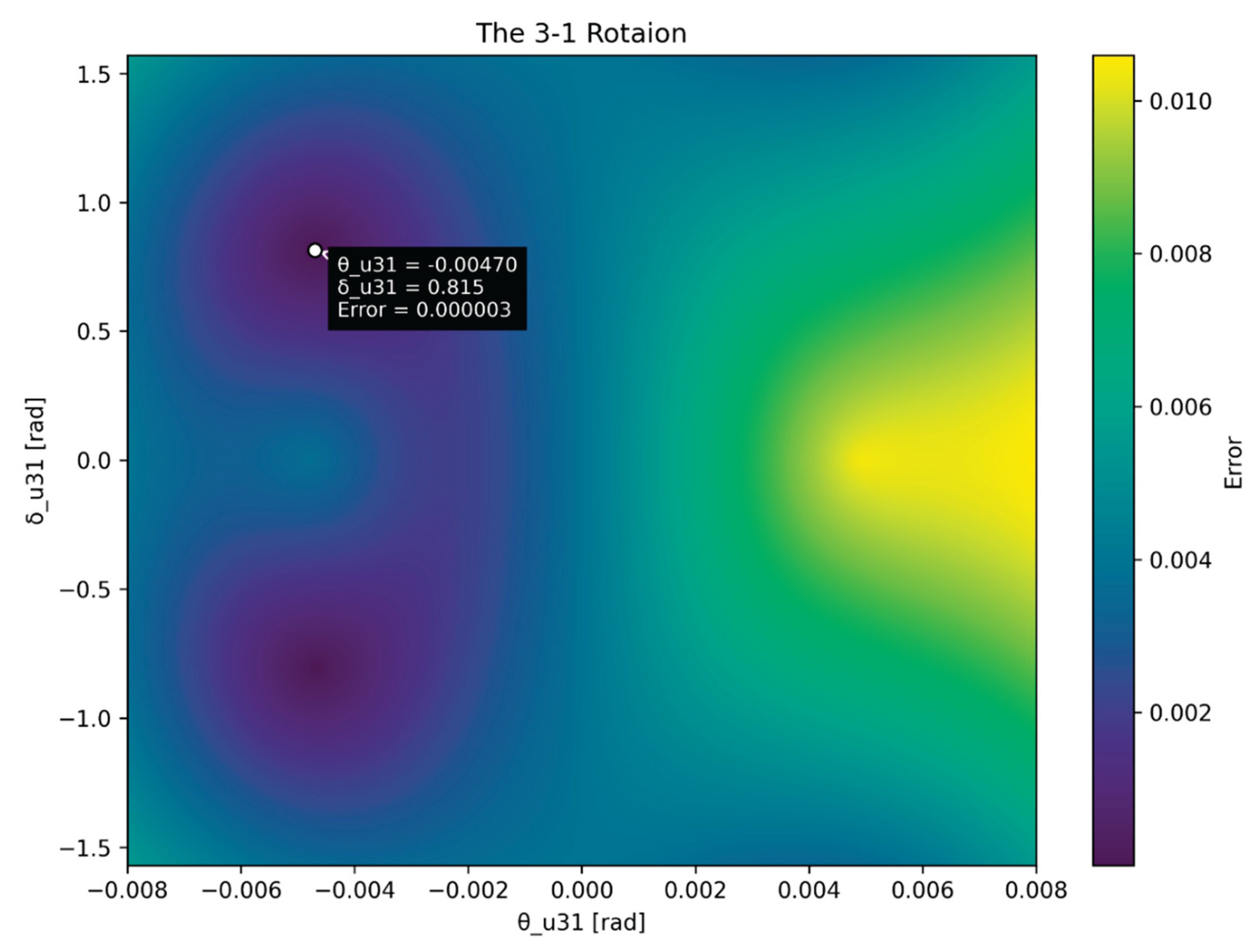
The only remaining free parameters are those of the 3–1 rotation, because the up-type quark mass formula remains unspecified. Hence the parameters and cannot be determined in advance. To resolve these, we have performed a two-dimensional grid search over and , selecting the values that minimize the deviation of and from their experimental counterparts. The optimal parameters are found to be:
(see Figure 2).
At these values the CKM matrix takes the form:
The absolute values of each element are:
These values are in excellent agreement with the PDG 2024 global-fit values, with all deviations within 0.7 standard deviations ().
Moreover, the three interior angles of the corresponding unitarity triangle are found to be:
Hence, we have
which is in excellent agreement with the experimental value
Finally, we calculate the Jarlskog invariant [12]
which is in excellent agreement with the experimental value
All parameters are in excellent agreement with the experimental values, but and cannot be uniquely determined because a corresponding mass formula for up-type quarks remains undetermined. We anticipate that future investigations will shed light on this issue.
5. Conclusion
By postulating a mass formula for down-type quarks—which yields the values:
—and by introducing a "half-Cabibbo" angle:
we have been able to construct a matrix that closely approximates the CKM matrix except for the 3–1 rotation. However, since no analogous mass formula for up-type quarks has yet been deduced, the 3–1 rotation matrix remains undetermined, and only a rough estimate of its value could be obtained. It is anticipated that, with the successful conjecture of an up-type quark mass formula in future work, a more accurate reconstruction of the CKM matrix will become possible.
References
- Harari, H.; Haut, H.; Weyers, J. Quark Masses and Cabibbo Angles. Physics Letters B 1978, 78(4), 459–461. [Google Scholar] [CrossRef]
- Koide, Y. Fermion-Boson Two Body Model of Quarks and Leptons and Cabibbo Mixing. Lettere al Nuovo Cimento 1982, 34(7), 201–206. [Google Scholar] [CrossRef]
- Koide, Y. A Fermion-Boson Composite Model of Quarks and Leptons. Physics Letters B 1983, 120(1–3), 161–165. [Google Scholar] [CrossRef]
- Brannen, C. A. The Lepton Masses. Brannen Works. 2006. Retrieved from: https://brannenworks.com/MASSES2.pdf.
- Particle Data Group Collaboration. Review of Particle Physics. Physics Letters D 2024, 110(3), 030001. [Google Scholar] [CrossRef]
- Cabibbo, N. Unitary Symmetry and Leptonic Decays. Physical Review Letters 1963, 10(12), 531–533. [Google Scholar] [CrossRef]
- Kobayashi, M.; Maskawa, T. CP-Violation in the Renormalizable Theory of Weak Interaction. Progress of Theoretical Physics 1973, 49(2), 652–657. [Google Scholar] [CrossRef]
- Maki, Z.; Nakagawa, M.; Sakata, S. Remarks on the Unified Model of Elementary Particles. Progress of Theoretical Physics 1962, 28(5), 870–880. [Google Scholar] [CrossRef]
- Harrison, P. F.; Perkins, D. H.; Scott, W. G. Tri-Bimaximal Mixing and the Neutrino Oscillation Data. Physics Letters B 2002, 530(1–4), 167–173. [Google Scholar] [CrossRef]
- Nem, S. Deriving the Pontecorvo–Maki–Nakagawa–Sakata Matrix from Koide’s Mass Formula and Brannen’s Neutrino Mass Hypothesis: Resolving the Mystery of the Rotation. Preprints.org 2025. [Google Scholar] [CrossRef]
- Wolfenstein, L. Parametrization of the Kobayashi–Maskawa Matrix. Physical Review Letters 1983, 51(21), 1945–1947. [Google Scholar] [CrossRef]
- Jarlskog, C. Commutator of the Quark Mass Matrices in the Standard Electroweak Model and a Measure of Maximal CP Nonconservation. Physical Review Letters 1985, 55(10), 1039–1042. [Google Scholar] [CrossRef] [PubMed]
Figure 1.
Direction of the -boson interaction.
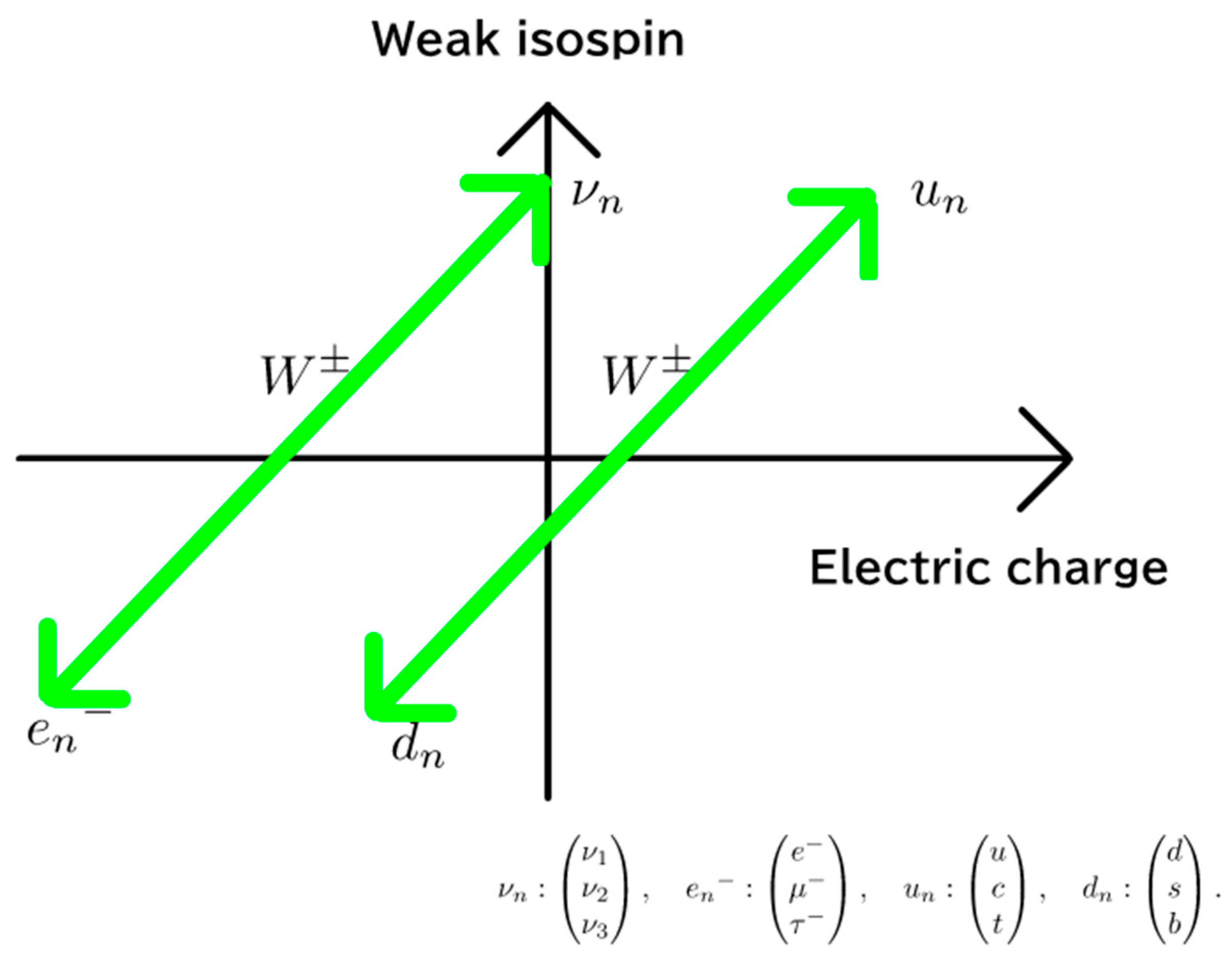
Figure 2.
Heat map of the fitting error over a grid of and with the best-fit point marked by an "".
Disclaimer/Publisher’s Note: The statements, opinions and data contained in all publications are solely those of the individual author(s) and contributor(s) and not of MDPI and/or the editor(s). MDPI and/or the editor(s) disclaim responsibility for any injury to people or property resulting from any ideas, methods, instructions or products referred to in the content. |
© 2025 by the authors. Licensee MDPI, Basel, Switzerland. This article is an open access article distributed under the terms and conditions of the Creative Commons Attribution (CC BY) license (http://creativecommons.org/licenses/by/4.0/).
Copyright: This open access article is published under a Creative Commons CC BY 4.0 license, which permit the free download, distribution, and reuse, provided that the author and preprint are cited in any reuse.


