

Submitted:
22 July 2026
Posted:
23 July 2026
You are already at the latest version
Abstract
The expansion of anaerobic digestion has created two linked opportunities: renewable-energy production and the return of nutrients and organic matter to land. It has also created an agronomic problem that cannot be solved by calling every residual material a biofertilizer. Digestate varies with feedstock, digestion conditions, separation, storage, post-treatment and the point at which it is sampled. Its value therefore emerges only when product composition is connected to crop demand, soil conditions, application practice and the environmental pathways that remain open after land application. This structured critical narrative review brings together evidence on crop production, nutrient replacement, soil physical and biological responses, greenhouse-gas emissions, nutrient losses, contaminants, processing and practical implementation. Greatest interpretive weight is given to inspectable original studies and replicated field evidence; reviews and meta-analyses are used to identify consistency and heterogeneity, not counted as additional experiments.The major points are the following. First, whole and processed digestates can replace part of a mineral-fertilizer programme, but the replacement value belongs to the complete product-management-soil-crop system rather than to digestate as a universal material. Trials that appear to compare equal fertilizer rates often match different quantities of total N, ammonium-N, estimated available N, P, K, S, organic N and carbon, and they frequently differ in mineral-fertilizer formulation, application timing and placement. Yield equivalence is therefore not automatically nutrient equivalence. Second, the product fraction matters. Liquid fractions commonly act as rapid N and K sources, whereas separated solids retain more particulate carbon and phosphorus and may release N more slowly. Third, long-term soil responses are real but conditional. Multi-year studies range from little detectable difference relative to slurry or mineral fertilizer to increases in soil-carbon pools under particular combinations of product, soil, crop, dose and management. Concentration changes, short incubations and degraded-soil demonstrations should not be treated as universal proof of durable stock change.Fourth, environmental performance cannot be represented by one emission factor or one safety label. Ammonia loss depends on pH, total ammoniacal N, dry matter, viscosity, storage, weather and surface exposure; nitrous oxide depends strongly on soil moisture, native mineral N, degradable carbon, placement and management history. Practices that reduce one pathway can increase another. Anaerobic digestion does not destroy metals, and evidence on pharmaceuticals, PFAS precursors, microplastics, phytotoxicity and antimicrobial resistance shows alteration of concentration, partitioning, viability or exposure rather than guaranteed removal. The central conclusion is consequently practical rather than promotional: digestate can be a valuable nutrient and, in some products and settings, carbon resource when it is characterized, matched to crop and soil requirements, applied with control of loss pathways and monitored over an appropriate timescale. It is neither intrinsically safe nor uniformly effective, but neither should it be dismissed as a waste when evidence-based management can recover useful functions.
Keywords:
anaerobic digestion
; digestate
; soil amendment
; nutrient equivalence
; crop production
; soil carbon
; greenhouse gas emissions
; environmental contaminants
1. Introduction
1.1. Organic-Resource Management Pathways: Direct Land Application, Composting, Anaerobic Digestion, and Nutrient Recovery
The management of animal manures, crop residues, food-processing by-products, municipal biowastes and sewage-derived organic materials is both a persistent environmental burden and a central opportunity for a circular bioeconomy. Agriculture needs nutrients and organic matter, yet poorly managed residual materials can transfer nitrogen, phosphorus, salts, pathogens, metals and organic contaminants to air, water and soil. The question is therefore not simply whether an organic material can be returned to land, but whether its nutrient forms, carbon quality and hazards are compatible with a particular soil, crop, climate and management system. In this review, soil health is considered through connected physical, chemical and biological functions, including structure and water relations, carbon and nutrient cycling, microbial communities and soil fauna [1,2,3].
Several pathways are available before nutrients reach the field. Untreated manure or slurry may be applied directly; composting can stabilize organic matter aerobically and produce a slower-release amendment; anaerobic digestion recovers energy while mineralizing part of the organic N to ammonium; and further processing can separate, concentrate or recover particular nutrient streams. These pathways are not mutually exclusive. Digestate may subsequently be separated, composted, dried, acidified, pelletized or used in nutrient-recovery systems. A mature comparison must therefore move beyond a binary choice between composting and digestion and ask which pathway best fits the nutrient-surplus problem, transport distance, crop requirement, soil objective, available equipment and environmental constraint [1,2,3,12,21,77,81].
Climate and energy policies have accelerated anaerobic digestion because biogas can provide heat and electricity or be upgraded to biomethane. The nutrient-rich residual stream is consequently generated as a major co-product and must be managed as part of the complete biogas system rather than as an incidental residue. This system boundary matters. A process may reduce methane emissions during waste storage yet lose ammonia during digestate storage or spreading; separation may improve transport of phosphorus-rich solids while creating a liquid stream that still requires responsible use; and a fertilizer credit is valid only when the recovered nutrients actually replace another input. Comparisons in this review therefore include untreated manure or slurry, compost and other stabilized amendments, mineral fertilizers, whole digestate, separated fractions and recovered nutrient products [1,2,3,7,12,21].
Biogas feedstocks vary substantially among countries, regions and individual plants. Purpose-grown maize and other energy crops have been important in some European systems, whereas many facilities depend more heavily on livestock manure, food waste, crop residues, industrial by-products, sewage sludge or mixed inputs. These origins influence dry matter, ammonium, P, K, salts, carbon quality, pathogens, organic contaminants and trace metals, but feedstock is only the starting point. Digestion, separation, storage and post-treatment can alter concentration, chemical form and partitioning before the product reaches soil. Regional production totals or broad labels such as agricultural digestate and sewage digestate should therefore never be used to imply a uniform composition or agricultural function [1,2,3,4,21,68,78,103].
The central challenge can be expressed as a management chain. Feedstock and digestion establish the starting material; characterization reveals what is actually present; storage and processing alter the product; soil, crop and climate determine demand and vulnerability; and application practice controls contact with roots, soil surfaces, air and water. Agronomic benefit and environmental risk arise from interactions across this chain. Figure 1 presents this logic and provides the organizing framework used throughout the review.
1.2. Defining Digestate: A Product of Anaerobic Biochemistry
As biogas production has expanded, land application of digestate has become widespread. Digestate may substitute for part of a mineral-fertilizer programme, compete with direct manure or slurry application, complement compost or crop residues, or be separated into products with different functions. Describing it as “liquid compost” is therefore misleading. Composting and anaerobic digestion transform carbon and nitrogen through different biochemical routes, and their products differ in nutrient availability, carbon stability, handling behavior and environmental-loss pathways [1,2,3,4,8,21,77].
Aerobic composting promotes oxidative decomposition and stabilization, commonly increasing the relative importance of humified organic matter and slower nutrient release. Anaerobic digestion removes part of the readily degradable carbon as biogas and generally increases the proportion of N present as ammonium, although the magnitude depends on feedstock and process. A pumpable whole digestate or liquid fraction can therefore behave mainly as a rapidly available fertilizer, while separated solids, composted digestate, pellets and recovered products may behave differently. The scientifically useful classification is functional and analytical: what nutrients, carbon forms, salts and contaminants are present at application, and how will that product behave in the intended system [1,2,3,4,8,21,77]?
For interpretation and reporting, the minimum product identity should include the source feedstocks and their proportions; digestion temperature and retention conditions where available; whether the material is whole, liquid or solid; all post-treatment; storage duration and conditions; and analysis close to application for dry matter, pH, electrical conductivity, total and ammonium N, P, K, organic carbon and source-relevant hazards. This is not an administrative detail. Without it, apparently contradictory crop, soil or emission responses may simply reflect different products being given the same name. Source category alone is insufficient because separation, storage, acidification, drying, composting and nutrient recovery can alter both fertilizer value and exposure pathways.
1.3. Filling the Knowledge Gap: Objectives of This Review
Research on digestate has expanded rapidly, but the evidence remains uneven across products, environments, outcomes and timescales. Short-term fertilizer response is comparatively well studied, while durable soil-carbon change, soil-faunal responses, cumulative nutrient loading and long-term contaminant pathways are less consistently resolved. Previous reviews have often emphasized either anaerobic digestion and bioenergy or immediate fertilizer value. Fewer have followed the material from feedstock and processing through crop response, soil ecology, emissions, cumulative loading and management decisions within one critical framework [4,78,82,103].
This review places agronomic, ecological and environmental outcomes on equal footing and treats digestate as a variable agroecological input rather than merely a by-product of waste treatment. It integrates crop-response evidence, nutrient-equivalence problems, liquid and solid fractions, greenhouse and soilless applications, long-term soil-carbon and biological responses, contaminants, processing technologies and tropical and Sub-Saharan African perspectives. Immediate fertilizer response is distinguished from residual and cumulative effects, and evidence of occurrence is separated from evidence of mobility, exposure, transfer and harm. The aim is not to deliver a universal verdict, but to identify the conditions under which beneficial functions are credible, the conditions under which risk becomes important and the evidence that remains too weak for confident generalization [4,78,82,103].
The synthesis is organized around three neutral review questions:
- Review question 1—Agronomic performance: Under what conditions can whole or processed digestate substitute for part of a mineral-fertilizer programme without reducing crop performance or nutrient-use efficiency?
- Review question 2—Soil health and ecology: How do digestate form, carbon quality, dose, soil, climate and duration influence soil physical, chemical and biological responses?
- Review question 3—Sources of variability and risk: How do feedstock, digestion, separation, storage, post-treatment, application method and site conditions interact to determine agronomic benefit and environmental loss?
By synthesizing field, greenhouse, pot, incubation, life-cycle, and mechanistic evidence, the review answers these questions and develops an evidence-informed framework for product characterization, nutrient matching, exposure control, monitoring, and research reporting.
2. Methods
2.1. Review Design and Scope
This article is a structured critical narrative review developed through targeted literature searches and claim-level source verification. It is not presented as a formal systematic review and does not claim PRISMA compliance. A prospectively registered protocol, complete deduplicated screening database, reproducible record of every historical query and study-flow record were not available, and retrospective counts were not reconstructed. The purpose is transparent critical synthesis: to examine how product identity, experimental design and management conditions explain agreement and disagreement in the literature, while making clear where the evidence is strong, context-limited or insufficient.
The unit of analysis was evidence concerning land application or horticultural use of whole digestate, liquid and solid digestate fractions, composted or conditioned digestate, and digestate-based formulations. Outcomes were grouped into agronomic performance, crop quality, nutrient availability, soil physical and chemical properties, soil carbon, microbial ecology, soil fauna, greenhouse-gas emissions, nutrient leaching, contaminants, and processing or management interventions.
2.2. Literature Search and Source Identification
The evidence base covered literature published mainly from 2000 through 20 July 2026, with older peer-reviewed articles retained where they supplied foundational evidence on bioslurry, manure separation, soil-amendment processes or analytical interpretation. The manuscript developed through staged searches of publisher platforms, PubMed where relevant, DOI and bibliographic records, open institutional repositories and cited-reference chains. Search concepts combined digestate or anaerobic-digestion residues with crop yield, fertilizer replacement, nutrient-use efficiency, soil carbon, soil structure, soil ecology, ammonia, nitrous oxide, leaching, sewage sludge, metals, phytotoxicity, antimicrobial resistance, microplastics, PFAS, pharmaceuticals, separation, nutrient recovery and life-cycle assessment. Appendix A records the search procedures that can be reproduced; because the complete historical search cannot be reconstructed, the review remains targeted rather than exhaustive.
For Version 3.5, targeted source verification was closed on 21 July 2026. Exact titles, DOI records, PubMed entries, publisher pages and institutional repositories were used to correct bibliographic records and to assess directly relevant evidence. Priority was given to peer-reviewed articles in established scientific journals. Conference abstracts, proceedings papers, industry reports and general web pages were not used as the central basis for consequential claims. Reviews were used for discovery and higher-level synthesis rather than counted as independent experiments. Detailed numerical findings, treatment descriptions and mechanistic claims required an inspectable original full text; abstract-only papers were restricted to what was explicitly stated in the abstract. When a final journal article superseded a poster, thesis chapter, proceedings paper or preprint, the definitive publication was preferred and the experiment counted once.
2.3. Eligibility and Evidence Appraisal
Eligible sources directly characterized whole digestate, separated fractions, recovered products, or digestate-based formulations, or evaluated their agronomic, soil, biological, environmental, processing, or life-cycle effects. Studies of raw slurry, compost, lime, gypsum, or general soil physics were used only as clearly labelled comparators or mechanistic background; they were not presented as direct digestate evidence. Quantitative table entries required an identifiable product, treatment, crop or soil, comparator, duration, and reported outcome.
Evidence was appraised at the outcome level using the rubric in Appendix B. The appraisal considered publication status, design, replication, duration, scale, product characterization, comparator quality, nutrient-equivalence basis, statistical support, direct versus surrogate endpoints, consistency, and relevance to field practice. Replicated multi-year or multi-site field studies received greater weight for durable agronomic and soil conclusions than single-season trials, pot studies, incubations, models, or reviews. Primary studies supplied study-specific numerical evidence. Systematic reviews and meta-analyses were used to assess consistency and heterogeneity but were not added to the number of independent experiments.
Evidence certainty and transferability were judged separately. Strong evidence denotes convergent replicated field or multi-site evidence with adequate product and comparator characterization. Moderate evidence denotes credible but context-limited field evidence or convergent controlled studies. Limited evidence denotes few studies, short duration, restricted scale, incomplete characterization, or indirect endpoints. Insufficient evidence denotes a literature base that cannot support a directional conclusion. A well-replicated result may still have low transferability when it is restricted to one feedstock, process, soil, crop, climate, or exposure pathway. These categories are qualitative and are not presented as a formal GRADE assessment.
2.4. Data Extraction and Synthesis
For the expanded evidence tables, information was extracted directly from accessible sources on feedstock, digestion and post-treatment, product fraction, storage, application rate and basis, crop or soil, experimental scale, duration, replication, comparator, mineral-fertilizer formulation, nutrient-matching basis, response, statistical status, and limitation. The audit also recorded access level and the exact page, table, figure, or section supporting consequential additions. Where results conflicted, the manuscript reports the conflict and its context rather than averaging incompatible designs.
The synthesis is organized around the three review questions: agronomic substitution and nutrient equivalence; short- and long-term soil responses; and the interacting effects of feedstock, product identity, site, and management. The final discussion answers each question and translates the evidence into an explicitly author-derived decision framework.
Causal interpretation follows the system chain shown in Figure 1. A second recurring problem concerns fertilizer equivalence. Studies use several matching rules—fresh mass, total N, ammonium-N, estimated available N or recommended crop N—and these rules do not deliver the same quantities of organic N, P, K, S, carbon or salts. Figure 2 summarizes the information needed before terms such as equivalent, replacement, superior or more efficient can be interpreted defensibly.
2.5. Limitations of the Review Process
The literature remains heterogeneous and often reports digestate composition, nutrient matching, storage, and application practice incompletely. This review is not an exhaustive database, and English-language and full-text accessibility may have influenced coverage. The staged nature of the work prevents reconstruction of a complete historical search log or a formal risk-of-bias assessment for every included study. One author conducted the search, extraction, and synthesis; an independent verification packet has therefore been prepared for external checking before submission. Evidence gaps are stated explicitly, especially for long-term tropical trials, soil fauna, repeated sewage-sludge-digestate application, cumulative contaminant transfer, PFAS and pharmaceutical field pathways, antimicrobial resistance, and comparisons that equalize both available N and complementary nutrients. Because designs and outcome definitions are highly heterogeneous, no pooled effect estimate was calculated.
2.6. Claim-Level Verification and Data Integrity
Consequential claims were checked at the level of the individual statement. Extraction recorded feedstock, process, fraction, storage, application basis, comparator, duration, experimental scale, statistical status, and an inspectable page, table, figure, or section where available. The conclusion of a paper was not used to supply treatment details absent from its methods or results.
Throughout the narrative, five evidential verbs are used deliberately. “Measured” denotes an endpoint quantified in the study; “reported” denotes the original authors’ statement; “consistent with” denotes an interpretation supported by the observed pattern but not directly demonstrated; “proposed” denotes a mechanism advanced by the study authors or this review; and “author-derived” identifies practical guidance synthesized from several evidence streams. This language is intended to prevent a plausible mechanism from being mistaken for a measured one.
Quantitative claims were retained only when units, treatment basis, and denominator were clear. Fresh-mass and dry-mass rates, total N and ammonium-N, concentration and stock, total and bioavailable contaminant fractions, and statistically significant and numerical differences were kept distinct. Where a source did not report a fertilizer formulation, nutrient-matching basis, limitation, or statistical result, the information was recorded as not reported rather than inferred.
Untraceable or incomplete citations, unnamed studies, inaccessible reference-only leads, and numerical claims that could not be connected to traceable evidence were excluded or rewritten conservatively.
2.7. Evidence Hierarchy, Duplicate Control, and Traceability
The evidence hierarchy was: final peer-reviewed primary article; peer-reviewed systematic or critical review for broad synthesis; doctoral dissertation containing inspectable original work; institutional or industry report for non-experimental context; and conference evidence only where no definitive journal article was available. Replicated multi-year and multi-site field studies received greater weight for durable field conclusions than single-season trials, pot studies, incubations, models, or reviews.
Duplicate files, conference versions, thesis chapters, preprints, and later journal publications were cross-checked to avoid counting one experiment more than once. Evidence certainty was assigned at outcome level from study design, replication, duration, scale, comparator quality, product characterization, consistency, access level, and transferability. These categories are qualitative and are not presented as a formal GRADE assessment.
3. Agronomic Efficacy: Crop Yield and Quality Responses
The agronomic value of digestate is often introduced through yield, but yield alone cannot explain how efficiently nutrients were recovered, whether a mineral input was genuinely displaced or whether a treatment left an environmental liability after harvest. A convincing agronomic assessment therefore begins with product identity and the comparison basis, follows nutrients through crop uptake and residual soil pools, and interprets quality, losses and repeated application alongside marketable yield.
3.1. Efficacy as a Mineral Fertilizer Substitute: A Synthesis of Yield Outcomes
Digestate has been evaluated widely as a source of plant-available nutrients, and many studies demonstrate that it can support commercially relevant crop production. The evidence does not, however, support one universal replacement rate or a simple ranking in which digestate is consistently better or worse than mineral fertilizer. Table 1 therefore reports crop response together with product identity, comparator formulation, nutrient-matching basis, timing, environmental measurements and limitations [4,6,13,14,39,74,83,84,85,86,87,96,101,102]. The purpose is to show not only what happened, but why apparently similar comparisons sometimes lead to different conclusions.
How to read the evidence tables. A row describes the treatment actually tested, not a general property of all digestates. “Primary study” indicates direct experimental evidence; “review” or “meta-analysis” indicates synthesis-level evidence and is not counted as an additional experiment. Evidence certainty concerns confidence in the direction of the finding, whereas transferability concerns how far it can be applied beyond the studied feedstock, process, soil, crop, climate and duration.
Two studies strengthen the temporal dimension of the agronomic evidence. Petraitytė et al. showed that soil mineral nitrogen and winter-wheat nitrogen accumulation must be interpreted together when digestate is compared with mineral fertilizer [84]. Villarino et al. extended the evidence to commercial fields receiving repeated digestate applications, linking productive farming with measurable increases in soil organic carbon [85].
Interpreting Nitrogen Fertilizer Replacement Value and Residual Effects
Nitrogen fertilizer replacement value (NFRV) is frequently used to compare digestate with a mineral-N reference, but the number is meaningful only when the calculation method, period and reference treatment are stated. A first-season value based on crop uptake may differ from a value based on yield, and both may differ from a multi-year value that includes residual mineralization. Digestate also supplies P, K, S, micronutrients and organic matter. If the mineral reference does not receive equivalent complementary nutrients, the apparent N replacement may partly reflect another nutrient; if digestate is applied at equal fresh mass, even the N dose may be unequal [4,8,13,14,74,84,86,96,101].
Comparative validity therefore depends on the matching rule illustrated in Figure 2. Equal total N does not supply equal immediately available N. Matching ammonium-N can leave a digestate treatment with additional organic N, P, K and carbon. Equal recommended crop N can still differ in formulation, split, placement or storage loss. Mineral controls range from ammonium nitrate and calcium ammonium nitrate to urea, ammonium sulfate, compound NPK products and controlled-release fertilizers. A study should report the formulation, rate, split, placement, matching basis and supplemental P, K or S; where these details are absent, replacement efficiency should be described as uncertain rather than reconstructed.
The ammonium fraction generally drives the immediate response. Organic nitrogen may mineralize later, become immobilized, or remain in stable soil pools. Storage and spreading losses occur before crop recovery is measured, so an apparently low field NFRV can reflect poor handling rather than intrinsically unavailable nitrogen. Conversely, an incubation study may overestimate practical availability if it excludes ammonia volatilization, runoff, uneven placement, or the timing of root uptake. For this reason, NFRV should be interpreted as a property of the digestate-management-soil-crop system rather than of digestate alone.
Residual effects matter most for repeated application. A single-season comparison can favour mineral fertilizer because its nutrient content is immediately standardized, while digestate may contribute gradually to soil nutrient pools and organic matter. Repeated applications can also create the opposite problem: phosphorus or potassium accumulates even when the annual nitrogen rate appears appropriate. Long-term assessment should therefore include crop recovery, changes in soil mineral nitrogen, phosphorus and potassium balances, soil organic carbon, gaseous emissions, and nutrient losses below the root zone.
A practical fertilizer plan can separate the digestate nitrogen supply into three operational pools: ammonium nitrogen expected to be available rapidly; organic nitrogen expected to mineralize during the crop cycle; and a residual fraction that contributes beyond the current season. The coefficients should be based on local guidance or field calibration and then adjusted for storage, placement, soil temperature, moisture, texture, and crop rooting. This approach is more defensible than assigning one universal percentage to all digestates.
This separation of N pools also clarifies application timing. A high-ammonium product applied before crop uptake may behave as an exposed soluble fertilizer and lose value rapidly, whereas a separated solid may contribute less immediate N but more residual organic N and particulate carbon. The appropriate interval between application and sowing is therefore a balance: enough time may be needed to reduce acute ammonium or salt exposure in sensitive crops, but excessive delay can leave mineral N vulnerable to volatilization, leaching or denitrification. Field calibration is more defensible than a fixed waiting period because soil temperature, moisture, texture and incorporation determine the rate of transformation.
Conditions Supporting High Agronomic Performance
Agronomically useful performance is most likely when a characterized product supplies nutrients in synchrony with crop demand. Verified trials show that whole digestate, liquid fractions, and processed products can produce yields comparable with mineral programmes in some cereals, maize, forage, and horticultural systems, but the result depends on nutrient-matching basis, formulation, soil, season, and placement. This supports conditional substitution after laboratory analysis and field calibration rather than a universal claim of superiority [74,83,84,85,86,87,96,101,102].
Integrated Nutrient Management and Complementary Fertilization
Integrated nutrient management can be useful where digestate supplies substantial ammonium-N, K, organic matter, or micronutrients but does not match the crop’s complete seasonal requirement. A complementary mineral input may correct timing, P, K, S, or micronutrient imbalance, yet a benefit of combination treatments should not automatically be described as synergy. It may instead reflect more complete nutrient supply, split timing, or a higher effective dose. Comparisons require complete nutrient budgets and a mineral treatment matched on the same agronomic basis before an interaction is attributed to microbial or carbon effects [12,13,19,20,36,84,86,96,102].
Explaining the Variability: The Critical Role of Feedstock and Management
Variation among studies is partly explained by feedstock and product management, but neither factor acts alone. Manure-, crop-, food-waste-, and sewage-derived digestates differ in nutrient form, dry matter, carbon quality, salts, and contaminants; separation, storage, application timing, soil, and weather can amplify or override those starting differences. Recalcitrant agricultural-waste feedstocks and maize-legume mixtures also illustrate how pre-digestion material selection changes subsequent product properties [11,27,76,104]. Crop response should therefore be interpreted from the measured product and treatment programme rather than from a feedstock label alone [4,8,12,21,103].
Application timing and dose determine whether plant-available N coincides with crop uptake or remains exposed to loss. A tomato study reported application-frequency effects on growth and water-nitrogen use efficiency, emphasizing treatment-specific scheduling rather than a fixed rule [26]. Longer-season cereals and crops grown in wet climates may require smaller split doses or complementary mineral N, whereas off-season application increases the risk of residual mineral N and drainage loss [14,18,74,84].
Taken together, the yield literature supports a qualified but useful conclusion. Digestate is capable of replacing a meaningful share of mineral fertilizer when composition is known and supply is synchronized with demand. Failure is more likely where an uncharacterized product is applied by volume, where complementary nutrients are ignored, where a high-ammonium material remains exposed at the surface, or where the same N-based rate repeatedly overloads P, K or salts. Agronomic performance is therefore not a fixed attribute of the material; it is the outcome of diagnosis and management.
3.2. Beyond Yield: Influence on Crop Quality and Nutritional Value
Crop evaluation should include quality and safety endpoints as well as biomass or yield. Digestate studies have reported changes in soluble solids, sugars, tissue nitrate, antioxidant measures, nutrient composition, and processing quality, but these responses are crop-, treatment-, and harvest-specific [6,9,10,13,19,20,22,23,28,30].
Quality responses also reveal why greater biomass is not always a sufficient indicator of improved nutrition. Dilution can lower tissue concentrations as yield rises, while changes in N form, light, water supply and harvest stage can alter nitrate or soluble solids without a corresponding change in total nutrient recovery. Quality data should therefore be interpreted with yield, tissue uptake and treatment composition rather than as isolated proof of benefit.
Enhancement of Desirable Quality Metrics
Individual studies illustrate the range of crop-quality responses. Food-waste digestate supplied through subsurface drip fertigation supported tomato yield and altered fruit-quality measures relative to mineral fertilizer [6]. A greenhouse cucumber study reported higher yield, dry matter, soluble solids, and reducing sugars under its digestate treatment [10]. Digestate enriched with P, K, Mg, and B also affected sugar-beet yield and processing quality [19]. These results should be interpreted within their formulations and production systems rather than generalized to all crops or digestates.
Reduction of Undesirable Compounds: The Case of Nitrates
A kohlrabi experiment reported edible-tissue nitrate of 228 mg kg−1 under digestate and 678 mg kg−1 under mineral fertilization, while the mineral treatment produced a slightly higher yield [9]. This single comparison shows that N source and treatment design can influence crop nitrate, but it does not establish that digestate generally lowers vegetable nitrate or that the mechanism was improved synchrony. Nitrogen rate, ammonium:nitrate balance, light, cultivar, growth duration, harvest stage, and yield dilution can all affect tissue nitrate. Hydroponic lettuce studies likewise show that digestate-derived nutrient solutions can either lower or increase nitrate depending on supplementation and formulation [22,23].
3.3. Liquid and Solid Digestate Fractions and Crop-Specific Responses
Digestate is not a homogeneous product, and many treatment systems use mechanical separation to produce a liquid fraction and a solids-enriched fraction. Separation technology and feedstock determine how dry matter, N, P, K, and carbon partition; the resulting products should therefore be analyzed and managed separately rather than assumed to have fixed functions [12,21,81,97].
The distinction between liquid and solid fractions is especially important for soil objectives. A liquid fraction may be well suited to precise in-season nutrient delivery but contribute little particulate carbon at a practical rate. A solid fraction may transport P and carbon more efficiently and release N more slowly, yet its agronomic value depends on storage, composting, drying and particle properties. Neither fraction should be described by a fixed function without analysis, because separation efficiency varies among feedstocks and equipment.

Table 2.
Verified solid-liquid separation, nutrient recovery, and post-treatment evidence.
| Process/study | Material and scale | Main separation or recovery result | N distribution | P/C or solids distribution | Energy/LCA implication | Agronomic use | Important caution | Ref. |
| Møller et al. (2007) | Pig and cattle manure; centrifugation and chemical precipitation/flocculation | Separation improved as centrifugal force increased to about 2200 G; chemical treatment achieved higher N and P separation than centrifugation at similar DM | Total-N separation depended strongly on manure DM | P separation was less dependent on initial DM; separated solids retained methane potential | Foundational manure-separation study, not a digestate-only assessment | Nutrient-rich solids can be routed to digestion or nutrient management | Results should not be transferred directly to every post-digestion product | [105] |
| Cathcart et al. (2023) | Agricultural digestate (~5% solids); optimized decanter centrifuge and screw press | Decanter P separation 51-71.5%; screw press 8.5-10.9% | Decanter partitioned up to 56% of N into the solid fraction | Decanter recovered more P; screw press produced a high-solids, carbon-rich fraction | Screw press had lower capital and operating cost; decanter favored P control | Select technology according to nutrient-surplus problem | High N removal to solids can reduce liquid-fraction fertilizer value | [97] |
| Review synthesis: Carraro et al. (2024) | Systematic review of 175 full-scale observations | Centrifuges separated significantly more DM and total P than screw presses; conditioners reduced liquid-fraction DM by 30% with centrifuges | Screw presses delivered 3.3 t ammonium-N in liquid fraction per MWh in the review metric | Screw presses delivered 0.3 t total P in solid fraction per MWh | Screw presses consumed 4.5 times less energy than centrifuges | Full-scale evidence supports substrate- and objective-specific selection | Performance distributions were wide; values are not universal design guarantees | [81] |
| Fernández-Labrada et al. (2023) | Pilot treatment of pig-slurry liquid fraction with AD and microfiltration | Microfiltration retained solids in the digester and produced a liquid fraction that was 99% water | Concentrated digestate retained similar N and P to the input liquid fraction; dissolved N entered the filtrate | Concentrated digestate had more DM and C; filtrate contained dissolved C, N, K, and Na | Potential reuse reduces water transport but requires post-treatment | Concentrate supplied stabilized OM and nutrients; filtrate may be used in fertigation after assessment | Filtrate did not meet reclaimed-water requirements without dilution or further treatment | [98] |
| Petrova et al. (2021) | Two raw and eight processed digestate products in field and incubation studies | Separation sometimes reduced N2O, but processing did not produce a universal reduction | N removal during subsequent processing did not predict N2O | Pelletizing concentrated degradable C and created anaerobic microsites when wetted | Storage and transport gains from pellets can be offset by field emissions | Separated solid and dried solid may be useful products | Pellets increased N2O by factors of 2.7, 3.5, and 7.3 relative to separated solid in the reported experiments | [90] |
| Zilio et al. (2023) | Stabilized digestate and recovered ammonium sulfate used in field | Recovered products supplied mineral N without greater nitrate at 1 m than mineral fertilizer | Extra organic N in digestate accumulated or was denitrified rather than causing measured extra leaching | Stabilized organic fraction remained in the soil system | Field results support recovery but not zero environmental burden | Recovered ammonium sulfate can replace a portion of synthetic N | System-specific sewage-sludge digestate; three-year observation | [96] |
| Angouria-Tsorochidou et al. (2022) | LCA of direct spreading, centrifugation, and advanced separation/drying/membrane/RO | Post-treatment produced differentiated fertilizer products and concentrated citrate-soluble P | Advanced treatment reduced nutrient-management pressure but required more processing | Dry solids improved transport where local land was insufficient | Direct spreading had the most favorable GWP in the modeled cases; advanced treatment improved terrestrial acidification but increased fossil-resource use | Choose post-treatment when nutrient redistribution or transport justifies inputs | Conclusions depend on functional unit, avoided products, electricity, transport, and application assumptions | [99] |
Note: Study outcomes are context-specific and should be interpreted with the feedstock, application rate, soil, crop, duration, and comparator reported in the cited source.
In one fraction-comparison study, the liquid product had lower pH but higher electrical conductivity and greater concentrations of total N, K, and Na, whereas the dewatered and granulated solid was richer in total C and P. The liquid fraction increased several readily available soil nutrients, while the solid product produced a different pattern of P, Mg, and exchangeable Ca response [12]. A separate soil study also showed dose- and fraction-specific changes in pH, EC, nutrients, carbon, and metals [21].
Valentinuzzi et al. applied liquid and pelleted fractions of a manure-based digestate to cucumber and maize and reported crop-specific biomass responses [12]. The findings support testing product-crop combinations, but they do not prove that liquid fractions are universally optimal starter fertilizers or that pellets consistently provide season-long release. Release pattern, salinity, application rate, crop duration, and soil conditions require direct measurement.
3.4. Digestate in Soilless and Hydroponic Systems: Opportunities and Challenges
Liquid digestate may contribute nutrients to soilless and hydroponic systems, but raw or minimally treated products often require filtration, dilution, nitrification, and nutrient balancing. Their variable ammonium, salt, suspended-solids, alkalinity, and organic-matter contents make direct replacement of a complete commercial nutrient solution unreliable [22,23,24,25,30,80].
Raw or minimally treated liquid digestate can contain ammonium, salts, suspended solids, alkalinity, and an unbalanced nutrient ratio at concentrations unsuitable for direct soilless use. The greenhouse review and original soilless study support analysis, filtration, dilution, and—where appropriate—nitrification or targeted mineral supplementation rather than a fixed universal dilution ratio [25,80].
The available evidence shows technical feasibility in controlled systems, but it does not justify a universal claim of commercial-scale replacement. Product composition, crop demand, root-zone monitoring, emitter performance, and treatment of residual water must be evaluated for each greenhouse system [25,80,98].
3.5. Applications in Controlled Environments: Greenhouse Horticulture
Digestate use in greenhouse horticulture has been investigated in tomato, cucumber, leafy vegetables, basil, and substrate systems. Controlled environments allow precise dosing, but they also magnify ammonium toxicity, salinity, nutrient imbalance, emitter blockage, and hygiene concerns. The evidence supports formulation- and crop-specific testing rather than a general expectation of superior performance [6,10,25,28,30,31,32,80].
The greenhouse-horticulture review identifies applications in tomato, cucumber, leafy vegetables, and hydroponic or substrate systems, but the studies vary widely in feedstock, dilution, supplementation, crop, and response measure. The defensible conclusion is that digestate can contribute nutrients when carefully formulated; the review does not establish a single yield or quality response applicable across greenhouse crops [25].
Controlled environments can magnify ammonium toxicity, salinity, emitter blockage, oxygen limitation, and nutrient imbalance because root volumes are restricted and recirculation may concentrate salts. Digestate used in growing media or fertigation should therefore be tested for physical properties, hygiene, electrical conductivity, pH, and crop-specific nutrient balance before scale-up [25,68,80].
3.5.1. Digestate Fertigation Systems in Greenhouse Horticulture
The evidence supports cautious use of digestate in fertigation. Liquid digestate is most controllable when filtered, analyzed, diluted, and supplied in frequent small doses rather than treated as a direct substitute for a complete nutrient solution. Subsurface delivery or closed systems may reduce foliar contamination, but emitter blockage, salt accumulation, oxygen limitation, and ammonium toxicity remain practical constraints [6,24,25,30,31,32,80].
Greenhouse studies in tomato, cucumber, basil, and leafy vegetables show that marketable production is possible when digestate-derived nutrients are matched to crop demand [6,10,28,30,31,32]. Yield alone is insufficient for judging success: fruit quality, tissue nitrate, root-zone EC, drainage composition, nutrient disorders, emitter performance, and hygienic quality should also be monitored.
3.5.2. Sensor-Guided and Automated Nutrient Delivery
Controlled environments create an opportunity to use soil-moisture sensors, EC probes, pH monitoring, drainage analysis, and automated dosing to manage a variable digestate-derived nutrient stream. These controls are established fertigation principles transferred to digestate management rather than a fully validated digestate-specific protocol. Their scientific value lies in detecting divergence between nutrient supply and crop uptake before salinity or deficiency becomes visible. Sensor signals must be calibrated against laboratory analysis because EC cannot distinguish useful nutrients from sodium or other salts.
A practical control strategy combines batch analysis with real-time monitoring: laboratory measurements define the initial nutrient recipe; irrigation volume and drainage EC track salt balance; pH and alkalinity guide acid addition; and periodic tissue analysis identifies hidden deficiencies. Automated systems should include fail-safe dilution, filtration-pressure alarms, and records of every nutrient addition.
3.5.3. Ornamental and Specialty Crops
Ornamental and specialty crops are a potentially valuable but underdeveloped application area. These crops can justify additional processing because product quality, uniformity, flowering, color, and shelf life may be economically more important than maximum biomass. At present, the evidence base is smaller and less standardized than for tomato, cucumber, or lettuce, so strong numerical claims about marketability or flower quality should not be generalized without crop- and product-specific trials.
For ornamentals, digestate should first be tested at small scale for salt sensitivity, ammonium tolerance, trace-element balance, odor, substrate shrinkage, and pathogen or weed-seed risk. A filtered liquid fraction may be useful as part of a fertigation recipe, while composted solids may substitute for a portion of peat where air-filled porosity and water-holding capacity remain within crop-specific limits [25,32].
3.5.4. Nursery Trees and Transplant Production
Nursery and transplant systems require sustained, balanced growth rather than a short nitrogen-driven flush. Digestate-derived nutrients may support root and shoot development, but container volume magnifies salinity and pH problems. Slow-release solid products, composted fractions, or carefully dosed liquid fractions are therefore more defensible than unprocessed whole digestate.
Evaluation should include root-to-shoot balance, substrate physical properties, leachate nutrients, survival after transplanting, and performance during establishment. Detailed numerical nursery responses remain insufficiently traceable in the accessible evidence; therefore, the topic is retained as a research and application priority rather than presented with unsupported percentages.
3.6. Precision Fertigation, Nutrient Balancing, and Product Standardization
Controlled-environment use is not simply a matter of replacing a commercial nutrient solution with raw digestate. A digestate-based fertigation programme must distinguish plant-available nitrogen from total nitrogen, identify imbalances among phosphorus, potassium, sulfur, calcium, magnesium, iron, and micronutrients, and manage salinity, suspended solids, alkalinity, organic compounds, and microorganisms that can affect emitters or roots. The greenhouse review and accessible soilless studies consistently support analysis, filtration, dilution, and targeted supplementation rather than volume-for-volume substitution [24,25,80].
Nitrification is particularly important because many horticultural crops perform better when part of the nitrogen is supplied as nitrate rather than ammonium. Biological oxidation can reduce acute ammonium toxicity and simplify pH control, but it does not correct phosphorus, sulfur, boron, or other deficiencies. In soilless horticulture, liquid digestate can supply most nutrients only when laboratory analysis and crop monitoring are used to identify the nutrients that still require mineral supplementation [25,80].
Field and on-farm evidence reinforces the importance of formulation and placement. Precision-application work in winter wheat found that liquid and solid digestates could produce agronomically useful yields, but their nitrogen-use efficiency remained below mineral fertilizer and varied between farms [86]. In corn silage, shallow injection conserved ammonia-N and produced a small yield benefit compared with surface application [87]. These results support analysis-based, site-specific use rather than an undifferentiated substitution ratio.
For commercial greenhouse use, quality assurance should include total solids, EC, pH, total N, ammonium-N, nitrate-N after any nitrification step, soluble and total P, K, S, Ca, Mg, Na, alkalinity, hygienic indicators, and feedstock-specific contaminants. Filtration should be matched to emitter dimensions, and drainage or leachate should be monitored. These controls convert a variable residue into a managed fertilizer ingredient [25,68,80].
3.6.1. On-Farm Precision Distribution and Nitrogen-Use Efficiency
The 2025 on-farm experiment by Piccoli et al. provides a useful counterweight to small-plot studies. Across 47 ha and two farms, winter-wheat yields and protein under digestate were agronomically comparable with mineral fertilizer, but mineral fertilizer achieved higher nitrogen-use efficiency. Variable-rate application improved the NUE of liquid digestate from the lower digestate range to 49%, while a nitrification inhibitor did not significantly improve NUE. The result supports precision placement but also shows that spatial technology cannot compensate for all product and site limitations [86].
For publication and practice, digestate performance should therefore be reported with both yield and nutrient-efficiency metrics. A treatment can maintain yield while leaving a larger nitrogen surplus, or it can improve apparent NUE at one site and fail at another. Site-year, soil texture, crop history, available-N fraction, and supplemental mineral N should be reported explicitly.
3.7. Crop-Specific Interpretation and Nutrient-Matching Strategies
The evidence base includes cereals, vegetables, legumes, oilseeds, fodder crops, energy crops, and nursery or greenhouse production. Their different responses are not random. Crop duration, root architecture, nutrient-demand curve, harvest index, salt sensitivity, and the economic value of product quality influence whether a particular digestate performs well.
Cereals such as maize and wheat can use large quantities of nitrogen, but the fertilizer programme must maintain supply across vegetative growth and grain filling. A high-ammonium liquid fraction can support rapid early growth, while later deficiency may occur if the dose is reduced to avoid early loss. Split application or a digestate-mineral combination can therefore be more reliable than one large basal application where equipment, soil traffic, and crop stage permit. In regions with wet winters, autumn application carries a particularly high risk because mineral nitrogen becomes available long before spring crop uptake [5,7,14,16,74].
Leafy vegetables respond rapidly to available nitrogen and can show strong biomass gains, but they are also sensitive to salinity, ammonium toxicity, and nitrate accumulation. Digestate does not invariably reduce tissue nitrate; responses differ with nitrogen rate, light, cultivar, growth period, and ammonium:nitrate balance [9,22,23,30]. For short-cycle crops, an analyzed and filtered liquid fraction supplied in small doses is generally more controllable than a coarse whole product.
Fruit vegetables such as tomato and cucumber can use digestate-derived nutrients, and individual studies have reported changes in soluble solids, nutrient composition, or other quality attributes [6,10,28,29]. Their long production cycle makes nutrient balance important. Potassium, calcium, magnesium, sulfur, iron, and boron may become limiting even when total nitrogen is adequate. Digestate should therefore be treated as one component of a complete fertigation recipe, with mineral supplementation determined from product and crop analysis [25,80].
Legumes are biologically capable of fixing nitrogen and may not benefit from high ammonium rates. Excess mineral nitrogen can suppress nodulation, while phosphorus, potassium, sulfur, or organic-matter effects may remain valuable. Digestate use in bean, clover, or legume-containing rotations should therefore focus on modest rates, timing, and non-nitrogen constraints. In some rotations, its residual value may be greater for the following cereal than for the legume itself [18].
Root and processing crops require attention to both yield and composition. Sugar concentration, dry matter, nitrate, and processing quality can respond differently from fresh mass. Enriched or blended digestate can correct deficiencies, but repeated use of a product high in potassium or sodium may alter nutrient balance or soil salinity. Product-quality specifications should be defined before the fertilizer treatment is selected [9,19].
Perennial biomass and energy crops can absorb nutrients over a long season and may provide an outlet on marginal land. Their large root systems and repeated biomass production can reduce nitrate-loss risk compared with bare soil, but this does not justify contaminant loading or nutrient application beyond removal. Long-term carbon and soil-physical effects should be measured alongside biomass yield [15,17,35,42].
The crop-specific lesson is that the most useful question is not whether digestate works, but which product, at what nutrient-equivalent rate, delivered when and where, with which supplements and environmental controls, best matches a defined production objective.
The agronomic evidence therefore points to a disciplined sequence: characterize the product; define the crop and soil objective; choose the nutrient-matching basis; account for storage and spreading loss; correct complementary nutrients; and then evaluate yield, quality, nutrient recovery and residual soil effects together. This sequence preserves the practical value of digestate while avoiding the misleading assumption that every successful yield trial demonstrates complete fertilizer equivalence.
Taken together, the verified agronomic studies reject a universal replacement factor. Digestate produced competitive yields in several systems, but performance depended on crop, weather, fraction, and application method. Long-term grassland, on-farm wheat, multi-crop rotations, and commercial dairy-corn studies all show that agronomic equivalence can coexist with lower NUE, different residual soil N, or different emission profiles [83,84,86,87,96,101,102].
4. Impacts on Soil Health and Ecology
The effect of digestate on soil health is more difficult to summarize than its fertilizer value because soil responses operate through several pathways and over different timescales. Readily available nutrients can stimulate plants and microorganisms quickly; salts or ammonium can cause temporary stress; particulate carbon may alter aggregation and water relations; and repeated applications can change nutrient stocks, carbon pools and biological communities. The central task is to distinguish a transient fertilization response from a durable change in soil function.
4.1. Impacts on Soil Physical Structure and Soil Carbon Stocks
Digestate effects on soil physical condition and carbon stocks are variable rather than uniformly restorative. Table 3 distinguishes randomized field trials, commercial-field observations, incubations, pot experiments, and single-plot structural studies because they support different levels of inference. Older slurry, sludge, compost, fly-ash, and physical-mechanics studies are retained only as labelled comparators or mechanistic background rather than counted as direct modern digestate evidence [34,37,38]. The principal digestate synthesis draws on directly characterized products and field or controlled studies [33,36,39,40,41,42,43,44,83,85,94,95,102,115].
Higher-level synthesis: A meta-analysis of 21 studies lasting at least 12 months reported an overall positive soil-carbon response, with stronger effects in some low-carbon sandy and loamy soils and under manure-derived digestates. This review-level result is used to assess consistency and heterogeneity; it is not counted as an additional independent experiment [43].
Carbon Stabilization, Priming, and the Interpretation of Soil-Carbon Change
Soil-carbon evidence must be interpreted through stocks and processes rather than concentration alone. A higher carbon concentration can result from a real gain, a change in bulk density, sampling depth or redistribution within the profile. Likewise, a short incubation can reveal mineralization or priming but cannot demonstrate persistence over years. Stronger claims require repeated field measurements at consistent depth, bulk-density correction, information on carbon inputs and, ideally, comparison with untreated manure, compost and mineral fertilizer under the same rotation.
Soil-carbon evidence requires careful terminology. An increase in soil organic carbon after digestate application may reflect retained amendment C, increased crop-root inputs, reduced decomposition of native organic matter, redistribution within the sampled profile, or temporary accumulation. A climate-mitigation claim additionally requires system boundaries that include digestion, methane leakage, storage, transport, field N2O, and the counterfactual treatment of the feedstock [39,42,43,44,63,65,83,85,95].
Anaerobic digestion removes a large proportion of the easily degradable carbon as methane and carbon dioxide. The remaining solids can therefore contain a higher relative proportion of lignocellulosic or otherwise resistant material, but the absolute quantity of carbon returned to soil is lower than if the entire undigested feedstock had been applied. This creates a systems trade-off: carbon exported as biogas displaces fossil energy, while the digestate returns nutrients and a smaller but potentially more stable carbon fraction. The appropriate comparator is not simply digestate versus no amendment; it may be digestate plus renewable-energy substitution versus composting, raw-manure application, residue retention, or mineral fertilization.
Priming adds another layer. Labile compounds can stimulate microorganisms and accelerate decomposition of native soil organic matter, whereas sorption, nutrient balance, or the addition of more resistant carbon can suppress decomposition. Published results differ because priming is sensitive to soil carbon status, clay content, microbial nutrient limitation, digestate composition, and the measurement period. Short incubations capture the initial pulse but not the eventual stabilization of microbial products or crop-derived carbon.
For field interpretation, durable carbon benefit is most plausible when digestate is integrated with practices that maintain plant inputs and protect soil: cover crops, reduced bare fallow, residue retention, diversified rotations, erosion control, and the addition of composted or biochar-like stable carbon where justified. Soil carbon should be measured by equivalent soil mass, at adequate depth, and over multiple years. Bulk density changes must be included because concentration expressed per kilogram can change even when the carbon stock per hectare does not.
Solid and whole-digestate applications can alter soil carbon, aggregation, porosity, and water movement, but the verified studies do not support one universal percentage improvement. Pastorelli et al. observed higher soil C and a transient improvement in aggregate stability without a bulk-density change, while Koch et al. observed higher topsoil C and macroporosity together with greater water repellency and preferential-flow expression [94,102].
Industrial and agro-industrial digestates may alter acidic or nutrient-poor soils, but evidence remains feedstock- and design-specific. An eight-week incubation with rubber-processing-effluent digestate increased soil organic C, nutrients, base saturation, and pH-related indicators in an acidic sandy soil [41]. Its laboratory dose units cannot be converted directly into field restoration recommendations.
Tropical and degraded-soil evidence in the accessible full-text evidence base remains limited. The verified rubber-processing-effluent incubation showed improved carbon, nutrients, base saturation, and exchangeable acidity in an acidic soil, but its laboratory dose and short duration do not establish a field restoration rate [41].
Long-term carbon evidence is mixed. Barłóg et al. detected no significant SOC treatment effect over four years, Rittl et al. found similar SOM decline under digested and untreated dairy slurry over ten years, and Villarino et al. measured SOC accumulation across commercial fields receiving repeated digestate [39,83,85]. The meta-analysis also found an overall positive tendency with stronger responses in low-carbon sandy and loamy soils, but heterogeneity prevents a fixed sequestration coefficient [43].
Fractionation changes function rather than creating an absolute dichotomy. Solid fractions generally carry more particulate carbon and phosphorus and can influence soil carbon or physical properties, whereas liquid fractions are commonly managed for soluble nitrogen and potassium. Whole digestate, separated products, soil texture, application history, and crop-derived carbon must all be considered before attributing a structural or carbon benefit [81,94,95,97,102].
The commercial-field study by Villarino et al. is especially important because it moves beyond short incubations and research-station plots. Across fourteen farm fields receiving digestate for approximately 5-12 years, soil organic carbon increased within an integrated crop-livestock-energy system [85]. The result does not imply that every digestate application sequesters carbon; it shows that repeated, operational-scale use can raise SOC when carbon inputs, crop production, and management history are considered together.
4.1.1. Reconciling Neutral and Positive Long-Term Carbon Results
The field evidence can be reconciled by separating concentration from stock, treatment effect from temporal trend, and amendment carbon from crop-derived carbon. Barłóg et al. detected no significant treatment effect despite slightly higher SOC under digestate, whereas Villarino et al. used repeated farm sampling and isotopes to estimate stock accrual. Rittl et al. began with high-SOM soil undergoing a general decline. These studies answer different questions and should not be presented as contradictory proof that digestate either always builds or never builds SOC [39,83,85].
A second distinction is between whole or liquid digestate and separated solids. Digestate solids can create a positive C balance and negative priming but may also immobilize inorganic N and release P [95]. In long-term nutrient planning, carbon and phosphorus benefits must therefore be evaluated together with crop N demand and soil-test P.
4.2. Impacts on the Soil Food Web: From Microbes to Earthworms
Digestate supplies nutrients, organic compounds, microorganisms, and source-dependent residues that can affect soil organisms through direct exposure and indirect changes in habitat or food resources. Responses differ by product, dose, soil, organism, endpoint, and sampling time; microbial activity, community composition, enzyme response, avoidance, mortality, reproduction, and ecological function should not be treated as interchangeable outcomes [45,46,47,48,49,50,51,52,78,82,93,100,102,103,104,105,106,107,108,109,110,111,112,113,114,115].
Table 4.
Primary microbial-community and soil-function studies involving digestate.
| Study | Design/duration | Digestate/context | Microbial or faunal result | Soil-function result | Main interpretation | Limitation | Evidence type | Ref. |
| Mora-Salguero et al. (2025) | In-situ samples from 2012, 2017, and 2022 | Annual pig-slurry digestate compared with pig slurry, cattle manure, mineral fertilizer, and control | Digestate plots had greater microbial diversity than pig-slurry plots; community composition resembled mineral-fertilized plots; few phylum-level differences | Only cattle manure plots had higher SOC | Agricultural management and climatic variation buffered fertilizer effects over a decade | One pedoclimatic context; function inferred mainly from community data | Primary long-term field study | [93] |
| Mora-Salguero et al. (2025) | Six-year field treatment history | Raw digestate combined with biowaste compost, farmyard manure, or sewage sludge | Microbial biomass did not differ significantly; diversity and community structure depended on organic product and N source; fungi responded more strongly than prokaryotes | Compost or FYM plus digestate maintained SOC and increased soil P and K | Stable-carbon co-amendments changed long-term response more than N source alone | One field platform and combined treatments | Primary long-term field study | [52] |
| Nikolaidou et al. (2024) | Mesocosm experiment | Digestate, chemical fertilizer, mixed treatment, and control | Microbial diversity was unchanged, richness increased after digestate and mixed fertilization; nematode abundance and composition did not respond | Mixed fertilization increased K and B; network structure differed among treatments | Community-network effects can occur without simple diversity or abundance changes | Mesocosm duration and network inference limit field prediction | Primary experiment | [100] |
| Pastorelli et al. (2021) | Three-year field rotation | Energy-crop digestate and solid fraction | Microbial community changes were transient; no evidence of Clostridiaceae-related soil contamination | Crop yield was maintained and soil C/N/K increased | Agronomic recycling did not produce persistent microbial disruption in the tested system | Sequencing and sampling dates may miss short pulses | Primary field study | [102] |
| Brtnicky et al. (2022) | Six-week controlled pot study | Maize, legume, and mixed-culture digestates | Basal and substrate-induced respiration differed with digestate fibre and feedstock composition | Mixed-culture digestates increased lettuce biomass | Feedstock before digestion can shape downstream biological function | Short pot experiment | Primary experiment | [76] |
| Hammerschmiedt et al. (2022) | Controlled lettuce pot experiment | Five plant-based digestates | Broad-bean digestate increased oxidizable C and basal respiration; mixed digestates increased selected hydrolase activities | All digestates increased plant biomass and N | Carbon quality, not the digestate label alone, controlled microbial response | High fresh-matter rate and short duration | Primary experiment | [104] |
| Zilio et al. (2023) | Three-year maize field trial | Stabilized digestate and recovered ammonium sulfate | Denitrification gene markers indicated greater denitrification activity under recovered fertilizers than mineral fertilizer | Measured N2O was not significantly higher and was numerically lower than mineral fertilizer | Microbial process potential does not translate directly into measured N2O flux | Sewage-sludge-derived product and one site | Primary field study | [96] |
| Cucina et al. (2026; same platform as Ref. 40) | 12-month Colombian field time series; companion analysis of the 2025 soil study | Psychrophilic pig-slurry digestate applied to degraded acidic sandy-loam soil | Bacterial, fungal, saprophytic-fungal, protozoan, and Gram-positive biomarkers increased at different sampling times | Changes covaried with higher pH, lower acidity and Al stress, greater nutrient availability, and altered C fractions | Chemical amelioration and organic inputs were associated with microbial restructuring | No randomized contemporaneous control; temporal covariation does not prove that digestate alone caused all changes | Primary field time series; one experiment with Ref. 40 | [115] |
Note: Study outcomes are context-specific and should be interpreted with the feedstock, application rate, soil, crop, duration, and comparator reported in the cited source.
Higher-level synthesis: The reviews by Karimi et al. and van Midden et al. show that microbial and faunal responses are heterogeneous and depend on carbon quality, product chemistry, dose, soil, endpoint, exposure route, and sampling time. They are used here to interpret consistency and gaps and are not counted as independent primary experiments [78,82].
Microbial Biomass, Community Structure, and Carbon Quality
Microbial responses should also be separated into abundance, activity, composition and function. An increase in respiration may reflect readily degradable carbon, root growth or stress and is not automatically evidence of a healthier community. A change in taxonomic composition may be transient, while a stable functional change requires repeated sampling and appropriate controls. The most informative studies connect product chemistry and nutrient supply to measured biological processes rather than treating any community shift as intrinsically beneficial or harmful.
Shortly after application, readily available carbon and nitrogen can increase respiration or alter microbial community structure, but the magnitude and persistence depend on carbon quality, ammonium, salts, soil, and sampling time. Some studies associate low-carbon liquid products with limited or transient microbial effects and higher-carbon products with stronger responses, yet the evidence does not establish a universal liquid-bacterial versus solid-fungal dichotomy [46,47,49,52,76,78,82,93,102,104,115].
Longer field studies provide a more integrated picture. A six-year trial found that digestate combined with compost or farmyard manure maintained SOC and altered microbial community structure without increasing microbial biomass [52]. A decade of pig-slurry-digestate application produced higher diversity than untreated pig slurry but not a uniquely digestate-like community [93]. In a Colombian degraded-soil field time series, a companion 2026 analysis of the same platform as Reference 40 reported increasing bacterial, fungal, and protozoan biomarkers after psychrophilic pig-slurry digestate application; the absence of a contemporaneous randomized untreated control limits causal attribution [115].
Mesofaunal Exposure, Toxicity, and Recovery
Soil-fauna evidence includes short-term toxicity, avoidance, neutral responses, and later recovery. High ammonium, salinity, organic acids, or direct surface contact can create acute stress, whereas later changes in moisture, microbial food, and organic particles can support recolonization. These patterns are species-, product-, dose-, and exposure-specific and do not justify a single claim that digestate is either beneficial or harmful to soil fauna [53,54,55,56,57,58,59,60,61,78,100].
Table 5.
Soil-fauna evidence and limits of inference from accessible full-text evidence.
| Evidence source | Organism/group | Digestate context | Observed response | Exposure mechanism | Management meaning | What cannot be concluded | Evidence type | Ref. |
| Nikolaidou et al. (2024) | Soil nematode community | Digestate alone or combined with mineral fertilizer | No significant change in nematode abundance or community composition in the mesocosm | Indirect nutrient and microbial-food-web changes | Agronomic application did not inevitably disturb nematodes in this experiment | No universal safety threshold or long-term field effect | Primary mesocosm | [100] |
| Review synthesis: van Midden et al. (2023) | Earthworms, springtails, nematodes, and microbial food web | Multiple digestates and doses | Acute adverse responses were concentrated in high-dose or direct surface-exposure studies; neutral or positive outcomes occurred under other conditions | Ammonia, salinity, organic acids, contaminants, moisture, and food resources | Separate short-term toxicity from later habitat and food-web responses | Review evidence cannot produce one field rate for all products or species | Peer-reviewed review | [78] |
| Review synthesis: Karimi et al. (2022) | Soil microbial communities supporting faunal food webs | Multiple digestate studies | Most microbial endpoints were neutral or positive, but response distributions were broad | Feedstock, carbon quality, soil, dose, and sampling time | Microbial-resource changes may mediate faunal outcomes | Microbial evidence is not direct proof of earthworm or arthropod benefit | Peer-reviewed review | [82] |
| Pastorelli et al. (2021) | Microbial indicators in cropped soil | Repeated energy-crop digestate | Only transient community shifts were detected | Nutrient pulse and organic-matter input | Repeated field use can be biologically compatible when rate and product quality are controlled | The study did not assess macrofauna | Primary field study | [102] |
| Evidence gap | Long-term soil fauna | Repeated field application of defined digestates | Too few full-text long-term studies were available in the supplied corpus for a quantitative synthesis | Species-specific exposure and recovery | Future trials should report fauna by ecological group and measure product chemistry | Absence of measured harm is not evidence of no effect | Gap identified in reviews | [78,82] |
Note: Study outcomes are context-specific and should be interpreted with the feedstock, application rate, soil, crop, duration, and comparator reported in the cited source.
Macrofaunal and Earthworm Responses
Earthworm responses differ among species, ecological groups, products, doses, and exposure routes. Surface-dwelling organisms may encounter concentrated fresh material, whereas burrowing species may experience diluted or incorporated digestate and later changes in microbial food or organic particles. Avoidance, mortality, growth, reproduction, burrowing, and residue incorporation are distinct endpoints; evidence from one species or acute test should not be generalized to the entire earthworm community [58,59,60,61,78].
4.2.1. Long-Term Microbial Evidence
A decade of annual pig-slurry-digestate application did not produce a simple increase in microbial biomass or a uniquely digestate-like community. Diversity was higher than under pig slurry, while community structure and phylum-level composition were often closer to mineral-fertilized plots. Agricultural practice and climate buffered treatment effects, and only cattle manure increased SOC in that trial [93].
A separate six-year field study found that combining raw digestate with biowaste compost or farmyard manure maintained SOC and increased P and K, while fungal communities responded more strongly than prokaryotes and microbial biomass remained statistically similar among treatments [52]. The combined evidence supports the importance of carbon quality and application history, but it does not justify claiming that digestate universally increases microbial biomass or diversity.
4.3. Molecular-Level Impacts: Dissolved Organic Matter Dynamics
Dissolved organic matter (DOM) is a rapidly interacting fraction that can connect amendment chemistry with microbial metabolism, nutrient mobility and mineral surfaces. Spectroscopic or molecular characterization can show that digestate alters the composition of soluble organic compounds, but it does not by itself establish a plant-growth-regulating effect. Where authors propose contributions from root activity, microbial transformation or interactions with soil minerals, those explanations are presented here as mechanisms consistent with the observations unless the relevant compounds or processes were directly measured.
Recent work has begun to resolve how digestate influences dissolved organic matter (DOM), the mobile and biologically accessible fraction of soil organic matter. In a lysimeter study comparing pig slurry and its digestate under mustard and wheat, crop identity and soil chemistry were associated with different DOM signatures along the profile. Under mustard, lignin-derived compounds were prominent and the authors linked their mobilization to pH changes associated with nitrate uptake. Under wheat, both amendment-derived compounds and root inputs were considered plausible contributors. The study did not measure auxin activity or demonstrate a biostimulant mechanism; it instead shows that crop development, rhizosphere processes, and amendment chemistry jointly influence DOM composition [62].
4.4. Degraded-Soil Restoration and Tropical Acidic Soils
Evidence extending from fertilization to soil restoration remains mixed. Four- and ten-year temperate field trials found little or no SOC advantage over relevant comparators, whereas repeated commercial-field application was associated with measurable SOC accumulation [39,83,85]. These outcomes show that initial SOC, carbon input, product fraction, crop residues, soil texture, duration, and management history determine whether the result is no detectable change, maintenance, or net accumulation.
A Colombian field platform provides directly relevant evidence for a degraded acidic sandy-loam Inceptisol. Psychrophilic pig-slurry digestate was applied for four months at a cumulative 40 Mg ha−1 dry weight across three approximately 900 m2 plots, with sampling before application, at the end of application, and four and eight months later. Soil pH, organic C and N, available P, exchangeable bases, biochemical indicators, and stable or recalcitrant C pools increased over the 12-month sequence [40]. A 2026 companion analysis of the same experimental platform reported marked temporal shifts in bacterial, fungal, and protozoan biomarkers and related those changes primarily to alleviation of acidity, exchangeable-Al stress, and nutrient imbalance [115].
The Colombian studies strengthen tropical highland and low-technology-digester evidence, but they should be treated as one field platform rather than two independent trials. The design used the pre-application condition as the baseline and did not include a contemporaneous randomized untreated field control; the site was not cropped during the experiment, and the cumulative dry-matter dose was high. Temporal change therefore cannot be attributed solely to digestate, and the results do not establish a general restoration rate, crop benefit, or long-term climate effect. The Ugandan rubber-processing-effluent study likewise remains an eight-week laboratory experiment rather than a field recommendation [41].
4.5. A Mechanistic Framework for Soil-Biological Responses
A useful organizing framework is carbon quality plus exposure pathway. Labile carbon can stimulate respiration soon after application, while more resistant carbon may support slower biological responses. Ammonium, salinity, volatile compounds, and direct contact can cause short-term stress, especially at the surface. These mechanisms are plausible and supported in parts of the literature, but their relative importance must be demonstrated for each product and soil rather than inferred from fraction labels alone [46,47,49,52,76,78,82,93,102,104,115].
This framework helps reconcile apparently conflicting findings. An increase in microbial biomass does not necessarily mean that community composition, nutrient retention, or trophic structure improved. Likewise, short-term avoidance or abundance decline does not by itself establish permanent ecological damage. Interpretation should distinguish abundance, diversity, activity, functional genes, enzyme activity, network structure, recovery time, and measured ecosystem processes [52,78,82,93,100,102,115].
4.6. Soil-Faunal Exposure, Recovery, and Ecological Function
The soil food web extends beyond microbial responses. Soil fauna experience digestate through several exposure pathways: direct contact with a concentrated surface layer, ingestion of amended soil or organic particles, altered pore-water chemistry, changes in microbial food, and longer-term modification of habitat. These pathways operate on different timescales and should not be collapsed into a single positive or negative response [53,54,55,56,57,58,59,60,61,78].
Springtails and mites are small, surface-associated organisms that can respond quickly to ammonium, salinity, and moisture change. Avoidance or reduced abundance shortly after application may indicate acute stress, but later populations can recover as volatile compounds dissipate and microbial food increases. A field study that samples only after recovery can miss the initial effect, whereas a short laboratory test can miss subsequent colonization and habitat improvement. Both phases are relevant.
Nematode responses are functionally diverse. Some digestates or digestate-residue combinations suppress plant-parasitic nematodes, potentially through ammonia, organic acids, antagonistic microorganisms, or changes in host condition. However, a suppressive effect on one pathogen does not establish a general benefit to the nematode community. Free-living bacterivores, fungivores, omnivores, and predators contribute to nutrient cycling and food-web regulation and should be reported separately from plant parasites [55,56].
Earthworm response depends strongly on species and ecological group. Epigeic species that occupy litter and the soil surface are more likely to encounter concentrated fresh material. Endogeic and anecic earthworms experience diluted or incorporated digestate and may benefit from increased microbial biomass or organic particles after acute toxicity declines. Avoidance, mortality, growth, reproduction, burrowing, and residue incorporation are distinct endpoints. A treatment that does not cause mortality may still reduce reproduction, while a material initially avoided can later support growth [58,59,60,61].
Application method is therefore an ecological intervention. Incorporation can reduce surface exposure but may concentrate digestate in bands. Dilution lowers acute concentration but increases the volume of material handled and does not change total nutrient loading. Co-composting reduces ammonium and readily degradable compounds and can create a more faunally compatible product, although the composting stage has its own emissions. Field margins, untreated refuges, rotation diversity, and avoidance of repeated high-dose applications can support recolonization.
Future soil-fauna research should combine standardized ecotoxicological tests with field monitoring and functional measurements such as decomposition, aggregation, biopores, and nutrient mineralization. Community DNA or abundance data alone cannot show whether ecosystem processes have recovered.
Across the soil literature, the most defensible conclusion is neither that digestate rebuilds soil automatically nor that digestion removes all soil-conditioning value. The outcome depends on how much carbon remains, whether it is delivered in a liquid or solid fraction, the nutrient and salt load, the initial soil condition, the crop and the duration of repeated use. Fertilizer-driven plant growth can improve soil indirectly through roots and residues, while solid or stabilized products can provide more direct carbon inputs. These pathways should be identified rather than combined under the broad phrase “improved soil health.”
5. Environmental Risks and Mitigation Strategies
Environmental risk is not the opposite of agronomic value; it is often the same nutrient or carbon resource moving through the wrong pathway or at the wrong time. Ammonium can support rapid crop growth or volatilize as ammonia. Nitrate can be absorbed by roots or move below them. Degradable carbon can stimulate microbial processes or intensify oxygen limitation and nitrous-oxide production. Risk management therefore requires synchrony, placement and pathway control rather than a simple classification of the product as safe or unsafe.
5.1. The Challenge of Nutrient Synchrony and Environmental Losses
The high concentration of readily available nitrogen that drives digestate’s agronomic value is also a principal environmental risk. The magnitude and direction of loss are not fixed properties of digestion. Product dry matter, pH, TAN, degradable carbon, viscosity, storage history, soil moisture, soil N status, weather, placement, and crop uptake interact. The verified studies summarized in Table 6 therefore replace universal emission percentages with study-specific evidence [7,87,88,89,90,91,92,96,99].
Surface exposure can produce substantial ammonia loss, but the systematic review by Pedersen and Hafner found no consistent overall difference between digested and undigested slurry. Digestion tends to lower dry matter, which can speed infiltration, while raising pH, which favors volatilization. Co-substrates can also create high-dry-matter digestates that do not match older experimental products [7].
These pathways also operate over different observation windows. Ammonia loss can be concentrated in the first hours after spreading, whereas nitrate movement, crop uptake and seasonal nitrous-oxide emissions unfold over weeks or months. Soil-carbon stocks, contaminant accumulation and ecological adaptation require repeated measurements over years. A study can be rigorous within its window and still be unable to answer a longer-term question; this distinction is developed further in Figure 4.
After incorporation, ammonium can be nitrified and the resulting nitrate can be denitrified when oxygen becomes limiting. Häfner et al. showed with 15N-labelled digestates that much of the short-term N2O came from the native soil N pool, while Liao et al. demonstrated that incorporation reduced NH3 and CH4 but increased N2O under wet conditions. Petrova et al. further showed that degradable organic matter and concentrated pellet geometry can be more important than ammoniacal-N concentration alone [88,89,90].
Long-term field evidence also resists a single ranking. Efosa et al. found similar N2O emissions from digestates, cattle slurry, and mineral fertilizer over 33 months; low-rate biochar did not mitigate N2O and caused short CH4 pulses after spreading [91]. Rosace et al. found that previous soil management explained CO2 and N2O responses better than the measured edaphic variables, while texture remained important for CH4 [92]. Consequently, application guidance must include soil and management history, not only product analysis.
5.1.1. Application Placement, Timing, and Weather as Risk Controls
Injection and rapid incorporation are major ammonia-mitigation options, but the verified evidence requires a trade-off formulation. In six commercial-farm studies, shallow injection reduced cumulative 24-hour NH3 loss relative to surface application and increased pooled corn-silage yield by 3.8% [87]. In soil-core incubations, however, incorporation raised N2O under wet conditions even while reducing NH3 and CH4 [89]. Placement should therefore be selected with soil moisture, drainage, crop, band concentration, and equipment constraints in mind.
On bare arable soil, shallow incorporation soon after spreading can reduce ammonia while avoiding excessively anaerobic bands. In growing crops, trailing hoses, trailing shoes, or appropriately designed injectors reduce canopy contamination and surface area compared with broad splash-plate application. For greenhouse fertigation, the equivalent principle is frequent delivery of small, filtered doses into the active root zone while maintaining oxygen and preventing salt accumulation.
Weather and crop stage are equally important. Application during cool, humid, low-wind conditions can reduce ammonia, but soil should not be saturated and substantial rain should not be imminent. A small amount of rain after infiltration may reduce ammonia; intense rainfall before crop uptake can increase runoff or leaching. Forecast-based scheduling is therefore more informative than a calendar rule. Applications should be avoided on frozen, flooded, snow-covered, or deeply cracked soil where transport pathways bypass the root zone.
Split application improves synchrony but creates additional traffic, labour, and equipment requirements. Its value is greatest for long growing seasons, high-value crops, irrigated production, or soils with low nitrogen-retention capacity. Where multiple passes are impractical, a smaller digestate dose can be combined with in-season mineral nitrogen guided by crop sensing or soil testing. This retains circular nutrient use while preserving control over late-season supply.
Storage management is inseparable from field application. Uncovered storage can lose ammonia and methane before spreading, changing both fertilizer value and environmental performance. Covered storage, agitation practices that limit sudden release, and analysis close to the time of application improve the accuracy of nutrient planning. A mass balance from feedstock through storage, processing, and field use is the most reliable way to identify where nitrogen and carbon are actually lost.
5.1.2. Nitrogen Budgets Beyond the Application Event
Field measurements of one gas or one sampling depth do not complete the nitrogen balance. The three-year maize study by Zilio et al. matched recovered fertilizers and mineral fertilizer on ammonium-N but delivered an additional 185 kg ha−1 of organic N with digestate. No extra nitrate was detected at 1 m, and measured NH3 and plant N were similar; gene markers indicated greater denitrification potential, while N2O was numerically lower but not significantly different [96]. The study shows why organic N accumulation, complete denitrification to N2, and residual soil N must be considered alongside NH3 and N2O.
5.2. Contaminant Fate and Source-Specific Risk
Contaminant risk must be assessed by source class, product chemistry, loading history, and exposure pathway. Anaerobic digestion can transform organic matter and contaminant speciation, but it does not destroy metals and does not guarantee removal of pathogens or organic contaminants. Total concentration remains necessary for compliance and mass balance, yet environmental behavior also depends on chemical fractionation, pH, redox conditions, soil sorption, runoff, leaching, crop uptake, and repeated application. Agricultural, food-waste, and sewage-sludge-derived digestates should therefore not be combined into one safety category [66,67,68,69,70,78,79,103,106,107,108,109,110,111].
5.2.1. Metals in Sewage-Sludge-Derived Digestate
Anaerobic digestion does not remove the elemental mass of metals. Because volatile solids are degraded, concentrations expressed per unit dry matter may increase even without an external metal input. A survey of treated sewage sludges from 16 wastewater-treatment plants also demonstrated substantial plant-to-plant variability, confirming that catchment and feedstock history must accompany treatment classification [106,107].
Total concentration alone does not describe mobility. In BCR fractionation of raw and digested municipal sludge, oxidizable and residual fractions were prominent, although patterns differed among metals and Zn behaved differently from several other elements [106]. More detailed soil work showed that Cu and Zn initially associated with sulphide-rich phases can transform after mixing with aerated soil and during crop growth. Thus, strong binding at the time of application should not be interpreted as permanent immobilization; pH, redox change, rhizosphere processes, and time alter exposure [106,109].
Crop-transfer evidence remains bounded. In an 18-week grassland microplot experiment using a single compliant application of treated sewage sludges, including anaerobically digested sludge, concentrations of the measured metals in perennial ryegrass generally did not differ significantly from the untreated control [108]. A later controlled root-zone study found that Zn was more mobile and more readily translocated to spring-barley shoots than Cu, whereas much of the Cu was retained in roots [111]. Neither experiment establishes safety under repeated multi-year field application.
Exposure assessment must also include movement away from the incorporation zone. A rainfall-runoff experiment found short-term losses of nutrients, microorganisms, and some metals after application of treated municipal sludges and dairy slurry, with outcomes depending on material and event conditions [110]. The most defensible management approach is therefore batch-specific analysis, cumulative loading records, soil monitoring, appropriate setbacks and timing, and crop- or pathway-specific interpretation. The verified evidence supports conditional use under control and monitoring; it does not support a universal statement that sewage-sludge digestate is safe or unsafe [106,107,108,109,110,111].
Other source-specific risks include salinity, phytotoxic compounds, and pathogens. High electrical conductivity or ammonium can suppress germination and early growth, particularly where undiluted liquid products contact roots or seedlings. Pathogen reduction depends on feedstock, digestion temperature, retention time, reactor performance, storage, and any post-treatment; mesophilic digestion alone should not be described as complete inactivation or a guarantee of hygienic safety. Product testing and locally applicable restrictions remain necessary [68,69,70,78,103].
Emerging contaminants require the same separation of occurrence, transformation and exposure. Pharmaceuticals, personal-care chemicals, PFAS precursors, antimicrobial-resistance determinants and microplastics are source dependent and are not measured consistently across studies. Detection establishes presence above a method-specific limit; it does not by itself establish plant uptake, ecological harm or human exposure. Conversely, absence from an unmeasured study is not evidence of absence. Detailed claims are therefore restricted to analytically verified compounds and matrices, with attention to detection limits, partitioning and transformation products [68,69,70,78,79].
5.3. Emerging Biological and Physical Contaminants
5.3.1. Antimicrobial Resistance and Microbial Hygiene
Antimicrobial-resistance risk cannot be inferred from one measurement. Viable resistant microorganisms, intracellular and extracellular antimicrobial-resistance genes (ARGs), mobile genetic elements, host identity, gene expression, transfer potential, and human or animal exposure are distinct endpoints. Anaerobic digestion may reduce culturable pathogens while leaving DNA targets detectable, and the direction and magnitude of change vary with feedstock, temperature, retention, microbial community, and analytical method [113,114].
In a laboratory batch study of chicken manure, high-throughput PCR detected lower relative ARG abundance but greater ARG diversity in pooled digestate profiles than in pooled manure profiles. Quantitative PCR of eight selected genes across a 20-day mesophilic digestion experiment found no major temporal reduction, even though complementary cultivation evidence indicated rapid decline of viable resistant Escherichia coli. The authors therefore concluded that the process was more effective against viable resistant microorganisms than against ARGs. Pooling in the broad screening stage, a limited set of genes in the time series, and laboratory batch conditions constrain transfer to commercial plants and field exposure [113].
A cross-sectional study of eight swine farms combined chemical analysis, metagenomics, and whole-genome sequencing across manure, anaerobically digested slurry, and orchard soils receiving slurry for 10-25 years. Digestion lowered many measured antibiotics and metals but had limited effect on total ARG abundance, while some high-risk ARG indicators and ARG-mobile-element associations increased. Long-term slurry-fertilized soils contained higher contaminant and resistance burdens than forest reference soils. These findings identify plausible cumulative pathways but do not constitute a controlled longitudinal field trial because sampling occurred once, one regional digestion paradigm was examined, and true pre-application soil baselines were unavailable [114].
Risk management should therefore combine feedstock stewardship, validated process control, prevention of post-treatment contamination, appropriate storage and application restrictions, and monitoring targeted to high-risk feedstocks. Interpretation should distinguish detection from viability, mobility, pathogenic host association, and exposure. No universal ARG-removal percentage should be assigned to anaerobic digestion, and a decrease in culturable indicator organisms should not be presented as equivalent to elimination of resistance genes [113,114].
5.3.2. Microplastics
Microplastics can enter digestate through mixed biowaste, sewage sludge, packaging residues, and imperfect source separation. Thermophilic digestion does not guarantee their removal, and land application can transfer persistent particles to soil. Current evidence is strongest for occurrence and source tracking, while long-term effects on aggregation, water movement, soil organisms, and crop exposure remain less certain [79].
Source control and analytical transparency are therefore essential. Particle-size definitions, digestion methods, recovery, blank correction, and polymer identification should be reported because methodological differences can dominate apparent concentration differences. Detection establishes occurrence, not by itself ecological harm or crop transfer.
5.3.3. Pharmaceuticals and PFAS in Sewage-Derived Digestates
Persistent organic contaminants differ from nutrients and pathogens because anaerobic digestion may transform precursor molecules or change solid-liquid partitioning without mineralizing the fluorinated or pharmaceutical burden. This distinction is especially important for sewage-derived digestates and biosolids, where wastewater catchment, industrial inputs, treatment sequence, and analytical target list strongly influence the apparent result.
For PFAS, the verified evidence does not support a simple removal percentage. In a laboratory anaerobic digester, short-chain perfluoroalkyl acids formed from precursors, whereas formation of the long-chain acids examined was not observed and digestion reduced sorption of several PFAAs to sludge solids [117]. An eight-facility study measuring 92 PFAS found that precursor species, particularly diPAPs, dominated total PFAS mass and that conventional treatment altered precursor-to-PFAA profiles, demonstrating that monitoring only a small set of terminal PFAAs can underestimate the burden [116]. A full-scale study at one water-resource recovery facility likewise found that anaerobic digestion and pre-digestion thermal hydrolysis changed the relative abundance of precursors, intermediates, and terminal compounds; its single-facility design does not provide a universal treatment ranking [118].
Pharmaceutical mobility is similarly compound- and source-specific. In laboratory soil columns amended with urban or hospital sludge stabilized by liming or anaerobic digestion, four of eleven target compounds were detected in leachate, and the compounds observed differed with sludge origin. The result identifies plausible mobility pathways but is not a field-scale groundwater-risk estimate [119]. Post-anaerobic aerobic digestion transformed twelve of fourteen measured pharmaceuticals or personal-care products in a laboratory reactor, including more than 80% transformation for six compounds, whereas the measured PFAS were not removed and were stable or increased in concentration [120]. This post-treatment study informs process selection but not crop uptake or long-term field fate.
The practical implication is not that every digestate requires the same analytical panel. It is that sewage-derived products and other high-risk feedstocks should be assessed using catchment history, precursor-aware PFAS methods, compound-specific detection limits, transformation products, and the relevant exposure pathway. Evidence for repeated field application, crop transfer, food-chain exposure, and tropical soils remains insufficient, and the manuscript therefore does not assign a universal PFAS or pharmaceutical safety threshold.
Table 7.
Verified evidence on metals in sewage-sludge-derived digestate and treated sewage sludge.
| Study/access | Material and design | Endpoint | Main finding | Boundary or limitation | Ref. |
| Zdeb et al. (2020); full text | Raw and anaerobically digested municipal sewage sludge from one plant; BCR sequential extraction | Cr, Cu, Ni, Pb, Zn concentration and fractionation | Dry-matter concentrations and fraction distributions changed after digestion; oxidizable and residual fractions were important, with metal-specific behavior. | Single plant; chemical fractions indicate potential mobility but are not direct field uptake measurements. | [106] |
| Healy et al. (2016a); full text | Sludges from 16 Irish wastewater-treatment plants treated by anaerobic digestion, lime stabilization, or thermal drying | Multi-metal composition | Metal profiles varied substantially among plants and treatments, demonstrating that treatment label alone does not define contaminant composition. | Composition survey; no repeated soil application or crop-transfer endpoint. | [107] |
| Healy et al. (2016b); full text | Permanent-grassland microplots; single application of treated sewage sludges; perennial ryegrass; 18 weeks | Uptake of 19 metals | Shoot concentrations generally did not differ significantly from the untreated control under the tested application and period. | Short microplot experiment and single application; cannot establish cumulative long-term safety. | [108] |
| Feng et al. (2024); full text | Digested-sludge-amended soil across three spring-barley growth cycles; sequential extraction and X-ray methods | Cu and Zn transformation | Initially strongly bound Cu and Zn underwent redistribution after soil mixing and crop growth; exchangeable fractions declined during the study. | Controlled 18-week system; not a multi-year field trial and not transferable to all sludge sources. | [109] |
| Peyton et al. (2016); full text | Plot-scale rainfall-runoff experiment with treated municipal sludges, including anaerobically digested material, and dairy slurry | Runoff of nutrients, metals, and microorganisms | Application created a short-term runoff pathway; losses depended on material, rainfall timing, soil, and plot conditions. | Event-based study; does not quantify long-term accumulation or emerging contaminants. | [110] |
| Feng et al. (2025); full text | Controlled spring-barley root-zone study of digested-sludge-derived Cu and Zn | Millimetre-scale mobility and plant partitioning | Zn was more mobile and more translocated to shoots than Cu; Cu was retained predominantly in roots. | Young-plant controlled system; does not establish repeated field-scale crop transfer. | [111] |
Note: Full-text access permits detailed use of these studies, but the evidence remains source-, soil-, crop-, pathway-, and duration-specific. Short-term non-significant uptake is not evidence of universal long-term safety.
Table 8.
Principal environmental hazards, controlling factors, and management responses.
| Hazard | Main controlling factors | Potential consequence | Priority management responses | Key evidence |
| Ammonia volatilization | pH, ammonium concentration, temperature, wind, surface exposure, delay before incorporation | Loss of fertilizer N; acidification and eutrophication after atmospheric deposition | Covered storage; trailing hose or injection where suitable; rapid incorporation; cool, low-wind application; acidification only with full safety and life-cycle assessment | [7,8,49,63] |
| Nitrous oxide | Soil moisture, aeration, nitrate production, labile carbon, pH, application rate | High climate-forcing emissions and reduced N-use efficiency | Match N to crop demand; avoid saturated soil; split applications; improve placement; monitor high-risk alkaline or wet soils | [49,65] |
| Nitrate leaching | Excess available N, low crop uptake, coarse texture, rainfall or irrigation, autumn application | Groundwater contamination and eutrophication | Nutrient budgeting; growing-season application; cover crops; split doses; avoid application before heavy rainfall | [56,64] |
| Residual methane during storage or after spreading | Incomplete digestion, warm storage, degradable organic matter | Loss of renewable-energy value and increased greenhouse impact | Adequate retention time; gas-tight covered storage with gas recovery; avoid prolonged warm open storage | [7,63] |
| Salinity and ammonium toxicity | Food-waste feedstock, concentration, low dilution, sensitive seedlings, soilless systems | Poor germination, root injury, osmotic stress | Measure EC and ammonium; dilute or nitrify; blend with low-salt inputs; avoid direct contact with seed | [22,23,58,68,80,112] |
| Trace metals | Industrial or municipal inputs, soil pH, cumulative loading | Soil accumulation, food-chain transfer, microbial effects | Feedstock exclusion; periodic product and soil testing; cumulative-loading limits | [66,67] |
| Pathogens and hygiene | Feedstock type, digestion temperature and retention time, post-treatment contamination | Worker, livestock, crop, and consumer exposure | Validated sanitation; protected storage; withholding periods; crop-specific restrictions; hygiene monitoring | [8,69] |
| Microplastics | Mixed biowaste, sewage sludge, packaging contamination, screening efficiency | Persistent soil accumulation and uncertain ecological effects | Source separation; depackaging control; particle monitoring; restrict contaminated streams | [79] |
| Antimicrobial resistance and microbial transfer | Feedstock antibiotic history, viable hosts, ARGs, mobile genetic elements, digestion conditions, post-treatment contamination, application pathway | Persistence or dissemination of resistant organisms and genes; uncertain exposure and health relevance | Feedstock stewardship; validated sanitation; protected storage; crop- and pathway-specific restrictions; monitor high-risk sources using viability- and gene-aware methods | [113,114] |
| PFAS and precursor compounds | Wastewater catchment, precursor profile, treatment sequence, solid-liquid partitioning, analytical target list | Persistent loading; transformation of precursors; uncertain mobility, crop transfer, and cumulative exposure | Source and catchment control; precursor-aware analysis; batch and soil records for high-risk products; pathway-specific restrictions | [116,117,118,120] |
| Pharmaceuticals and personal-care products | Sludge origin, compound chemistry, stabilization process, sorption, degradation, soil and rainfall | Compound-specific persistence or leaching; uncertain mixture and transformation-product effects | Target analysis for relevant catchments; report detection limits and transformation products; avoid universal removal assumptions | [119,120] |
Note: Study outcomes are context-specific and should be interpreted with the feedstock, application rate, soil, crop, duration, and comparator reported in the cited source.
6. Integrated Management and Valorization Pathways
Valorization begins when a variable residual stream is converted into a product with a defined composition, function and destination. Processing can reduce transport constraints, separate nutrient streams or improve handling, but it can also consume energy, transfer contaminants and create residual liquids or solids that still require management. The objective is therefore not maximum processing. It is the least burdensome combination of characterization, storage, separation, recovery and application that places useful nutrients and carbon where they are needed while controlling losses.
6.1. Digestate Processing and Conditioning for Enhanced Value
Optimizing the biogas chain requires matching treatment to the management objective. Full-scale separation evidence shows that centrifuges generally recover more dry matter and phosphorus than screw presses, whereas screw presses use substantially less energy [81]. In controlled optimization, a decanter recovered 51-71.5% of phosphorus compared with 8.5-10.9% for a screw press, but it also transferred up to 56% of nitrogen to the solid fraction [97]. These are trade-offs, not universal performance specifications.
Aerobic stabilization of separated solids remains a defensible route when the objective is a more stable, transportable, soil-conditioning product. Unsupported universal co-composting percentages are not retained. Composting, drying, and pelletizing can improve handling while losing nitrogen or changing field emissions; product-specific mass balances and emissions are required [69,70,71,90,99].
Drying and pelletizing improve storage and transport, but concentrated geometry can change soil aeration after wetting. In the processing experiment, pelletized separated solids generated far greater N2O than the unpelletized separated solid, despite the handling advantages [90]. Microfiltration of pig-slurry liquid fraction produced a concentrated digestate and a 99%-water filtrate containing dissolved C, N, K, and Na; the filtrate still required dilution or additional treatment before irrigation reuse [98].
6.2. Novel Formulations: Synergies with Biochar and Other Amendments
Co-application with biochar, compost, or crop residues can create useful formulations, but effects must be reported by material and rate. Greenberg et al. found that 40 Mg biochar ha−1 increased SOC and small macroaggregates in sandy soil, while fertilizer type did not alter SOC and no special digestate-biochar synergy was demonstrated [36]. Other formulations have reduced leaching or changed mature-compost emissions under particular conditions, but they remain formulation- and process-specific [72,73].
Biochar should therefore be presented as a conditional formulation component, not a guaranteed emissions-control technology. In a 33-month field experiment, annual addition of 2 t biochar ha−1 with digestate did not reduce N2O and caused short-lived CH4 peaks after spreading [91]. Other products and rates may perform differently, but the evidence does not support a universal 60-80% reduction claim.
6.3. Agroecosystem Integration: Intermediate Cropping and Carbon Dynamics
A systems approach must account for the carbon and nutrients removed in harvested biomass, the energy recovered during digestion, the carbon and nutrients returned in digestate, and changes in crop residues and soil management. Long-term field evidence shows that outcomes can range from no SOC advantage to measurable accumulation, so intermediate crops or residue strategies should be evaluated with site-specific carbon balances rather than a transferred model percentage [39,83,85,95].
6.4. Feedstock as One Determinant of Digestate Quality
Feedstock is a major source of variation in nutrient concentration, carbon quality, salts, pathogens, trace elements, and physical contaminants, but it does not determine field performance by itself. Digestion conditions, co-digestion proportions, separation, storage, post-treatment, and application practice can substantially change the product that reaches soil [4,8,21,77,81,103].
Manure-based digestates: These products can provide N, P, K, sulfur, and organic matter. Phosphorus or potassium may accumulate where rates are set only by crop N demand. Copper and zinc require attention in livestock systems where feed additives or manure composition create elevated inputs; this is a source- and batch-specific risk rather than an inherent property of all manure digestate [8,21,64,78].
Food-waste-based digestates: Source-separated products may contain high ammonium and potassium and can support crop growth, while salt, packaging fragments, composition variability, and ammonia loss may constrain use. Product characterization, source control, depackaging performance, and crop-specific dilution are therefore more informative than the feedstock label alone [6,67,68,79].
Other industrial and animal-processing streams: A laboratory study of poultry-slaughterhouse-waste digestate found high N content but crop-specific growth inhibition and short-term phytotoxicity linked to organic acids; aerobic post-treatment reduced phytotoxicity while losing part of the ammonia-N [75]. Unusual feedstocks therefore require product-specific chemical and bioassay assessment before agricultural use.
Crop- and energy-crop digestates: Plant-derived feedstocks may have lower risk for some livestock- or municipal-source contaminants, but they can still be nutritionally unbalanced and their production may create land-use trade-offs. Maize-legume intercropping changed digestate nutrient composition and subsequent plant and soil responses relative to maize monoculture in controlled studies [76,104]. These results support feedstock design as a management option, not a universal claim that crop-based digestates are cleaner or superior.
6.4.1. Feedstock-Specific Opportunities and Risk Profiles
Feedstock affects more than nutrient concentration. It influences salinity, biodegradability, trace elements, plastic contamination, pathogen profile, the proportion of ammonium to organic nitrogen, and the stability of the remaining carbon. Co-digestion can improve process performance and balance nutrients, but it can also make product traceability more difficult. A robust quality system records the origin and proportion of each input, rejects prohibited material, and links changes in feedstock to digestate analysis [4,8,21,66,67,68,77,79].
Feedstock category is an initial risk and nutrient screen, not a complete product identity. The minimum useful classification is source + whole/liquid/solid fraction + post-treatment + storage age and conditions + current analysis. Two products from the same plant can differ after separation or storage, while products from different feedstocks may converge after targeted processing. Management decisions should therefore be tied to measured properties and mass balance rather than to facility name or source label alone.
Manure-based digestate may retain a broad nutrient spectrum, but Cu, Zn, veterinary residues, pathogens, and residual methane should be assessed according to the livestock system and batch. Food-waste digestate can be rich in ammonium and K, while salt, packaging fragments, composition variability, and ammonia volatilization can be limiting. Crop- and energy-crop digestates may present lower concern for some source-specific contaminants, but composition, land-use implications, and product quality still require verification.
Sewage-sludge digestate is a distinct category because nutrient recovery is accompanied by a broader contaminant burden. Its use should follow the applicable legal framework and include metals, hygiene, persistent organic pollutants, and microplastics rather than treating compliance with a nitrogen limit as sufficient. Industrial-process digestates can be valuable when the input stream is clean and well characterized, but an unusual feedstock requires targeted toxicological assessment instead of assuming equivalence to agricultural manure.
Table 9.
General feedstock profiles and implications for agricultural use.
| Predominant feedstock | Typical agronomic strengths | Principal uncertainties or risks | Preferred management emphasis |
| Cattle or mixed livestock manure | Broad nutrient supply; familiar farm nutrient cycle; potential for local use | Ammonia loss, residual methane, pathogens, copper or zinc depending on livestock system | Covered storage, low-emission application, manure nutrient plan, metal monitoring where relevant |
| Pig or poultry manure | High fertilizer-N and phosphorus value | High ammonium, salinity, P accumulation, copper and zinc, odour | Separation or nutrient recovery; apply according to P status as well as N demand |
| Source-separated food waste | High ammonium and potassium; strong crop response possible | Salt, plastics from depackaging, variable feedstock, ammonia volatilization | Rigorous preprocessing, EC and contaminant testing, rapid incorporation or N recovery |
| Crop residues or energy crops | Generally low metal and plastic contamination; predictable plant-derived carbon | Lower nutrient density, possible sulfur or micronutrient imbalance, land-use trade-offs | Blend to balance nutrients; account for residue removal and soil-carbon consequences |
| Sewage sludge | Significant N and P resource | Metals, organic contaminants, pathogens, microplastics, public acceptance | Apply only under a validated regulatory and monitoring framework; consider P recovery rather than direct land application |
| Agro-industrial effluent or processing residues | Potentially consistent single-source stream; local waste solution | Feedstock-specific salts, metals, cleaning chemicals, phenolics, or other inhibitors | Targeted chemical characterization and crop-safety testing before routine use |
| Aquatic weeds and invasive biomass | Links biomass removal with energy and nutrient recycling | Variable ash and nutrient content; possible accumulated metals or pollutants | Test harvesting location and feedstock; use conservative land-application criteria |
| Mixed co-digestion feedstock | Improved digester stability and balanced biogas production | Reduced traceability and variable contaminant profile | Input register, acceptance criteria, frequent digestate analysis, product classification |
Note: Study outcomes are context-specific and should be interpreted with the feedstock, application rate, soil, crop, duration, and comparator reported in the cited source.
6.5. Economic and Policy Implications for Waste Valorization
The choice between composting and AD is influenced by feedstock availability, energy recovery, capital and operating costs, nutrient surplus, transport distance, land access, and the value of the resulting products. Anaerobic digestion can create revenue from energy and waste treatment, but digestate storage, analysis, transport, processing, and application remain real costs. Economic comparison must therefore evaluate the complete system rather than treating digestate as a cost-free fertilizer.
Policy determines whether renewable-energy production, nutrient recycling, contaminant control, and farmer confidence are aligned or treated separately. The classification of digestate as a waste, by-product, or fertilizer influences transport, quality assurance, market access, and liability. A durable policy framework should link traceable feedstocks and verified product quality to nutrient planning and environmental monitoring rather than assume that energy recovery alone guarantees beneficial land use.
6.5.1. Economic Interpretation Beyond Fertilizer Price
Digestate value is often calculated from the market price of nitrogen, phosphorus, and potassium, but farm-level value is reduced by storage, transport, analysis, handling, application, and nutrient-loss costs. It can also be increased by avoided waste-disposal costs, recovered energy, improved soil function, or access to separated products. A defensible economic analysis must state whose costs and benefits are counted, over what distance and time horizon, and under which fertilizer and energy prices [77,81,99].
Water content is a decisive transport constraint. Whole digestate can be economical near the plant but costly over distance. Separation allows the liquid fraction to remain local while phosphorus-rich solids are moved to deficient regions. Drying, pelletizing, or nutrient recovery can extend the market radius, but the capital and energy costs must be compared with the value of the product and the burden left in residual streams.
Policy can unintentionally reward biogas production while treating digestate quality as secondary. A more coherent framework links renewable-energy support to nutrient management, covered storage, product standards, contaminant limits, and verified outlets. End-of-waste or fertilizer-product status can create markets only when composition and safety are sufficiently consistent. Small producers need proportional requirements and access to shared testing rather than standards that are technically sound but impossible to implement.
Whole-system assessment should include avoided methane from unmanaged manure or waste, fossil-energy displacement, fertilizer substitution, field emissions, soil-carbon change, transport, processing energy, and leakage or displacement effects. The preferred pathway may vary by location; a technically advanced recovery plant is not automatically superior to well-managed direct use close to the digester.
6.6. Regional Perspectives: Digestate in Sub-Saharan African Agroecosystems
Most available field evidence originates from temperate Europe and North America, so transfer to Sub-Saharan Africa must be cautious. The directly inspectable African primary evidence in this review is sparse; it includes a Ugandan study of digestate derived from rubber-processing effluent, while long-term replicated crop-system evidence remains limited [41].
The potential value in Sub-Saharan Africa lies in linking household or farm energy, sanitation, residue management, and nutrient recycling. The constraints are equally important: feedstock variability, water demand, labor, storage, pathogen control, equipment access, transport, acidic or highly weathered soils, and intense rainfall. High temperature can increase ammonia loss and mineralization, while strong storms can move nitrate, phosphorus, and untreated solids.
Regionally useful research should therefore begin with full feedstock and digestate analysis and use replicated field trials that compare nutrient-equivalent treatments. Yield, nutrient recovery, residual soil N, soil-test P, SOC stocks, pathogens, metals, salinity, labor, and household economics should be measured together. Reference-within-reference claims for water hyacinth and other tropical feedstocks are not used where the original full text could not be inspected.
The evidence base requires a systems perspective rather than a fertilizer-only narrative. A technically successful digester can still fail agronomically if bioslurry is stored openly, applied before heavy rain, or spread beyond crop nutrient demand. Conversely, simple covered storage, calibrated application containers, and use during active crop uptake may provide more benefit than expensive refining technologies.
Aquatic weeds, market residues, manure, agro-industrial effluents, and crop biomass may all be candidate feedstocks, but environmental value before digestion does not prove digestate safety afterward. Feedstocks that accumulate metals, salts, plastics, or organic contaminants require testing before land application.
For smallholders, the most important innovations may be operational: covered storage, simple separation where useful, measured containers, application near planting or active uptake, avoidance of waterlogged soil, and demonstration plots that compare equal nutrient rates. Research should report labor, fuel substitution, crop response, sanitation, and affordability alongside yield.
The regional opportunity is nevertheless substantial where livestock, agro-processing or household organic residues are concentrated and mineral fertilizers are costly or unreliable. The strongest entry point is not a universal imported standard but a locally testable product specification: source identity, basic nutrient and salt analysis, a crop-relevant germination screen, safe storage, a rate based on crop need and simple records of repeated application. Research should prioritize field conditions, farmer equipment, labour, water availability and market crops rather than assuming that evidence from temperate mechanized systems transfers unchanged.
Figure 3.
Digestate processing and product pathways. Whole digestate may be used directly after characterization and rate planning or separated into liquid and solid fractions for further recovery, stabilization, concentration or transport. Liquid fractions commonly serve as rapid N and K sources, whereas solid fractions commonly retain more particulate carbon and phosphorus; these are conditional tendencies, and every product and residual stream requires analysis and management. Source: author-created.
Figure 3.
Digestate processing and product pathways. Whole digestate may be used directly after characterization and rate planning or separated into liquid and solid fractions for further recovery, stabilization, concentration or transport. Liquid fractions commonly serve as rapid N and K sources, whereas solid fractions commonly retain more particulate carbon and phosphorus; these are conditional tendencies, and every product and residual stream requires analysis and management. Source: author-created.
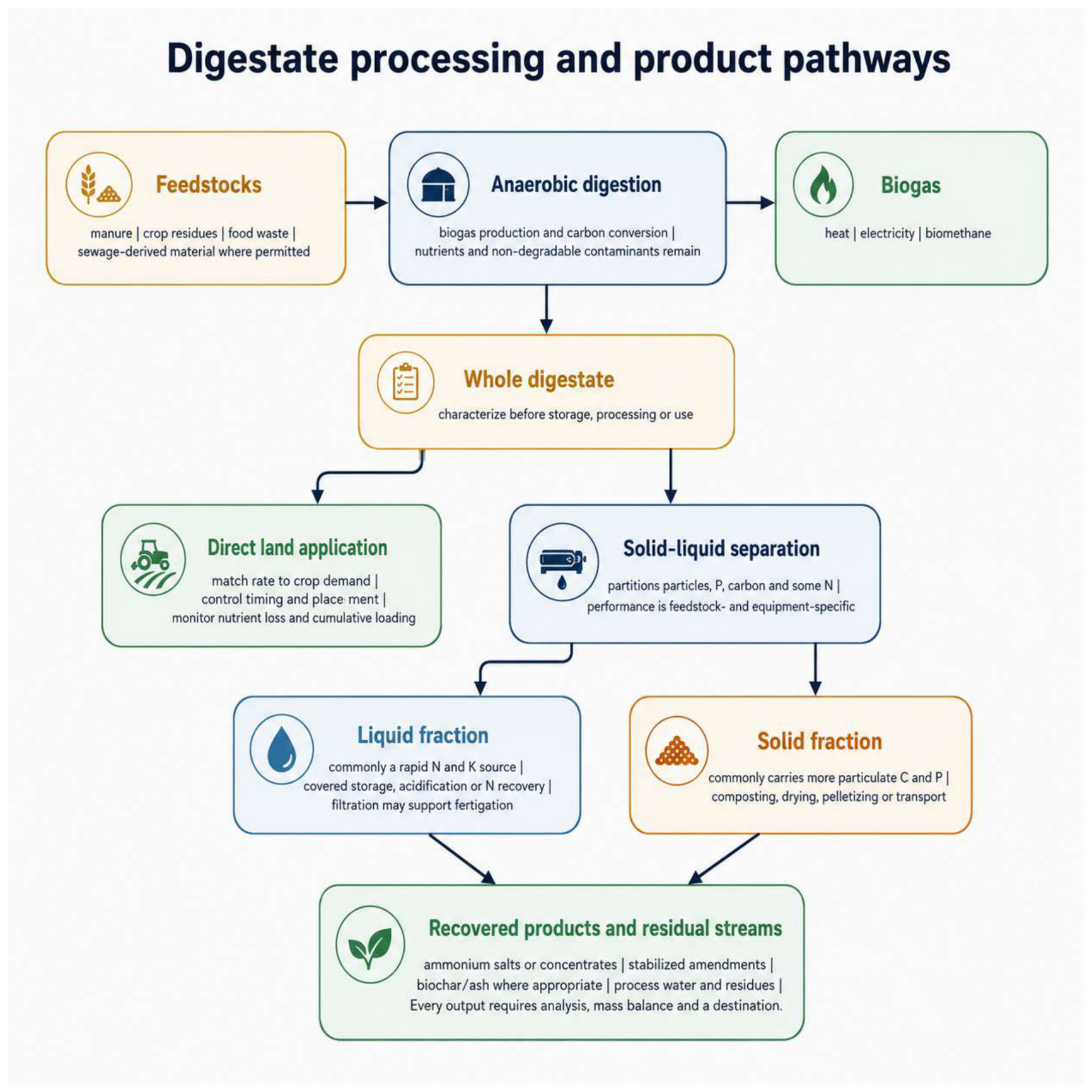
6.7. Expanded Processing and Nutrient-Recovery Options
Digestate processing is best interpreted as a sequence of separations and conversions. Verified full-scale evidence supports viewing processing as a sequence of separations and conversions. Screw presses and centrifuges partition particles and nutrients; microfiltration, stripping, precipitation, evaporation, reverse osmosis, drying, and pelletizing further change concentration, transport, and field behavior. No step creates value without an associated mass balance, energy demand, residual stream, and emissions profile [81,90,96,97,98,99,105].
The full-scale systematic review by Carraro et al. identified 175 separator observations and showed that substrate class, separator type, and chemical conditioning all influenced performance. Screw presses used 4.5 times less energy than centrifuges in the review, while centrifuges recovered more dry matter and phosphorus [81]. The practical objective should be nutrient allocation and usable product quality, not the highest isolated recovery percentage.
Table 10.
Digestate processing and valorization pathways.
| Process | Principal target or product | Agronomic advantage | Main limitations and safeguards | Key evidence |
| Screw press, screen, or centrifuge | Liquid N/K-rich fraction and solid P/organic-matter-rich fraction | Enables crop-specific use and reduces transport of water with solids | Separation efficiency varies; liquid fraction still carries ammonia-loss risk; all nutrients must remain in the mass balance | [12,21,77] |
| Nitrification or biofiltration | Nitrate-rich liquid fertilizer | Reduces ammonium toxicity in soilless systems and improves compatibility with horticultural crops | Requires aeration, alkalinity management, filtration, and pathogen control | [24,80] |
| Ammonia stripping, absorption, or membrane contact | Ammonium sulfate or another concentrated N product | Produces a standardized, transportable fertilizer and can reduce storage emissions | Energy and chemical use; corrosion and safety; residual liquid still requires management | [69,81] |
| Struvite or phosphorus precipitation | Concentrated P fertilizer | Recovers P and can reduce scaling or excess P in liquid streams | Chemical requirements, product purity, and variable plant availability | [69,81] |
| Microfiltration, ultrafiltration, reverse osmosis, or evaporation | Concentrate plus treated-water stream | High nutrient concentration and possible water reuse | Membrane fouling, energy demand, brine handling, and need for pretreatment | [77,81] |
| Co-composting of solid fraction | Stable compost-like amendment | Reduces phytotoxicity, increases handling quality, and shifts the product toward soil conditioning | Carbon and nitrogen losses during composting; need for bulking agent and aeration | [70,71,73] |
| Drying and pelletizing | Dense, transportable organic fertilizer | Easier storage, transport, metering, and regional redistribution of P and organic matter | Energy demand; ammonia losses unless captured; nutrient availability differs from liquid digestate | [12,69] |
| Biochar integration or pyrolysis of solids | Sorptive amendment or carbon-rich solid | Can retain ammonium, improve physical properties, and stabilize carbon | Performance depends on feedstock and process temperature; contaminant concentration must be assessed | [36,72,73] |
| Integrated biorefinery | Multiple fertilizer, water, energy, and carbon products | Maximizes resource use and may improve economic resilience | High capital complexity; requires whole-system life-cycle and market assessment | [77,81] |
Note: Study outcomes are context-specific and should be interpreted with the feedstock, application rate, soil, crop, duration, and comparator reported in the cited source.
6.7.1. Microfiltration, Recovered Nitrogen, and Product-Specific Field Behavior
Microfiltration can concentrate solids and produce a water-rich stream, but dissolved salts and nutrients remain. Fernández-Labrada et al. found that the filtrate was 99% water yet did not satisfy reclaimed-water requirements without further treatment or dilution [98]. Recovered ammonium sulfate can provide a more standardized nitrogen product, but Zilio et al. showed that the performance of recovered products must be assessed together with the stabilized organic fraction and the fate of the additional organic N [96].
Processing can also change emissions after land application. Petrova et al. found that removing N during processing did not reliably predict N2O; degradable carbon and product geometry were more informative, and pelletizing created a strong emission risk [90]. Product labels should therefore report processing history as well as nutrient concentration.
6.8. Decision Framework for Field and Horticultural Use
No single application recommendation can cover the diversity of digestates and agroecosystems. A practical decision sequence begins with feedstock and product characterization, then considers crop demand, soil limitations, climate and hydrology, available equipment, and cumulative nutrient or contaminant loading. The rate should be constrained by the most limiting nutrient or risk, not automatically by total nitrogen alone. Where phosphorus is already excessive, a liquid fraction or recovered nitrogen product may be preferable to repeated whole-digestate application. Where soil organic matter and water retention are the principal constraints, a solid, composted, or biochar-amended fraction may provide greater value. [7,8,21,63,65,77]
Table 11.
Author-proposed evidence-informed decision matrix for digestate selection and management.
| Production context | Preferred product strategy | Application and timing | Essential monitoring | Practices to avoid |
| High-N-demand annual crop on well-drained soil | Analyzed whole digestate or liquid fraction, possibly complemented with mineral P or S | Split doses during active uptake; band, trailing hose, or shallow injection according to crop and soil | Available N, soil P and K, weather, crop N status | Large pre-season dose; application before heavy rain |
| P-rich soil requiring N but little additional P | Liquid fraction or recovered ammonium product | Apply on an N-availability basis with low-emission placement | P mass balance, ammonium, pH, EC | Repeated whole or solid digestate application |
| Sandy, carbon-poor soil | Solid fraction, co-compost, or digestate plus stable-carbon amendment | Incorporate with erosion and moisture management; combine with cover crops | SOC, aggregation, water retention, nitrate leaching | Reliance on dilute liquid alone for soil-building |
| Heavy or poorly drained soil | Conservative rate; avoid high-labile-C application under wet conditions | Apply only when trafficability and aeration are adequate; split N | Soil moisture, N2O risk, compaction | Injection into saturated soil; large dose before prolonged wet weather |
| Acidic degraded tropical soil | Characterized whole or solid-rich digestate where contaminants are low | Incorporate at a restoration rate supported by soil testing and follow-up crops | pH, P, base cations, SOC, biological indicators | Assuming short-term yield response equals long-term restoration |
| Greenhouse soil or substrate | Filtered, diluted, or nitrified liquid digestate with targeted supplementation | Frequent small fertigation doses; flush and manage EC | EC, pH, ammonium:nitrate ratio, P, S, micronutrients, emitter performance | Raw undiluted digestate; unfiltered use in small emitters |
| Hydroponic or soilless recirculating system | Nitrified and filtered digestate blended to a complete nutrient recipe | Sensor-guided dosing and water-quality control | Full ion profile, dissolved oxygen, pathogens, organic load | Treating digestate as a complete nutrient solution without analysis |
| Land near sensitive water bodies | Low rate, high crop uptake, buffer zones, covered storage | Apply in favorable weather and outside runoff-prone periods | Soil mineral N, rainfall forecast, water-quality safeguards | Winter or storm-period application; spreading on saturated slopes |
| Municipal or sludge-derived digestate | Use only under a validated contaminant and hygiene programme | Site-specific restrictions and cumulative-load accounting | Metals, microplastics, organic contaminants, pathogens | Application based only on nutrient analysis |
Note: This author-derived framework synthesizes the reviewed evidence and has not itself undergone prospective field validation. It must be adapted to product analysis, site conditions, and applicable national or local regulation; it is not a universal agronomic or legal protocol.
6.9. Life-Cycle Assessment and System Boundaries
A life-cycle assessment can reach different conclusions depending on whether the functional unit is waste treated, energy produced, dry matter managed, nutrient delivered, crop produced, or land managed. In the life-cycle assessment, direct spreading had the lowest modeled global-warming burden, while advanced post-treatment reduced terrestrial acidification and improved nutrient concentration at the cost of greater fossil-resource use [99]. These results are scenario-specific rather than a ranking valid for every region.
The reference scenario is decisive. Digesting manure may avoid methane that would otherwise be emitted during unmanaged storage, creating a large climate benefit. Digesting a purpose-grown energy crop does not avoid that manure emission and carries land-use and cultivation burdens. Food-waste digestion may displace landfill or composting. The same field emissions from digestate therefore have different net implications in different systems.
Allocation between biogas and digestate is another source of variation. Treating digestate as a waste with no upstream burden makes its fertilizer use appear highly favorable. Allocating part of feedstock production and plant operation to digestate can reduce that apparent benefit. Substitution credits for mineral fertilizer depend on the actual crop recovery of nitrogen, phosphorus, and potassium, not their total chemical content. Credits for soil carbon require evidence of a durable stock change and should not double-count carbon already included in a waste-treatment baseline.
Methane leakage can dominate climate performance because methane has a high near-term warming effect. Leakage from the digester, upgrading equipment, pressure relief, storage, and digestate with residual biogas potential must be measured or represented with realistic assumptions. Covered storage with gas recovery can preserve energy value and reduce emissions, whereas open storage can erode the benefit of capture during digestion [7,63].
Field nitrous oxide is highly variable and often estimated using default emission factors. Digestate-specific measurement shows that soil pH, moisture, labile carbon, and mineral nitrogen can create responses that differ from mineral fertilizer. Sensitivity analysis should therefore test alternative emission factors and weather scenarios. Ammonia should also be included because its redeposition contributes to indirect nitrous oxide and ecosystem acidification or eutrophication [49,63,65].
Processing technologies create trade-offs. Separation uses energy but can reduce long-distance transport of water and enable better nutrient allocation. Ammonia recovery or reverse osmosis can produce standardized fertilizer, but electricity, heat, acid, alkali, membrane replacement, and residual concentrate management must be counted. Drying and pelletizing improve transportability while potentially increasing energy use and ammonia loss. Co-composting stabilizes solids but releases carbon dioxide and may lose nitrogen unless the process is well managed [69,70,71,72,73,77,81].
A defensible assessment should report system boundaries, functional unit, allocation method, substitution assumptions, nutrient availability, transport distances, storage type, methane leakage, field-emission assumptions, soil-carbon treatment, and uncertainty. Results should be presented for several plausible management scenarios rather than as one universal carbon footprint.
6.10. Product Quality Assurance, Regulation, and Farmer Confidence
A functioning digestate market requires confidence that the product is consistent, traceable, safe for its intended pathway, and agronomically useful. Quality assurance begins with feedstock acceptance and continues through process control, representative sampling, laboratory analysis, labelling, storage, transport, and field records. The relevant specification depends on product and use: a liquid fraction intended for arable injection requires different controls from a composted solid used in growing media or a recovered ammonium salt used as a mineral fertilizer substitute [8,21,68,81,96,97,98,103].
Sampling deserves particular attention. Whole digestate can stratify rapidly, and a grab sample from the surface may not represent a storage tank. Tanks should be mixed safely before representative sampling, or a validated composite protocol should be used. Liquid and solid fractions require separate analysis after any processing change. Laboratories should report analytical basis clearly - fresh mass, dry mass, total product, filtrate, or dissolved fraction - because conversion errors can lead directly to overapplication.
A practical product declaration should include feedstock class, treatment and sanitation status, dry matter, organic matter, pH, electrical conductivity, total nitrogen, ammonium nitrogen, total phosphorus, potassium, sulfur where relevant, and instructions for calculating an available-nitrogen rate. Threshold contaminants and hygienic indicators should be reported according to the applicable jurisdiction and feedstock. For a recovered mineral product, purity, concentration, solubility, and residual organic contaminants are more relevant than the composition of the original digestate.
Regulation should distinguish products by risk without assuming that all waste-derived fertilizers are identical. Source-separated agricultural digestate has a different risk profile from sewage-sludge digestate or mixed municipal waste. Proportionate rules can encourage nutrient recovery while maintaining strict exclusion and testing for higher-risk inputs. Traceability is especially important for co-digestion plants because one unacceptable feedstock can affect a large product batch.
Farmer confidence also depends on usability. Nutrient recommendations must be expressed in units compatible with spreading equipment, and analysis must be available before application rather than months later. Advisory services can translate laboratory results into crop plans, account for residual value, and calibrate applicators. Demonstration trials should compare equal available-nutrient rates and report both benefits and operational problems.
Where a target journal or market uses a formal digestate quality protocol, the manuscript’s terminology and recommendations should be aligned with that protocol at submission. This review provides general principles rather than a substitute for national fertilizer, waste, water, or food-safety law.
6.10.1. Performance-Based Phytotoxicity Screening
Chemical composition alone may not reveal the combined effect of ammonium, salts, micronutrients, and unmeasured inhibitory compounds on seed establishment. In a 2026 study of whole, liquid, and solid digestates from 23 full-scale plants in Sweden, Norway, and Denmark, a 72-hour tomato germination-index bioassay showed wide variation among feedstocks and fractions. Total ammonia nitrogen, potassium, and boron were the strongest modeled predictors of low germination performance [112].
The study identified candidate cut-points of total ammonia nitrogen at 1,122 mg N L−1, K at 39.6 × 10³ mg kg−1, and B at 22.5 mg kg−1 dry matter; every sample exceeding all three had a germination index below 50%. These values are study-specific decision aids, not universal regulatory limits. They should not be transferred to other seed species, assay durations, climates, soils, or digestate populations without validation [112].
A germination index can integrate multiple acute phytotoxic effects and can support batch screening for concentrated, novel, or highly variable products. It does not replace nutrient analysis, pathogen and contaminant testing, field calibration, or longer-term soil-plant assessment. The 72-hour assay did not measure multi-season soil, microbiome, contaminant, or food-chain outcomes, and the Nordic cross-sectional sample set limits geographic transferability [112].
6.11. Author-Proposed Operational Implementation and Monitoring Framework
The following framework is an author-derived translation of the evidence. Some elements are supported directly by digestate experiments, including product analysis, nutrient matching, storage losses, and placement effects. Other elements are transferred from established fertilizer, irrigation, hygiene, and exposure-control practice, while several remain proposed safeguards requiring prospective validation. The framework is therefore not a universal protocol or substitute for national law; it is a transparent starting point for adapting product characterization, monitoring, and contingency planning to feedstock, crop, soil, climate, and exposure pathway.
Before delivery or spreading, the operator should confirm that the receiving field has an agronomic need, that nutrient and contaminant limits will not be exceeded, and that storage capacity is adequate if weather delays application. A representative sample should be taken after safe mixing, and the planned application should be converted into fresh-volume, total-nitrogen, available-nitrogen, phosphorus, and potassium rates. Spreader calibration should use the actual product density and flow behavior.
During application, weather, soil condition, field boundaries, buffer zones, start and finish time, equipment setting, and actual volume should be documented. Visible runoff, ponding, excessive odour, blocked injectors or emitters, and uneven distribution are reasons to stop and correct the operation. Post-application records should include incorporation time, rainfall or irrigation, crop growth, and any signs of scorching or salt stress.
Monitoring intensity should be proportionate to risk. Agricultural manure digestate on a nearby field may require routine nutrient analysis and periodic soil testing. A municipal or industrial product, repeated use on P-rich soil, application near water, or use in recirculating horticulture warrants additional contaminant, water-quality, or system-performance monitoring.
Table 12.
Author-proposed evidence-informed pre-application and application-day checklist.
| Stage | Required check | Minimum record or decision |
| Feedstock and product acceptance | Confirm approved feedstocks, processing status, and absence of prohibited inputs | Batch identity and supplier or plant declaration |
| Representative sampling | Mix safely or follow a validated composite-sampling protocol | Sample date, location, method, laboratory, and analytical basis |
| Nutrient analysis | Dry matter, total N, ammonium-N, P, K, pH and EC; additional nutrients where relevant | Results converted to fresh-volume and dry-matter bases |
| Safety analysis | Feedstock-specific metals, pathogens, plastics or organic contaminants | Compliance decision and any crop or site restriction |
| Field selection | Soil test, crop demand, slope, drainage, proximity to water, previous applications | Written justification for field and rate |
| Nutrient plan | Calculate total and available N, P and K; account for mineral fertilizer and residual supply | Planned kg ha−1 and m3 or t ha−1 |
| Weather and soil condition | Forecast, wind, rainfall risk, soil moisture, trafficability | Proceed, postpone, or modify method |
| Equipment calibration | Product density, flow, working width, speed, emitter or injector condition | Calibration result and target output |
| Buffer and access control | Watercourses, wells, residences, livestock and public access | Marked no-spread areas and safety controls |
| Application | Record actual field, time, volume, method and operator | As-applied map or field log |
| Incorporation or follow-up | Incorporation time, irrigation, cover placement, equipment cleaning | Completed action and deviations from plan |
| Incident response | Runoff, spill, blockage, overapplication or odour complaint | Stop-work action, containment, notification and corrective record |
| Performance screening | For concentrated, novel, highly variable, or seed-contact products, use a crop-relevant germination or phytotoxicity bioassay alongside chemistry | Bioassay result, test species, dilution, duration, decision threshold, and corrective action |
| Microbiological and AMR risk | For sewage-derived, mixed municipal, poultry, or other high-risk feedstocks, apply jurisdictional hygiene tests and risk-based ARG or resistant-organism monitoring where justified | Method, target, viability basis, detection limit, compliance decision, and crop or application restriction |
Note: This checklist is an author-derived synthesis, not a validated universal protocol. Required tests, thresholds, records, and restrictions must follow the relevant jurisdiction and should be proportionate to feedstock, product, crop, site, and exposure pathway.
Table 13.
Author-proposed evidence-informed monitoring programme after repeated digestate use.
| Monitoring component | Suggested timing | Interpretation and trigger for action |
| Digestate nutrient composition | Each materially different batch or at a frequency justified by process stability | Revise rate when available N, P, K, dry matter or EC changes |
| Soil pH, P, K and organic carbon | Baseline and periodically according to soil and regulatory guidance | Reduce or redirect product when P or salts accumulate; evaluate carbon trend using consistent depth and bulk density |
| Soil mineral N | Before application and, in high-risk systems, after harvest or before drainage season | Reduce future N rate or improve timing when residual N is excessive |
| Crop yield and quality | Each harvest | Distinguish nutrient deficiency, salt injury, lodging, nitrate accumulation or quality change |
| Plant tissue nutrients | During critical growth stages for high-value crops | Correct specific nutrient imbalance rather than increasing total digestate |
| Ammonia-loss indicators | During initial implementation or when method changes | Improve storage cover, placement, timing or incorporation when loss is high |
| Nitrous oxide and methane | Research trials, high-risk sites, or life-cycle verification | Identify wet-soil, high-carbon or storage hotspots and modify management |
| Groundwater, drainage or surface water | Sensitive catchments or sites with leaching risk | Stop or restrict application when nutrient movement threatens water quality |
| Metals and emerging contaminants | According to feedstock risk and cumulative loading | Reject feedstock, redirect product or suspend land application when thresholds or trends are adverse |
| Soil biological indicators | Baseline and multi-year intervals in research or restoration programmes | Interpret with chemistry and habitat; investigate persistent decline rather than transient post-application response |
| Operational cost and energy | Each season or process change | Compare direct use, separation, recovery and transport options using actual data |
| Complaints and incidents | Continuous | Use root-cause analysis to improve handling, communication and site controls |
| Phytotoxicity or germination performance | New product, major process change, or batches with high ammonium, EC, K, B, or unexplained crop injury | Dilute, blend, post-treat, redirect, or withhold the batch when crop-relevant bioassay performance is unacceptable |
| Microbial hygiene, resistant organisms, ARGs and mobile elements | Risk-based baseline and periodic monitoring for high-risk feedstocks or sensitive crop pathways | Interpret viability, abundance, host association, mobility and exposure together; strengthen treatment or restrict use when persistent high-risk indicators occur |
Note: This monitoring framework is author-derived and has not been prospectively validated as a complete programme. Routine ARG or mobile-element testing is most defensible for research, high-risk feedstocks, sensitive crop pathways, or regulatory investigation rather than as a universal requirement for every farm.
7. Discussion and Answers to the Review Questions
7.1. Synthesis of Agronomic and Environmental Trade-offs
The evidence shows why digestate resists simple conclusions. It is not one fertilizer product and it is not merely a weaker or stronger version of manure, compost or mineral fertilizer. It is a family of materials created by different feedstocks and processes, subsequently changed by separation, storage and treatment, and finally exposed to soils and crops under different climates and management histories. When those differences are ignored, the literature appears contradictory. When they are restored, much of the disagreement becomes interpretable.
The most important distinction is between an intrinsic property and a managed outcome. Ammonium concentration is a product property; crop recovery, ammonia loss and nitrous-oxide formation are managed outcomes. Particulate carbon is a product property; soil-carbon persistence and aggregation are outcomes conditioned by soil, dose, crop and time. A contaminant concentration is a product measurement; exposure and harm depend on partitioning, mobility, receiving environment and repeated loading. This distinction permits practical recommendations without pretending that one product label determines the result.
Agronomic benefit and environmental risk are linked through the same nutrient pathways. A high concentration of readily available N can support rapid crop growth when placement and timing match demand, yet the same characteristic increases the consequences of surface exposure or application before uptake. Processing can create a more transportable nutrient product, but the energy used and the residual stream must remain inside the system boundary. A high-yield treatment can still be inefficient if it receives more available N or unreported complementary nutrients than the comparator. These are not reasons to reject digestate; they are reasons to define the comparison and manage the pathway.
Rapid nutrient supply versus biological response: Concentrated ammonium, salts, direct contact, and labile carbon can create acute responses in microbes or fauna, whereas later responses may be neutral or positive through changes in plant growth, moisture, and food resources. Community sequencing, enzyme assays, mesocosms, short toxicity tests, and replicated field monitoring answer different questions. A temporary abundance or community shift should not be presented as permanent ecosystem damage or restoration [52,58,59,60,61,78,82,93,100,102,115].
Energy recovery versus long-term stocks and cumulative loading: Anaerobic digestion removes part of feedstock carbon as biogas while returning nutrients and a residual carbon fraction. Whether soil organic carbon declines, remains unchanged, or accumulates depends on the comparator, crop productivity, residue management, soil, duration, and repeated inputs. The same time-scale distinction applies to P, salts, and metals: a neutral one-season response cannot exclude cumulative loading, while a short concentration increase does not establish durable stock change without consistent depth and bulk-density measurements [39,83,85,95,106,107,108,109,110,111].
Evidence grades should accompany this causal interpretation. Replicated long-term field evidence supports durable claims; single-site field studies support conditional conclusions; and pot, incubation, mesocosm, modelling, or review evidence is most appropriate for mechanisms and hypotheses within stated boundaries. This prevents apparent agreement across unlike designs from being mistaken for universal certainty.
7.2. Answers to the Review Questions
The three review questions can be answered as follows:
Review question 1—Agronomic performance: Whole or processed digestate can replace part of a mineral-fertilizer programme when the product is characterized, the comparison is made on an explicit nutrient basis and supply is synchronized with crop demand. The most convincing substitutions occur where ammonium-N is conserved during storage and spreading, P, K, S or micronutrient differences are accounted for, and the application method places nutrients within the period and zone of active uptake. The evidence does not support one universal replacement percentage. A replacement value should be reported for the studied product, crop, soil, season, management and time horizon [83,84,86,87,96,101,102].
Review question 2—Soil health and ecology: Digestate can influence soil through direct nutrient and carbon inputs and indirectly through greater plant growth and root-derived carbon. Liquid, high-ammonium products commonly express their strongest function through fertilization; solid, composted or combined products can supply more particulate carbon and may be better suited to structural or long-term soil objectives. Positive carbon, physical and biological responses have been reported, especially in some coarse-textured or degraded soils, but they are not universal. Durable conclusions require stock-based measurements, appropriate comparators, repeated field observations and separation of nutrient effects from carbon effects [39,40,52,78,82,83,84,85,93,94,95,100,102,115].
Review question 3—Sources of variability and risk: Feedstock and catchment influence the starting composition, but digestion, separation, storage, post-treatment, soil, climate, crop, dose, placement and duration can amplify or reverse that influence. Environmental losses are pathway specific: surface exposure favors ammonia, wet incorporated zones can favor nitrous oxide, excess mineral N can move below roots, and repeated N-based application can accumulate P, K or salts. Metals are not destroyed, organic contaminants can transform or repartition, and biological hazards require endpoint-specific interpretation. Benefit and risk are therefore controlled most reliably by representative analysis, mass balance, exposure-pathway management and monitoring over the relevant timescale [7,21,68,78,81,87,88,89,90,91,92,93,94,95,96,103,106,107,108,109,110,111,112,113,114,115,116,117,118,119,120].
7.3. Limitations of the Review and Key Lessons Learned
Several limitations frame these conclusions. The literature is heterogeneous, and product composition, nutrient matching, storage and application practice are often incompletely reported. The review was developed through targeted searches rather than a prospectively registered systematic protocol, and one author conducted the search, extraction and synthesis. Full-text access influenced the level of detail that could be verified. These limitations are stated because they affect confidence, not because they erase the patterns that recur across well-characterized studies.
Despite these limitations, several key lessons have emerged:
Function follows measured form: Whole and liquid high-ammonium digestates often function primarily as rapid nutrient sources, whereas separated solids, composted digestate, and other stabilized products may contribute proportionally more carbon and slower nutrient release. Digestate and compost are not interchangeable, but neither category has one fixed function.
Management and mass balance are decisive: Rate, timing, placement, storage, complementary nutrients, and cumulative N, P, K, salt, and contaminant loading determine whether analytical nutrient value becomes crop recovery or environmental loss.
Feedstock matters, but is not destiny: Source composition sets important boundaries, yet digestion, separation, storage, post-treatment, soil, crop, and weather can amplify or override source effects. Guidance must combine traceable feedstocks with batch analysis and site-specific management.
Evidence follows scale and duration: Incubations and pot studies are valuable for mechanisms; short field trials inform immediate response; and repeated multi-year, replicated field studies are required for claims about soil restoration, cumulative contaminants, and durable environmental safety.
7.4. Actionable Research Questions for the Future
The following research questions arise from the evidence gaps and are intended to guide testable, policy-relevant work:
To develop precision application guidelines: Under what specific soil types, moisture regimes, and application methods does digestate offer a verifiable net greenhouse gas benefit compared to mineral fertilizers, and how can this data be used to develop regional, evidence-based guidelines for farmers, particularly in under-researched regions like Sub-Saharan Africa?
To quantify long-term soil restoration potential: What is the decadal-scale impact of repeated digestate application on the restoration of degraded tropical soils, specifically measuring changes in soil organic carbon stocks, physical properties, and the functional resilience of microbial communities?
To optimize digestate valorization pathways: What are the most techno-economically viable and environmentally sound pathways for refining raw digestate into standardized, high-value bio-based fertilizer products, and what policy incentives are needed to support their development?
To validate novel formulations in the field: What are the long-term agronomic and ecological effects of novel formulations, such as digestate-encapsulated biochar, under a range of real-world farming conditions?
To standardize nutrient-equivalence and mass balance: Which comparison protocols best reconcile total N, ammonium-N, estimated available N, organic-N residual value, P, K, S, application timing, placement, and storage losses so that fertilizer-replacement claims are reproducible across sites?
To resolve cumulative sewage-sludge-digestate risk: How do repeated applications affect metal speciation, soil accumulation, root-zone mobility, crop partitioning, runoff and leaching across contrasting soils, crops, climates, and wastewater catchments, and which monitoring thresholds are protective over decades?
To validate performance-based product screening: Can germination-index and other crop-relevant bioassays be calibrated across seed species, digestate fractions, soils, climates, and field outcomes, and how should acute screening be integrated with chemistry, contaminant testing, and process certification?
To resolve antimicrobial-resistance and microbial-hygiene risk: Which combinations of viable resistant organisms, ARGs, mobile genetic elements, pathogenic hosts, treatment conditions, storage, application route, and environmental exposure best predict actual One Health risk, and which treatment or post-treatment barriers are effective at commercial scale?
Across these priorities, the experimental unit should be the complete product-management-soil-crop system. Future studies will be most useful when they compare treatments on a transparent nutrient basis, retain untreated and nutrient-equivalent controls, measure the pathways likely to carry losses, archive product samples or fingerprints, and continue long enough to test the claim being made. A short experiment can answer an acute question well; it should not be asked to prove a cumulative one.
7.5. Minimum Reporting Standards for Future Digestate Studies
The diversity of digestates makes incomplete reporting a major barrier to synthesis. A study that reports only the applied volume cannot be compared meaningfully with one that reports total nitrogen but not ammonium, dry matter, or application basis. The following minimum dataset would substantially improve reproducibility and enable future meta-analysis.
Table 14.
Author-proposed minimum reporting checklist for future digestate research.
| Domain | Minimum information to report | Why it matters |
| Feedstock | Material types, proportions, source, preprocessing, co-digestion inputs | Determines nutrients, contaminants, carbon quality, and traceability |
| Digestion | Reactor type, temperature class, hydraulic and solids retention time, loading, post-digestion storage | Affects stabilization, ammonium formation, pathogens, and residual methane |
| Product identity | Whole, liquid, solid, composted, dried, pelletized, nitrified, recovered nutrient, or blended product | Prevents unlike products from being treated as equivalent |
| Composition | Fresh and dry matter, organic matter or volatile solids, pH, EC, total N, ammonium-N, nitrate-N, total P, K, S, Ca, Mg, Na | Required for nutrient-equivalent comparisons and salinity assessment |
| Carbon characterization | Total organic C and, where possible, labile and stable fractions or biodegradability | Supports interpretation of priming, respiration, and sequestration claims |
| Safety | Relevant metals, pathogens, viable resistant organisms, antimicrobial-resistance genes and mobile elements where justified, microplastics, and feedstock-specific organic contaminants; include analytical method and detection limit | Enables risk assessment, comparison of treatment efficacy, exposure interpretation, and cumulative-load accounting |
| Application | Rate on fresh-mass, dry-mass, total-N and available-N bases; date; method; depth; dilution; incorporation delay | Determines exposure, nutrient supply, and gaseous losses |
| Site and soil | Location, climate, soil classification, texture, pH, SOC, drainage, baseline nutrients | Explains response heterogeneity and transferability |
| Crop and management | Species and cultivar, rotation, irrigation, mineral supplements, previous amendments | Needed to interpret yield and nutrient recovery |
| Experimental design | Comparator, replication, plot size, randomization, duration, statistical model | Indicates reliability and risk of bias |
| Outcomes | Yield and quality, nutrient uptake, soil properties, gaseous emissions, leaching, biological indicators | Prevents selective reporting of only positive endpoints |
| Mass balance | Nutrient and carbon inputs, crop removal, storage and field losses, residual soil pools | Reveals whether apparent efficiency is caused by unmeasured loss or accumulation |
| Economic and operational data | Energy, labour, transport, treatment chemicals, equipment, product value | Supports real-world adoption and life-cycle interpretation |
| Data availability | Raw or summarized data, analytical methods, units, detection limits | Allows checking, reanalysis, and future meta-analysis |
| Bioassay and product performance | Test species, seed lot where relevant, sample basis, dilution, exposure duration, germination and root-elongation calculation, reference control, and decision rule | Allows acute phytotoxicity screening to be reproduced and prevents study-specific thresholds from being treated as universal |
Note: This author-derived checklist is intended to improve comparability and future synthesis. It is not a reporting standard endorsed by a journal, regulator, or consensus body and should be adapted to the study design and applicable requirements.
Standardized reporting should be complemented by core outcome sets. For agronomic trials, these might include marketable yield, nitrogen uptake, apparent nitrogen recovery, residual mineral nitrogen, and phosphorus balance. For environmental trials, ammonia, nitrous oxide, methane where relevant, and nitrate movement should be measured over periods appropriate to each pathway rather than during a short window selected for convenience. Biological studies should include an untreated control and a nutrient-equivalent mineral treatment so that organic-carbon effects can be separated from simple fertilization.
Long-term experiments should also archive digestate samples or detailed analytical fingerprints, because the product can change substantially between years even when the facility name remains the same. Linking product chemistry to biological and environmental responses is more informative than classifying treatments only as digestate or control.
7.6. Overall Evidence Certainty and Transferability
The strongest evidence concerns short-term crop response, readily available N, and the need to control ammonia loss. Numerous field, pot, and greenhouse studies demonstrate fertilizer value, but inconsistent matching of total N, ammonium-N, available N, complementary nutrients, timing, and placement weakens direct replacement estimates. Nitrous-oxide evidence is credible but highly conditional; a single default direction or factor is not justified.
Evidence for soil physical improvement and carbon accumulation is moderate and context dependent. Positive responses are reported more often for solid, compost-like, or combined amendments and in some coarse-textured or degraded soils, but a recent degraded-soil field platform also lacked a randomized contemporaneous control [40,115]. Long-term stock measurements remain less common than short incubations or concentration-based measurements. Microbial evidence is growing, but differences in sequencing, biomarkers, enzymes, design, and sampling time limit generalization. Evidence for mesofauna and macrofauna remains smaller and species-specific.
Contaminant evidence is uneven and source specific. Full-text studies establish that metals persist through anaerobic digestion, that concentration and chemical fractionation can change, and that Cu and Zn can transform after soil application. PFAS studies show precursor transformation and changing solid-liquid partitioning rather than a stable universal removal factor, while pharmaceutical mobility depends on compound and sludge origin [106,107,108,109,110,111,116,117,118,119,120]. Evidence for occurrence and short-term process behavior is therefore moderate, but repeated field-scale crop transfer, cumulative loading, mixture effects, and long-term health outcomes remain insufficiently resolved. Microplastic occurrence is increasingly documented, and performance-based germination testing supports acute batch screening but not universal field thresholds [77,112]. Antimicrobial-resistance studies show that viable resistant organisms, ARG abundance, ARG diversity, mobile elements, host identity, and long-term soil exposure can respond differently; the evidence supports risk-based monitoring rather than a universal digestion-removal factor [113,114].
Table 15.
Qualitative assessment of evidence strength and transferability.
| Outcome or intervention | Current evidence strength | Transferability | Main reason for uncertainty |
| Short-term crop yield and N substitution | Moderate to strong | Moderate | Variable nutrient-equivalence methods, feedstocks, and crops |
| Crop quality and nitrate accumulation | Moderate | Low to moderate | Quality endpoints and harvest conditions differ substantially |
| Ammonia volatilization | Strong | Moderate to strong | Magnitude depends on weather, pH, storage, and placement |
| Nitrous oxide emissions | Moderate | Low | Strong soil-moisture, pH, carbon, and temporal interactions |
| Nitrate leaching | Moderate | Moderate | Depends on climate, soil, crop uptake, and application season |
| Soil physical properties | Moderate | Low to moderate | Greater response in sandy or degraded soils and with solid fractions |
| Long-term soil-carbon stocks | Moderate but limited in duration | Low to moderate | Few long trials; inconsistent depth and stock calculation |
| Microbial biomass and community | Moderate | Low to moderate | Methods, carbon quality, and sampling time differ |
| Soil fauna | Limited to moderate | Low | Species-specific tests and few long-term field studies |
| Trace metals | Moderate for occurrence and speciation; limited for repeated field crop transfer | Low to moderate | Source and catchment variability, changing chemistry, soil history, and few long-term repeated sewage-sludge-digestate field trials |
| Microplastics and emerging contaminants | Limited to moderate for occurrence; limited for long-term effects | Low | Analytical methods, source mixtures, transformation products, exposure pathways, and long-term dose-response remain inconsistent |
| Solid-liquid separation | Strong for partitioning principle | Moderate | Equipment performance and mass balances vary |
| Advanced nutrient recovery | Moderate at pilot/full scale for selected processes | Low to moderate | Energy, chemical use, fouling, markets, and residual streams |
| Co-composting and biochar integration | Moderate | Low to moderate | Formulation and process conditions determine performance |
| Sub-Saharan African smallholder outcomes | Limited to moderate | Low | Few long-term integrated agronomic, economic, and social studies |
| Performance-based phytotoxicity screening | Moderate for acute batch screening; limited for field prediction | Low to moderate | Few multi-product datasets; seed species, dilution, assay duration, product chemistry, and field conditions affect transferability |
| Antimicrobial resistance and microbial transfer | Limited to moderate for occurrence and process response; limited for exposure and health outcome | Low | Gene-, host-, process-, matrix-, and method-specific responses; few longitudinal field studies linking viability, mobility, exposure, and clinical relevance |
Note: Evidence certainty and transferability are graded separately. Strong = convergent replicated field or multi-site evidence with adequate product and comparator characterization; Moderate = credible but context-limited field evidence or convergent controlled studies; Limited = few, short, restricted, incompletely characterized, or indirect studies; Insufficient = too sparse or unsuitable for a directional conclusion. These author-applied categories are qualitative, not a formal GRADE assessment.
This assessment should guide the tone of conclusions. Strong practical recommendations can be made for representative analysis, nutrient matching, covered storage, avoidance of high-risk timing, and explicit product identity. Performance bioassays are useful screening tools but require calibration, while antimicrobial-resistance and emerging-contaminant conclusions require source-specific and pathway-specific language. More conditional language remains necessary for universal soil-carbon-stock claims, broad soil-fauna benefits, long-term contaminant safety, and advanced processing economics.
The resulting message is deliberately balanced. The evidence is strong enough to support practical use of characterized digestate and strong enough to reject careless generalization. It supports nutrient recycling, but not application by label or volume alone; it supports targeted mitigation, but not the assumption that one practice reduces every emission; and it supports monitoring of source-specific hazards without equating detection with demonstrated harm. This is the level of confidence on which responsible adoption can proceed.
8. Conclusion and Future Perspectives
Digestate should be understood as part of an integrated organic-resource and nutrient-management system rather than as a simple alternative to compost, untreated slurry or mineral fertilizer. Anaerobic digestion recovers energy and changes the chemical form of part of the feedstock, but the agronomic and environmental outcome is decided later—during storage, processing, characterization, application and repeated interaction with a particular soil and crop. The most defensible use therefore begins with a known product and a defined objective: rapid nutrient supply, transport of phosphorus-rich solids, addition of carbon, treatment of a nutrient surplus or a combination of these functions.
Digestate can support competitive crop production and can replace a meaningful share of mineral fertilizer in well-managed systems. The evidence does not justify universal claims of superior yield, a fixed replacement value, automatic soil-carbon accumulation, lower greenhouse-gas emissions or inherent safety. Yield equivalence is not necessarily nutrient equivalence, and a successful season does not complete the N, P, K or carbon balance. Liquid fractions, separated solids and recovered products should be evaluated according to the nutrients, carbon and hazards they actually carry, not according to a generic expectation attached to the term digestate.
Feedstock and wastewater catchment remain fundamental because they influence the initial nutrient and contaminant profile, but they are not destiny. Digestion, separation, storage and post-treatment alter concentration, form and partitioning; soil chemistry, crop partitioning, runoff, leaching and application history then determine exposure. Anaerobic digestion does not destroy metals. PFAS evidence points to precursor transformation and changing solid-liquid partitioning rather than dependable elimination, pharmaceutical behavior is compound- and source-specific, and reduction of viable resistant organisms does not guarantee removal of ARGs or mobile genetic elements. These findings support controlled, batch- and site-specific use with monitoring rather than a universal verdict of safety or hazard [106,107,108,109,110,111,112,113,114,115,116,117,118,119,120].
Future research should concentrate on questions that short, poorly characterized experiments cannot resolve: long-term replicated field performance in tropical and under-represented systems; standardized nutrient-equivalence and complete N, P, K and carbon balances; repeated application of sewage-sludge-derived products with metal speciation, mobility and crop transfer; cross-crop validation of phytotoxicity screening; and commercial-scale antimicrobial-resistance studies that connect viable organisms, ARGs, mobile elements, hosts and actual exposure. Monitoring periods must match the pathway, from hours for ammonia to years or decades for durable carbon change and cumulative contaminants.
The practical conclusion is not that digestate is universally beneficial, nor that uncertainty requires inaction. It is that the material becomes useful through knowledge and control. Representative sampling, nutrient and contaminant analysis, covered storage, an explicit matching basis, appropriate timing and placement, cumulative soil records and pathway-specific monitoring transform an uncertain residual into a manageable agricultural input. Where these controls are absent, the same material can become inefficient or hazardous.
This review therefore resolves the apparent digestate dilemma by replacing a product verdict with a decision process. Characterize what has been produced; identify the function required; compare treatments on an honest nutrient basis; manage the dominant loss and exposure pathways; and observe the system for long enough to test the intended benefit. When the evidence does not support a number or a mechanism, the correct scholarly response is to state the boundary. That discipline strengthens, rather than weakens, the case for responsible nutrient recycling.
Statements and Declarations
Review Reporting
This manuscript is reported as a structured critical narrative review based on targeted literature searches and claim-level source verification. It does not claim formal systematic-review or PRISMA status because no prospectively registered protocol, complete deduplicated screening database, reproducible historical search log, or documented study-flow record was available; no retrospective screening counts were reconstructed. Appendix A records the search procedures that can be reproduced, Appendix B defines the outcome-level evidence rubric, and Appendix C separates primary evidence, review synthesis, comparator evidence, and author-derived guidance.
Author Contributions
Benedict Twongyere is the sole author and is responsible for conceptualization, literature synthesis, interpretation, manuscript preparation, and approval of the final manuscript.
Funding
No specific funding was received for this work.
Data Availability Statement
No new primary dataset was generated. The evidence synthesized in this review is available in the cited publications and institutional sources.
Conflicts of Interest
The author declares no competing interests.
Abbreviations
AD, anaerobic digestion; AMR, antimicrobial resistance; ARG, antimicrobial-resistance gene; DM, dry matter; EC, electrical conductivity; GHG, greenhouse gas; LCA, life-cycle assessment; NFRV, nitrogen fertilizer replacement value; NUE, nitrogen-use efficiency; PFAS, per- and polyfluoroalkyl substances; SOC, soil organic carbon; SOM, soil organic matter; TAN, total ammoniacal nitrogen; TOC, total organic carbon; VRA, variable-rate application; WFPS, water-filled pore space.
Appendix A. Targeted Literature Search and Verification Record
The manuscript developed through staged targeted searches rather than a prospectively registered systematic-review protocol. This appendix records procedures that can be reproduced without inventing historical screening counts. Targeted verification for Version 3.5 was closed on 21 July 2026. Online-first articles were eligible when a final peer-reviewed version and persistent DOI were available. Publisher platforms, PubMed, DOI and bibliographic records, open institutional repositories and cited-reference chains were used according to the source and question.
| Evidence domain | Representative query structure | Principal platforms | Stopping rule |
| Crop response and nutrient equivalence | digestate AND (crop yield OR fertilizer replacement OR nitrogen-use efficiency OR nutrient equivalence) | Publisher platforms; PubMed; DOI records; reference tracing | Recent field and controlled studies were added until repeated searches yielded no new directly relevant, inspectable studies that changed the synthesis. |
| Soil carbon and physical properties | digestate AND (soil organic carbon OR carbon stock OR aggregation OR porosity OR water retention) | Elsevier, Springer Nature, Wiley, MDPI and institutional repositories | Priority was given to multi-year field evidence, isotopic work and controlled studies that distinguished concentration from stock. |
| Gaseous and dissolved N losses | digestate AND (ammonia OR nitrous oxide OR nitrate leaching OR injection OR incorporation) | Publisher platforms; PubMed; cited-reference tracing | Searches were closed after the principal field reviews and recent original field studies had been verified and no stable universal direction was supported. |
| Sewage-sludge-derived metals | anaerobically digested sewage sludge AND (metal speciation OR crop uptake OR runoff OR repeated application) | PubMed; Springer Nature; Elsevier; institutional repositories | Search continued until total concentration, fractionation, crop partitioning and runoff pathways were each represented by original evidence. |
| Biological and emerging hazards | digestate AND (soil fauna OR microbiome OR phytotoxicity OR antimicrobial resistance OR microplastics) | PubMed; Frontiers; Springer Nature; publisher platforms | Evidence was retained only where the product, exposure and endpoint could be identified; gaps were reported instead of inferred. |
| PFAS and pharmaceuticals | anaerobically digested sludge OR biosolids AND (PFAS OR PFAA precursor OR pharmaceutical OR landspreading OR leachate) | PubMed; ACS; Elsevier; Springer Nature; DOI records | Search was closed after original studies covered precursor transformation, anaerobic partitioning, post-digestion treatment and soil-column mobility; field-crop transfer remains a gap. |
| Processing and life-cycle assessment | digestate AND (solid-liquid separation OR nutrient recovery OR post-treatment OR life-cycle assessment) | Elsevier; Wiley; Springer Nature; publisher records | Full-scale systematic evidence and original process or LCA studies were prioritized; process performance was not generalized beyond reported system boundaries. |
Eligibility and access boundaries. Detailed numerical findings, treatment descriptions and mechanistic claims required an inspectable original full text. Abstract-only sources were restricted to statements explicitly reported in the abstract. A citation encountered in a review was treated as a discovery lead. When a journal article superseded a poster, proceedings paper, thesis chapter or preprint, the final article was used and the experiment was counted once.
Appendix B. Outcome-Level Evidence Appraisal Rubric
Evidence certainty and transferability were judged separately. The categories below are an author-applied qualitative rubric rather than a formal GRADE assessment. They are intended to make the logic of the narrative synthesis explicit.
| Category | Design and replication | Product and comparator | Consistency and duration | Permitted conclusion |
| Strong | Convergent replicated field or multi-site evidence; adequate statistical support | Digestate, rate, nutrient basis and comparator characterized sufficiently | Results consistent across relevant sites or years, or supported by a robust systematic synthesis | Durable directional conclusion within the represented systems; not a universal rate or safety claim |
| Moderate | Credible but context-limited field evidence or convergent controlled studies | Most consequential product and comparator details reported | Some consistency, but restricted sites, crops, durations or methods | Conditional conclusion with explicit product, site and timescale boundaries |
| Limited | Few studies, short duration, restricted scale, incomplete replication or indirect endpoints | Important characterization or matching information incomplete | Heterogeneous or too sparse for stable generalization | Mechanistic hypothesis, occurrence statement or research priority only |
| Insufficient | Evidence absent, inaccessible, or unsuitable for the proposed inference | Product, comparator or exposure cannot be reconstructed reliably | No defensible synthesis | Identify the gap; do not provide a directional conclusion or inferred number |
Transferability was evaluated independently from evidence certainty. A well-replicated result may still have low transferability when it is restricted to one feedstock, soil, crop, climatic regime, treatment process or exposure pathway.
Appendix C. Evidence Roles, Duplicate Control, and Author-Derived Guidance
| Evidence role | Use in this review | Control against overstatement |
| Primary original study | Supplies study-specific methods, numerical results and limitations | One experiment is counted once even when reported in multiple papers, theses or conference versions |
| Systematic review or meta-analysis | Assesses consistency and heterogeneity across a body of literature | Not added to the number of independent primary experiments represented in the same synthesis |
| Critical or narrative review | Provides context, terminology and discovery leads | Does not supply detailed treatment claims when the original study cannot be inspected |
| Comparator or mechanistic background | Explains processes using raw slurry, compost, sludge or general soil science | Clearly labelled and not presented as direct digestate evidence |
| Author-derived framework | Translates the evidence into decision, monitoring or reporting proposals | Explicitly identified as unvalidated guidance that must be adapted to local law and practice |
References
- Bernal, M.P.; Alburquerque, J.A.; Moral, R. Composting of Animal Manures and Chemical Criteria for Compost Maturity Assessment. A Review. Bioresour. Technol. 2009, 100(22), 5444–5453. [Google Scholar] [CrossRef] [PubMed]
- Weiland, P. Biogas Production: Current State and Perspectives. Appl. Microbiol. Biotechnol. 2010, 85(4), 849–860. [Google Scholar] [CrossRef] [PubMed]
- Holm-Nielsen, J.B.; Al Seadi, T.; Oleskowicz-Popiel, P. The Future of Anaerobic Digestion and Biogas Utilization. Bioresour. Technol. 2009, 100(22), 5478–5484. [Google Scholar] [CrossRef] [PubMed]
- Möller, K.; Müller, T. Effects of Anaerobic Digestion on Digestate Nutrient Availability and Crop Growth: A Review. Eng. Life Sci. 2012, 12(3), 242–257. [Google Scholar] [CrossRef]
- Dahiya, A.K. Biogas Plant Slurry as an Alternative to Chemical Fertilizers. Energy Manag. 1986, 9(1), 67–74. [Google Scholar] [CrossRef]
- Barzee, T.J.; Edalati, A.; El-Mashad, H.; Wang, D.; Scow, K.; Zhang, R. Digestate Biofertilizers Support Similar or Higher Tomato Yields and Quality Than Mineral Fertilizer in a Subsurface Drip Fertigation System. Front. Sustain. Food Syst. 2019, 3. [Google Scholar] [CrossRef]
- Pedersen, J.; Hafner, S.D. Ammonia Emissions after Field Application of Anaerobically Digested Animal Slurry: Literature Review and Perspectives. Agric. Ecosyst. Environ. 2023, 357, 108697. [Google Scholar] [CrossRef]
- Szymańska, M.; Ahrends, H.E.; Srivastava, A.K.; Sosulski, T. Anaerobic Digestate From Biogas Plants-Nuisance Waste or Valuable Product? Appl. Sci. 2022, 12(8), 4052. [Google Scholar] [CrossRef]
- Lošák, T.; et al. Comparison of the Effectiveness of Digestate and Mineral Fertilisers on Yields and Quality of Kohlrabi. Acta Univ. Agric. Et. Silvic. Mendel. Brun. 2011, 59(3), 117–122. [Google Scholar] [CrossRef]
- Duan, N.; et al. Ecological and Economic Analysis of Planting Greenhouse Cucumbers With Anaerobic Fermentation Residues. Procedia Env. Sci. 2011, 5, 71–76. [Google Scholar] [CrossRef]
- Zheng, X.; Fan, J.; Cui, J.; Wang, Y.; Zhou, J.; Ye, M.; Sun, M. Effects of Biogas Slurry Application on Peanut Yield, Soil Nutrients, Carbon Storage, and Microbial Activity in an Ultisol Soil in Southern China. J. Soils Sediments 2016, 16(2), 449–460. [Google Scholar] [CrossRef]
- Valentinuzzi, F.; et al. The Fertilising Potential of Manure-Based Biogas Fermentation Residues: Pelleted versus Liquid Digestate. Heliyon 2020, 6(2), e03325. [Google Scholar] [CrossRef] [PubMed]
- Alburquerque, J.A.; de la Fuente, C.; Campoy, M.; Carrasco, L.; Nájera, I.; Baixauli, C.; Bernal, M.P. Agricultural Use of Digestate for Horticultural Crop Production and Improvement of Soil Properties. Eur. J. Agron. 2012, 43, 119–128. [Google Scholar] [CrossRef]
- Šimon, T.; Kunzová, E.; Friedlová, M. The Effect of Digestate, Cattle Slurry and Mineral Fertilization on the Winter Wheat Yield and Soil Quality Parameters. Plant Soil Environ. 2015, 61(11), 522–527. [Google Scholar] [CrossRef]
- Popović, V.; Vasileva, V.; Ljubičić, N.; Rakašćan, N.; Ikanović, J. Environment, Soil, and Digestate Interaction of Maize Silage and Biogas Production. Agronomy 2024, 14(11), 2612. [Google Scholar] [CrossRef]
- Chantigny, M.H.; et al. Yield and Nutrient Export of Grain Corn Fertilized With Raw and Treated Liquid Swine Manure. Agron. J. 2008, 100(5), 1303–1309. [Google Scholar] [CrossRef]
- Rakascan, N.; et al. Effect of Digestate From Anaerobic Digestion on Sorghum bicolor L. Production and Circular Economy. Not. Bot. Horti Agrobot. Cluj.-Napoca 2021, 49(1), 12270. [Google Scholar] [CrossRef]
- Stinner, W.; Möller, K.; Leithold, G. Effects of Biogas Digestion of Clover/Grass-Leys, Cover Crops and Crop Residues on Nitrogen Cycle and Crop Yield in Organic Stockless Farming Systems. Eur. J. Agron. 2008, 29(2- 3), 125–134. [Google Scholar] [CrossRef]
- Baryga, A.; Połeć, B.; Klasa, A. The Effects of Soil Application of Digestate Enriched with P, K, Mg and B on Yield and Processing Value of Sugar Beets. Fermentation 2021, 7(4), 241. [Google Scholar] [CrossRef]
- Lee, M.E.; Steiman, M.W.; St. Angelo, S.K. Biogas Digestate as a Renewable Fertilizer: Effects of Digestate Application on Crop Growth and Nutrient Composition. Renew. Agric. Food Syst. 2021, 36(2), 173–181. [Google Scholar] [CrossRef]
- Rolka, E.; Wyszkowski, M.; Żołnowski, A.C.; Skorwider-Namiotko, A.; Szostek, R.; Wyżlic, K.; Borowski, M. Digestate From an Agricultural Biogas Plant as a Factor Shaping Soil Properties. Agronomy 2024, 14(7), 1528. [Google Scholar] [CrossRef]
- Liu, W.; Du, L.; Yang, Q. Biogas Slurry Added Amino Acids Decreased Nitrate Concentrations of Lettuce in Sand Culture. Acta Agric. Scand. Sect. B-Soil Plant Sci. 2009, 59(3), 260–264. [Google Scholar] [CrossRef]
- Liu, W.; et al. Nutrient Supplementation Increased Growth and Nitrate Concentration of Lettuce Cultivated Hydroponically With Biogas Slurry. Acta Agric. Scand. Sect. B-Soil Plant Sci. 2011, 61(5), 391–394. [Google Scholar] [CrossRef]
- Cheng, J.; Shearin, T.E.; Peet, M.M.; Willits, D.H. Utilization of Treated Swine Wastewater for Greenhouse Tomato Production. Water Sci. Technol. 2004, 50(2), 77–82. [Google Scholar] [CrossRef]
- Jankauskienė, J.; Laužikė, K.; Kaupaitė, S. The Use of Anaerobic Digestate for Greenhouse Horticulture. Agronomy 2024, 14(10), 2437. [Google Scholar] [CrossRef]
- Zheng, J.; et al. Animal-Based Biogas Digestate Application Frequency Effects on Growth and Water-Nitrogen Use Efficiency in Tomato. Int. J. Agric. Biol. 2019, 22(4), 748–756. [Google Scholar] [CrossRef]
- Panuccio, M.R.; Attinà, E.; Basile, C.; Mallamaci, C.; Muscolo, A. Use of Recalcitrant Agriculture Wastes to Produce Biogas and Feasible Biofertilizer. Waste Biomass Valorization 2016, 7(2), 267–280. [Google Scholar] [CrossRef]
- Li, F.; et al. Impact of Organic Fertilization by the Digestate From By-Product on Growth, Yield, and Fruit Quality of Tomato (Solanum lycopersicum) and Soil Properties Under Greenhouse and Field Conditions. Chem. Biol. Technol. Agric. 2023, 10, 70. [Google Scholar] [CrossRef]
- Tiong, Y.W.; et al. Enhancing Sustainable Crop Cultivation: The Impact of Renewable Soil Amendments and Digestate Fertilizer on Crop Growth and Nutrient Composition. Environ. Pollut. 2024, 342, 123132. [Google Scholar] [CrossRef] [PubMed]
- Ronga, D.; et al. Effects of Solid and Liquid Digestate for Hydroponic Baby Leaf Lettuce (Lactuca sativa L.) Cultivation. Sci. Hortic. 2019, 244, 172–181. [Google Scholar] [CrossRef]
- Horta, C.; Carneiro, J.P. Use of Digestate as Organic Amendment and Source of Nitrogen to Vegetable Crops. Appl. Sci. 2022, 12, 248. [Google Scholar] [CrossRef]
- Asp, H.; Bergstrand, K.-J.; Caspersen, S.; Hultberg, M. Anaerobic Digestate as Peat Substitute and Fertiliser in Pot Production of Basil. Biol. Agric. Hortic. 2022, 38(4), 247–257. [Google Scholar] [CrossRef]
- Wester-Larsen, L.; Jensen, L.S.; Jensen, J.L.; Müller-Stöver, D.S. Effects of Biobased Fertilisers on Soil Physical, Chemical and Biological Indicators-A One-Year Incubation Study. Soil Res. 2024, 62, SR23213. [Google Scholar] [CrossRef]
- Garg, R.N.; Pathak, H.; Das, D.K.; Tomar, R.K. Use of Flyash and Biogas Slurry for Improving Wheat Yield and Physical Properties of Soil. Environ. Monit. Assess. 2005, 107(1-3), 1–9. [Google Scholar] [CrossRef] [PubMed]
- Nabel, M.; et al. Effects of Digestate Fertilization on Sida hermaphrodita: Boosting Biomass Yieldson Marginal Soils by Increasing Soil Fertility. Biomass Bioenergy 2017, 107, 207–213. [Google Scholar] [CrossRef]
- Greenberg, I.; et al. The Effect of Biochar With Biogas Digestate or Mineral Fertilizer on Fertility, Aggregation and Organic Carbon Content of a Sandy Soil: Results of a Temperate Field Experiment. J. Plant Nutr. Soil Sci. 2019, 182(5), 793–804. [Google Scholar] [CrossRef]
- Pagliai, M.; et al. Effects of Sewage Sludges and Composts on Soil Porosity and Aggregation. J. Environ. Qual. 1981, 10(4), 556–561. [Google Scholar] [CrossRef]
- Beni, C.; Servadio, P.; Marconi, S.; Neri, U.; Aromolo, R.; Diana, G. Anaerobic Digestate Administration: Effect on Soil Physical and Mechanical Behavior. Commun. Soil Sci. Plant Anal. 2012, 43(5), 821–834. [Google Scholar] [CrossRef]
- Barłóg, P.; Hlisnikovský, L.; Kunzová, E. Effect of Digestate on Soil Organic Carbon and Plant-Available Nutrient Content Compared to Cattle Slurry and Mineral Fertilization. Agronomy 2020, 10(3), 379. [Google Scholar] [CrossRef]
- Cucina, M.; Massaccesi, L.; Garfí, M.; Escalante, H.; Castro, L. Application of Digestate from Low-Tech Digesters for Degraded Soil Restoration: Effects on Soil Fertility and Carbon Sequestration. Sci. Total Environ. 2025, 967, 178854. [Google Scholar] [CrossRef] [PubMed]
- Maliki, M.; Ifijen, I.H.; Khan, M.E. Effect of Digestate From Rubber Processing Effluent on Soil Properties. Uganda J. Agric. Sci. 2020, 19(2), 27–33. [Google Scholar] [CrossRef]
- Barrios Latorre, S.A.; Björnsson, L.; Prade, T. Managing Soil Carbon Sequestration: Assessing the Effects of Intermediate Crops, Crop Residue Removal, and Digestate Application on Swedish Arable Land. GCB Bioenergy 2024, 16, e70010. [Google Scholar] [CrossRef]
- Ablieieva, I.; et al. Digestate Biofertilization: A Sustainable Pathway to Increase Global Soil C Content. Int. J. Recycl. Org. Waste Agric. 2025, 14. [Google Scholar] [CrossRef]
- Nyang’au, J.O.; Møller, H.B.; Sørensen, P. Nitrogen Dynamics and Carbon Sequestration in Soil Following Application of Digestates From One- and Two-Step Anaerobic Digestion. Sci. Total Environ. 2022, 851, 158177. [Google Scholar] [CrossRef] [PubMed]
- Odlare, M.; Pell, M.; Svensson, K. Changes in Soil Chemical and Microbiological Properties During 4 Years of Application of Various Organic Residues. Waste Manag. 2008, 28(7), 1246–1253. [Google Scholar] [CrossRef] [PubMed]
- Abubaker, J.; Risberg, K.; Pell, M. Biogas Residues as Fertilisers - Effects on Wheat Growth and Soil Microbial Activities. Appl. Energy 2012, 99, 126–134. [Google Scholar] [CrossRef]
- Gómez-Brandón, M.; Juárez, M.F.D.; Zangerle, M.; Insam, H. Effects of Digestate on Soil Chemical and Microbiological Properties: A Comparative Study With Compost and Vermicompost. J. Hazard. Mater. 2016, 302, 267–274. [Google Scholar] [CrossRef] [PubMed]
- Levén, L.; et al. Phenols in Anaerobic Digestion Processes and Inhibition of Ammonia Oxidising Bacteria (AOB) in Soil. Sci. Total Environ. 2006, 364(1-3), 229–238. [Google Scholar] [CrossRef] [PubMed]
- Johansen, A.; et al. Effects of Digestate From Anaerobically Digested Cattle Slurry and Plant Materials on Soil Microbial Community and Emission of CO2 and N2O. Appl. Soil Ecol. 2013, 63, 36–44. [Google Scholar] [CrossRef]
- Chen, R.; et al. Decomposition of Biogas Residues in Soil and Their Effects on Microbial Growth Kinetics and Enzyme Activities. Biomass Bioenergy 2012, 45, 221–229. [Google Scholar] [CrossRef]
- Walsh, J.J.; et al. Replacing Inorganic Fertilizer With Anaerobic Digestate May Maintain Agricultural Productivity at Less Environmental Cost. J. Plant Nutr. Soil Sci. 2012, 175(6), 840–845. [Google Scholar] [CrossRef]
- Mora-Salguero, D.; Montenach, D.; Gilles, M.; Jean-Baptiste, V.; Sadet-Bourgeteau, S. Long-Term Effects of Combining Anaerobic Digestate with Other Organic Waste Products on Soil Microbial Communities. Front. Microbiol. 2025, 15, 1490034. [Google Scholar] [CrossRef] [PubMed]
- Pommeresche, R.; Loes, A.K.; Torp, T. Effects of Animal Manure Application on Springtails (Collembola) in Perennial Ley. Appl. Soil Ecol. 2017, 110, 137–145. [Google Scholar] [CrossRef]
- Domene, X.; et al. Role of Soil Properties in Sewage Sludge Toxicity to Soil Collembolans. Soil Biol. Biochem. 2010, 42(11), 1982–1990. [Google Scholar] [CrossRef]
- Min, Y.Y.; et al. Suppressive Effect of Anaerobically Digested Slurry on the Root Lesion Nematode Pratylenchus penetrans and Its Potential Mechanisms. Jpn. J. Nematol. 2007, 37(2), 93–100. [Google Scholar] [CrossRef]
- Wang, Y.; et al. Application of Biogas Digestate With Rice Straw Mitigates Nitrate Leaching Potential and Suppresses Root-Knot Nematode (Meloidogyne incognita). Agronomy 2019, 9, 227. [Google Scholar] [CrossRef]
- Platen, R.; Glemnitz, M. Does Digestate From Biogas Production Benefit to the Numbers of Springtails (Insecta: Collembola) and Mites (Arachnida: Acari)? Ind. Crops Prod. 2016, 85, 74–83. [Google Scholar] [CrossRef]
- Natalio, A.I.M.; et al. The Effects of Saline Toxicity and Food-Based AD Digestate on the Earthworm Allolobophora chlorotica. Geoderma 2021, 393, 114972. [Google Scholar] [CrossRef]
- Moinard, V.; et al. Short and Long-Term Impacts of Anaerobic Digestate Spreading on Earthworms in Cropped Soils. Appl. Soil Ecol. 2021, 168, 104149. [Google Scholar] [CrossRef]
- Ross, C.L.; et al. Assessing the Impact of Soil Amendments Made of Processed Biowaste Digestate on Soil Macrofauna Using Two Different Earthworm Species. Arch. Agron. Soil Sci. 2017, 63(14), 1939–1950. [Google Scholar] [CrossRef]
- Ernst, G.; et al. C and N Turnover of Fermented Residues From Biogas Plants in Soil in the Presence of Three Different Earthworm Species (Lumbricus terrestris, Aporrectodea longa, Aporrectodea caliginosa). Soil Biol. Biochem. 2008, 40(6), 1413–1420. [Google Scholar] [CrossRef]
- Didelot, A.-F.; Jaffrezic, A.; Morvan, T.; Liotaud, M.; Gaillard, F.; Jardé, E. Effects of Digestate Application, Winter Crop Species and Development on Dissolved Organic Matter Composition along the Soil Profile. Org. Geochem. 2025, 200, 104923. [Google Scholar] [CrossRef]
- Paolini, V.; et al. Environmental Impact of Biogas: A Short Review of Current Knowledge. J. Environ. Sci. Health Part A 2018, 53(10), 899–906. [Google Scholar] [CrossRef] [PubMed]
- Loria, E.R.; Sawyer, J.E. Extractable Soil Phosphorus and Inorganic Nitrogen Following Application of Raw and Anaerobically Digested Swine Manure. Agron. J. 2005, 97(3), 879–885. [Google Scholar] [CrossRef]
- Li, H.; et al. Digestate Induces Significantly Higher N2O Emission Compared to Urea under Different Soil Properties and Moisture. Environ. Res. 2024, 241, 117617. [Google Scholar] [CrossRef] [PubMed]
- Chen, M.; Cui, Y.; Bai, F.; Wang, J. Effect of Two Biogas Residues’ Application on Copper and Zinc Fractionation and Release in Different Soils. J. Environ. Sci. 2013, 25(9), 1865–1873. [Google Scholar] [CrossRef] [PubMed]
- Baldasso, V.; et al. Trace Metal Fate in Soil After Application of Digestate Originating From the Anaerobic Digestion of Non-Source-Separated Organic Fraction of Municipal Solid Waste. Front. Environ. Sci. 2023, 10, 1007390. [Google Scholar] [CrossRef]
- Yagüe, M.R.; Lobo, M.C. Liquid Digestate From Organic Residues as Fertilizer: Carbon Fractions, Phytotoxicity and Microbiological Analysis. Span. J. Soil Sci. 2020, 10(3), 248–256. [Google Scholar] [CrossRef]
- Grobelak, A.; Bień, B.; Sławczyk, D.; Bień, J. Conditioning Biomass for Biogas Plants: Innovative Pre-Treatment and Digestate Valorization Techniques to Enhance Soil Health and Fertility. Sustainability 2025, 17(8), 3289. [Google Scholar] [CrossRef]
- Bustamante, M.A.; et al. Co-Composting of the Solid Fraction of Anaerobic Digestates, to Obtain Added-Value Materials for Use in Agriculture. Biomass Bioenergy 2012, 43, 26–35. [Google Scholar] [CrossRef]
- Arab, G.; McCartney, D. Benefits to Decomposition Rates When Using Digestate as Compost Co-Feedstock: Part I - Focus on Physicochemical Parameters. Waste Manag. 2017, 68, 74–84. [Google Scholar] [CrossRef] [PubMed]
- Yan, M.; et al. Effects of Digestate-Encapsulated Biochar on Plant Growth, Soil Microbiome and Nitrogen Leaching. J. Environ. Manag. 2023, 334, 117481. [Google Scholar] [CrossRef] [PubMed]
- Weldon, S.; et al. Co-Composting of Digestate and Garden Waste With Biochar: Effect on Greenhouse Gas Production and Fertilizer Value of the Matured Compost. Environ. Technol. 2023, 44(28), 4261–4271. [Google Scholar] [CrossRef] [PubMed]
- Loria, E.R.; et al. Use of Anaerobically Digested Swine Manure as a Nitrogen Source in Corn Production. Agron. J. 2007, 99(4), 1119–1129. [Google Scholar] [CrossRef]
- Salminen, E.; Rintala, J.; Härkönen, J.; Kuitunen, M.; Högmander, H.; Oikari, A. Anaerobically Digested Poultry Slaughterhouse Wastes as Fertiliser in Agriculture. Bioresour. Technol. 2001, 78(1), 81–88. [Google Scholar] [CrossRef] [PubMed]
- Brtnicky, M.; et al. Effect of Digestates Derived From the Fermentation of Maize-Legume Intercropped Culture and Maize Monoculture Application on Soil Properties and Plant Biomass Production. Chem. Biol. Technol. Agric. 2022, 9, 43. [Google Scholar] [CrossRef]
- Feiz, R.; et al. Systems Analysis of Digestate Primary Processing Techniques. Waste Manag. 2022, 150, 352–363. [Google Scholar] [CrossRef] [PubMed]
- van Midden, C.; Harris, J.; Shaw, L.; Sizmur, T.; Pawlett, M. The Impact of Anaerobic Digestate on Soil Life: A Review. Appl. Soil Ecol. 2023, 191, 105066. [Google Scholar] [CrossRef]
- Öling-Wärnå, V.; Åkerback, N.; Engblom, S. Digestate from Biowaste and Sewage Sludge as Carriers of Microplastic into the Environment: Case Study of a Thermophilic Biogas Plant. Water Air Soil Pollut. 2023, 234, 432. [Google Scholar] [CrossRef]
- Weimers, K.; Bergstrand, K.-J.; Hultberg, M.; Asp, H. Liquid Anaerobic Digestate as Sole Nutrient Source in Soilless Horticulture - or Spiked with Mineral Nutrients for Improved Plant Growth. Front. Plant Sci. 2022, 13, 770179. [Google Scholar] [CrossRef] [PubMed]
- Carraro, G.; Tonderski, K.; Enrich-Prast, A. Solid-Liquid Separation of Digestate from Biogas Plants: A Systematic Review of the Techniques’ Performance. J. Environ. Manag. 2024, 356, 120585. [Google Scholar] [CrossRef] [PubMed]
- Karimi, B.; Sadet-Bourgeteau, S.; Cannavacciuolo, M.; Chauvin, C.; Flamin, C.; Haumont, A.; Jean-Baptiste, V.; Reibel, A.; Vrignaud, G.; Ranjard, L. Impact of Biogas Digestates on Soil Microbiota in Agriculture: A Review. Environ. Chem. Lett. 2022, 20, 3265–3288. [Google Scholar] [CrossRef]
- Rittl, T.F.; Pommeresche, R.; Johansen, A.; Steinshamn, H.; Riley, H.; Løes, A.K. Anaerobic Digestion of Dairy Cattle Slurry-Long-Term Effects on Crop Yields and Chemical Soil Characteristics. Org. Agric. 2023, 13, 547–563. [Google Scholar] [CrossRef]
- Petraitytė, D.; Arlauskienė, A.; Cesevičienė, J. Use of Digestate as an Alternative to Mineral Fertilizer: Effects on Soil Mineral Nitrogen and Winter Wheat Nitrogen Accumulation in Clay Loam. Agronomy 2022, 12(2), 402. [Google Scholar] [CrossRef]
- Villarino, S.H.; McDaniel, M.D.; Blauwet, M.J.; Sievers, B.; Sievers, L.; Schulte, L.A.; Miguez, F.E. Adding Anaerobic Digestate to Commercial Farm Fields Increases Soil Organic Carbon. J. Agric. Food Res. 2025, 21, 101942. [Google Scholar] [CrossRef]
- Piccoli, I.; Grillo, F.; Furlanetto, I.; Ragazzi, F.; Obber, S.; Bonato, T.; Meneghetti, F.; Ferlito, J.; Saccardo, L.; Morari, F. On-Farm Experimentation of Anaerobic Digestate Distribution Methods for Advancing Circular Economy in the Agroecosystem. Precis. Agric. 2025, 26, 81. [Google Scholar] [CrossRef]
- Sigdel, S.; Karsten, H.D.; Dell, C.J.; Hoover, R.J. Ammonia Emissions and Corn Yield Response from Injected versus Surface-Applied Liquid-Separated Anaerobic Digestate. Agron. J. 2025, 117, e70050. [Google Scholar] [CrossRef]
- Häfner, F.; Ruser, R.; Claß-Mahler, I.; Möller, K. Field Application of Organic Fertilizers Triggers N2O Emissions from the Soil N Pool as Indicated by 15N-Labeled Digestates. Front. Sustain. Food Syst. 2021, 4, 614349. [Google Scholar] [CrossRef]
- Liao, W.; Liu, C.; Yuan, Y.; Gao, Z.; Nieder, R.; Roelcke, M. Trade-Offs of Gaseous Emissions from Soils under Vegetable, Wheat-Maize and Apple Orchard Cropping Systems Applied with Digestate: An Incubation Study. J. Air Waste Manag. Assoc. 2020, 70(1), 108–120. [Google Scholar] [CrossRef] [PubMed]
- Petrova, I.P.; Pekrun, C.; Möller, K. Organic Matter Composition of Digestates Has a Stronger Influence on N2O Emissions than the Supply of Ammoniacal Nitrogen. Agronomy 2021, 11, 2215. [Google Scholar] [CrossRef]
- Efosa, N.; Krause, H.M.; Hüppi, R.; Krauss, M.; Vaucher, N.; Zourek, F.; Mayer, J.; Six, J.; Bünemann, E.K. Emissions of Nitrous Oxide and Methane after Field Application of Liquid Organic Fertilizers and Biochar. Agric. Ecosyst. Environ. 2023, 356, 108642. [Google Scholar] [CrossRef]
- Rosace, M.C.; Veronesi, F.; Briggs, S.; Cardenas, L.M.; Jeffery, S. Legacy Effects Override Soil Properties for CO2 and N2O but Not CH4 Emissions following Digestate Application to Soil. GCB Bioenergy 2020, 12, 445–457. [Google Scholar] [CrossRef] [PubMed]
- Mora-Salguero, D.; Ranjard, L.; Morvan, T.; Dequiedt, S.; Jean-Baptiste, V.; Sadet-Bourgeteau, S. Long-Term Effect of Repeated Application of Pig Slurry Digestate on Microbial Communities in Arable Soils. Heliyon 2025, 11, e41117. [Google Scholar] [CrossRef] [PubMed]
- Koch, S.; Liu, H.; Lenz, C.; Eichler-Löbermann, B.; Vogel, H.J.; Lennartz, B. Soil Structure and Solute Transport Pathways in Biogas Digestate-Amended Soils. Soil Tillage Res. 2024, 240, 106074. [Google Scholar] [CrossRef]
- Villarino, S.H.; Potter, S.W.; Hall, S.J.; Blauwet, M.; Miguez, F.E.; McDaniel, M.D. Carbon and Nutrient Release from Anaerobic Digestate Solids Applied as a Soil Amendment. Soil Sci. Soc. Am. J. 2025, 89, e70063. [Google Scholar] [CrossRef]
- Zilio, M.; Pigoli, A.; Rizzi, B.; Goglio, A.; Tambone, F.; Giordano, A.; Maretto, L.; Squartini, A.; Stevanato, P.; Meers, E.; Schoumans, O.; Adani, F. Nitrogen Dynamics in Soils Fertilized with Digestate and Mineral Fertilizers: A Full Field Approach. Sci. Total Environ. 2023, 868, 161500. [Google Scholar] [CrossRef] [PubMed]
- Cathcart, A.; Smyth, B.M.; Lyons, G.; Murray, S.T.; Rooney, D.; Johnston, C.R. Optimising Mechanical Separation of Anaerobic Digestate for Total Solids and Nutrient Removal. J. Environ. Manag. 2023, 345, 118449. [Google Scholar] [CrossRef] [PubMed]
- Fernández-Labrada, M.; López-Mosquera, M.E.; López-Fabal, A. Anaerobic Digestion and Microfiltration of the Liquid Fraction of Pig Slurry: N Mineralization, C-CO2 Emissions and Agricultural Value of the Products. Waste Biomass Valorization 2023, 14, 1667–1681. [Google Scholar] [CrossRef]
- Angouria-Tsorochidou, E.; Seghetta, M.; Trémier, A.; Thomsen, M. Life Cycle Assessment of Digestate Post-Treatment and Utilization. Sci. Total Environ. 2022, 815, 152764. [Google Scholar] [CrossRef] [PubMed]
- Nikolaidou, C.; Mola, M.; Papakostas, S.; Aschonitis, V.G.; Monokrousos, N.; Kougias, P.G. The Effect of Anaerobic Digestate as an Organic Soil Fertilizer on the Diversity and Structure of the Indigenous Soil Microbial and Nematode Communities. In Environmental Science and Pollution Research; 2024. [Google Scholar] [CrossRef] [PubMed]
- Doyeni, M.O.; Stulpinaite, U.; Baksinskaite, A.; Suproniene, S.; Tilvikiene, V. The Effectiveness of Digestate Use for Fertilization in an Agricultural Cropping System. Plants 2021, 10, 1734. [Google Scholar] [CrossRef] [PubMed]
- Pastorelli, R.; Valboa, G.; Lagomarsino, A.; Fabiani, A.; Simoncini, S.; Zaghi, M.; Vignozzi, N. Recycling Biogas Digestate from Energy Crops: Effects on Soil Properties and Crop Productivity. Appl. Sci. 2021, 11, 750. [Google Scholar] [CrossRef]
- Ragályi, P.; Szécsy, O.; Uzinger, N.; Magyar, M.; Szabó, A.; Rékási, M. Factors Influencing the Impact of Anaerobic Digestates on Soil Properties. Soil Syst. 2025, 9, 78. [Google Scholar] [CrossRef]
- Hammerschmiedt, T.; Kintl, A.; Holatko, J.; Mustafa, A.; Vitez, T.; Malicek, O.; Baltazar, T.; Elbl, J.; Brtnicky, M. Assessment of Digestates Prepared from Maize, Legumes, and Their Mixed Culture as Soil Amendments: Effects on Plant Biomass and Soil Properties. Front. Plant Sci. 2022, 13, 1017191. [Google Scholar] [CrossRef] [PubMed]
- Møller, H.B.; Hansen, J.D.; Sørensen, C.A.G. Nutrient Recovery by Solid-Liquid Separation and Methane Productivity of Solids. Trans. ASABE 2007, 50(1), 193–200. [Google Scholar] [CrossRef]
- Zdeb, M.; Pawłowska, M.; Pacan, J. The Influence of Anaerobic Digestion on Selected Heavy Metals Fractionation in Sewage Sludge. J. Ecol. Eng. 2020, 21(3), 27–35. [Google Scholar] [CrossRef] [PubMed]
- Healy, M.G.; Fenton, O.; Forrestal, P.J.; Danaher, M.; Brennan, R.B.; Morrison, L. Metal Concentrations in Lime Stabilised, Thermally Dried and Anaerobically Digested Sewage Sludges. Waste Manag. 2016, 48, 404–408. [Google Scholar] [CrossRef] [PubMed]
- Healy, M.G.; Ryan, P.C.; Fenton, O.; Peyton, D.P.; Wall, D.P.; Morrison, L. Bioaccumulation of Metals in Ryegrass (Lolium perenne L.) following the Application of Lime Stabilised, Thermally Dried and Anaerobically Digested Sewage Sludge. Ecotoxicol. Environ. Saf. 2016, 130, 303–309. [Google Scholar] [CrossRef] [PubMed]
- Feng, J.; Burke, I.T.; Chen, X.; Stewart, D.I. Evolution of Copper and Zinc Speciation in Agricultural Soil Amended with Anaerobically Digested Sewage Sludge during Repeated Crop Growth. Environ. Sci. Pollut. Res. 2024, 31, 54738–54752. [Google Scholar] [CrossRef] [PubMed]
- Peyton, D.P.; Healy, M.G.; Fleming, G.T.A.; Grant, J.; Wall, D.; Morrison, L.; Cormican, M.; Fenton, O. Nutrient, Metal and Microbial Loss from Surface Runoff following Treated Sludge and Dairy Cattle Slurry Application to an Irish Grassland Soil. Sci. Total Environ. 2016, 541, 218–229. [Google Scholar] [CrossRef] [PubMed]
- Feng, J.; Burke, I.T.; Sepúlveda Olea, F.E.; et al. Distribution and Speciation of Sewage-Sludge-Derived Copper and Zinc in the Root Zone and Their Uptake by Spring Barley. Environ. Geochem. Health 2025, 47, 172. [Google Scholar] [CrossRef] [PubMed]
- Anacleto, T.M.; Oliveira, H.R.; Carraro, G.; Skvortsova, P.; Šafarič, L.; Shakeri, S.Y.; Björn, A.; Pinheiros, E.F.M.; Enrich-Prast, A. Performance-Based Criteria for Safe and Circular Digestate Use in Agriculture. Sci. Rep. 2026, 16, 3369. [Google Scholar] [CrossRef] [PubMed]
- Atanasova, A.; Amon, T.; Roesler, U.; Friese, A.; Merle, R.; Kabelitz, T. Temporal Dynamics of Antimicrobial Resistance Gene Abundances in Chicken Manure and Anaerobic Digestate. Front. Antibiot. 2025, 4, 1612886. [Google Scholar] [CrossRef] [PubMed]
- Jin, L.; Chen, S.; Kang, R.; Li, C.; Yang, S.; Yang, Q.; Zhao, K.; Zou, L. Variation and Spread of Resistomes in Swine Manure, Manure Slurries, and Long-Term Manure-Fertilized Soils. Front. Microbiol. 2025, 16, 1683394. [Google Scholar] [CrossRef] [PubMed]
- Cucina, M.; Massaccesi, L.; Garfí, M.; Escalante, H.; Castro, L. Digestate from Psychrophilic Anaerobic Digestion Reshapes Microbial Communities and Facilitates the Recovery of Degraded Acidic Soils under Field Conditions. Biol. Fertil. Soils Published online. 2026. [Google Scholar] [CrossRef]
- Thompson, J.T.; Robey, N.M.; Tolaymat, T.M.; Bowden, J.A.; Solo-Gabriele, H.M.; Townsend, T.G. Underestimation of per- and polyfluoroalkyl substances in biosolids: precursor transformation during conventional treatment. Environ. Sci. Technol. 2023, 57(9), 3825–3832. [Google Scholar] [CrossRef] [PubMed]
- Li, Y.; Bräunig, J.; Guerrero, C.A.; Thai, P.K.; Mueller, J.F.; Yuan, Z. Formation and partitioning behaviour of perfluoroalkyl acids (PFAAs) in waste activated sludge during anaerobic digestion. Water Res. 2021, 189, 116583. [Google Scholar] [CrossRef] [PubMed]
- Alukkal, C.R.; Lee, L.S.; Gonzalez, D.J. Understanding the impact of pre-digestion thermal hydrolysis process on PFAS in anaerobically digested biosolids. Chemosphere 2024, 365, 143406. [Google Scholar] [CrossRef] [PubMed]
- Lachassagne, D.; Soubrand, M.; Casellas, M.; Gonzalez-Ospina, A.; Dagot, C. Impact of sludge stabilization processes and sludge origin (urban or hospital) on the mobility of pharmaceutical compounds following sludge landspreading in laboratory soil-column experiments. Environ. Sci. Pollut. Res. 2015, 22(21), 17135–17150. [Google Scholar] [CrossRef] [PubMed]
- Li, Y.; Thompson, J.; Wang, Z.; Bräunig, J.; Zheng, Q.; Thai, P.K.; Mueller, J.F.; Yuan, Z. Transformation and fate of pharmaceuticals, personal care products, and per- and polyfluoroalkyl substances during aerobic digestion of anaerobically digested sludge. Water Res. 2022, 219, 118568. [Google Scholar] [CrossRef] [PubMed]
Figure 1.
From feedstock to field: an integrated digestate system. Feedstock and catchment, digestion, product identity, storage and processing, characterization, field context and application management jointly determine agronomic outcomes and environmental pathways. Monitoring, archived product fingerprints, mass balance and quality assurance feed back into management. Source: author-created.
Figure 1.
From feedstock to field: an integrated digestate system. Feedstock and catchment, digestion, product identity, storage and processing, characterization, field context and application management jointly determine agronomic outcomes and environmental pathways. Monitoring, archived product fingerprints, mass balance and quality assurance feed back into management. Source: author-created.
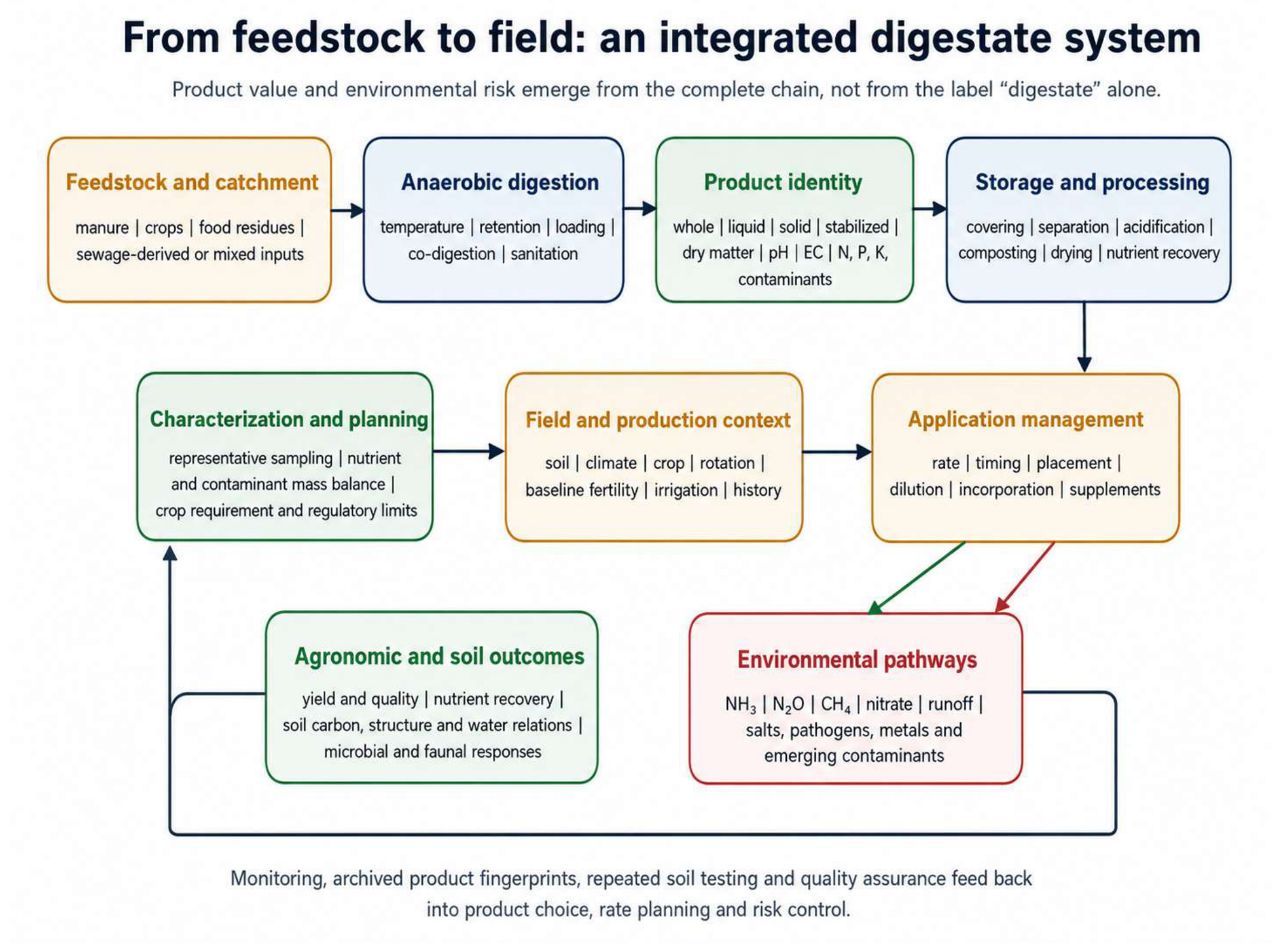
Figure 2.
Nutrient-equivalence framework for digestate comparisons. Equal fresh mass, total N, ammonium-N, estimated available N and recommended crop N answer different questions. Mineral-fertilizer formulation, complementary nutrients, product identity, site conditions and the time horizon of the comparison must be reported before fertilizer-replacement claims are generalized. Source: author-created.
Figure 2.
Nutrient-equivalence framework for digestate comparisons. Equal fresh mass, total N, ammonium-N, estimated available N and recommended crop N answer different questions. Mineral-fertilizer formulation, complementary nutrients, product identity, site conditions and the time horizon of the comparison must be reported before fertilizer-replacement claims are generalized. Source: author-created.
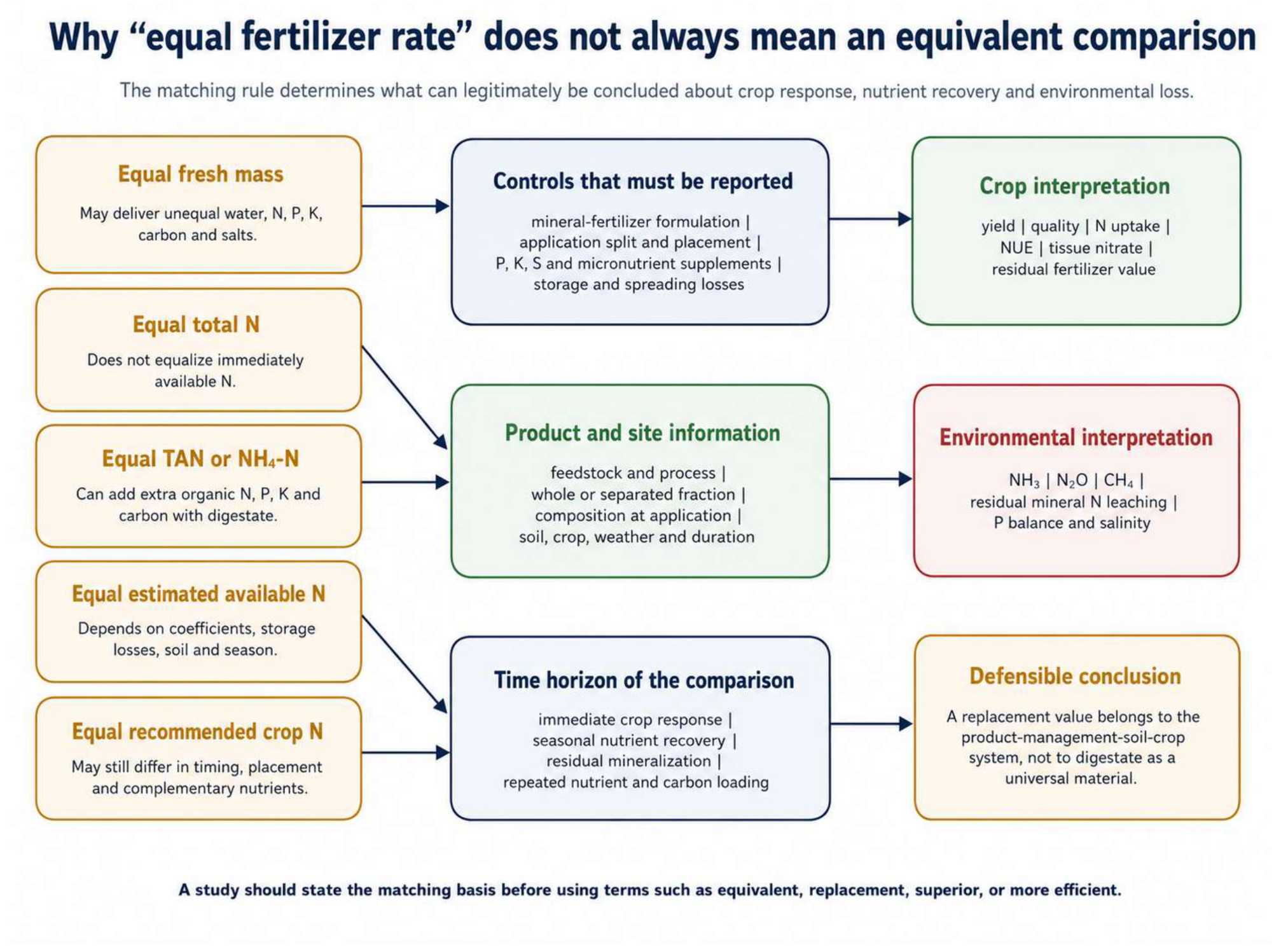
Figure 4.
Timescale of digestate responses and monitoring. Application contact, ammonia loss and acute ammonium or salt exposure occur over hours to days; nutrient transformation, crop uptake and seasonal emissions unfold over days to months; residual nutrients, repeated loading and many soil responses require seasons to years; and durable soil-carbon change, contaminant transfer and whole-system performance require multi-year evidence. Source: author-created.
Figure 4.
Timescale of digestate responses and monitoring. Application contact, ammonia loss and acute ammonium or salt exposure occur over hours to days; nutrient transformation, crop uptake and seasonal emissions unfold over days to months; residual nutrients, repeated loading and many soil responses require seasons to years; and durable soil-carbon change, contaminant transfer and whole-system performance require multi-year evidence. Source: author-created.
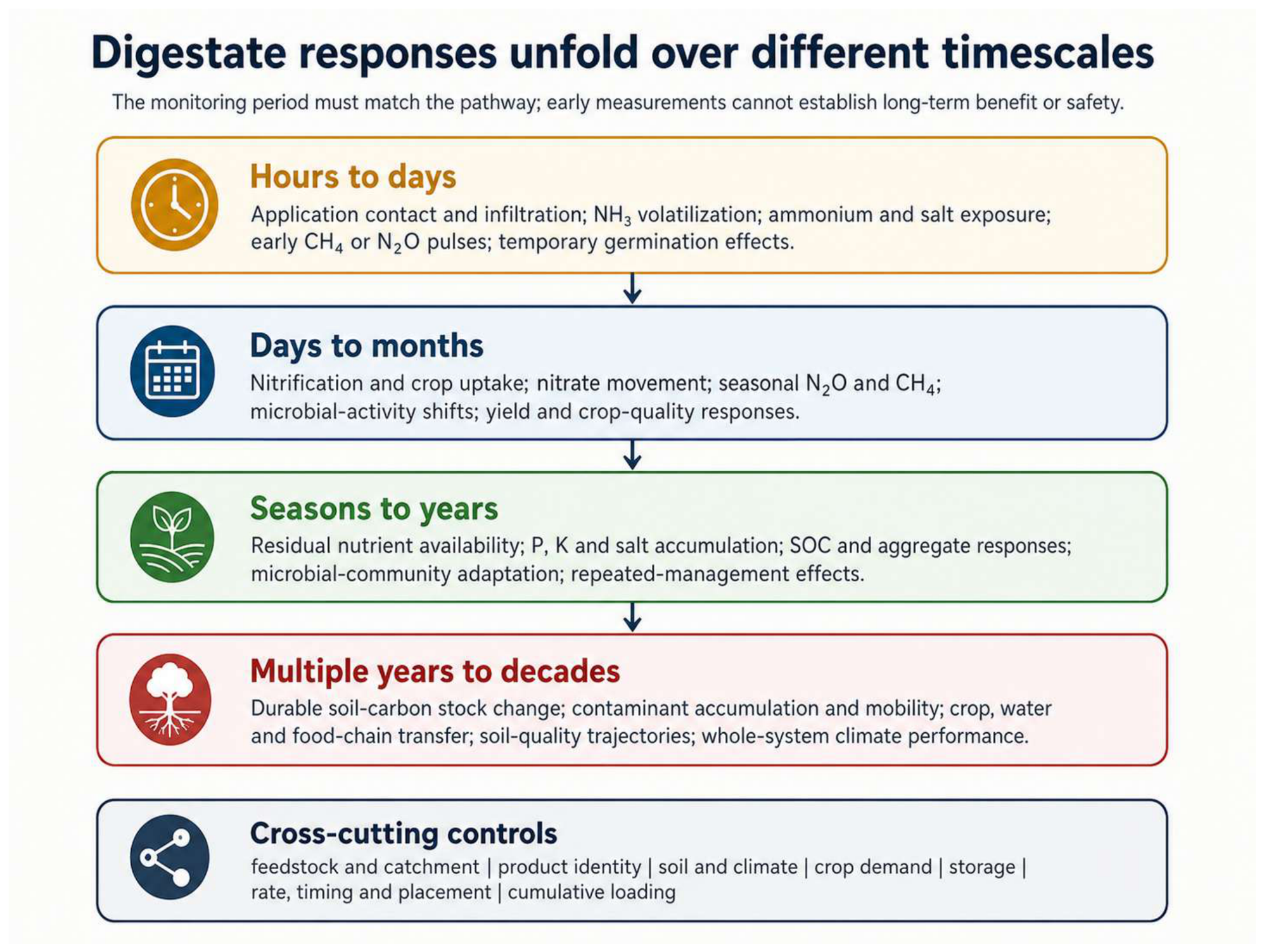
Table 1.
Verified crop-production, nitrogen-use, and crop-quality responses to digestate application.
Table 1.
Verified crop-production, nitrogen-use, and crop-quality responses to digestate application.
| Study | Design and duration | Crop/system | Digestate treatment | Comparator | Key crop result | NUE/quality or environmental note | Interpretive limitation | Ref. |
| Piccoli et al. (2025) | Two-year on-farm experiment across two farms (47 ha) | Winter wheat (Triticum aestivum L.) | Liquid digestate with nitrification inhibitor and/or variable-rate application; solid digestate | Mineral N programme: ammonium nitrate (26% N) in March and urea (46% N) in April; 40% and 60% of required N in two side-dressings | Digestate treatments achieved yields >5.9 t ha−1 and protein >5.3%; performance varied by farm | NUE: mineral fertilizer 69%, liquid digestate + inhibitor 43%, solid digestate 25%; VRA liquid digestate 49% | Digestate was applied once before tillage, whereas mineral N was split; NUE comparisons therefore combine formulation, timing, and placement effects | [86] |
| Rittl et al. (2023) | Ten-year field experiment | Perennial grass-clover ley and green fodder | Anaerobically digested organic dairy-cattle slurry at two rates | Untreated slurry and unfertilized control | Digested and untreated slurry produced similar long-term yields | AD treatment did not compromise crop productivity or measured chemical soil quality | High initial SOM declined in all plots; result does not show SOC gain | [83] |
| Sigdel et al. (2025) | Six field-scale corn-silage studies on commercial dairy farms, 2021-2023 | Corn silage (Zea mays L.) | Shallow-disk injection of liquid-separated dairy digestate | Surface application without incorporation | Pooled corn silage yield was 3.8% greater with injection | Surface application lost 58% more cumulative NH3 over 24 h; both treatments supplied abundant N | Placement result is specific to no-till commercial farms and 24-h emission measurement | [87] |
| Doyeni et al. (2021) | Three-year crop sequence | Spring wheat, triticale, and barley | Pig-, chicken-, and cattle-manure digestates, split applied | Synthetic N fertilizer, 170 kg N ha−1 split 90 + 80 kg N ha−1; chemical formulation not reported in the accessible full text | Digestate treatments produced equal or better grain performance in favorable years; third-year yields exceeded the mineral treatment | Digestate NUE was generally 20-25%; grain-quality responses were crop-specific | Rate was N-based, but missing mineral formulation limits mechanistic comparison | [101] |
| Petraitytė et al. (2022) | Two field experiments, 2018-2020 | Winter wheat on clay-loam Cambisol | Liquid digestate at N120 and N170-equivalent programs | Ammonium nitrate (344 g N kg−1; equal NH4-N and NO3-N), N120 or N120+50; basal N32P32K32 according to soil P and K status | Liquid organic fertilizers were effective in the favorable-moisture year | Residual mineral N and crop N accumulation depended on weather and extra N; additional N could increase unused N | Mineral N form, split and basal nutrients must be retained when interpreting replacement | [84] |
| Rakašćan et al. (2021) | Three-year field experiment | Sorghum (Sorghum bicolor L.) on calcic gleysol and chernozem | Digestate at 50 t ha−1 | Unamended soil | Digestate increased yield by 3.40%; maximum dry-matter yield was 41.74 t ha−1 on chernozem in 2018 | Response correlated with precipitation and soil fertility | Single high rate and two Serbian soils limit transferability | [17] |
| Lee et al. (2021) | Greenhouse experiment with several crop species | Vegetables and legumes in potting media | Increasing digestate concentration with or without biochar | Osmocote Plus controlled-release fertilizer 15-9-12 (5-6 month); some digestate treatments fortified with bone-meal P | Higher digestate potency increased growth and fruit production but generally less than conventional fertilizer | Kale antioxidant capacity, phenolics, and ascorbic acid increased in some treatments; legume nutrient responses were inconsistent | Treatments were not a nutrient-equivalent field replacement test; greenhouse container results are formulation-specific | [20] |
| Pastorelli et al. (2021) | Three-year maize-triticale rotation | Field crop rotation | Whole digestate plus mechanically separated solid fraction | Pre-sowing urea: control 125 kg N ha−1; D50 combined 62.5 kg urea-N + 62.5 kg digestate-N; D100 used digestate-N; triticale received urea | Crop yield under digestate treatment was similar to mineral-based fertilization | Soil C, N, and K increased; aggregate stability improved transiently | Three-year energy-crop system; shared urea and differing digestate shares must be considered | [102] |
| Brtnicky et al. (2022) | Six-week controlled pot experiment | Lettuce (Lactuca sativa L.) | Digestates from maize, broad bean, white lupine, and maize-legume mixtures | Unfertilized control | Maize-broad bean and maize-white-lupine digestates increased plant biomass by 14% and 33% relative to maize digestate | Feedstock composition altered respiration and enzyme activity | Pot study and fresh-matter rates require field validation | [76] |
| Hammerschmiedt et al. (2022) | Controlled pot experiment | Lettuce (Lactuca sativa L.) | Digestates from maize, legumes, and mixed cultures at 40 t ha−1 fresh-matter equivalent | Unamended control | All digestates significantly increased fresh and dry aboveground biomass and plant N | Different feedstocks produced distinct soil C, respiration, urease, and hydrolase responses | Short duration and high equivalent rate; no field-scale loss assessment | [104] |
| Zilio et al. (2023) | Three-year open-field maize plot trial | Maize | Stabilized sewage-sludge digestate and digestate-derived ammonium sulfate, mineral-N matched | Synthetic: granular urea pre-sowing + granular ammonium sulfate topdressing. Recovered: sewage-sludge digestate + digestate-derived ammonium sulfate | Plant and grain N contents and NH3 emissions were similar between recovered fertilizers and mineral fertilizer | No extra nitrate accumulation at 1 m; digestate treatments received 185 kg ha−1 additional organic N | Programmes were matched on readily plant-available ammonium-N, not total N; digestate supplied additional organic N | [96] |
Note: Study outcomes are context-specific and should be interpreted with the feedstock, application rate, soil, crop, duration, and comparator reported in the cited source.
Table 3.
Primary field and controlled evidence on soil organic carbon, physical properties, and nutrient responses to digestate.
Table 3.
Primary field and controlled evidence on soil organic carbon, physical properties, and nutrient responses to digestate.
| Study | Design/context | Digestate treatment | SOC/organic-matter result | Physical or nutrient result | Duration | Strength | Limitation/management implication | Ref. |
| Barłóg et al. (2020) | Randomized four-year field trial in clay-loam Orthic Luvisol | Digestate, digestate + straw, cattle slurry, mineral NPK | No significant treatment effect on SOC or total N; only upward trends under organic treatments | Digestate increased spring mineral N; cattle slurry increased available P; digestate + straw increased available K | 4 years | Direct multi-year comparison with full supplementary data | Straw moderated mineral N but did not create significant SOC gain within four years | [39] |
| Rittl et al. (2023) | Organic dairy field experiment in Norway | Digested vs untreated cattle slurry at different rates | SOM declined similarly in all treatments | Crop yields and chemical soil characteristics were similar for digested and untreated slurry | 10 years | Rare decadal field comparison | AD did not compromise soil quality, but digestate did not maintain high initial SOM | [83] |
| Villarino et al. (2025) | 421 soil samples from 14 commercial Iowa crop fields | Repeated farm digestate application | 86% of sampled points increased SOC; mean accrual 0.8 Mg ha−1 yr−1; estimated digestate-C formation efficiency 18% | Soil-test P and K increased; P doubled over 8 years and exceeded crop need in some fields | 5-12 years | Commercial-scale repeated-measure evidence plus isotopes | SOC gain accompanied by P-accumulation risk; no untreated randomized field control | [85] |
| Villarino et al. (2025) | 120-day incubation of Iowa loamy and sandy soils | Anaerobic digestate solids at 0, 2.5, 5, and 10 Mg C ha−1 | Increasing rate raised net C balance and caused negative SOC priming (mean -78%) | Dissolved reactive P increased while extractable N decreased; medium rate projected greater C gain in sandy soil | 120 days | Isotopic partitioning of amendment- and soil-derived CO2 | Laboratory projections are not field stock measurements; temporary N immobilization matters | [95] |
| Koch et al. (2024) | Sandy soil with long-term digestate treatment; dye tracing and X-ray CT | Biogas digestate-amended vs control profiles | Topsoil organic C increased | Macropore fraction and tortuosity increased; homogeneous matrix flow declined; preferential flow and water repellency increased; pH declined | Long-term field history, one plot per treatment | Detailed structural and flow-path analysis | Single plot prevented statistical attribution; improved OM can coexist with preferential-flow risk | [94] |
| Greenberg et al. (2019) | Temperate sandy Cambisol field experiment sampled after 4 years | Digestate/biochar treatments compared with mineral N (urea + ammonium in 2012; urea + ammonium + nitrate in 2013); 2014 comparator changed to a low-C liquid organic fertilizer | 40 Mg biochar ha−1 increased SOC in all fractions; fertilizer type did not affect SOC | Biochar increased small macroaggregates but did not consistently improve CEC, WHC, or pH | 4 years | Field factorial comparison | Treatments received equal total N, but the comparator changed across years; no special digestate-biochar synergy should be inferred | [36] |
| Pastorelli et al. (2021) | Three-year maize-triticale field rotation | Whole digestate and separated solid fraction | Total organic C and total N increased | Bulk density unchanged; aggregate stability improved transiently; transmission pores decreased and fissures increased | 3 years | Integrated physical, chemical, microbial, and crop measures | Physical responses were mixed rather than uniformly beneficial | [102] |
| Rolka et al. (2024) | Corn pot experiment with N-balanced liquid and solid fractions | Increasing liquid or solid digestate doses | Liquid fraction increased total C and N; solid fraction did not produce the same C:N response | Both forms raised pH and EC and altered available nutrients; total Cu, Cr, Pb, and Ni increased but remained below the limits applied in that study and jurisdiction | Single crop pot study | Detailed fraction-specific soil chemistry | Short duration; cumulative metal and salinity effects require field monitoring | [21] |
| Maliki et al. (2020) | Three-kilogram soil incubations amended with rubber-processing-effluent digestate | 0, 200, 400, or 600 mL digestate per soil unit | Soil organic C increased relative to control | N, P, K, Ca, Na, and base saturation increased; exchangeable acidity declined | 8 weeks | African feedstock and acidic-soil evidence | Laboratory-scale dose units cannot be converted directly into field recommendations | [41] |
| Cucina et al. (2025, 2026; same field platform) | Three approximately 900 m2 plots in a degraded Colombian Inceptisol; repeated sampling over 12 months | Psychrophilic pig-slurry digestate; cumulative 40 Mg dry matter ha−1 over 4 months | TOC increased from 1.9% to 3%; stable and recalcitrant C pools also increased | pH rose from 5.3 to 6; N, available P, exchangeable bases, biochemical indicators, and microbial biomarkers increased | 4-month application plus 8-month follow-up | Primary field time series with companion chemical and microbial analyses | No randomized contemporaneous control; no crop; one site; high rate. The two papers describe one experiment | [40,115] |
Note: Study outcomes are context-specific and should be interpreted with the feedstock, application rate, soil, crop, duration, and comparator reported in the cited source.
Table 6.
Verified ammonia, nitrous-oxide, methane, and whole-system emission evidence.
| Study/process | Design and conditions | Verified finding | Main controls | Comparator or trade-off | Management implication | Boundary/limitation | Evidence type | Ref. |
| Review synthesis: Pedersen & Hafner (2023): NH3 | Systematic review of field-applied digested animal slurry; 119 observations in the compiled dataset | No consistent overall difference between digestate and undigested slurry | Digestion generally lowers dry matter but raises pH; these effects oppose each other | Feedstock co-substrates can produce high-DM, high-viscosity digestates with greater risk | Measure DM, pH, TAN, viscosity, soil, weather, and application method; do not use a universal emission factor | Available field evidence was sparse and variable | Systematic review | [7] |
| Sigdel et al. (2025): NH3 and yield | Six field-scale commercial dairy-farm studies | Surface-applied liquid digestate lost twice as much NH3 during the first 6 h and 58% more cumulatively over 24 h than injection | Placement below the surface and rapid soil retention of NH4+ | Injection increased pooled corn-silage yield by 3.8% | Shallow injection can conserve N on suitable no-till fields | Only 24-h NH3 window; high N supply in both treatments | Primary field study | [87] |
| Häfner et al. (2021): N2O source | Field experiment with 15N-labelled digestates | A large share of N2O-N came from the native soil N pool; digestate composition had minor short-term effects on denitrification relative to weather and soil | Soil N status, precipitation, texture, amendment history, and moisture | Emission factors were mostly comparable among digestates | Synchronize application with crop uptake and account for soil mineral N | Bare-soil design and 60-day measurement do not represent annual cropped-field emissions | Primary field isotope study | [88] |
| Liao et al. (2020): NH3-N2O-CH4 trade-off | Incubation of vegetable, wheat-maize, and orchard soils at 40, 60, and 80% WFPS; surface vs incorporation | Surface application produced more NH3 and CH4 but less N2O than incorporation; emissions increased strongly with moisture | Cropping history, soil moisture, and placement | Incorporation offset NH3/CH4 benefits only under relatively dry conditions | Avoid incorporation or irrigation-based application into wet soil; consider cropping system | Laboratory cores, not field-scale machinery | Primary incubation | [89] |
| Petrova et al. (2021): processed products | Field and incubation tests of raw, separated, dried, pelletized, and concentrated products | Organic-matter composition was more informative than ammoniacal N alone; pellets produced much greater N2O than separated solid | Degradable C, O2 consumption, nitrification, denitrification, product geometry | Processing improved handling but could worsen field N2O | Assess processing, storage, and field application as one value chain | Year effects were strong; not every product followed the same order | Primary field/incubation | [90] |
| Efosa et al. (2023): multi-year N2O/CH4 | Multi-year field applications; digestates and liquid organic fertilizers compared with granular ammonium sulfate at similar total-N rates; supplemental P/K used where required | Digestates did not increase N2O relative to cattle slurry or mineral fertilizer; low-rate biochar did not reduce N2O and caused short CH4 pulses after spreading | Management history, ley termination, soil nitrate, moisture, temperature | Mineral comparator was granular ammonium sulfate; total-N matching did not make organic-C supply or nutrient form equivalent | Target high soil-N situations and include CH4 when biochar is added to liquid fertilizer | Low biochar rate did not reduce N2O and produced short CH4 pulses; do not generalize biochar mitigation | Primary long-term field study | [91] |
| Rosace et al. (2020): legacy effects | 64-day pot experiment using soils with different prior amendments | Previous management was a key determinant of CO2 and N2O; texture was more important for CH4 | Legacy of farmyard manure, green manure, or synthetic N; soil texture | Current soil properties alone did not predict flux response | Record amendment history when predicting emissions | Pot experiment and one digestate dose | Primary experiment | [92] |
| Zilio et al. (2023): N fate | Full-field sugar-beet system: synthetic granular urea + ammonium sulfate versus sewage-sludge digestate + digestate-derived ammonium sulfate | No greater nitrate at 1 m or NH3 than mineral fertilizer; N2O was numerically lower but not significantly different under recovered fertilizers | Stabilized product chemistry, crop uptake, denitrification, soil retention | Treatments matched on readily plant-available ammonium-N; digestate supplied extra organic N | Include organic N and denitrification in N balances rather than assuming leaching | One crop cycle and site; comparable N losses do not establish universal equivalence | Primary field study | [96] |
| Angouria-Tsorochidou et al. (2022): whole-system burdens | LCA of direct, separated, and advanced-treated digestate | Direct spreading had lower modeled global-warming burden in the studied scenarios, while advanced processing reduced terrestrial acidification and improved transportability | Energy, chemicals, transport, fertilizer substitution, field emissions | Advanced recovery shifts burdens rather than eliminating them | Choose technology using local nutrient surplus and distance, not recovery percentage alone | Model results depend on functional unit and assumptions | Life-cycle assessment | [99] |
Note: Study outcomes are context-specific and should be interpreted with the feedstock, application rate, soil, crop, duration, and comparator reported in the cited source.
Disclaimer/Publisher’s Note: The statements, opinions and data contained in all publications are solely those of the individual author(s) and contributor(s) and not of MDPI and/or the editor(s). MDPI and/or the editor(s) disclaim responsibility for any injury to people or property resulting from any ideas, methods, instructions or products referred to in the content. |
© 2026 by the author. Licensee MDPI, Basel, Switzerland. This article is an open access article distributed under the terms and conditions of the Creative Commons Attribution (CC BY) license.
Copyright: This open access article is published under a Creative Commons CC BY 4.0 license, which permit the free download, distribution, and reuse, provided that the author and preprint are cited in any reuse.