

Submitted:
08 August 2025
Posted:
11 August 2025
You are already at the latest version
Abstract
Accurate household electricity load forecasting is becoming increasingly vital with the continued growth of smart grids, household renewable energy systems, and smart meter deployment. Unlike regional or grid load forecasting, household-level forecasting presents unique challenges due to highly irregular consumption patterns, data scarcity, privacy concerns, and behavioral variability. In recent years, artificial intelligence (AI) methods have demonstrated strong potential to address these complexities, enabling more accurate, robust, and adaptive forecasting systems. This survey presents a comprehensive and up-to-date review, with a focus on AI-based techniques specifically tailored to household-level forecasting. A key contribution of this work is the development of a challengecentered taxonomy that categorizes methods based on four critical problem domains: methodological limitations, data-related constraints, behavioral complexity, and privacy and security concerns. By aligning representative AI approaches with these core challenges, the survey offers a structured and insightful understanding of the current research landscape. It also provides a comparative analysis with prior surveys, identifies gaps in the literature, and highlights promising research directions, including multimodal learning, adaptive modeling, integration of large language models, and privacypreserving forecasting. This work could serve as a valuable resource for researchers and practitioners aiming to advance intelligent and trustworthy forecasting solutions in household energy systems.
Keywords:
household load forecasting
; load forecasting
; artificial intelligence
; deep learning
1. Introduction
1.1. Background and Motivation
The transition toward smart grids, the integration of distributed renewable energy sources, and the widespread adoption of smart meters have significantly increased the demand for accurate household electricity load forecasting [1]. Although research has been conducted on regional or system-level load prediction, forecasting at the individual household level presents distinct and persistent challenges. Household electricity consumption is primarily influenced by human behavior, which introduces a high degree of irregularity and unpredictability into usage patterns [2]. Unlike system-level forecasts, where consumption trends often align with macro-level factors such as temperature or time-of-day, household profiles are shaped by individual routines, lifestyle choices, and appliance-level activity [3]. These behavioral complexities are further exacerbated by practical limitations in data availability [4]. In many regions, smart meter deployment remains incomplete, and even where such infrastructure exists, access to high-resolution data is constrained by privacy regulations. Legal frameworks such as the General Data Protection Regulation1 in the European Union and the Consumer Data Right2 in Australia impose strict controls on the collection, use, and sharing of energy consumption data. Consequently, household-level forecasting models generally suffer from conditions of data sparsity, noise, and limited contextual information [5]. Traditional statistical forecasting methods, which typically rely on assumptions of linearity and stationarity, struggle to capture the dynamic, nonlinear, and context-dependent nature of household electricity consumption.
Despite these challenges, accurate household load forecasting is increasingly critical for a range of applications in modern energy systems [6]. In household settings with solar photovoltaic systems and battery storage, reliable forecasts support the optimization of storage operations and the maximization of self-consumption. Load forecasting also enables households to reduce demand charges through strategic peak shaving, helping to minimize costs without compromising occupant comfort [7]. Additionally, precise load predictions play a key role in the implementation of dynamic pricing schemes and demand response programs, providing financial incentives for consumers while enhancing the operational efficiency of the grid [8].
In response to these growing demands, Artificial Intelligence (AI) methods have gained significant traction in household load forecasting [5,9]. Deep learning architectures such as Recurrent Neural Networks (RNNs), Convolutional Neural Networks (CNNs), and Transformers have demonstrated strong capabilities in capturing long- and short-term temporal dependencies, extracting latent features, and accommodating diverse and multimodal inputs [10,11]. Graph Neural Networks (GNNs) have expanded the modeling capabilities by incorporating spatial and relational information across households and devices [12,13]. Reinforcement Learning frameworks offer dynamic, feedback-driven adaptation to evolving energy behaviors [14], while Transfer Learning and few-shot learning approaches facilitate model generalization in data-scarce environments [15,16]. Collectively, these methods represent a shift toward AI-native solutions that aim to provide robust, scalable, and personalized forecasting for the household sector.
As the field of household load forecasting continues to evolve rapidly, there is a growing need to synthesize the expanding body of research, clarify the contributions of recent studies, and critically examine methodological advances within a structured analytical framework. Although several surveys on load forecasting have emerged in recent years, few offer a systematic and focused analysis of AI-driven techniques tailored specifically to the household level [2,17]. This survey addresses that gap by presenting a comprehensive, challenge-oriented review of recent developments in household load forecasting. The literature is organized around the key challenges facing the field, with an emphasis on how various AI methods are employed to address specific forecasting limitations. By adopting this structure, the survey aims to provide critical insights into current trends, highlight unresolved issues, and identify future research directions in this increasingly vital area of smart energy systems.
1.2. Comparison with Related Surveys
Table 1 presents a comparative analysis of related surveys [1,2,5,9,17] alongside this work. The comparison highlights the scope, limitations, and thematic coverage of each study in relation to the core challenges addressed in this review. Most existing surveys focus primarily on studies involving RNNs and CNNs, often neglecting recent advances in cutting-edge AI techniques and lacking a structured, challenge-oriented synthesis. As summarized in Table 1, few surveys provide a comprehensive coverage of the four key challenge categories in household load forecasting: (1) methodological limitations of traditional models, (2) data-related issues, (3) complexity of consumption patterns, and (4) privacy and security concerns. Moreover, many of these surveys fail to study emerging model architectures and novel learning paradigms that are increasingly relevant to addressing these challenges. In contrast, this survey explicitly structures the discussion around these four interconnected challenges and systematically maps state-of-the-art AI techniques, such as GNN, Transformer, Transfer Learning, Reinforcement Learning, generative models, and Federated Learning, onto their corresponding problem domains. Notably, recent developments in Large Language Models (LLMs), intelligent agents, few-shot learning, and privacy-preserving AI are covered in this work but absent from prior reviews.
To the best of our knowledge, there is no comprehensive survey that organizes AI-based household load forecasting techniques around the core methodological, data-related, behavioral, and privacy/security challenges that define this emerging research frontier. Overall, this survey features itself by providing a comprehensive, challenge-centered taxonomy (shown in Figure 1) of AI-driven household load forecasting methods. It not only bridges the thematic gaps in prior literature but also offers a forward-looking perspective to guide future research and practical deployment of intelligent household forecasting systems.
1.3. Taxonomy and Main Contributions
This work aims to fill these gaps by presenting a comprehensive, challenge-oriented survey of recent advances in AI-driven household load forecasting. As shown in Figure 1, a key contribution of this work is the development of a structured taxonomy that organizes AI-driven household load forecasting methods based on four major challenges: methodological limitations of traditional models, data-related constraints, behavioral complexity in consumption patterns, and privacy and security concerns. In contrast to previous surveys that typically categorize methods based on architectures such as RNNs or CNNs, this taxonomy adopts a problem-centered perspective, aligning representative AI techniques with the specific challenges they are designed to address. This approach enhances the clarity of how advanced AI architectures and learning paradigms, including GNN, Transformer, Transfer Learning, generative models, Few-shot Learning, LLM, intelligent agent, and privacy-preserving AI, are applied in real-world forecasting contexts. By mapping techniques to challenges, the taxonomy supports more systematic comparison, helps identify research gaps, and provides a foundation for advancing the development of effective and practical forecasting solutions for individual households.
The main contributions of this work are summarized as follows:
- It introduces a well-designed, challenge-centered taxonomy that organizes AI-based forecasting methods according to four major challenges in household load forecasting: methodological limitations, data-related constraints, behavioral complexity, and privacy and security concerns. This taxonomy offers a problem-driven perspective that enhances the interpretability and practical relevance of existing methods.
- It provides a comprehensive and up-to-date review of AI-based household load forecasting methods, covering a wide range of AI architectures and learning paradigms, including GNN, Transformer, generative AI, Transfer Learning, Reinforcement Learning, Few-shot Learning, Federated Learning, privacy-preserving AI, LLM and intelligent agent.
- It presents critical insights into current approaches within each challenge domain, thereby offering practical guidance for researchers and practitioners in selecting suitable methods.
- It outlines several forward-looking research directions, including multimodal data integration, behavior-aware and uncertainty-aware modeling, adaptive and continual learning, integration of LLM, explainable AI, and real-time edge deployment. These directions may advance the development of intelligent, secure, and user-centered forecasting systems for household energy applications.
1.4. Outline
This survey is organized around four major challenges in household load forecasting. Section 2 discusses the methodological limitations of traditional forecasting approaches and presents related AI-based solutions. Section 3 addresses data-related issues, including scarcity, noise, and low temporal granularity, and reviews techniques like Transfer Learning, Few-Shot Learning, and generative models. Section 4 explores the complexity of consumption patterns driven by human behavior, highlighting methods that incorporate behavioral modeling, attention mechanisms, and hybrid architectures. Section 5 focuses on privacy and security concerns and examines Federated Learning, differential privacy, and cryptographic AI. Section 6 outlines potential research opportunities and emerging directions for advancing the field. Finally, Section 7 concludes the review with a synthesis of insights and reflections on the path forward.
2. Challenge-I: Methodological Limitations
This section introduces the first major challenge in household load forecasting and reviews corresponding AI-driven solutions. Specifically, Section 2.1 examines the methodological limitations of traditional forecasting approaches. Section 2.2 reviews a diverse set of AI-based forecasting techniques, with an emphasis on recent advances in model architectures and learning paradigms that improve adaptability and predictive accuracy in complex household energy environments.
2.1. Limitations of Traditional Forecasting Methods
Household load forecasting refers to the task of predicting future electricity consumption for individual residential users over a specified time horizon, using historical load data and potentially auxiliary information. Formally, given a sequence of past power consumption observations , the goal is to estimate future consumption values , where k denotes the forecasting horizon. Forecasts can be generated at varying temporal resolutions (e.g., hourly, daily) and for different lead times (e.g., day-ahead, real-time). Unlike aggregated or regional forecasting, household-level load forecasting presents unique challenges due to high volatility, low predictability, and strong dependence on individual behaviors, occupancy patterns, appliance usage, and contextual factors such as weather or holidays.
Traditional statistical methods have long served as foundational tools for load forecasting due to their interpretability and low computational requirements. The most commonly adopted models include Autoregressive Integrated Moving Average (ARIMA) [18], Seasonal ARIMA (SARIMA), and their exogenous variants such as ARIMAX [19] and SARIMAX [20]. These models assume stationarity and rely on linear correlations within the time series data, which make them suitable for capturing periodic patterns and short-term trends under relatively stable conditions.
However, their effectiveness diminishes in the face of modern challenges in household energy consumption, such as non-stationary behavior, irregular appliance usage, integration of rooftop solar PV, and prosumers’ stochastic behaviors. Such variability, compounded by prosumer behaviors and dynamic appliance usage, fundamentally violates the stationarity assumptions upon which traditional models are built [21]. In this context, ARIMA-based models exhibit poor adaptability and limited generalizability. Empirical evidence further highlights these limitations. For instance, Chatuanramtharnghaka et al. [22] demonstrate that SARIMAX performs well in controlled environments for day-ahead forecasting. However, its performance deteriorates significantly during periods of peak demand, which is problematic for applications requiring high-resolution accuracy. Manual tuning of model parameters through grid search becomes computationally expensive and infeasible at the household level. Furthermore, SARIMAX’s reliance on linear differencing and rigid seasonal cycles prevents it from capturing irregular consumption patterns, such as ad hoc appliance activity or bidirectional energy flows in prosumer scenarios. Comparative studies consistently show that ARIMA and SARIMA underperform neural networks in sub-hourly household forecasting tasks, underscoring their limited capacity to model nonlinear temporal dependencies [23].
Regression-based approaches, although computationally efficient and theoretically capable of probabilistic output, also exhibit major drawbacks. For example, Gaussian Process Regression introduces uncertainty quantification via kernel methods but suffers from high computational complexity, rendering it impractical for real-time deployment on large-scale household datasets [24]. Moreover, the linearity embedded in conventional regression models restricts their ability to capture hierarchical or synergistic interactions. A typical example is the combined influence of ambient temperature and humidity on cooling load, which linear models often misrepresent [22]. A further limitation lies in the absence of inherent feature selection in traditional regression models [25]. Unlike modern techniques such as minimum redundancy maximum relevance, which automatically identify salient input variables, classical approaches rely on manual selection. This often leads to the inclusion of irrelevant or redundant features, thereby degrading model performance in the presence of noise or irregular behavior.
2.2. AI Solutions Addressing Methodological Limitations
Recent evidence suggests that AI-based approaches have demonstrated advantages over traditional methods in household load forecasting scenarios. This section presents a systematic review of AI-based forecasting techniques developed to address the methodological limitations of traditional models. It highlights recent advances in various AI model architectures and learning paradiagms, as summarized in Table 2.
2.2.1. Recurrent Neural Networks (RNNs)
RNNs, particularly Long Short-Term Memory (LSTM) and Bidirectional LSTM (BiLSTM) variants, have emerged as promising solutions for household load forecasting. Unlike ARIMA-based and regression models, which rely on stationarity assumptions and linear relationships, RNNs are explicitly designed to capture nonlinear and long-range temporal dependencies within sequential data [26]. RNNs incorporate memory cells that capture both short- and long-range temporal relationships, making them well-suited to handle the non-stationarity and dynamic variability inherent in household electricity usage, as shown in Figure 2.
Several studies have demonstrated the superior performance of RNN-based models in this domain. [27] developed an LSTM-based model to improve short-term household load forecasting accuracy. Their results highlight the advantage of RNNs in integrating exogenous variables and modeling context-sensitive patterns, which traditional models struggle to represent. [28] also demonstrated that LSTM networks significantly outperform ARIMA models in terms of forecasting accuracy, particularly in households with high consumption variability. Several studies have proposed architectural enhancements to further improve RNN performance. [29] fused LSTM with a self-attention mechanism and pooling layers, enabling the model to better identify salient temporal features and adapt to fluctuations in load profiles. Similarly, [30] introduced an interpretable LSTM model based on a mixture attention mechanism, which enhances forecasting transparency while maintaining strong predictive performance.
To address multi-step forecasting and sequence dependencies, [31] applied a Seq2Seq LSTM model combined with time-series clustering, effectively modeling long-term dependencies in single-household scenarios. [32] compared BiLSTM and CNN-BiLSTM architectures, demonstrating that bidirectional information flow and convolutional feature extraction improve short-term load prediction under variable temporal conditions. [33] extended the utility of BiLSTM networks by incorporating time-based embeddings, capturing periodic patterns and enhancing the model’s ability to learn temporal hierarchies from sparse and irregular consumption data.
Summary. RNN-based models offer significant advantages over traditional forecasting methods by addressing key limitations in temporal modeling, predictive flexibility, and context-awareness. Their effectiveness stems from the following capabilities:
- Nonlinear sequence modeling: Enabling the learning of complex temporal dependencies.
- Multi-step forecasting: Supporting long-range and rolling predictions with improved accuracy.
- Context integration: Incorporating exogenous variables such as weather and occupancy in a flexible manner.
These capabilities make RNN-based architectures a robust choice for accurate and scalable household load forecasting in dynamic energy environments.
2.2.2. Graph Neural Networks (GNNs)
Traditional forecasting methods, including ARIMA and regression models, operate under the assumption of temporal independence across households and often neglect the spatial or relational dependencies that exist in real-world residential environments. In practice, however, the electricity consumption of individual households is not isolated. It is influenced by spatially correlated factors such as neighborhood demographics, urban density, and shared infrastructure. These interdependencies can propagate across the residential network, affecting consumption patterns and forecasting accuracy. To address this limitation, GNN-based methods have been studied as an effective solution that explicitly models spatial-temporal relationships. GNNs represent household load forecasting problems as graphs, where nodes correspond to individual households and edges encode spatial, temporal, or functional similarities. By performing message passing over the graph structure, GNNs enable localized feature aggregation, allowing the model to capture mutual influences among neighboring households. This mechanism helps reveal relational information that traditional time series and regression models are unable to model.
[12] pioneered a spatial-temporal GNN for short-term household load forecasting by constructing a spatial graph based on distance and correlation among households. Their model outperformed both ARIMA-type baselines and deep sequence models, particularly in capturing cross-household influence. Extending this, [34] introduced a multiple correlation-temporal GNN to dynamically learn graph structures based on multiple similarity measures, which improved adaptability and forecasting accuracy in heterogeneous settings. A similar approach was taken by [35] who developed a framework combining transfer learning with GNNs to enable knowledge reuse from data-rich areas to data-sparse regions, addressing scalability limitations. GNNs can combine with recurrent units to better capture sequential patterns. [13] proposed a graph convolutional recurrent neural network, which integrates GNN layers with gated recurrent units to jointly learn spatial-temporal patterns. These hybrid designs show superior performance in dynamically changing environments compared to isolated GNN or RNN models.
Summary. GNN-based forecasting frameworks overcome the key limitations of traditional methods by:
- Explicit spatial encoding: Capturing structured spatial relationships among households or regions.
- Spatiotemporal joint learning: Simultaneously modeling both spatial correlations and temporal dependencies.
- Adaptive modeling capability: Dynamically handling nonlinear and non-stationary load behaviors.
These advancements position GNNs as a robust foundation for next-generation household load forecasting systems in the face of increasing complexity and decentralization.
2.2.3. Convolutional Neural Networks (CNNs)
CNNs, though originally developed for image processing, have proven highly effective in time-series forecasting due to their ability to extract multi-scale features and localized patterns through convolutional filters. CNNs are particularly useful in identifying periodicity, sudden load transitions, and localized temporal dependencies in high-resolution household energy data.
[36] introduced a CNN-based framework for modeling the joint influence of temperature and past consumption on future residential loads. The model effectively captured nonlinear interactions between temperature fluctuations and consumption spikes, outperforming linear regression and ARIMA models in both accuracy and robustness. [37] further advanced this approach by implementing a CNN-based sequence-to-sequence model with attention mechanisms, enhancing the model’s ability to identify salient time windows and improve multi-step forecasting performance.
Hybrid CNN architectures have also emerged to enhance the temporal modeling capabilities of pure CNNs. For instance, [38] developed a hybrid model combining CNNs and Gated Recurrent Units (GRUs) for probabilistic load forecasting across various building types. The convolutional layers extract spatial and temporal features, while GRUs capture sequential dependencies, resulting in superior accuracy and uncertainty estimation. Similar hybrid designs are explored by [39] and [40], demonstrating the flexibility of CNNs when integrated with recurrent structures.
Incorporation of attention mechanisms and optimization techniques further boosts CNN performance. [41] proposed a CNN-ICPSO-LSTM model, in which CNNs perform initial feature extraction, while attention-enhanced LSTMs handle long-term temporal patterns, and an improved particle swarm optimizer fine-tunes hyperparameters. Likewise, [42] combined CNNs with LSTMs, mode decomposition, and autoencoders to extract hierarchical features and denoise input data, effectively enhancing forecasting stability and robustness.
Summary. CNN-based models overcome traditional limitations through:
- Localized pattern recognition: Convolutional filters efficiently detect short-term spikes and recurring patterns.
- Hybrid flexibility: CNNs can be seamlessly integrated with other model architectures and learning paradigms.
- Multivariate input modeling: Effective in processing multi-dimensional inputs like temperature, time-of-use, and occupancy.
These advantages make CNNs a compelling building block for modern household load forecasting systems, especially in scenarios requiring high temporal granularity and model adaptability.
2.2.4. Transformer-Based Models
Traditional forecasting methods, including ARIMA and regression-based approaches, struggle to capture long-term temporal dependencies and adapt to the highly dynamic, irregular patterns of household electricity consumption. Transformer-based models offer a more powerful and scalable alternative by leveraging attention mechanisms that enable the model to learn temporal relationships without relying on recurrence [43]. Transformers, originally developed for natural language processing tasks, operate through self-attention mechanisms that assign dynamic weights to input elements across the entire sequence. This allows them to directly model interactions between any pair of time steps, regardless of their distance. In the context of household load forecasting, this capacity enables Transformers to effectively learn from complex and irregular consumption patterns, periodicities, and contextual features without being constrained by fixed memory windows or sequential bottlenecks.
Recent studies have demonstrated the efficacy of Transformers in household load forecasting tasks. [44] applied a deep-autoformer architecture to very short-term household load forecasting, demonstrating that self-attention and auto-correlation mechanisms significantly improve the model’s ability to capture both global trends and periodic behaviors. Similarly, [45] introduced a Temporal Fusion Transformer combined with Variational Mode Decomposition to handle nonstationary and high-frequency load components, achieving superior accuracy over traditional models in multivariate scenarios.
Transformer models have also been enhanced with spatial capabilities to address cross-household interactions. For instance, [46] proposed a spatial and temporal attention-enabled transformer that dynamically adjusts attention weights across both dimensions. This dual-attention mechanism allowed the model to better capture consumption co-dependencies among neighboring households. Extending this work, [11] incorporated a graph attention module into the transformer to explicitly represent topological relationships, yielding improved performance in highly interconnected smart grid environments.
In addition to deterministic forecasts, Transformer-based models have also been adapted for probabilistic forecasting. [47] introduced an interpretable Transformer architecture that outputs probabilistic residential net load forecasts, thus providing uncertainty estimates that are critical for operational decision-making and demand-side management.
Summary. Transformer-based approaches overcome the key limitations of traditional methods by:
- Modeling long-range dependencies: Self-attention mechanisms enable effective learning over extended temporal horizons.
- Multi-context integration: Flexible architectures allow the seamless inclusion of spatial, exogenous, and hierarchical inputs.
- Nonlinearity and nonstationarity: Advanced modules such as Variational Mode Decomposition and auto-correlation enhance robustness under real-world variability.
- Probabilistic forecasting: Transformer variants provide well-calibrated uncertainty estimates, aiding risk-aware grid operations.
These advancements position Transformer-based models as a leading paradigm for accurate, interpretable, and scalable residential load forecasting in next-generation energy systems.
2.2.5. Transfer Learning
Traditional forecasting models often require large volumes of high-quality data and extensive manual feature engineering to generalize effectively across residential settings. However, in real-world scenarios, many households have limited historical records, missing values, or variable sampling rates, which poses significant challenges for classical models such as ARIMA or linear regression. These limitations hinder model scalability and reduce forecasting accuracy, especially for households with insufficient training data. Transfer Learning has emerged as a promising strategy to overcome these limitations by leveraging knowledge from previously learned tasks or domains and applying it to target domains with limited data. In household load forecasting, Transfer Learning allows models trained on data-rich households or regions to generalize effectively to data-scarce or newly deployed smart meters, thereby reducing the need for extensive retraining and data collection.
[35] proposed a Transfer Learning framework that transfers learned representations between residential communities. Their results demonstrated improved forecasting accuracy in data-sparse scenarios, highlighting the utility of graph-based priors in cross-domain transfer. Similarly, [48] introduced a similarity-centred architecture evolution approach that aligns source and target tasks based on structural similarities, achieving high adaptability across households with varying consumption behaviors. [49] developed a hybrid deep Transfer Learning method combining convolutional feature extractors with fully connected adaptation layers. This framework enabled energy consumption knowledge transfer across commercial and residential buildings, showing robustness to domain shifts such as seasonal variation and occupant diversity. [15] further extended this concept into a federated setting, where Transfer Learning was used to enhance forecasting across decentralized households without data sharing, thus addressing privacy concerns.
Transfer Learning is also effective in handling anomalous events and distributional shifts. [50] incorporated Gaussian Process uncertainty modeling into a Transfer Learning architecture, enabling the model to adapt to rare consumption events and maintain reliable probabilistic forecasts under anomalies.
Summary. Transfer Learning addresses key shortcomings of traditional models through:
- Cross-domain generalization: Enabling forecasting in data-scarce households via knowledge reuse;
- Adaptability: Supporting fast adaptation to new households or consumption patterns;
- Efficiency: Reducing training costs by avoiding full model retraining;
- Robustness: Handling distributional shifts, seasonal variation, and anomalous events.
These advantages position Transfer Learning as a critical enabler for scalable and resilient residential load forecasting systems.
2.2.6. Reinforcement Learning
Traditional statistical methods and supervised learning models typically rely on fixed datasets and static optimization objectives. These approaches assume that historical patterns are sufficient to predict future consumption, and they often disregard the interactive and dynamic nature of energy systems. In contrast, Reinforcement Learning and its deep variants introduce a fundamentally different approach by framing the forecasting task within a decision-making paradigm. In Reinforcement Learning, agents learn to make predictions or scheduling decisions by interacting with an environment, receiving feedback through reward signals. This active learning framework enables continuous adaptation to evolve household behaviors, supports goal-oriented optimization, and aligns forecasting with energy management objectives.
Recent studies have shown that Reinforcement Learning can improve forecasting performance and operational flexibility. [51] proposed an online short-term load forecasting strategy based on Reinforcement Learning, wherein the model continuously updates its policy to improve real-time forecasting accuracy. The system demonstrated superior adaptability under non-stationary conditions and frequent load profile changes. Similarly, [52] utilized deep Reinforcement Learning to jointly optimize load forecasting and household multi-energy system scheduling. Their approach allowed the system to learn cost-efficient and accurate prediction strategies, outperforming traditional models in dynamic environments. [53] combined sequence-to-sequence forecasting with Q-learning, demonstrating that reinforcement-based strategies can improve predictive stability while enabling interaction-aware forecasting. Moreover, [54] applied deep Reinforcement Learning for real-time energy management in smart homes, where the learned forecasting and scheduling policy was capable of balancing accuracy, comfort, and cost in real-time operations.
In hybrid contexts, [55] and [56] developed multi-objective Reinforcement Learning frameworks that incorporate user preferences and appliance-level constraints. These models enable personalized and goal-aware forecasting, which traditional methods cannot support due to their fixed and agnostic modeling structure. [57] further extended Reinforcement Learning to a privacy-preserving setting using federated Reinforcement Learning, demonstrating that accurate and adaptive forecasting can be achieved without centralized data access.
Summary. Reinforcement Learning addresses key limitations of traditional forecasting methods through:
- Continuous adaptation: Updating forecasting policies in response to evolving demand profiles;
- Goal-directed learning: Aligning predictions with cost, comfort, or energy efficiency objectives;
- Interaction modeling: Incorporating appliance-level dynamics, user preferences, and control feedback;
These characteristics make Reinforcement Learning a compelling approach for intelligent, real-time, and adaptive household load forecasting in future energy systems.
2.2.7. Ensemble Learning
The foundational principle of ensemble learning is that combining the outputs of diverse models, each with unique strengths, can outperform any single model. This paradigm is particularly effective for household load forecasting, where high variance and unstructured consumption behavior often degrade the performance of individual learners. Ensemble techniques can be broadly categorized into four main types: bagging, boosting, stacking, and hybrid models.
Bagging methods reduce variance by training base learners on different subsets of the data and aggregating their predictions. Random Forests and other tree-based bagging techniques are widely applied in load forecasting to improve stability. [58] developed a weighted ensemble of multilayer perceptrons, decision trees, and gradient boosting models that achieved superior accuracy compared to standalone recurrent models. Similarly, the Multicolumn Radial Basis Function Neural Network by [59] applies ensemble-like strategies by training subnetworks on k-d tree–partitioned data and correcting errors through a dedicated mechanism.
Boosting strategies build models sequentially, allowing each learner to focus on the residual errors of its predecessors. This approach improves accuracy on difficult-to-predict cases. [58] emphasized gradient boosting as a key component of their ensemble. [60] proposed a boosting-like deep ensemble that uses variable-length particle swarm optimization for dynamic feature generation. Despite its deep learning foundation, this approach shares conceptual similarities with boosting by iteratively refining hard-to-learn patterns.
Stacking ensembles combine multiple heterogeneous base learners through a meta-model that learns how to best aggregate predictions. [61] developed a diversity-regularized stacking framework that uses mutual information and hierarchical clustering to ensure complementary base learners, improving generalization and reducing redundancy. [62] introduced the Ensemble Neural Network Forecaster, which merges various neural network types in parallel, effectively capturing diverse consumption features during irregular load periods.
Hybrid ensemble models dynamically integrate structurally distinct models to enhance adaptability in non-stationary environments. [63] presented the Holographic Ensemble Forecasting Method, which incorporates sampling diversity, data selection, and online adaptation. [64] proposed the Heterogeneous Ensemble Selection, which selects high-confidence learners in real time based on entropy, improving robustness under variable demand. [65] further refined this strategy with entropy-based thresholds to manage uncertainty. [50] integrated neural networks, ResNet modules, and Gaussian processes in a deep hybrid architecture, achieving reliable forecasts during abnormal conditions such as pandemic-induced disruptions.
Summary. Ensemble Learning addresses key weaknesses of traditional forecasting methods by:
- Variance reduction: Mitigating sensitivity to noise through aggregation of multiple predictions.
- Enhanced generalization: Providing reliable forecasts across diverse households, temporal horizons, and load regimes.
- Robustness: Maintaining accuracy despite behavioral irregularities and dynamic changes.
- Flexible architectures: Allowing adaptive integration of various modeling techniques and paradigms.
These characteristics make ensemble learning a powerful and versatile framework for accurate, resilient, and scalable household load forecasting.
2.2.8. Large Language Model (LLMs) and Agent
Emerging AI technologies, including LLMs and autonomous agents, offer novel pathways for addressing these limitations. Unlike other AI models, these approaches can perform reasoning over heterogeneous data sources, adapt to dynamic and user-specific contexts, and operate in zero-shot or few-shot settings without retraining.
LLMs are being explored for their ability to process natural language input, learn latent patterns from large-scale heterogeneous datasets, and generate contextualized forecasts. [66] demonstrated that privately hosted LLM agents can synthesize household energy data from sparse or irregular logs, enabling richer demand profiling while preserving user privacy. Similarly, [67] showed that prompting LLMs enables training-free non-intrusive load monitoring, providing appliance-level insights using only textual queries and structured metadata. Knowledge distillation techniques are also being employed to transfer the generalization capabilities of LLMs into lightweight forecasting models. [68] proposed a framework where LLMs serve as teacher models for downstream forecasting agents, significantly improving robustness and sample efficiency in household energy modeling tasks.
Recent studies have also explored agent-based frameworks that introduce decentralized decision-making and interactive learning capabilities into household load forecasting. [69] proposed a multi-agent approach that enables home energy management by modeling autonomous agents to learn and coordinate energy usage policies under varying grid conditions. Similarly, [70] integrated multi-agent systems with demand response and voltage control mechanisms, enhancing both forecasting accuracy and operational responsiveness. [71] further advanced this direction by introducing a dual-agent deep Reinforcement Learning model that separates the decision-making process for demand-side flexibility and cost minimization, resulting in more stable and efficient load patterns. Additionally, [72] presented a generalizable agent-based modeling framework that explicitly incorporates consumer behavior and appliance-level dynamics into load forecasting. These agent-oriented approaches provide a scalable and adaptive alternative to conventional methods, capable of addressing the non-linear, stochastic, and behavior-driven characteristics of household electricity demand.
Summary. These developments highlight the potential of LLMs and agents to overcome traditional forecasting limitations through:
- Contextual reasoning: Understanding personalized energy patterns using linguistic, behavioral, or textual data;
- Zero/Few-Shot adaptation: Reducing dependence on large labeled datasets through prompt-based or distillation-based learning;
- Autonomous behavior modeling: Simulating user-device interactions and demand response with high fidelity;
These capabilities position emerging LLMs and AI agents as transformative tools for next-generation residential load forecasting systems that demand high flexibility, personalization, and interpretability.
2.2.9. Summary
This section systematically reviews recent advancements in AI techniques developed to overcome the methodological constraints of traditional household load forecasting models. It highlights how state-of-the-art models such as GNNs, Transformer-based models, and Reinforcement Learning frameworks address key challenges like nonlinearity, nonstationarity, and limited adaptability. These models introduce enhanced capabilities for modeling long-range temporal dependencies, integrating multimodal context, and capturing spatiotemporal dynamics. In addition, emerging approaches including Transfer Learning and LLMs offer improved generalizability, robustness to domain shifts, and the ability to reason over heterogeneous data with minimal supervision. Together, these methods represent a significant shift from rigid statistical modeling toward flexible, data-driven architectures capable of real-time adaptation and scalable deployment in increasingly complex and decentralized household energy environments. Table 2 summarizes the model architectures and learning paradigms discussed above.
3. Challenge-II: Data Limitations
This section introduces the second major challenge in household load forecasting and reviews corresponding AI-driven solutions. Specifically, Section 3.1 examines key data-related constraints, including data scarcity, poor quality, and low temporal granularity. Section 3.2 reviews recent advancements in AI-based methods, which aim to enhance forecasting resilience and efficiency under noisy, sparse, or incomplete data conditions, as summarized in Table 3.
3.1. Data Limitations: Scarcity, Quality, and Low Granularity
One of the most critical and persistent challenges in household load forecasting lies in the multitude of data-related limitations, which collectively undermine the reliability, adaptability, and generalizability of predictive models. Among these, data scarcity, poor data quality, and low temporal granularity are particularly detrimental. These issues often originate from infrastructural constraints, non-uniform smart meter deployment, and the inherently stochastic nature of household energy consumption. Importantly, they are interdependent, and their combined effects introduce significant obstacles for model training, evaluation, and deployment in practical settings.
Data Scarcity remains a bottleneck in both academic research and practical implementation. In many regions, especially in rural or underdeveloped areas, the deployment of smart metering infrastructure is limited or delayed, resulting in incomplete and fragmented datasets. Even in technologically advanced regions, data sharing is often restricted due to legal and ethical concerns, particularly those involving consumer privacy. Consequently, most publicly available datasets are narrow in scope, covering only a limited number of households, short time spans, and constrained conditions. These datasets frequently lack diversity in terms of household types, behavioral patterns, climate zones, and appliance configurations. As a result, data-driven models trained on such datasets may struggle to generalize to new users, increasing the risk of overfitting and performance degradation in unseen scenarios.
Data Quality presents another significant concern, often manifesting through issues such as sensor malfunctions, communication dropouts, and timestamp misalignments. Smart meter data may contain noise introduced by hardware failures, unstable network connections, or manual installation errors. In addition, household-level anomalies, such as unexpected absences, abnormal energy events, or localized renewable generation, can lead to missing entries, extreme outliers, and inconsistent temporal records. These imperfections reduce the effectiveness of machine learning algorithms by distorting the true underlying patterns in energy consumption. Although preprocessing methods such as smoothing, imputation, and anomaly detection are commonly applied, they may introduce their own assumptions and obscure important temporal or behavioral nuances in the data.
Low Temporal Granularity further restricts model accuracy and responsiveness, especially in applications requiring fine-grained decision-making. Many residential load datasets are recorded at hourly or daily intervals in order to minimize data storage and transmission costs. However, such coarse sampling intervals are insufficient for capturing short-duration events like appliance switching, transient occupancy changes, or load spikes. This limitation is particularly problematic for real-time applications such as demand-side management, home energy automation, or load disaggregation, which require high-resolution signals to function effectively. Without sufficient temporal detail, models may fail to identify peak demand periods, dynamic usage patterns, or sudden behavioral shifts, ultimately reducing their practical value.
3.2. AI Methods Addressing the Data-Related Challenge
To address these limitations, various AI-based methods have been developed, demonstrating improved robustness and adaptability in real-world forecasting scenarios.
3.2.1. Few-Shot Learning
Data scarcity poses a fundamental limitation in household load forecasting, particularly for newly instrumented homes or underrepresented demographic and climatic conditions. Few-Shot Learning emerges as a compelling solution by enabling models to generalize from a very limited number of labeled instances. Rather than relying on extensive historical consumption records, Few-Shot Learning approaches aim to learn transferable representations that can quickly adapt to unseen households using only a few examples. In the context of household load forecasting, Few-Shot Learning typically leverages meta-learning frameworks to train a base learner across a distribution of tasks constructed from available households [16]. During meta-training, the model learns to rapidly adapt to new forecasting tasks using only a small support set. This paradigm is particularly suitable for settings where access to new household data is limited, intermittent, or delayed.
Recent work has explored Few-Shot Learning in related time series domains, showing its potential in transferability across heterogeneous environments. [16] proposed a novel ensemble-boosted Few-Shot Learning framework tailored for residential load forecasting, which incorporates meta-learning and ensemble strategies to improve generalization in low-data regimes. By learning how to ensemble predictions across base learners trained on diverse household patterns, their method achieves superior performance compared to baseline forecasting models under severe data limitations. Complementary to this, [74] presented a meta-learning approach designed for smart grid environments, emphasizing model adaptability across multiple low-sample scenarios. Their model leverages prior knowledge across tasks to rapidly converge on accurate predictions, thereby addressing the cold-start problem commonly encountered in real-world deployments. [75] explored the potential of leveraging pre-trained LLMs to enhance building-level load forecasting. Although not strictly an Few-Shot Learning method, their work demonstrates that LLMs, when fine-tuned with limited data, can effectively adapt to downstream forecasting tasks due to their broad generalization capabilities and prior training on diverse time-series contexts. [76] further investigated the application of few-shot learning in classifying electricity consumption patterns. Their pattern recognition approach highlights the utility of metric-based Few-Shot Learning techniques in identifying behavioral similarities among households, which can be leveraged to cluster users with analogous profiles for improved forecasting. Finally, [77] proposed a hybrid model to forecast short-term residential loads with small sample sets. By transferring learned representations from large-scale datasets to new households, the model effectively overcomes the limitations posed by sparse target data, making it highly suitable for edge environments and early-stage deployments.
Summary. Few-shot learning presents a promising solution to the data sparsity challenge in household load forecasting by:
- Learning from limited samples: Enabling accurate forecasting with minimal training data by extracting transferable patterns from related tasks or households;
- Rapid model adaptation: Supporting fast generalization to new households and cold-start scenarios through meta-learning and ensemble strategies;
- Leveraging pretrained models: Utilizing knowledge embedded in large-scale models or related domains to enhance performance in low-data regimes.
These strengths position few-shot learning as an effective and practical paradigm for improving forecast accuracy in resource-constrained residential environments, particularly during early deployment or for sparsely monitored households.
3.2.2. Transfer Learning
While Transfer Learning has been adopted to enhance the performance and generalization of modern forecasting models beyond the assumptions of traditional statistical methods, its role in alleviating data scarcity represents a distinct and increasingly impactful research direction. In this context, Transfer Learning focuses not merely on model optimization but on reusing knowledge from data-rich source domains to support learning in data-constrained target environments. In household load forecasting, the scarcity of labeled and diverse datasets remains a primary obstacle to training effective models. Transfer Learning provides a mechanism to overcome this limitation by enabling the transfer of learned representations or model parameters from households, regions, or tasks with abundant data to those with insufficient samples.
A common strategy involves pretraining deep models on large-scale datasets from urban or commercial settings, then fine-tuning them on small residential datasets. For example, [78] proposed a framework in which an LSTM model is initially trained on a source domain comprising rich load data from multiple households. This pre-trained model is then fine-tuned on a target domain that contains significantly fewer data points. The Transfer Learning process enables the target model to inherit temporal patterns, consumption dynamics, and general load characteristics from the source, thus mitigating the effects of data sparsity. Notably, the study demonstrates that Transfer Learning not only accelerates convergence but also significantly improves forecasting accuracy compared to models trained from scratch on the target domain.
Another effective approach is domain adaptation, which seeks to reduce the distributional mismatch between source and target domains. Techniques such as adversarial learning are employed to align feature spaces, enabling more effective knowledge transfer despite differences in consumption patterns or user demographics. This is especially relevant in household forecasting, where individual energy profiles vary significantly across regions and seasons. [79] proposed a sequence-to-sequence adversarial domain adaptation network that jointly learns a forecasting task and an adversarial domain classification task. Experiments on real-world smart meter datasets showed that the proposed model outperformed baseline methods in both accuracy and generalization, particularly when only limited target data were available. Similarly, [80] introduced a domain adversarial transfer network combined with K-shape clustering for short-term residential load forecasting. By grouping households with similar load patterns, the method first enhances intra-cluster homogeneity, then applies adversarial adaptation to align distributions across clusters. Empirical results demonstrated that the approach significantly improved forecasting performance under sparse data conditions and effectively preserved personalized load dynamics.
Unlike its role in overcoming the linear assumptions and rigidity of traditional models, Transfer Learning for data scarcity emphasizes sample efficiency, cross-domain generalization, and rapid adaptation. It enables the development of forecasting solutions even in settings with sparse, incomplete, or heterogeneous data, extending the applicability of AI-driven models to low-resource residential environments.
Summary. Transfer Learning effectively addresses data sparsity in household load forecasting by:
- Cross-domain knowledge reuse: Leveraging historical data from well-instrumented households, regions, or periods to inform predictions in data-scarce or newly deployed household settings;
- Adaptation to behavioral heterogeneity: Aligning transferred representations with target household consumption patterns, thereby improving generalization and mitigating the risk of negative transfer;
- Privacy-preserving learning: Enabling decentralized forecasting via federated transfer approaches that maintain predictive accuracy without compromising local data confidentiality.
These capabilities establish Transfer Learning as a foundational strategy for scalable, robust, and privacy-conscious load forecasting across heterogeneous and resource-constrained household environments.
3.2.3. Denoising Autoencoders (DAEs)
Household load forecasting relies on the availability of high-quality time series data collected through smart meters. However, in practice, this data is often corrupted by noise, gaps, and missing values due to sensor failures, communication disruptions, or user tampering. DAEs, a class of unsupervised deep learning models, have emerged as a solution for recovering corrupted input signals and enhancing data robustness in household load forecasting.
[81] proposed a DAE-based imputation framework tailored for smart meter data. Their approach leverages temporal regularities and latent features to reconstruct missing or noisy load segments more accurately than traditional statistical methods. This method preserves temporal dynamics and outperforms linear and matrix-completion techniques, especially in datasets with extensive missingness. Building upon this, [82] introduced a hybrid architecture that integrates DAEs with LSTM networks for short-term load forecasting. The DAE module first reconstructs incomplete inputs, while the LSTM performs sequential prediction. This design demonstrated improved accuracy and resilience in scenarios with randomly missing values, highlighting the complementary strengths of noise-robust feature extraction and sequence modeling. [83] explored the application of DAEs to non-intrusive load monitoring, where disaggregated device-level consumption needs to be inferred from aggregated signals. Their model, trained to suppress irrelevant background noise, improved the discrimination between overlapping appliance signatures, thereby indirectly enhancing forecasting precision at the individual device level. In a related effort, [84] enhanced a Variational Autoencoder with a Siamese network to improve residential load disaggregation at low-frequency sampling rates. Their architecture learns both reconstruction and similarity-based representations, making it particularly robust to input degradation and useful for applications where high-resolution data is unavailable or unreliable. [85] proposed a global forecasting pipeline that incorporates a pre-trained autoencoder to extract denoised and compressed representations of heterogeneous household loads. These latent features are subsequently passed to a deep LSTM forecaster, which achieves superior accuracy in diverse household scenarios by mitigating the negative impacts of noise, variability, and outliers in the original data.
Summary. Denoising Autoencoders significantly enhance household load forecasting pipelines by:
- Recovering missing and corrupted data: Learning latent representations for effective imputation;
- Noise suppression: Removing irrelevant fluctuations while preserving informative temporal patterns;
- Improving downstream model performance: Enabling more robust and accurate forecasting through cleaner input signals.
These advantages establish DAEs as a crucial pre-processing and enhancement module in modern household load forecasting architectures, particularly in data-constrained or noise-prone environments.
3.2.4. RNNs
While RNNs are well known for their ability to mitigate the limitations of traditional forecasting models, they also offer distinct advantages in addressing the challenge of low temporal granularity in residential load data. In many household load forecasting tasks, smart meters record electricity consumption at relatively coarse intervals, such as hourly or daily. These sparse measurements hinder the model’s ability to detect fine-grained behaviors, such as appliance switching events or short-term load fluctuations. RNNs provide a mechanism for modeling such sub-patterns and recovering fine-scale information from low-resolution data.
RNN-based models can be trained to interpolate or infer missing high-frequency details by learning the underlying dynamics from coarsely sampled sequences. [86] introduced a long- and short-term time-series network that combines convolutional and recurrent structures to extract both local and long-range temporal dependencies in household electricity consumption. Their model achieved high forecasting accuracy on coarse-grained data by capturing temporal correlations that span both intraday and inter-day patterns. [6] proposed a hybrid CNN-LSTM model for short-term load forecasting, where convolutional layers extract spatial and local features from the input sequences and LSTM layers model sequential dependencies. This hybrid design is particularly useful when working with low-resolution input data, as it enhances feature extraction and temporal reasoning simultaneously. [87] extended this idea by integrating an RNN with Gradient Boosted Regression Trees (GBRT), forming a hybrid RNN-GBRT model. Their architecture was capable of modeling nonlinear trends in low-resolution electricity demand, while also incorporating an energy theft detection module, demonstrating the versatility of RNNs in low-granularity scenarios with security constraints. [88] further refined the use of LSTM networks by introducing a novel temporal feature selection mechanism. Their model emphasizes the importance of selecting informative temporal features before feeding sequences into the LSTM architecture, which improves performance under limited temporal resolution. In a related effort, [89] employed an RNN-based generative model for short-term forecasting enhanced by non-intrusive load monitoring. Their model effectively reconstructs high-resolution household consumption patterns from aggregated low-frequency data, demonstrating the generative capacity of RNNs in recovering fine-scale load profiles.
Summary. RNN-based models effectively address the limitations imposed by low temporal granularity in household load forecasting by:
- Temporal resolution enhancement: Learning fine-grained consumption dynamics from coarse-grained data via sequential pattern extraction;
- Hybrid feature modeling: Combining convolutional or boosting techniques with RNNs to enhance local feature detection and nonlinear trend learning;
- Generative reconstruction: Inferring high-frequency consumption patterns from low-resolution input through sequence-aware generation;
- Feature-aware learning: Leveraging selective temporal features to maximize forecasting accuracy when input resolution is limited.
These capabilities make RNNs a compelling choice for low-frequency metering environments, where capturing latent temporal structure is essential for accurate and responsive forecasting.
3.2.5. Generative AI
To address the lack of clean and complete data, generative approaches such as Generative Adversarial Networks (GANs) produce synthetic household load profiles that preserve statistical and temporal properties.
Claeys et al. [3] propose a GAN framework that captures multiscale temporal dynamics to generate realistic synthetic load profiles. Their method addresses the challenge of replicating both short- and long-term consumption patterns by incorporating hierarchical temporal structures into the GAN architecture. This improves the realism and utility of generated profiles for downstream forecasting tasks. Expanding on this direction, Liang et al. [90] integrate recurrent GANs with ensemble learning to produce synthetic residential load patterns. Their approach enhances temporal consistency and diversity in generated data while stabilizing GAN training. The ensemble framework improves generalizability across households, making the synthetic data more effective for supporting models in data-scarce settings. Su et al. [91] introduce a multi-attribute adversarial learning method that incorporates multi-source uncertainties into the generation process. By jointly modeling variability from behavioral, environmental, and sensor-derived data, the model produces more robust synthetic samples. This not only benefits data augmentation but also improves the resilience of forecasting models to uncertainty. From an application-driven perspective, Razghandi [92] design a synthetic data generation framework tailored to smart home energy management systems. Their work demonstrates how realistic synthetic loads can facilitate demand forecasting and control without relying on extensive real-world measurements, offering practical implications for deployment in privacy-sensitive environments. Similarly, Tiwari et al. [93] evaluate the effectiveness of training deep neural networks with a combination of real and synthetic datasets. Their findings show that synthetic augmentation improves forecast accuracy, especially for households with limited consumption history, supporting the potential of hybrid training strategies.
Summary. Generative AI offers a promising pathway to mitigate data limitations in household load forecasting by:
- Synthetic data augmentation: Generating realistic and diverse household load profiles that replicate multiscale consumption patterns;
- Enhanced robustness: Modeling multi-source uncertainty to produce resilient inputs for downstream forecasting models;
- Privacy-friendly modeling: Enabling data-driven development in privacy-constrained settings through the use of synthetic proxies.
These contributions demonstrate that generative methods, especially GAN-based frameworks, are valuable tools for augmenting and diversifying training data, thereby improving forecasting performance and adaptability. Nonetheless, future work must address rigorous evaluation of synthetic data quality, its effect on model generalizability, and the preservation of household privacy.
3.2.6. Supplementary Data-Enhanced AI
Data limitations, such as missing readings or limited household instrumentation, present a persistent challenge in household load forecasting. To address this, recent studies have explored the integration of supplementary data, including weather conditions, behavioral patterns, and mobility-related indicators, into forecasting models. These auxiliary signals act as proxies for latent variables such as occupancy, appliance usage, or building thermal response, thereby enriching the data and enabling the development of more accurate and generalizable models [94].
[27] incorporated weather features including temperature and humidity into an LSTM-based model for short-term household load forecasting. Their results demonstrated that environmental factors significantly improve prediction accuracy, particularly for households equipped with heating, ventilation, and air conditioning systems that are sensitive to ambient conditions. Beyond single-modality weather data, [95] proposed a hybrid multi-task learning model that fuses multi-source information such as time-of-day, temperature, and calendar features. Their framework improves both forecasting accuracy and robustness by enabling parallel optimization of different feature streams, highlighting the advantages of cross-domain data integration. Similarly, [4] developed a deep learning model that captures multi-scale consumption behavior through time-aware modeling of user habits. Supplementary behavioral patterns, when aligned across short and long time windows, offer improved model adaptability under sparse or irregular data conditions. [96] emphasized the use of contextual temporal information in online probabilistic models, accounting for serial correlation in household demand. Their probabilistic framework incorporates past and present consumption states alongside exogenous features to deliver uncertainty-aware forecasts. Notably, [97] introduced a multi-task learning approach that jointly learns load forecasting and human mobility dynamics using aggregated mobile phone movement data. During the COVID-19 pandemic, their model effectively captured load variations caused by population behavior shifts, reinforcing the role of mobility data as a high-impact supplementary feature.
Although these proxy indicators can be valuable, they also introduce additional uncertainty and contribute to increased model complexity. The relationship between such variables and household electricity consumption is often non-linear and highly context-dependent. For instance, temperature exerts a substantial influence on energy usage, yet its effect can vary considerably across different households and seasons. While proxy-based approaches may enhance data coverage, they often do so at the expense of reliability and fine-grained accuracy. Consequently, the effective use of these indirect signals requires forecasting models that are robust enough to manage the uncertainty and variability inherent in supplementary data sources.
Summary. Supplementary data-enhanced AI approaches improve household load forecasting by:
- Leveraging proxy signals: Utilizing external indicators such as weather, mobility, and sensor data to compensate for missing or incomplete load measurements;
- Behavioral context modeling: Inferring occupancy, activity, and lifestyle shifts through auxiliary sources like traffic flow and mobile movement;
- Cross-domain data integration: Enhancing predictive capacity via multimodal learning frameworks that combine heterogeneous signals.
While these methods broaden data availability and contextual depth, they demand robust modeling strategies to manage the non-linearity and uncertainty associated with indirect indicators. Their success hinges on the model’s ability to adapt to dynamic, household-specific relationships between proxy variables and energy consumption.
3.2.7. Summary
To overcome the diverse data-related limitations in household load forecasting, including data sparsity, noise, missing values, low granularity, and limited sensor coverage, various AI methods have been proposed. Transfer Learning enables knowledge reuse across domains and supports privacy-aware adaptation. Few-shot learning allows models to generalize effectively with minimal data. Denoising autoencoders improve data quality by reconstructing corrupted or incomplete inputs. Recurrent neural networks capture temporal dependencies from low-resolution input sequences, enhancing forecasting performance. Generative AI produces synthetic load profiles that reflect realistic consumption patterns, supporting data augmentation and privacy preservation. Supplementary data-enhanced approaches integrate external signals such as weather, mobility, and behavioral features to improve model robustness and context awareness. These AI strategies offer promising frameworks for improving accuracy, adaptability, and scalability in household load forecasting under various data constraints. Table 3 outlines the main categories of AI-based approaches, highlighting their corresponding strengths, representative studies, and core model architectures used in recent studies.
4. Challenge-III: Consumption Pattern Complexity
This section introduces the third major challenge in household load forecasting and reviews corresponding AI-driven solutions. Specifically, Section 4.1 discusses the complexity of consumption patterns, which are characterized by high volatility, non-linearity, and intricate temporal dependencies. Section 4.2 reviews state-of-the-art AI-based methods developed to address these challenges, as summarized in Table 4
4.1. Key Aspects of Consumption Pattern Complexity
The intrinsic nature of household electricity consumption patterns presents a fundamental and multifaceted challenge in the domain of load forecasting. Unlike aggregate system loads, where individual variations tend to average out, household demand is characterized by high volatility, non-linearity, and a deeply embedded connection to unpredictable human behavior and diverse appliance usage. Effectively modeling this complexity is paramount for accurate forecasting.
Behavioral Volatility: At its core, household electricity consumption is closely linked to human routines, decisions, and lifestyle dynamics. Variability in work schedules, social activities, travel patterns, and personal preferences can lead to abrupt and unpredictable changes in load profiles. For example, a consistent evening peak observed on weekdays may disappear during holidays or shift unexpectedly due to family visits or changes in daily routines. In addition, the diversity of appliances within a household, each used at irregular intervals and for different purposes, further increases variability. The presence or absence of occupants and the nature of their activities are strong determinants of electricity usage, yet this information is typically unavailable or difficult to infer. These behavioral factors introduce a high degree of randomness and highlight the limitations of static or purely historical models. As a result, forecasting frameworks increasingly rely on behavior-aware and adaptive methods to improve prediction accuracy.
Non-Linearity: The relationship between electricity consumption and its influencing factors is often complex and disproportionate. Many household appliances operate in binary or multi-state modes, producing sudden shifts in power usage rather than gradual changes. For instance, heating and cooling systems frequently respond to ambient temperature only after specific thresholds are exceeded, resulting in sharp increases in energy demand. Time-of-day effects can also be non-uniform, as even small variations in occupant behavior may lead to significant differences in load intensity and peak timing. Moreover, multiple factors often interact in non-linear ways. For example, the combined influence of weather conditions and occupancy can amplify or dampen appliance usage depending on contextual factors. Capturing such relationships requires models capable of learning conditional dependencies and hierarchical patterns, motivating the use of advanced deep learning techniques that can accommodate the non-linear characteristics of household energy data.
Complex Temporal Dependencies: Household load also functions as a dynamic time series with multiple interacting temporal layers. This includes short-term autocorrelation, where current consumption is highly dependent on recent past consumption. Additionally, multiple periodicities are evident, such as daily (e.g., morning and evening peaks), weekly (e.g., weekend vs. weekday patterns), and seasonal (e.g., summer vs. winter) cycles; however, their interaction can be complex and non-stationary. Moreover, event-based disruptions like holidays, personal events (e.g., vacations, family gatherings), and special occasions significantly disrupt typical temporal patterns in an irregular fashion, showcasing the complex temporal dependencies.
4.2. AI Methods Addressing Consumption Pattern Complexity
4.2.1. Addressing Behavioral Volatility
Addressing the behavioral volatility inherent in household load forecasting remains a paramount challenge, as household electricity consumption is distinct from aggregate loads due to its pronounced volatility and direct linkage to human behavior.
Uncertainty-Aware Forecasting: Given the stochastic nature of household electricity consumption and its sensitivity to user behavior, weather conditions, and dynamic system interactions, recent studies have shown that incorporating uncertainty into forecasting frameworks enhances predictive accuracy and supports more resilient, adaptive, and user-centric energy management in household contexts. [98] developed a probabilistic load forecasting model that integrates micrometeorological data and user-specific consumption patterns to generate predictive distributions rather than point estimates. Their method improves robustness against unpredictable fluctuations by capturing external environmental effects alongside behavioral variability. Similarly, [38] proposed a hybrid CNN-GRU architecture that combines probabilistic learning with spatial-temporal feature extraction to forecast loads across different building scales. This model enhances accuracy while quantifying uncertainty, making it suitable for scenarios with diverse usage patterns. [99] incorporated user preference uncertainty into a data-driven home energy management system, demonstrating how probabilistic modeling of occupant behavior can optimize load schedules while accommodating behavioral flexibility. In a related effort, [100] proposed an uncertainty-aware learning model for thermal comfort prediction in smart residential buildings. Their model accounts for user comfort variability, further emphasizing the importance of probabilistic approaches in user-centric energy forecasting.
Behavior Pattern Recognition: Another strategy involves modeling and recognizing behavioral patterns to improve forecast reliability. [101] utilized family behavior pattern recognition for small-scale load forecasting, identifying repetitive usage behaviors to reduce prediction errors during periods of irregular consumption. [102] focused specifically on forecasting during atypical behavioral events, such as lockdowns or disruptions, demonstrating that model retraining with behavior-specific data improves performance under unpredictable scenarios. [4] and [103] both emphasized the need for multi-scale and autoregressive feature selection to track shifting patterns in individual apartments or homes. These techniques enable the model to adapt dynamically to both sudden spikes and longer-term deviations in usage behavior. [32] explored BiLSTM and CNN-BiLSTM models for short-term aggregated load forecasting, showing that combining convolutional layers with bidirectional memory can enhance pattern extraction from volatile time series. [6] further validated the robustness of hybrid CNN-LSTM models in forecasting sharp changes in individual household load curves. Beyond standard architectures, [4] proposed a multi-time scale deep learning framework that integrates long-term behavioral trends and short-term fluctuations, enabling better adaptation to variable electricity usage. Likewise, [95] presented a hybrid multitask learning model that fuses diverse contextual information such as time, weather, and previous load data to handle dynamic household behavior more effectively.
Ensemble Learning: Ensemble methods have also shown promise in managing volatility by leveraging model diversity. [104] investigated advanced ensemble learning techniques for residential load forecasting by integrating explainable AI techniques. Their approach not only improved forecasting accuracy under erratic conditions but also enhanced transparency, enabling insights into how volatile consumption behaviors impact model outputs. Jiang et al. [95] developed a hybrid multitask framework that simultaneously processes multiple information sources, including weather data and historical consumption patterns.
4.2.2. Modeling Non-Linearity
As household loads often exhibit sudden spikes, cyclic variations, and irregular trends, recent advances have focused on developing deep learning architectures that can effectively learn such patterns. In particular, attention-based mechanisms and hybrid neural networks have emerged as prominent strategies to address these challenges. These models are designed to capture both local and global nonlinear relationships within the data, enabling improved generalization and higher forecasting accuracy under dynamic and volatile consumption scenarios.
Attention mechanisms have emerged as an effective solution for modeling the complex and nonlinear patterns inherent in household electricity consumption. These mechanisms allow models to dynamically prioritize informative input segments, enabling the capture of irregular load fluctuations and context-specific dependencies that are often missed by traditional methods. [37] proposed a CNN-based sequence-to-sequence model with attention that combines local pattern extraction through convolutional layers with long-range temporal modeling via an encoder-decoder structure. The attention module highlights key time steps contributing to prediction, improving performance under highly variable demand conditions. [46] extended this concept by integrating both spatial and temporal attention within a transformer-based framework for multivariate forecasting. Their model effectively learns inter-household relationships and dynamic temporal behaviors, resulting in improved forecasting accuracy across diverse input features. Similarly, [11] introduced a spatiotemporal graph attention-enabled transformer that incorporates household-level structural information using graph learning. The attention mechanism adaptively weighs both spatial and temporal signals, enhancing the model’s ability to track multi-scale nonlinear dependencies. [105] developed a bi-attention mechanism that refines baseline load profiles using contextual and temporal cues, allowing the model to adapt to consumption dynamics not captured by static input. Further advancing this line of work, [43] proposed the deep learning framework, which combines wavelet-based multi-scale feature extraction with attention-based sequence modeling. This architecture effectively captures periodic fluctuations and abrupt changes in household loads by selectively emphasizing multi-resolution features. Collectively, these studies demonstrate that attention mechanisms significantly enhance a model’s capacity to represent nonlinear consumption patterns, particularly when integrated with spatial encoding, multi-scale processing, or graph-based representations.
Hybrid models that combine different neural network components have been shown to effectively capture both spatial and temporal nonlinear dependencies in electricity usage. [106] proposed a hybrid CNN-GRU model in which the convolutional layers learn local patterns while the GRU units handle temporal dependencies. This architecture demonstrated superior performance in capturing nonlinearities in short-term residential load profiles. [107] developed a CNN LSTM-based hybrid network that similarly benefits from the spatial feature extraction of CNN and the long-term sequence modeling capability of LSTM. Their experiments confirmed that such hybrid structures are well suited for capturing irregular load fluctuations and underlying nonlinear patterns in short-term forecasting tasks. [108] extended this paradigm by incorporating time-encoded features into a hybrid deep learning framework. Their model improves not only predictive accuracy but also interpretability, which is essential for practical implementation in energy-aware smart homes. Time encoding enables the model to explicitly account for periodic and temporal variations in a nonlinear context.
4.2.3. Capturing Temporal Dependencies
Temporal dependencies are central to the accurate forecasting of household electricity consumption, as household loads are inherently sequential, time-correlated, and influenced by both short-term usage patterns and long-term seasonal or behavioral trends. Recent research has leveraged advanced deep learning architectures to effectively model and forecast load by capturing both short- and long-term temporal correlations. Approaches based on LSTMs, Transformers, graph-based architectures, and probabilistic learning each contribute distinct advantages.
RNNs have been widely adopted for modeling sequential household electricity consumption due to their ability to capture temporal structures over time. Atef et al. [109] developed a deep BiLSTM model that captures both forward and backward temporal dependencies, resulting in enhanced short-term forecasting performance. Guo et al. [86] extended this approach by proposing a hybrid long- and short-term time-series network, which integrates LSTM encoders with multi-resolution feature extraction to handle temporal patterns at different scales. Xu et al. [30] further improved temporal learning and interpretability by introducing an LSTM framework augmented with a mixture attention mechanism that dynamically weights time steps. This not only enhances model focus on relevant temporal features but also increases transparency. Building on the temporal decomposition perspective, Gao et al. [110] proposed a hybrid framework combining seasonal-trend decomposition with deep temporal models to capture both long-term periodicity and intra-seasonal variation. While LSTM-based models remain effective in capturing complex sequential dependencies, their performance may degrade when exposed to extreme non-stationarity or irregular consumption behavior without additional feature regularization or external context.
Transformer-based architectures have emerged as powerful alternatives to RNNs, offering superior capability in modeling long-range temporal dependencies through self-attention mechanisms. They treat the entire input sequence as a set of tokens and apply self-attention to weigh the importance of each time step relative to others. [44] introduced a Transformer-based architecture specifically designed for very short-term residential load forecasting. Unlike traditional models that rely on sequential processing, deep-autoformer incorporates an autocorrelation mechanism to capture long-range temporal dependencies efficiently. Its series decomposition block separates trend and seasonal components, allowing the model to focus on time-varying patterns. Extending this, Zhao et al. [11] demonstrated that Transformer-based models, when combined with spatiotemporal attention mechanisms, are highly effective for capturing complex temporal dependencies in household electricity forecasting. This model represents a significant advance over traditional and sequential deep learning methods, offering improved accuracy, scalability, and explainability in practical residential energy forecasting applications.
GNNs offer a novel approach to temporal learning that goes beyond sequence modeling alone, particularly due to their ability to capture both inter-household spatial dependencies and local temporal dynamics. Rather than treating temporal sequences as isolated vectors or series, recent GNN-based methods construct temporal graphs in which each node represents a time step and edges encode temporal relationships such as autocorrelation, causality, or learned similarity. Lin and Wu [73] introduced a novel GNN-based approach to address temporal heterogeneity in household data. A key innovation of the framework lies in the use of dynamic graph construction and attention-driven adaptation, which allows the model to focus on temporally correlated patterns even when data distributions shift across households or seasons. It addresses limitations of both sequential models and static GNNs by enabling adaptive, interpretable, and data-efficient learning of temporal relationships across heterogeneous household time series. [111] proposed an explainable causal GNN that captures both temporal correlations and causal relationships for electricity demand forecasting at household and distribution levels. Temporal dependencies are embedded in the graph through time-aware message passing, where each node aggregates information from both historical states and causally related variables. This design enables the model to reflect how past consumption and external factors contribute to future demand in a structured and interpretable manner. [112] proposed a spatial-temporal GNN-based knowledge distillation framework for individual household load forecasting. The experimental results show that the proposed knowledge-distilled GNN achieves superior forecasting accuracy on individual household datasets compared to standard LSTM, ARIMA, and shallow GNN baselines. The model performs particularly well in capturing irregular peaks and demand fluctuations that span across time, demonstrating its strength in temporal sequence modeling.
Others: Langevin et al. [89] proposed a generative forecasting framework based on non-intrusive load monitoring, which implicitly captures temporal patterns by learning appliance-level signatures over time. This enables fine-grained temporal modeling without explicit sequence modeling. Lemos-Vinasco et al. [96] developed online probabilistic models that estimate the conditional distribution of load profiles, effectively accounting for variability and sequential correlation in dynamic residential settings. Ismail et al. [113] presented a multi-level forecasting system that integrates univariate and multivariate time series models to capture both short-term fluctuations and longer-term trends. While less complex than attention-based models, these approaches remain practical and interpretable for temporal learning in constrained environments.
4.2.4. Summary
AI-driven methods have advanced household load forecasting by tackling the complexity of consumption patterns through three key strategies. First, probabilistic and behavior-aware models effectively address behavioral unpredictability, improving robustness to user-driven variability. Second, attention mechanisms and hybrid neural networks capture nonlinear consumption trends and dynamic fluctuations. Third, temporal modeling approaches such as LSTMs, Transformers, and GNNs capture both short-term and long-term dependencies across households.These approaches collectively promote adaptive, scalable, and accurate forecasting in highly volatile household settings. Table 4 summarizes AI-based approaches addressing consumption pattern complexity in household load forecasting.
5. Challenge IV: Privacy and Security
This section addresses the fourth major challenge in household load forecasting, namely privacy and security concerns. Section 5.1 outlines the nature and implications of these concerns, focusing on how regulatory constraints and consumer apprehension affect data availability and model performance. Section 5.2 reviews recent AI-driven approaches designed to mitigate these challenges, including federated learning architectures, differential privacy-enhanced methods, cryptography-enhanced AI, and personalized learning techniques, as summarized in Table 5.
5.1. Privacy and Security Concerns
privacy and security pose significant challenges to household load forecasting by fundamentally constraining the volume, granularity, and fidelity of the data required for accurate modeling. Regulatory frameworks such as the General Data Protection Regulation3 in Europe, the Consumer Data Right4 in Australia, and similar privacy legislation in other jurisdictions impose strict requirements on how consumer data is collected, stored, shared, and processed. These regulations often mandate data anonymization or aggregation, which reduces the temporal and spatial resolution of household energy data and limits its usefulness for detailed forecasting tasks. At the same time, many consumers remain hesitant to share their load data due to concerns about potential misuse, unauthorized access, or unintended inferences about their daily routines, behaviors, or device usage. This reluctance can significantly reduce participation in data-sharing programs, resulting in data sparsity and the loss of valuable variability across households.
The limitations imposed by privacy and security considerations often lead to the use of incomplete, noisy, or biased datasets for training forecasting models. These issues negatively affect the robustness, generalizability, and accuracy of the resulting predictions. Although emerging privacy-preserving techniques such as differential privacy and federated learning offer potential solutions by enabling local training and noise injection to protect sensitive information [114,115], they also introduce new technical challenges. These include reduced model precision, increased training time, communication bottlenecks, and additional complexity in model design and deployment. Similarly, security-enhancing mechanisms such as encryption and secure multiparty computation provide strong data protection but increase the computational and infrastructural burden, which may hinder real-time or large-scale forecasting applications. In summary, privacy and security requirements significantly impact the ability to collect and utilize high-quality household load data, thereby creating a fundamental tension between data protection and predictive performance. Addressing this challenge will require the development of innovative machine learning models and system architectures that can operate effectively under privacy and security constraints while preserving forecasting accuracy and ensuring user trust.
5.2. AI Methods Addressing Privacy and Security Concerns
The widespread deployment of smart meters and advanced forecasting models has heightened privacy and security concerns in household load forecasting. AI-driven solutions, especially federated and distributed learning frameworks, have emerged as effective responses to these challenges.
Federated Learning is central to many privacy-preserving efforts. It allows decentralized model training while keeping raw data local, thus reducing exposure risks, as shown in Figure 3.
This architecture inherently enhances user privacy by eliminating the need for centralized data storage and transmission, significantly reducing vulnerabilities associated with traditional methods [116]. [117] demonstrated the feasibility of integrating Federated Learning with edge computing to support privacy-preserving load forecasting in resource-constrained household environments. Their approach highlights the practical advantages of localized computation, particularly in reducing data transmission and enhancing confidentiality. [118] further validated the effectiveness of Federated Learning by achieving forecasting accuracy comparable to centralized models while maintaining data locality, thereby confirming Federated Learning’s suitability for real-world deployment across heterogeneous households. However, challenges such as communication overhead and convergence inefficiencies persist, especially in large-scale settings. To overcome these limitations, [119] proposed a hierarchical Federated Learning framework that clusters households into localized groups for intermediate model aggregation, which significantly reduces communication cost and accelerates convergence. Moreover, [15] demonstrated that combining Federated Learning with Transfer Learning can enhance model generalizability under non-IID data distributions, further bolstering the robustness and scalability of Federated Learning-based solutions. Collectively, these studies underscore the potential of federated learning as a privacy-preserving and scalable alternative to traditional centralized forecasting approaches in smart grid systems.
Differential Privacy-Enhanced AI: Differential privacy (DP) has emerged as a promising technique in enhancing AI models for privacy-preserving household load forecasting. By introducing mathematically bounded random noise into data queries, model gradients, or outputs, DP ensures that the inclusion or exclusion of a single household’s data has negligible impact on the forecasting results. This mechanism effectively mitigates the risk of re-identification and inference attacks while allowing AI models to learn meaningful patterns from aggregated consumption data. [120] proposed a differential privacy-enhanced federated learning framework specifically designed for short-term household load forecasting. Their approach demonstrates how combining DP with federated learning can prevent data leakage in distributed environments without significantly degrading predictive performance. Similarly, [121] developed a privacy-preserved probabilistic forecasting framework, showing that calibrated noise injection within a DP context can support accurate short-term energy predictions while satisfying regulatory constraints. In another study, Ferná [122] emphasized the role of DP in addressing consumer privacy concerns in federated household forecasting systems, further reinforcing its importance in real-world deployments. Despite the privacy-utility trade-off inherent to DP, recent advances in adaptive noise calibration and local differential privacy offer promising directions to reduce accuracy degradation. Overall, the integration of differential privacy into AI-based forecasting pipelines provides a robust and principled foundation for safeguarding consumer data in smart grid applications.
Cryptography-Enhanced AI: To mitigate security vulnerabilities in household load forecasting, recent advances have integrated cryptographic techniques into AI frameworks, resulting in secure and privacy-preserving predictive models. These cryptography-enhanced AI methods are designed to protect sensitive consumption data during model training, inference, and transmission, thereby addressing threats such as data breaches, adversarial manipulation, and model inversion attacks. [123] introduced a forecasting model that combines temporal convolutional networks with homomorphic encryption to enable encrypted model inference without exposing raw load data. Their results demonstrate that their approach achieves high forecasting accuracy while preserving end-to-end confidentiality. Similarly, [124] proposed a cloud-based forecasting service that employs secure computation protocols to protect individual load profiles during remote processing. This architecture ensures that neither the cloud provider nor potential adversaries can access plaintext data. [125] advanced this line of work by developing a secure federated learning framework that combines encryption, local model training, and communication protocols to prevent data leakage and unauthorized access in distributed settings. In parallel, [126] explored secure multiparty computation for real-time household load scheduling, showing how distributed optimization can be achieved without compromising data privacy or control integrity. [127] further reinforced the utility of cryptographic methods by demonstrating a privacy-preserving distributed learning approach using lightweight encryption and secure communication protocols tailored for IoT-enabled smart grids. Collectively, these efforts underscore the growing viability of cryptography-enhanced AI in securing forecasting pipelines, though challenges remain regarding scalability, computational overhead, and deployment complexity in real-world systems.
Personalized AI: Personalized AI, particularly in the form of personalized federated learning, has emerged as an effective approach for addressing both privacy and security concerns in household load forecasting. Unlike traditional centralized models, personalized federated learning enables local model adaptation to individual household characteristics while avoiding the need to transmit raw data to external servers. This decentralization inherently reduces the risk of data leakage and unauthorized access. [128] demonstrated that incorporating personalization into federated frameworks significantly improves forecasting accuracy for individual consumers while maintaining privacy compliance. Building upon this, [129] addressed the challenge of imbalanced historical data across households by introducing a personalized federated learning approach capable of learning personalized representations even in the presence of non-uniform data distributions. Their model achieved high accuracy without compromising privacy. [130] further highlighted the robustness of personalized federated learning under heterogeneous household settings, showing that personalization mitigates the performance degradation typically observed in standard federated learning when client data distributions diverge. Moreover, [131] proposed a personalized federated differentiable architecture search method that autonomously optimizes forecasting architectures per household while preserving data locality, further enhancing scalability and user-specific performance. Collectively, these studies illustrate that personalized AI offers a promising pathway for developing secure, privacy-aware forecasting systems capable of accommodating diverse household behaviors without requiring intrusive data access.
Further innovations include interpretable federated learning for edge computing [132], which introduces model explainability into traditionally opaque architectures. This aspect is particularly important for ensuring transparency and accountability in energy governance. He et al. [133] incorporate clustering into FL to address statistical heterogeneity, while Chen et al. [134] empirically validate the practical trade-offs between accuracy and privacy preservation. Federated Non-Intrusive Load Monitoring models offer privacy-aware appliance-level disaggregation without raw data transmission. Zhou et al. [135] propose a federated deep learning approach for non-intrusive load monitoring that can infer appliance-specific load curves while maintaining household privacy. This advancement is particularly relevant as non-intrusive load monitoring can reveal sensitive behavioral patterns; thus, privacy-preserving disaggregation is vital to ethical and compliant deployment. From a system-level perspective, Chen et al. [136] tackle the challenge of reconstructing baseline loads for demand response under privacy constraints. Their framework considers the interplay between distributed energy resources and privacy, emphasizing that privacy-preserving methods must also align with operational requirements of grid services.
Summary. These efforts collectively mark a significant evolution toward privacy-aware, secure, and intelligent household load forecasting systems. However, challenges remain in balancing system performance, communication efficiency, and robustness to adversarial manipulation. For example, integrating differential privacy often introduces noise that can degrade model utility, particularly in edge cases with limited data. Moreover, the computational demands of encryption and secure aggregation can strain edge devices. A pressing concern is the robustness of these systems under coordinated attacks or during unexpected network disruptions, which are common in household settings. Looking forward, there is a need for lightweight, adaptive AI frameworks that can self-tune privacy levels based on context, user preference, and legal constraints. Ensuring transparency, fairness, and verifiability in these systems will also be crucial for maintaining long-term user trust and regulatory compliance in evolving smart grid infrastructures. Table 5 summarizes key privacy- and security-preserving approaches in household load forecastin, highlighting how Federated Learning, DP-Enhanced AI, Cryptography-Enhanced AI, and Personalized AI contribute distinct capabilities to developing secure and privacy-aware smart grid applications.
6. Future Directions
As household energy systems become increasingly digitized and decentralized, future advancements in load forecasting must address the growing demand for accurate, reliable, secure, and interpretable predictions. The following directions highlight promising research frontiers that aim to improve both technical performance and practical applicability of household load forecasting systems.
- Multimodal Datasets: Creating high-quality multimodal datasets is a critical foundation for advancing household load forecasting. Traditional forecasting methods typically rely on univariate or limited multivariate time series data, such as aggregated power usage from smart meters. However, household energy consumption is inherently influenced by a wide range of interdependent factors, including real-time IoT sensor readings (e.g., appliance status, motion detectors), data from wearable devices (e.g., activity levels, health signals), environmental variables (e.g., temperature, humidity, solar irradiance), user behavior (e.g., daily routines, occupancy), and static building characteristics (e.g., insulation, floor area, orientation). Combining these diverse data sources offers several advantages. It allows for the development of more accurate and context-aware models that account for the dynamic and personalized nature of household energy use. For instance, data from wearable devices can indicate changes in residents’ activity or sleep patterns that influence electricity consumption profiles, while weather information contributes to the accurate modeling of heating, ventilation, and air conditioning demand. Building characteristics influence thermal inertia and load response, providing a basis for personalized forecasting. Future research could focus on the development of open, well-annotated, and representative multimodal household energy datasets to enable the training and benchmarking of advanced AI models under realistic conditions.
- Multimodal Learning: With the increasing availability of diverse data sources in household settings, such as smart meters, IoT devices, environmental sensors, and behavioral logs, there is a growing need for advanced learning frameworks that can effectively model and integrate these heterogeneous modalities. Traditional forecasting models struggle to capture the complex, non-linear interactions between modalities, often treating different data streams in isolation or performing simplistic concatenation. To fully leverage the predictive power of multimodal data, future research should explore sophisticated architectures designed for cross-modal learning. Attention-based fusion mechanisms, for example, can dynamically weigh the importance of each modality based on context, enabling the model to focus on the most relevant information at different time points. GNNs offer another promising avenue, as they can model the relational structure among various data types and spatial entities, such as rooms, devices, or neighboring households. Variational inference techniques can also be employed to handle uncertainty and missing data, a common issue in multimodal household datasets. Ultimately, effective multimodal data learning will be instrumental in enhancing the granularity, interpretability, and generalizability of household load forecasting systems, paving the way for more personalized and adaptive energy management solutions.
- Integrating LLMs: The integration of LLMs into household load forecasting frameworks opens new possibilities for leveraging unstructured textual data, which has traditionally been underutilized. LLMs can process and understand natural language inputs such as customer feedback, usage diaries, utility service messages, and policy documents, enabling models to incorporate subjective and contextual information that complements structured sensor and consumption data. This can enhance model interpretability by allowing natural language explanations for forecasting outcomes and recommendations. Furthermore, incorporating LLMs may support user-centric forecasting by enabling personalized predictions based on textual preferences or behavioral descriptions. The synergy between LLMs and structured time-series models offers a promising direction for more interactive, adaptive, and human-understandable energy forecasting systems. Nonetheless, this integration introduces challenges related to aligning textual and numerical data, managing computational cost, and ensuring data privacy, which future research must carefully address
- Adaptive and Continual Learning: Household load patterns are inherently dynamic due to seasonal changes, occupant behavior shifts, appliance upgrades, and evolving lifestyle patterns. Traditional static models, which rely on historical data and periodic retraining, often fail to capture such non-stationarities in real-time. Future research should prioritize adaptive and continual learning techniques that allow forecasting models to incrementally update with new data while retaining previously acquired knowledge. Online learning algorithms can support real-time updates using incoming data streams, while meta-learning enables models to quickly adapt to new tasks or household-specific patterns with minimal data. Additionally, drift detection and adaptation mechanisms are crucial for identifying and responding to distributional shifts over time. Implementing these approaches can significantly enhance the resilience, longevity, and accuracy of forecasting systems deployed in dynamic household environments, reducing the need for frequent model redevelopment and retraining. However, challenges such as catastrophic forgetting, computational efficiency, and maintaining privacy during continual updates remain important research concerns.
- Privacy–Accuracy Trade-Off: Maintaining a balance between data privacy and predictive accuracy remains a central challenge. Granular consumption data can significantly improve forecasting performance, but it also raises serious privacy concerns, especially when revealing sensitive behavioral patterns or enabling intrusive inferences. Future research must focus on designing adaptive frameworks that dynamically manage this trade-off based on contextual risk assessments and user-defined privacy preferences. For instance, federated learning allows local model training without centralizing raw data, but it may still be vulnerable to gradient leakage. Integrating differential privacy can mitigate this risk by adding calibrated noise to model updates, though excessive noise may reduce model utility. Secure computation methods such as homomorphic encryption and multi-party computation offer stronger guarantees but often introduce high computational overhead. To address these limitations, future work should explore hybrid techniques that intelligently combine these methods and tune privacy levels in response to data sensitivity, model uncertainty, or user feedback. Such context-aware systems will be crucial to building trust, encouraging data sharing, and ensuring regulatory compliance in practical household energy applications.
- Explainable AI for Trustworthy Forecasting: To enhance transparency and promote stakeholder trust, future household load forecasting models should incorporate built-in mechanisms for interpretability. As these models increasingly influence energy management decisions at both household and grid levels, understanding how and why specific predictions are made becomes essential. Techniques such as feature attribution methods, attention weight visualization in deep networks, and counterfactual reasoning can offer insights into which inputs drive predictions, detect anomalies, and explain unexpected outputs. Moreover, explainability plays a vital role in regulatory acceptance and user engagement, especially in privacy-sensitive environments. Future work should investigate explainable AI methods tailored to time-series and multimodal energy data, ensuring that interpretability does not compromise accuracy or efficiency. Developing transparent models that are both accurate and understandable is critical for ensuring responsible deployment of AI in household energy forecasting.
- Real-Time Processing for Real-World Deployment: As household load forecasting systems advance toward operational applications, there is an increasing need for models that can deliver rapid, low-latency predictions under practical constraints. This requirement is especially relevant in smart homes and energy-aware buildings, where timely responses are essential for tasks such as load shifting, device scheduling, and grid coordination. Future research should focus on developing forecasting models that are both lightweight and computationally efficient, making them suitable for deployment on edge hardware such as smart meters or embedded controllers. Techniques including model pruning, quantization, and knowledge distillation are promising for minimizing resource consumption without sacrificing accuracy. Moreover, designing models that can adapt their computational complexity in response to changing energy demand or hardware limitations will be critical. Meeting these goals will support the deployment of scalable and reliable forecasting systems in diverse real-world household environments.
7. Conclusion
This review has presented a comprehensive, challenge-oriented synthesis of recent advances in AI-driven household load forecasting. We have categorized and analyzed state-of-the-art forecasting methods with respect to four primary challenges: methodological limitations of traditional approaches, data-related constraints, consumption pattern complexity, and privacy and security concerns. Across these dimensions, a wide range of AI techniques have demonstrated significant potential, including Transformers, GNNs, Transfer and Few-Shot Learning, Federated Learning, Reinforcement Learning, and LLM. Future research could focus on developing lightweight, personalized forecasting models that can operate effectively under privacy constraints and varying data conditions. There is also a growing need for unified benchmarking datasets and evaluation protocols that can support reproducible and comparable assessments of forecasting performance across diverse settings. In conclusion, household load forecasting represents a rapidly advancing research area with significant practical implications for the energy transition. By framing the discussion around fundamental challenges and mapping them to emerging AI solutions, this review provides a foundation for future work that aims to build intelligent, equitable, and sustainable energy systems at the household level.
References
- Ma, P.; Cui, S.; Chen, M.; Zhou, S.; Wang, K. Review of family-level short-term load forecasting and its application in household energy management system. Energies 2023, 16, 5809. [Google Scholar] [CrossRef]
- Chandrasekaran, R.; Paramasivan, S.K. Advances in deep learning techniques for short-term energy load forecasting applications: A review. Archives of Computational Methods in Engineering 2025, 32, 663–692. [Google Scholar] [CrossRef]
- Claeys, R.; Cleenwerck, R.; Knockaert, J.; Desmet, J. Capturing multiscale temporal dynamics in synthetic residential load profiles through Generative Adversarial Networks (GANs). Applied Energy 2024, 360, 122831. [Google Scholar] [CrossRef]
- Yang, W.; Shi, J.; Li, S.; Song, Z.; Zhang, Z.; Chen, Z. A combined deep learning load forecasting model of single household resident user considering multi-time scale electricity consumption behavior. Applied Energy 2022, 307, 118197. [Google Scholar] [CrossRef]
- Jaaz, Z.A.; Rusli, M.E.; Rahmat, N.A.; Khudhair, I.Y.; Al Barazanchi, I.; Mehdy, H.S. A review on energy-efficient smart home load forecasting techniques. In Proceedings of the 2021 8th International Conference on Electrical Engineering, Computer Science and Informatics (EECSI). IEEE; 2021; pp. 233–240. [Google Scholar]
- Alhussein, M.; Aurangzeb, K.; Haider, S.I. Hybrid CNN-LSTM model for short-term individual household load forecasting. Ieee Access 2020, 8, 180544–180557. [Google Scholar] [CrossRef]
- Ahmad, M.; Javaid, N.; Niaz, I.A.; Almogren, A.; Radwan, A. A cost-effective optimization for scheduling of household appliances and energy resources. IEEE Access 2021, 9, 160145–160162. [Google Scholar] [CrossRef]
- Zhao, X.; Gao, W.; Qian, F.; Ge, J. Electricity cost comparison of dynamic pricing model based on load forecasting in home energy management system. Energy 2021, 229, 120538. [Google Scholar] [CrossRef]
- Moradzadeh, A.; Mohammadi-Ivatloo, B.; Abapour, M.; Anvari-Moghaddam, A.; Roy, S.S. Heating and cooling loads forecasting for residential buildings based on hybrid machine learning applications: A comprehensive review and comparative analysis. Ieee Access 2021, 10, 2196–2215. [Google Scholar] [CrossRef]
- Kong, W.; Dong, Z.Y.; Jia, Y.; Hill, D.J.; Xu, Y.; Zhang, Y. Short-term residential load forecasting based on LSTM recurrent neural network. IEEE transactions on smart grid 2017, 10, 841–851. [Google Scholar] [CrossRef]
- Zhao, P.; Hu, W.; Cao, D.; Zhang, Z.; Liao, W.; Chen, Z.; Huang, Q. Enhancing multivariate, multi-step residential load forecasting with spatiotemporal graph attention-enabled transformer. International Journal of Electrical Power & Energy Systems 2024, 160, 110074. [Google Scholar]
- Lin, W.; Wu, D.; Boulet, B. Spatial-temporal residential short-term load forecasting via graph neural networks. IEEE Transactions on Smart Grid 2021, 12, 5373–5384. [Google Scholar] [CrossRef]
- Arastehfar, S.; Matinkia, M.; Jabbarpour, M.R. Short-term residential load forecasting using graph convolutional recurrent neural networks. Engineering Applications of Artificial Intelligence 2022, 116, 105358. [Google Scholar] [CrossRef]
- Pinthurat, W.; Surinkaew, T.; Hredzak, B. An overview of reinforcement learning-based approaches for smart home energy management systems with energy storages. Renewable and Sustainable Energy Reviews 2024, 202, 114648. [Google Scholar] [CrossRef]
- Singh, G.; Bedi, J. A federated and transfer learning based approach for households load forecasting. Knowledge-Based Systems 2024, 299, 111967. [Google Scholar] [CrossRef]
- Liang, J.; Lu, C.; Jiang, W.; Wu, C. Few-shot residential load forecasting boosted by learning to ensemble. In Proceedings of the 2023 IEEE 7th Conference on Energy Internet and Energy System Integration (EI2). IEEE; 2023; pp. 3398–3403. [Google Scholar]
- Rodrigues, F.; Cardeira, C.; Calado, J.M.; Melicio, R. Short-term load forecasting of electricity demand for the residential sector based on modelling techniques: a systematic review. Energies 2023, 16, 4098. [Google Scholar] [CrossRef]
- Lee, C.M.; Ko, C.N. Short-term load forecasting using lifting scheme and ARIMA models. Expert Systems with Applications 2011, 38, 5902–5911. [Google Scholar] [CrossRef]
- Cui, H.; Peng, X. Short-term city electric load forecasting with considering temperature effects: An improved ARIMAX model. Mathematical Problems in Engineering 2015, 2015, 589374. [Google Scholar] [CrossRef]
- Tarsitano, A.; Amerise, I.L. Short-term load forecasting using a two-stage sarimax model. Energy 2017, 133, 108–114. [Google Scholar] [CrossRef]
- Safhi, H.M.; Frikh, B.; Ouhbi, B. Energy load forecasting in big data context. In Proceedings of the 2020 5th International Conference on Renewable Energies for Developing Countries (REDEC). IEEE; 2020; pp. 1–6. [Google Scholar] [CrossRef]
- Chatuanramtharnghaka, B.; Deb, S.; Singh, K.R. Short - Term Load Forecasting for IEEE 33 Bus Test System using SARIMAX. In Proceedings of the 2023 IEEE 2nd International Conference on Industrial Electronics: Developments &, 2023, Applications (ICIDeA). IEEE; pp. 275–280. [CrossRef]
- Zuleta-Elles, I.; Bautista-Lopez, A.; Cataño-Valderrama, M.J.; Marín, L.G.; Jiménez-Estévez, G.; Mendoza-Araya, P. Load Forecasting for Different Prediction Horizons using ANN and ARIMA models. In Proceedings of the 2021 IEEE CHILEAN Conference on Electrical, Electronics Engineering, Valparaíso, Chile, 2021, Information and Communication Technologies (CHILECON); pp. 1–7. [CrossRef]
- Tchakala, M.; Tafticht, T.; Rahman, M.J. An Efficient Approach for Short-Term Load Forecasting Using the Regression Learner Application. In Proceedings of the 2023 4th International Conference on Clean and Green Energy Engineering (CGEE). IEEE; 2023; pp. 31–34. [Google Scholar] [CrossRef]
- Zhang, M.; Xu, D.; Shi, P.; Geng, L.; Zhu, H. A short term load forecasting method based on sensitive meteorological factor extraction and BiGRU-Attention network. In Proceedings of the 2023 IEEE 6th International Conference on Automation, Electronics and Electrical Engineering (AUTEEE). IEEE; 2023; pp. 680–684. [Google Scholar] [CrossRef]
- Ji, Y.; Liew, A.W.C.; Yang, L. A Novel Improved Particle Swarm Optimization With Long-Short Term Memory Hybrid Model for Stock Indices Forecast. IEEE Access 2021, 9, 23660–23671. [Google Scholar] [CrossRef]
- Wang, Y.; Zhang, N.; Chen, X. A short-term residential load forecasting model based on LSTM recurrent neural network considering weather features. Energies 2021, 14, 2737. [Google Scholar] [CrossRef]
- Muneer, A.; Ali, R.F.; Almaghthawi, A.; Taib, S.M.; Alghamdi, A.; Ghaleb, E.A.A. Short term residential load forecasting using long short-term memory recurrent neural network. International Journal of Electrical & Computer Engineering (2088-8708) 2022, 12. [Google Scholar]
- Zang, H.; Xu, R.; Cheng, L.; Ding, T.; Liu, L.; Wei, Z.; Sun, G. Residential load forecasting based on LSTM fusing self-attention mechanism with pooling. Energy 2021, 229, 120682. [Google Scholar] [CrossRef]
- Xu, C.; Li, C.; Zhou, X. Interpretable LSTM based on mixture attention mechanism for multi-step residential load forecasting. Electronics 2022, 11, 2189. [Google Scholar] [CrossRef]
- Masood, Z.; Gantassi, R.; Choi, Y. A multi-step time-series clustering-based Seq2Seq LSTM learning for a single household electricity load forecasting. Energies 2022, 15, 2623. [Google Scholar] [CrossRef]
- Bohara, B.; Fernandez, R.I.; Gollapudi, V.; Li, X. Short-Term Aggregated Residential Load Forecasting using BiLSTM and CNN-BiLSTM. In Proceedings of the 2022 International Conference on Innovation and Intelligence for Informatics, Computing, 2022, and Technologies (3ICT). IEEE; pp. 37–43. [CrossRef]
- Aurangzeb, K.; Haider, S.I.; Alhussein, M. Individual household load forecasting using bi-directional LSTM network with time-based embedding. Energy Reports 2024, 11, 3963–3975. [Google Scholar] [CrossRef]
- Wang, Y.; Rui, L.; Ma, J.; et al. A short-term residential load forecasting scheme based on the multiple correlation-temporal graph neural networks. Applied Soft Computing 2023, 146, 110629. [Google Scholar] [CrossRef]
- Wu, D.; Lin, W. Efficient residential electric load forecasting via transfer learning and graph neural networks. IEEE Transactions on Smart Grid 2022, 14, 2423–2431. [Google Scholar] [CrossRef]
- Imani, M. Electrical load-temperature CNN for residential load forecasting. Energy 2021, 227, 120480. [Google Scholar] [CrossRef]
- Aouad, M.; Hajj, H.; Shaban, K.; Jabr, R.A.; El-Hajj, W. A CNN-Sequence-to-Sequence network with attention for residential short-term load forecasting. Electric Power Systems Research 2022, 211, 108152. [Google Scholar] [CrossRef]
- Chiu, M.C.; Hsu, H.W.; Chen, K.S.; Wen, C.Y. A hybrid CNN-GRU based probabilistic model for load forecasting from individual household to commercial building. Energy Reports 2023, 9, 94–105. [Google Scholar] [CrossRef]
- Suresh, M.; Anbarasi, M.; Divyabharathi, J.; Harshavardeni, D.; Meena, S. Household electricity power consumption prediction using CNN-GRU techniques. In Proceedings of the 2021 International Conference on System, Computation, 2021, Automation and Networking (ICSCAN). IEEE; pp. 1–6.
- Syed, D.; Abu-Rub, H.; Ghrayeb, A.; Refaat, S.S. Household-level energy forecasting in smart buildings using a novel hybrid deep learning model. IEEE Access 2021, 9, 33498–33511. [Google Scholar] [CrossRef]
- Ma, L.; Wang, L.; Zeng, S.; Zhao, Y.; Liu, C.; Zhang, H.; Wu, Q.; Ren, H. Short-Term Household Load Forecasting Based on Attention Mechanism and CNN-ICPSO-LSTM. Energy Engineering 2024, 121. [Google Scholar] [CrossRef]
- Li, C.; Shi, J. A novel CNN-LSTM-based forecasting model for household electricity load by merging mode decomposition, self-attention and autoencoder. Energy 2025, p. 136883.
- Ji, Y.; Zhu, Y.; Lu, S.; Yang, L.; Liew, A.W.C. WTC-iPST: A deep learning framework for short-term electric load forecasting with multi-scale feature extraction. Knowledge-Based Systems 2025, 324, 113907. [Google Scholar] [CrossRef]
- Jiang, Y.; Gao, T.; Dai, Y.; Si, R.; Hao, J.; Zhang, J.; Gao, D.W. Very short-term residential load forecasting based on deep-autoformer. Applied Energy 2022, 328, 120120. [Google Scholar] [CrossRef]
- Ye, H.; Zhu, Q.; Zhang, X. Short-Term Load Forecasting for Residential Buildings Based on Multivariate Variational Mode Decomposition and Temporal Fusion Transformer. Energies 2024, 17, 3061. [Google Scholar] [CrossRef]
- Zhao, H.; Wu, Y.; Ma, L.; Pan, S. Spatial and temporal attention-enabled transformer network for multivariate short-term residential load forecasting. IEEE Transactions on Instrumentation and Measurement 2023, 72, 1–11. [Google Scholar] [CrossRef]
- Xu, C.; Chen, G. Interpretable transformer-based model for probabilistic short-term forecasting of residential net load. International Journal of Electrical Power & Energy Systems 2024, 155, 109515. [Google Scholar]
- Gomez-Rosero, S.; Capretz, M.A.; Mir, S. Transfer learning by similarity centred architecture evolution for multiple residential load forecasting. Smart Cities 2021, 4, 217–240. [Google Scholar] [CrossRef]
- Fang, X.; Gong, G.; Li, G.; Chun, L.; Li, W.; Peng, P. A hybrid deep transfer learning strategy for short term cross-building energy prediction. Energy 2021, 215, 119208. [Google Scholar] [CrossRef]
- Zhao, P.; Cao, D.; Wang, Y.; Chen, Z.; Hu, W. Gaussian Process-Aided Transfer Learning for Probabilistic Load Forecasting Against Anomalous Events. IEEE Transactions on Power Systems 2023, 38. [Google Scholar] [CrossRef]
- Wang, X.; Wang, H.; Li, S.; Jin, H. A reinforcement learning-based online learning strategy for real-time short-term load forecasting. Energy 2024, 305, 132344. [Google Scholar] [CrossRef]
- Zhao, L.; Yang, T.; Li, W.; Zomaya, A.Y. Deep reinforcement learning-based joint load scheduling for household multi-energy system. Applied Energy 2022, 324, 119346. [Google Scholar] [CrossRef]
- Razghandi, M.; Zhou, H.; Erol-Kantarci, M.; Turgut, D. Smart home energy management: Sequence-to-sequence load forecasting and Q-learning. In Proceedings of the 2021 IEEE Global Communications Conference (GLOBECOM). IEEE; 2021; pp. 01–06. [Google Scholar]
- Aldahmashi, J.; Ma, X. Real-time energy management in smart homes through deep reinforcement learning. IEEE Access 2024. [Google Scholar] [CrossRef]
- Deanseekeaw, A.; Khortsriwong, N.; Boonraksa, P.; Boonraksa, T.; Marungsri, B. Optimal Load Scheduling for Smart Home Energy Management using Deep Reinforcement Learning. In Proceedings of the 2024 12th International Electrical Engineering Congress (iEECON). IEEE; 2024; pp. 1–4. [Google Scholar]
- Chen, S.J.; Chiu, W.Y.; Liu, W.J. User preference-based demand response for smart home energy management using multiobjective reinforcement learning. IEEE Access 2021, 9, 161627–161637. [Google Scholar] [CrossRef]
- Lu, Y.; Cui, L.; Wang, Y.; Sun, J.; Liu, L. Residential Energy Consumption Forecasting Based on Federated Reinforcement Learning with Data Privacy Protection. CMES-Computer Modeling in Engineering & Sciences 2023, 137. [Google Scholar]
- Songkin, M.; Wong, F.; Abang, S.; Tung, Y.H.; Mamat, M.B.; Kiring, A.; Ming, C.I. Study of Short-Term Load Forecasting Techniques. In Proceedings of the 2024 International Conference on Green Energy, Computing and Sustainable Technology (GECOST); 2024; pp. 272–276. [Google Scholar] [CrossRef]
- Hoori, A.O.; Kazzaz, A.A.; Khimani, R.; Motai, Y.; Aved, A.J. Electric Load Forecasting Model Using a Multicolumn Deep Neural Networks. IEEE Transactions on Industrial Electronics 2020, 67, 6473–6482. [Google Scholar] [CrossRef]
- Luong, A.V.; Nguyen, T.T.; Han, K.; Vu, T.H.; McCall, J.; Liew, A.W.C. DEFEG: Deep ensemble with weighted feature generation. Knowledge-Based Systems 2023, 275, 110691. [Google Scholar] [CrossRef]
- Shi, J.; Li, C.; Yan, X. Artificial intelligence for load forecasting: A stacking learning approach based on ensemble diversity regularization. Energy 2023, 262, 125295. [Google Scholar] [CrossRef]
- Li, Y.; Wang, R.; Yang, Z. Optimal Scheduling of Isolated Microgrids Using Automated Reinforcement Learning-Based Multi-Period Forecasting. IEEE Transactions on Sustainable Energy 2022, 13, 159–169. [Google Scholar] [CrossRef]
- Zhou, M.; Jin, M. Holographic Ensemble Forecasting Method for Short-Term Power Load. IEEE Transactions on Smart Grid 2019, 10, 425–434. [Google Scholar] [CrossRef]
- Luong, A.V.; Nguyen, T.T.; Liew, A.W.C.; Wang, S. Heterogeneous ensemble selection for evolving data streams. Pattern Recognition 2021, 112, 107743. [Google Scholar] [CrossRef]
- Nguyen, T.T.; Luong, A.V.; Dang, M.T.; Liew, A.W.C.; McCall, J. Ensemble selection based on classifier prediction confidence. Pattern Recognition 2020, 100, 107104. [Google Scholar] [CrossRef]
- Almashor, M.; Miyashita, Y.; West, S.; Dong, T.V.D. Can Private LLM Agents Synthesize Household Energy Consumption Data? In Proceedings of the Proceedings of the 15th ACM International Conference on Future and Sustainable Energy Systems; 2024; pp. 664–668. [Google Scholar]
- Xue, J.; Wang, X.; He, X.; Liu, S.; Wang, Y.; Tang, G. Prompting Large Language Models for Training-Free Non-Intrusive Load Monitoring. arXiv preprint arXiv:2505.06330 2025.
- Takrouri, M.; Cuadrado, N.M.; Takáč, M. Knowledge Distillation from Large Language Models for Household Energy Modeling. arXiv preprint arXiv:2502.03034 2025.
- Xu, X.; Jia, Y.; Xu, Y.; Xu, Z.; Chai, S.; Lai, C.S. A multi-agent reinforcement learning-based data-driven method for home energy management. IEEE Transactions on Smart Grid 2020, 11, 3201–3211. [Google Scholar] [CrossRef]
- Khan, D.A.; Arshad, A.; Lehtonen, M.; Mahmoud, K. Combined DR pricing and voltage control using reinforcement learning based multi-agents and load forecasting. IEEE Access 2022, 10, 130839–130849. [Google Scholar] [CrossRef]
- Zheng, W.; Pi, R.; Zhong, X.; Yang, C. Demand response for home energy management systems: a novel dual-agent DRL approach. Energy Systems 2025, pp. 1–27.
- Kamana-Williams, B.L.M.; Gnoth, D.; Hooper, R.; Chase, J.G. A generalisable agent-based model of residential electricity demand for load forecasting and demand response management. International Journal of Electrical Power & Energy Systems 2025, 168, 110671. [Google Scholar] [CrossRef]
- Lin, W.; Wu, D. Residential Electric Load Forecasting via Attentive Transfer of Graph Neural Networks. In Proceedings of the IJCAI; 2021; pp. 2716–2722. [Google Scholar]
- Tsoumplekas, G.; Athanasiadis, C.; Doukas, D.I.; Chrysopoulos, A.; Mitkas, P. Few-Shot Load Forecasting Under Data Scarcity in Smart Grids: A Meta-Learning Approach. Energies 2025, 18, 742. [Google Scholar] [CrossRef]
- Zhou, Y.; Wang, M. Empower pre-trained large language models for building-level load forecasting. IEEE Transactions on Power Systems 2025. [Google Scholar] [CrossRef]
- García-Sigüenza, J.; Vicent, J.F.; Llorens-Largo, F.; Berná-Martínez, J.V. Few-shot learning for prediction of electricity consumption patterns. In Proceedings of the Iberian conference on pattern recognition and image analysis. Springer; 2023; pp. 705–715. [Google Scholar]
- Zhang, Z.; Zhao, P.; Wang, P.; Lee, W.J. Transfer learning featured short-term combining forecasting model for residential loads with small sample sets. IEEE Transactions on Industry Applications 2022, 58, 4279–4288. [Google Scholar] [CrossRef]
- Klein-Seetharaman, R.; Zhu, X.; Mather, B. Transfer Learning Trained LSTM Models for Household Load Profile Forecasting. In Proceedings of the 2025 IEEE PES Grid Edge Technologies Conference &, 2025, Exposition (Grid Edge). IEEE; pp. 1–5.
- Dong, H.; Zhu, J.; Li, S.; Miao, Y.; Chung, C.Y.; Chen, Z. Probabilistic residential load forecasting with sequence-to-sequence adversarial domain adaptation networks. Journal of Modern Power Systems and Clean Energy 2024, 12, 1559–1571. [Google Scholar] [CrossRef]
- Zhu, J.; Miao, Y.; Dong, H.; Li, S.; Chen, Z.; Zhang, D. Short-Term Residential Load Forecasting Based on K-shape Clustering and Domain Adversarial Transfer Network. Journal of Modern Power Systems and Clean Energy 2024, 12, 1239–1249. [Google Scholar] [CrossRef]
- Ryu, S.; Kim, M.; Kim, H. Denoising autoencoder-based missing value imputation for smart meters. IEEE Access 2020, 8, 40656–40666. [Google Scholar] [CrossRef]
- Park, K.; Jeong, J.; Kim, D.; Kim, H. Missing-insensitive short-term load forecasting leveraging autoencoder and LSTM. IEEE Access 2020, 8, 206039–206048. [Google Scholar] [CrossRef]
- He, X.; Dong, H.; Yang, W.; Hong, J. A Novel Denoising Auto-Encoder-Based Approach for Non-Intrusive Residential Load Monitoring. Energies 2022, 15, 2290. [Google Scholar] [CrossRef]
- Qian, C.; Wu, Z.; Xu, D.; Hu, Q.; Liu, Y. Low frequency residential load disaggregation via improved variational auto-encoder and Siamese network. CSEE Journal of Power and Energy Systems 2023. [Google Scholar]
- Zhao, W.; Li, T.; Xu, D.; Wang, Z. A global forecasting method of heterogeneous household short-term load based on pre-trained autoencoder and deep-LSTM model. Annals of Operations Research 2024, 339, 227–259. [Google Scholar] [CrossRef]
- Guo, X.; Gao, Y.; Li, Y.; Zheng, D.; Shan, D. Short-term household load forecasting based on Long-and Short-term Time-series network. Energy Reports 2021, 7, 58–64. [Google Scholar] [CrossRef]
- Dash, S.K.; Roccotelli, M.; Khansama, R.R.; Fanti, M.P.; Mangini, A.M. Long term household electricity demand forecasting based on RNN-GBRT model and a novel energy theft detection method. Applied Sciences 2021, 11, 8612. [Google Scholar] [CrossRef]
- Ijaz, K.; Hussain, Z.; Ahmad, J.; Ali, S.F.; Adnan, M.; Khosa, I. A novel temporal feature selection based LSTM model for electrical short-term load forecasting. IEEE Access 2022, 10, 82596–82613. [Google Scholar] [CrossRef]
- Langevin, A.; Cheriet, M.; Gagnon, G. Efficient deep generative model for short-term household load forecasting using non-intrusive load monitoring. Sustainable Energy, Grids and Networks 2023, 34, 101006. [Google Scholar] [CrossRef]
- Liang, X.; Wang, Z.; Wang, H. Synthetic Data Generation for Residential Load Patterns via Recurrent GAN and Ensemble Method. IEEE Transactions on Instrumentation and Measurement 2024. [Google Scholar] [CrossRef]
- Su, Y.; He, Q.; Chen, J.; Tan, M. A residential load forecasting method for multi-attribute adversarial learning considering multi-source uncertainties. International Journal of Electrical Power & Energy Systems 2023, 154, 109421. [Google Scholar]
- Razghandi, M. Load Forecasting and Synthetic Data Generation for Smart Home Energy Management System 2022.
- Tiwari, P.; Mahanta, P.; Trivedi, G. DNN Based Short Term Load Forecasting of Individual Household with Real and Synthetic Data-Set. In Advanced Machine Intelligence and Signal Processing; Springer, 2022; pp. 789–800.
- Deb, R.; Liew, A.W.C. Noisy values detection and correction of traffic accident data. Information Sciences 2019, 476, 132–146. [Google Scholar] [CrossRef]
- Jiang, L.; Wang, X.; Li, W.; Wang, L.; Yin, X.; Jia, L. Hybrid multitask multi-information fusion deep learning for household short-term load forecasting. IEEE Transactions on Smart Grid 2021, 12, 5362–5372. [Google Scholar] [CrossRef]
- Lemos-Vinasco, J.; Bacher, P.; Møller, J.K. Probabilistic load forecasting considering temporal correlation: Online models for the prediction of households’ electrical load. Applied Energy 2021, 303, 117594. [Google Scholar] [CrossRef]
- Liu, J.; Zhang, Z.; Fan, X.; Zhang, Y.; Wang, J.; Zhou, K.; Liang, S.; Yu, X.; Zhang, W. Power system load forecasting using mobility optimization and multi-task learning in COVID-19. Applied Energy 2022, 310, 118303. [Google Scholar] [CrossRef]
- Cheng, L.; Zang, H.; Xu, Y.; Wei, Z.; Sun, G. Probabilistic residential load forecasting based on micrometeorological data and customer consumption pattern. IEEE Transactions on Power systems 2021, 36, 3762–3775. [Google Scholar] [CrossRef]
- Liu, Y.; Ma, J.; Xing, X.; Liu, X.; Wang, W. A home energy management system incorporating data-driven uncertainty-aware user preference. Applied Energy 2022, 326, 119911. [Google Scholar] [CrossRef]
- Yelisetti, S.; Saini, V.K.; Kumar, R.; Lamba, R.; Saxena, A. Uncertainty aware learning model for thermal comfort in smart residential buildings. IEEE Transactions on Industry Applications 2023, 60, 1909–1918. [Google Scholar] [CrossRef]
- Cheng, X.; Wang, L.; Zhang, P.; Wang, X.; Yan, Q. Short-term fast forecasting based on family behavior pattern recognition for small-scale users load. Cluster Computing 2022, 25, 2107–2123. [Google Scholar] [CrossRef]
- Hora, C.; Dan, F.C.; Bendea, G.; Secui, C. Residential short-term load forecasting during atypical consumption behavior. Energies 2022, 15, 291. [Google Scholar] [CrossRef]
- Li, L.; Meinrenken, C.J.; Modi, V.; Culligan, P.J. Short-term apartment-level load forecasting using a modified neural network with selected auto-regressive features. Applied Energy 2021, 287, 116509. [Google Scholar] [CrossRef]
- Moon, J.; Maqsood, M.; So, D.; Baik, S.W.; Rho, S.; Nam, Y. Advancing ensemble learning techniques for residential building electricity consumption forecasting: Insight from explainable artificial intelligence. PloS one 2024, 19, e0307654. [Google Scholar] [CrossRef]
- Xiao, J.W.; Liu, P.; Fang, H.; Liu, X.K.; Wang, Y.W. Short-term residential load forecasting with baseline-refinement profiles and bi-attention mechanism. IEEE Transactions on Smart Grid 2023, 15, 1052–1062. [Google Scholar] [CrossRef]
- Sajjad, M.; Khan, Z.A.; Ullah, A.; Hussain, T.; Ullah, W.; Lee, M.Y.; Baik, S.W. A novel CNN-GRU-based hybrid approach for short-term residential load forecasting. Ieee Access 2020, 8, 143759–143768. [Google Scholar] [CrossRef]
- Agga, A.; Abbou, A.; Labbadi, M.; El Houm, Y. Short-term load forecasting: based on hybrid CNN-LSTM neural network. In Proceedings of the 2021 6th International Conference on Power and Renewable Energy (ICPRE). IEEE; 2021; pp. 886–891. [Google Scholar]
- Mubarak, H.; Stegen, S.; Bai, F.; Abdellatif, A.; Sanjari, M.J. Enhancing interpretability in power management: A time-encoded household energy forecasting using hybrid deep learning model. Energy Conversion and Management 2024, 315, 118795. [Google Scholar] [CrossRef]
- Atef, S.; Nakata, K.; Eltawil, A.B. A deep bi-directional long-short term memory neural network-based methodology to enhance short-term electricity load forecasting for residential applications. Computers & Industrial Engineering 2022, 170, 108364. [Google Scholar]
- Gao, S.; Zhang, X.; Gao, L.; Zhou, Y. A novel residential electricity load prediction algorithm based on hybrid seasonal decomposition and deep learning models. International Journal of Energy Technology and Policy 2025, 20, 1–23. [Google Scholar] [CrossRef]
- Miraki, A.; Parviainen, P.; Arghandeh, R. Electricity demand forecasting at distribution and household levels using explainable causal graph neural network. Energy and AI 2024, 16, 100368. [Google Scholar] [CrossRef]
- Lin, W.; Wu, D.; Jenkin, M. Electric load forecasting for individual households via spatial-temporal knowledge distillation. IEEE Transactions on Power Systems 2024, 40, 572–584. [Google Scholar] [CrossRef]
- Ismail, L.; Materwala, H.; Dankar, F.K. Machine learning data-driven residential load multi-level forecasting with univariate and multivariate time series models toward sustainable smart homes. IEEE Access 2024, 12, 55632–55668. [Google Scholar] [CrossRef]
- Yin, X.; Zhu, Y.; Hu, J. A comprehensive survey of privacy-preserving federated learning: A taxonomy, review, and future directions. ACM Computing Surveys (CSUR) 2021, 54, 1–36. [Google Scholar] [CrossRef]
- Li, F.Q.; Wang, S.L.; Liew, A.W.C. Linear Functionality Equivalence Attack Against Deep Neural Network Watermarks and a Defense Method by Neuron Mapping. IEEE Transactions on Information Forensics and Security 2023, 18, 1963–1977. [Google Scholar] [CrossRef]
- Li, F.Q.; Wang, S.L.; Liew, A.W.C. Watermarking Protocol for Deep Neural Network Ownership Regulation in Federated Learning. In Proceedings of the 2022 IEEE International Conference on Multimedia and Expo Workshops (ICMEW). IEEE; 2022; pp. 1–4. [Google Scholar]
- Taïk, A.; Cherkaoui, S. Electrical load forecasting using edge computing and federated learning. In Proceedings of the ICC 2020-2020 IEEE international conference on communications (ICC). IEEE; 2020; pp. 1–6. [Google Scholar]
- Briggs, C.; Fan, Z.; Andras, P. Federated learning for short-term residential load forecasting. IEEE Open Access Journal of Power and Energy 2022, 9, 573–583. [Google Scholar] [CrossRef]
- He, Y.; Luo, F.; Sun, M.; Ranzi, G. Privacy-preserving and hierarchically federated framework for short-term residential load forecasting. IEEE Transactions on Smart Grid 2023, 14, 4409–4423. [Google Scholar] [CrossRef]
- Zhao, Y.; Xiao, W.; Shuai, L.; Luo, J.; Yao, S.; Zhang, M. A differential privacy-enhanced federated learning method for short-term household load forecasting in smart grid. In Proceedings of the 2021 7th International Conference on Computer and Communications (ICCC). IEEE; 2021; pp. 1399–1404. [Google Scholar]
- Razavi, E.; Arefi, A.; Smith, D.; Ledwich, G.; Nourbakhsh, G.; Minakshi, M. Privacy-preserved framework for short-term probabilistic net energy forecasting. IEEE Transactions on Industrial Informatics 2022, 19, 7613–7623. [Google Scholar] [CrossRef]
- Fernández, J.D.; Menci, S.P.; Lee, C.M.; Rieger, A.; Fridgen, G. Privacy-preserving federated learning for residential short-term load forecasting. Applied energy 2022, 326, 119915. [Google Scholar] [CrossRef]
- Wu, L.; Fu, S.; Luo, Y.; Xu, M. Sectcn: privacy-preserving short-term residential electrical load forecasting. IEEE Transactions on Industrial Informatics 2023, 20, 2508–2518. [Google Scholar] [CrossRef]
- Lei, J.; Wang, L.; Pei, Q.; Sun, W.; Lin, X.; Liu, X. Privgrid: Privacy-preserving individual load forecasting service for smart grid. IEEE Transactions on Information Forensics and Security 2024. [Google Scholar] [CrossRef]
- Husnoo, M.A.; Anwar, A.; Hosseinzadeh, N.; Islam, S.N.; Mahmood, A.N.; Doss, R. A secure federated learning framework for residential short-term load forecasting. IEEE Transactions on Smart Grid 2023, 15, 2044–2055. [Google Scholar] [CrossRef]
- Cheng, L.; Zang, H.; Wei, Z.; Sun, G. Secure multi-party household load scheduling framework for real-time demand-side management. IEEE Transactions on Sustainable Energy 2022, 14, 602–612. [Google Scholar] [CrossRef]
- Dong, Y.; Wang, Y.; Gama, M.; Mustafa, M.A.; Deconinck, G.; Huang, X. Privacy-preserving distributed learning for residential short-term load forecasting. IEEE Internet of Things Journal 2024, 11, 16817–16828. [Google Scholar] [CrossRef]
- Wang, Y.; Gao, N.; Hug, G. Personalized federated learning for individual consumer load forecasting. CSEE Journal of Power and Energy Systems 2022, 9, 326–330. [Google Scholar] [CrossRef]
- Zhu, S.; Shi, X.; Zhao, H.; Chen, Y.; Zhang, H.; Song, X.; Wu, T.; Yan, J. Personalized federated learning for household electricity load prediction with imbalanced historical data. Applied Energy 2025, 384, 125419. [Google Scholar] [CrossRef]
- Qu, X.; Guan, C.; Xie, G.; Tian, Z.; Sood, K.; Sun, C.; Cui, L. Personalized federated learning for heterogeneous residential load forecasting. Big Data Mining and Analytics 2023, 6, 421–432. [Google Scholar] [CrossRef]
- Qin, D.; Wang, C.; Wen, Q.; Chen, W.; Sun, L.; Wang, Y. Personalized federated darts for electricity load forecasting of individual buildings. IEEE Transactions on Smart Grid 2023, 14, 4888–4901. [Google Scholar] [CrossRef]
- Xu, C.; Chen, G.; Li, C. Federated learning for interpretable short-term residential load forecasting in edge computing network. Neural Computing and Applications 2023, 35, 8561–8574. [Google Scholar] [CrossRef]
- He, Y.; Luo, F.; Ranzi, G.; Kong, W. Short-term residential load forecasting based on federated learning and load clustering. In Proceedings of the 2021 IEEE international conference on communications, control, 2021, and computing technologies for smart grids (SmartGridComm). IEEE; pp. 77–82.
- Chen, J.; Gao, T.; Si, R.; Dai, Y.; Jiang, Y.; Zhang, J. Residential short term load forecasting based on federated learning. In Proceedings of the 2022 IEEE 2nd International Conference on Digital Twins and Parallel Intelligence (DTPI). IEEE; 2022; pp. 1–6. [Google Scholar]
- Zhou, X.; Feng, J.; Wang, J.; Pan, J. Privacy-preserving household load forecasting based on non-intrusive load monitoring: A federated deep learning approach. PeerJ Computer Science 2022, 8, e1049. [Google Scholar] [CrossRef]
- Chen, Y.; Chen, C.; Zhang, X.; Cui, M.; Li, F.; Wang, X.; Yin, S. Privacy-preserving baseline load reconstruction for residential demand response considering distributed energy resources. IEEE Transactions on Industrial Informatics 2021, 18, 3541–3550. [Google Scholar] [CrossRef]
Figure 1.
A taxonomy of AI-driven household load forecasting methods structured by four major challenges (shown in red). For each challenge, representative AI techniques (shown in green) are presented to their corresponding problem contexts, illustrating the landscape of current solutions and their alignment with forecasting needs.
Figure 1.
A taxonomy of AI-driven household load forecasting methods structured by four major challenges (shown in red). For each challenge, representative AI techniques (shown in green) are presented to their corresponding problem contexts, illustrating the landscape of current solutions and their alignment with forecasting needs.
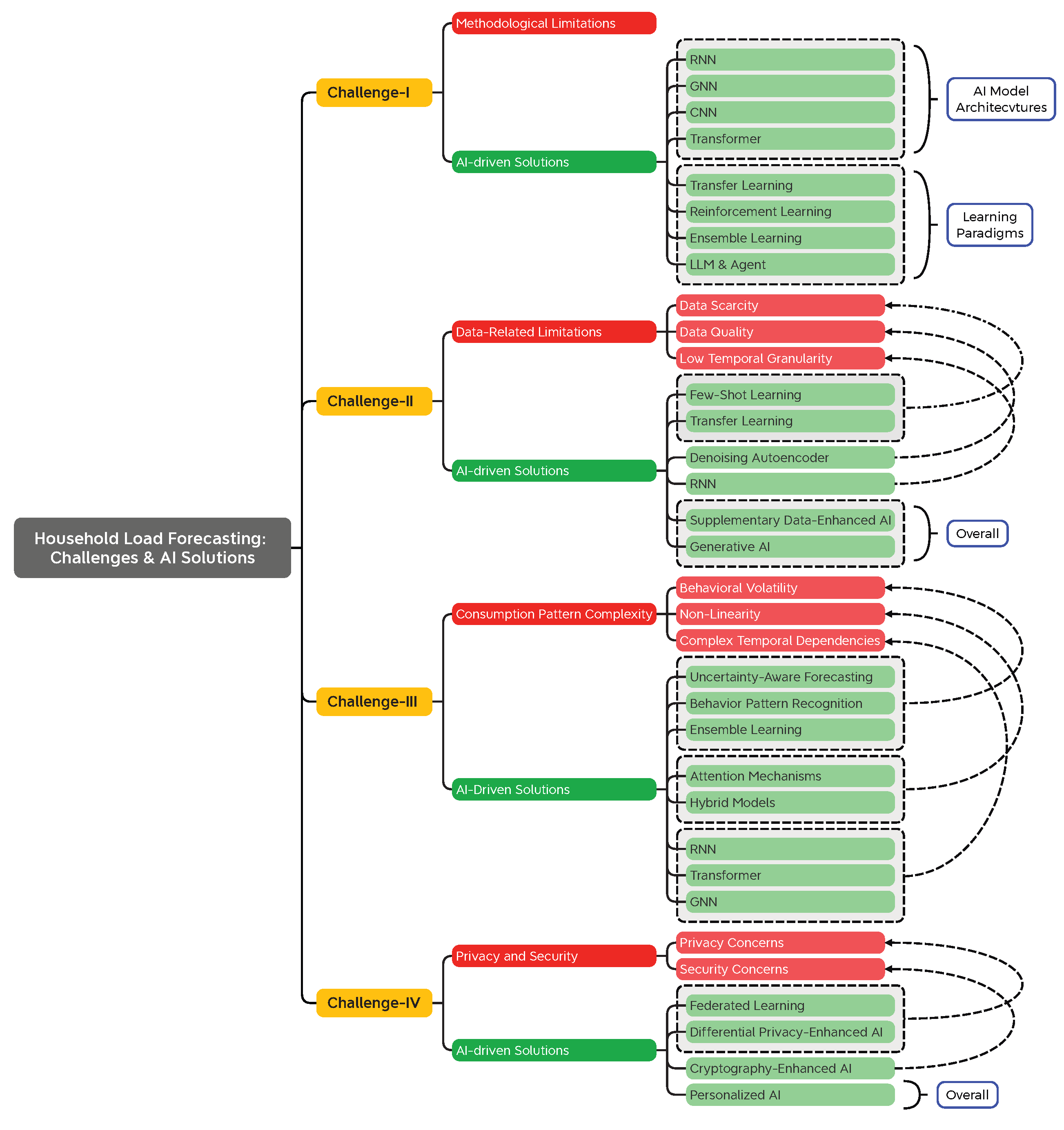
Figure 2.
(a) A general RNN structure for sequential modeling of household electricity consumption, where each input represents the time-series data at time t, and is the corresponding forecast. The hidden layers may be instantiated with LSTM units to capture temporal dependencies more effectively. (b) The architecture of a LSTM unit, which can enhance the RNN by introducing memory cells and gating mechanisms (forget gate , input gate , and output gate ) to effectively capture long-term temporal dependencies.
Figure 2.
(a) A general RNN structure for sequential modeling of household electricity consumption, where each input represents the time-series data at time t, and is the corresponding forecast. The hidden layers may be instantiated with LSTM units to capture temporal dependencies more effectively. (b) The architecture of a LSTM unit, which can enhance the RNN by introducing memory cells and gating mechanisms (forget gate , input gate , and output gate ) to effectively capture long-term temporal dependencies.
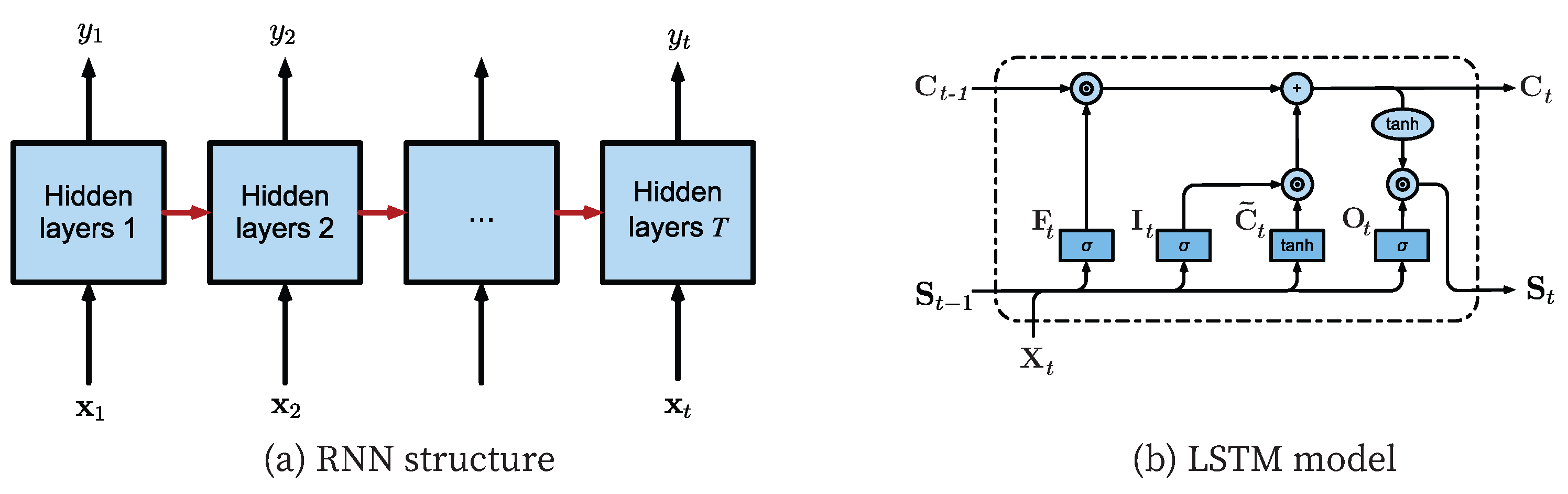
Figure 3.
A federated learning framework for privacy-preserving household load forecasting. Each house trains a local LSTM-based model using its private consumption data and shares only the model gradients with a central aggregator. The aggregator performs gradient aggregation and distributes the updated global model gradients back to individual clients, thus preserving data locality and mitigating privacy risks associated with centralized data collection.
Figure 3.
A federated learning framework for privacy-preserving household load forecasting. Each house trains a local LSTM-based model using its private consumption data and shares only the model gradients with a central aggregator. The aggregator performs gradient aggregation and distributes the updated global model gradients back to individual clients, thus preserving data locality and mitigating privacy risks associated with centralized data collection.
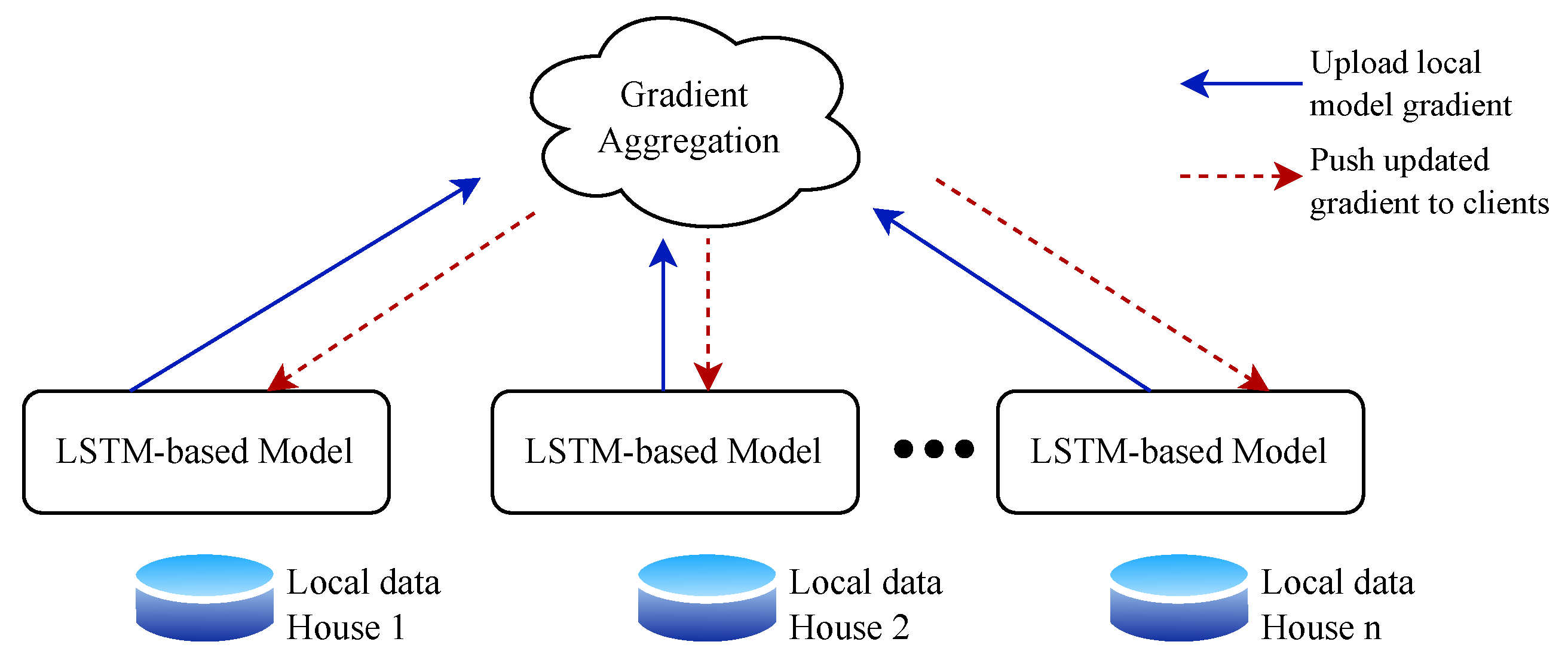

Table 1.
Comparison between this work and existing surveys on household load forecasting, including RA [9], RB [5], RC [17], RD [1], and RE [2].
| Comparison Dimensions | Related Surveys | Ours | |||||
|---|---|---|---|---|---|---|---|
| RA | RB | RC | RD | RE | |||
| Limitations of Traditional Forecasting Methods | ✗ | ✗ | † | † | † | √ | |
| AI Model Architectures | RNN | √ | † | √ | √ | √ | √ |
| CNN | √ | √ | √ | √ | √ | √ | |
| GNN | ✗ | ✗ | ✗ | ✗ | ✗ | √ | |
| Transformer | ✗ | ✗ | ✗ | ✗ | † | √ | |
| AI Learning Paradigms | Transfer Learning | ✗ | ✗ | ✗ | ✗ | √ | √ |
| Ensemble Learning | † | † | † | √ | √ | √ | |
| Reinforcement Learning | ✗ | ✗ | ✗ | ✗ | √ | √ | |
| LLM & Agent | ✗ | ✗ | ✗ | ✗ | ✗ | √ | |
| Data-Related Limitations: Scarcity, Quality, Granularity | ✗ | † | † | † | † | √ | |
| AI Model Architectures | RNN | √ | √ | √ | √ | √ | √ |
| Generative AI | ✗ | ✗ | ✗ | ✗ | † | √ | |
| Autoencoder | ✗ | ✗ | ✗ | ✗ | √ | √ | |
| AI Learning Paradigms | Transfer Learning | ✗ | ✗ | ✗ | ✗ | √ | √ |
| Few-Shot Learning | ✗ | ✗ | ✗ | ✗ | ✗ | √ | |
| Consumption Pattern Complexity | ✗ | √ | † | † | √ | √ | |
| AI Model Architectures | RNN | † | √ | √ | √ | √ | √ |
| GNN | ✗ | ✗ | ✗ | ✗ | ✗ | √ | |
| Transformer | ✗ | ✗ | ✗ | ✗ | √ | √ | |
| AI Learning Paradigms | Ensemble Learning | † | † | † | † | † | √ |
| Uncertainty-Aware Forecasting | ✗ | ✗ | † | √ | √ | √ | |
| Behavior Pattern Recognition | † | √ | √ | √ | √ | √ | |
| Privacy & Security Concerns and Regulations | ✗ | † | ✗ | ✗ | † | √ | |
| AI Learning Paradigms | Federated Learning | ✗ | ✗ | ✗ | ✗ | √ | √ |
| DP-Enhanced AI | ✗ | ✗ | ✗ | ✗ | ✗ | √ | |
| Cryptography-Enhanced AI | ✗ | † | ✗ | ✗ | ✗ | √ | |
| Personalized AI | ✗ | ✗ | ✗ | ✗ | ✗ | √ | |
Note: = studied, † = partially studied, ✗ = not studied.
Table 2.
Summary of AI-Based approaches mitigating traditional forecasting limitations in household load forecasting.
Table 2.
Summary of AI-Based approaches mitigating traditional forecasting limitations in household load forecasting.
| Category | Strength | References | |
|---|---|---|---|
| Model Architectures |
RNN | Nonlinear sequence modeling, multi-step forecasting, and context integration |
[33] |
| [31] | |||
| [30] | |||
| GNN | Explicit spatial encoding, spatiotemporal joint learning, and adaptive modeling capability |
[34] | |
| [13] | |||
| [73] | |||
| CNN | Localized pattern recognition, hybrid flexibility, and multivariate input modeling |
[42] | |
| [41] | |||
| [38] | |||
| Transformer | Modeling long-range dependencies, multi-context integration, nonlinearity & nonstationarity, and probabilistic forecasting |
[47] | |
| [11] | |||
| [45] | |||
| [44] | |||
| Learning Paradigms |
Transfer Learning |
Cross-domain generalization, adaptability, efficiency, and robustness |
[15] |
| [50] | |||
| [35] | |||
| Reinforcement Learning |
Continuous adaptation, goal-directed learning, and interaction modeling |
[55] | |
| [54] | |||
| [51] | |||
| [57] | |||
| Ensemble Learning |
Variance reduction, robustness, enhanced generalization, and flexible architectures |
[58] | |
| [58] | |||
| [61] | |||
| [50] | |||
| LLM& Agent |
Contextual reasoning, zero/few-shot adaptation, and autonomous behavior modeling |
[68] | |
| [67] | |||
| [66] | |||
| [72] | |||
Table 3.
Summary of AI-based approaches addressing data-related limitations in household load forecasting. The table categorizes key AI methods according to the specific data challenge they target, including data scarcity, data quality, low temporal granularity, and overall data enhancement. For each category, the strengths, representative studies, and core model architectures are listed.
Table 3.
Summary of AI-based approaches addressing data-related limitations in household load forecasting. The table categorizes key AI methods according to the specific data challenge they target, including data scarcity, data quality, low temporal granularity, and overall data enhancement. For each category, the strengths, representative studies, and core model architectures are listed.
| Limitations | AI Methods | Strengths | References | Models |
|---|---|---|---|---|
| Data Scarcity |
Few-Shot Learning |
Data-efficient learning, adaptive learning, model adaptation |
[75] | LLM |
| [74] | LSTM | |||
| [16] | RNN, LSTM | |||
| [77] | CNN | |||
| Transfer Learning |
Cross-domain reuse, behavioral alignment, protected inference |
[78] | LSTM | |
| [79] | LSTM, GAN | |||
| [80] | LSTM, GAN | |||
| Data Quality |
Denoising Autoencoder |
Data recovery, noise suppression, forecast boosting |
[85] | LSTM |
| [84] | LSTM, CNN | |||
| [83] | CNN | |||
| [82] | LSTM | |||
| Low Temporal Granularity |
RNN | Granularity refinement, feature fusion, load regeneration, feature-aware learning |
[89] | CNN |
| [88] | LSTM | |||
| [87] | RNN | |||
| [86] | LSTM | |||
| Overall | Generative AI |
Data synthesis, enhanced robustness, privacy-friendly modeling |
[3] | CNN, GAN |
| [90] | LSTM, GAN | |||
| [91] | LSTM, CNN | |||
| [93] | CNN, RNN | |||
| Supplementary Data Enhanced AI |
Auxiliary signals, context-aware modeling, multimodal fusion |
[97] | LSTM | |
| [4] | LSTM | |||
| [95] | LSTM, CNN | |||
| [27] | LSTM |
Table 4.
Summary of AI-based approaches addressing consumption pattern complexity in household load forecasting. The table categorizes methods by key aspects. For each approach, representative references and core model types are listed.
Table 4.
Summary of AI-based approaches addressing consumption pattern complexity in household load forecasting. The table categorizes methods by key aspects. For each approach, representative references and core model types are listed.
| Aspects | Approaches | Representative References | Core Models |
|---|---|---|---|
| Behavioral Volatility |
Uncertainty-Aware Forecasting |
[38] | CNN, GRU |
| [100] | LSTM, GRU | ||
| [99] | CNN | ||
| [98] | CNN, AutoEncoder | ||
| Behavior Pattern Recognition |
[101] | CNN, GRU | |
| [4] | LSTM | ||
| [32] | CNN, BiLSTM | ||
| [6] | CNN, LSTM | ||
| Ensemble Learning |
[104] | Bagging, Boosting | |
| [95] | CNN, LSTM | ||
| Non-Linearity | Attention Mechanisms |
[11] | GNN, Transformer |
| [46] | Transformer | ||
| [105] | CNN, LSTM | ||
| [37] | CNN | ||
| Hybrid Models |
[108] | CNN, LSTM | |
| [106] | CNN, GRU | ||
| [107] | CNN, LSTM | ||
| Temporal Dependencies |
RNN | [110] | CNN, LSTM |
| [109] | LSTM | ||
| [86] | LSTM | ||
| [30] | LSTM | ||
| Transformer | [11] | Transformer, GNN | |
| [44] | Transformer | ||
| GNN | [112] | GNN, CNN | |
| [111] | GNN, CNN | ||
| [73] | GNN |
Table 5.
Summary of privacy- and security-preserving methods in household load forecasting. The table categorizes recent approaches by method type, target concerns, key strengths, representative references, and employed forecasting models.
Table 5.
Summary of privacy- and security-preserving methods in household load forecasting. The table categorizes recent approaches by method type, target concerns, key strengths, representative references, and employed forecasting models.
| Method Category |
Target | Strengths | References | Models |
|---|---|---|---|---|
| Federated Learning |
Privacy | Data locality, scalability potential, heterogeneity-resilience |
[15] | LSTM, GRU |
| [119] | ANN | |||
| [118] | LSTM | |||
| [117] | LSTM | |||
| DP-Enhanced AI |
Privacy | Formal privacy guarantees, regulatory compliance, flexible integration, adaptive mechanisms |
[75] | LLM |
| [121] | ANN | |||
| [122] | CNN, LSTM | |||
| [120] | LSTM | |||
| Cryptography Enhanced AI |
Security | End-to-end security, infrastructure compatibility, secure collaboration |
[124] | LSTM |
| [123] | CNN | |||
| [125] | CNN, LSTM | |||
| [126] | ANN | |||
| Personalized AI |
Privacy & Security |
User-centric adaptation, resilience to data imbalance, client-specific optimization |
[129] | ANN |
| [130] | LSTM | |||
| [131] | LSTM, RNN | |||
| [128] | LSTM |
Disclaimer/Publisher’s Note: The statements, opinions and data contained in all publications are solely those of the individual author(s) and contributor(s) and not of MDPI and/or the editor(s). MDPI and/or the editor(s) disclaim responsibility for any injury to people or property resulting from any ideas, methods, instructions or products referred to in the content. |
© 2025 by the authors. Licensee MDPI, Basel, Switzerland. This article is an open access article distributed under the terms and conditions of the Creative Commons Attribution (CC BY) license (http://creativecommons.org/licenses/by/4.0/).
Copyright: This open access article is published under a Creative Commons CC BY 4.0 license, which permit the free download, distribution, and reuse, provided that the author and preprint are cited in any reuse.


