

Submitted:
06 August 2025
Posted:
07 August 2025
You are already at the latest version
Abstract
A meta-analysis was conducted to predict the methane production potential of feed ingredients and rations based on their chemical composition. Thirty-seven publications were selected, yielding 377 datasets. Prediction equations for Biochemical Methane Potential (BMP) were developed using NDF and CP. The accuracy of these equations (R²=63.2; RMSE=81.6) was lower than that obtained from smaller experimental datasets.
Keywords:
prediction
; Biochemical Methane Potential (BMP)
; tropical and temperate ingredients
1. Introduction
Anaerobic digestion involves the breakdown of organic matter in a digester by a consortium of methanogenic microorganisms. The performance of this process partially depends on the characteristics of both the inoculum and the substrates [1]. A wide variety of ingredients are eligible for anaerobic digestion [1,2], including: Plant products (grains, fruits, tubers); Crop residues (straws, vines, leaves); Livestock waste (pig and cow slurry, manure, poultry droppings); Agro-industrial by-products (bran, oilseed cakes, peels); Food waste (canteens, hotels); Slaughterhouse waste; Wastewater treatment sludge.
The reference method for determining Biochemical Methane Potential (BMP) is a laboratory test measuring methane production over 30–40 days from a substrate inoculated and fermented in biodigesters. Methane production from the inoculum alone is subtracted to isolate the substrate’s contribution. While automated versions exist, these tests remain time-consuming and expensive, unsuitable for rapid screening.
Alternative approaches include larger-scale anaerobic digestion reactors (up to 10 L), used in batch or continuous mode. Continuous reactors mimic real digesters, allowing assessment of biogas productivity and process stability—but like BMP tests, are labor-intensive.
Conversely, “gas test” methods use much smaller containers under batch-like conditions. These classify ingredients but are not suitable for extrapolation to industrial digestion systems.
Predictive methods offer alternatives:
- Stoichiometric approaches estimate CH₄ and CO₂ production using the empirical formula (CₐHbOcNd) of the substrate via Buswell or Mueller equations. These are only useful for pure or well-characterized substrates and ignore degradability.
- Infrared spectroscopy models [4] rely on large, diverse calibration datasets.
Previous prediction models were based on small datasets usually originating from experiments conducted by a team. This study aims to improve BMP predictions using a larger meta-analysis database. To our knowledge, based on a search of the Web of Science platform, this is the first meta-analysis on this subject.
2. Materials and Methods
2.1. Database Development
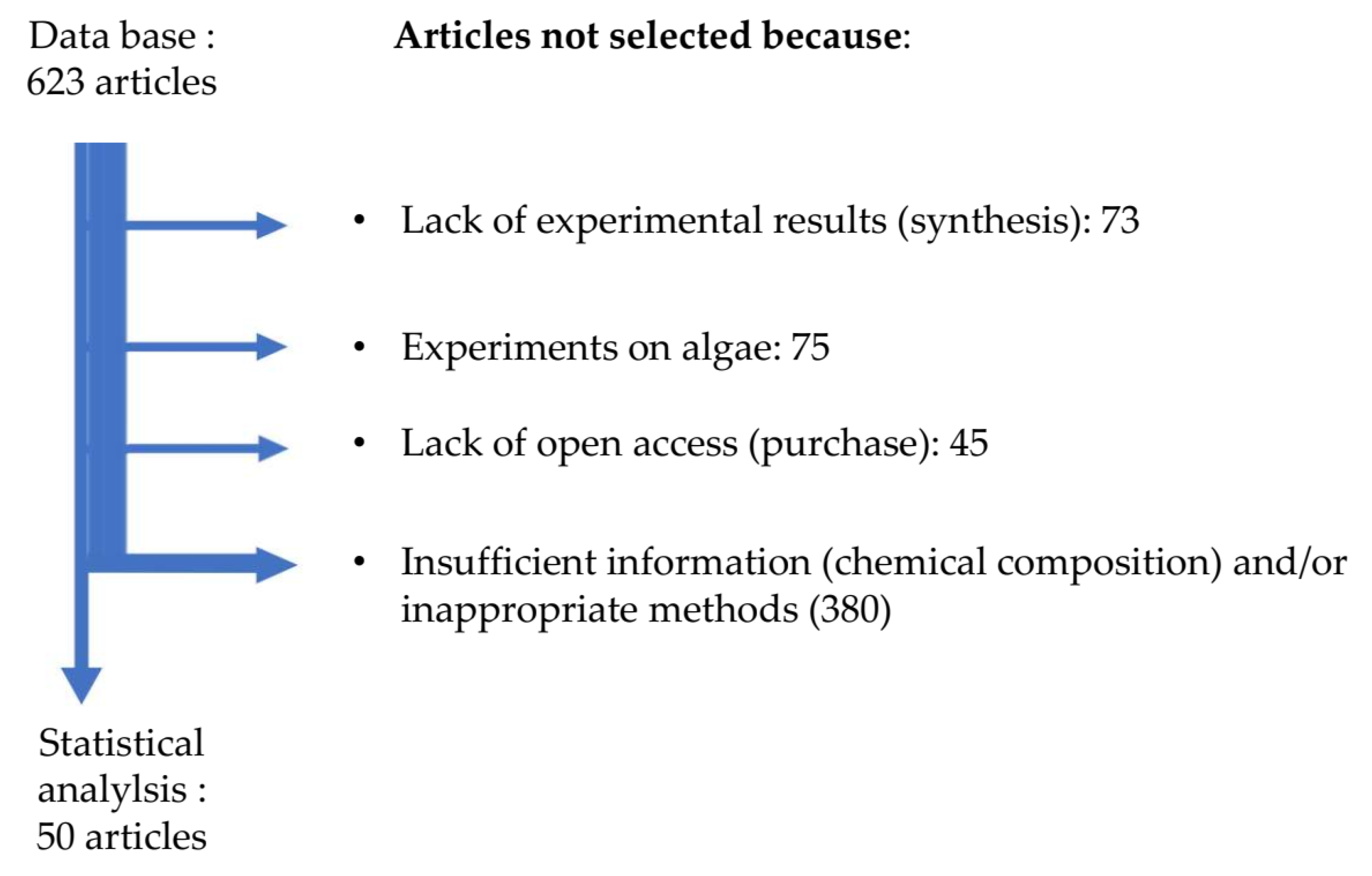
The study was conducted following the guideline of “Preferred Reporting Items for Systematic Reviews and Meta-Analyses: The PRISMA Statement” [5]. Data were collected from articles in the Web of Science using keywords: Biochemical Methane Potential (BMP) and biomass. The period covered was from January 1, 2009 to December 30, 2024. The strategy for selecting articles for the meta-analysis is summarized in Figure 1.
Six hundred and twenty-three (623) articles were identified. After reading the abstracts and methodological material, only 50 publications were retained for the meta-analysis. Seventy-three (73) were literature reviews that did not include experimental data. Studies focusing on algae (75) were excluded because it is a very specific type of biomass that deviates from circular economy approaches. A significant number of publications (390) were excluded due to inappropriate methodology (the BMP tests were not well described; bottles smaller than 100 ml and short duration of measurement (< 7 days); presence of biomass pre-treatment that alters its physical and chemical composition and consequently impacts methane production) and insufficiently characterized substrates (chemical composition). The chemical composition (CP, NDF, ADF, ADL) of biomasses had to be indicated while the known theoretical variability for the ingredient concerned did not authorize taking average values from the literature. To address missing data concerning chemical composition (CP, NDF, ADF, ADL), 81 datasets were supplemented using Feedipedia. The lack of information on the lipid content of biomass, known to impact methane production, was not considered a deal breaker, as this data was very rare in the literature.
Forty-five publications (45) were excluded because they were not freely accessible (purchase required). About ten trials were excluded due to abnormally low BMP values (>50 L/kg DM), often caused by short incubation times (<72 h) or atypical chemical compositions.
Articles had to include methane production data, organic matter input.All units were standardized.
2.2. Data Coding and Analysis
Data were coded by: 1) Origin: temperate vs tropical resources; 2) substrate type: grass, fodder trees, straw, unconventional high-fibre, high-fat, manure, slurry; 3) substrate group: High in fibre; High in carbohydrates (sugar, starch; > 30% of DM), High in fat (> 20% of DM).
Statistical analysis (ANOVA) was conducted using Minitab. The BMP was the response variable. Two mixed-effect models were used. The first model treated: trials as random effects; included the biomass group (high in fibre, high in carbohydrates, high in fat) as fixed factor; included NDF and CP as covariates. The second model treated: trials as random effects; included the biomass group (high in fibre, high in carbohydrates, high in fat) as fixed factor; included NDF, ADL and CP as covariates. Neither model included lipids as a covariate because little data was available.
3. Results
3.1. Database Description
The Figure 1 describes the data present in the database.
Most trials occurred in temperate zones. Frequently studied substrates were grasses, straw, manure, and slurry. Unconventional resources (e.g., agro-industrial by-products) were also well-represented. Fiber-rich ingredients were most evaluated. Protein-rich (meat) samples were few; fat-rich substrates mainly included oilseed cakes.
Chemical composition data were often incomplete and could not always be supplemented due to high variability. Statistical comparisons and variance analysis used a subset where both NDF ADL and CP were available (Table 1).
3.2. Influence of Ingredient Characteristics on BMP
Resource origin (temperate vs tropical) had no significant effect on BMP (P<0.869). Chemical composition significantly influenced BMP (P<0.001). Fat-rich resources had the highest BMP (408.6 ±52.67 L/kg DM), while fiber-rich ones had the lowest (176.3 ±8,07 L/kg DM). Carbohydrate-rich substrates were intermediate (264.6± 17.61 L/kg DM), with no significant difference between the latter two. Except for lipid-rich ingredients, BMP differences between groups disappeared when NDF and CP were equal.
Main BMP prediction equations based on NDF ADL and CP are shown in Table 2. Analysis of equations incorporating NDF and CP indicates that BMP decreases with increasing NDF and CP content. The relatively high value of R² results from taking into account the different publications (trials) as a random effect. The RSE specifying the prediction error, 62.24 L/kg DM, is relatively high in view of the variability observed during the analysis of triplicate BMP measurements.
Some equations for predicting BMP based on the chemical composition of feedstock ingredients, reported in the literature, are presented in Table 3. They indicate a reduction in BMP with increasing NDF content and an increase with lipid concentration.
4. Discussion and Conclusions
Methane production is the result of a succession of complex chemical reactions carried out by a consortium of microorganisms under anaerobic conditions: 1) Hydrolysis breaks down certain macromolecules of organic matter (polysaccharides like cellulose, hemicellulose, starch; lipids; proteins) into simpler molecules (sugars, fatty acids, amino acids); 2) Acidogenesis converts some of these simple molecules into carbon dioxide and hydrogen; 3) Acetogenesis transforms simple molecules (mainly soluble sugars and amino acids) into low molecular weight acids (2 to 5 carbon atoms, volatile fatty acids), low molecular weight alcohols (including ethanol), and hydrogen; 4) Methanogenesis is the final step, where acetate is converted into methane and CO₂. In addition, part of the CO₂ is reduced to methane. Consequently, predicting BMP based solely on chemical composition is a challenge. The composition of the substrate may reflect the potential for hydrolysis and, to a lesser extent, the profile of acetogenesis products. Hydrolysis is a limiting step, especially with lignified substrates. Acetogenesis may be hindered by high hydrogen concentrations.
To our knowledge, no meta-analysis has yet been conducted to predict BMP from the chemical composition of feedstock ingredients. The published equations were developed from relatively small experimental datasets [9]. The objective of this study was to develop robust BMP prediction equations using literature data. This goal is difficult to achieve due to the nature of the published data. One of the difficulties encountered in the present study is a lack of information (complete chemical composition in macro elements, precise description of protocols) in the majority of the publications consulted, which led to the rejection of more than 80% of the experiments evaluating BMPs. Raposo et al [9] had already identified this constraint: “unfortunately, a lot of information necessary when reporting BMP studies was not included in the description of most articles. Specifically, 50% of the possible in-formation that should be reported in the reviewed articles was omitted”. We therefore chose to use known macro elements (fiber, protein) [9] to have a significant impact on methane production. Fats and carbohydrates were too poorly documented to be included in the equations. To characterize the fiber, we used NDF and ADL from the Van Soest method [10]. Unlike ADL, which is the non-degradable fraction of fiber, the NDF fraction may contain carbohydrates depending on the protocol used and whether the substrate being evaluated is more or less rich in carbohydrates [10]. The use of fiber-rich versus carbohydrate-rich groups in the statistical analysis helps to control this bias to some extent.
The accuracy of prediction equations must be evaluated in terms of intra-laboratory (triplicate) and inter-laboratory variability of BMP measurements. Several studies have been published on intra- and inter-laboratory variability in BMPs [11,12,13]. Using harmonized protocols, the intra- and interlaboratory variability (Residual Standard Deviation) measured in France [13] are 5% and 20%, which would represent values of 10.4 and 38.1 L/kg DM based on the average BMP value measured in this meta-analysis. The accuracy of the equations for predicting BMP from chemical composition, obtained in the study, was 62.4 L/kg DM. Consequently, the produced equations in the present metanalysis, although statistically significant and consistent with known effects of composition, have moderate accuracy. Moreover, their predictive power is understandably lower than that of equations developed from smaller, more homogeneous experimental databases. However, some of these equations incorporate more relevant compositional variables (lipids, lignin) describing methanogenic biomass.
The BMP of biomass samples is negatively correlated with variables describing plant cell walls [9]. In our prediction equations, NDF—which is more commonly reported in the literature—was used as a proxy for cell wall carbohydrates. The negative effect of NDF on BMP aligns with literature trends. However, NDF is likely not the most relevant indicator, as it contains varying amounts of cellulose, hemicellulose, and lignin. The proportions of these components determine the fermentability of the structural carbohydrates and, consequently, methane yield. The more lignified the carbohydrates, the less fermentable they are. Hence, lignin content is arguably the strongest predictor of BMP outcomes [9]. Our results confirm this tendency. The introduction of lignin improves the accuracy of the prediction because it accounts for the non-fermentable fraction of the fiber. However, this data remains relatively rare in the literature on BMPs. Furthermore, it is the fiber component for which the variability in measurement is greatest.
Depending on the predictors used in the prediction equations, the impact of CP can be positive or negative on the BMP. The positive effect of CP can be explained by the supply of N necessary for the growth of bacteria involved in methanogenesis. Furthermore, high CP levels are correlated with higher fermentability of the substrate. This positive effect aligns with literature findings [9]. However, high CP concentrations may lead to excessive ammonia production, which can inhibit anaerobic digestion and reduce methane formation [14].
Lipid content was not included in our equations due to limited data availability. Nonetheless, lipid content is highly relevant, as lipids are high-energy organic compounds that are biodegradable under anaerobic conditions. Lipids result in higher methane yields compared to structural and non-structural carbohydrates [9]. The higher BMP values observed in this study for lipid-rich rations support this finding.
5. Conclusion
The data available from the literature are too heterogeneous to allow accurate BMP prediction based solely on chemical composition. Our findings highlight the need for a standardized, homogeneous experimental database including BMP values and detailed physicochemical composition. Ingredient characterization should, at a minimum, include NDF, lignin, lipids, and proteins, as these significantly influence BMP. Developing ingredient-category-specific prediction equations—yet to be defined—could improve BMP prediction accuracy.
References
- Lallement, A.; Peyrelasse, C. ; Lagnet, C; Barakat, A. ; Schraauwers, B.; Maunas, S.; Monlau, F. A detailed database of the chemical properties and methane potential of biomasses covering a large range of common agricultural biogas plant feedstocks. Waste 2023, 1, 195–227. [Google Scholar] [CrossRef]
- Béline, F.; Girault, R.; Peu, P.; Trémier, A.; Teglia, C.; Dabert, P. Enjeux et perspectives pour le développement de la méthanisation agricole en France. Sciences Eaux & Territoires, 2012, 7, 34–43. [Google Scholar] [CrossRef]
- Charnier, C.; Latrille, E.; Moscoviz, R.; Miroux, J.; Jean-Philippe Steyer, JP. Biochemical composition and methane production correlations. XII Latin American Workshop and Symposium on Anaerobic Digestion - XII DAAL, International Water Association (IWA). INT., Oct 2016, Cusco,Peru. hal-02740481.
- Godin, B.; Mayer, F.; Agneessens, R.; Gerin, P.; Dardenne, P.; Delfosse, P.; Delcarte, J. Biochemical methane potential prediction of plant biomasses: Comparing chemical composition versus near infrared methods and linear versus non-linear models. Bioresource Technology 2015, 175, 382–390. [Google Scholar] [CrossRef]
- Moher, D.; Liberati, A.; Tetzlaff, J.; Altman, D.G.; Altman, D.; Antes, G.; Atkins, D.; Barbour, V.; Barrowman, N.; Berlin, J.A.; et al. Preferred reporting items for systematic reviews and meta-analyses: The PRISMA statement. PLoS Med. 2009, 6, e1000097. [Google Scholar] [CrossRef] [PubMed]
- Edwidge, T.; Frare, L.; Mayer, B.; Lins, L.; Triolo, J.M.; Flotats, X.; Sarolli Silva de Mendonça Costa, M. Influence of chemical composition on biochemical methane potential of fruit and vegetable wast. Waste Management 2018, 71, 618–625. [Google Scholar] [CrossRef] [PubMed]
- Cu, T.T.T.; Nguyen, T.X.; Triolo, JM.; Pedersen, L.; Le, V.D.; Le, PD.; Sommer, S.G. Biogas production from vietnamese animal manure, plant residues and organic waste: influence of biomass composition on methane yield. Asian-Australasian Journal of Animal Sciences 2015, 28 (2), 280-289. [CrossRef]
- Lymperatou, A.; Engelsen, T.K.; Skiadas, I.V.; Gavala, H.N. Prediction of methane yield and pretreatment efficiency of lignocellulosic biomass based on composition. Waste Management 2023, 155, 302–310. [Google Scholar] [CrossRef]
- Raposo, F.; Borja, R.; Ibelli-Bianco, C. Predictive regression models for biochemical methane potential tests of biomass samples: Pitfalls and challenges of laboratory measurements. Energy Reviews 2020, 127, 109890. [Google Scholar] [CrossRef]
- Van Soest, P. J.; Robertson, J. B.; Lewis, B. A. Methods for dietary fiber, neutral detergent fibre and non-starch polysaccharides in relation to animal nutrition. Journal of Dairy Science 1991, 74, 3583–3597. [Google Scholar] [CrossRef] [PubMed]
- Hafner, S.D.; Fruteau de Laclos, H.; Koch, K.; Holliger, C. Improving Inter-Laboratory Reproducibility in Measurement of Biochemical Methane Potential (BMP). Water 2020, 12, 1752. [Google Scholar] [CrossRef]
- Hafner, S.D. , Fruteau de Laclos, H.; Koch, K.; Holliger, C.; Raposo, F.; Fernandez-Cegrı, V.; De la Rubia, M.A.; Borja, R.; Béline, F.; Cavinato, C.; Demirer, G.; Fernandez B.; Fernandez-Polanco, M.; Frigon, J.C.; Ganesh, R.; Kaparaju, P.; Koubova, J.; Mendez, R.; Menin, G.; Peene, A.; Scherer, P.; Torrijos, M.; Uellendahl, H.; Wierinck, I.; de Wilde, V. Biochemical methane potential (BMP) of solid organic substrates: evaluation of anaerobic biodegradability using data from an international interlaboratory study. Journal of Chemical Technolology Biotechnology 2011; 86, 1088–1098. [CrossRef]
- Ribeiro, T.; Cresson, R.; Pommier, S.; Preys, S.; André, L.; Béline, F.; Bouchez, T.; Bougrier, C.; Buffière, P.; Cacho, J.; et al. Measurement of Biochemical Methane Potential of Heterogeneous Solid Substrates: Results of a Two-Phase French Inter-Laboratory Study. Water 2020, 12, 2814. [Google Scholar] [CrossRef]
- Yenigün, O.; Burak Demirel, B. 2013. Ammonia inhibition in anaerobic digestion: A review. Process Biochemistry 2013, 48, 901–911.
Figure 1.
Description of the database.
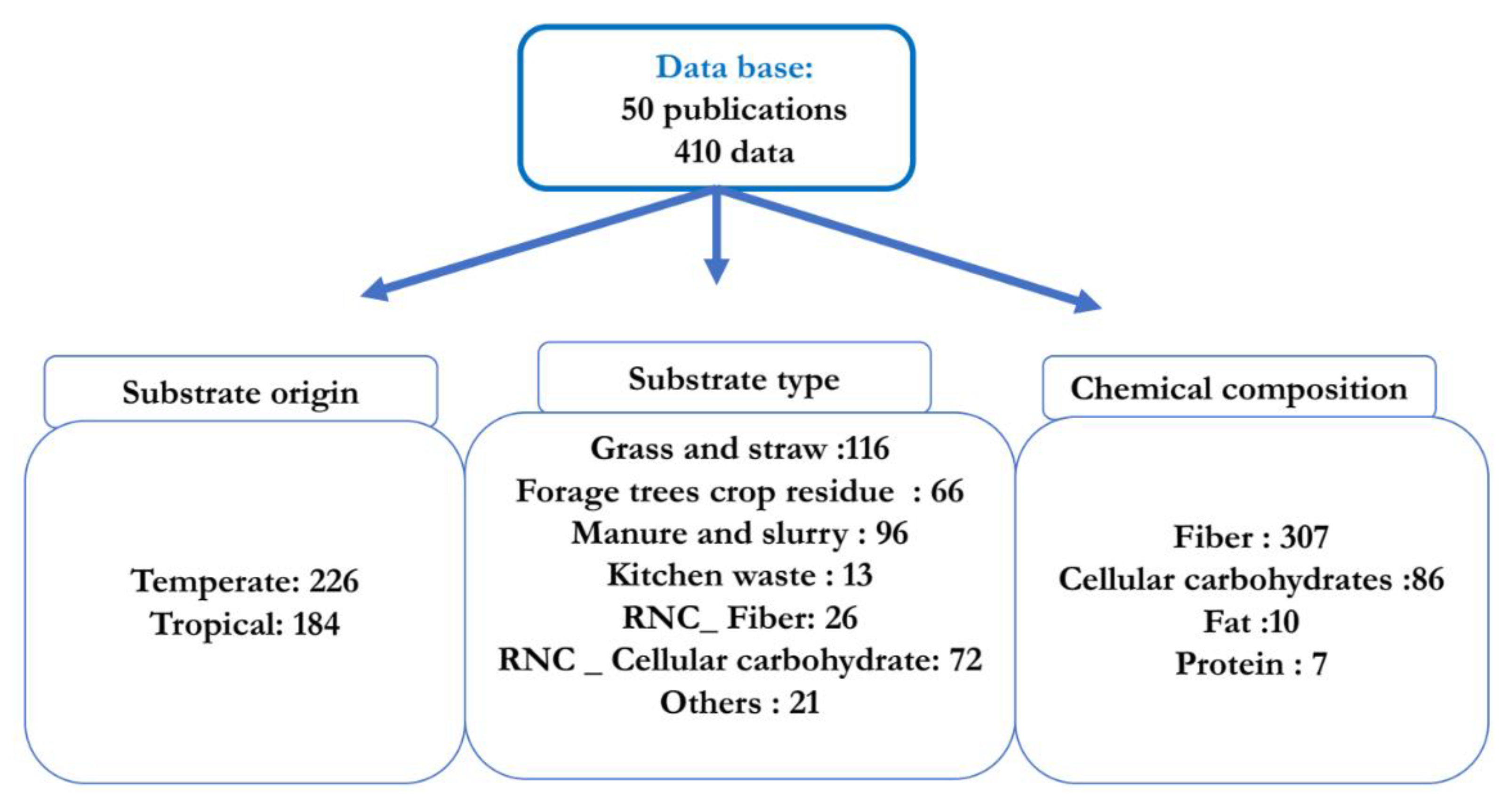

Table 1.
Characteristics of the Database.
| Variable | Type | N | Mean | SE | Q1 | Median | Q3 |
| NDF | High in fibre | 246 | 555,9 | 14,2 | 386,0 | 533,0 | 716,6 |
| High in carbohydrates | 58 | 363,8 | 28,2 | 197,0 | 329,5 | 500,0 | |
| High in fat | 4 | 249,3 | 145,3 | 0,0 | 225,0 | 522,8 | |
| Proteins (meat) | 3 | 109,8 | 100,7 | 0,0 | 18,5 | 311,0 | |
| ADL | High in fibre | 191 | 108,4 | 7,5 | 44,0 | 74,0 | 145,8 |
| High in carbohydrates | 46 | 102,3 | 15,2 | 38,5 | 52,2 | 130,5 | |
| High in fat | 2 | 87,0 | 20,0 | 67,0 | 87,0 | 107,0 | |
| Proteins (meat) | 3 | 30,1 | 24,9 | 0,0 | 10,8 | 79,5 | |
| MAT | High in fibre | 249 | 136,5 | 6,1 | 65,9 | 121,0 | 190,0 |
| High in carbohydrates | 69 | 88,6 | 7,3 | 61,5 | 76,8 | 108,3 | |
| High in fat | 4 | 151,0 | 70,7 | 17,5 | 147,0 | 288,5 | |
| Proteins (meat) | 5 | 319,7 | 87,6 | 162,5 | 248,1 | 512,8 | |
| CH4 | High in fibre | 307 | 176,3 | 8,1 | 29,3 | 180,9 | 281,8 |
| High in carbohydrates | 86 | 264,6 | 17,6 | 128,6 | 288,7 | 364,5 | |
| High in fat | 10 | 408,7 | 52,8 | 284,5 | 393,5 | 548,9 | |
| Proteins (meat) | 7 | 217,7 | 46,7 | 85,3 | 217,5 | 352,6 |
Table 2.
Prediction Equations for BMP Based on Chemical Composition (g/kg).
| Substrate Type | BMP Equation (L/kg DM) | R² | RSE | N |
| Fibrous Carbohydrates | BMP = 225.0 – 0.1246 NDF – 0.1308 CP | 82.7 | 62.24 | 251 |
| Cellular Carbohydrates | BMP = 248.8 – 0.1246 NDF – 0.1308 CP | 82.7 | 62.24 | 251 |
| Lipids | BMP = 513.9 – 0.1246 NDF – 0.1308 CP | 82.7 | 62.24 | 251 |
| Fibrous Carbohydrates | BMP = 177.5 – 0.0272 NDF – 0.2265 ADL + 0.0641 CP | 84.5 | 52.73 | 213 |
| Cellular Carbohydrates | BMP = 202.6 – 0.0272 NDF – 0.2265 ADL + 0.0641 CP | 84.5 | 52.73 | 213 |
| Lipids | BMP = 263.0 – 0.0272 NDF – 0.2265 ADL + 0.0641 CP | 84.5 | 52.73 | 213 |
Table 3.
Predictive equations for biochemical methane potential (BMP) reported in the literature.
| Various ingredients [6] BMP, L/kg DM = 346 + 6.96 Lipids (%DM); RMSE = 53.8; R² = 0.411 BMP, L/kg DM = 402 - 3.85 Lignin (%DM); RMSE = 69.3; R² = 0.23 BMP, L/kg DM = 418 + 9.24 Lipids (%DM) - 12.8 Lignin (%DM); RMSE = 45.4; R² = 0.623 BMP, L/kg DM = 845 + 7.59 Lipids (%DM) - 36.9 Lignin (%DM) - 5.67 Structural carbohydrates (%DM); RMSE = 34.3; R² = 0.809 BMP, L/kg DM = 279 + 5.47 Protein (%DM) + 12.0 Lipids (%DM) + 8.99 Cellulose (%DM) - 30.5 Lignin (%DM); RMSE = 27.6; R² = 0.891 Manure [7] BMP, L/kg DM = 57.9 + 35 Lipids (%DM); R² = 67.9 BMP, L/kg = 167 + 30.1 Lipids (%DM) - 5.43 Lignin (%DM) + 1.15 (%DM) ; R² = 96.6 BMP, L/kg = 201 + 31.5 × Lipids - 3.85 × Lignin - 1.88 × Cellulose; R² = 96.6 Manure & plant mixture [7] BMP, L/kg = 78.4 + 33.4 × Lipids (%DM); R² = 59.9 BMP, L/kg = 198 + 31.2 × Lipids (%DM) - 5.51 × Lignin (%DM) ; R² = 94.3 BMP, L/kg = 92 + 26.1 Lipids - 5.97 Lignin + 1.88 Protein; R² = 95.7 Fibrous resources [7] BMP, L/kg = 371.0 - 8.1289 Lignin (%DM) – 3.2705 Ash (%DM) + 4.8242 Hemicellulose (%DM) BMP, L/kg = 394.6 - 6.3368 Lignin (%DM) - 4.8595 Ash (%DM) – 1.3054 Total Extract (%DM) + 4.4641 Hemicellulose (%DM) |
Disclaimer/Publisher’s Note: The statements, opinions and data contained in all publications are solely those of the individual author(s) and contributor(s) and not of MDPI and/or the editor(s). MDPI and/or the editor(s) disclaim responsibility for any injury to people or property resulting from any ideas, methods, instructions or products referred to in the content. |
© 2025 by the authors. Licensee MDPI, Basel, Switzerland. This article is an open access article distributed under the terms and conditions of the Creative Commons Attribution (CC BY) license (http://creativecommons.org/licenses/by/4.0/).
Copyright: This open access article is published under a Creative Commons CC BY 4.0 license, which permit the free download, distribution, and reuse, provided that the author and preprint are cited in any reuse.


