

Submitted:
06 August 2025
Posted:
07 August 2025
You are already at the latest version
Abstract
Based on the “Unified Theory of Fields,” we have previously discussed the essence of magnetic fields; however, several critical questions remained unsettled: 1) whether moving charges produce magnetic fields—in other words, whether magnetic fields originate from moving charges—and 2) the essence and origin of planetary magnetic fields. The reason these two crucial issues have not been fully resolved is that, at that time, we had not yet found sufficient evidence to support our conclusions. Meanwhile, the “ ” phenomenon described in the Unified Theory of Fields and its consequences were not analyzed in greater detail. Therefore, this paper will provide comprehensive and definitive answers to the above two questions.
Keywords:
moving charges
; magnetic field
; Earth’s magnetic field
; planetary magnetic field
1. Introduction
In traditional electromagnetic theory, it is taken for granted that magnetic fields are produced by moving charges, and this belief has never been seriously questioned. Yet, in practical applications we can easily discover defects in this theory. For example:
1)If moving charges were able to generate magnetic fields, then magnetic fields should exert mutual attraction or repulsion and convert magnetic-field energy into the kinetic energy of objects. However, we observe that magnetic fields perform no work on moving charges; the magnetic force on a charged particle is always perpendicular to the particle’s velocity, which implies that no energy conversion actually occurs between the moving charge and the magnetic field.
2)If moving charges could generate magnetic fields, then an electron at rest in a magnetic field—owing to its spin—should necessarily produce an intrinsic magnetic field that interacts attractively or repulsively with the external field. Yet experiments show that an electron at rest in a magnetic field experiences no such attraction or repulsion.
Contemporary quantum mechanics indeed holds that the electron possesses an intrinsic magnetic moment, but claims it does not produce any classical magnetic effect. The author believes that neither quantum mechanics nor classical electromagnetism is complete on this point. If moving charges truly generated magnetic fields, then the magnetic field so produced would necessarily exhibit the attractive or repulsive effects characteristic of magnetic fields, rather than merely producing a magnetic-moment effect.
Quantum theory also asserts that the electron has no spatial size, so its real spin cannot be equated with classical rotation. The issue of whether the electron possesses a finite size will be set aside for now; we merely stipulate, as a working premise, that every particle has spatial extension. A deeper analysis will be presented in a later paper on the essence of wave-particle duality.
In short, if we accept the following axiom, then the electron at rest in a magnetic field discussed above must indeed generate a magnetic field and interact attractively or repulsively with the external field.
Axiom: The laws of our universe are self-consistent; the physical rules governing the microscopic and macroscopic realms are mutually consistent. There do not exist two separate sets of physical laws, one for the micro-world and one for the macro-world.
3)As for the magnetic fields of planets in solid, gaseous, or liquid states, no persuasive theory exists to explain their origin and nature. The dominant approach remains the traditional electromagnetic theory, which attributes planetary magnetic fields to moving charges. However, such an approach has obvious defects and only a narrow range of applicability for planets of widely differing compositions.
The principal aim of this paper is to answer and resolve the above questions theoretically. By revising traditional electromagnetic theory, we ultimately unify macroscopic and microscopic electromagnetic phenomena without the need to employ two disjoint sets of physical laws. At the same time, we resolve the fundamental question of the origin of planetary magnetic fields.
2. Proof That Moving Charges Do Not Generate Magnetic Fields
2.1. The Essence of Magnetic-Field Generation
Let us first recall the essence of magnetic fields as expounded in our “Unified Theory of Fields” [1] and two subsequent papers [2,3]. The core ideas are:
1)No field possesses real energy; instead, every field represents an energy deficit . This does not imply a violation of energy conservation—energy remains conserved in the time dimension.
2)It is precisely because of such energy deficits that forces arise between objects. Every force originates from an energy deficit.
3)The essence of magnetic-field generation is this: when the electric field cannot be smoothly converted into the kinetic energy of moving charges, a new energy-deficit effect appears, and we observe a magnetic field in the vicinity of a current-carrying conductor.
2.2. The Action of the Magnetic Field on Moving Charges
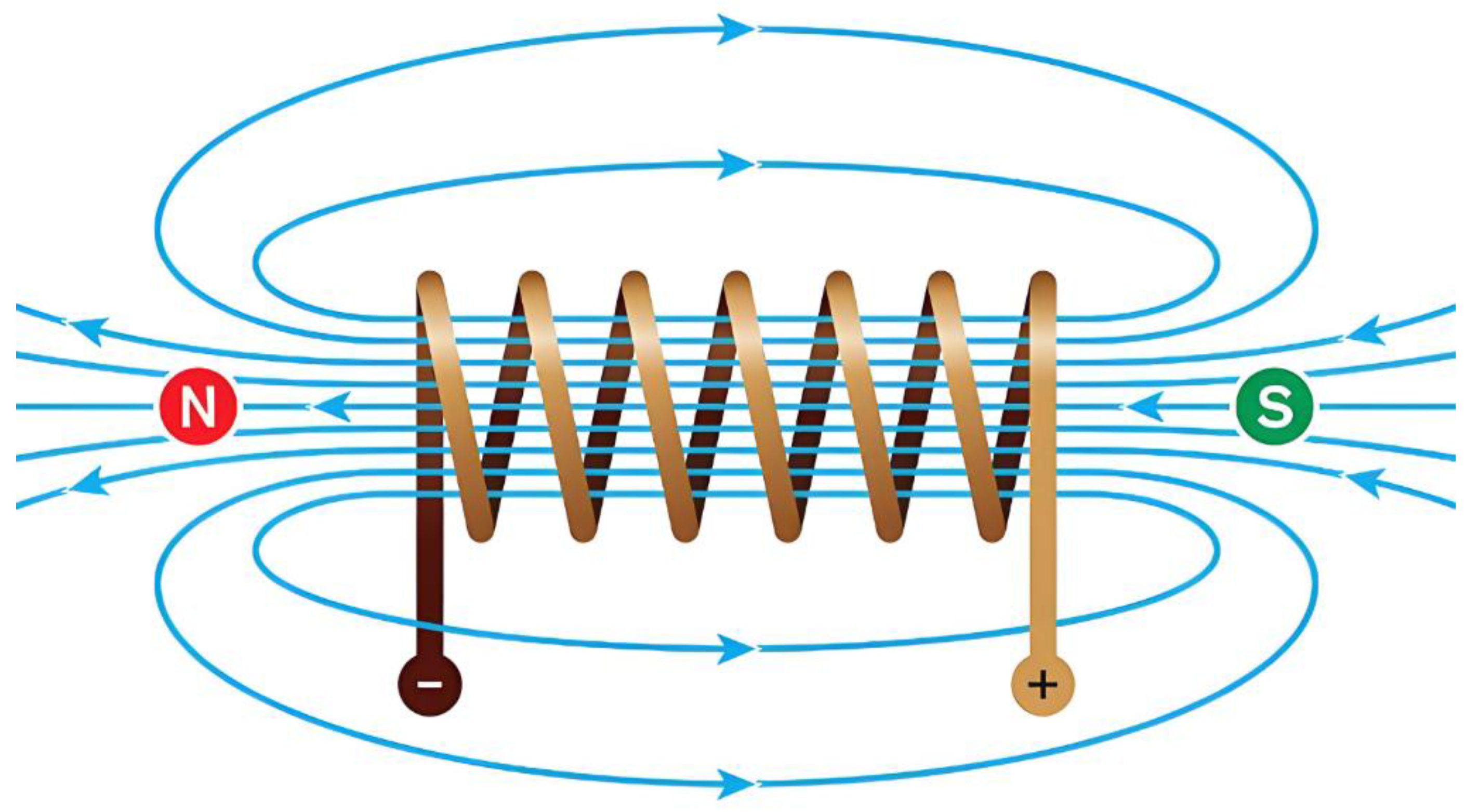
As shown in Figure 1, traditional electromagnetic theory claims that moving charges produce magnetic fields. Yet several points deserve re-examination:
1)In reality, electric current and the magnetic field appear simultaneously.
2)One readily observes that, under all circumstances, the magnetic force on a moving charge is perpendicular to the charge’s velocity; the magnetic field performs no work directly on the charge. In Figure 1, the magnetic-field direction is perpendicular to the direction of current. If Figure 1 is replaced by a straight current-carrying wire, this perpendicularity is even more obvious.
3)The essential role of the magnetic field is, by acting on moving charges, to convert magnetic-field energy back into electric-field energy.
4)One readily proves the following relation , which contains the formula for the magnetic force on a moving charge:.
5)Therefore, the essence of the magnetic force on a moving charge can be regarded as a kind of identity effect of the charge. The magnetic field cannot distinguish carriers of the energy deficit (for example, the device in Figure 1), so it applies the same action to every charged particle situated in the field.
2.3. Proof That Moving Charges Do Not Generate Magnetic Fields
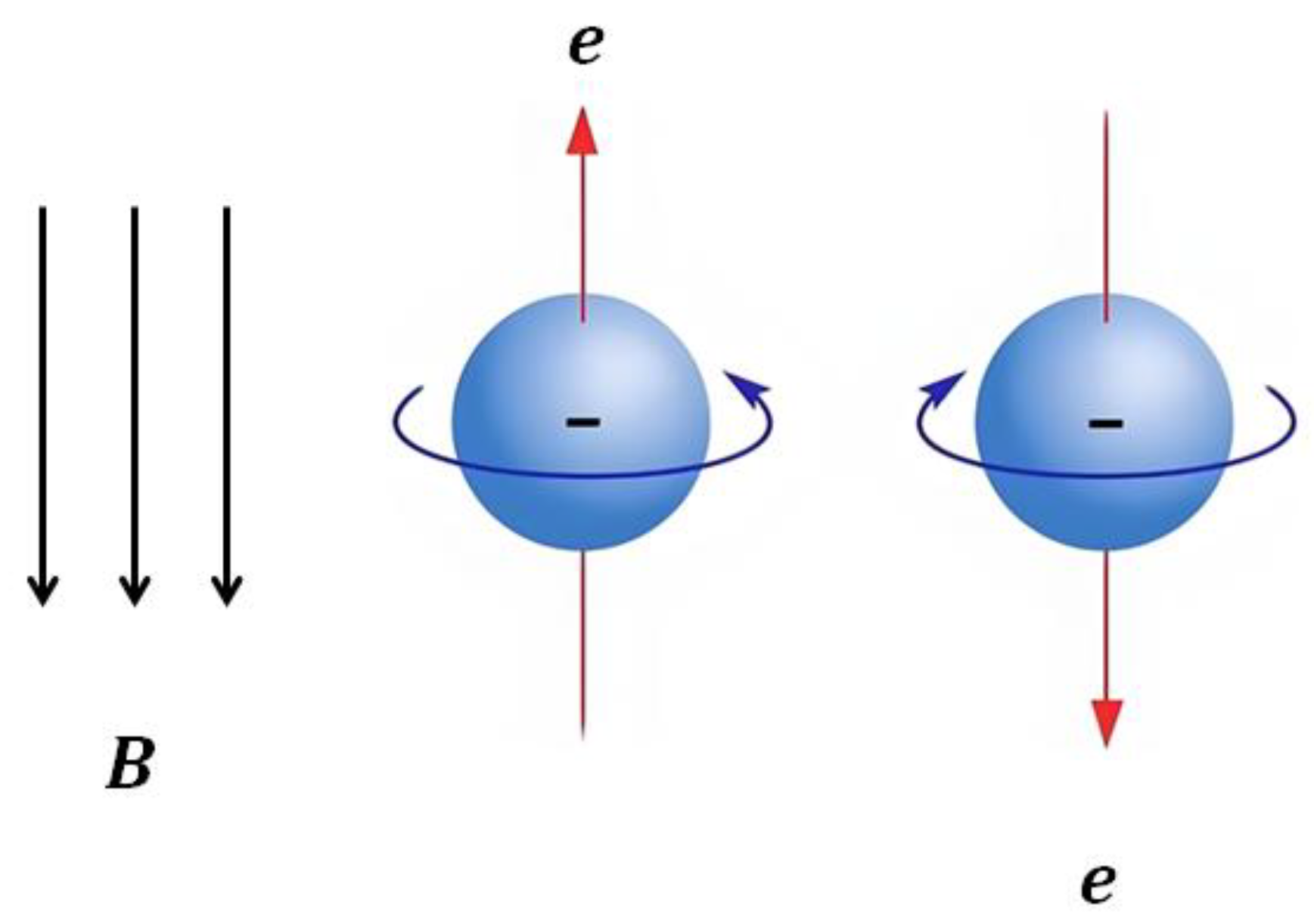
The question of whether moving charges generate magnetic fields has already been discussed in another paper [3]. Because we discovered that the interaction between a moving charge and a magnetic field differs greatly from the interaction between two magnetic fields, we tentatively concluded that moving charges might not produce magnetic fields. However, at that time we lacked sufficient evidence, so the conclusion was not definitive. In Figure 2 we now give a rigorous proof using the spin of a charged particle.
Proof:
1)Assume the electron is a sphere of finite spatial size.
The reasonableness of this assumption is denied in quantum mechanics, for to date no experiment has revealed any finite size of the electron; it behaves like a point. Moreover, even if the electron had a finite size, its calculated rotational speed based on spin angular momentum would exceed the speed of light.
Nevertheless, the author maintains that physical theories must be self-consistent and that macroscopic and microscopic theories must cohere. All matter possesses spatial distribution and size, including the electron. The reason we have not observed the electron’s size is the following:
According to the Unified Theory of Fields, force arises from energy deficit. The prerequisite for measuring an object’s size is the occurrence of force between pieces of matter. All forces originate from energy deficits. For example, if we attempt to probe an electron by firing another electron at it, then as the distance between them decreases, the energy deficit between the two electrons tends to infinity , which forces the probed electron to collapse to an infinitesimal size. Thus, the electron’s apparent point-like nature is not intrinsic but is determined by the act of measurement.
2)Assume the electron’s charge is uniformly and symmetrically distributed.
Current experimental evidence supports this assumption. Furthermore, it is required by the “No-Arbitrage-of-Energy Theorem” proposed in the Unified Theory of Fields. If the electron’s charge distribution were non-uniform, causing its electric field to vary in strength from place to place, then we could let a negative charge approach from the direction of the weaker field and retreat in the direction of the stronger field, thereby gaining excess energy—an “energy arbitrage.” Just as perpetual-motion machines are forbidden, the universe forbids energy arbitrage.
Many textbooks commit this error [4]; for instance, in analyses of the relativistic effects on moving charges, some texts depict the electron’s field distribution as asymmetric. In fact, this would trigger an energy-arbitrage effect and is therefore forbidden. These issues reveal the limitations of special relativity; the necessary corrections are given in two other papers by the author [5,6].
3)On the basis of the above two assumptions, we readily prove that, in Figure 2, if moving charges could generate magnetic fields, then the magnetic field produced by the spin of the electron in the external field would necessarily interact attractively or repulsively with the external field, rather than leaving the electron at rest in the field.
Q.E.D.
2.4. Reinterpretation of the Stern-Gerlach Experiment
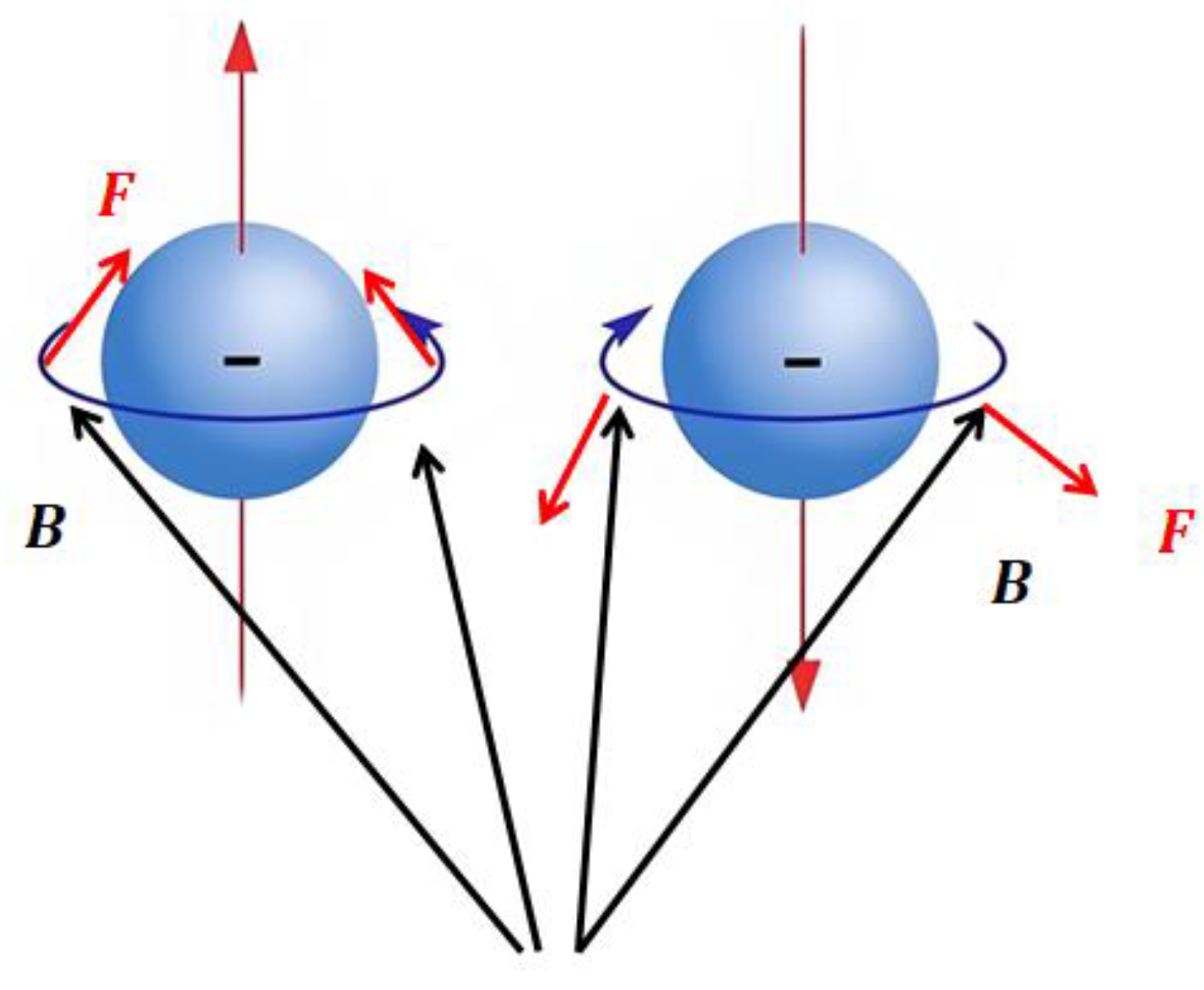
As shown in Figure 3, for particles with different spin orientations, the forces in an inhomogeneous magnetic field are in fact equivalent to the forces on moving charges in a magnetic field. In this way we achieve a perfect unification of quantum mechanics and classical electromagnetic theory, without the need for any additional hypotheses or explanations. We no longer need to picture the motion of atomic electrons as an electric current, nor interpret the effect as the magnetic moment of a moving electron. Here we have united electromagnetic theory and quantum mechanics in a single coherent explanation.
3. The Origin of Planetary Magnetic Fields
Concerning the origin of planetary magnetic fields, we have already discussed the issue in paper [2]; here we merely add some supplementary remarks.
1)When paper [2] was written, our understanding of the repulsive force between particles at short range was incomplete; that gap was filled in paper [7]. Here we briefly summarize the viewpoint of that paper. Take the short-range repulsion between a proton and an electron as an example. Because the energy deficit between any two particles is finite, the mutual attraction between electron and proton disappears once a certain critical distance is reached. If the electron approaches still closer, the negatively charged constituents (quarks) inside the proton begin to repel the electron. This is the essence of the short-range repulsive force observed between all particles.
2)When two mutually repelling particles are forced closer together by an external force, the work done by that force is converted into electric-field energy, thereby creating a new energy deficit. For a planet, under the action of gravity, its internal particles are pressed closer together; the repulsive forces between them perform negative work, thereby producing a new energy-deficit effect within the planet. The planet as a whole is electrically neutral, yet this energy deficit generated by gravity is real.
3)When the planet begins to rotate, the “No-Arbitrage-of-Energy Theorem” in the Unified Theory of Fields dictates that an accompanying energy must appear inside the planet, and this is the origin of the planetary magnetic field. Its essence is identical to the magnetic field produced by a current-carrying conductor: the latter arises because electric-field energy cannot be smoothly converted into the kinetic energy of the moving charges, whereas the planetary magnetic field arises because the energy deficit produced by gravity cannot be smoothly converted into the kinetic energy of the constituent particles. Hence, the generation of a magnetic field by a current-carrying wire and by a planet under gravity are of the same nature.
4)However, a clear distinction must be drawn: the magnetic field of a current-carrying conductor is generated while the conductor is at rest, whereas the planetary magnetic field presupposes planetary rotation; it is a magnetic-field effect produced by relative motion. Consequently, we often observe that, for planets of the same mass and volume, the faster the rotation, the stronger the magnetic field.
4. Discussion
Experimental evidence concerning whether moving charges generate magnetic fields can in fact be obtained rather easily. However, one must not attempt to verify this by observing whether a moving charge causes a magnetic needle to deflect, because an interaction already exists between a moving charge and a magnetic field. Instead, one must carefully observe the direction of deflection of a permanent magnet: for instance, a rotating charged object will cause a nearby magnet to deflect, yet the manner of interaction is clearly different from the interaction between two magnets.
Experimental verification of the origin of planetary magnetic fields is also possible, but extremely high pressures are required.
5. Conclusion
Through the above analysis we have proven that moving charges in fact do not generate magnetic fields; the essence of magnetic-field generation is an energy-deficit effect. The revised theory enables us to unite electromagnetic theory and quantum mechanics perfectly, so that quantum phenomena can be explained by a single coherent theory. At the same time, we can give a unified explanation of the origin of planetary magnetic fields, allowing us to recognize that planetary magnetic fields differ from the magnetic fields of current-carrying conductors: the former are magnetic-field effects of relative motion generated by planetary rotation under the action of gravity.
References
- Qin, S. Unified Theory of Gravity, Electromagnetic Force, Strong and Weak Forces and their Applications: Theoretical Explanation for Dark Matter. J Phys Chem Biophys. 2022, 12, 335. [Google Scholar]
- Qin, S. Theoretical explanation and experimental design of the origin of Earth's magnetic field, stellar magnetic field, and neutron star magnetic field, 2023, 1 April. [CrossRef]
- ShengQin. 2025. “On the Essence of Magnetic Field and the Revision of Electric Field Theory.” OSF Preprints. 2 April. [CrossRef]
- Purcell, E.M.; Morin, D.J. Berkeley Physics Course (SI Edition) Vol. 2: Electricity and Magnetism. Translated by Song Feng, Yang Jia, An Shuangxin, et al. Beijing: China Machine Press: 2018.
- Qin, S. A Possible Explanation for the Twin Paradox and Action at a Distance: The Relative Independence of Space and the Absoluteness of Simultaneity. J Phys Chem Biophys. 2022, 12, 332. [Google Scholar]
- Qin, S. Derivation of Special Relativity Transformation Formulas without Time Delay Effect and Length Contraction Effect. J Phys Chem Biophys. 2022, 12, 333. [Google Scholar]
- ShengQin. “Theoretical Explanation and Computational Formulas for the Repulsion of Atomic Nucleus on Electrons and Strong Short-range Repulsion.” OSF Preprints. 2023, 21 October. [CrossRef]
Disclaimer/Publisher’s Note: The statements, opinions and data contained in all publications are solely those of the individual author(s) and contributor(s) and not of MDPI and/or the editor(s). MDPI and/or the editor(s) disclaim responsibility for any injury to people or property resulting from any ideas, methods, instructions or products referred to in the content. |
© 2025 by the authors. Licensee MDPI, Basel, Switzerland. This article is an open access article distributed under the terms and conditions of the Creative Commons Attribution (CC BY) license (http://creativecommons.org/licenses/by/4.0/).
Copyright: This open access article is published under a Creative Commons CC BY 4.0 license, which permit the free download, distribution, and reuse, provided that the author and preprint are cited in any reuse.