

Submitted:
25 May 2026
Posted:
27 May 2026
You are already at the latest version
Abstract
Let F(x, n) denote the formula from J. P. Jones’ article published in 1978. From the results of this article, it follows that the set {n ∈ N : ¬F(n, n)} is non-recursively enumerable and co-recursively enumerable. We prove that the set W = {n ∈ N : ∃p, q ∈ N ((2n = (p + q)(p + q + 1) + 2q) ∧ ∀(x0, . . . , xp) ∈ Np+1 ∃(y0, . . . , yp) ∈ {0, . . . , q}p+1 ((∀j, k ∈ {0, . . . , p} (xj + 1 = xk ⇒ yj + 1 = yk)) ∧ (∀i, j, k ∈ {0, . . . , p} (xi · xj = xk ⇒ yi · yj = yk))))} is not recursively enumerable. We prove that the set N \W is recursively enumerable. Let β : N3 → N denote Gödel’s β function. For x1, x2, x3 ∈ N, β(x1, x2, x3) equals the remainder after integer division of x1 by 1 + (x3 + 1) · x2. We prove that the set W consists of all n ∈ N such that ∀u, v ∈ N ∃a, b, p, q ∈ N ((2n = (p + q)(p + q + 1) + 2q) ∧ ∀i, j, k ∈ {0, . . . , p} ((β(a, b, i) ⩽ q) ∧ (β(u, v, j) + 1 = β(u, v, k) ⇒ β(a, b, j) + 1 = β(a, b, k)) ∧ (β(u, v, i) · β(u, v, j) = β(u, v, k) ⇒ β(a, b, i) · β(a, b, j) = β(a, b, k)))) The above formula can be easily translated into a formula in Peano arithmetic.
Keywords:
co-recursively enumerable set
; eventual domination
; Gödel’s β function
; limit-computable function
; recursively enumerable set
MSC: 03D25
Let denote the formula
 from [2] (p. 336). From the results of [2], it follows that the set is non-recursively enumerable and co-recursively enumerable. In this article, we define another non-recursively enumerable subsets of which have a short description in terms of arithmetic. Semi-algorithms differ from algorithms, as they may not terminate.
Definition 1
(cf. [4], pp. 233–235). A computation in the limit of a function is a semi-algorithm which takes as input a non-negative integer n and for every prints a non-negative integer such that .
By Definition 1, a function is computable in the limit when there exists an infinite computation which takes as input a non-negative integer n and prints a non-negative integer on each iteration and prints on each sufficiently high iteration.
For , let
For , denotes the smallest such that if a system of equations has a solution in , then S has a solution in . The function is computable in the limit and eventually dominates every computable function , see [6]. The term "dominated" in the title of [6] means "eventually dominated".
Definition 2.
An approximation of a tuple is a tuple such that
Figure 2 shows a simpler semi-algorithm which computes in the limit.
Proof.
For every ,
□
Proof.
Let . For every system of equations , if and solves S, then solves the following system of equations:
□
Proof.
It follows from Lemmas 1 and 2. □
Corollary 1.
Theorem 3.
For every , is the smallest such that every tuple possesses an approximation in .
Proof.
It follows from Theorem 1 and Corollary 1. □
Theorem 4.
No algorithm takes as input non-negative integers n and m and decides whether or not
Proof.
Since the function f is not computable, it follows from Theorem 3. □
Lemma 3
Theorem 5.
No algorithm takes as input a non-negative integer n and decides whether or not
Proof.
It follows from Theorem 4 and Lemma 3. □
Let
Theorem 6.
The set is recursively enumerable.
Proof.
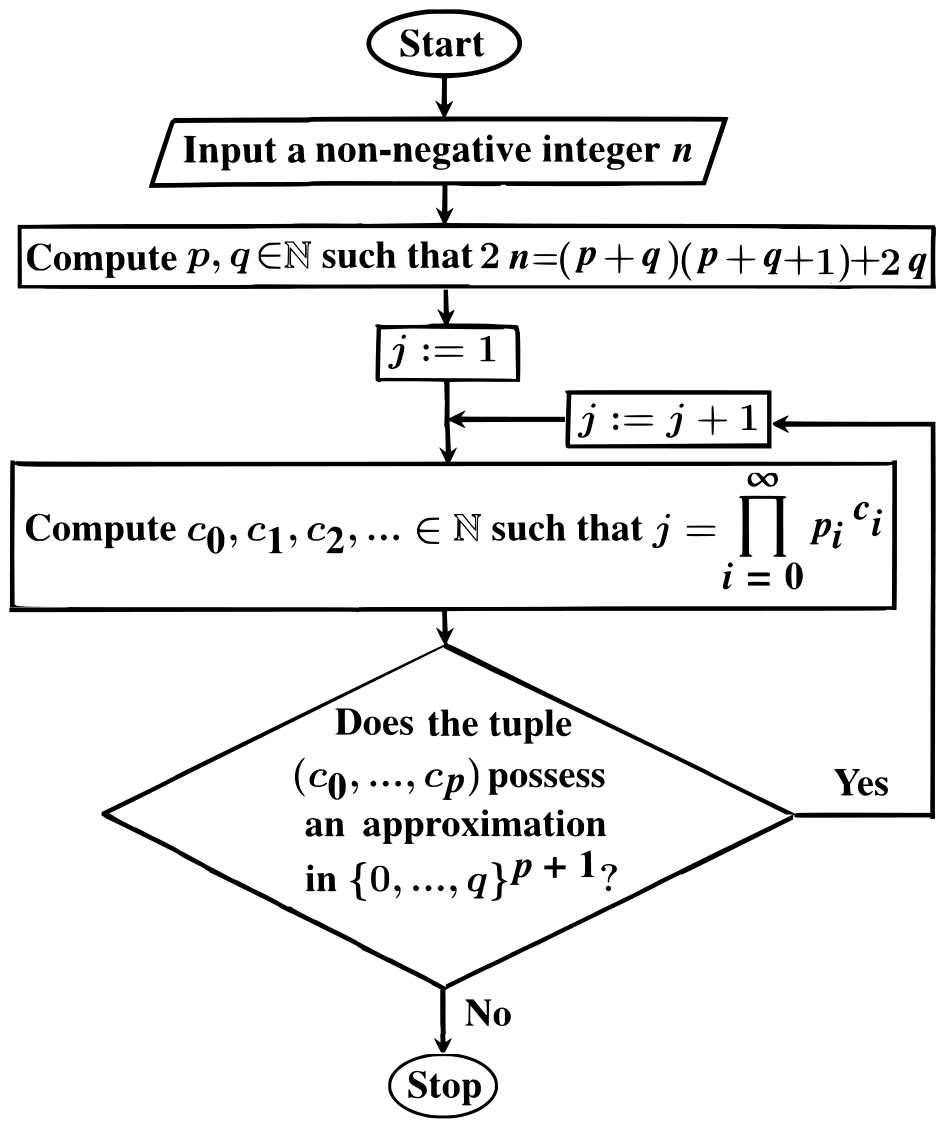
For , let denote the i-th prime number. Figure 3 shows a semi-algorithm which takes as input and terminates if and only if . □
Theorem 7.
The set T is not recursively enumerable.
Proof.
It follows from Theorems 5 and 6. □
Lemma 4.
([5], p. 110). For non-negative integers, the equation is equivalent to a system which consists of equations of the forms and .
For , denotes the smallest such that if a system of equations has a solution in , then S has a solution in . From Lemma 4 and [6], it follows that the function is computable in the limit and eventually dominates every computable function .
Theorem 8.
No algorithm takes as input non-negative integers n and m and decides whether or not
Proof.
It holds because the function h is not computable, and for every , is the smallest such that
□
Theorem 9.
No algorithm takes as input a non-negative integer n and decides whether or not
Proof.
It follows from Theorem 8 and Lemma 3. □
Let W denote the algorithmically undecidable subset of considered in Theorem 9. Similarly as in Theorem 6, the set is recursively enumerable. Similarly as in Theorem 7, the set W is not recursively enumerable. Let denote Gödel’s function, see [1]. For , equals the remainder after integer division of by .
Lemma 5
([1]). If , then .
Theorem 10.
The formula that defines the set W can be easily translated into a formula in Peano arithmetic.
Proof.
By Lemma 5, the set W consists of all such that
The above formula can be easily translated into a formula in Peano arithmetic. □
References
- Gödel’s β function, https://en.wikipedia.org/wiki/G%C3%B6del%27s_%CE%B2_function.
- J. P. Jones, Three universal representations of recursively enumerable sets, J. Symbolic Logic 43 (1978), no. 2, 335–351. [CrossRef]
- Pairing function, https://en.wikipedia.org/wiki/Pairing_function.
- R. I. Soare, Interactive computing and relativized computability, in: B. J. Copeland, C. J. Posy, and O. Shagrir (eds.), Computability: Turing, Gödel, Church and beyond, MIT Press, Cambridge, MA, 2013, 203–260.
- A. Tyszka, A hypothetical upper bound on the heights of the solutions of a Diophantine equation with a finite number of solutions, Open Comput. Sci. 8 (2018), no. 1, 109–114. [CrossRef]
- A. Tyszka, All functions which have a single-fold Diophantine representation are dominated by a limit-computable function which is implemented inMuPADand whose computability is an open problem, in: Computation, cryptography, and network security (eds. N. J. Daras, M. Th. Rassias), Springer, Cham, 2015, 577–590. [CrossRef]
Figure 1.
A semi-algorithm which computes in the limit.
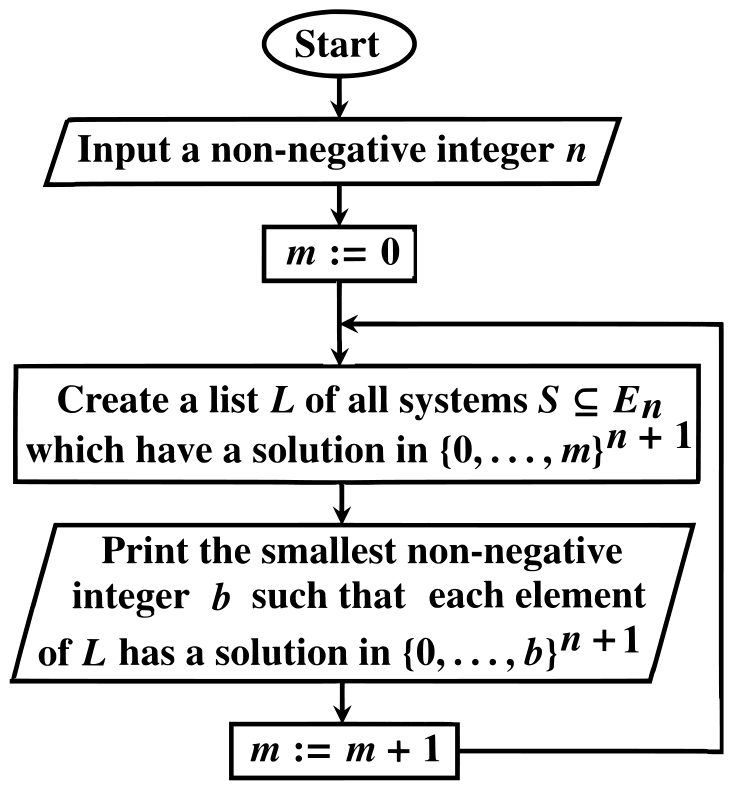
Figure 2.
A simpler semi-algorithm which computes in the limit.
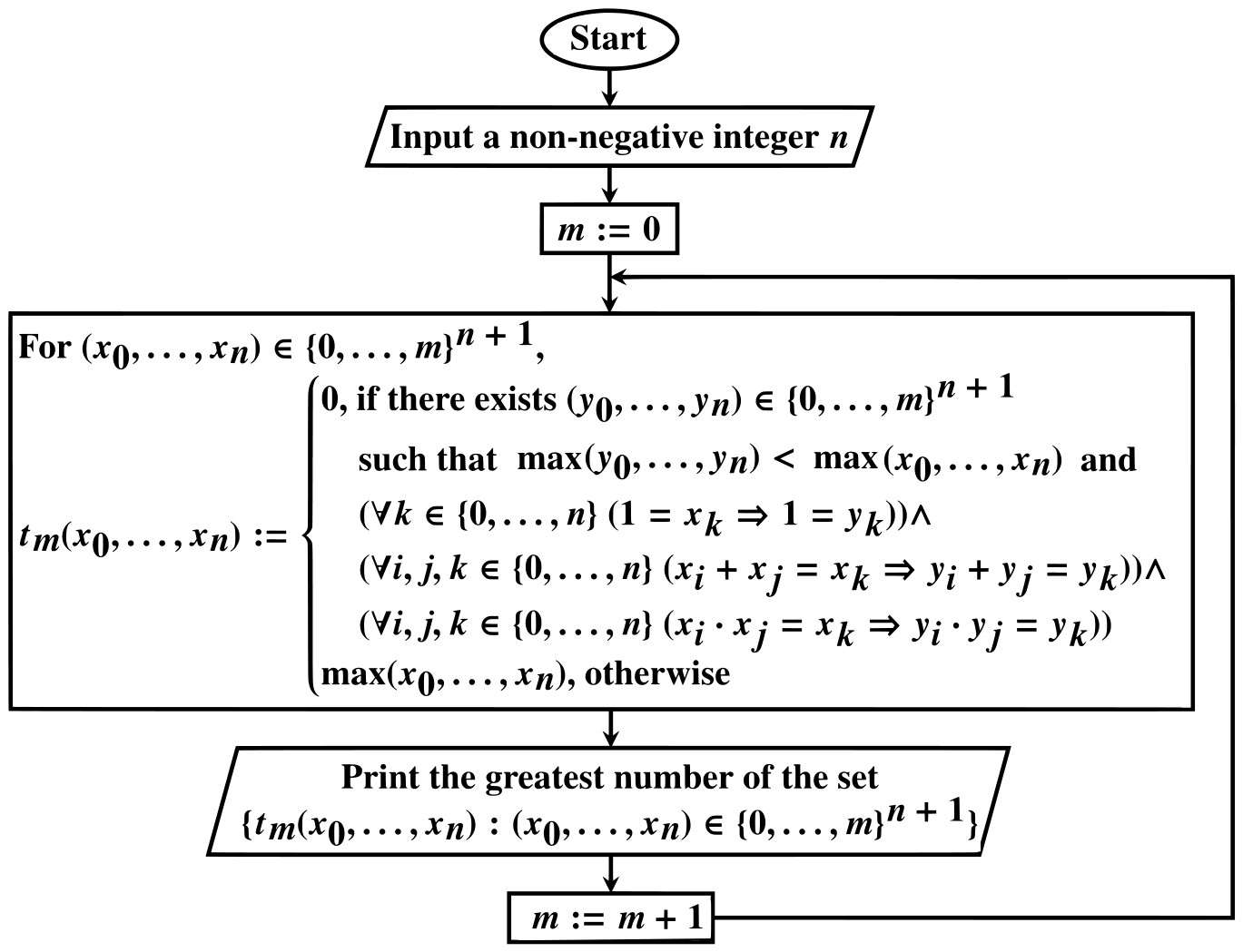
Figure 3.
A semi-algorithm which takes as input and terminates if and only if .
Disclaimer/Publisher’s Note: The statements, opinions and data contained in all publications are solely those of the individual author(s) and contributor(s) and not of MDPI and/or the editor(s). MDPI and/or the editor(s) disclaim responsibility for any injury to people or property resulting from any ideas, methods, instructions or products referred to in the content. |
© 2026 by the author. Licensee MDPI, Basel, Switzerland. This article is an open access article distributed under the terms and conditions of the Creative Commons Attribution (CC BY) license (http://creativecommons.org/licenses/by/4.0/).
Copyright: This open access article is published under a Creative Commons CC BY 4.0 license, which permit the free download, distribution, and reuse, provided that the author and preprint are cited in any reuse.


