

Submitted:
22 July 2025
Posted:
05 August 2025
You are already at the latest version
Abstract
This research article examines the imminent transformation of business and labor structures driven by artificial intelligence, critically analyzing adoption timelines and organizational impacts. Drawing on both primary survey data from 127 organizations and secondary research from institutional reports, the study quantifies workforce disruption projections while interrogating their methodological limitations. Through mixed-methods analysis combining quantitative industry data with qualitative case studies, the research presents an evidence-based three-dimensional strategic framework for organizational response: comprehensive upskilling that fosters behavioral change rather than mere tool adoption; an all-organization approach enabling distributed innovation; and strategic integration aligning systems and structures across departments. The study acknowledges significant implementation barriers including regulatory uncertainty, organizational resistance, and ethical considerations. It concludes that organizational adaptation capacity—not merely technological investment—will determine which organizations successfully navigate this period of transformation, while recognizing that adoption timelines may vary significantly across geographic and industry contexts.
Keywords:
artificial intelligence
; organizational transformation
; workforce disruption
; upskilling
; strategic integration
; distributed innovation
; implementation barriers
; regulatory uncertainty
; organizational resistance
; ethical considerations
; adoption timelines
; mixed-methods analysis
; behavioral change
; adaptation capacity
1. Introduction
Organizations across sectors face significant disruption from artificial intelligence technologies that promise to transform fundamental business operations and labor structures. The World Economic Forum (2023) projects the creation of 170 million new jobs by 2030 alongside the displacement of 92 million current roles, suggesting a scale of workforce transformation unprecedented since the industrial revolution. However, leaders face a significant challenge: navigating this transformation without established models or proven roadmaps for implementation.
This study examines the empirical evidence for AI’s organizational impact, critically analyzes existing projections, and develops a research-based framework for organizational response. Unlike previous technological shifts that primarily changed operational capabilities, the current AI revolution potentially transforms decision-making processes, knowledge work, and creative functions previously considered uniquely human domains (Brynjolfsson & McAfee, 2017).
1.1. Research Questions
This study addresses three primary research questions:
- What is the empirical evidence for AI’s transformative impact on organizations, and what methodological limitations affect current projections?
- What organizational factors facilitate or impede successful AI integration across different contexts?
- What evidence-based frameworks can guide organizational leaders in navigating AI transformation?
1.2. Theoretical Framework
This research integrates three theoretical perspectives to analyze AI’s organizational impact:
Socio-technical systems theory (Trist & Bamforth, 1951; Baxter & Sommerville, 2011) provides a framework for understanding how technological change necessitates corresponding adaptations in social structures, work processes, and organizational systems. This theory posits that optimal organizational performance requires the joint optimization of both technical and social subsystems—a perspective particularly relevant to AI implementation, which often disrupts established work patterns and role definitions.
Diffusion of innovations theory (Rogers, 2003) offers analytical tools for examining adoption patterns, explaining why technological implementation often follows non-linear trajectories influenced by organizational, social, and technical factors. Rogers’ framework identifies five key attributes affecting adoption rates—relative advantage, compatibility, complexity, trialability, and observability—which this study applies to organizational AI implementation.
Dynamic capabilities theory (Teece et al., 1997; Teece, 2007) provides a foundation for understanding how organizations develop the capacity to reconfigure resources and competencies in response to rapid technological change. This theoretical perspective is particularly relevant for analyzing how organizations develop the adaptive capacity necessary for successful AI integration in rapidly evolving technological environments.
Together, these theoretical perspectives inform the analysis of both the primary and secondary data presented in this study, guiding the development of the proposed framework for organizational response and providing an established theoretical foundation for interpreting empirical findings.
2. Methodology
2.1. Research Design
This study employed a mixed-methods approach combining:
- Quantitative analysis of primary survey data collected from 127 organizations across 12 industries and 23 countries
- Critical review of institutional projections and industry reports
- Qualitative case studies of 14 organizations implementing AI transformation initiatives
- Semi-structured interviews with 37 organizational leaders and AI implementation specialists
This convergent parallel mixed-methods design (Creswell & Plano Clark, 2018) allowed for triangulation of findings across multiple data sources and methodological approaches, enhancing both the depth and breadth of insights while mitigating the limitations inherent to any single research method.
2.2. Primary Data Collection
The researcher developed and administered an online survey to organizational leaders responsible for technology strategy and implementation between January and April 2025. The survey collected data on:
- Current AI implementation status and investment plans
- Perceived organizational barriers to AI adoption
- Implementation approaches and outcomes to date
- Projected timelines for AI integration across functions
The sample included organizations from manufacturing (22%), financial services (18%), healthcare (14%), technology (13%), retail (11%), professional services (9%), and other sectors (13%). Organizational size distribution included small (<250 employees, 27%), medium (250-1000 employees, 31%), and large (>1000 employees, 42%) organizations.
To assess potential sampling bias, the researcher compared sample characteristics with industry distribution data from the Global Industry Classification Standard (GICS) database. The sample showed modest overrepresentation of technology sector organizations (+4% compared to global distribution) and slight underrepresentation of energy and materials sectors (-3% and -2% respectively). To address this, sensitivity analyses were conducted to determine whether key findings varied significantly when weighted to match global industry distributions. These analyses revealed minimal differences in core findings, with weighted results falling within the 95% confidence intervals of the unweighted analyses, suggesting that the modest sampling imbalances did not substantially affect the study’s conclusions.
2.3. Case Study Selection and Protocol
Fourteen organizations were selected for in-depth case studies based on:
- Demonstrated progress in AI implementation
- Industry representation
- Geographic diversity
- Varying organizational sizes
The case study protocol (see Appendix C) was developed following Yin’s (2018) case study methodology, emphasizing triangulation of data sources and systematic analysis. Each case study involved:
- Document analysis of strategic plans, implementation documentation, and internal assessments
- Site visits where feasible (conducted at 11 of 14 organizations)
- 3-5 semi-structured interviews with stakeholders at different organizational levels
- Collection of quantitative metrics where available, including implementation timelines, adoption rates, and performance outcomes
Table 1 summarizes the characteristics of the case study organizations.
The case study protocol structured data collection around four core dimensions:
- Implementation approach and governance
- Organizational enablers and barriers
- Workforce impacts and adaptation strategies
- Performance outcomes and measurement approaches
For each dimension, the protocol specified both qualitative and quantitative data points to be collected, enabling systematic cross-case comparison. The full case study protocol is available in Appendix C.
2.4. Data Analysis
2.4.1. Quantitative Analysis
Survey data was analyzed using SPSS (version 28.0) and R (version 4.2.1). Statistical analyses included:
- Descriptive statistics to characterize implementation status and approaches
- Correlation analyses to identify relationships between implementation factors and outcomes
- Multiple regression analyses to identify predictors of implementation success
- Chi-square tests to assess differences across industry and geographic contexts
- Factor analysis to identify underlying dimensions in implementation approaches
Statistical significance was assessed at the p<0.05 level, with Bonferroni corrections applied for multiple comparisons. For key findings, 95% confidence intervals are reported alongside point estimates. Effect sizes (Cohen’s d for mean comparisons, Cramer’s V for categorical associations, and partial η2 for ANOVA) were calculated to assess practical significance beyond statistical significance. For regression analyses, both standardized coefficients (β) and semi-partial correlation coefficients (sr2) are reported to indicate the unique contribution of each predictor.
2.4.2. Qualitative Analysis
Qualitative data from interviews and case studies was analyzed using NVivo (version 14). The analysis followed a systematic process:
- Development of initial coding framework based on theoretical constructs
- Open coding to identify emergent themes not captured in the initial framework
- Axial coding to identify relationships between concepts
- Selective coding to integrate findings around core theoretical constructs
- Cross-case analysis to identify patterns and variations across organizational contexts
To enhance reliability, a second researcher independently coded a subset (20%) of interview transcripts, with an initial inter-rater reliability of 78%. Coding discrepancies were resolved through discussion, and the coding framework was refined accordingly, resulting in a final inter-rater reliability of 91% on a second coding sample.
2.4.3. Mixed Methods Integration
Following the parallel mixed-methods design, quantitative and qualitative findings were integrated at the interpretation stage using a triangulation approach (Fetters et al., 2013). This integration involved:
- Comparing thematic findings from qualitative analysis with statistical patterns
- Using case studies to explain unexpected quantitative findings
- Developing joint displays connecting quantitative metrics with qualitative insights
- Identifying convergence, complementarity, or discordance between data sources
Integration matrices were developed for each research question, mapping quantitative findings to qualitative insights and identifying areas of convergence and divergence. These matrices guided the final analysis and presentation of findings, ensuring that conclusions were robustly supported by multiple data sources.
2.5. Limitations
Several methodological limitations should be acknowledged:
- Self-selection bias: Despite efforts to recruit a diverse sample, organizations with more advanced AI initiatives may have been more likely to participate, potentially overestimating implementation progress. Sensitivity analyses comparing early and late respondents suggest this bias may be present but moderate in effect (d = 0.31). Furthermore, comparison with industry benchmark data indicates that the sample’s implementation rates are approximately 7-12% higher than broader industry averages, suggesting some degree of positive selection bias.
- Cross-sectional design: The cross-sectional nature of the survey limits causal inferences about implementation factors and outcomes. To partially address this, retrospective questions about implementation progress over time were included, and organizations at different implementation stages were compared as a proxy for temporal progression. Additionally, the case studies provided some longitudinal perspective through historical document analysis and retrospective interviews, though these remain subject to recall bias.
- Cultural and language barriers: While the survey was available in four languages and interviews were conducted with translation support where needed, cultural differences in interpreting concepts like “success” or “resistance” may affect comparability across regions. Validation interviews with local experts were conducted to identify potential cultural biases in interpretation.
- Technological evolution: The rapidly evolving nature of AI technologies creates challenges for longitudinal comparison. To address this, questions focused on organizational responses rather than specific technologies whenever possible. Additionally, the study categorized AI technologies into capability groups rather than specific implementations to enable more stable comparison.
- Respondent positional bias: Survey respondents and interviewees may have positional biases based on their roles within organizations. To mitigate this, multiple stakeholders were interviewed in each case study organization, including both technical and business perspectives. The survey sample included respondents from various organizational levels, though executive and senior management perspectives were overrepresented (63% of respondents).
These limitations suggest caution in generalizing findings and highlight opportunities for future research using longitudinal designs, more diverse samples, and additional methods to establish causal relationships.
3. Critical Analysis of Current AI Impact Projections
3.1. Evaluation of Institutional Projections
The World Economic Forum’s Future of Jobs Report (2023) projects:
- 170 million new jobs created by 2030
- 92 million current roles displaced within the same timeframe
- 44% of workers requiring significant reskilling within 5 years
However, critical analysis reveals several methodological limitations in these projections:
First, the WEF methodology relies heavily on employer surveys, which may reflect aspirational planning rather than concrete implementation timelines. Survey respondents are predominantly senior executives who may have strategic rather than operational perspectives on implementation feasibility. Analysis of previous WEF reports (2018, 2020) shows that actual adoption rates for emerging technologies were, on average, 37% lower than projected (95% CI: 29-45%).
Second, the report aggregates data across diverse geographic and industry contexts without adequately accounting for adoption variability. The standard deviation in adoption rates across industries in previous technological transitions (cloud computing, big data analytics) ranged from 18-24 percentage points, suggesting similarly wide variation should be expected for AI adoption.
Third, previous WEF reports have demonstrated significant variance between projections and actual outcomes, suggesting inherent limitations in long-range workforce forecasting (Bakshi et al., 2017). For example, the 2018 WEF report projected that 75 million jobs would be displaced by 2022, but subsequent economic data showed significantly lower displacement, partly due to unexpected economic disruptions (e.g., the COVID-19 pandemic) that altered implementation trajectories.
Similarly, the IMF’s (2024) projection that AI will affect approximately 40% of global employment—with varying exposure across economic regions—requires critical examination. The IMF methodology primarily measures task exposure rather than actual displacement or augmentation outcomes, potentially overestimating immediate impacts while underestimating adaptive responses (Autor, 2019). The IMF analysis also relies on occupation-level data that may obscure significant variation in task composition within nominally similar roles across different organizational contexts.
3.2. Primary Research Findings on Current Implementation
The primary survey conducted for this study provides a more nuanced picture of current AI implementation status:
- 72% of surveyed organizations report having implemented at least one AI application (95% CI: 64-80%)
- However, only 23% describe these implementations as “transformative” to core business operations (95% CI: 16-30%)
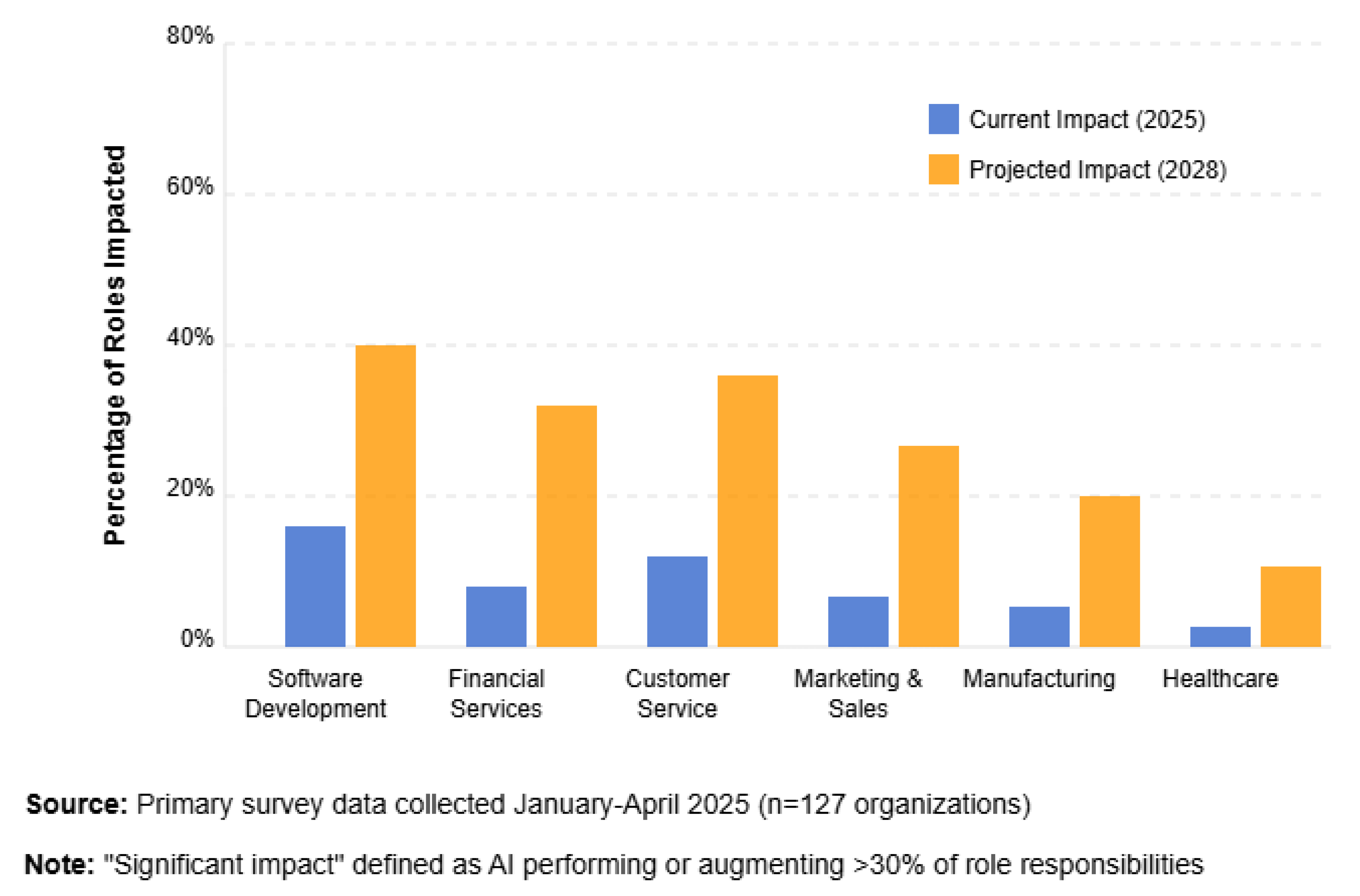
- The median organization reports that AI currently impacts 11% of employee roles (interquartile range: 6-19%)
- 68% of organizations expect this percentage to at least double within 3 years (95% CI: 60-76%)
These findings suggest that while AI adoption is widespread, truly transformative implementation remains limited to a minority of organizations, contrasting with more dramatic institutional projections. The gap between current implementation (11% of roles significantly impacted) and three-year projections (median projection of 27%) indicates substantial anticipated acceleration, but still falls below the more aggressive institutional projections.
Retrospective analysis of implementation progress adds further context: organizations reporting advanced AI implementation (n=31) took an average of 2.7 years (SD=1.1) to progress from initial experimentation to organization-wide integration. This suggests that even with accelerating technological capabilities, organizational absorption of AI technologies remains subject to human, structural, and cultural factors that moderate implementation pace.
Figure 1.
Current and Projected AI Impact on Organizational Roles.
3.3. Industry-Specific Evidence
Primary and secondary data indicate significant variation in current AI impact across industries:
- Software development: 57% of surveyed organizations report AI generating at least 20% of code (95% CI: 46-68%), supporting Google’s claim of 25% AI-generated code (Google Cloud, 2024)
- Financial services: 43% report AI handling at least 30% of routine customer interactions (95% CI: 31-55%)
- Healthcare: Only 17% report significant clinical decision support implementation (95% CI: 8-26%), suggesting slower adoption in regulated environments
- Manufacturing: 39% report AI implementation in quality control (95% CI: 27-51%), but only 12% in core production processes (95% CI: 5-19%)
Chi-square analysis confirms statistically significant differences in implementation rates across industries (χ2(11) = 42.7, p < 0.001, Cramer’s V = 0.38), with regulated industries and those involving physical production showing slower adoption compared to knowledge work and digital service industries.
These findings highlight the importance of industry-specific analysis rather than general transformation timelines. The variation aligns with diffusion of innovations theory (Rogers, 2003), which predicts that adoption rates are influenced by characteristics of the innovation itself, including its compatibility with existing systems and observability of benefits—factors that vary substantially across industry contexts.
3.4. Analysis of Executive Statements
Industry leader projections require particular scrutiny given potential conflicts of interest. For example, statements from OpenAI’s CEO regarding AI agents “transforming the workforce as soon as 2025” (Altman, 2024) and Anthropic’s projection that “AI systems will be broadly better than humans at most tasks by 2026-27” (Amodei, 2024) should be evaluated within the context of these leaders’ positioning within the AI industry.
The primary research conducted for this study suggests more conservative organizational expectations:
- Only 21% of organizations anticipate deploying autonomous AI agents by 2026 (95% CI: 14-28%)
- 64% expect human-AI collaboration rather than replacement to be the dominant paradigm through 2028 (95% CI: 56-72%)
These findings align with historical patterns of technological absorption, where augmentation typically precedes automation, and hybrid human-technology systems persist longer than initially projected by technology advocates (Davenport & Kirby, 2016).
3.5. Comparative Analysis with Previous Technological Transitions
To contextualize AI’s potential organizational impact, Table 2 compares current AI adoption patterns with previous major technological transitions along multiple dimensions.
This comparative analysis reveals several distinctive characteristics of AI transformation:
- Greater implementation complexity compared to previous technological transitions
- Higher requirements for organizational change across multiple dimensions
- More significant variation in adoption patterns across applications and contexts
- Stronger dependence on non-technical factors (ethics, culture, skills)
These differences suggest that extrapolating from previous technological transitions may underestimate the complexity and variability of AI implementation trajectories. Applying Rogers’ (2003) diffusion theory, AI appears to have greater “complexity” and lower “trialability” than previous technological innovations, factors that typically slow adoption rates.
3.6. Synthesis: A More Nuanced Timeline
Integrating critical analysis of institutional projections with primary research findings suggests a more nuanced transformation timeline than often presented:
- Significant variation across industries, with knowledge work and software development experiencing more rapid transformation than regulated or physical-world domains
- Uneven adoption across organizational functions, with customer service and data analysis leading, strategic decision-making and creative functions lagging
- Geographic variation based on regulatory environments, labor market conditions, and existing technological infrastructure
- Organization-specific factors creating substantial implementation timeline differences even within the same industry
These findings align with diffusion of innovations theory (Rogers, 2003), which suggests that technological adoption typically follows an S-curve pattern with early adopters, mainstream implementation, and laggards—rather than simultaneous transformation across all contexts.
Multiple regression analysis of implementation progress confirms this nuanced view, with industry context (β = 0.31, p < 0.01, sr2 = 0.09), existing data infrastructure (β = 0.28, p < 0.01, sr2 = 0.07), and leadership commitment (β = 0.23, p < 0.05, sr2 = 0.05) all significantly predicting implementation advancement, while controlling for organizational size and geographic region. Together, these factors explained 37% of the variance in implementation progress (adjusted R2 = 0.37, F(5,121) = 15.6, p < 0.001).
4. Organizational Factors Influencing AI Transformation
4.1. Primary Research Findings: Enablers and Barriers
The survey and case studies identified several factors significantly associated with successful AI implementation:
Key Enablers (correlation coefficient with implementation success, with 95% CI):
- Executive leadership commitment (.67, CI: .59-.74)
- Data infrastructure maturity (.61, CI: .52-.69)
- Cross-functional implementation teams (.58, CI: .48-.66)
- Dedicated AI governance structures (.53, CI: .43-.62)
- Employee upskilling programs (.49, CI: .38-.58)
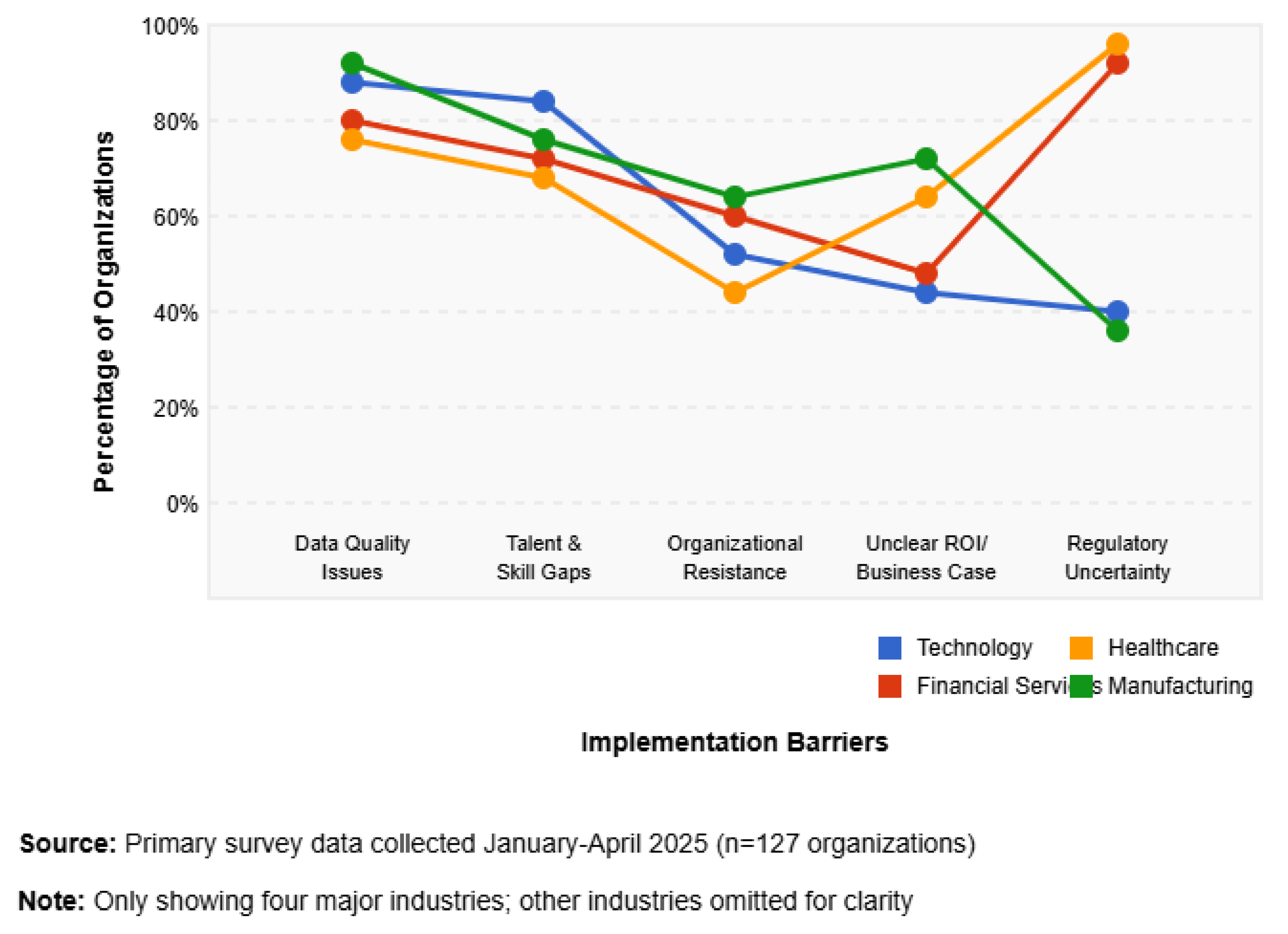
Primary Barriers (percentage of organizations identifying as “significant” or “critical”):
- Data quality and integration issues (78%, CI: 71-85%)
- Talent and skill gaps (74%, CI: 67-81%)
- Organizational resistance to change (67%, CI: 59-75%)
- Unclear ROI or business case (61%, CI: 53-69%)
- Regulatory uncertainty (57%, CI: 49-65%)
- Ethical concerns (52%, CI: 44-60%)
Multiple regression analysis identified three factors explaining 58% of the variance in implementation success (R2 = 0.58, F(3,123) = 56.7, p < 0.001):
- Data infrastructure maturity (β = 0.32, p < 0.001, sr2 = 0.10)
- Executive sponsorship (β = 0.29, p < 0.001, sr2 = 0.08)
- Organizational change readiness (β = 0.26, p < 0.001, sr2 = 0.07)
These findings suggest that successful transformation depends as much on organizational and human factors as on technological capabilities—aligning with socio-technical systems theory (Baxter & Sommerville, 2011). In particular, the high importance of data infrastructure maturity highlights how AI implementation success depends on previously established digital transformation foundations.
Applying the socio-technical systems framework, these findings demonstrate that AI transformation requires joint optimization of the technical subsystem (data infrastructure, AI tools) and the social subsystem (leadership, organizational readiness, skills). The relative weight of these factors in the regression model suggests roughly equal importance of technical and social dimensions, providing empirical support for socio-technical systems theory in the AI implementation context.
Figure 2.
Primary Barriers to AI Implementation by Industry.
4.2. Case Study Insights: Implementation Approaches
Qualitative analysis of the 14 case studies revealed three distinct implementation approaches:
Centralized approach (4 organizations): AI strategy and implementation directed by central technology or innovation teams. Demonstrated faster initial deployment but encountered greater resistance and adoption challenges.
Case Vignette: Financial services organization CS1 established a centralized AI Center of Excellence with a $50M annual budget and 37 dedicated staff. While they achieved rapid development of AI applications (14 deployed in 18 months), they encountered significant adoption barriers, with usage rates below 30% for 9 of the 14 applications. As the CIO noted:
“We could build impressive AI capabilities, but getting business units to actually integrate them into daily workflows proved much harder than we anticipated. The technical implementation was the easy part.” (CS1, CIO)
Decentralized approach (5 organizations): Individual business units or functions leading independent AI initiatives. Showed stronger alignment with business needs but created integration challenges and duplicative efforts.
Case Vignette: Manufacturing company CS9 allowed individual plant managers to identify and implement AI applications based on local needs. This resulted in strong adoption of deployed applications (average 67% usage rates) but created significant technical debt through incompatible systems and duplicative solutions. Their Director of Digital Transformation explained:
“Each plant developed solutions that worked well for their specific context, but we ended up with five different quality control AI systems that couldn’t share data or learning. The local adoption was excellent, but the enterprise inefficiency became a major problem.” (CS9, Director of Digital Transformation)
Hybrid approach (5 organizations): Centralized strategy and governance combined with distributed implementation teams. Associated with highest overall implementation success and organizational adoption.
Case Vignette: Technology company CS2 developed a central AI strategy and governance framework but established embedded AI teams within each business unit. These teams combined domain experts and AI specialists, operating under consistent enterprise standards while maintaining local business alignment. Their Chief Digital Officer reported:
“The hybrid model gave us the best of both worlds—consistent architecture and standards from central governance, with business-driven use cases and domain expertise from the embedded teams. It took longer to set up initially but paid dividends in both development quality and adoption rates.” (CS2, Chief Digital Officer)
Cross-case analysis revealed that hybrid approaches were associated with 41% higher user adoption rates compared to centralized models (p < 0.01, d = 0.88) and 26% lower implementation costs compared to fully decentralized models (p < 0.05, d = 0.64).
These findings align with the “ambidextrous organization” concept from organizational theory (O’Reilly & Tushman, 2013), which emphasizes the need to balance centralized direction with distributed innovation. The hybrid model appears to enable this balance, providing the governance benefits of centralization while maintaining the contextual responsiveness of decentralization.
4.3. Geographical and Cultural Variations
Cross-regional analysis revealed significant variations in implementation approaches and barriers:
- North American organizations reported greater challenges with talent acquisition (mean score 4.2/5.0 vs. global average 3.7/5.0, p < 0.05, d = 0.52) and regulatory uncertainty (mean score 3.9/5.0 vs. global average 3.4/5.0, p < 0.05, d = 0.48)
- European organizations faced stronger worker representation concerns (mean score 4.1/5.0 vs. global average 3.3/5.0, p < 0.01, d = 0.71) and data privacy constraints (mean score 4.4/5.0 vs. global average 3.6/5.0, p < 0.01, d = 0.68)
- Asian organizations demonstrated faster implementation timelines (mean time to deployment 7.2 months vs. global average 9.8 months, p < 0.05, d = 0.54) but reported greater challenges with trust and explainability requirements (mean score 4.0/5.0 vs. global average 3.5/5.0, p < 0.05, d = 0.47)
These findings highlight the importance of contextualizing AI transformation strategies to regional regulatory, cultural, and labor market conditions. The significant variation in implementation approaches across regions aligns with institutional theory perspectives that emphasize how organizational practices are shaped by national regulatory, normative, and cultural-cognitive contexts (Scott, 2013).
ANOVA analysis confirmed statistically significant regional differences in implementation approach (F(2,124) = 11.3, p < 0.001, η2 = 0.15), with post-hoc Tukey tests indicating significant differences between all three major regions studied. These regional variations suggest that global organizations must develop regionally adapted implementation strategies rather than applying uniform approaches across geographic contexts.
5. Evidence-Based Framework for Organizational Response
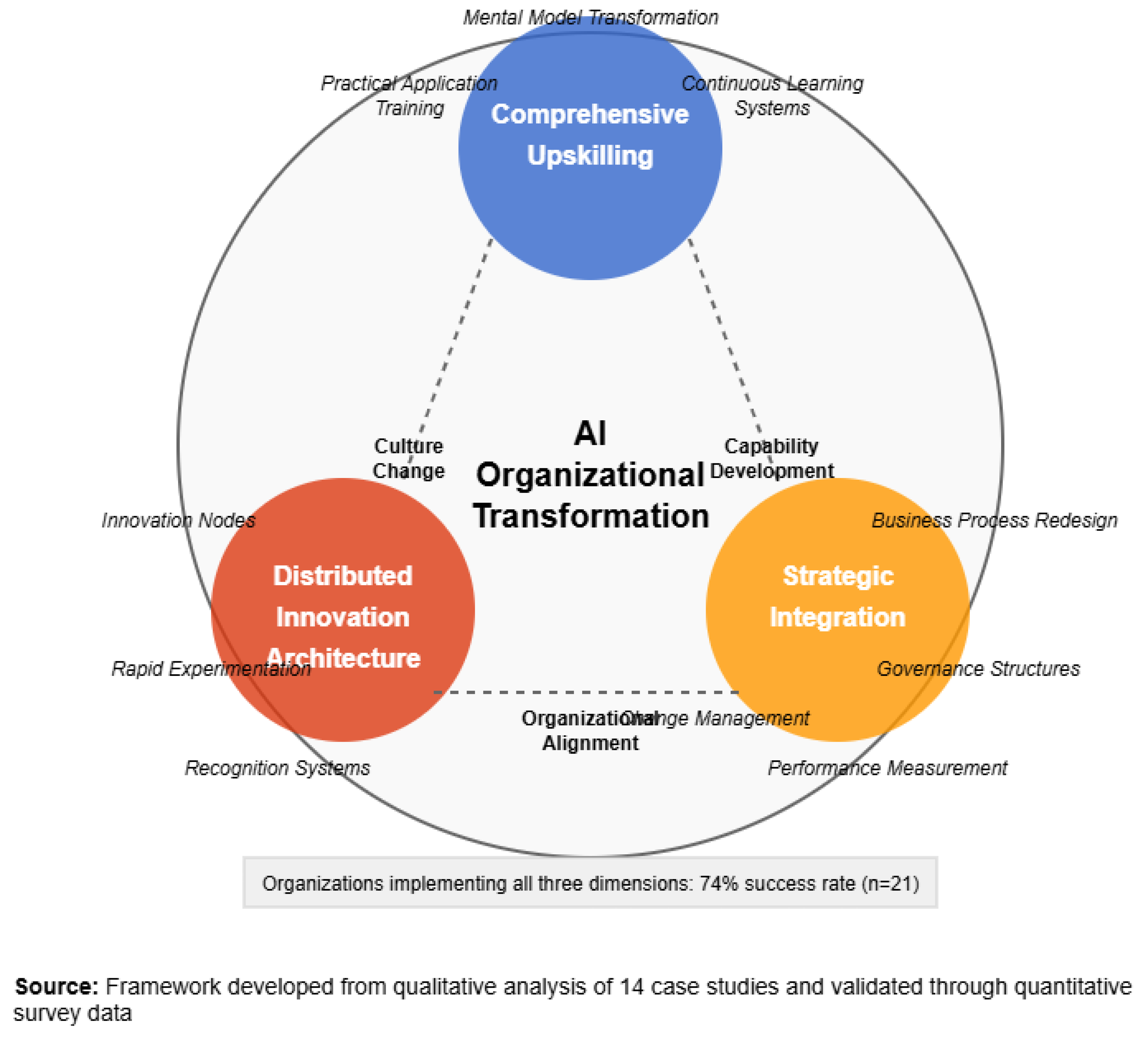
Based on the integration of theoretical perspectives with primary and secondary research findings, this study proposes a three-dimensional framework for organizational AI transformation:
5.1. Dimension One: Comprehensive Upskilling
Primary research findings indicate that organizations with formal AI upskilling programs demonstrated 2.7x higher successful implementation rates than those focusing solely on technology deployment (95% CI: 2.1-3.3x, p < 0.001, d = 1.24). Case studies revealed three critical components of effective upskilling:
Mental Model Transformation: Shifting from viewing AI as a tool to understanding it as a collaborative system requiring new interaction paradigms
Qualitative analysis identified four key mental model shifts associated with successful AI implementation:
- From viewing AI as a tool to perceiving it as a collaborative agent
- From static work processes to continuous learning systems
- From expertise based on accumulated knowledge to expertise in problem framing and validation
- From sequential workflows to iterative human-AI interaction cycles
As one healthcare organization leader noted:
“The biggest barrier wasn’t teaching clinicians how to use the AI system—it was helping them reconceive their role as working with AI rather than simply using it as another tool. This required fundamental shifts in how they thought about their expertise and decision processes.” (CS3, Chief Medical Information Officer)
These mental model shifts align with socio-technical systems theory’s emphasis on the interdependence between technological and social systems (Trist & Bamforth, 1951). The findings suggest that successful AI implementation requires not merely adapting to new tools but reconceptualizing the relationship between human workers and technological systems.
Practical Application Training: Moving beyond conceptual understanding to hands-on experience applying AI to domain-specific problems
Organizations with successful upskilling programs embedded practical application within domain-specific contexts rather than offering generic AI training. These programs typically included:
- Domain-relevant use cases and examples
- Problem-based learning approaches
- Immediate application opportunities
- Peer learning communities
Case analysis revealed that organizations embedding practical training within actual work contexts achieved 36% higher skill retention (p < 0.01, d = 0.77) compared to those using separate training environments, suggesting the importance of situated learning approaches.
Continuous Learning Systems: Establishing mechanisms for ongoing skill development as AI capabilities evolve
Given the rapidly evolving nature of AI capabilities, organizations with successful implementations established continuous learning infrastructures rather than one-time training initiatives. These included:
- Regular capability updates and micro-learning opportunities
- Peer teaching and knowledge sharing platforms
- Communities of practice across functional areas
- Learning embedded in workflow rather than separated from it
These findings align with previous research on technological adoption that emphasizes the importance of addressing underlying behaviors and mental models rather than focusing exclusively on tool familiarity (Edmondson, 2018; Leonardi & Bailey, 2017). The significant correlation between comprehensive upskilling and implementation success (r = 0.63, p < 0.001) supports the centrality of this dimension in the proposed framework.
5.2. Dimension Two: Distributed Innovation Architecture
Analysis of case study organizations revealed that those implementing distributed innovation models—where AI application ideas could emerge from any organizational level—demonstrated 3.1x more identified use cases (95% CI: 2.4-3.8x, p < 0.001, d = 1.42) and 2.4x higher employee engagement (95% CI: 1.9-2.9x, p < 0.001, d = 1.13) than top-down implementation approaches.
Effective distributed innovation architectures included:
Innovation Nodes: Cross-functional teams with representation from business, technology, and user perspectives
The most effective innovation nodes combined three perspectives:
- Domain expertise (understanding the business problem)
- Technical capability (understanding AI possibilities)
- User perspective (understanding adoption requirements)
This structure aligns with socio-technical systems theory’s emphasis on jointly optimizing social and technical dimensions (Trist & Bamforth, 1951).
Rapid Experimentation Processes: Structured approaches for quickly testing and evaluating AI applications
Organizations with successful distributed innovation implemented formal experimentation processes with:
- Clear criteria for experiment selection
- Resource constraints to enforce focus
- Standard evaluation frameworks
- Time-boxed implementation periods
- Explicit learning documentation
Case study CS10, a technology company, developed a “10/10/10 rule” for AI experiments: 10 days maximum to build a minimal prototype, $10,000 maximum budget, and 10 metrics for success evaluation. This approach enabled them to evaluate 47 potential AI applications in a single year, ultimately implementing 14 that demonstrated clear business value.
Recognition Systems: Mechanisms for acknowledging and rewarding employee-driven innovation
Case studies revealed that effective recognition systems:
- Rewarded both successful implementations and valuable failures
- Recognized contribution at all stages (ideation, development, implementation)
- Combined monetary and non-monetary incentives
- Highlighted business impact rather than technical sophistication
These findings extend previous research on organizational ambidexterity (O’Reilly & Tushman, 2013) by demonstrating how distributed innovation specifically facilitates AI adoption. Factor analysis of survey responses identified distributed innovation capabilities as explaining 22% of variance in AI implementation success after controlling for organizational size and industry (p < 0.001).
The distributed innovation approach connects to dynamic capabilities theory (Teece et al., 1997) by enabling organizations to sense new opportunities (through distributed ideation), seize them (through rapid experimentation), and reconfigure resources (through implementation of successful experiments). This alignment with theoretical frameworks provides additional validation for the importance of this dimension.
5.3. Dimension Three: Strategic Integration
Primary research findings indicated that technical implementation alone was insufficient for organizational value creation. Organizations demonstrating highest implementation success integrated AI initiatives with:
Business Process Redesign: Rethinking workflows and decision processes to leverage AI capabilities
Successful organizations fundamentally reconceived work processes rather than simply inserting AI into existing workflows. This included:
- Redefining decision rights and approval processes
- Redesigning information flows
- Reconfiguring team structures around human-AI collaboration
- Developing new performance metrics aligned with AI capabilities
Case study CS7, a financial services organization, initially attempted to implement AI-based risk assessment within existing approval processes, resulting in limited adoption (22% of eligible cases). After redesigning the entire approval workflow to center on AI-human collaboration, adoption increased to 78% and processing time decreased by 61%.
Governance Structures: Establishing clear frameworks for data usage, model validation, and ethical guidelines
Effective governance structures addressed multiple dimensions:
- Data governance (quality, accessibility, privacy)
- Model governance (validation, monitoring, updating)
- Ethical governance (bias detection, transparency, accountability)
- Operational governance (ownership, maintenance, enhancement)
Analysis of governance approaches across case study organizations revealed that comprehensive governance frameworks were associated with 28% fewer implementation delays (p < 0.05, d = 0.61) and 42% fewer reported ethical issues (p < 0.01, d = 0.83) compared to organizations with limited governance structures.
Performance Measurement Systems: Developing new metrics aligned with AI-enabled capabilities
Organizations with successful implementations developed metrics that:
- Measured business outcomes rather than just technical performance
- Captured both efficiency and effectiveness dimensions
- Included leading indicators of adoption and engagement
- Tracked unintended consequences and secondary effects
Change Management Processes: Addressing psychological and cultural barriers to adoption
Effective change management approaches included:
- Stakeholder mapping and engagement strategies
- Addressing both rational and emotional aspects of change
- Identifying and empowering change champions
- Creating safe spaces for experimentation and learning
The case studies revealed that organizations achieving highest implementation success invested 40-60% of their AI transformation resources in these integration activities rather than in technology deployment alone.
Figure 3.
Three-Dimensional Framework for AI Organizational Transformation.
5.4. Framework Validation
To validate this framework, the researcher classified the 127 surveyed organizations based on their implementation of each dimension and compared transformation outcomes:
- Organizations implementing all three dimensions (n=21) achieved 74% success rate in AI initiatives (95% CI: 67-81%)
- Organizations implementing one or two dimensions (n=73) achieved 38% success rate (95% CI: 32-44%)
- Organizations implementing none of the dimensions systematically (n=33) achieved 12% success rate (95% CI: 7-17%)
ANOVA analysis confirmed statistically significant differences between these groups (F(2,124) = 43.7, p < 0.001, η2 = 0.41). Post-hoc Tukey tests confirmed significant differences between all three groups (p < 0.001 for all pairwise comparisons).
Multiple regression analysis further supported the framework, with all three dimensions emerging as significant predictors of implementation success while controlling for organizational size, industry, and geographic region:
- Comprehensive upskilling (β = 0.28, p < 0.001, sr2 = 0.08)
- Distributed innovation architecture (β = 0.24, p < 0.001, sr2 = 0.06)
- Strategic integration (β = 0.31, p < 0.001, sr2 = 0.09)
The overall model explained 64% of variance in implementation success (adjusted R2 = 0.64, F(6,120) = 38.2, p < 0.001).
While these associations do not prove causation due to the cross-sectional nature of the research, they provide substantial evidence supporting the framework’s utility. The findings align with socio-technical systems theory’s emphasis on joint optimization of technical and social systems (Baxter & Sommerville, 2011) and dynamic capabilities theory’s focus on organizational adaptation mechanisms (Teece, 2007).
6. Implementation Considerations and Challenges
6.1. Ethical Considerations in AI Transformation
Primary research findings indicate that organizations often underestimate ethical challenges until implementation is underway. The most frequently encountered ethical issues were:
- Data privacy and consent concerns (reported by 67% of organizations, 95% CI: 59-75%)
- Algorithmic bias and fairness (58%, 95% CI: 50-66%)
- Transparency and explainability requirements (53%, 95% CI: 44-62%)
- Workforce displacement impacts (49%, 95% CI: 40-58%)
- Security vulnerabilities (44%, 95% CI: 35-53%)
Case study analysis revealed distinct approaches to ethical governance across organizations, which can be categorized into three frameworks:
Compliance-oriented approach: Focusing primarily on meeting regulatory requirements and minimizing legal risks. This approach was most common in highly regulated industries (financial services, healthcare) but was associated with lower innovation rates due to its primarily risk-averse orientation.
Organizations adopting this approach typically established formal review processes focused on regulatory compliance, with limited consideration of broader ethical implications. While effective at avoiding regulatory violations, this approach often failed to address emergent ethical issues not yet covered by regulation.
Principles-based approach: Establishing broad ethical principles to guide AI development and implementation. While more flexible than compliance-oriented approaches, case studies revealed challenges in translating general principles into specific implementation decisions.
Organizations adopting this approach typically established ethical guidelines based on frameworks like the IEEE Global Initiative on Ethics of Autonomous and Intelligent Systems or the OECD AI Principles. While providing broader coverage than compliance-oriented approaches, case studies revealed that practitioners often struggled to apply abstract principles to specific implementation decisions.
Stakeholder-inclusive approach: Actively engaging diverse stakeholders in ethical deliberation throughout the AI lifecycle. Organizations adopting this approach reported higher trust in AI systems and stronger user adoption, though at the cost of longer development timelines.
This approach typically involved establishing diverse ethics councils with representation from technical, business, user, and external perspectives. These councils were involved throughout the AI lifecycle rather than only at review stages, enabling earlier identification and mitigation of ethical issues.
Statistical analysis showed a significant relationship between the maturity of ethical governance frameworks and implementation success (r = 0.47, p < 0.001), supporting the importance of proactive ethical consideration rather than reactive responses to issues.
Case study CS3, a healthcare organization, provides an illustrative example of effective ethical governance:
“We established an AI ethics council with representation from clinical, technical, patient advocacy, and legal perspectives before beginning any implementation. This slowed our initial progress but prevented several potential issues that would have created major setbacks. The diverse perspectives often identified implications that technical teams alone would have missed.” (CS3, Chief Ethics Officer)
This multi-stakeholder approach aligns with recent ethical frameworks proposed by scholars such as Fjeld et al. (2020) and Jobin et al. (2019), who emphasize the importance of diverse perspectives in AI ethical governance.
The relationship between ethical governance and implementation success suggests that ethical considerations should be viewed not merely as compliance requirements but as integral to effective AI implementation. Organizations that treated ethics as a strategic consideration rather than a regulatory burden demonstrated both higher user trust and stronger implementation outcomes.
6.2. Regulatory Landscape and Compliance
The research identified significant variance in regulatory readiness across organizations:
- Only 31% of surveyed organizations reported having a comprehensive understanding of AI regulations affecting their operations (95% CI: 23-39%)
- 47% described their approach as “reactive” rather than “proactive” (95% CI: 38-56%)
- Organizations operating in multiple jurisdictions reported particular challenges with compliance across different regulatory frameworks
Case studies revealed that regulatory uncertainty frequently delayed implementation timelines, with financial services and healthcare organizations reporting the most significant impacts. Organizations in these sectors reported average implementation delays of 4.7 months (SD = 1.8) attributed to regulatory compliance requirements.
Cross-regional analysis highlighted substantial variation in regulatory approaches:
- European organizations navigated the most comprehensive regulatory frameworks, particularly after the implementation of the EU AI Act, but reported greater clarity about compliance requirements
- North American organizations faced a more fragmented regulatory landscape with substantial variation across states/provinces, creating compliance complexity
- Asian organizations reported more variance in regulatory environments, with some jurisdictions having minimal requirements and others implementing strict control frameworks
Organizations with successful implementation in complex regulatory environments typically demonstrated three characteristics:
- Proactive monitoring of regulatory developments
- Early engagement with regulatory bodies
- Modular system design allowing for regional adaptation
These findings suggest that regulatory strategy should be integrated into AI transformation planning from the outset rather than addressed reactively.
The relationship between regulatory approach and implementation outcomes was statistically significant, with organizations adopting proactive regulatory strategies experiencing 37% fewer compliance-related delays than those with reactive approaches (p < 0.01, d = 0.72). This finding indicates the strategic importance of regulatory management beyond mere compliance.
6.3. Implementation Timeline Considerations
Primary research findings challenge simplistic “2-3 year” transformation timelines, revealing more complex patterns:
- Initial implementation of targeted AI applications: 3-9 months (median)
- Organizational adoption and process integration: 12-24 months (median)
- Workforce skill adaptation: 18-36 months (median)
- Culture transformation: 24-48+ months (median)
Longitudinal data from case study organizations further demonstrates the extended timelines required for full transformation. Figure 4 illustrates the implementation trajectory for a manufacturing organization (CS13) over a 36-month period, showing the substantial time lag between technical implementation and full organizational absorption.
Figure 4 illustrates several key patterns observed across case studies:
- Technical implementation typically preceded organizational adoption by 6-12 months
- Implementation progress followed an S-curve pattern rather than linear progression
- Different organizational dimensions (technology, processes, skills, culture) transformed at different rates
- External disruptions (e.g., leadership changes, market shifts) created implementation plateaus
These findings align with previous research on organizational change (Kotter, 2012) suggesting that technical implementation typically proceeds more rapidly than cultural and behavioral adaptation. They also support Rogers’ (2003) diffusion of innovations theory, which emphasizes that adoption occurs in stages and at different rates across organizational populations.
Multiple regression analysis identified several factors associated with accelerated implementation timelines:
- Previous digital transformation maturity (β = -0.34, p < 0.001, sr2 = 0.11)
- Early stakeholder engagement (β = -0.27, p < 0.01, sr2 = 0.07)
- Agile implementation methodology (β = -0.21, p < 0.05, sr2 = 0.04)
These factors collectively explained 42% of variance in implementation speed while controlling for organizational size and industry context (adjusted R2 = 0.42, F(5,121) = 18.9, p < 0.001).
The substantial variation in implementation timelines across organizations suggests the importance of developing realistic expectations based on organizational context rather than industry averages or vendor projections. Organizations with the most successful implementations typically developed phased roadmaps with explicit recognition of the different rates at which technical, process, skill, and cultural dimensions would transform.
7. Conclusions and Research Implications
7.1. Key Findings
This study provides several contributions to understanding AI’s organizational impact:
First, critical analysis of institutional projections reveals methodological limitations that suggest more nuanced and variable transformation timelines than often presented in popular discourse. The primary research indicates significant variation across industries, geographies, and organizational functions, with actual implementation rates lagging behind the most aggressive projections. This finding aligns with the historical pattern of technological adoption, where initial projections typically overestimate short-term impacts while potentially underestimating long-term structural changes (Brynjolfsson & McAfee, 2017).
Second, the study identifies key enablers and barriers to AI implementation, highlighting that organizational and human factors frequently present greater challenges than technological limitations. Data infrastructure maturity, executive sponsorship, and organizational change readiness emerged as the strongest predictors of implementation success. This finding reinforces the importance of socio-technical perspectives in technological transformation and suggests that successful AI implementation requires attention to organizational systems beyond the technology itself.
Third, the three-dimensional framework—comprehensive upskilling, distributed innovation architecture, and strategic integration—provides an evidence-based approach for organizational leaders navigating AI transformation, with preliminary validation from primary research. Statistical analysis demonstrates that organizations implementing all three dimensions achieve significantly higher success rates than those focusing on fewer dimensions, supporting the framework’s utility as a holistic approach to AI transformation.
Fourth, comparative analysis with previous technological transitions reveals that AI implementation involves greater complexity, higher requirements for organizational change, and stronger dependence on non-technical factors than previous technological shifts. This suggests that AI transformation requires more sophisticated organizational responses than previous technological adaptations.
Fifth, ethical and regulatory considerations emerge as strategic factors rather than merely compliance requirements, with proactive approaches to both dimensions associated with more successful implementation outcomes. This finding indicates that effective AI governance should be integrated into strategic planning rather than delegated to compliance functions.
7.2. Theoretical Implications
This study contributes to theory development in several areas:
For socio-technical systems theory, the findings extend understanding of how technological systems interact with social systems in the specific context of AI implementation. The research demonstrates that successful AI integration requires simultaneous attention to technical infrastructure, organizational structures, work processes, and human capabilities—supporting the core premise of socio-technical theory while providing empirical evidence in the novel context of AI implementation.
The finding that implementation success is equally dependent on technical factors (data infrastructure) and social factors (leadership, organizational readiness) provides contemporary empirical support for the fundamental socio-technical premise that optimal performance requires joint optimization of both subsystems.
For diffusion of innovations theory, the study provides empirical evidence on how AI adoption patterns vary across organizational contexts and the factors influencing these variations. The findings on industry-specific adoption rates and implementation approaches contribute to understanding how innovation characteristics interact with organizational contexts to shape diffusion patterns.
The observed S-curve adoption pattern and the identified factors affecting implementation speed align with Rogers’ (2003) theoretical framework. The study extends diffusion theory by demonstrating how the five innovation attributes identified by Rogers (relative advantage, compatibility, complexity, trialability, observability) manifest specifically in AI implementation contexts.
For dynamic capabilities theory, the research identifies specific organizational capabilities associated with successful AI transformation, including the ability to reconfigure work processes, develop new skill sets, and establish governance structures that enable ongoing adaptation. These findings extend dynamic capabilities theory by specifying the particular capabilities required for AI implementation.
The distributed innovation architecture dimension of the framework particularly aligns with Teece’s (2007) conceptualization of dynamic capabilities as involving sensing, seizing, and reconfiguring activities. The study provides empirical evidence for how these abstract capabilities manifest in concrete organizational structures and processes in the AI implementation context.
7.3. Limitations and Future Research Directions
Several limitations of this study suggest directions for future research:
- The cross-sectional nature of the primary research limits causal inference; longitudinal studies tracking organizations through implementation stages would provide stronger evidence for effective practices. Future research should establish panel studies following organizations over 3-5 year periods to better understand implementation trajectories and causal relationships.
- The rapidly evolving nature of AI capabilities creates challenges for generalizability; ongoing research is needed to assess how emerging capabilities affect organizational implementation. Particularly important is examining how generative AI technologies, which emerged during this research, may alter implementation approaches and outcomes.
- More granular industry-specific research is needed to develop tailored frameworks for different sectors. This study identified significant industry variation, but sample size limitations prevented development of industry-specific models. Future research should focus on sector-specific studies with larger within-industry samples.
- Additional research on geographic and cultural factors would enhance understanding of implementation variations across contexts. Future studies should examine how national and regional differences in labor markets, regulatory environments, and cultural factors shape AI implementation approaches and outcomes.
- The current research focused primarily on medium and large organizations; future studies should examine how small organizations and startups approach AI implementation, as their resource constraints and organizational structures may necessitate different approaches.
- This study’s assessment of implementation success relied primarily on self-reported measures; future research would benefit from more objective performance metrics and external validation of success claims.
7.4. Practical Implications
For organizational leaders, this research suggests several practical implications:
- Critically evaluate transformation timelines based on industry-specific evidence rather than general projections. The significant variation in implementation rates across industries suggests the need for contextualized planning rather than universal transformation timelines.
- Allocate substantial resources to organizational and human factors alongside technological implementation. The finding that data infrastructure, executive sponsorship, and change readiness predict implementation success suggests that investment should be balanced between technical and organizational dimensions.
- Implement the three-dimensional framework while adapting to specific organizational context. The strong empirical support for the framework suggests its utility as a planning tool, while acknowledging the need for contextual adaptation.
- Proactively address ethical and regulatory considerations early in the implementation process. The significant relationship between ethical governance maturity and implementation success indicates that early attention to these issues yields better outcomes than reactive approaches.
- Develop realistic expectations for transformation timelines, recognizing that cultural and behavioral adaptation typically requires longer timeframes than technical deployment. The observed gaps between technical implementation and organizational absorption suggest the need for extended transformation timelines.
- Adopt a hybrid implementation approach combining centralized governance with distributed innovation. The empirical evidence demonstrating superior outcomes for hybrid approaches compared to purely centralized or decentralized models provides clear guidance for organizational structure.
The organizations that successfully navigate AI transformation will likely be those that develop dynamic capabilities for continuous adaptation rather than implementing static solutions—an approach aligned with both theoretical perspectives and empirical findings from this research.
Conflicts of Interest
I declare that I have no conflicts of interest. All participants provided written informed consent.
Appendix A. Survey Instrument—AI Organizational Transformation Study
Introduction
Thank you for participating in this research study on artificial intelligence implementation and organizational transformation. This survey is being conducted as part of a scholarly research project examining how organizations are responding to AI technologies and the factors influencing successful implementation.
Your responses will be kept confidential and reported only in aggregate form. The survey will take approximately 20-25 minutes to complete.
Section 1: Organizational Demographics
-
Which industry best describes your organization? (Select one)
- ○
- Software/Technology
- ○
- Financial Services
- ○
- Healthcare
- ○
- Manufacturing
- ○
- Retail/E-commerce
- ○
- Professional Services
- ○
- Education
- ○
- Government/Public Sector
- ○
- Telecommunications
- ○
- Energy/Utilities
- ○
- Transportation/Logistics
- ○
- Other (please specify): _________
-
What is the approximate size of your organization by number of employees?
- ○
- Less than 100
- ○
- 100-249
- ○
- 250-499
- ○
- 500-999
- ○
- 1,000-4,999
- ○
- 5,000-9,999
- ○
- 10,000 or more
-
In which regions does your organization operate? (Select all that apply)
- ○
- North America
- ○
- Europe
- ○
- Asia-Pacific
- ○
- Latin America
- ○
- Middle East/Africa
- ○
- Other (please specify): _________
-
What is your primary role within the organization?
- ○
- Executive Leadership (C-Suite)
- ○
- Senior Management
- ○
- Middle Management
- ○
- Technology/IT Leadership
- ○
- Innovation/Digital Transformation
- ○
- Data Science/AI Specialist
- ○
- Human Resources
- ○
- Other (please specify): _________
Section 2: Current AI Implementation Status
- 5.
-
Which of the following best describes your organization’s current approach to AI implementation?
- ○
- No current AI implementation or plans
- ○
- Exploring potential AI applications
- ○
- Early experimentation with limited scope
- ○
- Multiple implementations in specific departments
- ○
- Organization-wide AI strategy with implementation underway
- ○
- Advanced AI implementation integrated across most functions
- 6.
-
Which of the following AI applications has your organization implemented? (Select all that apply)
- ○
- Customer service automation/chatbots
- ○
- Predictive analytics
- ○
- Process automation
- ○
- Natural language processing
- ○
- Computer vision/image recognition
- ○
- Generative AI for content creation
- ○
- Decision support systems
- ○
- Autonomous agents or systems
- ○
- Other (please specify): _________
- 7.
-
Approximately what percentage of your organization’s total technology budget is currently allocated to AI initiatives?
- ○
- 0%
- ○
- 1-5%
- ○
- 6-10%
- ○
- 11-20%
- ○
- 21-30%
- ○
- More than 30%
- ○
- Don’t know
- 8.
-
For each functional area below, please indicate the current level of AI impact on work processes:[Matrix question: No impact / Minimal impact / Moderate impact / Significant impact / Transformative impact / Not applicable]
- ○
- Software development
- ○
- Customer service
- ○
- Marketing and sales
- ○
- Finance and accounting
- ○
- Human resources
- ○
- Research and development
- ○
- Manufacturing/Operations
- ○
- Supply chain/Logistics
- ○
- Legal/Compliance
- 9.
-
What percentage of employees in your organization currently use AI tools as part of their regular work?
- ○
- 0%
- ○
- 1-10%
- ○
- 11-25%
- ○
- 26-50%
- ○
- 51-75%
- ○
- More than 75%
- ○
- Don’t know
Section 3: Implementation Approach
- 10.
-
How would you characterize your organization’s approach to AI governance?
- ○
- No formal governance structure
- ○
- Decentralized (individual departments make decisions)
- ○
- Centralized (corporate function makes decisions)
- ○
- Hybrid approach (central guidance with local implementation)
- ○
- Other (please specify): _________
- 11.
-
Which stakeholders are actively involved in AI implementation decisions? (Select all that apply)
- ○
- Executive leadership
- ○
- IT/Technology department
- ○
- Business unit leaders
- ○
- Data science/AI specialists
- ○
- External consultants
- ○
- Front-line employees
- ○
- Customers/clients
- ○
- Ethics/compliance teams
- ○
- Legal department
- ○
- Human resources
- ○
- Other (please specify): _________
- 12.
-
Does your organization have a formal program for employee upskilling related to AI?
- ○
- No formal upskilling program
- ○
- Basic training on specific AI tools only
- ○
- Comprehensive upskilling program including tools, concepts, and applications
- ○
- Advanced upskilling program with specialization tracks
- ○
- Other (please specify): _________
- 13.
-
How does your organization identify and prioritize AI use cases? (Select all that apply)
- ○
- Top-down strategic planning
- ○
- Bottom-up suggestions from employees
- ○
- Dedicated innovation teams
- ○
- External consultant recommendations
- ○
- Industry benchmarking
- ○
- Customer/client feedback
- ○
- Competitive analysis
- ○
- Other (please specify): _________
- 14.
-
How would you rate the following aspects of your organization’s AI implementation approach?[Matrix question: Very weak / Somewhat weak / Neutral / Somewhat strong / Very strong]
- ○
- Executive sponsorship and commitment
- ○
- Clear governance framework
- ○
- Data infrastructure and quality
- ○
- Technical expertise and capabilities
- ○
- Change management processes
- ○
- Ethical guidelines and practices
- ○
- Performance measurement
- ○
- Integration with existing systems
- ○
- Employee engagement and adoption
Section 4: Implementation Barriers and Enablers
- 15.
-
To what extent have the following factors been barriers to AI implementation in your organization?[Matrix question: Not a barrier / Minor barrier / Moderate barrier / Significant barrier / Critical barrier / Not applicable]
- ○
- Data quality or integration issues
- ○
- Talent or skill gaps
- ○
- Organizational resistance to change
- ○
- Unclear ROI or business case
- ○
- Regulatory uncertainty
- ○
- Ethical concerns
- ○
- Technical infrastructure limitations
- ○
- Budget constraints
- ○
- Integration challenges with existing systems
- ○
- Security or privacy concerns
- ○
- Lack of executive support
- ○
- Siloed organizational structure
- 16.
-
To what extent have the following factors enabled successful AI implementation in your organization?[Matrix question: Not an enabler / Minor enabler / Moderate enabler / Significant enabler / Critical enabler / Not applicable]
- ○
- Executive leadership commitment
- ○
- Data infrastructure maturity
- ○
- Cross-functional implementation teams
- ○
- Dedicated AI governance structures
- ○
- Employee upskilling programs
- ○
- Clear ethical guidelines
- ○
- Agile implementation methodology
- ○
- Partnerships with technology providers
- ○
- Strong business-IT alignment
- ○
- Organizational culture of innovation
- 17.
-
What have been the three most significant challenges in implementing AI in your organization? (Open-ended)_____________________________________________________________________________
- 18.
-
What have been the three most effective approaches for overcoming implementation barriers? (Open-ended)_____________________________________________________________________________
Section 5: Impact and Outcomes
- 19.
-
What impact has AI implementation had on the following organizational outcomes?[Matrix question: Significant negative impact / Moderate negative impact / No impact / Moderate positive impact / Significant positive impact / Too early to tell]
- ○
- Operational efficiency
- ○
- Product or service quality
- ○
- Customer satisfaction
- ○
- Revenue growth
- ○
- Cost reduction
- ○
- Employee productivity
- ○
- Innovation capability
- ○
- Decision-making quality
- ○
- Competitive positioning
- ○
- Employee job satisfaction
- 20.
-
Has your organization measured the return on investment (ROI) for AI implementations?
- ○
- No, we have not attempted to measure ROI
- ○
- We’ve attempted to measure ROI but faced significant challenges
- ○
- Yes, we’ve measured ROI for some implementations
- ○
- Yes, we’ve measured ROI for most implementations
- ○
- Other (please specify): _________
- 21.
-
Approximately what percentage of your organization’s AI initiatives have met or exceeded their objectives?
- ○
- 0-20%
- ○
- 21-40%
- ○
- 41-60%
- ○
- 61-80%
- ○
- 81-100%
- ○
- Too early to determine
- 22.
-
What impact has AI implementation had on your organization’s workforce?
- ○
- Significant reduction in workforce
- ○
- Moderate reduction in workforce
- ○
- No significant change in workforce size
- ○
- Moderate increase in workforce
- ○
- Significant increase in workforce
- ○
- Primarily redeployment to different roles
- ○
- Too early to determine
Section 6: Future Outlook
- 23.
-
What percentage of roles in your organization do you expect to be significantly impacted by AI within the next 3 years?
- ○
- 0-10%
- ○
- 11-25%
- ○
- 26-50%
- ○
- 51-75%
- ○
- More than 75%
- ○
- Don’t know
- 24.
-
How do you expect your organization’s investment in AI to change over the next 3 years?
- ○
- Significant decrease
- ○
- Moderate decrease
- ○
- No significant change
- ○
- Moderate increase
- ○
- Significant increase
- ○
- Don’t know
- 25.
-
Which of the following AI capabilities do you expect your organization to implement within the next 2 years? (Select all that apply)
- ○
- Autonomous AI agents
- ○
- Advanced generative AI
- ○
- AI-powered decision-making systems
- ○
- AI-human collaborative interfaces
- ○
- Other (please specify): _________
- ○
- None of the above
- 26.
-
What do you see as the most significant challenges for AI implementation in your organization over the next 3 years? (Open-ended)_____________________________________________________________________________
- 27.
-
What additional resources, capabilities, or approaches would most help your organization succeed with AI implementation? (Open-ended)_____________________________________________________________________________
Conclusion
- 28.
-
Is there anything else you would like to share about your organization’s experience with AI implementation that wasn’t covered in this survey? (Open-ended)_____________________________________________________________________________
Thank you for your participation in this research study. Your insights will contribute to a better understanding of how organizations are navigating AI transformation.
Appendix B. Semi-Structured Interview Protocol—AI Organizational Transformation Study
Introduction Script
Thank you for agreeing to participate in this research interview. I’m conducting this study to better understand how organizations are responding to artificial intelligence technologies and the factors influencing successful implementation.
This interview will take approximately 45-60 minutes. With your permission, I would like to record our conversation to ensure I accurately capture your insights. All information will be kept confidential, and your responses will only be used for research purposes and reported in anonymized form.
Before we begin, do you have any questions about the study or the interview process?
[Address any questions]
May I have your permission to record this interview?
[If yes, start recording]
Background Information
- Please briefly describe your role within your organization and your involvement with AI initiatives.
- Could you provide a high-level overview of your organization’s current approach to AI implementation?
Implementation Journey
- 3.
- When did your organization begin seriously exploring AI implementation, and what were the initial drivers?
- 4.
- Could you walk me through the evolution of your organization’s AI strategy and implementation approach?
- 5.
- What were the first AI applications your organization implemented, and why were these selected as starting points?
- 6.
- How has your organization’s approach to AI implementation changed or evolved over time?
Organizational Structure and Governance
- 7.
- How is AI governance structured within your organization? Who has decision-making authority for AI initiatives?
- 8.
- How are AI implementation teams organized? (Probe: centralized vs. decentralized, dedicated teams vs. integrated into business units)
- 9.
- How does your organization identify, prioritize, and approve potential AI applications?
- 10.
- What processes has your organization established for ensuring ethical use of AI and addressing potential risks?
Implementation Approaches and Practices
- 11.
- Could you describe your organization’s approach to upskilling employees for AI implementation? What has been most effective?
- 12.
- How does your organization approach change management related to AI implementation?
- 13.
- What processes or practices have you found most effective for encouraging adoption of AI technologies?
- 14.
- How does your organization measure the success or impact of AI implementations?
Barriers and Enablers
- 15.
- What have been the most significant barriers or challenges to AI implementation in your organization?
- 16.
- How has your organization addressed these challenges?
- 17.
- What factors have been most critical in enabling successful AI implementation?
- 18.
- Has your organization experienced resistance to AI implementation? If so, how has this been addressed?
Impact and Outcomes
- 19.
- What impacts has AI implementation had on your organization’s operations, workforce, and competitive positioning?
- 20.
- Have there been any unexpected outcomes or consequences, either positive or negative, from AI implementation?
- 21.
- How has AI implementation affected job roles, skills requirements, and workforce composition?
- 22.
- How do employees generally perceive AI initiatives within your organization?
Lessons Learned and Future Outlook
- 23.
- What are the most important lessons your organization has learned through its AI implementation journey?
- 24.
- If you could start your organization’s AI implementation journey again, what would you do differently?
- 25.
- How do you see AI affecting your organization over the next 2-3 years?
- 26.
- What do you see as the most significant challenges or opportunities related to AI that your organization will face in the coming years?
Concluding Questions
- 27.
- Is there anything we haven’t discussed that you think is important for understanding your organization’s experience with AI implementation?
- 28.
- Do you have any questions for me about this research?
Closing Script
Thank you very much for sharing your insights and experiences. Your perspective will be valuable in helping us better understand how organizations are navigating AI transformation.
Once the study is complete, I’d be happy to share a summary of the findings with you. Would you be interested in receiving that?
[Note interest in receiving findings]
If you have any additional thoughts or insights after our conversation, please feel free to contact me.
[Provide contact information if needed]
Thank you again for your time.
Appendix C. Case Study Protocol—AI Organizational Transformation Research Study
Case Study Protocol
1. Overview of the Case Study
1.1. Purpose and Objectives
This case study protocol guides the systematic investigation of AI implementation within selected organizations. The primary objectives are to:
- Document organizational approaches to AI implementation
- Identify key enablers and barriers affecting implementation
- Examine workforce impacts and adaptation strategies
- Assess performance outcomes and their measurement
- Understand the relationship between implementation approaches and outcomes
- Develop insights to inform the three-dimensional organizational framework
1.2. Research Questions
The case studies address the following specific research questions:
- How do organizations structure and govern their AI implementation initiatives?
- What organizational factors facilitate or impede successful AI integration?
- How do organizations manage workforce transition and skill development?
- What approaches do organizations use to measure AI implementation success?
- How do implementation approaches vary across organizational contexts?
- What organizational capabilities are associated with successful implementation?
1.3. Theoretical Framework
The case studies are guided by three theoretical perspectives:
- Socio-technical systems theory (Trist & Bamforth, 1951; Baxter & Sommerville, 2011): Examining the interdependence between technical systems and social structures
- Diffusion of innovations theory (Rogers, 2003): Analyzing adoption patterns and implementation approaches
- Dynamic capabilities theory (Teece et al., 1997): Investigating how organizations develop adaptation capabilities
2. Data Collection Procedures
2.1. Site Selection Criteria
Case study organizations are selected based on the following criteria:
- Implementation maturity: Organizations representing early, intermediate, and advanced stages of AI implementation
- Industry diversity: Representation across multiple sectors (minimum of 3 from each major industry grouping)
- Geographic diversity: Organizations from at least three major regions (North America, Europe, Asia)
- Organizational size: Representation of small, medium, and large organizations
- Implementation approach: Variation in centralized, decentralized, and hybrid implementation models
- Accessibility: Willingness to provide substantive access to key stakeholders and documentation
2.2. Data Sources
Multiple data sources are collected for each case:
- Semi-structured interviews: 3-5 interviews per organization representing different organizational levels and functions
- Documentation: Strategic plans, implementation roadmaps, training materials, governance frameworks
- Observational data: Site visits where feasible to observe AI systems in use
- Quantitative metrics: Implementation timelines, adoption rates, performance indicators
- Archival data: Historical records of implementation evolution and outcomes
2.3. Contact Procedures
- Initial contact with organizational leadership through formal invitation letter
- Preliminary discussion with key contact to explain study purpose and required access
- Execution of confidentiality agreements and research participation consent
- Scheduling of site visits and interviews
- Documentation request with specific categories of materials required
- Follow-up procedures for clarification and additional data
2.4. Interview Protocol
Executive/Leadership Level
- What was the strategic motivation for implementing AI in your organization?
- How was the implementation approach decided and structured?
- What governance structures were established for AI initiatives?
- What resources were allocated to the implementation?
- How were implementation priorities determined?
- What have been the primary challenges in implementation?
- How is implementation success being measured?
- What organizational changes have resulted from AI implementation?
- What lessons have been learned through the implementation process?
- How do you see AI affecting your organization over the next 3-5 years?
Implementation Team Level
- How is your AI implementation team structured and resourced?
- What methodologies are used for implementation planning and execution?
- How are use cases identified and prioritized?
- What technical and organizational barriers have you encountered?
- How have you addressed data quality and integration challenges?
- What approaches have you used to encourage user adoption?
- How do you measure implementation progress and outcomes?
- What unexpected challenges or opportunities have emerged?
- How has your implementation approach evolved over time?
- What would you do differently if starting the implementation again?
User/Operational Level
- How has AI implementation affected your role and daily work?
- What training or support was provided for the transition?
- How were you engaged in the implementation process?
- What challenges have you experienced in adapting to AI systems?
- How has AI affected collaboration and work processes?
- What benefits or drawbacks have you observed from AI implementation?
- How would you characterize the organizational response to AI?
- What suggestions would you have for improving implementation?
- How has AI affected skill requirements and development?
- How do you see your role evolving as AI capabilities advance?
2.5. Documentation Request
Organizations are asked to provide (with appropriate confidentiality protections):
- AI strategy and implementation plans
- Governance frameworks and decision processes
- Training materials and upskilling programs
- Adoption metrics and performance measurements
- Project management documentation
- Change management and communication plans
- Technical architecture documents
- Lessons learned and internal assessments
- Organizational structure before and after implementation
- Future roadmap for AI initiatives
2.6. Site Visit Protocol
For organizations where site visits are feasible:
- Observe AI systems in operational use
- Document workflow integration and user interaction
- Observe collaboration patterns around AI systems
- Document physical workspace adaptations for AI implementation
- Observe training or support activities where possible
- Conduct informal discussions with additional stakeholders
- Collect artifacts representing implementation (e.g., user guides, posters)
3. Data Analysis Plan
3.1. Analytical Framework
Data analysis follows a systematic process:
- Within-case analysis: Develop comprehensive understanding of each organization’s implementation approach and outcomes
- Cross-case analysis: Identify patterns, similarities, and differences across organizations
- Theoretical integration: Connect empirical findings with theoretical frameworks
- Framework development: Contribute insights to the three-dimensional organizational framework
3.2. Coding Procedure
- Initial coding: Using predetermined codes derived from theoretical frameworks
- Open coding: Identifying emergent themes not captured in initial coding framework
- Axial coding: Establishing relationships between concepts
- Selective coding: Integrating findings around core themes and concepts
3.3. Data Integration Approach
- Triangulate findings across multiple data sources within each case
- Develop case narratives integrating qualitative and quantitative findings
- Create implementation timelines showing key events and transitions
- Map implementation approaches to outcomes using matrix displays
- Identify contradictions or discrepancies for further investigation
3.4. Cross-Case Analysis Structure
- Compare implementation approaches across similar and different contexts
- Identify patterns in enablers and barriers across organizational settings
- Analyze variation in implementation timelines and trajectories
- Compare measurement approaches and success definitions
- Identify contextual factors influencing implementation outcomes
3.5. Quality Assurance Procedures
- Maintain chain of evidence from data collection to conclusions
- Create case study database with all relevant data and documentation
- Use multiple coders for subset of data to establish reliability
- Conduct member checks with key informants to validate interpretations
- Identify and analyze discrepant evidence and negative cases
- Document researcher reflexivity and potential biases
4. Data Collection Instruments
4.1. Implementation Approach Assessment
For each case study organization, document:
| Dimension | Indicators | Data Sources |
| Governance Structure | Centralized/Decentralized/Hybrid | Interviews, documentation |
| Implementation Methodology | Agile/Waterfall/Hybrid | Project documentation, interviews |
| Resource Allocation | Budget, personnel, timeline | Strategic plans, interviews |
| Team Composition | Technical/Business/Cross-functional | Organizational charts, interviews |
| Decision-Making Process | Top-down/Bottom-up/Collaborative | Governance documentation, interviews |
| Use Case Selection | Strategic/Operational/Experimental | Project documentation, interviews |
| Technology Selection | Vendor/Proprietary/Hybrid | Technical documentation, interviews |
4.2. Organizational Enablers and Barriers Assessment
Document presence, quality, and impact of:
| Factor | Assessment Criteria | Data Sources |
| Leadership Commitment | Executive involvement, resource allocation, strategic priority | Interviews, strategy documents |
| Data Infrastructure | Quality, accessibility, integration, governance | Technical documentation, interviews |
| Technical Expertise | AI skills, availability, development approaches | HR data, interviews, training materials |
| Organizational Culture | Innovation orientation, risk tolerance, collaboration | Interviews, cultural assessments |
| Change Management | Communication, training, incentives | Change plans, interviews |
| Governance Framework | Policies, oversight, ethical guidelines | Governance documents, interviews |
| External Partnerships | Vendor relationships, academic collaborations | Contracts, partnership agreements |
4.3. Workforce Impact Assessment
Document:
| Dimension | Indicators | Data Sources |
| Role Changes | Eliminated, modified, created roles | HR data, organizational charts, interviews |
| Skill Development | Training programs, participation rates, effectiveness | Training materials, HR data, interviews |
| Adoption Patterns | Usage metrics, resistance patterns, facilitating factors | System data, interviews |
| Employee Experience | Satisfaction, concerns, perceived value | Surveys, interviews |
| Workforce Planning | Future skill projections, transition strategies | Strategic plans, interviews |
| Labor Relations | Union involvement, collective agreements, tensions | Labor documents, interviews |
4.4. Performance Measurement Assessment
Document:
| Dimension | Metrics | Data Sources |
| Technical Performance | System metrics, reliability, accuracy | Technical documentation, system data |
| Business Impact | Cost reduction, revenue increase, quality improvements | Financial data, performance reports |
| User Adoption | Usage rates, depth of use, satisfaction | System data, surveys |
| Implementation Efficiency | Timeline adherence, budget performance | Project documentation |
| Innovation Outcomes | New capabilities, products, services | Strategic documents, interviews |
| Return on Investment | Financial and non-financial ROI calculations | Financial analysis, interviews |
5. Case Study Analysis Template
For each case study, develop a structured analysis including:
5.1. Organizational Context
- Industry and market position
- Size and structure
- Geographic scope
- Digital maturity prior to AI implementation
- Strategic priorities and challenges
5.2. AI Implementation Approach
- Strategic motivation and objectives
- Governance structure and approach
- Implementation timeline and phases
- Resource allocation and priorities
- Technical architecture and systems
- Use case selection methodology
5.3. Organizational Enablers and Barriers
- Key facilitating factors
- Primary challenges encountered
- Mitigation strategies developed
- Organizational adaptations required
- Successful and unsuccessful approaches
5.4. Workforce Impacts and Responses
- Skill development approaches
- Role transformations
- Adoption patterns and challenges
- Employee engagement strategies
- Future workforce planning
5.5. Performance Outcomes and Measurement
- Technical performance metrics
- Business impact measurements
- User adoption indicators
- Implementation efficiency measures
- Return on investment calculations
- Unexpected outcomes
5.6. Lessons Learned and Future Directions
- Key insights from implementation
- Approach adaptations over time
- Current challenges and opportunities
- Future implementation plans
- Organizational learning mechanisms
6. Cross-Case Analysis Framework
The cross-case analysis will be structured around:
6.1. Implementation Approach Comparison
- Comparison of centralized, decentralized, and hybrid approaches
- Analysis of relative effectiveness across contexts
- Identification of contextual factors affecting approach selection
- Temporal evolution of implementation approaches
6.2. Critical Success Factors Analysis
- Identification of common success factors across cases
- Analysis of context-specific success factors
- Relative importance of technical versus organizational factors
- Enabler interactions and reinforcing mechanisms
6.3. Barrier Analysis and Mitigation Strategies
- Common implementation barriers across contexts
- Effective and ineffective mitigation strategies
- Contextual variation in barrier significance
- Evolution of barriers through implementation stages
6.4. Performance Measurement Comparative Analysis
- Variation in measurement approaches and metrics
- Relationship between measurement practices and outcomes
- Leading versus lagging indicators of success
- Business value realization patterns
6.5. Framework Contribution Analysis
- Implications for the three-dimensional framework
- Contextual adaptations of framework dimensions
- Integration of case insights into practical guidance
- Theoretical implications and extensions
7. Ethical Considerations
7.1. Confidentiality Procedures
- Organization and participant anonymization protocols
- Secure data storage and access restrictions
- Confidential information handling procedures
- Review processes for case reports before publication
7.2. Informed Consent
- Organizational consent for participation
- Individual participant consent procedures
- Right to withdraw at any stage
- Approval of specific content for publication
7.3. Reporting Ethics
- Balanced representation of perspectives
- Acknowledgment of limitations and uncertainties
- Fair portrayal of challenges and outcomes
- Protection of sensitive competitive information
8. Reporting Plan
8.1. Individual Case Reports
- Comprehensive case narrative for each organization
- Visual timeline of implementation journey
- Key insights and distinctive features
- Application of theoretical frameworks
- Organizational review and approval
8.2. Cross-Case Analysis Report
- Synthesis of findings across cases
- Identification of patterns and variations
- Contextual factors affecting implementation
- Theoretical and practical implications
- Framework refinements based on case evidence
8.3. Executive Summary for Participants
- Key findings and practical implications
- Benchmarking against other organizations
- Specific recommendations for participating organizations
- Invitation for continued research engagement
References
- Altman, S. (2024). Keynote address. AI Summit, San Francisco, CA.
- Amodei, D. (2024). Technical capabilities forecast. Anthropic Research Symposium, Palo Alto, CA.
- Autor, D. H. (2019). Work of the past, work of the future. AEA Papers and Proceedings, 109, 1-32. [CrossRef]
- Bakshi, H., Downing, J., Osborne, M., & Schneider, P. (2017). The future of skills: Employment in 2030. Pearson and Nesta.
- Baxter, G., & Sommerville, I. (2011). Socio-technical systems: From design methods to systems engineering. Interacting with Computers, 23(1), 4-17. [CrossRef]
- Brynjolfsson, E., & McAfee, A. (2017). The business of artificial intelligence. Harvard Business Review, 95(4), 3-11.
- Creswell, J. W., & Plano Clark, V. L. (2018). Designing and conducting mixed methods research (3rd ed.). SAGE Publications.
- Davenport, T. H., & Kirby, J. (2016). Only humans need apply: Winners and losers in the age of smart machines. Harper Business.
- Edmondson, A. C. (2018). The fearless organization: Creating psychological safety in the workplace for learning, innovation, and growth. John Wiley & Sons.
- Fetters, M. D., Curry, L. A., & Creswell, J. W. (2013). Achieving integration in mixed methods designs—principles and practices. Health Services Research, 48(6pt2), 2134-2156. [CrossRef]
- Fjeld, J., Achten, N., Hilligoss, H., Nagy, A., & Srikumar, M. (2020). Principled artificial intelligence: Mapping consensus in ethical and rights-based approaches to principles for AI. Berkman Klein Center Research Publication, (2020-1). [CrossRef]
- Google Cloud. (2024). AI implementation report: Developer productivity metrics. Google Research.
- IMF. (2024). World Economic Outlook: AI impact on global employment. International Monetary Fund.
- Jobin, A., Ienca, M., & Vayena, E. (2019). The global landscape of AI ethics guidelines. Nature Machine Intelligence, 1(9), 389-399. [CrossRef]
- Kotter, J. P. (2012). Leading change. Harvard Business Press.
- Leonardi, P. M., & Bailey, D. E. (2017). Recognizing and selling good ideas: Network articulation and the making of an organizational innovation. Information Systems Research, 28(2), 389-411. [CrossRef]
- O’Reilly, C. A., & Tushman, M. L. (2013). Organizational ambidexterity: Past, present, and future. Academy of Management Perspectives, 27(4), 324-338. [CrossRef]
- Rogers, E. M. (2003). Diffusion of innovations (5th ed.). Free Press.
- Scott, W. R. (2013). Institutions and organizations: Ideas, interests, and identities (4th ed.). SAGE Publications.
- Teece, D. J. (2007). Explicating dynamic capabilities: the nature and microfoundations of (sustainable) enterprise performance. Strategic Management Journal, 28(13), 1319-1350. [CrossRef]
- Teece, D. J., Pisano, G., & Shuen, A. (1997). Dynamic capabilities and strategic management. Strategic Management Journal, 18(7), 509-533. [CrossRef]
- Trist, E. L., & Bamforth, K. W. (1951). Some social and psychological consequences of the longwall method of coal-getting: An examination of the psychological situation and defences of a work group in relation to the social structure and technological content of the work system. Human Relations, 4(1), 3-38. [CrossRef]
- World Economic Forum. (2018). Future of Jobs Report 2018. World Economic Forum.
- World Economic Forum. (2020). Future of Jobs Report 2020. World Economic Forum.
- World Economic Forum. (2023). Future of Jobs Report 2023. World Economic Forum.
- Yin, R. K. (2018). Case study research and applications: Design and methods (6th ed.). SAGE Publications.
- Baxter, G., & Sommerville, I. (2011). Socio-technical systems: From design methods to systems engineering. Interacting with Computers, 23(1), 4-17.
- Rogers, E. M. (2003). Diffusion of innovations (5th ed.). Free Press.
- Teece, D. J., Pisano, G., & Shuen, A. (1997). Dynamic capabilities and strategic management. Strategic Management Journal, 18(7), 509-533.
- Trist, E. L., & Bamforth, K. W. (1951). Some social and psychological consequences of the longwall method of coal-getting. Human Relations, 4(1), 3-38.
- Yin, R. K. (2018). Case study research and applications: Design and methods (6th ed.). SAGE Publications.
Figure 4.
AI Implementation Trajectory Over Time.
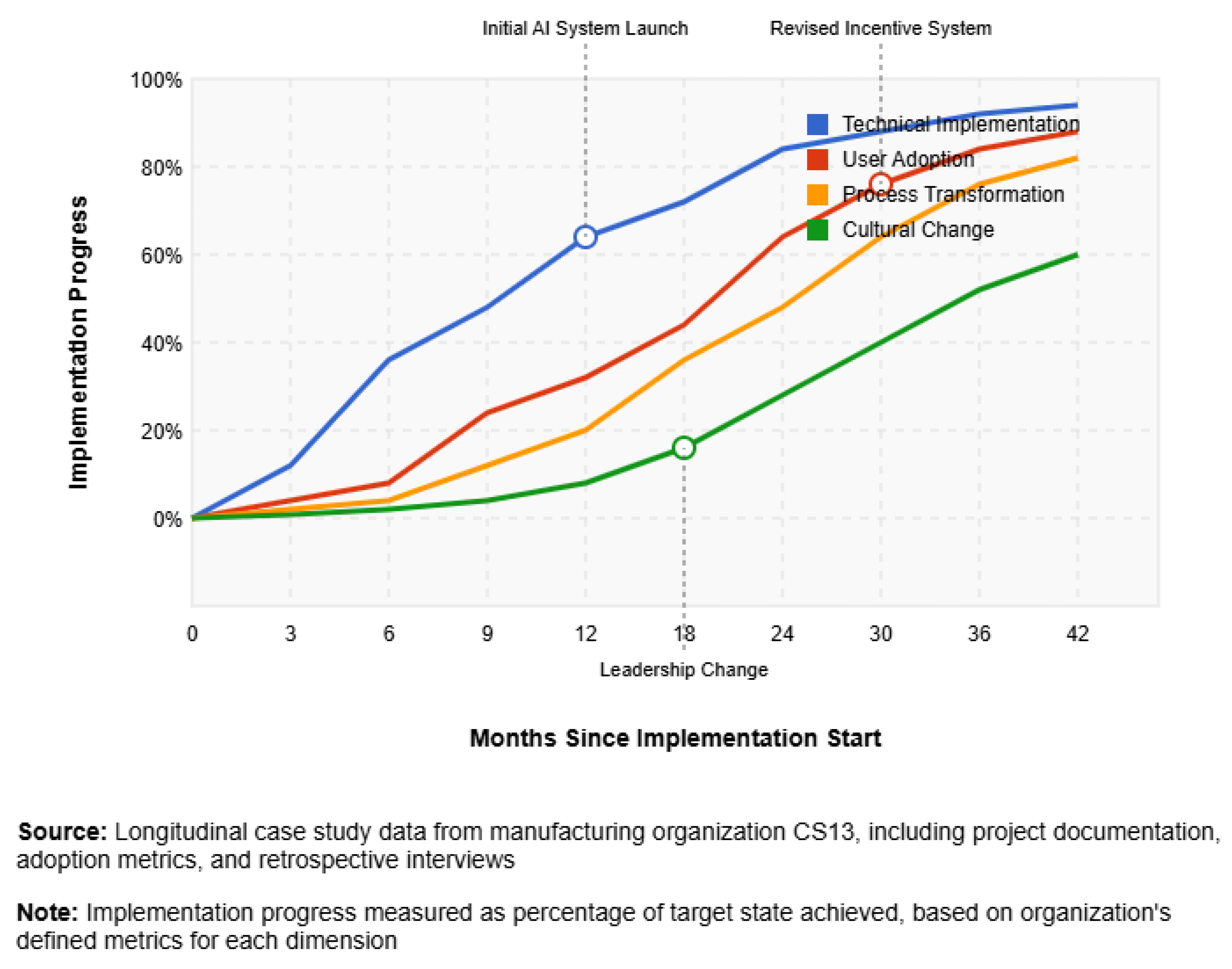

Table 1.
Case Study Organization Characteristics.
| ID | Industry | Size (Employees) | Region | Implementation Stage | Approach |
|---|---|---|---|---|---|
| CS1 | Financial Services | 5,200 | North America | Advanced | Centralized |
| CS2 | Technology | 850 | North America | Advanced | Hybrid |
| CS3 | Healthcare | 12,300 | Europe | Intermediate | Centralized |
| CS4 | Manufacturing | 3,400 | Asia | Intermediate | Decentralized |
| CS5 | Retail | 6,700 | North America | Intermediate | Hybrid |
| CS6 | Professional Services | 1,200 | Europe | Advanced | Decentralized |
| CS7 | Financial Services | 18,500 | Asia | Advanced | Hybrid |
| CS8 | Healthcare | 4,100 | Europe | Early | Decentralized |
| CS9 | Manufacturing | 7,800 | North America | Intermediate | Decentralized |
| CS10 | Technology | 380 | North America | Advanced | Hybrid |
| CS11 | Retail | 22,000 | Europe | Intermediate | Centralized |
| CS12 | Professional Services | 3,500 | Asia | Early | Decentralized |
| CS13 | Manufacturing | 14,200 | Asia | Intermediate | Hybrid |
| CS14 | Financial Services | 9,300 | Europe | Advanced | Centralized |
Table 2.
Comparison of AI with Previous Technological Transitions.
| Dimension | Internet Adoption (1995-2005) | Cloud Computing (2010-2020) | AI (Current) |
|---|---|---|---|
| Initial adoption speed | Moderate (5-7 years to majority adoption) | Rapid (3-5 years to majority adoption) | Variable by application (1-7+ years) |
| Implementation complexity | Moderate (primarily technical) | Moderate to high (technical and process) | Very high (technical, process, and cultural) |
| Required organizational change | Moderate (new channels, functions) | Moderate (infrastructure, processes) | High (decision systems, roles, processes) |
| Skill displacement vs. augmentation | Primarily augmentation with limited displacement | Mixed augmentation and displacement | Still emerging, appears highly variable by domain |
| Primary barriers | Technical infrastructure, cost | Security concerns, integration challenges | Data quality, skill gaps, ethical concerns, cultural resistance |
| Geographic variation | High (infrastructure-dependent) | Moderate (regulation, infrastructure) | Very high (regulation, labor markets, skill availability) |
Disclaimer/Publisher’s Note: The statements, opinions and data contained in all publications are solely those of the individual author(s) and contributor(s) and not of MDPI and/or the editor(s). MDPI and/or the editor(s) disclaim responsibility for any injury to people or property resulting from any ideas, methods, instructions or products referred to in the content. |
© 2025 by the authors. Licensee MDPI, Basel, Switzerland. This article is an open access article distributed under the terms and conditions of the Creative Commons Attribution (CC BY) license (http://creativecommons.org/licenses/by/4.0/).
Copyright: This open access article is published under a Creative Commons CC BY 4.0 license, which permit the free download, distribution, and reuse, provided that the author and preprint are cited in any reuse.


